The Checks
Part 2 of 4
- The Checks, QuickBooks, and the Motive
- The Checks (Claims 1-7) (you are here)
- The QuickBooks Calls (Claims 8-14)
- The Money (Claim 15)
Part 2 answers the State’s claims about the checks: where they came from, who made them, the signatures, the dates and the deletions. Part 1 has the timeline and what I told the investigators, and when.
Claim 1 of 15
“He stole Joseph’s checks from his office on January 31.”
What the State said
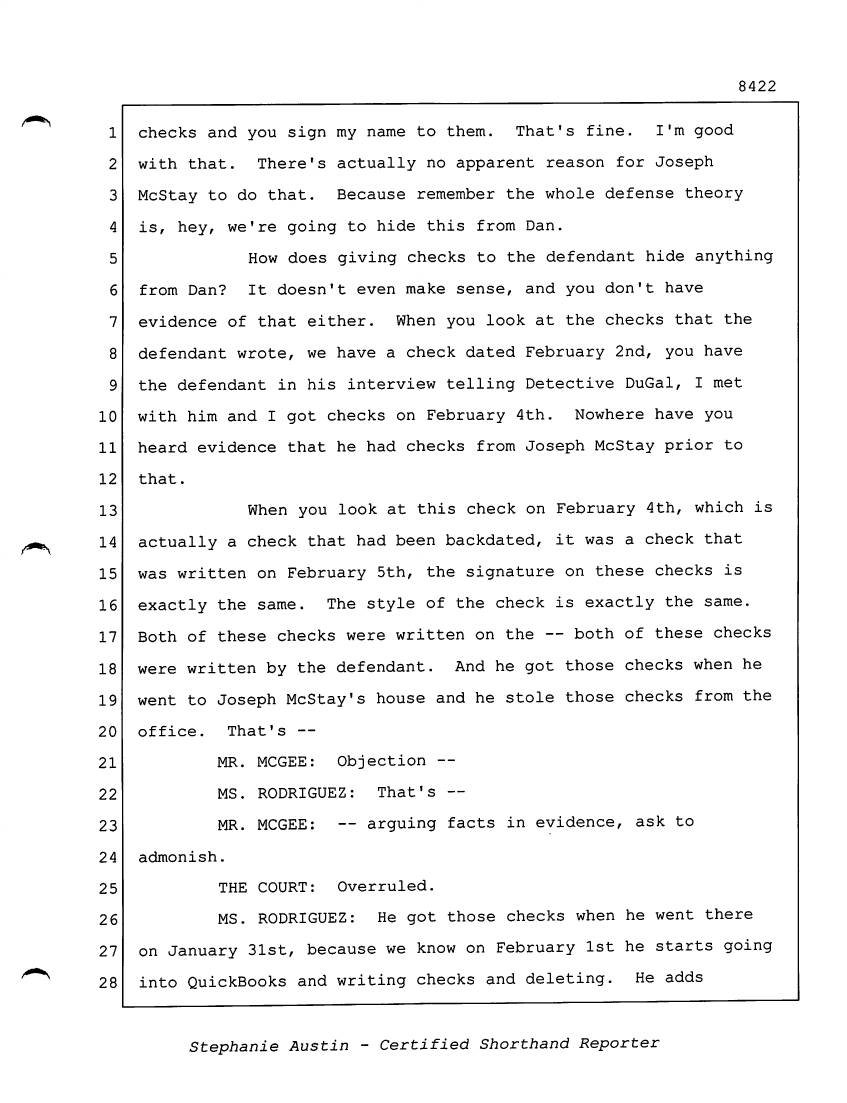
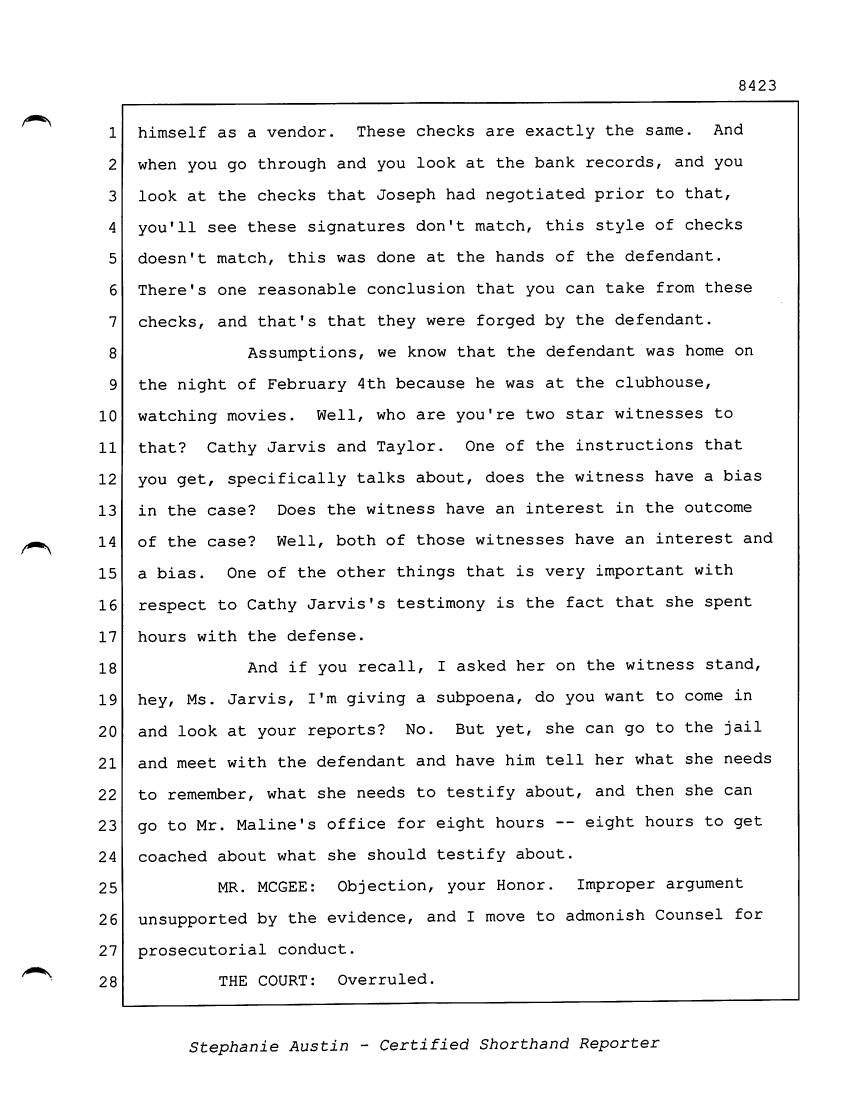
Ms. Rodriguez told the jury I took the checks from Joseph’s office on January 31, began writing and deleting them on February 1, and forged them: (RT 8422:13-8423:7)
When you look at this check on February 4th, which is actually a check that had been backdated, it was a check that was written on February 5th, the signature on these checks is exactly the same. The style of the check is exactly the same. Both of these checks were written on the — both of these checks were written by the defendant. And he got those checks when he went to Joseph McStay’s house and he stole those checks from the office. That’s —
MR. MCGEE: Objection —
MS. RODRIGUEZ: That’s —
MR. MCGEE: — arguing facts in evidence, ask to admonish.
THE COURT: Overruled.
MS. RODRIGUEZ: He got those checks when he went there on January 31st, because we know on February 1st he starts going into QuickBooks and writing checks and deleting. He adds himself as a vendor. These checks are exactly the same. And when you go through and you look at the bank records, and you look at the checks that Joseph had negotiated prior to that, you’ll see these signatures don’t match, this style of checks doesn’t match, this was done at the hands of the defendant. There’s one reasonable conclusion that you can take from these checks, and that’s that they were forged by the defendant.
See the trial transcript (RT 8422, 8423)
My answer
I wasn’t at Joseph’s house on January 31. Every call on my phone that day with a tower listed, from 9:11 in the morning on, was on my home tower in Rancho Cucamonga. Joseph gave me checks. The first one I wrote was on February 2, from a check he handed me that morning (Claim 3).
What the State already knew
On February 17, 2010, I told DuGal that Joseph gave me checks and that we went over when to write them (What I told them, and when). In 2014, Bachman himself told me, “We have no other checks prior to that 2nd of you writing a check” (Claim 2).
The record
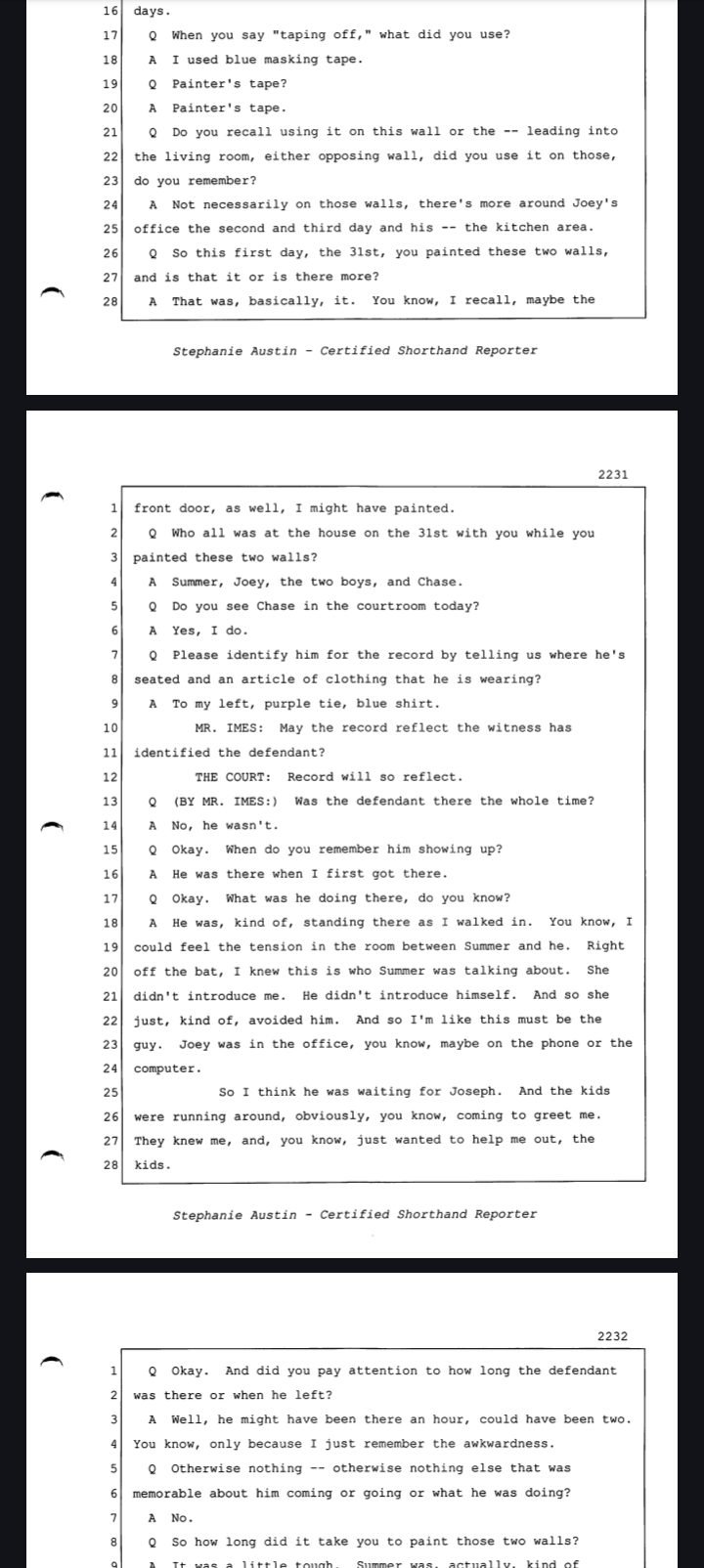
The prosecution told the jury that I took Joseph’s checks myself, and that I, not Joseph, wrote and deleted the first two on February 1. To make that work, they had to put me in Joseph’s house before February 1, with a chance to take the checks. Their only witness for that was McGyver McCargar, a family friend who was painting at the house. On direct examination he told Mr. Imes I was already there when he arrived on Sunday, January 31: (RT 2231:2-2232:7)
Read the full exchange
Q Who all was at the house on the 31st with you while you painted these two walls?
A Summer, Joey, the two boys, and Chase.
Q Do you see Chase in the courtroom today?
A Yes, I do.
Q Please identify him for the record by telling us where he’s seated and an article of clothing that he is wearing?
A To my left, purple tie, blue shirt.
MR. IMES: May the record reflect the witness has identified the defendant?
THE COURT: Record will so reflect.
Q (BY MR. IMES:) Was the defendant there the whole time?
A No, he wasn’t.
Q Okay. When do you remember him showing up?
A He was there when I first got there.
Q Okay. What was he doing there, do you know?
A He was, kind of, standing there as I walked in. You know, I could feel the tension in the room between Summer and he. Right off the bat, I knew this is who Summer was talking about. She didn’t introduce me. He didn’t introduce himself. And so she just, kind of, avoided him. And so I’m like this must be the guy. Joey was in the office, you know, maybe on the phone or the computer.
So I think he was waiting for Joseph. And the kids were running around, obviously, you know, coming to greet me. They knew me, and, you know, just wanted to help me out, the kids.
Q Okay. And did you pay attention to how long the defendant was there or when he left?
A Well, he might have been there an hour, could have been two. You know, only because I just remember the awkwardness.
Q Otherwise nothing — otherwise nothing else that was memorable about him coming or going or what he was doing?
A No.
See the trial transcript (McCargar, RT 2230-2233)
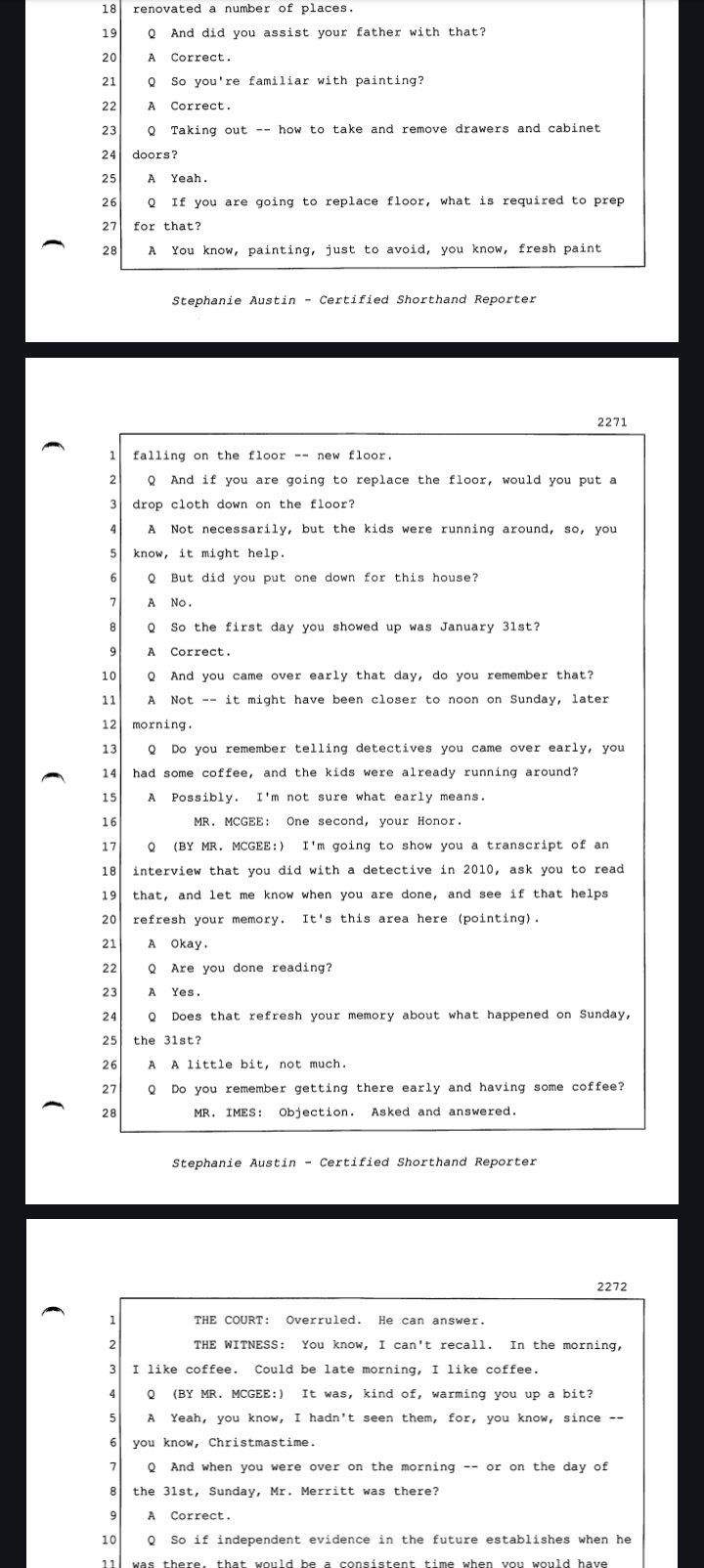
On cross-examination, Mr. McGee asked him when he got there. He said it “might have been closer to noon on Sunday, later morning,” that he “possibly” told detectives he came over early, and that I was there “earlier on, closer to when I first got there”: (RT 2271:8-2272:27)
Read the full exchange
Q So the first day you showed up was January 31st?
A Correct.
Q And you came over early that day, do you remember that?
A Not — it might have been closer to noon on Sunday, later morning.
Q Do you remember telling detectives you came over early, you had some coffee, and the kids were already running around?
A Possibly. I’m not sure what early means.
MR. MCGEE: One second, your Honor.
Q (BY MR. MCGEE:) I’m going to show you a transcript of an interview that you did with a detective in 2010, ask you to read that, and let me know when you are done, and see if that helps refresh your memory. It’s this area here (pointing).
A Okay.
Q Are you done reading?
A Yes.
Q Does that refresh your memory about what happened on Sunday, the 31st?
A A little bit, not much.
Q Do you remember getting there early and having some coffee?
MR. IMES: Objection. Asked and answered.
THE COURT: Overruled. He can answer.
THE WITNESS: You know, I can’t recall. In the morning, I like coffee. Could be late morning, I like coffee.
Q (BY MR. MCGEE:) It was, kind of, warming you up a bit?
A Yeah, you know, I hadn’t seen them, for, you know, since — you know, Christmastime.
Q And when you were over on the morning — or on the day of the 31st, Sunday, Mr. Merritt was there?
A Correct.
Q So if independent evidence in the future establishes when he was there, that would be a consistent time when you would have been there?
MR. IMES: Objection. Calls for speculation.
THE COURT: Sustained.
Q (BY MR. MCGEE:) Well, how long did you work at the house on the 31st, Sunday? Was that the all day?
A Yeah, they went to the park — or I told them to go to the park, and, you know, I got some stuff done, and I remember sitting at the banister after, and we were all just, kind of, catching up.
Q And then they talked about going out to a craft-beer-type place but it was too late?
A Yeah, pizza and craft beer place, but it was a little too late.
Q And Mr. Merritt was only there at one time when you were there that day?
A Yeah, earlier on, closer to when I first got there.
See the trial transcript (McCargar, RT 2270-2273)

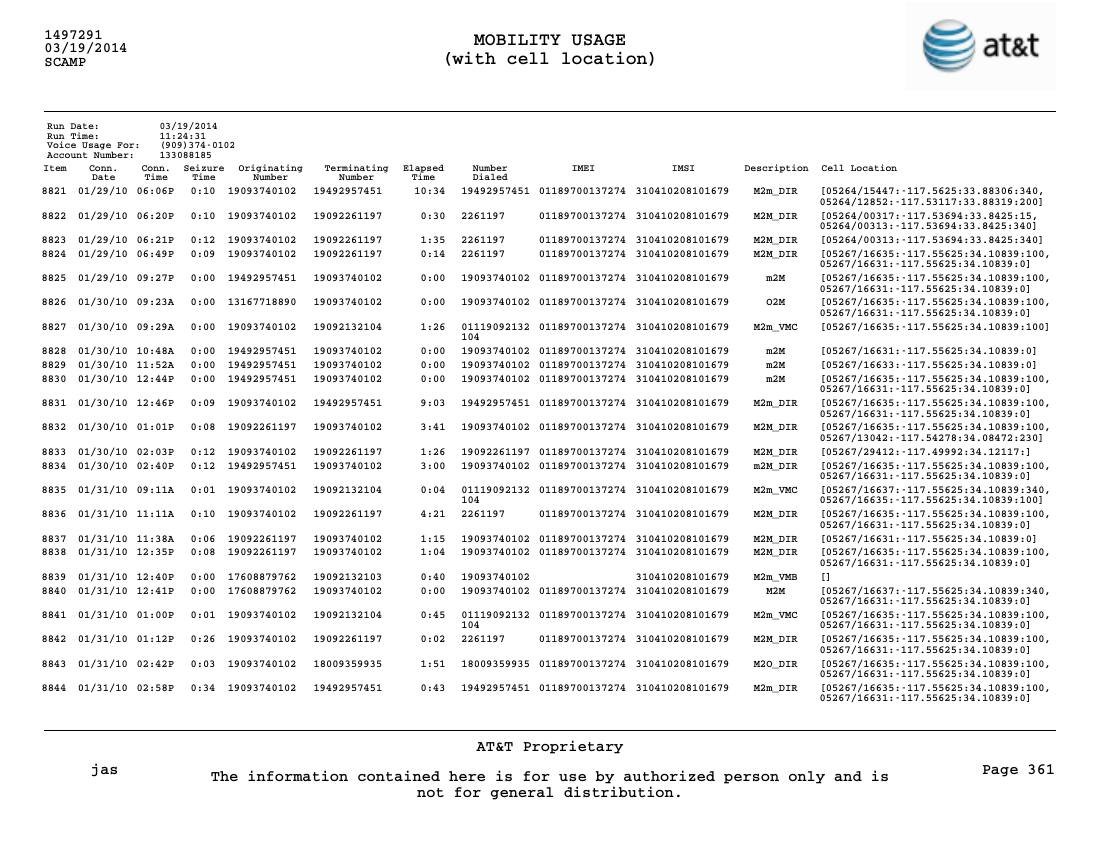
My phone record says I was home in Rancho Cucamonga that day. It is at a minimum a 2-hour round trip, so McCargar’s account means at least three hours away from home around midday. Every one of my calls that day with a tower listed hit my home tower, from 9:11 in the morning through 9:00 at night: 9:11, 11:11, 11:38, 12:35, 12:41, 1:00, 1:12, 2:42, 2:58 (a call to Joseph), 3:39 (Joseph calling me) and on into the evening. Between 9:11 in the morning and 5:28 in the afternoon, the longest gap between calls is the two hours from 9:11 to 11:11. (Exhibit 794, items 8835-8852)
See Exhibit 794 (AT&T pages 361, 362)

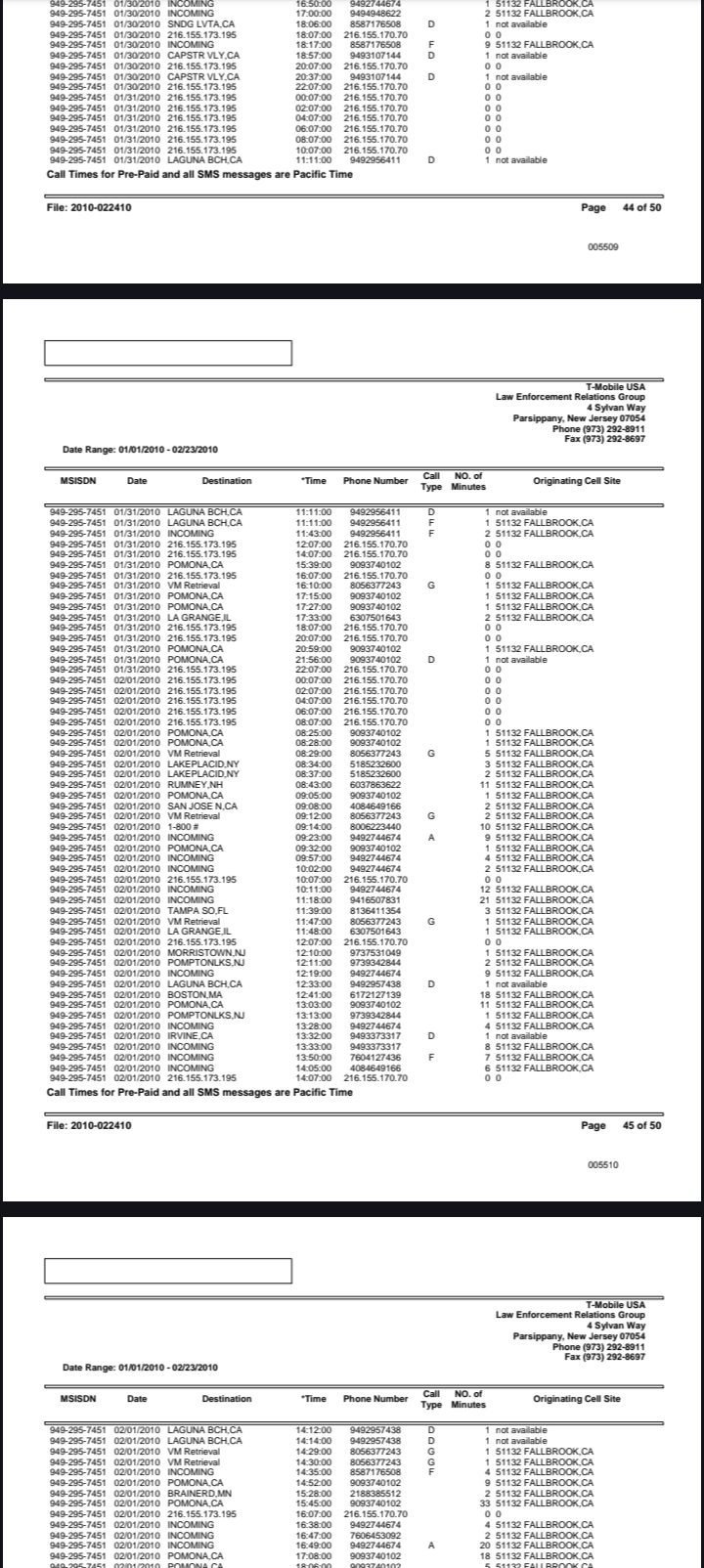
At 3:39 that afternoon Joseph called me: his phone was on the Fallbrook tower, and mine was on my home tower. (Joseph’s T-Mobile record, Bates 005510)
See Joseph’s T-Mobile record (subpoena response to Det. DuGal, Bates 005509-005512)

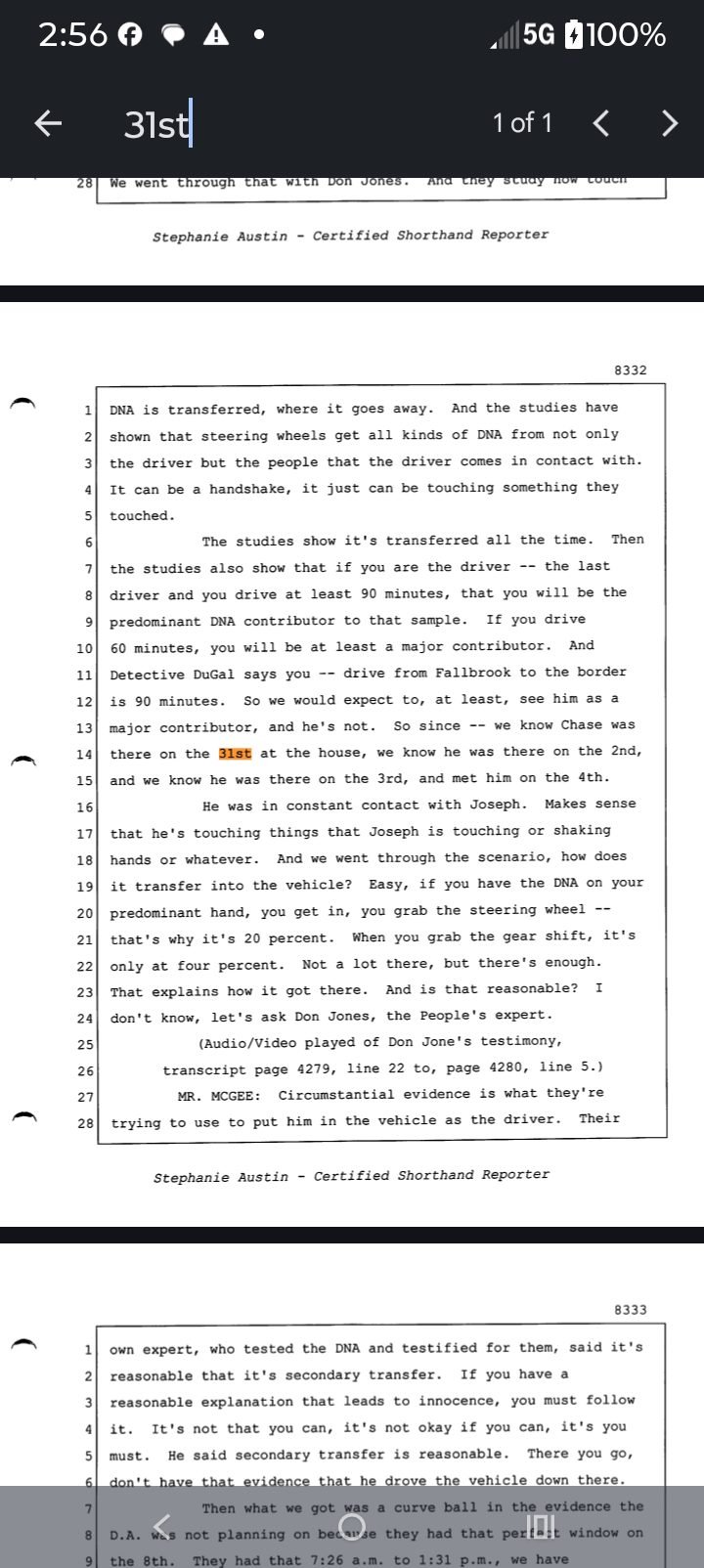
Without McCargar, nothing puts me at the house on January 31, the day the State says I took the checks, and every call on my phone that day with a tower listed was on my home tower. Nothing says the February 1 checks were mine rather than Joseph’s. My lawyers were told this and never used it (What I gave counsel, Part 1). Mr. McGee even repeated the same timeline in his closing, while explaining how my DNA could have gotten into the Trooper: (RT 8332:6-15)
The studies show it’s transferred all the time. Then the studies also show that if you are the driver — the last driver and you drive at least 90 minutes, that you will be the predominant DNA contributor to that sample. If you drive 60 minutes, you will be at least a major contributor. And Detective DuGal says you — drive from Fallbrook to the border is 90 minutes. So we would expect to, at least, see him as a major contributor, and he’s not. So since — we know Chase was there on the 31st at the house, we know he was there on the 2nd, and we know he was there on the 3rd, and met him on the 4th.
See the trial transcript (Mr. McGee’s closing, RT 8331-8333)
Fact check
- “He got those checks when he went there on January 31st”: the State’s only witness for that was McCargar. Every call on my phone that day with a tower listed, from 9:11 a.m. through 9:00 p.m., was on my home tower (Exhibit 794, items 8835-8852).
- “We know on February 1st he starts going into QuickBooks and writing checks”: the State’s own summary, describing February 1, says only “the user,” and that neither check “was cashed after being printed” (Bates 000022). Its conclusion still says I “forged checks on February 1 and February 2” (Bates 000040), though Bachman had told me my first check was February 2 (Claim 2).
Claim 2 of 15
“Joseph didn’t make the February 1 checks, and the McStay computers show no activity.”
What the State said
Mr. Imes told the jury that the February 1 checks were made out to a lowercase “charles merritt,” and that no recovered McStay computer showed the activity: (RT 8190:3-8191:4)
Chase was overpaid $15,000.00, plus Levine and the Provecho disasters, were a total of $42,000.00. That’s what started it February 1st. But then mysteriously, at 12:24 p.m. — I believe that’s correct — on Joseph’s QuickBooks account, Charles Merritt is added as a vendor. However, as you learned, the QuickBooks account was divided into two QuickBooks accounts — the Internet side and the custom side. This was added to the custom side. Charles Merritt already existed as a vendor or a payee in the other side, properly capitalized. But at 12:24 p.m., it’s added, but it’s added in lowercase.
I believe around the same time, Metro Sheet Metal was added in the same fashion to that account. But then what also happens, is a check is written — a check is written in the amount of $2,500.00 to that Charles Merritt, with a vague lowercase description of deposit. It was created, it was edited, and it was printed. And then another check, same thing was done, created, edited, and printed, for $2,500.00 to the lowercase Charles Merritt.
However, there’s no computer activity on the McStay computers that were recovered that show this activity actually occurred. Here’s the other thing that’s important about this: At 12:47 p.m. and 12:52 p.m., those two checks were deleted from the QuickBooks accounts.
See the trial transcript (RT 8190-8192, Mr. Imes)

My answer
Joseph made the February 1 checks. He made two out to me in QuickBooks, printed them, deleted them, and called me at 1:03 that afternoon to explain that this was how we would handle things from then on. Neither check was ever given to me or cashed.
What the State already knew
Bachman told me in 2014, “We have no other checks prior to that 2nd of you writing a check.” Two days later his case summary’s conclusion said I “forged checks on February 1 and February 2” (Bates 000040), while its own account of February 1 names only “the user” and says neither check was ever cashed (Bates 000022).
The record
My account: on February 1, Joseph started setting it up. He thought my first check would be for $2,500, so he made one out to me in QuickBooks, printed it and then deleted the transaction on the QuickBooks platform. There ended up being two, not sure why this is, unless one of them failed when he printed it. Nonetheless, just afterward he called me. My phone record shows the call: Joseph called me at 1:03 that afternoon, and we talked for almost ten minutes (Exhibit 794, item 8865). He explained that this was how we’d handle things from then on, and I told him I wasn’t sure of the amount yet. Neither of them was ever given to me or cashed. That first check ended up being the $2,495 check I wrote on February 2.
At trial Ms. Rodriguez told the jury I got Joseph’s checks at his house on January 31 and started writing them in QuickBooks on February 1 (quoted above). Its own lead detective did not think so. In my October 2014 interview, Det. Bachman laid out his theory to me: Joseph was replacing me, and on February 2 he found out about a check I had written that day, the first check I ever wrote on Joseph’s account. Here is the whole passage: (interview October 22, 2014, pp. 257:23-258:25)
Read the full exchange
[DETECTIVE BACHMAN:] That’s what — he’s called other welding companies — right? — Dugal told you. He knows — he knows that he’s getting rid of you. Okay? He knows that he has — he has all these problems.
Just like you said, there were fountains in — in production. And he knows he needs to finish them. But he needs somebody else to do it because Dan Kavanaugh (sic) can’t do it. He needs another welder.
So he calls his bank —
MR. MERRITT: Dan Kavanaugh is not a welder.
DETECTIVE BACHMAN: Exactly. He’s a web guy. So he needs another welder. Okay?
So on the 2nd, he finds out about this check that you write. Okay? It’s unauthorized. We know that. We know you were not supposed to write checks on his account.
Somehow you had access to it, whether you knew there was a password — and you wrote that check from your house. That’s true. That is true that you wrote that check from your house.
Joseph didn’t give you access or didn’t — did not authorize that check. He didn’t know about that check. That’s why it was out of sequence because you took those checks without him knowing about it.
You took those checks. You wrote a check. We have no other checks prior to that 2nd of you writing a check. That is the very first time that you write a check and forged Joseph’s name.
See my October 22, 2014 interview (pages 257-258)

Bachman had the QuickBooks records in front of him when he said that, and the February 1 checks were in them. His case summary, written two days later, describes them. It says the vendor “was added by someone other than Joseph,” and that “the user” created, printed and deleted the checks. In this account it never says the user was me, and it says neither check was cashed. Only the summary’s conclusion, pages later, says I “forged checks on February 1 and February 2” (Bates 000040). The account itself: (Bates 000022)
Read the full passage
On February 1, 2010, the custom QuickBooks account was logged into and at 1224 hours, “charles merritt” (all lowercase) was added as a vendor to the custom@earthinspiredproducts.com account. “Charles Merritt” (Uppercase) was already listed as a vendor on the contact@earthinspiredproducts.com account. This activity shows the user was unaware of the fact Charles Merritt was listed as a vendor on the primary account and was added by someone other than Joseph.
On February 1, 2010, at 1234 hours, a check was added to “charles merritt” for $2500.00, and the memo line stated “deposit.” After the check was created, the check was printed listing check #4092 and right after it was printed, the check was deleted. After check #4092 was deleted, the user created a second check #4093 for “charles merritt” for $2500.00 and printed the check. As soon as the check was printed, the user deleted the check. Investigators looked into the printed checks and learned neither check was cashed after being printed.
See the State’s case summary (Bates 000022)

The computer nobody collected
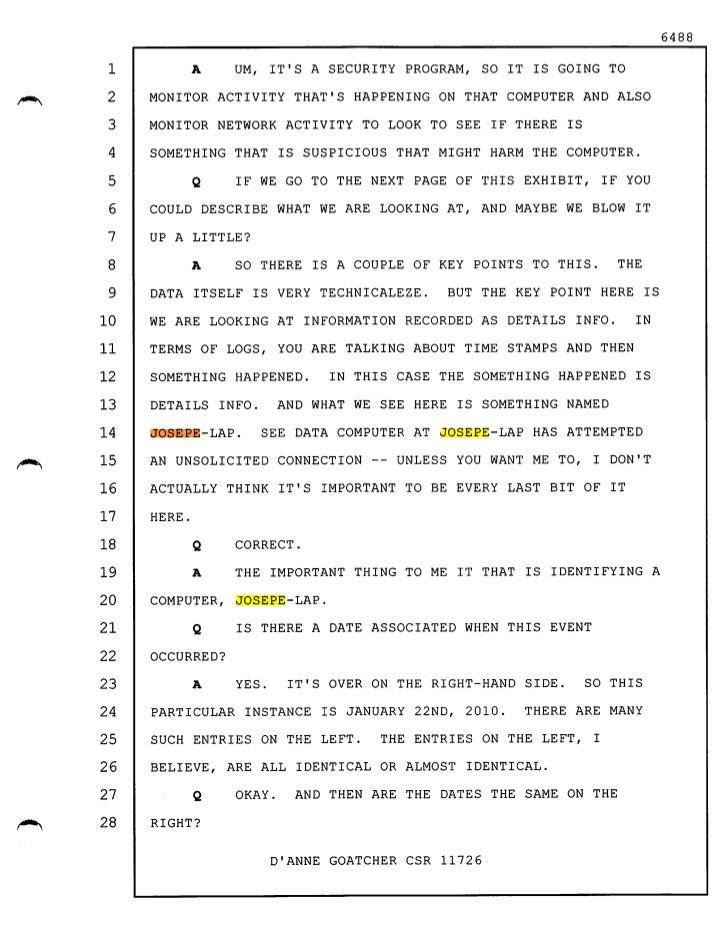
Mr. Imes’s point about Joseph’s computers turns on one word: “recovered.” The defense’s computer expert, Bryan La Rock, testified that a third computer had been on the McStays’ home network, named “Josepe-lap,” and that, from everything in discovery, it was never collected. First he walked the jury through the security logs that recorded it, and the dates it appears in them: (RT 6488:21-6489:14)
Q IS THERE A DATE ASSOCIATED WHEN THIS EVENT OCCURRED?
A YES. IT’S OVER ON THE RIGHT-HAND SIDE. SO THIS PARTICULAR INSTANCE IS JANUARY 22ND, 2010. THERE ARE MANY SUCH ENTRIES ON THE LEFT. THE ENTRIES ON THE LEFT, I BELIEVE, ARE ALL IDENTICAL OR ALMOST IDENTICAL.
Q OKAY. AND THEN ARE THE DATES THE SAME ON THE RIGHT?
A NO. THEY ARE DIFFERENT DATES.
Q OKAY. ARE EVENTS THAT YOU WERE ABLE TO SEE WHERE JOSEPE-LAP IS IDENTIFIED ON DIFFERENT DATES; IS THAT CORRECT?
A THAT’S RIGHT.
Q SO IF WE GO DOWN, WE SEE JANUARY 25TH, 26TH AND 27TH AS WELL?
A THAT’S RIGHT.
Q OF 2010?
A YES.
Q OKAY. IF WE CAN GO TO THE NEXT PAGE.
A THE SAME THING FOR JANUARY 28TH — YES. JANUARY 28, 2010, JANUARY 31ST, JANUARY 31ST, FEBRUARY 3RD AND FINALLY FEBRUARY 3RD.
See the trial transcript (RT 6488, 6489)
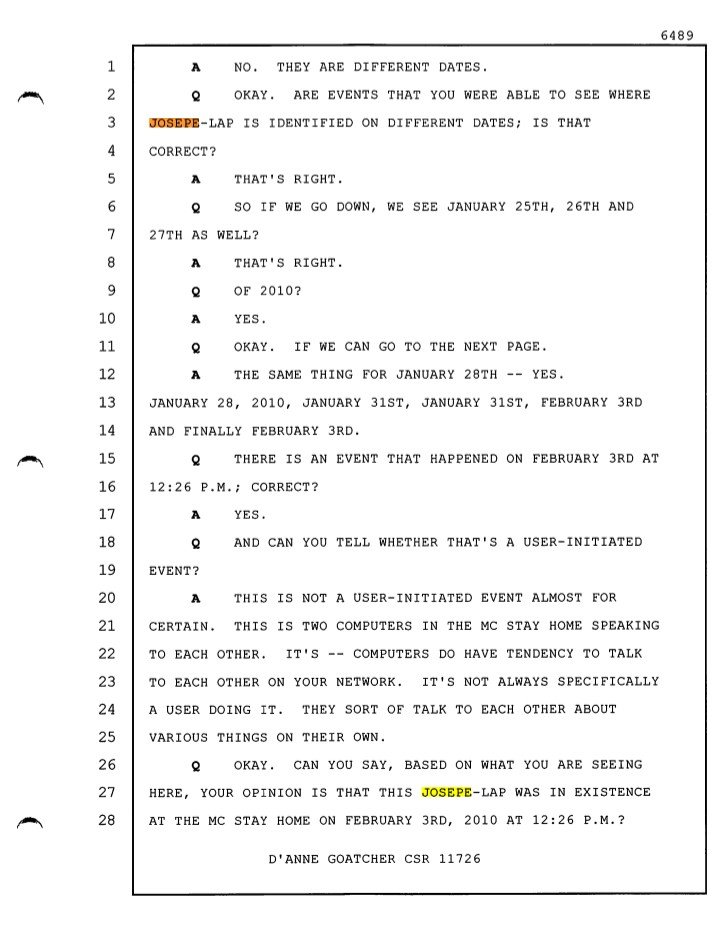
He was then asked whether that put the laptop in the house in early February, how much it had been used, and when it was last seen. It was there and powered on, it was used throughout 2009, and February 3 was the last day it appears: (RT 6489:15-6490:18)
Read the full exchange
Q THERE IS AN EVENT THAT HAPPENED ON FEBRUARY 3RD AT 12:26 P.M.; CORRECT?
A YES.
Q AND CAN YOU TELL WHETHER THAT’S A USER-INITIATED EVENT?
A THIS IS NOT A USER-INITIATED EVENT ALMOST FOR CERTAIN. THIS IS TWO COMPUTERS IN THE MC STAY HOME SPEAKING TO EACH OTHER. IT’S — COMPUTERS DO HAVE TENDENCY TO TALK TO EACH OTHER ON YOUR NETWORK. IT’S NOT ALWAYS SPECIFICALLY A USER DOING IT. THEY SORT OF TALK TO EACH OTHER ABOUT VARIOUS THINGS ON THEIR OWN.
Q OKAY. CAN YOU SAY, BASED ON WHAT YOU ARE SEEING HERE, YOUR OPINION IS THAT THIS JOSEPE-LAP WAS IN EXISTENCE AT THE MC STAY HOME ON FEBRUARY 3RD, 2010 AT 12:26 P.M.?
A THE COMPUTER WAS IN EXISTENCE AND POWERED ON EACH OF THESE DATES. THE DATE YOU JUST LISTED BEING ONE OF THEM, YES.
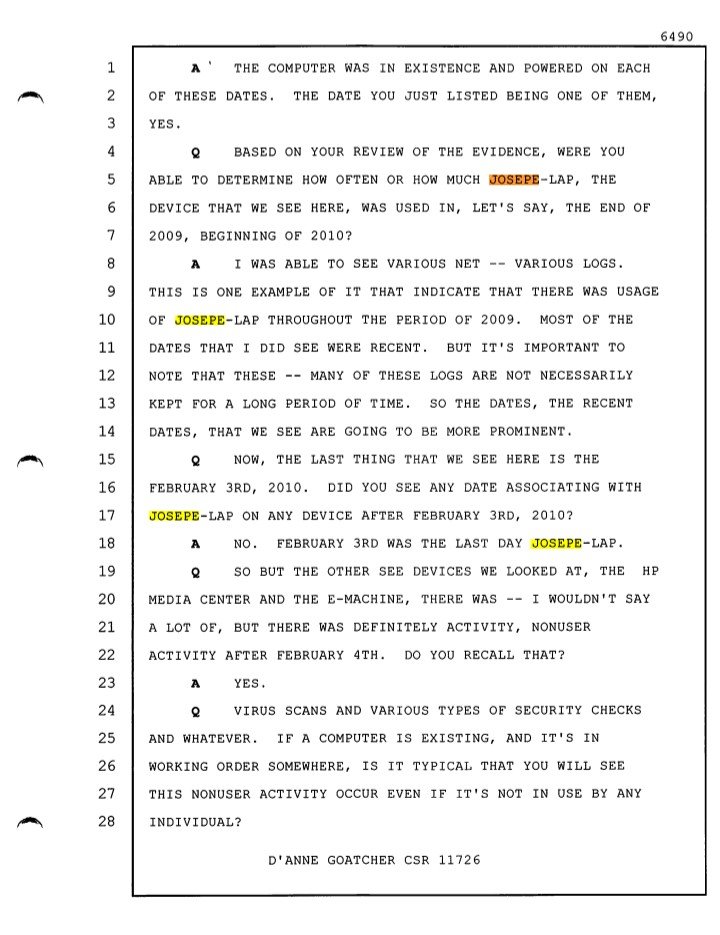
Q BASED ON YOUR REVIEW OF THE EVIDENCE, WERE YOU ABLE TO DETERMINE HOW OFTEN OR HOW MUCH JOSEPE-LAP, THE DEVICE THAT WE SEE HERE, WAS USED IN, LET’S SAY, THE END OF 2009, BEGINNING OF 2010?
A I WAS ABLE TO SEE VARIOUS NET — VARIOUS LOGS. THIS IS ONE EXAMPLE OF IT THAT INDICATE THAT THERE WAS USAGE OF JOSEPE-LAP THROUGHOUT THE PERIOD OF 2009. MOST OF THE DATES THAT I DID SEE WERE RECENT, BUT IT’S IMPORTANT TO NOTE THAT THESE — MANY OF THESE LOGS ARE NOT NECESSARILY KEPT FOR A LONG PERIOD OF TIME, SO THE DATES, THE RECENT DATES, THAT WE SEE ARE GOING TO BE MORE PROMINENT.
Q NOW, THE LAST THING THAT WE SEE HERE IS THE FEBRUARY 3RD, 2010. DID YOU SEE ANY DATE ASSOCIATING WITH JOSEPE-LAP ON ANY DEVICE AFTER FEBRUARY 3RD, 2010?
A NO. FEBRUARY 3RD WAS THE LAST DAY JOSEPE-LAP.
See the trial transcript (RT 6489, 6490)
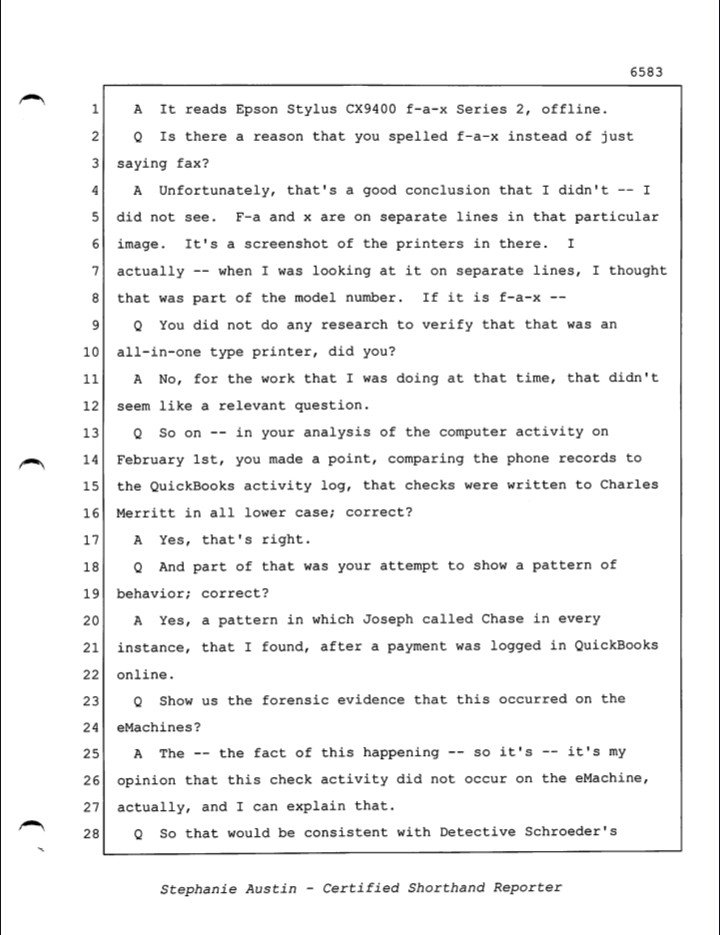
On cross-examination, Mr. Imes asked where the February 1 checks had been written. Mr. La Rock said not on the eMachine and not on the HP, the two computers recovered from the house. If they were written on a computer in the house, he said, it was most likely the one nobody collected. He also explained why no one can prove it either way: (RT 6583:23-6585:14)
Read the full exchange
Q Show us the forensic evidence that this occurred on the eMachines?
A The — the fact of this happening — so it’s — it’s my opinion that this check activity did not occur on the eMachine, actually, and I can explain that.
Q So that would be consistent with Detective Schroeder’s testimony that there was no computer activity, at all, on the 1st?
A That’s — that’s consistent with that and there’s — I would really like to explain that.
Q Can you point us to the forensic evidence that it occurred on the HP tower in the house?
A Which activity are you speaking about?
Q This 2/1, checks being written to Charles Merritt all lower case.
A That activity didn’t happen on the HP either. If that happened on a computer in the McStay house, it seems most likely to me, from the evidence that I had seen, it was on a computer not in evidence. Again, we have a pattern that the eMachine was used less near the end of 2009 and conspicuously at the same time there is existence of another computer by the name of Josephe lap.
Q Point me to the forensic evidence that that transaction occurred on that laptop in that house to confirm your suspicions and assumptions?
MR. MALINE: Objection. Argumentative.
THE COURT: Sustained as phrased.
Q (BY MR. IMES:) Show me the forensic evidence that would confirm that suspicion?
A The forensic evidence that I found is in the — that adds to that is in the McAfee logs and associated network logs that show the existence of Josephe lap on the same network as the McStay in the McStay home in — particularly in 2010, and records in 2009, as well, however, it’s impossible to show records of QuickBooks activity on that computer because that computer was never provided to me, an image of that computer was never provided to me.
From what I’ve seen in the records and the reports in discovery provided by law enforcement, I have seen no mention, at all, of that computer, Josephe lap, which indicates to me that the laptop, assuming that is a laptop — the computer’s named Josephe lap — exists, that that was not collected.
Q Okay. But point to me the actual forensic evidence that that laptop was used to write those checks?
A That evidence, as I — as I was explaining, that evidence cannot be found, because we don’t have the laptop.
Q There isn’t any, is there?
A Not that I’m aware.
See the trial transcript (RT 6583, 6584, 6585)


Mr. Imes then asked why the logs show no laptop entry on February 1. Mr. La Rock explained that the logs only record the moments the laptop happened to reach out to the eMachine. They are not a record of every time it was on: (RT 6586:4-24)
Read the full exchange
Q Okay. Well, let’s just cut to the chase, 1036 is the exhibit you had yesterday, it’s your 5A, show me where that laptop accessed the network or attempted to access the network on February 1st?
A On — on February 1st, I don’t specifically have a record of the computer accessing the network. It’s very important — context is incredibly important in this example. The dates that are listed on the right-hand side here (pointing), these are times when Josephe lap specifically reached out to the computer that this came from, which I believe was the eMachine.
There’s — I — I don’t have any reason to know or to think that the computer would be reaching out to the eMachine every single time that it’s turned on.
Q Well, it did several times on the 31st and on the 3rd and on other dates that you listed on this exhibit; correct?
A Several times is — I — I mean, it reached out two times on the 31st, and there — from what I can see, they both appeared to be almost the exact same time. So it’s very clear to me, looking at these momentary snapshots in time, that this is unlikely to be a complete list of the times that this laptop was on and powered on in the McStay home.
See the trial transcript (RT 6586)

He also explained what Mr. Imes called the “test run of print page” caught in the print spool on the McStays’ eMachine on the night of February 4. Checks had been created in the custom account only since February 1, so this was “new activity,” with “a greater chance of prompting to run an alignment page.” Asked if that was speculative, he said he had “actually tested QuickBooks online” and “confirmed” it prompts the alignment page when you create checks: (RT 6592:26-6593:14)
Q (BY MR. IMES:) You testified yesterday that this test run of print page that was caught in the print spool was quote, “new activity” for QuickBooks. Were you attempting to infer that this was the first time that Joe was attempting to print a check?
A No, I was not trying infer that. I was — rather the new activity that I was discussing was just what we were spoken (sic) about a moment ago, in the custom account, checks had not been created in QuickBooks until February 1st, 2010. And in the context of this, creating a check in QuickBooks online, whereas, this new activity would have a greater chance of prompting to run an alignment page.
Q Well, that’s quite speculative, would you agree?
A No, that’s not speculative, that’s based on my experience. I have actually tested QuickBooks online for that very — for that very question and confirmed that when you are using it to create checks it will prompt you to go through the alignment page process.
See the trial transcript (RT 6592-6593)

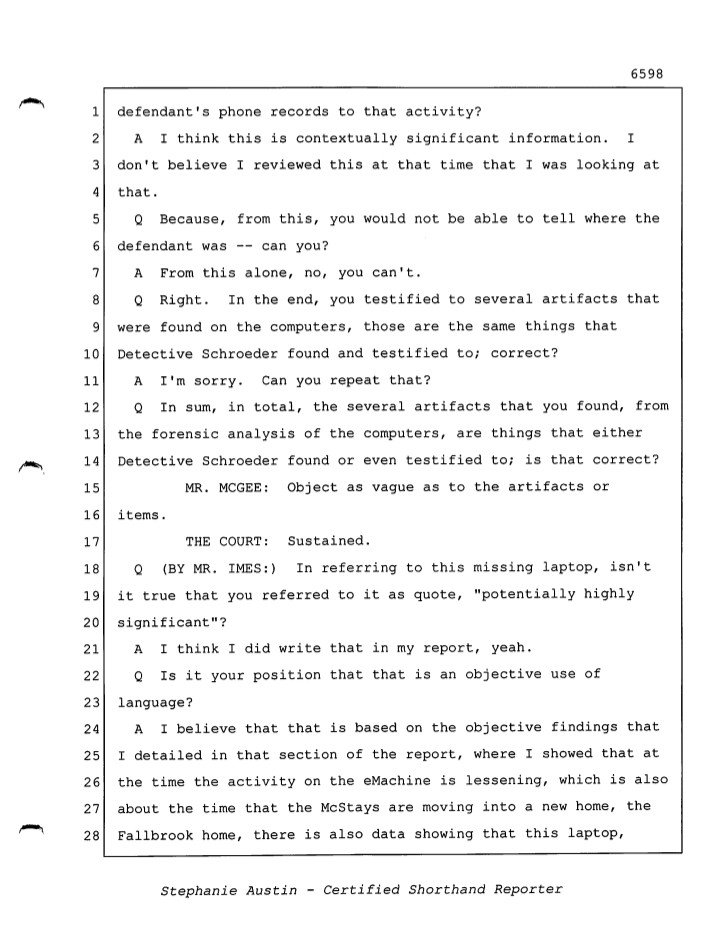
Mr. Imes challenged him for calling the missing laptop “potentially highly significant.” He explained why: use of the eMachine dropped off just as the McStays moved into the Fallbrook house and the laptop appeared, so it was most likely the computer Joseph was using: (RT 6598:18-6599:8)
Read the full exchange
Q (BY MR. IMES:) In referring to this missing laptop, isn’t it true that you referred to it as quote, “potentially highly significant”?
A I think I did write that in my report, yeah.
Q Is it your position that that is an objective use of language?
A I believe that that is based on the objective findings that I detailed in that section of the report, where I showed that at the time the activity on the eMachine is lessening, which is also about the time that the McStays are moving into a new home, the Fallbrook home, there is also data showing that this laptop, Josephe lap exists and powered on on the network.
Seeing as how I had a — there — there is not a lot of information to draw upon from the eMachine because of this lack of activity, if it is correct that Josephe lap is a laptop that Joseph was using instead of the eMachine at this time, which is a logical conclusion, then I think that the — it is my opinion — my expert opinion that the evidence contained on that laptop would be significant to this case.
See the trial transcript (RT 6598, 6599)
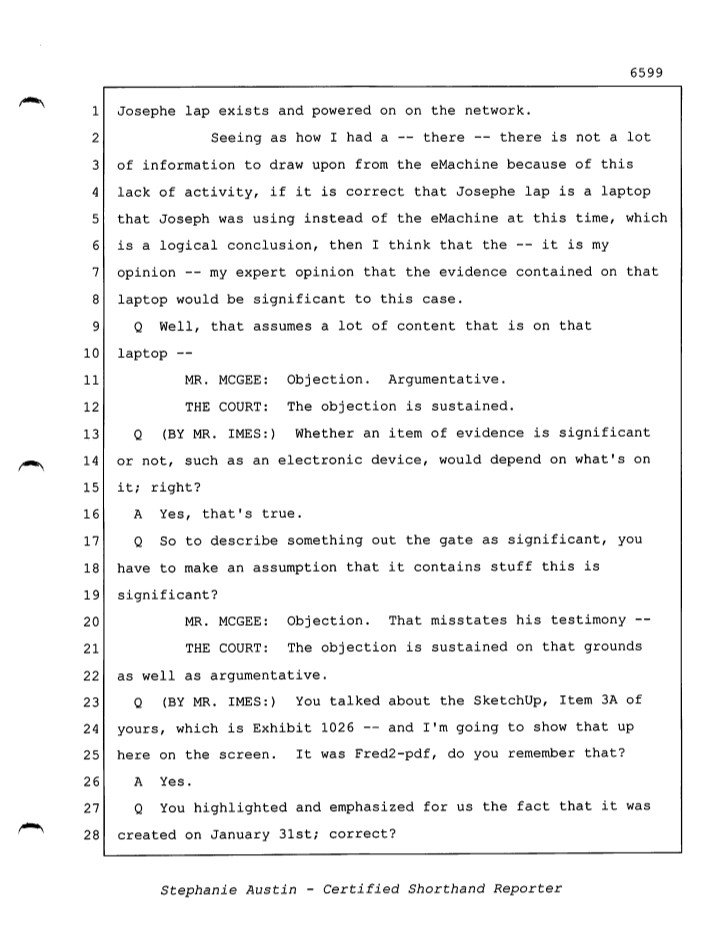
In closing, Mr. Imes turned the laptop against me. He asked the jury why Joseph would backdate and delete checks “if he did this on this mysterious Josepe laptop, that there’s no evidence of”: (RT 8214:5-18)
All around 12:00 p.m. to 12:39 p.m., a series of QuickBooks activity occurs. A series of QuicksBooks activity not on the McStay computers. A series of QuickBooks activity in which checks were created, edited, printed, and deleted, and checks that were ultimately negotiated by the defendant. You have your first transaction for Paul Mitchell, all in lowercase, for $4500.00; created, edited, printed, deleted. What was edited? They were backdated to the 4th. Why would Joseph backdate a check to the 4th, if he did this on this mysterious Josepe laptop, that there’s no evidence of?
Why would he delete it from his own QuickBooks records if he’s paying the defendant $4500.00 for a Paul Mitchell job? Why would he backdate it to the 4th if he’s writing it on the 5th?
See the trial transcript (RT 8212-8214, Mr. Imes)


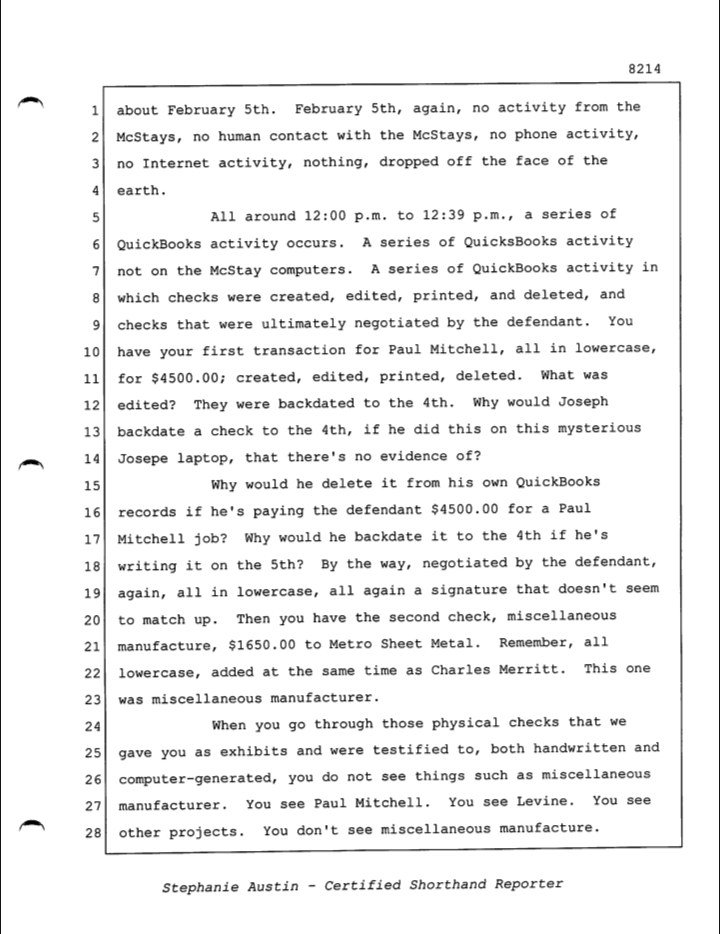
Mr. McGee answered in his closing. The laptop existed, nobody knows what was on it, and it is the missing evidence: (RT 8294:5-12)
THEY SAID, THERE IS NO RECORDS FROM THE COMPUTER SHOWING ALL OF THE STUFF DONE. WHAT ABOUT THE JOSEPE LAPTOP THAT WAS TAKEN AND MISSING? THEY DON’T KNOW WHAT’S ON THAT. THEY WANT TO — WE DON’T KNOW HOW THAT REALLY EXISTS. IT’S IN THE NETWORK. THERE IS PICTURES OF HIM LOOKING AT IT. THE COMPUTER EXISTS. THERE IS YOUR MISSING EVIDENCE TO SUPPORT A LOT OF STUFF THAT WAS GOING ON.
See the trial transcript (RT 8294)
Nobody can say what was on that laptop, because nobody collected it. What the record does show is that it existed and was on Joseph’s network through February 3, and that the defense expert’s opinion was that it was most likely the computer Joseph was using then. “No computer activity on the McStay computers that were recovered” says nothing about the one that wasn’t.
Fact check
- “There’s no computer activity on the McStay computers that were recovered”: true only of the two that were recovered. The defense expert testified that he saw no mention, in the law-enforcement records and reports in discovery, of a laptop on Joseph’s home network through February 3, and said that “indicates to me that… that was not collected” (RT 6489-6490, 6583-6585).
- The State’s summary says the vendor “was added by someone other than Joseph,” but its account of February 1 never says by whom, and its own lead detective put my first check on February 2 (Bates 000022; interview pp. 257-258).
Claim 3 of 15
“No indication he was there on February 2.”
What the State said
Mr. Imes told the jury there was no indication I was at Joseph’s house on February 2, and that the checks could have come to me on January 31 or at the February 4 meeting. Here is the passage: (RT 8191:4-8192:15)
Read the full passage
[MR. IMES:] Then we fast forward to February 2nd. Again, a series of events that the connection, and meaning, and understanding standing alone, may not seem interesting or may not seem important. You have a series, again, of QuickBooks activities from 11:27 a.m. to 11:37 a.m. What we do know is on that day, February 2nd, McGyver was at the house, painting. We saw evidence of that in Deputy Tingley’s photo, the drawers were removed, the cabinet drawers were removed. There’s paper on the ground.
All of it consistent with McGyver being there, helping paint. No indication that the defendant was there on the 2nd. That QuickBooks activity was, again, to Charles Merritt, deposit s-a 1001, but this was a zero amount. Again, created, edited to be printed, deleted. But then you had a second check created. Same memo line, deposit for s-a 1001, this time with an amount 2495, again, to the lowercase Charles Merritt, and again, created, printed, and deleted. What’s more important is, that check was actually cashed. That check was cashed by the defendant.
What is interesting to note, there is no indication that full deposits had been received for the Saudi Arabia project, at this point, or that Joseph McStay actually created these checks to give to the defendant. In fact, the defendant was at home during that time, where there was computer in the clubhouse that he could easily use. But again, checks that were created, printed, and deleted, by a man who had never really done that before, that was not his business practice; checks that could have been given to the defendant on the 31st, when he was physically there, or potentially given to him at this mysterious meeting that may have occurred or may not have occurred on February 4th.
But we know that the defendant got these, because he cashed one of them. What you also know, is that there was no computer activity on the McStay computers that were recovered from the residence. Why would Joe write two checks to the defendant on the same day, one handwritten, one computer-generated? This $100.00 deposit, when you look at those bank records, is what opened the defendant’s bank account, when he deposited it. The defendant then negotiated the 2400 check at or near that same time.
See the trial transcript (RT 8190-8192, Mr. Imes)
My answer
I was there. On the morning of February 2 I drove to Joseph’s to pick up lighting for the Saudi job. He gave me a check, blank because the cost wasn’t yet known, and showed me again how to delete it in QuickBooks once I’d written it. At home I wrote it for $2,495, signed it, deleted it, and called Joseph at 11:46 to let him know. The $100 handwritten check the State compared it to was one Joseph signed himself. The two signatures are different because two different people signed them. I cashed it that day at Union Bank.
What the State already knew
In 2014 I told Bachman that Joseph gave me checks, often blank, and of the February 2 check, “this was when Joseph was still around,” and “I never wrote checks without him being okay with it” (Claim 4).
The record
My phone record shows the trip. I called Joseph at 8:50 on my way down (Exhibit 794, item 8898, 2 min 27 sec). At 9:03 my phone was on a tower in the Temecula area, and from 9:22 to 10:01 it stayed on a single tower by the 15, just east of Fallbrook (items 8900-8903). Joseph called me at 10:31 while I was on my way back (item 8908, 3 min 25 sec). By 11:10 my phone was back on my home tower in Rancho Cucamonga. I wrote the check out at home for $2,495, and at 11:46 I called Joseph to let him know (item 8924, 3 min 24 sec; Joseph’s record shows him on another call from 11:46 and no incoming call from me then, so it would have gone to his voicemail, Bates 005511). At 12:04 we talked for 13 minutes (item 8928); Joseph’s own record shows that call coming in on the Fallbrook tower (Bates 005511).
Joseph’s own phone record shows him in Fallbrook all that morning. His phone hit the Fallbrook tower on every call, including when I called him at 8:51 (8:50 on my record) and when he called me at 10:31 (Joseph’s T-Mobile record, Bates 005511).
See Exhibit 794 (AT&T pages 362, 364, 365)


See Joseph’s T-Mobile record (subpoena response to Det. DuGal, Bates 005509-005512)
Fact check
- “No indication that the defendant was there on the 2nd”: my phone record puts me on the road south toward Fallbrook that morning, and Joseph’s puts him in Fallbrook. Neither record shows the house itself, but both fit my account of driving down to pick up the lighting, and nothing in the record puts me anywhere else.
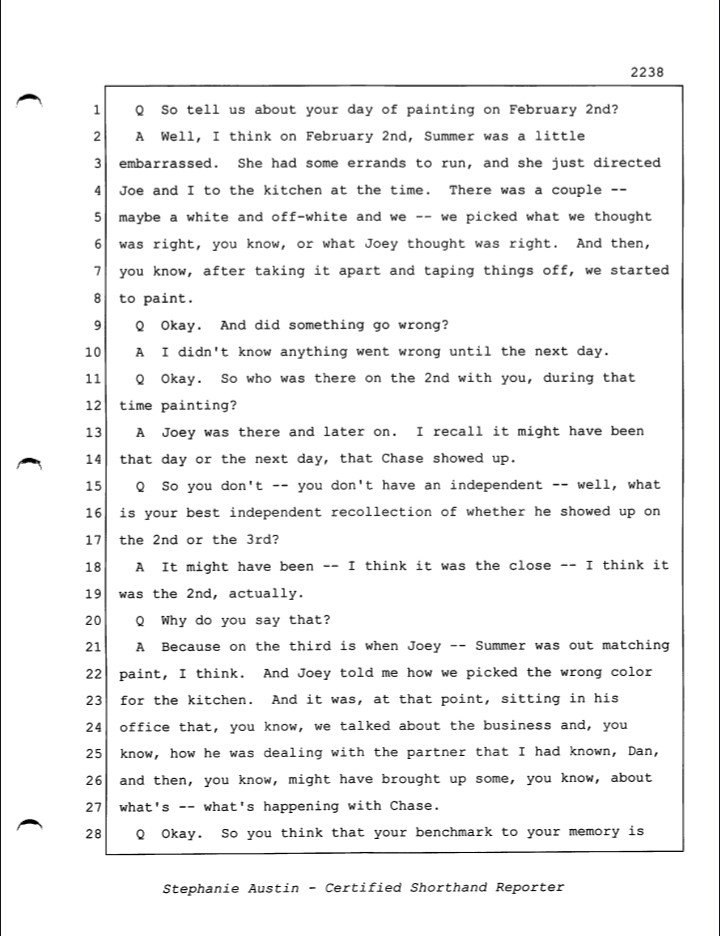
- The State’s own witness put me there. On direct, McGyver McCargar told Mr. Imes: “Joey was there and later on. I recall it might have been that day or the next day, that Chase showed up. … I think it was the 2nd, actually” (RT 2238:11-19). That is because I was there. I picked up the check I wrote that day for $2,495, the $100 check Joseph gave me to open a new checking account, and the lighting for the Saudi job. On cross-examination, Mr. McGee asked McCargar whether he had told detectives that Joseph and I were talking about LED lights, “how this is something we have to implement into all of our waterfalls in the future,” and whether “the sole conversation was talking about the lights and the waterfall and the projects coming up.” He answered “Correct” to each (RT 2266:12-2267:14). Even on February 2, Joseph and I were planning ahead.
See the trial transcript (RT 2238, 2239, 2266, 2267)
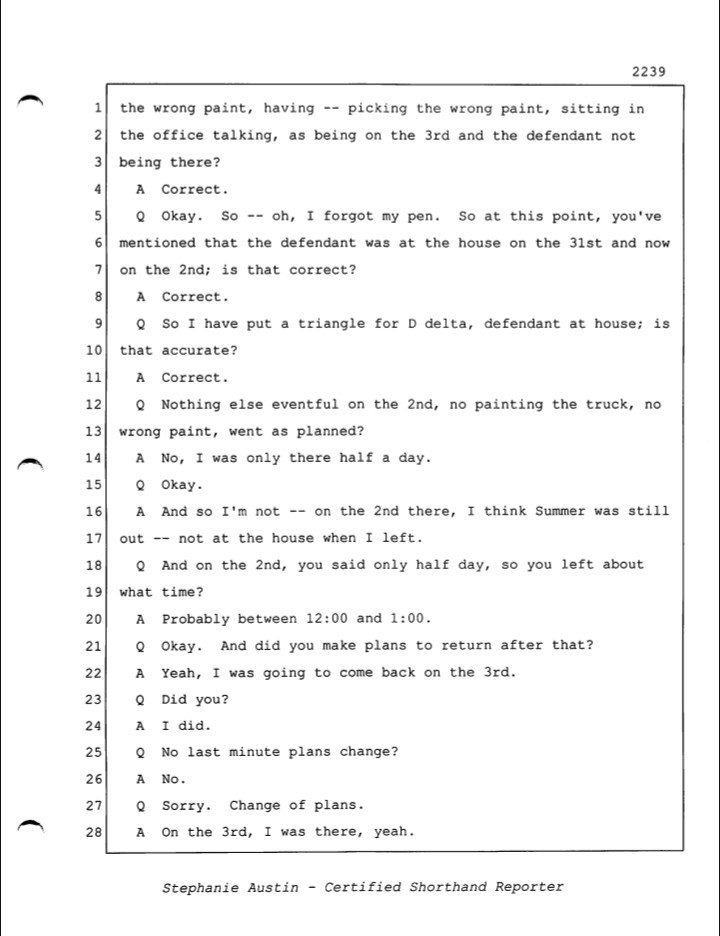
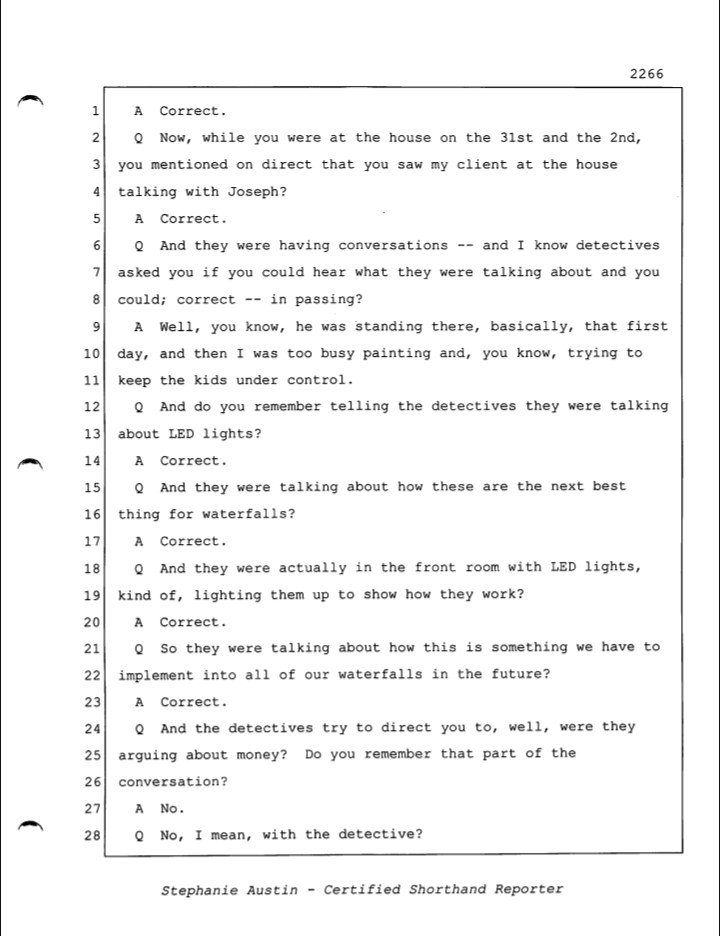
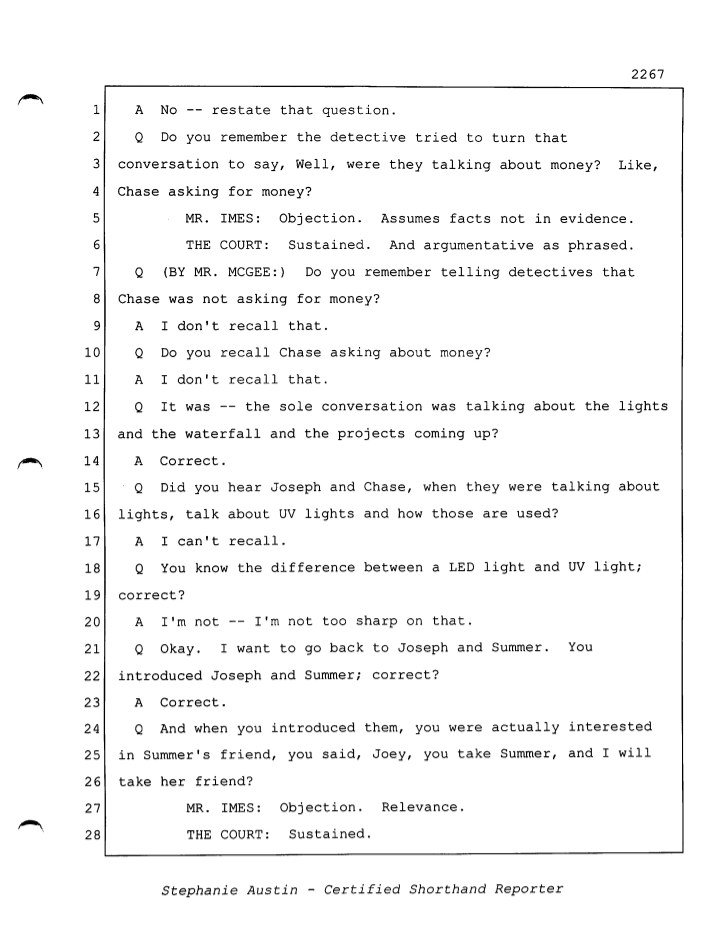
- Ms. Rodriguez: “Nowhere have you heard evidence that he had checks from Joseph McStay prior to” February 4 (RT 8422, Claim 6). The February 2 check is that evidence. It was written and cashed two days before the meeting.
Claim 4 of 15
“The checks were forged.”
What the State said
Mr. Imes told the jury the checks were “forged to the defendant”: (RT 8212:9-19)
In order for you to believe that the defendant was not there on the 4th and committing four willful, deliberate, premeditated murders, you have to ignore other evidence. You have to ignore that checks that were forged to the defendant and deleted from the QuicksBooks accounts to a vendor that never existed before in that account, didn’t happen, but they did. And the only person to benefit from that was the defendant. You would also have to ignore the fact that Joe, for the first time, called his bank. And in relation to other evidence, such as the check being deposited, negotiated, a bank he’s never called, according to his phone records, before.
See the trial transcript (RT 8212-8214, Mr. Imes)
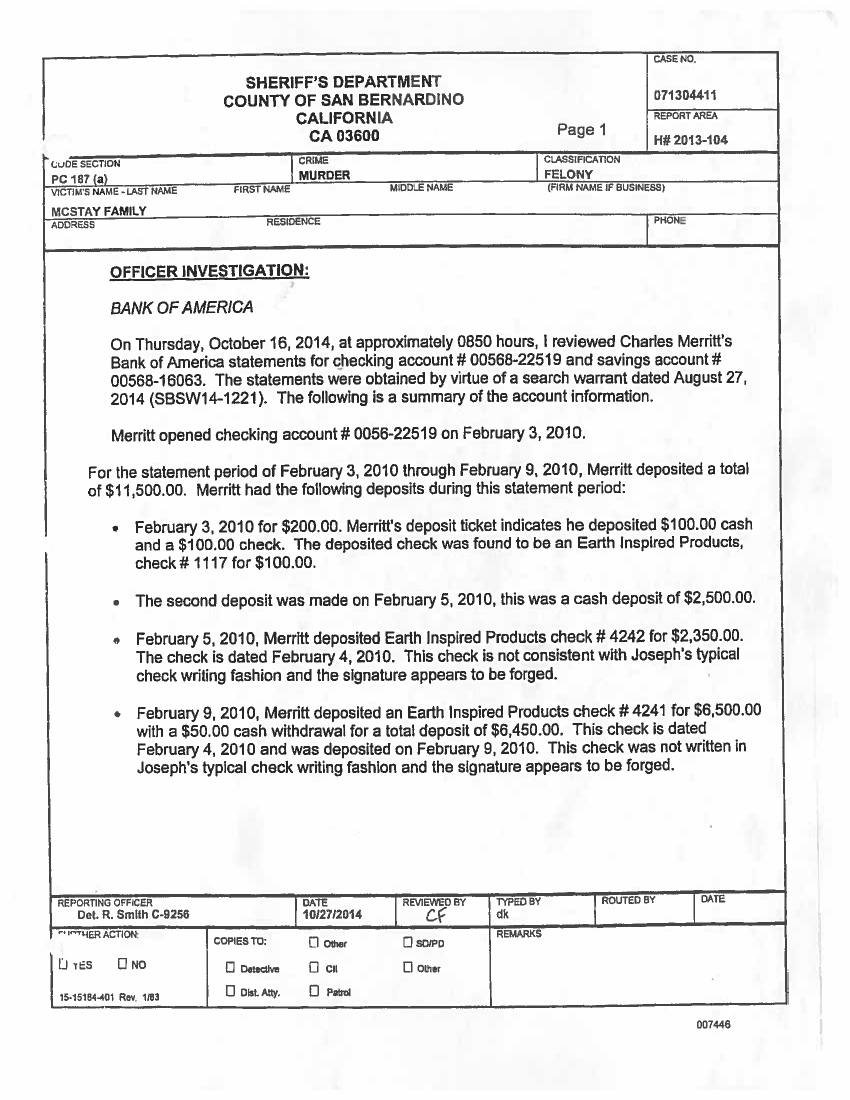
San Bernardino Det. R. Smith wrote in his bank report that the signatures on two of the checks appeared forged. This is a detective’s opinion, not the bank’s: (Bates 007446)
“February 5, 2010, Merritt deposited Earth Inspired Products check# 4242 for $2,350.00. The check is dated February 4, 2010. This check is not consistent with Joseph’s typical check writing fashion and the signature appears to be forged.
February 9, 2010, Merritt deposited an Earth Inspired Products check# 4241 for $6,500.00 with a $50.00 cash withdrawal for a total deposit of $6,450.00. This check is dated February 4, 2010 and was deposited on February 9, 2010. This check was not written in Joseph’s typical check writing fashion and the signature appears to be forged.”
See the bank report (Bates 007446)
My answer
I wrote these checks, and I signed Joseph’s name on them, with his permission, the way I had done more than 30 or 40 times over the years. I have never said otherwise. I told San Diego in 2010 and 2011, and San Bernardino in 2014. The only real question was whether Joseph authorized them, and the record says he did: he handed me checks, he wrote me checks himself, he deleted his own checks to me the same way, and I let him know after every one.
When Bachman told me I was “lying… about something as small as writing checks,” I answered, “But I’m not lying about the — the checks. I wrote a lot of checks.” When he pressed me about the $6,500 check, and why I deleted it, I said again, “I know I wrote checks” (pp. 187-188, 198-200). So the State spent its effort proving something I had already told them. As will be shown below, what it proved was a signature I said was mine.
What the State already knew
Everything in “What I told them, and when.” In 2011 DuGal told me that ordering QuickBooks for Joseph’s business account was “not criminal and it’s not wrong as long as Joey had authorized it,” and that it was “pretty much proved” that “that’s how the business was running.” In 2014 I told Bachman and Hanke I signed Joseph’s name, before anyone in the room had accused me of forging anything.
The record
“Dozens.“ The State’s theory needs these checks to be new and secret. I told Bachman I had written dozens of checks on Joseph’s account, to Metro, to suppliers and to myself, almost from the start of our business. I also told him how Joseph kept track: I let him know what each check was for, and after he disappeared I left him messages about the ones I had written (Claim 13): (pp. 137:14-139:25)
Read the full exchange
DETECTIVE BACHMAN: Okay. So — so before new Quick Books, with old Quick Books you had access. You said you wrote checks. How many checks did you write?
MR. MERRITT: Over the years?
DETECTIVE BACHMAN: Yes.
MR. MERRITT: Dozens. Dozens.
DETECTIVE BACHMAN: And who did you write checks to?
MR. MERRITT: Either Metro or suppliers or myself or — I mean, it just depended on what was going on that day or that week. You know, I mean, we had — we had checks going out almost on a daily basis. You know, it was — it was — we were pretty busy.
DETECTIVE BACHMAN: Okay. So he would — you said you would write checks. But Joseph would always write checks?
MR. MERRITT: Yeah.
DETECTIVE BACHMAN: Well, how — how were the — how were the books taken care of, if you guys are both writing checks?
MR. MERRITT: He pretty much kept track — kept track as — you know, I would let him know what the checks were written for. And I — I don’t know how he kept his books. I know it was done on Quick Books mostly.
But he would keep track of his — his records. I — I didn’t keep track that much. So I don’t know.
DETECTIVE BACHMAN: But you said the Metro checks you believe you wrote after the 4th. How did you keep track of that — those checks?
MR. MERRITT: Well, I kept — I’m sure I kept copies of them. And I was going to be letting Joseph know.
As a matter of fact, I’m almost positive I called him, left a couple of messages probably just after — not long after he disappeared when I was still trying to get a hold of him, letting him know that — you know, that I needed to get a hold of him and that I had written this check to Metro and this check to me and this check to, you know, different — whatever it was.
And I’m 99 percent sure I left messages for him. And that’s pretty much the way I would tell him, just let him know what the checks were written for, how much — and how much and who to. And then he’d take care of it from there.
DETECTIVE BACHMAN: Okay. So — but prior to yourself and Metro, who did you write checks to?
MR. MERRITT: I don’t remember. Probably Little Giant, probably Industrial Pipe & Supply or “I” — I’m sorry — “IMS,” Industrial Metal Supply, for stainless steel, copper. Where else?
It’s possible — I mean, just plumbing supplies and stuff like that. But I don’t remember.
DETECTIVE BACHMAN: How long prior to Joseph going missing were you writing those checks?
MR. MERRITT: Almost within a few months of Joseph and I being — doing business together. He — he just started — we were — we were pretty much open books from almost day one. We were good friends. And we did — we did all of our business together and —
See my October 22, 2014 interview (pages 137, 138, 139)
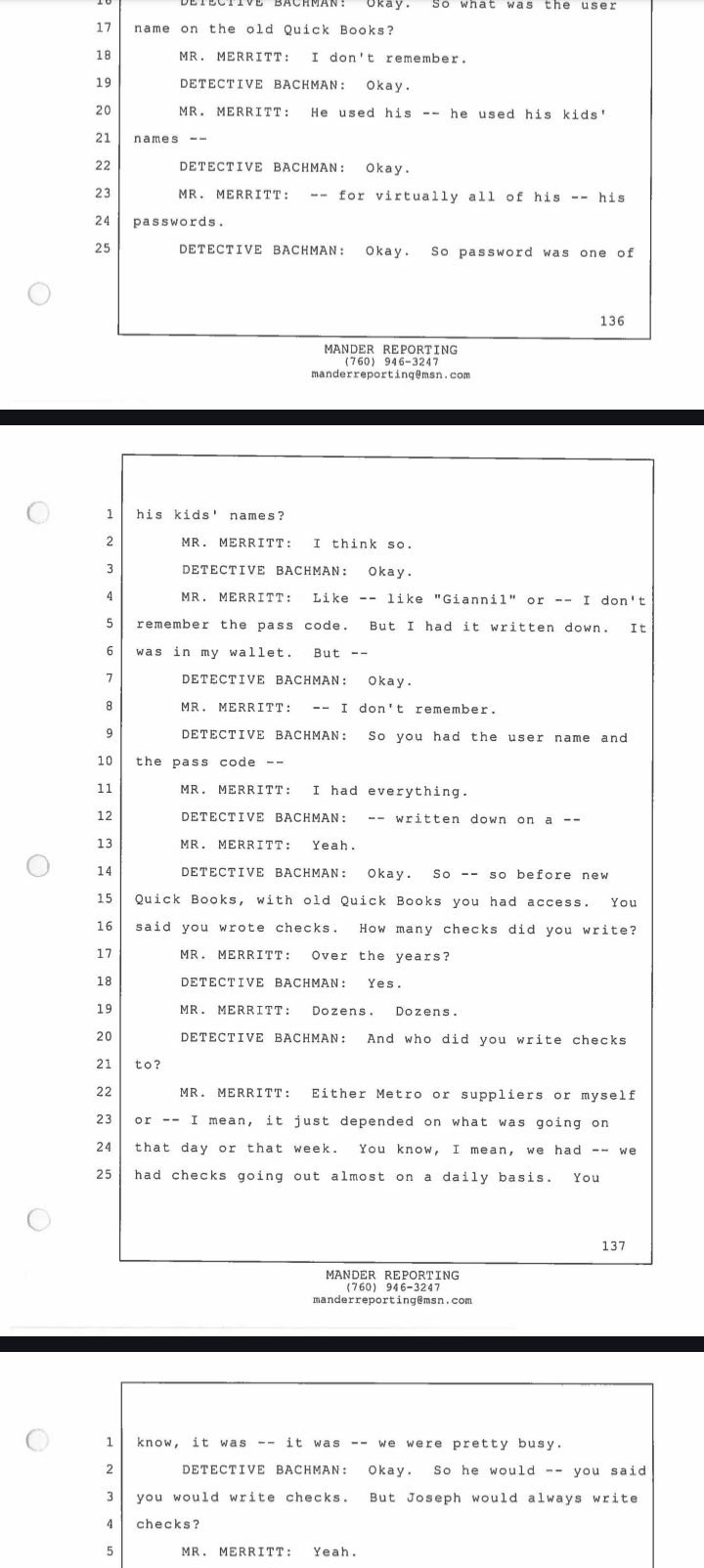


“Either he signed it or I signed his name.“ The State called my signature on these checks forgery. Before anyone in the interview had accused me of forging anything, Bachman asked how I signed them, and I told him: sometimes Joseph signed the checks and handed them to me; sometimes I signed his name. Over the years I had done it more than 30 or 40 times: (p. 140:1-23)
DETECTIVE BACHMAN: So he gave you checks. And then did you sign it “Earth Inspired Products” or did you sign it “Chase Merritt”?
MR. MERRITT: No. I — I — either he signed it or I signed his name. He would just hand me, you know, three or four checks. And then I would either sign his name or he would have already signed it and just handed them to me or — you know, it just depended on the day what —
DETECTIVE BACHMAN: Okay. How many checks — so how many checks did you sign that were actually Joseph’s name?
MR. MERRITT: Oh, probably — oh, you mean over the years?
DETECTIVE BACHMAN: Yeah, total. How many times have you signed Joseph’s name?
MR. MERRITT: God, probably more than 30 or 40, I would guess.
DETECTIVE BACHMAN: Okay. And did it look similar to Joseph’s, or was it just —
MR. MERRITT: I don’t know.
DETECTIVE BACHMAN: — scribble and —
MR. MERRITT: I don’t know.
See my October 22, 2014 interview (pages 140)
“Actually I did.“ Hanke told me I had never told San Diego that I wrote checks and signed Joseph’s name. I told him I had, to Det. DuGal, early on. (DuGal’s report of my February 17, 2010 notes, “Went over when to write the checks,” is above.) (pp. 142:16-143:25)
Read the full exchange
DETECTIVE HANKE: Okay. And we’ll get to that. I just have a few more notes that I — like I said, I was taking some — some of the notes.
And — and like I said, we — you know, we’ve reviewed San Diego. We review all the books and all the interviews. We’ve listened to everything.
And you didn’t tell San Diego that you were writing checks and signing Joseph’s name. So that’s why I’m — I’m asking.
MR. MERRITT: Actually I did. I told Detective — the guy you just mentioned earlier.
DETECTIVE BACHMAN: Dugal?
MR. MERRITT: Dugal.
DETECTIVE BACHMAN: Uh-huh.
MR. MERRITT: I told Detective Dugal that.
DETECTIVE HANKE: When did you tell him that?
MR. MERRITT: Early on. In — matter of fact, at the interview when we were in — I think it was Lancaster, if I remember the name of the city right.
DETECTIVE HANKE: Uh-huh.
MR. MERRITT: When they did the lie detector test, I did tell him that.
DETECTIVE HANKE: Okay. So you’re talking about when you did the polygraph test, you told him about those checks?
MR. MERRITT: Yeah. But not in the polygraph test.
DETECTIVE HANKE: Uh-huh.
MR. MERRITT: But when — when we were talking before and after. Because he did — he did an interview, not extremely extensive then. But he — he did talk to me then.
DETECTIVE HANKE: Okay.
MR. MERRITT: But, yeah. I definitely talked — told Dugal that.
See my October 22, 2014 interview (pages 142, 143)


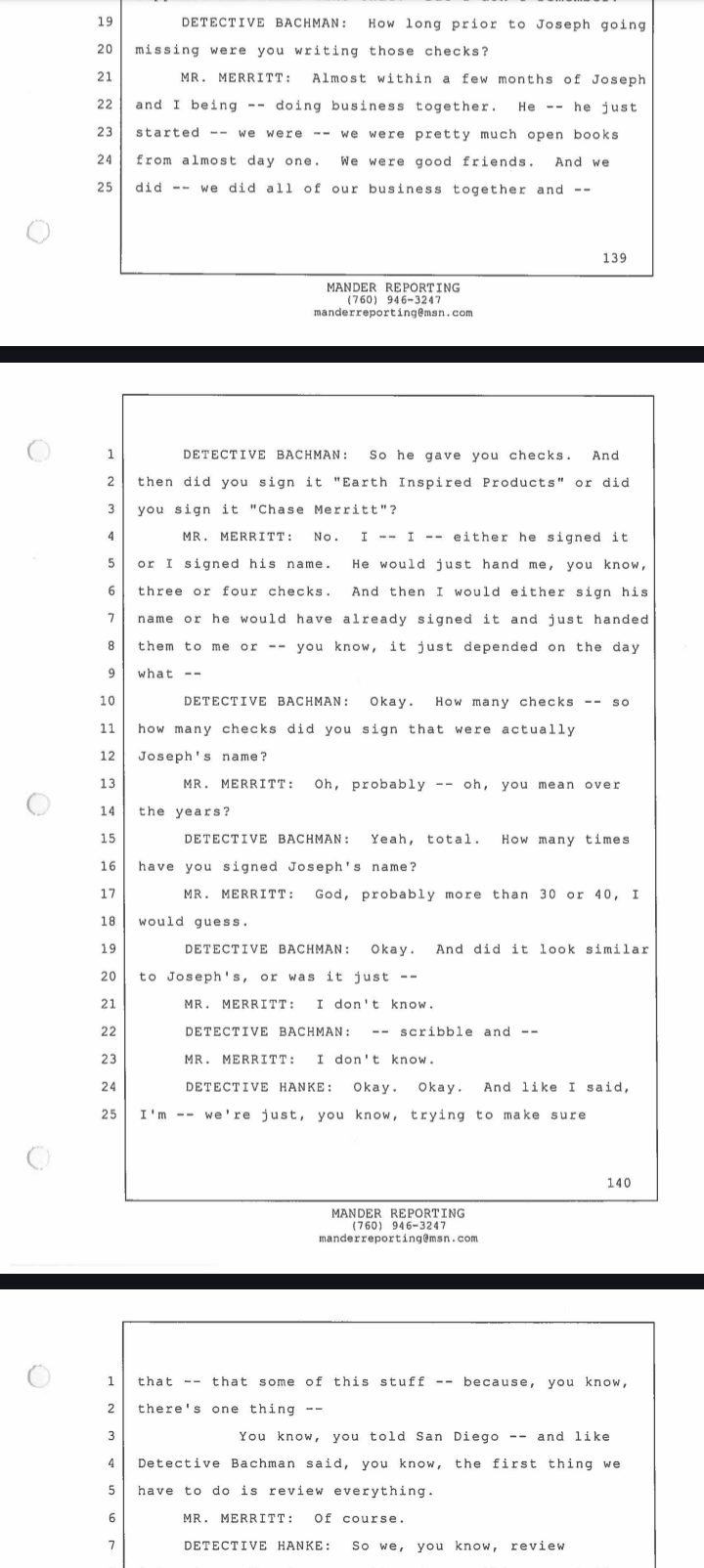
I told Hanke I wrote the Metro checks, and not on the 4th. Hanke laid out the checks dated February 4 and asked whether I had received any other checks from Joseph after the 4th. No one had suggested I wrote any of them. I volunteered that I was “almost positive” I had written the Metro check, “maybe the $250 one too,” and that they went to Metro days later. When Hanke pressed whether these were the checks Joseph gave me for Metro, I explained how Joseph and I worked: he handed me several checks at a time, and I paid things out as they came due. The Metro checks waited because Metro hadn’t given us a price: (pp. 121:15-123:2)
Read the full exchange
DETECTIVE HANKE: For sure you knew there was three or four. But you didn’t receive any other checks from Joseph after the 4th?
MR. MERRITT: I received these checks here, two, three — I can’t remember. I know that I had — I wrote probably — I’m almost positive the Metro Sheet Metal check I wrote. I’m almost positive I did that one. Maybe the $250 one too.
Because Metro Sheet Metal — the check wasn’t given to them until at least a few days after the 4th. I’m almost positive.
DETECTIVE HANKE: Okay. I —
MR. MERRITT: I’m almost positive.
DETECTIVE HANKE: I just want to clarify. Because earlier you told Detective Bachman that you guys talked about Metro Sheet Metal —
MR. MERRITT: Right.
DETECTIVE HANKE: — and he gave you checks. Joseph actually paid for those materials and gave you checks to Metro Sheet Metal.
These are the only two checks from the 4th. So I’m just trying to confirm that these checks are the ones that Joseph gave you for Metro Sheet Metal.
MR. MERRITT: You know, more than likely. I don’t remember. I know that there was checks given to me. I know that — at least a couple of them. I recall — if I — if my memory is right — because if — and it could be a little — a little askewed because probably every other time Joseph gave me checks, he would just — like if I met him at his house or I met him at — or he met me, or whatever, he would just hand me two, three, four checks.
And — and, generally, I would disburse it wherever it was necessary to get disbursed. I — I was almost positive that the Metro Sheet Metal checks were ones that he left to me because we weren’t sure of the price yet on the 4th. I’m almost positive Metro hadn’t given us a total yet.
See my October 22, 2014 interview (pages 121, 122, 123)
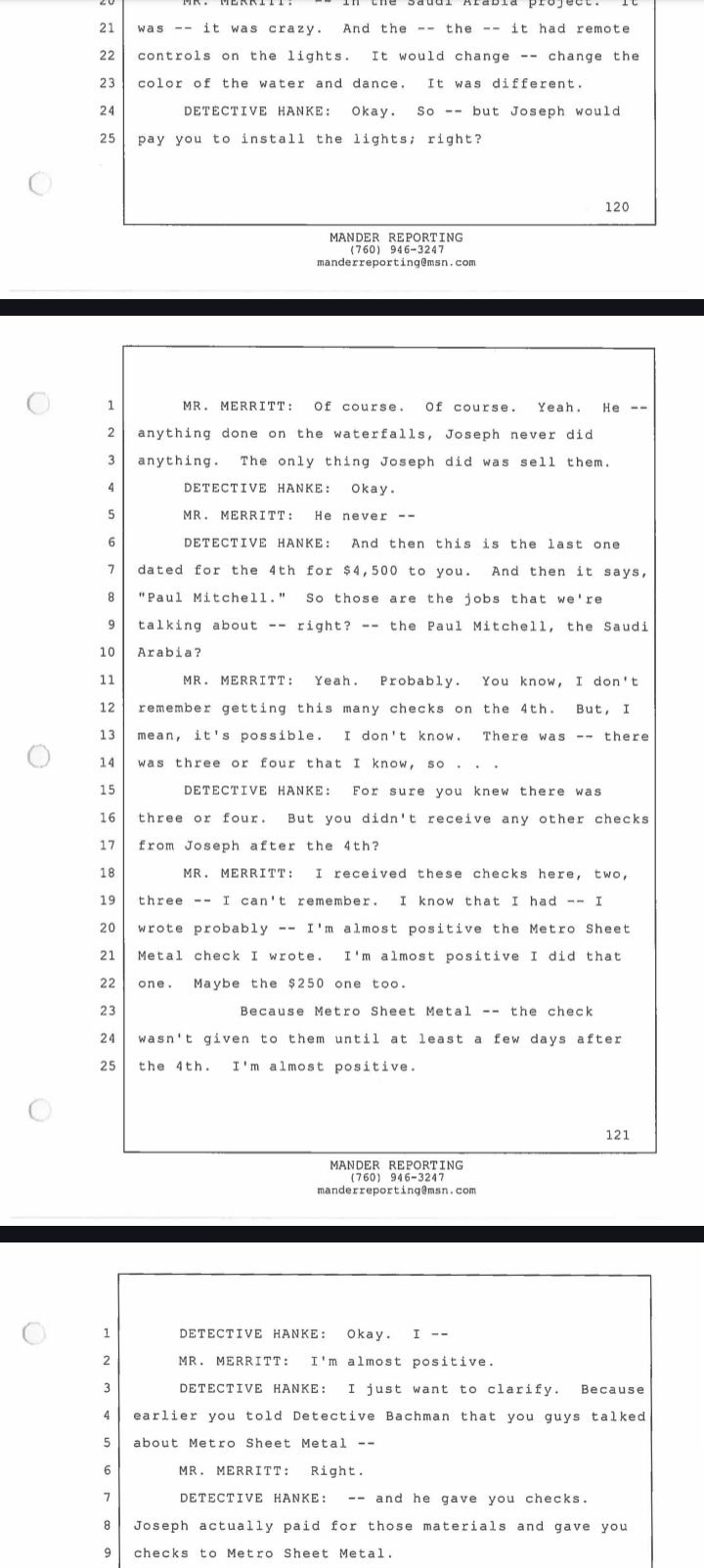

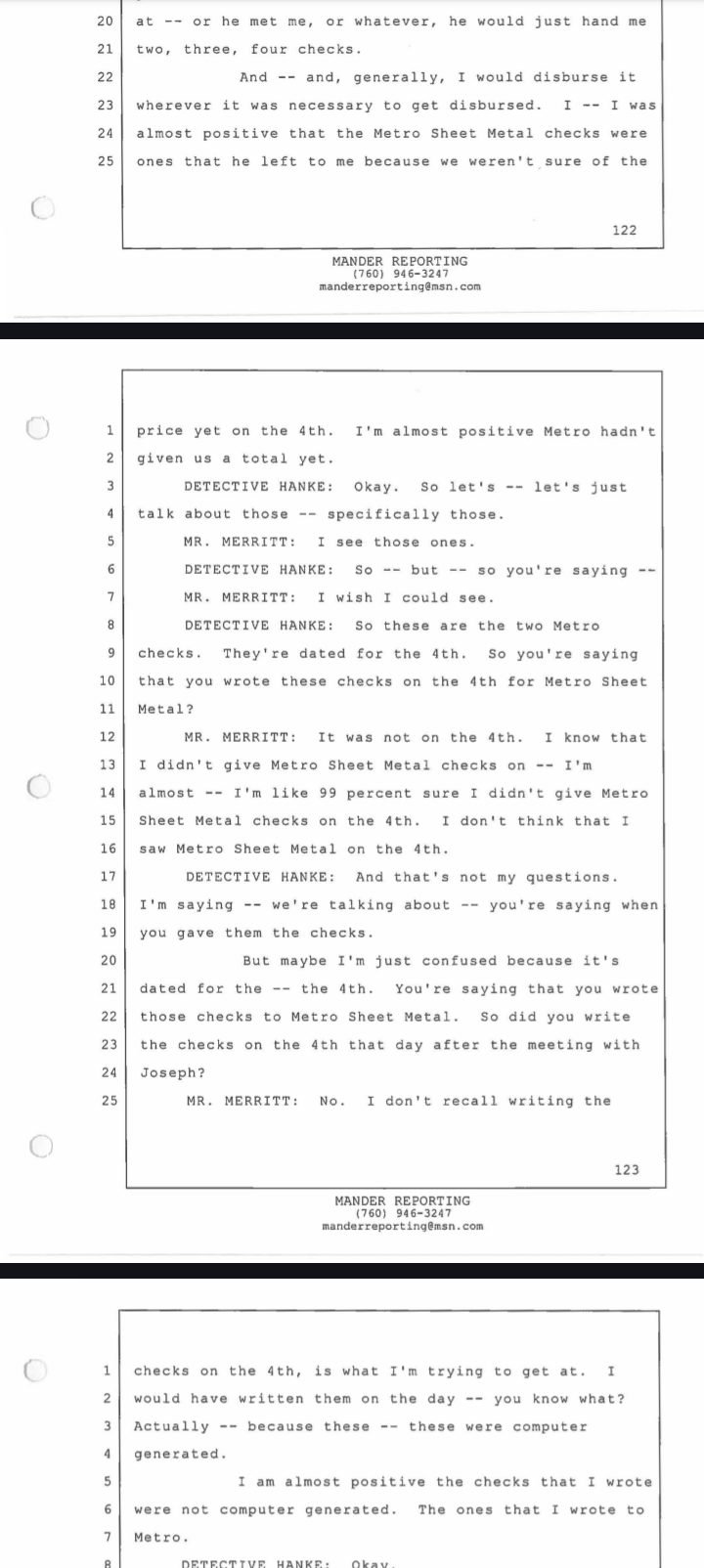
“I could computer generate them.“ Hanke then asked whether I wrote the Metro checks on the 4th, after the meeting. I said no. Then, looking at them, I noticed myself that these were computer-printed, and said I was almost positive the ones I wrote to Metro were not. When Hanke asked if that meant I didn’t believe I wrote these, I told him I could have printed them myself from Joseph’s QuickBooks, the very thing the State later said I did in secret: (pp. 123:3-125:13)
Read the full exchange
DETECTIVE HANKE: Okay. So let’s — let’s just talk about those — specifically those.
MR. MERRITT: I see those ones.
DETECTIVE HANKE: So — but — so you’re saying —
MR. MERRITT: I wish I could see.
DETECTIVE HANKE: So these are the two Metro checks. They’re dated for the 4th. So you’re saying that you wrote these checks on the 4th for Metro Sheet Metal?
MR. MERRITT: It was not on the 4th. I know that I didn’t give Metro Sheet Metal checks on — I’m almost — I’m like 99 percent sure I didn’t give Metro Sheet Metal checks on the 4th. I don’t think that I saw Metro Sheet Metal on the 4th.
DETECTIVE HANKE: And that’s not my questions. I’m saying — we’re talking about — you’re saying when you gave them the checks.
But maybe I’m just confused because it’s dated for the — the 4th. You’re saying that you wrote those checks to Metro Sheet Metal. So did you write the checks on the 4th that day after the meeting with Joseph?
MR. MERRITT: No. I don’t recall writing the checks on the 4th, is what I’m trying to get at. I would have written them on the day — you know what? Actually — because these — these were computer generated.
I am almost positive the checks that I wrote were not computer generated. The ones that I wrote to Metro.
DETECTIVE HANKE: Okay.
MR. MERRITT: I’m also positive.
DETECTIVE HANKE: Handwritten checks?
MR. MERRITT: Yeah. But I’m — I’m like — you know, it’s kind of vague. But I — I wrote — there was — if you go back over Joseph’s records for the years that him and I were together, he would just give me checks, two, three, four checks sometimes. Sometimes half a dozen. And I would take care of the different things that he needed to be taken care of.
And I’m almost positive that I didn’t give Metro the checks until several days after.
DETECTIVE HANKE: Okay. But just to be — but just to be clear — and sorry to cut you off. I just —
MR. MERRITT: Please.
DETECTIVE HANKE: I just want to make — be clear in my mind. Because these ones are computer generated, you don’t believe you wrote these ones. You would have handwritten a check to Metro?
MR. MERRITT: I would have either handwritten it or I would — because I — I could computer generate them. But I don’t think it would have been on the 4th.
DETECTIVE HANKE: Okay. You’re saying you would — you could computer generate —
MR. MERRITT: Well, of course. Yeah. I can — I can — I could have done the checks. But I don’t think I would have done them on the 4th. I don’t — I think I would have — and I don’t think Joseph gave me — I don’t remember Joseph giving me checks on the 4th for Metro. I don’t remember him doing that.
See my October 22, 2014 interview (pages 123, 124, 125)


“Either handwritten or I generated it myself.“ A few minutes later Bachman asked the same question. I gave the same answer, and said again that I paid Metro for Saudi at least a week after the 4th. I also said it had been five and a half years; in fact it had been four years and eight months: (p. 128:16-25)
DETECTIVE BACHMAN: So you believe that — you believe that you could have had a handwritten check to Metro?
MR. MERRITT: Because — either handwritten or I generated it myself, yes. Because I know that there was — I’m almost positive. And, again, my — my memory on this is really vague because, I mean, it’s been five and a half years.
But I’m also positive that I paid Metro at least a week for Saudi Arabia — at least a week after.
See my October 22, 2014 interview (pages 128)
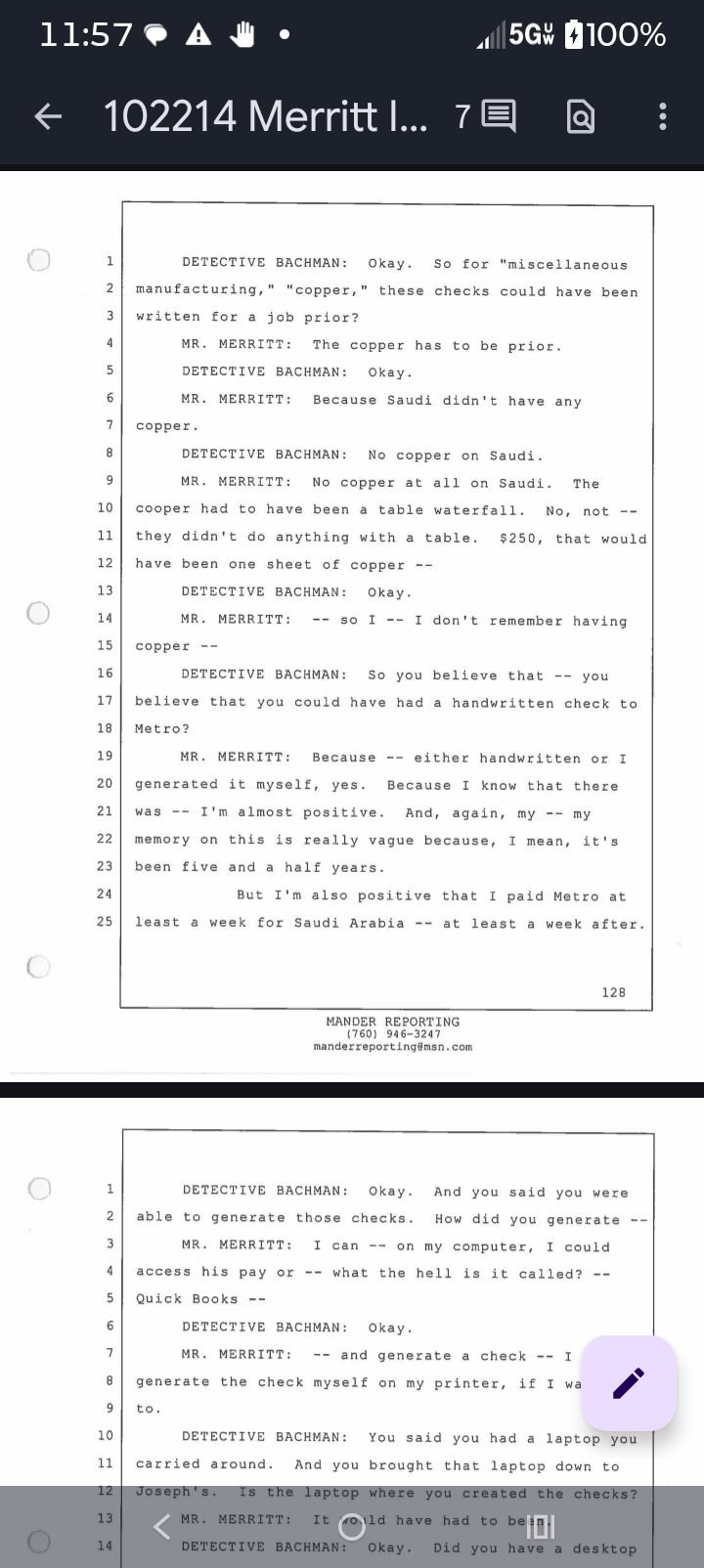
Bachman then asked how I made the checks. I told him: from Joseph’s QuickBooks, on my own computer and printer: (p. 129:1-25)
DETECTIVE BACHMAN: Okay. And you said you were able to generate those checks. How did you generate —
MR. MERRITT: I can — on my computer, I could access his pay or — what the hell is it called? — Quick Books —
DETECTIVE BACHMAN: Okay.
MR. MERRITT: — and generate a check — I could generate the check myself on my printer, if I wanted to.
DETECTIVE BACHMAN: You said you had a laptop you carried around. And you brought that laptop down to Joseph’s. Is the laptop where you created the checks?
MR. MERRITT: It would have had to been.
DETECTIVE BACHMAN: Okay. Did you have a desktop computer also?
MR. MERRITT: No. I’ve never had a desktop.
DETECTIVE BACHMAN: Okay. So then you said you had a printer. So where was the printer located? Was it a mobile printer, or was it —
MR. MERRITT: No. It was at my house.
DETECTIVE BACHMAN: Okay. So you had a —
MR. MERRITT: It was an HP printer.
DETECTIVE BACHMAN: “HP printer”?
MR. MERRITT: Yeah.
DETECTIVE BACHMAN: Okay. So —
See my October 22, 2014 interview (pages 129)

Faced with the QuickBooks records, I said the same thing. Bachman told me there was no record of my writing checks on Joseph’s account before the days around his disappearance, and that I was not authorized to sign. He told me it looked like I was lying. I did not change my account: (pp. 186:2-188:23)
Read the full exchange
DETECTIVE BACHMAN: Okay. So — so that’s the first thing. Okay?
You talked about you have access to writing checks. You say you created checks from Quick Books. Yet, we have every record from Joseph. We have every check written. We have every account cashed — every check that’s been cashed. And there’s no record of you ever writing checks on his account until the day leading up to and the days after he goes missing.
MR. MERRITT: Okay.
DETECTIVE BACHMAN: We have every check, Chase. So —
MR. MERRITT: All right.
DETECTIVE BACHMAN: — we have every check. Okay? You weren’t authorized to sign on this account. Okay? We have every single account. We have every single check. Okay?
You were not authorized to sign on the account. There’s no record of these checks that you’re supposedly saying that you wrote. There’s no record of them. And you said you wrote up to 40 checks. We don’t have them. So there’s —
MR. MERRITT: They’re there. You — you —
DETECTIVE BACHMAN: You have to understand —
MR. MERRITT: — at the very least missed them.
DETECTIVE BACHMAN: Okay. You have to understand —
MR. MERRITT: I wrote checks.
DETECTIVE BACHMAN: So they were found in November of 2013. Okay? We’re October of 2014. We’ve been working on this case every single day for the past year. Okay? I know this case inside and out. And this is a fraction — a hundredth — one and one hundredth of — of what we’ve been looking through.
MR. MERRITT: Right.
DETECTIVE BACHMAN: So you have to understand.
MR. MERRITT: Oh, I understand.
DETECTIVE BACHMAN: Okay. So — so we didn’t miss it.
MR. MERRITT: Okay.
DETECTIVE BACHMAN: We didn’t miss it. There’s no checks missing. Okay? We — we don’t have that stuff missing. Okay?
So I understand you’re saying it. But it looks bad, Chase. It looks very bad for you right now that you’re lying about this stuff. Okay?
And that’s what we need to give — we gave you the opportunity. We gave you a chance. Okay? So that’s why we need you to be honest with us here because this is a murder investigation —
MR. MERRITT: Oh, trust me, I —
DETECTIVE BACHMAN: — involving Joseph, involving Summer, involving a four-year-old boy, and a two-year-old boy.
MR. MERRITT: I know that.
DETECTIVE BACHMAN: Okay? So you’re lying in a murder investigation about something as small as — as writing checks. There’s something else that — that you’re lying about.
MR. MERRITT: But I’m not lying about the — the checks. I wrote a lot of checks.
DETECTIVE BACHMAN: Okay. So when you wrote these checks and you kept them, did you ever delete the checks from Quick Books?
MR. MERRITT: I don’t remember.
DETECTIVE BACHMAN: Okay.
MR. MERRITT: I don’t — it’s possible. I don’t —
DETECTIVE BACHMAN: Why would you delete the checks from Quick Books?
MR. MERRITT: I — I don’t know. I don’t remember.
See my October 22, 2014 interview (pages 186, 187, 188)

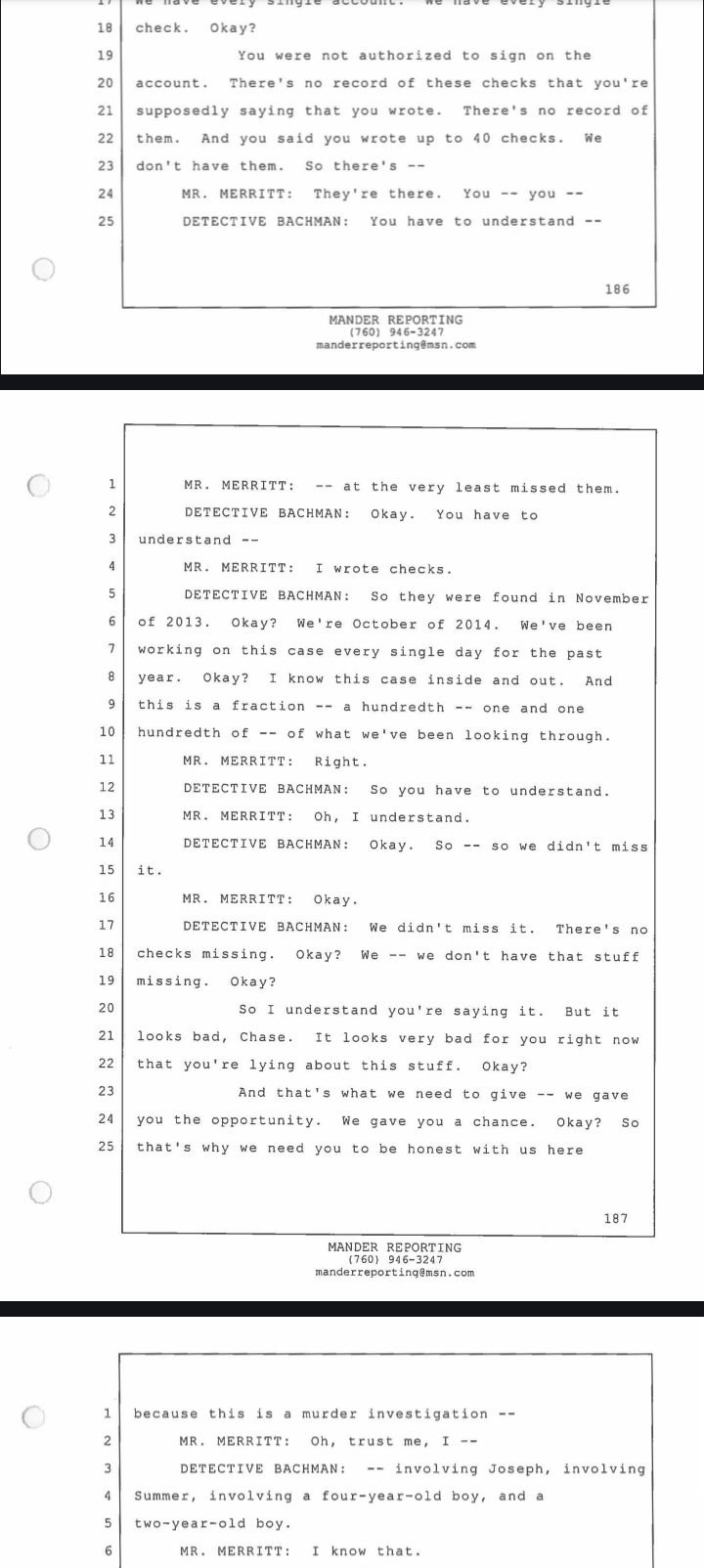

“Which is okay.“ Bachman tried to make it sound improper that I could write checks on Joseph’s account when Joseph didn’t write on mine. I explained why: the money on every job came to Joseph first, and the account was used to pay for the work and to pay me. Bachman’s answer was “Which is okay.” Hanke then said it himself: “He did write checks to you.” (pp. 200:19-202:22)
Read the full exchange
DETECTIVE BACHMAN: Okay. So — but you’re telling me — again, we go back to this. Joseph has his own company. You have your own company.
You want me to believe that you have carte blanche. I have access to his account. He can write on my account?
Because the thing is, you have your own account; he never wrote a check from your account. He never wrote a check from your Bank of America account. He never wrote a check claiming to be Chase Merritt. He never wrote a check claiming to be I-Design.
Okay. So — but you’re saying that it’s carte blanche business; that I had access to his stuff. He had access to my stuff. He wrote checks on my account. And I wrote checks on his account.
MR. MERRITT: I didn’t say he wrote checks on my account. I said I wrote checks on his account.
DETECTIVE BACHMAN: Okay. So —
MR. MERRITT: That’s different.
DETECTIVE BACHMAN: Okay. So you wrote checks on his account.
MR. MERRITT: Of course.
DETECTIVE BACHMAN: “Of course.” Which is okay. But Joseph didn’t have access to your stuff.
MR. MERRITT: I didn’t have — the finances originated with Joseph throughout — throughout our business arrangement, through our entire business life.
The finances originated from him. He was paid for the — for the waterfalls first. And then he paid me. So when I had access to his account, it was only to get stuff paid for or to pay me or to — whatever it was.
DETECTIVE BACHMAN: Okay. But here’s the problem —
MR. MERRITT: He had no reason to have — write checks on —
DETECTIVE BACHMAN: Here’s the problem — here’s the problem, Chase.
MR. MERRITT: Okay.
DETECTIVE HANKE: He did write checks to you. Okay?
MR. MERRITT: He wrote checks to me, a lot of them.
DETECTIVE BACHMAN: Multiple checks to you.
The problem is, the way the checks are written is not the way you wrote the checks.
MR. MERRITT: Okay.
DETECTIVE BACHMAN: Okay. So we know what checks you wrote. And we know what checks Joseph wrote. And I can prove that. Okay?
MR. MERRITT: Okay.
DETECTIVE BACHMAN: Do you understand what I’m saying?
MR. MERRITT: Sure.
See my October 22, 2014 interview (pages 200, 201, 202)
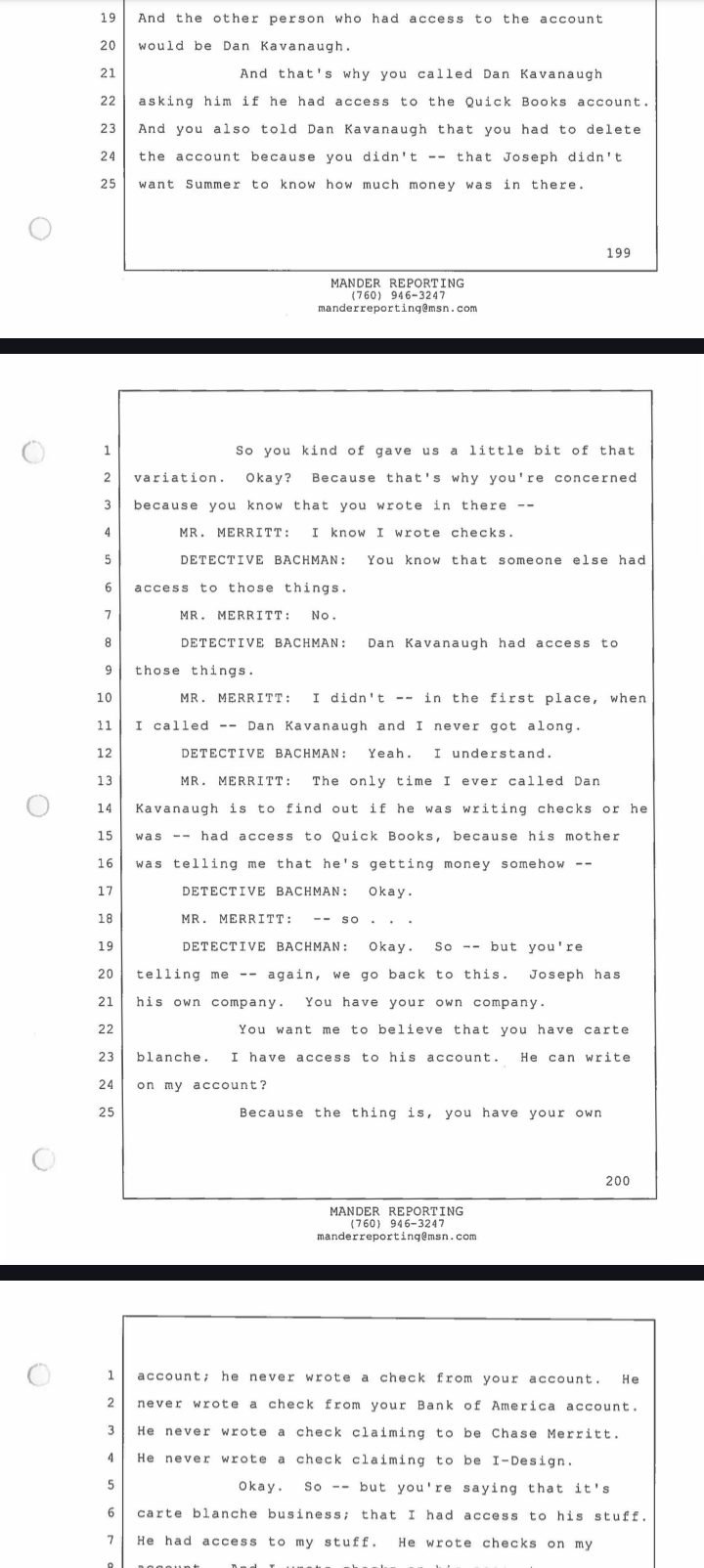
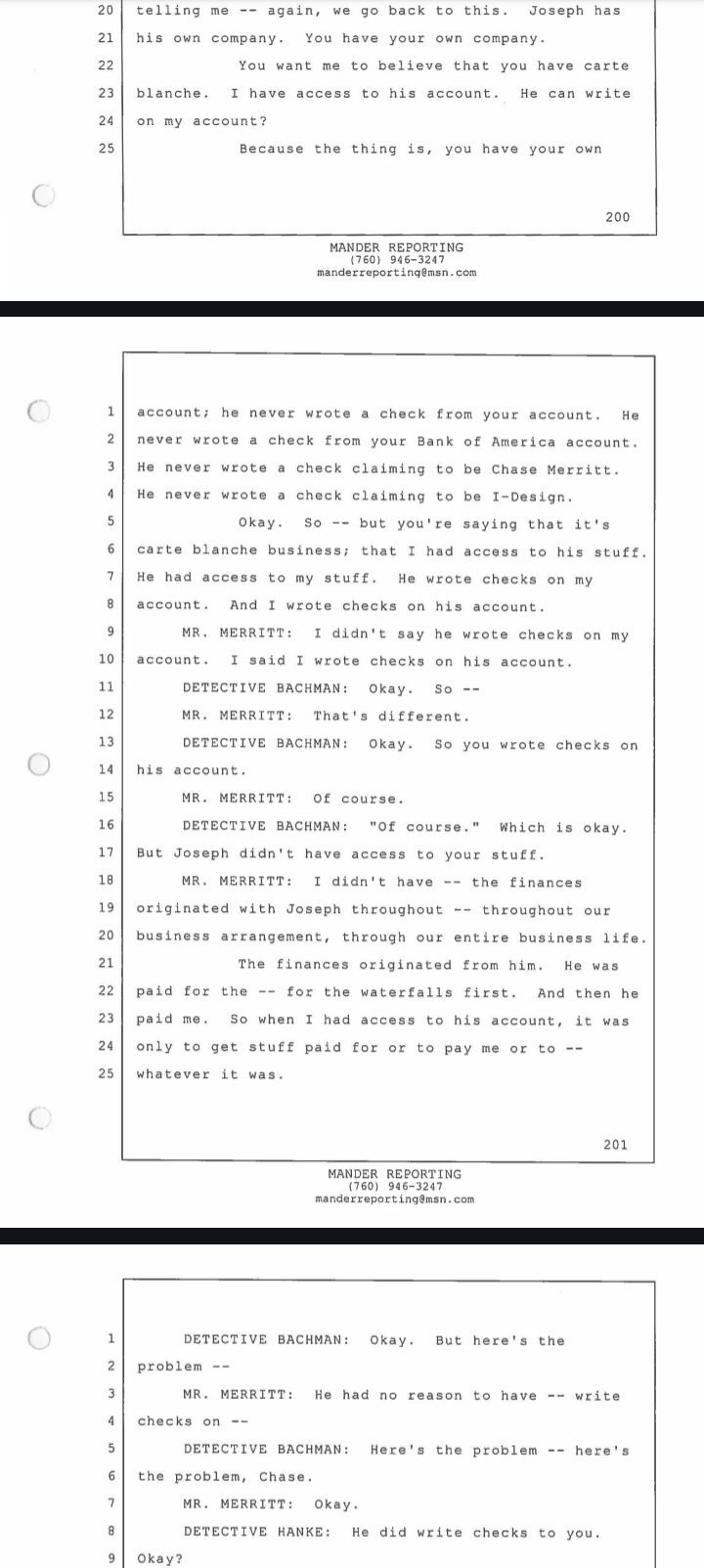
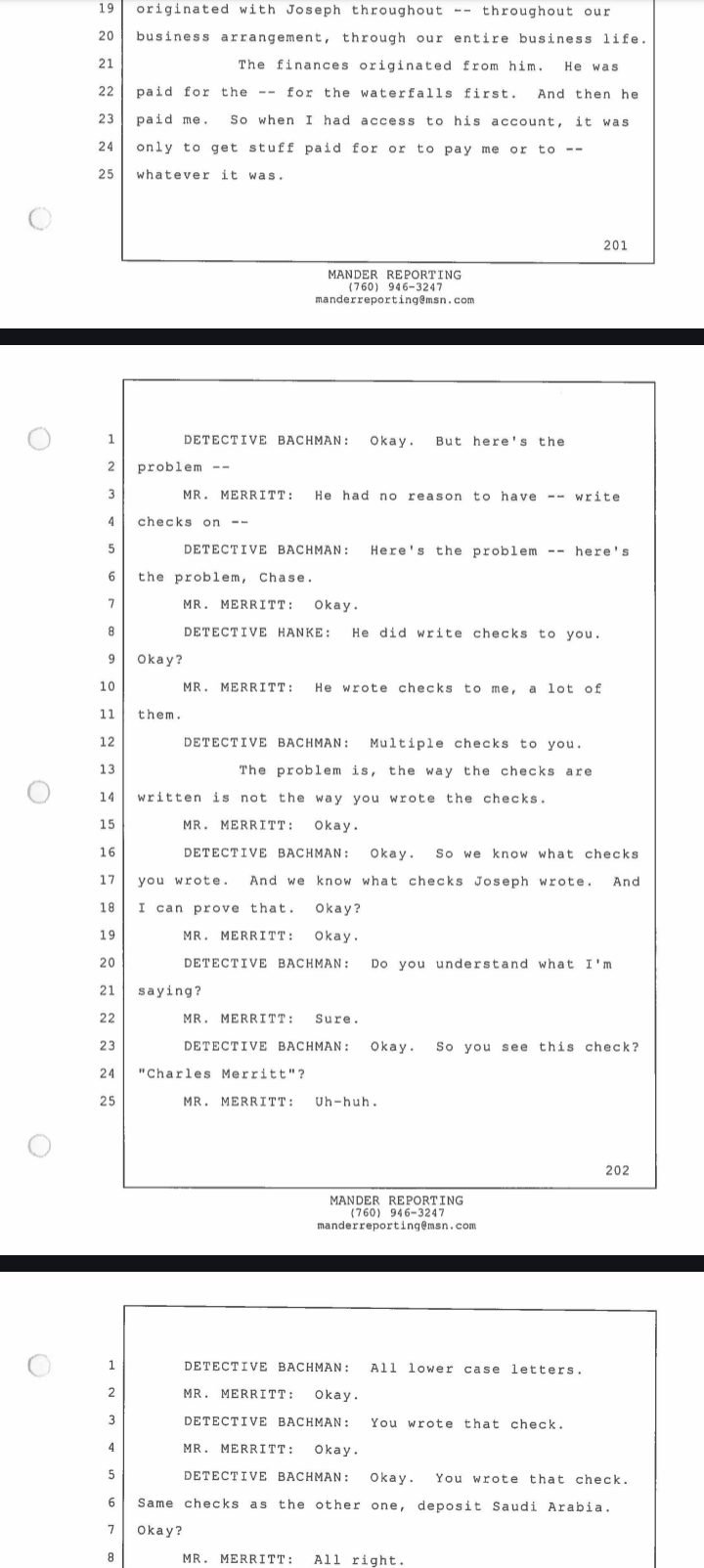
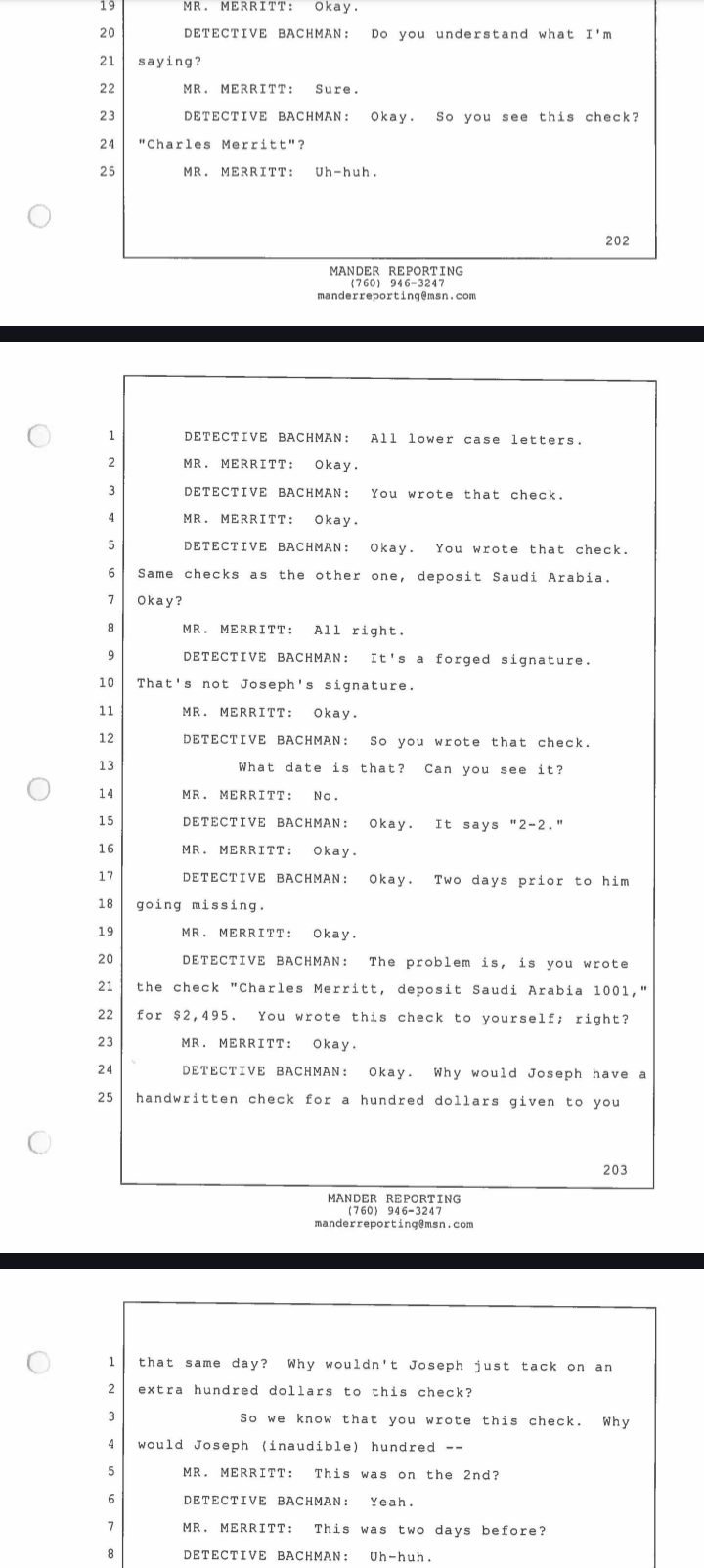
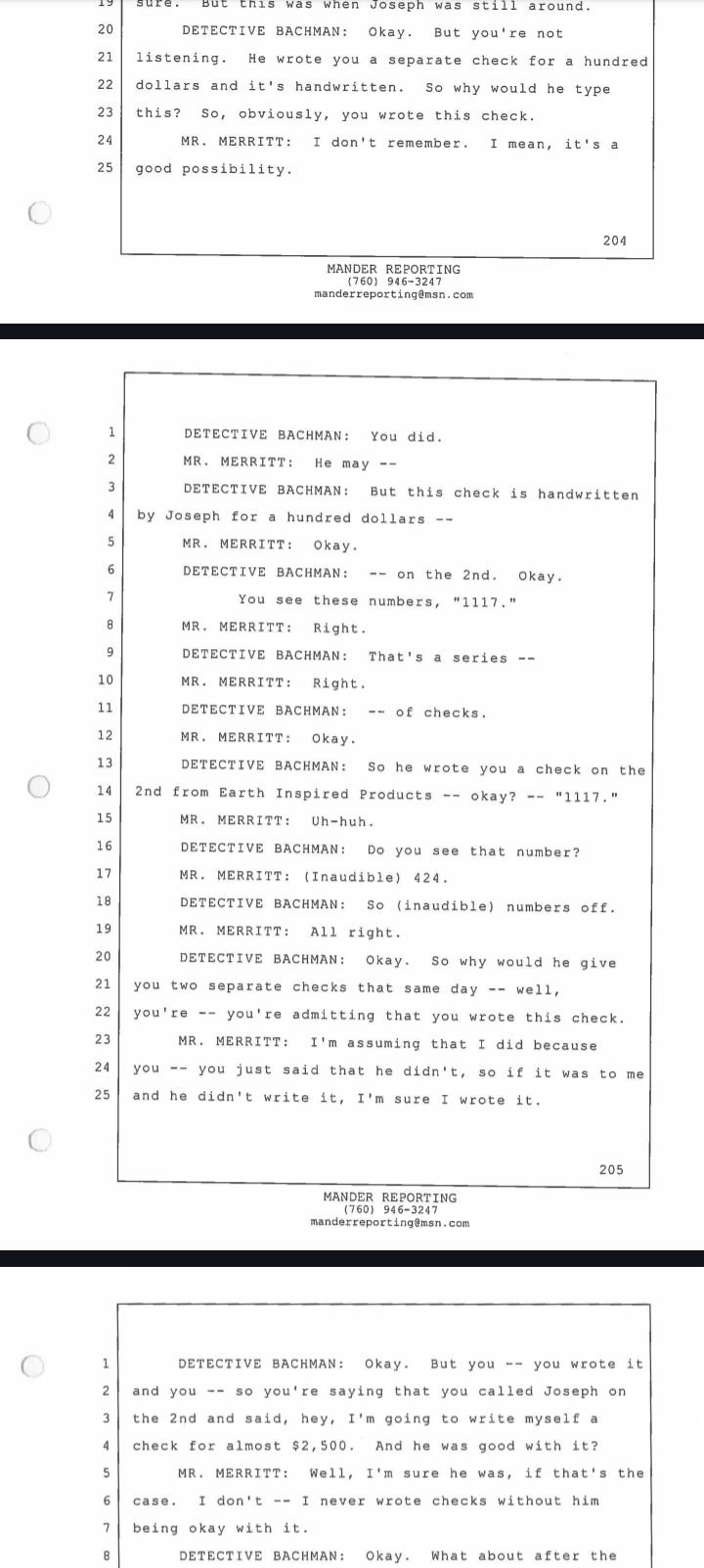
February 2, and the checks after the 4th. Bachman then showed me the February 2 check and told me its signature was forged. I said I might have signed it, but that Joseph was still here then, and that I never wrote a check without Joseph being okay with it. The checks after the 4th were ones we had already discussed, “on the 4th or prior.” That is why I had them: (pp. 202:23-207:1)
Read the full exchange
DETECTIVE BACHMAN: Okay. So you see this check? “Charles Merritt”?
MR. MERRITT: Uh-huh.
DETECTIVE BACHMAN: All lower case letters.
MR. MERRITT: Okay.
DETECTIVE BACHMAN: You wrote that check.
MR. MERRITT: Okay.
DETECTIVE BACHMAN: Okay. You wrote that check. Same checks as the other one, deposit Saudi Arabia. Okay?
MR. MERRITT: All right.
DETECTIVE BACHMAN: It’s a forged signature. That’s not Joseph’s signature.
MR. MERRITT: Okay.
DETECTIVE BACHMAN: So you wrote that check.
What date is that? Can you see it?
MR. MERRITT: No.
DETECTIVE BACHMAN: Okay. It says “2-2.”
MR. MERRITT: Okay.
DETECTIVE BACHMAN: Okay. Two days prior to him going missing.
MR. MERRITT: Okay.
DETECTIVE BACHMAN: The problem is, is you wrote the check “Charles Merritt, deposit Saudi Arabia 1001,” for $2,495. You wrote this check to yourself; right?
MR. MERRITT: Okay.
DETECTIVE BACHMAN: Okay. Why would Joseph have a handwritten check for a hundred dollars given to you that same day? Why wouldn’t Joseph just tack on an extra hundred dollars to this check?
So we know that you wrote this check. Why would Joseph (inaudible) hundred —
MR. MERRITT: This was on the 2nd?
DETECTIVE BACHMAN: Yeah.
MR. MERRITT: This was two days before?
DETECTIVE BACHMAN: Uh-huh.
MR. MERRITT: Okay.
DETECTIVE BACHMAN: So if Joseph is alive, why are you writing checks to yourself?
MR. MERRITT: Okay. This is on the 2nd. Joseph disappeared on the 4th.
DETECTIVE BACHMAN: Yep.
MR. MERRITT: Okay. So this is when Joseph was —
DETECTIVE BACHMAN: Okay. But Joseph didn’t sign this check. You wrote this check.
MR. MERRITT: Oh, I might have signed it. I’m sure. But this was when Joseph was still around.
DETECTIVE BACHMAN: Okay. But you’re not listening. He wrote you a separate check for a hundred dollars and it’s handwritten. So why would he type this? So, obviously, you wrote this check.
MR. MERRITT: I don’t remember. I mean, it’s a good possibility.
DETECTIVE BACHMAN: You did.
MR. MERRITT: He may —
DETECTIVE BACHMAN: But this check is handwritten by Joseph for a hundred dollars —
MR. MERRITT: Okay.
DETECTIVE BACHMAN: — on the 2nd. Okay.
You see these numbers, “1117.”
MR. MERRITT: Right.
DETECTIVE BACHMAN: That’s a series —
MR. MERRITT: Right.
DETECTIVE BACHMAN: — of checks.
MR. MERRITT: Okay.
DETECTIVE BACHMAN: So he wrote you a check on the 2nd from Earth Inspired Products — okay? — “1117.”
MR. MERRITT: Uh-huh.
DETECTIVE BACHMAN: Do you see that number?
MR. MERRITT: (Inaudible) 424.
DETECTIVE BACHMAN: So (inaudible) numbers off.
MR. MERRITT: All right.
DETECTIVE BACHMAN: Okay. So why would he give you two separate checks that same day — well, you’re — you’re admitting that you wrote this check.
MR. MERRITT: I’m assuming that I did because you — you just said that he didn’t, so if it was to me and he didn’t write it, I’m sure I wrote it.
DETECTIVE BACHMAN: Okay. But you — you wrote it and you — so you’re saying that you called Joseph on the 2nd and said, hey, I’m going to write myself a check for almost $2,500. And he was good with it?
MR. MERRITT: Well, I’m sure he was, if that’s the case. I don’t — I never wrote checks without him being okay with it.
DETECTIVE BACHMAN: Okay. What about after the 4th, after he was murdered and you wrote a check?
MR. MERRITT: We had — any checks that I wrote after the 4th were already discussed. And we had already — it was — that’s the reason I had the checks. And we were already — I mean, it was already moving forward with these projects. So it — it was already discussed.
DETECTIVE BACHMAN: Okay. So you — you asked him specifically if — if you were able to write a check on his account, even though he had been missing for four days?
MR. MERRITT: It was — I said it was already discussed —
DETECTIVE BACHMAN: Okay.
MR. MERRITT: — like on the 4th or prior.
DETECTIVE BACHMAN: So on the 4th — okay. So now the story is changing a little bit.
MR. MERRITT: The story is not changing.
See my October 22, 2014 interview (pages 202, 203, 204, 205, 206)


Only after all that: the forgery claim
The detectives sent the signatures to the FBI. It found “dissimilarities” but “could not say it was an absolute forgery due to the lack of original documents”: (Bates 000025)
“Detectives noted the checks made out to Charles Merritt, 1Design4U, Cash, or Catherine Jarvis, all the checks were handwritten from October 2008 until January 22, 2010. Detectives observed patterns in Joseph McStay’s check writing and signature. It was noted Joseph always capitalized the first letter of every word of the payee and wrote information in the memo area such as a job number or address a majority of the time. Joseph’s signature was written by writing a cursive J into a capitalized M. Each time Joseph wrote a check to Metro Sheet Metal, Joseph included the job name. Copies of Joseph’s signature and the suspected forged signature were sent to the FBI for comparison. The FBI concluded there were dissimilarities in the signatures, but could not say it was an absolute forgery due to the lack of original documents.”
See the State’s case summary (Bates 000025)

The detectives called them forged anyway: (Bates 000027)
“After analyzing the McStay’s financials, detectives formed the opinion the checks written to Merritt and Metro Sheet Metal in all lower case letters and with different signatures were forged. The checks matched account activity located by Detective Dan Hanke during the Intuit QuickBooks analysis.”
See the State’s case summary (Bates 000027)

Fact check
- “Forged”: I said in 2014 that I signed Joseph’s name, and how often. The FBI found dissimilarities but would not call it “an absolute forgery” without the originals (Bates 000025).
- Det. Smith’s report says the signature on both checks it describes “appears to be forged”: number 4242 for $2,350 and number 4241 for $6,500 (Bates 007446). I wrote both of them, and I said so.
- At the preliminary hearing, Hanke testified I said Joseph wrote the checks. At trial, Det. Smith told the jury I admitted only receiving them, not writing them. Both are contradicted by my interview, and nobody corrected either one (What I told them, and when).
Claim 5 of 15
“He backdated them to the 4th, and had no explanation.”
What the State said
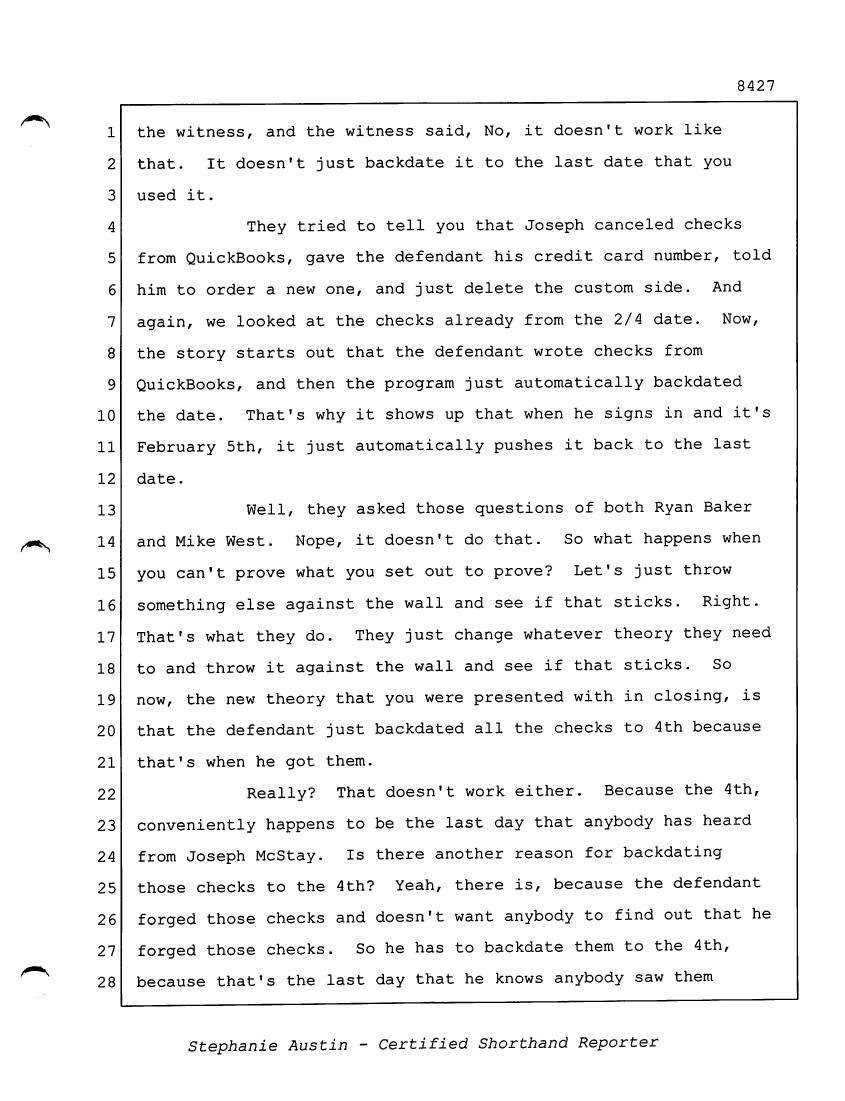
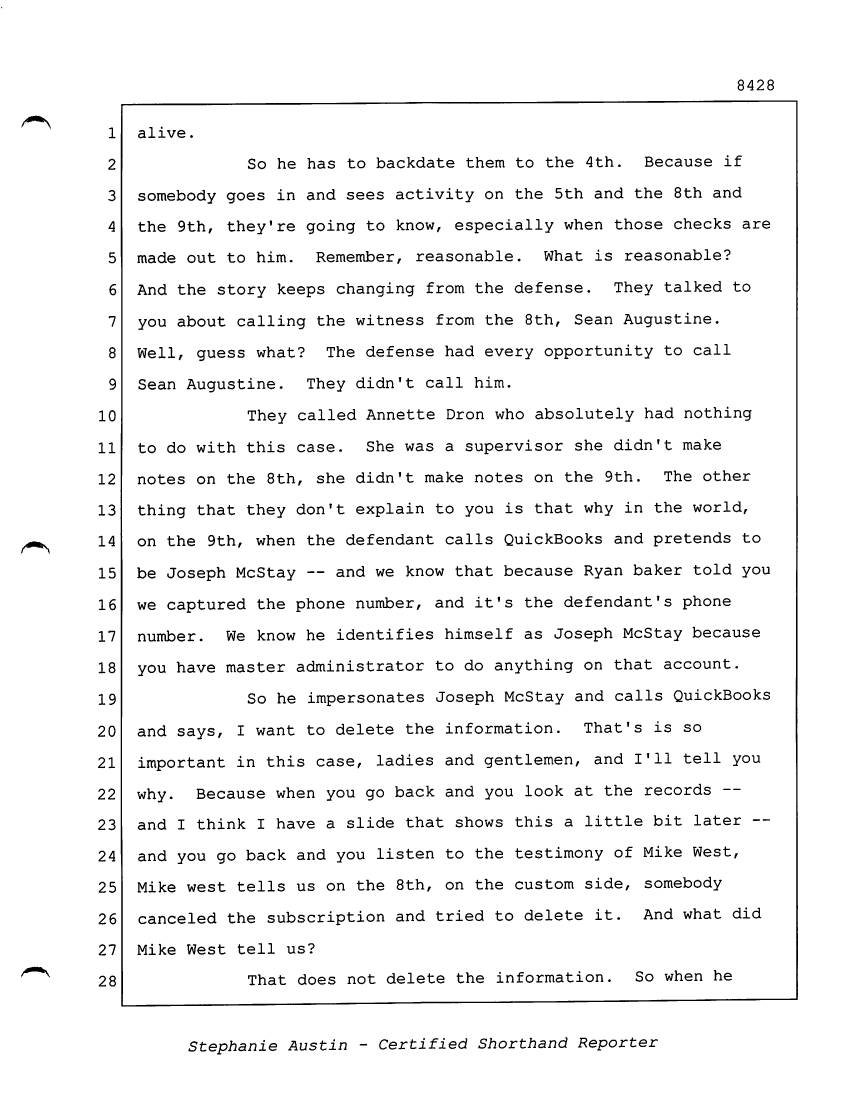
Ms. Rodriguez told the jury the 4th was chosen because it was the last day anyone heard from Joseph: (RT 8427:4-8428:5)
They tried to tell you that Joseph canceled checks from QuickBooks, gave the defendant his credit card number, told him to order a new one, and just delete the custom side. And again, we looked at the checks already from the 2/4 date. Now, the story starts out that the defendant wrote checks from QuickBooks, and then the program just automatically backdated the date. That’s why it shows up that when he signs in and it’s February 5th, it just automatically pushes it back to the last date.
Well, they asked those questions of both Ryan Baker and Mike West. Nope, it doesn’t do that. So what happens when you can’t prove what you set out to prove? Let’s just throw something else against the wall and see if that sticks. Right. That’s what they do. They just change whatever theory they need to and throw it against the wall and see if that sticks. So now, the new theory that you were presented with in closing, is that the defendant just backdated all the checks to 4th because that’s when he got them.
Really? That doesn’t work either. Because the 4th, conveniently happens to be the last day that anybody has heard from Joseph McStay. Is there another reason for backdating those checks to the 4th? Yeah, there is, because the defendant forged those checks and doesn’t want anybody to find out that he forged those checks. So he has to backdate them to the 4th, because that’s the last day that he knows anybody saw them alive.
So he has to backdate them to the 4th. Because if somebody goes in and sees activity on the 5th and the 8th and the 9th, they’re going to know, especially when those checks are made out to him.
See the trial transcript (RT 8427, 8428)
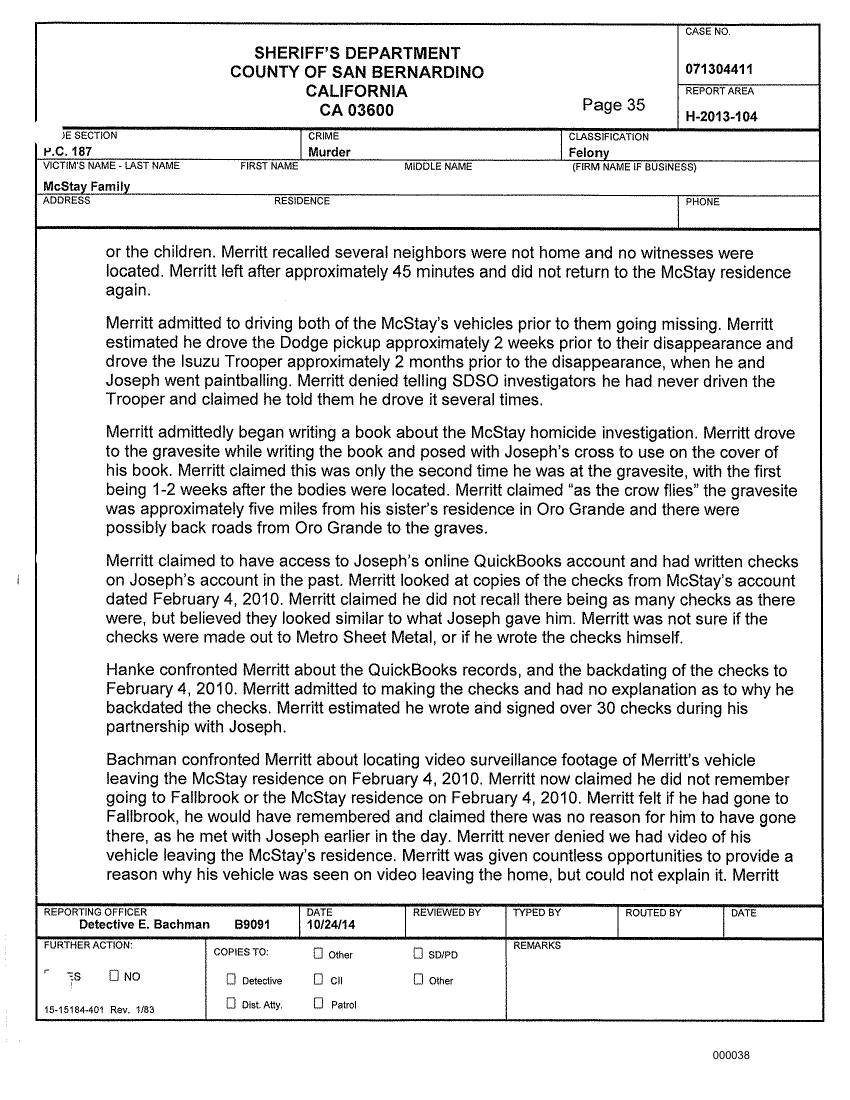
The case summary said I “had no explanation” for the dates: (Bates 000038)
“Merritt claimed to have access to Joseph’s online QuickBooks account and had written checks on Joseph’s account in the past. Merritt looked at copies of the checks from McStay’s account dated February 4, 2010. Merritt claimed he did not recall there being as many checks as there were, but believed they looked similar to what Joseph gave him. Merritt was not sure if the checks were made out to Metro Sheet Metal, or if he wrote the checks himself.”
“Hanke confronted Merritt about the QuickBooks records, and the backdating of the checks to February 4, 2010. Merritt admitted to making the checks and had no explanation as to why he backdated the checks. Merritt estimated he wrote ahd signed over 30 checks during his partnership with Joseph.”
See the State’s case summary (Bates 000038)
My answer
Joseph and I had gone over these checks on the 4th, and I dated them the 4th. (The State’s summary says the $4,500 check was first printed dated the 5th, then edited to the 4th and printed again, Bates 000023.) I almost certainly did it so Joseph could tell which ones I wrote, but nobody asked me until years later, and by then I wasn’t sure. In 2014 I told Bachman, “I have no clue. I mean, I may have thought it was the 4th.” He answered, “you’re absolutely right. Right? It’s the next day. Maybe you thought it was the 4th. So you backdate it.”
What the State already knew
Bachman’s own report of my interview says I “claimed he could have dated the checks thinking it was February 4th” (Bates 007862).
The record
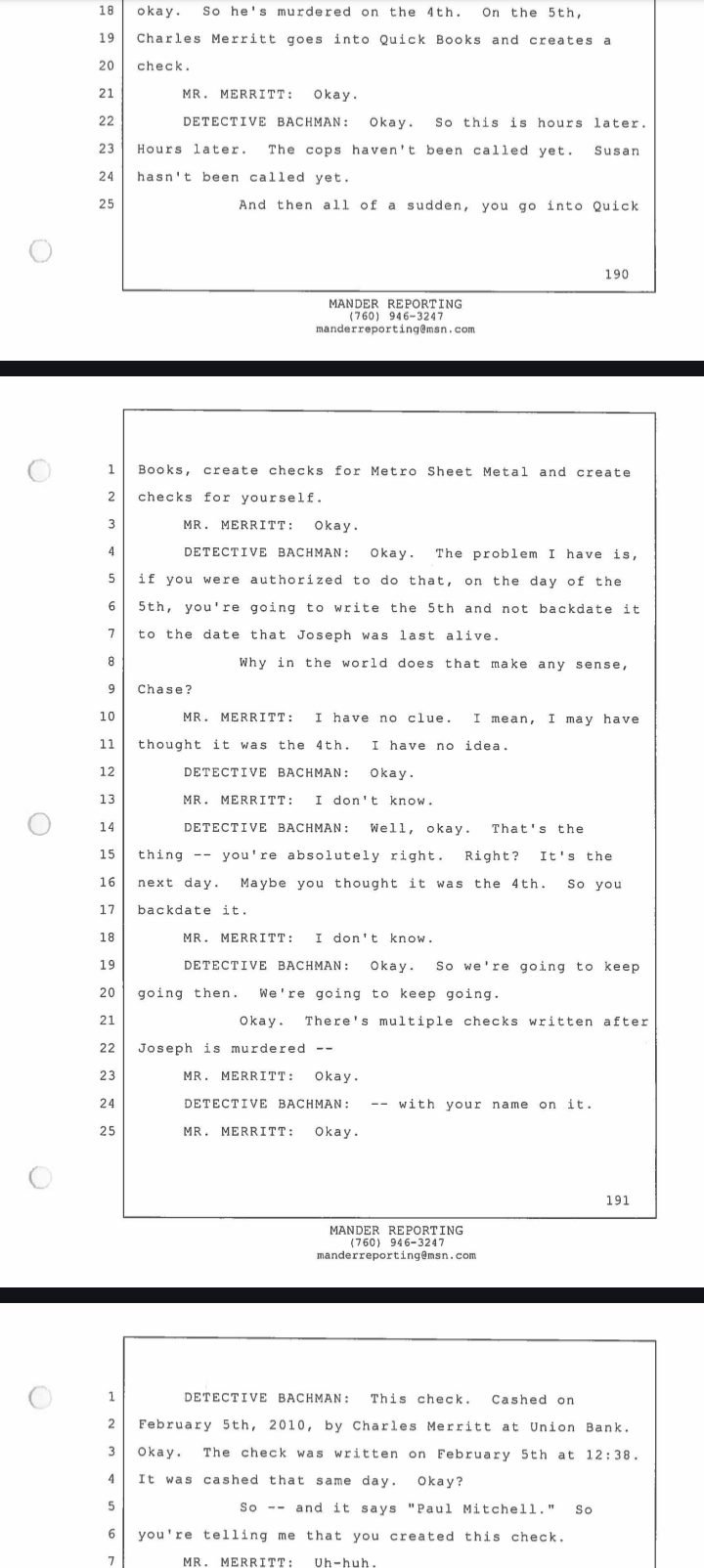
The dates. This is the exchange behind the summary’s “no explanation.” Asked why the February 5 checks were dated the 4th, I said I may have thought it was the 4th. Bachman answered, “you’re absolutely right”: (pp. 190:22-191:20)
DETECTIVE BACHMAN: Okay. So this is hours later. Hours later. The cops haven’t been called yet. Susan hasn’t been called yet.
And then all of a sudden, you go into Quick Books, create checks for Metro Sheet Metal and create checks for yourself.
MR. MERRITT: Okay.
DETECTIVE BACHMAN: Okay. The problem I have is, if you were authorized to do that, on the day of the 5th, you’re going to write the 5th and not backdate it to the date that Joseph was last alive.
Why in the world does that make any sense, Chase?
MR. MERRITT: I have no clue. I mean, I may have thought it was the 4th. I have no idea.
DETECTIVE BACHMAN: Okay.
MR. MERRITT: I don’t know.
DETECTIVE BACHMAN: Well, okay. That’s the thing — you’re absolutely right. Right? It’s the next day. Maybe you thought it was the 4th. So you backdate it.
MR. MERRITT: I don’t know.
DETECTIVE BACHMAN: Okay. So we’re going to keep going then. We’re going to keep going.
See my October 22, 2014 interview (pages 191)
Two pages later, after telling me my account to San Diego was “a completely different story,” Bachman came back to the 5th and said it himself: “Maybe it’s a mess-up”: (pp. 193:22-194:23)
Read the full exchange
DETECTIVE BACHMAN: So what you told San Diego is something — you know, two weeks after they — they were murdered what you told them is now a completely different story than what you told me.
MR. MERRITT: It’s apples and oranges.
DETECTIVE BACHMAN: No. It’s not. It’s really not, Chase. So —
MR. MERRITT: Okay.
DETECTIVE BACHMAN: So I can understand the 5th. And I’m — you know, I understand the 5th. Maybe it’s a mess-up.
The problem I have is, there was a check that was actually printed for the 5th, and then edited. You went back in and edited it and changed the date. Okay?
So — okay. So you actually wrote the check for the 5th —
MR. MERRITT: Uh-huh.
DETECTIVE BACHMAN: — thinking, you know, okay. It’s the 5th. That’s the day maybe it automatically populates, or whatever it is. It actually printed. You go back in a few minutes later and actually edit it at 12:06. The only thing you did on it, Chase — the only thing you did was change it back to the 4th.
MR. MERRITT: Okay.
DETECTIVE BACHMAN: Okay? You printed it. And you backdated it back to the 4th. Okay?
See my October 22, 2014 interview (pages 194)

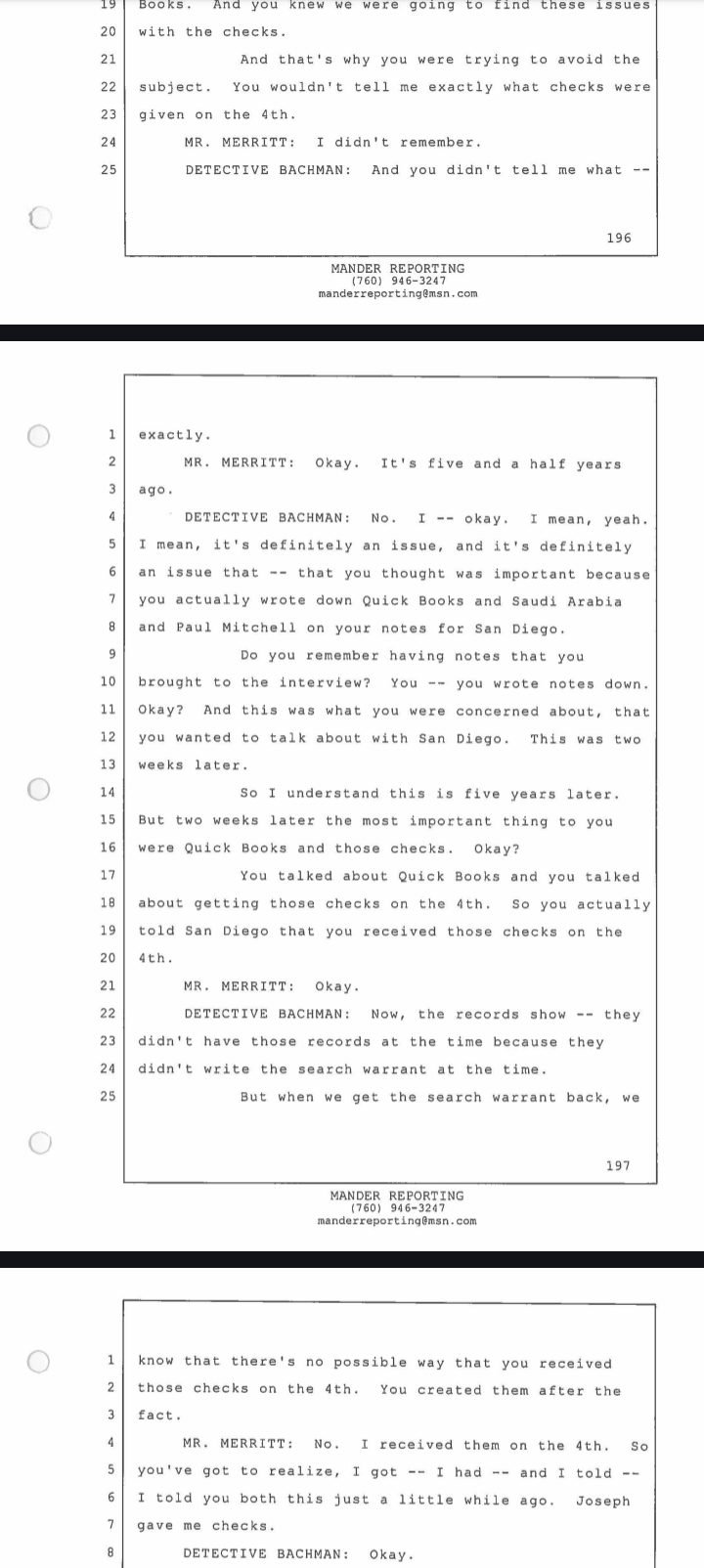
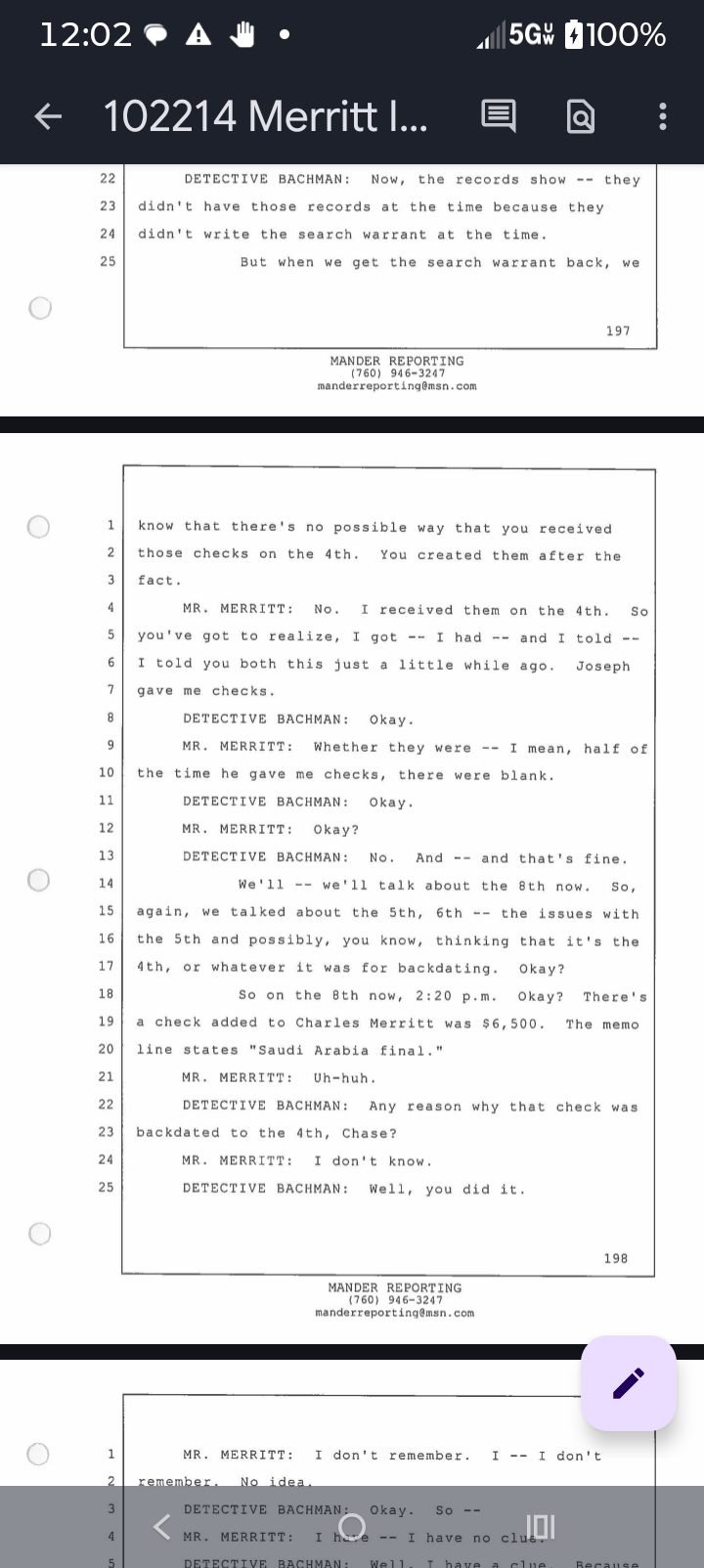
Bachman then said there was no possible way I received the checks on the 4th, and that I created them after the fact. I told him Joseph gave me checks, and that half the time they were blank. (The February 2 check, as I now know, was one of those.) Bachman repeated “thinking that it’s the 4th” himself, then asked about the February 8 check, and on that one I had no answer in the room. He gave his own: that I deleted the checks because Dan Kavanaugh had access to the account: (pp. 197:2-200:18)
Read the full exchange
MR. MERRITT: Okay. It’s five and a half years ago.
DETECTIVE BACHMAN: No. I — okay. I mean, yeah. I mean, it’s definitely an issue, and it’s definitely an issue that — that you thought was important because you actually wrote down Quick Books and Saudi Arabia and Paul Mitchell on your notes for San Diego.
Do you remember having notes that you brought to the interview? You — you wrote notes down. Okay? And this was what you were concerned about, that you wanted to talk about with San Diego. This was two weeks later.
So I understand this is five years later. But two weeks later the most important thing to you were Quick Books and those checks. Okay?
You talked about Quick Books and you talked about getting those checks on the 4th. So you actually told San Diego that you received those checks on the 4th.
MR. MERRITT: Okay.
DETECTIVE BACHMAN: Now, the records show — they didn’t have those records at the time because they didn’t write the search warrant at the time.
But when we get the search warrant back, we know that there’s no possible way that you received those checks on the 4th. You created them after the fact.
MR. MERRITT: No. I received them on the 4th. So you’ve got to realize, I got — I had — and I told — I told you both this just a little while ago. Joseph gave me checks.
DETECTIVE BACHMAN: Okay.
MR. MERRITT: Whether they were — I mean, half of the time he gave me checks, there were blank.
DETECTIVE BACHMAN: Okay.
MR. MERRITT: Okay?
DETECTIVE BACHMAN: No. And — and that’s fine. We’ll — we’ll talk about the 8th now. So, again, we talked about the 5th, 6th — the issues with the 5th and possibly, you know, thinking that it’s the 4th, or whatever it was for backdating. Okay?
So on the 8th now, 2:20 p.m. Okay? There’s a check added to Charles Merritt was $6,500. The memo line states “Saudi Arabia final.”
MR. MERRITT: Uh-huh.
DETECTIVE BACHMAN: Any reason why that check was backdated to the 4th, Chase?
MR. MERRITT: I don’t know.
DETECTIVE BACHMAN: Well, you did it.
MR. MERRITT: I don’t remember. I — I don’t remember. No idea.
DETECTIVE BACHMAN: Okay. So —
MR. MERRITT: I have — I have no clue.
DETECTIVE BACHMAN: Well, I have a clue. Because the last day Joseph is alive is on the 4th. So if you’re cashing a check that’s written for the 5th or the 6th, or the 7th or the 8th — okay? Because this is the day that it’s written. So if the — if it’s the 8th, we know that Joseph is not alive on the 8th.
MR. MERRITT: Okay.
DETECTIVE BACHMAN: So — so checks written, backdated to the 4th. Okay? You printed the check at 2:20. Same minute you deleted it. You know why you deleted it?
MR. MERRITT: Nope.
DETECTIVE BACHMAN: Because you were afraid someone else was going to have access to this account. And the other person who had access to the account would be Dan Kavanaugh.
And that’s why you called Dan Kavanaugh asking him if he had access to the Quick Books account. And you also told Dan Kavanaugh that you had to delete the account because you didn’t — that Joseph didn’t want Summer to know how much money was in there.
So you kind of gave us a little bit of that variation. Okay? Because that’s why you’re concerned because you know that you wrote in there —
MR. MERRITT: I know I wrote checks.
DETECTIVE BACHMAN: You know that someone else had access to those things.
MR. MERRITT: No.
DETECTIVE BACHMAN: Dan Kavanaugh had access to those things.
MR. MERRITT: I didn’t — in the first place, when I called — Dan Kavanaugh and I never got along.
DETECTIVE BACHMAN: Yeah. I understand.
MR. MERRITT: The only time I ever called Dan Kavanaugh is to find out if he was writing checks or he was — had access to Quick Books, because his mother was telling me that he’s getting money somehow —
DETECTIVE BACHMAN: Okay.
MR. MERRITT: — so . . .
See my October 22, 2014 interview (pages 197, 198, 199, 200)

Bachman wrote up the same interview in his report (Bates 007862):
“Hanke showed Merritt several checks dated February 4, 2010, endorsed to Metro Sheet Metal and Charles Merritt. On looking at the checks, Hanke explained to Merritt the signatures on the checks did not match Joseph’s normal signature. Merritt claimed he may have written the checks with Joseph’s permission and at no point in time did Merritt ever forge the checks. Hanke confronted Merritt about several of the checks having been written on February 5, 2010 and February 8, 2010, but being backdated to February 4, 2010. Merritt never denied writing or backdating the checks, and claimed he could have dated the checks thinking it was February 4th.”
See Bachman’s report (Bates 007861-007863)
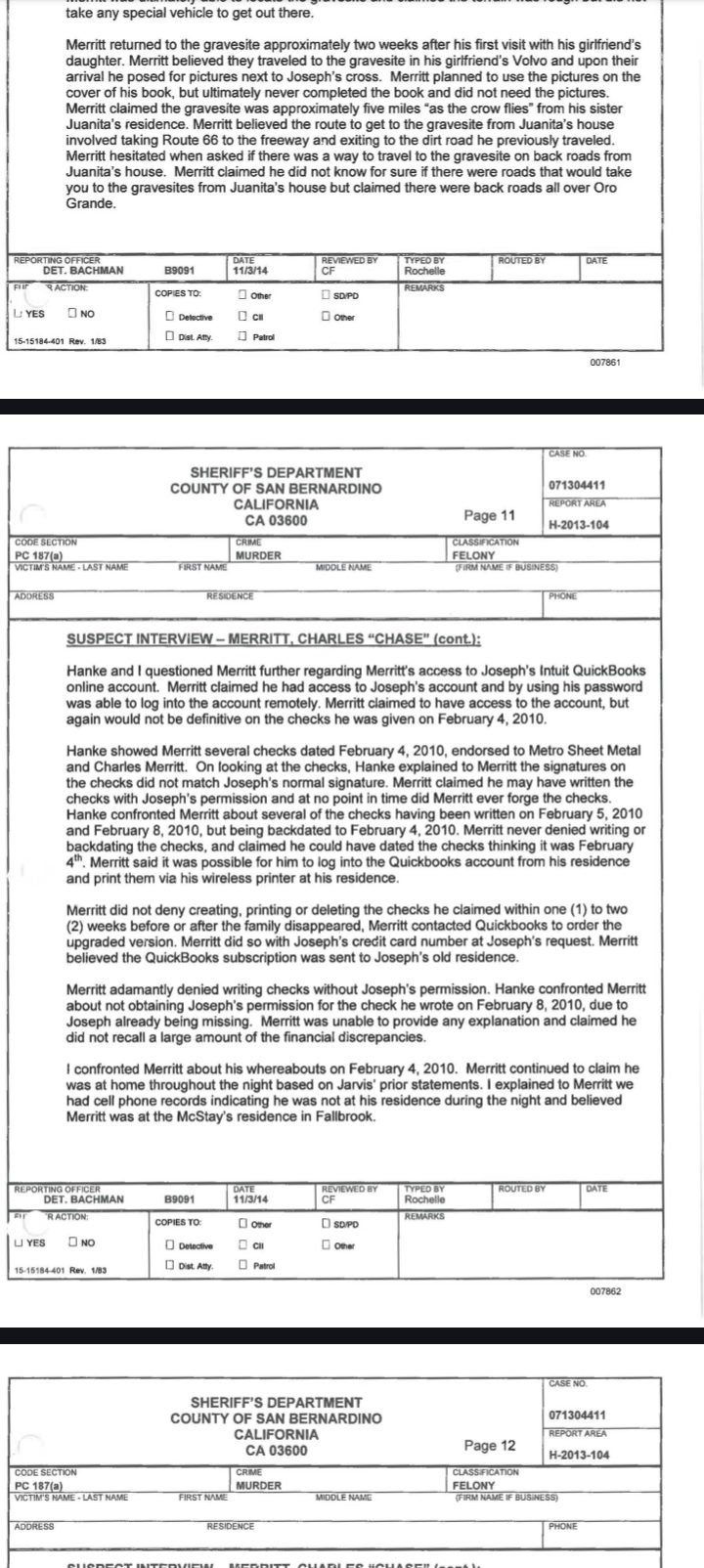
In the room, Bachman said it back to me: “Maybe you thought it was the 4th.” His own report says I “claimed he could have dated the checks thinking it was February 4th.” Yet the State’s case summary says I “had no explanation as to why he backdated the checks” (above, Bates 000038).
Hanke told the preliminary hearing I offered no explanation: (prelim RT 124:3-14)
Q Did you confront him with the fact that those checks that were dated February 4th to himself and to Metro Sheet Metal were backdated?
A Yes, I did.
Q Did you ask him why in the world they would be backdated to the date this family went missing?
A Yes.
Q Did he deny backdating any of those checks?
A He did not deny.
Q Did he have an explanation as to why he would back-date those checks?
A He did not offer any explanations.
See the preliminary hearing transcript (p. 124)

Fact check
- “No explanation”: Bachman’s own report records my explanation, “he could have dated the checks thinking it was February 4th” (Bates 007862), and in the room he said it back to me, “Maybe you thought it was the 4th” (interview p. 191).
- “Because the 4th, conveniently happens to be the last day that anybody has heard from Joseph”: the 4th was also the day Joseph and I met and went over these checks, which I told DuGal in February 2010.
Claim 6 of 15
“Joseph would never hand him his checks. How does that hide anything from Dan?”
What the State said
In rebuttal, Ms. Rodriguez argued Joseph would never have handed me his checks. The court sustained Mr. McGee’s objection to her first version of it and told the jury to disregard it; his objection to the second was overruled. She went on to say that keeping the checks from Dan made no sense: (RT 8420:20-8422:12)
Read the full exchange
MS. RODRIGUEZ: The other part that we need to talk about is this assertion that the defendant received blank checks from Joe on that date. Why in the world is Joe going to give financial responsibility to a convicted felon with a gambling problem?
MR. MCGEE: Objection. Improper argument. Move to admonish.
THE COURT: Sustained. There’s no evidence that Mr. McStay was aware of the fact that the defendant had a burglary conviction that was referenced during the testimony, so the jury is instructed to disregard that portion of the argument.
MS. RODRIGUEZ: Well, we know from Susan Blake’s testimony that Joe had bailed the defendant out of a gambling debt for about $20,000.00.
MR. MCGEE: Objection, your Honor, that violates the Court’s ruling and that assumes facts not in evidence.
THE COURT: Overruled.
MS. RODRIGUEZ: Susan —
THE COURT: Again, ladies and gentlemen, the — you are the — to determine what the facts and the evidence are, and so it’s up to you to review what the actual evidence was with regard to that particular issue, and, of course, your determination as to its significant.
MR. MCGEE: Defense would request to approach now because the People just violated a direct court order on what they can argue.
THE COURT: Denied.
MS. RODRIGUEZ: Susan Blake testified very specifically from that witness stand that Joe was aware of the defendant’s gambling problem and that he had helped him out in the neighborhood of $20,000.00. That’s what she testified to. You have questions about that, please go back, ask for readback on that portion of her testimony, because the defendant had gotten money from Joe for that particular issue.
So why in the world is Joe going to hand over financial documents, checks, to somebody that has that issue and say, hey, you go ahead, you take control? You just write these checks and you sign my name to them. That’s fine. I’m good with that. There’s actually no apparent reason for Joseph McStay to do that. Because remember the whole defense theory is, hey, we’re going to hide this from Dan.
How does giving checks to the defendant hide anything from Dan? It doesn’t even make sense, and you don’t have evidence of that either. When you look at the checks that the defendant wrote, we have a check dated February 2nd, you have the defendant in his interview telling Detective DuGal, I met with him and I got checks on February 4th. Nowhere have you heard evidence that he had checks from Joseph McStay prior to that.
See the trial transcript (RT 8420, 8421, 8422)


My answer
Joseph handed me checks for years, and wrote me checks himself. Hanke said so in my interview: “He did write checks to you” (Claim 4). Giving me checks didn’t hide them from Dan. Deleting them from the online QuickBooks account Dan could see did (Why the jobs were kept from Dan and Summer).
What the State already knew
I told Bachman in 2014 that Joseph gave me checks for Metro, for me and for the work we had planned, and that I paid them out as things came due.
The record
Asked what the checks were that Joseph gave me on the 4th, I told them they were for Metro, for me, and for the work we had planned, and that after Joseph disappeared I made sure Metro was paid and finished the Saudi job myself: (pp. 54:8-55:23)
Read the full exchange
DETECTIVE BACHMAN: The checks that you talked about that he gave, what were the — what were the checks?
MR. MERRITT: Well, they were just — just checks for — for Metro, for me, for just stuff that we were — we were planning.
DETECTIVE BACHMAN: Okay.
MR. MERRITT: I mean, we — every time we met, he would — we would figure out what the next week or two or three or four would be. And he would give me checks for — for those things.
DETECTIVE BACHMAN: Okay.
MR. MERRITT: And no different that day. I mean, he picked — I know that he gave me one or two checks for Metro. I don’t remember how many exact. I know that one of them was for the Saudi project.
DETECTIVE BACHMAN: Uh-huh.
MR. MERRITT: I think Metro was doing some — some other project, too, with us at that — at that particular time. And I can’t remember what waterfall. It may have been the hair salon, Paul Mitchell. It may have been a Paul Mitchell. Because we had a contract — Joseph and I, we had had — Joseph had the contract for Paul Mitchell. And any salon — any Paul Mitchell salon that was built or established anywhere in the continental United States, we built waterfalls for. And so we were — that was another one of the projects. And I think there was a Paul Mitchell waterfall in process then. But I can’t remember.
DETECTIVE BACHMAN: Okay.
MR. MERRITT: But I finished at the — at the end, after Joseph was — had disappeared, I finished the — I — I made sure that Metro got paid. I finished the Saudi project. I made sure all of the shipping was taken care of. I actually flew to Saudi Arabia and installed it —
DETECTIVE BACHMAN: Okay.
MR. MERRITT: — myself. That was a — that was a nightmare project.
See my October 22, 2014 interview (pages 53-56)


Fact check
- Her first version, a “convicted felon with a gambling problem,” was ruled improper because nothing showed Joseph knew of my conviction, and the jury was told to disregard that portion (RT 8420-8421).
- “How does giving checks to the defendant hide anything from Dan?”: Dan told detectives he “had access to the Quick Books account” (p. 65) and that Joseph set up the second account “kind of like behind my back” (p. 23); Hanke’s report says Dan believed it was set up “so Kavanaugh could not see the deals” (Bates 007291).
Claim 7 of 15
“He deleted the checks to cover his tracks.”
What the State said
Mr. Imes told the jury the checks were deleted “in an attempt to cover their tracks”: (RT 8213:2-11)
You would have to ignore the fact that his first human contact, via cell phone, at 9:32 p.m., is not at home, and it’s not on those towers that he hit time after time after time after time and again, over months, when he was at home. You would have to ignore the fact that those checks were written to lowercase Charles Merritt and negotiated by the defendant into his account. You would also have to ignore the fact that those checks were deleted in an attempt to cover their tracks. You would have to ignore that to find that he wasn’t there on the 4th.
See the trial transcript (RT 8212-8214, Mr. Imes)
Ms. Rodriguez asked why anyone would delete checks if he was going to delete the whole account: (RT 8448:5-13)
The last check was written and deleted on February 8th, and the QuickBooks activity to delete was done on February 9th, the very next day. Ryan Baker said that the caller was adamant that he needed it to be deleted and that was so important that he put it in all caps. Why would you take the time to go through and delete the checks if you’re just going to delete the entire account? If you are making a call on February 9th, to say, I want to delete the account, why take the time to go and delete checks? It doesn’t make sense.
See the trial transcript (RT 8448, Ms. Rodriguez)
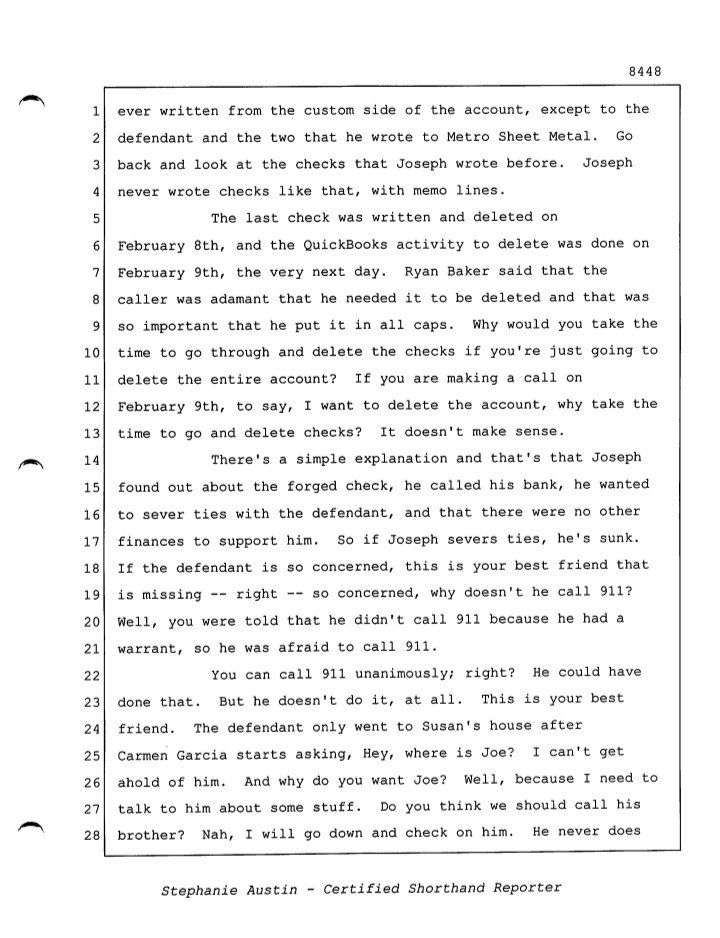
My answer
The deleting started with Joseph, before I wrote a single check, and he kept doing it after my first one. On February 1 Joseph created two checks to me, printed them, deleted them, and called me. On the morning of February 2 he gave me a check and showed me again how to delete it; I wrote it that morning, deleted it, and called him. On the evening of February 4 a $4,000 check to me was created in QuickBooks from the McStay house and deleted. So my February 2 check falls between Joseph’s February 1 and February 4 checks, handled the same way: created in QuickBooks and deleted (the State’s summary says the February 4 check was never printed, Bates 000023).
What the State already knew
In June 2011 I told DuGal the February 4 meeting was about getting Dan out of Joseph’s accounts (What I told them, and when). Dan told detectives Joseph set up the second account “kind of like behind my back” (Kavanaugh p. 23).
The record
On February 4, Joseph came to Rancho Cucamonga and we met about the two projects and the money. He gave me the checks I’d need over the next several days. That evening at 7:59, by my account, he made one more check to me in QuickBooks, for $4,000. Two print jobs went from the McStays’ computer to the printer, and what they contained couldn’t be recovered (RT 3941-3942); on cross-examination Mr. Imes called it a “test run of print page” (RT 6592). The check was deleted a few minutes later. I’m not sure why he did this, but my assumption would be that he was again making sure this procedure would indeed hide the transaction from Kavanaugh.
On the evening of February 4, a $4,000 check to me was created in QuickBooks and deleted without being printed. This is the State’s summary of it in full: (Bates 000023)
“On February 4, 2010, at 1959 hours, the custom QuickBooks account was logged into and the user added a check for “charles merritt” for $4000.00 with “paul mitchell” in the memo line. The check was never printed and the user deleted the check at 2005 hours. Per computer records, this check was created from the Mcstay residence in the time frame Merritt’s cell phone was off and his vehicle was seen on cameraat the McStay residence.”
See the State’s case summary (Bates 000023)

The cell phone evidence and the alleged sighting of my vehicle are clearly refuted in their respective arguments here on the site:
Phone is “off” if an incoming call goes to voicemail?Home that nightThe Mitchley videoFact check
- Ms. Rodriguez: “Why would you take the time to go through and delete the checks if you’re just going to delete the entire account?” The checks were deleted as they were written, day by day from February 1 to February 8, because the online account was still there for Dan to see. Getting the online account deleted was meant to be the last step, once the books had been moved to QuickBooks Pro (Claims 8 and 9).
Who’s who
- Joseph McStay: owner of Earth Inspired Products (EIP).
- Me, Chase Merritt: I designed and built the custom waterfalls.
- Dan Kavanaugh: Joseph’s partner in EIP. He ran the website.
- Summer McStay: Joseph’s wife.
- Metro Sheet Metal, Azusa (Dave Sequeida Sr.): fabricated the sheet metal portion of the fountains.
- Susan Blake: Joseph’s mother.
- McGyver McCargar: a family friend who was painting at the McStay house.
- Rahage Trading, Riyadh (paid through Kocache Enterprises): the Saudi customer.
- MW Mitchell Construction: the Paul Mitchell job.
- Intuit: the company that makes QuickBooks. Joseph had two QuickBooks Online accounts: the main one (contact@earthinspiredproducts.com) and the custom one for the jobs he and I did (custom@earthinspiredproducts.com).
- Shawn Augenstein: the Intuit representative on the February 8, 2010 case. The trial transcript spells him “Augustine,” and Baker’s interview “Odgenstine.”
- Ryan Baker: the Intuit representative who took the February 9, 2010 call. He testified by video.
- Mike West: an Intuit investigator who testified about the account records.
- Annette Dron and Janet Taylor: Intuit employees who spoke with Det. DuGal in 2011. Dron testified for the defense on April 16, 2019.
- Det. Troy DuGal: San Diego Sheriff’s Department, 2010-2011.
- Dets. Eddie Bachman, Dan Hanke and R. Smith: San Bernardino County Sheriff’s Department, 2014. Det. Hanke handled the QuickBooks records.
- Mr. Daugherty, Mr. Imes and Ms. Rodriguez: the prosecutors.
- James McGee and Rajan Maline: my lawyers at trial. Mr. Terrell: my lawyer at the preliminary hearing.
The checks
As the State’s own case summary lists them (Det. Bachman, Bates 000022-000024), with the check numbers from the State’s check lists (Bates 007415, 007417):
- February 1: two checks to me, $2,500 each, memo “deposit” (#4092, #4093). Printed and deleted. Never given to me, never cashed.
- February 2: a check to me for $2,495, memo “deposit sa 1001” (#4240, dated February 2). I cashed it February 2 at Union Bank. (A $0.00 check was also created and printed; it was not cashed.)
- February 4, 7:59 p.m.: a check to me for $4,000, memo “paul mitchell.” Never printed; deleted at 8:05 p.m. Two print jobs were sent that night, and nothing readable was recovered from them (RT 3941-3942). Never negotiated.
- February 5, dated February 4: to me, $4,500, “paul mitchell” (#4237). Cashed February 5 at Union Bank.
- February 5, dated February 4: to Metro Sheet Metal, $1,650, “misc manufacture” (#4236), and $250, “copper” (#4238). Metro cashed them March 5.
- February 5, dated February 4: to me, $6,505, “balance sa (1001).” Not cashed.
- February 5, dated February 4: to me, $2,350, “lighting install sa (1001)” (#4242). Deposited February 5 at Bank of America. (The State’s summary first lists it as $2,300.50; the check was $2,350.00, as the summary itself later says and the bank report and check list show.)
- February 8, dated February 4: to me, $6,500, “saudi arabia final” (#4241). Deposited February 9 at Bank of America.
Much of the money I received went on to Metro and into the two jobs. “Where the money went,” under Claim 15, shows where it went.
See the State’s case summary (Bates 000022, 000023, 000024)

Exhibits and terms
- RT: the trial transcript (reporter’s transcript). “RT 7025:17-18” means page 7025, lines 17 to 18.
- Bates number: the page number stamped on each page of the discovery the State turned over.
- Exhibit 794: my AT&T phone record, February 2009 to February 2010.
- Joseph’s T-Mobile record: T-Mobile’s subpoena response to Det. DuGal, February 24, 2010 (Bates 005509-005512 on this page).
- Exhibits 1115 and 1123: the defense accountant’s flow-of-money charts for the Saudi and Paul Mitchell jobs. Both were shown to the jury. 1123 was shown, with boxes ordered removed, as Exhibit 1133.
- Exhibit 740: Metro Sheet Metal’s statement of March 1, 2010. The court kept it out, except that the jury heard $3,450 was still due.
- Exhibit 419: Joseph’s e-mail to me of February 1, 2010.
- Exhibit 990: my e-mail to Susan Blake from Riyadh.
- Folder D: my notes on the checks, given to James McGee October 16, 2017.
- Exhibit 794 items 9150-9179: my calls on February 8 and 9, 2010 (AT&T pages 374-375).
- INT_MCSTAY (INT) numbers: the pages Intuit produced to San Bernardino under the search warrant. Exhibits 808 and 809 are INT 000047-49 (custom account) and INT 000050-54 (main account).
- The custom account: Joseph’s second QuickBooks Online account, custom@earthinspiredproducts.com. The main account: contact@earthinspiredproducts.com.
- Activity log: the custom account’s “All activities by all users” log, printed October 13, 2014.
- MMA: master administrator, the one user who can close or delete a QuickBooks Online company.
- Prelim RT: the preliminary hearing transcript.
Sources
- Trial transcript, People v. Merritt, San Bernardino County Superior Court, Case No. FVI1404194 (RT): Sequeida Jr. 2846; Blake 4995 (court), 5512-5514, 5541-5542; exhibit rulings 7011-7026 (April 29, 2019); defense accountant 7080-7086; Det. DuGal 2475, 2482-2483, 2521; Annette Dron 6240-6281 (April 16, 2019); Jan. 31, 2019 hearing 3627-3640; Ryan Baker 3739-3780 (Feb. 6, 2019); Mike West 3975-3996 (Feb. 13, 2019); Det. Hanke 4054-4066 (Feb. 14, 2019); closing arguments 8190-8225 (Imes), 8294 and 8331-8333 (McGee), 8420-8430 and 8448 (Rodriguez); McGyver McCargar 2230-2239, 2266, 2270-2273, 2279, 2286; Det. Schroeder 3941-3942; Bryan La Rock 6488-6490, 6583-6586, 6592-6593, 6598-6599.
- San Diego Sheriff’s Department: interview of Daniel Kavanaugh, 2-22-10 #2 (pp. 18-24); DuGal follow-up report on my interview of February 17, 2010 (Bates 001673-001675), and the interview transcript (pp. 15, 28, 31).
- San Bernardino County Sheriff’s Department: bank report, Det. R. Smith, October 27, 2014 (Bates 007446-007448); case summary; interviews of Susan Blake (August 13, 2014) and Dave Sequeida Sr. (September 30, 2014); my interview (October 22, 2014).
- Trial exhibits: 794 (my AT&T record), 990 (my e-mail to Susan Blake from Riyadh), 1115 (Saudi flow of money, shown to the jury), 1123 (Paul Mitchell flow of money; shown to the jury, modified, as 1133), 740 (Metro’s March 1, 2010 statement), 419 (Joseph’s e-mail of February 1, 2010).
- My handwritten pages for Susan Blake, March 17, 2010; my photos from Saudi Arabia; the Rahage Trading purchase-order e-mail.
- Intuit records, INT_MCSTAY000004-000054; the custom account activity log and check audit histories (Exhibits 421, 425, 426, 427, 429).
- San Bernardino: search warrant to Intuit sworn August 21, 2014; Det. Hanke’s reports (Bates 000589; 007467-007470) and the interview of Ryan Baker, October 24, 2014; interview of Dan Kavanaugh, September 20, 2014; preliminary hearing testimony of Det. Hanke (pp. 101-124).
- San Diego: recorded calls with me, June 9 and June 21, 2011, and DuGal’s follow-up report on me (pp. 23-24); Det. Hillen’s report on Susan Blake (Bates 001818-001819); recorded call between Det. DuGal and Intuit, May 11, 2011; recorded calls with Annette Dron, May 12, 2011 (audio; my 2017 handwritten copy of the transcript) and May 24, 2011 (audio); my interview of February 17, 2010 (pp. 15-16, 31).
- My notes on the checks (Folder D), given to James McGee October 16, 2017.
Part 2 of 4
- The Checks, QuickBooks, and the Motive
- The Checks (Claims 1-7) (you are here)
- The QuickBooks Calls (Claims 8-14)
- The Money (Claim 15)