Closing argument: what they told the jury
In a trial, closing argument is the last thing the jury hears from the lawyers before it goes into the jury room. What a lawyer says there isn’t evidence, and the judge tells the jury so, but jurors take a prosecutor’s closing as the State’s account of what the evidence showed. Ms. Rodriguez’s rebuttal came last of all, and the defense doesn’t get to answer a rebuttal.
This page takes the statements the prosecutors made to my jury, in closing argument, in rebuttal and at the penalty phase, and checks each one against the record. Each card quotes what was said, word for word, and then shows what the record says, right where you need it. Where a statement was false, I say so. Where it was misleading, I say that instead. Each card also says what my own lawyers did about it, or didn’t.
Mr. Imes · closing argument · May 28, 2019 · and Ms. Rodriguez · rebuttal · May 29, 2019
“You cannot isolate an individual fact”
On the morning of May 28, 2019, the judge read the jury its instructions, and then the closing arguments began. Mr. Imes and Ms. Rodriguez spent part of theirs telling the jury that no fact in the case could be looked at by itself. The instructions the jury had just heard said something different. All of what follows was said in front of the jury, and no one objected to any of it.
1. “You cannot look at those facts in isolation”
Mr. Imes started near the beginning of his closing argument:
“You can’t just look at one thing in isolation. It is one big piece of collective evidence.”
(RT 8184:24-26)
See RT 8184
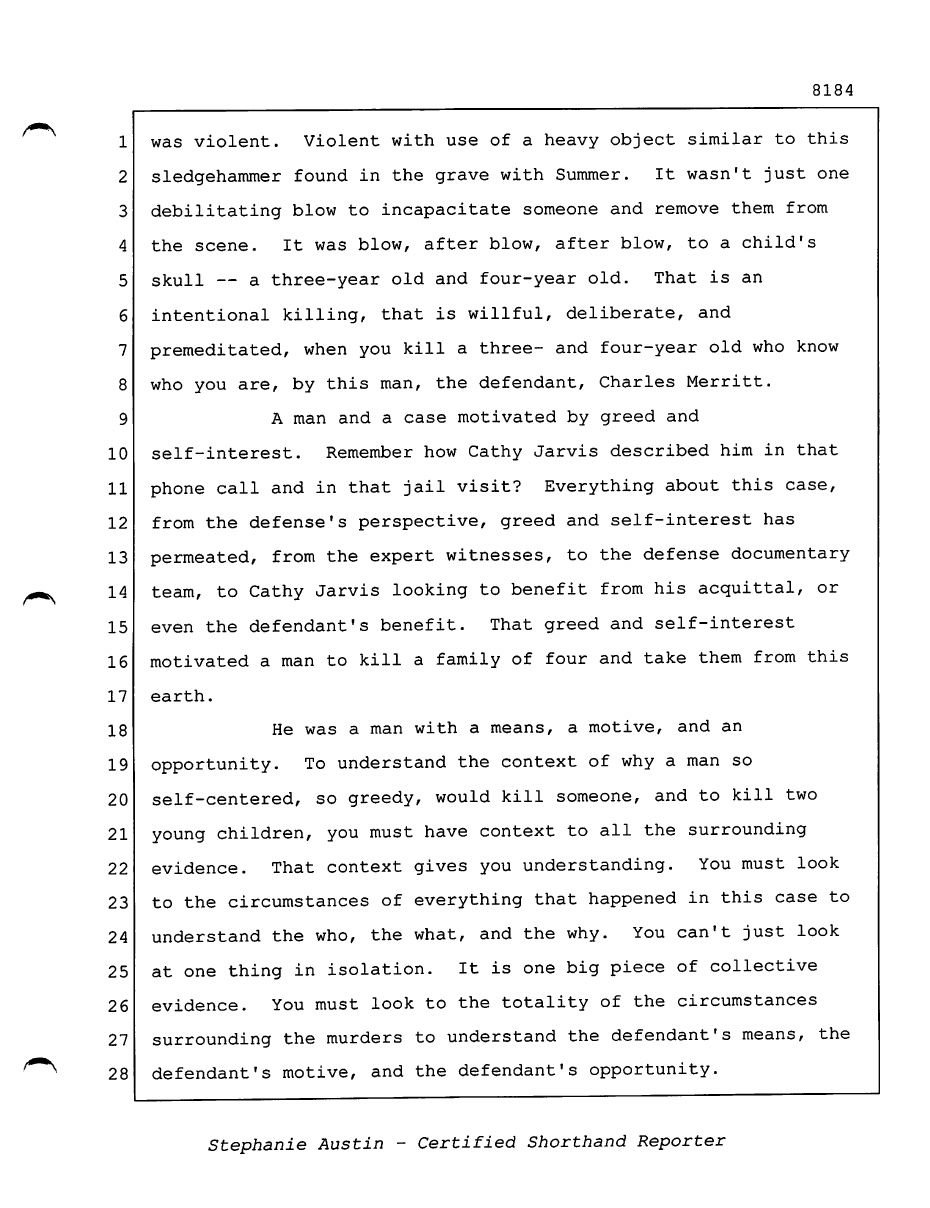
“A single individual fact may have two reasonable interpretations, one points to guilt, one points to innocence. And that isolated individual fact, in that scenario, you would have to accept the one that points to innocence. The problem is, ladies and gentlemen, when you’re talking about the totality of a case that spans six months of your lives, almost six months, is you cannot look at those facts in isolation.”
(RT 8185:13-19)
See RT 8185
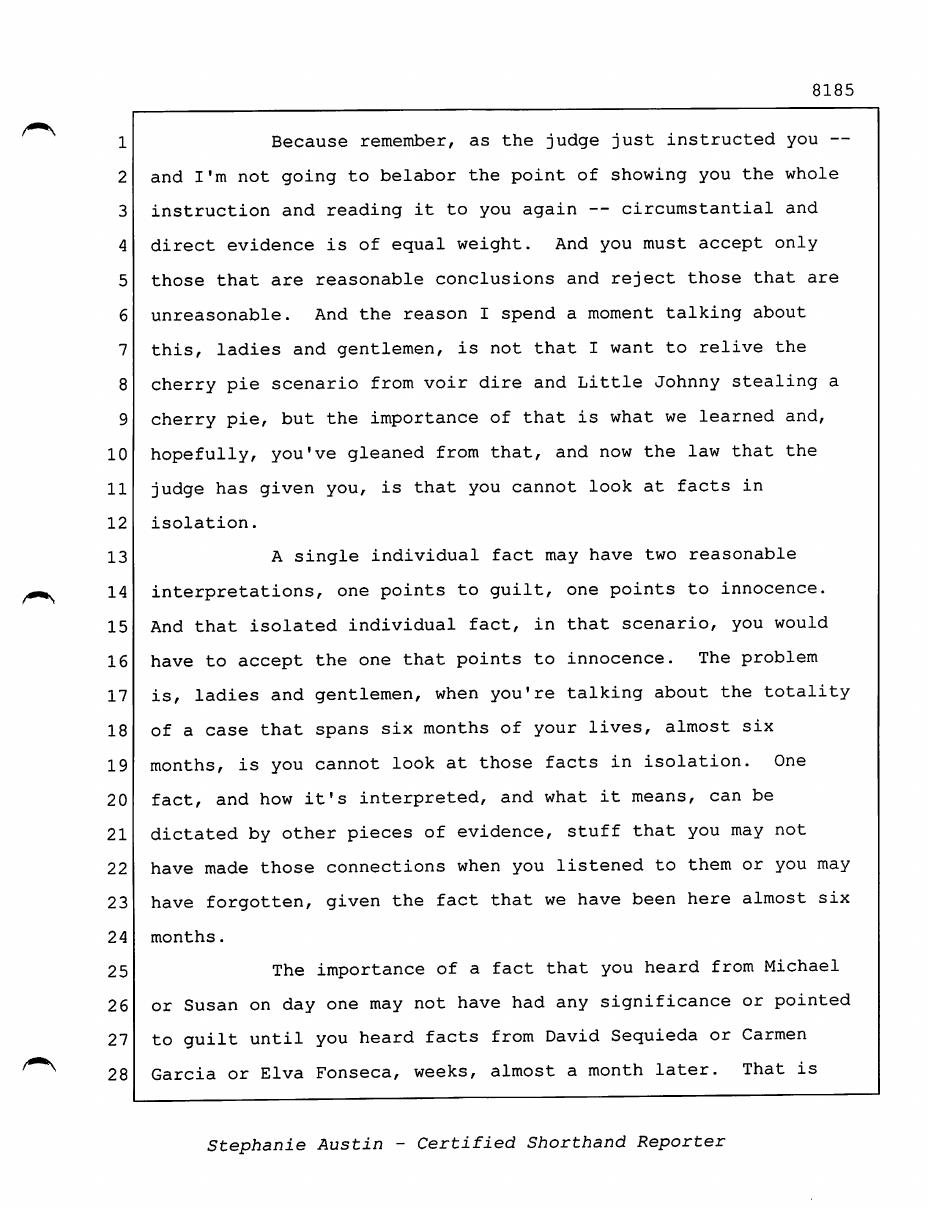
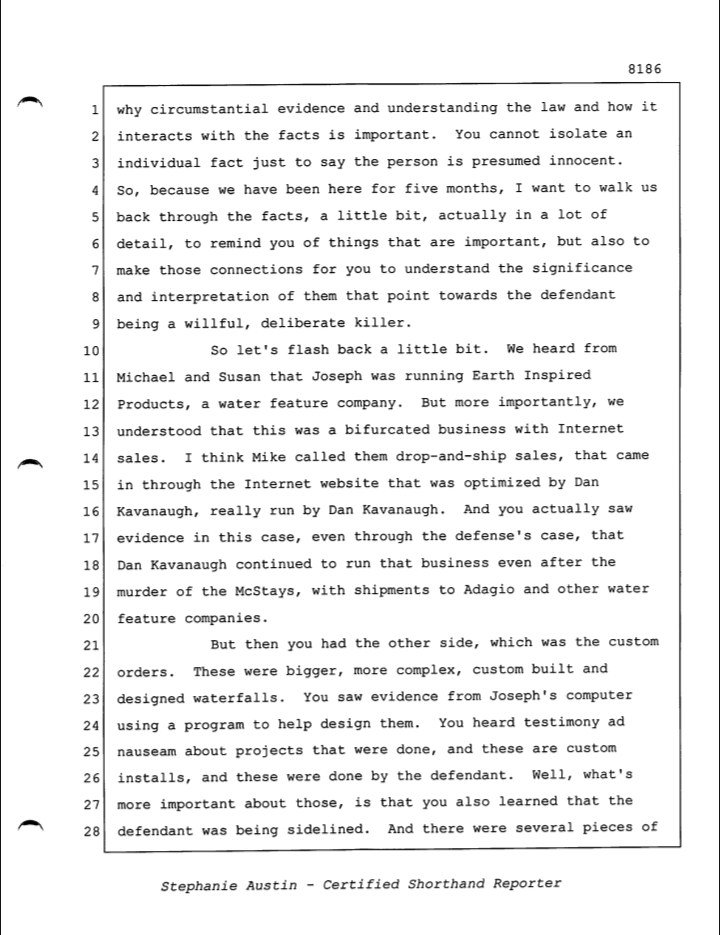
“You cannot isolate an individual fact just to say the person is presumed innocent.”
(RT 8186:2-3)
See RT 8186
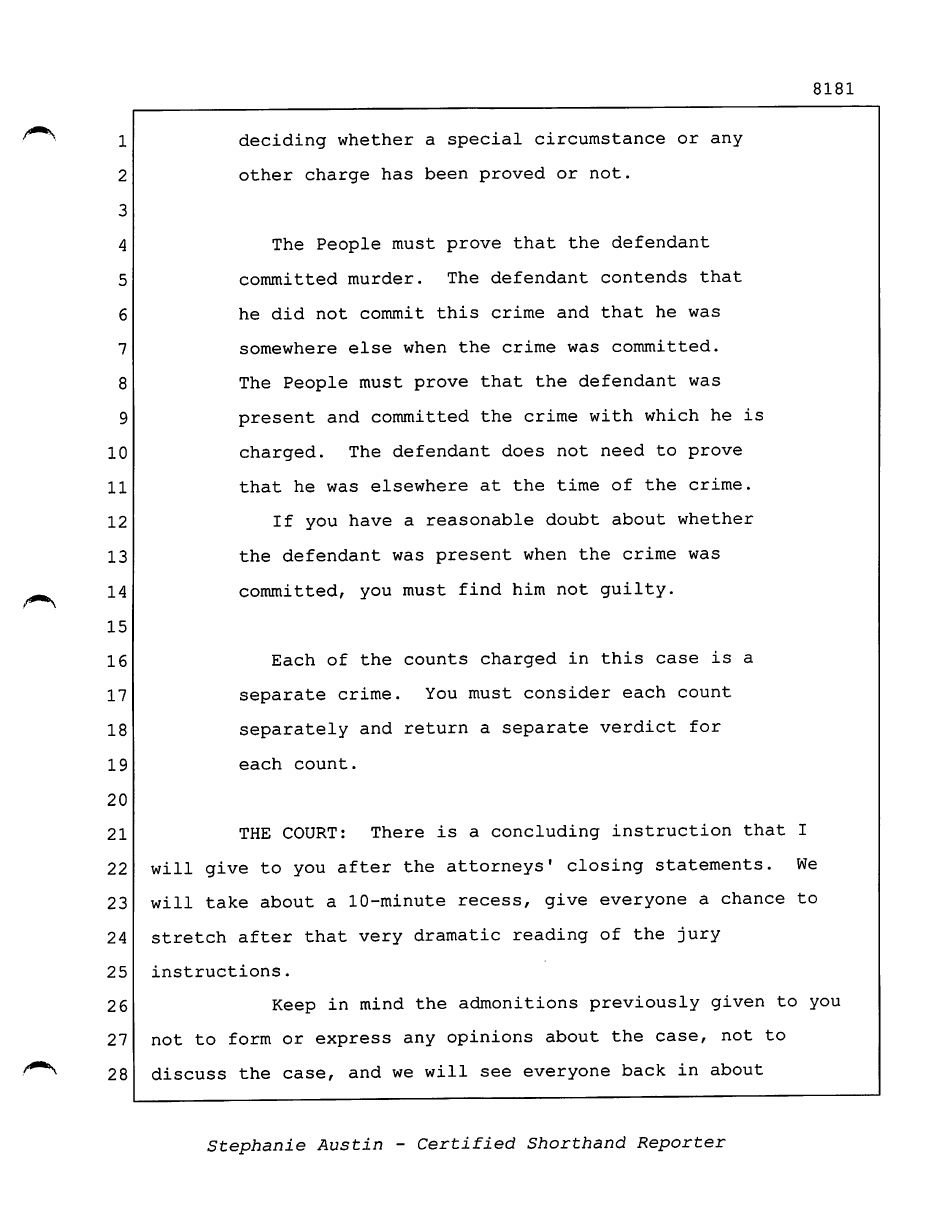
The first two were misleading, and the third was false. The jury could weigh all the evidence together, and the People were free to argue that everything pointed to me. But the instructions the judge had just read also work one fact at a time. The alibi instruction, CALCRIM 3400, takes one fact, whether I was there, and tells the jury that a reasonable doubt about it alone means not guilty:
“If you have a reasonable doubt about whether the defendant was present when the crime was committed, you must find him not guilty.”
(RT 8181:12-14)
See RT 8181
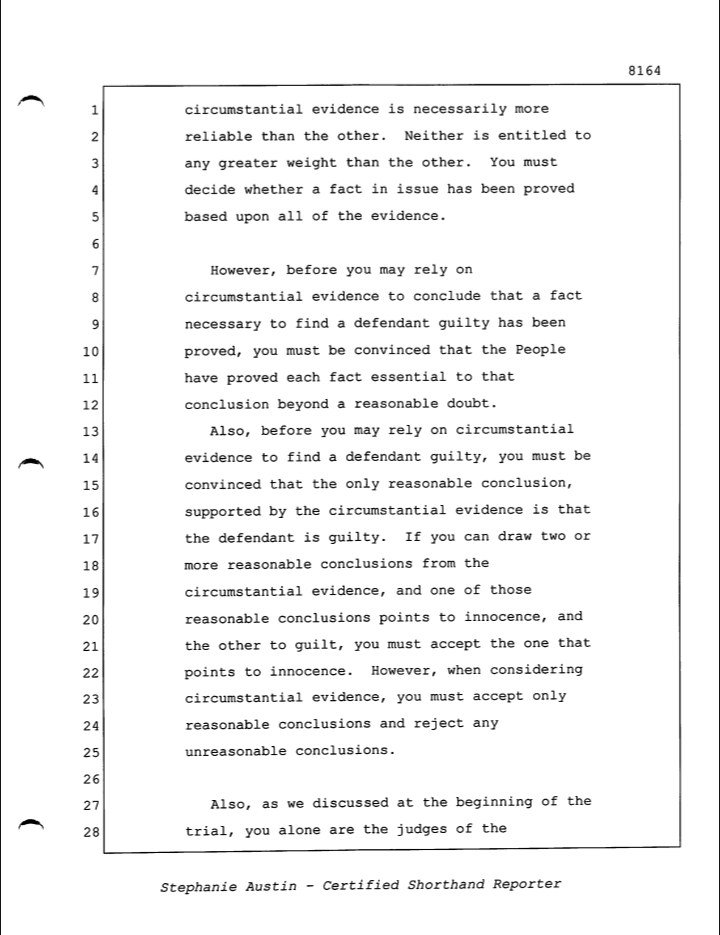
The circumstantial evidence instruction, CALCRIM 224, says the same for every fact a guilty verdict depends on:
“However, before you may rely on circumstantial evidence to conclude that a fact necessary to find a defendant guilty has been proved, you must be convinced that the People have proved each fact essential to that conclusion beyond a reasonable doubt.”
(RT 8164:7-12)
See RT 8164
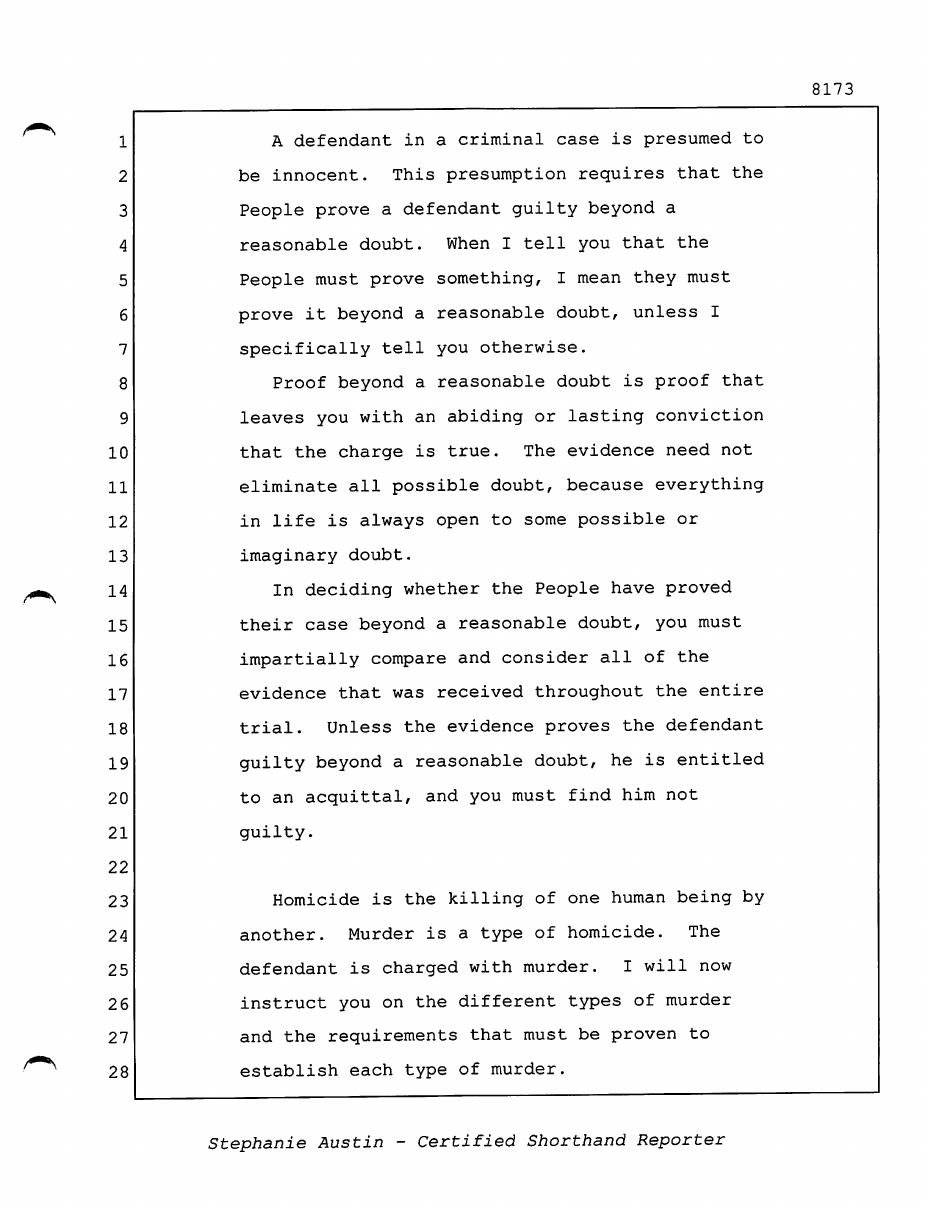
And the presumption of innocence isn’t something a defendant earns by pointing to a fact. It is where the jury starts. The judge told them so, in CALCRIM 220:
“A defendant in a criminal case is presumed to be innocent. This presumption requires that the People prove a defendant guilty beyond a reasonable doubt.”
(RT 8173:1-4)
See RT 8173
2. Innocent readings, set aside
Mr. Imes then used the same argument on particular pieces of evidence. Each time he admitted there was an innocent reading, and told the jury to set it aside. On the checks:
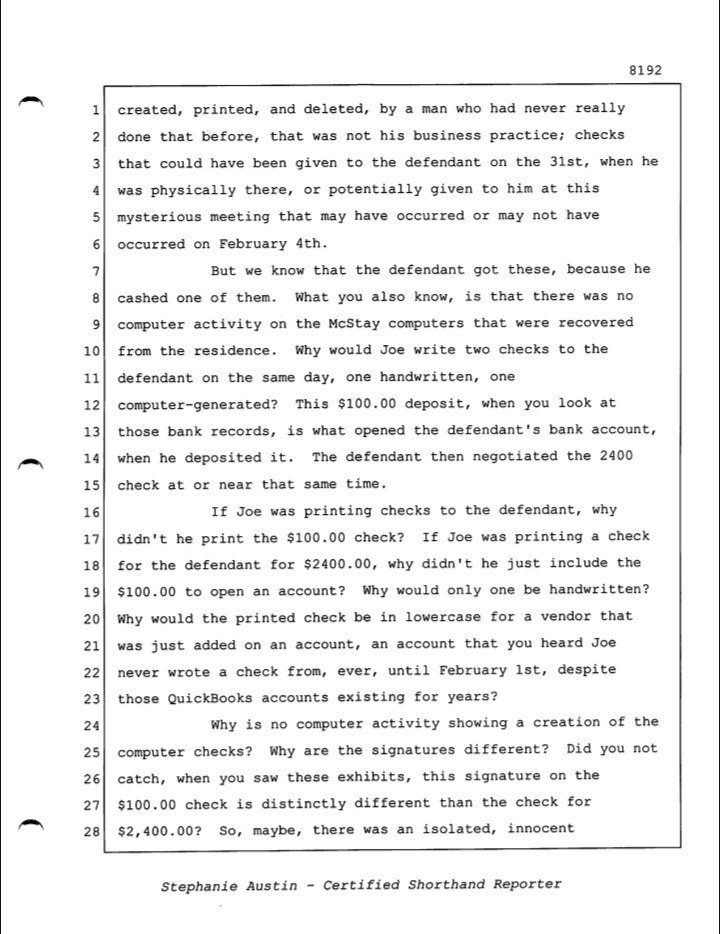
“So, maybe, there was an isolated, innocent explanation for the printed check that it was a deposit for the Saudi Arabia project. Okay. That standing alone would point to innocence. However, when you put it all into context and answer all of those questions about all of the attendant circumstances on February 1st and 2nd, is that now a reasonable interpretation of that check? No.”
(RT 8192:28-8193:7)
See RT 8192 and 8193
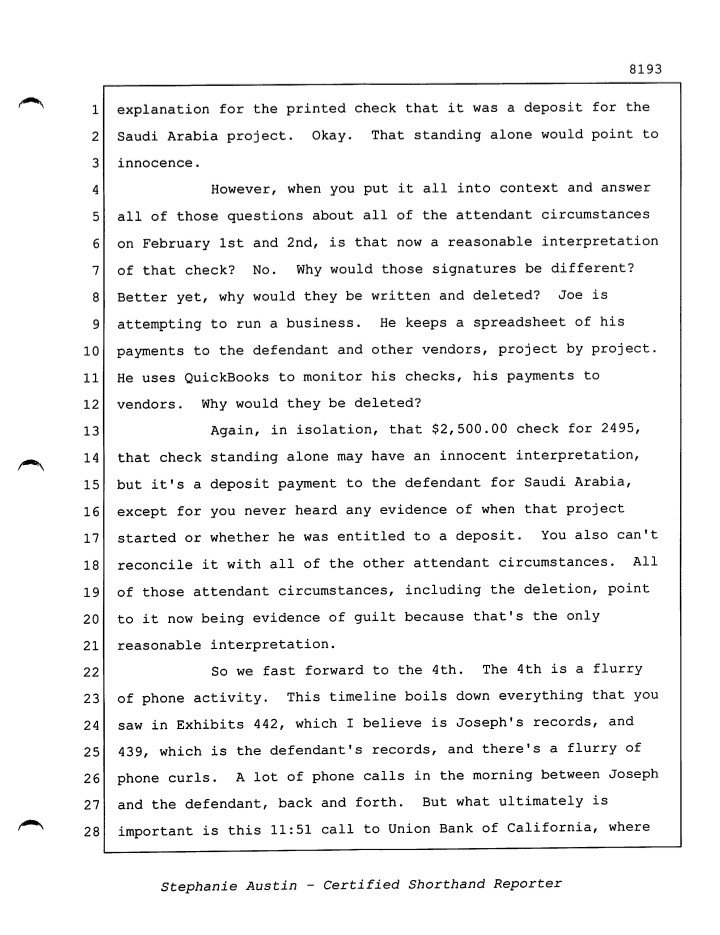
“Again, in isolation, that $2,500.00 check for 2495, that check standing alone may have an innocent interpretation, but it’s a deposit payment to the defendant for Saudi Arabia, except for you never heard any evidence of when that project started or whether he was entitled to a deposit.”
(RT 8193:13-17)
See RT 8193
On the car in the Mitchley video, on the evening of February 4:
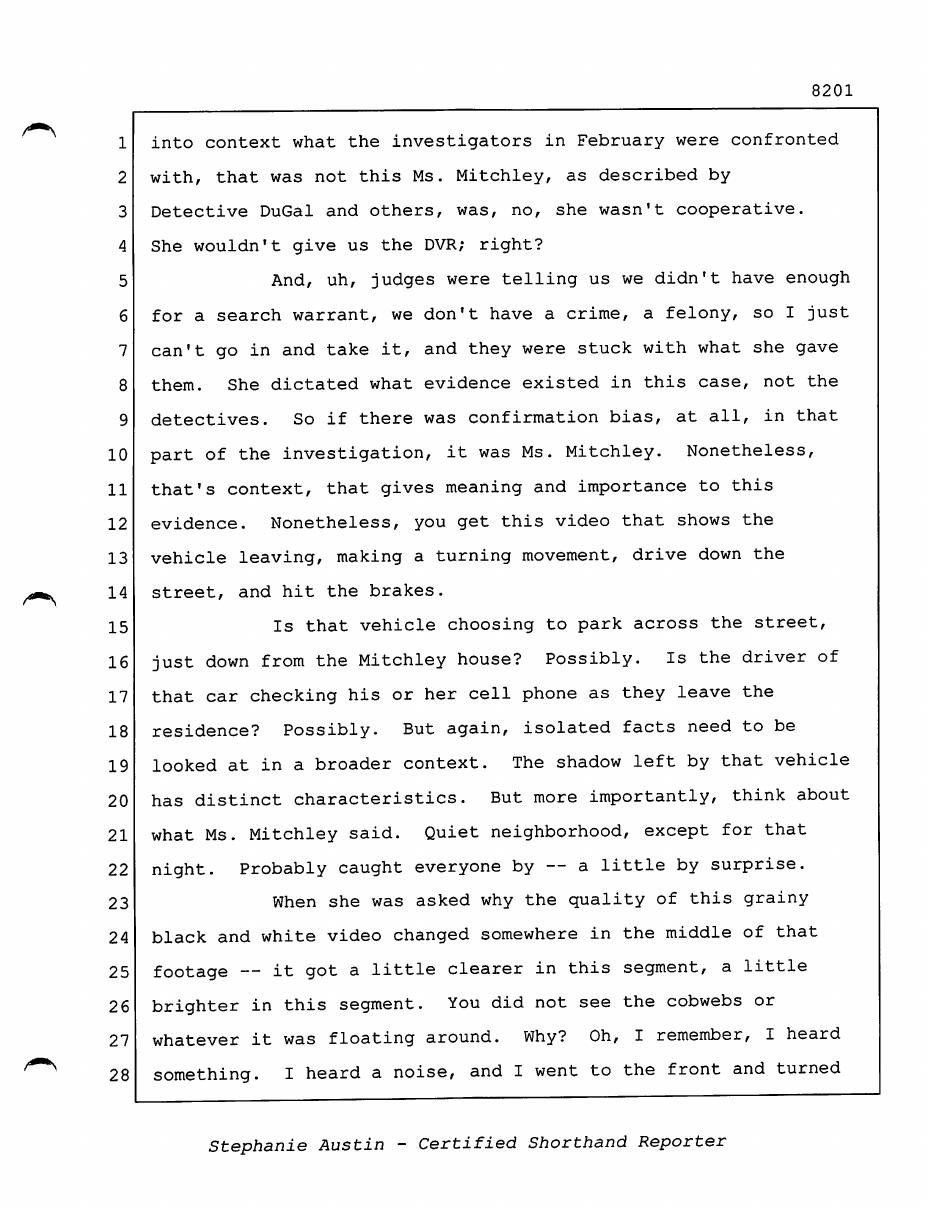
“Is that vehicle choosing to park across the street, just down from the Mitchley house? Possibly. Is the driver of that car checking his or her cell phone as they leave the residence? Possibly. But again, isolated facts need to be looked at in a broader context.”
(RT 8201:15-19)
See RT 8201
And near the end of his closing, he put it as a rule:
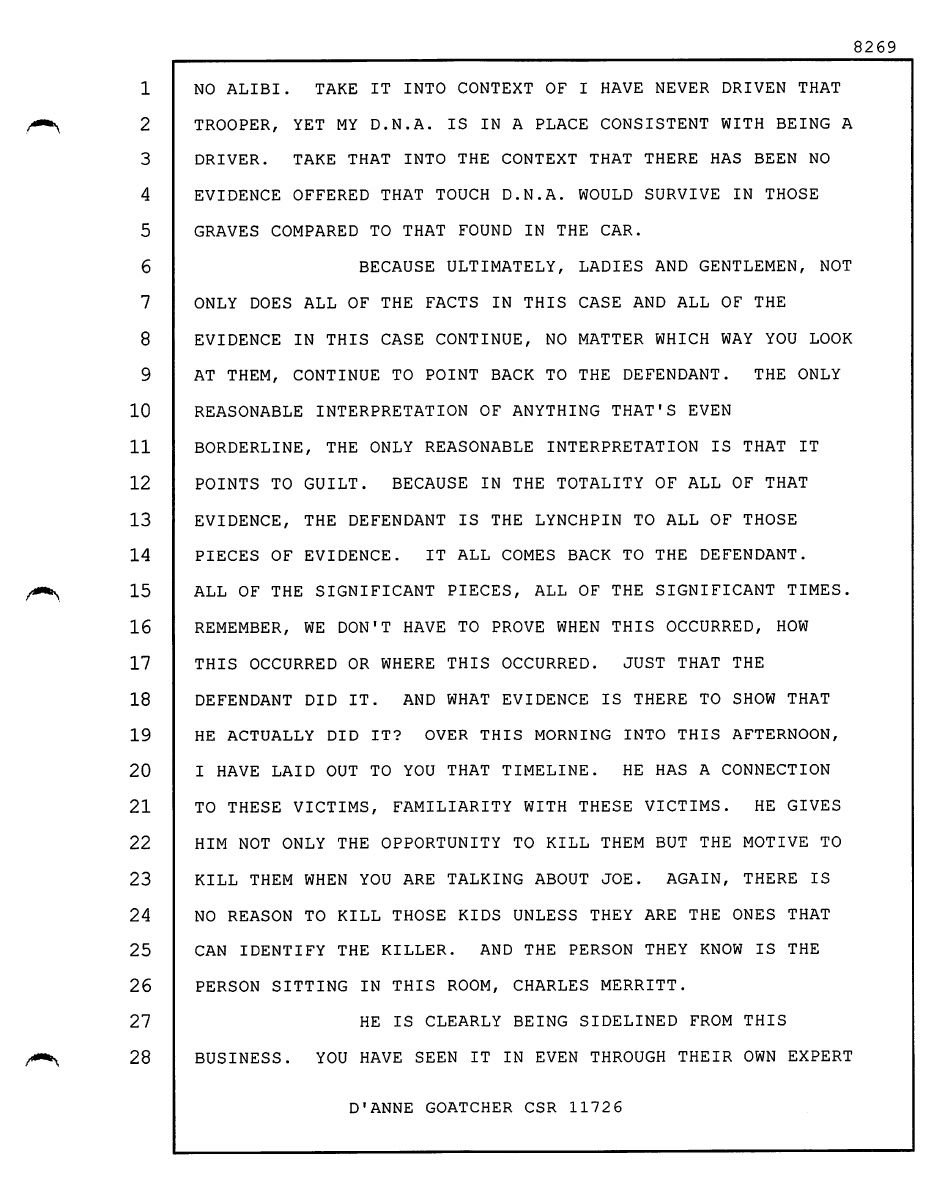
“The only reasonable interpretation of anything that’s even borderline, the only reasonable interpretation is that it points to guilt.”
(RT 8269:9-12)
See RT 8269
The first three were misleading, and the last was false. The rest of CALCRIM 224, the same instruction, told the jury exactly what to do when the evidence can reasonably be read two ways, and it is the opposite of what he said:
“Also, before you may rely on circumstantial evidence to find a defendant guilty, you must be convinced that the only reasonable conclusion, supported by the circumstantial evidence is that the defendant is guilty. If you can draw two or more reasonable conclusions from the circumstantial evidence, and one of those reasonable conclusions points to innocence, and the other to guilt, you must accept the one that points to innocence. However, when considering circumstantial evidence, you must accept only reasonable conclusions and reject any unreasonable conclusions.”
(RT 8164:13-25)
See RT 8164
His claim that the jury “never heard any evidence” about the Saudi Arabia project is a separate question, and card 6 answers it.
3. The last word, in rebuttal
On the afternoon of the next day, Wednesday, May 29, Mr. Maline read CALCRIM 3400 to the jury and used it the way it is written, on one fact, the truck in the Mitchley video: “if it’s not his truck, you can’t convict him. That’s why this jury instruction is it” (RT 8407:24-26). Minutes later Ms. Rodriguez began the People’s rebuttal, the one argument the defense doesn’t get to answer, and told the jury:
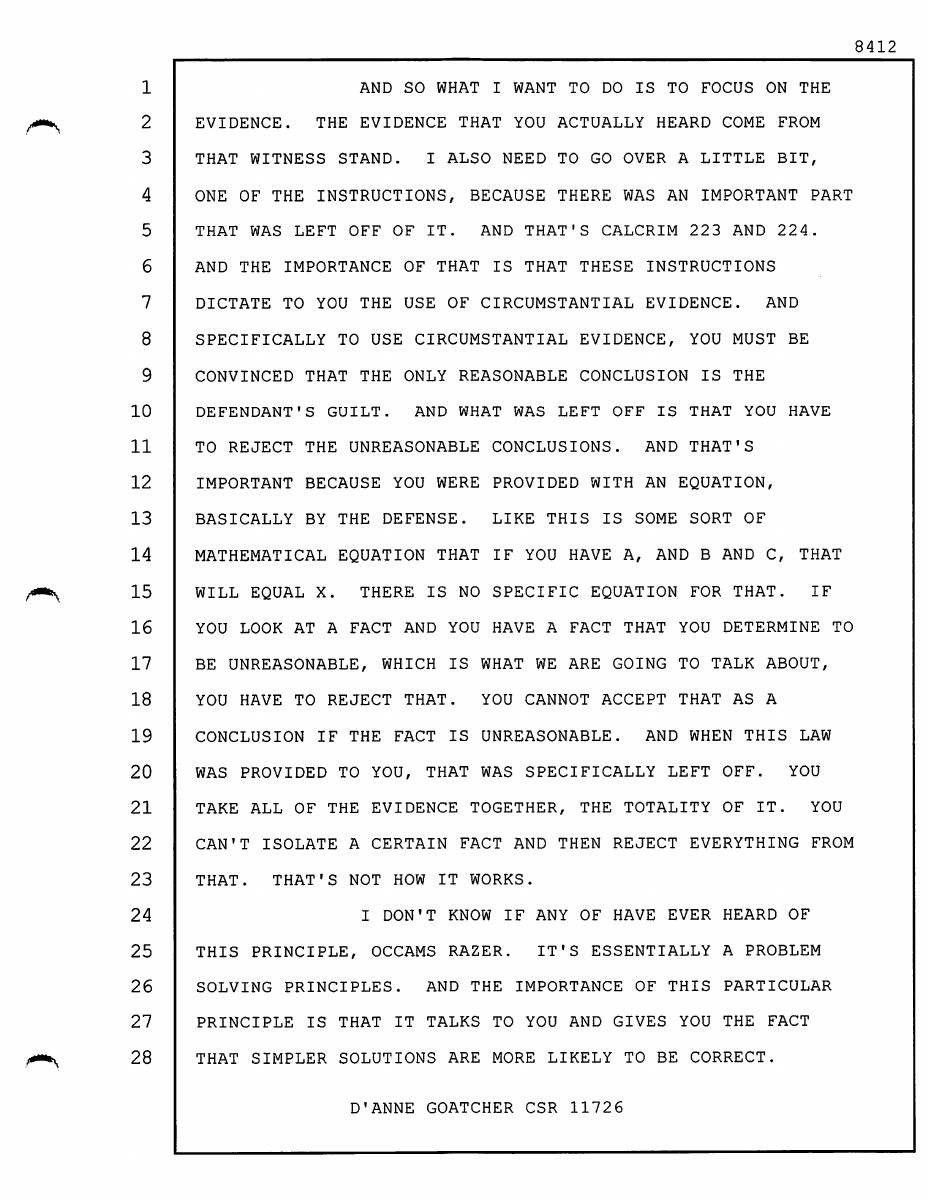
“You take all of the evidence together, the totality of it. You can’t isolate a certain fact and then reject everything from that. That’s not how it works.”
(RT 8412:20-23)
See RT 8412
This was misleading. It is how the alibi instruction works. CALCRIM 3400, the instruction Mr. Maline had just read to them, isolates one fact and tells the jury that a reasonable doubt about it means not guilty, whatever else the jury believes.
What the defense said
Mr. McGee read the jury CALCRIM 220 and 224, including the rule that each fact essential to guilt must be proved beyond a reasonable doubt. Mr. Imes objected, and the objection was overruled (RT 8282:16-8283:8). In reading 224, Mr. McGee left out its last sentence, that the jury “must accept only reasonable conclusions and reject any unreasonable conclusions,” and Ms. Rodriguez used that in rebuttal: “what was left off is that you have to reject the unreasonable conclusions” (RT 8412:10-11). Mr. Maline read CALCRIM 3400 and applied it to the truck (RT 8407:15-26). Neither of them objected to any of these statements, and neither told the jury that Mr. Imes’s “You cannot isolate an individual fact” was the opposite of what CALCRIM 3400 said. Ms. Rodriguez’s statement came in rebuttal, when the defense could no longer answer.
Why it mattered
As I see it, CALCRIM 3400 told the jury that a single fact could decide the case, and the prosecutors told the jury again and again, through closing and into rebuttal, that no single fact could do that. My Where and when page has each of these statements in its full context.
Mr. Imes · closing argument · May 28, 2019
“Cathy Jarvis looking to benefit from his acquittal”
Cathy Jarvis is the mother of my children, and she testified for the defense on March 13 and 14, 2019, that I was at home on the night of February 4, 2010. While the case was going on, an independent film company was making a documentary about the case, and Cathy had sat for interviews with them. In his closing argument, speaking in front of the jury, Mr. Imes used that documentary to tell the jury that Cathy had a money reason to say what she said.
1. “A witness who potentially profits”
He first raised it near the beginning of his argument, in a sentence about everyone on my side of the case:
“Everything about this case, from the defense’s perspective, greed and self-interest has permeated, from the expert witnesses, to the defense documentary team, to Cathy Jarvis looking to benefit from his acquittal, or even the defendant’s benefit.”
(RT 8184:11-15)
See RT 8184
Later, when he turned to Cathy’s testimony itself, he said it again and went further:
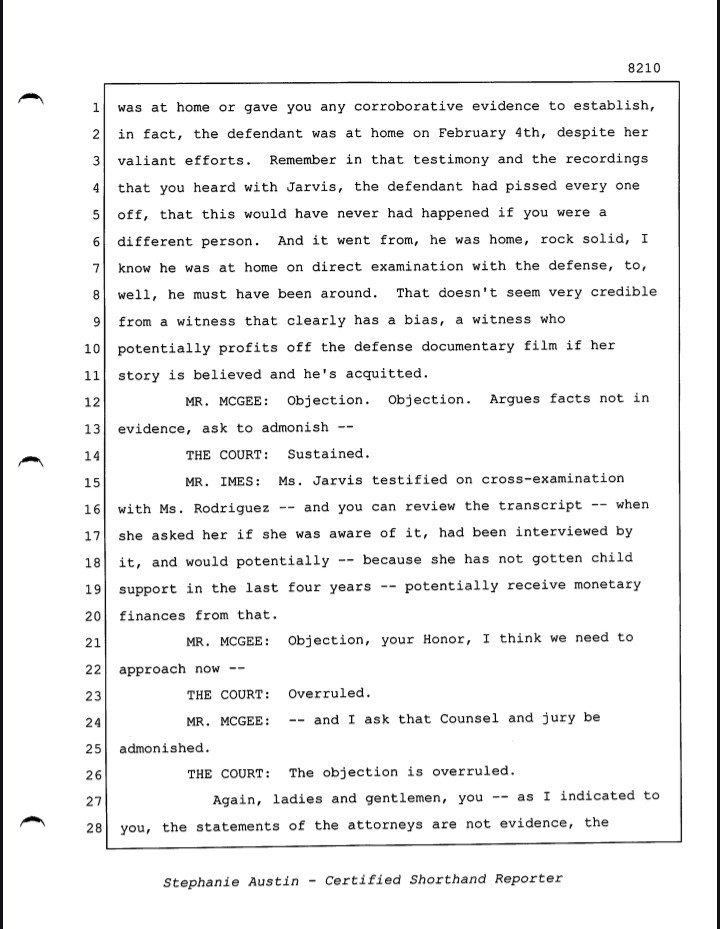
“That doesn’t seem very credible from a witness that clearly has a bias, a witness who potentially profits off the defense documentary film if her story is believed and he’s acquitted.”
(RT 8210:8-11)
See RT 8210
Both were false. Cathy had been asked about exactly this, in front of the jury, on March 14, when Ms. Rodriguez cross-examined her, and her answers were the opposite:
Q. “And did you participate in the documentary?”
(RT 5419:18-5420:1)
A. “Yes.”
Q. “Were you interviewed for it?”
A. “Yes.”
Q. “Were you paid for it?”
A. “I was reimbursed for parking and gas, yes.”
Q. “Were you ever promised any money in the future for your participation in the documentary?”
A. “No, I was not.”
Q. “Did the defendant ever tell you that he would give you proceeds from the documentary?”
A. “No, he did not.”
See RT 5419 and 5420
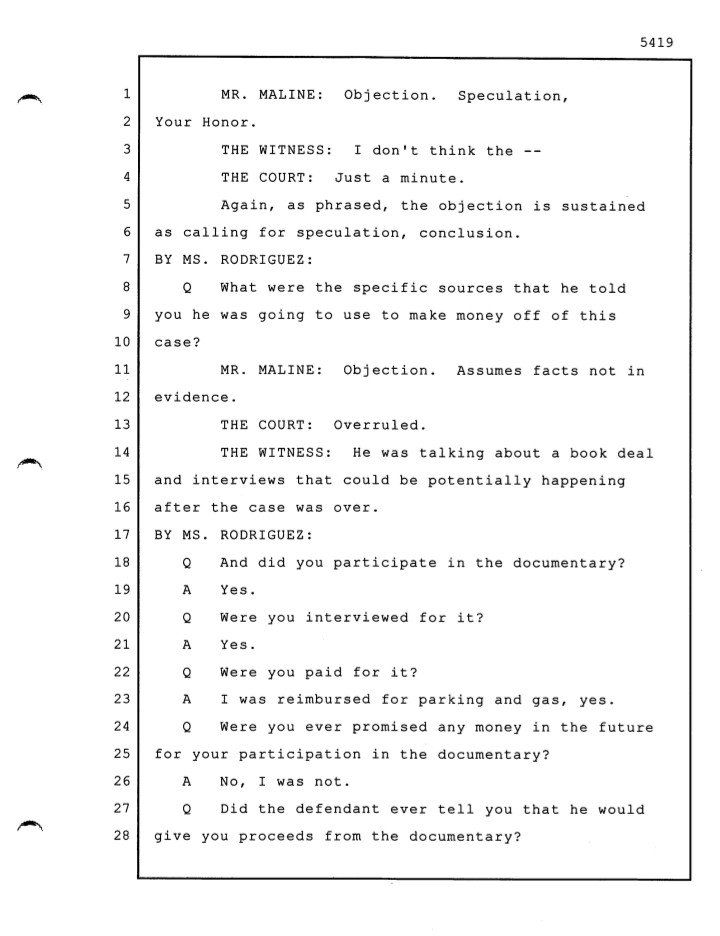
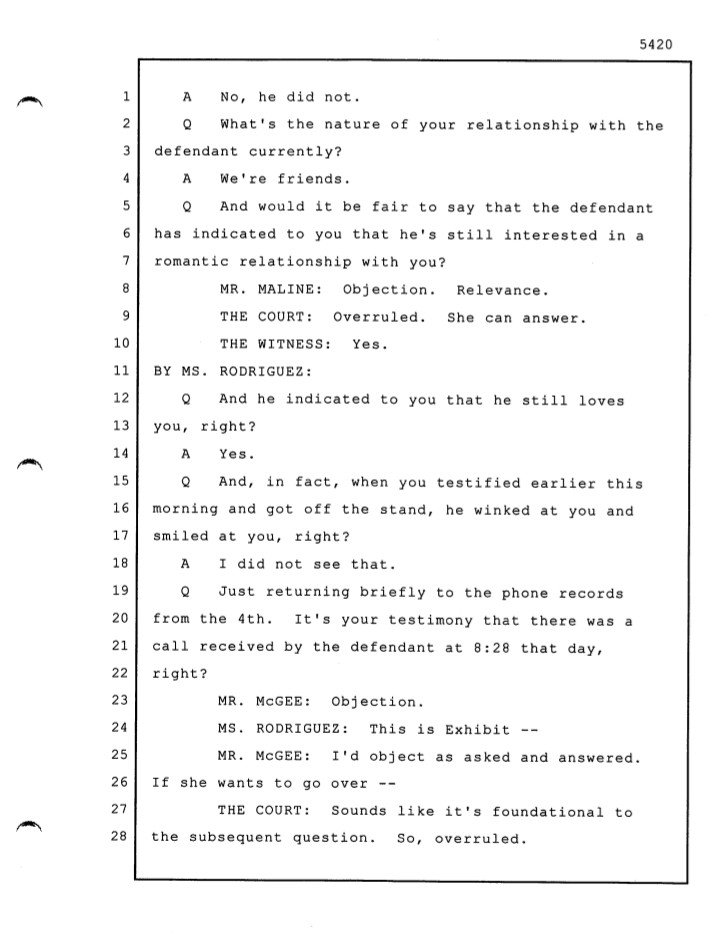
There is one thing in her testimony that the State could point to, and I want it right here. A few questions before those, Cathy told the jury I had talked about making money from the case once it was over:
Q. “What were the specific sources that he told you he was going to use to make money off of this case?”
(RT 5419:8-16)
MR. MALINE: “Objection. Assumes facts not in evidence.”
THE COURT: “Overruled.”
A. “He was talking about a book deal and interviews that could be potentially happening after the case was over.”
See RT 5419
That answer was about me and what I might do someday. It said nothing about Cathy getting anything, and a few questions later, in the answers just above, she told the jury I had never said I would give her any of the documentary’s proceeds.
The prosecutors had already tried this line with my daughter Taylor the day before. At a sidebar on March 13, Mr. Daugherty asked to question her about my “profiting” from the documentary, and the judge sustained the defense objection “as to this witness on relevancy grounds and Evidence Code 352.” He added, “It may not be the case with his wife” (RT 5275:13-5276:23). When Ms. Rodriguez did ask Cathy the next day, the answers she got are the ones above.
2. “Ms. Jarvis testified…”
Mr. McGee objected to “potentially profits” that there was no evidence of it, and the judge sustained the objection. Mr. Imes didn’t move on. He told the jury that Cathy herself had said it on the witness stand, and when Mr. McGee objected a second time, the judge overruled him:
MR. MCGEE: “Objection. Objection. Argues facts not in evidence, ask to admonish —”
(RT 8210:12-8211:5)
THE COURT: “Sustained.”
MR. IMES: “Ms. Jarvis testified on cross-examination with Ms. Rodriguez — and you can review the transcript — when she asked her if she was aware of it, had been interviewed by it, and would potentially — because she has not gotten child support in the last four years — potentially receive monetary finances from that.”
MR. MCGEE: “Objection, your Honor, I think we need to approach now —”
THE COURT: “Overruled.”
MR. MCGEE: “— and I ask that Counsel and jury be admonished.”
THE COURT: “The objection is overruled. Again, ladies and gentlemen, you — as I indicated to you, the statements of the attorneys are not evidence, the attorneys can give you what they believe the evidence is and what they believe are reasonable inferences and conclusions to be drawn from the evidence. But ultimately, it is up to you to decide what the actual evidence is and what the reasonable inferences and conclusions from the evidence is.”
See RT 8210 and 8211
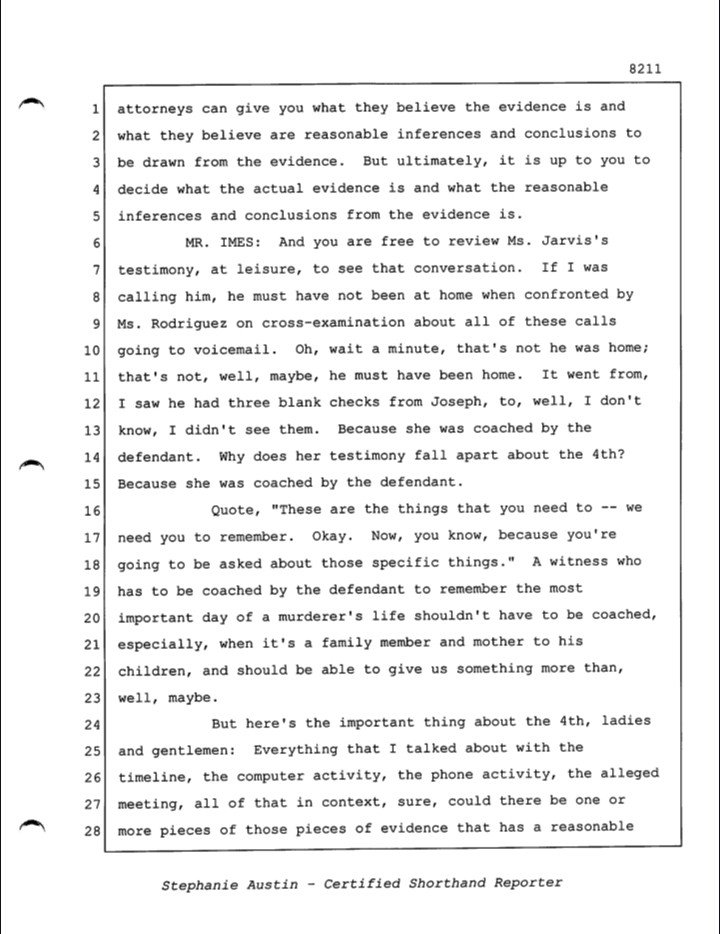
This was false. The transcript he told the jury to review is the one quoted in the section above, and in it Cathy said she was never promised any money and that I never told her she would get any.
The child support part was something Mr. Imes added on his own. Nobody ever asked Cathy about child support, and she never mentioned it, so there was nothing in her testimony for him to point to. As I see it, he simply assumed it, because I had been sitting in jail for those four years and he took it for granted that I hadn’t been helping her. The truth is that all through those years I was paying Cathy to help her take care of our kids.
What the defense said
Mr. McGee objected twice, and both times he asked the judge to admonish the jury. The judge sustained the first objection but didn’t tell the jury anything about it. He overruled the second, and the only thing the jury heard from him was the general reminder that what lawyers say isn’t evidence. After that, neither Mr. McGee nor Mr. Maline came back to it in the defense closing, and neither of them told the jury what Cathy had actually said when she was asked about the documentary.
Why it mattered
Cathy was the witness who told the jury I was home that night, so what the jury thought of her honesty went straight to the heart of my defense. The judge had just ruled that there was no evidence for what Mr. Imes was saying. Instead of letting it go, Mr. Imes told the jury that Cathy had admitted it herself and invited them to check the transcript, a transcript that says the opposite. What the jury was left with was the prosecutor’s version of her testimony and a general reminder that lawyers’ words aren’t evidence.
Mr. Imes · closing argument · May 28, 2019
“Greed and self-interest has permeated, from the expert witnesses, to the defense documentary team”
My defense called expert witnesses to answer the State’s case on the truck in the Mitchley video, the DNA, the computers and the money. They were paid for their time, the jury heard what several of them were paid, and the prosecutors were free to argue that. While the trial was going on, an independent film company was also making a documentary about the case, and its camera people filmed in and around the courtroom and sometimes followed my lawyers. Mr. Imes put the experts and the film company together and told the jury that greed was what drove my whole side of the case.
1. Greed, “notoriety and business”
He said it near the start of his closing argument, in front of the jury:
“A man and a case motivated by greed and self-interest. Remember how Cathy Jarvis described him in that phone call and in that jail visit? Everything about this case, from the defense’s perspective, greed and self-interest has permeated, from the expert witnesses, to the defense documentary team, to Cathy Jarvis looking to benefit from his acquittal, or even the defendant’s benefit.”
(RT 8184:9-15)
See RT 8184
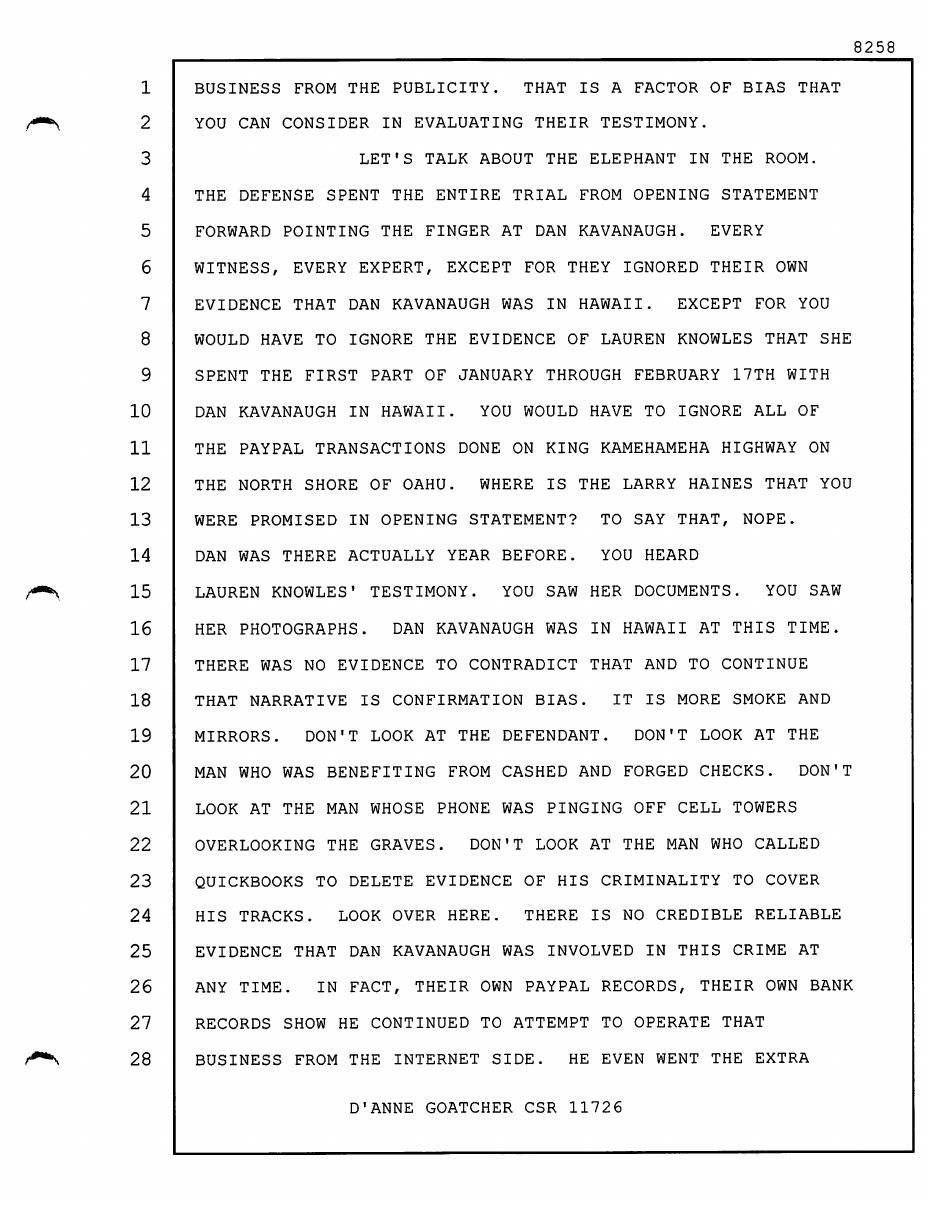
He came back to it near the end of his argument, after telling the jury that Dr. Rudin “had an agenda so he could retire” (RT 8257:12). Mr. McGee objected and the judge sustained it, and Mr. Imes said the same thing again in different words, this time telling the jury it came from the witnesses’ own testimony:
“All of the attacks by these witnesses should be taken with a large grain of salt. All of these witnesses, the credibility and quality of their testimony should be taken in context. What expert sandbags their reports and their exhibits until the early morning hours of the day they testified after having months, if not years, to do it? What expert isn’t influenced by the fact they are being followed around and being interviewed by defense documentary team.”
(RT 8257:14-8258:2)
MR. MC GEE: “Objection, your Honor.”
THE COURT: “Sustained.”
MR. IMES: “Documentary team that was followed by Mr. Maline to go interview Mr. Shogren at the time according to his testimony. Clearly, it can be inferred from their testimony that they were hoping to gain notoriety and business from the publicity. That is a factor of bias that you can consider in evaluating their testimony.”
See RT 8257 and 8258
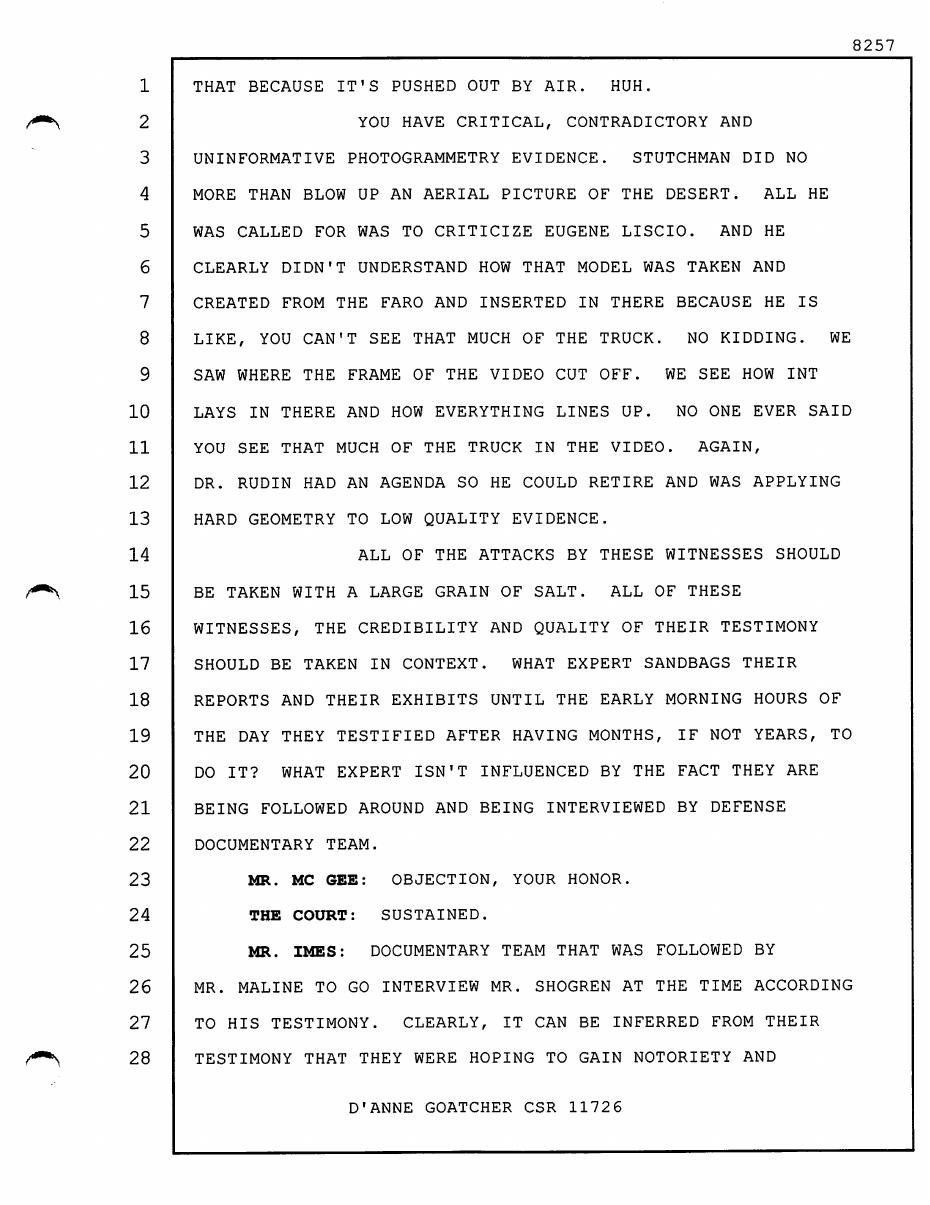
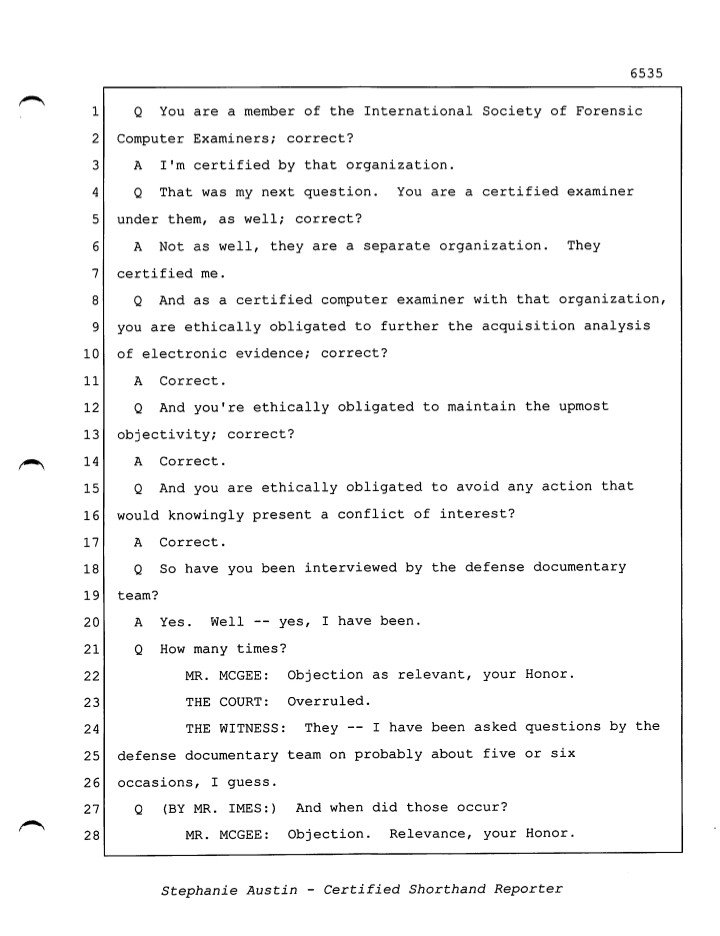
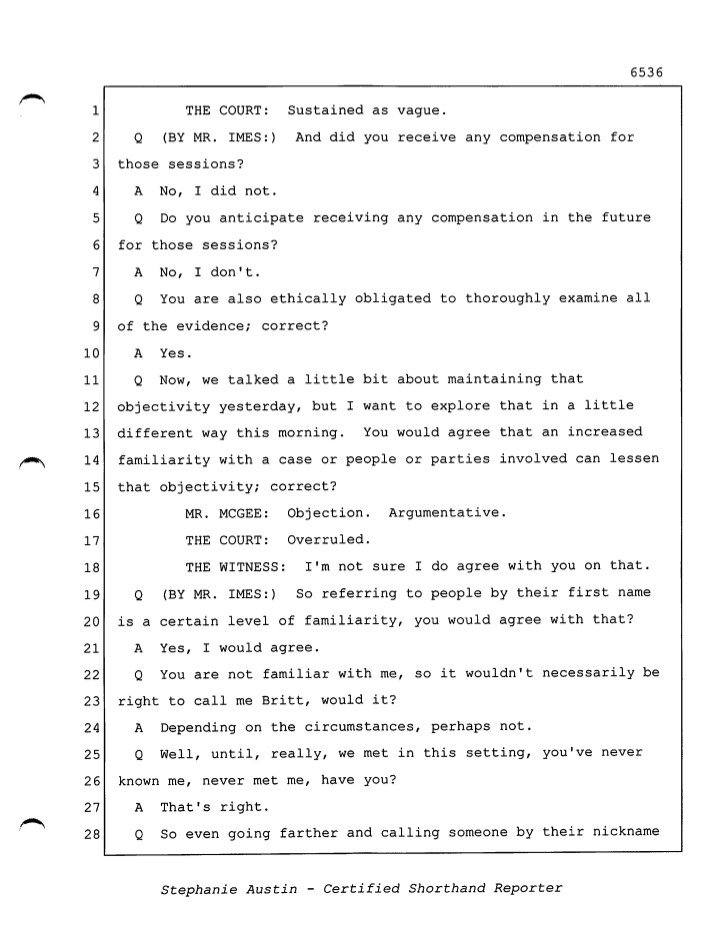
Both were false. Nothing in the evidence showed that greed drove my experts or the film company, and the experts’ own testimony, the testimony he told the jury to draw “notoriety and business” from, said the opposite. Mr. Imes asked the defense computer expert, Mr. La Rock, about it himself on cross-examination:
Q. “So have you been interviewed by the defense documentary team?”
(RT 6535:18-6536:7)
A. “Yes. Well — yes, I have been.”
Q. “How many times?”
MR. MCGEE: “Objection as relevant, your Honor.”
THE COURT: “Overruled.”
THE WITNESS: “They — I have been asked questions by the defense documentary team on probably about five or six occasions, I guess.”
Q. (BY MR. IMES:) “And when did those occur?”
MR. MCGEE: “Objection. Relevance, your Honor.”
THE COURT: “Sustained as vague.”
Q. (BY MR. IMES:) “And did you receive any compensation for those sessions?”
A. “No, I did not.”
Q. “Do you anticipate receiving any compensation in the future for those sessions?”
A. “No, I don’t.”
See RT 6535 and 6536
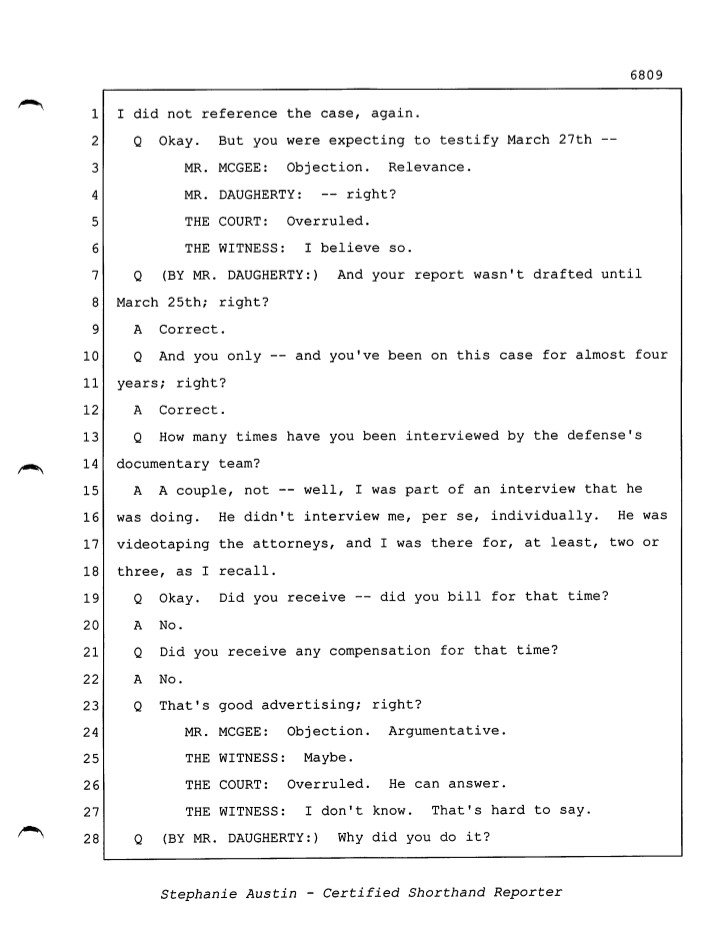
Mr. Daugherty asked the defense crime scene expert, Mr. Beasley, on cross-examination:
Q. “How many times have you been interviewed by the defense’s documentary team?”
(RT 6809:13-22)
A. “A couple, not — well, I was part of an interview that he was doing. He didn’t interview me, per se, individually. He was videotaping the attorneys, and I was there for, at least, two or three, as I recall.”
Q. “Okay. Did you receive — did you bill for that time?”
A. “No.”
Q. “Did you receive any compensation for that time?”
A. “No.”
See RT 6809
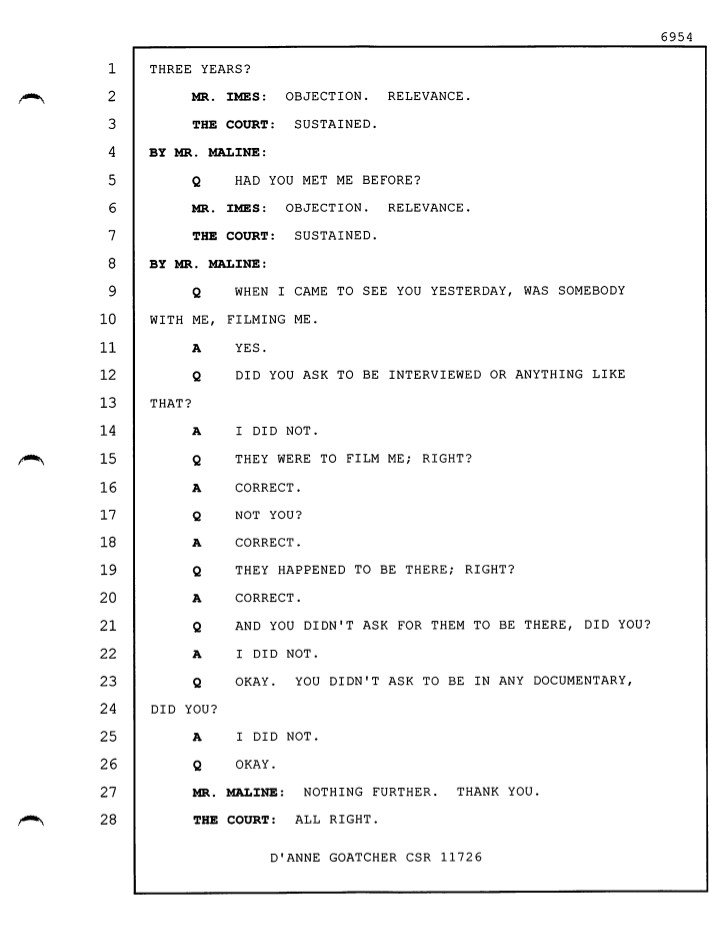
Mr. Maline asked Mr. Stutchman, the photogrammetry expert, about the day before, when Mr. Maline had come to see him with a camera person along:
Q. “When I came to see you yesterday, was somebody with me, filming me.”
(RT 6954:9-25)
A. “Yes.”
Q. “Did you ask to be interviewed or anything like that?”
A. “I did not.”
Q. “They were to film me; right?”
A. “Correct.”
Q. “Not you?”
A. “Correct.”
Q. “They happened to be there; right?”
A. “Correct.”
Q. “And you didn’t ask for them to be there, did you?”
A. “I did not.”
Q. “Okay. You didn’t ask to be in any documentary, did you?”
A. “I did not.”
See RT 6954
And Mr. Shogren, the accountant Mr. Imes named, told the jury on direct examination by Mr. Maline that he had never been interviewed by anyone from the documentary:
Q. “Okay. And so have you ever been interviewed by a documentary person?”
(RT 7033:2-9)
A. “No.”
Q. “Okay. But did you see, maybe, a person with a camera following me around, even when I came to your office?”
A. “Yes.”
Q. “Do you get paid for any documentary work that you know of?”
A. “Not that I know of.”
See RT 7033
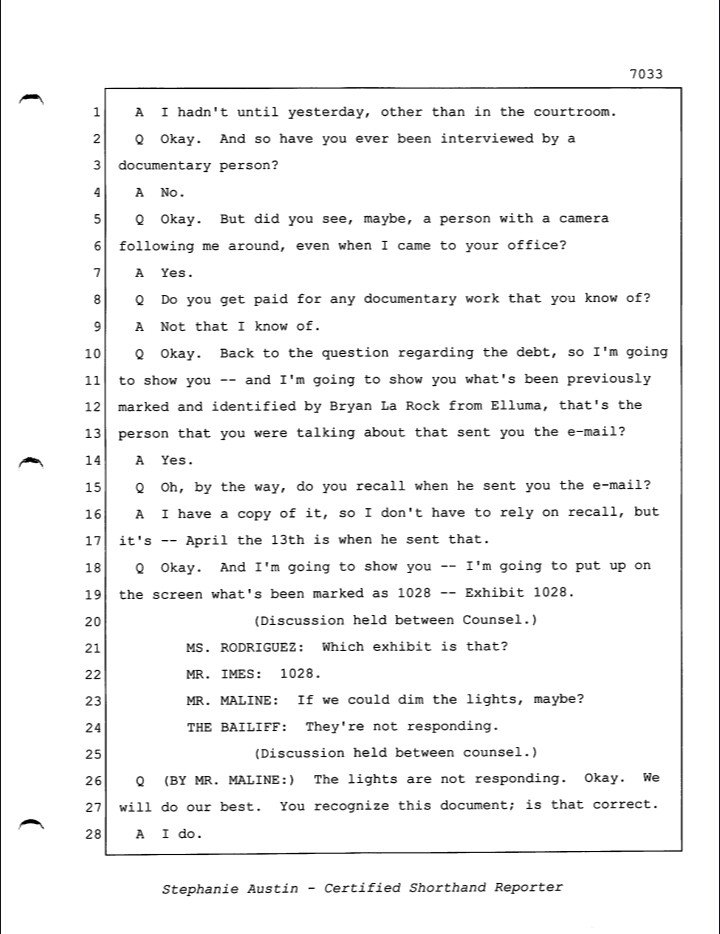
The experts said they weren’t paid anything for the documentary and didn’t expect to be, Mr. Stutchman said he never asked to be in it, and Mr. Shogren said he was never even interviewed. Nothing in that testimony showed that any of them was hoping to gain business or publicity from it.
The film company wasn’t part of the defense, either. On April 11, 2019, outside the jury’s presence, when the prosecutors tried to get the film company’s footage by arguing it was acting for the defense, the judge ruled against them:
“I’m satisfied that TSG is not an agent of Mr. Merritt or defense counsel or the defense team.”
(RT 6230:19-21)
See RT 6230
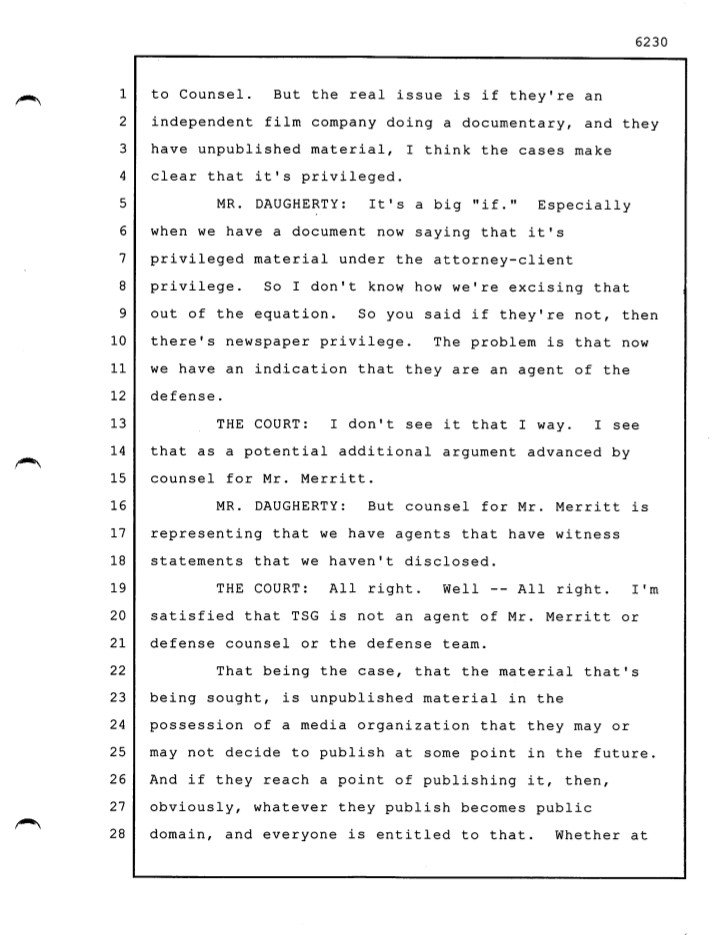
Seven weeks later Mr. Imes was still calling it the “defense documentary team” in front of the jury.
2. Dr. Rudin and Cathy
The same sentence at RT 8184 named Cathy, and on the same theme Mr. Imes told the jury that Dr. Rudin, the defense video expert, had “an agenda” and had said “If it worked, I could retire. I want to do this, so I can make money off it, and I can retire” (RT 8206:20-8207:5). Each of those has its own card. Cathy’s own testimony shows she was never promised anything, and Dr. Rudin’s actual words meant the reverse of what Mr. Imes said.
What the defense said
No one objected when Mr. Imes said it the first time, at RT 8184. When he said it again at RT 8257, Mr. McGee objected and the judge sustained it, but the judge didn’t tell the jury anything, and when Mr. Imes repeated the point in different words, nobody objected again. Neither Mr. McGee nor Mr. Maline answered it in the defense closing or reminded the jury what the experts had actually said when they were asked about the documentary.
Why it mattered
My experts were the people who answered the State’s case on the truck, the DNA and the computers. The prosecutors were entitled to tell the jury what those experts were paid and to argue that pay can shade an opinion. What they weren’t entitled to do was tell the jury that greed drove my experts and everyone on my side, when the only evidence on the point, much of it from the prosecutors’ own questions, said the opposite. As I see it, that was an invitation to throw out my experts’ work without ever having to answer it.
Mr. Imes · closing argument · May 28, 2019 · Ms. Rodriguez · rebuttal · May 30, 2019 · Mr. Imes · penalty argument · June 19, 2019
“Project failures — Provecho, Levine” and “you owe me $42,000”
The State’s motive was that Joseph was pushing me out of his business by February 2010, and that I killed him over it. The reason the prosecutors gave for it was money. They told the jury that two old jobs, Provecho and Levine, were my failures, that they left me owing Joseph $42,000, and that Joseph’s e-mail to me on February 1, 2010, was a bill for it. Provecho and Levine were two of Joseph’s custom water-feature jobs that I worked on, Levine in 2007 and Provecho, a restaurant, in 2008. In both, the customer later disputed the job and took some of its money back. Everything below was said in front of the jury.
1. “Project failures”
Mr. Imes started with the jobs, early in his closing argument:
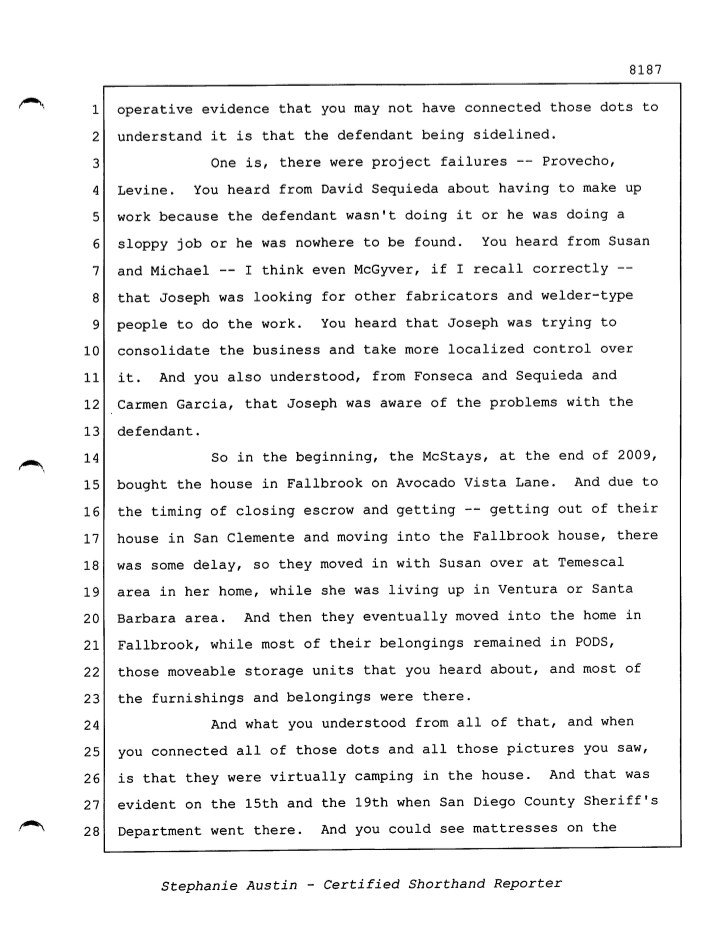
“Well, what’s more important about those, is that you also learned that the defendant was being sidelined. And there were several pieces of operative evidence that you may not have connected those dots to understand it is that the defendant being sidelined. One is, there were project failures — Provecho, Levine.”
(RT 8186:26-8187:4)
See RT 8186 and 8187
Three weeks later, at the penalty phase, when the jury was deciding whether I should live or die, he said it again:
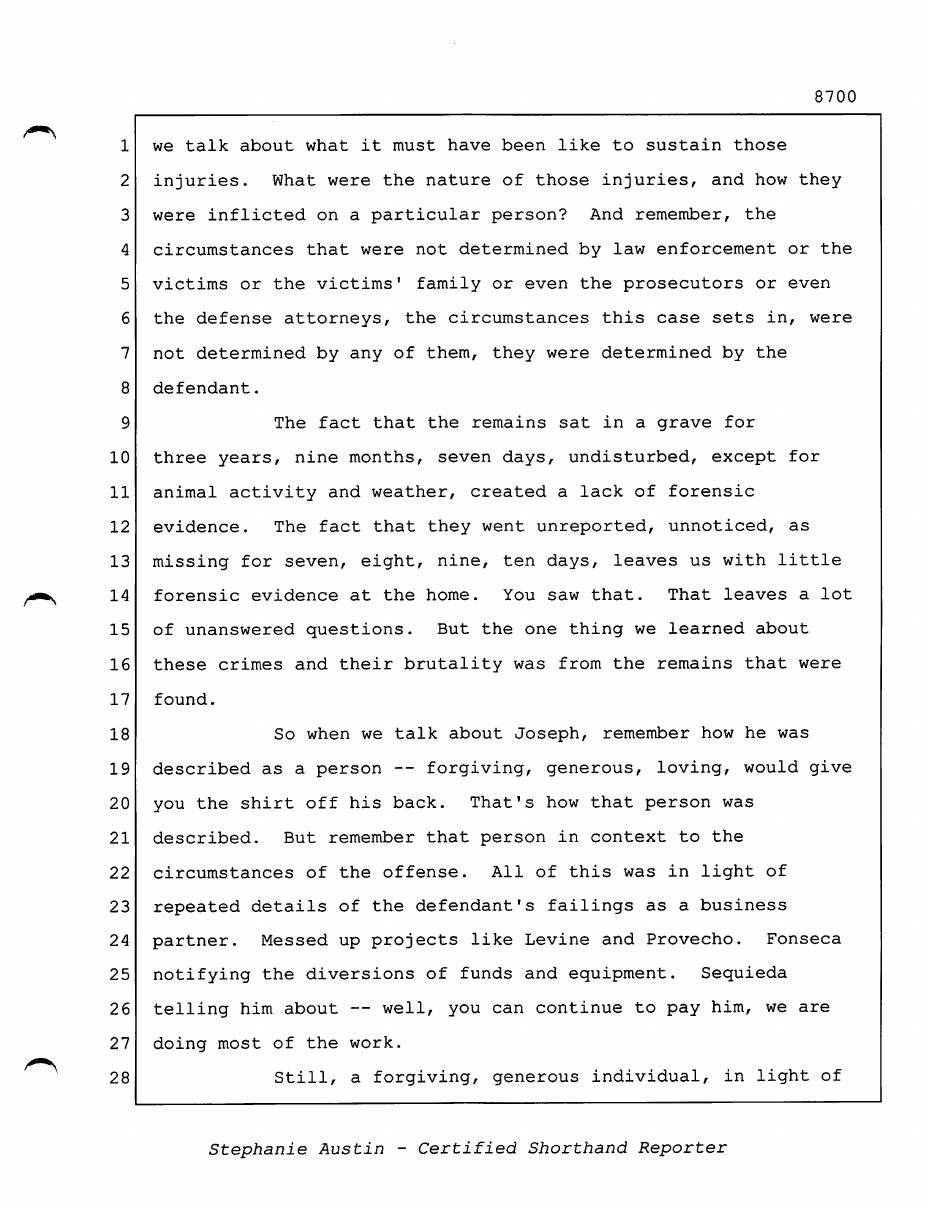
“All of this was in light of repeated details of the defendant’s failings as a business partner. Messed up projects like Levine and Provecho.”
(RT 8700:22-24)
See RT 8700
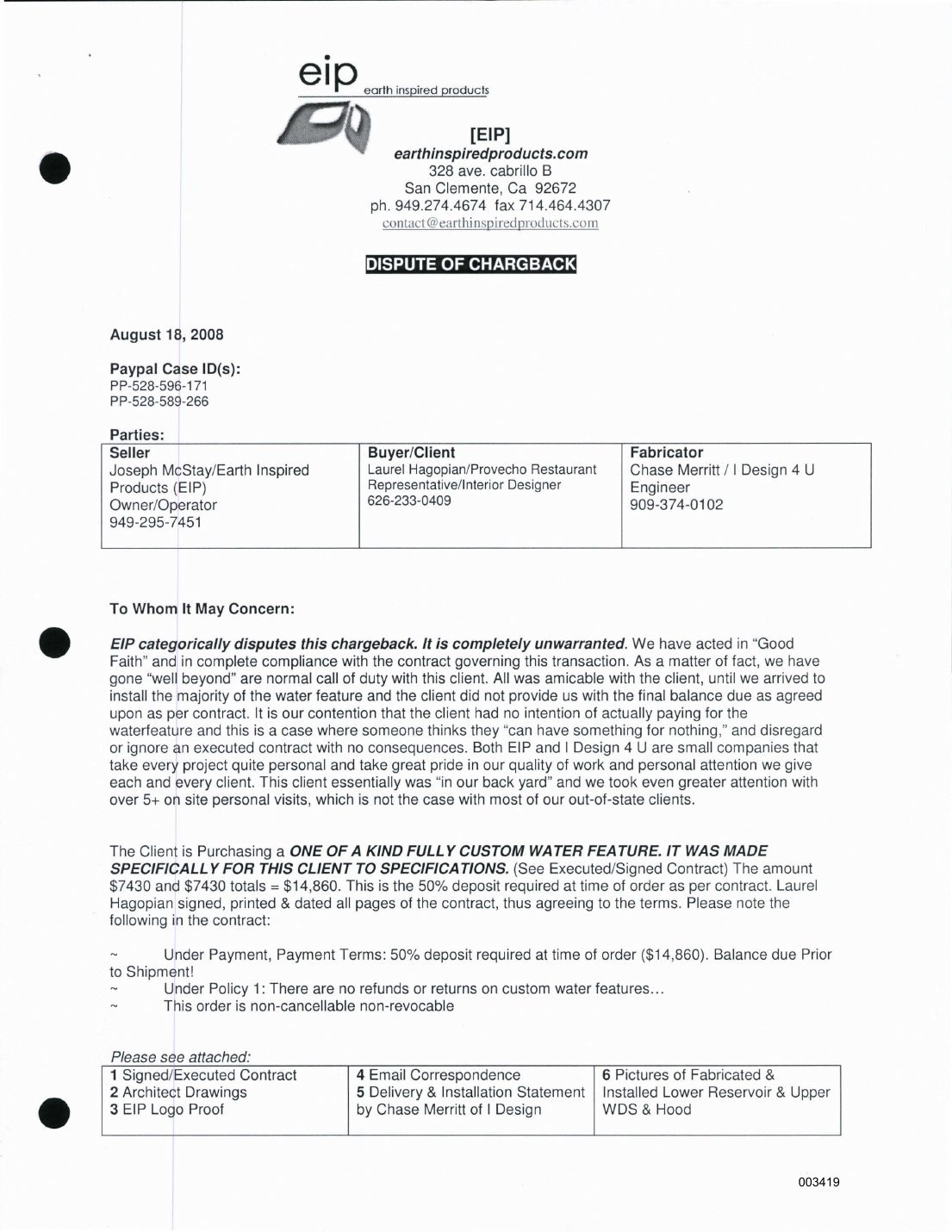
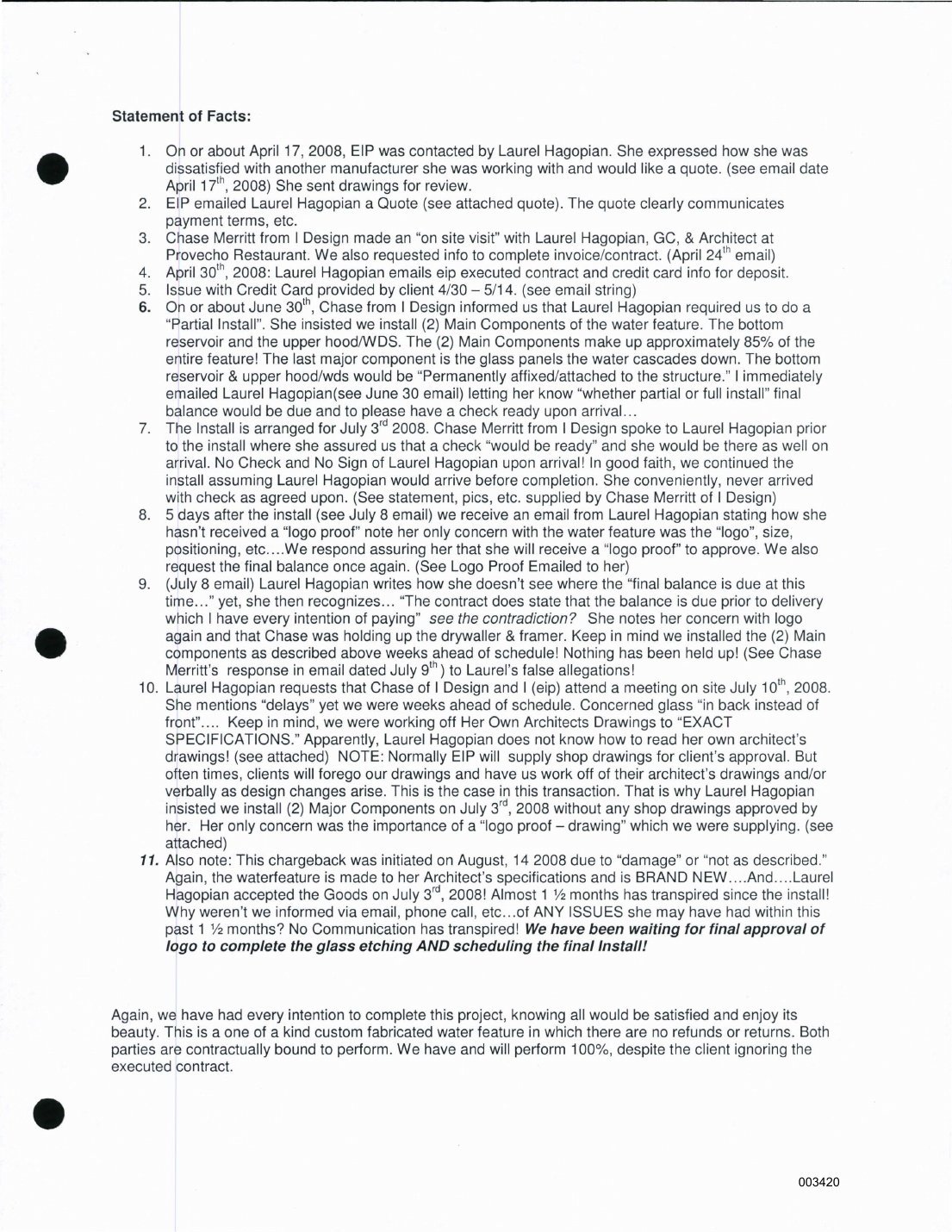
Both were false. Neither job was a failure of mine, and Joseph said so himself. When the Provecho dispute happened in 2008, he wrote to PayPal defending my work and blaming the customer:
“EIP categorically disputes this chargeback. It is completely unwarranted. We have acted in “Good Faith” and in complete compliance with the contract governing this transaction. As a matter of fact, we have gone “well beyond” are normal call of duty with this client. All was amicable with the client, until we arrived to install the majority of the water feature and the client did not provide us with the final balance due as agreed upon as per contract. It is our contention that the client had no intention of actually paying for the waterfeature and this is a case where someone thinks they “can have something for nothing,” and disregard or ignore an executed contract with no consequences. Both EIP and I Design 4 U are small companies that take every project quite personal and take great pride in our quality of work and personal attention we give each and every client.”
(Joseph McStay to PayPal, August 18, 2008, Bates 003419-003420)
See Bates 003419 and 003420
And Joseph kept sending me his custom jobs after both of these projects, right up through January 28, 2010, a week before he disappeared. As I see it, a man who blamed me for Provecho and Levine, and was getting ready to push me out over them, wouldn’t have kept doing that for a year and a half. The full story of Provecho is on my Provecho page.
2. “You owe me $42,000”
A few minutes later Mr. Imes turned the jobs into a debt and the e-mail into a bill:
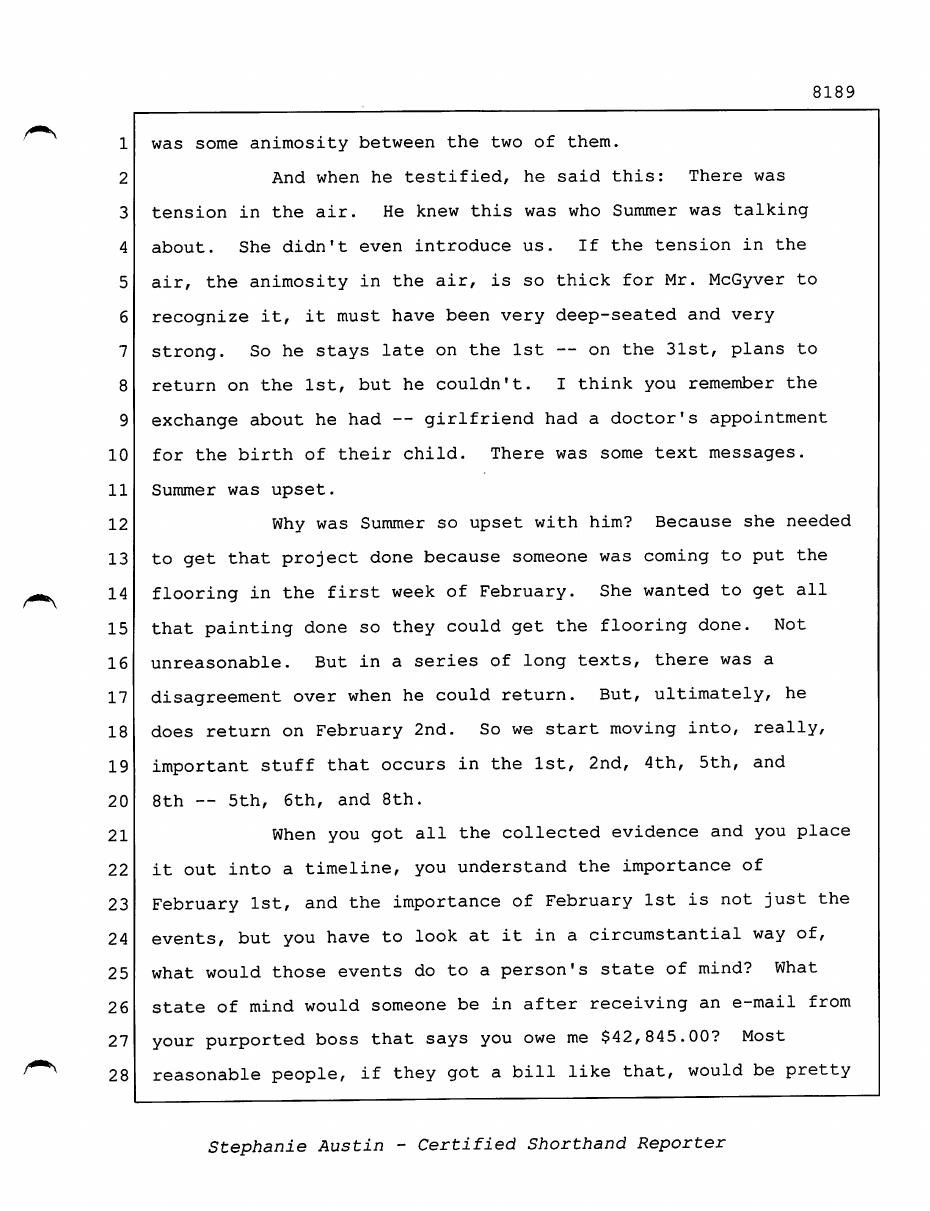
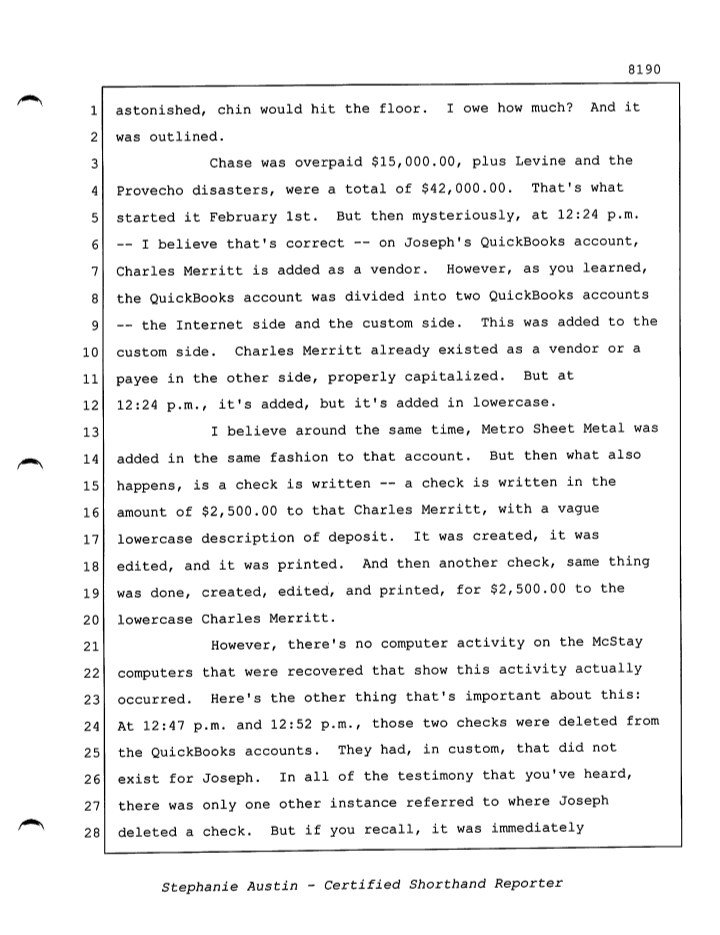
“What state of mind would someone be in after receiving an e-mail from your purported boss that says you owe me $42,845.00? Most reasonable people, if they got a bill like that, would be pretty astonished/ chin would hit the floor. I owe how much? And it was outlined. Chase was overpaid $15,000.00, plus Levine and the Provecho disasters, were a total of $42,000.00. That’s what started it February 1st.”
(RT 8189:25-8190:5)
See RT 8189 and 8190
Then he put it in Joseph’s mouth, as if Joseph were firing me on February 4. Mr. McGee objected, and the judge overruled him:
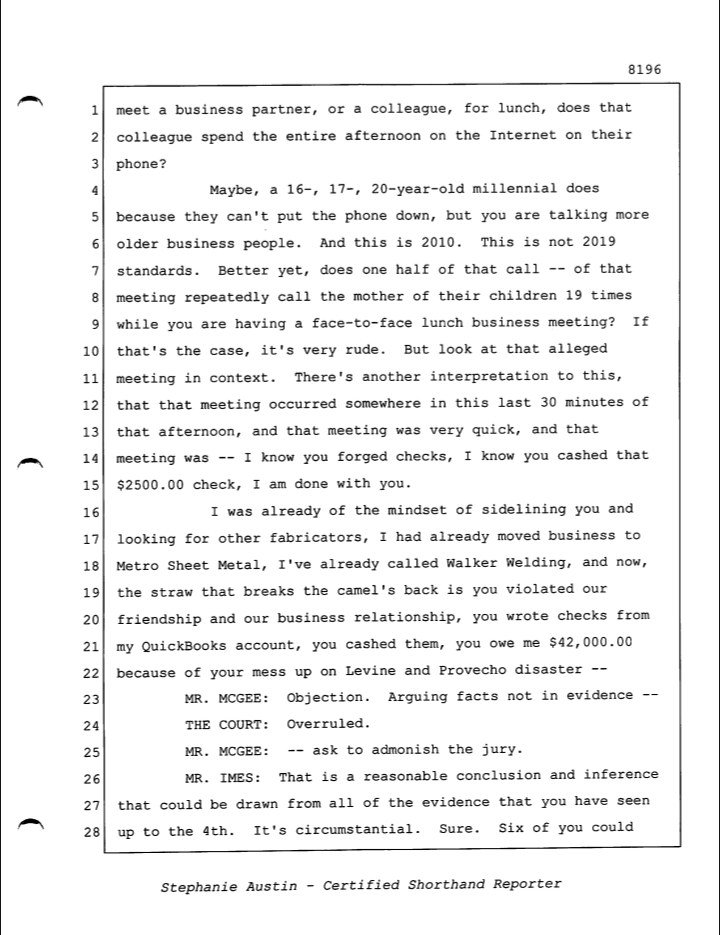
“I was already of the mindset of sidelining you and looking for other fabricators, I had already moved business to Metro Sheet Metal, I’ve already called Walker Welding, and now, the straw that breaks the camel’s back is you violated our friendship and our business relationship, you wrote checks from my QuickBooks account, you cashed them, you owe me $42,000.00 because of your mess up on Levine and Provecho disaster —”
(RT 8196:16-8197:1)
MR. MCGEE: “Objection. Arguing facts not in evidence —”
THE COURT: “Overruled.”
MR. MCGEE: “— ask to admonish the jury.”
See RT 8196 and 8197
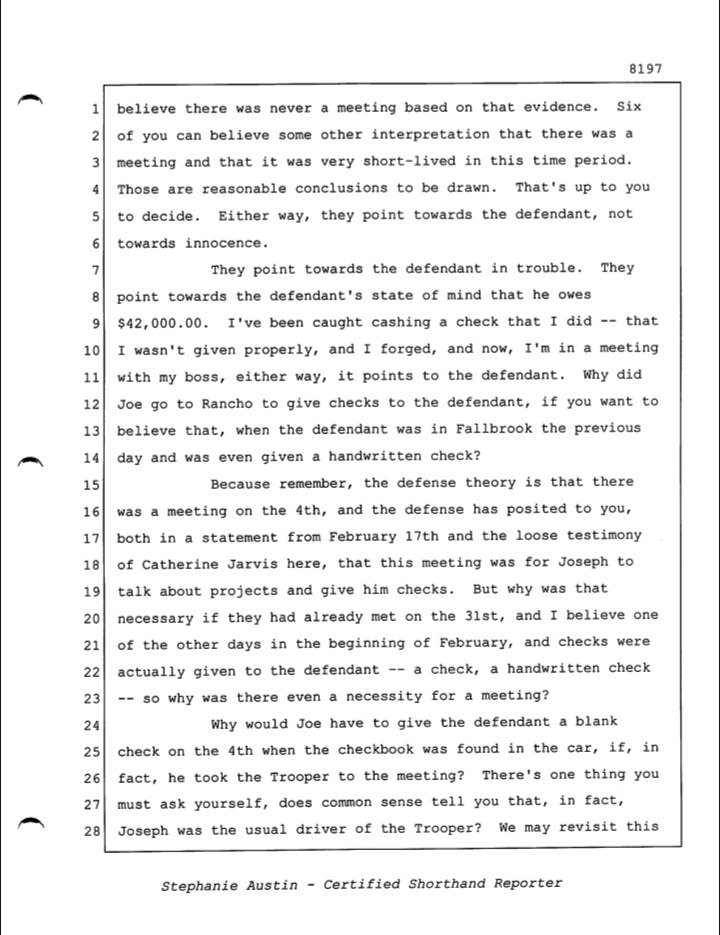
He went straight on: “They point towards the defendant in trouble. They point towards the defendant’s state of mind that he owes $42,000.00.” (RT 8197:7-9) And he kept coming back to it, through the rest of his closing:
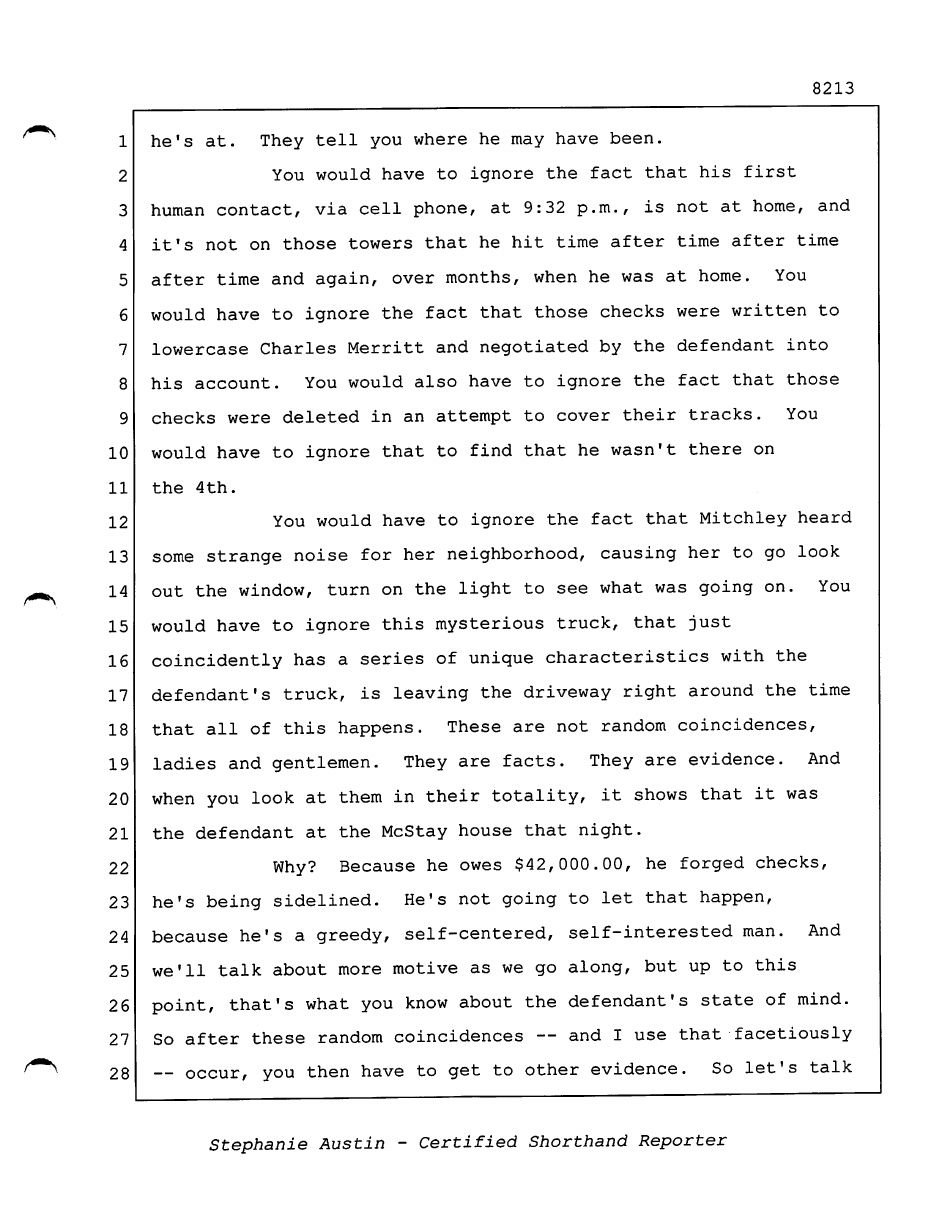
“Why? Because he owes $42,000.00, he forged checks, he’s being sidelined.”
(RT 8213:22-23)
See RT 8213
“That is a short brief meeting where Joseph Mc Stay basically kicks the defendant to the curb saying, I’m done. Forged checks have been cashed. You owe me $42,000.”
(RT 8245:17-20)
See RT 8245
“He also had a motive. He had a motive to erase the debt.”
(RT 8262:7-8)
See RT 8262
“So when you go back to that e-mail, the total is $42,000. It showed that that debt for Provecio disaster was only $19,000. It changed between the spreadsheet and that e-mail being sent. It’s consistent with the defendant’s own admission during the jailhouse visit with Cathy Jarvis, a piece of evidence Mr. Shogren either conveniently overlooked or intentionally disregarded because his mission was to downplay the debt the defendant had despite the evidence being consistent in front of his face.”
(RT 8263:3-12)
See RT 8263
“That loss of income would make it a lot harder to pay back $42,000 he clearly owed Joe.”
(RT 8265:3-5)
See RT 8265
“There is no other reasonable interpretation of that February 1st e-mail than, you owe me $42,000. Makes logical sense when you see the fact that it modified the Provecio disaster to $19,000 in light of the defendant’s statements as well. You see that he is in debt.”
(RT 8270:2-6)
See RT 8270
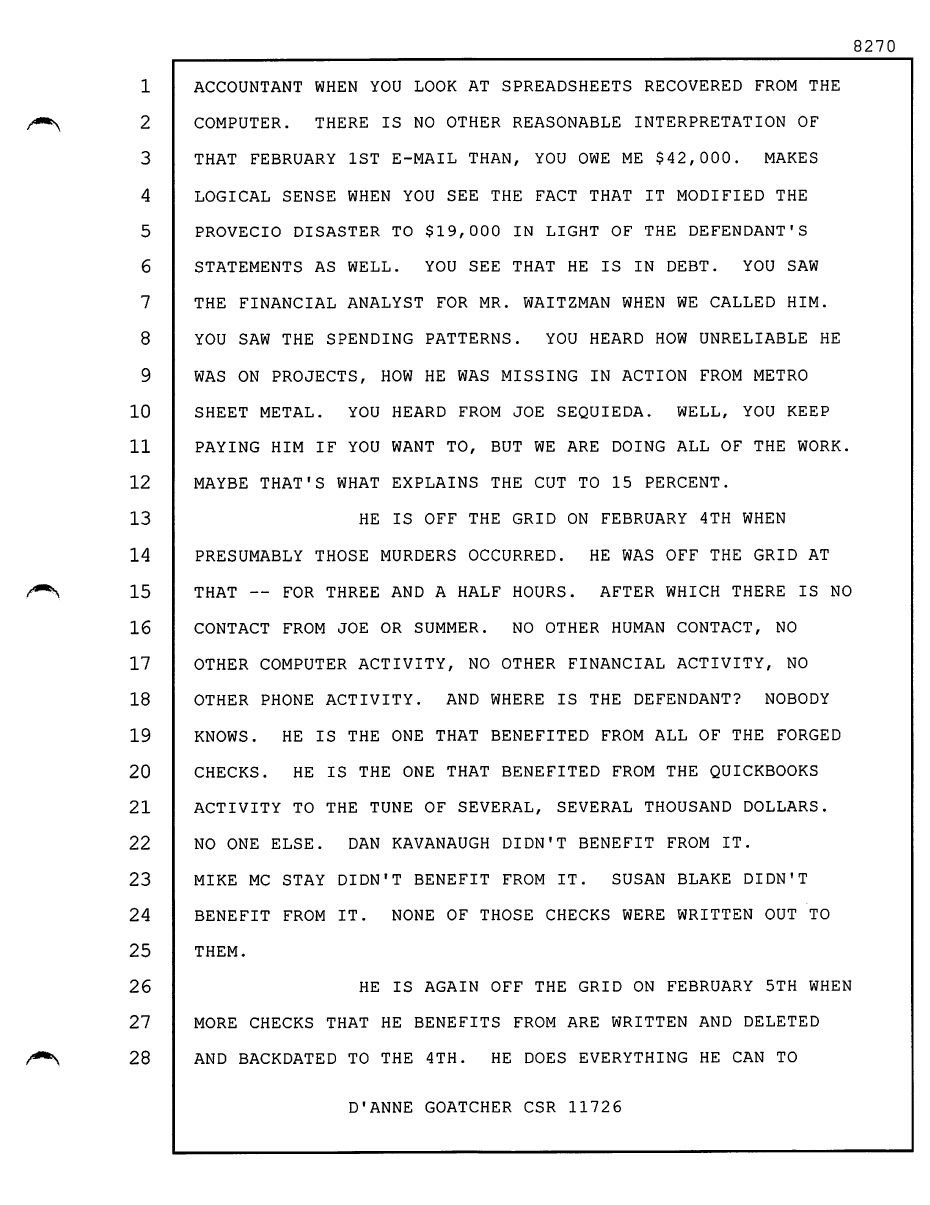
And at the penalty phase:
“We talked about erasing the debt, that $42,000.00 debt, that started the chain of events on February 1st with that e-mail from Joseph.”
(RT 8697:3-5)
See RT 8697
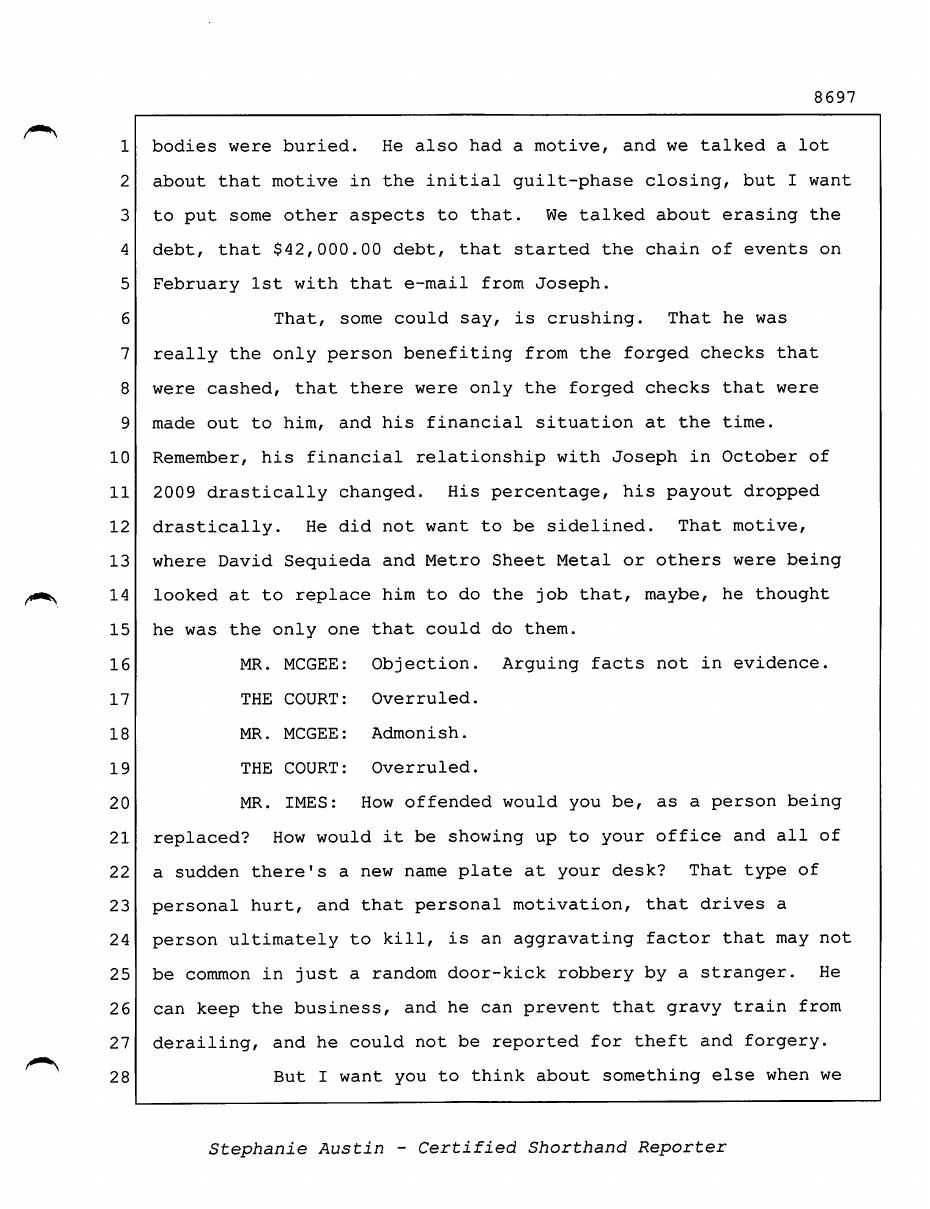
Every one of these was false. The e-mail wasn’t a bill, there was no $42,000 debt, and Joseph wasn’t my boss. Here is why.
The e-mail opens with what Joseph owed me, on two current jobs, Paul Mitchell and Saudi Arabia: “PM 15% $4725 Savings $3050 Total: $7775 / SA 15% $7725 Savings $6500 Install $4000 Total$18,225 / Total $26,000.” Only after that does it list “Overpaid $15,045 / PLUS $8800 (Levine) / PLUS $19000 (Provecho) / Total $42,845” (Exhibit 419). The defense accountant walked the jury through it on direct examination by Mr. Maline. The $26,000 was owed to me once the customers’ 50 percent deposits came in, and both had come in by the time Joseph wrote it:
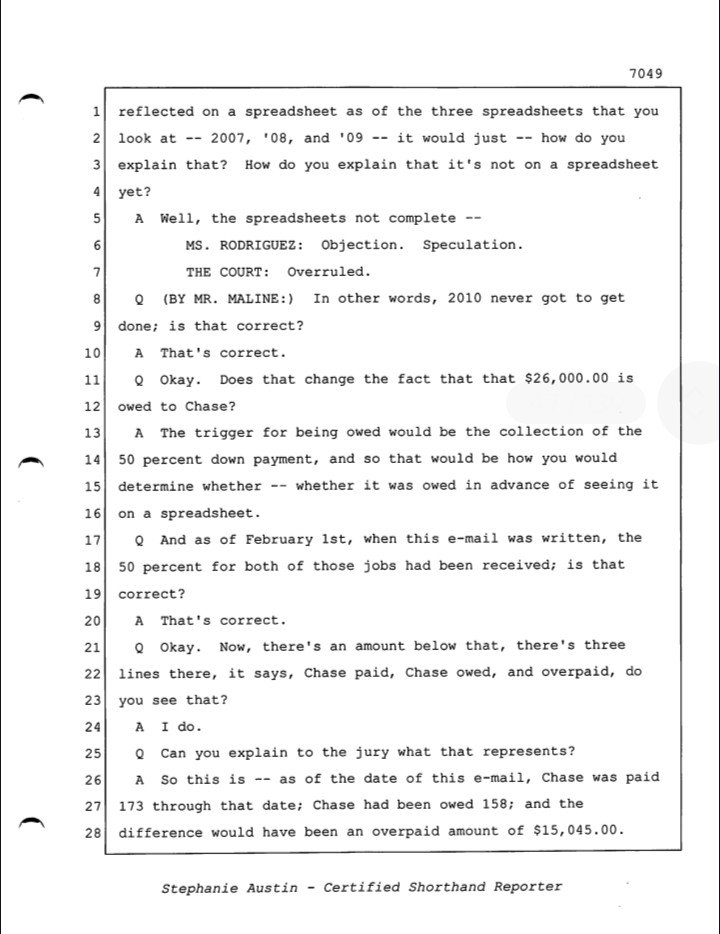
Q. “Okay. Does that change the fact that that $26,000.00 is owed to Chase?”
(RT 7049:11-20)
A. “The trigger for being owed would be the collection of the 50 percent down payment, and so that would be how you would determine whether — whether it was owed in advance of seeing it on a spreadsheet.”
Q. “And as of February 1st, when this e-mail was written, the 50 percent for both of those jobs had been received; is that correct?”
A. “That’s correct.”
See RT 7049
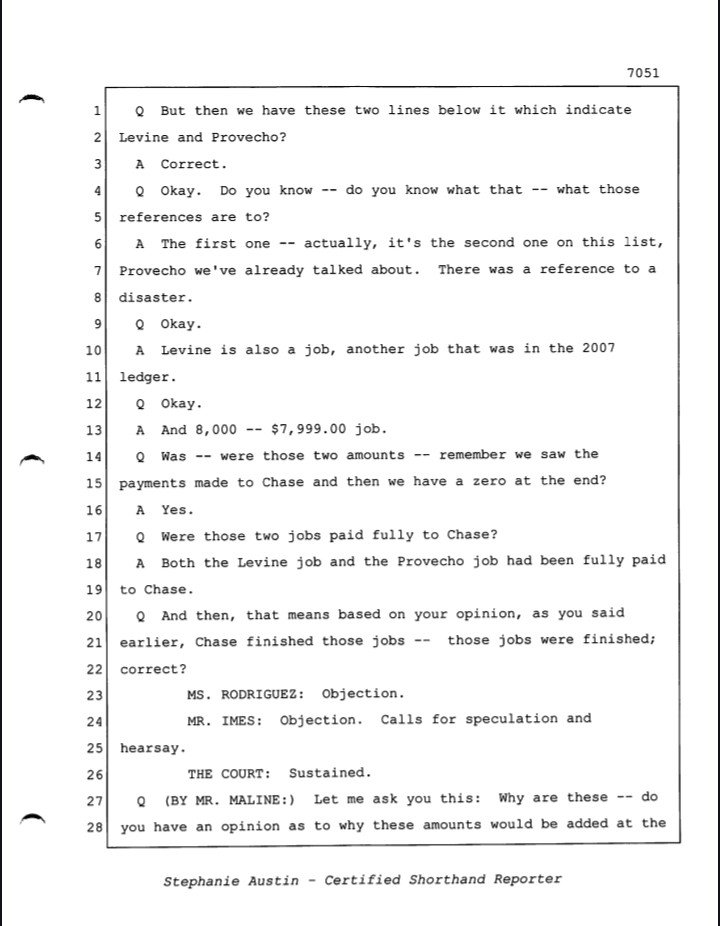
The word “disaster” was Joseph’s, in a box he kept off to the side of his ledger: “Provecho Disaster $34,000.00” and “Levine CB Disaster $8800” (Bates 002605). Those were side notes, not part of what he and I owed each other. The accountant told the jury I had been paid my share of both jobs in full, and that the notes were customer claims, not money I owed:
Q. “Were those two jobs paid fully to Chase?”
(RT 7051:17-19)
A. “Both the Levine job and the Provecho job had been fully paid to Chase.”
See RT 7051
“It’s my opinion that these are jobs that there are claims that exist, so the customer is making a claim against Earth Inspired Products for something involving the installation of, workmanship, the final product; and so they have been listed here as claims, but there has been no demand for payment made.”
(RT 7052:5-10)
See RT 7052
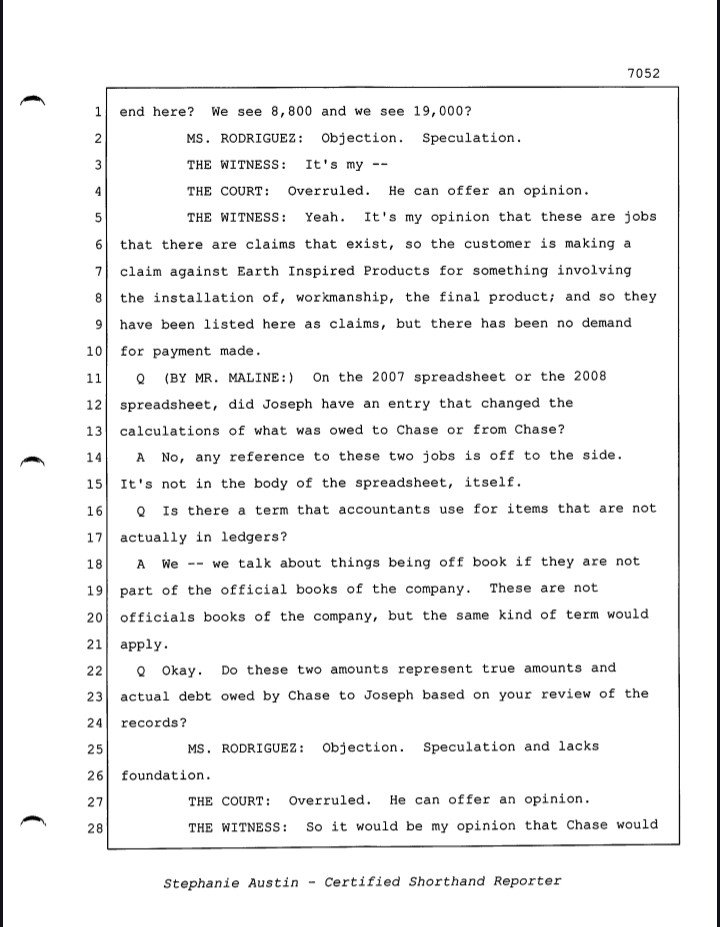
There is one sentence in his testimony the State could point to, and I want it right here. Asked whether the side notes were a real debt, he said:
“So it would be my opinion that Chase would be liable for up to the amount he had been paid for these jobs as an independent contractor. And on the Levine job, he had been paid $5,400.00, so I — I believe it would be limited to that. The on the Provecho job, he was actually paid 19,500, and I think that 19 should be nineteen-five.”
(RT 7052:28-7053:5)
See RT 7052 and 7053
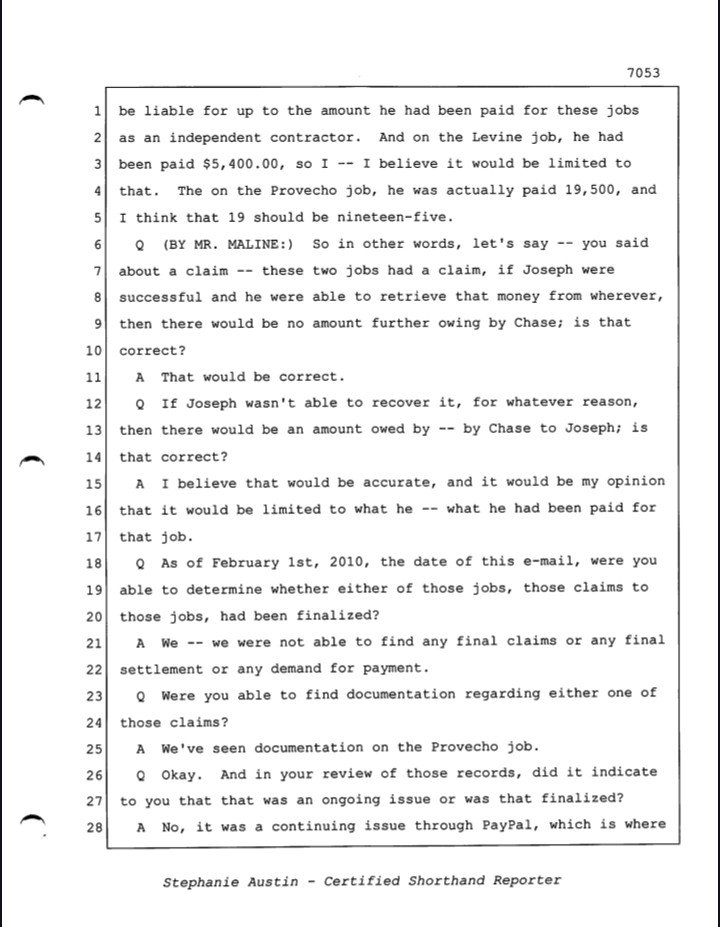
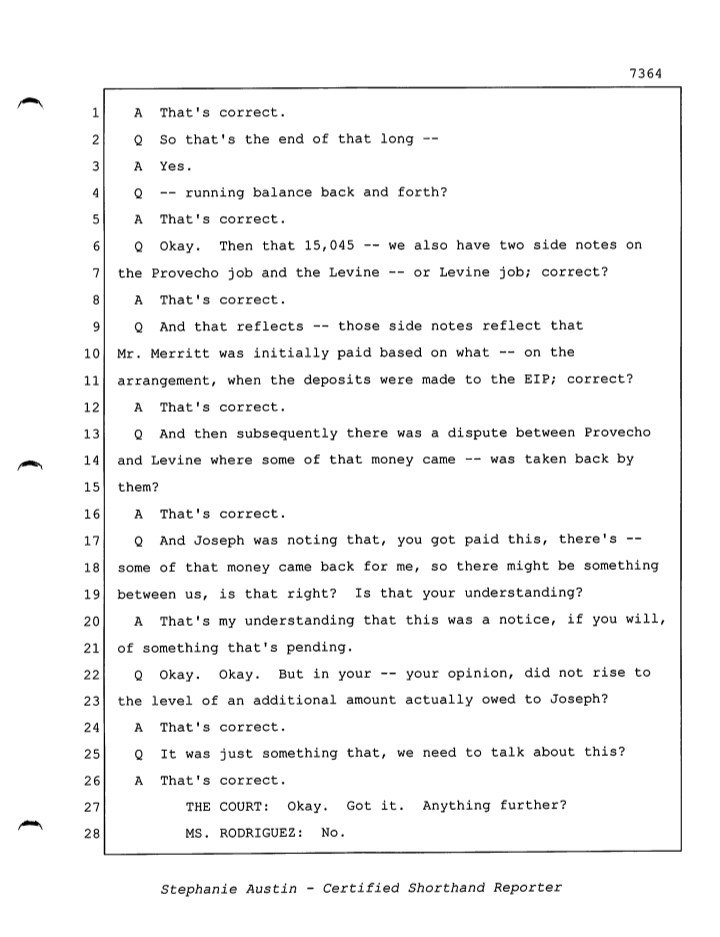
He was answering a question about what could happen if the claims were never resolved, and Mr. Maline’s very next questions made that clear. If Joseph got the money back, the accountant said, “That would be correct,” there would be nothing more owing, and as of February 1, 2010, “we were not able to find any final claims or any final settlement or any demand for payment” (RT 7053:6-22). When Ms. Rodriguez pressed him on cross-examination whether the two jobs were amounts I owed Joseph, he said “No,” and that they had “never been included in the actual data that is accumulated for what’s owed and not owed” (RT 7154:16-7155:8). And at the end of his testimony the judge asked him about it himself, in front of the jury:
THE COURT: “And that reflects — those side notes reflect that Mr. Merritt was initially paid based on what — on the arrangement, when the deposits were made to the EIP; correct?”
(RT 7364:9-26)
A. “That’s correct.”
THE COURT: “And then subsequently there was a dispute between Provecho and Levine where some of that money came — was taken back by them?”
A. “That’s correct.”
THE COURT: “And Joseph was noting that, you got paid this, there’s — some of that money came back for me, so there might be something between us, is that right? Is that your understanding?”
A. “That’s my understanding that this was a notice, if you will, of something that’s pending.”
THE COURT: “Okay. Okay. But in your — your opinion, did not rise to the level of an additional amount actually owed to Joseph?”
A. “That’s correct.”
THE COURT: “It was just something that, we need to talk about this?”
A. “That’s correct.”
See RT 7364
So the accountant hadn’t misrepresented anything, as Mr. Imes told the jury. The judge’s own questions got the same answer. The $19,000 wasn’t a debt either. It was my promise to share the loss with Joseph only if he lost his lawsuit and didn’t get the money back, and when Ms. Rodriguez tried to put it to the accountant as money I owed, the judge sustained the defense objection and agreed at the bench that it “doesn’t mean he owes it right then” (RT 7164:17-7166:3). My Provecho page has that whole exchange.
And Joseph wasn’t my boss. His own letter to PayPal, quoted in the first section, says “Both EIP and I Design 4 U are small companies.” EIP was his company and I Design 4 U was mine, and I did his custom work as an independent contractor, the accountant’s own words for it. I never owed Joseph that money, and he never asked me for it.
3. The last word, in rebuttal
Ms. Rodriguez picked it up in rebuttal, the last argument the jury heard, when the defense couldn’t answer:
“There is no way for him to get additional savings on that. And even if — nowhere in this e-mail, first of all, does it say, hey, this total is 26,000 owing to you, so let me subtract that from the 42,000. Doesn’t say that.”
(RT 8419:5-8)
See RT 8419
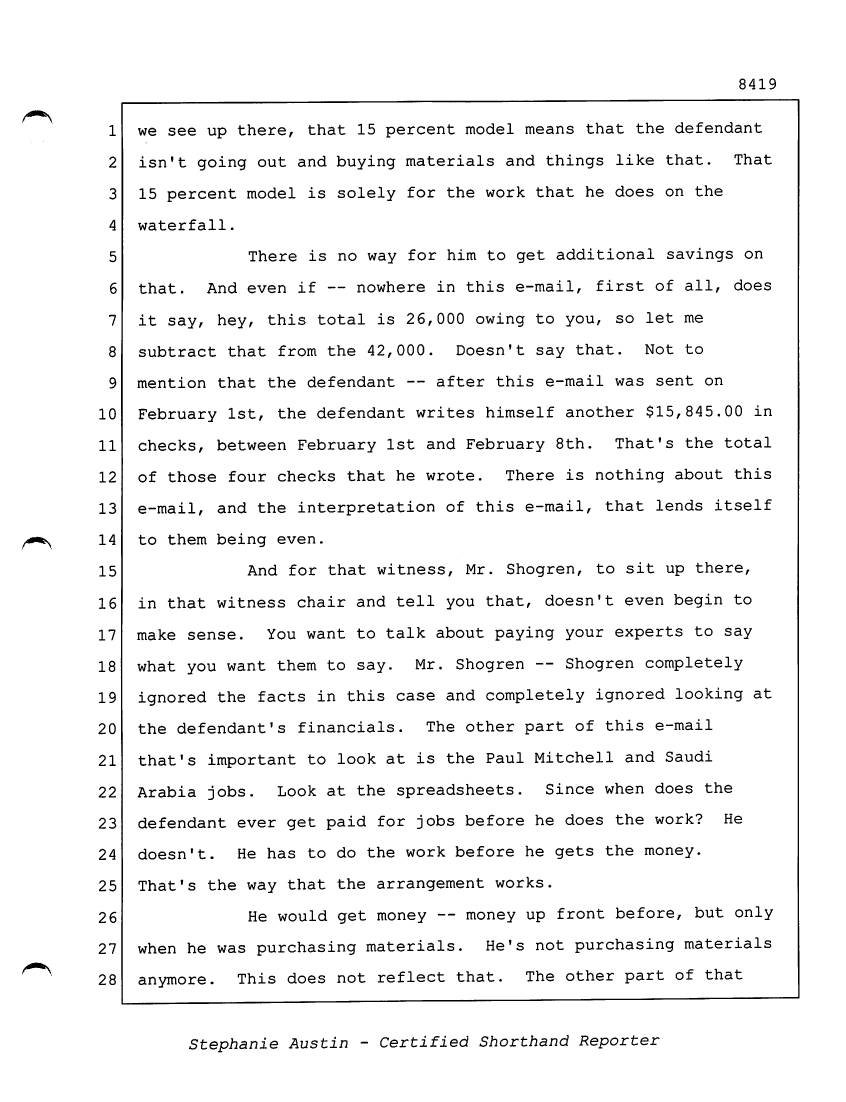
“Since when does the defendant ever get paid for jobs before he does the work? He doesn’t. He has to do the work before he gets the money.”
(RT 8419:22-24)
See RT 8419
These were false. The $26,000 is the first thing in the e-mail, just as quoted in the section above, and the savings are in it in Joseph’s own numbers. The accountant told the jury that my $6,500 check “matches the savings number in the e-mail at savings of 6,500 for the Saudi Arabia job” (RT 7084:26-7085:4), and, over the State’s objection, that “Payments begin when the deposit is received from the customer” (RT 7083:15-22).
What the defense said
Mr. McGee objected once, when Mr. Imes put “your mess up on Levine and Provecho disaster” in Joseph’s mouth, and asked that the jury be admonished. The judge overruled him. The next day, in the defense closing, Mr. Maline answered the $42,000 directly. He told the jury that Joseph never added Provecho and Levine into his running tally, that the accountant had called them off-the-books items, that Provecho “defaulted” and pulled back its deposit, and that “for the prosecution to just add that in when it’s clearly not a part of the calculation, and just to tell you that there is debt of $42,000 is misleading” (RT 8392:6-8393:8). Nobody objected to any of the other statements. At the penalty phase, Mr. McGee objected a few lines after the “$42,000.00 debt” line, when Mr. Imes told the jury Metro Sheet Metal and others were being looked at to replace me, and the judge overruled him (RT 8697:12-19). Nobody objected to the debt line itself or to “messed up projects.”
Why it mattered
The State needed a reason Joseph would turn on me, and these two jobs and this “debt” were it. But the only person whose state of mind mattered was Joseph’s, and he wrote it down when it happened. He defended my work, blamed the customer, kept the side notes off to the side of his ledger, opened his e-mail with what he owed me, and kept giving me his custom jobs for another year and a half. Mr. Imes told the jury the opposite of what Joseph himself wrote, and then told it again to a jury deciding whether I should be executed.
Mr. Imes · closing argument · May 28, 2019 · and penalty argument · June 19, 2019
“Joseph was looking for other fabricators and welder-type people to do the work”
The State’s motive was that Joseph was pushing me out of his business by February 2010. Mr. Imes told the jury I “was being sidelined,” named Provecho and Levine as the first sign of it, and then told them that three witnesses had heard Joseph was looking for people to do my work in my place. The three were Joseph’s mother Susan Blake, his brother Michael McStay, and McGyver McCargar, who had been helping the family paint their new house. I was the one who built Joseph’s custom water features, so “other fabricators and welder-type people to do the work” meant people to replace me. Mr. Imes made that plain himself a few minutes later, when he put it in Joseph’s mouth: “I was already of the mindset of sidelining you and looking for other fabricators” (RT 8196:16-17). Here is what he told the jury, with no objection from anyone:
“You heard from Susan and Michael — I think even McGyver, if I recall correctly — that Joseph was looking for other fabricators and welder-type people to do the work.”
(RT 8187:6-9)
See RT 8187
He came back to the same three witnesses near the end of his argument:
“He has a motive to not be sidelined from this business. You know from those spreadsheets as well that he we, in fact, being sidelined. You don’t have to believe Mc Gyver and Susan and Mike.”
(RT 8263:18-22)
See RT 8263
Both of these were false. None of the three told the jury that Joseph was looking for someone to replace me. Here is what each of them actually said.
1. McGyver McCargar
McGyver McCargar testified on January 14, 2019. Nothing in his testimony says Joseph was looking for other fabricators or welders, or that Joseph wanted me out. Mr. Imes named him anyway, with “if I recall correctly.”
2. Michael McStay
Michael McStay was called back as a defense witness on April 3, 2019, and this came up on direct examination by Mr. Maline, when he asked Michael how involved he had been in Joseph’s business:
“No, but my brother, literally, for about the last two years was asking me to learn how to weld. He wanted me to learn how to weld, but I didn’t have any involvement in his business. So he wanted me to weld to replace Chase.”
(RT 5654:15-18)
See RT 5654
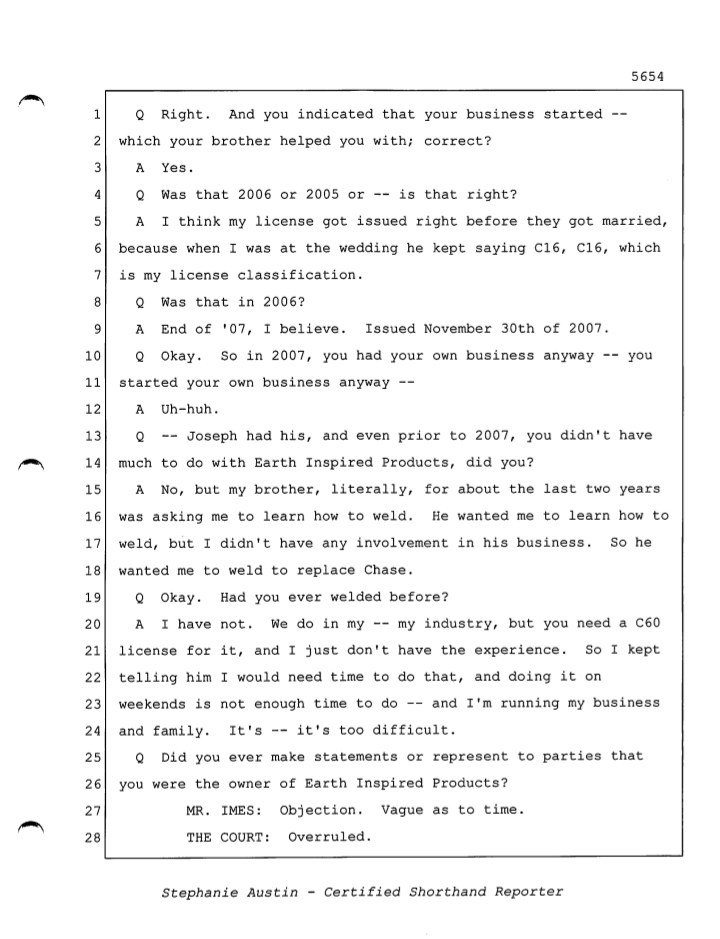
What Joseph did was ask his brother to learn to weld. “So he wanted me to weld to replace Chase” is Michael’s own conclusion about why. He didn’t say Joseph ever told him that.
3. Susan Blake
Susan is Joseph’s mother, and she is where the State will point, so I’ll start with how it got the one answer from her that seems to support Mr. Imes. In August 2014 she was interviewed by Detectives Steers and Hanke, and the interview was recorded and transcribed. On page 157 she told them what Joseph had said his plan was, and on page 158 Detective Hanke summed it up in his own words and then asked her directly. Here are those lines, in order:
MS. BLAKE: “Well, and I also knew that Joey was wanting to get his own I.T. guy and — and — and mentioned from Joey to me that, I’m buying him out, mom. So I just thought Dan the man was going to be gone, and then he’d still have Chase and the welders and everybody in one spot. That was his goal.”
(Interview of Susan Blake, August 13, 2014, pp. 157:19-158:15)
DETECTIVE HANKE: “That was my next question. So you talked about buying Dan — that Joey was going to buy Dan and Chase out.”
MS. BLAKE: “Uh-huh.”
DETECTIVE HANKE: “Did he ever tell you that he was planning on getting a new — you say I.T. guy — but did he ever say that he wanted a new builder or welder?”
MS. BLAKE: “No. He didn’t say as much about Chase, wanting to get Chase out. He wanted to get more Dan out. Because Dan acted as if he could just flip the switch and shut his whole business down. And Joey couldn’t get it back up and this and that. So his — his concern was to buy him out — and he’s told me this, Joey — and then start over. And he said he’s talked to other people about, you know, it getting it going, to where he could control it in an office in his building.”
See interview pages 157 and 158
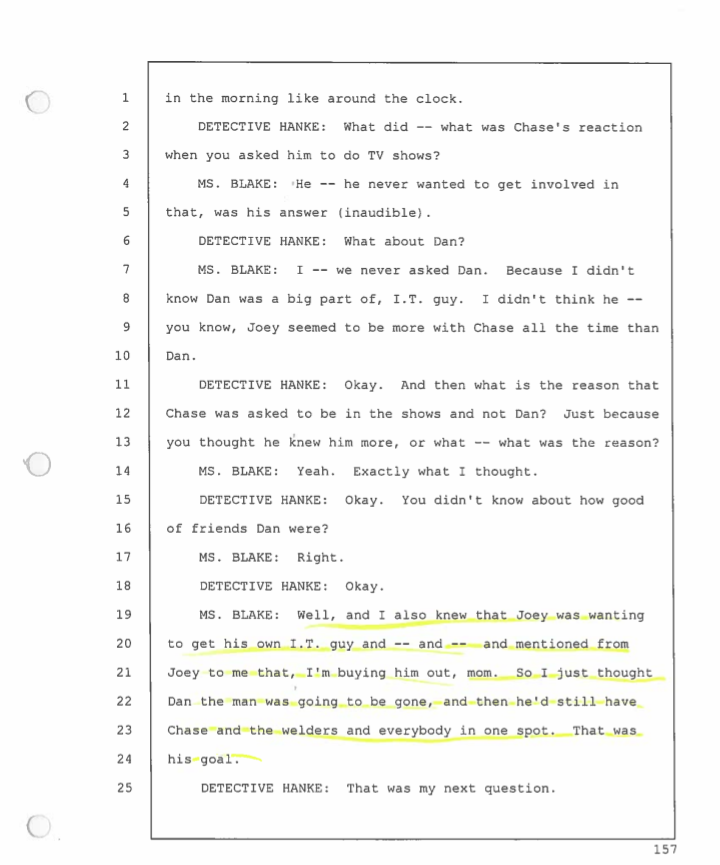
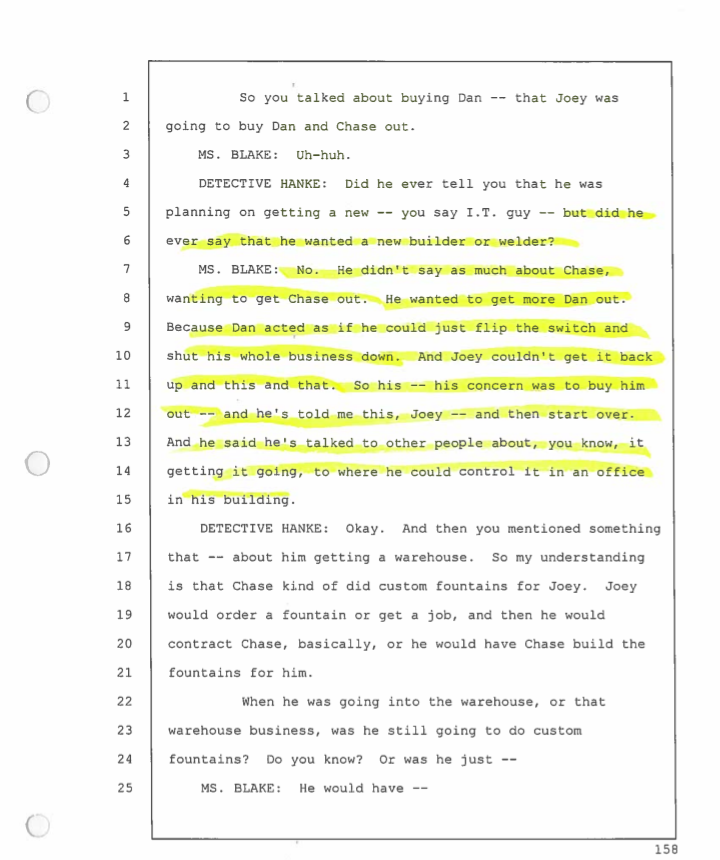
“Joey was going to buy Dan and Chase out” were the detective’s words, not hers. Her own answer, when he asked her directly, was “No,” and that Joseph “wanted to get more Dan out.”
On March 18, 2019, in front of the jury, Ms. Rodriguez cross-examined Susan. Earlier in that cross, on a different document, she had wanted Susan to read past the highlighted part, and told her so:
Q. “Showing that same exhibit, page 28857, defense counsel asked you, specifically, if you noticed any blood or anything on the tables, if you could read the next line that’s not highlighted. Right up here, ma’am.”
(RT 5525:26-5526:1)
See RT 5525 and 5526
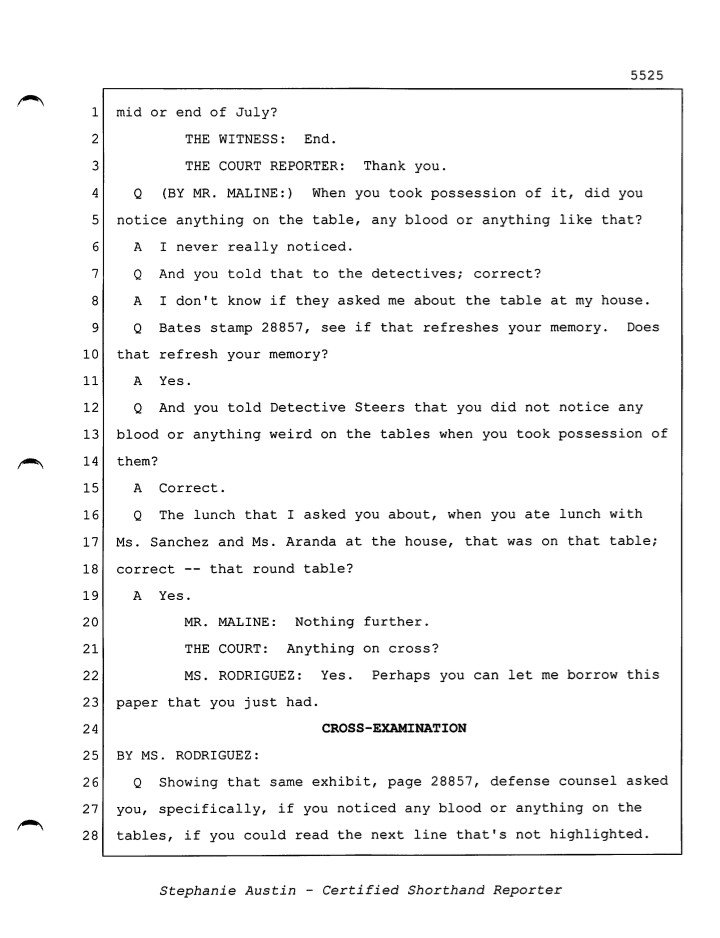
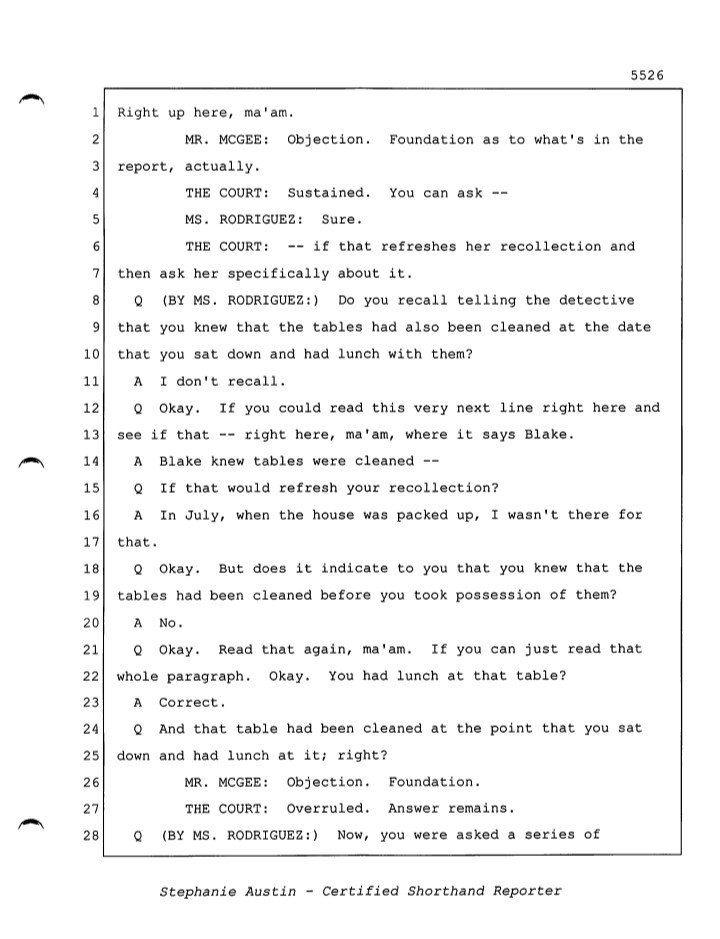
After the afternoon recess she came to page 158 of the interview, and this time she had Susan read only the top of it:
Q. “And do you recall being asked that Joey was going to buy Dan and Chase out?”
(RT 5535:15-28)
A. “Just Dan.”
Q. “Well, let me ask you to review page 158 of that transcript.”
THE COURT: “This is of an interview?”
MS. RODRIGUEZ: “This is of an interview with Detective Steers.”
Q. (BY MS. RODRIGUEZ:) “If you could just review the first couple of lines there. That’s it. Do you recall talking to that — with — talking about that with Detective Steers?”
A. “Yes.”
Q. “And did you tell Detective Steers that Joey was going to buy Dan and Chase out?”
A. “Yes.”
See RT 5535
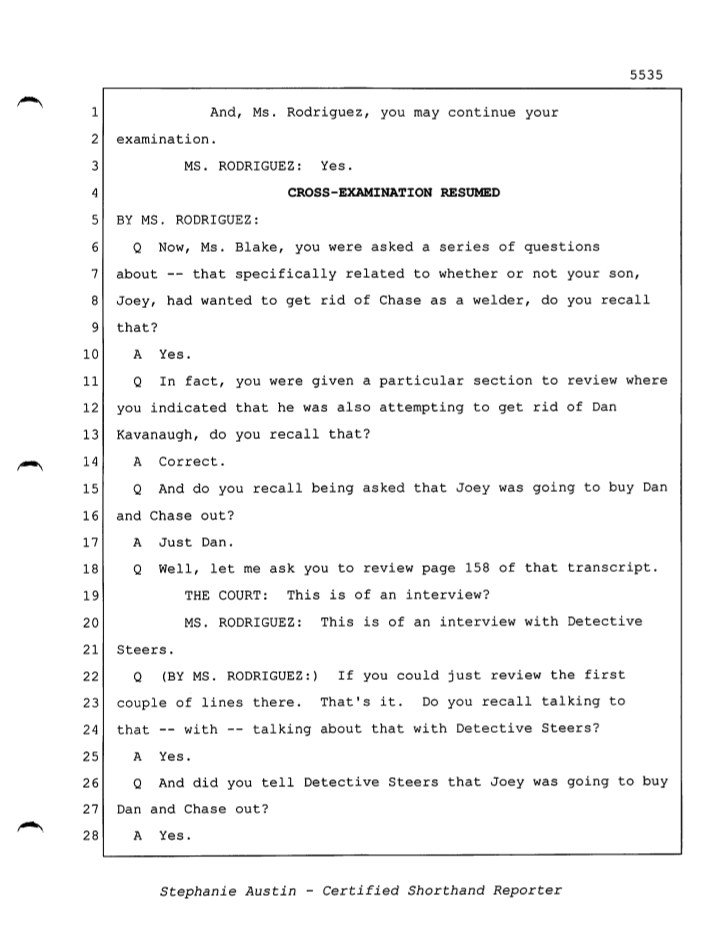
When it helped the State, Ms. Rodriguez had Susan read past the highlighting. When it didn’t, she stopped her at “the first couple of lines.” Susan had just answered “Just Dan.” The lines Ms. Rodriguez let her read were the detective’s summary, and they stopped before Susan’s own answer a few lines down: “No. He didn’t say as much about Chase, wanting to get Chase out.” The “Yes” the jury heard rested on the “Uh-huh” she gave to the detective’s summary, not on anything she said Joseph had told her. The prosecutors had the whole transcript in hand, and her real answer was a few lines below where Ms. Rodriguez told her to stop. Ten weeks later Mr. Imes stood in front of the same jury and told them they had heard from Susan that Joseph was looking for other fabricators. I have a separate card on how that “Yes” was gotten, “‘Just Dan’ became ‘Yes,’” on my page about the testimony the prosecutors let stand.
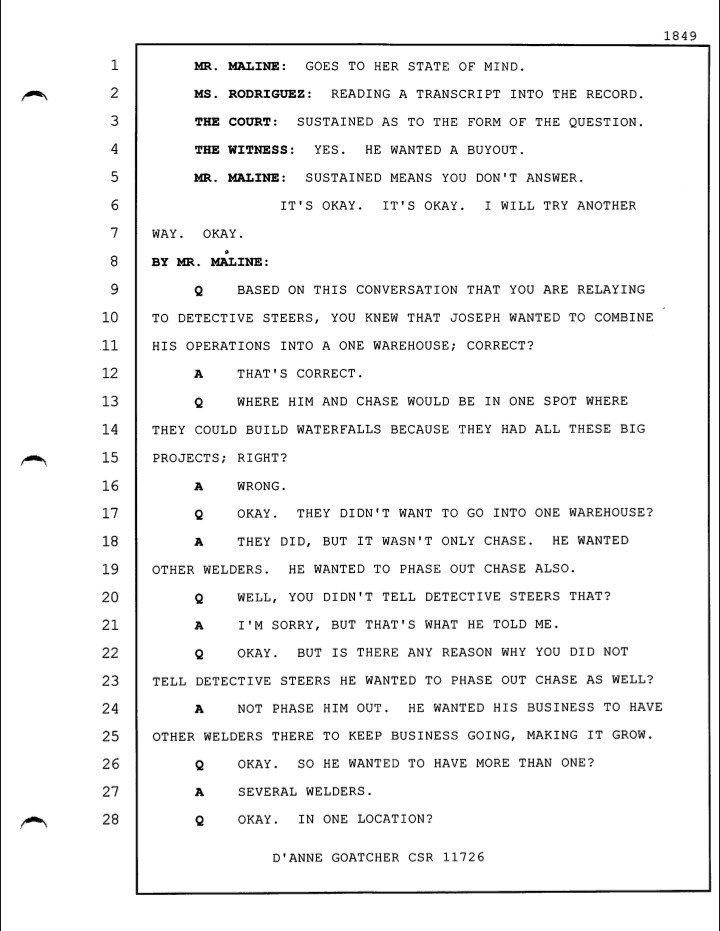
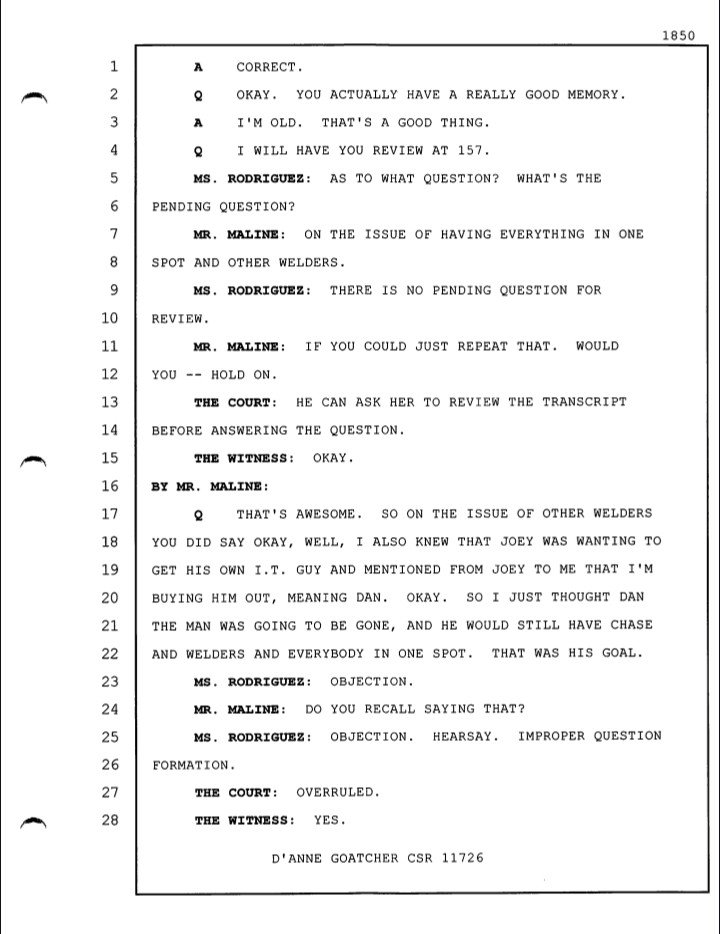
When Susan was asked what Joseph himself had told her, without being stopped partway down a page, she described more welders, with me kept on. At her first appearance, on January 8, 2019, on cross-examination by Mr. Maline, she first said Joseph wanted to phase me out. When Mr. Maline asked why she had never told the detective that, she took it back and said what Joseph had actually wanted:
Q. “Okay. But is there any reason why you did not tell Detective Steers he wanted to phase out Chase as well?”
(RT 1849:13-1850:1)
A. “Not phase him out. He wanted his business to have other welders there to keep business going, making it grow.”
Q. “Okay. So he wanted to have more than one?”
A. “Several welders.”
Q. “Okay. In one location?”
A. “Correct.”
See RT 1849 and 1850
The defense recalled her on March 18, 2019, earlier the same day as Ms. Rodriguez’s questions. On direct examination by Mr. Maline she first said Joseph “wanted to weed Chase out” and “wanted to get rid of him” (RT 5489:24-5490:9). Mr. Maline then took her to what she had told Detective Hanke, and to what Joseph himself had talked about:
Q. “And you also told Detective Hanke that he’d still have Chase and the welders and everybody in one spot; isn’t that —”
(RT 5492:11-22)
MR. IMES: “Objection. Hearsay. Lacks foundation.”
THE COURT: “Overruled.”
Q. “Isn’t that what you told him?”
A. “Yes.”
Q. “Okay. And what you meant by that was Joey’s vision of having one warehouse would include Chase and the other — other welders?”
MS. RODRIGUEZ: “Objection. Leading.”
THE COURT: “Overruled.”
THE WITNESS: “That’s what he talked about.”
See RT 5492
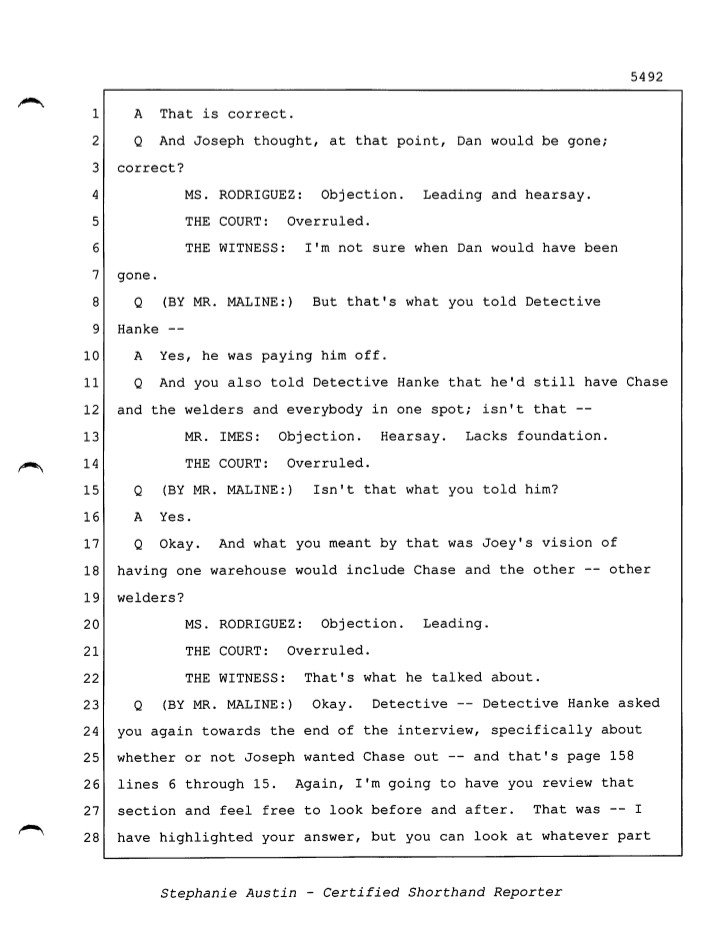
So when Susan was asked what Joseph himself had said, in 2014, in January and again in March, her answer was that he wanted more welders and a warehouse with me in it.
Joseph also kept sending me his custom jobs right up through January 28, 2010, a week before he disappeared.
4. At the penalty phase, “looked at to replace him”
Three weeks after his closing argument, at the penalty phase, when the jury was deciding whether I should live or die, Mr. Imes told them again that I was being replaced, and this time he named who was replacing me. Mr. McGee objected and asked for an admonition, and the judge overruled him both times:
MR. IMES: “Remember, his financial relationship with Joseph in October of 2009 drastically changed. His percentage, his payout dropped drastically. He did not want to be sidelined. That motive, where David Sequieda and Metro Sheet Metal or others were being looked at to replace him to do the job that, maybe, he thought he was the only one that could do them.”
(RT 8697:10-22)
MR. MCGEE: “Objection. Arguing facts not in evidence.”
THE COURT: “Overruled.”
MR. MCGEE: “Admonish.”
THE COURT: “Overruled.”
MR. IMES: “How offended would you be, as a person being replaced? How would it be showing up to your office and all of a sudden there’s a new name plate at your desk?”
See RT 8697
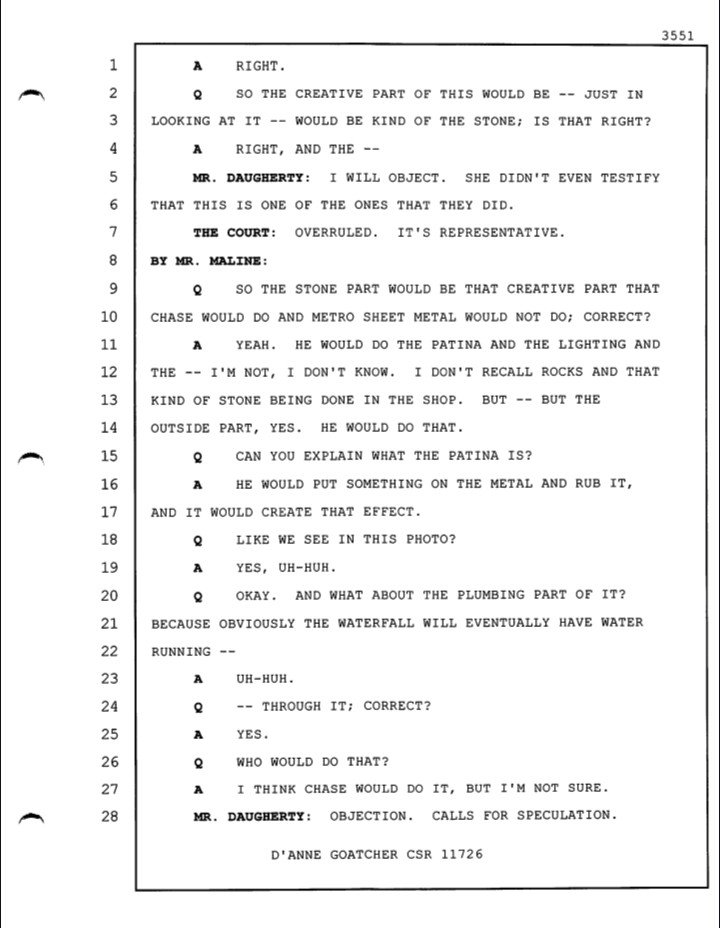
This was false. Metro Sheet Metal wasn’t replacing me. Metro and I worked on the same waterfalls, and each of us did a different part. The People’s own witness from Metro, its office manager Carmen Garcia, told the jury so on cross-examination by Mr. Maline:
Q. “So the stone part would be that creative part that Chase would do and Metro Sheet Metal would not do; correct?”
(RT 3551:9-14)
A. “Yeah. He would do the patina and the lighting and the — I’m not, I don’t know. I don’t recall rocks and that kind of stone being done in the shop. But — but the outside part, yes. He would do that.”
See RT 3551
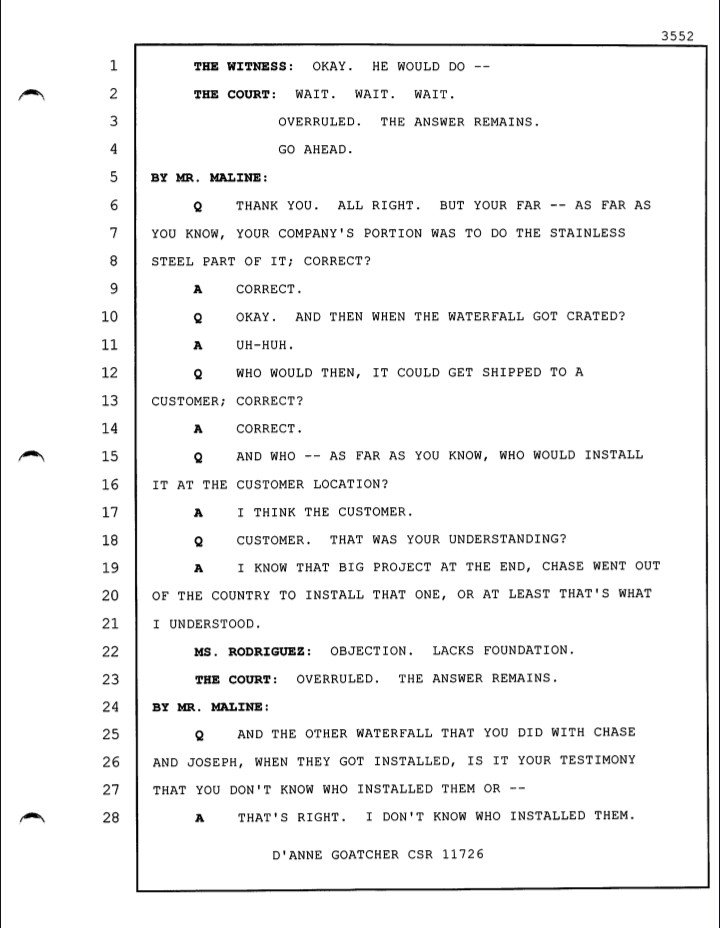
Q. “Thank you. All right. But your far — as far as you know, your company’s portion was to do the stainless steel part of it; correct?”
(RT 3552:6-9)
A. “Correct.”
See RT 3552
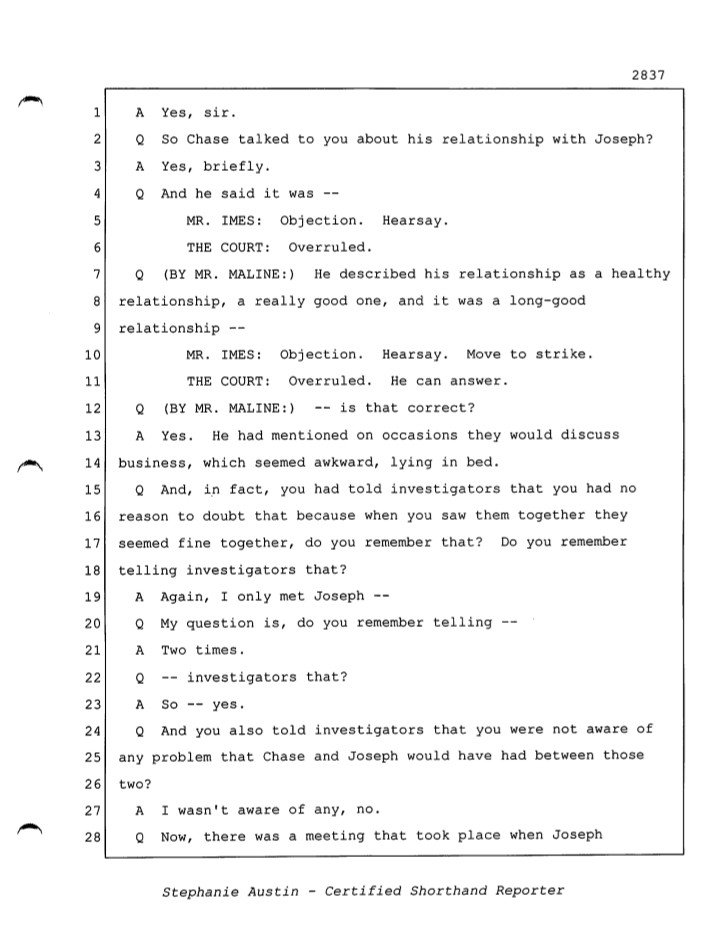
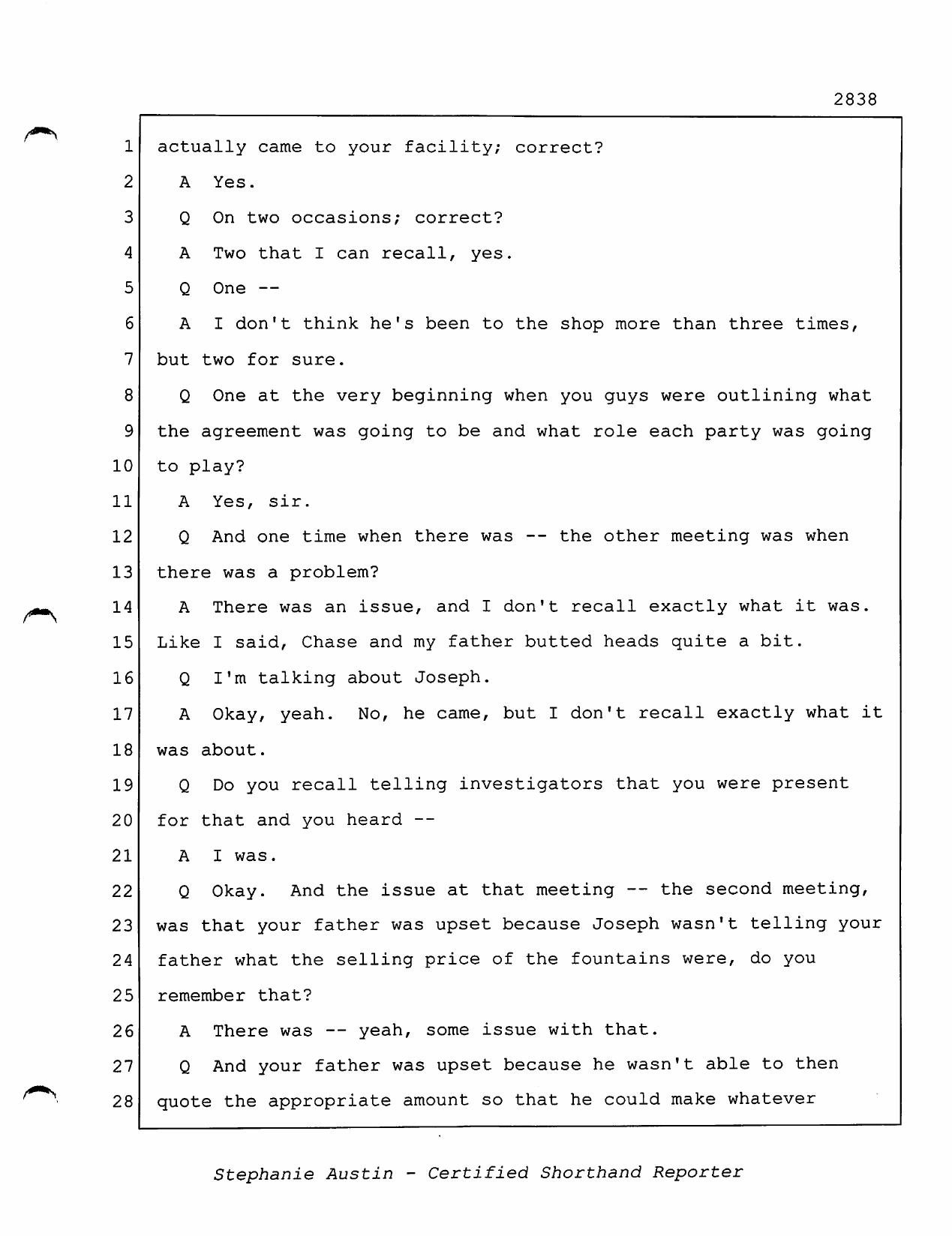
The State also called David Sequeida, who worked at Metro with his father. On January 22, 2019, on cross-examination by Mr. Maline, he told the jury he knew of no problem between Joseph and me at all, and that the real problem was between his father and Joseph:
Q. “And you also told investigators that you were not aware of any problem that Chase and Joseph would have had between those two?”
(RT 2837:24-27)
A. “I wasn’t aware of any, no.”
See RT 2837
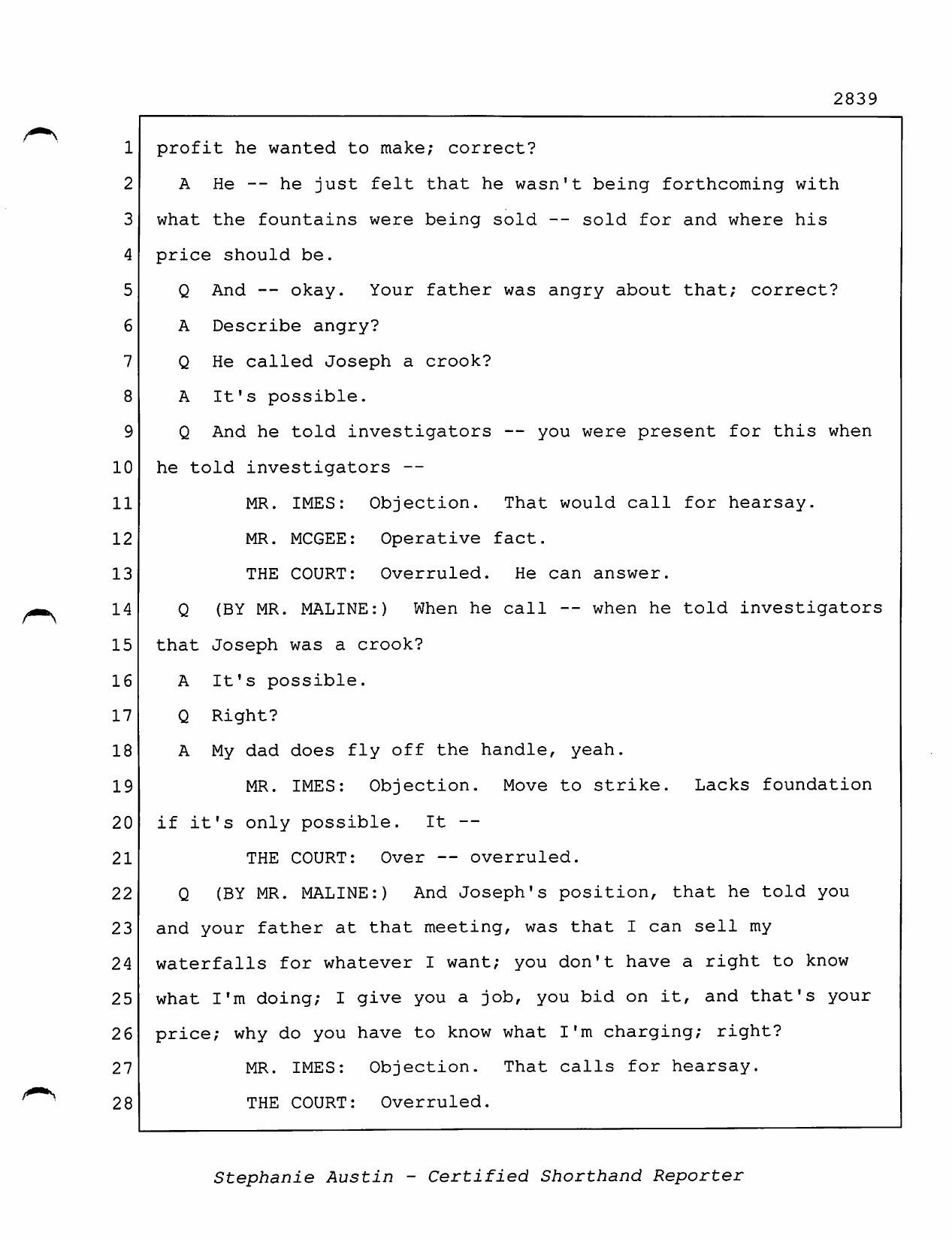
Q. “Okay. And the issue at that meeting — the second meeting, was that your father was upset because Joseph wasn’t telling your father what the selling price of the fountains were, do you remember that?”
(RT 2838:22-2839:8)
A. “There was — yeah, some issue with that.”
Q. “And your father was upset because he wasn’t able to then quote the appropriate amount so that he could make whatever profit he wanted to make; correct?”
A. “He — he just felt that he wasn’t being forthcoming with what the fountains were being sold — sold for and where his price should be.”
Q. “And — okay. Your father was angry about that; correct?”
A. “Describe angry?”
Q. “He called Joseph a crook?”
A. “It’s possible.”
See RT 2838 and 2839
Q. “And your dad swallowed that because you guys needed the work and it was good work for you?”
(RT 2840:7-14)
A. “No, he wanted to cut — cut the ties with — with them because it was becoming more of a problem than —”
Q. “You said yesterday you wanted to cut ties with Chase, but really you wanted to cut ties with Joseph because Joseph, as you said, was the money guy; right?”
A. “Joseph was the guy paying the bills, yes.”
See RT 2840
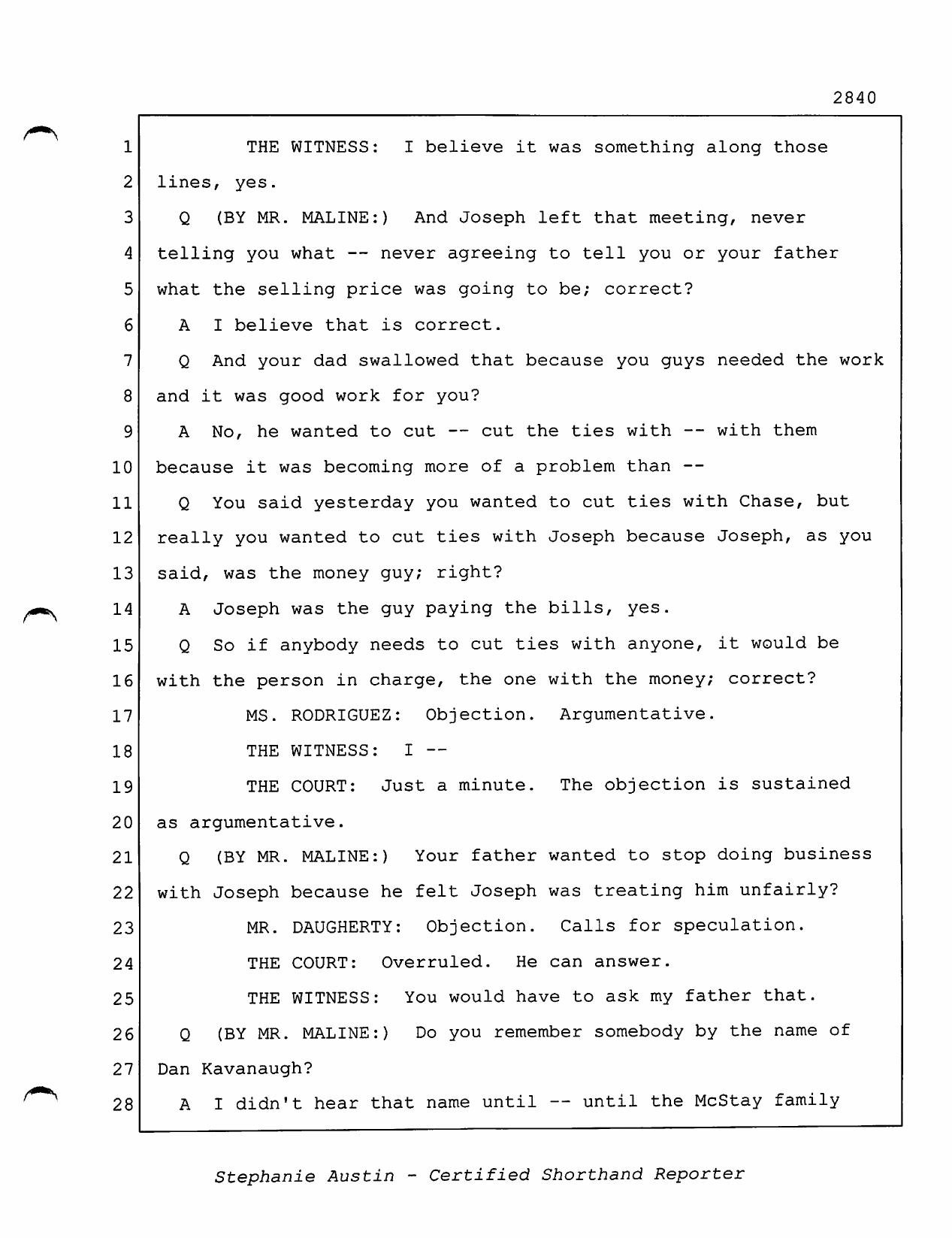
So the trouble the State’s own Metro witness described was Metro’s trouble with Joseph, over prices, not Joseph’s trouble with me.
Joseph’s own e-mail of February 1, 2010, three days before he disappeared, shows the same thing. On his two current jobs, Paul Mitchell and Saudi Arabia, it lists my share and my savings, and on Saudi Arabia my installation fee, and the defense accountant read it to the jury:
“The 15 percent is — is calculated as 4725 and then there’s additional amount labeled savings and a total of 7775 for that job. For Saudi Arabia, we go through the same exercise, 15 percent is 7725. The savings are listed as 6500. There’s also an installation fee for the Saudi job, and the total then that would be due would be 18,225 and a total of $26,000.00.”
(RT 7048:12-18)
See RT 7048
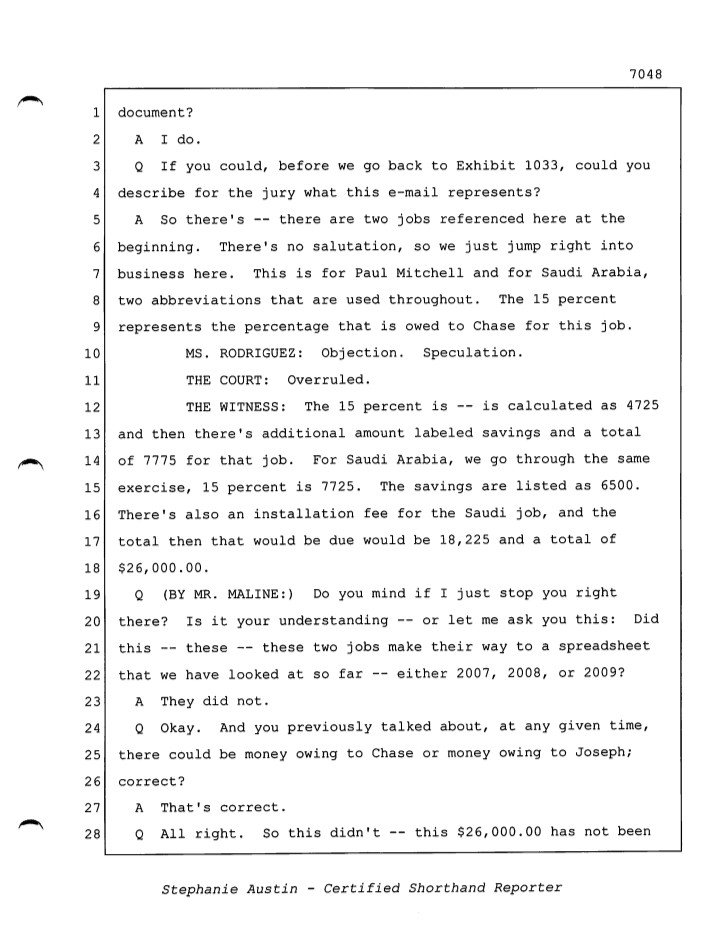
Joseph wasn’t putting a new name plate on my desk. He was paying me my share of his current jobs, including the installation of the Saudi Arabia job, and he kept sending me custom jobs right up through January 28, 2010. The change in my percentage in October 2009 is a separate question, and I answer it on its own card.
What the defense said
No one objected to the two statements in closing argument. At the penalty phase, Mr. McGee objected and asked for an admonition, and was overruled both times. In the defense closing, Mr. McGee played the jury part of Mr. Maline’s cross of David Sequeida about his father’s dispute with Joseph over prices (RT 8288:4-20), and told the jury that if Joseph was getting rid of me, someone had to take over my work, and the State hadn’t called a single witness who did: “They have nobody set up to replace him because he wasn’t getting replaced” (RT 8285:2-17). He didn’t tell the jury that McGyver never said it, that Michael’s words were his own conclusion, or what Susan had said Joseph actually talked about.
Why it mattered
The State’s whole motive depended on Joseph wanting me gone. Mr. Imes told the jury three people had heard it from Joseph. One never said it, one was giving his own opinion, and the third, when asked what Joseph himself had said, described a business that grew with me still in it.
- Read the full record → The first couple of lines (Susan Blake), Page 158 section (/recanted-testimony-susan-blake/#s4)
- Read the full record → The testimony they let stand, card t11 (/the-puppeteers-testimony-they-let-stand/#t11)
Mr. Imes · closing argument · May 28, 2019
“No indication that the defendant was there on the 2nd”
The State’s case on the checks was that I stole checks from Joseph and wrote them to myself. The first check I cashed was written on February 2, 2010, check #4240 for $2,495, with the memo “deposit sa 1001,” the deposit on the Saudi Arabia job. I cashed it that same day at Union Bank. My account is that I drove down to Joseph’s that morning to pick up lighting for the Saudi job, and Joseph gave me the check, blank because the cost wasn’t known yet. If I was at Joseph’s on February 2, the check came from Joseph’s hand. Mr. Imes told the jury there was no indication I was there. All of this was said in front of the jury, and no one objected.
1. “No indication that the defendant was there on the 2nd”
“Then we fast forward to February 2nd. Again, a series of events that the connection, and meaning, and understanding standing alone, may not seem interesting or may not seem important. You have a series, again, of QuickBooks activities from 11:27 a.m. to 11:37 a.m. What we do know is on that day, February 2nd, McGyver was at the house, painting. We saw evidence of that in Deputy Tingley’s photo, the drawers were removed, the cabinet drawers were removed. There’s paper on the ground. All of it consistent with McGyver being there, helping paint. No indication that the defendant was there on the 2nd.”
(RT 8191:4-15)
See RT 8191
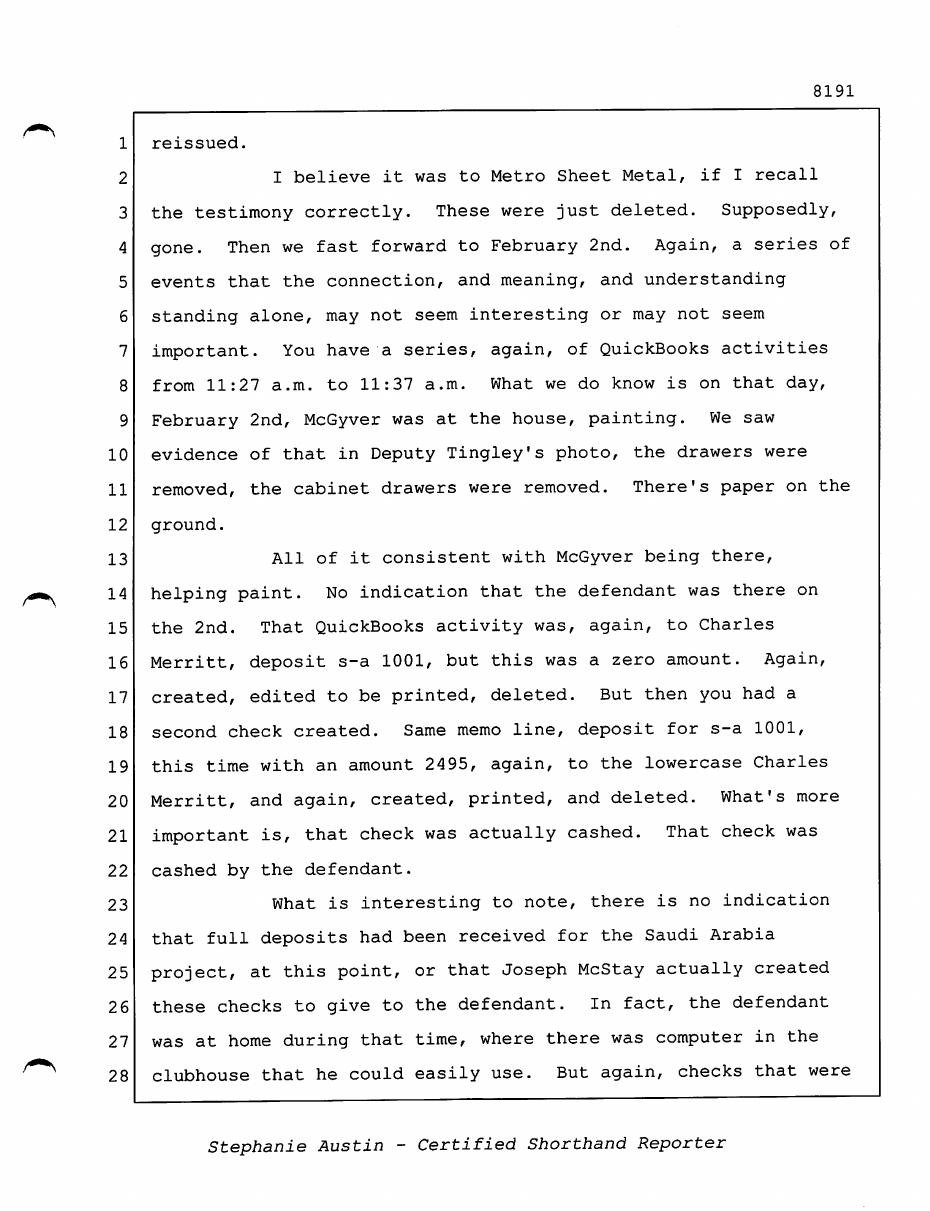
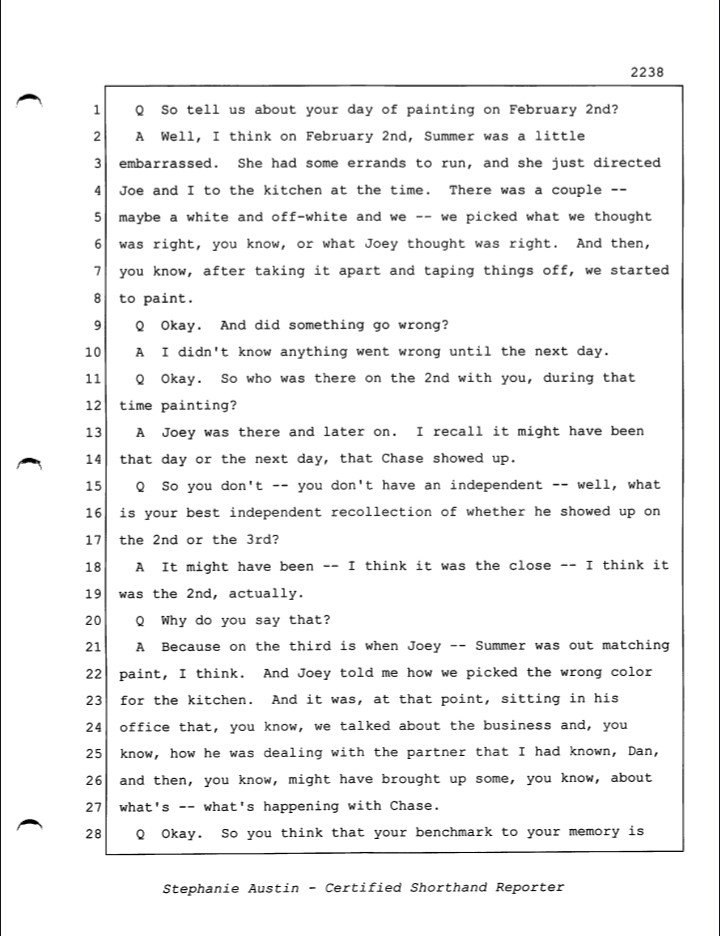
This was false, and Mr. Imes knew it, because his own witness had told him so. McGyver McCargar, the family friend who was painting at the house, testified on January 14, 2019, on direct examination by Mr. Imes:
Q. “Okay. So who was there on the 2nd with you, during that time painting?”
(RT 2238:11-19)
A. “Joey was there and later on. I recall it might have been that day or the next day, that Chase showed up.”
Q. “So you don’t — you don’t have an independent — well, what is your best independent recollection of whether he showed up on the 2nd or the 3rd?”
A. “It might have been — I think it was the close — I think it was the 2nd, actually.”
See RT 2238
A few questions later, Mr. Imes summed it up himself:
Q. “Okay. So — oh, I forgot my pen. So at this point, you’ve mentioned that the defendant was at the house on the 31st and now on the 2nd; is that correct?”
(RT 2239:5-8)
A. “Correct.”
See RT 2239
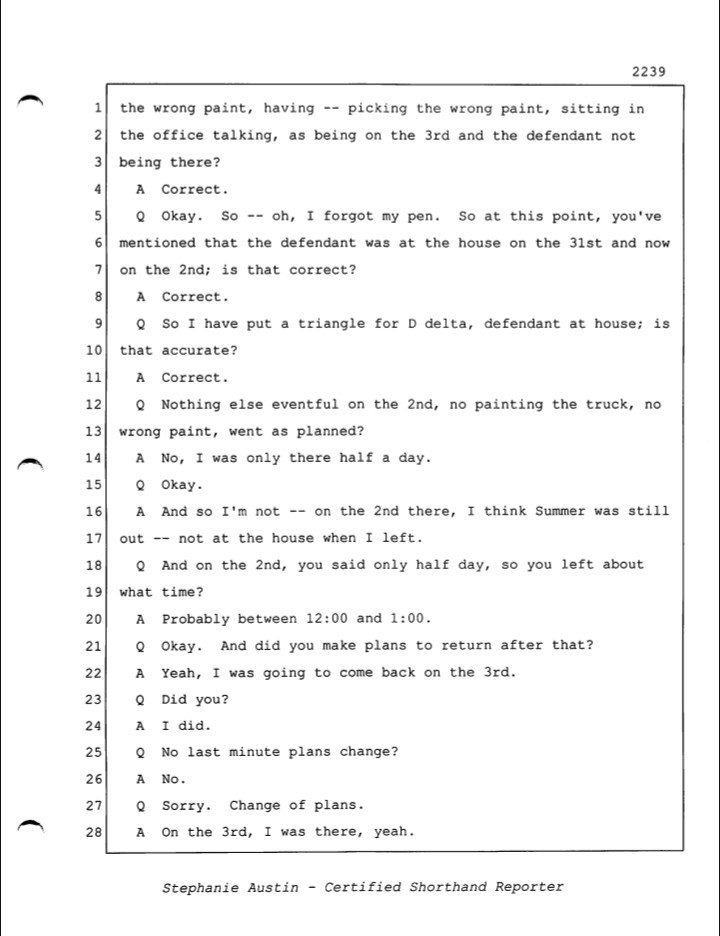
That same question also says January 31. I wasn’t at Joseph’s house on January 31, and my phone record shows it. That is card 7, which takes up every statement that I was there that day taking checks.
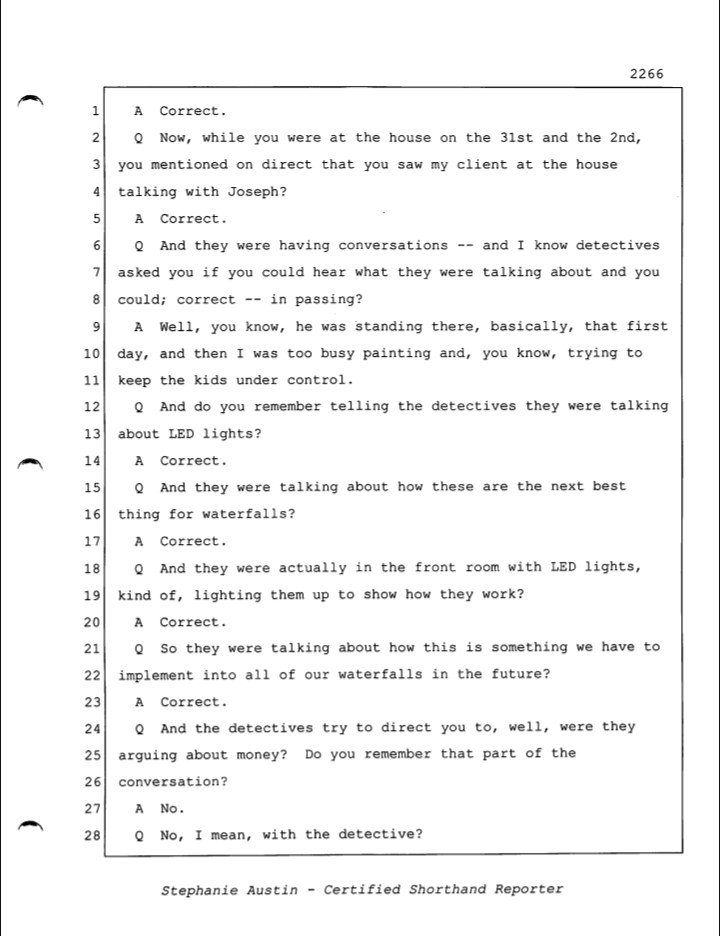
On cross-examination, Mr. McGee asked McCargar what he had heard Joseph and me talking about that day:
Q. “And do you remember telling the detectives they were talking about LED lights?”
(RT 2266:12-23)
A. “Correct.”
Q. “And they were talking about how these are the next best thing for waterfalls?”
A. “Correct.”
Q. “And they were actually in the front room with LED lights, kind of, lighting them up to show how they work?”
A. “Correct.”
Q. “So they were talking about how this is something we have to implement into all of our waterfalls in the future?”
A. “Correct.”
See RT 2266
My phone record shows the trip. I called Joseph at 8:50 on my way down (Exhibit 794, item 8898). At 9:03 my phone was on a tower in the Temecula area, and from 9:22 to 10:01 it stayed on a single tower by the 15, just east of Fallbrook (items 8900-8903). Joseph called me at 10:31 while I was on my way back (item 8908), and by 11:10 my phone was back on my home tower in Rancho Cucamonga. Joseph’s own record shows him on the Fallbrook tower all that morning (Joseph’s T-Mobile record, Bates 005511). Even my own lawyer said it in closing: “we know he was there on the 2nd” (RT 8332:14).
2. “Or that Joseph McStay actually created these checks to give to the defendant”
Mr. Imes went straight on from the check to the deposit, and then to where I could have gotten the checks instead:
“What is interesting to note, there is no indication that full deposits had been received for the Saudi Arabia project, at this point, or that Joseph McStay actually created these checks to give to the defendant. In fact, the defendant was at home during that time, where there was computer in the clubhouse that he could easily use. But again, checks that were created, printed, and deleted, by a man who had never really done that before, that was not his business practice; checks that could have been given to the defendant on the 31st, when he was physically there, or potentially given to him at this mysterious meeting that may have occurred or may not have occurred on February 4th.”
(RT 8191:23-8192:6)
See RT 8191 and 8192
And a few minutes later, about the same check:
“Again, in isolation, that $2,500.00 check for 2495, that check standing alone may have an innocent interpretation, but it’s a deposit payment to the defendant for Saudi Arabia, except for you never heard any evidence of when that project started or whether he was entitled to a deposit.”
(RT 8193:13-17)
See RT 8193
These were false. The Saudi Arabia deposit had come in eleven days earlier. The defense accountant showed the jury the customer’s 50 percent deposit arriving by wire on January 22, 2010, and Joseph paying Metro its share the same day (RT 7081:1-7082:13). The State’s own list of Joseph’s checks shows it too: #4153, $9,250.00, January 22, 2010, “AZZOUZI1001 – 50% Deposit” (Bates 007417). And the accountant told the jury, on direct examination by Mr. Maline, that both of Joseph’s current jobs had their deposits in by February 1:
Q. “And as of February 1st, when this e-mail was written, the 50 percent for both of those jobs had been received; is that correct?”
(RT 7049:17-20)
A. “That’s correct.”
See RT 7049
As for whether Joseph gave me the check, he did, that morning, in Fallbrook, as shown in the first section. He also showed me again how to delete it in QuickBooks once I’d written it. Mr. Imes was right that I was home when the QuickBooks activity happened. I wrote the check out at home for $2,495, and at 11:46 I called Joseph to let him know (Exhibit 794, item 8924). At 12:04 we talked for 13 minutes (item 8928), and Joseph’s own record shows him on the Fallbrook tower for that call (Bates 005511).
Mr. Imes’s other places for me to have gotten the checks were “the 31st, when he was physically there,” which card 7 answers, and the February 4 meeting, two days after I had already cashed this one.
What the defense said
No one objected to any of this. In his closing, Mr. McGee told the jury “we know he was there on the 2nd” (RT 8332:14), but he said it while talking about DNA in the Trooper and not in answer to Mr. Imes’s statement. In the same sentence he also said “we know Chase was there on the 31st at the house” (RT 8332:13-14), which card 7 answers.
Why it mattered
As I see it, Mr. Imes needed February 2 to disappear. If I was at Joseph’s that morning, and Joseph handed me the check I wrote for $2,495, then the first check I ever cashed came from Joseph, and the story that I stole his checks on January 31 falls apart. So he told the jury there was “no indication” I was there, when the witness he had just questioned had told him I was.
Mr. Imes · closing argument · May 28, 2019 · and Ms. Rodriguez · rebuttal · May 30, 2019
“He stole those checks from the office”
The State told the jury I stole checks from Joseph’s home office on Sunday, January 31, 2010, and then wrote them to myself. That story only works if I was at Joseph’s house that day. I wasn’t. My phone record puts me at home in Rancho Cucamonga all day. Card 6 shows that the first check I cashed was written on February 2, from a check Joseph handed me that morning in Fallbrook.
1. “The defendant was at the house that day”
Mr. Imes told the jury, in front of them and without objection, that I was at Joseph’s house on January 31, and he came back to it twice more:
“So we know on the 31st that McGyver is at the house painting, gave us a lot of detail about reminiscing with Joseph and Summer, the paint jobs that he had to do, the taping off, all of that glory detail. But the defendant was at the house that day.”
(RT 8188:22-26)
See RT 8188
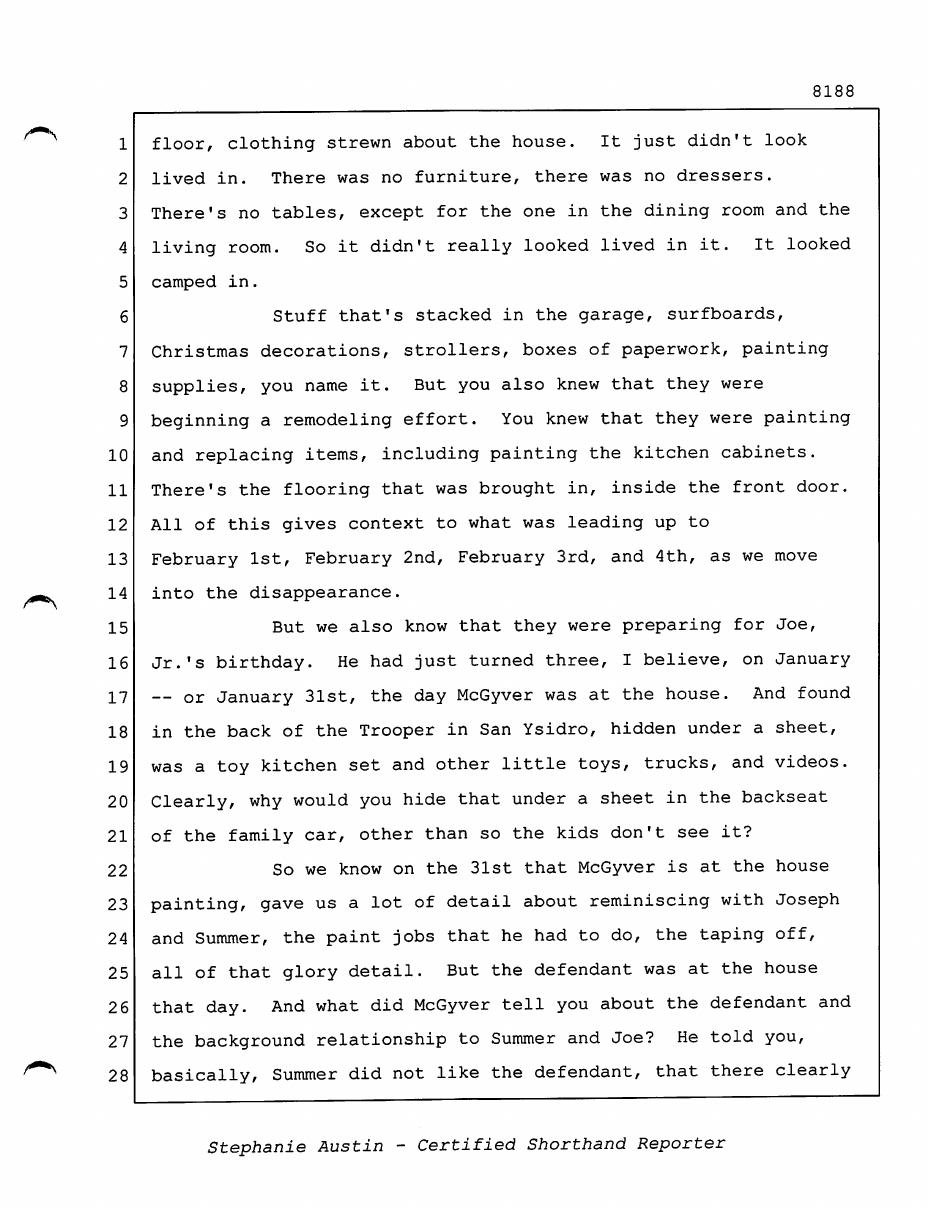
“But again, checks that were created, printed, and deleted, by a man who had never really done that before, that was not his business practice; checks that could have been given to the defendant on the 31st, when he was physically there, or potentially given to him at this mysterious meeting that may have occurred or may not have occurred on February 4th.”
(RT 8191:28-8192:6)
See RT 8191 and 8192
“But why was that necessary if they had already met on the 31st, and I believe one of the other days in the beginning of February, and checks were actually given to the defendant — a check, a handwritten check — so why was there even a necessity for a meeting?”
(RT 8197:19-23)
See RT 8197
Two days later, in rebuttal, Ms. Rodriguez turned it into a theft. Mr. McGee objected, and the judge overruled him:
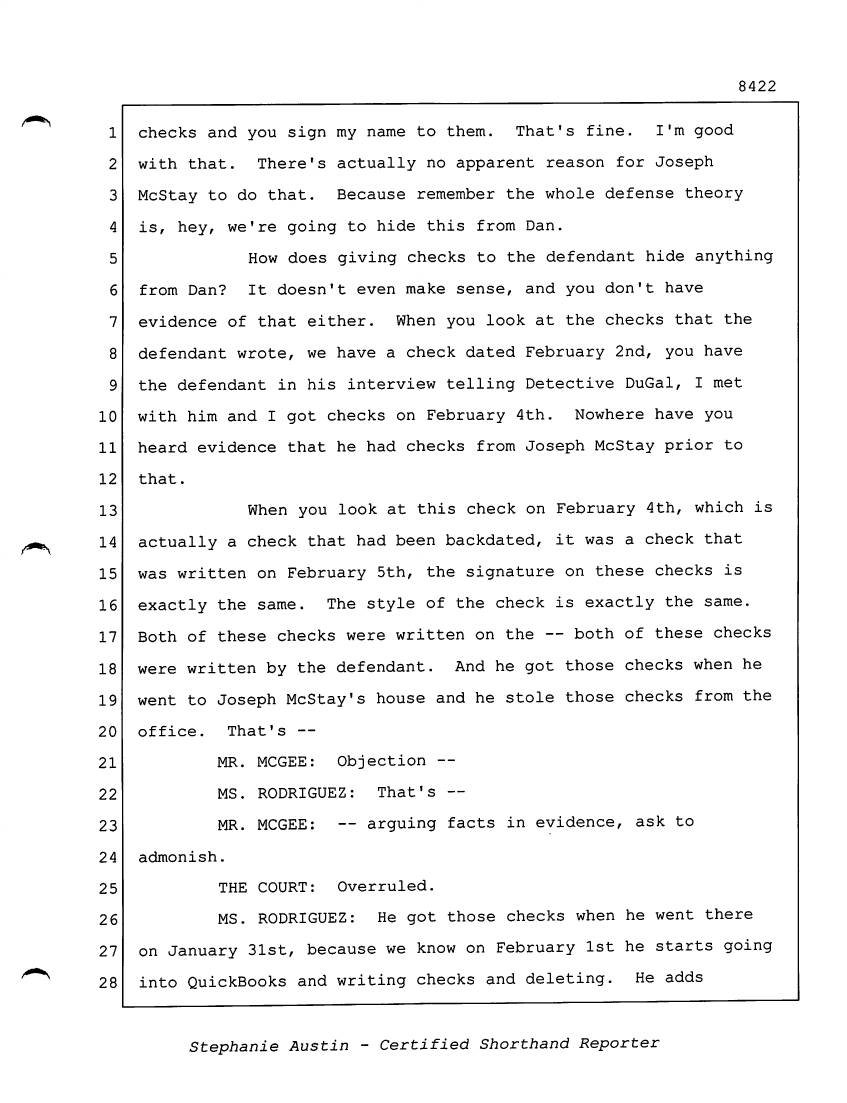
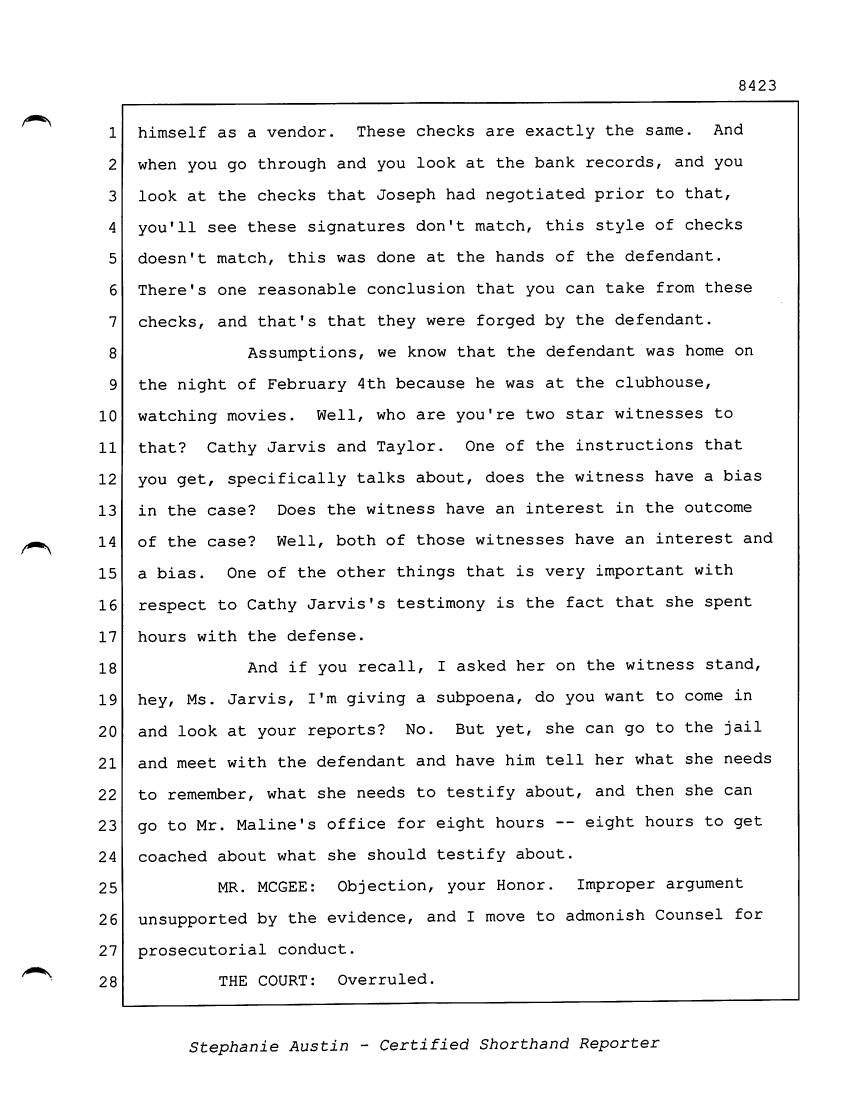
MS. RODRIGUEZ: “Both of these checks were written on the — both of these checks were written by the defendant. And he got those checks when he went to Joseph McStay’s house and he stole those checks from the office. That’s —”
(RT 8422:17-8423:1)
MR. MCGEE: “Objection —”
MS. RODRIGUEZ: “That’s —”
MR. MCGEE: “— arguing facts in evidence, ask to admonish.”
THE COURT: “Overruled.”
MS. RODRIGUEZ: “He got those checks when he went there on January 31st, because we know on February 1st he starts going into QuickBooks and writing checks and deleting. He adds himself as a vendor.”
See RT 8422 and 8423
All of these were false. I wasn’t at Joseph’s house on January 31, and I never took his checks.
The only evidence that put me there was one witness, McGyver McCargar, the family friend who was painting at the house, and I want his words right here. On January 14, 2019, on direct examination by Mr. Imes, he said:
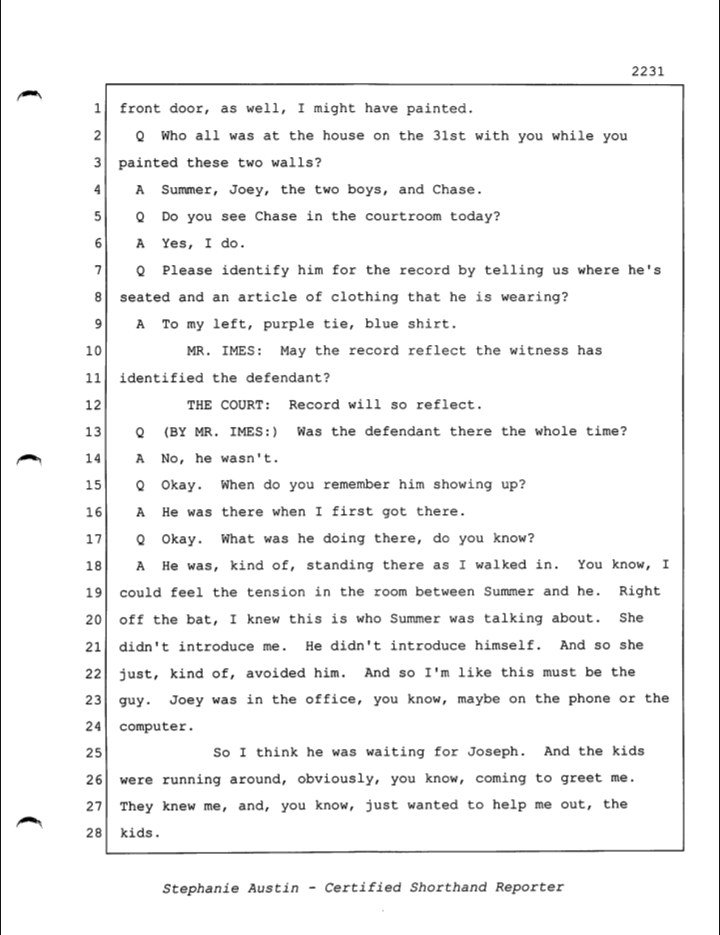
Q. “Who all was at the house on the 31st with you while you painted these two walls?”
(RT 2231:2-16)
A. “Summer, Joey, the two boys, and Chase.”
…
Q. “Was the defendant there the whole time?”
A. “No, he wasn’t.”
Q. “Okay. When do you remember him showing up?”
A. “He was there when I first got there.”
See RT 2231
Q. “Okay. And did you pay attention to how long the defendant was there or when he left?”
(RT 2232:1-4)
A. “Well, he might have been there an hour, could have been two. You know, only because I just remember the awkwardness.”
See RT 2232
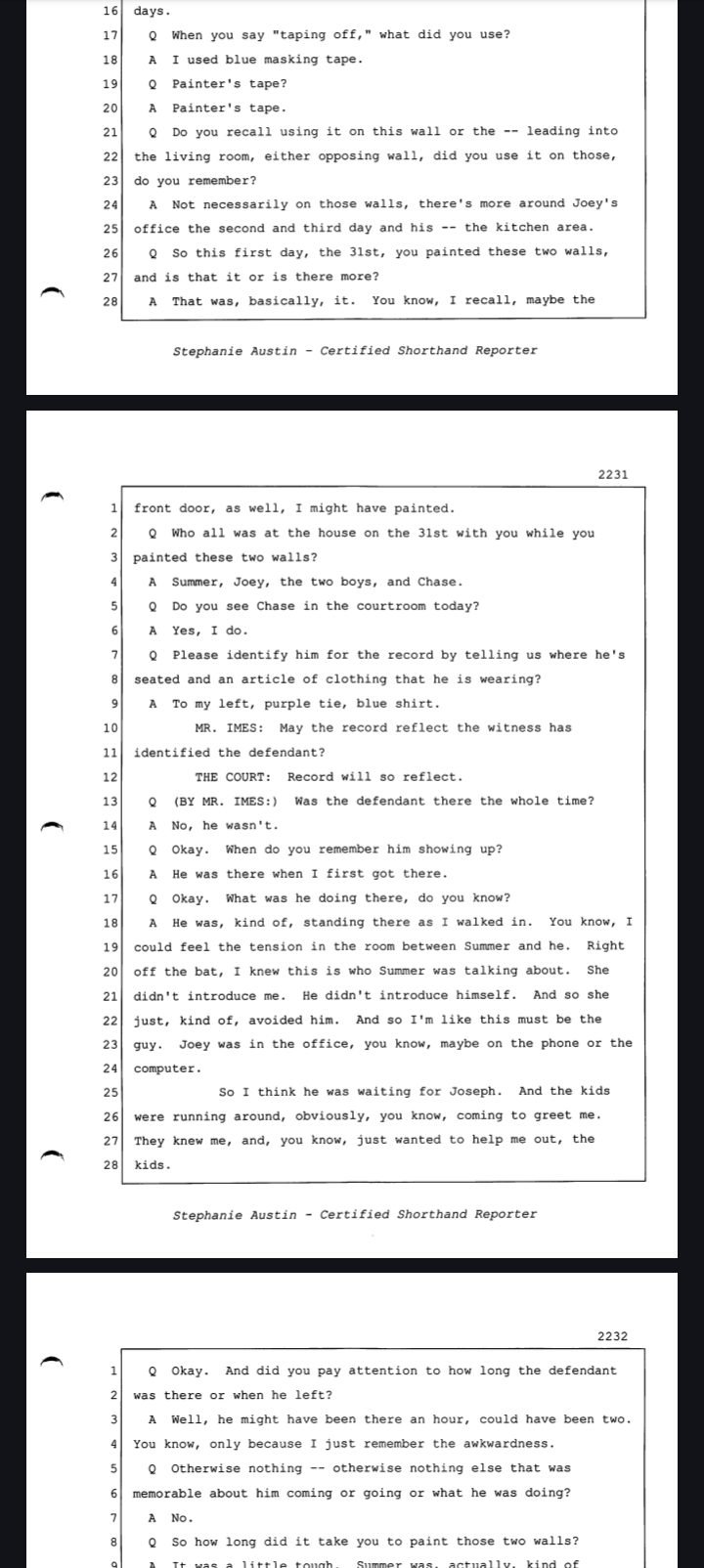
On cross-examination by Mr. McGee, he moved his own arrival to around midday:
Q. “So the first day you showed up was January 31st?”
(RT 2271:8-12)
A. “Correct.”
Q. “And you came over early that day, do you remember that?”
A. “Not — it might have been closer to noon on Sunday, later morning.”
See RT 2271
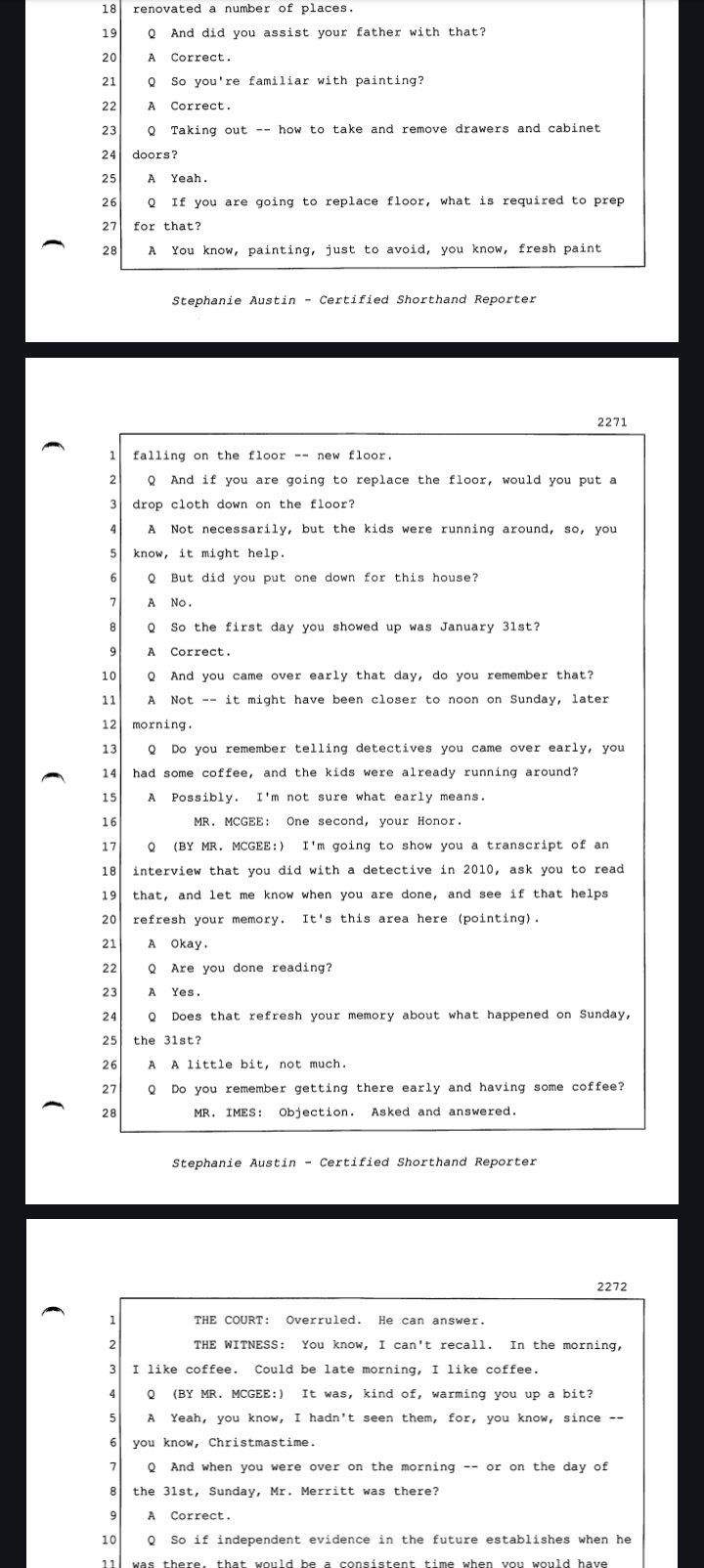
He also said I was there “earlier on, closer to when I first got there” (RT 2271:8-2272:27). So by his account I was at Joseph’s house in Fallbrook for an hour or two, around noon. Fallbrook is at least a two-hour round trip from my home, so that would mean at least three hours away from home in the middle of the day.
My phone record says otherwise. Every call on my phone that day with a tower listed hit my home tower in Rancho Cucamonga, from 9:11 in the morning through 9:00 at night: 9:11, 11:11, 11:38, 12:35, 12:41, 1:00, 1:12, 2:42, 2:58 (a call to Joseph), 3:39 (Joseph calling me) and on into the evening. Between 9:11 in the morning and 5:28 in the afternoon, the longest gap between calls is the two hours from 9:11 to 11:11 (Exhibit 794, items 8835-8852). Right around noon, when McCargar put me in Fallbrook, my phone hit my home tower at 11:38, 12:35, 12:41, 1:00 and 1:12. And when Joseph called me at 3:39 that afternoon, his phone was on the Fallbrook tower and mine was on my home tower (Joseph’s T-Mobile record, Bates 005510).
The State’s own lead detective didn’t think I had Joseph’s checks before February 2, either. In 2014, Det. Bachman told me, “We have no other checks prior to that 2nd of you writing a check.” And on February 17, 2010, two weeks after the family disappeared, I had already told Det. DuGal that Joseph gave me checks and that we went over when to write them. The full account, with the February 1 checks and the signatures Ms. Rodriguez went on to argue, is on my Part 2 page.
What the defense said
No one objected when Mr. Imes said it. When Ms. Rodriguez said I stole the checks, Mr. McGee objected, and the judge overruled him. But my own lawyers never showed the jury my phone record for January 31, and in his closing Mr. McGee told the jury the opposite. “Chase was there every time Mc Gyver was there,” he said (RT 8290:16), and “January 31st was the day they had that conversation based on the testimony” (RT 8291:13-14), and “we know Chase was there on the 31st at the house” (RT 8332:13-14). I had told my lawyers this, and they never used it.
Why it mattered
As I see it, the January 31 story was the State’s whole answer to how I got Joseph’s checks. If I wasn’t there, I couldn’t have taken them, and the only other way I got a check before February 4 was from Joseph’s own hand on February 2, as card 6 shows. One witness’s uncertain memory put me in Fallbrook. My phone record put me at home all day, and the prosecutors told the jury I was a thief anyway.
Mr. Imes · closing argument · May 28, 2019 · Ms. Rodriguez · rebuttal · May 29-30, 2019
“You would have to believe that the signatures on all those checks were the same, but they’re not”
Between February 2 and February 8, 2010, I wrote checks on Joseph’s account, signed his name, and deleted them from his QuickBooks, the way he had shown me. I never denied it. I told the San Diego detectives from the first week, in February 2010, that Joseph and I “went over when to write the checks,” and I told the San Bernardino detectives in 2014 that I had signed Joseph’s name “probably more than 30 or 40” times over the years. The only real question was whether Joseph had authorized it. But the jury never heard me say any of that. Neither side played those interviews, and the prosecutors argued the checks as though I had been hiding that I wrote them, which a jury hears as a sign of guilt.
1. How the jury came to think I had denied it
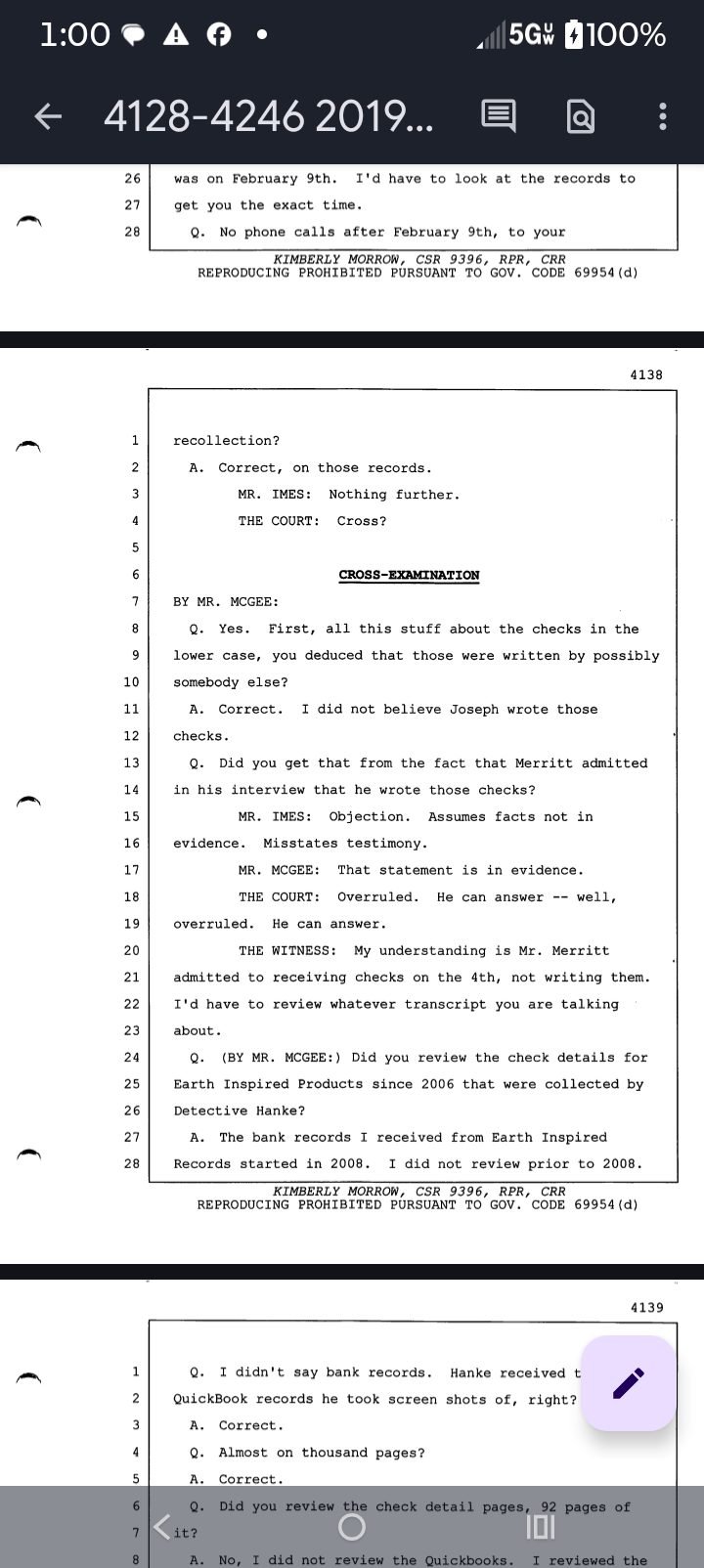
It started with a detective. On February 19, 2019, on direct examination by Mr. Imes, Det. Smith walked the jury through the lowercase checks. On cross-examination, he said he didn’t believe Joseph wrote them, and when Mr. McGee tried to bring out that I had admitted writing them, Mr. Imes objected that my admission wasn’t in evidence:
Q. “Yes. First, all this stuff about the checks in the lower case, you deduced that those were written by possibly somebody else?”
(RT 4138:8-23)
A. “Correct. I did not believe Joseph wrote those checks.”
Q. “Did you get that from the fact that Merritt admitted in his interview that he wrote those checks?”
MR. IMES: “Objection. Assumes facts not in evidence. Misstates testimony.”
MR. MCGEE: “That statement is in evidence.”
THE COURT: “Overruled. He can answer — well, overruled. He can answer.”
THE WITNESS: “My understanding is Mr. Merritt admitted to receiving checks on the 4th, not writing them. I’d have to review whatever transcript you are talking about.”
See RT 4138
This was false. In my October 22, 2014 interview I told Det. Bachman and Det. Hanke that I wrote the checks and signed Joseph’s name. The State’s own case summary of that interview, which the jury never saw, records it, including the part where I wasn’t sure at first:
“Merritt claimed to have access to Joseph’s online QuickBooks account and had written checks on Joseph’s account in the past. Merritt looked at copies of the checks from McStay’s account dated February 4, 2010. Merritt claimed he did not recall there being as many checks as there were, but believed they looked similar to what Joseph gave him. Merritt was not sure if the checks were made out to Metro Sheet Metal, or if he wrote the checks himself.”
(State’s case summary, Bates 000038)
“Hanke confronted Merritt about the QuickBooks records, and the backdating of the checks to February 4, 2010. Merritt admitted to making the checks and had no explanation as to why he backdated the checks. Merritt estimated he wrote ahd signed over 30 checks during his partnership with Joseph.”
See Bates 000038
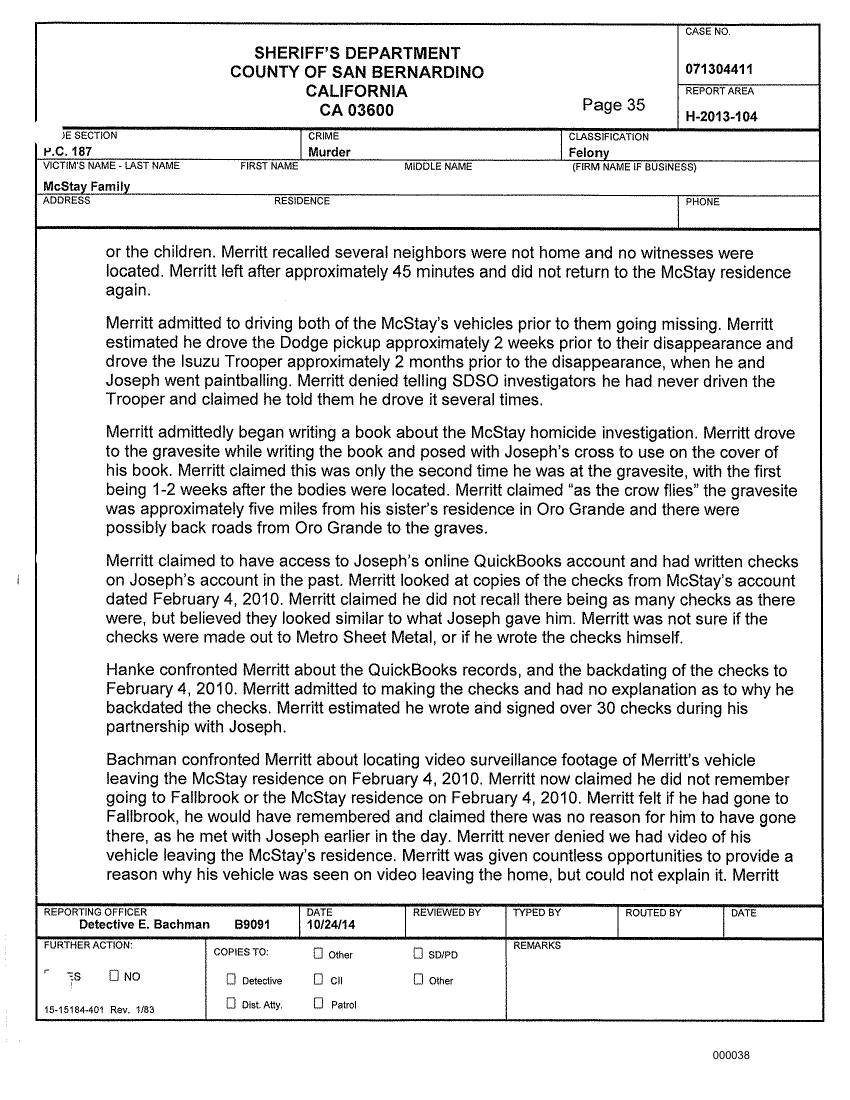
Det. Smith wasn’t in that interview. Mr. Imes was right that the jury hadn’t heard it, because nobody had played it. Then he argued the checks as though I had never said it. Mr. McGee let Det. Smith’s answer stand and moved on to something else.
Then, on March 14, 2019, Ms. Rodriguez put it to Cathy as a question, in front of the jury:
Q. “Okay. Well, the defendant told you that he had the checks from Joseph, right?”
(RT 5397:13-25)
A. “Yes.”
Q. “And he said that Joseph gave him the checks, right?”
A. “Yes.”
Q. “And he said that Joseph wrote the checks, right?”
MR. MALINE: “Objection. Misstates testimony.”
THE COURT: “Overruled. She can answer.”
THE WITNESS: “Joseph gave him the checks. I don’t know whether he specified he wrote the checks, but I know he had checks from Joseph.”
See RT 5397
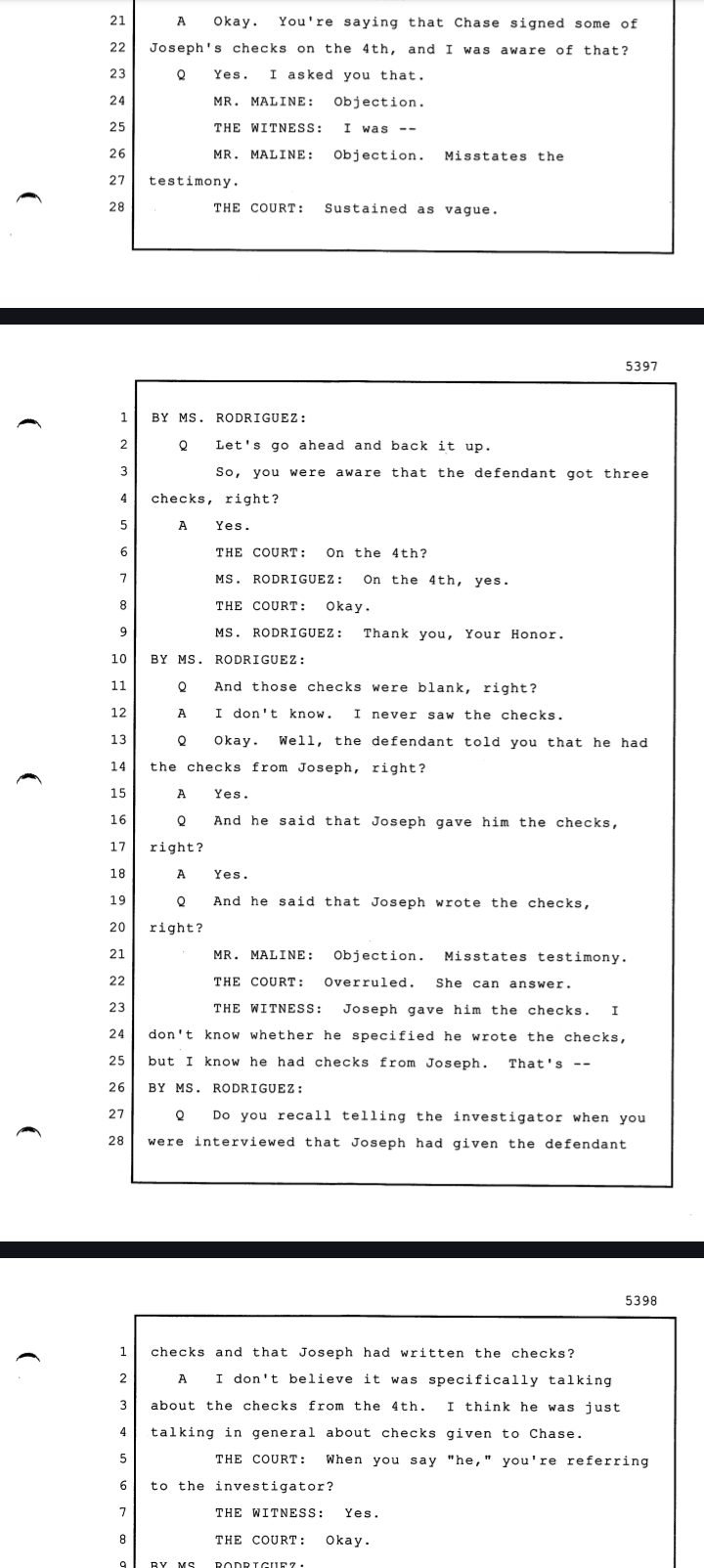
That question put words in my mouth that I never said, to anyone. I never claimed Joseph wrote those checks. Cathy didn’t say I had, either.
My live page “Part 1” sets out everything I told the detectives, and when, beside what the State later told the court and the jury.
2. Then they argued it as a denial
With the jury believing I had said Joseph wrote the checks, the prosecutors spent their closing arguments proving that I wrote them. Mr. Imes, on May 28:
“Why is no computer activity showing a creation of the computer checks? Why are the signatures different? Did you not catch, when you saw these exhibits, this signature on the $100.00 check is distinctly different than the check for $2,400.00?”
(RT 8192:24-28)
See RT 8192
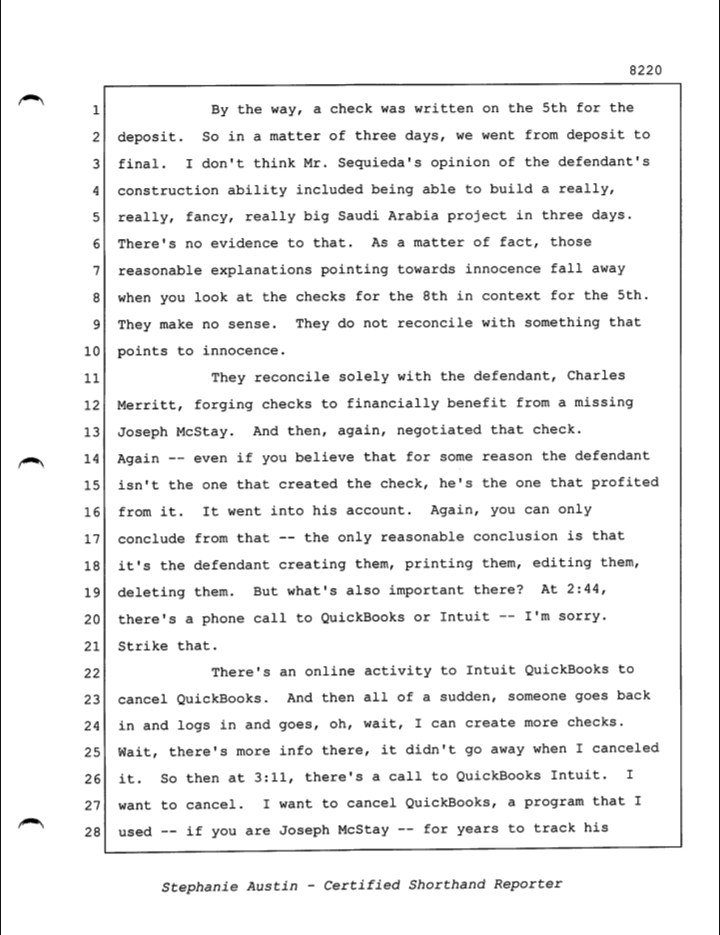
“Again — even if you believe that for some reason the defendant isn’t the one that created the check, he’s the one that profited from it. It went into his account. Again, you can only conclude from that — the only reasonable conclusion is that it’s the defendant creating them, printing them, editing them, deleting them.”
(RT 8220:14-19)
See RT 8220
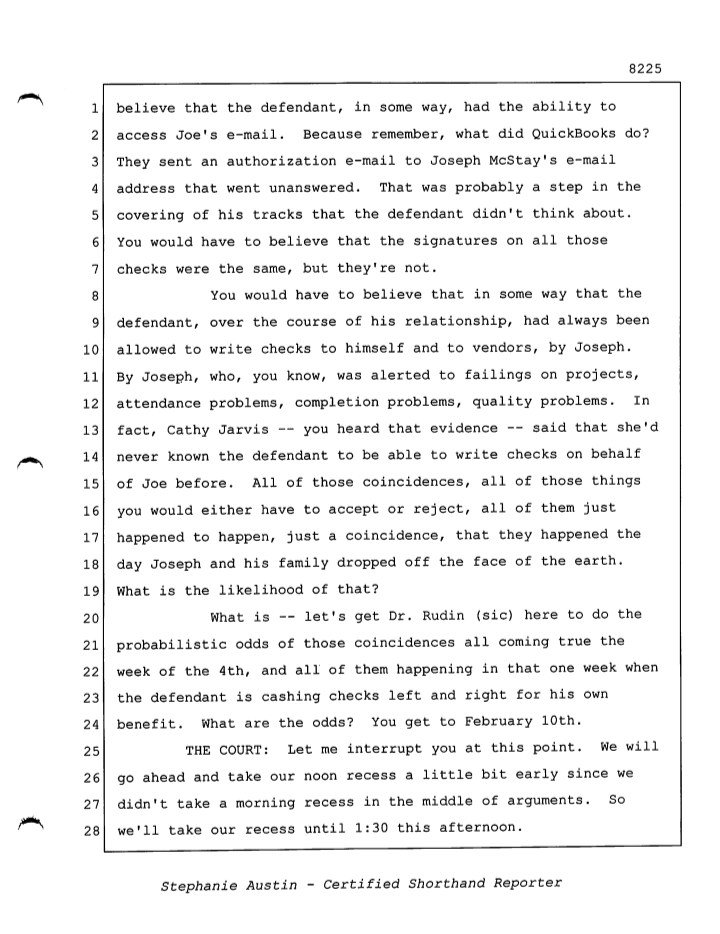
“You would have to believe that the signatures on all those checks were the same, but they’re not.”
(RT 8225:6-7)
See RT 8225
And he called it forgery. On February 8, he told the jury, my “known whereabouts is while he’s forging checks to profit off the disappearance of Mr. McStay” (RT 8222:21-24).
The first three were misleading, and the last was false. I had already told the detectives I wrote those checks and signed Joseph’s name on them. The prosecutors didn’t need the signatures, the lowercase letters or “the only reasonable conclusion” to prove something I had said myself. If they had wanted to argue that I wrote them, my own words were enough. As I see it, there was only one reason to work this hard to prove it in front of the jury, and that was to make the jury believe I had denied it, so that writing the checks would look like something I was hiding. That is how a jury hears it, especially a jury that had just heard Det. Smith say I admitted only receiving them.
Of course the signatures were different. I signed the printed checks, and Joseph signed the $100 handwritten check himself. And signing someone’s name with his permission isn’t forgery. The State couldn’t prove forgery, either. The FBI, looking at the signatures for the State, “could not say it was an absolute forgery due to the lack of original documents” (State’s case summary, Bates 000025). The jury never heard that. Whether Joseph gave me permission is the next section.
Mr. Imes also asked, “Why would Joseph backdate a check to the 4th, if he did this on this mysterious Josepe laptop, that there’s no evidence of?” (RT 8214:12-14). The checks dated the 4th were mine. I wrote them on the 5th and dated them the 4th, the day Joseph and I went over them, and my Part 2 page explains it.
3. “There is no evidence before you” of permission
On May 29, in rebuttal, Ms. Rodriguez told the jury there was no evidence that Joseph had ever given me checks or let me write them:
“These are some of the assumptions that the defense is telling you happened. I want to talk about where the evidence in these assumptions are. That the defendant had written checks for Joseph before. Where did you ever hear any evidence of that? You didn’t. That the defendant had received checks from Joseph and had permission to write and sign the checks. Where did you hear evidence of that? You may have heard some reference to the defendant receiving checks in the defendant’s statement when he talked to Detective Du Gal. But there is no evidence before you that he actually received the checks from Joseph and that he had permission to write and sign those checks. There is no evidence of that. But yet they want you to believe that that’s true. That the defendant and Joseph had a pattern of calling each other after writing the checks and the QuickBook activity. None of these assumptions are supported by the evidence. None of them.”
(RT 8413:11-28)
See RT 8413
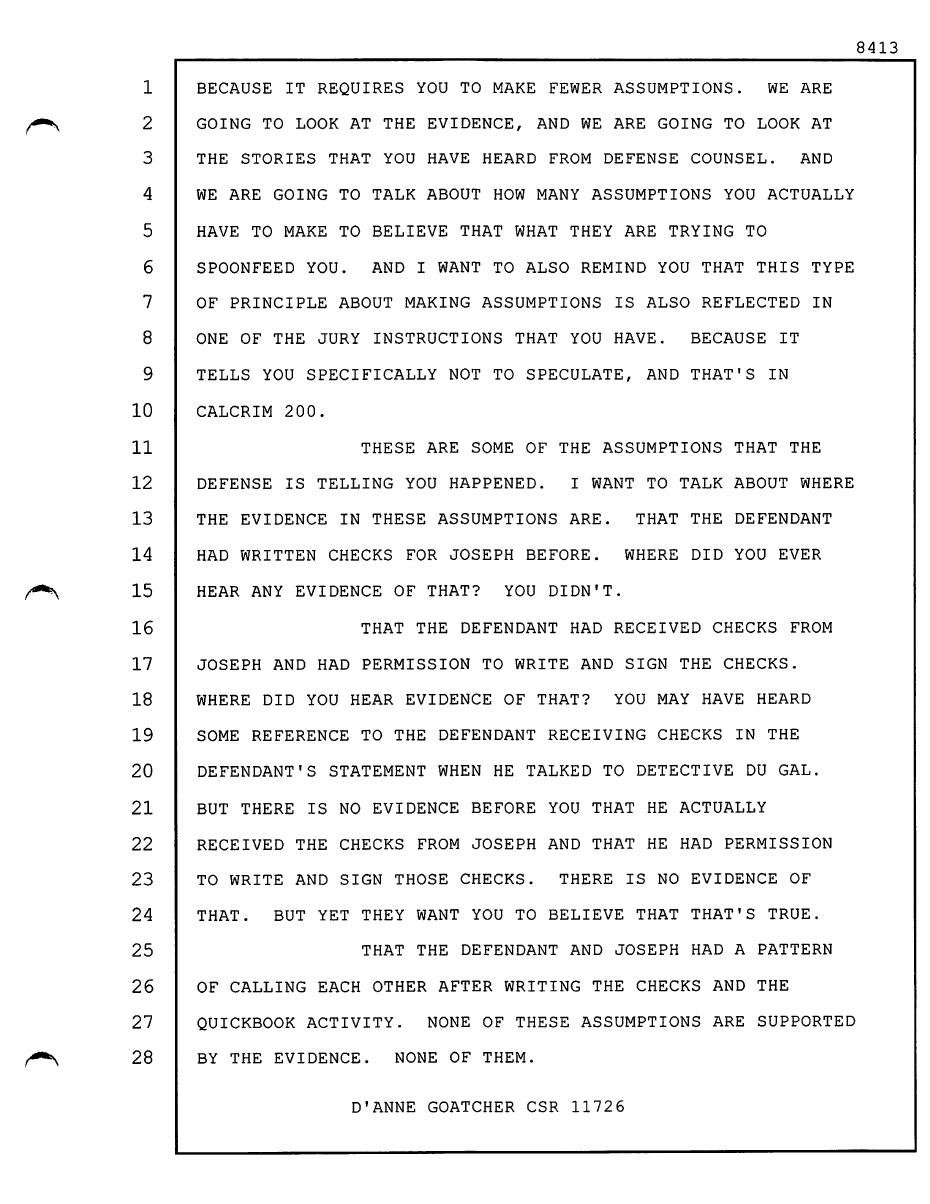
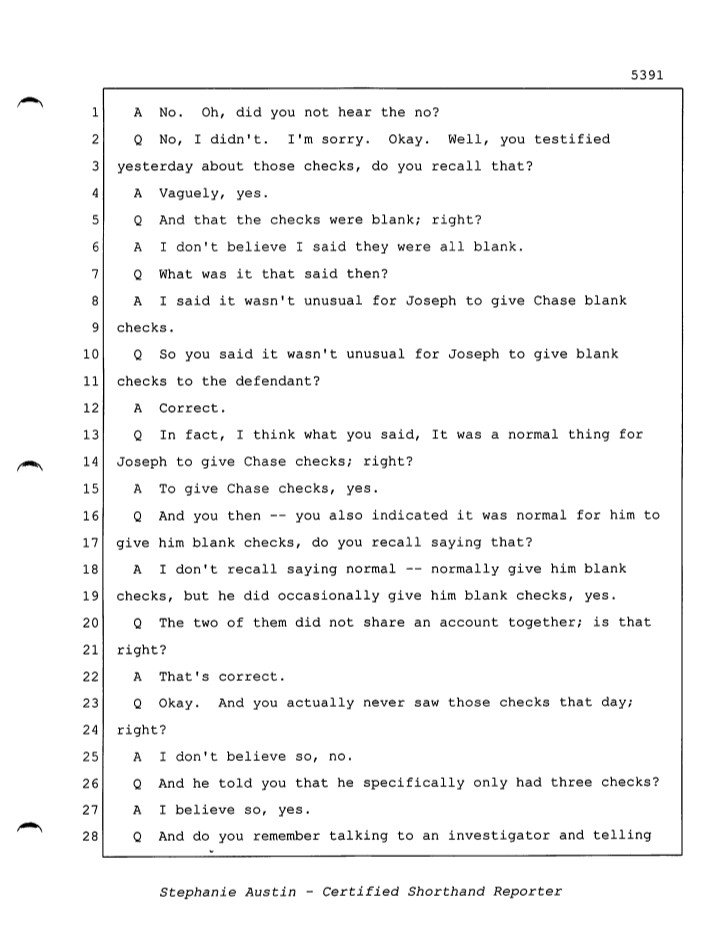
She was right about one thing. The jury never heard that I had written checks for Joseph before, because neither the prosecutors nor my lawyers ever played the interview where I said so. The rest was false. In the same breath she admitted that my statement to Det. DuGal was in front of the jury, and a defendant’s statement played to the jury is evidence. And Cathy, on Ms. Rodriguez’s own cross-examination earlier in the trial, had told the jury that Joseph gave me checks, sometimes blank:
A. “I said it wasn’t unusual for Joseph to give Chase blank checks.”
(RT 5391:8-15)
Q. “So you said it wasn’t unusual for Joseph to give blank checks to the defendant?”
A. “Correct.”
Q. “In fact, I think what you said. It was a normal thing for Joseph to give Chase checks; right?”
A. “To give Chase checks, yes.”
See RT 5391
Ms. Rodriguez even read Cathy her own words to the investigator, that Joseph “signed the checks. Some of them weren’t filled out because they were for stuff that Chase — or that Chase needed to purchase,” and Cathy agreed she had said it (RT 5403:6-15). That also answers Mr. Imes’s question about why Joseph would give me a blank check when his checkbook was in the car (RT 8197:24-26). Giving me checks was ordinary.
The calls were in evidence too, in the phone records. Joseph called me at 1:03 on February 1, after he made the first two checks and deleted them himself. I called him at 11:46 on February 2, after I wrote that day’s check, and I left him a message at 12:49 on February 5 after I wrote the next ones. My Part 2 and Part 3 pages lay out every check and every call.
4. “Joseph never wrote checks like that, with memo lines”
The next day, Ms. Rodriguez told the jury:
“Go back and look at the checks that Joseph wrote before. Joseph never wrote checks like that, with memo lines.”
(RT 8448:2-4)
See RT 8448
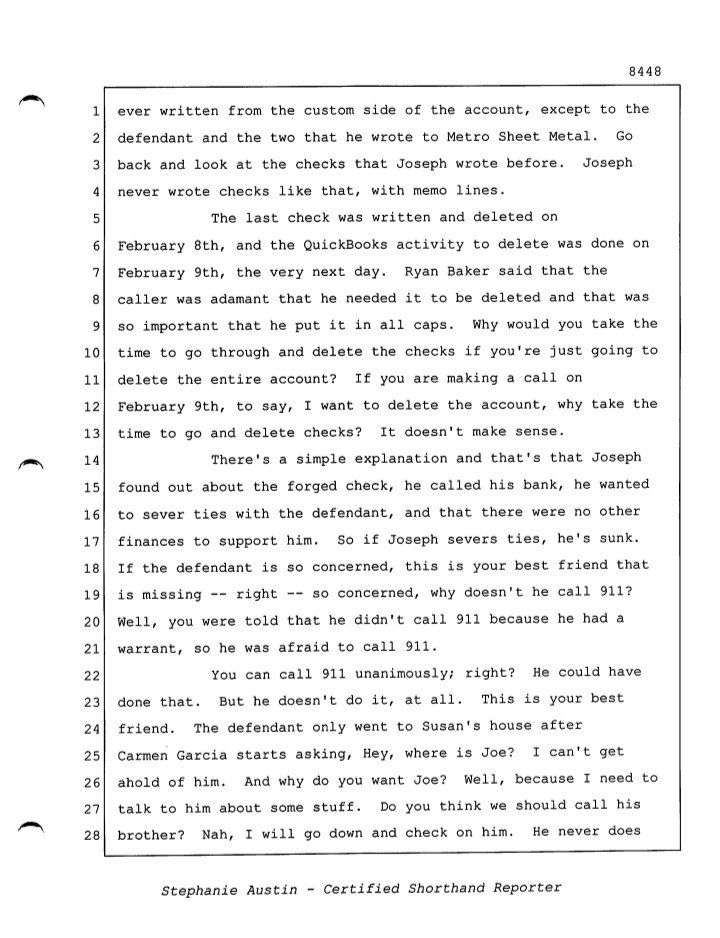
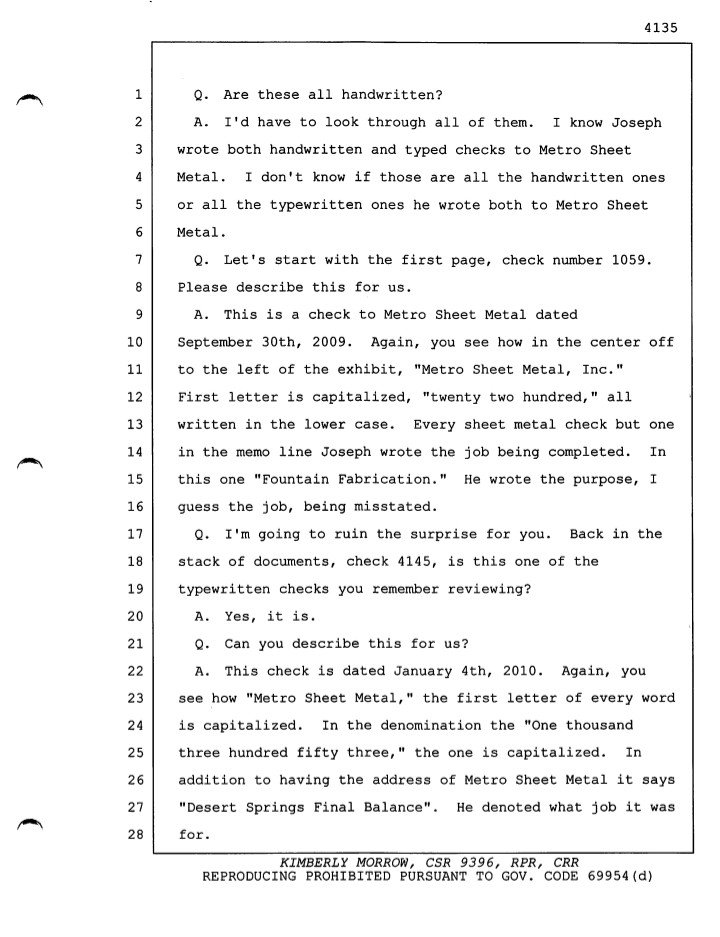
This was false, and the State’s own detective had already told the jury so. On February 19, on direct examination by Mr. Imes, Det. Smith described Joseph’s checks to Metro Sheet Metal:
“Every sheet metal check but one in the memo line Joseph wrote the job being completed. In this one “Fountain Fabrication.” He wrote the purpose, I guess the job, being misstated.”
(RT 4135:12-16)
See RT 4135
The State’s own list of Joseph’s checks shows one from January 22, 2010, two weeks before he disappeared, with the memo “AZZOUZI1001 – 50% Deposit” (Bates 007417). That is the same kind of memo as on the February 2 check, “deposit sa 1001.”
What the defense said
Mr. McGee drew out Det. Smith’s answer that I had admitted only receiving the checks. He told the court my statement was in evidence, and then he let the answer stand. He never played my interview, never read the jury the State’s own summary, and never corrected it. In his closing, Mr. McGee told the jury that deleting checks from QuickBooks couldn’t hide anything, because “all checks go through a bank” (RT 8336:19-8337:4), and that Joseph “was bringing him blank checks” to the February 4 meeting (RT 8292:5-10). Mr. Maline told the jury that two of the six checks went to Metro Sheet Metal (RT 8408:24-8409:8). Nobody told the jury that I had admitted writing the checks from the first week, or that the real question was permission, and nobody pointed them to Cathy’s answers or Det. Smith’s own testimony about Joseph’s memo lines.
Why it mattered
The prosecutors knew I had never denied writing the checks. They had my interviews, and their own summary said I admitted it. As I see it, they kept that from the jury and then argued the checks as though I had been caught in a lie, so that the jury would read my writing them as consciousness of guilt. My own lawyer let a detective tell the jury I had denied it and never set it right.
More are coming. These are the first eight. There are dozens more statements from the closing arguments, the rebuttal and the penalty phase still to be checked against the record, and I will add them to this page as each one is done.