Was I hiding my whereabouts by turning off my phone?
← Back to Were the phone records outcome dispositive?The six calls that evening had one job at trial: to convince the jury I was hiding where I was. For that, the State needed my phone turned off or in airplane mode. Agent Boles gave it that.
Between 6:09 and 9:04 p.m. on February 4, 2010, six calls came to my phone and went to voicemail. None shows a cell tower. (AT&T items 9077-9082, page 371.)
See AT&T page 371
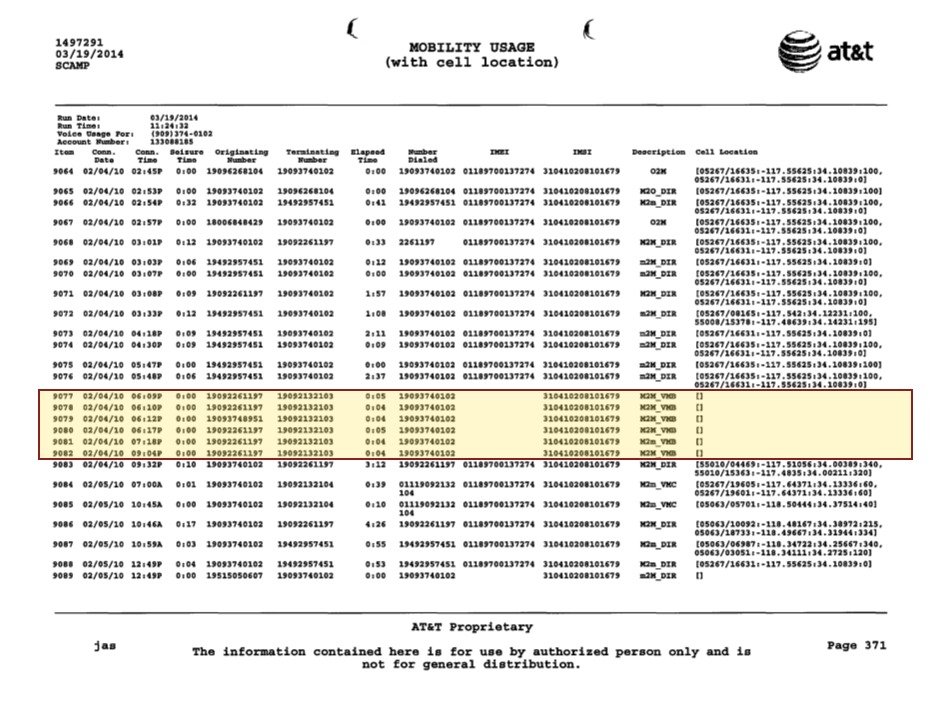
Agent Boles knew there was another explanation for a call that goes to voicemail with no tower: a phone that was on, and not answered. He kept it from my jury.
He wanted it both ways
On cross-examination, Agent Boles told my jury that an AT&T phone that is on “should record a cell tower” when a call goes to voicemail. (RT 4639:13-16.) The next day, the prosecutor who called him asked about a call that simply goes unanswered:
ADA Imes: “Or if you ignored that call, that would be some type of activity from the phone, wouldn’t it?”
Boles: “Yes. I’m not sure if that would generate a tower or not, if you ignored it.”
(RT 4693:11-14.)
See page 4693
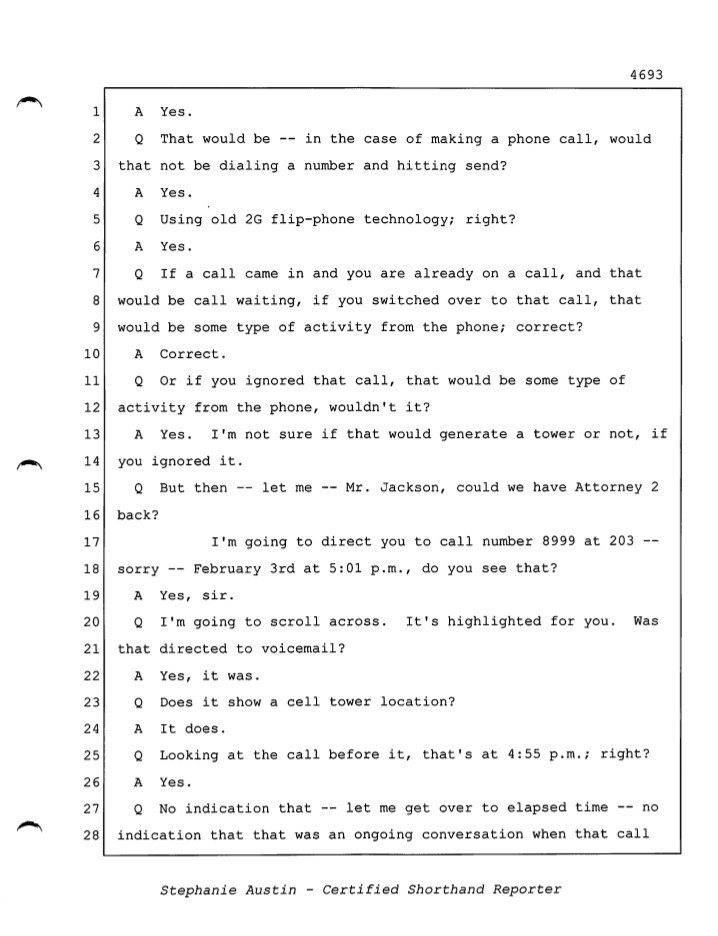
He was not sure. The State’s expert could not say whether an unanswered call leaves a tower in the record. Yet the jury was told that because the six calls left no tower, my phone was off.
Here is what he told the same jury:
| What Agent Boles said | Where |
|---|---|
| An AT&T phone that is on, with a call going to voicemail: it “should record a cell tower.” | RT 4639:13-16 |
| Asked “if you didn’t pick up, just shows no cell tower data, correct?”: “Yes.” | RT 4652:6-9 |
| A call that is ignored: “I’m not sure if that would generate a tower or not.” | RT 4693:13-14 |
| A phone that is off, or with no signal: “At least with these records you can’t tell.” | RT 4528:3-8 |
| A call with zero seizure and zero elapsed time: “a ring, no answer.” In Exhibit 794, 443 of those calls show no tower. | RT 4596:18-20 |
He cannot have it both ways. If an unanswered call leaves no tower, the six calls say nothing about whether my phone was on. If he did not know whether it does, he could not say my phone was off. Either way, when ADA Imes told the jury “the only reasonable interpretation is that the phone was powered off or in airplane mode” (RT 8199:7-13), she was not relying on anything her own expert could support.
What he told the judge at my preliminary hearing
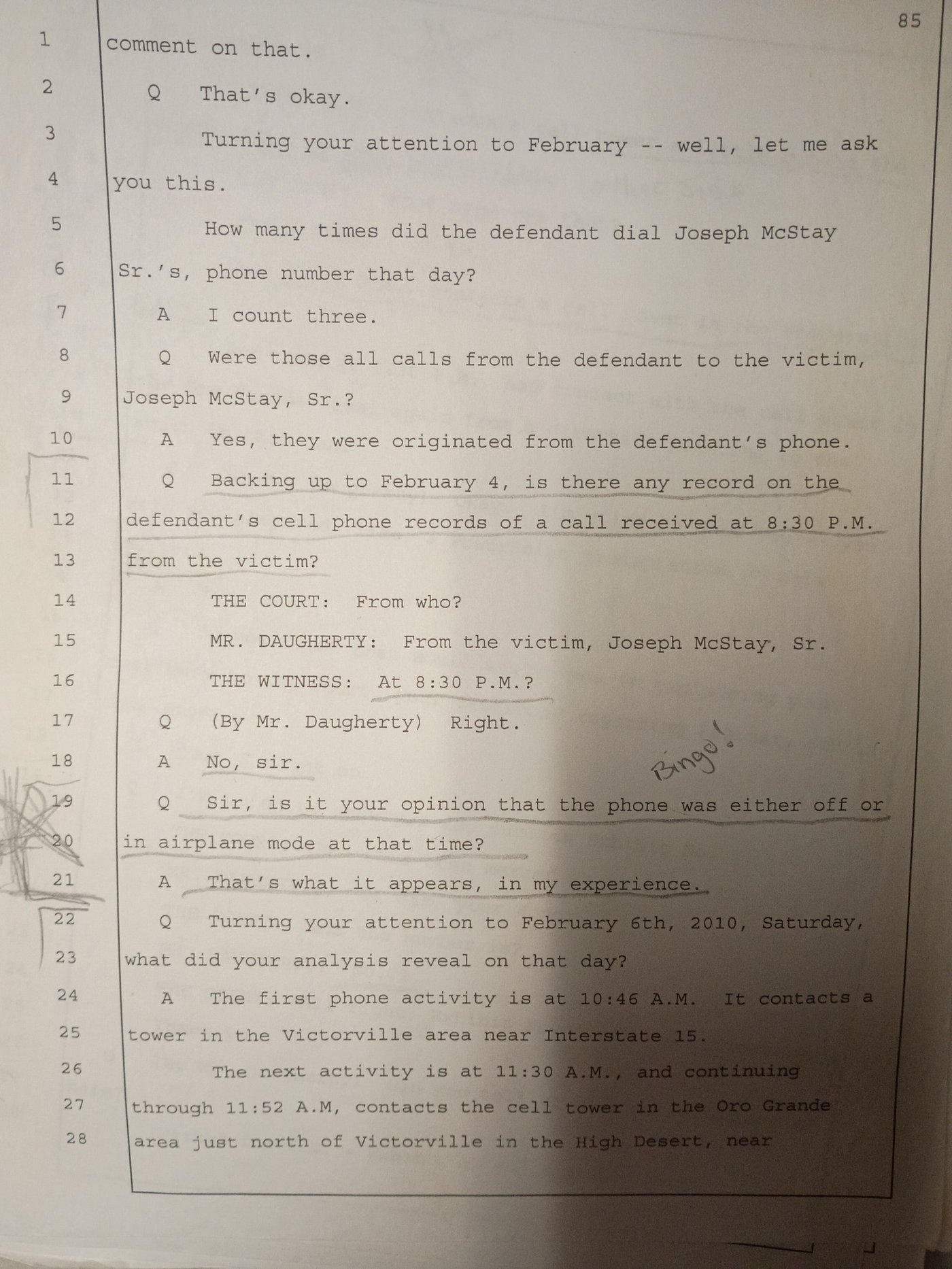
On direct examination at my preliminary hearing, the prosecution asked Agent Boles about the evening of February 4:
ADA Daugherty: “Backing up to February 4, is there any record on the defendant’s cell phone records of a call received at 8:30 P.M. from the victim?”
The Court: “From who?”
ADA Daugherty: “From the victim, Joseph McStay, Sr.”
Boles: “At 8:30 P.M.?”
ADA Daugherty: “Right.”
Boles: “No, sir.”
ADA Daugherty: “Sir, is it your opinion that the phone was either off or in airplane mode at the time?”
Boles: “That’s what it appears, in my experience.”
(Prelim. RT 85:11-21.)
See prelim page 85
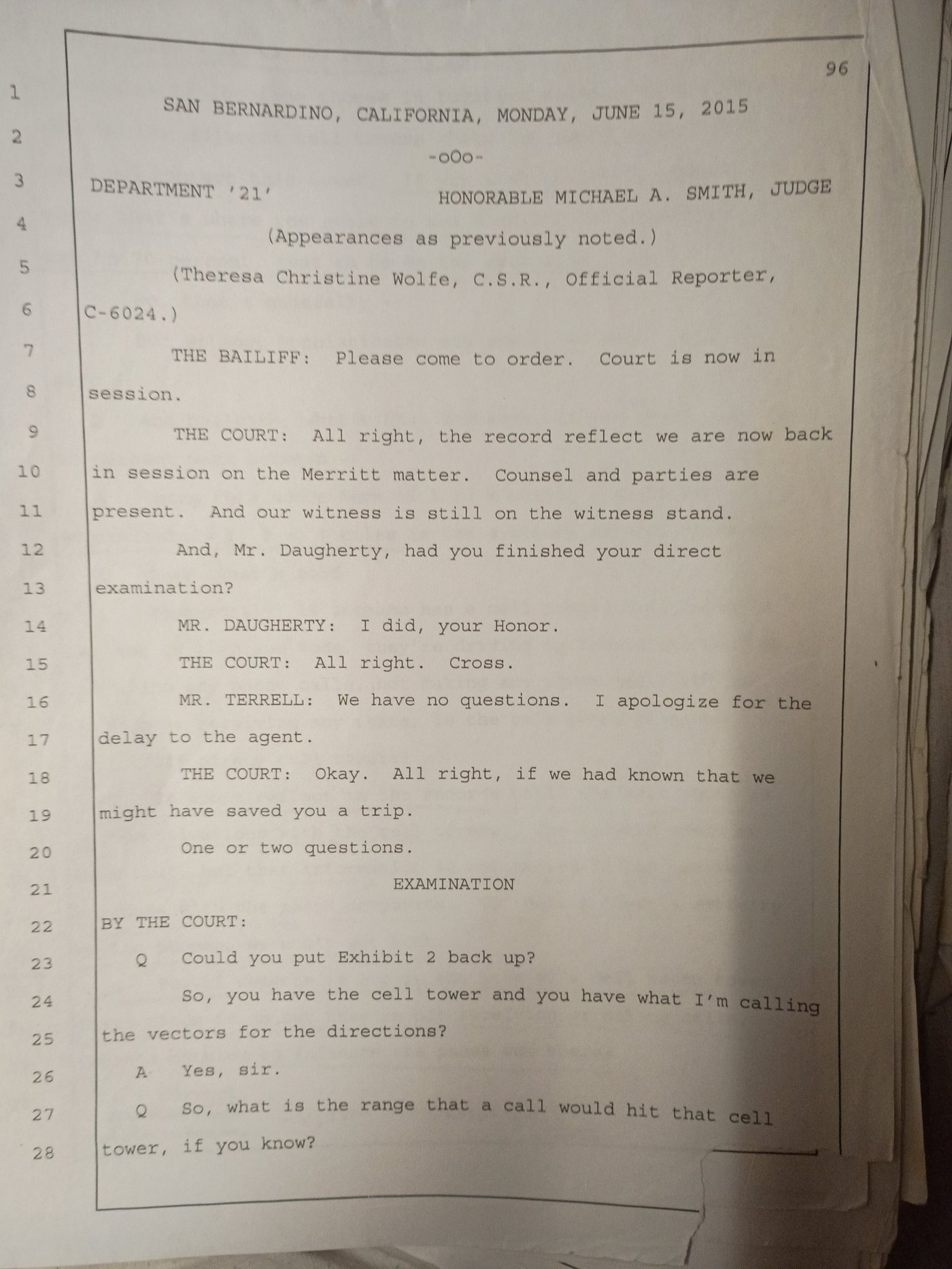
When the hearing resumed on June 15, 2015, my lawyer had no questions for him. The judge did. (Prelim. RT 96:9-22.)
See prelim page 96
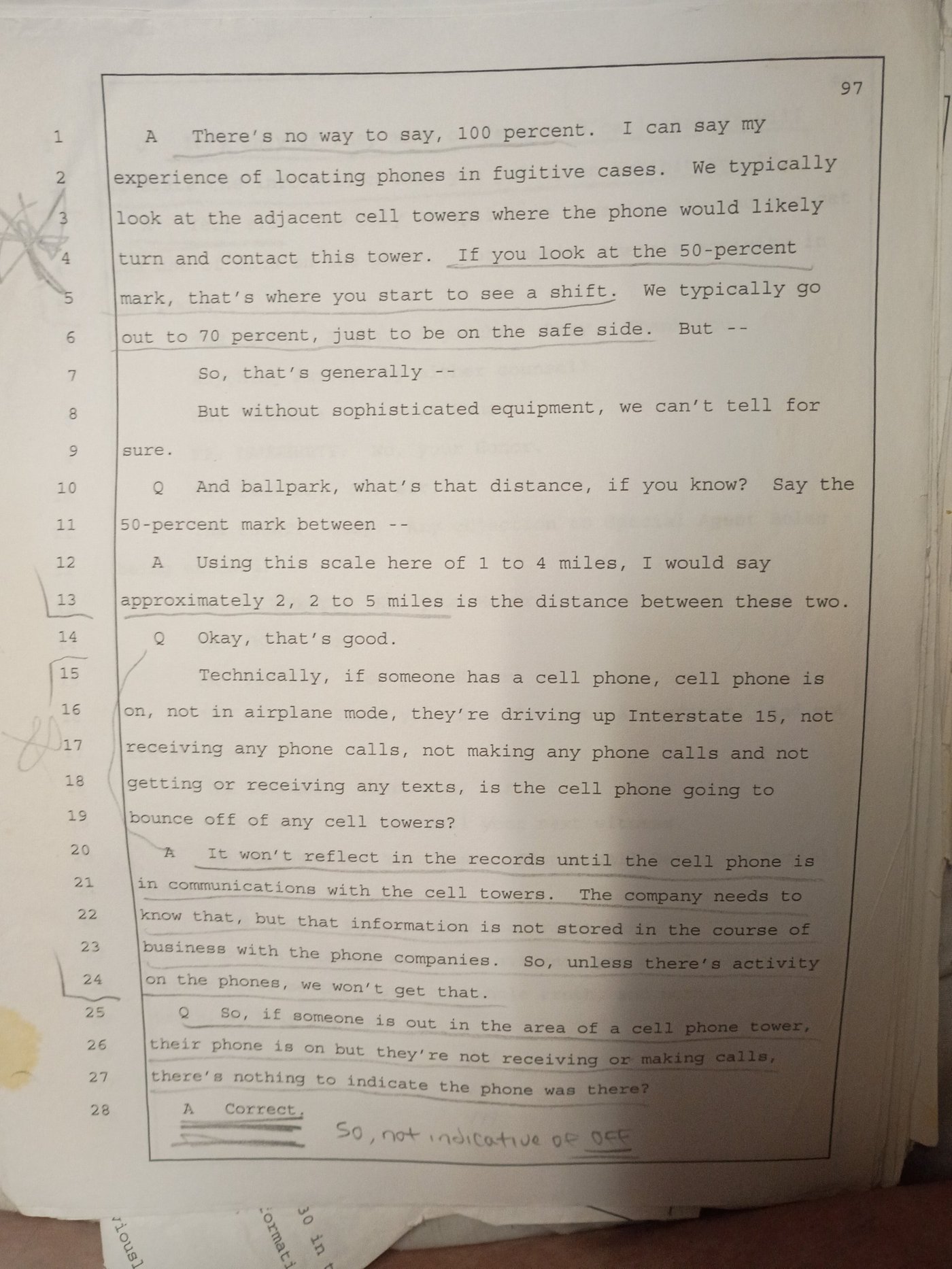
The Court: “Technically, if someone has a cell phone, cell phone is on, not in airplane mode, they’re driving up Interstate 15, not receiving any phone calls, not making any phone calls and not getting or receiving any texts, is the cell phone going to bounce off of any cell towers?”
Boles: “It won’t reflect in the records until the cell phone is in communications with the cell towers. The company needs to know that, but that information is not stored in the course of business with the phone companies. So, unless there’s activity on the phones, we won’t get that.”
The Court: “So, if someone is out in the area of a cell phone tower, their phone is on but they’re not receiving or making calls, there’s nothing to indicate the phone was there?”
Boles: “Correct.”
The Court: “It’s only if they make or receive a call that it will generate the information that you put up on Exhibit No. 1?”
Boles: “Yes, sir. The only exception is occasionally you can get the use of data on the phone. But, again, there’s activity in the phone.”
(Prelim. RT 97:15-98:5.)
See prelim page 97
See prelim page 98
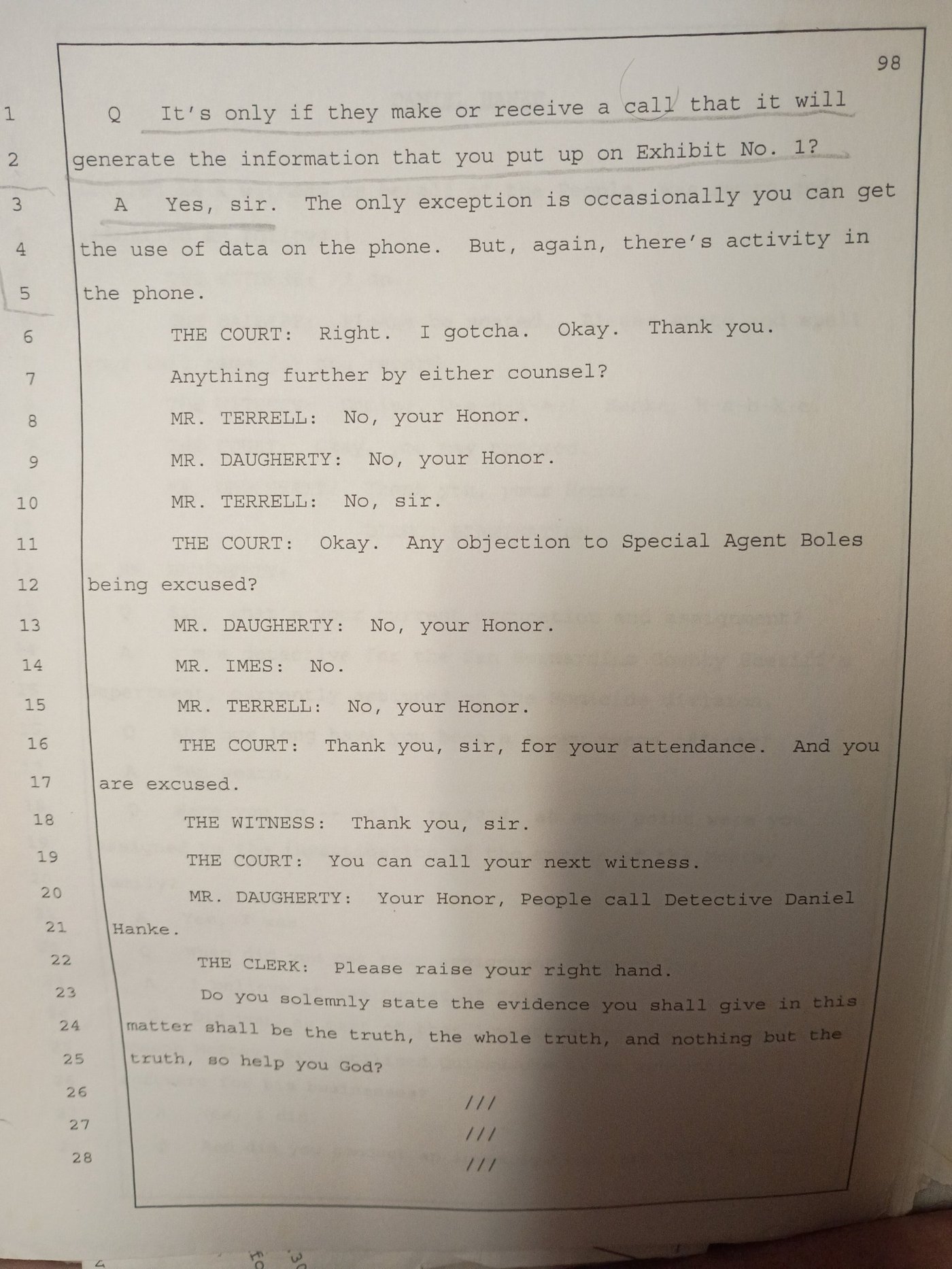
So the judge heard both from the same witness: a phone that is on leaves nothing to indicate where it was until it is in use, and, for the evening of February 4, an opinion that my phone was off or in airplane mode. That exchange is about a phone that is on but not in use, which leaves no record at all. It does not settle what a voicemail entry with no tower means. That question is answered by AT&T’s custodian and by Boles’s own trial testimony, below.
What he said in the Pape trial
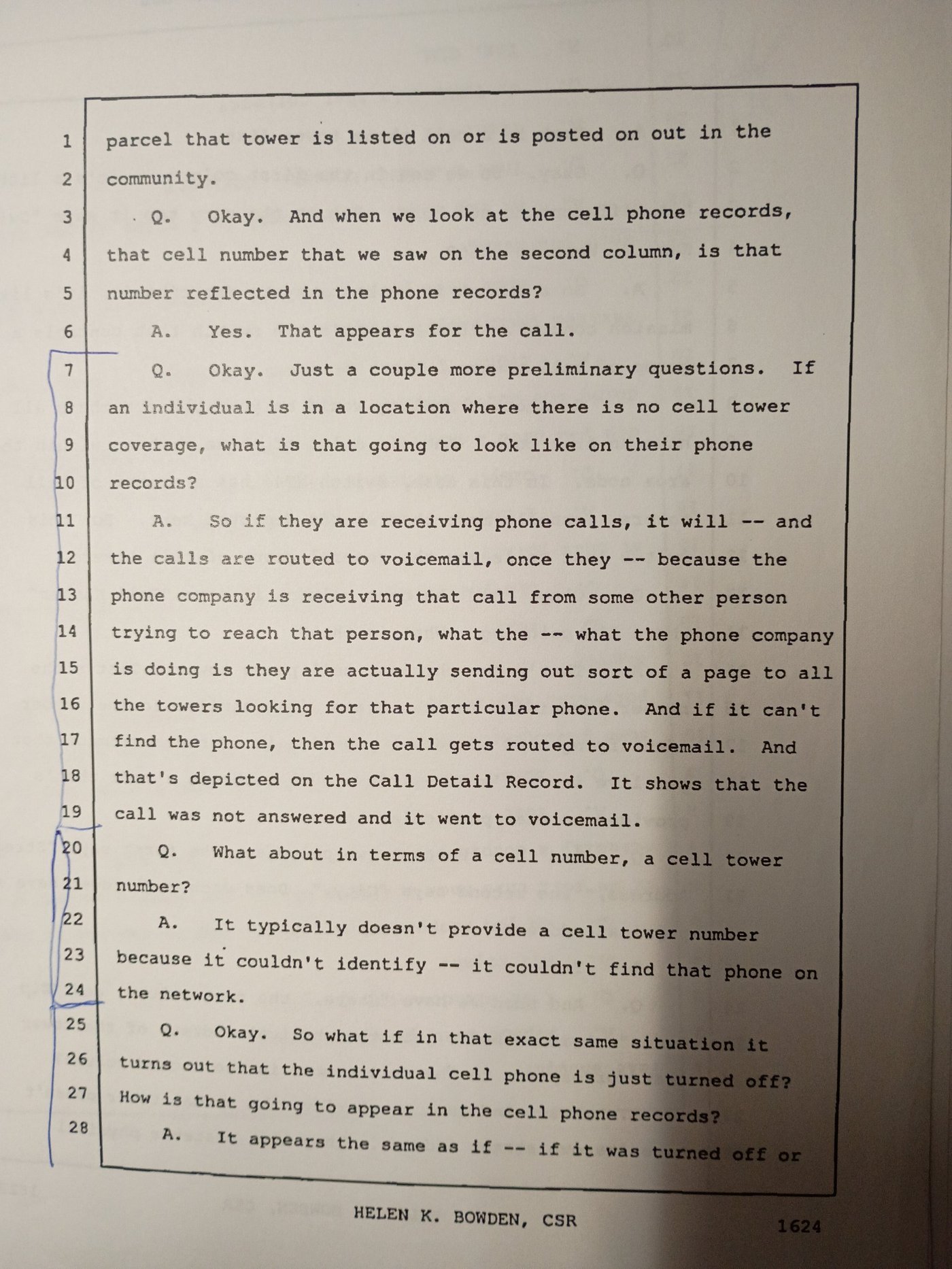
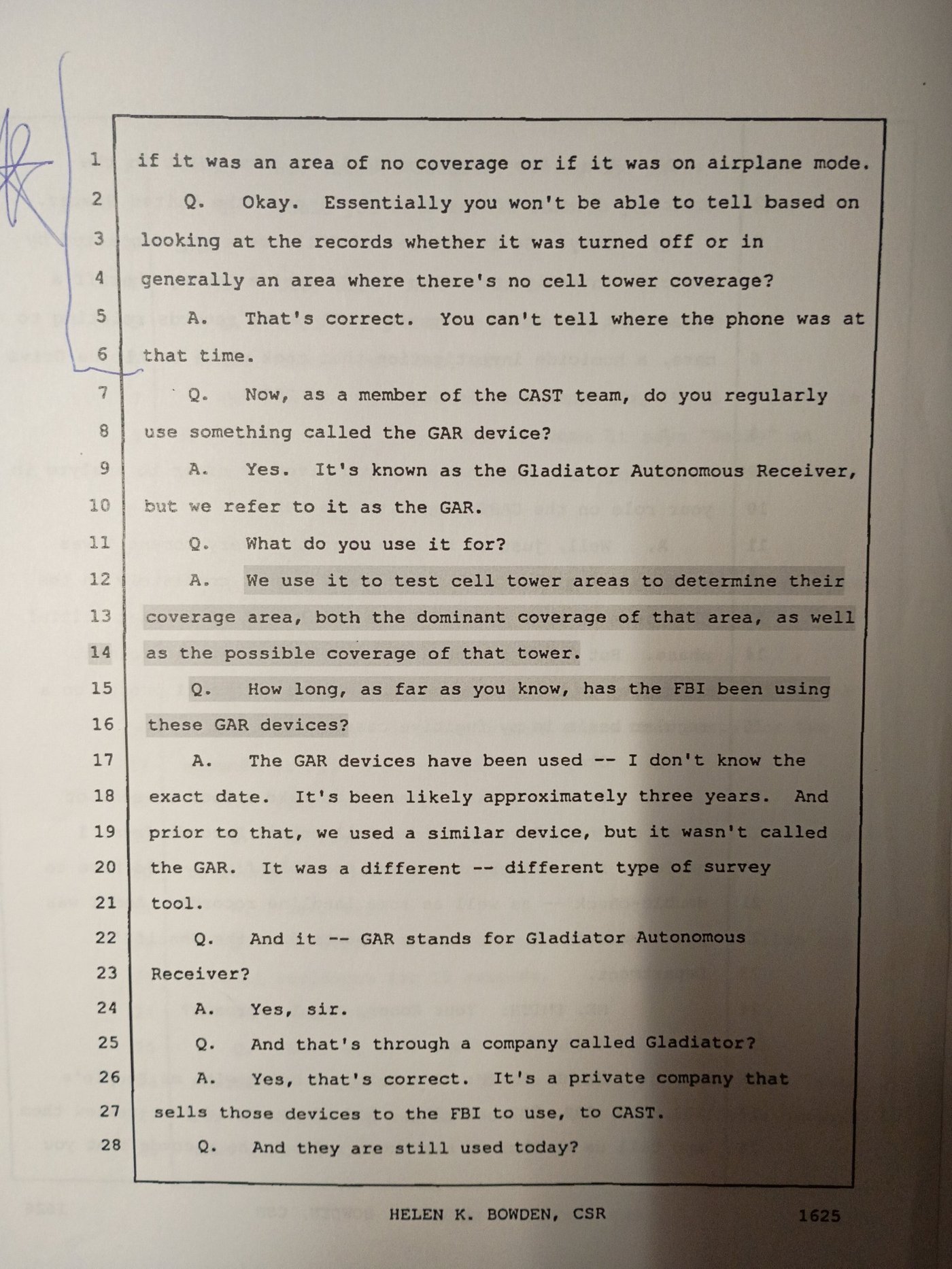
Before my trial, Agent Boles testified in the trial of Robert Lars Pape, a case built on Verizon records. He described calls that went to voicemail with no tower as he would later describe them to my jury: the phone was off, out of range, or in airplane mode. (People v. Pape, RT 1624:25-1625:6, 1660:14-21, 1712:17-23.) And he explained what no tower means:
Question: “What about in terms of a cell number, a cell tower number?”
Boles: “It typically doesn’t provide a cell tower number because it couldn’t identify — it couldn’t find that phone on the network.”
(Pape RT 1624:20-24.)
See Pape page 1624
See Pape page 1625
See Pape page 1660
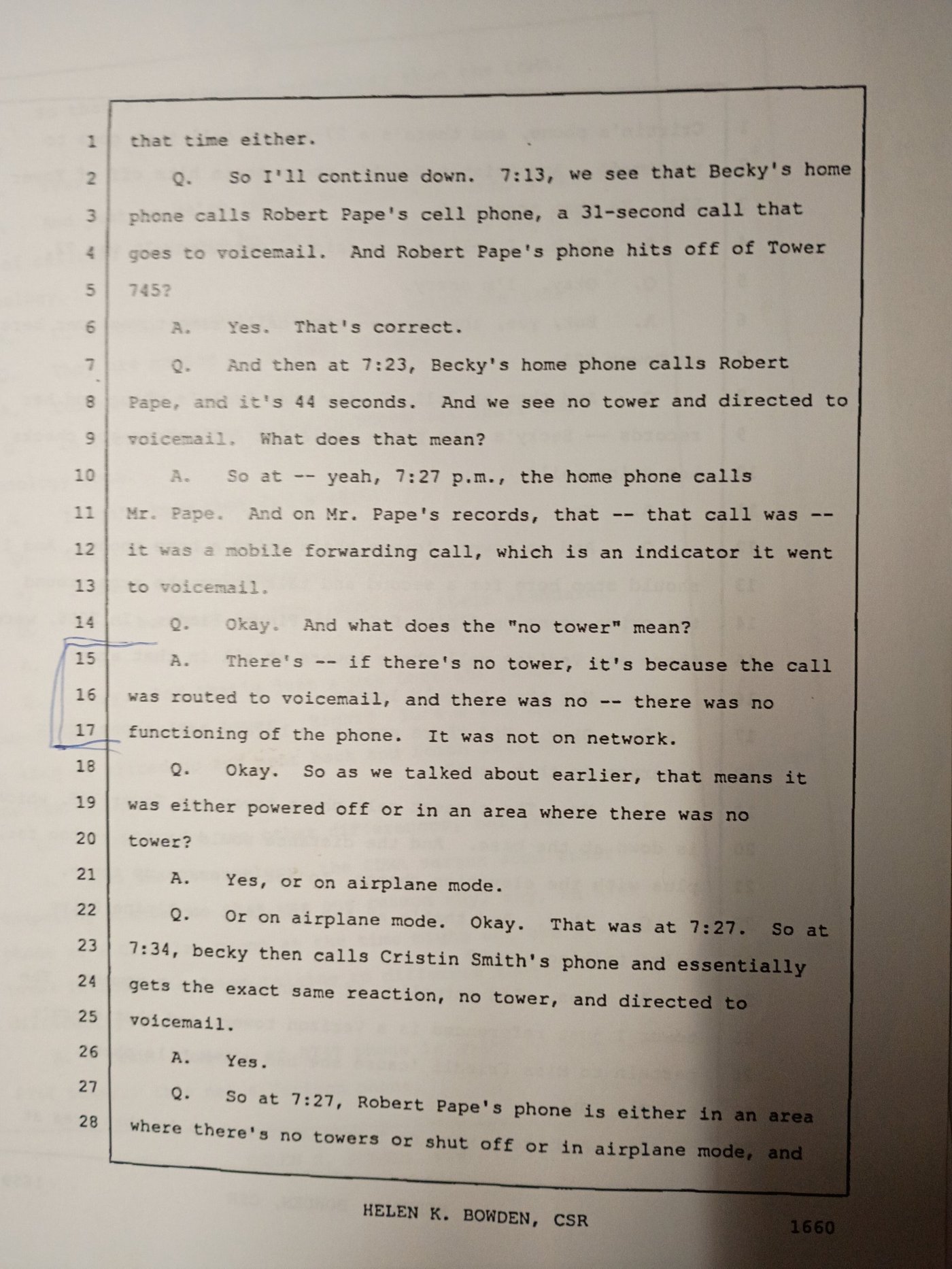
See Pape page 1712
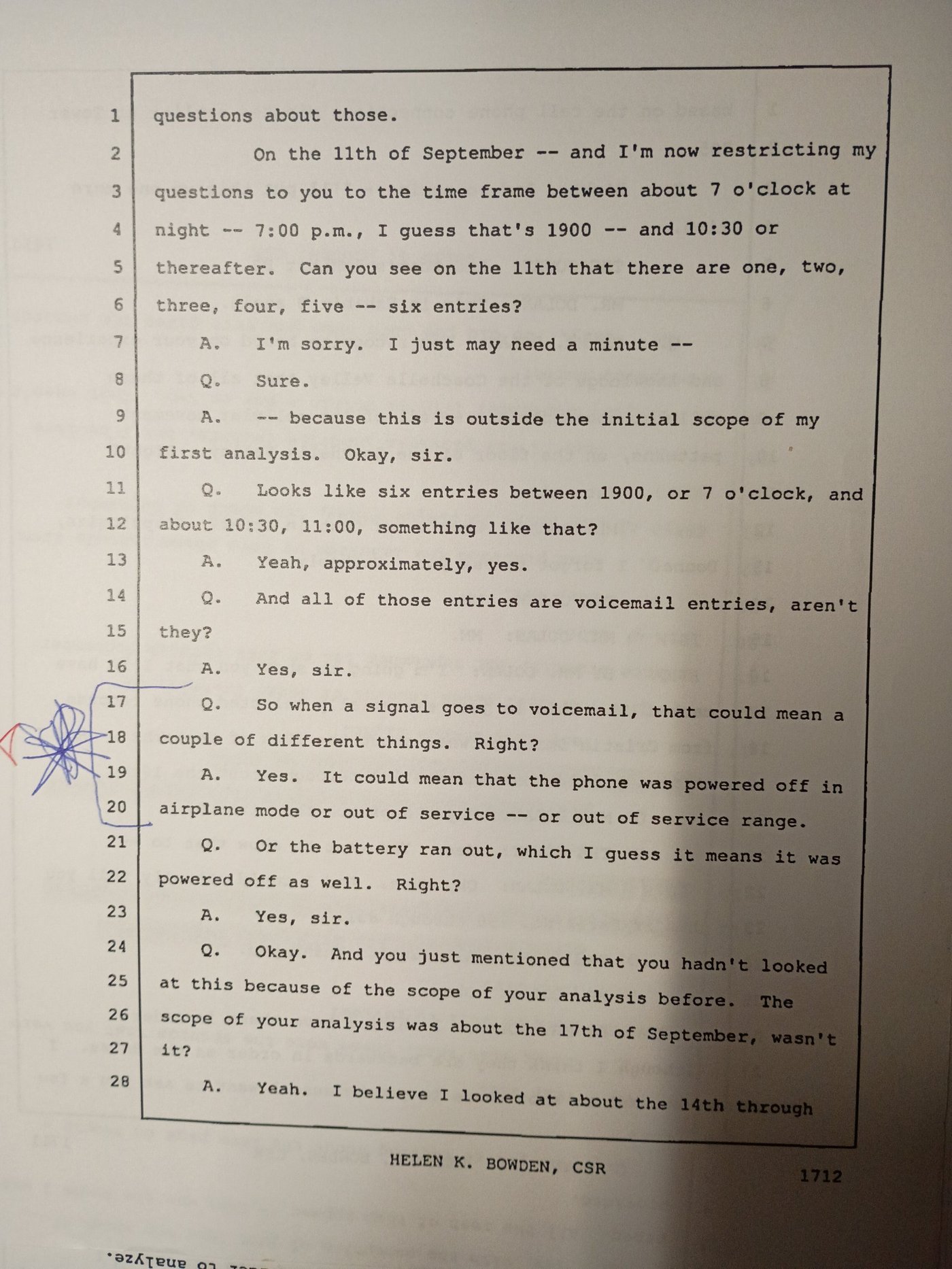
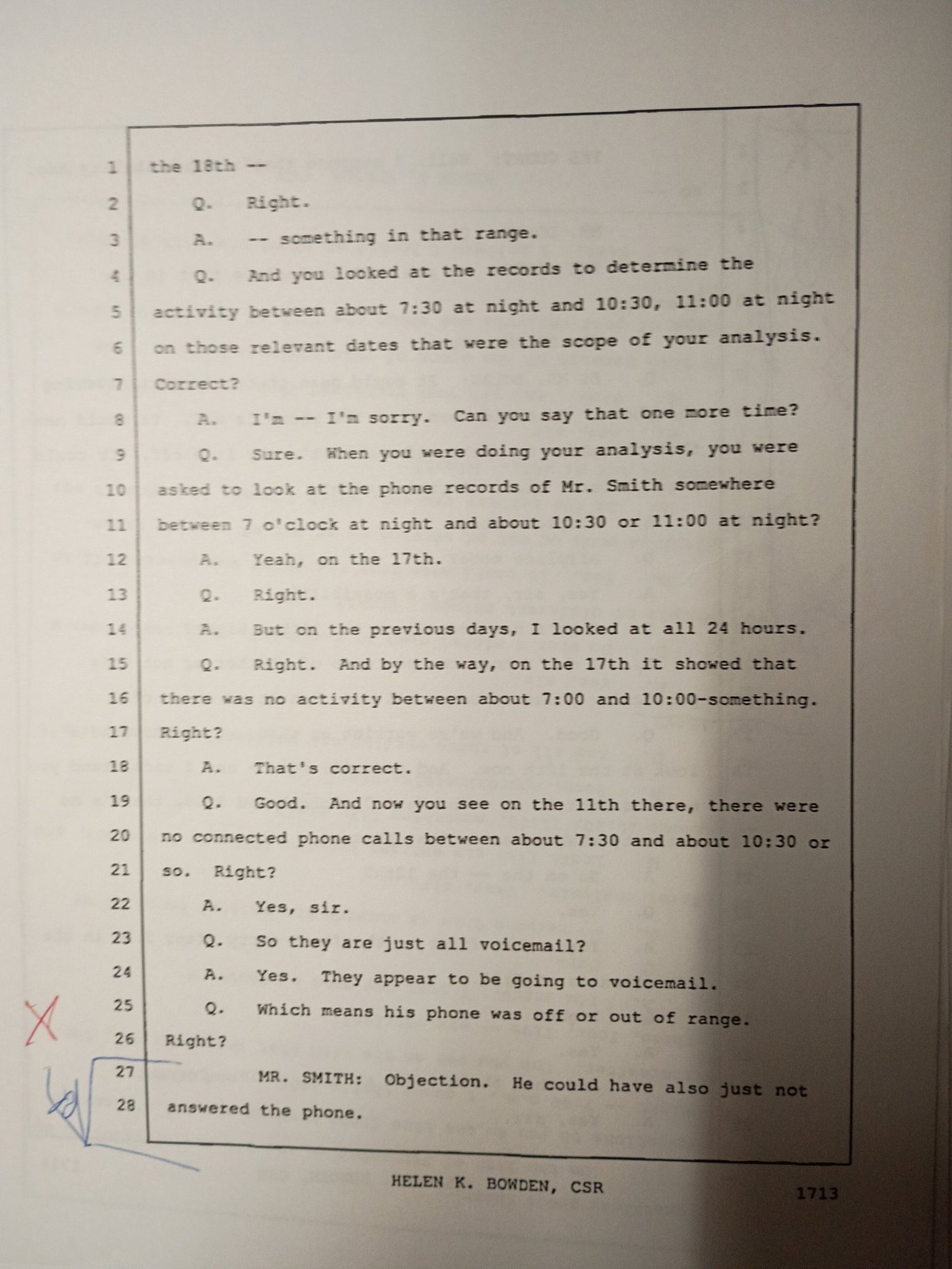
In that trial, the explanation he left out was forced into the question:
Mr. Dolan: “Which means his phone was off or out of range. Right?”
Mr. Smith: “Objection. He could have also just not answered the phone.”
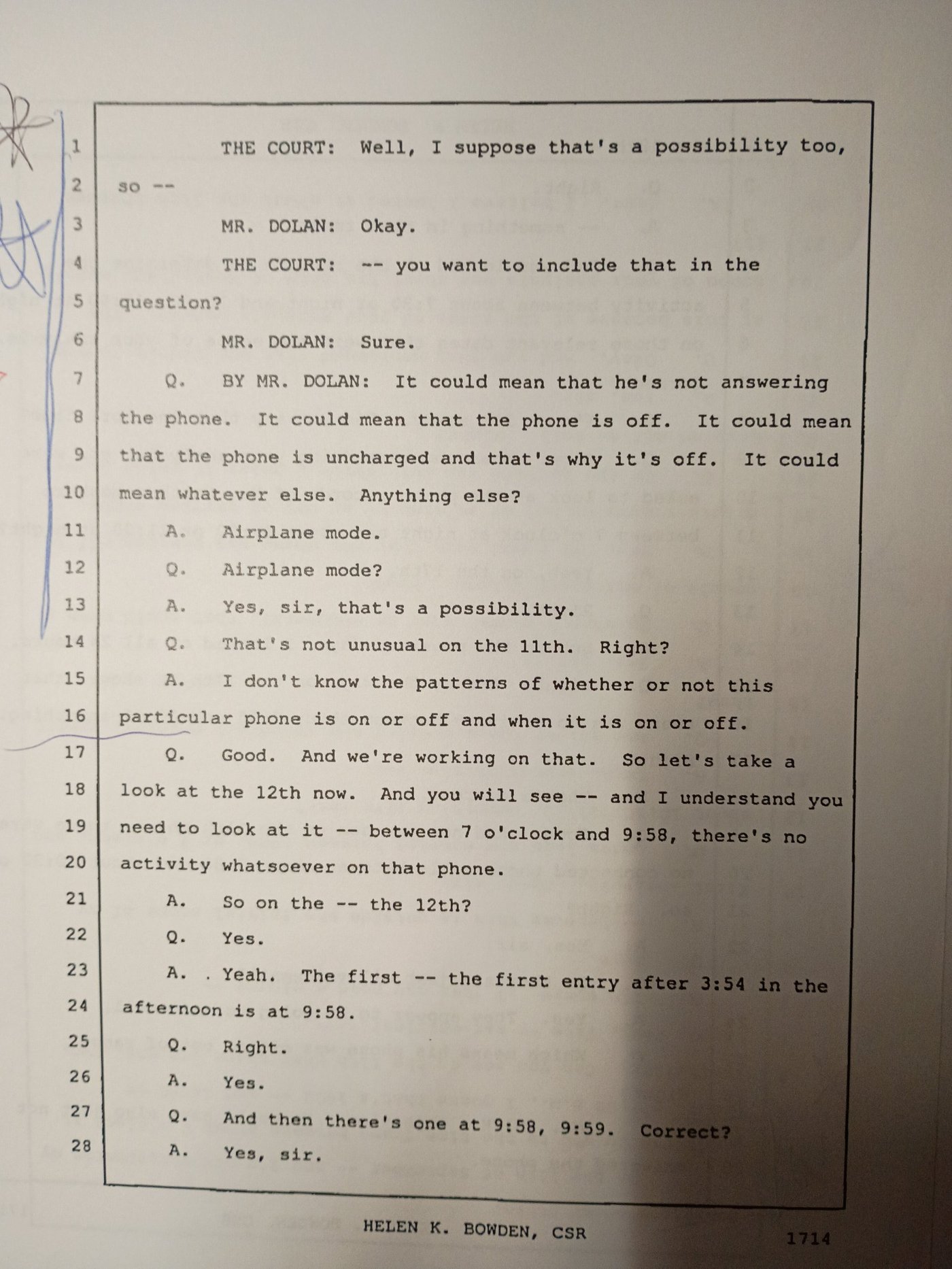
The Court: “Well, I suppose that’s a possibility too, so —”
Mr. Dolan: “Okay.”
The Court: “— you want to include that in the question?”
Mr. Dolan: “Sure.”
Mr. Dolan: “It could mean that he’s not answering the phone. It could mean that the phone is off. It could mean that the phone is uncharged and that’s why it’s off. It could mean whatever else. Anything else?”
Boles: “Airplane mode.”
Mr. Dolan: “Airplane mode?”
Boles: “Yes, sir, that’s a possibility.”
(Pape RT 1713:25-1714:13.)
See Pape page 1713
See Pape page 1714
Boles did not dispute it. Then he explained when a voicemail call does show a tower:
Mr. Smith: “Correct? Now, if it’s going to voicemail and it’s hitting a tower, we had the option of someone just not answering their phone.”
Boles: “Yes. The cell phone network has located that phone because the user sent that call to voicemail when it came in by pressing a button, or it was able to identify what tower that — that phone was camped on or connected to.”
(Pape RT 1721:15-21.)
See Pape page 1721
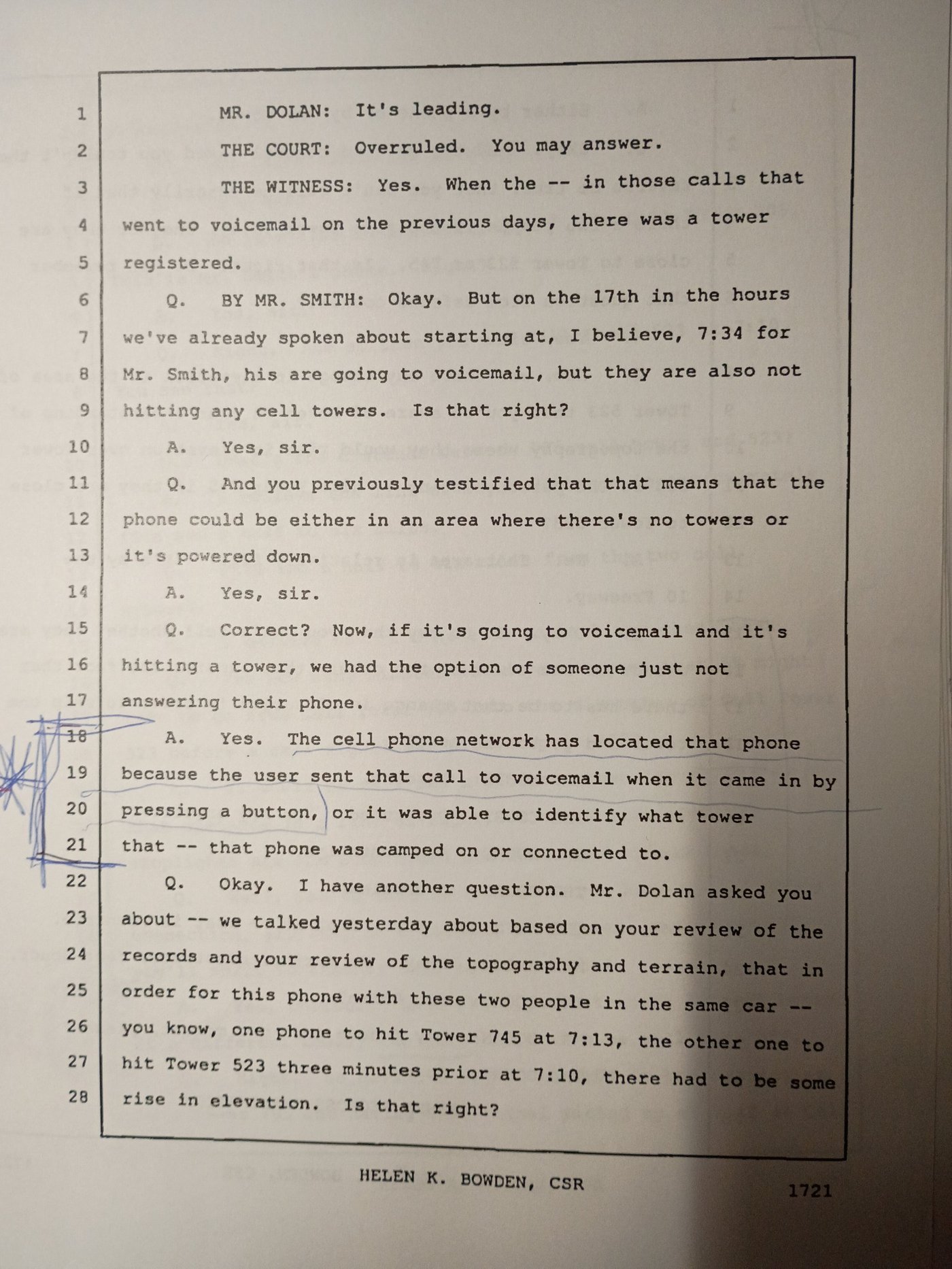
He tied the tower to the user pressing a button, “or” to the network identifying the tower the phone was on. Neither part says every unanswered call must show a tower.
What AT&T said
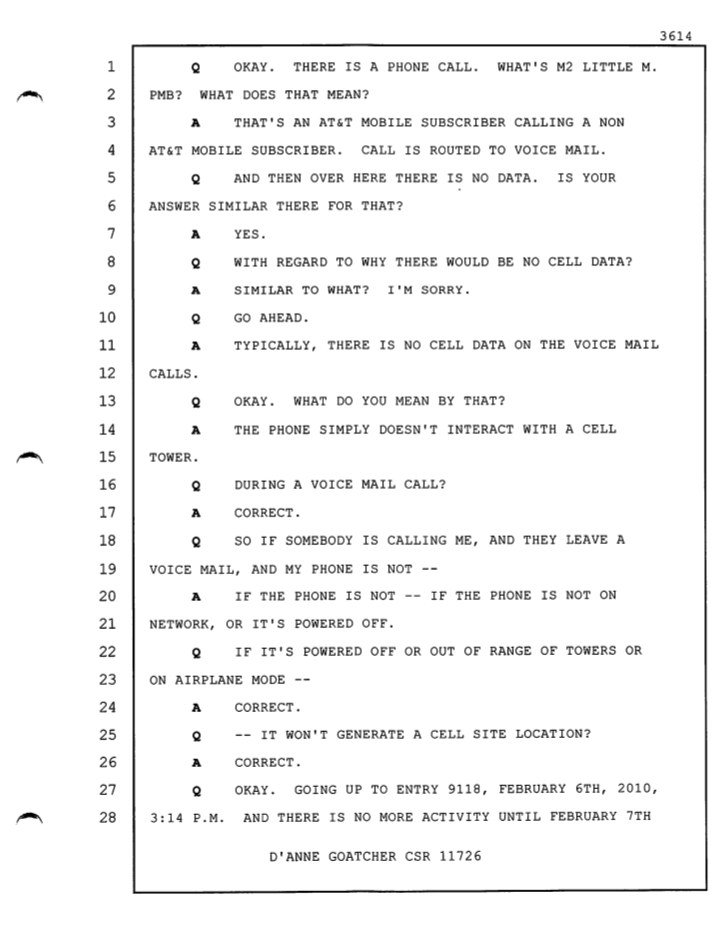
Before Agent Boles took the stand at my trial, AT&T’s custodian of records had told the court:
Mr. Lipnisky: “Typically, there is no cell data on the voice mail calls.”
(RT 3614:11-12.)
See page 3614
What he told my jury
On the first morning of his testimony, before he said a word about my records, Agent Boles explained to the jury how a cell phone connects to a tower:
Question: “So from your perspective as an investigator using this technology, can you give us insight into the mechanics of cellphones and the relationship to cell towers?”
Boles: “Yeah, certainly. So when a cellphone is powered on and it’s in service, it’s constantly scanning its environment looking for the cleanest and the best signal for that phone. And when the phone is powered on it may be able to read four or five towers in its area, and it will sort of stack those in the ranking from most attractive down to least attractive. When that individual goes to use that phone to either send a phone call or to receive a phone call, the phone is going to — that initial sort of push of the button is going to request resources from the cellphone company, and when that occurs it creates the call detail records. And that’s when that first cell tower connection is initiated, and that’s what logged when the resources are requested.”
(RT 4488:11-27.)
See page 4488
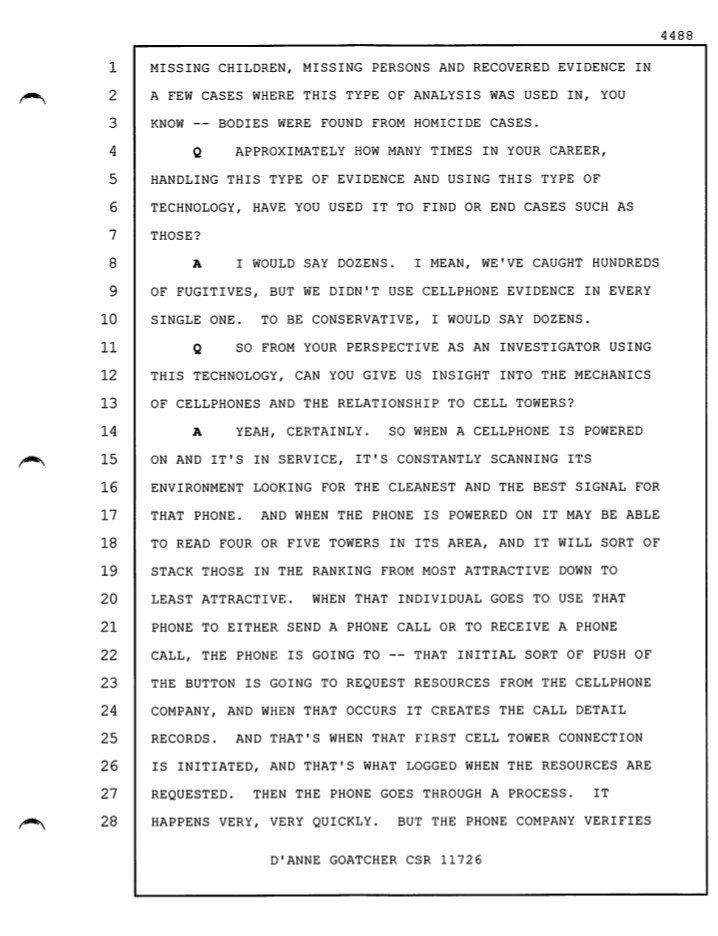
Sending a call or receiving one, the tower is logged at “that initial sort of push of the button.”
Later that morning, ADA Imes showed him three lines from my records:
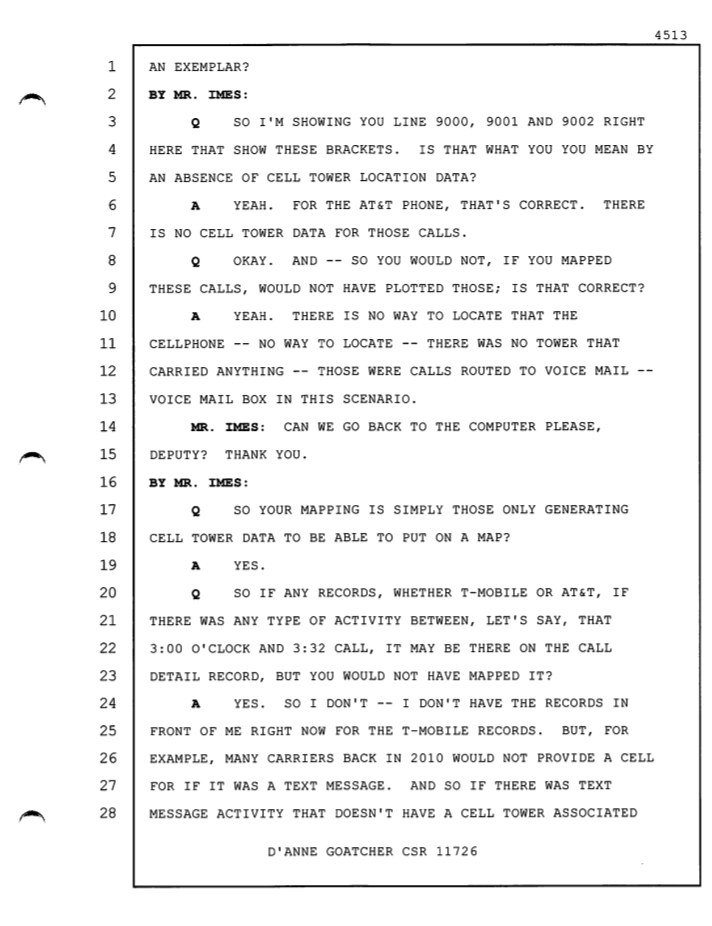
ADA Imes: “So I’m showing you line 9000, 9001 and 9002 right here that show these brackets. Is that what you you mean by an absence of cell tower location data?”
Boles: “Yeah. For the AT&T phone, that’s correct. There is no cell tower data for those calls.”
ADA Imes: “Okay. And — so you would not, if you mapped these calls, would not have plotted those; is that correct?”
Boles: “Yeah. There is no way to locate that the cellphone — no way to locate — there was no tower that carried anything — those were calls routed to voice mail — voice mail box in this scenario.”
(RT 4513:3-13.)
See page 4513
Then he told the jury what the brackets meant:
ADA Imes: “What are these brackets in between? What is that activity?”
Boles: “These were incoming calls that got sent to voice mail and with the lack of the equipment identifier in there, it indicates the phone could be off, off the network, airplane mode, any one of those.”
ADA Imes: “Well, is there a difference between, I’m in area nowhere near a cell tower signal strong enough, versus airplane mode or off?”
Boles: “No. The network — in any one of those situations the network can’t see the phone, so that it can’t decipher it. At least with these records you can’t tell.”
(RT 4527:25-4528:8.)
See page 4527
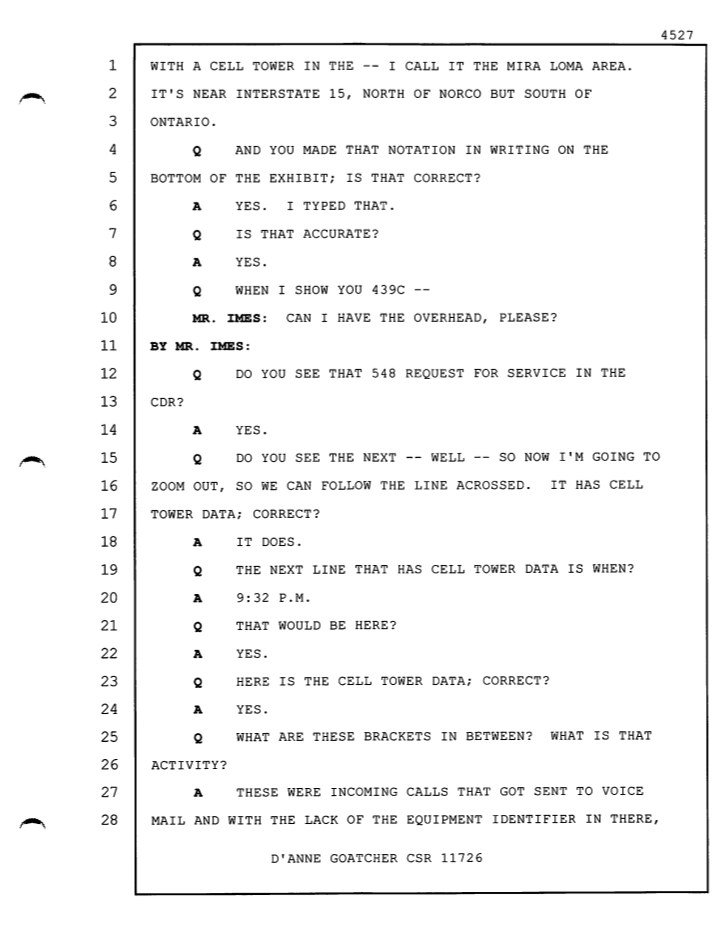
See page 4528
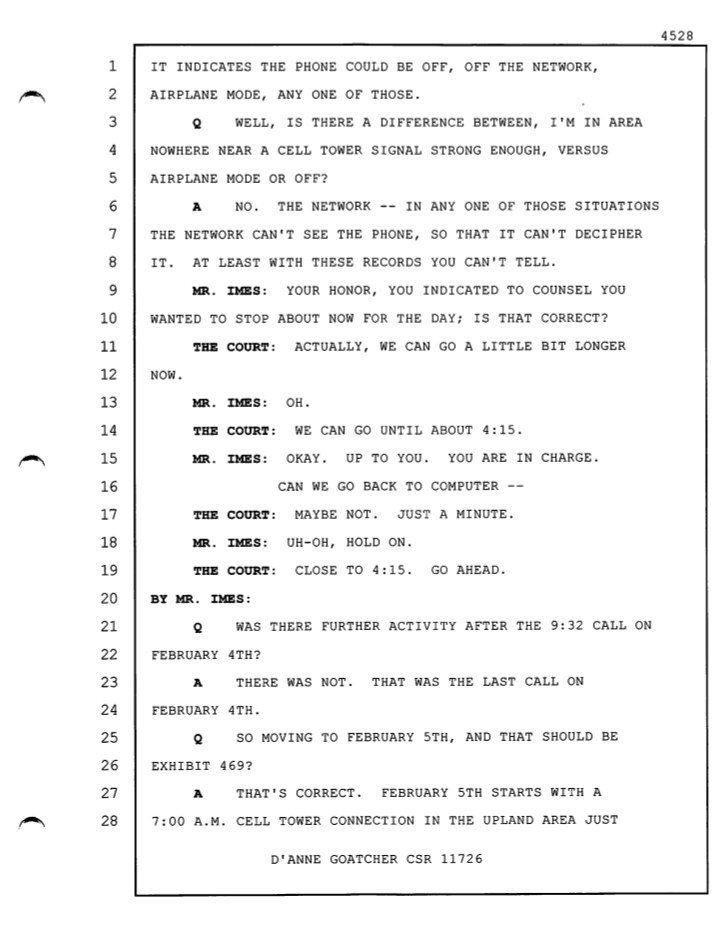
“You can’t tell.” By his own answer, the records could not tell a phone that was off from a phone with no signal.
On the second day, he described how an incoming call reaches the phone it is meant for:
ADA Imes: “So it selects the tower somewhere around the courthouse, how does my call then get to Denver? Does it go tower to tower?”
Boles: “No, once it hits the tower, at some point it will get into what’s called the back hall, or the core network, which is, essentially, like a landline stuff. It will route it to the other phone’s carrier. In some cases, it may be, you know, going from, say, an AT&T phone to a Sprint phone or some other phone company — excuse me. And once it gets into that other phone’s network, they will find their phone based on — there’s various ways they know where their phones are, but they will know the last general area the phone was at. And that company would then send out a paging message from all the towers in that area until it finds that individual’s phone, in which case, once it locates it, that phone will ring, and then that individual answers the phone. It will connect that call.”
(RT 4549:27-4550:14.)
See page 4549
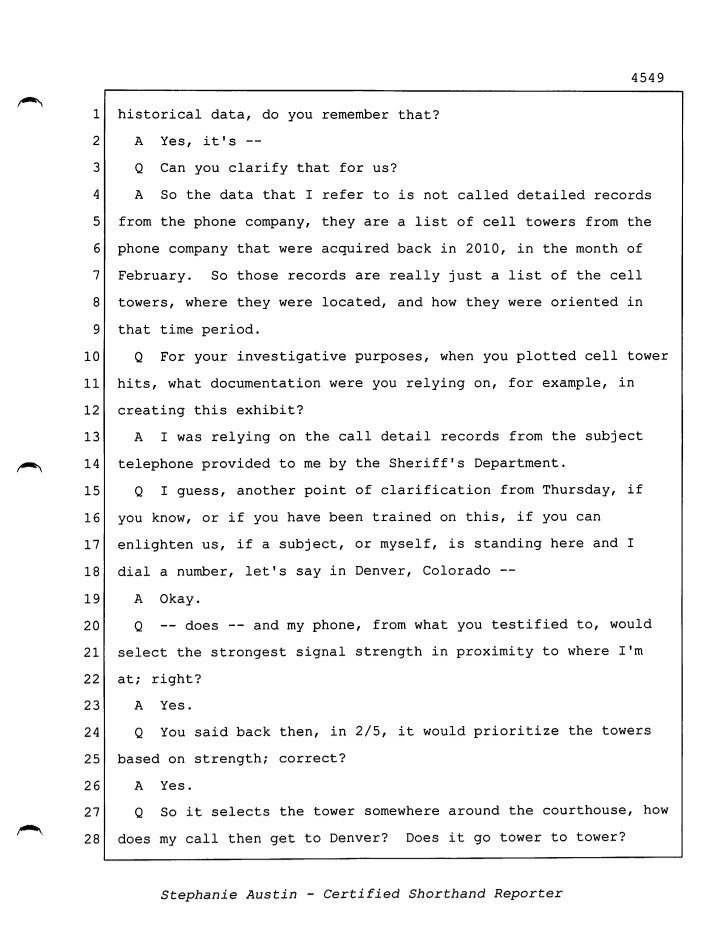
See page 4550
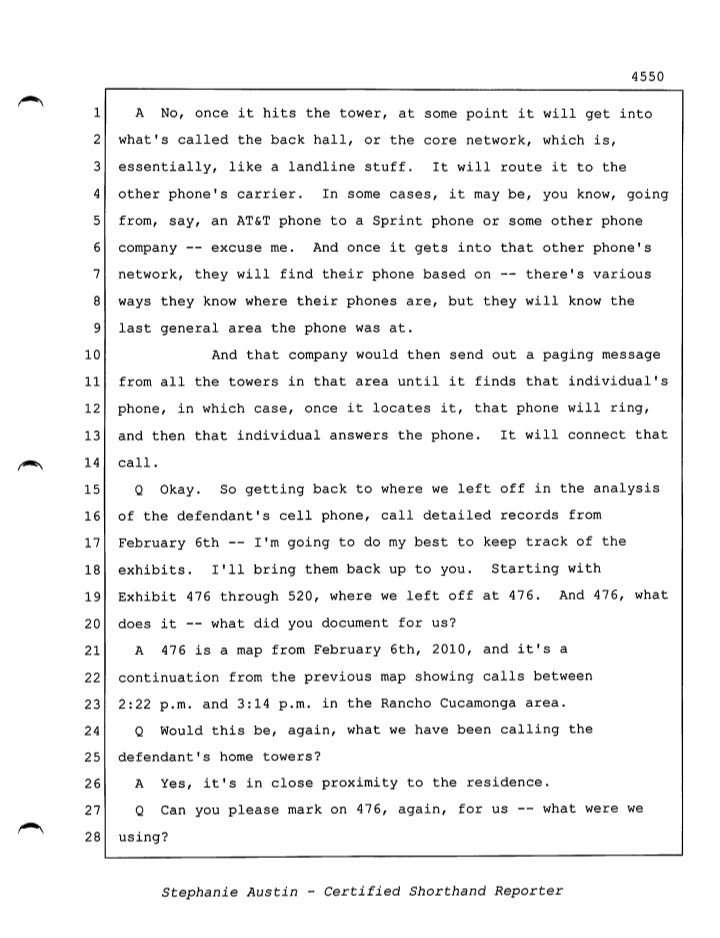
In his account, the phone rings, the person answers, and then the call connects.
On cross-examination, he said it again:
McGee: “And just explain as brief as you can. So we’re not waisting too much time.”
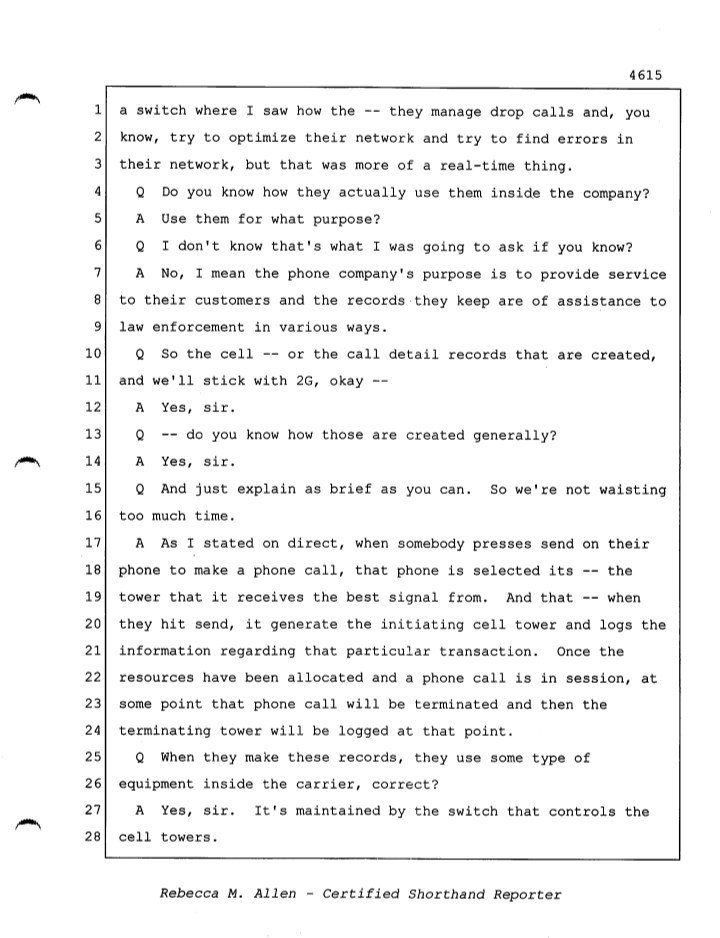
Boles: “As I stated on direct, when somebody presses send on their phone to make a phone call, that phone is selected its — the tower that it receives the best signal from. And that — when they hit send, it generate the initiating cell tower and logs the information regarding that particular transaction. Once the resources have been allocated and a phone call is in session, at some point that phone call will be terminated and then the terminating tower will be logged at that point.”
(RT 4615:15-24.)
See page 4615
Then McGee asked him directly:
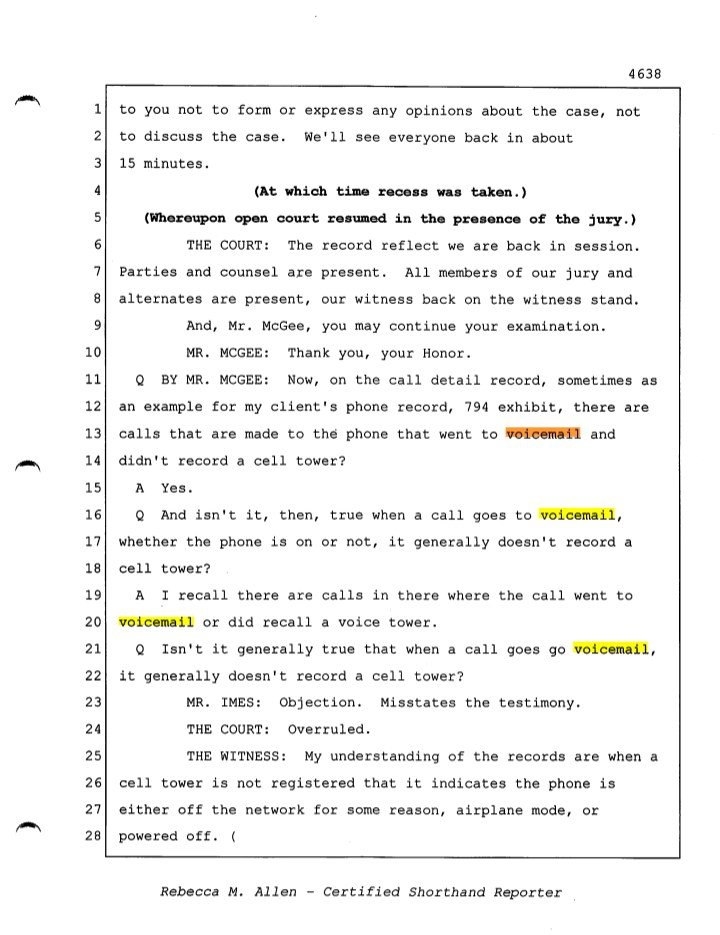
McGee: “Now, on the call detail record, sometimes as an example for my client’s phone record, 794 exhibit, there are calls that are made to the phone that went to voicemail and didn’t record a cell tower?”
Boles: “Yes.”
McGee: “And isn’t it, then, true when a call goes to voicemail, whether the phone is on or not, it generally doesn’t record a cell tower?”
Boles: “I recall there are calls in there where the call went to voicemail or did recall a voice tower.”
McGee: “Isn’t it generally true that when a call goes go voicemail, it generally doesn’t record a cell tower?”
ADA Imes: “Objection. Misstates the testimony.”
The Court: “Overruled.”
Boles: “My understanding of the records are when a cell tower is not registered that it indicates the phone is either off the network for some reason, airplane mode, or powered off.”
(RT 4638:11-28.)
See page 4638
McGee then confronted him with his testimony from the Pape trial:
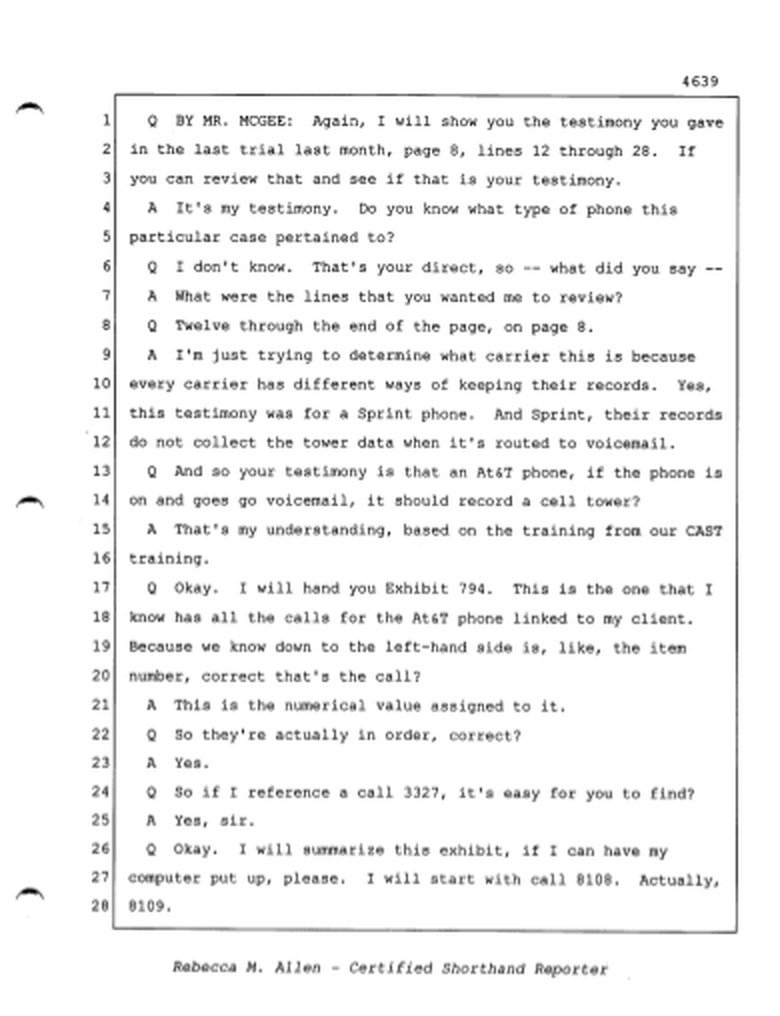
McGee: “Again, I will show you the testimony you gave in the last trial last month, page 8, lines 12 through 28. If you can review that and see if that is your testimony.”
Boles: “It’s my testimony. Do you know what type of phone this particular case pertained to?”
McGee: “I don’t know. That’s your direct, so — what did you say —”
Boles: “What were the lines that you wanted me to review?”
McGee: “Twelve through the end of the page, on page 8.”
Boles: “I’m just trying to determine what carrier this is because every carrier has different ways of keeping their records. Yes, this testimony was for a Sprint phone. And Sprint, their records do not collect the tower data when it’s routed to voicemail.”
McGee: “And so your testimony is that an AT&T phone, if the phone is on and goes go voicemail, it should record a cell tower?”
Boles: “That’s my understanding, based on the training from our CAST training.”
(RT 4639:1-16.)
See page 4639
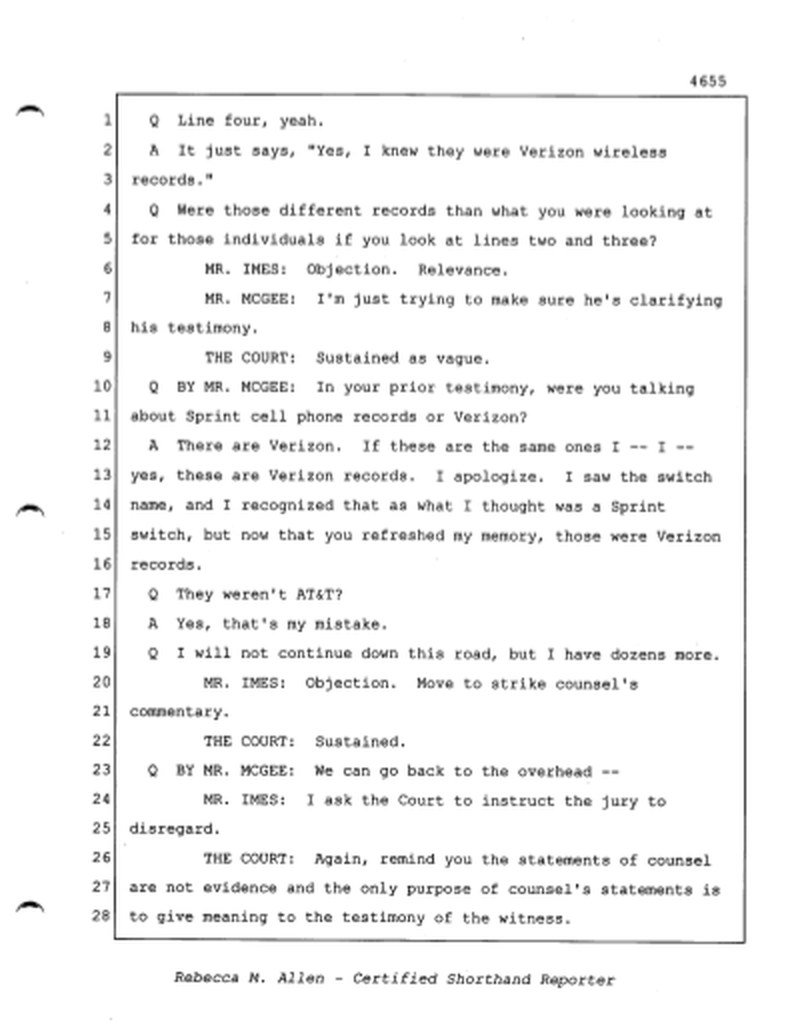
The Pape records were not Sprint. The transcript in his hands said so. Directed to page 12, line four, he read it: “It just says, ‘Yes, I knew they were Verizon wireless records.’” (RT 4655:2-3.) And in Pape he had not blamed the carrier. He had said the network could not find the phone.
McGee then took him through calls from my own records, Exhibit 794, one at a time. The first came in while I was on another call:
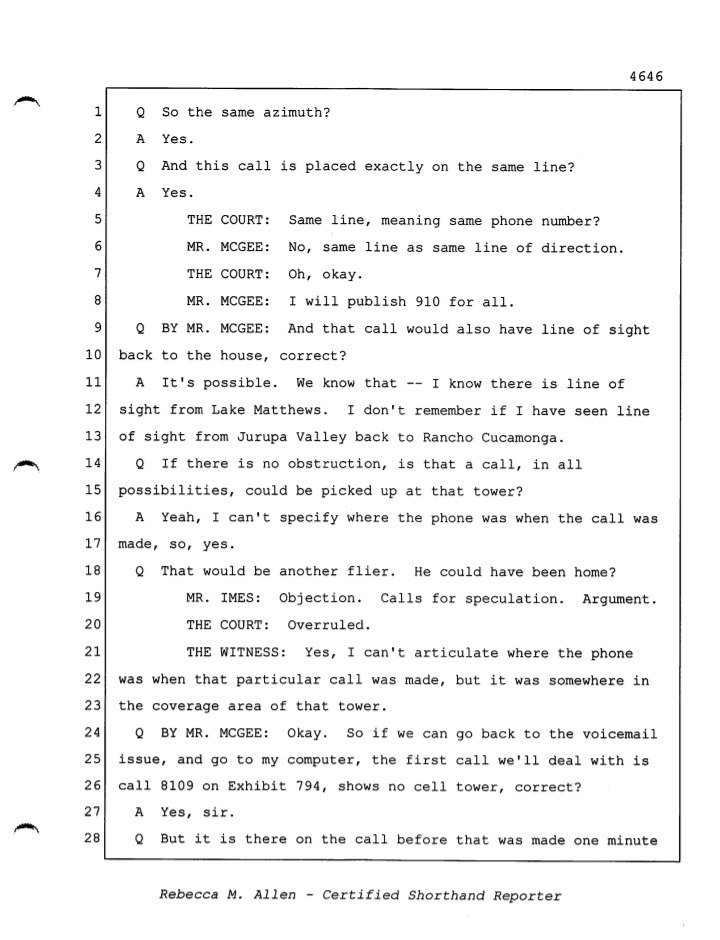
McGee: “Okay. So if we can go back to the voicemail issue, and go to my computer, the first call we’ll deal with is call 8109 on Exhibit 794, shows no cell tower, correct?”
Boles: “Yes, sir.”
McGee: “But it is there on the call before that was made one minute before and it’s a 12-minute phone call, correct?”
Boles: “Yes.”
McGee: “So the phone is on?”
Boles: “Yes, he was in a call at the time.”
McGee: “If he was on a call, then it wouldn’t show the cell tower?”
Boles: “Yeah, it did not show the incoming cell tower, and I don’t have an answer why. Zero 2M indicate it came from a landline to the mobile, so I don’t know if that has an affect on it.”
(RT 4646:24-4647:8.)
See page 4646
See page 4647
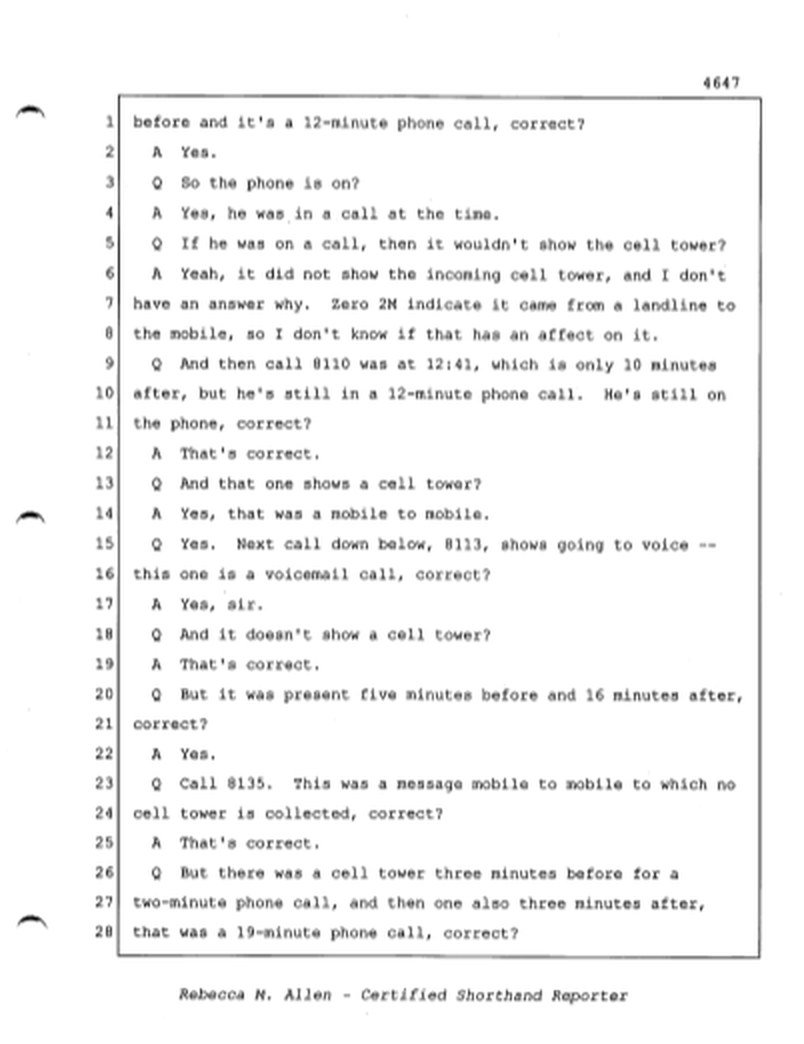
Many came in when I was on no other call at all, with my phone registering on a tower in the same minute, or minutes before and after:
McGee: “Yes. Next call down below, 8113, shows going to voice — this one is a voicemail call, correct?”
Boles: “Yes, sir.”
McGee: “And it doesn’t show a cell tower?”
Boles: “That’s correct.”
McGee: “But it was present five minutes before and 16 minutes after, correct?”
Boles: “Yes.”
(RT 4647:15-22.)
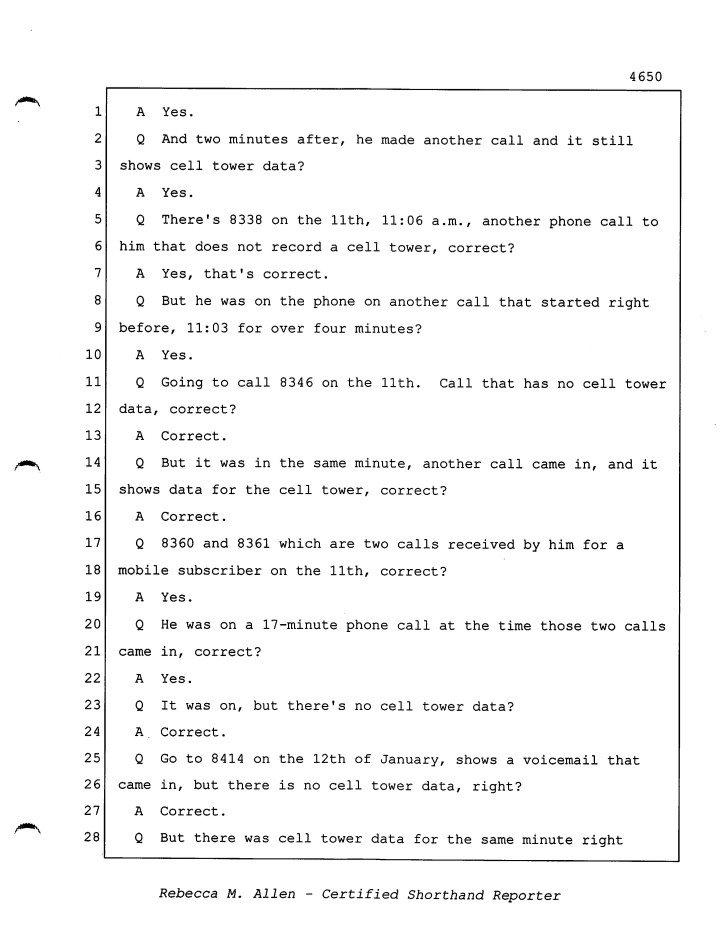
McGee: “Go to 8414 on the 12th of January, shows a voicemail that came in, but there is no cell tower data, right?”
Boles: “Correct.”
McGee: “But there was cell tower data for the same minute right before, and the next minute right after?”
Boles: “Yes.”
(RT 4650:25-4651:2.)
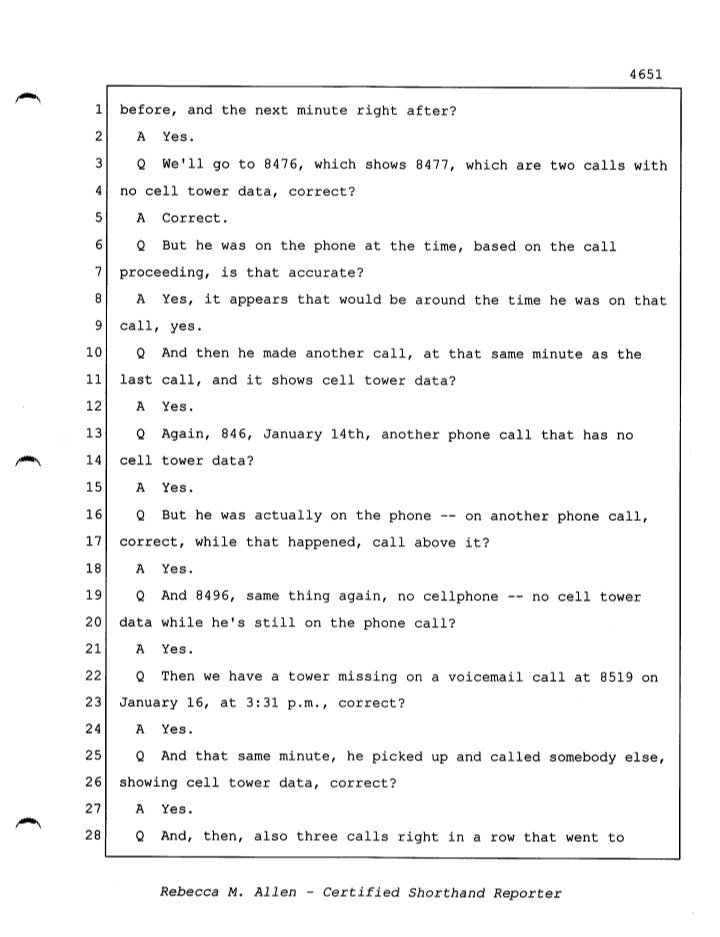
McGee: “Then we have a tower missing on a voicemail call at 8519 on January 16, at 3:31 p.m., correct?”
Boles: “Yes.”
McGee: “And that same minute, he picked up and called somebody else, showing cell tower data, correct?”
Boles: “Yes.”
McGee: “And, then, also three calls right in a row that went to voicemail, that showed no cellphone — no tower data?”
Boles: “Yes.”
(RT 4651:22-4652:2.)
See page 4650
See page 4651
And McGee put the rule to him in so many words:
McGee: “And then 8622 through 8628 were a bunch of calls that came in that show some went to voicemail, some did not, if you didn’t pick up, just shows no cell tower data, correct?”
Boles: “Yes.”
(RT 4652:6-9.)
See page 4652
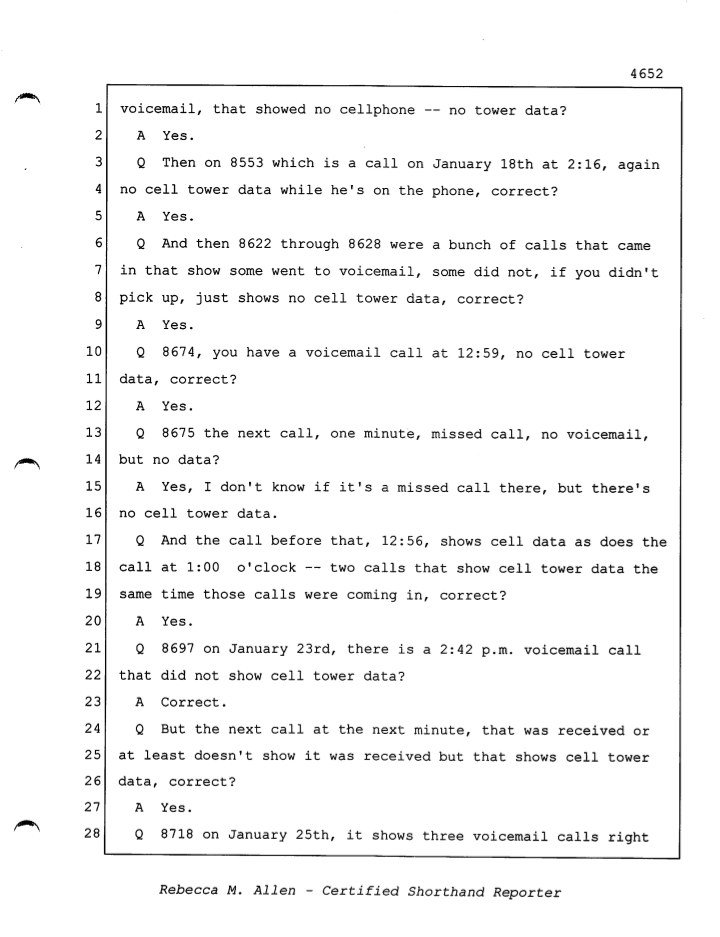
If you didn’t pick up, no cell tower data. Boles agreed.
Only when McGee pressed him did he give ground:
McGee: “Are you certain that voice mailbox calls record the cell tower data on AT&T?”
ADA Imes: “Objection. Still argumentative.”
The Court: “Overruled.”
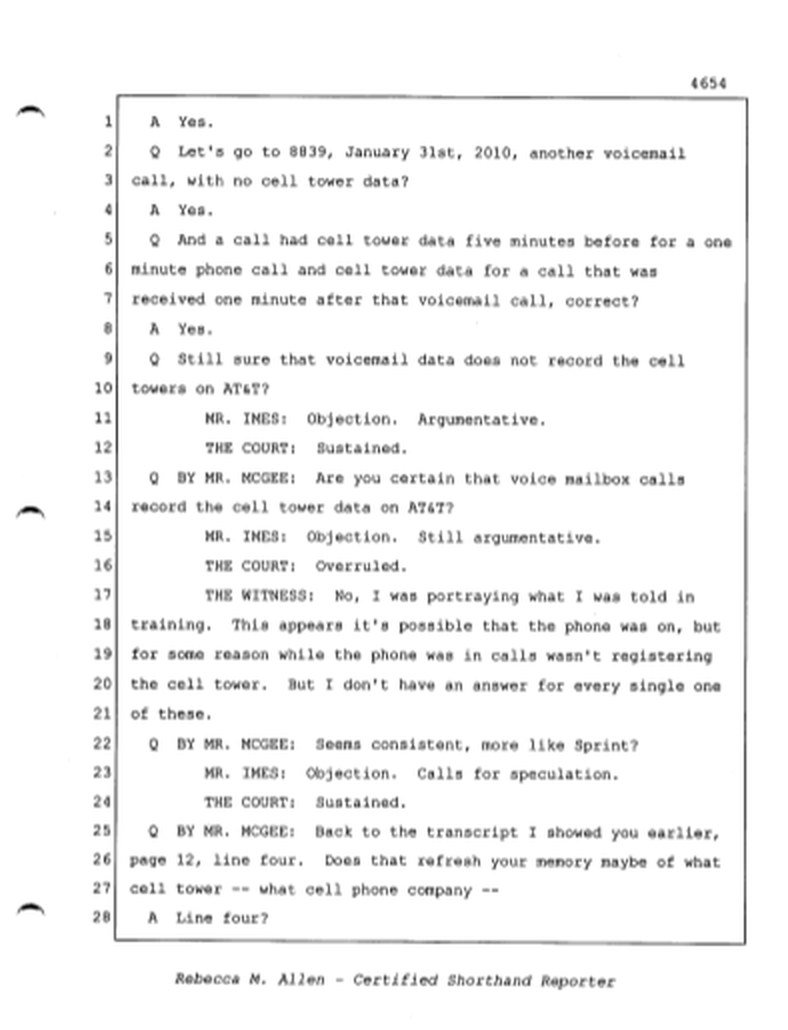
Boles: “No, I was portraying what I was told in training. This appears it’s possible that the phone was on, but for some reason while the phone was in calls wasn’t registering the cell tower. But I don’t have an answer for every single one of these.”
(RT 4654:13-21.)
See page 4654
McGee stopped at January 31, with “I have dozens more.” (RT 4655:19.) He never put a February 4 call to Boles.
See page 4655
On redirect the next day, ADA Imes went back to how a call is logged:
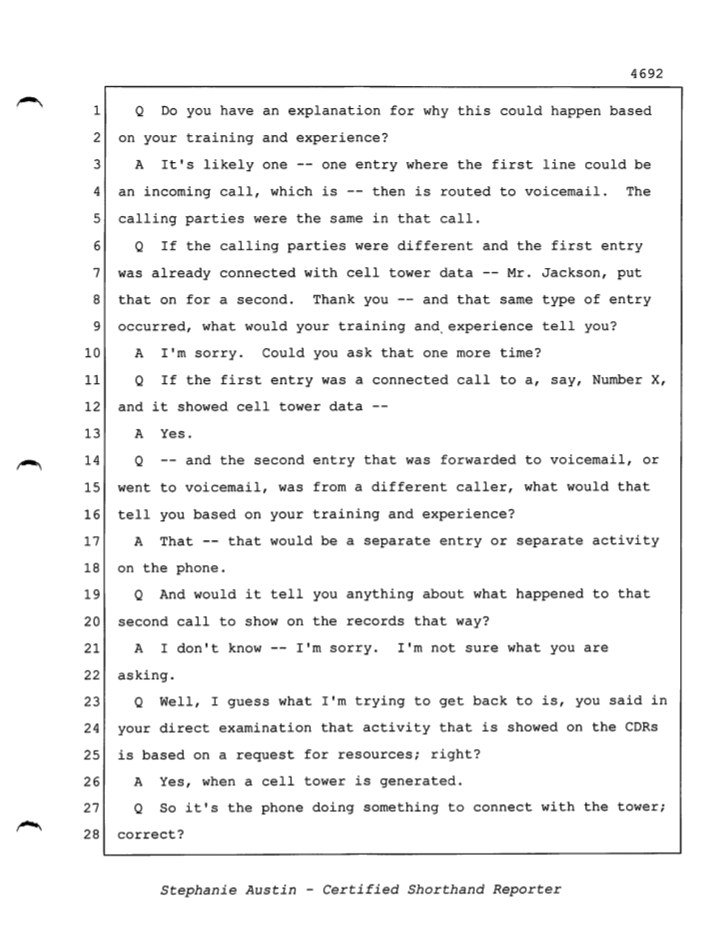
ADA Imes: “Well, I guess what I’m trying to get back to is, you said in your direct examination that activity that is showed on the CDRs is based on a request for resources; right?”
Boles: “Yes, when a cell tower is generated.”
ADA Imes: “So it’s the phone doing something to connect with the tower; correct?”
Boles: “Yes.”
ADA Imes: “That would be — in the case of making a phone call, would that not be dialing a number and hitting send?”
Boles: “Yes.”
ADA Imes: “Using old 2G flip-phone technology; right?”
Boles: “Yes.”
ADA Imes: “If a call came in and you are already on a call, and that would be call waiting, if you switched over to that call, that would be some type of activity from the phone; correct?”
Boles: “Correct.”
ADA Imes: “Or if you ignored that call, that would be some type of activity from the phone, wouldn’t it?”
Boles: “Yes. I’m not sure if that would generate a tower or not, if you ignored it.”
(RT 4692:23-4693:14.)
See page 4692
See page 4693
The phone doing something to connect with the tower. The prosecutor’s own question. And asked about a call that is simply ignored, the State’s expert said he was not sure whether it would generate a tower at all.
Then she directed him to a voicemail call that did show a tower:
ADA Imes: “I’m going to direct you to call number 8999 at 203 — sorry — February 3rd at 5:01 p.m., do you see that?”
Boles: “Yes, sir.”
ADA Imes: “I’m going to scroll across. It’s highlighted for you. Was that directed to voicemail?”
Boles: “Yes, it was.”
ADA Imes: “Does it show a cell tower location?”
Boles: “It does.”
ADA Imes: “Looking at the call before it, that’s at 4:55 p.m.; right?”
Boles: “Yes.”
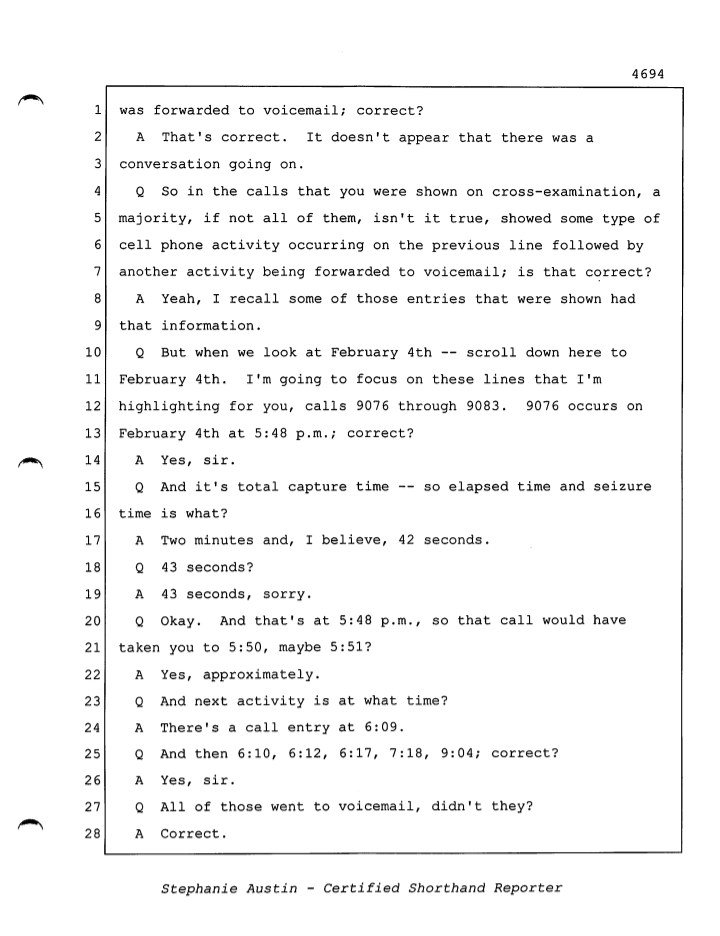
ADA Imes: “No indication that — let me get over to elapsed time — no indication that that was an ongoing conversation when that call was forwarded to voicemail; correct?”
Boles: “That’s correct. It doesn’t appear that there was a conversation going on.”
(RT 4693:17-4694:3.)
See page 4694
That was the State’s point: a voicemail call can show a tower. McGee answered it on recross, with the calls that followed that one, below.
She then recast the calls McGee had shown him:
ADA Imes: “So in the calls that you were shown on cross-examination, a majority, if not all of them, isn’t it true, showed some type of cell phone activity occurring on the previous line followed by another activity being forwarded to voicemail; is that correct?”
Boles: “Yeah, I recall some of those entries that were shown had that information.”
(RT 4694:4-9.)
See page 4694
Calls 8113 and 8414 had no call on the previous line. Boles had agreed to both the day before.
Then she put the evening of February 4 to him:
ADA Imes: “But when we look at February 4th — scroll down here to February 4th. I’m going to focus on these lines that I’m highlighting for you, calls 9076 through 9083. 9076 occurs on February 4th at 5:48 p.m.; correct?”
Boles: “Yes, sir.”
ADA Imes: “And it’s total capture time — so elapsed time and seizure time is what?”
Boles: “Two minutes and, I believe, 42 seconds.”
ADA Imes: “43 seconds?”
Boles: “43 seconds, sorry.”
ADA Imes: “Okay. And that’s at 5:48 p.m., so that call would have taken you to 5:50, maybe 5:51?”
Boles: “Yes, approximately.”
ADA Imes: “And next activity is at what time?”
Boles: “There’s a call entry at 6:09.”
ADA Imes: “And then 6:10, 6:12, 6:17, 7:18, 9:04; correct?”
Boles: “Yes, sir.”
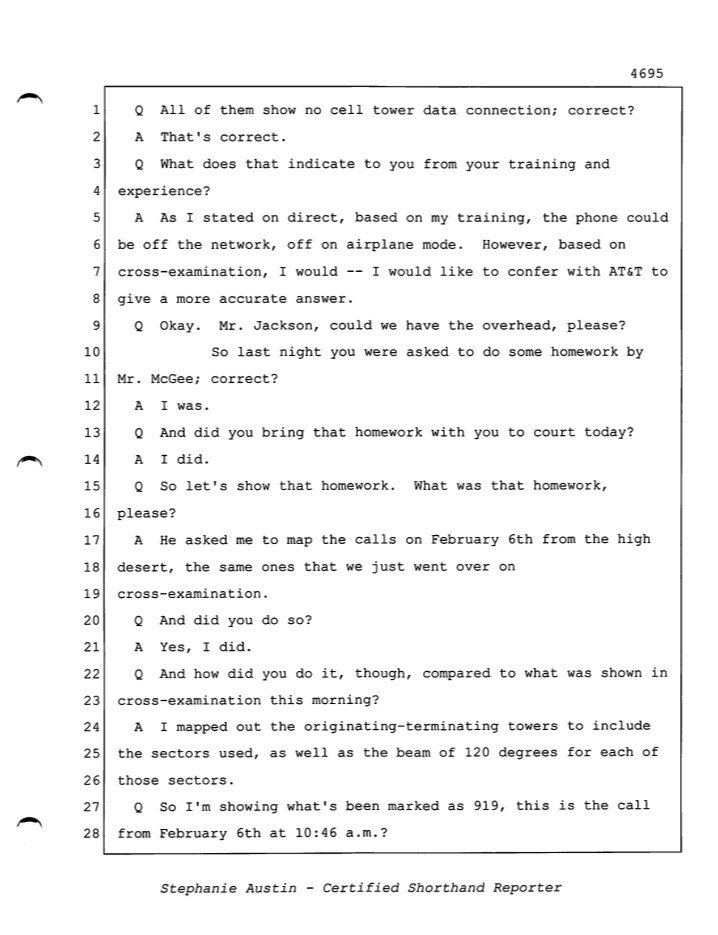
ADA Imes: “All of those went to voicemail, didn’t they?”
Boles: “Correct.”
ADA Imes: “All of them show no cell tower data connection; correct?”
Boles: “That’s correct.”
ADA Imes: “What does that indicate to you from your training and experience?”
Boles: “As I stated on direct, based on my training, the phone could be off the network, off on airplane mode. However, based on cross-examination, I would — I would like to confer with AT&T to give a more accurate answer.”
(RT 4694:10-4695:8.)
See page 4695
On recross, McGee took him through the calls that came to me at home on February 3, beginning with the one Imes had shown him:
McGee: “And those are what you kept referring to as the home towers?”
Boles: “Yes.”
McGee: “And now, the 501 call was from Ms. Jarvis, left a voicemail, and it had cell tower data; correct?”
Boles: “Yes, it appears that’s the case.”
McGee: “And then two minutes later, Ms. Jarvis called again, no cell tower data?”
Boles: “Correct.”
McGee: “And then in the same minute, it appears to be Joseph McStay calling and leaving a voicemail with no cell tower data?”
Boles: “Correct.”
McGee: “And then 16 minutes after that, Ms. Jarvis calls again, voicemail, no cell tower data?”
Boles: “That’s correct.”
McGee: “12 minutes after that, client does an outgoing call, looks like to collect his voicemail?”
Boles: “Yes. The VMC indicates like a voicemail check.”
McGee: “Now, based on this, can you say whether or not the phone was off or if he just has bad coverage when he’s at home?”
ADA Imes: “Objection. Calls for speculation.”
The Court: “Overruled. He can answer if he has opinion.”
Boles: “At this point, I would like to confer with AT&T before I provide an answer for that.”
(RT 4712:3-25.)
See page 4712
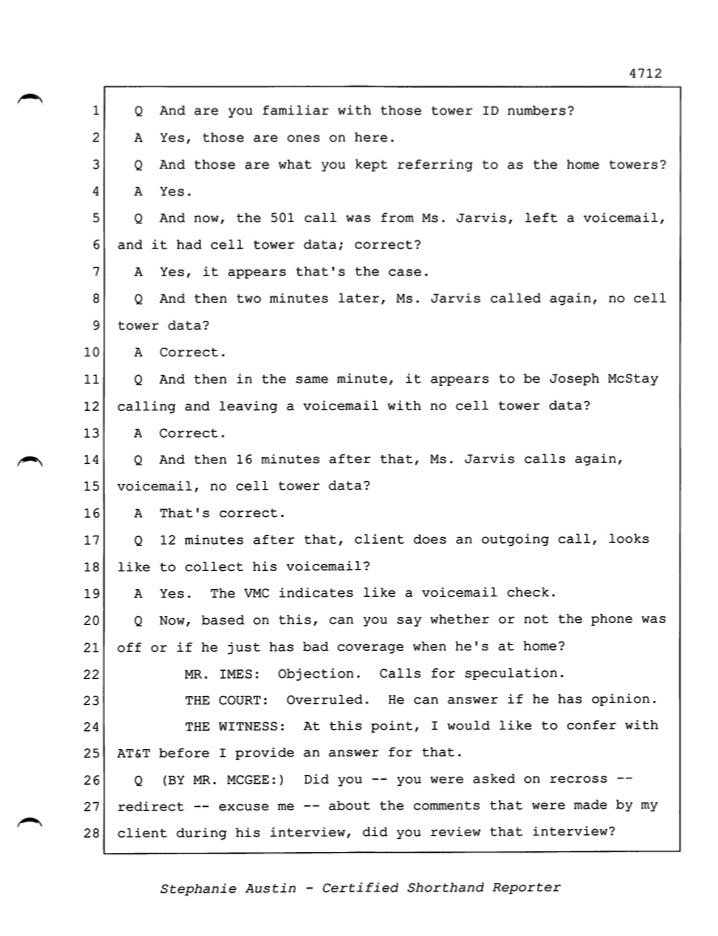
One voicemail call with a tower, then three without, within 18 minutes, on the same phone, at home. Off, or bad coverage at home? Asked that exact question, the State’s expert could not answer it.
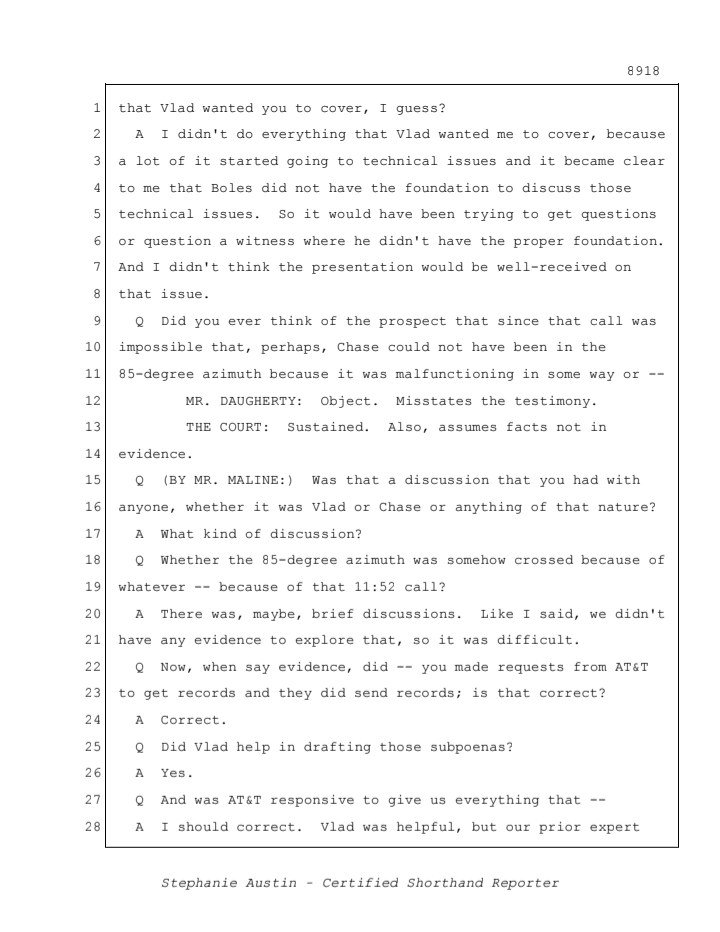
After the verdict, asked why he had not covered everything our expert wanted, my own lawyer said under oath:
McGee: “I didn’t do everything that Vlad wanted me to cover, because a lot of it started going to technical issues and it became clear to me that Boles did not have the foundation to discuss those technical issues. So it would have been trying to get questions or question a witness where he didn’t have the proper foundation. And I didn’t think the presentation would be well-received on that issue.”
(RT 8918:2-8.)
See page 8918
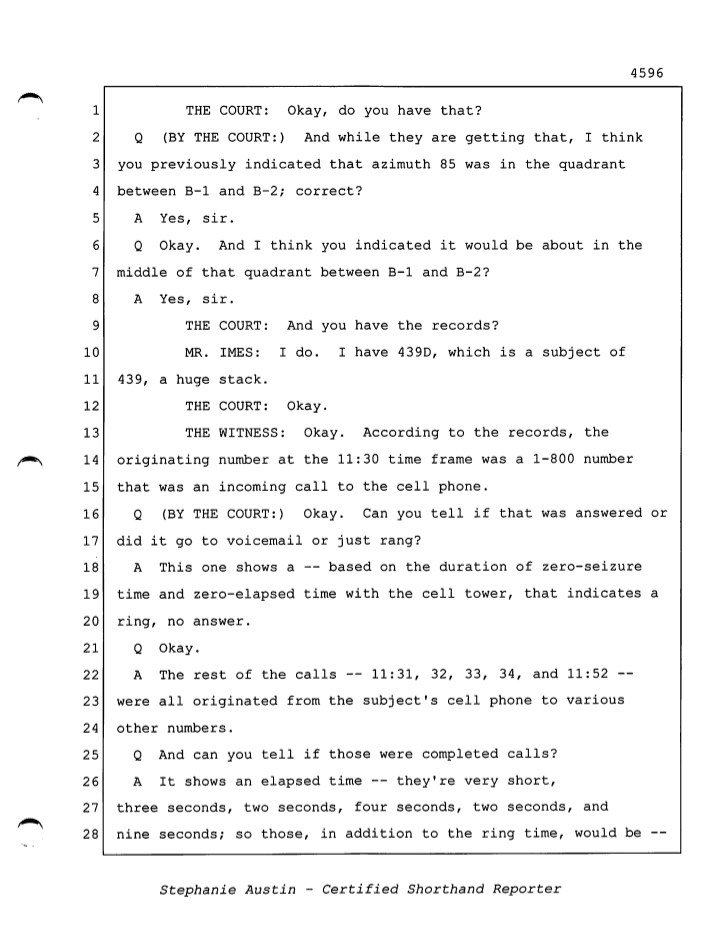
“A ring, no answer”
On the second day of his testimony, the court asked Agent Boles about a call that came in to my phone from a 1-800 number:
The Court: “Okay. Can you tell if that was answered or did it go to voicemail or just rang?”
Boles: “This one shows a — based on the duration of zero-seizure time and zero-elapsed time with the cell tower, that indicates a ring, no answer.”
(RT 4596:16-20.)
See page 4596
On cross-examination, he named his source for reading zero seizure time:
McGee: “And, I believe, that one was not answered?”
ADA Imes: “Objection. Calls for speculation.”
The Court: “Overruled. He can answer.”
Boles: “Yes, based on the — there was a zero-seizure time, zero-elapsed time, and my understanding from AT&T is that indicates a ring, no answer.”
(RT 4668:22-27.)
See page 4668
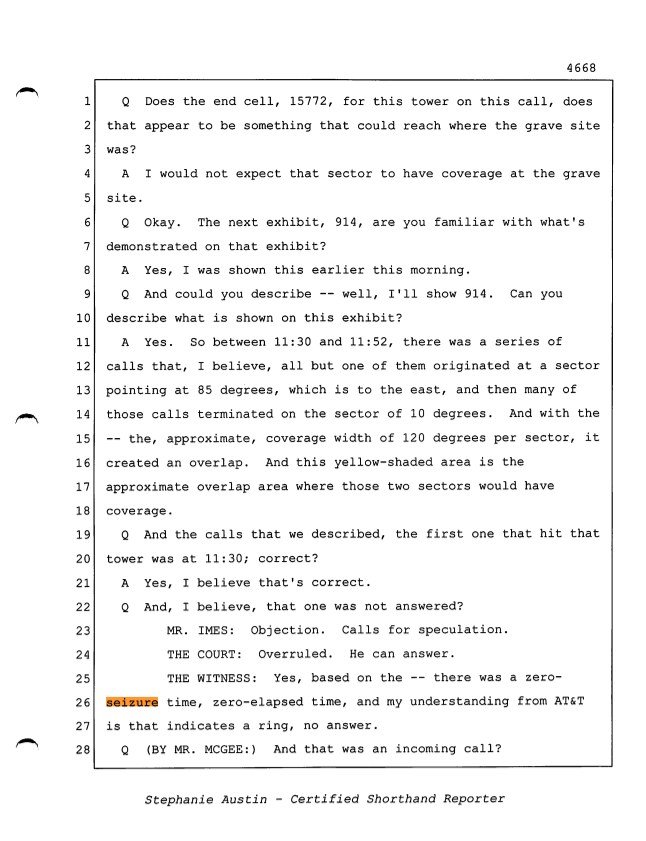
“My understanding from AT&T.” Yet asked whether he was certain about voicemail calls, he said “I was portraying what I was told in training” (RT 4654:17), and asked about my six calls, he wanted to “confer with AT&T” (RT 4695:7-8).
He did not know why the records carry seizure time at all:
McGee: “Now, you talked about seizure time. And the seizure time as you describe is the time for when — for when you hit send until there is a connection with a phone call, correct?”
Boles: “Yes, sir.”
McGee: “Do you know why the cell companies collect seizure time?”
Boles: “I don’t know why they do it. I just know it’s in the records and it’s been explained to me what seizure time means.”
(RT 4623:15-21.)
See page 4623
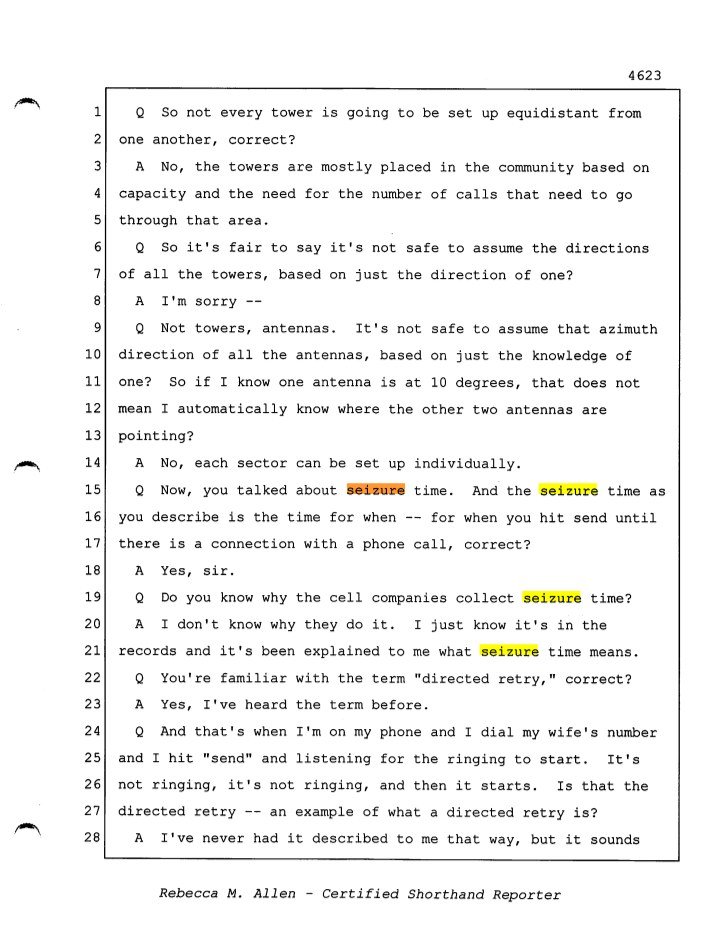
And when McGee asked what seizure time covers, he agreed it could be almost anything:
McGee: “And that seizure time can be either ring time or a directed retry?”
Boles: “My understanding is that seizure time is from when the user requests — requests resources until they’re talking on the call, so whatever occurs in that period of time. It may be a number of things.”
McGee: “So it could be ringing the whole time, it could be trying to get a ring to start, it could be looking for a tower that will accept it’s resources, it could be doing anything in that time?”
Boles: “Yes, this — this is the things that are going on between the phone and the network.”
(RT 4673:14-24.)
See page 4673
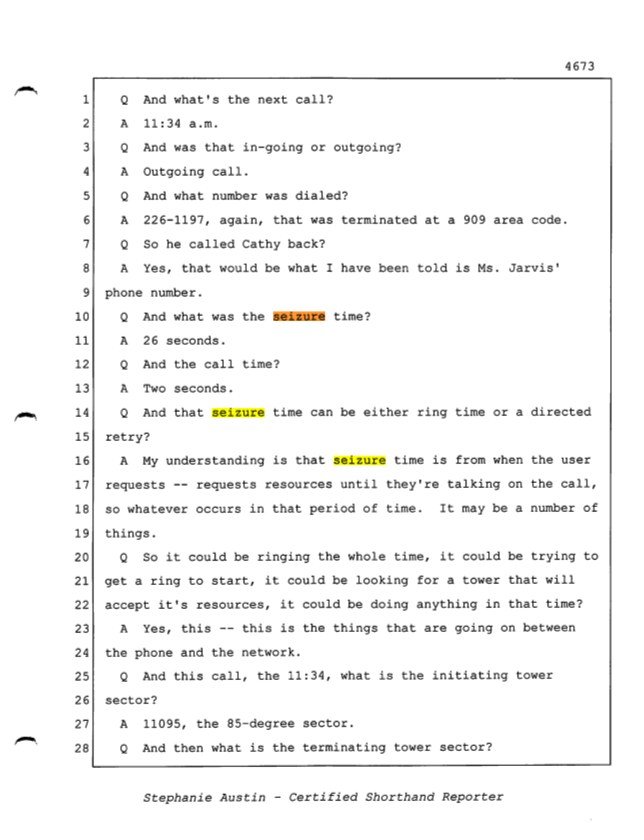
A measure that “could be doing anything” cannot tell anyone that a zero meant “a ring, no answer.” But that is how he read it, and the record he read it from shows what follows.
Zero seizure time and zero elapsed time: a ring, no answer. That was his reading, and I do not have to accept it as fact to use it. If he was right, the phone was on and the call reached it. That one showed a tower. Exhibit 794, the record he was reading from, has 1,731 calls to my phone with zero seizure time and zero elapsed time. 443 of them show no tower. By his own reading, then, hundreds of calls reached a phone that was on, and left no tower. His interpretation cannot be squared with his treatment of a missing tower as a phone that was off.
| Calls to my phone in Exhibit 794, February 2009 to February 2010 | With a tower | No tower |
|---|---|---|
| Zero seizure, zero elapsed: “a ring, no answer” | 1,288 | 443 |
| Of those, the same caller’s call went to voicemail in that minute | 97 | 60 |
| Of those, I called the number back within two minutes | 133 | 56 |
Some of the calls that rang, left no tower, and what happened next:
- December 28, 2009, 2:46 p.m. I called the number back at 2:47, on my home tower. (Exhibit 794, items 7927, 7929, page 323.)
- February 4, 2010, 9:55 a.m. One minute earlier, a call from the same number had connected on my home tower. (Items 9015, 9016, page 369.)
- February 12, 2010, 11:29 a.m. I called the number back at 11:29, on my home tower. (Items 9279, 9280, page 379.)
- February 15, 2010, 4:11 p.m. I called the number back at 4:12, on my home tower. (Items 9432, 9433, page 385.)
- February 18, 2010, 12:27 p.m. I called the number back at 12:28, three times, on my home towers. (Items 9579-9582, page 391.)
Under Boles’s own interpretation, each of these calls rang and reached a phone that was on. Yet none shows a tower, and in most of them I called right back.
The six calls on February 4 were voicemail calls, not rings with zero elapsed time, and I do not claim they are the same. The point is simpler: on the record he was reading from, a phone that was on left no tower hundreds of times. A missing tower could not tell the jury my phone was off.
What it left the jury
So the jury was told that an AT&T phone that is on “should record a cell tower” when a call goes to voicemail. With that, Boles took away the one explanation that fit the evidence: a phone that was on, and not answered. What he left were reasons the phone was not on the network. My phone had been on my home towers all afternoon. From 2:45 to 5:48 p.m., call after call registered on my home towers, the last two at 5:47 and 5:48. (AT&T items 9064-9076, page 371.) Twenty-one minutes later, the six calls began. That left the jury two choices: I had turned it off, or put it in airplane mode. Either way, I had done it on purpose.
That is exactly what the prosecution told the jury:
ADA Imes: “The only reasonable interpretation is that the phone was powered off or in airplane mode. This is not bad cell reception. The defense is going to try to argue to you that, oh, those were missed calls, these were dropped calls. Remember all of this bad reception. That’s not what that is. That is a phone that is off and every call being directed to voice mail.”
(RT 8199:7-13.)
See page 8199
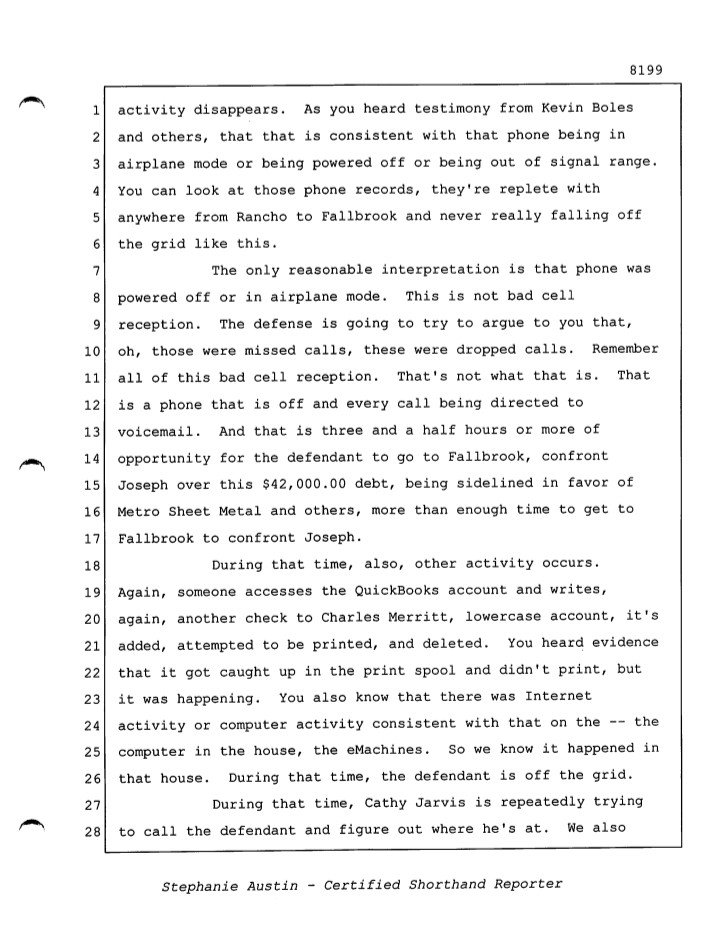
Boles’s testimony set up that sentence. Imes delivered it.
It was not the only time. The State told the jury my phone was off from its opening statement through its rebuttal:
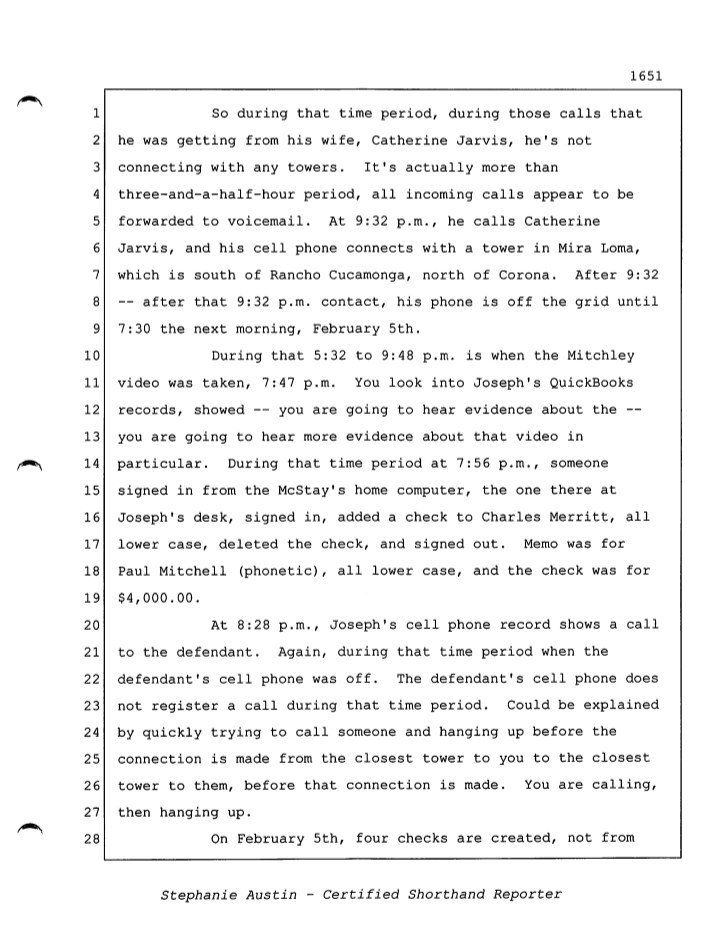
ADA Daugherty: “At 8:28 p.m., Joseph’s cell phone record shows a call to the defendant. Again, during that time period when the defendant’s cell phone was off.”
(Opening statement, RT 1651:20-22.)
See page 1651
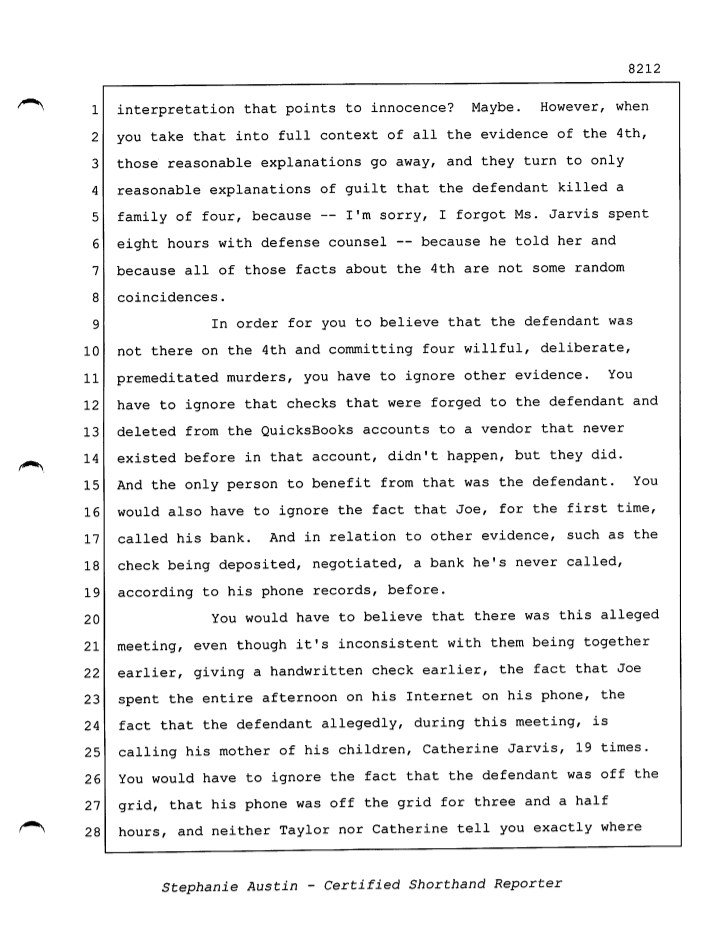
ADA Imes: “You would have to ignore the fact that the defendant was off the grid, that his phone was off the grid for three and a half hours, and neither Taylor nor Catherine tell you exactly where he’s at. They tell you where he may have been.”
(RT 8212:26-8213:1.)
See page 8212
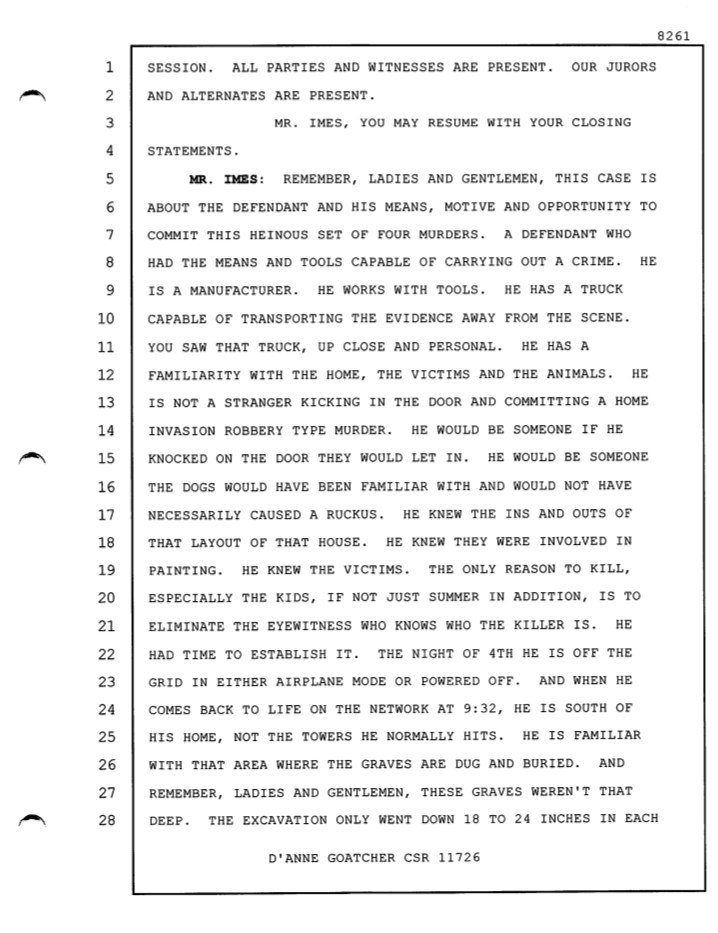
ADA Imes: “He had time to establish it. The night of 4th he is off the grid in either airplane mode or powered off. And when he comes back to life on the network at 9:32, he is south of his home, not the towers he normally hits.”
(RT 8261:21-25.)
See page 8261
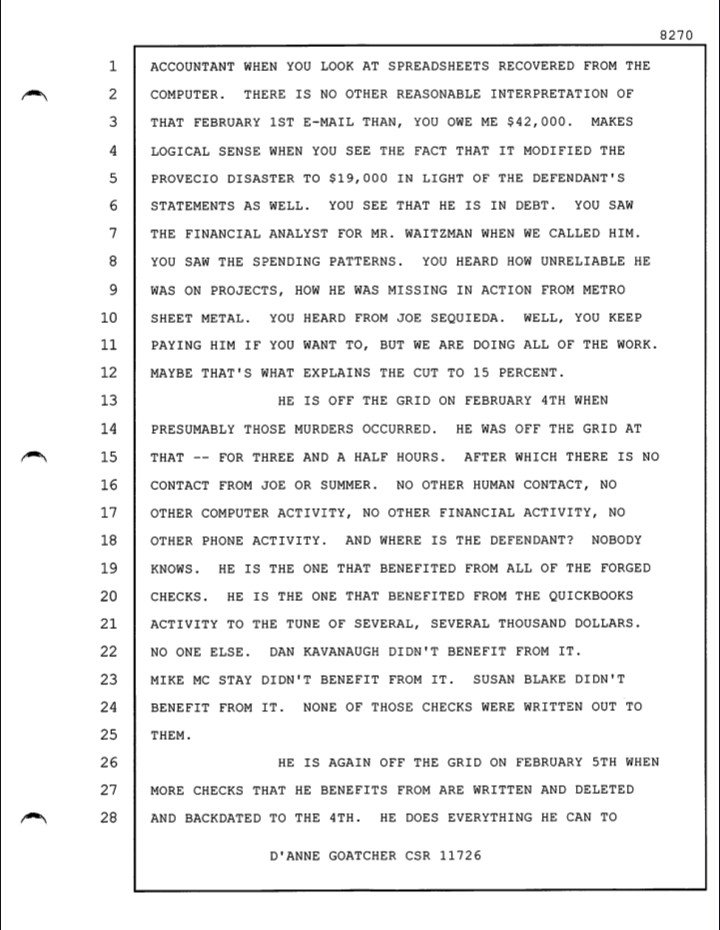
ADA Imes: “He is off the grid on February 4th when presumably those murders occurred. He was off the grid at that — for three and a half hours. After which there is no contact from Joe or Summer. No other human contact, no other computer activity, no other financial activity, no other phone activity. And where is the defendant? Nobody knows.”
(RT 8270:13-19.)
See page 8270
ADA Rodriguez: “The defendant’s phone is off the grid. February 4th, there is a check written and deleted to the defendant from the McStay house, at the same time, or shortly thereafter as that truck pulls over.”
(Rebuttal, RT 8449:19-22.)
See page 8449
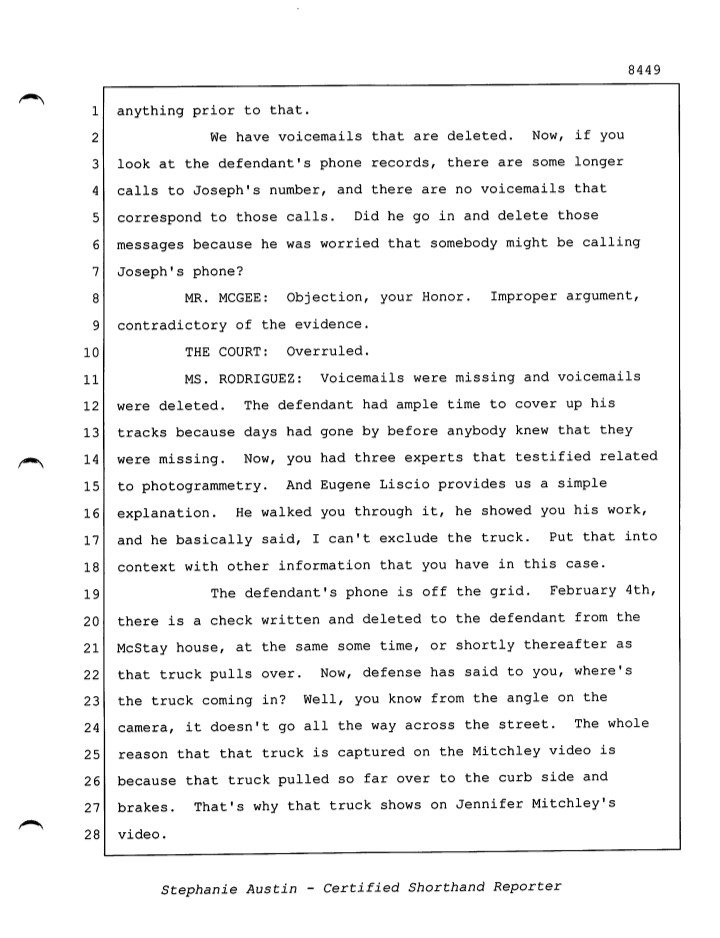
Off, off the grid, airplane mode, powered off. Each time, the jury heard it as a fact. Its own expert had said the records could not tell.
What the court did with it
It did not end with the jury. Arguing against my motion to dismiss, ADA Imes told the court that “from 5:30ish p.m. to 9:23 p.m., he is effectively off the cell phone grid and no one can put his whereabouts anywhere; not at his Rancho home, not at a casino.” (RT 4993:1-4.)
See page 4993
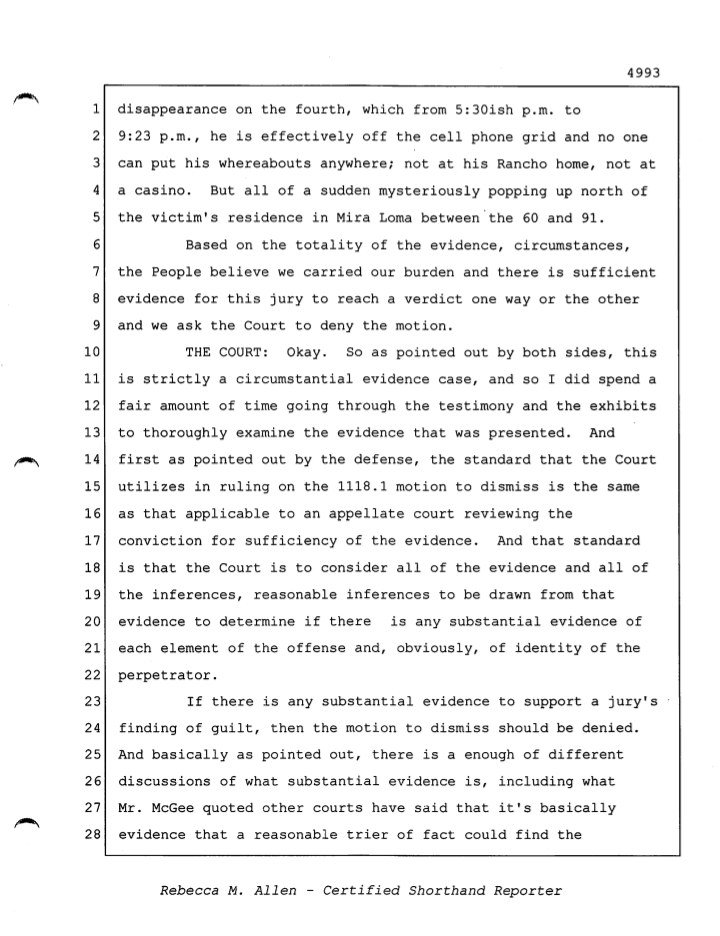
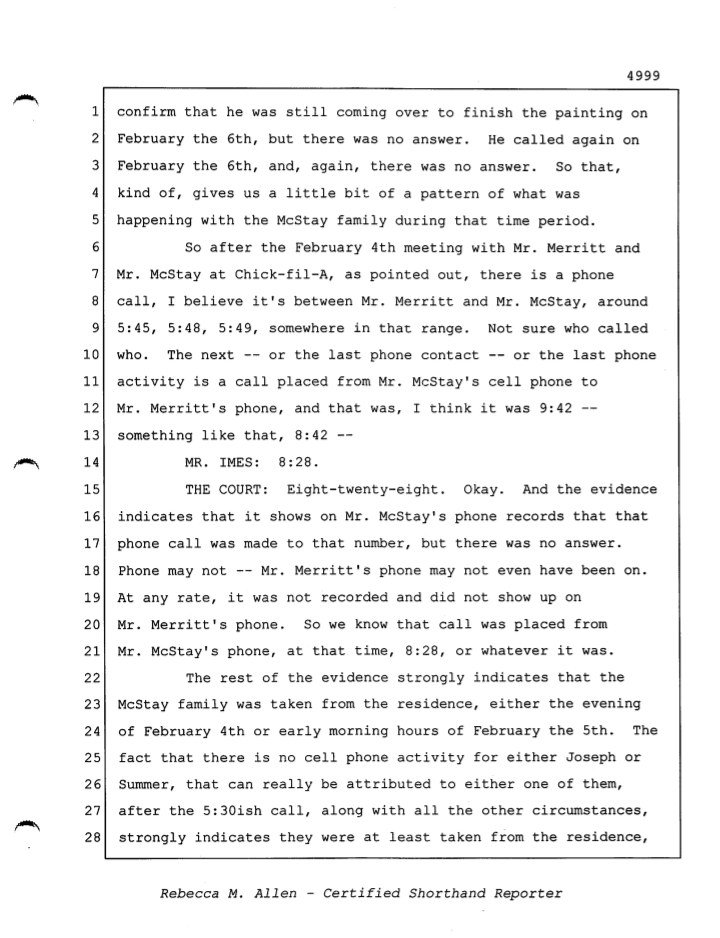
Ruling on that motion, the court said of Joseph’s 8:28 call:
The Court: “Eight-twenty-eight. Okay. And the evidence indicates that it shows on Mr. McStay’s phone records that that phone call was made to that number, but there was no answer. Phone may not — Mr. Merritt’s phone may not even have been on. At any rate, it was not recorded and did not show up on Mr. Merritt’s phone.”
(RT 4999:15-20.)
See page 4999
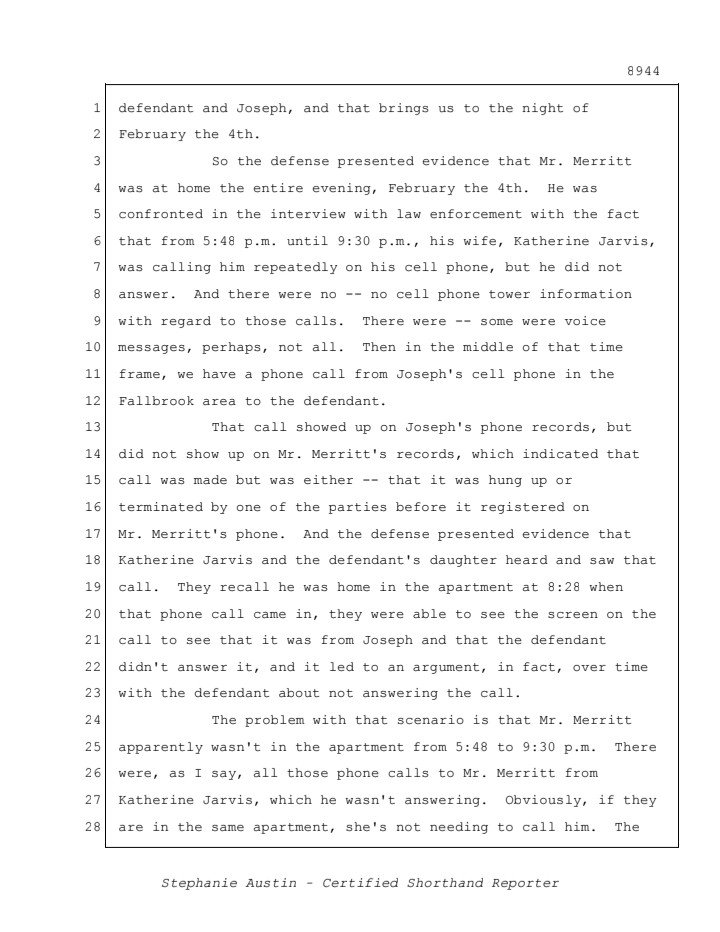
Denying my motion for a new trial, the court took the six calls as proof that I was not home:
The Court: “The problem with that scenario is that Mr. Merritt apparently wasn’t in the apartment from 5:48 to 9:30 p.m. There were, as I say, all those phone calls to Mr. Merritt from Katherine Jarvis, which he wasn’t answering. Obviously, if they are in the same apartment, she’s not needing to call him.”
(RT 8944:24-28.)
See page 8944
The court then turned to where Cathy said I was:
The Court: “The explanation given was he was in the clubhouse and the clubhouse doesn’t have very good cell phone connection. Okay. But that would mean he would have had to been there from 5:48, gotten home back to the apartment in time to get that 8:28 call for everybody to see, and then go back to the clubhouse until 9:30 — actually, until 9:32, because we know that there were additional calls from Katherine to Mr. Merritt from 8:28 to 9:30, in which he wasn’t answering. That’s just not reasonable or believable.”
(RT 8944:28-8945:9.)
See page 8945
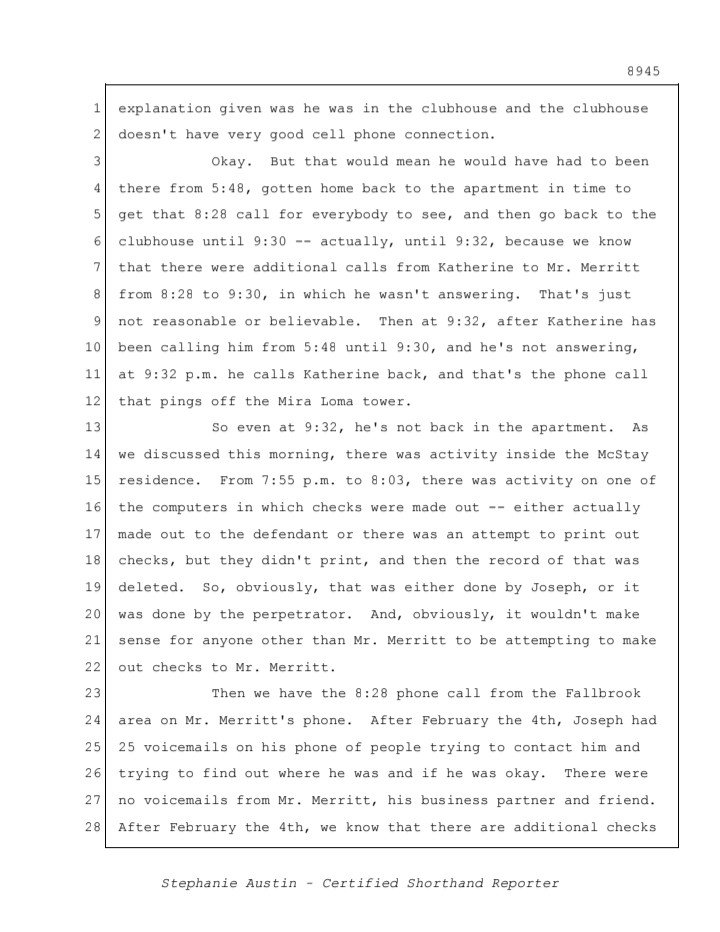
The court rejected the clubhouse on records the State’s own expert had said could not tell a phone that was off from bad coverage, on the question he had twice declined to answer without conferring with AT&T.
It was the same court that, at my preliminary hearing, had asked Agent Boles its own questions and heard him agree that a phone that is on, but not in use, leaves “nothing to indicate the phone was there.” (Prelim. RT 97:25-28.) And Cathy and I called each other when we were both at home, again and again. (See “Both at home?”)
Why I believe it was deliberate
I believe Agent Boles did this deliberately. At my preliminary hearing, he told the judge that a phone that is on leaves no trace until it is in use. In Pape, he did not dispute that an unanswered phone was another possibility, and he tied a voicemail call’s tower to the user pressing a button, “or” to the network identifying the tower the phone was on. He told my jury the opposite, and when confronted with his own testimony, he gave a reason the transcript in front of him contradicted. The prosecution then argued the one conclusion his testimony left open: that I had turned off my phone to hide where I was.
↑ Back to the menu← Back to Were the phone records outcome dispositive?