Both at home?
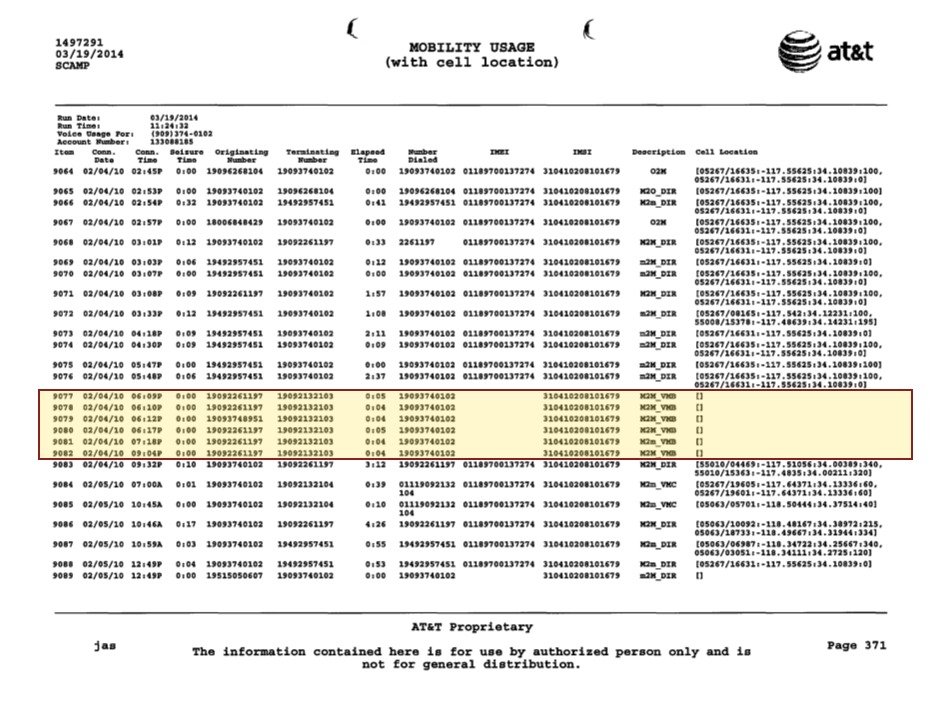
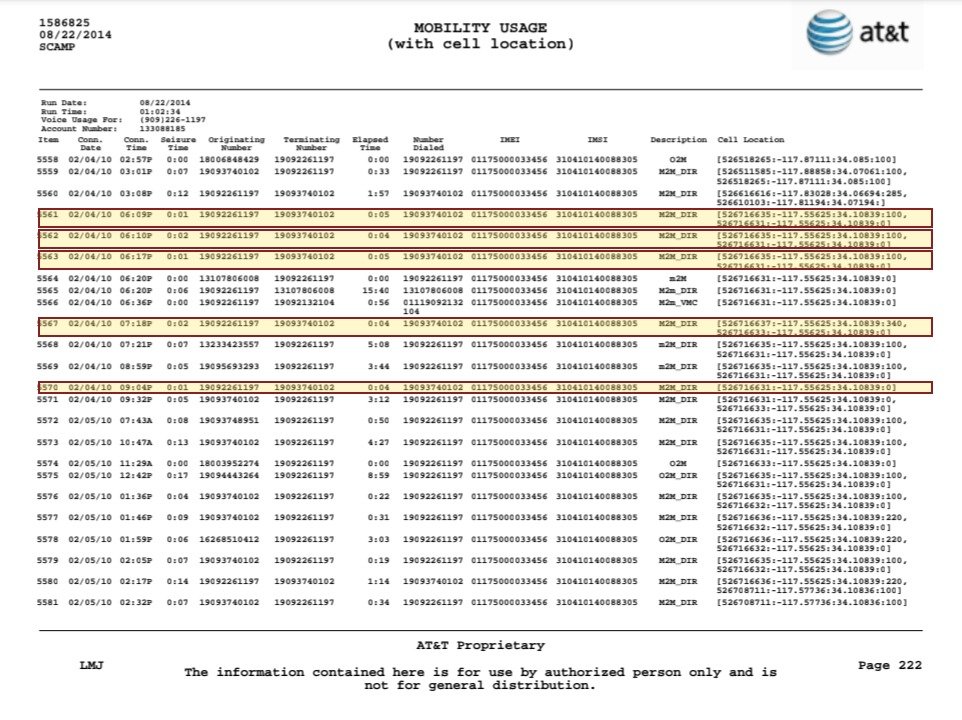
On the evening of February 4, 2010, six calls came to my phone from home and went to voicemail. Cathy placed five of them from her phone and one from our daughter’s. None shows a cell tower on my records. The State told the jury that meant I had turned my phone off to hide where I was, and that this was “not bad cell reception.”
The State’s own records say otherwise. Cathy testified that she called me at the clubhouse, thirty yards from our apartment, where reception was bad. The same pattern of failed calls with no tower shows up on other days, when the calls around it put both our phones on the towers the State’s own expert called our “home towers.” And on February 17, 2010, the State’s own detectives sat with me at that clubhouse and watched calls between these same two AT&T phones break up, again and again. AT&T’s records of those calls do not agree with each other.
The State said “The only reasonable interpretation is that phone was powered off or in airplane mode. This is not bad cell reception.” (Mr. Imes, RT 8199:7-17.)
The record: Cathy testified that calls to me at the clubhouse often failed: “It was bad reception” (RT 5302:15-5304:7). Thirteen days later, the State’s detectives watched calls fail at that clubhouse, and Detective Fisk said, on the record, “He’s got AT&T” (Merritt Int. 2/17/10, p. 73).
The State said Cathy would not have been calling me if I was home: “If I was calling him, he must have not been at home.” (Mr. Imes, RT 8211:6-15.)
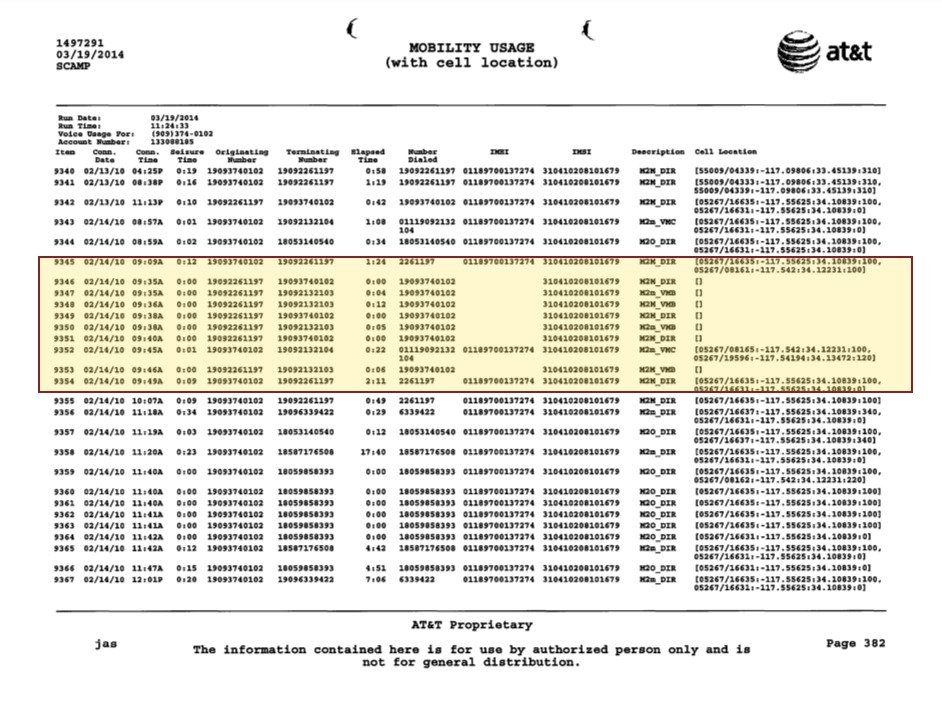
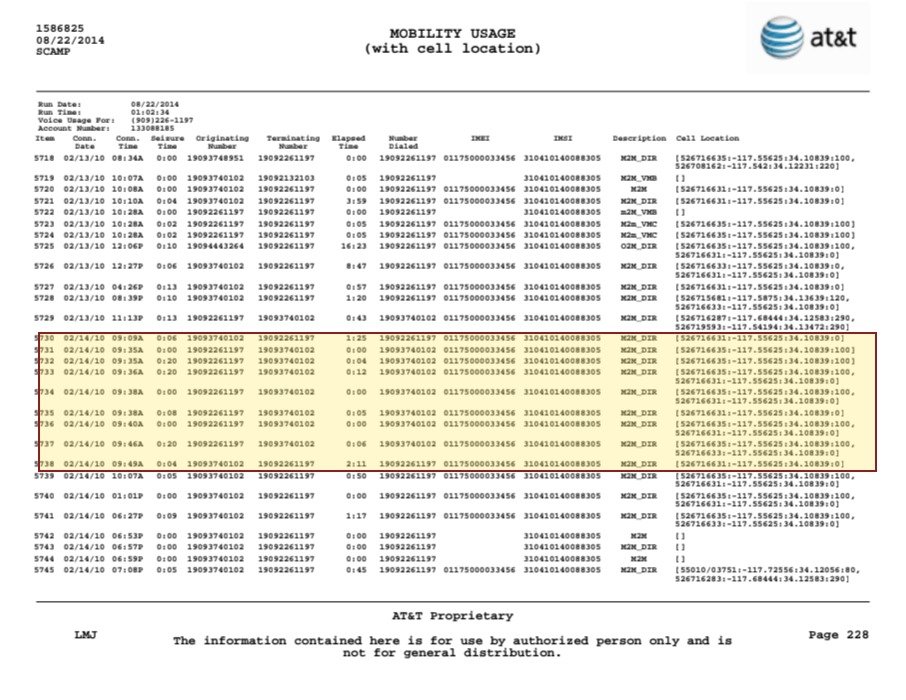
The record: She called because I was at the clubhouse, not in the apartment. On February 14, the same burst of unanswered, no-tower calls happened in the middle of a morning when the calls around it put both our phones on the home towers (my AT&T records, p. 382; Cathy’s, p. 228).
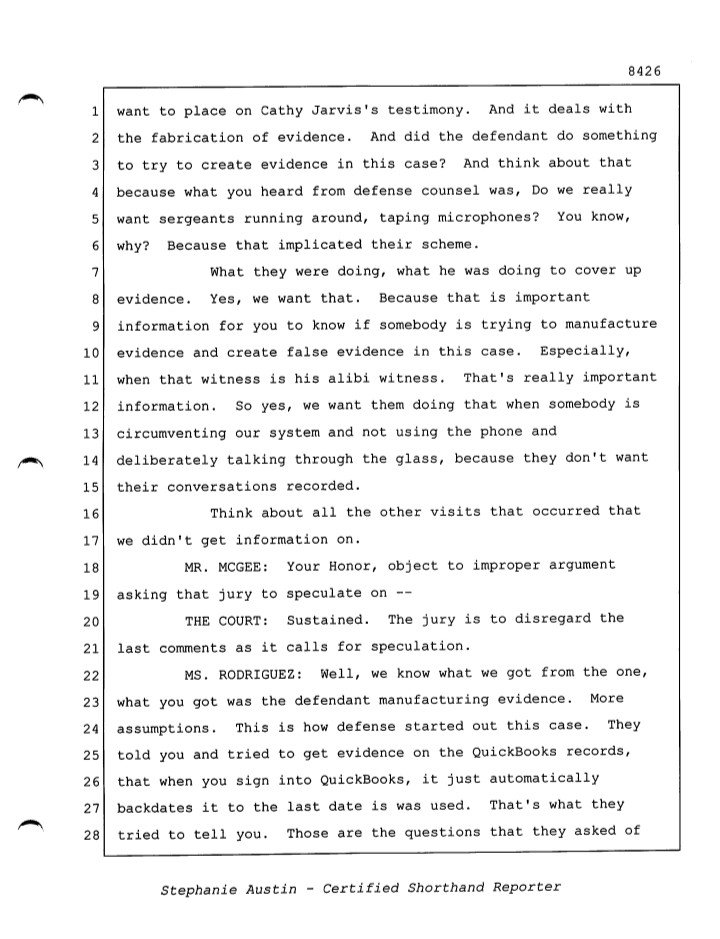
The State said the clubhouse explanation was a “scheme” that appeared only after Cathy met with the defense. (Ms. Rodriguez, RT 8424:24-8426:6.)
The record: The clubhouse reception problem is in the State’s own investigation, recorded at the clubhouse on February 17, 2010, nine years before trial.
And my own lawyers had all of it. Maline told the jury there were “hundreds of calls” between Cathy and me on the home tower (RT 8372:13-21), but no one ever put those calls, or the February 17 records, to a witness.
So here is the question: how could the State tell the jury that bad reception was not a reasonable explanation, when its own investigation had recorded that very problem?
Here is the record, so you can check it yourself.
What the State told the jury
The State’s theory was that on the evening of February 4, 2010, within the window its own evidence fixed, roughly 5:48 to 9:32 p.m., I left the apartment Cathy and I shared in Rancho Cucamonga, drove about sixty miles to the McStay home in Fallbrook, and killed the family. To put me there, it relied on two claims: that Joseph’s 8:28 p.m. call “never happened” (see The (impossible?) call), and that my phone “went dark.” This page is about the second.
The six calls that evening went to voicemail and left no tower on my records. The prosecution told the jury:
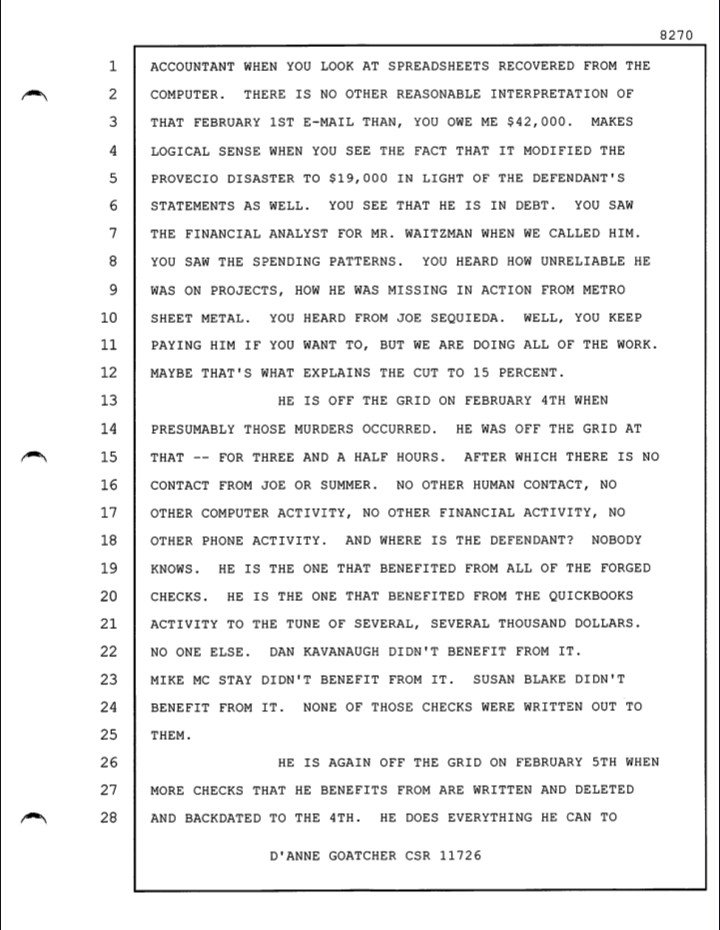
ADA Imes: “He is off the grid on February 4th when presumably those murders occurred.”
(RT 8270:13-14.)
See page 8270
When the defense said the calls failed because of poor reception, the prosecutor answered it head-on:
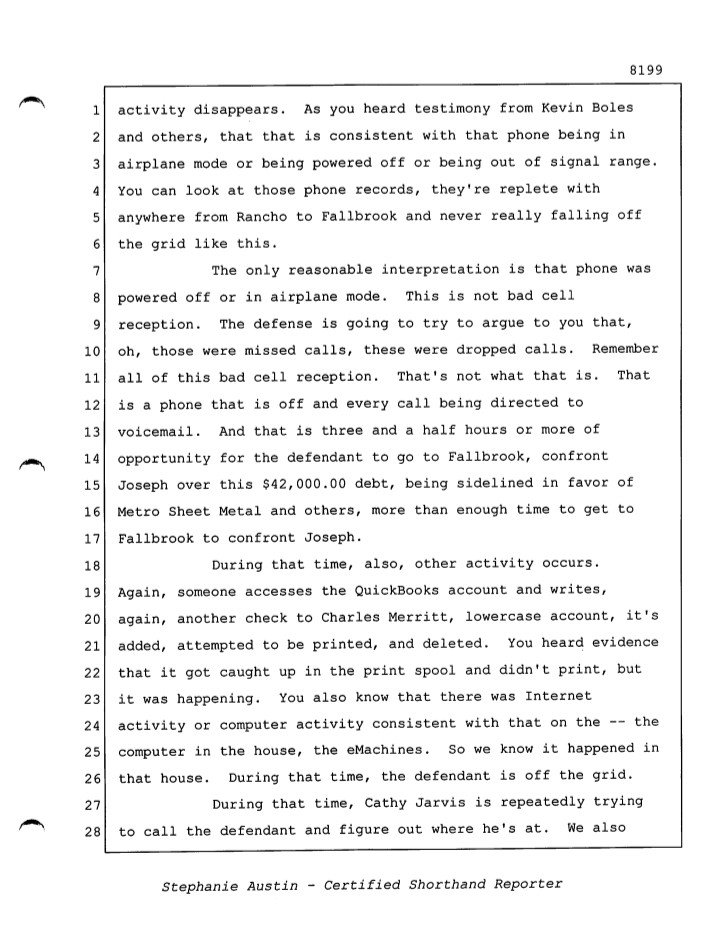
ADA Imes: “The only reasonable interpretation is that phone was powered off or in airplane mode. This is not bad cell reception. The defense is going to try to argue to you that, oh, those were missed calls, these were dropped calls. Remember all of this bad cell reception. That’s not what that is.”
(RT 8199:7-17.)
See page 8199
He pressed the same conclusion a second way: Cathy would not have been calling me if we were both home.
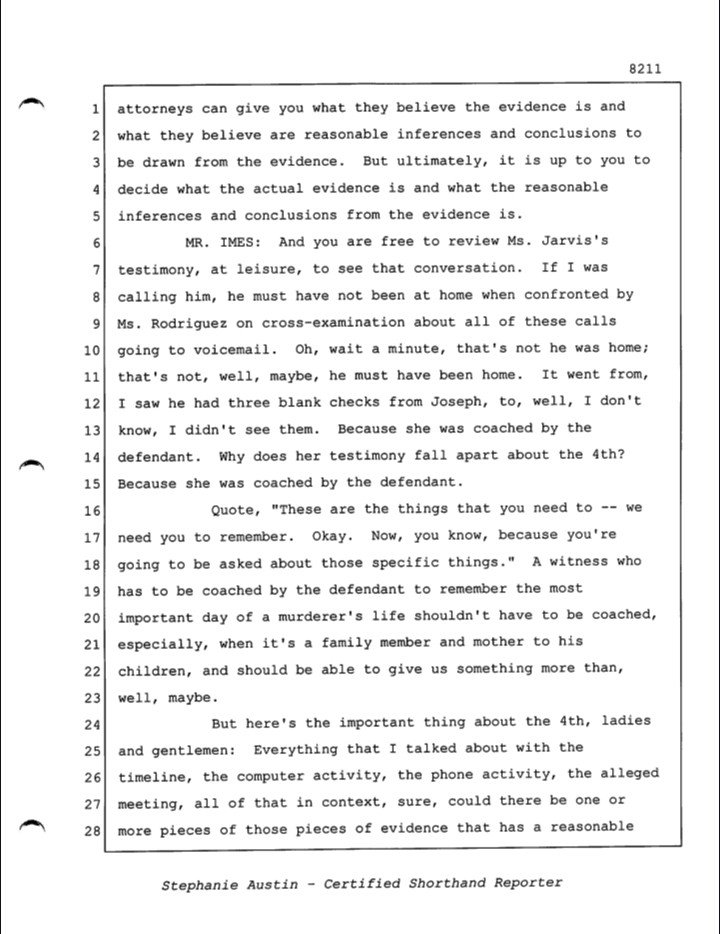
ADA Imes: “If I was calling him, he must have not been at home when confronted by Ms. Rodriguez on cross-examination about all of these calls going to voicemail. Oh, wait a minute, that’s not he was home; that’s not, well, maybe, he must have been home… Because she was coached by the defendant. Why does her testimony fall apart about the 4th? Because she was coached by the defendant.”
(RT 8211:6-15.)
See page 8211
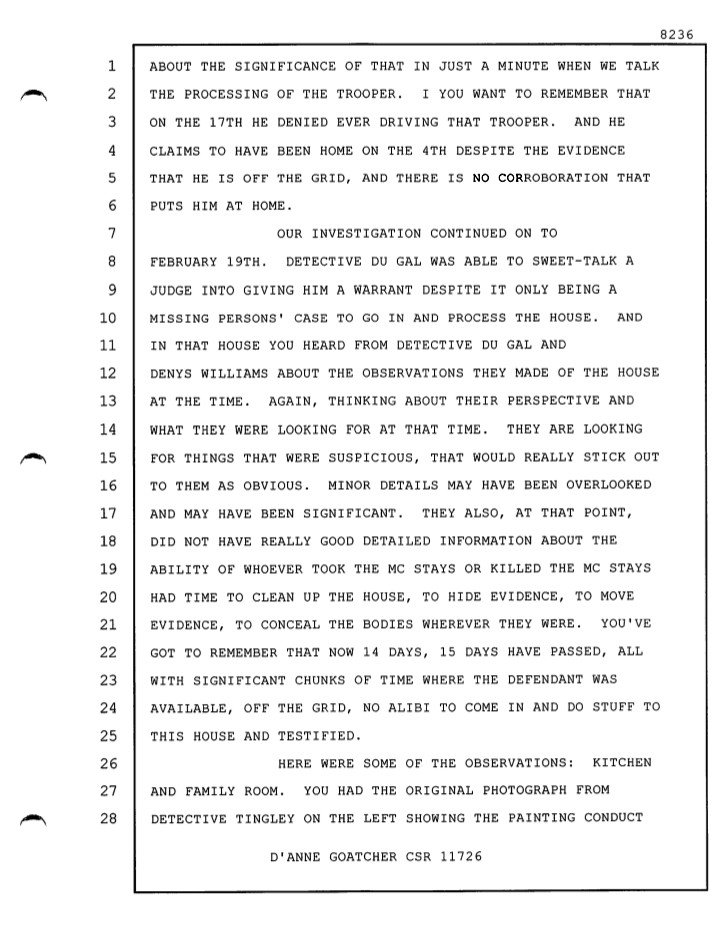
ADA Imes: “And he claims to have been home on the 4th despite the evidence that he is off the grid, and there is no corroboration that puts him at home.”
(RT 8236:3-6.)
See page 8236
The trial court adopted the same reasoning in denying my motion for a new trial:
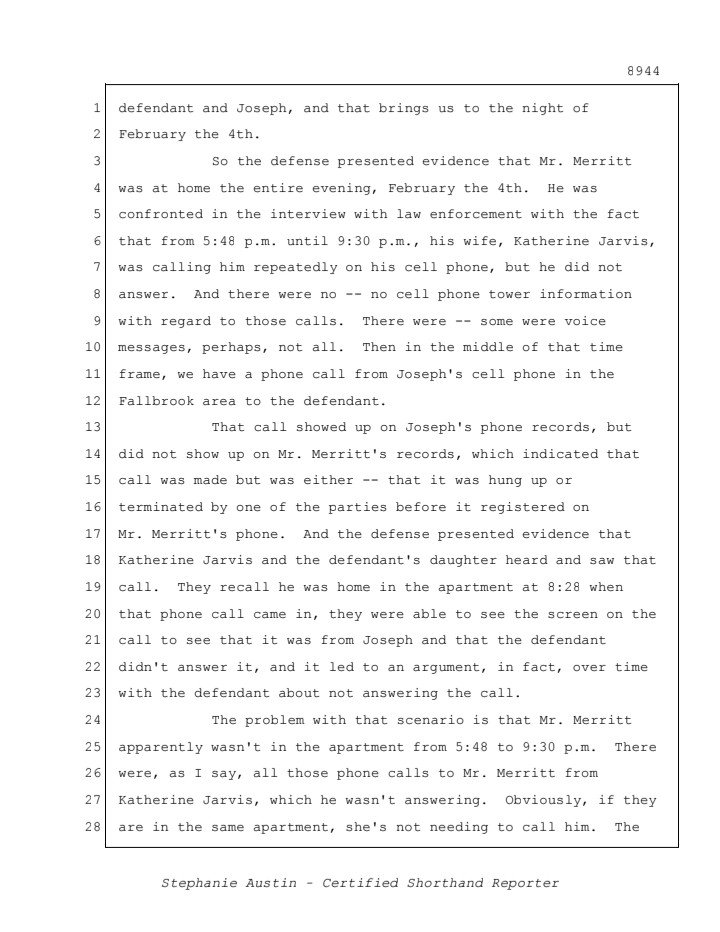
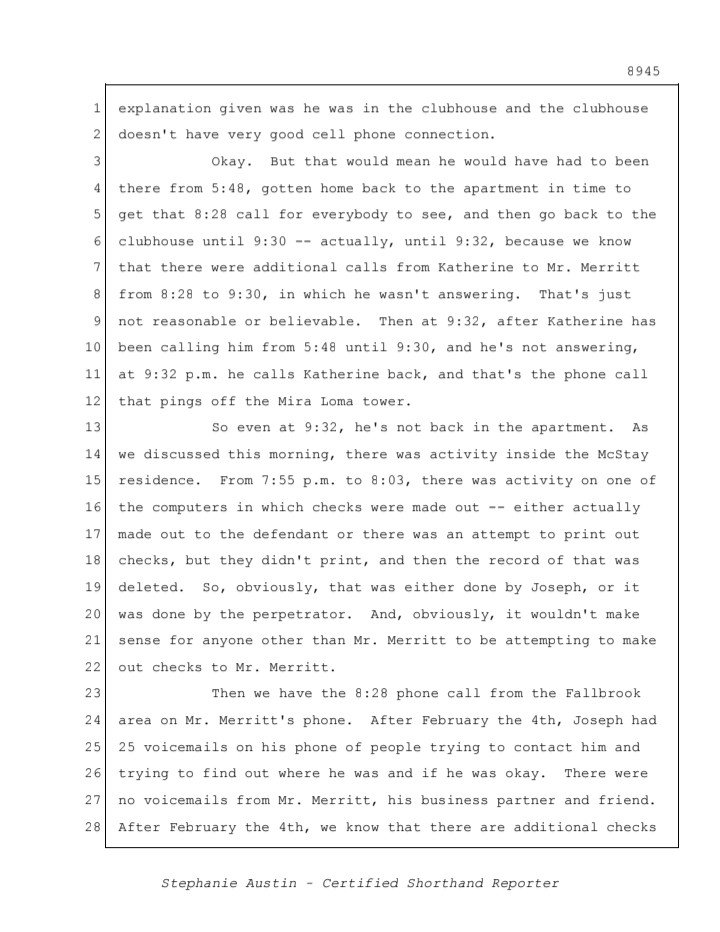
The Court: “The problem with that scenario is that Mr. Merritt apparently wasn’t in the apartment from 5:48 to 9:30 p.m. There were, as I say, all those phone calls to Mr. Merritt from Katherine Jarvis, which he wasn’t answering. Obviously, if they are in the same apartment, she’s not needing to call him. The explanation given was he was in the clubhouse and the clubhouse doesn’t have very good cell phone connection.”
“Okay. But that would mean he would have had to been there from 5:48, gotten home back to the apartment in time to get that 8:28 call for everybody to see, and then go back to the clubhouse until 9:30 — actually, until 9:32, because we know that there were additional calls from Katherine to Mr. Merritt from 8:28 to 9:30, in which he wasn’t answering. That’s just not reasonable or believable. Then at 9:32, after Katherine has been calling him from 5:48 until 9:30, and he’s not answering, at 9:32 p.m. he calls Katherine back, and that’s the phone call that pings off the Mira Loma tower.”
(RT 8944:24-8945:12.)
See page 8944
See page 8945
What Cathy testified
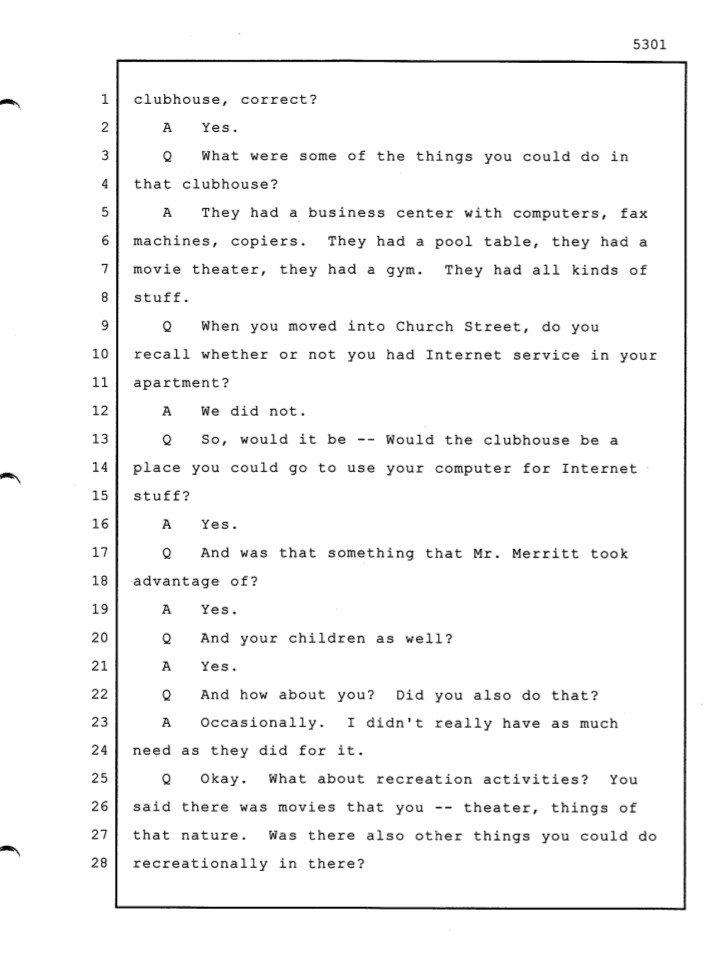
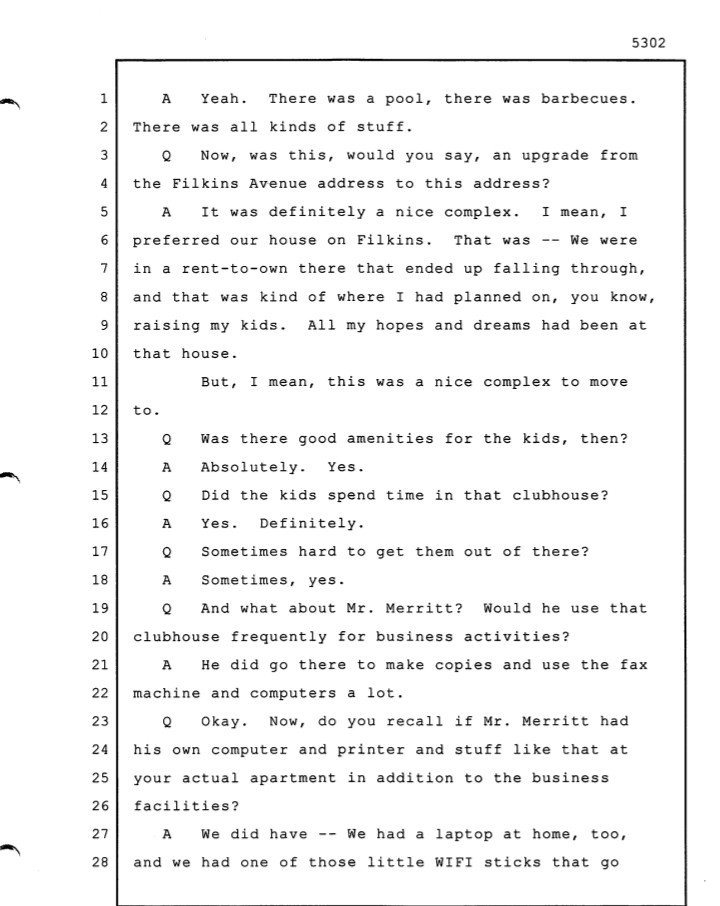
Cathy testified, on direct examination by Maline, that I used the apartment complex’s clubhouse for business, that calling me there was our ordinary practice, and that reception there was bad:
Mr. Maline: Did the kids spend time in that clubhouse?
Ms. Jarvis: Yes. Definitely.
Mr. Maline: Sometimes hard to get them out of there?
Ms. Jarvis: Sometimes, yes.
Mr. Maline: And what about Mr. Merritt? Would he use that clubhouse frequently for business activities?
Ms. Jarvis: He did go there to make copies and use the fax machine and computers a lot.
Mr. Maline: Okay. Now, do you recall if Mr. Merritt had his own computer and printer and stuff like that at your actual apartment in addition to the business facilities?
Ms. Jarvis: We did have — We had a laptop at home, too, and we had one of those little WIFI sticks that go into the laptop. But we sometimes had difficulty getting reception.
Mr. Maline: Okay. So, the clubhouse offered a easy, convenient way —
Ms. Jarvis: They had —
MS. RODRIGUEZ: Objection. Leading.
THE COURT: Overruled.
Ms. Jarvis: Yeah. They had a hard wire system; so we never lost Internet there.
Mr. Maline: So, Exhibit 978 is up there now. And your daughter had marked the clubhouse area, and you said that that was consistent with your memory as well, correct?
Ms. Jarvis: Yes.
Mr. Maline: And in relation to where you made a new mark where your apartment was, correct?
Ms. Jarvis: Yeah.
Mr. Maline: In this area (indicating)?
Ms. Jarvis: Yeah.
Mr. Maline: And if you had to drag your kids out of there or get Chase’s attention, if he was there, or get him home, how would you communicate? Would you walk over to the clubhouse, or would you call him?
MS. RODRIGUEZ: Objection. Leading.
THE COURT: Overruled.
Ms. Jarvis: Most oftentimes, it was easier just to call. If I could. A lot of times, I couldn’t get ahold of them that way, so I would end up walking over there and seeing what they were doing or when they were coming home.
Mr. Maline: And why was it difficult to sometimes call him there?
Ms. Jarvis: I don’t know. It just — It was bad reception.
(RT 5302:15-5304:7.)
See page 5302
See page 5303
See page 5304
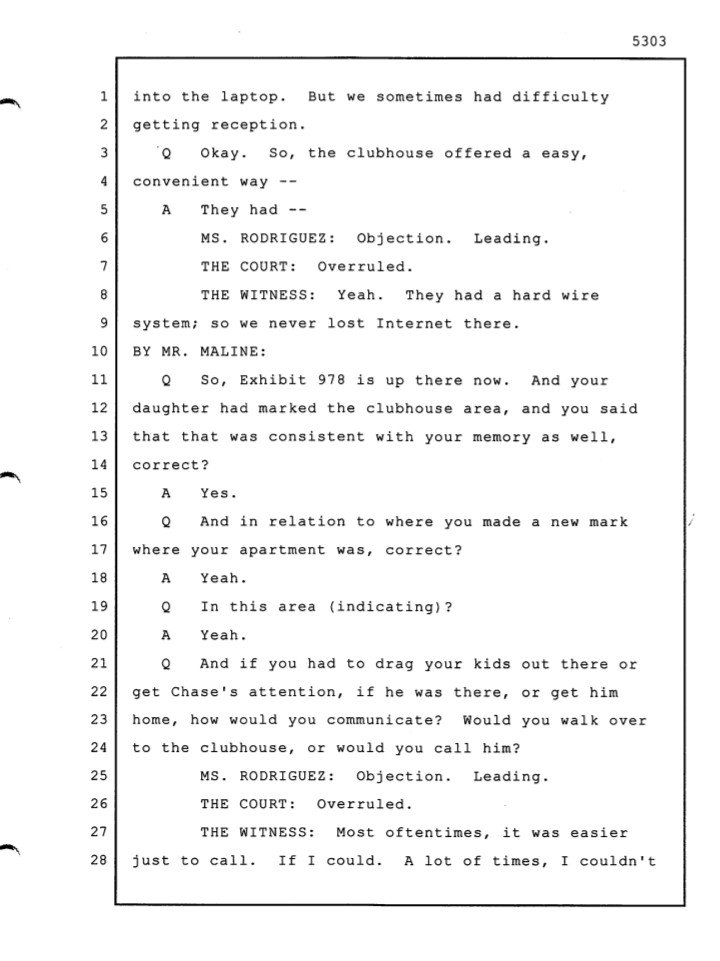
Her testimony puts three facts on the trial record: I used the clubhouse often; when she needed me there, she called; and reception there was bad, so calls often failed and she would walk over instead.
That is the innocent explanation the State’s inference leaves out. A call from Cathy to me that went unanswered was the ordinary result of clubhouse reception, not proof that my phone was off or that I was somewhere else. Cathy’s testimony is what places me. The records that follow do not prove my location by themselves. They corroborate her.
The State’s own expert named the “home towers”
The defense did not have to prove which towers my phone used at home. The prosecution’s own cell-site expert, Agent Kevin Boles, did it on direct examination, and the prosecutor supplied the label:
Boles: “476 is a map from February 6th, 2010, and it’s a continuation from the previous map showing calls between 2:22 p.m. and 3:14 p.m. in the Rancho Cucamonga area.”
ADA Imes: “Would this be, again, what we have been calling the defendant’s home towers?”
Boles: “Yes, it’s in close proximity to the residence.”
(RT 4550:15-28.)
See page 4550
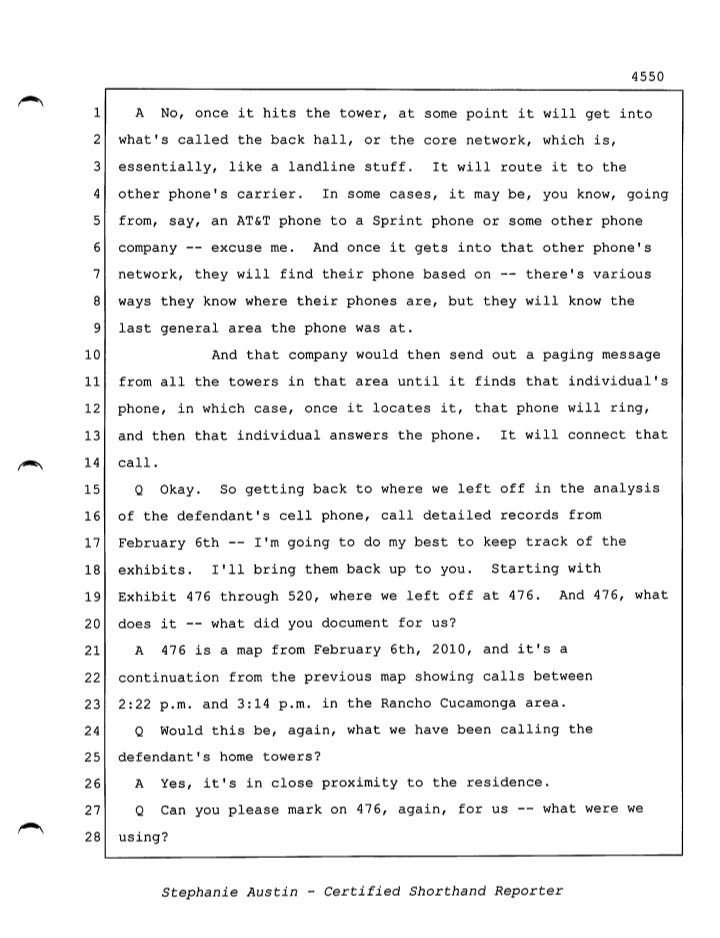
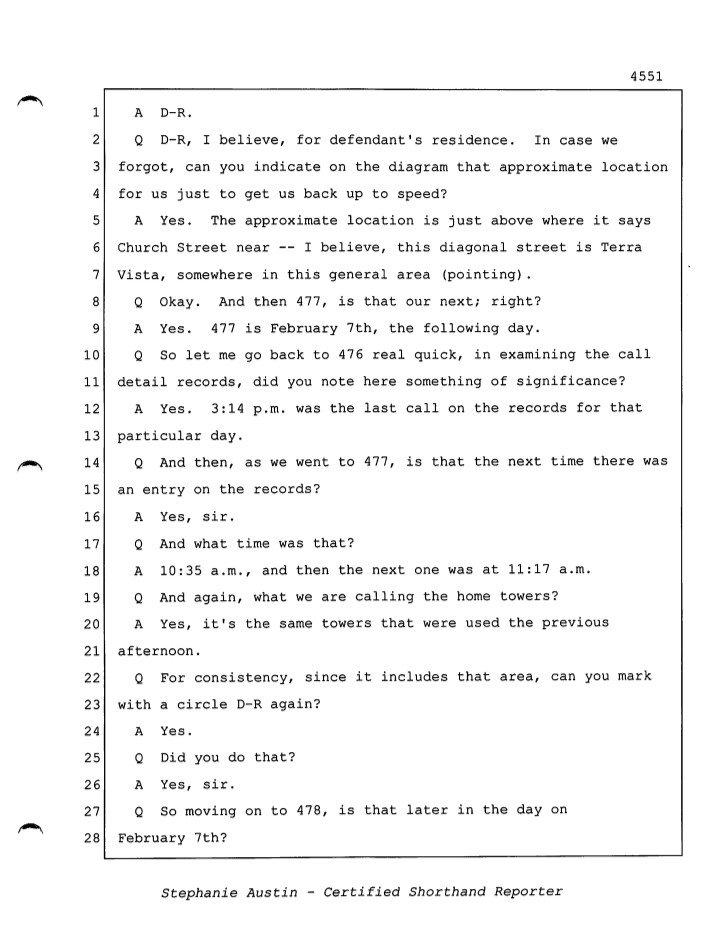
ADA Imes: “And then, as we went to 477, is that the next time there was an entry on the records?”
Boles: “Yes, sir.”
ADA Imes: “And what time was that?”
Boles: “10:35 a.m., and then the next one was at 11:17 a.m.”
ADA Imes: “And again, what we are calling the home towers?”
Boles: “Yes, it’s the same towers that were used the previous afternoon.”
(RT 4551:14-24.)
See page 4551
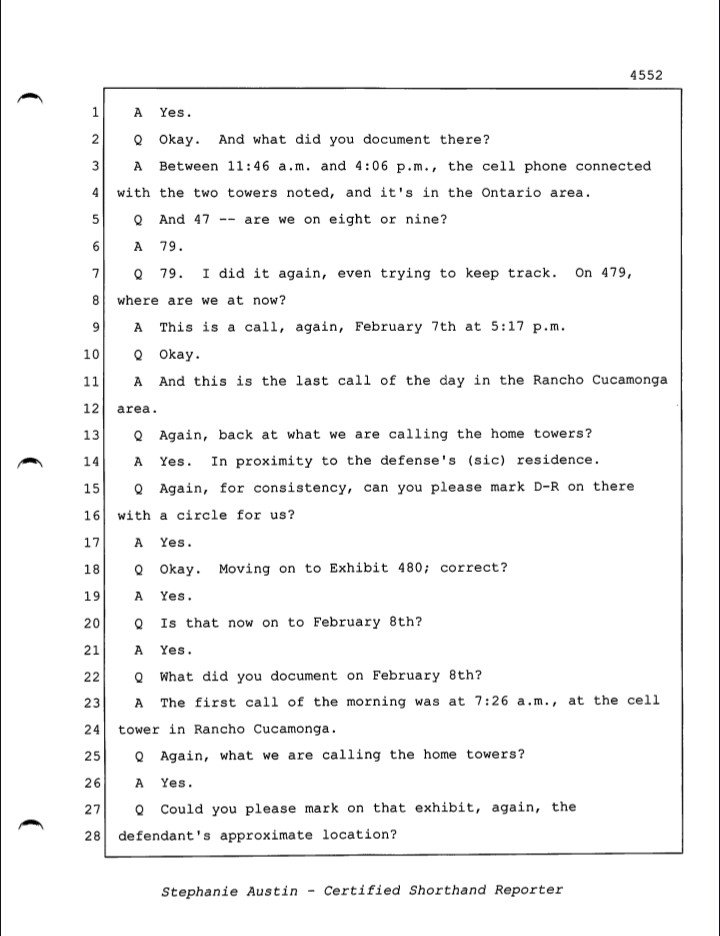
ADA Imes: “79. I did it again, even trying to keep track. On 479, where are we at now?”
Boles: “This is a call, again, February 7th at 5:17 p.m. — And this is the last call of the day in the Rancho Cucamonga area.”
ADA Imes: “Again, back at what we are calling the home towers?”
Boles: “Yes. In proximity to the defense’s (sic) residence.”
(RT 4552:7-17.)
ADA Imes: “What did you document on February 8th?”
Boles: “The first call of the morning was at 7:26 a.m., at the cell tower in Rancho Cucamonga.”
ADA Imes: “Again, what we are calling the home towers?”
Boles: “Yes.”
(RT 4552:22-28.)
See page 4552
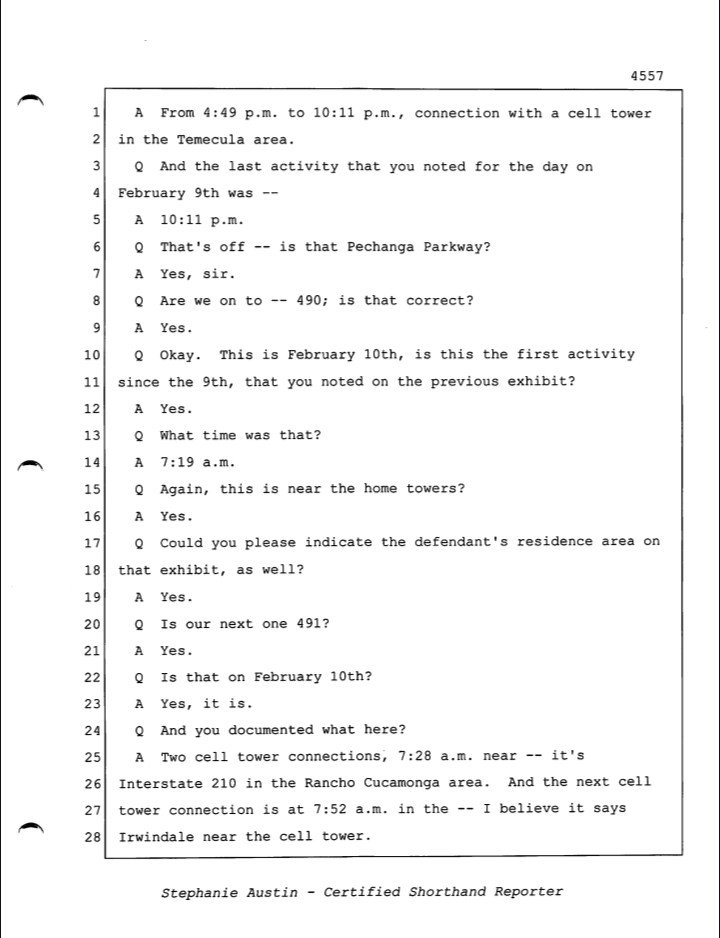
ADA Imes: “Okay. This is February 10th, is this the first activity since the 9th, that you noted on the previous exhibit?”
Boles: “Yes.”
ADA Imes: “What time was that?”
Boles: “7:19 a.m.”
ADA Imes: “Again, this is near the home towers?”
Boles: “Yes.”
(RT 4557:10-19.)
See page 4557
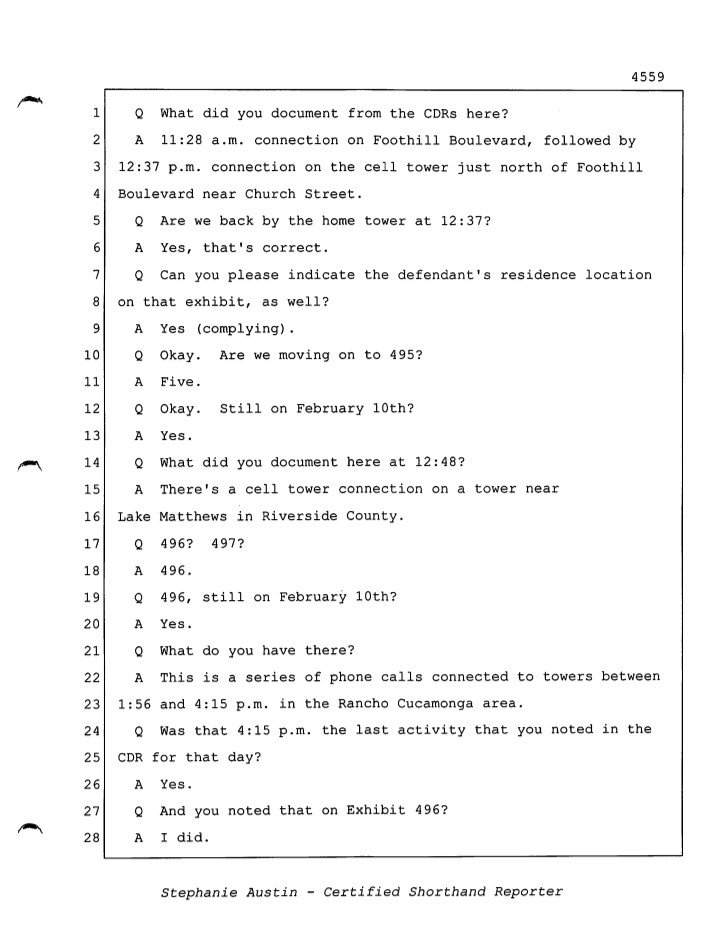
Boles: “11:28 a.m. connection on Foothill Boulevard, followed by 12:37 p.m. connection on the cell tower just north of Foothill Boulevard near Church Street.”
ADA Imes: “Are we back by the home tower at 12:37?”
Boles: “Yes, that’s correct.”
(RT 4559:2-9.)
See page 4559
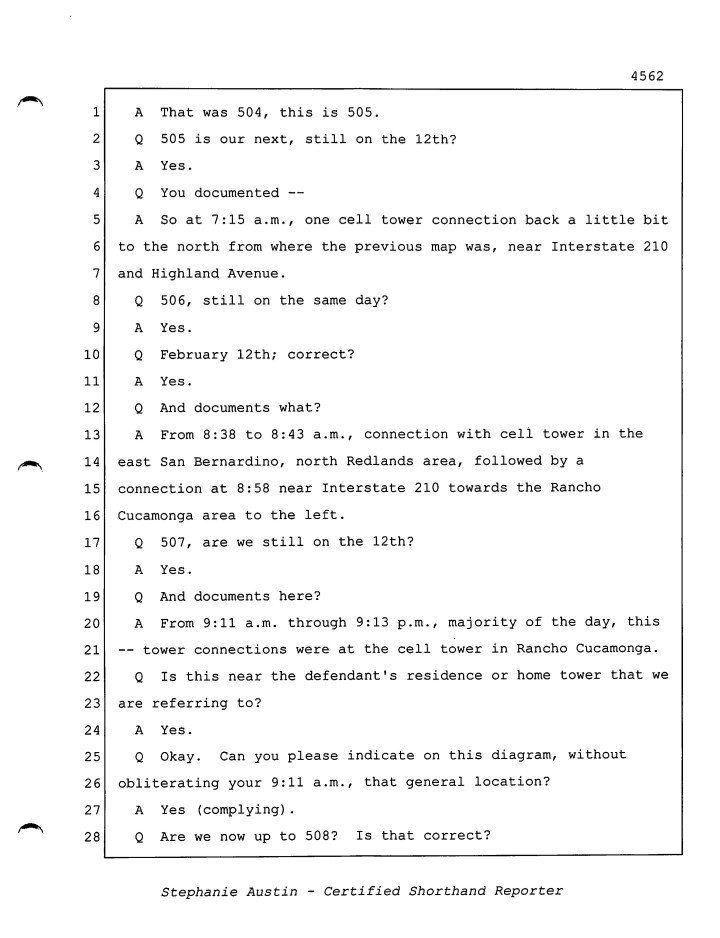
ADA Imes: “507, are we still on the 12th?”
Boles: “Yes.”
ADA Imes: “And documents here?”
Boles: “From 9:11 a.m. through 9:13 p.m., majority of the day, this — tower connections were at the cell tower in Rancho Cucamonga.”
ADA Imes: “Is this near the defendant’s residence or home tower that we are referring to?”
Boles: “Yes.”
(RT 4562:17-24.)
See page 4562
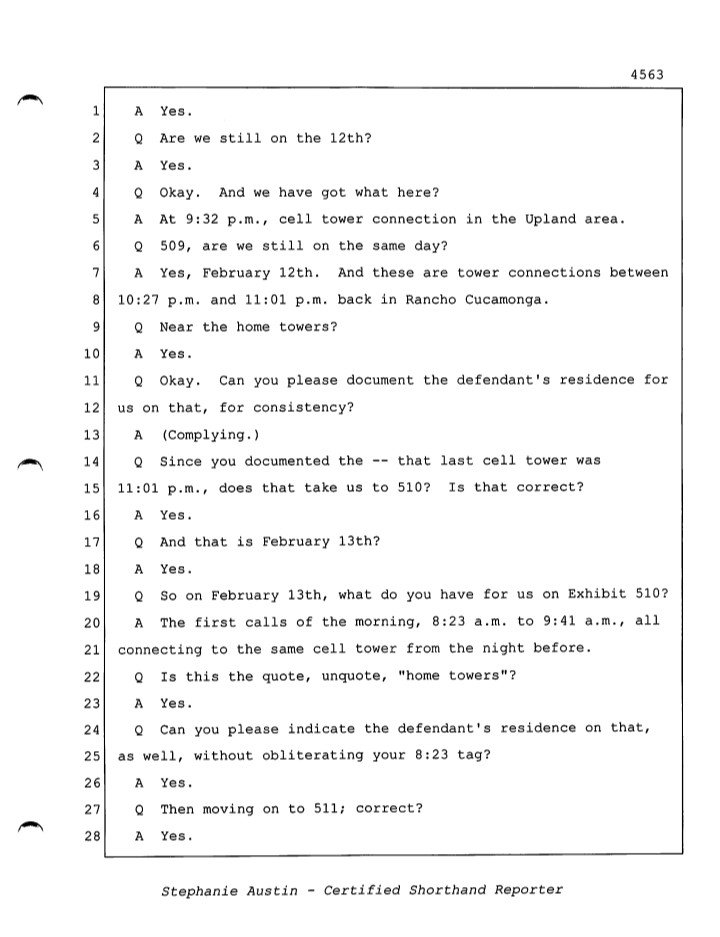
ADA Imes: “509, are we still on the same day?”
Boles: “Yes, February 12th. And these are tower connections between 10:27 p.m. and 11:01 p.m. back in Rancho Cucamonga.”
ADA Imes: “Near the home towers?”
Boles: “Yes.”
(RT 4563:6-10.)
ADA Imes: “So on February 13th, what do you have for us on Exhibit 510?”
Boles: “The first calls of the morning, 8:23 a.m. to 9:41 a.m., all connecting to the same cell tower from the night before.”
ADA Imes: “Is this the quote, unquote, ‘home towers’?”
Boles: “Yes.”
(RT 4563:19-23.)
See page 4563
The State’s own expert fixed the reference point: the home towers near my Rancho Cucamonga residence. The prosecution adopted the label as its own (“what we have been calling the defendant’s home towers,” “the quote, unquote, ‘home towers’”). With that in the record, a call between Cathy and me on the home towers is a documentary fact, not an interpretation the defense had to supply.
The both-at-home pattern, and February 14
How to read the entries. Each entry gives the tower a call used, by a five-digit number (for example, 10839), and the azimuth: the direction, in degrees, that the serving antenna faces. Most towers, including these, have several antennas facing different directions. Every tower below is one of the home towers. Where an entry says “home,” as in “(100 home),” the antenna that carried the call is the one facing our residence.
What this does and does not show: tower records cannot pinpoint a phone inside an apartment, and I do not claim they do. A tower and antenna cover an area, not an address. What these entries show is two phones, again and again, on the towers the State’s own expert tied to our home, often on the same antenna, the one facing home. That is the home-area calling pattern Cathy described.
My 2017 analysis
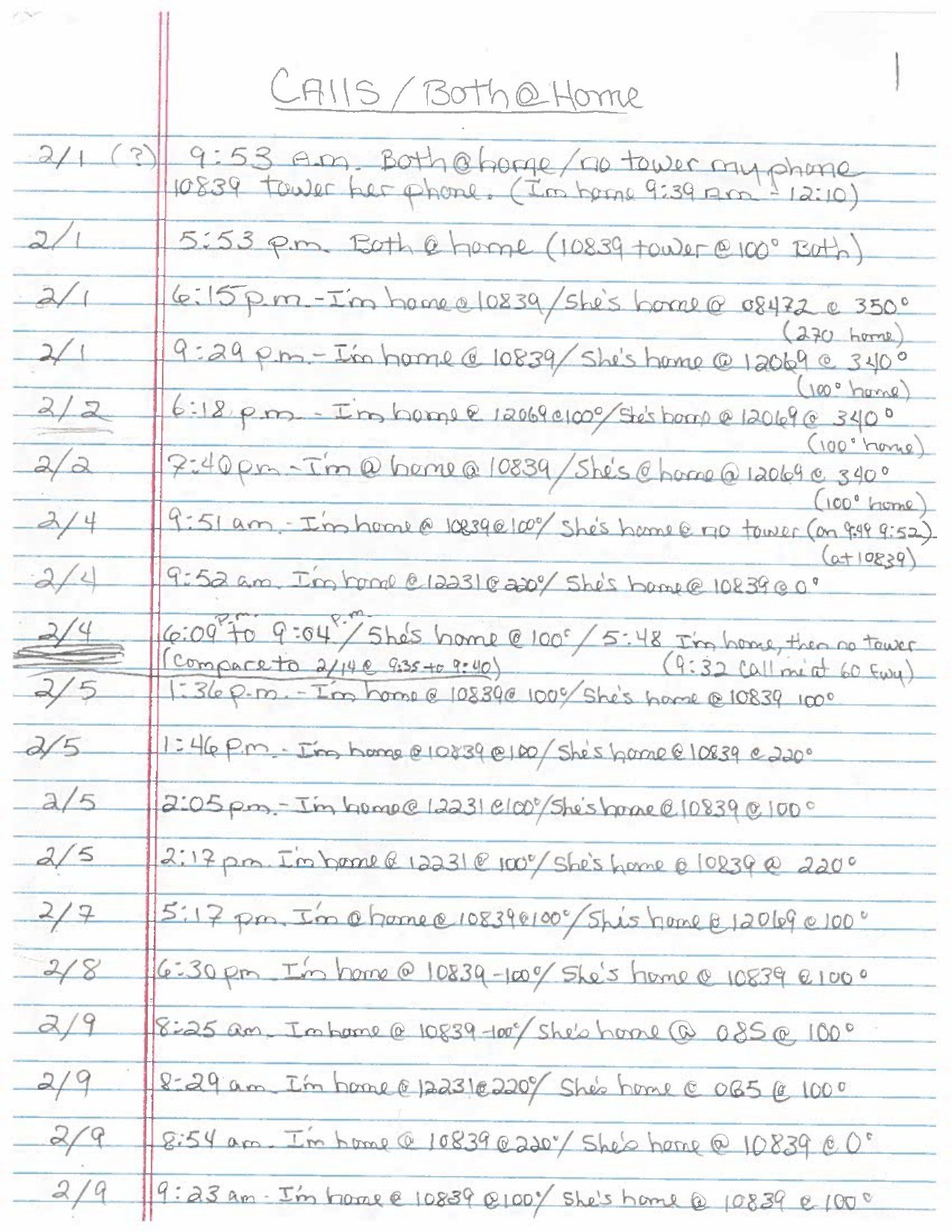
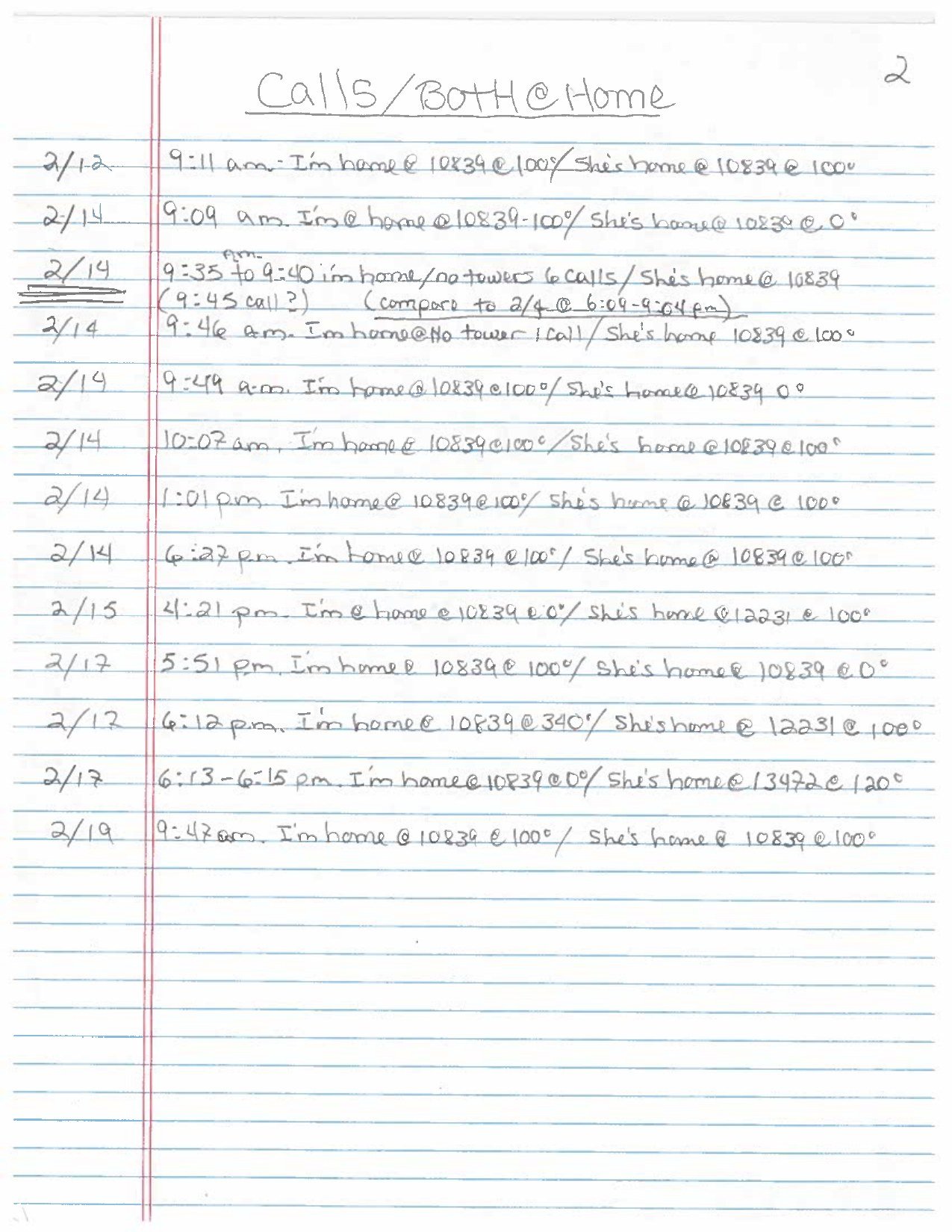
This is not a pattern assembled after the fact. I gave my lawyers a dated, handwritten cell-record analysis on November 1, 2017, more than a year before trial. It lists, under the heading “Calls / Both @ Home,” calls between Cathy and me while we were both at home in February 2010, with the tower and azimuth on each side.
See White Paper page 2
See White Paper page 3
- 2/1 at 5:53 p.m. — Both at home (10839 tower at 100° both).
- 2/1 at 6:15 p.m. — I’m home at 10839 / Cathy home at 08472 at 350° (“270 home”).
- 2/1 at 9:29 p.m. — I’m home at 10839 / Cathy home at 12069 at 340° (“100 home”).
- 2/2 at 6:18 p.m. — I’m home at 12069 at 100° / Cathy home at 12069 at 340° (“100 home”).
- 2/2 at 7:40 p.m. — I’m home at 10839 / Cathy home at 12069 at 340° (“100 home”).
- 2/4 at 9:51 a.m. — I’m home at 10839 at 100° / Cathy home, no tower (on 9:48 / 9:52 at 10839).
- 2/4 at 9:52 a.m. — I’m home at 12231 at 220° / Cathy home at 10839 at 0°.
- 2/4 at 6:09 to 9:04 p.m. — Cathy home at 100° / 5:48 I’m home, then no tower (9:32 call to me at 60 freeway). (Compare to 2/14 at 9:35 to 9:40.)
- 2/5 at 1:36 p.m. — I’m home at 10839 at 100° / Cathy home at 10839 at 100° — same tower, same azimuth.
- 2/5 at 1:46 p.m. — I’m home at 10839 at 100° / Cathy home at 10839 at 220° — same tower.
- 2/5 at 2:05 p.m. — I’m home at 12231 at 100° / Cathy home at 10839 at 100°.
- 2/5 at 2:17 p.m. — I’m home at 12231 at 100° / Cathy home at 10839 at 220°.
- 2/7 at 5:17 p.m. — I’m home at 10839 at 100° / Cathy home at 12069 at 100°.
- 2/8 at 6:30 p.m. — I’m home at 10839 at 100° / Cathy home at 10839 at 100° — same tower, same azimuth.
- 2/9 at 8:25 a.m. — I’m home at 10839 at 100° / Cathy home at 085 at 100°.
- 2/9 at 8:29 a.m. — I’m home at 12231 at 220° / Cathy home at 085 at 100°.
- 2/9 at 8:54 a.m. — I’m home at 10839 at 220° / Cathy home at 10839 at 0° — same tower.
- 2/9 at 9:23 a.m. — I’m home at 10839 at 100° / Cathy home at 10839 at 100° — same tower, same azimuth.
- 2/12 at 9:11 a.m. — I’m home at 10839 at 100° / Cathy home at 10839 at 100° — same tower, same azimuth.
- 2/14 at 9:09 a.m. — I’m home at 10839 at 100° / Cathy home at 10839 at 0°.
- 2/14 at 9:35 to 9:40 — I’m home / no towers, six calls / Cathy home at 10839 (9:45 call ?). (Compare to 2/4 at 6:09 to 9:04 p.m.)
- 2/14 at 9:46 a.m. — I’m home / no tower, one call / Cathy home at 10839 at 100°.
- 2/14 at 9:49 a.m. — I’m home at 10839 at 100° / Cathy home at 10839 at 0°.
- 2/14 at 10:07 a.m. — I’m home at 10839 at 100° / Cathy home at 10839 at 100° — same tower, same azimuth.
- 2/14 at 1:01 p.m. — I’m home at 10839 at 100° / Cathy home at 10839 at 100° — same tower, same azimuth.
- 2/14 at 6:27 p.m. — I’m home at 10839 at 100° / Cathy home at 10839 at 100° — same tower, same azimuth.
- 2/15 at 4:21 p.m. — I’m home at 10839 at 0° / Cathy home at 12231 at 100°.
- 2/17 at 5:51 p.m. — I’m home at 10839 at 100° / Cathy home at 10839 at 0°.
- 2/17 at 6:12 p.m. — I’m home at 10839 at 340° / Cathy home at 12231 at 100°.
- 2/17 at 6:13 to 6:15 p.m. — I’m home at 10839 at 0° / Cathy home at 13472 at 120°.
- 2/19 at 9:47 a.m. — I’m home at 10839 at 100° / Cathy home at 10839 at 100° — same tower, same azimuth.
Eight of these show both phones on the same tower and the same antenna. Where the antennas differ, both phones are still on the home towers. The pattern runs across weeks, at every time of day. The evening of February 4 fits it. The missing towers that evening do not, by themselves, show where I was, but nothing in them sets that evening apart from the others.
The same sequences, on other days
The same kind of calling sequence as February 4 recurs through February:
- 2/1/10 between 9:39 a.m. and 12:11 p.m. I attempted to contact a number at 9:39 a.m.; the call lasted 0 seconds (likely dropped). Cathy then attempted to call me at 9:53 a.m. and twice at 11:29 a.m. I then called voicemail, followed by a call to Cathy. The call to Cathy lasted 7 seconds (likely dropped). At 12:11 p.m. Cathy called me back and we talked for approximately 2 minutes. Records show both on the home towers throughout this series.
- 2/1/10 at 5:53 p.m. through 9:29 p.m. I called Cathy; we talked for just over a minute. At 6:15 p.m. I called again; the call lasted 16 seconds (likely dropped). Cathy then called me back at 9:29 p.m. Records show both on the home towers.
- 2/4/10 at 9:51 a.m. I called Cathy. The call lasted 3 seconds (almost certainly dropped). Cathy immediately called me back; we talked for approximately 1 minute 23 seconds. We were both hitting the home towers.
- 2/5/10 at 1:36 p.m., 1:46 p.m., and 2:05 p.m. I called Cathy three times, each call lasting approximately 30 seconds. Cathy then called me at 2:17 p.m.; we talked for just over a minute. Records show both hitting the home towers.
- 2/8/10 at 5:40 p.m. Cathy called me; we talked for approximately 2 minutes. Records show both on the home towers.
- 2/9/10 at 8:54 a.m. and 9:23 a.m. I called Cathy. Records show both hitting home towers.
- 2/12/10 at 8:58 a.m. and 9:11 a.m. I called Cathy. Records show both on the home towers.
- 2/14/10 at 1:01 p.m. and 6:27 p.m. I called Cathy. Records show both hitting home towers.
- 2/17/10 between 5:51 p.m. and 6:27 p.m. Cathy called me at 5:51; the call lasted 18 seconds. I called her back at 6:15; we talked for approximately two and a half minutes. Cathy called me at 6:27; the call lasted 25 seconds. Records show both hitting home towers.
February 14, next to February 4
The closest match is the morning of February 14. At 9:09 a.m. I called Cathy, and we talked for about a minute and a half. Then Cathy tried to call me at 9:35, 9:36, twice at 9:38, and at 9:40. None of those calls registered a tower in my records, though they did in hers. Five minutes later I checked my voicemail, and that call did register a tower. At 9:46 a.m. Cathy tried again; the call went to voicemail with no tower in my records.
See my AT&T record, Page 382 (February 14)
See Cathy’s AT&T record, Page 228 (February 14)
See my AT&T record, Page 371 (February 4)
See Cathy’s AT&T record, Page 222 (February 4)
| February 4, evening | February 14, morning | |
|---|---|---|
| Calls from home to my phone | Six, between 6:09 and 9:04 p.m. (five from Cathy’s phone, one from our daughter’s) | Repeated calls from Cathy, 9:35 to 9:46 a.m. |
| Tower on my side for those calls | None | None |
| My calls just before and after | Before: 5:48 p.m., on my home tower. After: 9:32 p.m., on a tower in Mira Loma | Before: 9:09 a.m., on my home tower. After: 9:45 and 9:49 a.m., on my home towers |
| What Cathy’s records show | Her phone on the home towers | Her phone on the home towers |
| What the State said it meant | My phone was off, to hide where I was | Nothing. No one has ever claimed I was anywhere but home |
The calls around the February 14 sequence put me on the home towers just before and just after it (items 9345, 9352, 9354). On February 4, the call after the sequence, at 9:32 p.m., reached a tower in Mira Loma; what that call does and does not show is set out on Home that night. The February 14 calls support being in the home area that morning; they are not minute-by-minute proof. But they show the point that matters: the pattern the State called proof of guilt on February 4 was not unique to February 4. It happened on an ordinary Sunday morning, at home.
(The 6:12 p.m. call on February 4 came from our daughter’s phone, 909-374-8951, which Cathy was using. [My AT&T records, Page 371, item 9079.] Cathy’s own record shows the other five. [Catherine Jarvis AT&T records, Page 222, items 5561, 5562, 5563, 5567, 5570.])
The timing of the February 4 calls
The six calls that evening came in three bursts:
- 6:09, 6:10, 6:12 and 6:17 p.m.: four calls in eight minutes;
- 7:18 p.m.: one call, about an hour later;
- 9:04 p.m.: one call, nearly two hours after that.
That fits what Cathy described: she called, the calls failed, and when she could not reach me, she “would end up walking over there.” The record does not show that she walked over on February 4. It cannot; nothing records a walk. But a burst of calls, then silence, then isolated calls hours apart is consistent with her routine, and it is not what the State needed: a phone whose owner had left for the evening to drive sixty miles and back. The timing relies only on when each call was attempted, which these records do capture. It does not rely on whether the calls connected, which, as February 17 shows, these records do not reliably capture.
The prosecution attacked exactly this routine in rebuttal:
MS. RODRIGUEZ: “Remember I’m at the clubhouse, where we have that bad reception. But somehow, Ms. Jarvis wouldn’t walk the 30 yards down to clubhouse or Taylor wouldn’t 30 yards to the clubhouse. I’m just going to keep calling you, you’re not going to answer, but I’m not going to walk over. It doesn’t make sense, ladies and gentlemen.”
(RT 8425:2-7.)
See page 8425
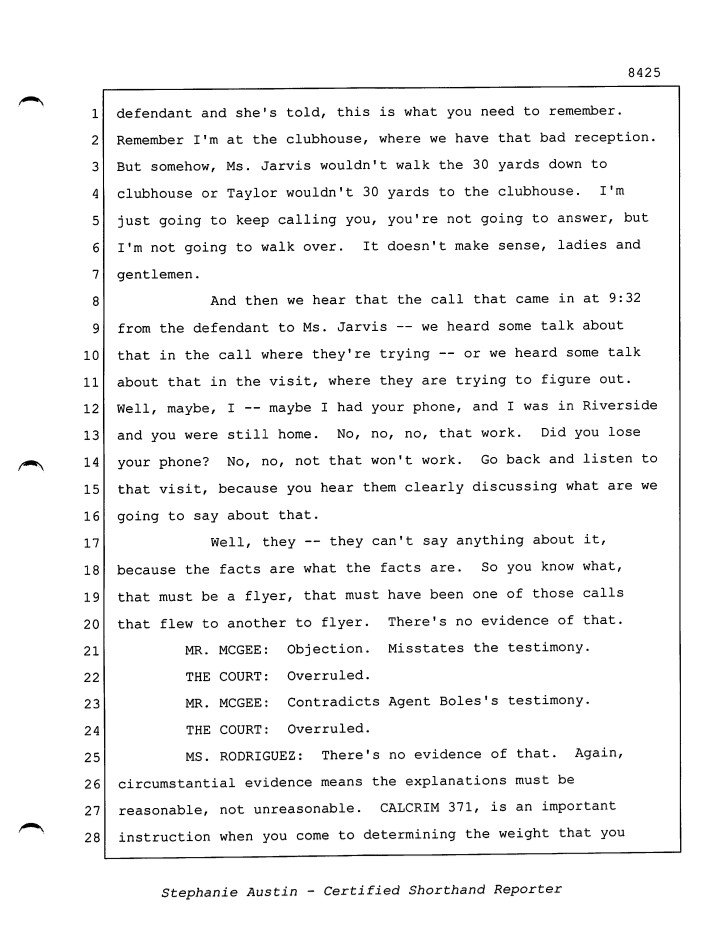
Cathy’s sworn testimony was the opposite: when the calls failed, she walked over. And the trial court’s reasoning, “if they are in the same apartment, she’s not needing to call him,” assumes I was in the apartment. Cathy’s testimony is that I was at the clubhouse, which is why she was calling at all.
February 17: the State’s detectives watched it happen
On February 17, 2010, thirteen days after February 4, I sat for a recorded interview with San Diego Sheriff’s Detectives Troy DuGal and Susan Fisk. The interview was held in the clubhouse, the place Cathy identified as where I likely was on the evening of February 4, and where her calls to me so often failed. During the interview, with my phone on and in use in front of the detectives, Cathy and I called each other several times. The calls kept breaking up.
What the transcript shows
The interview began at 4:26 p.m. The second part of the transcript begins at 1:30:01, about 5:56 p.m., and the calls between Cathy and me appear in it about sixteen pages later, in the 6:12 to 6:15 p.m. window shown on both our records. The transcript shows two things about those calls: they were live, two-way conversations, not voicemail, and they were breaking up as they happened.
MERRITT: “(Phone call) I’m yeah you just I just lost you anyway what-what-what went on on Monday? You’re breaking up. You’re still breaking up a lot can you call me right back? I can’t even understand a word you’re saying okay I was home you were home what did we do? Nothing”
FISK: “What time did you go to bed?”
MERRITT: “What time did I go to bed? Hey”
FISK: “and just ask if you even left this area”
MERRITT: “Okay I-I did I go anywhere?”
FISK: “Yeahm oh that’s sounds..”
MERRITT: “Hello?”
FISK: “This is a wire bits”
DUGAL: “(inaudible)”
MERRITT: “Duh”
FISK: “Um”
MERRITT: “Hello?”
FISK: “(inaudible)”
MERRITT: “Can you hear me?”
FISK: “This is uh kit if you want to collect my DNA (inaudible)”
MERRITT: “Aya”
DUGAL: “It’s okay (inaudible)”
FISK: “Yeah but this”
DUGAL: “Oh”
FISK: “It-it serves two motions”
DUGAL: “I got you I don’t know”
FISK: “You hear what I’m sayin’?”
MERRITT: “I lost her again one second”
FISK: “That’s okay”
(Merritt Interview 02/17/10, p. 72:1-27.)
See interview page 70
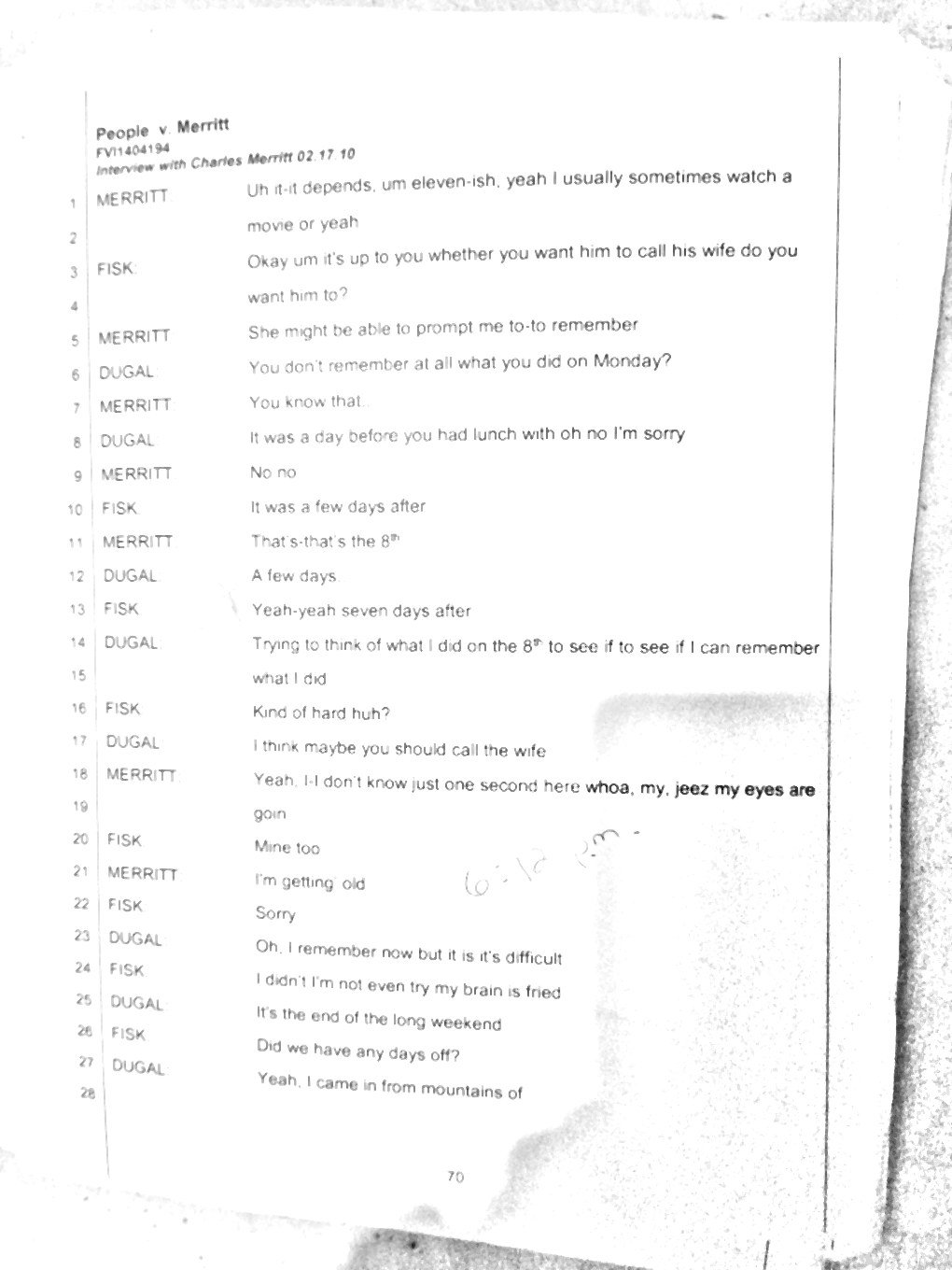
See interview page 71
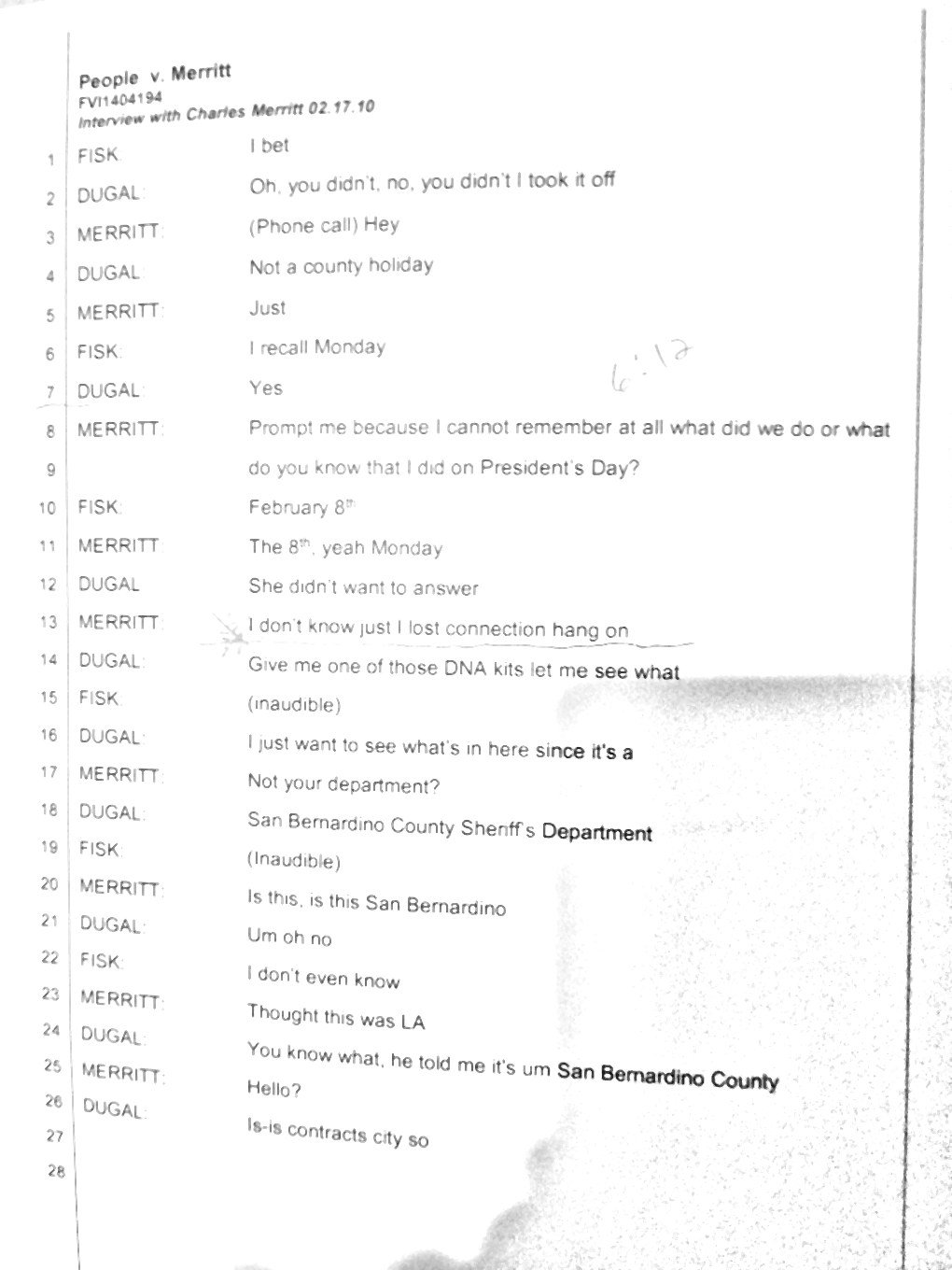
See interview page 72
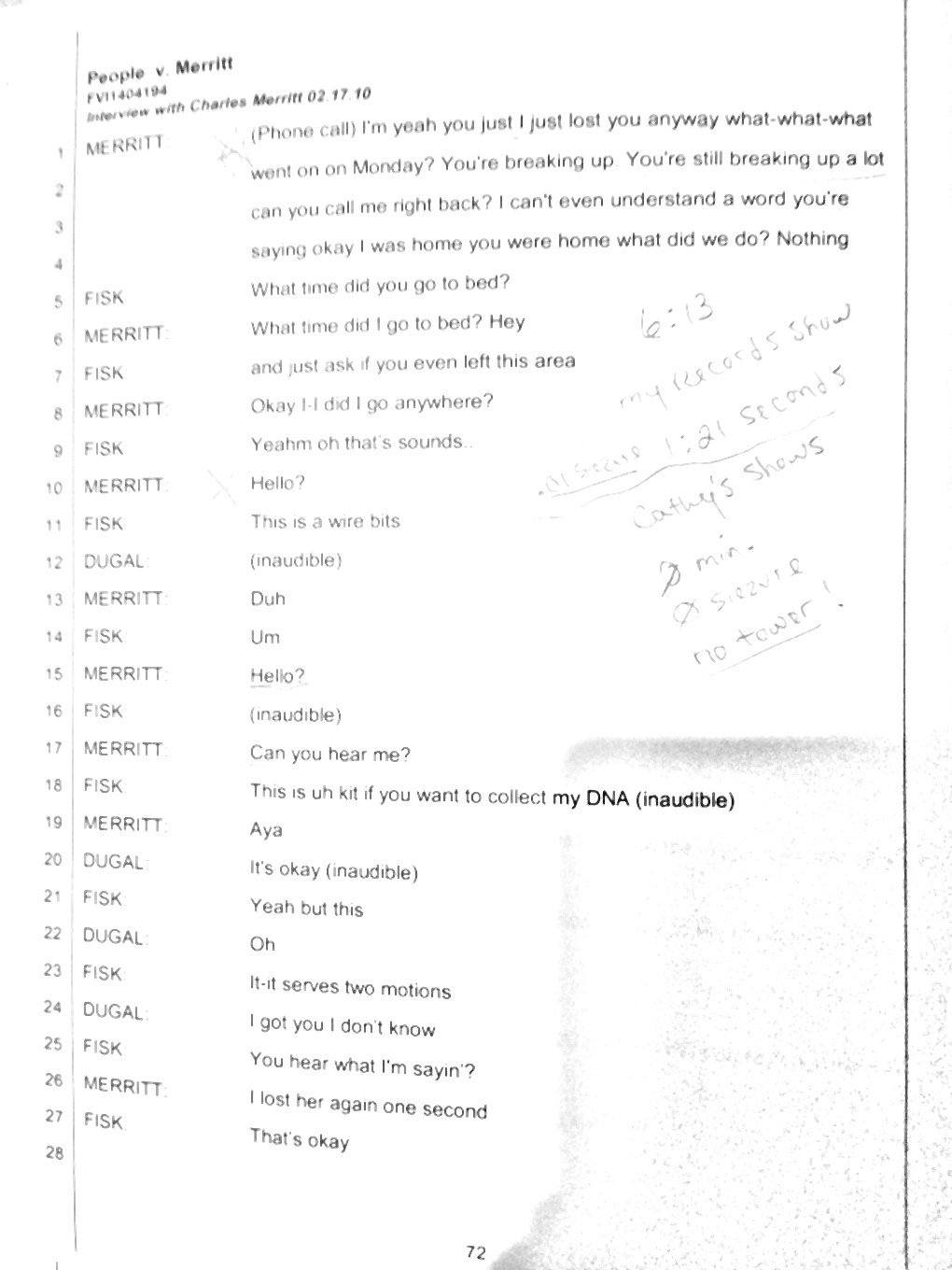
As I tried to reconnect, Detective Fisk remarked:
MERRITT: “Um she said we were home that-that’s all she said”
DUGAL: “Is it M-E-R-R-I-T-T”
MERRITT: “And I didn’t get to”
FISK: “Two R’s and two T’s right? (inaudible)”
MERRITT: “Yeah okay, okay try that one more time hang on hang on one second”
FISK: “He’s got AT&T”
MERRITT: “Okay”
JARVIS: “(inaudible)”
MERRITT: “Now can you hear me?”
JARVIS: “Yes”
(Merritt Interview 02/17/10, p. 73:1-10.)
See interview page 73
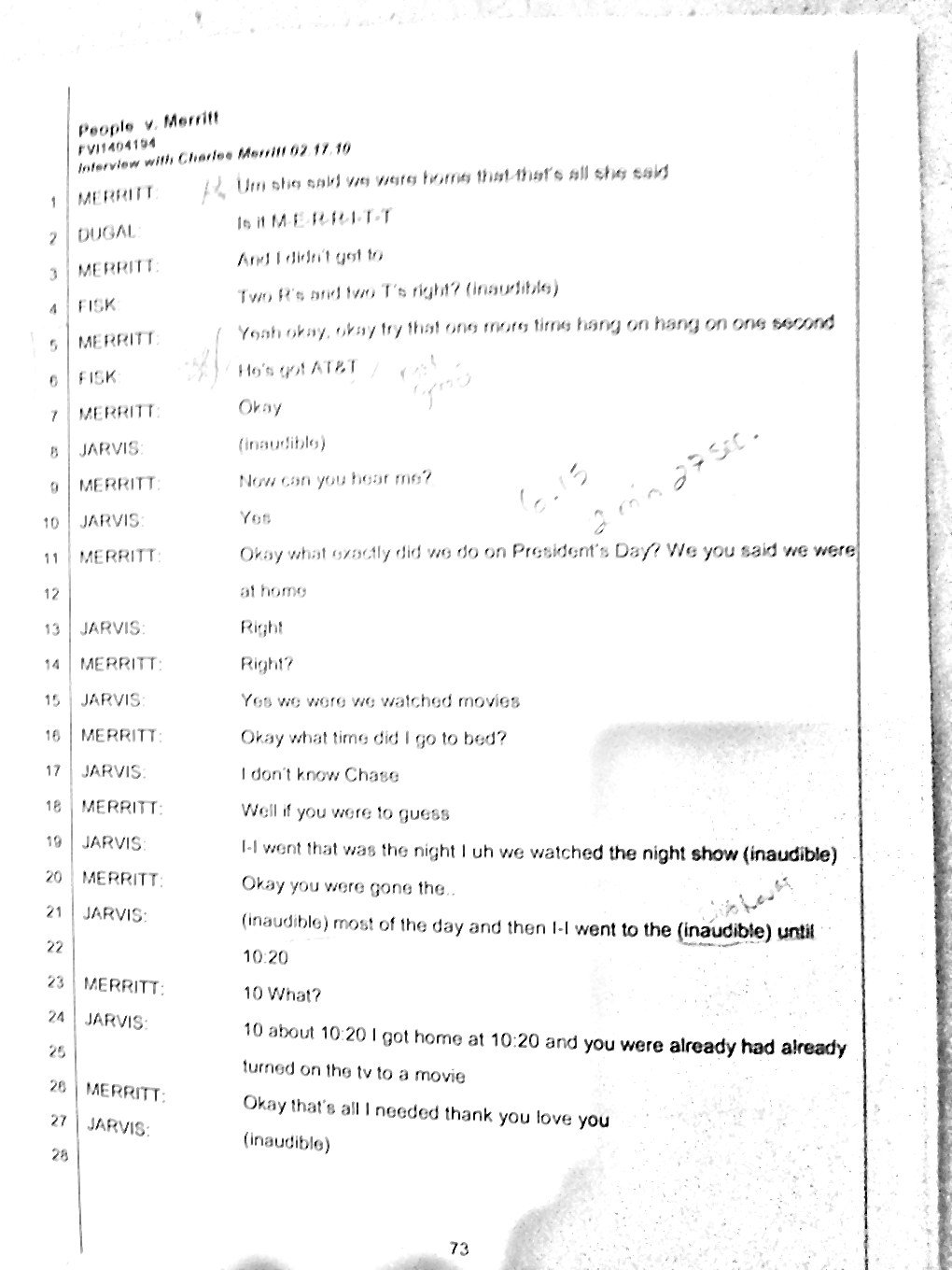
See interview page 74
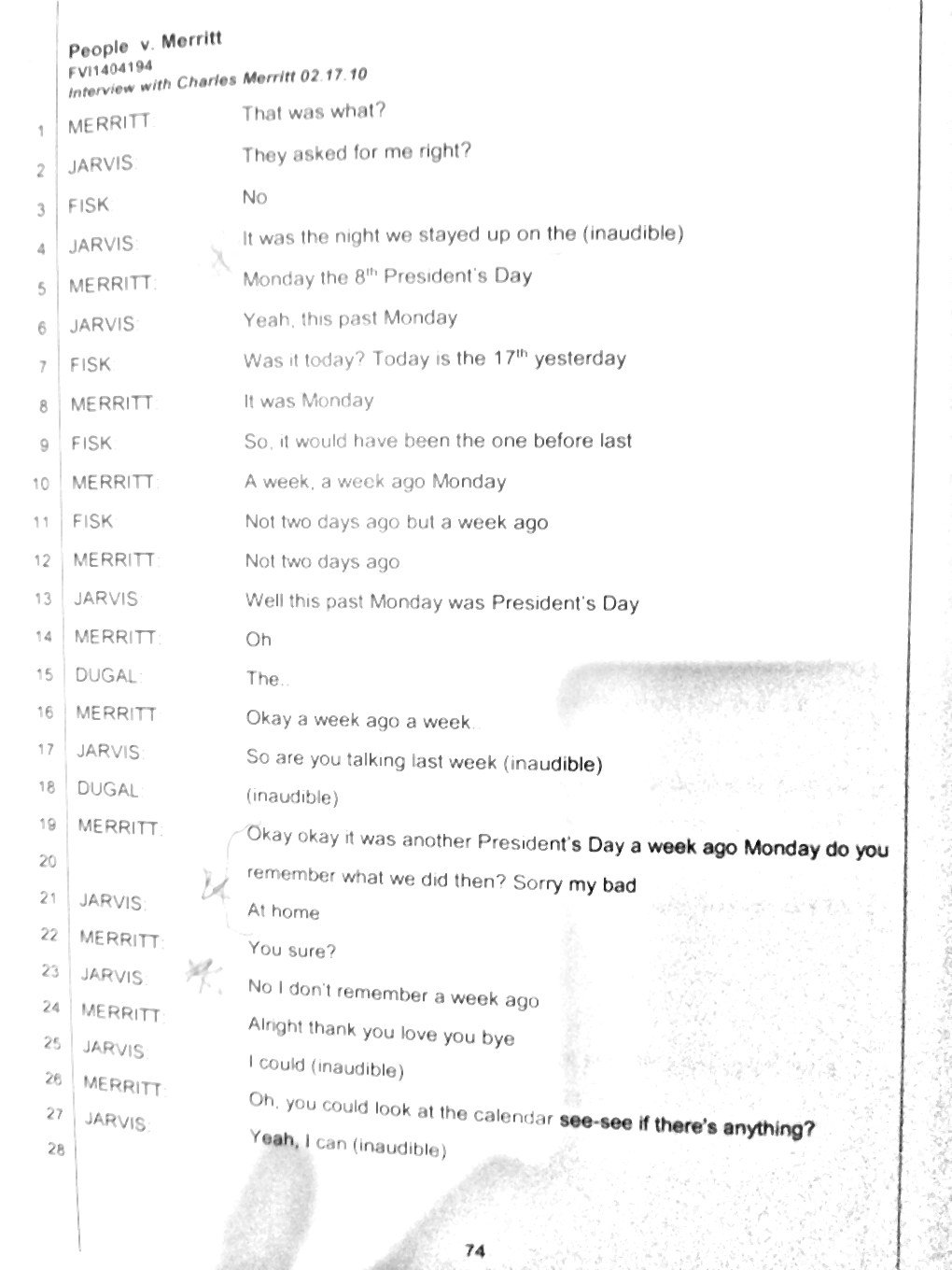
See interview page 75
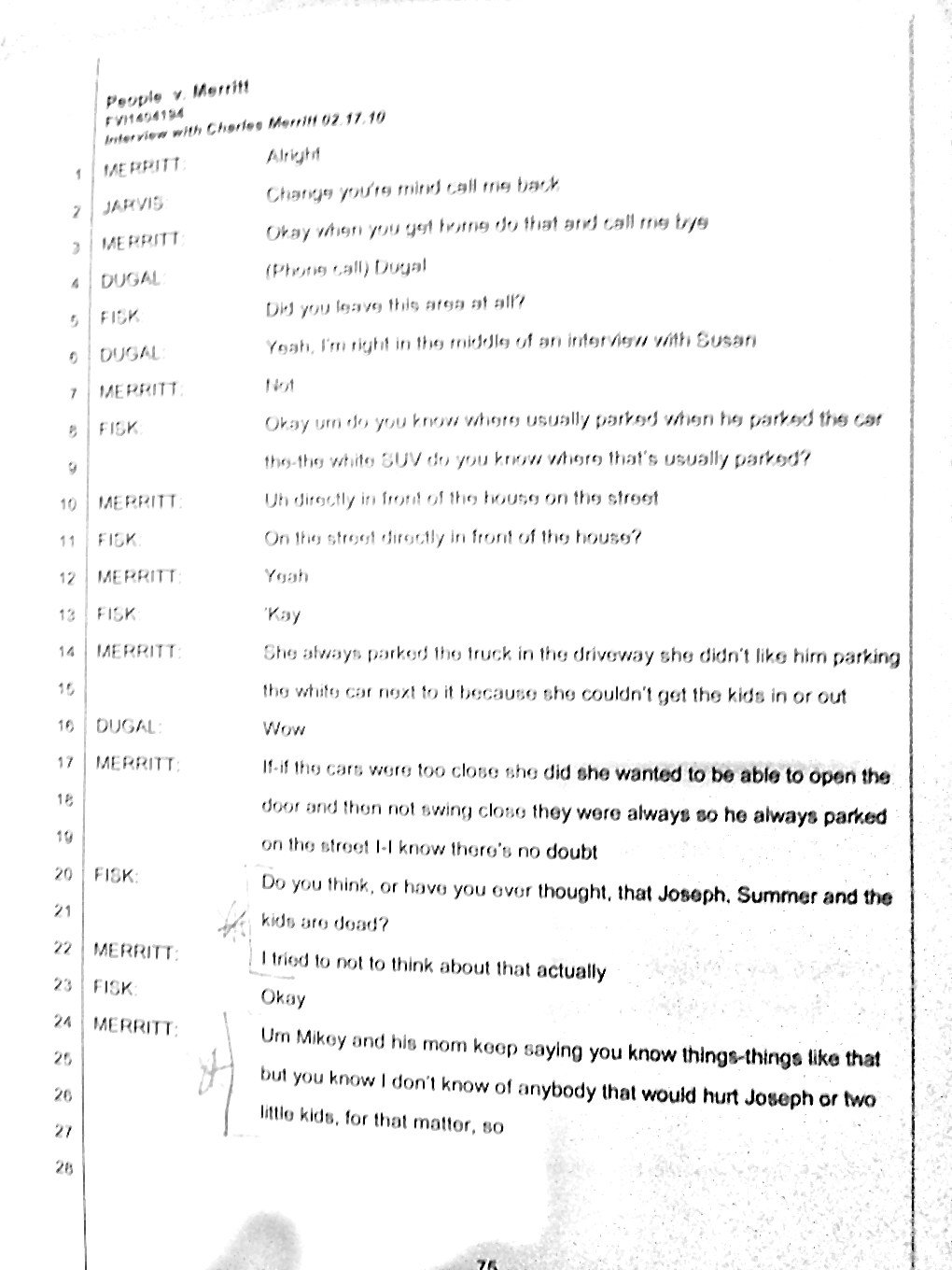
See interview page 81 (the 6:27 call)
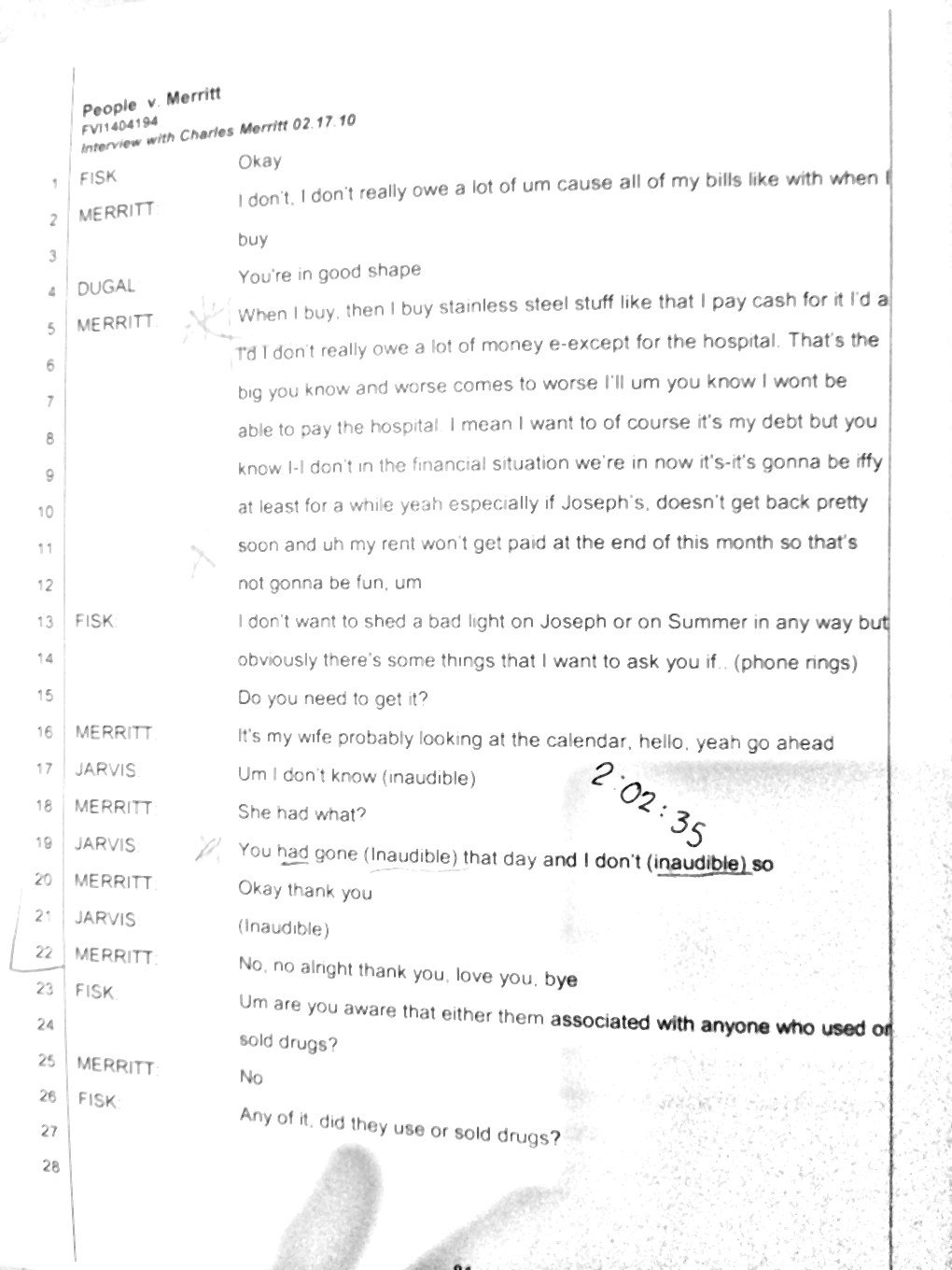
Two homicide detectives watched these calls fail at the clubhouse, and one of them named my carrier as it happened. Fisk was not running a technical test, and I do not claim she diagnosed the cause. What the recording shows is that the State’s own detectives witnessed the reception problem at the clubhouse, on my AT&T phone: the problem the prosecutor later told the jury did not exist.
The transcript does not say which call is which. It shows that the calls in this window were live and breaking up. What happened to each call is in the records. AT&T’s records carry no shared call number, so the two sets of entries line up by the minute, the two phone numbers and the direction of each call.
What AT&T recorded
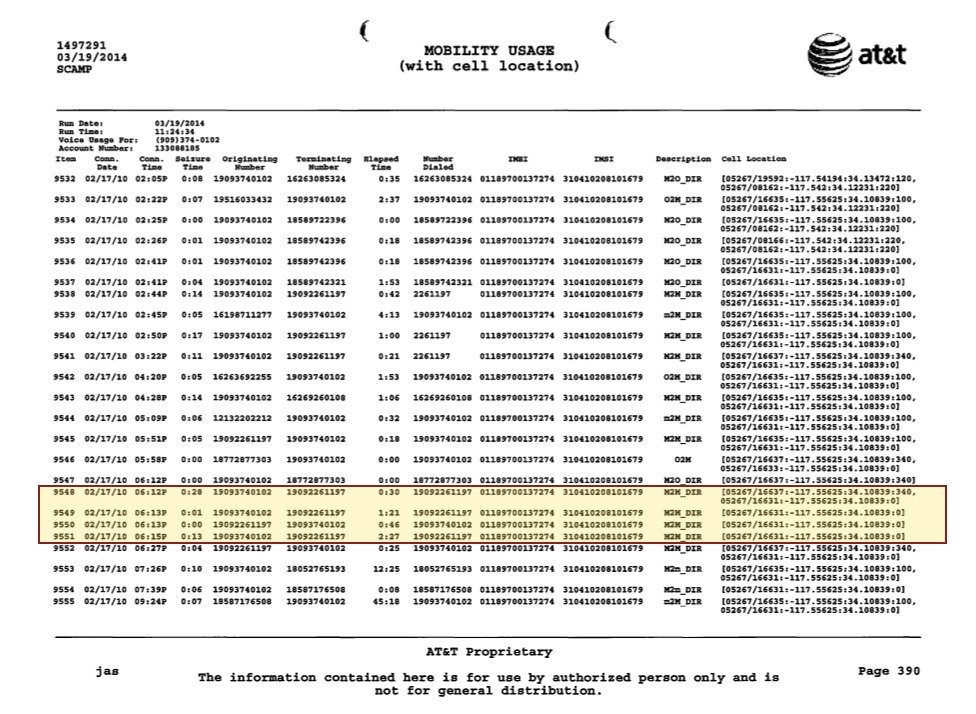
In the 6:12 to 6:15 p.m. window, my AT&T record shows four calls between my line (909-374-0102) and Cathy’s (909-226-1197):
- 6:12 p.m. — me to Cathy — elapsed 0:30 [my AT&T records, Page 390 (ReportAU 1497291), item 9548];
- 6:13 p.m. — me to Cathy — elapsed 1:21, M2M_DIR, cell site recorded (16631) [my AT&T records, Page 390, item 9549];
- 6:13 p.m. — Cathy to me — elapsed 0:46 [my AT&T records, Page 390, item 9550];
- 6:15 p.m. — me to Cathy — elapsed 2:27 [my AT&T records, Page 390, item 9551].
Cathy’s AT&T record, from the same carrier, for the same minutes, does not match. The 6:13 p.m. call that my record shows as a 1:21 conversation, with a tower, appears on hers as:
- 6:13 p.m. — seizure time 0:00, elapsed time 0:00, empty cell-site field (“[ ]”), and no IMEI recorded [Catherine Jarvis AT&T records, Page 230, item 5790; 0:00 / empty brackets / absent IMEI on certified copy].
See my AT&T record, Page 390 (February 17)
See Cathy’s AT&T record, Page 230 (February 17)
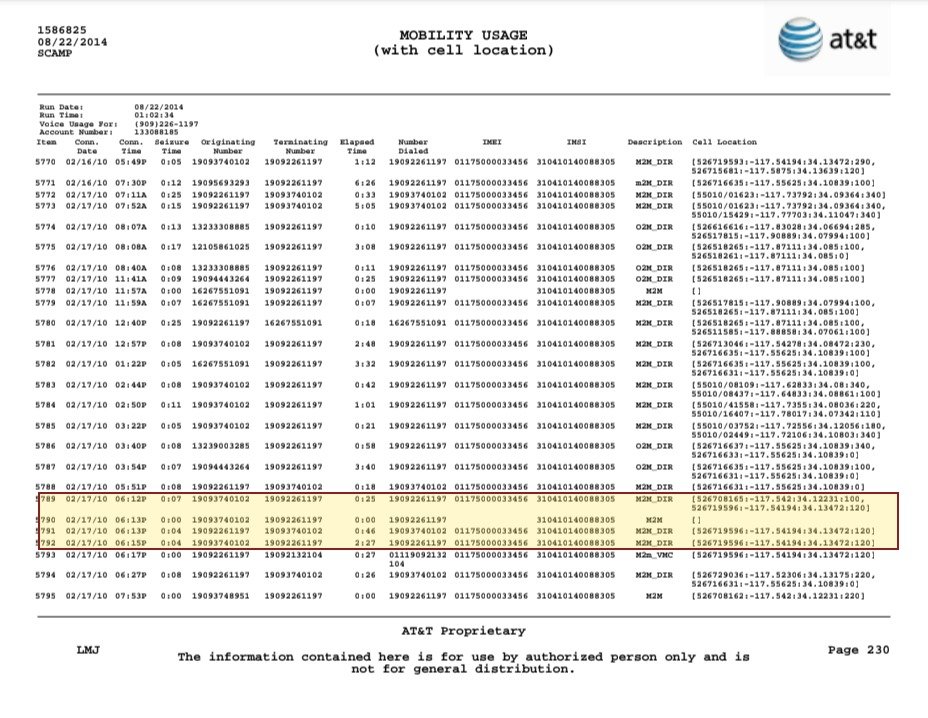
My record shows that call connected, for a minute and twenty-one seconds, with a tower. Hers shows it with no time, no tower and no phone identifier at all. In the same minute, Cathy’s 6:13 call to me appears the same way on both records, 0:46 [my item 9550; her item 5791]. And the 6:12 call shows different durations on the two records [my item 9548; her item 5789]. In six minutes, AT&T’s two records for the same two phones disagree about how long one call lasted, and about whether another connected at all.
What this shows
AT&T’s records are not a complete, consistent account of which calls connected. On this one witnessed evening, the same carrier recorded one call between these two phones as a real conversation on one line and as nothing on the other, while recording a call in the same minute correctly on both. Nothing in the records tells you which entries are which.
That matters for the 8:28 p.m. call: a call missing from my records is not proof the call never came in. The State’s own custodians testified that Joseph’s 8:28 call was received and should appear on my records (see The (impossible?) call). It does not. February 17 shows that kind of gap is something these records do.
None of this was assembled for trial. It happened on February 17, 2010, in front of the State’s own detectives, at the clubhouse, thirteen days after February 4.
The records miss calls: Exhibit 148
Exhibit 148 document: image to be added.
February 17 is one witnessed example. Exhibit 148, my exhibit, catalogs thirty-one more, all from the AT&T and T-Mobile records in the State’s own discovery. They are not all the same kind of error, so they are grouped by kind:
One-sided: the call is on one record, not the other (25)
- 1/1/10 @ 12:17 p.m. — Joseph calls me. On Joseph’s (2 min), not on mine.
- 1/2/10 @ 11:22 a.m. — Joseph calls me. Elapsed 1 min, not on mine.
- 1/2/10 @ 11:34 a.m. — Joseph calls me. Elapsed 1 min, not on mine.
- 1/3/10 @ 2:04 p.m. — I call Joseph. Connected, not on Joseph’s.
- 1/3/10 @ 2:05 p.m. — I call Joseph. Connected, not on Joseph’s.
- 1/6/10 @ 1:43 p.m. — I call Joseph. On my records: with a 3 min 56 sec. elapsed time. However, this call doesn’t appear on Joseph’s records at all.
- 1/8/10 @ 3:53 p.m. — I call Joseph. Connected, not on Joseph’s. Joseph calls back the same minute.
- 1/10/10 @ 8:27 a.m. — I call Joseph. Connected, not on Joseph’s.
- 1/10/10 @ 8:51 a.m. — I call Joseph. Connected, not on Joseph’s.
- 1/12/10 @ 9:54 a.m. — I call Joseph. Connected, not on Joseph’s.
- 1/13/10 @ 7:50 a.m. — I call Joseph. Mine: 1 min 35 sec. Duration while not appearing on Joseph’s at all.
- 1/13/10 @ 8:04 a.m. — I call Joseph. Connected, not on Joseph’s.
- 1/13/10 @ 8:15 a.m. — I call Joseph. Connected, not on Joseph’s.
- 1/15/10 @ 10:05 a.m. — I call Joseph. Connected, not on Joseph’s. Joseph returns the call 1 min later.
- 1/15/10 @ 2:54 p.m. — I call Joseph. Connected, not on Joseph’s. Joseph returns the call 1 min later.
- 1/19/10 @ 11:20 a.m. — I call Joseph. While this call was initiated by me, it does not appear on my records, while simultaneously showing on Joseph’s with a 2 min. elapsed time.
- 1/19/10 @ 5:11 p.m. — I call Joseph. Initiated by me, not on my records, but on Joseph’s.
- 1/19/10 @ 5:25 p.m. — I call Joseph. Initiated by me, not on my records, but on Joseph’s.
- 1/28/10 @ 8:51 a.m. — Joseph calls me. Connected, not on my records.
- 2/3/10 @ 4:35 p.m. — I call Cathy. Connected, not on Cathy’s records.
- 2/6/10 @ 8:33 a.m. — I call Cathy. Connected, not on Cathy’s records.
- 2/6/10 @ 10:47 a.m. — I call Cathy. Connected, on Cathy’s, but not on mine.
- 2/6/10 @ 11:32 a.m. — I call Cathy. Connected, on Cathy’s, not on mine.
- 2/6/10 @ 11:35 a.m. — I call Cathy. Connected, on Cathy’s, but not on mine.
- 2/6/10 @ 11:53 a.m. — I call Cathy. Connected, on Cathy’s, but not on mine.
Zero on one side, connected on the other (5)
- 1/5/10 @ 1:08 p.m. — Joseph calls me. On Joseph’s: with an elapsed time of 4 min. The same call was on mine: with an elapsed time of 0 sec.
- 1/7/10 @ 9:59 a.m. — Joseph calls me. My records: 0 sec. While Joseph’s: show an elapsed time of 3 min.
- 1/7/10 @ 5:03 p.m. — Joseph calls me. My records: 0 sec. While Joseph’s: show an elapsed time of 2 min.
- 1/13/10 @ 11:24 a.m. — Joseph calls me. On mine: 0 sec. On Joseph’s: for a full 2 min.
- 1/26/10 @ 9:56 a.m. — I call Joseph. This call connected, but was not on Joseph’s. Joseph calls back the same minute: this call was on Joseph’s with a duration of 2 min. Yet my records registered 0 sec.
Durations that conflict (1)
- 1/6/10 @ 1:42 p.m. — I call Joseph. On mine: with a 6 sec. duration. On Joseph’s: but with a 5 min. duration.
A State expert could argue about any one of these. Billing systems log calls in different ways. But thirty-one of them, in both directions, on both carriers, in one month, plus the one the detectives watched, means these records cannot be read as a complete and exact ledger. A call missing from one side, or recorded as zero, is something these records produce routinely. It is not proof that a call never happened.
What the records prove, and what they don’t
It is worth being exact about this, because the State was not.
- The records do not pinpoint where either of us stood. A tower and antenna cover an area. They put both our phones, again and again, in the home area the State’s own expert identified.
- They do corroborate Cathy. Her testimony is what places me. The home-tower pattern, the February 14 morning and the February 17 interview all fit what she described. They do not prove where I was on February 4. They show that the State’s explanation was not the only reasonable one.
- No tower on a voicemail call does not mean the phone was off. When a call goes to voicemail without being answered, the receiving phone often leaves no tower at all. AT&T’s own custodian told the court so: “Typically, there is no cell data on the voice mail calls” (RT 3614:11-12). A phone that is off, out of range, or in bad reception, like the clubhouse, can all look the same. The six February 4 calls were voicemail calls. Their missing towers cannot tell those cases apart, and the State’s own expert agreed: “At least with these records you can’t tell” (RT 4528:3-8).
- Separately, the records are not a complete ledger. February 17 and Exhibit 148 show something different: calls that connected but appear on only one record, or as zero on one side. That is why a call missing from my records, like the 8:28 call, is not proof it never came in.
See page 3614
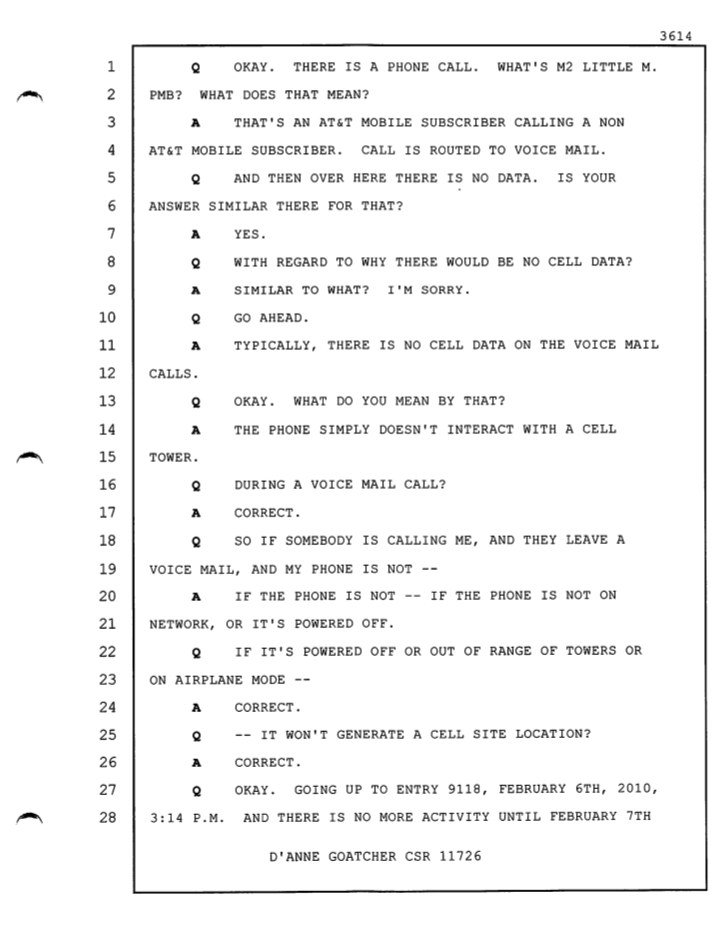
The State needed the records to do the one thing they cannot do: prove an absence. The prosecutor told the jury the “only reasonable interpretation” was a phone turned off. The records allow another reasonable interpretation, and the State’s own detectives had seen it happen.
What my lawyers had, and did not present
My lawyers had all of it before trial: my November 1, 2017 analysis of the both-at-home calls; the home towers, fixed by the State’s own expert on direct, so no defense expert was needed for that; Cathy’s testimony about clubhouse reception; the February 17 interview and both AT&T records for it; and Exhibit 148. On February 18, 2019, their own office’s notes listed it again: “Cathy and Chase making calls both from home” and “Hitting on same tower – caller and receiver.” (See Home that night.)
They did not put it to a witness. No one asked Boles about the home-tower calls between Cathy and me, though he had laid the foundation himself on direct. No one showed the jury the February 17 records, or pointed out the failing calls inside the interview. No one set February 14 beside February 4. And no one objected when the prosecutor told the jury, as fact, that the phone was off, that this was “not bad cell reception,” that there was “no corroboration,” and that the clubhouse explanation was a “scheme.”
Maline did tell the jury, in closing, what the records showed:
Maline: “Which is exactly what Cathy did. That’s why when you look through the records, the phone records for Mr. Merritt, you will have them back there. You can looks through them. You will see the same home tower that Kevin Boles testified about. The home tower. There’s is hundreds of calls between Chase and Cathy that both ping off the home tower. Those are logical calls that Chase or the kids or whoever are in the clubhouse. There was — there is a long history of calls being made from the same location.”
(RT 8372:13-21.)
See page 8372
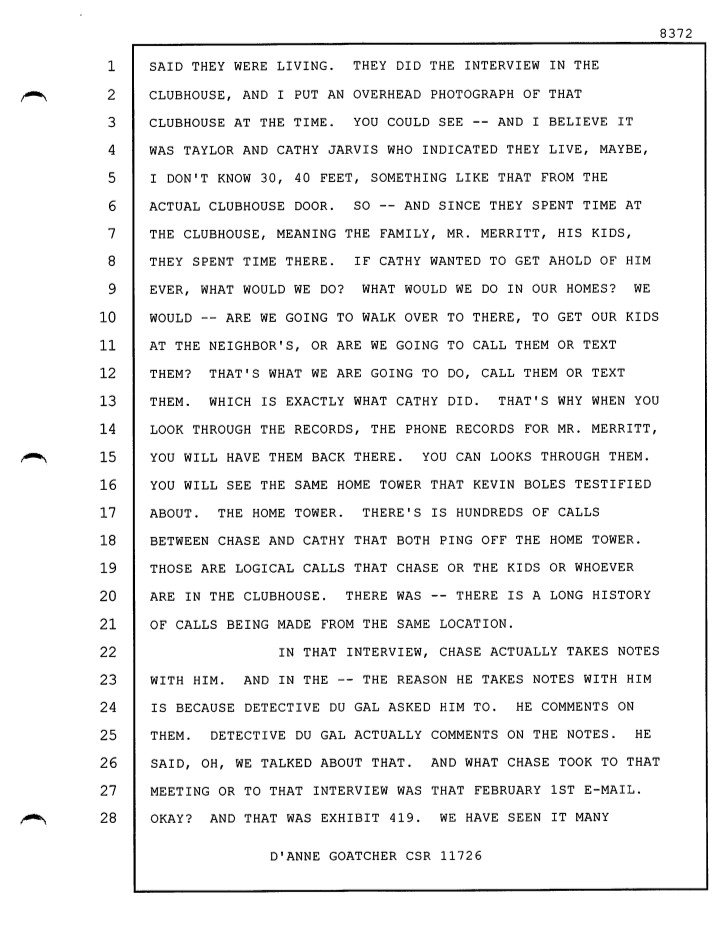
Closing argument is not evidence, and the jury was told so. They were left to search thousands of lines of records on their own, with no witness, no analysis and no February 17 demonstration behind his words.
After the verdict, McGee, questioned by Maline, explained why:
McGee: “There was the demand by Chase to try to push forward the error in the cell tower records to the effect — an example, he kept saying him and Kathy would call each other from home, but they would show up on different azimuths during the call. I would tell him that we can’t really address that because we don’t have testimony that you can say on this exact call, this exact date you can say where you were and she can say where she was, because it — they were just random days. There were no days locked into anything. That became — as I expressed to him that would be a fruitless venture to go down that road to try to prove it that way.”
(RT 8920:19-8921:1.)
See page 8920
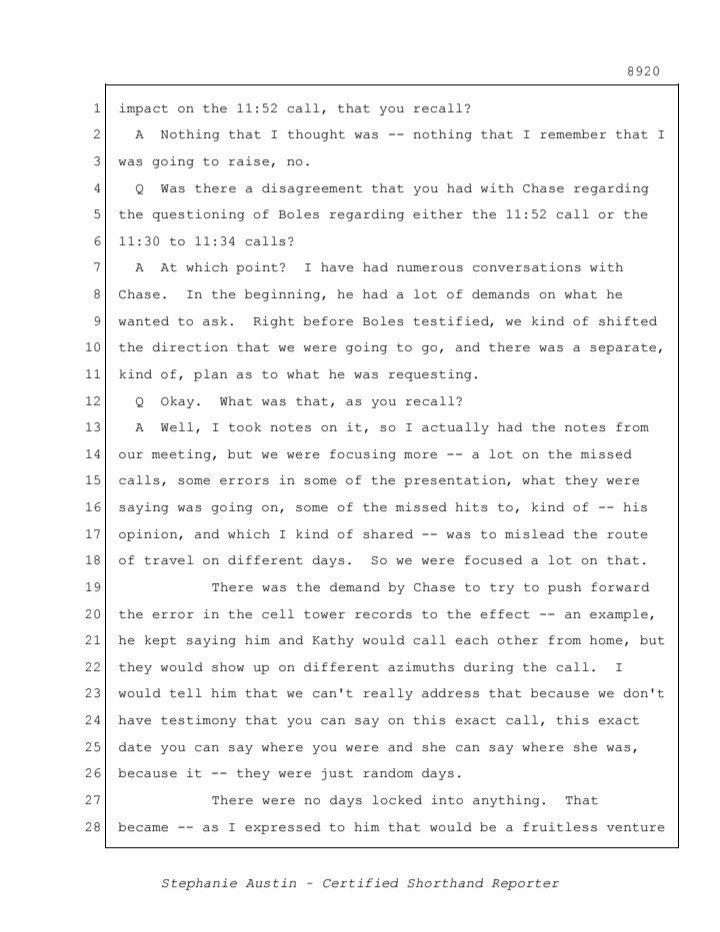
He is right that tower records cannot say exactly where each of us stood on a given call. But that was never the point. The point was the pattern: Cathy and I called each other from home routinely, on the home towers, often on the same antenna, with the same failed calls the State called proof of guilt on February 4. The State had argued she would not call me if I was home. The pattern answers that. McGee treated the lack of pinpoint proof as a reason not to present evidence that corroborated Cathy and rebutted the State. And eight of those calls show both phones on the same tower and the same antenna.
The defense was also divided against itself. Maline told the jury the “hundreds of calls” proved our pattern. Then, at the motion for new trial, he questioned McGee, who testified that developing those calls would have been “a fruitless venture.” One lawyer argued the pattern as fact; the other said it was too weak to present. The jury heard the claim without the evidence behind it.
What the prosecution argued despite the records
The prosecutors told the jury, as fact, that my phone was off, that this was “not bad cell reception,” that there was “no corroboration” putting me at home, and that the clubhouse explanation was a post-trial “scheme”:
MS. RODRIGUEZ: “That’s what she told the detective. Nowhere does she tell the detective, oh, you know, he was at the clubhouse. That’s why all those calls are missed prior to this call at 8:28. He was at the clubhouse. She doesn’t say that. She doesn’t say that until she meets with the . . . [defendant]. And it deals with the fabrication of evidence. And did the defendant do something to try to create evidence in this case? And think about that because what you heard from defense counsel was, Do we really want sergeants running around, taping microphones? You know, why? Because that implicated their scheme.”
(RT 8424:24-8426:6.)
See page 8424
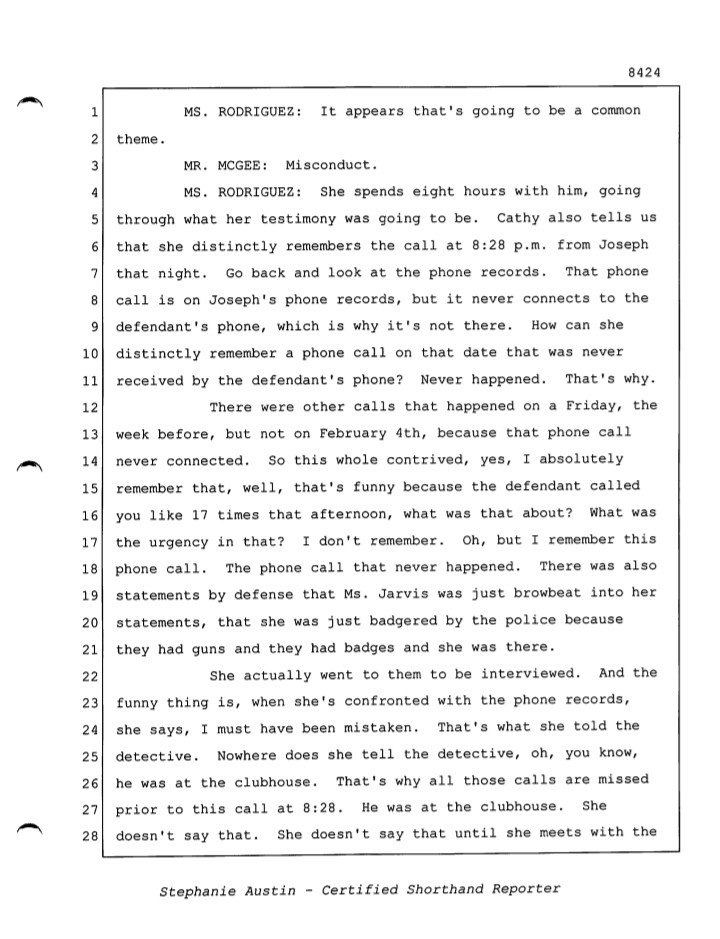
See page 8426
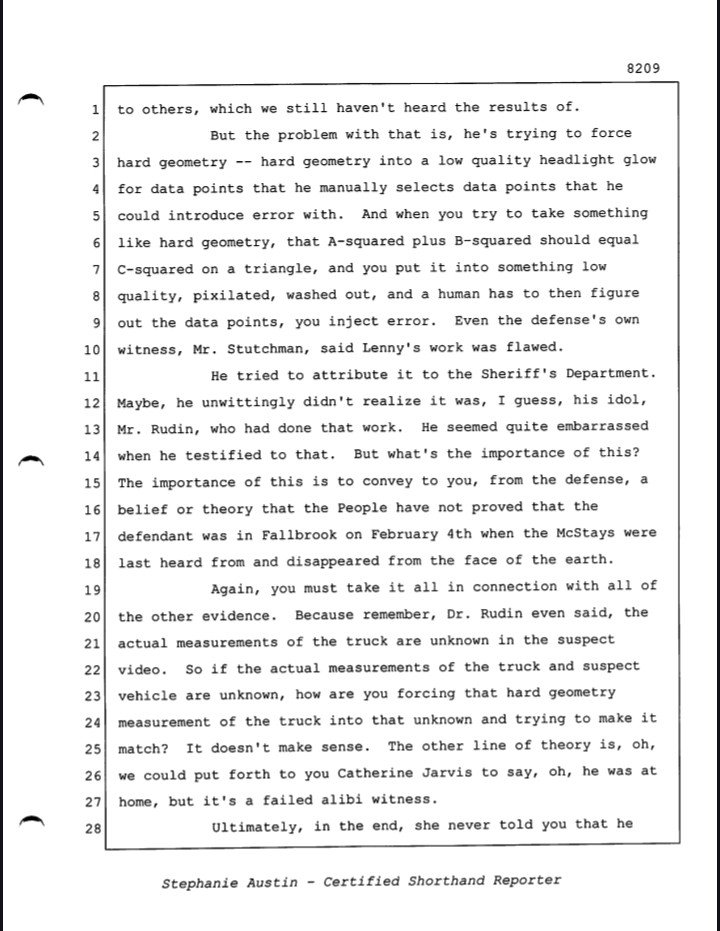
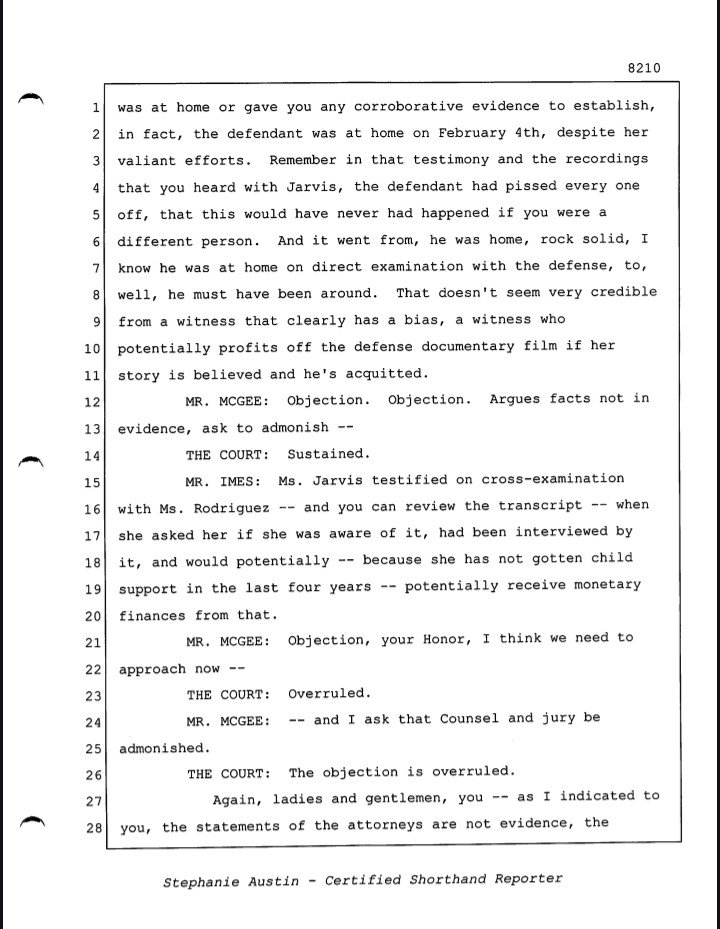
ADA Imes: “The other line of theory is, oh, we could put forth to you Catherine Jarvis to say, oh, he was at home, but it’s a failed alibi witness. Ultimately, in the end, she never told you that he was at home or gave you any corroborative evidence to establish, in fact, the defendant was at home on February 4th, despite her valiant efforts.”
(RT 8209:25-8210:3.)
See page 8209
See page 8210
Each of those statements runs into the State’s own file. “Not bad cell reception”: the State’s own detectives recorded bad reception at the clubhouse, on my AT&T phone, and one of them said why. “No corroboration”: the home-tower calls, fixed by the State’s own expert, and Cathy’s sworn testimony. “Scheme”: the clubhouse reception problem is in the State’s own 2010 investigation, nine years before trial.
These raise three separate questions, and they should be kept separate:
- Prosecutorial misconduct. A prosecutor may argue inferences from the evidence. A prosecutor may not tell a jury that a fact is so, when the State’s own record shows otherwise. “This is not bad cell reception” was stated as fact, against the State’s own February 17 recording. (People v. Hill (1998) 17 Cal.4th 800.)
- False evidence (Napue). The knowing use of false evidence violates due process. (Napue v. Illinois (1959) 360 U.S. 264.) Here the question is narrower: the testimony that my phone was off, and the State’s knowledge of what its own records showed. Agent Boles’s “phone off” testimony is set out on Was I hiding my whereabouts by turning off my phone? and on The (impossible?) call, and is not repeated here.
- Ineffective assistance. Separately from anything the State did, my lawyers had the evidence that answered these arguments and did not present it. (Strickland v. Washington (1984) 466 U.S. 668.)
Why it mattered
Where I was that evening was the central contested fact of the guilt phase. The State’s case put me sixty miles away, and its proof that I was gone was a phone that “went dark.” I had no burden to prove where I was; the State had to prove I was there. But the jury was never shown the evidence that backed up the innocent reading of those six calls.
The jury was instructed that if circumstantial evidence allows two reasonable interpretations, one pointing to innocence, they must accept that one. (CALCRIM 224.) The second interpretation of the February 4 calls was in the records: the home-tower pattern, the February 14 morning, and February 17. The jury heard that alternative, from Cathy and in Maline’s closing, but never saw the evidence that backed it up: none of it was put to a witness or shown to them. Without it, the second interpretation was a claim the jury had no way to test against the State’s. And the trial court, denying a new trial, adopted the State’s reading: “if they are in the same apartment, she’s not needing to call him.” (RT 8944:27-28.)
The prosecutors’ statements and my lawyers’ silence worked on the same fact, and they reinforced each other. The State asserted my absence as fact, and my defense never put in front of the jury what showed otherwise. There is a reasonable probability that, with that evidence, the result would have been different.
Two halves of one evening
The “went dark” claim and the 8:28 call are two halves of one evening alibi. The (impossible?) call shows that Joseph’s 8:28 p.m. call was received, while I was at home. This page shows that clubhouse reception, recorded by the State’s own detectives on February 17, is a real and reasonable explanation for why Cathy’s six calls went unanswered. That is all it takes to defeat the State’s claim that a phone turned off was the only one.
Together they put me at home, or at the clubhouse thirty yards away, through the only window the State’s evidence supports.
The prosecution told the jury that poor reception was not a reasonable explanation for the February 4 calls. Yet thirteen days later, at the very clubhouse Cathy named, the State’s own detectives watched calls between the same two AT&T phones break up, and the carrier’s records of those calls contradict each other. My lawyers had the evidence, told the jury the home-tower pattern existed, and never presented it so the jury could judge it for themselves. The State told the jury there was only one reasonable explanation. The record supplies another.
Sources
Reporter’s Transcript (RT), People v. Merritt, San Bernardino County Superior Court, Case No. FVI1404194:
- RT 3614: AT&T’s custodian (Mr. Lipnisky).
- RT 4528, 4550-4563: Agent Kevin Boles, direct examination (the “home towers”).
- RT 5302-5304: Catherine Jarvis, direct examination by Mr. Maline.
- RT 8199, 8209-8211, 8236, 8270: closing argument, Mr. Imes.
- RT 8372: closing argument, Mr. Maline.
- RT 8424-8426: rebuttal, Ms. Rodriguez.
- RT 8920-8921, 8944-8945: motion for new trial (Mr. McGee testifying; the Court’s ruling).
Records:
- My AT&T records, Trial Exhibit 794, pages 371, 382 and 390 (posted on The records).
- Catherine Jarvis’s AT&T records, pages 222, 228 and 230.
- Interview of Charles Merritt, February 17, 2010, Detectives DuGal and Fisk (posted on The records; the page numbers cited here are the original transcript’s).
- My cell-record analysis (“White Paper”), given to my lawyers November 1, 2017, pages 2-3.
- Exhibit 148, my catalog of record discrepancies.
- “Notes on Agent Kevin Boles – Merritt Meeting 2-18-2019,” my lawyers’ office (shown on Home that night).
Where I describe what I gave my lawyers and when, I state what I know personally.
↑ Back to the menu