Home that night
← Back to Advocates or puppets? (Opportunity)On the evening of February 4, 2010, I was at home with my family in Rancho Cucamonga. Cathy Jarvis testified to it. So did my daughter Taylor. The State’s case needed the opposite: that I was away, and that I had turned my phone off to hide where I was.
It built that case on six calls. Between 6:09 and 9:04 p.m., Cathy called my phone six times, and each call went to voicemail. Detective Bachman’s summary drew the conclusion the State would carry to trial: “Merritt’s phone was determined to be off by the cell phone records and no cell site location was available.” (Summary, Bates #17, par. 5.) Cathy’s own records placed her at home. If she was calling me, the reasoning went, I could not have been there.
ADA Daugherty told the jury the evidence would show “the person, whose cell phone activity for significant portions of time, during significant days and times around the time of the murder, is off the grid. Nowhere to be found, when all other times, it’s always found.” (RT 1631:19-22.) ADA Imes closed on it:
See page 1631
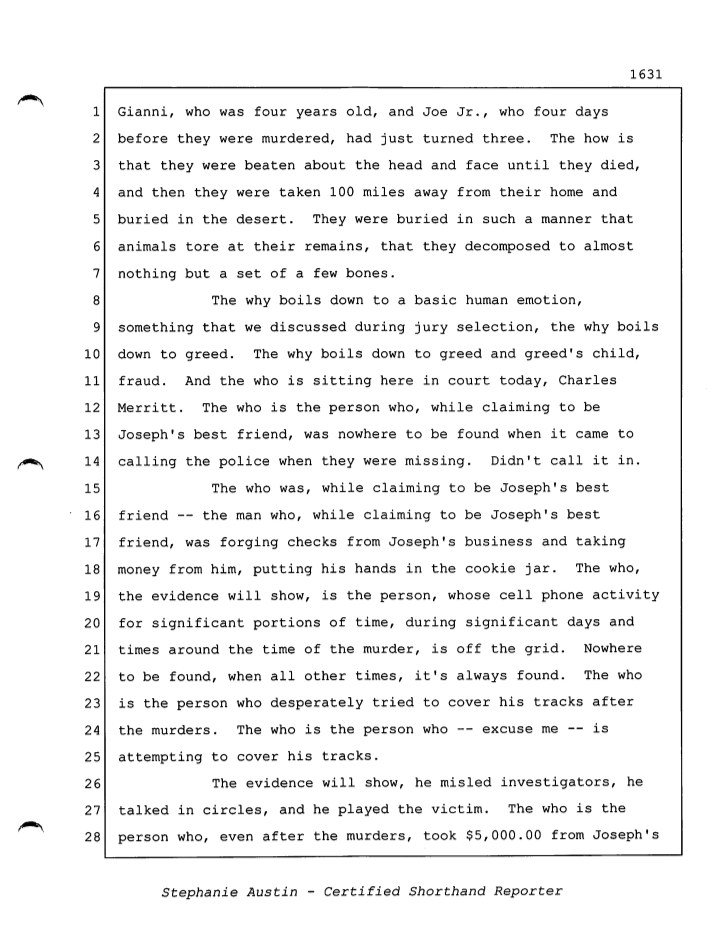
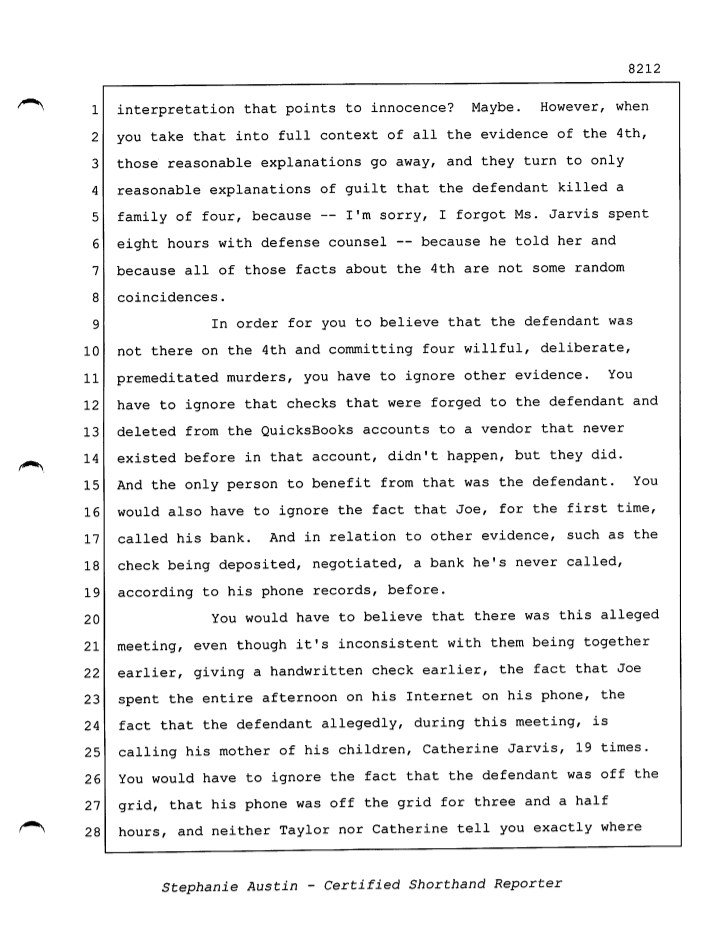
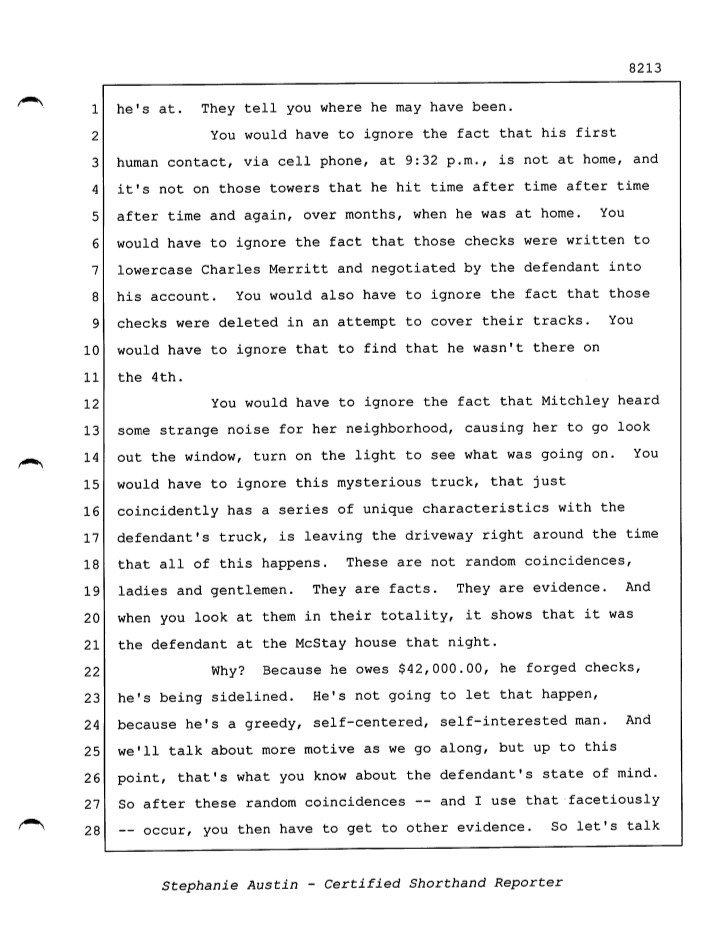
ADA Imes: “His phone was off the grid for three and a half hours, and neither Taylor nor Catherine tell you exactly where he’s at. They tell you where he may have been. — You would have to ignore that to find that he wasn’t there on the 4th. — These are not random coincidences, ladies and gentlemen. They are facts. They are evidence. And when you look at them in their totality, it shows that it was the defendant at the McStay house that night.”
(RT 8212:26-8213:21.)
See page 8212
See page 8213
Every part of that rested on two claims: that calls without tower data meant my phone was off, and that nothing corroborated Cathy. Both were false. The people who made them had the records that proved it. And the people who were supposed to expose them did not.
“Powered off or in airplane mode”
“Determined to be off”
It started with Detective Bachman. His summary of the investigation states: “Merritt’s phone was determined to be off by the cell phone records and no cell site location was available.” (Summary, Bates #17, par. 5.)
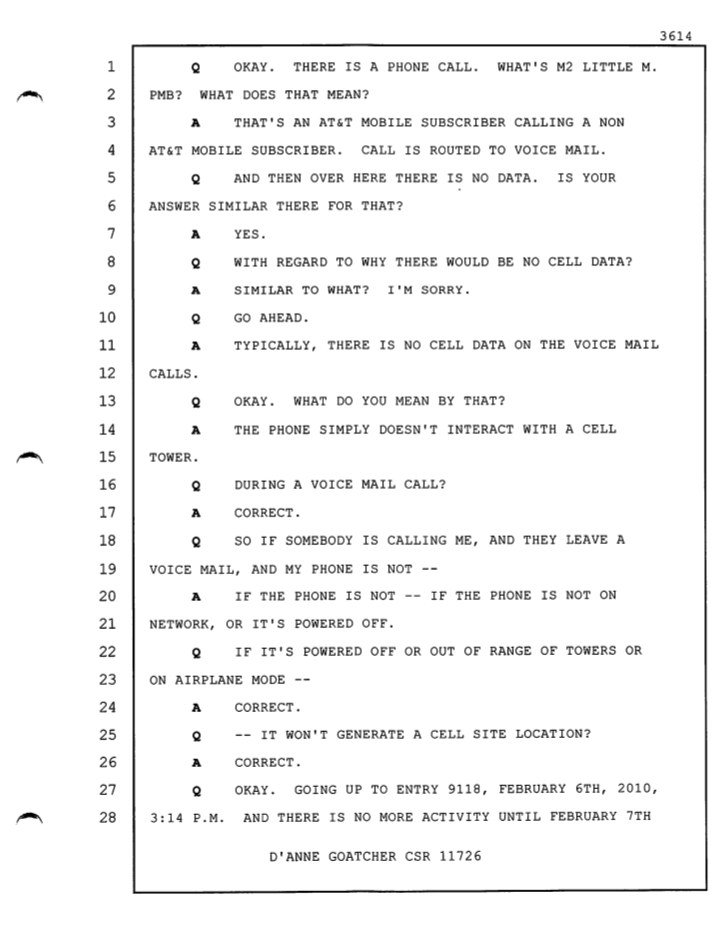
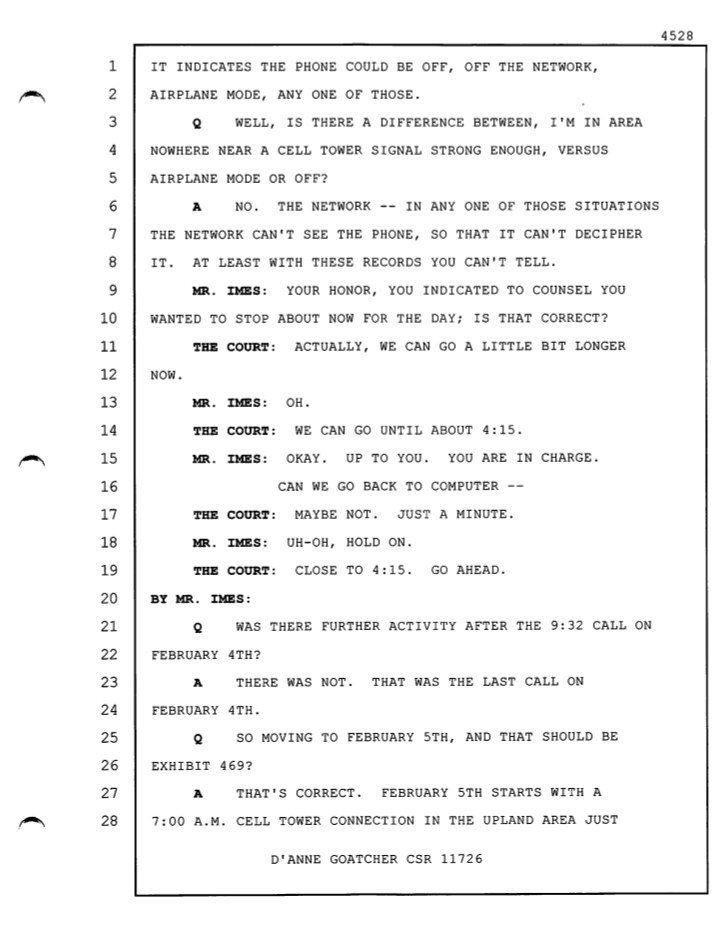
Nothing in those records determines that. The records he was pointing to were voicemail calls with no tower, and a call that does not appear on my bill at all. AT&T’s own custodian told the court that “typically, there is no cell data on the voice mail calls.” (RT 3614:11-12.) The prosecution’s own expert told the jury that a phone that is off and a phone the network cannot see look the same: “At least with these records you can’t tell.” (RT 4528:3-8.) Bachman did not know my phone was off. He wrote that the records had determined it.
See page 3614
See page 4528
Then the State built its case on it. Boles gave the jury the same conclusion, and the prosecutors argued it in closing, after their own witnesses had said the records could not determine it.
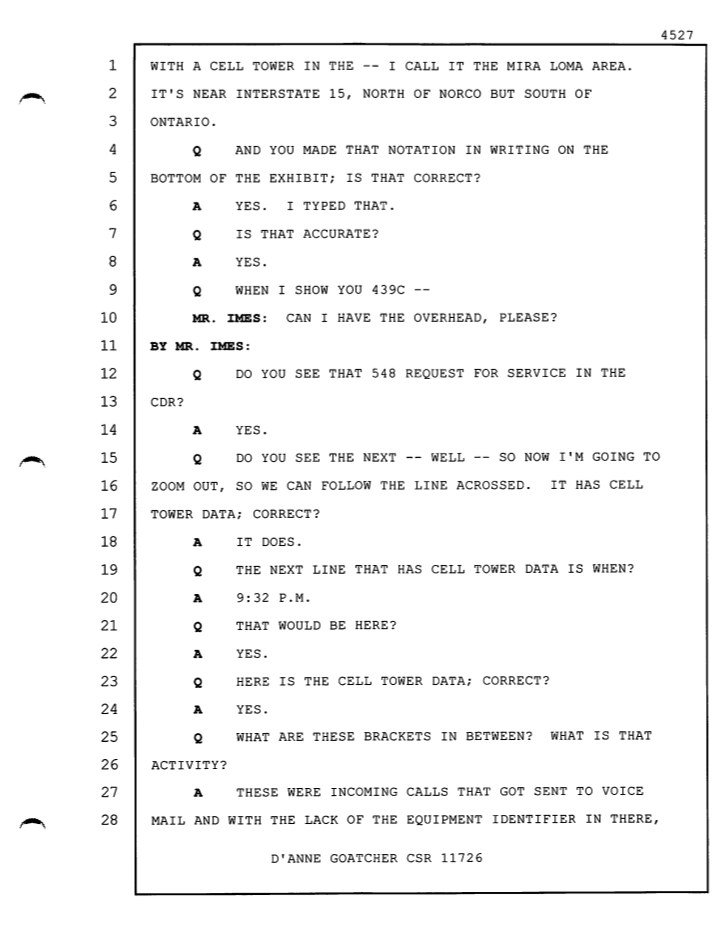
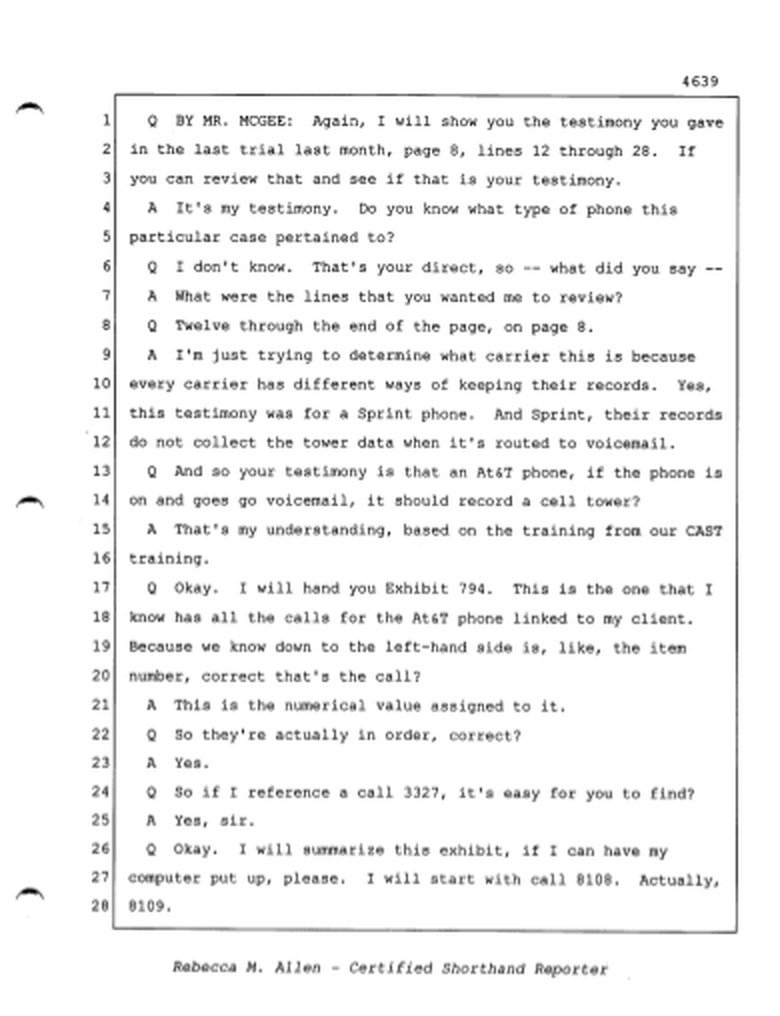
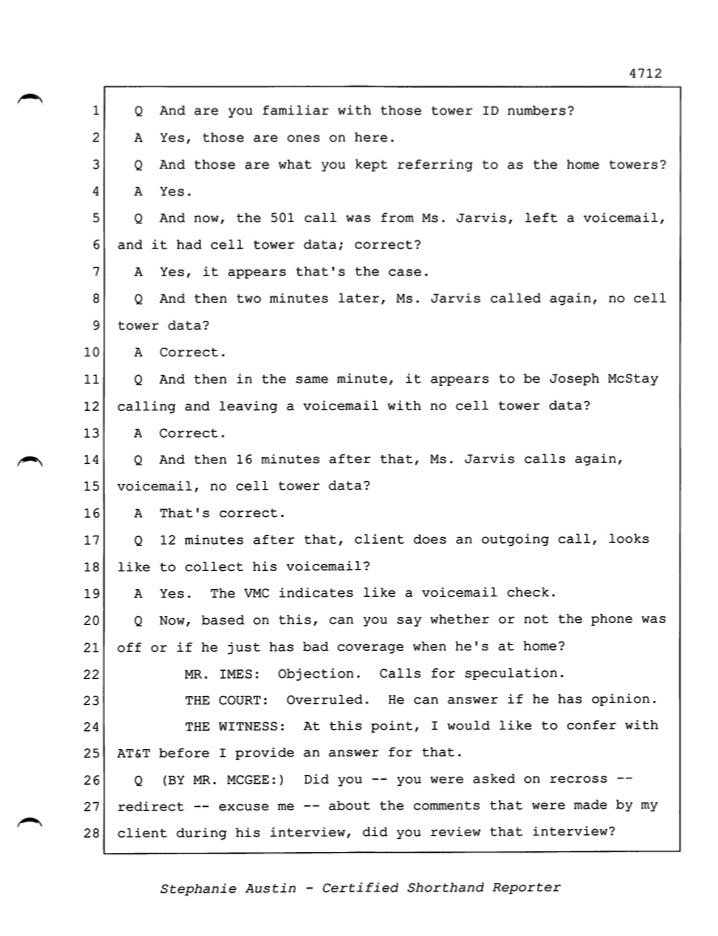
Agent Boles told the jury that calls without a tower meant my phone “could be off, off the network, airplane mode, any one of those.” (RT 4527:27-4528:2.) Confronted on cross with calls from my own records, he fell back on his training, then twice said he needed to “confer with AT&T.” (RT 4639:13-16; 4695:5-8; 4712:20-25.) What he had sworn before my trial is set out in “Was I hiding my whereabouts by turning off my phone?”.
See page 4527
See page 4639
See page 4695
See page 4712
The jury had already heard the answer, from AT&T itself. AT&T’s custodian of records told the Court:
Mr. Lipnisky: “Typically, there is no cell data on the voice mail calls.”
(RT 3614:11-12.)
Neither side asked it. The Court drew it out while clarifying other evidence. So before Boles took the stand, the prosecution, my defense and the Court had all heard AT&T say what a call that goes to voicemail leaves in the record: no tower.
On redirect, the prosecution tried to explain away the calls my lawyer had shown Boles:
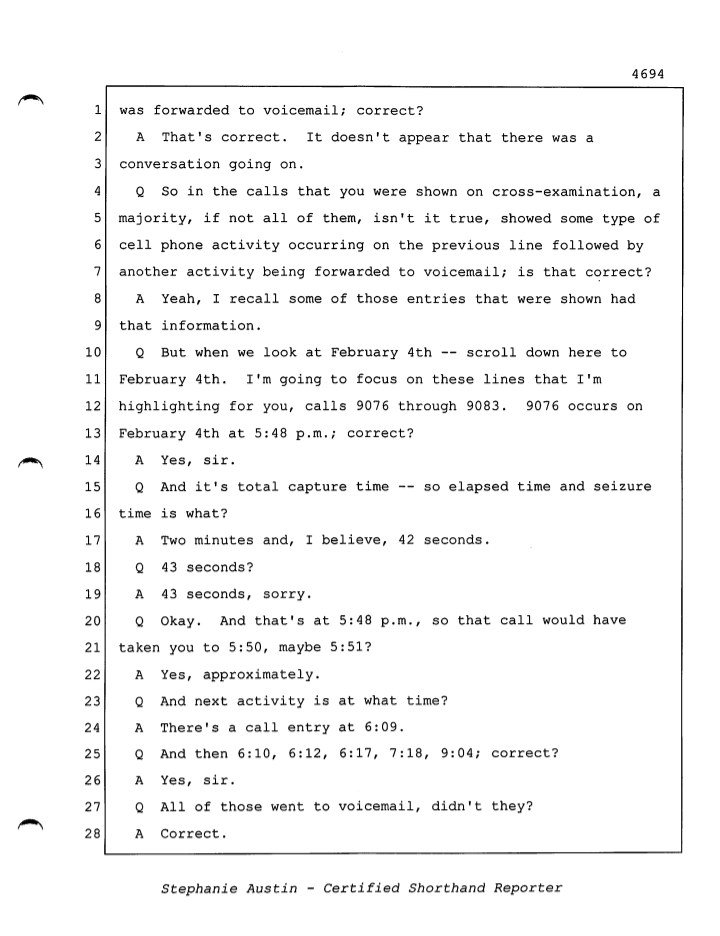
ADA Imes: “So in the calls that you were shown on cross-examination, a majority, if not all of them, isn’t it true, showed some type of cell phone activity occurring on the previous line followed by another activity being forwarded to voicemail; is that correct?”
Boles: “Yeah, I recall some of those entries that were shown had that information.”
(RT 4694:4-9.)
See page 4694
The suggestion was that those calls had no tower because I was already on another call. In rebuttal, ADA Rodriguez said it outright:
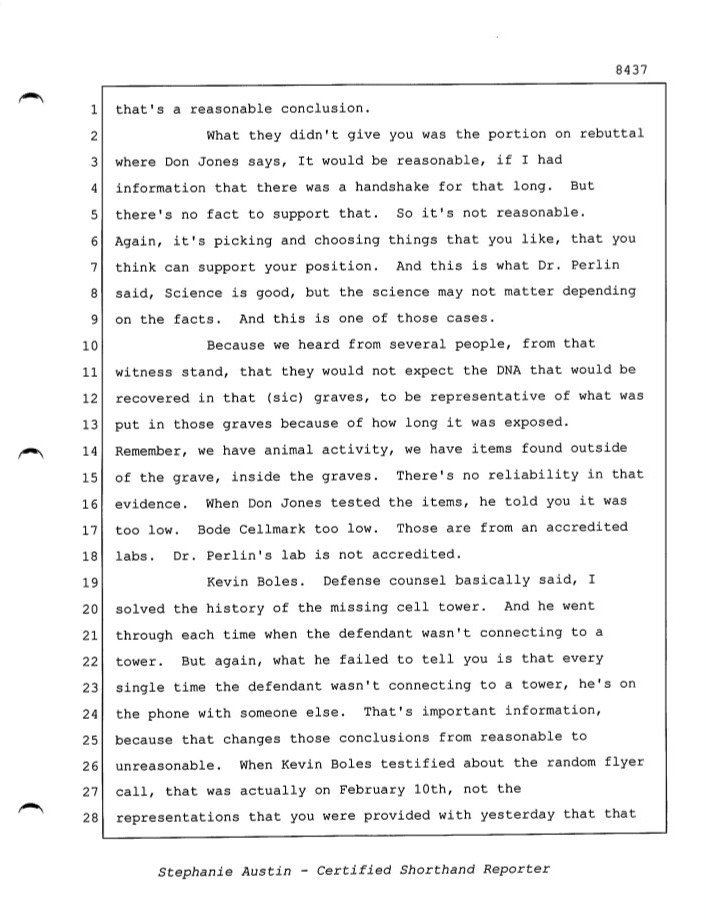
ADA Rodriguez: “Kevin Boles. Defense counsel basically said, I solved the history of the missing cell tower. And he went through each time when the defendant wasn’t connecting to a tower. But again, what he failed to tell you is that every single time the defendant wasn’t connecting to a tower, he’s on the phone with someone else. That’s important information, because that changes those conclusions from reasonable to unreasonable.”
(RT 8437:19-26.)
See page 8437
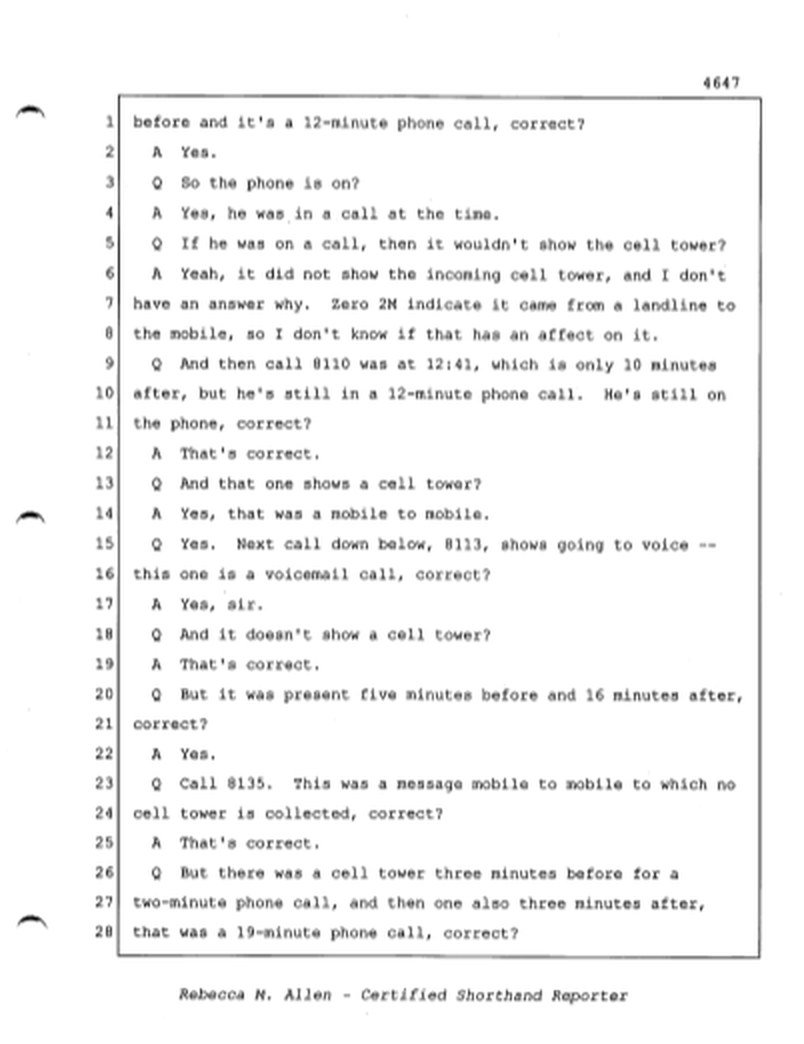
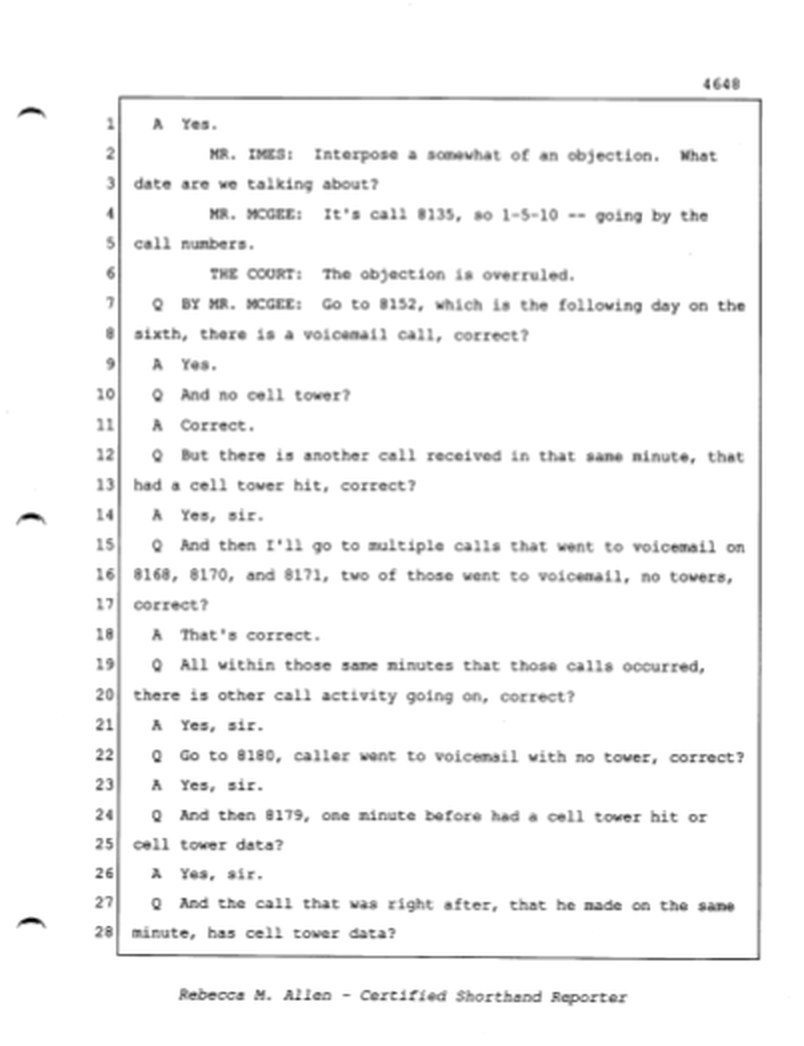
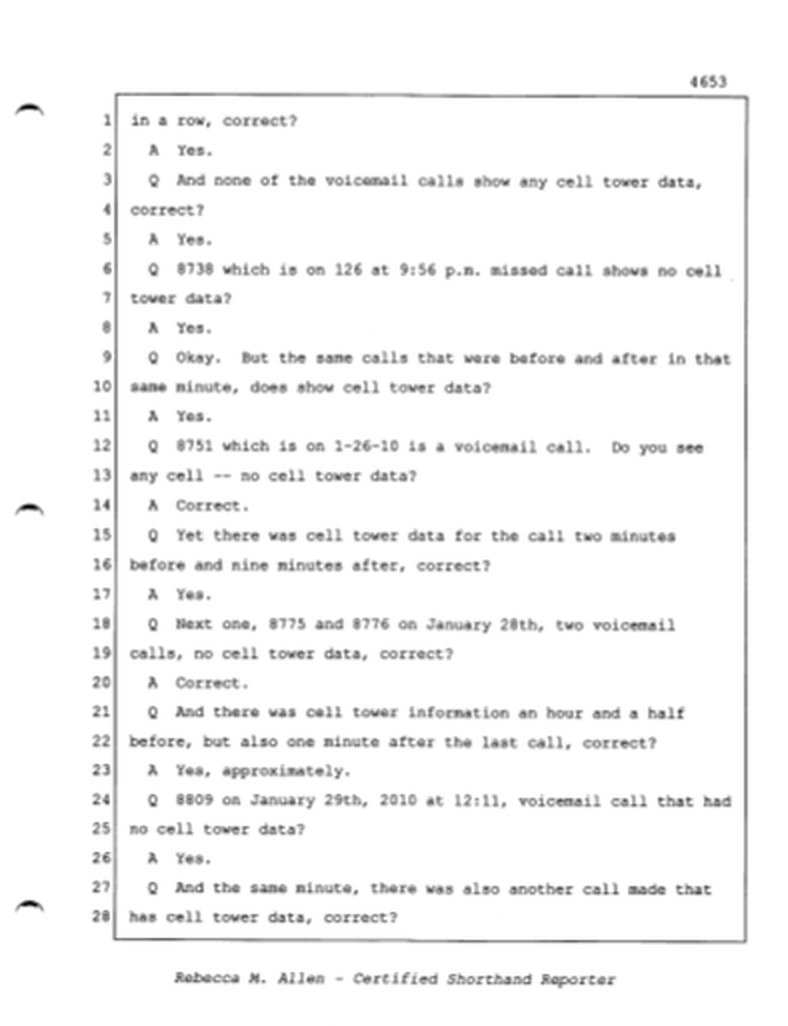
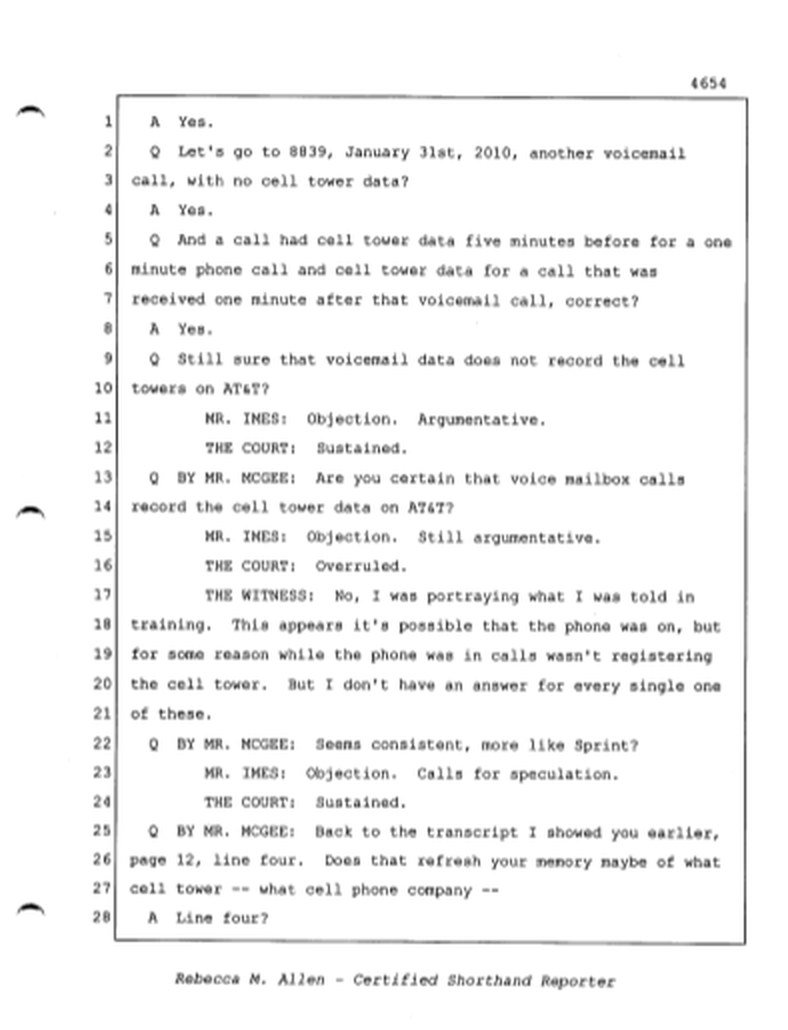
It was false. McGee walked Boles through dozens of these calls. Some did come in while I was on another call, and that was his point: the phone was plainly on, and the record still showed no tower. But many did not, and Boles agreed with each one. At 6:26 p.m. on January 5, Joseph called me between two of his calls that registered on my home tower; that call shows no tower, and no other call was on the line. At 12:11 p.m. on January 29, and 12:40 p.m. on January 31, calls went to my voicemail with no tower, between calls on my home tower, with nothing else on the line. (RT 4647:23-4648:1; 4653:24-4654:8; AT&T items 8135, 8809, 8839.) The prosecution had those records in front of it while the calls were read out. The same records were the State’s own exhibit, which Rodriguez later put on the screen for Cathy. (Exhibit 439C; RT 5421:4-11.)
See page 4647
See page 4648
See page 4653
See page 4654
See page 5421
Then ADA Imes told the jury what the evening of February 4 meant:
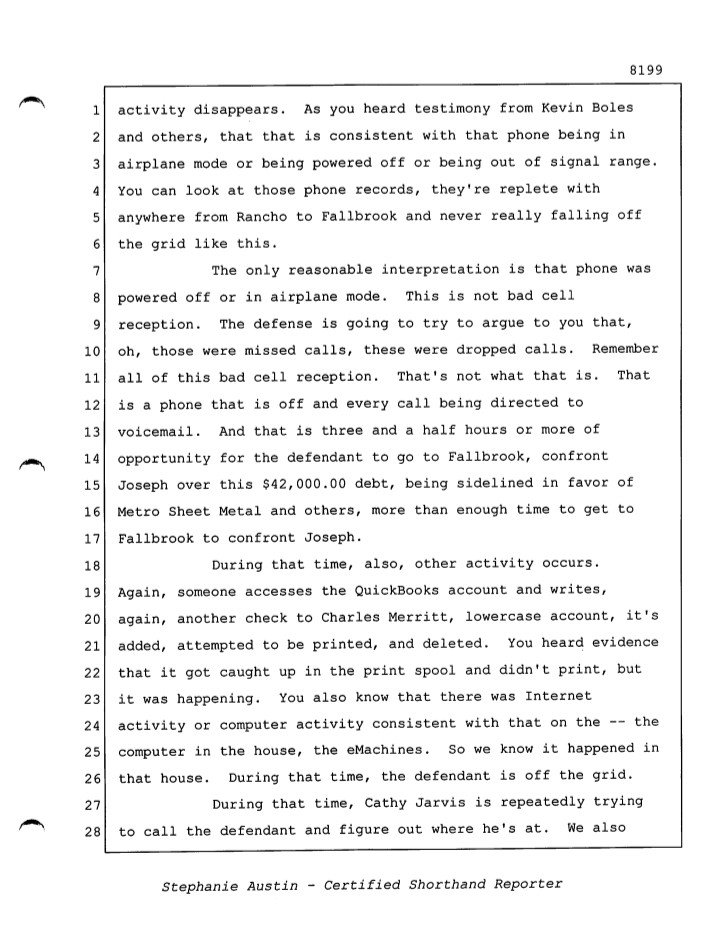
ADA Imes: “The only reasonable interpretation is that the phone was powered off or in airplane mode. This is not bad cell reception. The defense is going to try to argue to you that, oh, those were missed calls, these were dropped calls. Remember all of this bad reception. That’s not what that is. That is a phone that is off and every call being directed to voice mail.”
(RT 8199:7-13.)
See page 8199
His own witness had given the jury the opposite. On direct, Imes himself asked Boles:
ADA Imes: “Well, is there a difference between, I’m in area nowhere near a cell tower signal strong enough, versus airplane mode or off?”
Boles: “No. The network — in any one of those situations the network can’t see the phone, so that it can’t decipher it. At least with these records you can’t tell.”
(RT 4528:3-8.)
“At least with these records you can’t tell.” AT&T had said voicemail calls typically carry no tower. The prosecution’s own expert had said no tower could mean no signal, and that the records could not tell them apart. Imes told the jury the only reasonable interpretation was a phone turned off. It was a false statement to the jury, one the prosecutor’s own evidence had already contradicted, made to turn an unanswered phone into a hidden one.
The 8:28 call
At 8:28 p.m. on February 4, Joseph McStay called my phone. If I was at home when that call came in, I could not have been at the McStays’ home in Fallbrook, more than 60 miles away, where the prosecution said I was until at least 8:05.
Cathy remembered that call. She told Detective Bachman exactly how. His own report records it:
“After Merritt returned home, Jarvis recalled standing at the bar in the kitchen. Jarvis stood on one side of the bar and Merritt stood on the other. Merritt’s cell phone was lying face up on the bar allowing Jarvis to see the screen. Jarvis recalled a phone call coming through from Joseph on Merritt’s cell phone. Jarvis claimed Merritt did not answer the phone and she clearly saw Joseph’s name on the display. Jarvis believed the phone rang and vibrated while on the counter and Merritt let the phone ring completely out prior to it going to voice mail. Jarvis believed they went on to watch television for the rest of the night and to her knowledge Merritt did not leave.”
(Follow-up report, Bates #7823, pars. 1-2.)
What Bachman told her
In the interview, Bachman answered her with this:
Det. Bachman: “Well, you’re telling — you’re giving us vivid details of that phone call coming through and that — but at the time that call was made that phone is not showing there at the house.”
(Jarvis Int. 59143, p. 25:19-23.)
Then:
Det. Bachman: “So is it possible you have that mixed up with another day?”
Ms. Jarvis: “It could be, yes.”
(Id., p. 43:15-17.)
What Bachman told her was false, and he knew it. The 8:28 call appears in Joseph’s records. It never appears in mine, so my records show no location for my phone at 8:28 at all. Bachman wrote that down himself:
“The call from Joseph’s cell phone records from Joseph to Merritt at 2028 hours (8:28 p.m.) was not visible on Merritt’s phone records.”
(Summary, Bates #17, par. 5.)
Read the interview against his own summary. The 8:28 call is not on my bill. A call that is not on the bill has no tower at the house, and no tower anywhere else. “Not showing there at the house” takes that absence and states it as a place. Bachman knew the call was not in my records; he wrote it down. He told Cathy the records put my phone away from the house anyway, so that she would doubt her own memory. She did, for a moment.
Then his follow-up report changed what the interview was about:
“Investigators showed Ms. Jarvis the last phone call [Merritt] made that night at approximately 2132 hours (9:32 p.m.) and told her the cellular site for the phone was not in the city of Rancho Cucamonga, where the couple lived at the time. The cellular records were inconsistent with Jarvis’ recollection of the night of the 4th, 2010.”
(Follow-up report, Bates #1287, par. 1.)
The 9:32 call came up once in the interview, and Cathy said she did not remember it. The call she described in “vivid details” was the 8:28 call. The report moved her concession onto a different call, one with a tower, and dropped the call that had none.
What Rodriguez did with it
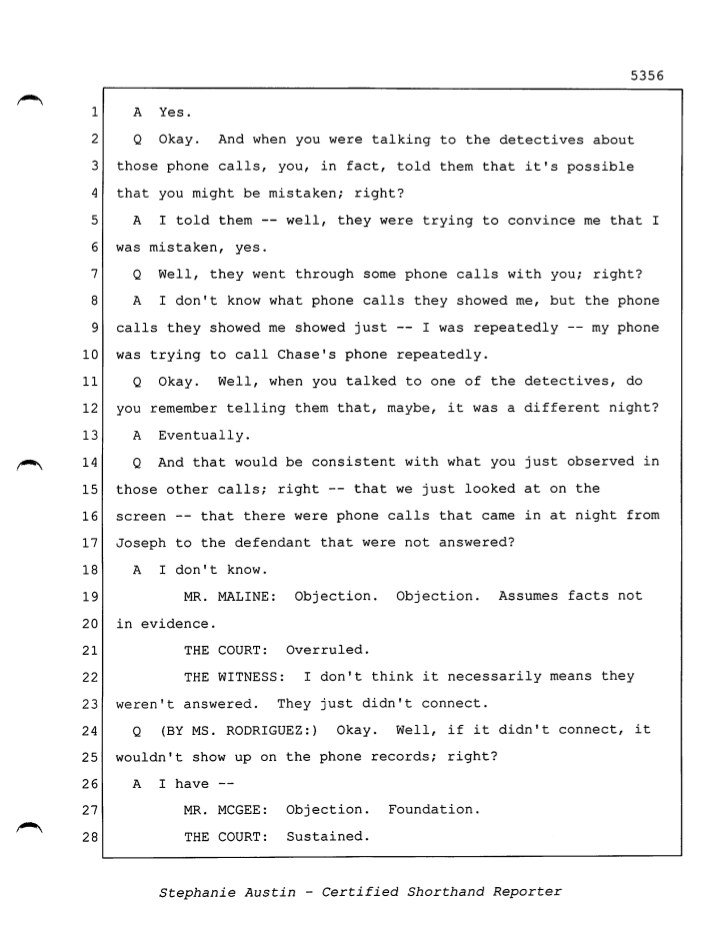
At trial, ADA Rodriguez put the concession to Cathy as if it covered all of her calls that night:
ADA Rodriguez: “Okay. And when you were talking to the detectives about those phone calls, you, in fact, told them that it’s possible that you might be mistaken; right?”
Ms. Jarvis: “I told them — well, they were trying to convince me that I was mistaken, yes.”
ADA Rodriguez: “Well, they went through some phone calls with you; right?”
Ms. Jarvis: “I don’t know what phone calls they showed me, but the phone calls they showed me showed just — I was repeatedly — my phone was trying to call Chase’s phone repeatedly.”
ADA Rodriguez: “Okay. Well, when you talked to one of the detectives, do you remember telling them that, maybe, it was a different night?”
Ms. Jarvis: “Eventually.”
(RT 5356:2-13.)
See page 5356
When Bachman asked Cathy about her calls to me, she had said: “I don’t know, that wasn’t unusual, like I said — he oftentimes didn’t answer his phone.” (Jarvis Int. 59143, p. 38:11-22.) The only thing she conceded might be “mixed up with another day” was the 8:28 call, and only after Bachman told her something false about it. Rodriguez knew which call it was. On the same cross-examination she identified it herself: the call from Joseph, “sometime around 8:00 or 8:30.” (RT 5421:4-9.)
Asked about that call directly, Cathy held to it:
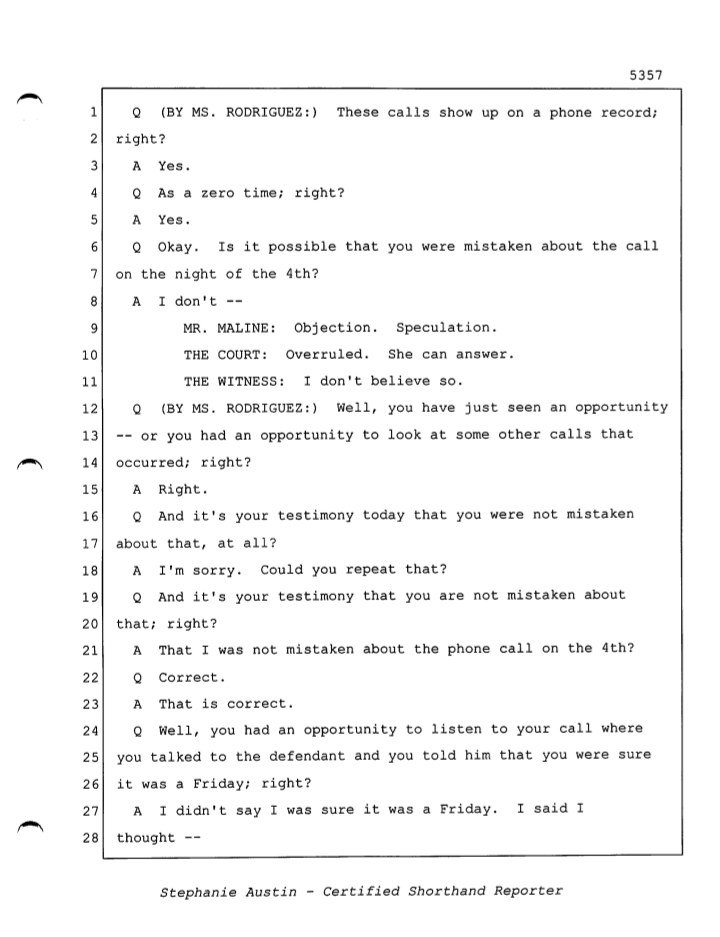
ADA Rodriguez: “Okay. Is it possible that you were mistaken about the call on the night of the 4th?”
Ms. Jarvis: “I don’t —”
Mr. Maline: “Objection. Speculation.”
The Court: “Overruled. She can answer.”
Ms. Jarvis: “I don’t believe so.”
ADA Rodriguez: “Well, you have just seen an opportunity — or you had an opportunity to look at some other calls that occurred; right?”
Ms. Jarvis: “Right.”
ADA Rodriguez: “And it’s your testimony today that you were not mistaken about that, at all?”
Ms. Jarvis: “I’m sorry. Could you repeat that?”
ADA Rodriguez: “And it’s your testimony that you are not mistaken about that; right?”
Ms. Jarvis: “That I was not mistaken about the phone call on the 4th?”
ADA Rodriguez: “Correct.”
Ms. Jarvis: “That is correct.”
(RT 5357:6-23.)
See page 5357
Rodriguez used the same absence in her cross-examination, showing Cathy my phone records on the screen:
ADA Rodriguez: “On 439C, which we have up on the screen, you indicated that the defendant got a phone call that night from Joseph, right?”
Ms. Jarvis: “Yes.”
ADA Rodriguez: “And that was sometime around 8:00 or 8:30?”
Ms. Jarvis: “Yes.”
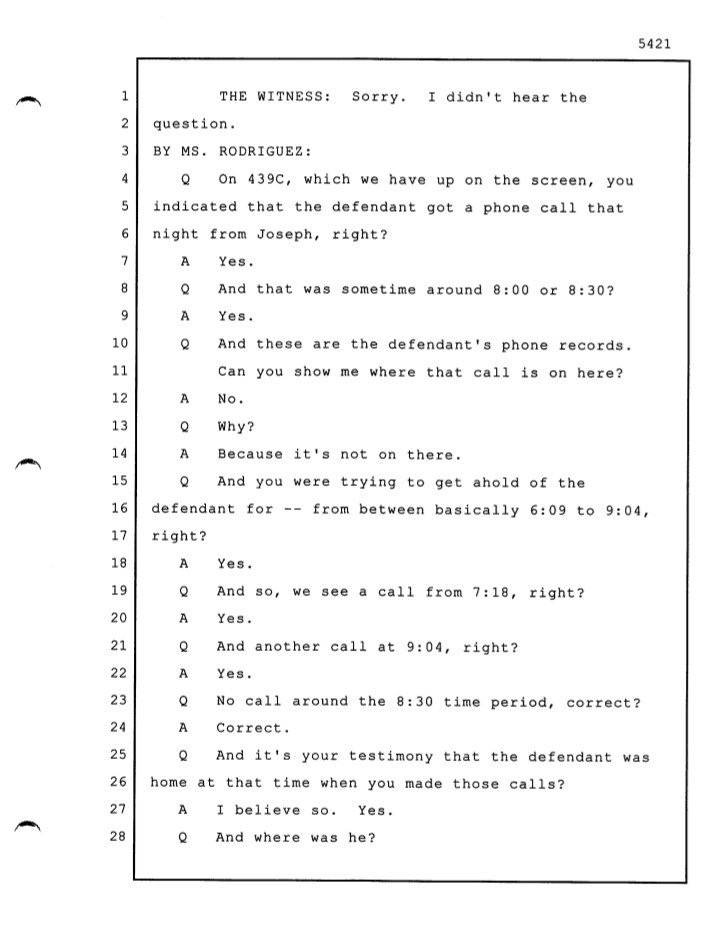
ADA Rodriguez: “And these are the defendant’s phone records. Can you show me where that call is on here?”
Ms. Jarvis: “No.”
ADA Rodriguez: “Why?”
Ms. Jarvis: “Because it’s not on there.”
(RT 5421:4-14.)
The call was not on my records because my records did not record it, not because it did not come in. Rodriguez put the absence to the jury as if it were proof.
“Never happened”
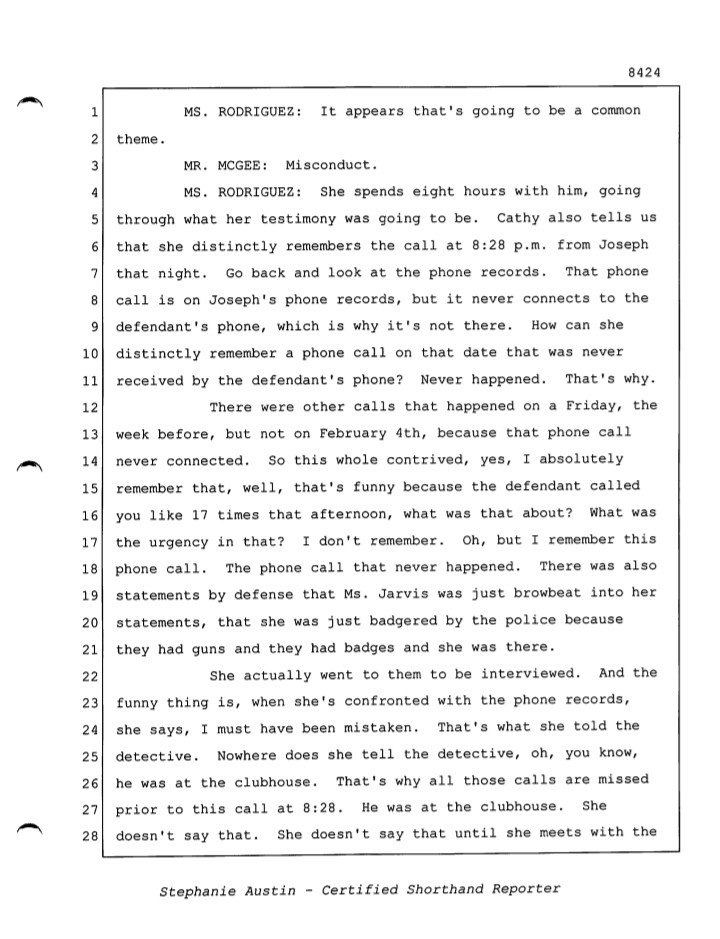
In rebuttal, ADA Rodriguez told the jury the call Cathy saw did not exist:
ADA Rodriguez: “Cathy also tells us that she distinctly remembers the call at 8:28 p.m. from Joseph that night. Go back and look at the phone records. That call is on Joseph’s records, but it never connected to the defendant’s phone. Which is why it’s not there. How can she distinctly remember a phone call on that date that was never received by the defendant’s phone? Never happened. That’s why.”
(RT 8424:5-11.)
See page 8424
The jury had heard otherwise, from the phone companies. T-Mobile’s custodian, asked by the Court about the 8:28 call on Joseph’s records:
The Court: “Is that the time of that last call is listed as one minute; is that right?”
Mr. Bostillo: “Yes, your Honor.”
The Court: “Does that — can you tell from that whether the call was answered or not?”
Mr. Bostillo: “Showing the one minute, it would either be answered, or it could have gone to voice mail.”
The Court: “Okay. But if it just rang and there was no voice mail, it would be something different?”
Mr. Bostillo: “It would show nothing because it has to — in order to record a duration, it has to be received.”
(RT 3588:21-3589:3.)
See page 3588
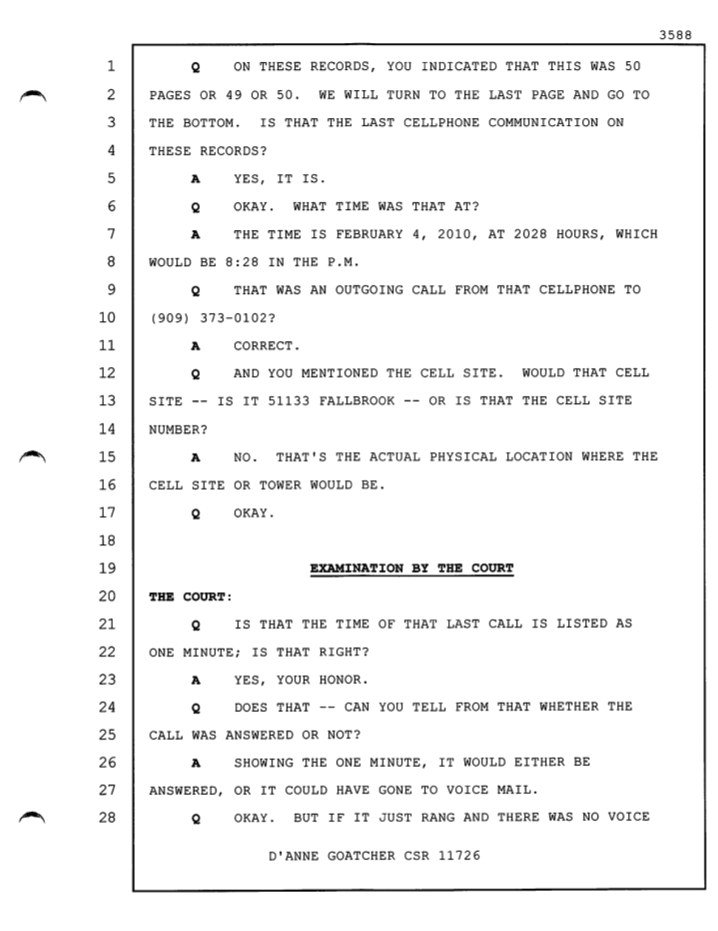
See page 3589
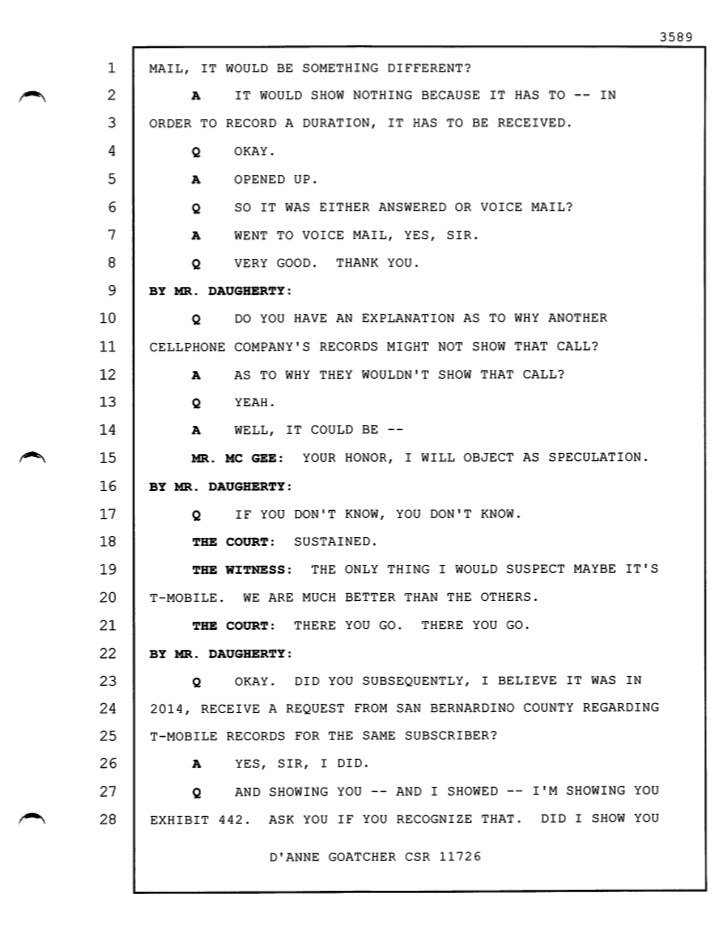
T-Mobile said the call was received: answered, or sent to my voicemail. AT&T’s custodian, asked by the Court, said what a received voicemail call leaves on the receiving phone’s records:
The Court: “All right. So if a cellphone is off, and someone calls that cellphone, obviously, it’s not going to ring or anything; correct?”
Mr. Lipnisky: “Correct.”
The Court: “But the call can still go to the voice mail; correct?”
Mr. Lipnisky: “Yes.”
The Court: “And someone calls, the phone is off, they leave a voice mail, would AT&T records for the receiving phone show that it received a call and a voice mail was left?”
Mr. Lipnisky: “Yes.”
(RT 3621:27-3622:9.)
See page 3621
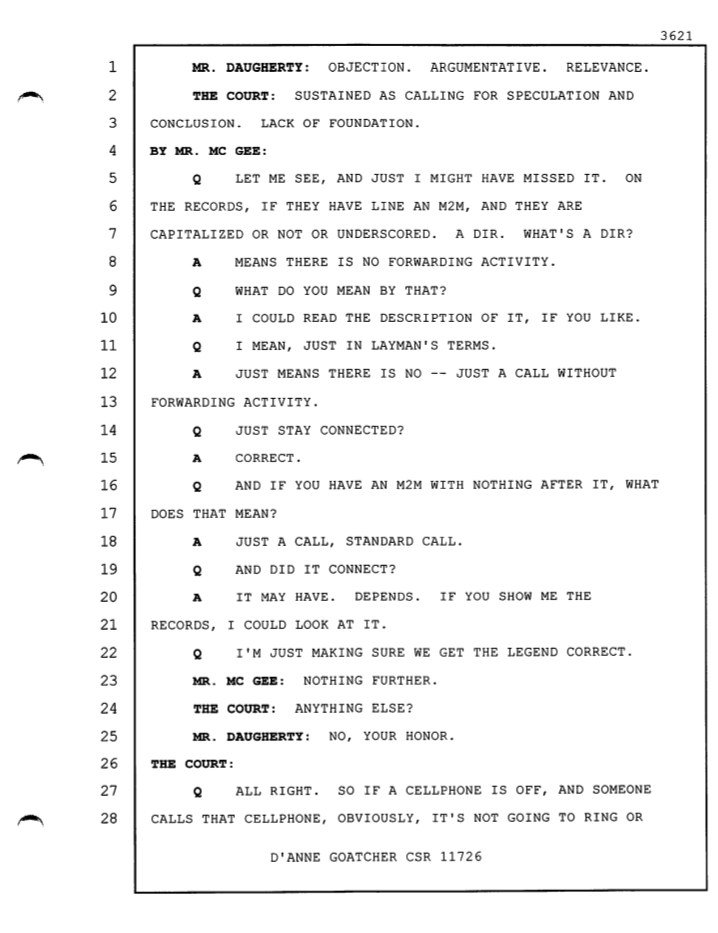
See page 3622
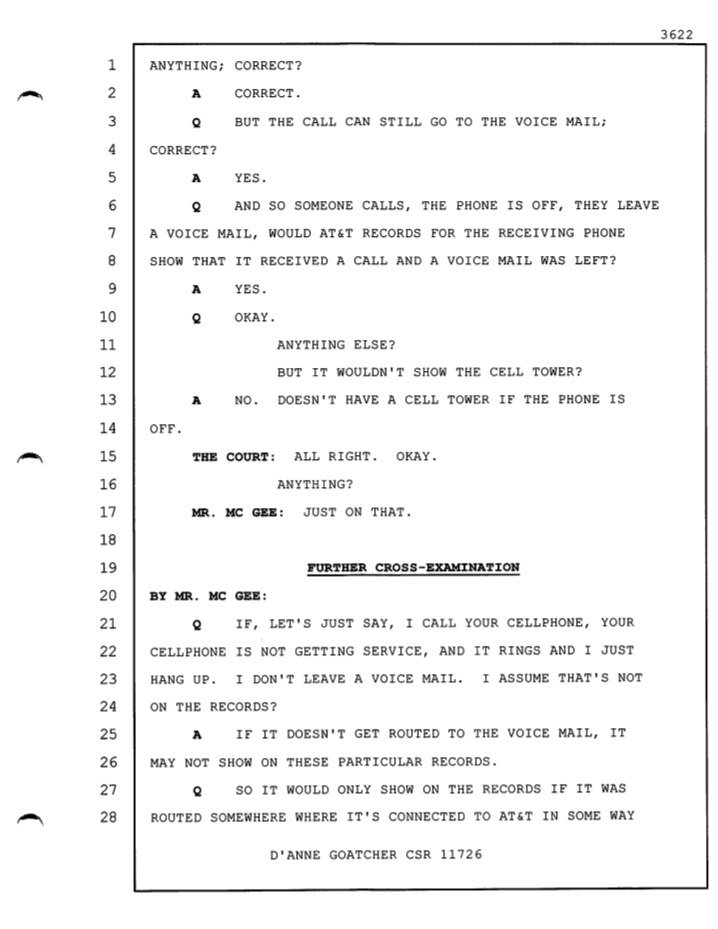
The carriers said the call was received. My records do not show it. Rodriguez told the jury the opposite of what both carriers had said: that the call “never connected” and “never happened.”
That is fraud, from the detective’s interview to the prosecutor’s last words to the jury. Bachman told a witness something his own report shows he knew was false. His follow-up report moved her answer to a different call. Rodriguez put that answer to the jury as covering all of Cathy’s calls, then told them the call Cathy saw never happened, against the testimony of both carriers.
“No corroboration”
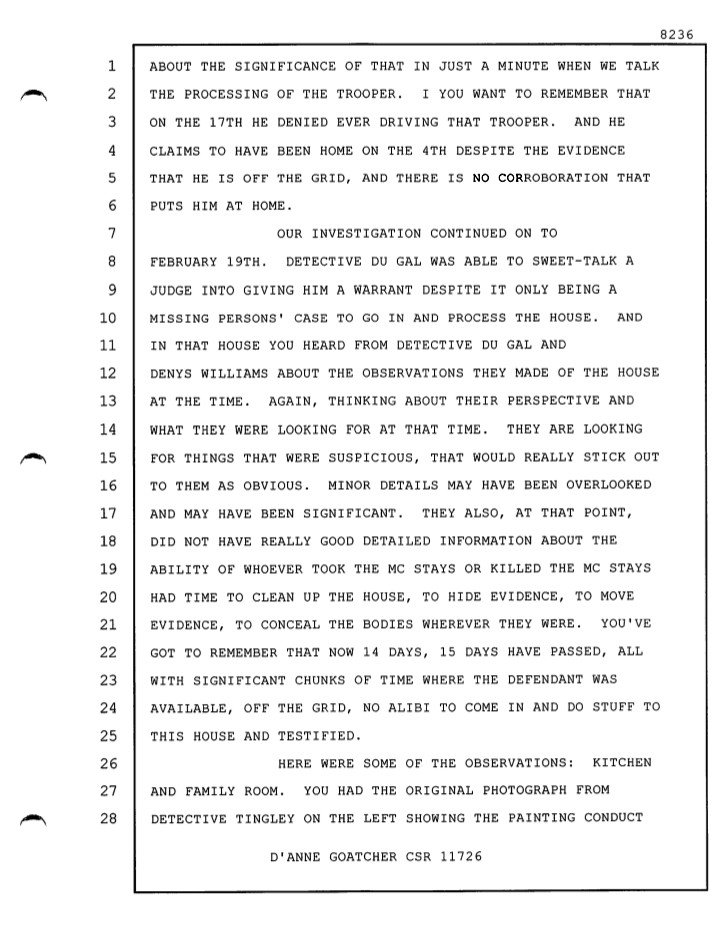
In closing, ADA Imes told the jury:
ADA Imes: “And he claims to have been home on the 4th despite the evidence that he is off the grid, and there is no corroboration that puts him at home.”
(RT 8236:3-6.)
See page 8236
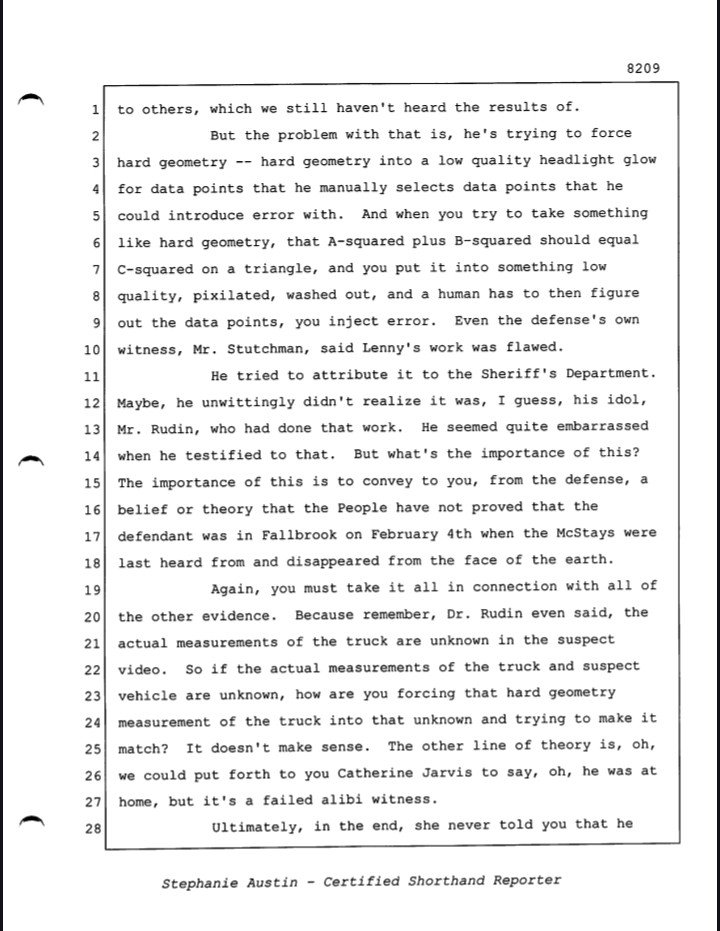
And:
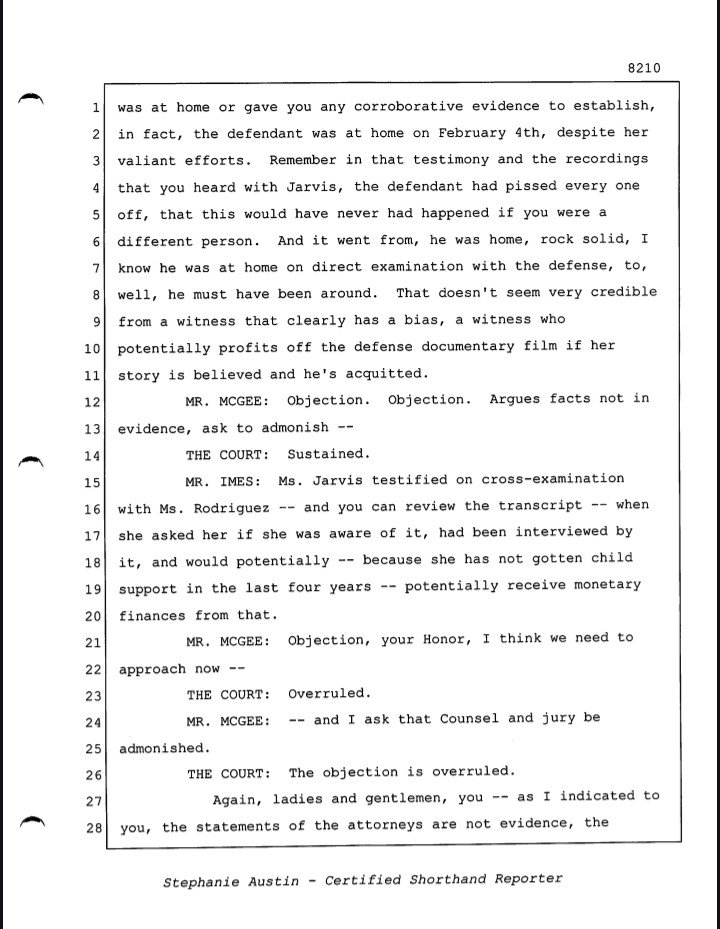
ADA Imes: “The other line of theory is, oh, we could put forth to you Catherine Jarvis to say, oh, he was at home, but it’s a failed alibi witness. Ultimately, in the end, she never told you that he was at home or gave you any corroborative evidence to establish, in fact, the defendant was at home on February 4th, despite her valiant efforts.”
(RT 8209:25-8210:3.)
See page 8209
See page 8210
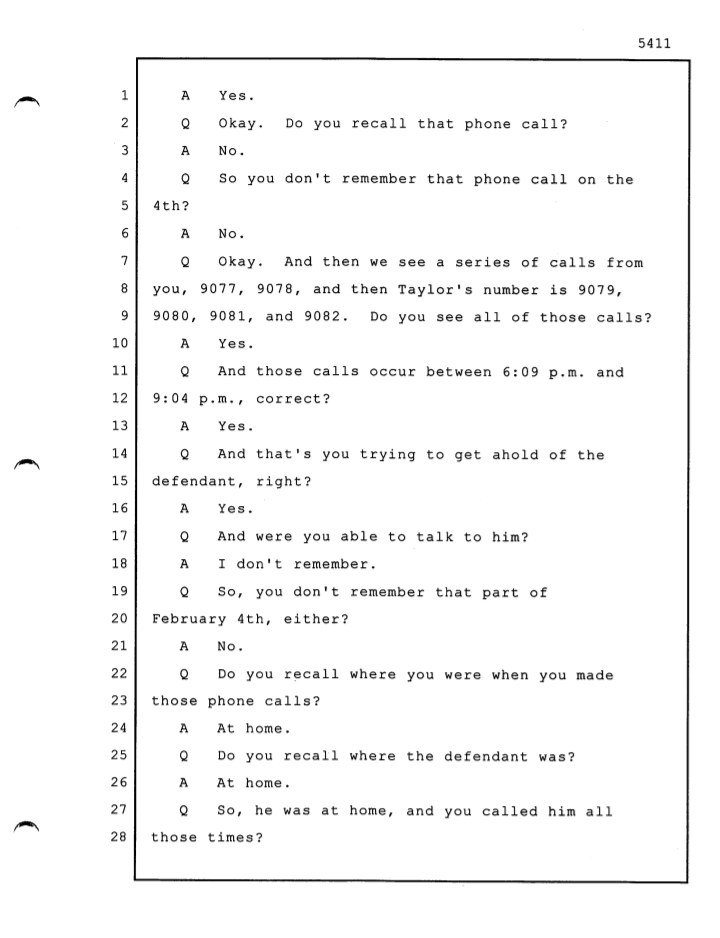
“She never told you that he was at home.” Here is what she told the jury, on cross-examination by the prosecution itself:
ADA Rodriguez: “Do you recall where you were when you made those phone calls?”
Ms. Jarvis: “At home.”
ADA Rodriguez: “Do you recall where the defendant was?”
Ms. Jarvis: “At home.”
ADA Rodriguez: “So, he was at home, and you called him all those times?”
Ms. Jarvis: “I believe so. Yes.”
ADA Rodriguez: “So, if you don’t remember these phone calls, how do you remember that he was at home?”
Ms. Jarvis: “Because I had a discussion with him that night about him not picking up his phone.”
(RT 5411:22-5412:5.)
ADA Rodriguez: “And it’s your testimony that the defendant was home at that time when you made those calls?”
Ms. Jarvis: “I believe so. Yes.”
ADA Rodriguez: “And where was he?”
Ms. Jarvis: “I don’t know. He could’ve been someplace else on the property.”
ADA Rodriguez: “Such as?”
Ms. Jarvis: “Such as the business center at the clubhouse.”
ADA Rodriguez: “So, for three hours, you’re trying to get ahold of him. But you couldn’t walk to the clubhouse that 256 feet?”
Ms. Jarvis: “I don’t believe he was gone that entire time. It was back and forth.”
(RT 5421:25-5422:9.)
See page 5411
See page 5412
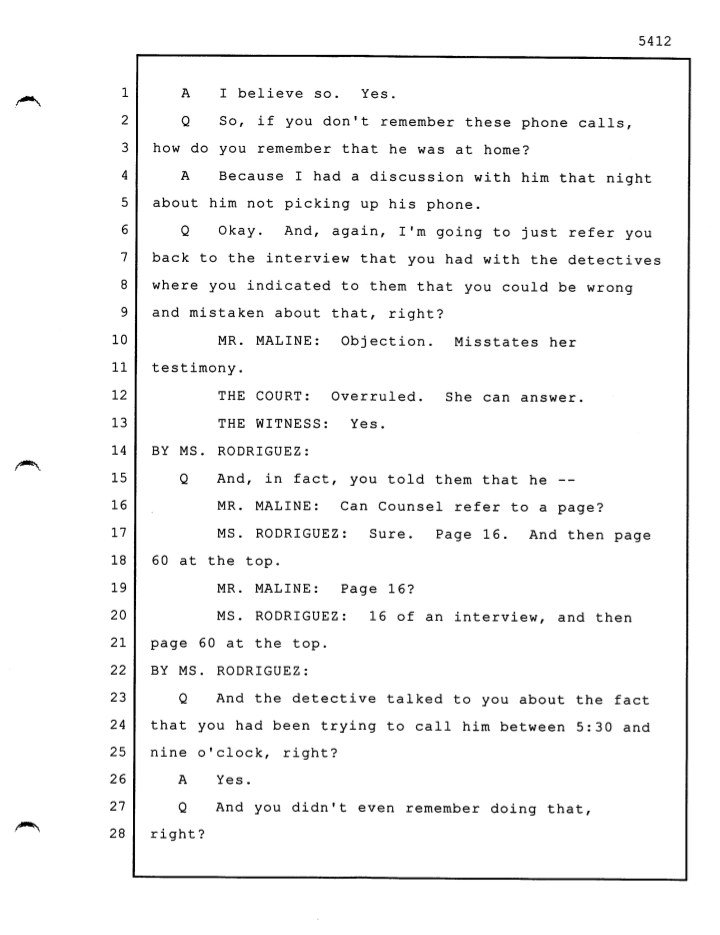
See page 5422
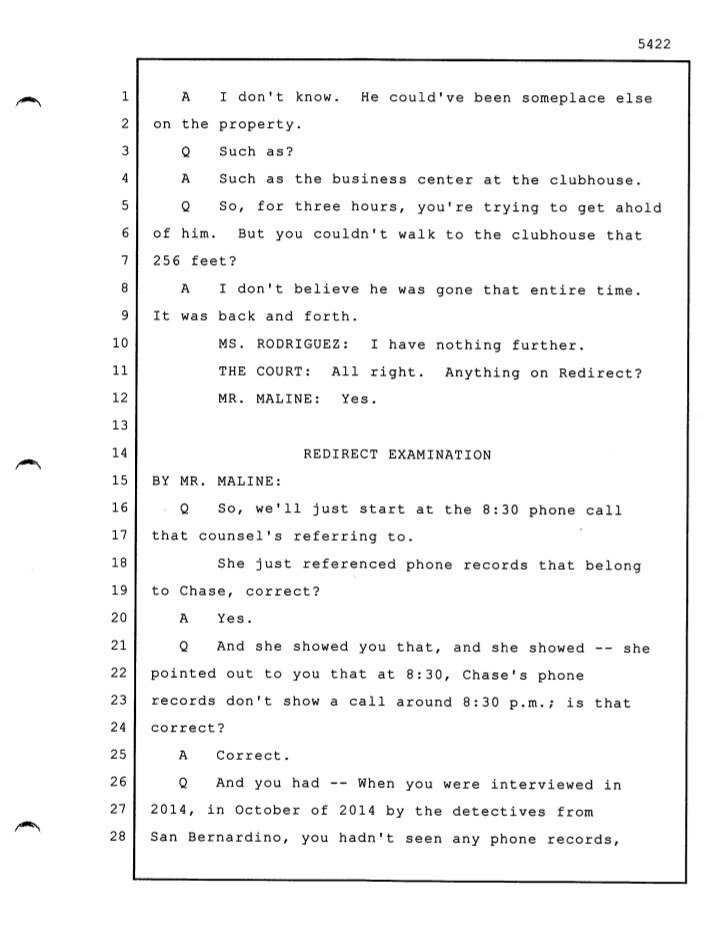
Imes then told the jury her story had changed:
ADA Imes: “And it went from, he was home, rock solid, I know he was at home on direct examination with the defense, to, well, he must have been around. That doesn’t seem very credible from a witness that clearly has a bias, a witness who potentially profits off the defense documentary film if her story is believed and he’s acquitted.”
(RT 8210:6-11.) McGee objected to the remark about the film, and the objection was sustained. (RT 8210:12-14.)
ADA Imes: “And you are free to review Ms. Jarvis’s testimony, at leisure, to see that conversation. If I was calling him, he must have not been at home when confronted by Ms. Rodriguez on cross examination about all those calls going to voice mail. Oh, wait a minute, that’s not he was at home, that’s not, well, maybe, he must have been home.”
(RT 8211:6-11.)
See page 8211
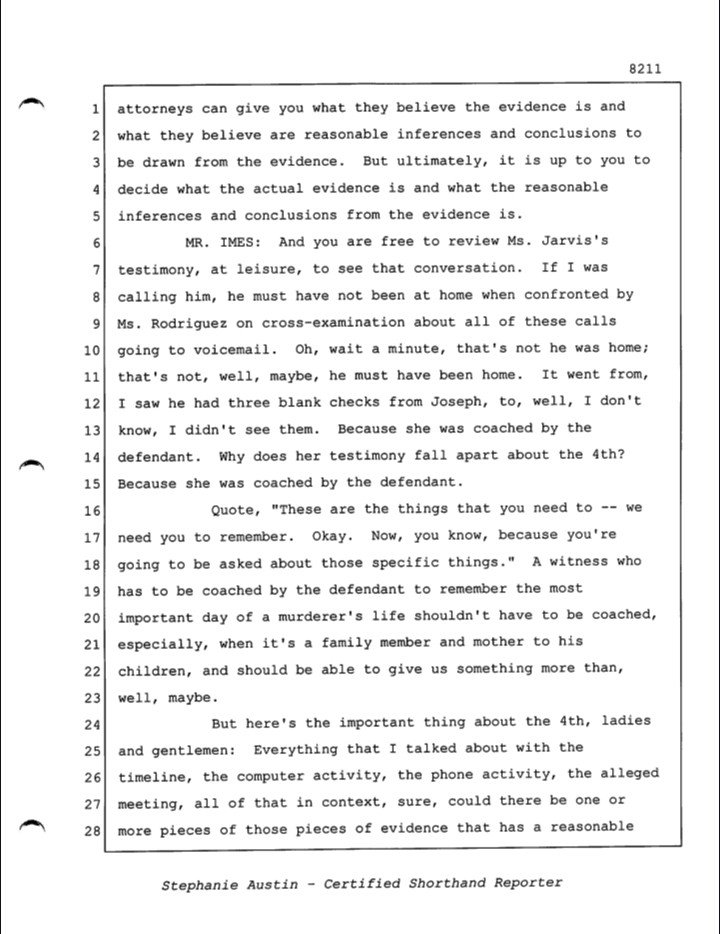
She never said “he must have been around.” She never said “if I was calling him, he must have not been at home.” Under the prosecution’s own cross she said “At home,” twice, and “back and forth” between home and a clubhouse 256 feet from our door. Imes invited the jury to review her testimony, then told them it said something it does not say.
She had said the same on direct: “Specifically, I don’t remember for sure if he went to the clubhouse. But he was home in the area that day.” (RT 5319:21-23.) She never once said I was not at home. She said I was not beside her while she was calling, because I was at the clubhouse, which is part of where we lived.
See page 5319
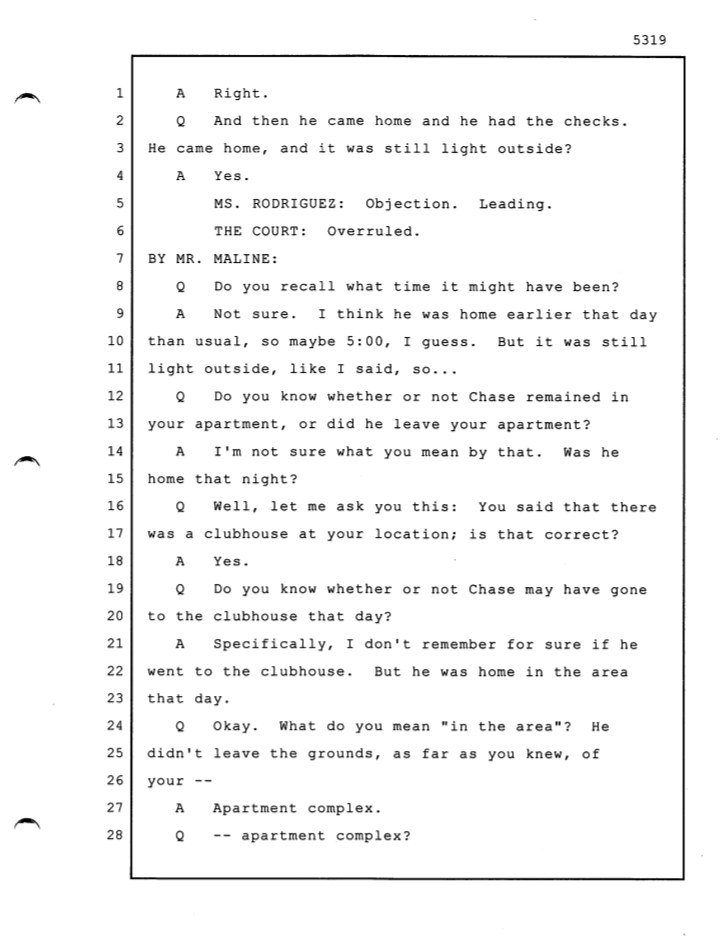
The corroboration that was there
Cathy was not alone. My daughter Taylor testified:
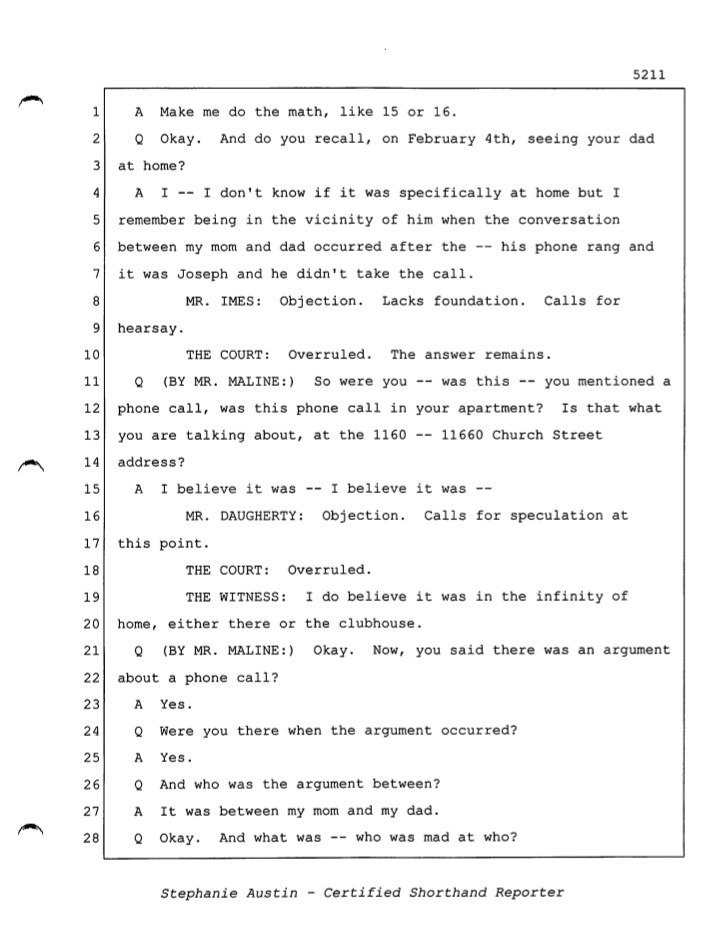
Mr. Maline: “Okay. And do you recall, on February 4th, seeing your dad at home?”
Taylor: “I — I don’t know if it was specifically at home but I remember being in the vicinity of him when the conversation between my mom and dad occurred after the — his phone rang and it was Joseph and he didn’t take the call.”
ADA Imes: “Objection. Lacks foundation. Calls for hearsay.”
The Court: “Overruled. The answer remains.”
Mr. Maline: “So were you — was this — you mentioned a phone call, was this phone call in your apartment? Is that what you are talking about, at the 1160 — 11660 Church Street address?”
Taylor: “I believe it was — I believe it was —”
ADA Daugherty: “Objection. Calls for speculation at this point.”
The Court: “Overruled.”
Taylor: “I do believe it was in the infinity [sic] of home, either there or the clubhouse.”
(RT 5211:2-20.)
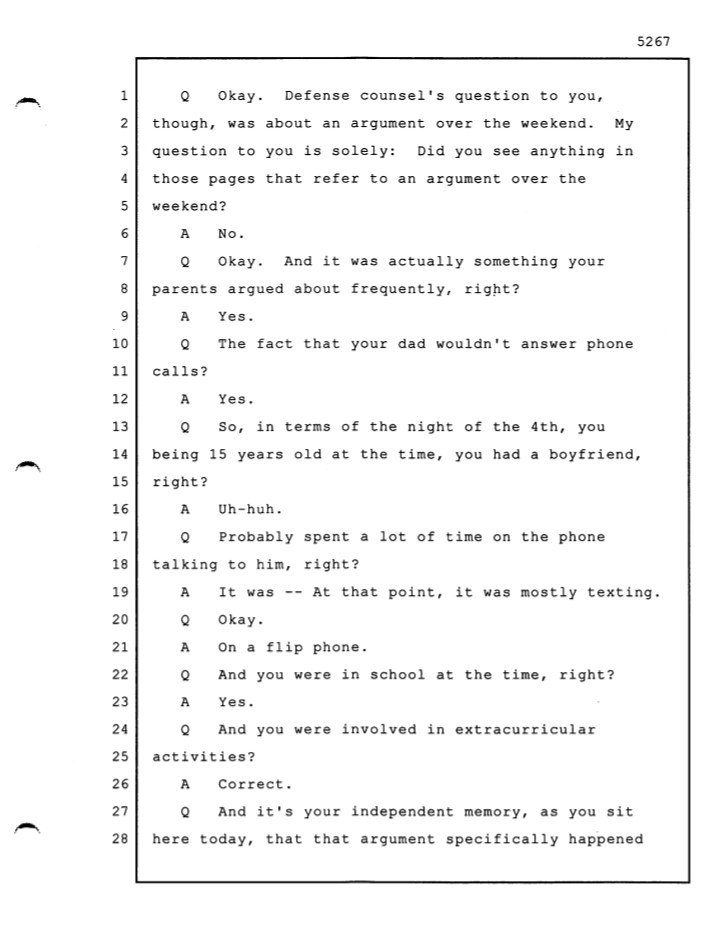
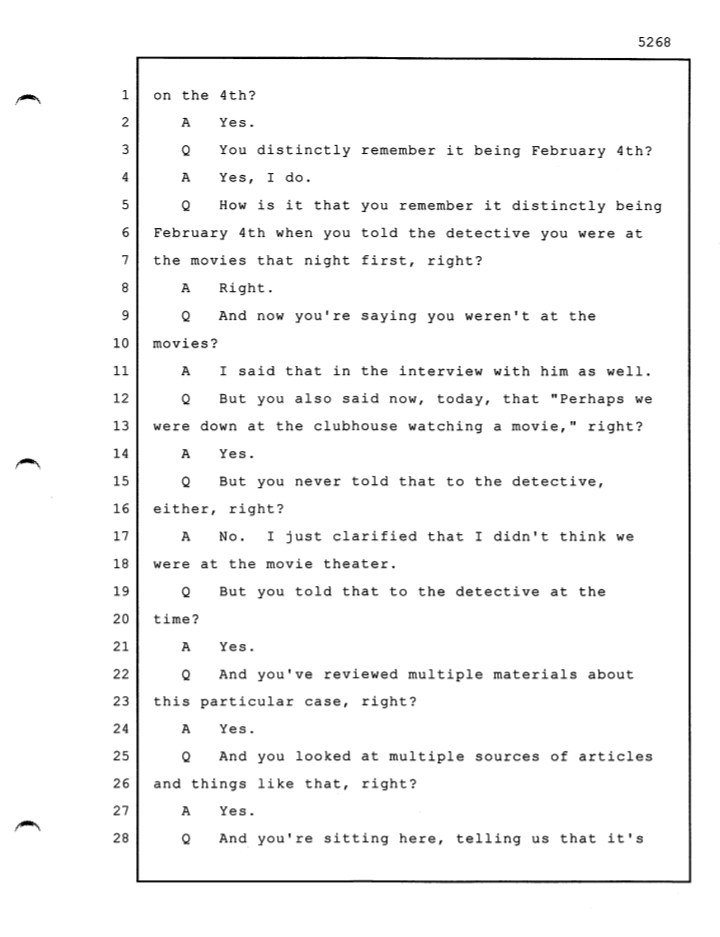
ADA Rodriguez: “And it’s your independent memory, as you sit here today, that that argument specifically happened on the 4th?”
Taylor: “Yes.”
(RT 5267:27-5268:1.)
See page 5211
See page 5267
See page 5268
Two witnesses put me at home when Joseph’s call came in. The carriers said that call was received. And the records Imes called “off the grid” showed something else he never mentioned: Cathy and I called each other when we were both at home, on the same home towers, again and again. On the morning of February 14, she called me six times between 9:35 and 9:46 a.m. None connected, and none shows a tower in my records, though every one shows a tower in hers. Between them, I checked my voicemail, and that call does show a tower. We were both at home. It is the evening of February 4 again, on a morning no one has ever claimed I was anywhere else. (See “Both at home?”)
“No corroboration” was false when Imes said it, and the evidence that made it false was in the State’s own exhibits.
Taylor
ADA Rodriguez then went after Taylor’s memory with a conversation Taylor never adopted and the recordings do not contain:
ADA Rodriguez: “And [he] specifically told you about the need to be at home on the night of the 4th because his phone was pinging off of a tower in the Riverside area, do you recall that part of the conversation?”
Taylor: “I don’t know if he said he needed to be home, but I remember talking in general about the phone towers.”
ADA Rodriguez: “You talked about the fact that McKinley was a big street; right?”
Taylor: “McKinley?”
ADA Rodriguez: “Or the street in Riverside?”
(RT 5248:28-5249:9.)
See page 5248
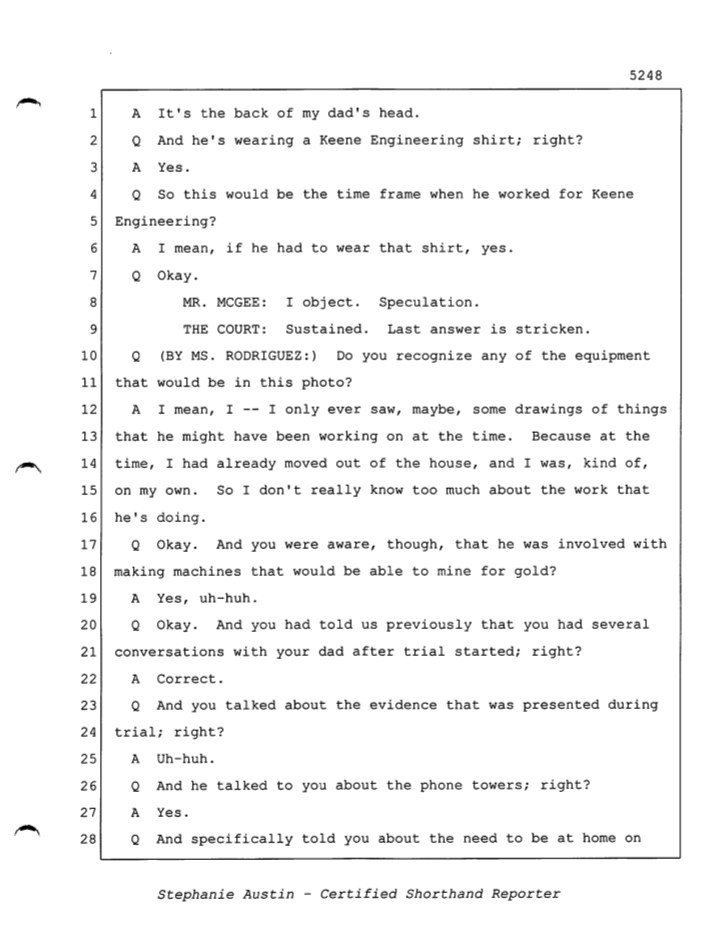
See page 5249
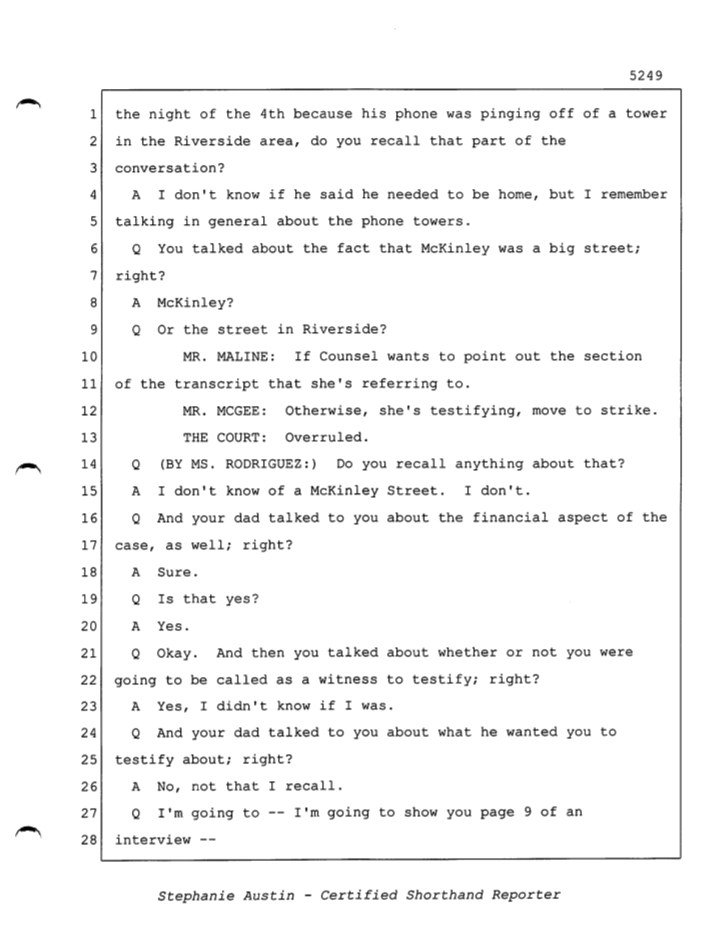
Taylor did not adopt it: “I don’t know if he said he needed to be home.” The recordings contain no such conversation. (Recorded calls, Chase Merritt and Taylor Jarvis.) And my phone never pinged in Riverside that night. The one call that reached a distant tower, at 9:32 p.m., hit a tower in Mira Loma. (RT 4529:4-6.) I never told Taylor I “needed to be at home” that night, and we never discussed a street called McKinley. The question put the conversation before the jury anyway, as if it were a fact, and no one objected.
See page 4529
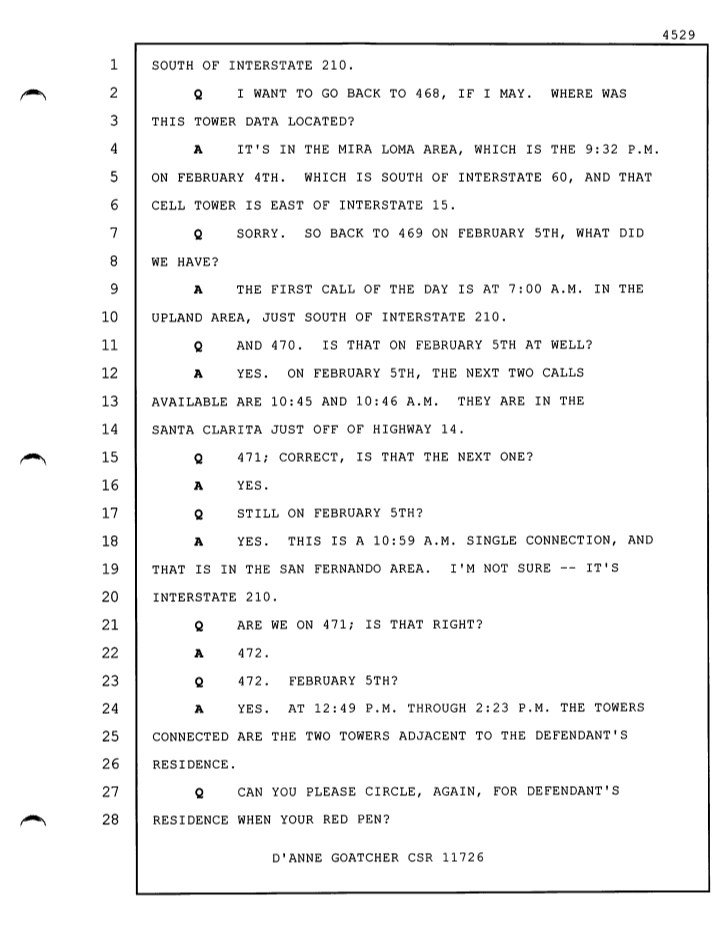
The word “Riverside” did its own work. The prosecution’s theory was that I spent that evening at the McStays’ home in Fallbrook and drove back afterward. A phone “pinging off a tower in the Riverside area” sounds like a phone on that road home. Put to the jury as something I had supposedly told my own daughter, it may well have made the 9:32 call look like exactly what the prosecution needed: me, on my way back from Fallbrook.
In their own file
For years before trial, I went through every line of Cathy’s phone records and mine. I found what the prosecution’s case against my alibi could not survive. Cathy and I called each other when we were both at home, on the same towers, again and again. My phone’s records lost calls that connected, including the 8:28 call from Joseph that Cathy watched come in. And the prosecution’s own expert had sworn, in another case, that the records cannot tell a phone that is off from one that is simply out of range. I wrote it all down in what my lawyers called my White Paper, gave it to them, and asked them, again and again, to put it in front of the jury.
They had it. On February 18, 2019, days before Agent Boles took the stand, my lawyers’ office typed it up from my White Paper after a meeting with me. The document is in my file:
“Notes on Agent Kevin Boles
Meeting with Merritt 2/18/2019 at 2:55pm
What to get out of Boles
Need to get Boles to admit that:
Cathy and Chase making calls both from home
Hitting on same tower – caller and receiver
See NOTES FROM MERRITT (White Paper)”
Image of the notes to be added.
It goes on. “Possible for Chase to receive a call but not be on his record,” followed by a list of calls between Joseph and me that appear on only one of our two bills, ending: “Phone can be on but not on the phone bill? Call on Feb 4th @ 8:28 p.m.” Then: “0.0 seizure time means the phone is OFF??” with the call numbers. Then: “Feb 4th @ 9:32pm hits towers in Mira Loma — Can be in Rancho?” and “Feb 10th – hit in Riverside — Hit in Rancho 1 min before.” And Boles’s own sworn testimony from another case, People v. Pape: “When you are looking at historical records, if someone’s phone is powered off or it is out of range, there is no way to really tell that.” (Pape, Grand Jury, 271:11-13.) “It typically means the phone is either powered down or it is in an area where there is no cell service.” (Id., 289:3-6.)
This was the most important evidence I had. It answered every pillar of the prosecution’s case against my alibi: that my phone was off, that the 8:28 call never happened, that nothing corroborated Cathy. It was the evidence that gave the jury a path to my innocence. This was a capital case. My life depended on whether the jury believed I was at home that night.
This document is the smoking gun. It turns every silence that followed into a choice, and every choice into intent. The proof runs in four links, and every link is in their own hand or on the record:
- They knew. The answer to the prosecution’s case against my alibi was typed into their own notes on February 18, 2019, days before Boles took the stand.
- They had the moment. Every claim those notes answered was made at trial, in front of them: my phone was off, the 8:28 call never happened, Cathy was a failed alibi witness with no corroboration.
- They did not use it where it counted. On the phone-off claim, not one February 4 call was put to Boles. On corroboration, the calls Cathy and I made to each other when we were both at home, on the same tower, never reached the jury as evidence. And when Rodriguez told the jury that every time my phone showed no tower I was on the phone with someone else, no one objected. (RT 8437:19-26.)
- They covered it up. After the verdict, McGee swore under oath that the calls showed “different azimuths” and that pursuing them was “a fruitless venture,” moments after testifying that he had the notes from our meeting. The notes say “same tower.”
That is how intent is proved: knowledge, opportunity, omission, and a false explanation afterward. A lawyer who writes down the answer, watches the moment come, says nothing, and then swears the answer was never there did not overlook it. He chose it. My lawyers did not fail to defend me. They deliberately left the prosecution’s case standing, knowing they held what would have knocked it down. They meant for this evidence to disappear, and they made sure it did.
McGee’s cross of Boles on the phone-off claim was real. He walked Boles through dozens of voicemail calls with no tower and got him to concede that “it’s possible that the phone was on.” (RT 4654:17-21.) Then he stopped at January 31, with “I have dozens more” (RT 4655:19), and never put a February 4 call to Boles, the evening my alibi turned on.
See page 4655
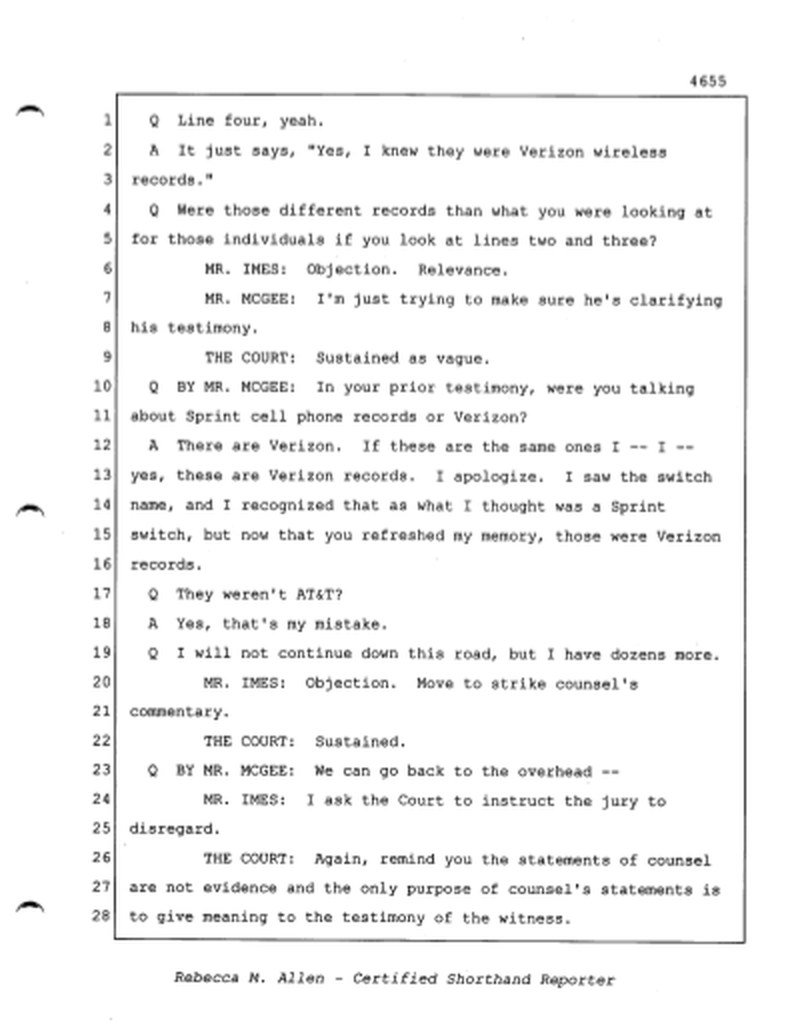
The calls Cathy and I made to each other when we were both at home were another matter. Maline told the jury in closing about “hundreds of calls” from the same tower, which he had never put into evidence and the jury could not weigh. Those calls answered “no corroboration,” and they never left the file.
Then the openings came, one after another. Each time, the prosecution or the circumstances handed my lawyers the moment to use what they had. Each time, they chose silence, or helped the prosecution.
When Rodriguez put Bachman’s concession to Cathy
ADA Rodriguez asked Cathy whether she had told detectives “that, maybe, it was a different night.” (RT 5356:11-13.) She put it as if it covered every call Cathy made to me that evening.
My lawyers had Cathy’s interview. They knew the only thing she had conceded was the 8:28 call, and only after Bachman told her the records put my phone away from the house, records his own summary says did not contain the call at all. They knew her answer about her calls to me had been “he oftentimes didn’t answer his phone.” (Jarvis Int. 59143, p. 38:11-22.) One objection, one question on redirect, and the jury would have seen how that concession was obtained and what it actually covered. They said nothing, and the jury was left to believe my alibi witness had already admitted she was wrong.
When the redirect explained away my calls
On cross, McGee walked Boles through dozens of calls from my records that went to voicemail and left no tower. On redirect, ADA Imes asked whether “a majority, if not all of them” showed “some type of cell phone activity occurring on the previous line,” and Boles said he recalled “some of those entries” did. (RT 4694:4-9.) In rebuttal, ADA Rodriguez told the jury that “every single time the defendant wasn’t connecting to a tower, he’s on the phone with someone else.” (RT 8437:19-26.)
Many of them did not. Boles had just agreed, call by call, that calls such as Joseph’s at 6:26 p.m. on January 5 came in with no tower, between two of his calls that registered on my home tower, with no other call on the line. (RT 4647:23-4648:1; AT&T item 8135.) Rodriguez’s “every single time” was false on the testimony the jury had just heard, and it went unanswered. And not one of the calls McGee put to Boles was from February 4. His cross ran through January 31 and stopped with “I have dozens more.” (RT 4655:19.) The evening that mattered was never put to the witness. The jury was left to believe it was the defense that had tried to mislead them.
When Imes said “the only reasonable interpretation”
In closing, ADA Imes told the jury that my phone going unanswered that evening had one meaning: “The only reasonable interpretation is that the phone was powered off or in airplane mode.” (RT 8199:7-13.) It was the foundation of the prosecution’s case against my alibi. If my phone was off, I was hiding. If I was hiding, Cathy was wrong, or lying.
My lawyers had two answers to it in their own file. The first was Boles’s own sworn testimony from another case: “if someone’s phone is powered off or it is out of range, there is no way to really tell that.” The prosecution’s own expert had already told another jury that the records could not do what Imes now told mine they did.
The second was the list of calls between Joseph and me that connected but appear on only one of our two bills. A call can go through and leave no trace in my records at all. A record that can lose an entire call cannot prove a phone was off. And it does more than that. It explains why Cathy could see Joseph’s name on my phone while my records show nothing: why her account was true and the records were not. It was the evidence that would have let the jury believe her.
The jury was instructed that if the evidence allowed two reasonable conclusions, one pointing to innocence, they had to accept that one. (CALCRIM 224.) This was the evidence that gave them the second conclusion. When Imes told them there was only one, my lawyers did not object, did not call a witness, and did not answer him in their own closing. The path to my innocence stayed in their file.
When Rodriguez said the 8:28 call “never happened”
In rebuttal, ADA Rodriguez told the jury the call Cathy saw “never connected to the defendant’s phone. Which is why it’s not there. … Never happened. That’s why.” (RT 8424:5-11.)
T-Mobile’s custodian had already told the court that a one-minute call “has to be received.” (RT 3588:21-3589:3.) And my lawyers’ own notes asked the exact question the jury needed answered: “Phone can be on but not on the phone bill? Call on Feb 4th @ 8:28 p.m.” They had the list of other calls that connected and never appeared on my bill. They had the answer to “never happened” written down before trial testimony on it began. The last thing the jury heard about the call that put me at home was that it never existed, and my lawyers let that be the last word.
When Imes called Cathy a failed alibi witness
ADA Imes told the jury “there is no corroboration that puts him at home” (RT 8236:3-6), that Cathy was “a failed alibi witness” (RT 8209:25-8210:3), and that her testimony “doesn’t seem very credible from a witness that clearly has a bias” (RT 8210:8-9).
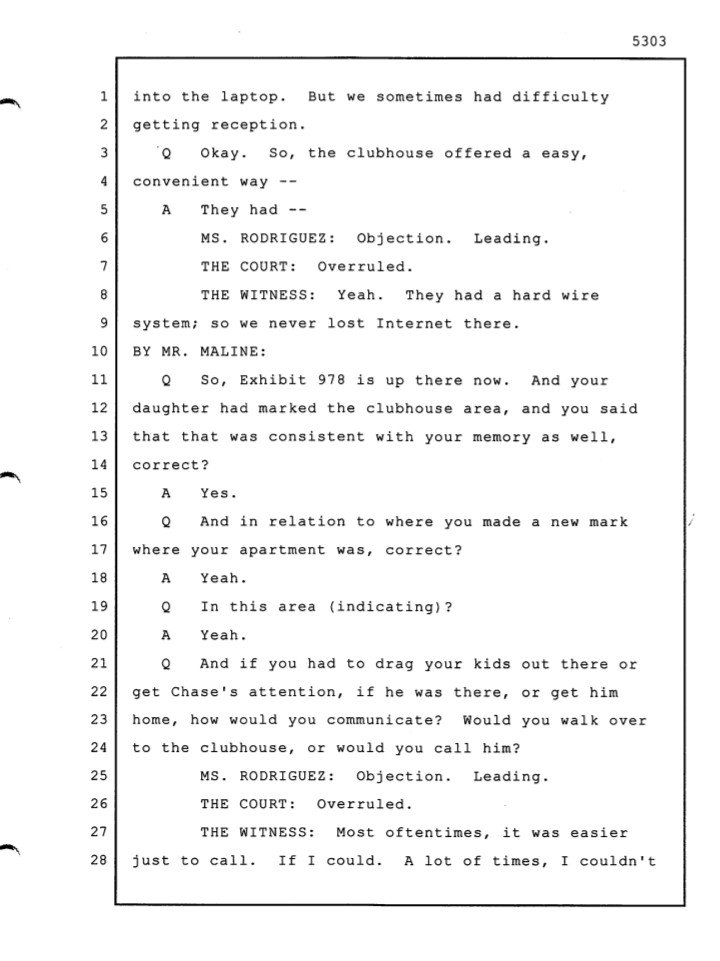
The corroboration was in my lawyers’ notes: “Cathy and Chase making calls both from home. Hitting on same tower – caller and receiver.” It was in the AT&T records, call after call, Cathy and me on the same home towers while we were both at home. On the morning of February 14, she called me six times in eleven minutes, every call to voicemail, none with a tower in my records, while we were both at home: the evening of February 4, repeated on a morning no one has ever claimed I was anywhere else. Maline even drew out from Cathy why she called instead of walking over:
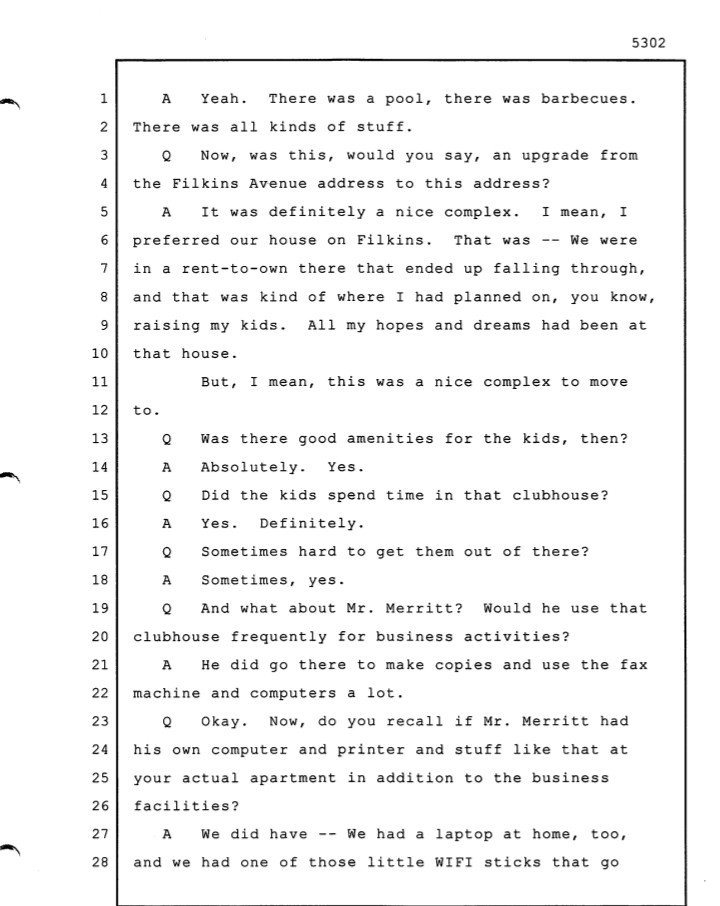
Mr. Maline: “And if you had to drag your kids out of there or get Chase’s attention, if he was there, or get him home, how would you communicate?”
Ms. Jarvis: “Most oftentimes, it was easier just to call. If I could. A lot of times, I couldn’t get ahold of them that way, so I would end up walking over there and seeing what they were doing or when they were coming home.”
Mr. Maline: “And why would it be difficult to sometimes call him there?”
Ms. Jarvis: “I don’t know. It just — it was bad reception.”
(RT 5303:21-5304:8.)
See page 5303
See page 5304
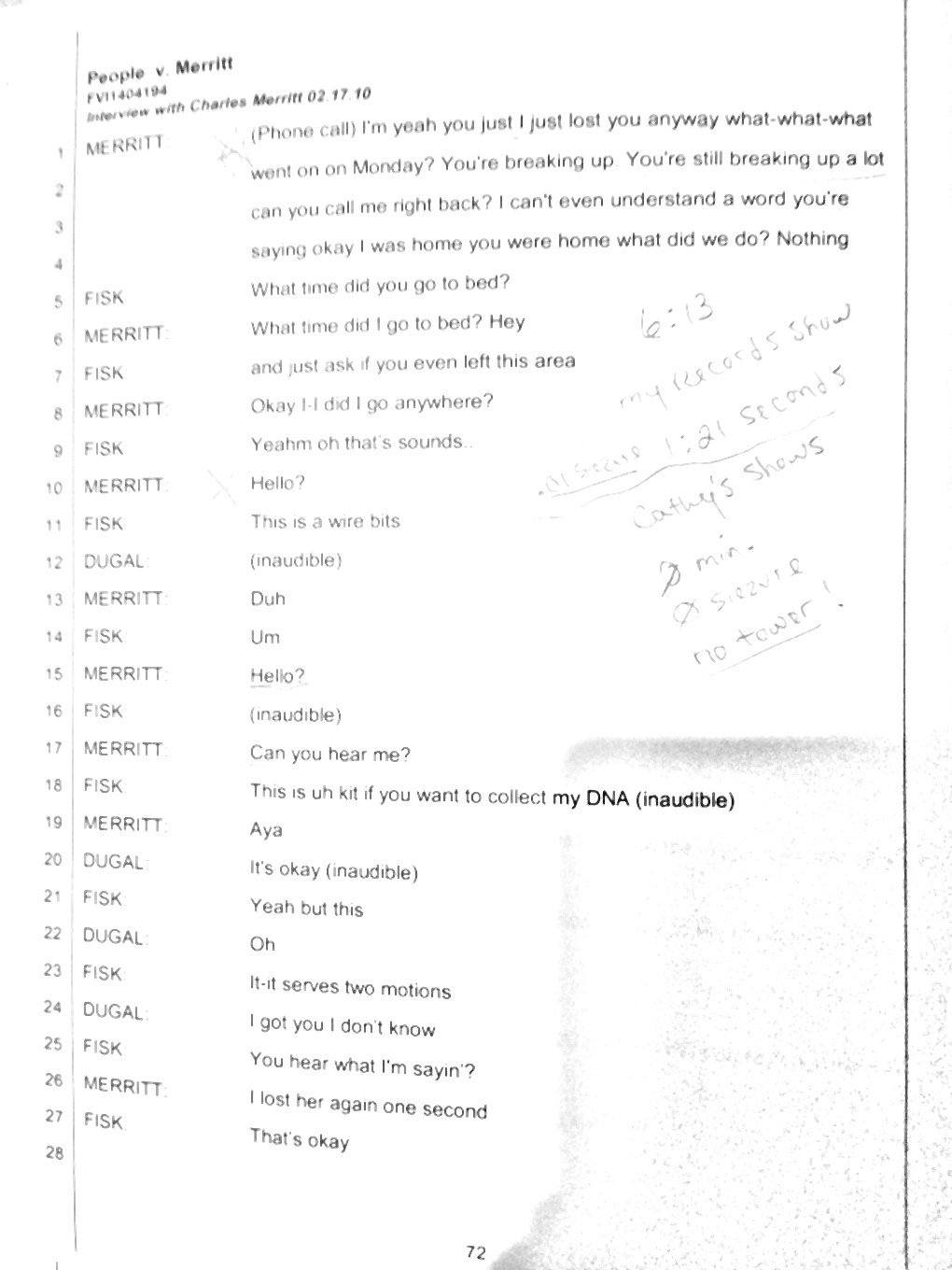
The jury had already heard that bad reception on a recording. My first interview with detectives was held in that same clubhouse, and when a detective asked me to call Cathy, the call broke up: “Hello, — Hello, — Can you hear me? Aya. — I lost her again.” (Merritt Int. 2/17/10, p. 72.) No one pointed the jury to it.
See interview page 72
Instead, Maline described the calls in closing, without the evidence behind them:
Mr. Maline: “The phone records for Mr. Merritt — you will see the same home tower that Kevin Boles testified about. The home tower. There’s is hundreds of calls between Chase and Cathy that ping off the same tower. Those are logical calls that Chase, or the kids or whatever are in the clubhouse. There was — there is a long history of calls being made from the same location.”
(RT 8372:13-21.)
See page 8372
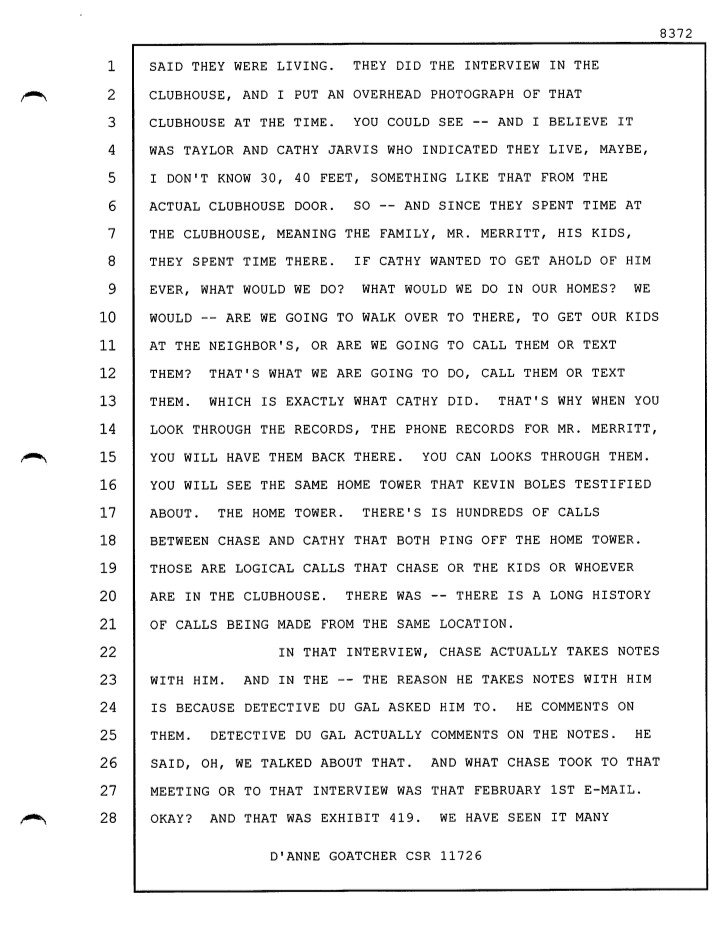
The jury had been told that what lawyers say in closing is not evidence. Hundreds of calls, never shown to them, described in argument: they could only take his word for it, or go through thousands of lines of records themselves. Maline knew what the calls proved. He said so to the jury. He never let them see it. And when Imes stood up afterward and told them there was no corroboration, there was nothing in evidence to prove him wrong. My lawyers made sure of that.
When Rodriguez put a conversation to Taylor that never happened
ADA Rodriguez asked my daughter whether I had told her about “the need to be at home on the night of the 4th because his phone was pinging off of a tower in the Riverside area,” and about “McKinley.” (RT 5248:28-5249:9.) I never told her that, the recordings contain nothing like it, Taylor did not adopt it, and my phone never pinged in Riverside that night. My lawyers’ own notes said where the 9:32 call went: “hits towers in Mira Loma.” They did not object, and they did not correct it.
When McGee handed Boles “18.8 by Google”
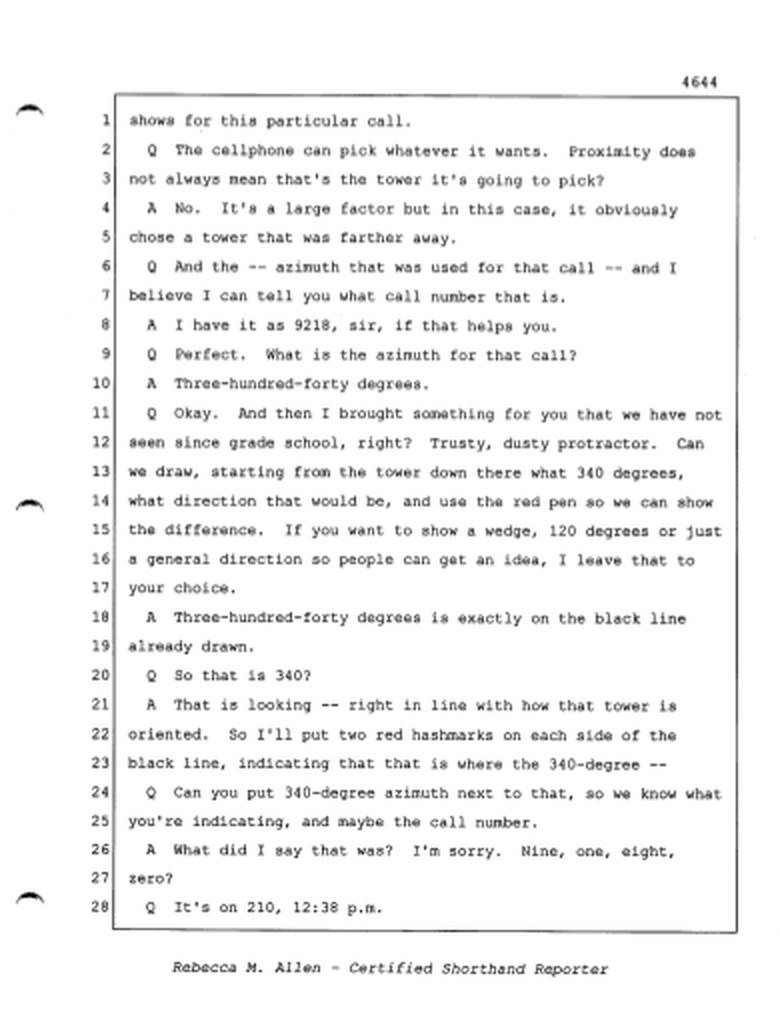
This one was not silence. My lawyers’ notes said of February 10: “hit in Riverside — Hit in Rancho 1 min before.” One minute. They knew what that meant before Boles took the stand. At trial, McGee prepared his own map placing that call near Lake Mathews, handed Boles the distance, “18.8 by Google?”, and had him call it one of the “fliers.” (RT 4642:27-4644:5.) The impossibility in their own notes became, through my own lawyer, an ordinary connection. (See “The (impossible?) call.”)
See page 4642
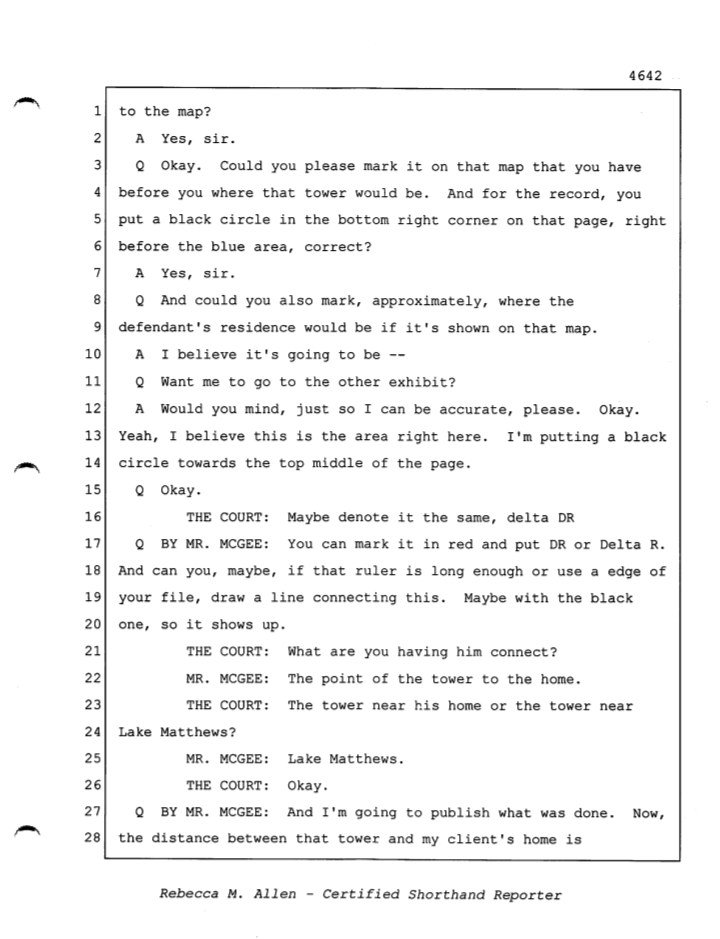
See page 4643
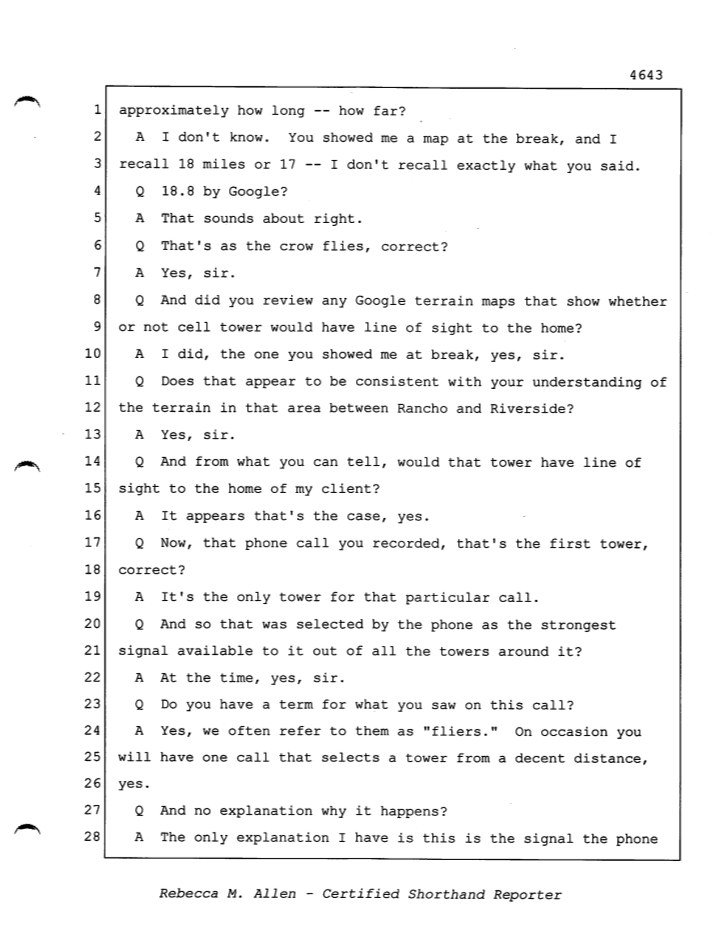
See page 4644
What McGee swore afterward
At the motion for a new trial, McGee testified about the evidence I had given him:
McGee: “There was the demand by Chase to try to push forward the error in the cell tower records to the effect — an example, he kept saying him and Kathy would call each other from home, but they would show up on different azimuths during the call. I would tell him that we can’t really address that because we don’t have testimony that you can say on this exact call, this exact date you can say where you were and she can say where she was, because it — they were just random days. There were no days locked into anything. That became — as I expressed to him that would be a fruitless venture to go down that road to try to prove it that way.”
(RT 8920:19-8921:1.)
See page 8920
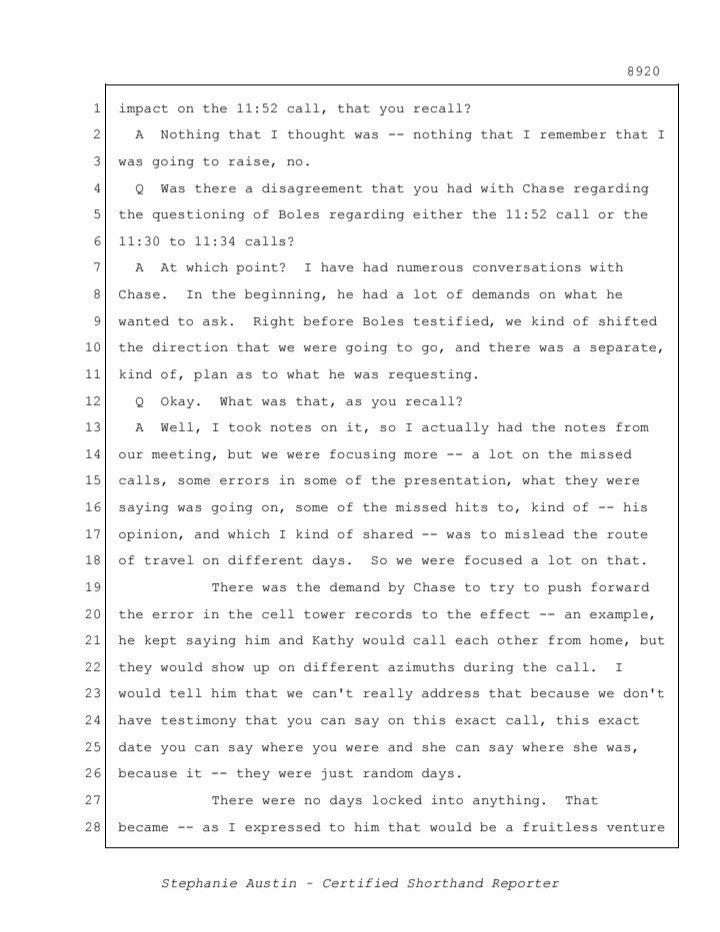
See page 8921
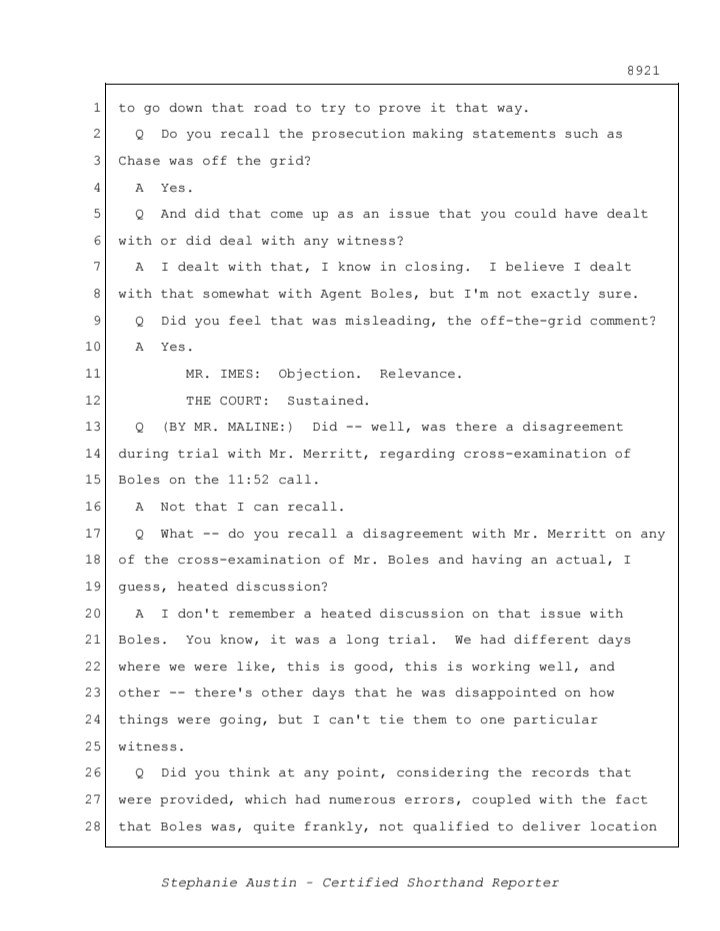
Moments earlier, he had testified: “I took notes on it, so I actually had the notes from our meeting.” (RT 8920:13-14.) He did. They say “Hitting on same tower – caller and receiver.” Not “different azimuths.” Under oath, with his own notes in his file, McGee told the court the evidence showed the opposite of what his notes record, and called it “a fruitless venture.” And the point was never what Cathy and I did on one particular day. It was that we called each other routinely when we were both at home, which is exactly what the prosecution told the jury we would not do.
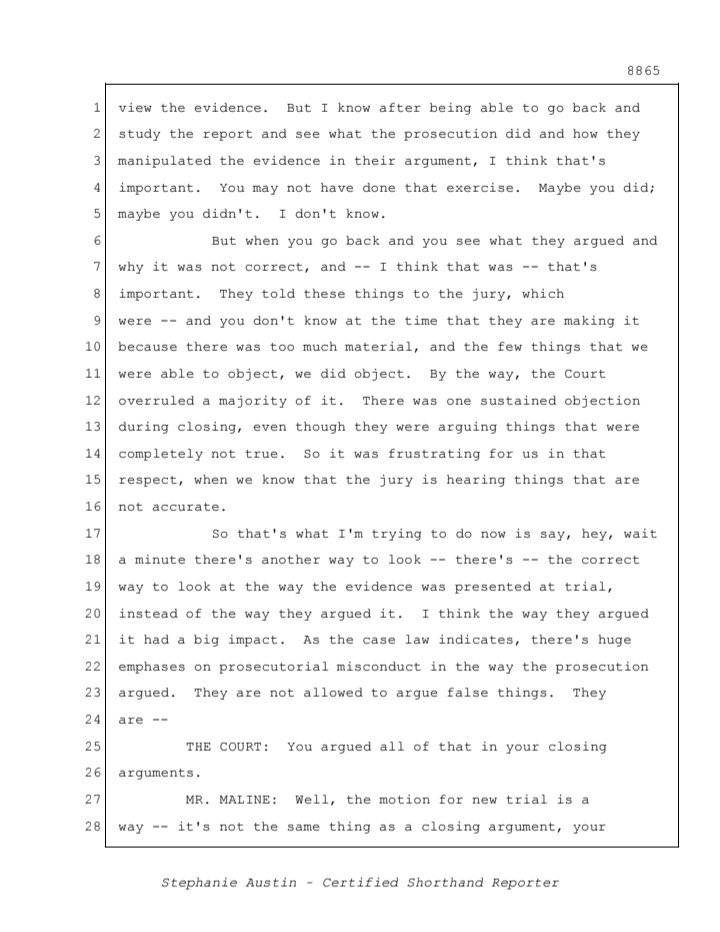
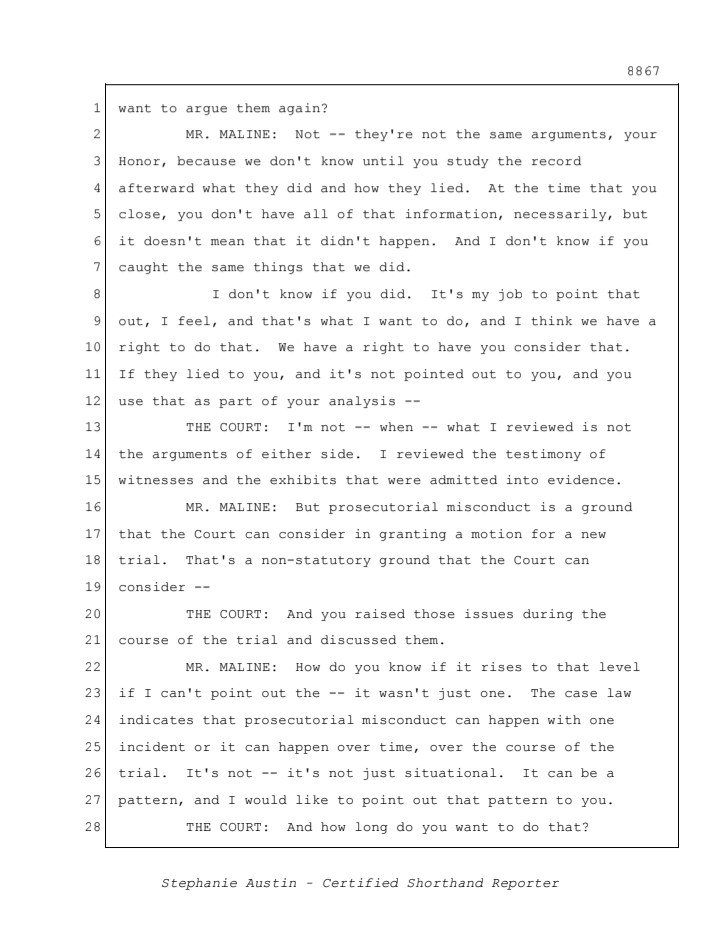
Maline, who had described those same “hundreds of calls” on “the same tower” to the jury, sat through the testimony and did not correct it. He gave the court his own explanation instead:
Maline: “They told these things to the jury, which were — and you don’t know at the time that they are making it because there was too much material…”
(RT 8865:8-10.)
Maline: “…because we don’t know until you study the record afterward what they did and how they lied. At the time that you close, you don’t have all of that information, necessarily, but it doesn’t mean that it didn’t happen.”
(RT 8867:3-6.)
See page 8865
See page 8867
They did know. It was typed in their own notes on February 18, 2019. That is fraud: the evidence held, the duty and the chance to use it, the choice to bury it, and a sworn account afterward that made it disappear.
Who it served
The prosecution had these records longer than anyone. It held Joseph’s phone records and mine side by side for years, and in them was call after call that appears on one bill and not the other. It heard T-Mobile’s own custodian tell the court that the 8:28 call, at one minute, “has to be received.” Then it told the jury that call “never happened,” and that the only reasonable reading of an unanswered phone was a phone turned off.
My lawyers had the same evidence, from me, typed into their own notes. McGee took the voicemail calls as far as January 31 and no further. The calls Cathy and I made to each other when we were both at home, hitting the same tower as caller and receiver, never reached the jury as evidence.
The prosecution hid it by arguing past it. My defense hid it by never putting it before the jury. Whether by direction or by choice, the result was the same, and it served one side only. Every decision my lawyers made about February 4 and the calls Cathy and I made when we were both at home benefited the prosecution. Not one benefited me.
The Court
The evidence that answered both of the State’s claims came out in answer to the Court’s own questions. Neither the prosecution nor my defense asked AT&T or T-Mobile about voicemail calls or the 8:28 call. Judge Smith did.
He asked T-Mobile whether the 8:28 call was received, and was told a one-minute call “has to be received.” (RT 3588:21-3589:3.) He asked AT&T what happens when a call goes to voicemail:
The Court: “All right. So if a cellphone is off, and someone calls that cellphone, obviously, it’s not going to ring or anything; correct?”
Mr. Lipnisky: “Correct.”
The Court: “But the call can still go to the voice mail; correct?”
Mr. Lipnisky: “Yes.”
The Court: “And someone calls, the phone is off, they leave a voice mail, would AT&T records for the receiving phone show that it received a call and a voice mail was left?”
Mr. Lipnisky: “Yes.”
(RT 3621:27-3622:9.)
And he heard AT&T say: “Typically, there is no cell data on the voice mail calls.” (RT 3614:11-12.)
The Court knew, from testimony it had drawn out itself, that a call with no tower was what a voicemail call ordinarily looks like, and that the 8:28 call had connected. Then it heard Imes tell the jury that “the only reasonable interpretation is that the phone was powered off or in airplane mode,” and Rodriguez tell the jury the 8:28 call “never happened.” Answering that was my lawyers’ job, by objection, and they made none. So the Court that had drawn out the answers heard both claims go to the jury unchallenged.
Every hand
Put it together. A detective told my alibi witness the records put my phone away from home, when his own report says the call was not in my records at all. His follow-up report moved her answer to a different call. A prosecutor put that answer to the jury as if it covered every call that night. Another told the jury Cathy never said I was home, when she said it twice under the prosecution’s own questioning. The prosecution’s expert said no tower meant my phone was off, then said he needed to ask AT&T, after AT&T had already said otherwise in the same courtroom. In closing, the prosecutors told the jury the only reasonable reading was a phone turned off, and that the call Cathy saw never happened.
My own lawyers held the records that answered all of it. They described the calls Cathy and I made when we were both at home in closing, and never showed them to the jury. One of them swore afterward the records showed something they do not. The Court drew out the testimony that contradicted the prosecution’s closing, then heard the closing go to the jury unchallenged.
Every lawyer and witness in that courtroom with a duty to correct the record either failed to, or advanced the false version. The Court, which had drawn out the truth itself, heard it all go to the jury unchallenged. No one has answered for any of it. The record does not say why. It does raise the question: was it coincidence, or collaboration?
← Back to Advocates or puppets? (Opportunity)