The Mitchley Video and the Identification of My Truck
Where I state what a witness, a prosecutor, or the court said, I am quoting the Reporter’s Transcript (“RT”), cited by page and line so that anyone can check it. Where I describe a document, I cite its Bates number. Where I describe my own truck or my own conversations with my trial counsel, I state what I know personally.
A. What this is about
The State charged that the McStay family was killed on the evening of February 4, 2010, and it fixed a narrow window of time for the murders. I was not at the McStay home during that window. Catherine Jarvis saw me elsewhere, and her account is corroborated by the 8:28 p.m. call from Joseph McStay’s phone, the same call the State sought to erase, and by her daughter’s independent recollection.
That night, a home security camera belonging to Jennifer Mitchley, who lived across the street from the McStays in Fallbrook, recorded a vehicle passing on the street at 7:48 p.m. That recording, called the Mitchley video throughout the trial, together with expert testimony claiming to read it, was the whole of the State’s effort to place my Chevrolet truck at the McStay residence.
The truck was not one piece of the State’s case among many. It was the State’s only physical answer to where I was. My counsel told the jury so in terms the State never disputed: the case “comes down to the truck,” and “if it’s not his truck, you can’t convict him” (RT 8407:18-25).
The evidence did not support the identification. It defeated it, from every direction at once. Among the qualified experts who examined the Mitchley video, the result was consistent and ran one way:
- Dr. Leonid Rudin, the State’s own retained expert of approximately four years, rejected my truck, because placing it in the video created a physical impossibility. That reversed the position he had given at the earlier Evidence Code section 402 hearing, and it went against the party that had hired him.
- Gregg Stutchman, the defense forensic video analyst, independently excluded my truck on two separate grounds.
- Eugene Liscio, whom the State brought in mid-trial after Rudin’s reversal, could say only that the vehicle was “consistent with” a Chevrolet truck. He conceded that he could not make an identification, and that the distinguishing features an identification would require cannot be seen in the video at all.
Unable to prove the identification through the evidence, the State supplied it through argument. The prosecutor presented Liscio’s speculation to the jury as established fact, and urged the jury to find the truck was “in fact, the defendant’s truck,” the exact identification Liscio testified he could not make. Two prosecutors told the jury that the defense expert had called Rudin’s work “flawed” and had “flip-flopped” into praising Rudin as a “creative genius,” statements the witness refused to make under oath and that appear nowhere in any testimony. And throughout the cross-examination of the defense expert, the prosecutor put facts before the jury through the form of his own questions: pointing at the screen to confirm features the witnesses had testified could not be seen, and asserting a federal requirement that does not exist.
The trial court overruled defense objections to speculative testimony, sustained prosecution objections that cut off the cross-examination designed to expose the contradiction at the center of Liscio’s opinion, and commented before the jury in terms that favored the prosecution’s characterization. My trial counsel, for the reasons I set out in Section G, did not take certain steps that were available.
These things did not happen in isolation. At the same time the State was supplying my presence at the McStay home through argument, it was working to destroy the alibi evidence that placed me elsewhere, and it obtained instructions telling the jury that the specific time my alibi covered did not matter.
B. What the experts actually said
Three witnesses with the qualifications to analyze the Mitchley video addressed whether the vehicle in it was my truck. The State’s own retained expert rejected it. The defense expert excluded it. The expert the State substituted mid-trial declined to make the identification at all, and conceded that the features any identification would require cannot be seen in the video.
B.1. The State’s own expert, Dr. Rudin, rejected my truck.
Dr. Leonid Rudin was the State’s retained photogrammetry expert and had worked on the case for approximately four years. By the time he testified at trial, he did so as a defense witness, and the jury was not told the chronology of how the State’s long-retained expert came to testify for the defense (Section E). At the pretrial section 402 hearing, his position was that he could not reject my truck. By the time he testified before the jury, his analysis had moved to a rejection, and he explained why, step by step.
The reason was a physical impossibility in the geometry. The feature Rudin had been asked to locate was my truck’s rear marker light, situated 5.17 feet above the ground, which he called the “517 point.” When he placed that point in his model to match the vehicle in the video, the measurements did not work. The overhang in the scene blocked everything above roughly four feet, so a marker light at 5.17 feet could not be seen where it would have to appear. Forcing the match drove the point below ground level, or required the truck to sit in a position no vehicle could occupy.
Two points matter here. First, the light the State pointed to was one it had identified as my own rear marker light; that identification was the geometry Rudin set out to confirm, and it was the geometry that failed. Second, the rejection did not rest on the blocked view alone: the dimensions of the vehicle in the video did not match the dimensions of my truck, a separate basis for the same conclusion.
In his own words on redirect (RT 8037:21-27):
Rudin: THE OVERHANG IS — OF THE BORDER COVERED ANYTHING ABOVE I THINK 4.17 OR SOMETHING LIKE THIS. FOUR SOMETHING FEET. SO NOTHING ABOUT 517 CAN BE SEEN UNLESS IT’S ON THIS SIDE OF BORDER. AND THIS IS WHAT THIS METHOD SAID. THIS METHOD SAID, OH, MY GOD. I CAN’T PUT IT THERE. IT CANNOT BE SEEN. I HAVE TO PUT IT HERE. THAT’S THE ONLY PLACE IT CAN BE SEEN.
The alternative placement was no better, because it required the truck to occupy a physically impossible position (RT 8037:27-8038:5):
Rudin: I WOULD KNOW IMMEDIATELY, WAIT A MINUTE. THE BACK WHEELS OF THE TRUCK CANNOT BE SITTING ON THE LAWN WHILE THE FRONT IS SITTING OVER THERE. IT’S NOT PHYSICALLY POSSIBLE BECAUSE THE ANGLE BETWEEN THESE TWO WOULD BE GREATER THAN 90 DEGREES, BY A LOT. MAYBE 120. THAT SHOWS ME RIGHT AWAY THAT MY METHOD IS WORKING REALLY BEAUTIFUL.
Rudin called the result what it was: a “PHYSICAL IMPOSSIBILITY” (RT 8039:15). It was “IMPOSSIBLE TO SEE ANYTHING LIKE THIS 517-POINT, THAT HIGH CORNER POINT, ON THIS WHITE TRUCK” (RT 8039:23-25). He acknowledged this was not the position he took at the 402 hearing: “MY PRIOR 402 FROM NO REJECT GOES TO REJECT WITH QUALIFICATION” (RT 8047:10-11). The qualification was about data he was not given: “I WOULD NEED EXTRA DATA TO CROSS-VALIDATE IT, A155 [sic] WHICH I’M NOT GIVEN FOR SOME REASON. I DON’T KNOW WHY. I WOULD NOT BE GIVEN DATA SUPPOSED TO BE PUBLIC” (RT 8047:11-14).
Asked to state his conclusion plainly, Rudin rendered it as a rejection, over the objection of the prosecutor, ADA Imes, which the court overruled (RT 8048:18-22; 8048:26-8049:3):
Q: BASED ON DATA YOU HAVE ONLY, THE WHITE TRUCK IS REJECTED AS BEING THE VEHICLE IN THE VIDEO?
MR. IMES: OBJECTION. MISSTATES HIS TESTIMONY.
THE COURT: OVERRULED. HE CAN ANSWER IF THAT’S HIS OPINION.
Rudin: BASED ON THE DATA I HAVE AND ALL THE METHODS THAT I HAVE AVAILABLE TO ME NOW, I RENDER A REJECTION. YET I ALSO SAID THAT EXPERIMENT IS REQUIRED. AN EXPERIMENT CAN OVERRULE MY REJECTION IF IT TURNS OUT TO BE THAT WAY. OKAY? SO I MEAN I’M OPEN TO THAT AND OPEN TO ACCEPT IT. I WOULD HAVE TO FIND A REASON, BUT RIGHT NOW I DON’T SEE A REASON.
Two features of that answer matter. The rejection is stated affirmatively, in his own words, “I RENDER A REJECTION,” and it rests on the data he and the jury actually had. The live re-projection experiment he mentioned was not a condition for the rejection; it was something that could later overrule a rejection he had already reached, and only “IF IT TURNS OUT TO BE THAT WAY,” for which he saw no present reason.
In the hearing on his communications with the prosecution, Rudin described the same point in narrower terms: “THE TRUTH IS THAT IT DID NOT EXCLUDE THE MODEL. IT JUST EXCLUDED THE LIGHT. I MEAN IT JUST EXCLUDED THAT LIGHT” (RT 7911:20-24). The light he meant is the one the State had identified as my rear marker light, the foundation of its identification. In the same hearing he named the other problem: “IT’S THE LENGTH IS TOO SHORT” (RT 7911:14-15). Before the jury, asked whether, on the data he had, the white truck was rejected as the vehicle in the video, he answered: “I RENDER A REJECTION” (RT 8048:18-27). That was a rejection of my truck as the vehicle in the video: an exclusion. The 402 remark describes how he got there. The light the State relied on could not be my marker light, and without it, and with the length not matching, my truck could not be placed in the video. The trial court understood his conclusion exactly that way, describing it as “my opinion is I can exclude the vehicle and here’s why I can exclude it” and “MR. MERRITT’S TRUCK IS EXCLUDED AND WHY IT’S EXCLUDED” (RT 7833:6-8; 7930:18-20), and at the motion for new trial, that he “would tend to exclude the defendant’s truck as being the truck” (RT 8958:13-15). The hearing on his communications was a section 402 hearing held outside the jury’s presence; the court described its purpose as determining that “AT SOME POINT HE COMMUNICATED WITH VARIOUS PARTIES ABOUT HIS CHANGE OF POSITION” (RT 7909:3-10).
Rudin declined to use the word “excluded.” Asked whether the truck was “excluded as being the vehicle that is represented in the video evidence,” he answered, “THOSE ARE NOT THE WORDS I WOULD USE,” and chose “reject with qualification” instead (RT 8047:5-11). The difference is one of vocabulary, not substance. His word was “rejection,” reached on the available data, because the identification was geometrically impossible on that data.
Put plainly: the State had its own expert working for four years to put my truck in that video. It had begun by calling the light in that video my rear marker light. When Rudin finished the geometry, he realized that light could not be mine. My marker light sits high enough on the truck that the awning beam blocks the camera’s view of it, and the vehicle’s dimensions did not match my truck either. He told the jury it was a physical impossibility, and he rendered a rejection, against the interest of the party that hired him. The State’s answer was to stop calling him and bring in a new expert to call the same light something else.
B.2. The defense expert, Gregg Stutchman, excluded my truck on two independent grounds.
Gregg Stutchman, a forensic video analyst, examined the Mitchley video and identified two independent reasons my truck could be excluded. Each rests on a feature the video either should show and does not, or could not show at all if my truck were the vehicle in it.
(a) The running lights are missing where they must appear.
My truck has always-on running and side-marker lights. In a comparison video, Stutchman showed that such lights are plainly visible and separate from the headlights. The Mitchley video shows no such lights where they would have to appear. On redirect, Stutchman tied that absence directly to exclusion (RT 7271:12-25):
Q: At any point in viewing that video … did you see the contrast between the headlight and that running light underneath?
MR. DAUGHERTY: Objection. Cumulative.
THE COURT: Overruled.
Stutchman: No. It’s dark where the running light would be.
Q: Was that a factor in your analysis?
Stutchman: Yes.
Q: And did you use that as a factor to exclude Mr. Merritt’s truck?
Stutchman: Yes.
He confirmed that this was “your second factor of exclusion” (RT 7272:2-4). Asked on cross, “Do you see anything in the Mitchley video that is consistent with any running light anywhere on the front end of that vehicle?”, he answered: “No” (RT 6982:2-5). A comparison photograph placing my truck and the Mitchley video still side by side is described at Section C.5(e).
(b) The visible light cannot be my marker light.
Stutchman reached the same conclusion about the rear light that Rudin’s geometry had compelled, by an independent route. The side marker light on my truck is mounted high, measured at sixty to sixty-one inches above the ground (RT 6922:12-19). The measurements agree. Sergeant Smith testified that the side marker measured 60 inches from the ground at its bottom and 62 inches at its top (RT 3433:24-26). Stutchman’s sixty to sixty-one inches and Rudin’s 5.17 feet, about 62 inches (RT 8037:21-27), both fall on that same light. At that height it falls above the awning support beam on the Mitchley house, the same structure Rudin called the overhang, which blocked everything above roughly four feet. That beam blocks the marker light from the camera’s view: the marker light “does not show up in the Mitchley video because the beam blocks the view of it from the camera” (RT 6909:5-12). If my truck had passed through the Mitchley video, its marker light could not have been seen at all. Asked whether “if Mr. Merritt’s vehicle was passing through on the Mitchley video, the side light would not [be] visible,” Stutchman answered: “That’s correct. It would be blocked by this beam” (RT 6924:21-24).
Stutchman did not rely on the single, degraded Mitchley view. He traced the vehicle’s lights across two separate camera views, channel 7 looking straight down the roadway and the angled Mitchley porch camera, and found the same behavior in both: “if you look over to the right, you see it over there, too. In the Mitchley video” (RT 7251-7252). That answers the State’s repeated theme that the Mitchley video alone was too poor to support any conclusion. And on redirect, he testified that the four-frame disappearance of the illuminated feature was not “a result of any type of reflection activity” (RT 7272), before the State ever argued its side-latch reflection theory.
But a light is visible in the video, and it sits lower than sixty inches. A light that can be seen cannot be my marker light, which the beam would hide. Stutchman stated it directly (RT 6924:8-15):
Stutchman: This is a side light which I labeled marker light, side marker light, but it’s a side light and this is the ground and this is 60 inches, so you can see clearly this isn’t the marker light on top of the box on Mr. Merritt’s former truck, because you can’t see that because it’s blocked by — by the beam. So this light here exists, and it’s at a height you can still see it, and it can’t possibly be the marker light on Mr. Merritt’s vehicle.
He confirmed each was a basis for exclusion. Asked whether the analysis would “exclude Mr. Merritt’s truck,” he answered: “That would certainly be an exclusion factor” (RT 6922:1-3). Asked whether the sixty-inch side light, “not consistent with this vehicle in the Mitchley video,” was “another individual characteristic that you can use for exclusion,” he answered: “Yes” (RT 6926:9-14).
(c) The word “excluded” in his written report.
On recross, the prosecutor established that Stutchman’s written reports did not use the word “excluded” in their opinions-and-conclusions section. Asked, “In neither of your reports did you say that that was an exclusionary factor, did you?”, he answered: “I thought that I did. In the first report. I showed it as an exhibit in that report.” Told to “[s]how me in the opinions and conclusions, last page, where you used the word ‘excluded,’” he answered: “I’m sorry. It’s not there” (RT 7279:10-16). On redirect he identified where it was: “That image is in my report. Comparing the headlights,” on page 3, “[c]omparing the headlights from the Mitchley video truck with the headlights and the parking lights of the truck that was image 0246JPG” (RT 7279:21-28). Just before that recross, asked whether the running light extending out below the headlight was a factor, he had answered “Yes,” “[b]ecause it’s clearly obvious where the headlight is versus where the driving light is” (RT 7278:25-7279:4). So the comparison was in his report; only the word “excluded” was not on the conclusions page. That is so, and it does not change what he told the jury under oath: that the missing running lights and the marker-light geometry each exclude my truck (RT 6922; 6924; 6926; 7271-7272). The report’s wording was a point for cross-examination. It was not a retraction of his sworn analysis.
Put plainly: my truck has front running lights that are always on; the video shows darkness where they would be. That is one exclusion. Separately, at the rear, the one light that is visible sits too low to be my marker light, which is mounted high enough that the awning beam would block the camera’s view of it. That is a second. Two independent reasons, on two different lights, each fatal, from a witness the State spent its closing calling a hired critic who did nothing.
B.3. The State’s mid-trial substitute, Eugene Liscio, disclaimed the identification and conceded the identifying features cannot be seen.
After Rudin’s position moved to a rejection, the State retained Eugene Liscio to supply the “consistent with the defendant’s truck” opinion Rudin would no longer give. Liscio compared the Mitchley video to a three-dimensional laser (FARO) scan of my truck and testified that features in the video were “consistent with” a 2000 Chevrolet truck. That was not an identification, and he said so.
He disclaimed the identification without ambiguity: “I cannot make an identification. Which means I can’t say it is your client’s truck” (RT 5156:1-2). He explained that the same opinion would fit any truck of the same model: “the same model truck, that could be consistent, as well. That’s possible. It would have the same geometry, the same features, and everything else. So I can’t make an identification … I can’t go in and say, well, look, you know, I can tell exactly that it’s this 2000 Chevy truck” (RT 5082:3-8).
As to the illuminated spot at the center of his “consistency” opinion, he repeatedly said he did not know its source: “the honest truth is I don’t know. I don’t know where it’s coming from” (RT 5140:11-13); “I’m just speculating … where the source of that light is from” (RT 5144:28-5145:1); “the honest answer is that I don’t know. I don’t know. I don’t know” (RT 5154:7-8). He went further: “When it comes to these reflections, you know, maybe it might be better to get a physicist and, you know, have them do the analysis with proper lighting and everything else. It’s not a simple answer” (RT 5154:24-27). And he acknowledged that in his own search he “found a vehicle that has a similar back end” (RT 5155:7-8). On the State’s own redirect, asked whether the similar trucks he found were identical, he answered “No,” and added: “in fairness, there could be vehicles in existence that could be similar to the 2000 Chevy truck” (RT 5166:22-27; 5167:11-14). Asked about the box on the back of my truck, he said: “I want to be careful about saying that that open box at the back is a requirement for the analysis. It could be that that open box in the back wasn’t there, and the shadow would still look the same if the lights were mounted in the same position on the back” (RT 5167:25-5168:2).
More than disclaiming the identification, Liscio conceded that the distinguishing features on which any identification would depend cannot be seen in the video. Feature by feature, he testified on cross that the feature is not visible, while the same feature was presented as “consistent with” my truck. A feature cannot be both absent from the video and a match within it.
- Rear / compartment marker. Asked whether the marker light on the compartment was an important feature, he answered: “No, because you can’t see it” (RT 5088:19-22); pressed, “in terms of the analysis, if it’s not in the video, then it’s not important because I can’t see it” (RT 5088:28-5089:1). What he then listed as “consistent with the 2000 Chevy truck” was a different feature, “the outline of the rear of the vehicle” (RT 5172:12-18).
- The shadow. Conceded: the outline “is not based on what you’re seeing in the shadow… it’s a trace of the shadow that was seen in the FARO scan data”; the hitch and box detail are not seen (RT 5130:26-5131:4; 5132:4-7; 5132:13-16). Yet the shadow was listed among the characteristics “consistent with the 2000 Chevy truck” (RT 5172:12-18).
- The exhaust pipe. Conceded: “In the shadow, you can’t see if the exhaust pipe goes out an additional distance to the left, correct? — A: Right” (RT 5181:26-5182:1). Yet exhaust position was listed as “consistent with the 2000 Chevy truck” (RT 5172:12-18).
- The illuminated spot. Conceded: source unknown, “I don’t know where it’s coming from”; “I’m just speculating.” It could be a taillight: “that would be one feature that wouldn’t be consistent”; exclusionary? “Possibly. Possibly.” He did not test it (RT 5140:11-13; 5144:28-5145:1; 5145:28-5146:5). Pressed on whether it was a taillight, he said both “I don’t think you can say that’s a taillight” and “you can’t tell from the video whether it is or it isn’t” (RT 5147:27-28; 5148:8-10). All he would say was “it’s illuminated, it lines up with the latch. I don’t know what it is” (RT 5149:12-14). Yet it anchored the opinion: “all these features are consistent with the 2000 Chevy truck” (RT 5081:26-27).
- The running lights. Conceded: “It’s quite likely that it’s not detectible… So, it may be on, but we can’t see it; or it may be off” (RT 5128:14-17). Neither shown nor accounted for.
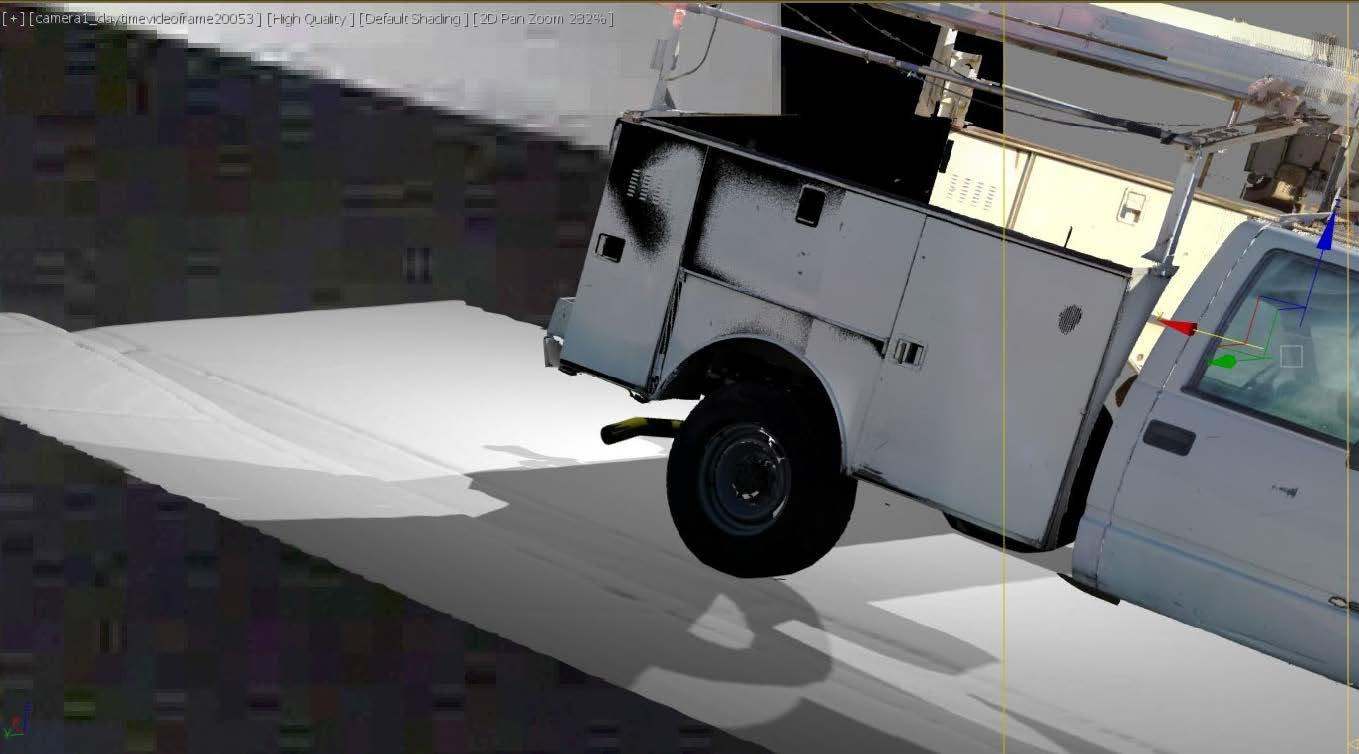
The shadow is not merely unsupported; it is circular. The outline was generated from the FARO scan of my own truck and then fitted to the video. Its “consistency” with my truck was built into the method. It could not have come out any other way. A comparison guaranteed to match before it is performed is not evidence of a match.
Put plainly: the State’s replacement expert told the jury he could not say the truck was mine; that his opinion fit any truck of that model; that he did not know what the light in the video was; that it might be a taillight, which would exclude my truck, and that he never checked; and that not one of the distinguishing features could actually be seen in the footage. Then he listed those same invisible features as “consistent” with my truck, using a shadow he had traced from a scan of my truck in the first place.
B.4. Where the expert evidence came out.
Side by side, the expert evidence runs one way. The State’s own expert of four years rejected my truck on the available data, because the identification was geometrically impossible. The defense expert excluded it on two independent grounds. The mid-trial substitute could say only that the vehicle was “consistent with” a model of truck shared by countless others, while disclaiming any identification and conceding that the features the identification required cannot be seen. No qualified witness identified the truck as mine. The State had no expert testimony capable of placing my vehicle at the scene during the time my alibi covered. What remained was argument.
B.5. The second camera: the side-yard view.
The Mitchley house had a second camera, looking out from between the homes at a different angle (the side-yard view, channel 7). It recorded the same vehicle.
In that view, I see the light at the rear of the vehicle stay bright and steady as the vehicle leaves the frame, the way a taillight does.
The State’s own expert could not say otherwise. Asked about that light, Liscio said: “I don’t think you can say that’s a taillight,” and also “you can’t tell from the video whether it is or it isn’t” (RT 5147:27-28; 5148:8-10). He agreed that if it is a taillight, “that would be one feature that wouldn’t be consistent” with my truck, and asked whether that would exclude my truck, answered: “Possibly. Possibly.” He never tested it (RT 5145:28-5146:5). Pressed further, he conceded “it’s possible that it’s another vehicle” and “I’m not saying that this is your client’s vehicle” (RT 5150:18-5151:13).
He did not use this camera at all: “the reason I didn’t use this video is that I don’t have anything to do any measurement or alignment from” (RT 5150:3-6). Asked whether he still stood behind his statement that there was nothing important in it, he answered: “I don’t know” (RT 5149:15-23).
The defense expert did use it. Stutchman traced the vehicle’s lights across both camera views and found the same behavior in each: “if you look over to the right, you see it over there, too. In the Mitchley video” (RT 7251-7252). He testified that the light’s disappearance was not “a result of any type of reflection activity” (RT 7272).
The State’s theory was that the light was a reflection off a side latch that was “probably” hanging open (RT 8203:10-11). Two cameras, at two different angles, show the same light behaving the same way. Liscio’s answer to that was that a reflection “disperses light all over… it’s reflecting in an infinite number of directions. That’s why we can see the light from any position” (RT 5148:14-17). That explanation is ridiculous, and his own testimony shows why. A reflection needs a light shining on the surface. Liscio could not name one: “I don’t know what that illumination is; and so, I don’t know what the source is” (RT 5148:18-20). He told the jury that reflections were “not a simple answer” and that “it might be better to get a physicist… with proper lighting” (RT 5154:24-27). No physicist was called, and no test was run. And when my counsel asked whether the fire hydrant beside that spot should then be lit by the same source, the prosecutor objected that the question assumed facts not in evidence, and the court sustained it (RT 5156:15-19). The State’s explanation for why two cameras saw the same light was a reflection with no known source, from a witness who said he needed a physicist, and it was never tested.
Put plainly: the State had a second camera that watched the vehicle leave. Its own expert refused to use it, would not say the light was not a taillight, and admitted that if it was, the truck was not mine. The only expert who examined both cameras found the light behaved the same way in both, and was not a reflection.
C. What the jury was told instead
Because the expert evidence rejected, excluded, and disclaimed the identification, the State could not prove through testimony that the truck in the video was mine. In closing argument and on cross-examination, the prosecutors put before the jury, as established fact, statements the evidence did not support and in several places flatly contradicted.
C.1. Liscio’s disclaimed speculation, argued as identifying fact.
Liscio testified that he could not make an identification and that the distinguishing features were not visible in the video (Section B.3). In closing, the prosecutor told the jury the opposite.
He told the jury the unique features were shown to be consistent and visible: that Liscio “inserts the model, and he inserts the shadow trace that he did, and he shows you the consistency of that shadow with unique characteristics of the defendant’s” truck, “its uniqueness based on the rear-end characteristics of the defendant’s truck” (RT 8204:26-8205:6), and that “those unique class characteristics, that box, that trailer hitch, the shape of the bumper — Mr. Liscio even showed you how that shape is construed and manipulated by the shape of the curb and how that shadow is consistent with placement of the” truck (RT 8205:7-10). Liscio had conceded that none of that detail is visible in the video, and that the outline was a trace from the FARO scan of my own truck (RT 5130:26-5131:4; 5132:4-7; 5132:13-16). As to “that box” in particular, he had told the jury, on the State’s own redirect, that the shadow “would still look the same” if the box “wasn’t there” (RT 5167:25-5168:2). A feature whose absence would not change the shadow cannot make the shadow unique to my truck.
The same argument asserted, as observed fact, that “[t]he shadow left by that vehicle has distinct characteristics” (RT 8201:19-20). The witness on whose analysis that rested had testified to the contrary. The outline the jury was shown was not taken from the video at all: “No. What I’m doing is I’m projecting the — it’s a trace of the shadow that was seen in the FARO scan data, and projecting that on the roadway where the video is” (RT 5131:1-4); “that trace that’s there is not from — I didn’t trace the video” (RT 5132:9-10); “[i]t’s an overlay of what we measured someplace else, and then overlay of the video” (RT 5132:12-13). Asked whether the exhibit should be understood to show those features in the footage: “You’re not saying any of that detail is seen here, correct? — A: Correct… So it shouldn’t be understood as ‘Oh yeah, we can see all that stuff here, too’? — A: Correct” (RT 5132:4-16). The “distinct characteristics” described to the jury were characteristics of a laser scan of my own truck, laid over the video. They were not observed in the evidence. They were imported into it.
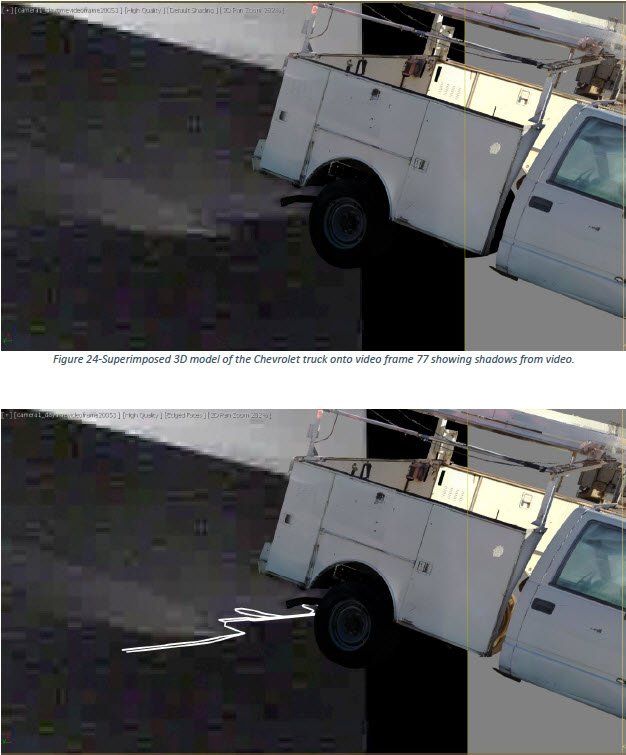
He told the jury the exhaust pipe “matches even the pixelation zoomed in, frame by frame, track by track” (RT 8206:10-12), when Liscio had conceded the exhaust cannot be seen in the shadow at all (RT 5181:26-5182:1). He told the jury the reflection theory was validated: “he figured out this trajectory of the side latch through the video being consistent. Low and behold, shocking, Mr. Liscio was right” (RT 8207:18-24), presenting as proven a conclusion the witness had reached only with “I don’t know” and “I’m just speculating” (RT 5144:28-5145:1).
And he urged the jury to find the very identification the witness had refused to make (RT 8272:1-8):
THE PROSECUTOR: YOU HAVE A TRUCK THAT CANNOT BE EXCLUDED. YOU HAVE A TRUCK THAT CANNOT BE EXCLUDED FROM THE MITCHLEY VIDEO. YOU HAVE A TRUCK THAT CANNOT BE EXCLUDED FROM THE TIRE DEPRESSIONS IN THE DESERT. IS IT CONCLUSIVE PROOF? NO. BUT IS IT A COMPELLING AND REASONABLE INTERPRETATION THAT IS, IN FACT, THE DEFENDANT’S TRUCK GIVEN THE UNIQUE CHARACTERISTIC, THE TIMING, THE LOCATION …
The witness whose analysis that argument rests on had testified: “I cannot make an identification. Which means I can’t say it is your client’s truck” (RT 5156:1-2). The prosecutor’s own “IS IT CONCLUSIVE PROOF? NO” does not fix the problem; it sharpens it. Having conceded the evidence was not conclusive, he still told the jury it showed the truck was “in fact, the defendant’s truck,” turning the expert’s non-identification into the State’s conclusion of identity.
The phrase “a truck that cannot be excluded” was itself built. Liscio had already disclaimed identification twice: “So I can’t make an identification with the — with the evidence that I have” (RT 5082:5-6); “I cannot make an identification. Which means I can’t say it is your client’s truck” (RT 5155:25-5156:2). Only after those disclaimers did the prosecutor elicit the single hedge the closing phrase rests on: “I believe your ultimate conclusion was Mr. Merritt’s vehicle cannot be excluded from being the vehicle that appeared in the video, is that correct? — That’s correct” (RT 5157:24-28). Non-exclusion, from a witness who has just said he cannot identify the vehicle, is not an identification; it is the absence of one. And on redirect, after Liscio had conceded on cross that the distinguishing features are not visible, the prosecutor had him re-affirm “the unique nature of the shadow behind the truck” (RT 5165:27-5166:6), eliciting again the characterization the witness had just disavowed.
The State’s own rebuttal confirms the overstatement. In rebuttal, the prosecutor described Liscio’s conclusion in far weaker terms: he “basically said, I can’t exclude the truck” (RT 8449:14-17), which is much closer to what Liscio actually said. Having walked the expert testimony back to non-exclusion, the State then rebuilt “the defendant’s truck” on “all of those items of evidence together” (RT 8450:5-7), not on Liscio’s analysis.
Put plainly: the expert said, “I cannot say it is your client’s truck.” The prosecutor said, “it is, in fact, the defendant’s truck.” Same evidence, described by the man who examined it and by the man who needed a conviction. When the State returned in rebuttal, it quietly restated the expert’s position correctly, which tells you it knew the difference.
C.2. Rudin was described to the jury as having come around to the State’s theory. He had not.
The argument did not stop at overstating Liscio. It told the jury that Dr. Rudin, the State’s own expert whose analysis had moved to a rejection, had come around to the State’s theory of the light. The prosecutor said Rudin “used, during most of his analysis, the side light, not the latch,” and that only after going home overnight did he “figured out this trajectory of the side latch through the video being consistent” (RT 8207:18-23). Then: “Low and behold, shocking, Mr. Liscio was right. It must have been the side latch causing some type of refection because it’s consistent through the video, and it’s consistent with the location of the side latch” (RT 8207:23-26). And: “That latch is consistent even in his experiment” (RT 8207:27-28).
Rudin adopted the trajectory point, and nothing more. After preparing visuals overnight, he testified that the two features “fall exactly same trajectory” (RT 7951:3-9). What he did not say, and refused when it was put to him, is that the light was a reflection off the latch, or that Liscio was right. He tracked an illuminated feature in the video that he twice refused to identify. Describing the flash point, he told the jury: “We don’t know what it is, but we call it a real light” (RT 7951:26-27). Tracking it across the frames: “I tracked the — whatever, mystery light — and we don’t know what it is, right, so I call it mystery light” (RT 7952:5-7).
His conclusion was about geometry, and he limited it himself. When defense counsel McGee pressed him toward flashing, Rudin drew the line: “So now you’re asking me about flashing and all this which is a different issue. Right now I’m addressing a different issue, what is the trajectory… What I’m saying, simply, that this two features will follow the same trajectory” (RT 7954:11-16). “That’s my main conclusion on this” (RT 7954:18).
He was handed the reflection theory in open court and did not take it. Counsel put the premise to him: “If there is anything going through — or this is hitting some reflector, causing some reflecting, going through some point, the other latch will go through the exact same point?” (RT 7954:23-25). Rudin said nothing about a reflector, a reflection, or a latch as the source of the light. He answered about the timing of video frames, and qualified even that: “Up to synchronization of video frames because frames are not exactly — they’re one third- — I’m assuming. I have never examined original DVR” (RT 7954:26-28).
The record contains no adoption by Rudin of a reflection, of the latch as the source of the light, or of Liscio’s opinion. It contains a witness who called the feature a mystery light, kept his conclusion to trajectory, and turned down the reflector premise when it was offered. The prosecutor told the jury the opposite, and the conversion he described was not a gloss on Rudin’s testimony but a replacement for it. Its function in the argument was structural. The State’s photogrammetry rested on Liscio alone, and Liscio had disclaimed the identification. A corroborating expert was needed. The State did not have one, so it described the expert it had as though he were the expert it needed.
Put plainly: the State’s own expert of four years looked at that spot of light and told the jury, twice, that no one knows what it is. He called it a mystery light. Asked directly whether it was a reflection off something, he would not say so. The prosecutor told the jury that Rudin went home, worked it out overnight, and came back agreeing with the State’s expert. The record contains no such change of mind.
C.3. Two prosecutors told the jury the defense expert called Rudin’s work “flawed.” He refused to say that under oath.
On cross-examination, the prosecutor tried three times to get Stutchman to say he had found Rudin’s work flawed. The witness refused each time. The prosecutor then told the jury, in closing, that the witness had said it, and a second prosecutor repeated and added to it in rebuttal, where the defense could not respond.
Asked whether he found Rudin’s methods flawed, Stutchman testified he had prepared no report on Rudin and did not know the work was Rudin’s (RT 7243:2-11):
Q: In this case, you also had the chance to review the work of a Dr. Lenny Rudin, did you not?
Stutchman: Yes, I did.
Q: And isn’t it true you found his methods to be flawed?
Stutchman: I didn’t prepare any report on Dr. Lenny Rudin.
Q: Ahhh. Yes, you did.
Stutchman: Did I?
Q: Did you not know that?
Stutchman: No, I did not.
The prosecutor then directed him to his report: page 3, where he criticized “the analysis of the SB model 2,” and page 5, where the second sentence of his summary used the word “flawed.” Stutchman said, “I’m not seeing where I said ‘flawed,’” and when shown the word, “Yes. I see that” (RT 7243:12-7244:11). Pressed further, he testified that he had attributed the work he criticized to the Sheriff’s Department, did not know it was Rudin’s, never saw a report from Rudin, and would not say Rudin’s results were flawed (RT 7244:12-28):
Q: Were you aware that that was the work of Dr. Lenny Rudin from Cognitech?
Stutchman: I did not.
Q: Matter of fact, you attribute it to the sheriff’s department?
Stutchman: Correct.
Q: But nonetheless, you found his work flawed, correct?
Stutchman: Well, the dimensions are off. … The dimensions of this truck I’m looking at are off. Are skewed.
Q: From his work. What you were looking at of his work.
Stutchman: If that was his work, then yes.
Q: And his results were flawed, were they not?
Stutchman: I actually don’t know what his results were. I never saw a report from him.
He accepted “flawed” only on a condition, “if that was his work,” as to a fact he disputed, and he refused the ultimate point outright. The prosecutor supplied the Rudin attribution. The witness never did.
In closing, the prosecutor told the jury the witness had said it (RT 8209:9-14):
THE PROSECUTOR: Even the defense’s own witness, Mr. Stutchman, said Lenny’s work was flawed. He tried to attribute it to the Sheriff’s Department. Maybe, he unwittingly didn’t realize it was, I guess, his idol, Mr. Rudin, who had done that work. He seemed quite embarrassed when he testified to that.
Every part of that is contrary to the record. The witness did not say Rudin’s work was flawed; he refused to. He did not “unwittingly” fail to realize the work was Rudin’s; he testified that he attributed it to the Sheriff’s Department and did not know it was Rudin’s. And “his idol” and “seemed quite embarrassed” appear nowhere in the testimony. They were invented. The jury was told, as established fact, both a conclusion the witness expressly declined under oath and an editorial gloss with no basis in the record at all.
In rebuttal, a second prosecutor repeated it and added to it (RT 8441:7-11):
THE PROSECUTOR: So we have Stutchman that conceded the characteristics that match the truck. Interestingly enough, he called Dr. Lenny’s work flawed until Dr. Lenny became a defense witness. Then all of a sudden, he’s a creative genius. Look at the flip flop in opinion.
Stutchman never called Rudin a “creative genius” and never praised him anywhere in the record. The “flip flop” has no testimony behind it. The rebuttal compounded the original misstatement with an invented reversal, delivered at the one stage of argument the defense could not answer.
This does not depend on whose work Stutchman actually criticized. The word “flawed” did appear in his written report, attached to a comparison he understood to be the Sheriff’s Department’s work, which is exactly the attribution he refused to make on the stand. Even if that comparison had been Rudin’s, he testified he did not know that and would not say Rudin’s results were flawed. The jury was told the witness said something he declined to say.
The same closing used the same witness three incompatible ways. Where he helped the State, he was a credible corroborator: “you heard, even with Mr. Stutchman, the defense witness, that it changed for four frames” (RT 8202:23-25). Then he had done nothing: “STUTCHMAN DID NO MORE THAN BLOW UP AN AERIAL PICTURE OF THE DESERT. ALL HE WAS CALLED FOR WAS TO CRITICIZE EUGENE LISCIO” (RT 8257:3-5). Then he was the source of a Rudin criticism he had refused to make (RT 8209:9-14). The dismissal is itself false: Stutchman performed photogrammetry, conducted the sixty-to-sixty-one-inch marker-light analysis, and gave two independent exclusion factors (Section B.2).
Put plainly: the prosecutor asked three times. Three times the witness said no: I never saw Rudin’s report; I don’t know what his results were. So the prosecutor told the jury he had said yes, and added that Rudin was his idol and that he looked embarrassed, which no witness ever said. Then a second prosecutor stood up in rebuttal, where no one could answer him, and described a “creative genius” flip-flop that never happened.
C.4. Rudin’s method was described to the jury as an invention. He described it as the opposite.
The prosecutor told the jury that Rudin had confessed to inventing his method for this case: “what did he tell you? It was a process I dreamt up. It was a process that’s never been used before, never been validated before, never been used by others for validation” (RT 8208:17-20).
Rudin described his analysis as “classical for grammetry,” classical “not in the sense that this is an old method, but it’s a variation on an old method that I came up with in 1995” (RT 7957:1-3). A variation on classical photogrammetry developed about two decades before trial is not a process dreamt up in the middle of a capital case. He also testified that his method was “exactly the same method people use for human heights, and that was validated,” and “[i]n my opinion it’s completely validated” (RT 8030-8031).
What Rudin identified as the limitation was not his method. It was the evidence: “We don’t have a method — that’s going back to my principal. We don’t are have a method to look at bunch of lights and say what is it. Because the problem is physically not well defined. You don’t have enough information” (RT 7970:25-28). That is a statement about the evidence, not about the witness. It says that a low-resolution night video showing a handful of lit points does not contain the information from which the object producing them can be identified, by any analyst, using any method. It applies to Liscio’s analysis exactly as it applies to Rudin’s, and the jury was never told so. The prosecutor took a limitation the witness located in the evidence and recast it as a defect in the witness. The jury was left to understand that the State’s expert had a sound method and the reversed expert had a homemade one, when the testimony that argument was drawn from had established that the evidence itself does not contain what an identification requires. The State’s own argument confirms it, used against Rudin alone: “Dr. Rudin even said, the actual measurements of the truck are unknown in the suspect video” (RT 8209:20-22). If the measurements of the vehicle in the video are unknown, they are unknown for every expert who examined it. The State used that fact to attack the expert who rejected my truck, and never once applied it to the expert its identification depended on.
Put plainly: Rudin never said his method was junk. He said that when all you have is a scattering of lights in a grainy night video, no method, not his, not Liscio’s, not anyone’s, can tell you what produced them, because the information is not there. The prosecutor turned that into a confession of incompetence, and then asked the jury to accept an identification from exactly the kind of analysis Rudin had just said cannot produce one.
C.5. The prosecutor put facts before the jury through his own questions.
Throughout the cross-examination of Stutchman, the prosecutor placed factual assertions before the jury in the form of questions: pointing at the screen to represent that invisible features were visible, supplying technical propositions no witness had established, and asserting a federal requirement that does not exist. A question is not evidence, but an assertion made in a question does its work the moment it is spoken, whether or not an objection follows.
(a) Pointing at features the witnesses said could not be seen.
As to the shadow, he asserted it twice by pointing: “But you see the same shadow here (indicating) and (indicating), right?” Stutchman had just said, “I don’t see the shadow with that definition,” and he answered, “Well, that isn’t very clear. I’m not sure if the jurors can see it or not” (RT 7231:2-10). As to the bed: “Do we not see the bed of the truck in that position in the Mitchley video?” — “We do not see any detail of the bed of the vehicle in the Mitchley video” (RT 7235:8-11). As to the hitch and box, he built a “uniqueness” ladder on features both video experts said are invisible in the video, asking the witness to confirm the “shape of the hitch” and the “unique” box (RT 7222-7224). The questions represented to the jury that these features could be seen and matched in the evidence, when the testimony of both video experts was that they cannot.
(b) Presenting a truck-derived overlay as though it were the video.
Before the State cross-examined Stutchman, Liscio had already conceded the shadow outline was traced from the FARO scan of my truck, not from the video (RT 5131:1-4; 5132:4-16). The prosecutor nonetheless cross-examined Stutchman as though the overlay reflected the video. He first got Stutchman to agree that Liscio’s 3D model was consistent with the FARO scan, two things both made from my truck: “Did you find anything inconsistent between Mr. Liscio’s 3D model … and the FARO scan to be inconsistent? — No” (RT 7232). Getting a witness to agree that the truck matches itself proves nothing about the video. He then tried to carry that agreement onto the video: “isn’t it true that Mr. Liscio’s outline was consistent with the shadow that was seen in the suspect video?” Stutchman refused: “No. You do not see this detail in the actual Mitchley video” (RT 7233); “you do not see the detail that we see here in the actual video behind the truck” (RT 7231). And he named the problem: the overlay “creates an impression that this is the truck, whether it is or not” (RT 7235).
The prosecutor then tried a formal syllogism, and defense counsel Maline objected mid-question (RT 7236-7237):
Q: The trailer hitch and the box on the back of the truck cast a unique shadow, do they not?
Stutchman: In the — In the model yes, they do.
Q: Well, you already agreed that the 3D model was consistent with the shadow that was cast in the FARO scan, correct?
Stutchman: Correct.
Q: Therefore, if “A” is true and “B” is true —
MR. MALINE: Objection, Your Honor. Counsel’s —
Q: — the next must be true, correct?
MR. MALINE: Counsel is misleading this witness on the issue of —
THE COURT: Objection is sustained. Calls for speculation. Conclusion.
The witness’s qualifier, “In the model yes, they do,” is the whole point. The unique shadow exists in Liscio’s FARO-derived model, not in the video. The syllogism would have carried the model’s features onto the video, proving my truck’s presence from features the video does not show. The prosecutor then ran the same inference again in different words: “those are unique characteristics that contribute to that shadow, correct?” The defense objected that it misstated the testimony, and this time the court overruled (RT 7237). The jury watched the court block the inference and then allow it, rephrased, moments later.
The prosecutor also invited the jury to substitute its own untrained eyes for the expert’s. He asked whether a lay juror who “were to view that and see it differently than you, they would be entitled to that opinion, would they not?” (RT 7234). On a photogrammetric question, the jury was told it was free to see a match the expert could not.
When Stutchman began to explain the four-frame disappearance the State would later argue as proof (“I need to tell you what’s going on when that happens”), the prosecutor cut in: “Well, you weren’t there that day, were you not?” My counsel asked whether the witness could explain his answer; the court said, “Overruled” (RT 7241:21-26). Stutchman gave the explanation anyway: “[t]he light was not visible for those frames. It doesn’t mean it wasn’t there,” and the return to full brightness “is the result of compression artifact masking” (RT 7242:9-13). When he began to say he had mentioned it before, the prosecutor told him, “You don’t need to answer, sir” (RT 7242:19-20). The expert’s explanation was interrupted twice on cross, and the disappearance was then argued to the jury in closing as proof. Earlier in the same cross, the prosecutor suggested it would be “irresponsible to draw a conclusion” that the light was the side marker, a premise Stutchman rejected because the feature appears in both camera views (RT 7241).
Put plainly: the shadow the prosecutor waved in front of the jury was traced from my own truck and laid over the video: the truck matched to itself, then presented as if it matched the footage. When the defense expert kept saying you cannot see those features in the actual video, the prosecutor tried a syllogism the court stopped, then rephrased it until the court let it through, and finally told the jury it was free to see the match the expert could not. And when the expert began to explain that the light’s disappearance was a compression artifact, not a reflection, he was interrupted, and the same disappearance was then argued to the jury as proof. The match was manufactured in the asking.
(c) A federal requirement that does not exist.
To neutralize the missing-running-light exclusion, the prosecutor asserted, as the premise of a question, that running lights are required by the Federal Trade Commission (RT 6982:6-13):
Q: YOU ARE TELLING ME THAT IN 2010, THERE WAS A VEHICLE THAT EXISTED THAT HAD ZERO RUNNING LIGHTS ON THE FRONT?
Stutchman: THAT’S WHAT IT’S CONSISTENT WITH.
Q: DESPITE BEING REQUIRED BY THE FEDERAL TRADE COMMISSION?
MR. MALINE: OBJECTION. ASSUMES FACTS NOT IN EVIDENCE.
THE COURT: OBJECTION SUSTAINED.
There was no evidence of any such requirement, and the court sustained the objection. The assertion had still been spoken to the jury. The prosecutor had already pressed the same premise a moment earlier, “ARE YOU AWARE OF ANY MAKE OR MODEL OF ANY CAR IN 2010 THAT DID NOT HAVE SOME FORM OF RUNNING LIGHTS ON THE FRONT END OF A CAR?”, to which Stutchman answered that he is not “A MECHANICAL EXPERT OR A VEHICLE LIGHTING EXPERT” and could not answer (RT 6981:20-27). After the sustained objection, he restated it three more ways: whether Stutchman had investigated “IF THERE WAS ACTUALLY ANY VEHICLE EVER MADE THAT DOES NOT HAVE ANY TYPE OF RUNNING LIGHTS ON THE FRONT” (objection overruled; answer: “I DID NOT”); “ON YOUR COMMON SENSE EVERY DAY DRIVING AROUND THE UNITED STATES, HAVE YOU EVER SEEN A VEHICLE THAT DOESN’T HAVE SOME TYPE OF RUNNING LIGHT?” (objection sustained as argumentative); and “HAVE YOU EVER OBSERVED A VEHICLE, IN YOUR EXPERIENCE, THAT DOES NOT HAVE A RUNNING LIGHT OR RUNNING LIGHT TURN SIGNAL COMBINATION ON THE FRONT OF THE VEHICLE?” (answer: “I DON’T RECALL”) (RT 6982:14-6983:5).
(d) Physics and a color supplied by the prosecutor.
Through his own questions, the prosecutor supplied the bulb-wattage and luminosity physics behind the State’s “wash-out” theory: that running lights, being lower wattage than headlights, would be indistinguishable in a grainy video. No vehicle-lighting expert testified to any of it, and the questions stood unobjected (RT 6960:2-28). He then asserted, as the premise of his questions, that the running lights on my truck were “orangeish yellowish” (RT 6979:8-14).
The color premise came from the prosecutor, and it was offered to do a specific job: to explain why a real, lit running light would not show as its own band beside bright headlights. The State’s own evidence shows that it does. Two photographs taken by San Bernardino County Sheriff’s detectives during their investigation show the running-light lenses directly beneath the headlights (Photo 1, daylight) and, lit at night, showing as a bright band beneath each headlight, separate from the headlights’ glare (Photo 2). Both come from the Sheriff’s Department’s own investigative materials. The detectives’ own night video shows the same thing as the truck approaches (Section C.5(e)). Lit, the running lights on my truck do not wash out beside its headlights. They show.
(e) The State’s own photographs and video.
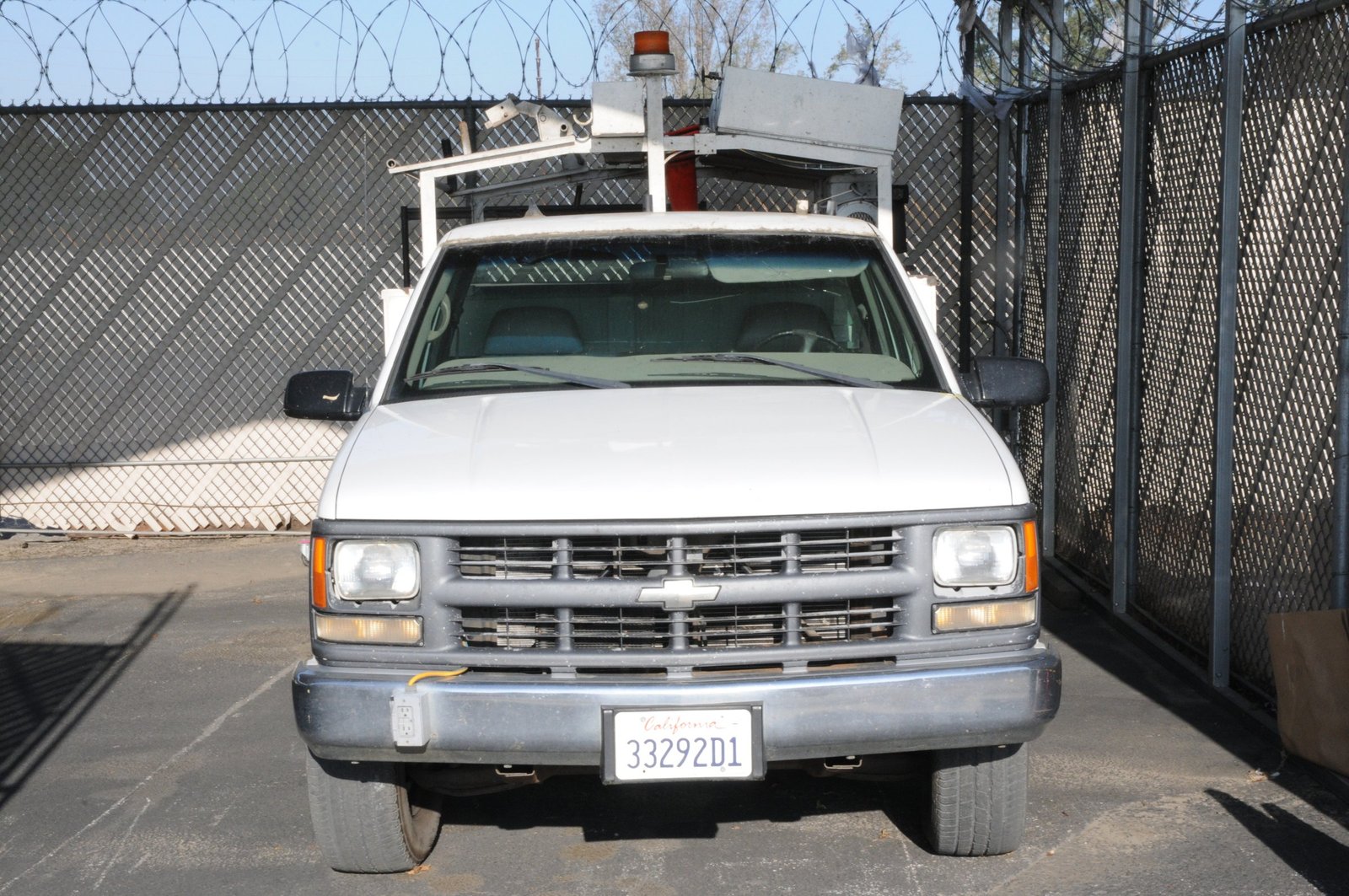
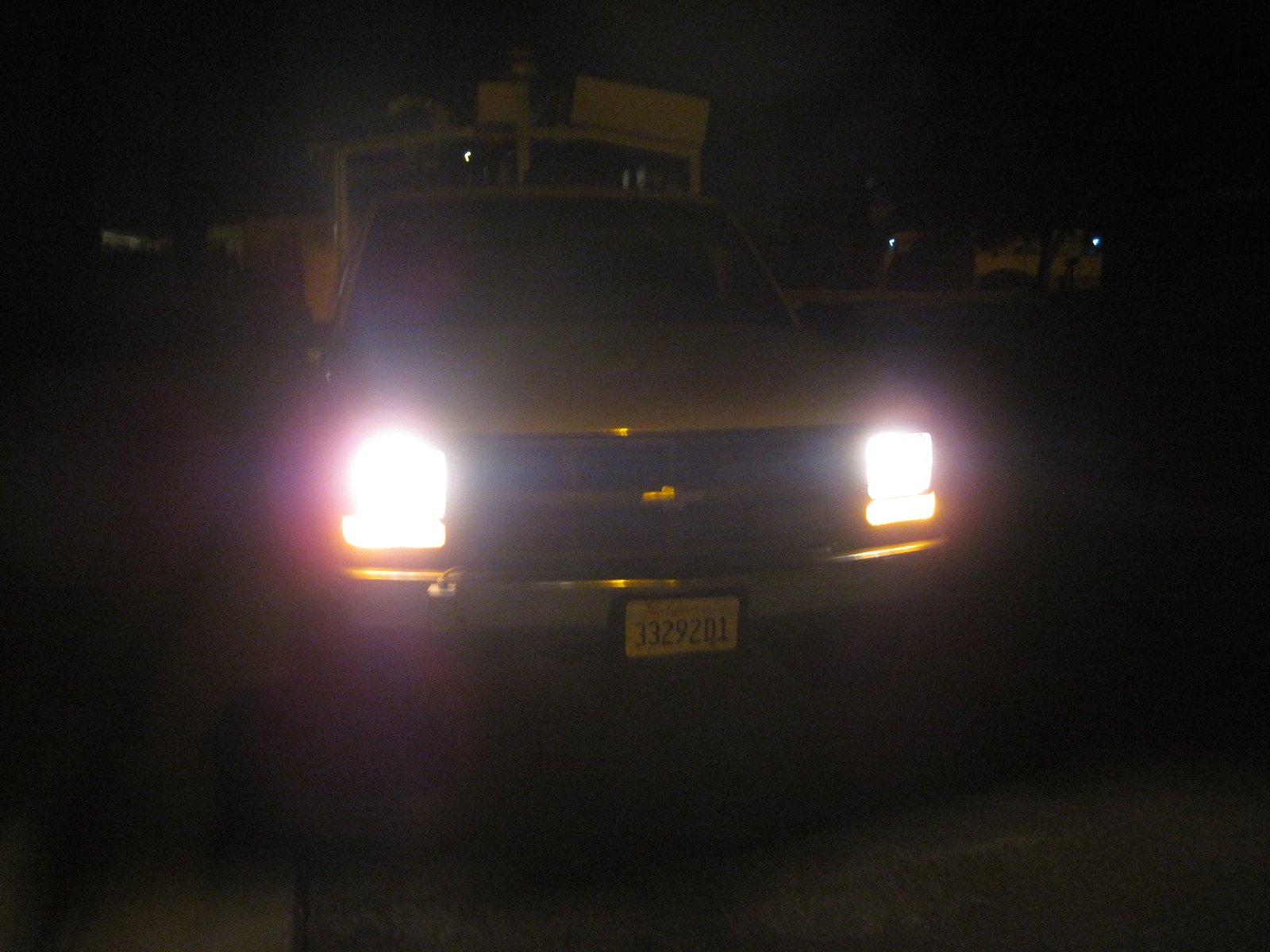
Photo 1 (daylight) shows the running-light lenses directly beneath the headlights. Photo 2 (night, lights on) shows them lit: a distinct band of light under each headlight, not washed out by the headlights’ glare. Both were taken by the State’s own detectives. That band of light is exactly what the Mitchley video does not show.
The State’s detectives also filmed my truck at night with its headlights on. As it approaches the camera, the running light shows as a separate band of light beneath each headlight, visible through the headlights’ glare. That band never appears in the Mitchley video. The video comes from the Sheriff’s Department’s own investigative materials. Sergeant Ryan Smith was present when it was taken and confirmed the running lights were on (RT 3434:1-9).
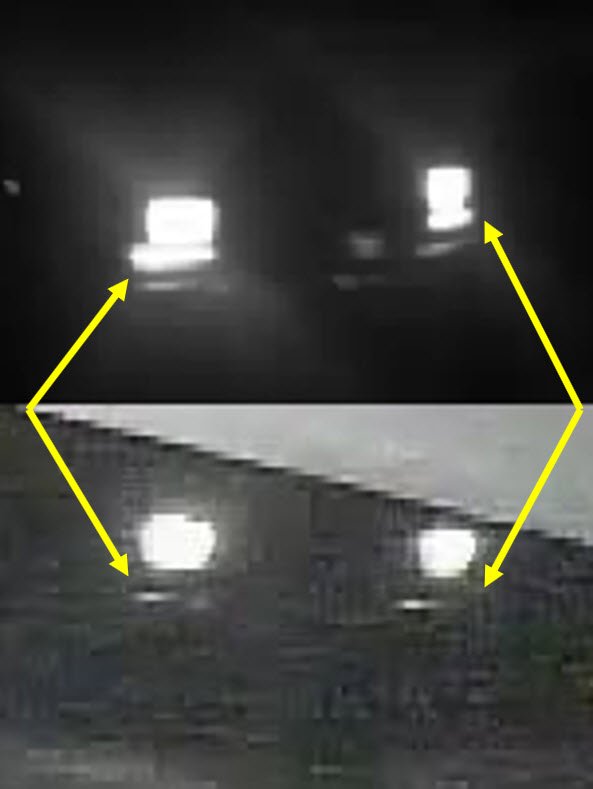
Each of these put before the jury, as fact, something the record did not contain: an identification the witness disclaimed, a criticism the witness refused to make, features the witnesses said could not be seen, a syllogism the court stopped, and a law that does not exist. Separately and together, this was the manufacture of evidence by argument.
Put plainly: a question is not evidence. But a question that asserts a fact puts that fact in the jury’s mind whether or not the witness agrees, and whether or not the objection is sustained. The prosecutor pointed at a screen and told the jury it showed a shadow the witness said he could not see. He invoked a federal agency that regulates nothing of the kind. He put a color for my running lights into his questions to explain why they would vanish in the video; the State’s own photograph and video show they do not vanish. And when the court stopped him, he asked the same question three more ways.
C.6. The State’s own report swapped the labels on its comparison photographs.
A San Bernardino County Sheriff’s Department report (Case No. 071304411, Report Area H-2013-104, p. 3, Bates 007737), authored by Detective Bachman and dated October 17, 2014, shows two photographs of the truck side by side, captioned: “The photograph on the right was taken on October 15, 2014, during the follow up contact. The photograph on the left was clipped from Mitchely’s surveillance footage from February 4, 2010… The photographs show the consistencies between the surveillance footage and Merritt’s [truck].”
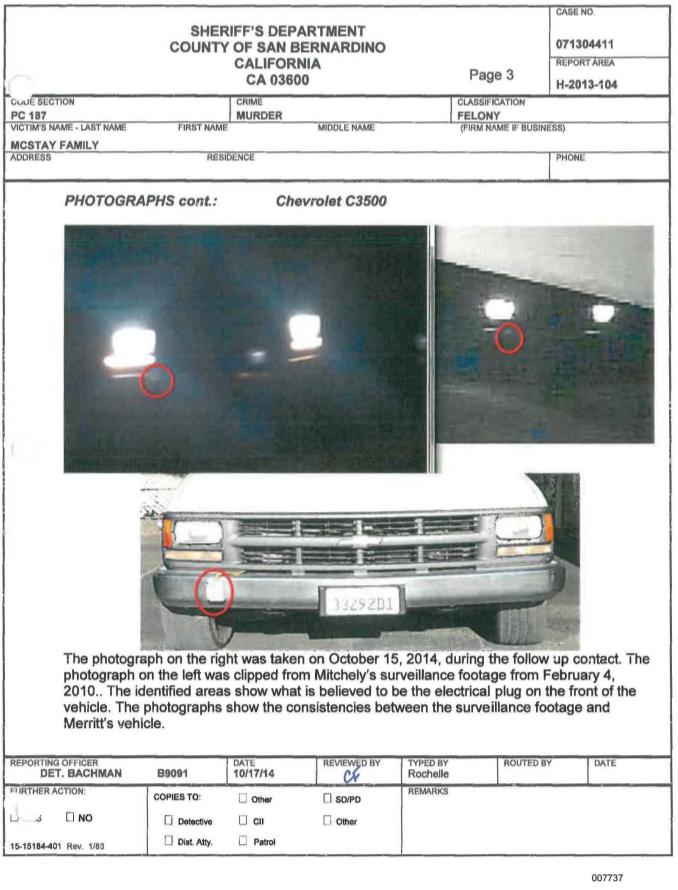
The labels are reversed. The image the caption calls the video still is actually the October 2014 exemplar photograph, the one showing lit running lights beneath the headlights. The image the caption calls the 2014 exemplar is actually the Mitchley video still: dark, low-contrast, with no lit running lights at all. The report presents the exemplar’s running lights to the reader as though they appeared in the video, and relabels the video, the very image Stutchman testified shows no running lights where they must appear, as the known photograph of the truck.
The caption claims “consistencies,” plural. The most significant of them, running lights, exists only because the report shows the exemplar while calling it the video. Correct the labels, and the video the report actually displays shows the same missing running lights Stutchman relied on.
Each photograph also carries a red circle around what the caption calls “what is believed to be the electrical plug on the front of the vehicle,” offered as another point of consistency. But the circled object cannot be made out in the actual video image. A circle drawn around an indistinguishable feature does not establish consistency. It is the same pattern as Liscio’s rear-of-vehicle features (Section B.3), recurring at the front.
The report was created years before trial and was part of the investigative record on which the State’s identification theory was built. Whether the mislabeling was a clerical transposition or something else, its effect was to create, in the State’s own file, a documentary appearance of consistency, running lights present in the video, that the video itself does not show.
Bachman admitted the transposition on the stand. Shown Bates 7737 on direct examination by my counsel, he first described the left photograph as “a still or screenshot of the truck when we processed it” and the right as “a snippet of the Mitchley video” (RT 7475:15-19). Then: “I just noticed that it says the photo on the left was from the Mitchley video, which is incorrect. That would be — the one on the right was from the Mitchley video” (RT 7475:25-27). He agreed he was “drawing circles around what you believed were similarities,” including “an electrical box on the bumper of Mr. Merritt’s truck” (RT 7475:28-7476:6), and that after October 15, 2014, he did nothing further “to either exclude or include Mr. Merritt’s vehicle as being the one in the Mitchley video” (RT 7476:21-25). Counsel identified the report page as next in order, “1146” (RT 7475:9-12).
Put plainly: the report told the reader, here is the video, here is the truck, and they match. But the photograph doing the matching was not the video. It was the truck. The State’s own file swapped the labels on the one comparison that could have answered Stutchman’s exclusion, and even the feature circled as consistent cannot be seen in the image that actually is the video.
The mislabeling did not stand alone. The proposition it created on the page, that the running lights of my truck are visible in the Mitchley video, is the same proposition the prosecutor asserted through the premises of his own questions at trial and argued to the jury in closing. The report is the documentary layer of that theory. Its other layers, and the reason the State needed all of them, are in Section C.7.
C.7. The running lights were argued into the video four ways.
My truck has always-on running lights. The Mitchley video shows none. That was Stutchman’s ground of exclusion: it is “dark where the running light would be,” and he used that as “a factor to exclude Mr. Merritt’s truck” (RT 7271:12-25). If the running lights are not in that video, the State’s only physical placement of me at the scene fails.
The State had no evidence answering that absence. It had a theory: that the running lights are present but lost to glare. No witness qualified in vehicle lighting or video brightness supplied it. It was supplied four ways.
In closing, by argument. The prosecutor pointed the jury to a 2014 photograph of my truck: “I will note for you, by the way, in Exhibit 796, the glow and the bleed-out in that photograph, even though it’s taken four years later with a better camera and a closer angle, those lights are all washed out, including the parking lights” (RT 8202:13-17). The transcript records the number as “796” (RT 8202:14). I have found no Exhibit 796 among the trial exhibits available to me. Whatever photograph he meant, a photograph taken four years later with a better camera from a closer angle is not evidence of what the 2010 surveillance camera could capture. The sentence itself says why. And the State’s own detectives photographed my truck at night with the lights on: the running lights show plainly, as a separate band beneath each headlight, in their photograph and in their video (Section C.5(e)).
On cross-examination, by unsworn assertion. The wattage physics and the “orangeish yellowish” color premise, neither supplied by any witness (Section C.5(d)).
In the file, by mislabeling. The swapped captions in Bates 007737 (Section C.6). The one feature the mislabeling created was the appearance of running lights in the footage.
In the record, by leaving the alternative untested. The State’s own photogrammetry expert would not say the running lights were merely washed out. His answer was not the answer the State needed:
“What I’m saying is that it’s quite likely that it’s not detectible is what I’m saying. So, it may be on, but we can’t see it; or it may be off, and that’s why we don’t see it. Or it could be a different vehicle, right? So there’s different scenarios there.” (RT 5128:14-19)
Three scenarios, from the State’s own expert. The third is that the vehicle in the video is not my truck. He put a different vehicle on the record as a live explanation for the missing lights, and neither he nor the State ever ruled it out.
The second scenario does not survive the record. My running lights cannot be switched off while the headlights are on, and the headlights in the Mitchley video are on. I know this about my own truck, and Sergeant Ryan Smith of the San Bernardino County Sheriff’s Department so testified. He was present when the Sheriff’s Department filmed my truck at night, and confirmed the running lights were on (RT 3434:1-9). Then:
Q: COULD YOU TURN THOSE OFF WHEN YOU HAD THE TRUCK RUNNING WITH THE HEADLIGHTS ON?
A: NO.
Q: LET ME ASK YOU: DID YOU GUYS TRY TO TURN THEM OFF WHILE THE HEADLIGHTS WERE STILL ON.
A: YOU COULDN’T, NO.
Q: SO THE PARKING LIGHTS OR THE RUNNING LIGHTS ALWAYS HAD TO BE ON WHEN THE HEADLIGHTS WERE ON?
A: CORRECT. IT’S LIKE ANY CAR, THE RUNNING LIGHTS ALWAYS TURN ON IF YOU TURN THE HEADLIGHTS ON.
(RT 3434:10-19.)
With “may be off” eliminated, Liscio’s scenarios reduce to two: the running lights are present but undetectable, or the vehicle is not my truck. The State needed the first. Its own expert would not choose between them.
And the State never ran the test that would have settled it. Asked whether he had asked for the truck to be driven in front of the camera at night, Liscio answered: “I did not ask them to go drive the truck, no” (RT 5127:25-5128:5).
Put plainly: the running lights on my truck are always on. They cannot be switched off while the headlights are burning, and in that video the headlights are burning. They are still not there. The State could not answer that with evidence, so it answered it with a story: the lights are there, you just cannot see them. To make the story work, the prosecutor needed the lights to disappear beside the headlights; the State’s own night photograph and video show them plainly. He needed a photograph of the video showing lights; the one in the State’s own file was a photograph of the truck, with the labels swapped. And the State’s own expert, given the chance to say the lights were merely washed out, said instead that they were not detectible, and that one reason might be that the vehicle was not my truck at all. Nobody ever drove my truck past the Mitchley camera at night to find out.
Decide for yourself, did they know the truth?
The prosecution told the jury two opposite things about my truck’s running lights.
They can be seen.
Q: And can you see those running lights in the Mitchley video?
Detective Smith: Yes.
(RT 3470:8-9)
Shown a close-up of the Mitchley video beside the Sheriff’s photograph of my truck (RT 3505:4-14):
Q: … you are saying these two pictures both show the running lights; correct?
Smith: I’m — yes.
(RT 3505:15-17)
MR. IMES: WHAT IS THAT GRAY BAR RIGHT THERE IN BETWEEN?
Stutchman: IT’S EMPTY SPACE.
MR. IMES: YOU SURE IT’S NOT A DIMMER LIGHT?
(RT 6980:9-11)
They can’t be seen.
Liscio, the State’s expert: it’s quite likely that it’s not detectible … it may be on, but we can’t see it.
(RT 5128:14-16)
MR. IMES: DO YOU HAVE ANY INDEPENDENT FORENSIC EVIDENCE THAT THAT WASHOUT IS NOT CONCEALING POTENTIALLY DIMMER RUNNING LIGHTS ON THAT VEHICLE?
(RT 6977:21-23)
MR. IMES: YOU ARE TELLING ME THAT IN 2010, THERE WAS A VEHICLE THAT EXISTED THAT HAD ZERO RUNNING LIGHTS ON THE FRONT?
Stutchman: THAT’S WHAT IT’S CONSISTENT WITH.
MR. IMES: DESPITE BEING REQUIRED BY THE FEDERAL TRADE COMMISSION?
Objection sustained.
(RT 6982:6-13)
Q: Why did you not highlight that that light is missing from this side?
MR. IMES: Objection. Assumes facts not in evidence that the light is missing.
THE COURT: Appears to be missing. He can answer.
Sergeant Bachman: … I was noting consistencies in there.
(RT 8081:20-27)
MR. IMES, in closing: those lights are all washed out, including the parking lights.
(RT 8202:16-17)
Both can’t be true. The State’s own photographs and video show which one is.
C.8. An identification was argued from a light the prosecutor told the jury no one could identify.
Liscio said under oath that he did not know the source of the illuminated spot (RT 5140:11-13; 5144:28-5145:1). Rudin called it a mystery light and refused to identify it (Section C.2). No witness told the jury what that light was.
The prosecutor told them, and in the same argument told them nobody knows. He conceded it at the start: “What is it? No one really knows, given the quality and character of this — of the video” (RT 8202:26-27). He conceded it again in the middle: “Remember, when you talk about the side latch, illumination, whatever that is” (RT 8205:21-22). And he conceded the condition of the video itself: “everything kind of gets washed out on the front end; it’s hard to see; you can’t even see the direct headlights” (RT 8206:13-17). Describing Liscio’s own zoomed-in excerpt, he said the same: “You can see even when he zooms in on the photo — video, how pixilated and washed out these headlights get to where you can’t even see the definition of them” (RT 8204:8-10). Between and after those concessions, he supplied:
- An identification: “It’s not the best video, granted. But it was more consistent with a side latch and some type of reflection off the side latch” (RT 8202:28-8203:2). No witness said this. Liscio speculated; Rudin refused; the prosecutor asserted.
- A mechanism: the water valve cover in the street “has a reflection,” and “[t]he yellow fire hydrant had a reflection in this video. So you don’t have to be chrome” (RT 8203:4-9). Just before that, he accused the defense of the very thing he was doing: “The defense will probably tell you, oh, it’s not chrome, it wouldn’t reflect light, it’s too intense. That’s a lot of speculation” (RT 8203:2-4).
- A physical condition: “What you probably have to be is at a position to be able to catch the light, such as slightly open or ajar” (RT 8203:10-11). No evidence shows the latch on my truck was open or ajar on February 4, 2010, and his own “probably” and “such as” concede it.
- An attribution to unnamed witnesses: “And you heard testimony from Mr. Liscio, and I believe, maybe, even Sergeant Smith that, in fact, that lever, that particular one was very difficult to manipulate” (RT 8203:11-14). A prosecutor telling a jury what the evidence was, while conceding on the record that he does not know who gave it, is not summarizing evidence. He is supplying it.
- Brake-light optics: “Remember, when you saw the truck, as well as the evidence you heard from the stand, the housing around those brake lights had an open translucent area to them. Well, if it’s open or translucent, it would allow more light through, making it brighter, causing the effect that you would see in the shadow on the street” (RT 8205:26-8206:3). The housing he attributed to the evidence. The physics that made it matter came from nowhere: no witness gave that opinion. It is a brightness conclusion, delivered by an advocate.
- Glare, attributed to Liscio: He told the jury Liscio had shown “there would appear to be this strange glare, which was possibly from the top of the bumpers caused by the projection of the lights” (RT 8204:3-6). “Possibly,” from a witness who had already said he was speculating about the light’s source, argued forward into the inference as though it had been established.
Set against the concessions that bracket them, these assertions describe themselves. The prosecutor told the jury that no one knows what the light is, and then told them it was a reflection off a latch that was probably ajar, catching light in the manner of a water valve cover, in a video whose front end he conceded was washed out. Every load-bearing piece of that account (the latch, the reflection, the ajar position, the reflective mechanism, the physics of the translucent housing) entered the case in the prosecutor’s own voice. The State’s own expert had told the jury that reflections called for a physicist and were “not a simple answer” (RT 5154:24-27). No physicist testified. What may not be admitted from the witness stand cannot be supplied from the lectern.
Put plainly: the prosecutor told the jury, twice, that nobody knows what that light is. In between, he told them what it is: a reflection off a latch that was probably hanging open. No witness said that. The State’s replacement expert said he was speculating. The State’s own expert of four years called it a mystery light. The only person in that courtroom who claimed to know what the light was, was not under oath.
C.9. The case agent’s comparison searched only for inclusion.
The Sheriff’s Department comparison report behind the State’s “consistency” narrative was the work of the case agent, Detective Sergeant Bachman. He admitted on the stand that it came from a method built to confirm, not to test. He “compared pictures based off the belief, initially, that it was the Trooper” (RT 7480:4-6). Asked whether for my truck he was “looking to include it,” he answered, “Yeah, to find consistencies in there”; asked whether with the Trooper he was “looking for inconsistencies,” he answered, “Right” (RT 7480:15-20). Two vehicles, two opposite standards.
Confronted with a parking light present on my actual truck but missing from the video, and asked why he had not noted it, Bachman answered: “I was noting consistencies in there” (RT 8081). The trial court, over the prosecutor’s objection, stated on the record that the light “[a]ppears to be missing” (RT 8081).
His own method of exclusion, applied evenly, excludes my truck. He agreed the marker light was one of “these three distinct features that you used to exclude the Isuzu Trooper” (RT 8080:12-16). My counsel put to him his preliminary-hearing testimony: “because that marker light is there and seen on the video, that’s how you conclude it’s not the Isuzu Trooper” (RT 8080:17-20). My marker light sits at about sixty inches and is blocked by the overhang; a marker light visible at the low position shown is inconsistent with my truck exactly as the wrong-side exhaust was inconsistent with the Trooper. At the preliminary hearing he had testified that “[t]here’s an inside marker light on the passenger side, rear portion on the vehicle leaving the house,” and that it was “not present on the McStay’s Trooper”; the prosecutor objected, hearsay and improper impeachment, and the court overruled (RT 8080:24-8081:4).
Bachman told the jury twice that the light could be seen in the video: “It looks, to me, like you can see the light in the video” (RT 7471:28); “it was just on the fact that you can see the light in the video” (RT 7472:3-4). My counsel also put to him his preliminary-hearing testimony that the marker light “is there and seen on the video” (RT 8080:17-20). That is the opposite of the prosecutor’s closing statement that no one could identify it. And he confirmed he never measured the awning, porch, or roof of the Mitchley residence (RT 7474), the geometry that decides whether the marker light could appear at all.
Put plainly: the man who built the State’s comparison report admitted he set out to include my truck, not to test whether it belonged in that video. He wrote down only the similarities and skipped the light that was missing. And the one feature he swore he could see, the marker light, is the feature that cannot be there if the truck is mine. His own logic excludes the truck he set out to include.
C.10. The closing statements, catalogued.
In closing and rebuttal, two prosecutors, ADA Imes and ADA Rodriguez, told the jury at least thirteen things the record contradicts. Each is listed with the testimony it contradicts.
ADA Imes told the jury:
- That the shadow showed “unique characteristics of the defendant’s truck,” “that box, that trailer hitch, the shape of the bumper” (RT 8205-8206), when Liscio had conceded those features are not visible and the outline was a FARO trace of my own truck (RT 5131-5132).
- That “[t]he shadow left by that vehicle has distinct characteristics” (RT 8201:19-20), when Liscio’s own report found it “was not possible to find any unique or identifying features for the vehicle in the video,” and when he conceded on the stand the outline was a FARO trace of my own truck, not the video (RT 5131:1-4; 5132:4-16).
- That the exhaust pipe “matches even the pixelation zoomed in, frame by frame” (RT 8206:10-12), when Liscio had agreed it was only “within the ballpark, but it’s not exact,” and “difficult to say exactly where it ends” because “it’s pixelated” (RT 5181:9-11; 5182:13-15).
- That Rudin’s data points “all still matched … You saw the 10 point match. All those data points still lined up” (RT 8207:28-8208:9), when the reason Rudin reversed was that the points could be made to line up only by placing the truck “below ground level, in order to make that match,” and the overall length of the truck in the video did not match the FARO scan of my truck, as the trial court’s own ruling recites: “those measurements did not match” (RT 7984:9-23). Points that line up only when the truck is underground are not a match.
- That Rudin’s margin of error “moved … from 5 percent or 6 percent up to 10 percent, and then … back to 9 percent” (RT 8208:22-24), when Rudin testified his threshold was five to six percent and never stated a nine-percent figure (RT 7847).
- That Rudin was “an expert within [sic] an agenda from the minute he hit the stand” who “reaches out to the defense” (RT 8206:21-26), when, as defense counsel told the court, Rudin’s own email said “I know I’m still a prosecution witness” (RT 7833:22-25), when the record shows he took his changed conclusion to the prosecution, and when ADA Imes asked him on cross, “Isn’t it true you’re upset he didn’t use your software?”, the defense objection was sustained, and Rudin answered, “That’s ridiculous” (RT 8013:9-12).
- That Rudin said “if it worked, I could retire. I want to do this, so I can make money off it” (RT 8207:2-5), reversing what he actually said (see below).
- That “[y]ou have a truck that cannot be excluded … from the Mitchley video” (RT 8272:1-3), reversing the burden of proof and contradicting the two experts who excluded it and the court’s own statements that it was excluded (Section D.6).
ADA Rodriguez told the jury:
- That “Dr. Lenny … never attempted to match a data point to the latch” (RT 8441:11-12), when Rudin testified in detail that he did (RT 7960:28-7961:10), and when ADA Imes’s own closing said “[t]hat latch is even consistent in his experiment.”
- That Rudin’s process “shrunk the Trooper” and he “couldn’t exclude that process” (RT 8441:11-15), when Rudin testified “there’s no shrinking or expanding model” (RT 7865) and that his model “cannot shapeshift” because “[i]t’s a rigid object” (RT 7965).
- That “[h]is tests are not validated. This is brand new science that has never been used before” (RT 8441:17-19), when Rudin testified his method was “exactly the same method people use for human heights, and that was validated” (RT 8030-8031).
- That “Dr. Lenny (sic), from day one, would not exclude the truck, and still from that witness stand would not exclude the truck,” and “never concretely excludes the truck” (RT 8440:17-23), when Rudin said “I render a rejection” (RT 8048:26-27).
- That “[h]e couldn’t do the trajectory” (RT 8441:1), when Rudin testified that the features “fall exactly same trajectory” (RT 7951:3-9), and when ADA Imes’s own closing told the jury Rudin “figured out this trajectory” (RT 8207:18-23).
Two more items belong with these but are not false statements of fact. After a defense objection to item 12 (“Objection. Misstates the testimony. Ask to admonish.”) was overruled (RT 8440:24-26), ADA Rodriguez added: “you wonder why the prosecution didn’t call Dr. Lenny. Dr. Lenny sat up there talking in circles” (RT 8440:27-8441:1), the overruling of the objection visibly emboldening the escalation. And outside the closing, ADA Daugherty objected “cumulative” three times to Stutchman’s exclusion testimony (RT 7271-7272), each objection acknowledging that the exclusion was already in evidence; each was overruled.
The “retire” statement. Rudin’s actual words, explaining to the court what he meant: “If I’m wrong, and we do this experiment, and we can actually match these three points — three points being the front lights, and the other light — I said I’m going to retire” (RT 7911:15-18). He would retire if the test proved his rejection wrong. He added that he said this to Imes, and “AT THAT MOMENT I THOUGHT IT WAS THE WRONG THING TO SAY. I BASICALLY DISCOURAGED HIM FROM DOING THIS” (RT 7911:18-20). “I’m going to retire,” not “I can retire.” It was an expression of confidence in his conclusion, told to the jury as a financial motive to fabricate.
“Reaches out to the defense.” Rudin did not defect. When his re-analysis changed his conclusion to a rejection, he took it to the prosecution, the party that had retained him: “I MADE A CALL TO DEPUTY DISTRICT ATTORNEY, MR. IMES … AND I TOLD HIM THAT WE HAVE A PROBLEM” (RT 7910:2-4), and was set aside. In the hearing on those communications he testified: “I WAS TOLD TO STAND DOWN, BASICALLY,” and that Imes wrote “WE WILL ASK YOU TO STOP THE WORK, YES. AND ALSO THAT THERE WILL BE NO EXPERIMENT” (RT 7912:1-14). When he said before the jury that “ONE OF REASONINGS I BELIEVE I WAS TOLD TO STAND DOWN” was that he was advocating for the re-projection test, the prosecutor moved to strike it as nonresponsive, and the court struck it (RT 8047:24-28). His own email, as defense counsel quoted it to the court, shows how he understood his role even after the reversal: “I know I’m still a prosecution witness” (RT 7833:22-25). The court itself described him as “contacted by the prosecution,” whom “the prosecution intended to call,” and whom “[t]hey did call” at the 402 hearing, until “he changed his mind” (RT 7834:1-5), and at the motion for new trial said he “was initially retained by the prosecution” (RT 8958:7-8). The State did not lose Rudin to the defense. It set him aside when he stopped saying what it needed, and then told the jury the reverse.
Put plainly: a jury that had heard two exclusions, a rejection, and a disclaimer was told it had heard consistency, a match, a validated identification, and an expert with a motive to lie. Thirteen statements, all in one direction, every one of them away from what the witnesses said.
D. The trial court’s rulings
D.1. Defense objections to speculative testimony were overruled.
When defense counsel objected that Liscio’s testimony was speculative and moved to strike, after Liscio speculated that the latch could be “stuck a little bit open,” the court overruled the objection (RT 5080:11-13). When counsel objected on relevance grounds that the box was not visible in the video, the objection was overruled, letting the jury weigh a feature the witness conceded could not be seen: “Objection. Relevance. Because the box isn’t seen in the video.” “Overruled” (RT 5167:4-6).
D.2. Objections that cut off the defense cross-examination were sustained.
When counsel asked Liscio, “What is a reasonable percentage range for things that you don’t see?”, the prosecutor objected “Asked and answered”; counsel told the court, “He hasn’t answered it yet”; and the court sustained the objection (RT 5087:9-13). The court then asked its own general question about a margin of error, and Liscio answered that it “was on the order of a couple of inches, roughly” (RT 5087:16-27). The question counsel asked, about the features that cannot be seen, was not answered. When counsel sought to establish the taillight point, “Just to be clear, if that’s an actual taillight, it’s not my client’s vehicle, right?”, the court sustained a speculation objection (RT 5150:12-16). When counsel rephrased it, the court let it through over the prosecutor’s objection, and Liscio conceded “if that’s a different vehicle, then it’s not the same vehicle,” “it’s possible that it’s another vehicle,” and “I’m not saying that this is your client’s vehicle” (RT 5150:18-5151:13). What never came in was the direct answer: that if the light is a taillight, it is not my truck.
When counsel sought to summarize what was visible in the video, “But you can’t see the shape of the vehicle, you can’t see the form of the vehicle. All you can see are headlights, taillight, shadow, and a illuminescent (sic) spot, correct?”, the court sustained the prosecutor’s objection that it misstated the testimony, added “And argumentative,” and when the witness began to answer, told him, “You don’t need to answer” (RT 5155:12-23).
When counsel asked whether “[t]he hydrant then should be illuminated by the light source that illuminates that spot,” the prosecutor objected that the question “[a]ssumes facts not in evidence,” and the court sustained it, “Also vague” (RT 5156:15-19). In closing, the same prosecutor used the hydrant’s reflection to argue that the latch did not “have to be chrome” (RT 8203:4-9).
The speculative opinion came in. The cross-examination that would have shown it to be speculative was cut off.
D.3. The court’s comment before the jury.
During the defense cross-examination on whether the illuminated spot was a taillight, counsel asked Liscio: “So, you’re just going to find whatever evidence matches the theory that you want to reach, and you’re going to say that’s a latch, it’s not a light, right?” The prosecutor objected on one ground: “Objection. Argumentative.” The court sustained it and added a ground of its own: “Objection’s sustained. It’s argumentative and assumes facts not in evidence” (RT 5148:22-28). Phrased in the court’s own words, on a ground the prosecutor had not raised, it told the jury the bench viewed the defense’s line of questioning as improper.
D.4. Speaking objections.
The court permitted the prosecutor to make objections that argued the State’s position, asserting for example facts “not in evidence; such as a bulb being burnt out” (RT 5129:2-4) and characterizing the witness’s earlier answers (RT 5126:1-2). When the court responded, it addressed both sides at once: “Both of your comments are argumentative, and should be reserved for your closing arguments” (RT 5129:7-9).
Put plainly: every time the State needed speculation admitted, it came in. Every time the defense tried to show it was speculation, the question was cut off. And when the defense pressed Liscio on whether he was fitting the evidence to his theory by calling the light a latch, the court told the jury, in its own voice and on a ground the prosecutor had not raised, that the question assumed facts not in evidence. The rephrased question drew only the concession that another vehicle was possible. The direct answer never came in.
D.5. The “consistent with” language began with the court.
At the section 402 hearing, after the prosecutor passed the witness, the court examined Rudin itself and offered the prosecution-favorable characterization: “some people would say it would be consistent with, is that a term that you would use?” Rudin declined it: “to say consistent, I … would need a few more things”; “we would not call it consistent or inconsistent.” The court settled for “you cannot eliminate it” (RT 3684-3685). The term the court reached for, before any witness adopted it, is the term the State later built its identification on.
D.6. The court described the truck as excluded, then called the record inconclusive.
During trial, the court described my truck as excluded in its own words three times: in the bench colloquy, that the defense could present “DR. RUDIN’S CONCLUSIONS THAT I THINK THE TRUCK IS EXCLUDED, THAT MR. MERRITT’S TRUCK IS EXCLUDED AND WHY IT’S EXCLUDED” (RT 7930:18-20); describing what Rudin could tell the jury: “I changed my opinion, and now my opinion is I can exclude the vehicle and here’s why I can exclude it. He can testify on all of that in front of the jury” (RT 7833:6-8); and, in its ruling on the suppression motion, that the length mismatch “would certainly be a factor which would suggest exclusion of Mr. Merritt’s truck, and that those measurements did not match” (RT 7984:14-17), and that “Mr. Merritt’s truck would likely be excluded as the truck in the video due to the length of the truck not matching” (RT 7985:9-12). The court also admitted Stutchman’s two exclusion factors over three prosecution objections (RT 7271-7272), and stated that the light Bachman had not noted “[a]ppears to be missing” (RT 8081).
At the motion for new trial, the same court first called the Mitchley video “of relatively limited significance,” because it “is not a complete surveillance of all the activity that might have been in that area,” shows “only a few segments,” and “does not show the truck arriving” (RT 8957:18-23). It then turned to the experts. It said “[t]he best analysis was ultimately provided by Dr. Rudin at the end of trial” (RT 8958:6-7). It recounted that Rudin “changed his opinion and said that his initial analysis was wrong because he actually had the truck below ground level for those things to match up. So he said, Now, they don’t match up, and he would tend to exclude the defendant’s truck as being the truck” (RT 8958:11-15). Then: “He concluded his testimony with saying that what was needed was a live re-projection test or experiment. That would be definitive. He said he urged both sides to do such a test. Neither side did it. He said without that test, all you have is competing models, and there are problems with all of them. So there’s no definitive conclusion that can be reached with regard to whether the truck was or was not Mr. Merritt’s” (RT 8958:15-22).
The truck identification was the only physical evidence the State offered to place me at the McStay residence. It was not corroborated by a witness who could identify me, or by any other physical evidence tying me to the scene. When the court came to rule on the motion for new trial, it did not confront that record. It misdescribed it.
That description is not what the record shows. The court called Rudin’s the best analysis, and then treated his conclusion as waiting on a test. Rudin did not make his conclusion depend on that test. He reached one without it: “BASED ON THE DATA I HAVE… I RENDER A REJECTION,” and said the test could later overrule it: “AN EXPERIMENT CAN OVERRULE MY REJECTION IF IT TURNS OUT TO BE THAT WAY… RIGHT NOW I DON’T SEE A REASON” (RT 8048:26-8049:3). The court’s own words confirm that neither side ran the test, and it was the State that bore the burden of proof. The ruling also never mentions Stutchman, who excluded my truck on two independent grounds (RT 7271:12-25; 6922:1-3). And in the same passage, the court said Rudin “would tend to exclude the defendant’s truck as being the truck” and, sentences later, that there was “no definitive conclusion that can be reached” (RT 8958:13-22). A court cannot both find that the expert who gave the best analysis would tend to exclude the truck and that no conclusion about the truck can be reached.
This was not a harmless imprecision. The truck identification was the case. If the court’s description of the expert testimony had been accurate (two independent, unrebutted exclusions, and the State’s own retained expert’s rejection, all reached without need of further testing), the motion for new trial would have confronted a record in which no expert supported the identification the State argued to the jury as “in fact, the defendant’s truck” (RT 8272:1-8). Instead, the court’s summary repeated the imprecision the trial itself had produced: a rejection recast as inconclusive, and an exclusion left out altogether.
The court also reasoned: “if it is the defendant and his truck leaving the house at 7:45, and if the evidence is that the McStays were still in the residence until 8:28, that evidence would be exculpatory. But the defense claimed that it was not his truck. And if it was not his truck, and a truck not his truck is leaving the area before the McStays were killed, where they were still in the residence with activity going on in the residence after that truck leaves, the fact that it’s not his truck doesn’t have any significance” (RT 8957:23-8958:4).
Both halves of that alternative cannot be assessed by a measure the court applied to only one of them. If the truck is mine, the court is right that the timeline is exculpatory: I am gone before the window closes. But if the truck is not mine, the consequence is not “no significance.” It is that the State’s only physical evidence placing me at the scene is false. The State did not argue to the jury that an unidentified truck left the residence. It argued that Liscio’s analysis showed the truck was, “in fact, the defendant’s truck” (RT 8272:1-8), the very identification Liscio himself refused to make (Section C.1). If that identification is wrong, the State’s only physical placement of me at the scene during its own charged window does not exist. That is exculpatory by a different route than the first branch, removing the State’s proof rather than placing me elsewhere, but it is exculpatory all the same, and the court’s own reasoning gives no basis for crediting one branch and discarding the other. The ruling credits the truck’s identity only when identifying it as mine would help me, and treats the opposite finding as immaterial exactly when it would hurt the State. That is not a neutral evaluation of the evidence. It is the same one-sided treatment of the identification that runs through the trial itself, reproduced at the motion for new trial.
Put plainly: the court that reviewed my case after trial did not get the expert testimony right either. Rudin did not say he needed a test to reach a conclusion; he said a test could someday undo the conclusion he had already reached. Stutchman was not mentioned at all, though he excluded my truck twice, on his own two grounds, independent of Rudin entirely. The motion for new trial was my chance to have this record examined with care. It was examined, and it was still gotten wrong, twice over.
Put another way: the same judge described my truck as excluded three times, admitted the defense expert’s two exclusions over the State’s objections, and said the one light the State pointed to appears to be missing. Then, at the hearing meant to catch trial error, he called the record “no definitive conclusion” and never mentioned the defense expert who excluded my truck twice.
E. The jury did not hear why Rudin changed, or when
My counsel did get the headline of Rudin’s reversal before the jury in closing: that Rudin was “their expert that they had for four years,” that his analysis had turned, “it can’t be that marker light … it’s not his truck,” that Liscio was retained “four days later” once “[o]ur whole theory that we’ve sold this whole time is wrong” (RT 8303:11-24), and that the State “didn’t call Lenny Rudin, once he changed his testimony” (RT 8349:2-3). That was argument, not evidence. The one time Rudin said before the jury that he had been “TOLD TO STAND DOWN,” the prosecutor moved to strike it and the court struck it (RT 8047:24-28). Outside the jury’s presence, the court held that the defense could not go into “COMMUNICATIONS BETWEEN THE PROSECUTION AND MR. RUDIN REGARDING HIM BEING FIRED,” sustaining objections “UNDER EVIDENCE CODE 352” (RT 8046:3-16).
What the court excluded under Evidence Code section 352 was the communications chronology (when Rudin told the State of his reversal, the instruction to stand down, the sequence of his being set aside) and the technical material behind the reversal: the analysis showing the marker light could not be placed where the identification required without driving the truck below ground.
That technical material was the cross-examination of Liscio. My counsel said so on the record: it was information “I could have used on cross on Mr. Liscio,” it “came to light after the People rested,” and “we can’t unring the cross-examination of Mr. Liscio” (RT 7944-7945). The court agreed the material was Brady material the State “had a duty to provide” (RT 7944:17-18), but with no motion brought, it ruled there was “no issue before the court” (RT 7945:24-26). Having it after Liscio left the stand is not having it in time to cross-examine him with it.
Put plainly: the State’s own expert had worked out that putting my truck in the video required the truck to bend at 120 degrees or its marker light to sit underground. That was the perfect cross-examination of Liscio. The defense got it after Liscio had left the stand.
F. Exhibit O: the four points that were not turned over
When Rudin reversed, he set out the specific bases for his rejection, “the four points that are a problem,” in a text message later designated Exhibit O. The court found that ADA Imes did email the defense about the problem: that Rudin could not validate the overall length of the truck against the FARO scan, that the software had placed the truck below ground level to make the match, and that there was a pixel-space issue, adding that he had only “a rudimentary understanding of this” and the defense should “feel free to contact Dr. Rudin” (RT 7984:2-7985:3). But the text message itself, which laid out, in defense counsel’s words, “the Z coordinate problems, curb placement problems and goes in detail,” was not provided. As counsel told the court, the prosecution “forwarded the e-mail saying that we fired him,” but “the contents of the text, which is Exhibit O, this was never given to defense” (RT 7932:10-7933:5). When the defense raised this, ADA Vos argued that the text was “IRRELEVANT TO THEIR ACCUSATIONS OF MISCONDUCT AND IRRELEVANT TO THEIR ACCUSATIONS OF SUPPRESSION” (RT 7932:4-6).
The trial court found that “Exhibit O the more detailed text message was, number one, still exculpatory, and number two, should have been provided” (RT 7985:27-7986:1). It denied relief anyway, reasoning under People v. Morrison that evidence is not “suppressed” if the defense obtains it before resting, and that the substance came in through Rudin’s eventual testimony (RT 7983-7986). In the same ruling, it denied the defense motion to strike Liscio’s testimony (RT 7986:10). Defense counsel then told the court that, “as Mr. Imes said, I don’t have to make my experts write reports” (RT 7986:22-23), and the four exclusionary points were left in a text message rather than a report.
The text was not peripheral. It was the written, itemized basis for excluding the only physical evidence placing me at the scene, written by the State’s own long-retained expert. And after it surfaced, the State argued the opposite of its contents to the jury, telling the jury Rudin’s data “still matched” (RT 8207:28-8208:9) when the text listed the four points on which it did not.
Put plainly: the State’s own expert wrote down, in four points, exactly why my truck was excluded. The prosecution sent the defense an email summarizing the problem and saying he had been let go, but not the four points themselves. Then it told the jury the opposite of what those four points said. The court found the text was exculpatory and should have been handed over, and denied relief because it eventually came out.
G. My trial counsel
My counsel did object and did move to strike at several points: the speculation objection and motion to strike at RT 5080, the relevance objections at RT 5074 and 5167, and the cross-examination the court cut short at RT 5087, 5150, and 5156.
Counsel did not move to strike Liscio’s reflection opinion in its entirety, although Liscio had admitted he did not know the light source (RT 5140; 5148; 5154) and could not exclude a taillight (RT 5145:28-5146:5). Counsel did not request a hearing on whether identifying a vehicle part from an unexplained reflection in a low-resolution night video is an accepted method, and no showing of acceptance was ever made.
I identified the swapped captions in the Bachman report (Section C.6) to my trial counsel myself, and I asked counsel to impeach the witness with them. Counsel raised the discrepancy on direct examination. Counsel had Bachman identify which photograph was which, and he conceded the caption was “incorrect” (RT 7475:15-27). The examination then moved on to the circles and the electrical box (RT 7475:28-7476:6) without establishing why the swap mattered: that the photograph labeled as the video is the one showing lit running lights, and the photograph labeled as the 2014 exemplar is the actual video still, showing none.
H. What the jury was instructed, and why it could not work
The jury was instructed under CALCRIM 224 that, before relying on circumstantial evidence to find a fact necessary for guilt, it had to decide whether the evidence allowed two reasonable interpretations, one pointing to guilt and one to innocence, and if so, to adopt the one pointing to innocence.
The truck identification was circumstantial in the purest sense. No witness saw me at the McStay residence. The State asked the jury to infer my presence from a vehicle in a grainy night video.
Here, unlike other parts of my case, the innocent interpretation did reach the jury. Rudin testified that he rendered a rejection. Stutchman testified to two independent grounds of exclusion. Liscio conceded he could not make an identification and that the distinguishing features cannot be seen. The innocent reading was not merely reasonable; it was the only reading any qualified witness gave.
What the jury did not get was an accurate account of that testimony. Before it could weigh the innocent interpretation, it was told: that the defense expert called Rudin’s work flawed, when he refused three times to say so (Section C.3); that Rudin reversed overnight and adopted the State’s latch theory, when he called the light a mystery light and kept his conclusion to trajectory (Section C.2); that Rudin’s method was dreamt up and never validated, when he described a 1995 variation on classical photogrammetry and placed the limitation in the evidence, not himself (Section C.4); that the shadow showed the unique characteristics of my truck, when Liscio conceded none of that detail is visible and the outline was a trace of my own truck laid over the video (Section C.1); that the running lights were washed out, when the State’s expert said they were not detectible and offered a different vehicle as one explanation (Section C.7); and what the unidentified light was, in a passage that twice conceded no one knows (Section C.8). The trial court’s rulings then foreclosed the correction. The cross-examination that would have exposed the speculation was cut off; the question that would have established the taillight point, that if the light is a taillight the vehicle is not my truck, drew a sustained speculation objection, and when rephrased drew only the concession that another vehicle was possible, never the direct answer; and the summary of what the video actually showed was cut off as misstating the testimony and argumentative, with the witness told he did not need to answer (Section D.2). The one point capable of ending the case never reached the jury in its direct form.
The instruction works in three steps. First, the jury decides whether the innocent interpretation, that the vehicle in the Mitchley video is not my truck, is reasonable. Second, that interpretation was supported not by argument but by the sworn testimony of every qualified expert who examined the video: a rendered rejection, two independent exclusions, and a disclaimed identification. Third, if the jury so found, the instruction required it to adopt that interpretation rather than the one pointing to guilt.
The jury never reached the first step. It could not decide whether the innocent reading was reasonable, because the testimony that decision depended on had been recharacterized before the jury was asked to weigh it. A jury cannot adopt an innocent interpretation it has been told the witnesses rejected. The instruction was read, and it was read correctly. It had nothing to work on, because the State had replaced the record with an account of the record, and the court had disabled the cross-examination that would have restored it. Elsewhere in my case the innocent evidence was kept from the jury; here it was described out of existence. The result for the instruction was the same.
Put plainly: the jury heard the truth. Every expert who examined that video said it was not my truck, could not be my truck, or that they could not say. Then the prosecutors told the jury the experts had said the opposite. The instruction told the jury to adopt the innocent reading if it was reasonable. By the time they deliberated, they had been told the innocent reading was not what the witnesses said at all.
I. What this means
None of these things happened alone, and they cannot be understood alone. Each one protected the others.
The truck identification was the only physical evidence offered to place my vehicle at the McStay residence during the time my alibi covered. Nothing else did.
Take away what the record does not support, and nothing remains to place me there. No expert identified the truck. The State’s own expert of four years rejected it because the geometry made it physically impossible. The defense expert excluded it on two independent grounds. The mid-trial substitute offered only “consistent with,” resting on an unknown light source, features he conceded are invisible in the video, and a shadow made from my own truck rather than observed in the footage. Even the prosecution, in rebuttal, described his conclusion as “I can’t exclude the truck” (RT 8449:14-17).
What carried the identification to the jury was the argument built on top of the testimony: disclaimed speculation presented as fact, invisible features described as visible, a criticism the witness refused to make attributed to him by two prosecutors, facts planted through the prosecutor’s own questions, swapped labels in the State’s own report, a witness interrupted as he explained what the jury would later be told was proof, and a trial court that let the speculation in and kept the correction out.
That matters because of what the truck was answering. Catherine Jarvis placed me elsewhere during the State’s window, corroborated by the 8:28 p.m. call and her daughter’s independent recollection. The truck was the State’s answer to that. Once the identification is seen for what the experts actually said, that answer disappears, and the alibi evidence stands unrebutted by any reliable physical placement of me at the scene. On top of that, the jury was instructed that it need not find my presence at the specific time my alibi addressed.
This is not a close case in which one bad ruling might have tipped the balance. Admitting non-identifying and speculative testimony, arguing it to the jury as proof of an identification every qualified expert declined to make, cutting off the cross-examination that would have exposed the difference, and the bench lending its apparent endorsement to the prosecution’s characterization, together supplied the jury with a physical placement the evidence did not contain. The State was relieved of proving the one fact its theory could not do without. On the record as the evidence actually reads, rather than as it was argued, no reasonable jury would have convicted me.
Put plainly: my counsel told the jury, if it’s not his truck, you can’t convict him. The State did not disagree; it simply produced a truck identification no witness would make. Every expert who looked at that video said it was not my truck, could not be my truck, or that they could not say. The jury convicted anyway, because the prosecutors told them the experts had said something else.
J. Conclusion
My counsel told the jury: if it’s not his truck, you can’t convict him. The State did not disagree. It produced a truck identification that no witness would make.
The State’s own expert of four years said it was not my truck, and that putting it in that video was a physical impossibility. The defense expert gave two independent reasons it could not be my truck. The State’s replacement expert said he could not say it was my truck, that his opinion fit any truck of that model, and that the features an identification would need cannot be seen. The State’s case agent admitted he looked only for similarities, skipped the light that was missing, and swapped the labels on his own comparison photographs. The State’s own expert wrote down four reasons my truck was excluded, and that text was not turned over. The trial judge himself described my truck as excluded, three times.
The jury was told something else. It was told the experts matched my truck to the video, that the defense expert condemned Rudin’s work, that Rudin came around, that the invisible features were visible, that my running lights would wash out beside the headlights, when the State’s own night photograph and video show them plainly, and that a light nobody could identify was a reflection off a latch that was probably hanging open.
Viewed together with the rest of my case, these were a single course of conduct: the State built its only evidence of my presence while at the same time working to destroy the alibi evidence that placed me elsewhere, and obtaining instructions that relieved it of proving my presence at the time my alibi addressed.
It was not my truck in that video. The evidence did not put it there. The only thing that put it there was what the jury was told about the evidence.