James McGee and Rajan Maline: advocates or puppets?
Opportunity
The State told my jury that on the night of February 4, 2010, “his phone was off the grid for three and a half hours” (RT 8212:26-8213:1), and that on February 6 my phone was pinging “within eyesight of those graves” (RT 8217:10-20).
My own lawyers had answers to both before the State made those arguments in closing: their expert’s written report, the AT&T records, and their own typed notes from our meeting on February 18, 2019. This page sets out nine times those answers did not reach the jury, or the judge.
Each card is short: what my lawyers had, what they did, and what the jury or the court was left with. Each one also gives the answer my lawyers or the State would likely give, and what the record says about it. The transcript pages are on each card, and each card links to the full record.
Before you start: who, where, and how the phone records work
If you are new to this case, these few facts will make the rest of the page easy to follow.
What happened
Joseph McStay, his wife Summer, and their two young children disappeared from their home in Fallbrook, in San Diego County, in February 2010. In November 2013 their remains were found in shallow graves in the desert near Victorville. Joseph was my business associate. I was charged with the murders and convicted in 2019.
The State’s theory was that on the evening of February 4, 2010, I left the apartment Cathy and I shared in Rancho Cucamonga, drove more than 60 miles to the McStays’ home in Fallbrook, and killed the family. “Opportunity” is the part of the State’s case that tried to put me there, and later near the graves. Much of it rested on my cell-phone records.
Who is who
- James McGee and Rajan Maline: my defense lawyers at trial. Mr. McGee was responsible for the cell-phone evidence and the defense’s cell expert. (RT 8909:8-15.) Mr. Maline was co-counsel at trial, and after I was convicted he argued my motion for a new trial.
- Agent Kevin Boles: the prosecution’s cell-phone expert. He read my phone records for the jury and made the maps the State used.
- Dr. Vladan Jovanovic (“Vlad”): the cell-phone expert my lawyers hired. He gave them written reports in September 2018, before trial. He never testified.
- Cathy Jarvis: the woman I lived with. She testified that I was at home on the evening of February 4. Taylor: my daughter. She testified that she and I argued after Joseph’s call that night “in the [vicinity] of home, either there or the clubhouse.” (RT 5211:2-20.)
- ADA Imes, ADA Rodriguez and ADA Daugherty: the prosecutors. ADA Daugherty gave the opening statement, ADA Imes the closing argument, and ADA Rodriguez the rebuttal.
How the phone records work
My phone company was AT&T. For each call, its records list the time, the length, and, usually, the cell tower that handled the call. Most towers have several antennas pointing in different directions, called sectors. Each sector’s direction is given in degrees, called its azimuth: 0° is north, 90° east, 180° south, 270° west. The records name the tower and the sector, not the exact spot where the phone was.
When a call goes to voicemail, my records often show no tower at all for my phone. The State told the jury that meant my phone was turned off. My position is that a call with no tower cannot tell you whether a phone was off or simply had poor reception, and the State’s own expert had said as much under oath in another case.
My AT&T records were admitted at trial as Exhibit 794. The calls on them are numbered, and this page refers to some of them by number (“item 9218”).
How to read the citations
“RT 8199:7-13” means the Reporter’s Transcript of my trial, page 8199, lines 7 to 13. Tap “See page” under a card to open the transcript page itself. “The new-trial hearing” is the hearing on my motion for a new trial, held January 17 and 21, 2020, after the verdict. At that hearing Mr. Maline represented me, and Mr. McGee testified as a witness about his own work at trial.
↑ Back to the menuHome that night (February 4)
This was the evening the State said the murders happened. Between 6:09 and 9:04 p.m., Cathy called my phone six times from our apartment, and each call went to my voicemail with no tower in my records. I was at the clubhouse on our property, which has bad reception, while Cathy called from the apartment. Asked where I was, Cathy testified I was home, “someplace else on the property,” “such as the business center at the clubhouse,” and that “it was back and forth.” (RT 5421:25-5422:9.) At 8:28 p.m., Joseph called my phone, and Cathy watched that call come in. The State said the six calls proved my phone was off, and that nothing backed up Cathy.
These four cards are about how my lawyers handled the evidence that I was home.
The State said
“The only reasonable interpretation is that phone was powered off or in airplane mode.”
(ADA Imes, closing, RT 8199:7-13)
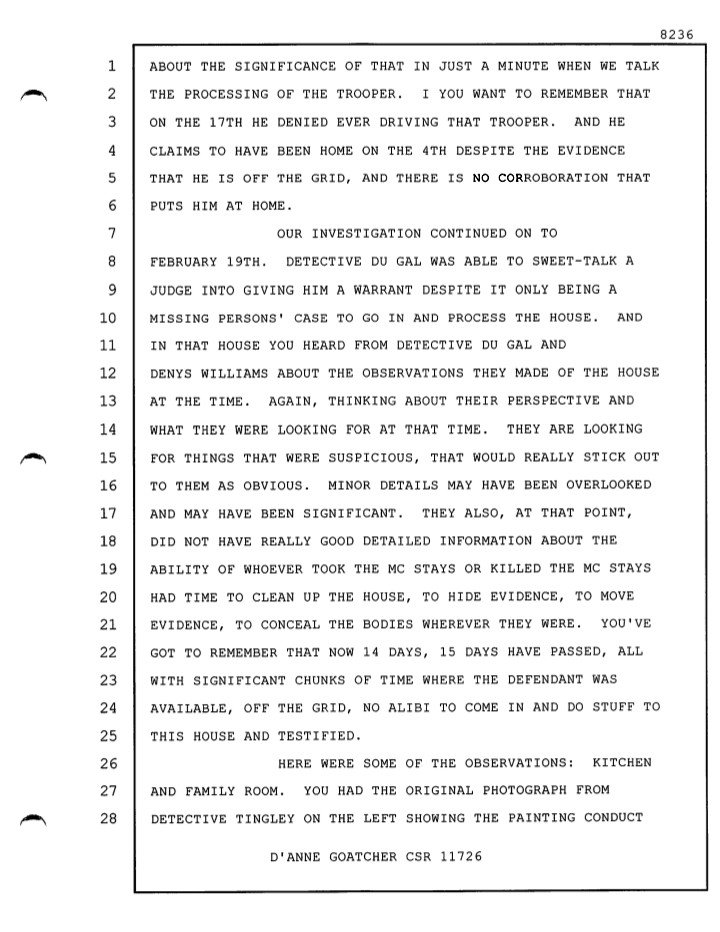
“There is no corroboration that puts him at home.”
(ADA Imes, closing, RT 8236:3-6)
What my lawyers had
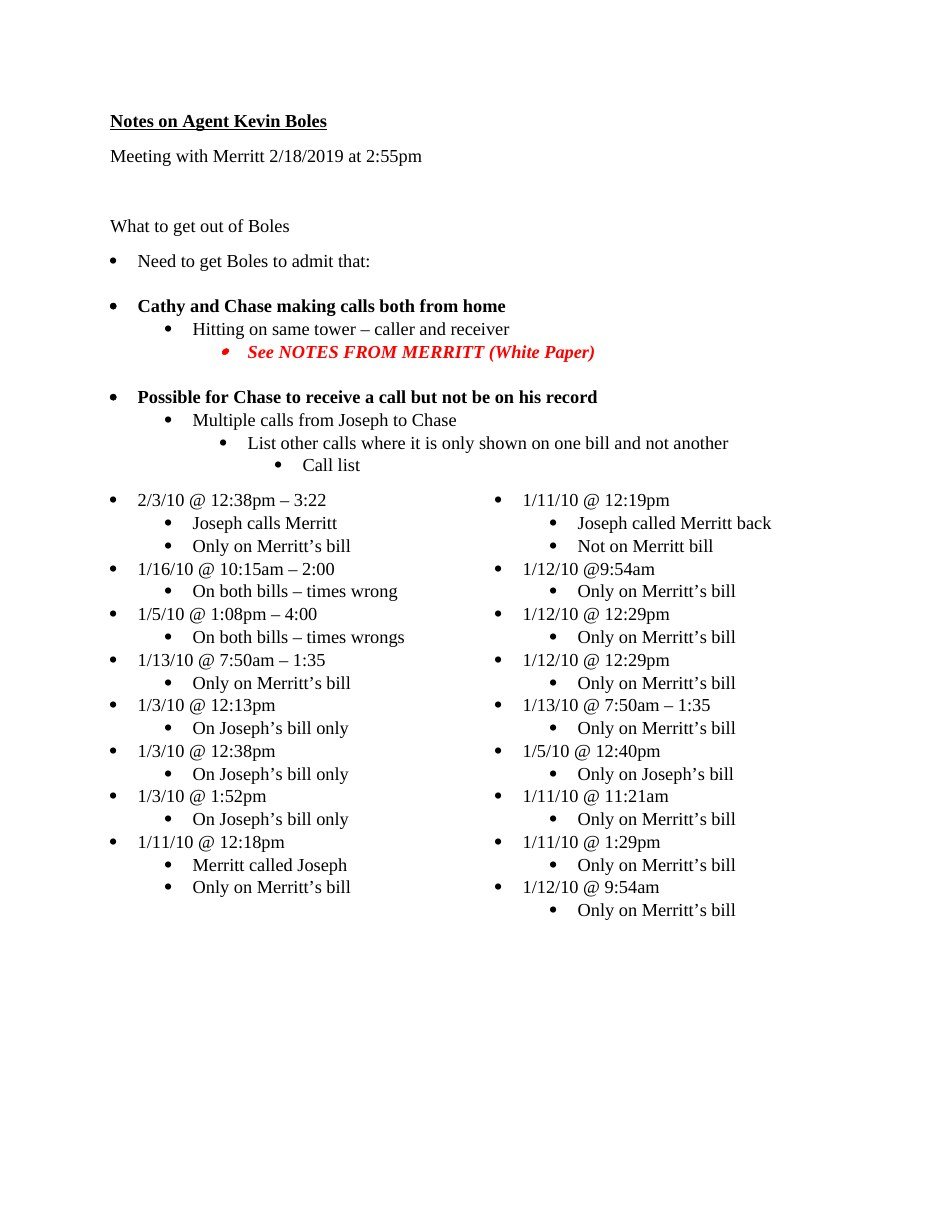
Their own notes, typed after our meeting on February 18, 2019, before Agent Boles testified: “Cathy and Chase making calls both from home,” “Hitting on same tower — caller and receiver,” “0.0 seizure time means the phone is OFF??,” and “Feb 4th @ 9:32pm hits towers in Mira Loma — Can be in Rancho?” The notes also quote Boles’s own sworn testimony from another case, People v. Pape: “When you are looking at historical records, if someone’s phone is powered off or it is out of range, there is no way to really tell that.” (Pape, Grand Jury, 271:11-13.)
See the notes (page 1)
February 4 · Card 1 of 9
Same tower, caller and receiver. The jury never saw those calls.
What they had
The State argued that if Cathy was calling me, I could not have been home. The answer was in the records: Cathy and I called each other routinely while we were both at home. Their notes put it in two lines: “Cathy and Chase making calls both from home” and “Hitting on same tower — caller and receiver.”
Nine of those calls show the same tower and the same 100° face on both phones: February 1 at 5:53 p.m., February 5 at 1:36 p.m., February 8 at 6:30 p.m., February 9 at 9:23 a.m., February 12 at 9:11 a.m., February 14 at 10:07 a.m., 1:01 p.m. and 6:27 p.m., and February 19 at 9:47 a.m. (Exhibit 794, items 8878, 9090, 9166, 9173, 9272, 9355, 9369, 9380 and 9618; my record logs the February 8 call at 6:31.)
What my lawyers did
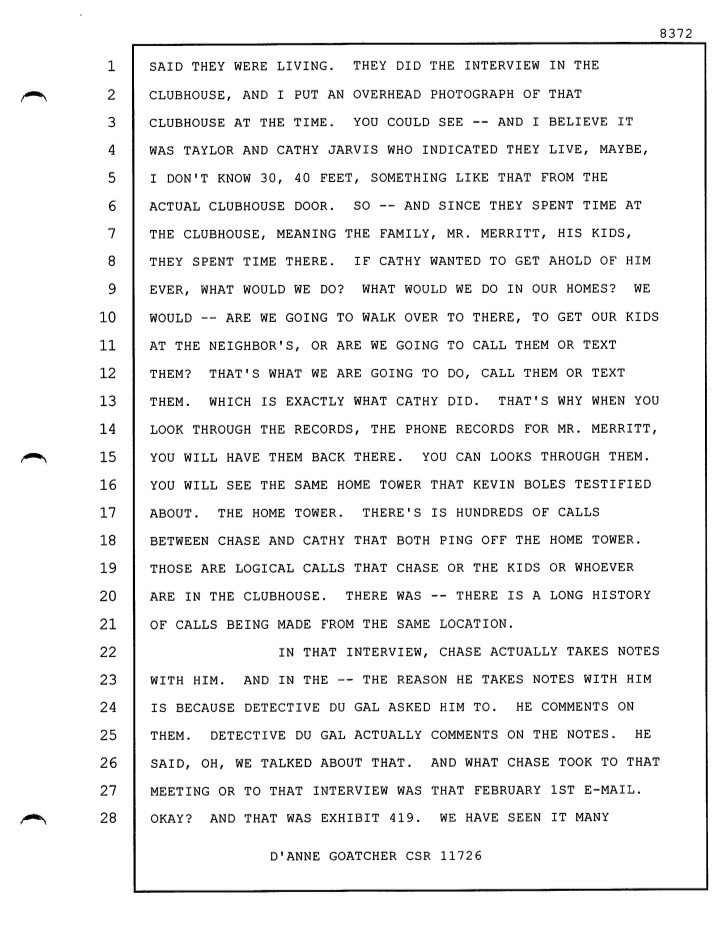
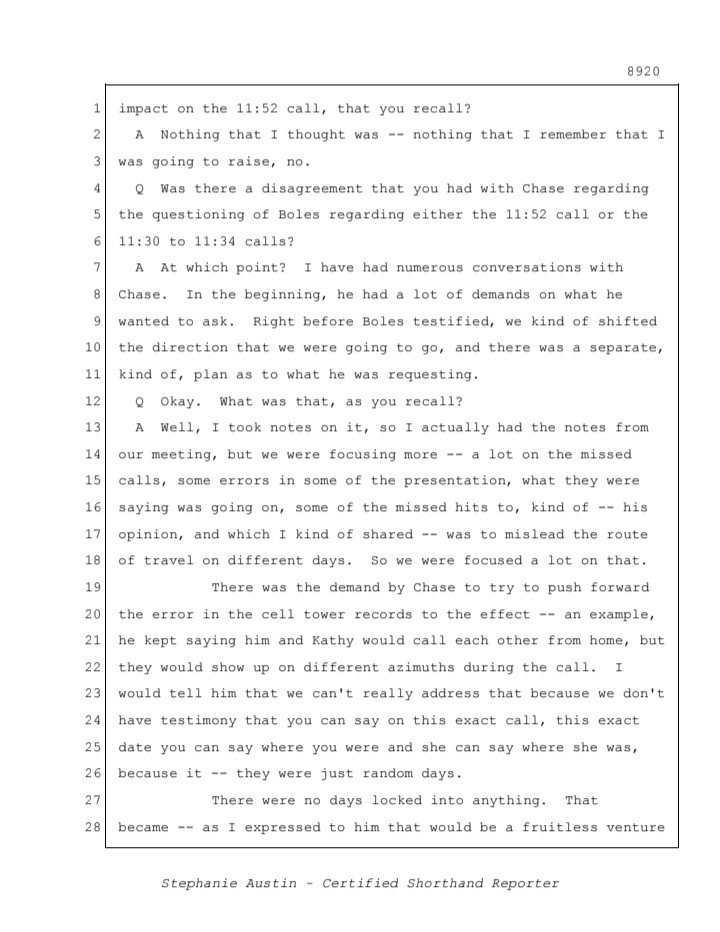
They never put those calls to a witness or showed the jury which ones they were. In closing, Mr. Maline told the jury there were “hundreds of calls between Chase and Cathy that both ping off the home tower” (RT 8372:13-21), but by then no witness had been shown a single one. After the verdict, Mr. McGee testified, “I took notes on it, so I actually had the notes from our meeting” (RT 8920:13-14), then testified: “he kept saying him and Kathy would call each other from home, but they would show up on different azimuths during the call,” and that pursuing it “would be a fruitless venture.” (RT 8920:19-8921:1.) “Different azimuths,” “random days” and “a fruitless venture” were his reasons for not using the calls. Those were his words, not mine.
See the trial transcript (RT 8372)
What the jury was left with
“No corroboration that puts him at home.” (RT 8236:3-6.) Denying my motion for a new trial, the court said: “Obviously, if they are in the same apartment, she’s not needing to call him.” (RT 8944:24-28.)
See the trial transcript (RT 8236)
What they might say: Mr. McGee gave his reason under oath: they were “just random days. There were no days locked into anything.” (RT 8920:19-8921:1.)
See the trial transcript (RT 8920, 8921)
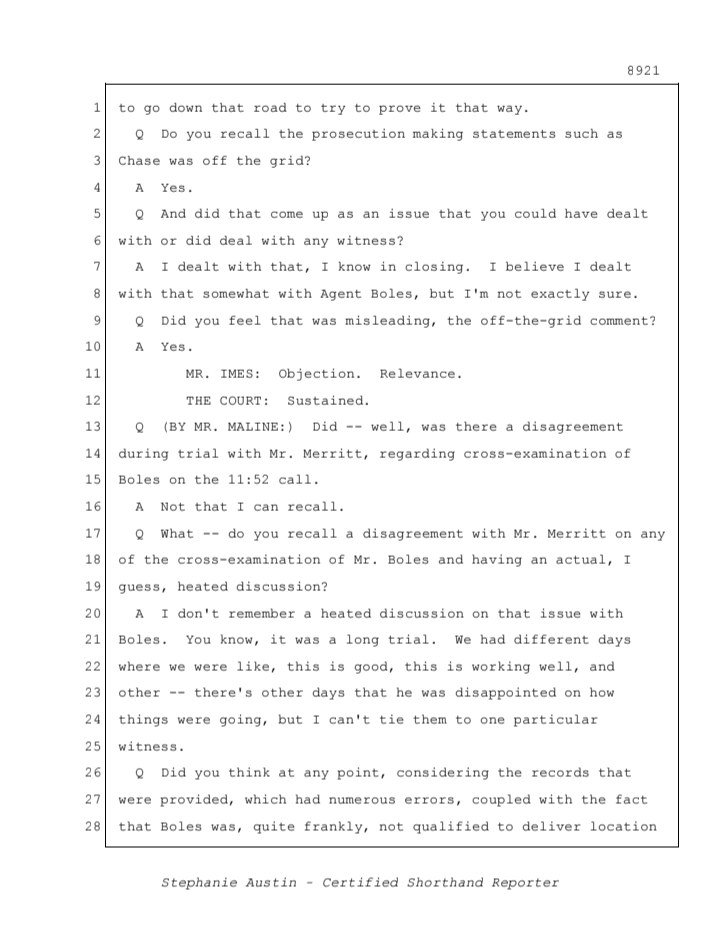
The record: The point was never one particular day. It was that Cathy and I called each other routinely when we were both at home, which is exactly what the State, and then the court, said we would not do. Mr. McGee had the records that answered him. His own notes of our meeting: “Hitting on same tower — caller and receiver.” My Exhibit 147, which he had before trial: thirty calls with exact dates and times, and the item number of each on both our records. My handwritten notes on the records, scanned May 10, 2018, also before trial. Both full AT&T records show 173 calls from February 2009 to February 19, 2010 with both our phones on home towers in the same call, 122 on the tower a third of a mile from our apartment, and fourteen on the very same antenna. Some calls show different faces or nearby towers; all are home towers facing home. And nothing needed a day “locked in.” At the hearing, Mr. Maline did not show Mr. McGee Exhibit 147, my White Paper or his own notes. Mr. McGee’s sworn description was false, and his own notes show he knew it. (Both lists: Both at home?)
The nine calls: both phones on the same antenna (cell 16635, 100°)
| # | Date | Time | Call | My record (Exh. 794) | Cathy’s record |
|---|---|---|---|---|---|
| 1 | 2/1/10 | 5:53 p.m. | I called Cathy | item 8878, p. 363 | item 5481, p. 218 |
| 2 | 2/5/10 | 1:36 p.m. | I called Cathy | item 9090, p. 372 | item 5576, p. 222 |
| 3 | 2/8/10 | 6:31 p.m. | I called Cathy | item 9166, p. 374 | item 5647, p. 225 |
| 4 | 2/9/10 | 9:23 a.m. | I called Cathy | item 9173, p. 375 | item 5652, p. 225 |
| 5 | 2/12/10 | 9:11 a.m. | I called Cathy | item 9272, p. 379 | item 5702, p. 227 |
| 6 | 2/14/10 | 10:07 a.m. | I called Cathy | item 9355, p. 382 | item 5739, p. 228 |
| 7 | 2/14/10 | 1:01 p.m. | I called Cathy | item 9369, p. 383 | item 5740, p. 228 |
| 8 | 2/14/10 | 6:27 p.m. | I called Cathy | item 9380, p. 383 | item 5741, p. 228 |
| 9 | 2/19/10 | 9:47 a.m. | Cathy called me | item 9618, p. 393 | item 5807, p. 231 |
All 173 home-tower calls are listed on Both at home?
February 4 · Card 2 of 9
Boles wanted to ask AT&T. My lawyer asked about February 3.
What they had
In an earlier case, People v. Pape, Boles had sworn that historical phone records cannot tell a phone that is powered off from one that is out of range, and my lawyers had typed that testimony into their notes. At my trial, Boles told the jury that calls with no tower meant the phone “could be off, off the network, airplane mode, any one of those.” (RT 4527:27-4528:2.)
What my lawyers did
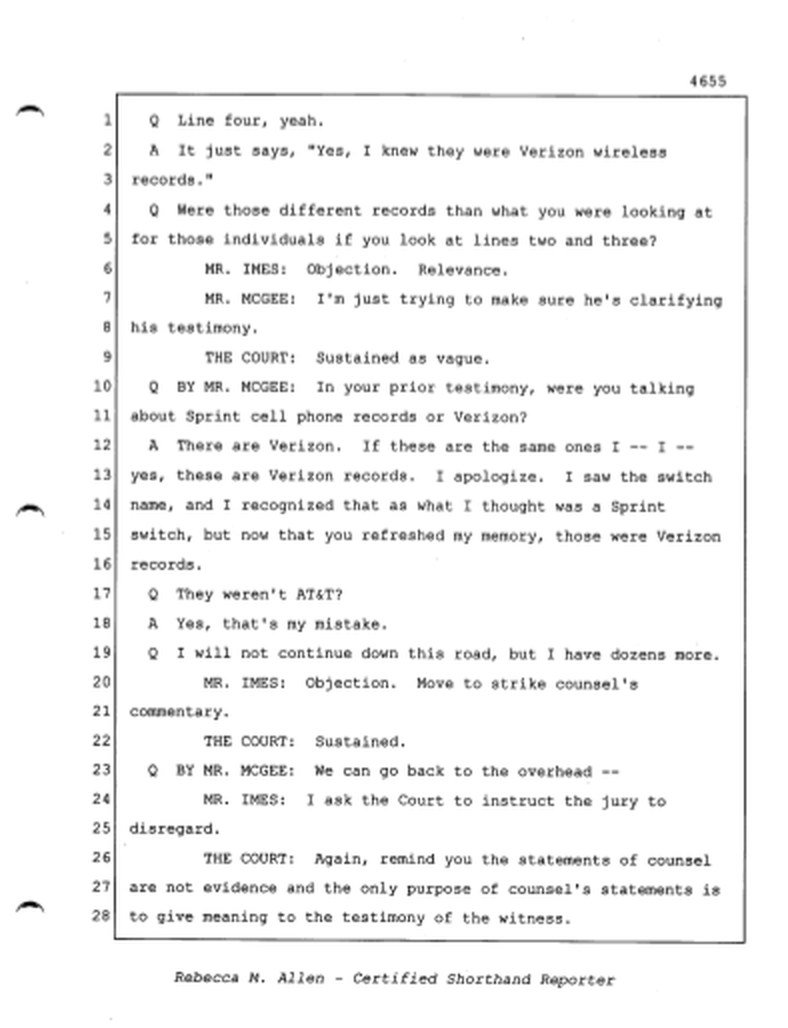
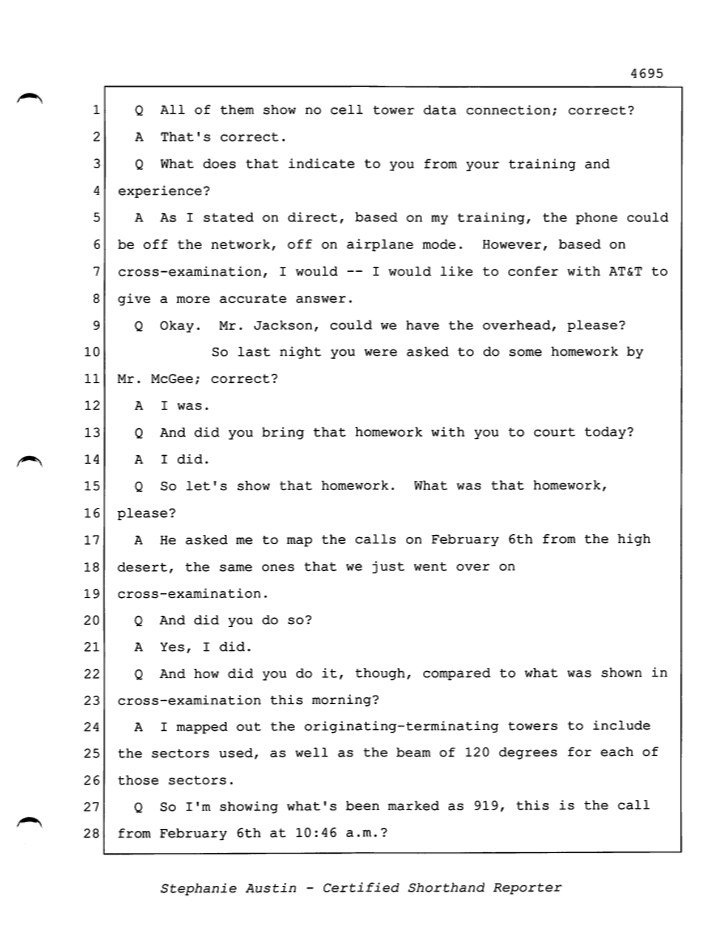
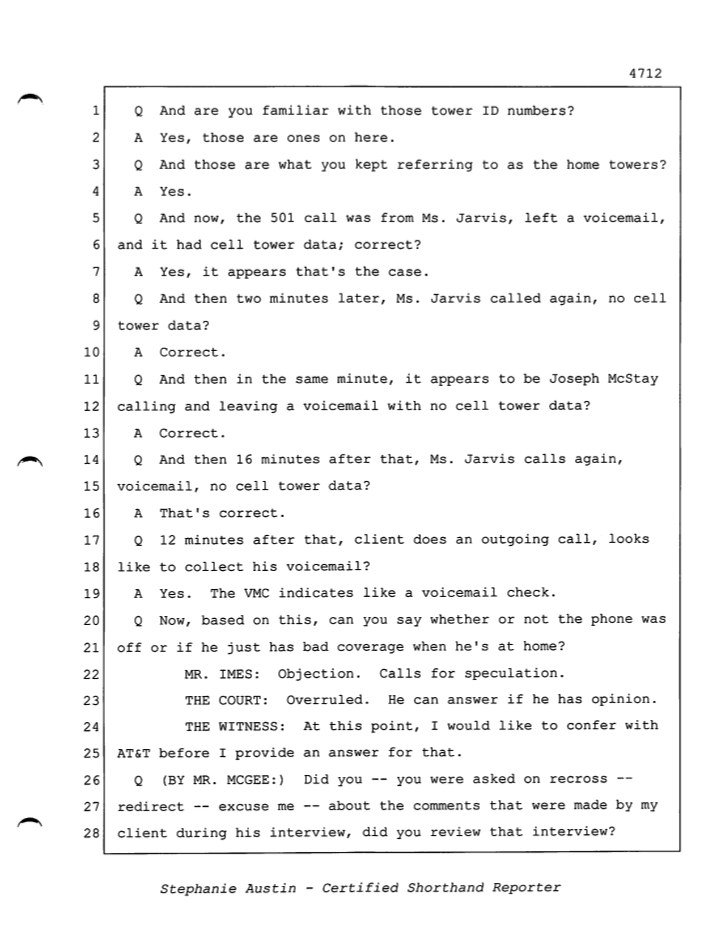
On cross-examination (the defense’s questioning), Mr. McGee walked Boles through dozens of my voicemail calls with no tower and got him to agree “it’s possible that the phone was on.” (RT 4654:17-21.) Then he stopped at January 31, with “I have dozens more” (RT 4655:19), and never put a February 4 call to him. On redirect (the prosecution’s follow-up questions), the prosecutor, Mr. Imes, did. Boles answered: “based on my training, the phone could be off the network, off on airplane mode. However, based on cross-examination, I would — I would like to confer with AT&T to give a more accurate answer.” (RT 4694:10-4695:8.) On recross, Mr. McGee took Boles through calls on February 3 instead, and asked whether he could say “whether or not the phone was off or if he just has bad coverage when he’s at home?” Boles: “At this point, I would like to confer with AT&T before I provide an answer for that.” (RT 4712:3-25.)
See the trial transcript (RT 4655, 4695, 4712)
What the jury was left with
“The only reasonable interpretation is that phone was powered off or in airplane mode.” (RT 8199:7-13.) No objection. Ruling on my motion to dismiss, the court said of Joseph’s 8:28 call: “Mr. Merritt’s phone may not even have been on.” (RT 4999:15-20.)
See the trial transcript (RT 8199)
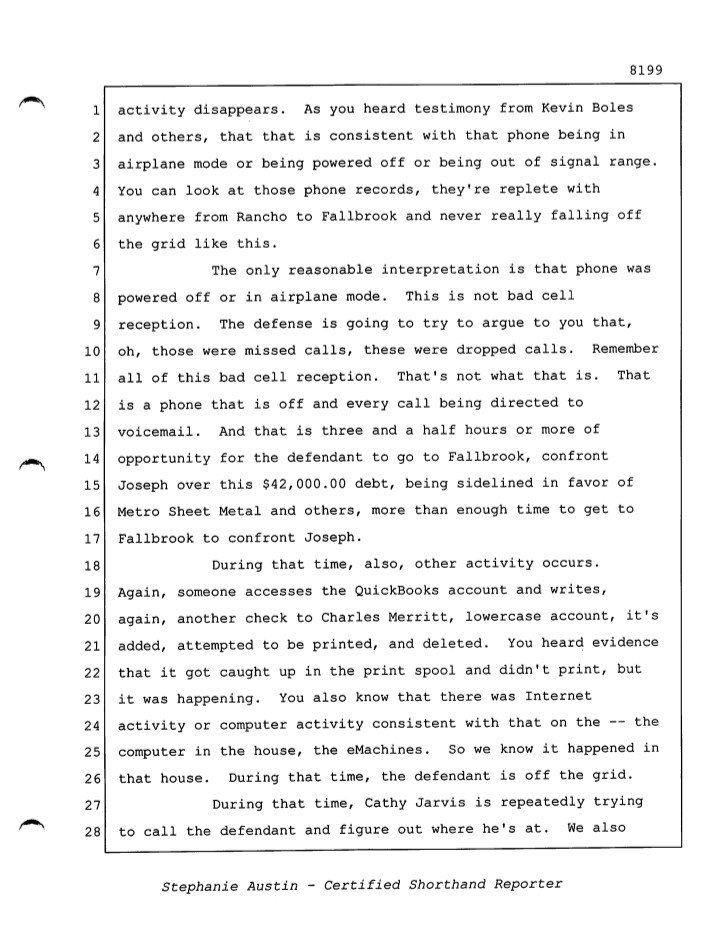
What they might say: Mr. McGee did cross-examine Boles on the phone-off claim, and he got a real concession. (RT 4654:17-21.)
See the trial transcript (RT 4654)
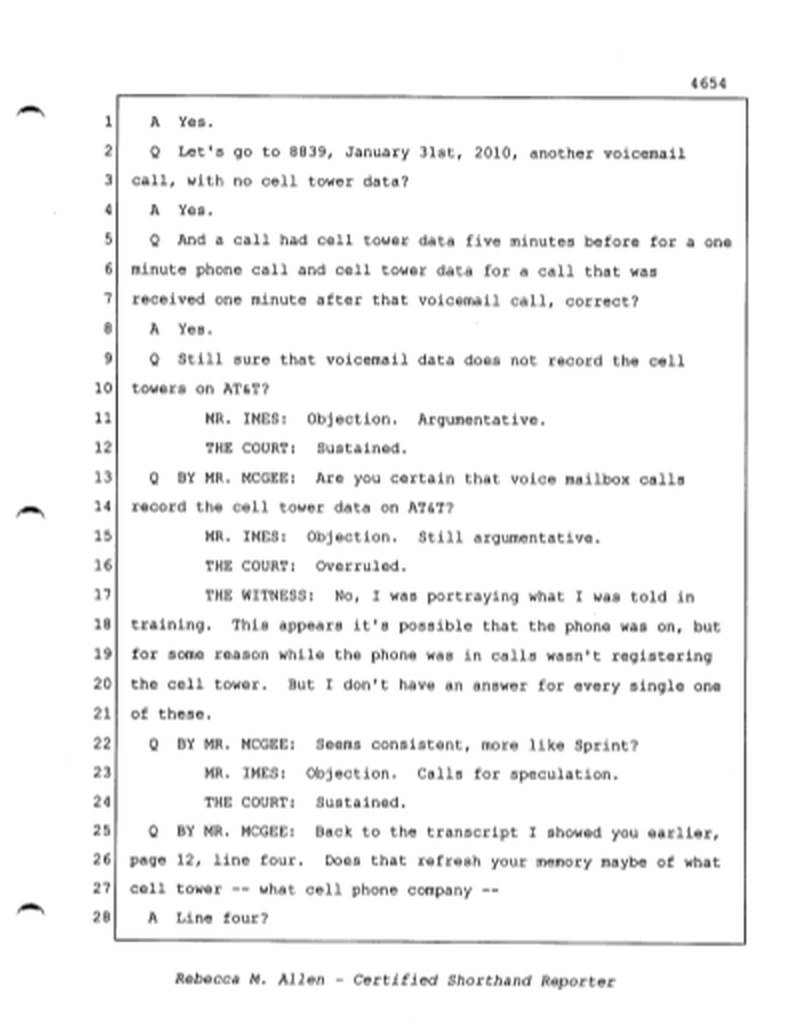
The record: He did, and that matters. But the concession was about other days. The one evening my alibi turned on was put to Boles by the prosecution, not by my lawyer, and when Boles said he would need AT&T to answer, on recross my lawyer put that question to Boles about February 3, not February 4, and Boles again said he needed AT&T. My position has never been that the records show my phone was on. I was at the clubhouse, which has bad reception, while Cathy called from the apartment. The point is that the records could not tell, and Boles had sworn as much in Pape.
February 4 · Card 3 of 9
A conversation the recordings do not contain. Objected to, overruled, and left standing.
What they had
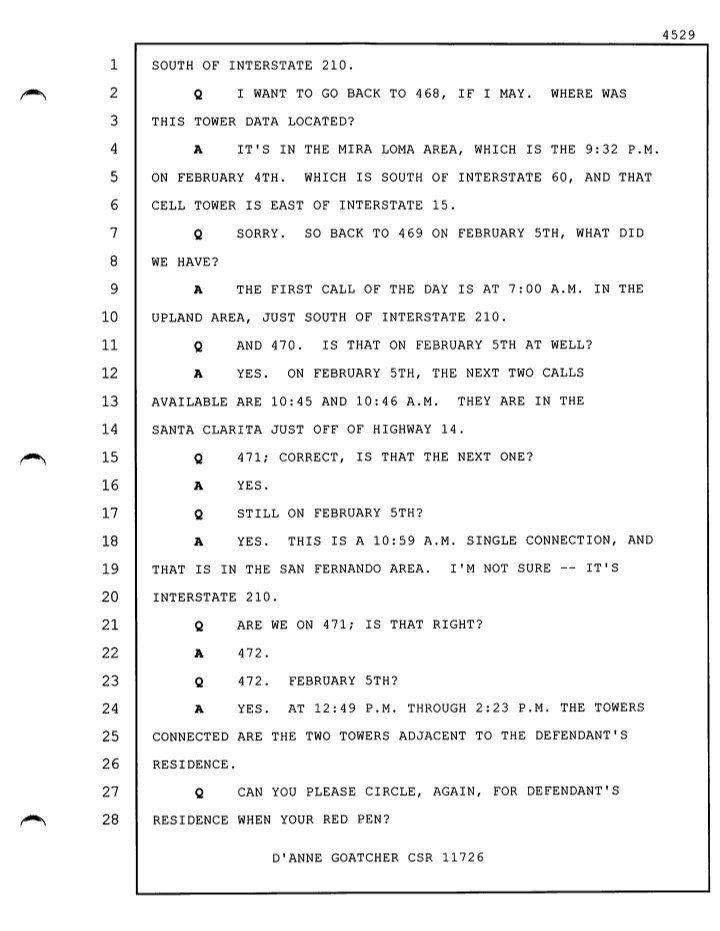
Their notes: “Feb 4th @ 9:32pm hits towers in Mira Loma.” Boles had already placed the 9:32 p.m. tower “in the Mira Loma area… south of Interstate 60.” (RT 4529:4-6.) And the recorded calls between my daughter Taylor and me contain no conversation like the one below.
See the trial transcript (RT 4529)
What my lawyers did
My daughter Taylor testified for the defense about that evening. Cross-examining her, ADA Rodriguez asked whether I had told her about “the need to be at home on the night of the 4th because his phone was pinging off of a tower in the Riverside area,” and about “McKinley.” (RT 5248:28-5249:9.) My lawyers objected. Mr. Maline: “If Counsel wants to point out the section of the transcript that she’s referring to.” Mr. McGee: “Otherwise, she’s testifying, move to strike.” The court: “Overruled.” (RT 5249:10-13.) After that, neither of them showed the jury that the recordings contain no such conversation, or pointed the jury back to Boles’s own placement of the 9:32 p.m. tower in Mira Loma.
What the jury was left with
The question itself, put to the jury as if the conversation had happened. The State’s theory was that I drove home from Fallbrook that night, and a phone “pinging off of a tower in the Riverside area” sounds like a phone on that road home. Taylor did not adopt it: “I don’t know if he said he needed to be home, but I remember talking in general about the phone towers.” (RT 5248:28-5249:9.) Asked about McKinley: “I don’t know of a McKinley Street. I don’t.” (RT 5249:15.)
See the trial transcript (RT 5248, 5249)
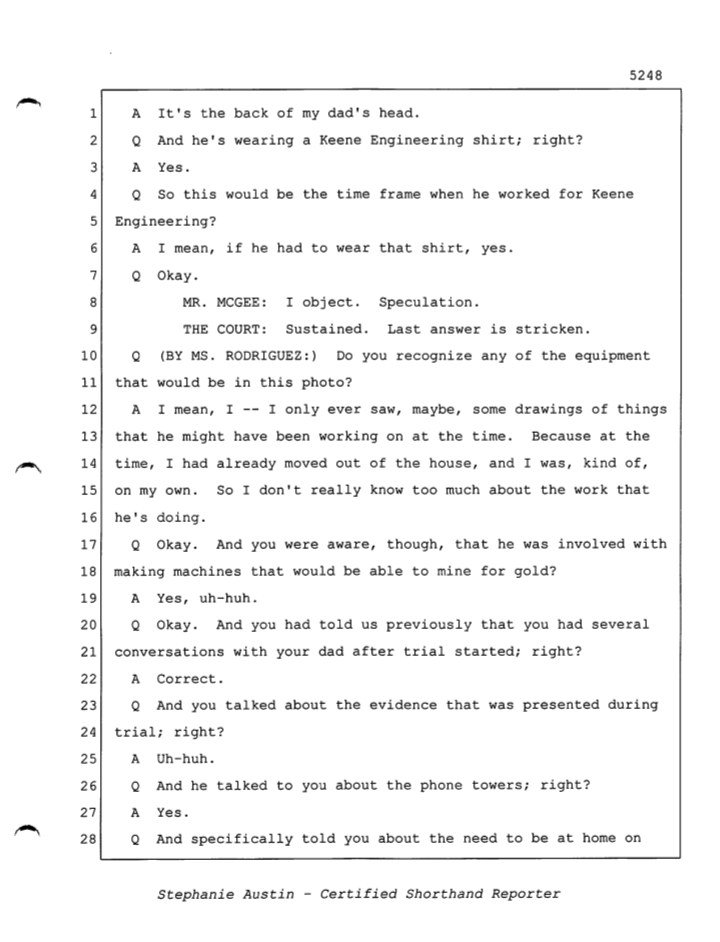
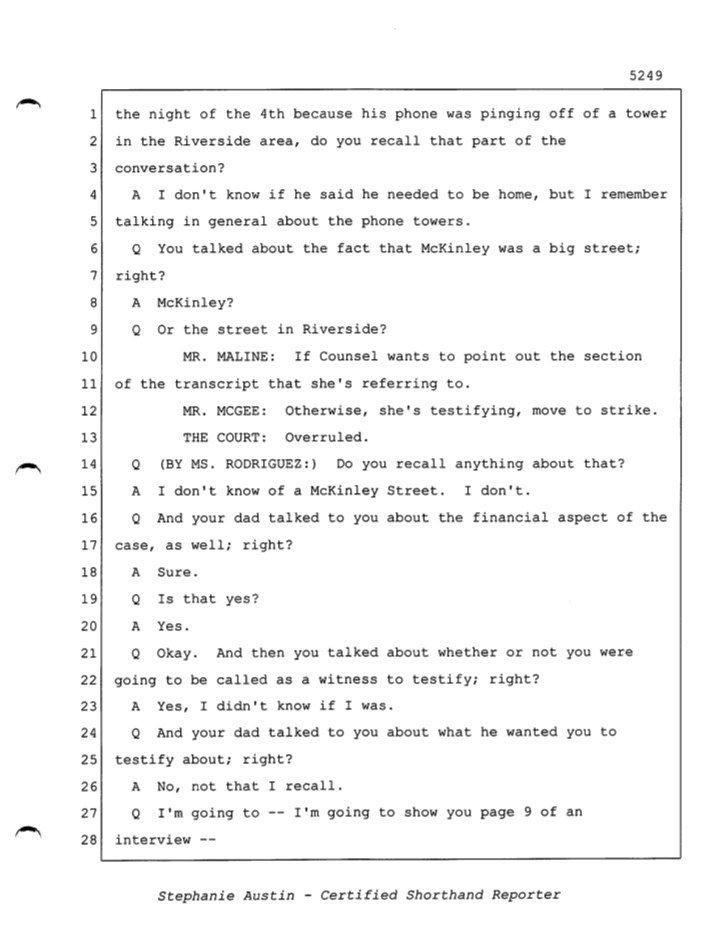
What they might say: My lawyers did object, and the court overruled them. A question is not evidence, and Taylor did not agree with it. They might also point out that Mira Loma is in Riverside County.
The record: All true, and the objection was the right one: the prosecutor was testifying through her question. But once it was overruled, the question stood, and nothing my lawyers did afterward showed the jury it rested on a conversation the recordings do not contain. Mira Loma is in Riverside County, so “Riverside area” is not the problem. The conversation is. I never told Taylor about “the need to be at home” that night because of a tower, and we never discussed a street called McKinley.
February 4 · Card 4 of 9
The 8:28 call was not alone. My lawyers had the list.
What they had
Before trial, I gave my lawyers my Exhibit 148: thirty-one calls that appear on one phone record and not the other, or as zero on one side. My handwritten notes, scanned May 10, 2018, include a page headed “Rebuttal Data — Phone Call @ 8:28 on 4th (my phone on, it rings but not on bill).” And they had Joseph’s T-Mobile record, admitted as Exhibit 793. Set against mine, it shows 12 of Joseph’s calls to me in the five weeks before February 5 that are missing from my record entirely, the 8:28 call among them, and 98 more that last minutes on his record and zero on mine.
What my lawyers did
By my account, none of these calls was ever put to a witness. The carriers’ own custodians had already given the answer. T-Mobile’s: a call with a length on Joseph’s record “has to be received” (RT 3588:21-3589:3). AT&T’s: a voicemail call appears on the receiving phone’s record (RT 3621:27-3622:9).
What the jury was left with
“That phone call is on Joseph’s phone records, but it never connects to the defendant’s phone, which is why it’s not there. How can she distinctly remember a phone call on that date that was never received by the defendant’s phone? Never happened. That’s why.”
(ADA Rodriguez, rebuttal, RT 8424:5-11)
What they might say: A call missing from my record means my phone was off, or the call never connected.
The record: Both carriers’ custodians said otherwise: a call with a length on Joseph’s record was received, and a call that reached my voicemail would still be on mine. Twelve of Joseph’s calls to me are missing from my record in five weeks, and 8:28 is one of them. A record that drops calls cannot prove a call never happened. My lawyers had the list and never used it.
See my notes: “Rebuttal Data” and Exhibit 148 (page 1)
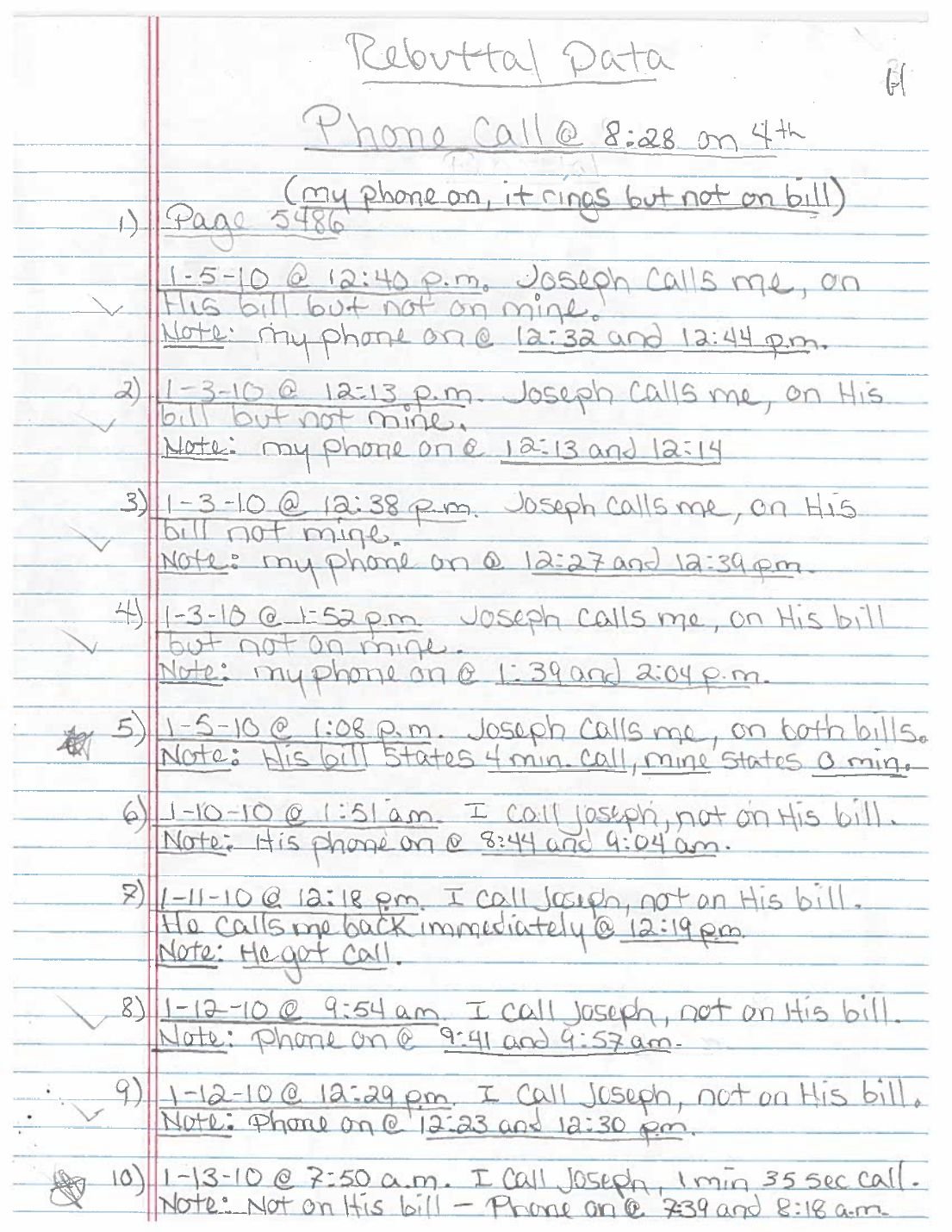
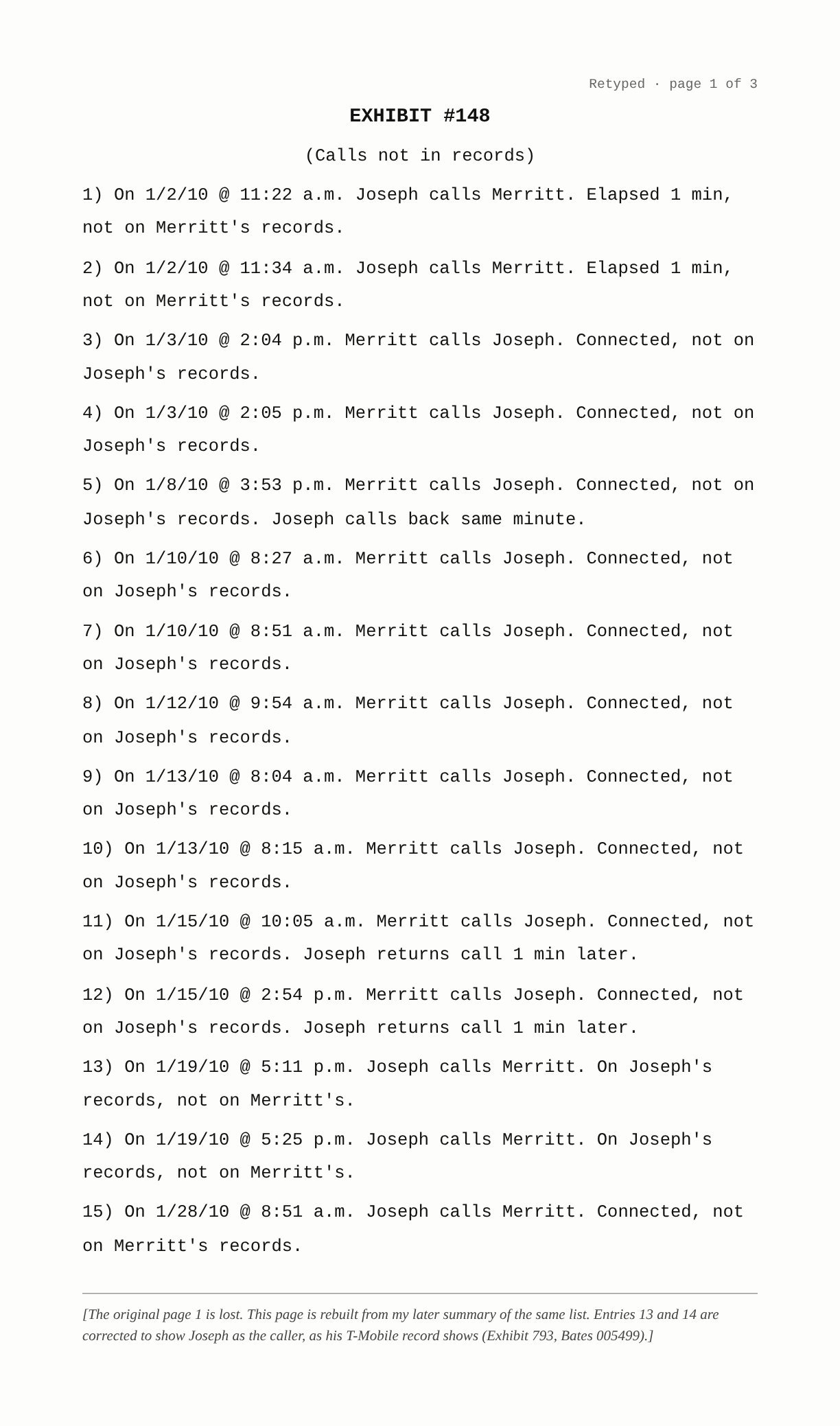
The 12 calls from Joseph missing from my record
| # | Date | Time | Joseph’s record (Exh. 793) | Bates | My record (Exh. 794) |
|---|---|---|---|---|---|
| 1 | 1/2/10 | 11:22 a.m. | 1 min | 005482 | not there |
| 2 | 1/2/10 | 11:34 a.m. | 1 min | 005482 | not there |
| 3 | 1/19/10 | 5:11 p.m. | 1 min | 005499 | not there |
| 4 | 1/19/10 | 5:25 p.m. | 1 min | 005499 | not there |
| 5 | 1/19/10 | 5:51 p.m. | 2 min | 005500 | not there |
| 6 | 1/19/10 | 6:28 p.m. | 1 min | 005500 | not there |
| 7 | 1/19/10 | 6:51 p.m. | 1 min | 005500 | not there |
| 8 | 1/19/10 | 7:55 p.m. | 2 min | 005500 | not there |
| 9 | 1/25/10 | 9:04 a.m. | 1 min | 005504 | not there |
| 10 | 1/28/10 | 8:51 a.m. | 1 min | 005507 | not there |
| 11 | 2/3/10 | 7:34 a.m. | 1 min | 005512 | not there |
| 12 | 2/4/10 | 8:28 p.m. | 1 min | 005515 | not there |
The 98 calls with minutes on Joseph’s record and zero on mine are listed on Home that night.
The graves (February 6)
The McStays’ remains were found in the desert near Victorville. To connect me to the graves, the State used calls my phone made on the morning of February 6, 2010, two days after the family disappeared. It told the jury my phone was pinging towers “within eyesight of those graves,” and stressed two calls recorded on the sector of the Quartzite tower that points due east. One more call that morning, at 11:52 a.m., started on that same east-facing sector, which AT&T’s records list at 85°. In December 2019, before the new-trial hearing, Mr. Maline asked the defense expert: “If the 85 degree azimuth is a database error on the 11:52am call, wouldn’t it be logical that the 11:30-11:34am calls would also be errors?” (E-mail, Dec. 20, 2019.) These four cards are about the one call that tested that record, the 11:52 a.m. call, and what my lawyers did with it.
The State said
“Within eyesight of those graves, the defendant’s phone is pinging. … two of those calls in particular, where it pings off the sector of that — that tower that points due east.”
(ADA Imes, closing, RT 8217:10-20)
What my lawyers had
Their own expert’s report, delivered in September 2018, before trial. Dr. Vladan Jovanovic found that the 11:52 a.m. call could not have happened the way the State read it, from the east sector of the Quartzite tower to the Palmdale Road tower in 35 seconds. His best guess put the phone in West Victorville, on the other side of the tower from the graves. A second report, three days earlier, found AT&T’s own data for the Quartzite site unreliable, including the directions listed for its sectors. (Jovanovic, Geolocation of Calls, Sept. 17, 2018, pp. 25-27; AT&T Cell Site Table Problems, Sept. 14, 2018, pp. 16-22.)
February 6 · Card 5 of 9
The expert ruled out the State’s reading. My lawyer asked if the phone was moving.
What they had
The call: at 11:52 a.m. on February 6, a 35-second call on my phone started on the east-facing sector of the Quartzite tower and, by the records, ended on a different tower at “15 Fwy and Palmdale Rd” in West Victorville, about 7.4 miles away by the tower coordinates in my AT&T record. At 60 mph, a phone covers about 0.6 miles in 35 seconds. Their expert’s report, delivered before trial, said:
“It should be fairly obvious that it is impossible to find a section of this length on I-15, or any other road in this area, where the phone could have been to start the call on cell 11095 and end it on cell 03483 based on the proximity criteria only.”
(Jovanovic report, p. 25)
His most likely scenario: the phone “was reasonably close to the ‘15 Fwy and Palmdale Rd’ site in the West Victorville, but was redirected.” (Id., pp. 25-26.) His summary: “Our best guess is that it was made from the West Victorville area, but other options cannot be excluded.” (Id.)
What my lawyers did
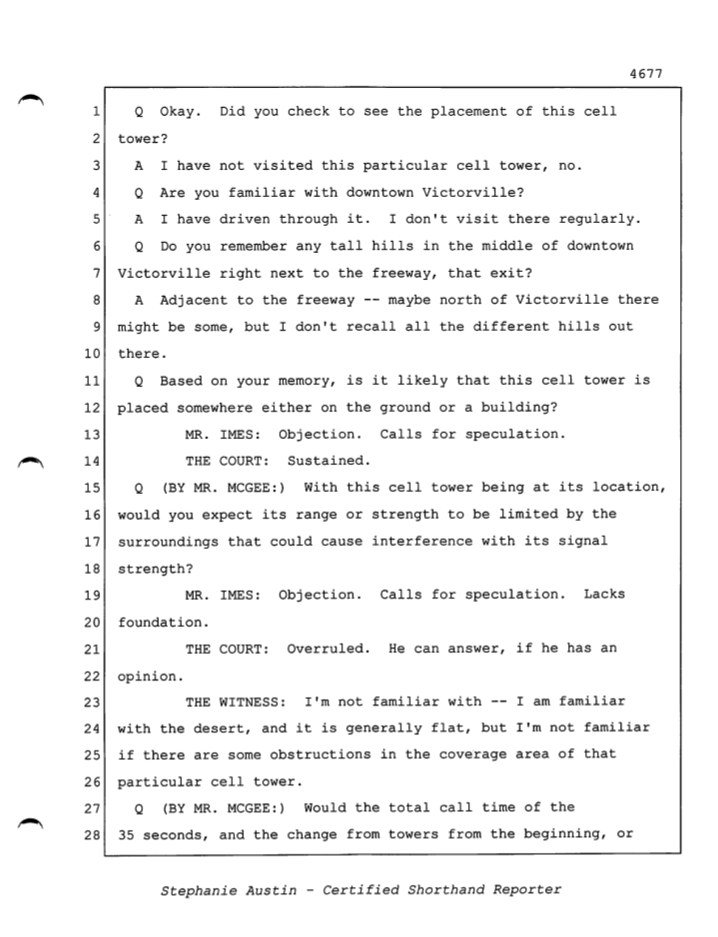
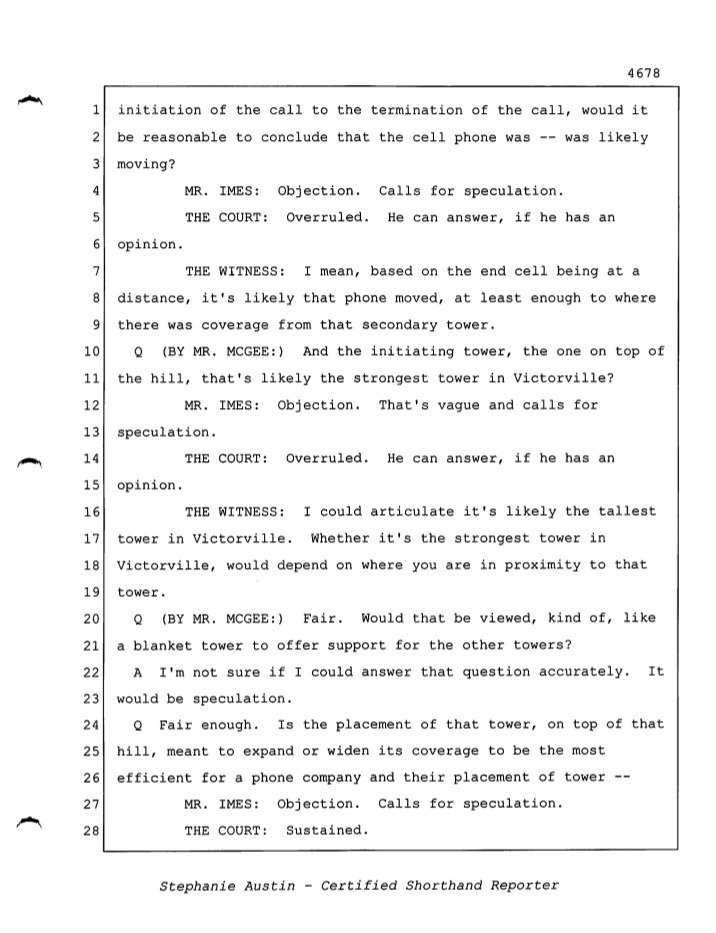
Mr. McGee asked the State’s expert whether the phone on that call was likely moving, and Boles agreed: “it’s likely that phone moved, at least enough to where there was coverage from that secondary tower.” (RT 4677:27-4678:9.)
See the trial transcript (RT 4677, 4678)
What the jury was left with
A phone that started the call on the east sector and drove away: the State’s reading, now agreed to in answer to my own lawyer’s question. The core findings of the expert’s report never reached the jury.
What they might say: The question was meant to show my phone was on the road, not standing at the graves.
The record: A moving phone that started on the east sector is still the State’s reading of the record. The defense’s own expert had found that reading impossible by distance alone, and his best guess put the phone in West Victorville. The question did not challenge the east-sector record. It accepted it.
February 6 · Card 6 of 9
The report said “impossible.” My lawyer swore it didn’t.
What they had
The same pre-trial report from Dr. Jovanovic quoted in Card 5 (p. 25). And Mr. Maline’s own e-mail to the expert a month before the hearing: the 11:52 call “WAS IMPOSSIBLE.” (E-mail, Maline to Jovanovic, Dec. 16, 2019.)
What my lawyers did
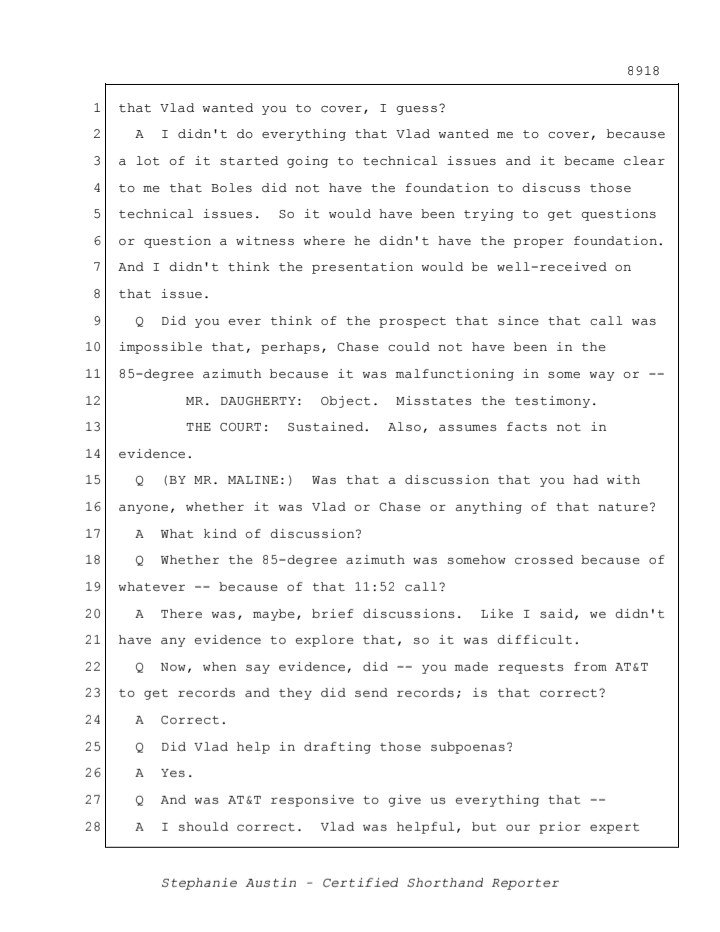
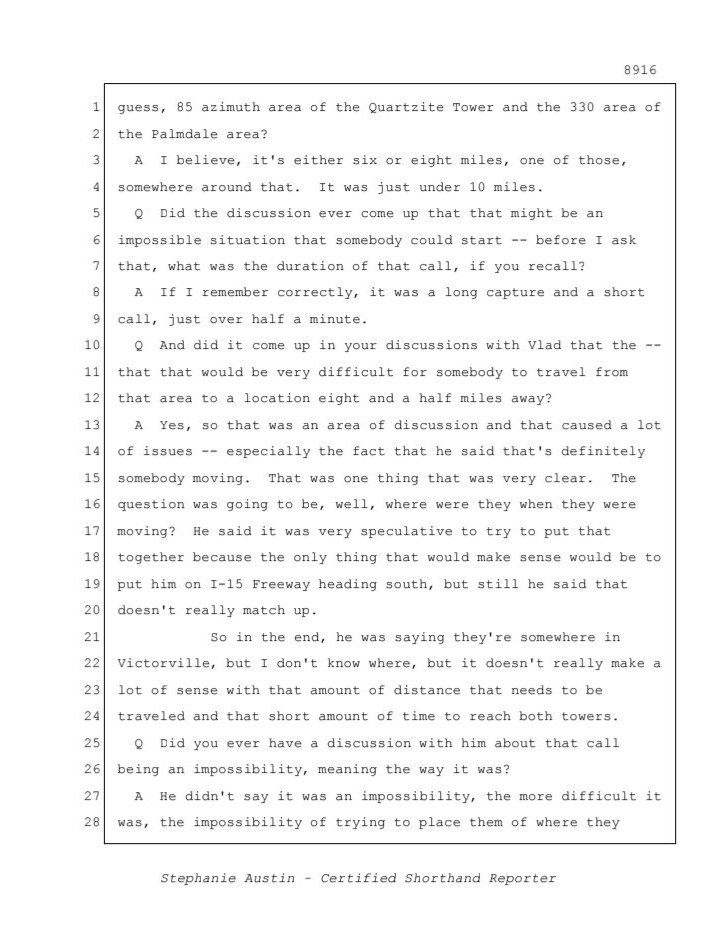
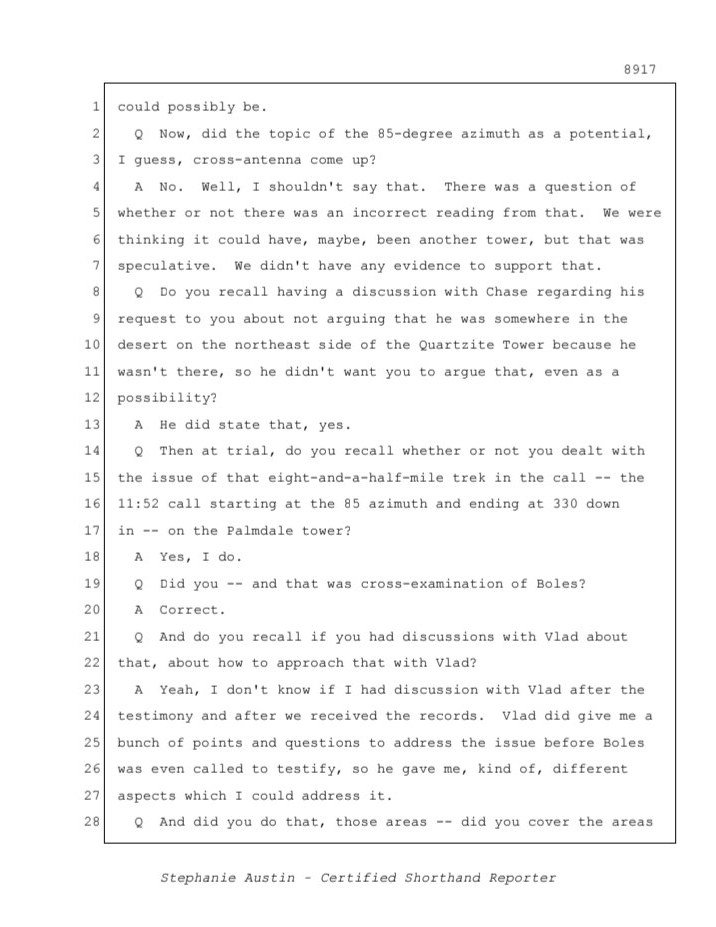
The new-trial hearing was where my lawyers’ work at trial was supposed to be examined. Mr. Maline called Mr. McGee as a witness. Under oath, Mr. McGee said the expert “said that’s definitely somebody moving” (RT 8916:13-15), and: “He didn’t say it was an impossibility, the more difficult it was, the impossibility of trying to place them of where they could possibly be.” (RT 8916:27-8917:1.) Mr. Maline did not use the report or his own e-mail to correct him. Minutes later, when Mr. Maline asked a question that called the call impossible, the court sustained Mr. Daugherty’s objection: “Also, assumes facts not in evidence.” (RT 8918:9-14.)
See the trial transcript (RT 8918)
What the court was left with
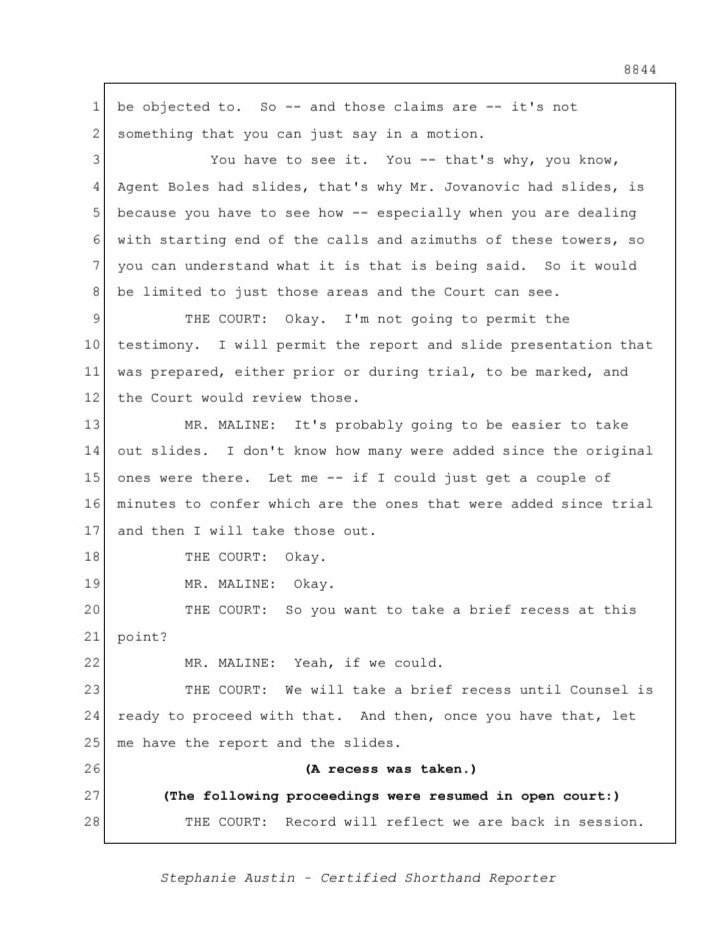
Mr. McGee’s description of his expert, uncorrected in the testimony. The court did allow the expert’s pre-trial report and slides to be marked and reviewed (RT 8843:18-23), but no one used them to confront Mr. McGee.
What they might say: Mr. McGee was describing his conversations with the expert, not the written report.
The record: He was testifying about what the expert had concluded (RT 8916:13-8917:7), and the expert’s written conclusion was in his own file. Whatever was said in conversation, the report says “impossible.” Mr. Maline had both the report and his own e-mail, and used neither.
See the trial transcript (RT 8916, 8917)
February 6 · Card 7 of 9
The Quartzite data was questioned in writing. My lawyer told the court there was “no way for anyone to know.”
What they had
In plain terms: the State’s case at the graves rested on the record saying my calls that morning used the Quartzite sector that points east, 85°. If that direction is wrong, whether from a data-entry error in AT&T’s tables or from antenna cables crossed at the tower, the east-facing record says nothing about where I was.
Here is what the defense had, and when:
| When | Who | What it says |
|---|---|---|
| Sept. 14, 2018, before trial | Dr. Jovanovic, “AT&T Cell Site Table Problems,” pp. 20-22 | “Yet another cell site with more than likely problems regarding azimuths is ‘Quartzite’ once again.” On the sector arrangement that includes the 85° sector: “very, very unusual in practice.” |
| Feb. 2019, during trial | Dr. Jovanovic, proposed questions for cross-examining Boles | “I would use his cross to establish that cell coordinates and azimuths in CDR’s are coming from Site Tables that are populated by humans and prone to errors.” |
| During trial, after Boles testified | Me | I told Dr. Jovanovic, Mr. McGee and Mr. Maline that I believed the 85° and 325° sectors at Quartzite were crossed. (My own account.) |
| Jan. 3, 2020, two weeks before the hearing | Mr. Maline, e-mail to Dr. Jovanovic | “As we discussed when you were here, the likely scenario would be that the 85 deg azimuth was crossed with the 325 azimuth on the Quartzsite tower.” And: “Chase argues that it is the 325 azimuth is bouncing back and forth with the 10 azimuth, so the 325 and 85 are the ones that are switched.” |
What my lawyers did
At the new-trial hearing, Mr. Maline told the court:
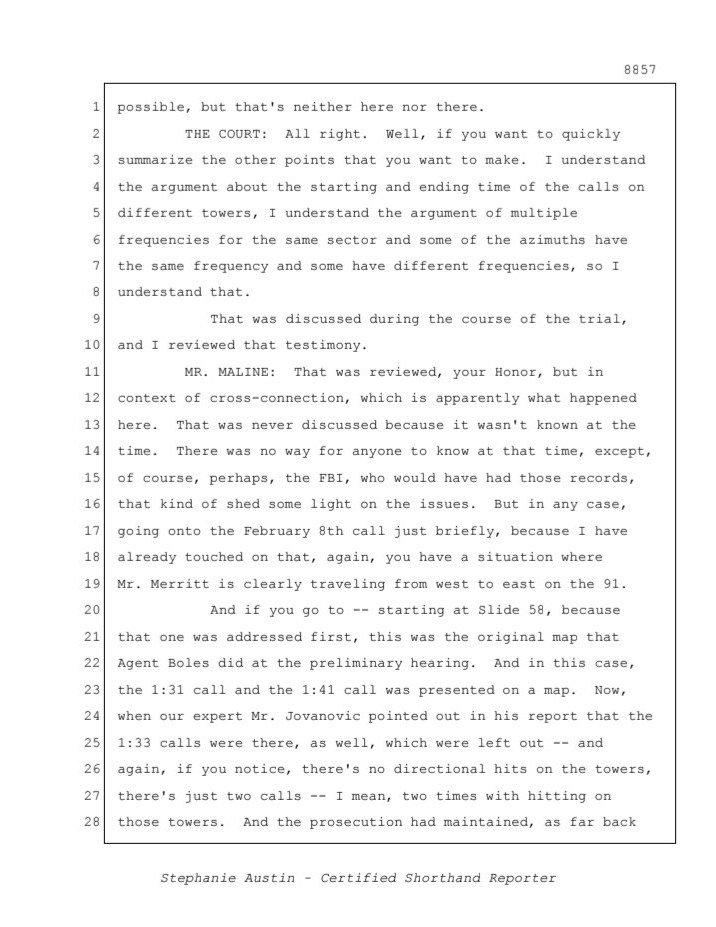
“That was reviewed, your Honor, but in context of cross-connection, which is apparently what happened here. That was never discussed because it wasn’t known at the time. There was no way for anyone to know at that time, except, of course, perhaps, the FBI, who would have had those records, that kind of shed some light on the issues.”
(RT 8857:11-16)
What the court was left with
An explanation for why the defense never raised the Quartzite sector problem at trial: no one could have known. No one told the court that the defense’s own expert had questioned the Quartzite sector directions in writing before trial and again during it.
What they might say: He only meant that no one could prove at trial that the cables were actually crossed.
The record: No one could prove it then, and I do not claim it is proven now. But “never discussed” and “no way for anyone to know” are different claims, and the record contradicts both. The expert questioned the Quartzite sector data in writing before trial and during it. By my own account, I raised the crossed sectors with Dr. Jovanovic, Mr. McGee and Mr. Maline during trial, and Mr. Maline’s e-mail shows he knew the theory was mine. To be exact about the limits: the expert’s reports call it a data problem in AT&T’s tables, not crossed cables. Either one means the 85° record cannot be taken at face value.
See the trial transcript (RT 8857)
February 6 · Card 8 of 9
Promised to the jury. Never called.
What they had
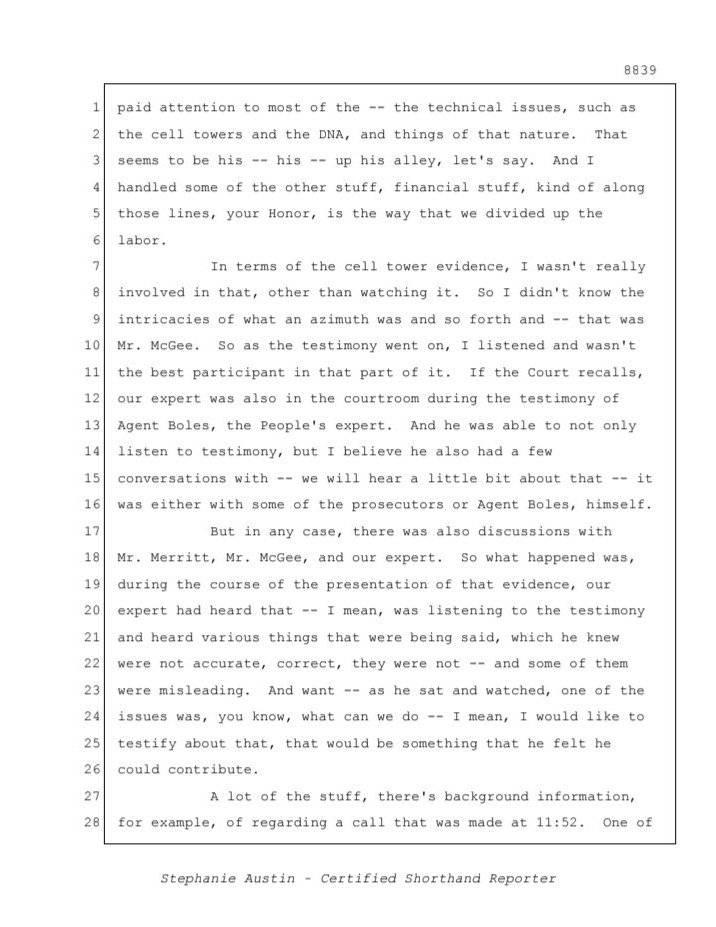
An expert with written findings, who, by Mr. Maline’s own account, sat in the courtroom through Boles’s testimony and “felt he could contribute.” (RT 8839:11-26.)
See the trial transcript (RT 8839)
What my lawyers did
They never called him at trial.
What the jury was left with
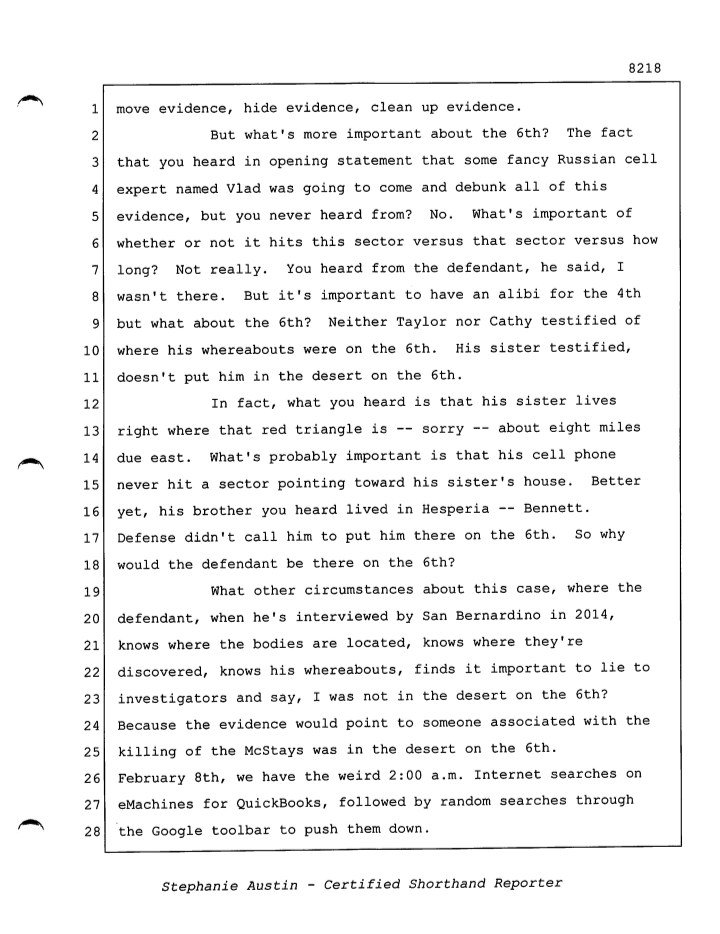
“You heard in opening statement that some fancy Russian cell expert named Vlad was going to come and debunk all of this evidence, but you never heard from? No.”
(ADA Imes, closing, RT 8218:3-5)
See the trial transcript (RT 8218)
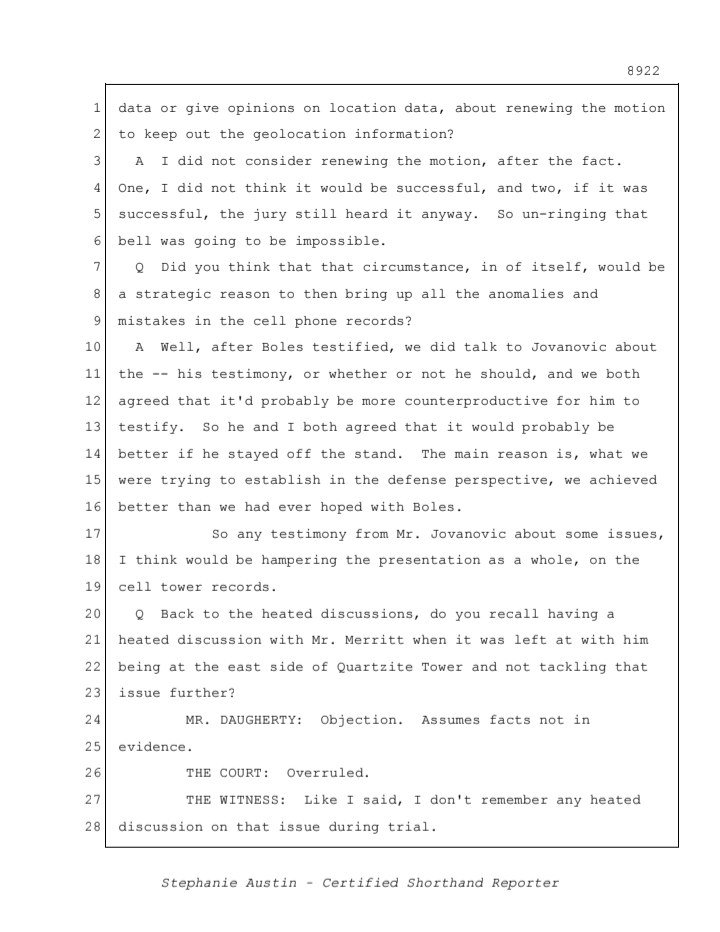
What they might say: It was strategy. Under oath, Mr. McGee said that after Boles testified, “he and I both agreed that it would probably be better if he stayed off the stand. The main reason is, what we were trying to establish in the defense perspective, we achieved better than we had ever hoped with Boles.” (RT 8922:10-16.)
See the trial transcript (RT 8922)
The record: That is his reason, and it is in the record. The cost is in the record too: the State used the expert’s absence in closing, and the core findings of his reports never reached the jury through Boles either. At the new-trial hearing, the court did not permit his testimony; it allowed his pre-trial report and slides to be marked and reviewed. (RT 8843:18-23; 8844:9-17.)
See the trial transcript (RT 8844)
The call records (February 10)
The State showed the jury maps of my phone’s tower connections, including one for February 10, 2010. It told the jury the maps simply plotted what was in the phone records. One call that day shows the maps did not always match the records. That call also mattered later: at the new-trial hearing, the judge relied on this call to explain away a call from February 4.
The State said
Boles said his maps were a “graphical representation of what’s in the call detail record.” (RT 4571:1-3.) On direct, the prosecution showed my 12:38 p.m. call (the transcript reads 12:48) on its map, and Boles, asked by Mr. Imes what he had documented, answered: “There’s a cell tower connection on a tower near Lake Matthews in Riverside County.” (RT 4558:27-4559:16.)
What my lawyers had
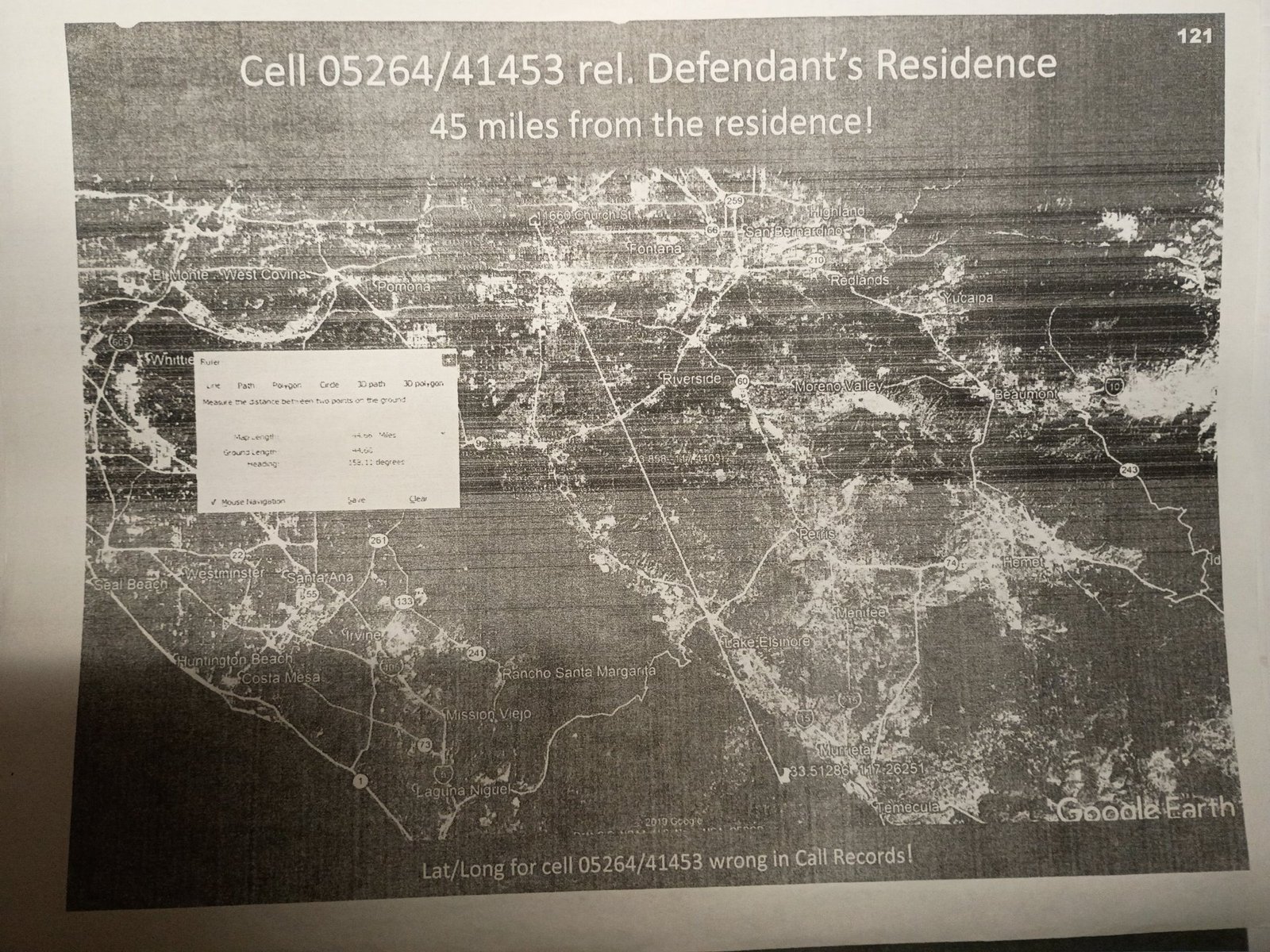
My AT&T record, Exhibit 794. At 12:37 p.m., call 9217 is on my home tower. One minute later, call 9218 is on cell 05264/41453, and the only location AT&T gives for that cell is 33.51286, -117.26251, about 45 miles from my home. Their expert’s slide was headed: “Lat/Long for cell 05264/41453 wrong in Call Records!” (Jovanovic slide 121.) Their notes: “Feb 10th — hit in Riverside — Hit in Rancho 1 min before.”
See the Jovanovic slide (slide 121)
February 10 · Card 9 of 9
AT&T put the cell 45 miles away. My lawyer handed the jury 18.8.
What they had
The two locations above, which do not match: AT&T’s, 45 miles from my home, and the State’s map, near Lake Mathews, 18.8 miles away. And Boles’s own testimony in Pape that the farthest he had seen a phone reach a tower was 12.5 miles, in open desert, and that “it’s very rare to get a distance that far.” (People v. Pape, RT 1688:13-25.)
What my lawyers did
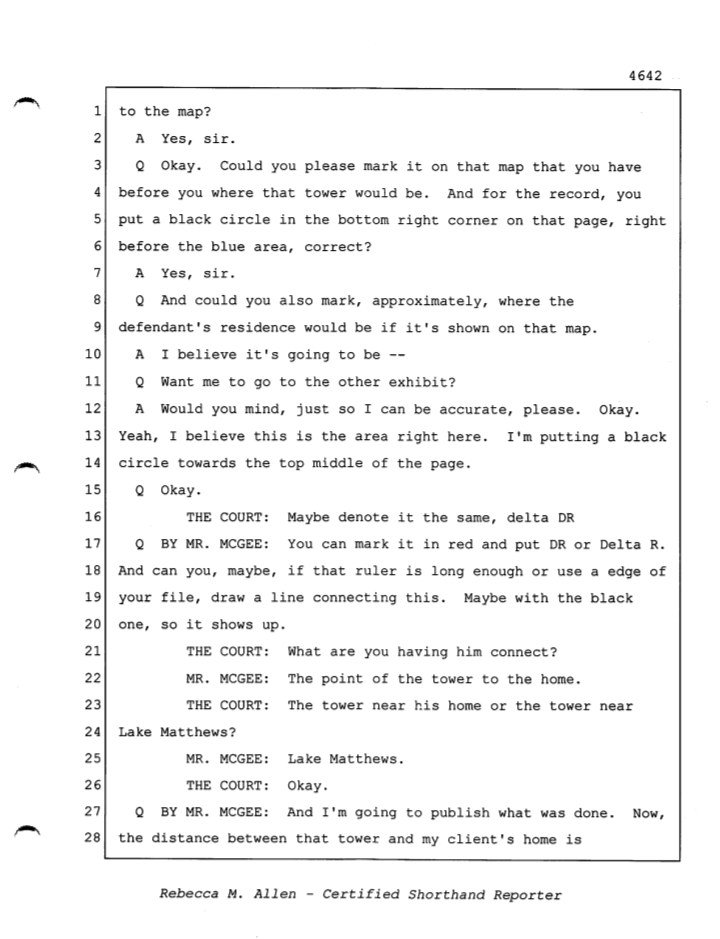
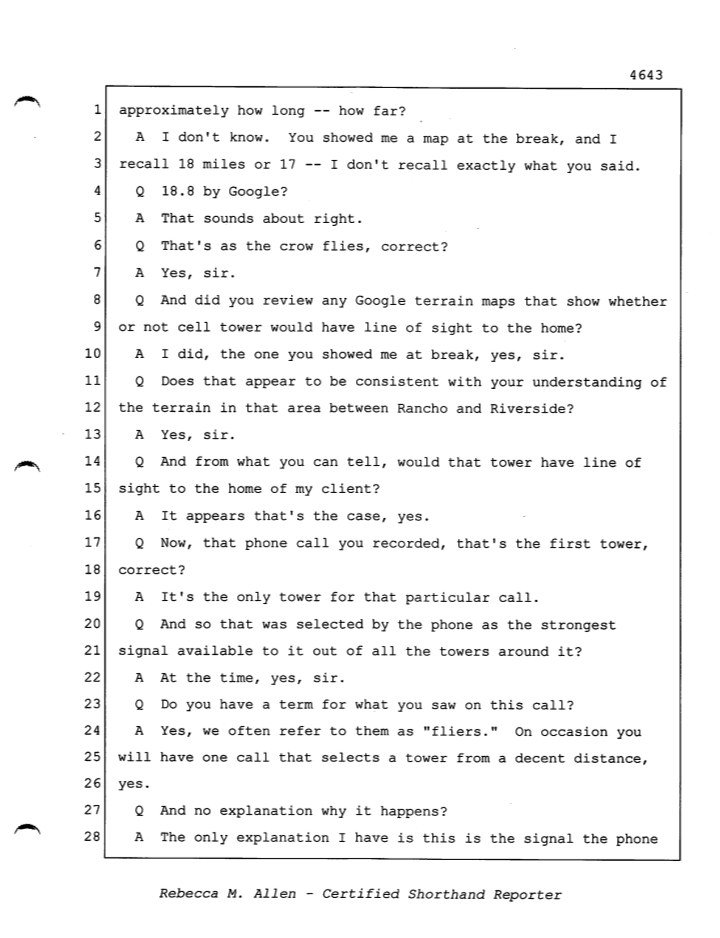
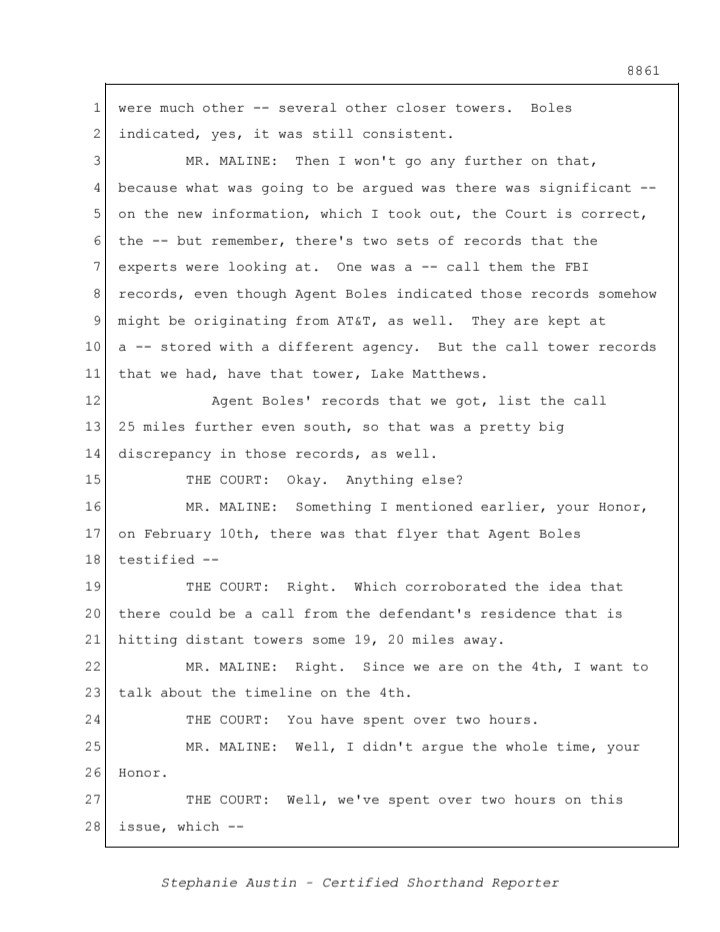
Mr. McGee prepared the defense’s own map, Exhibit 910, with the call at the Lake Mathews location, and handed Boles the distance: “18.8 by Google?” Boles: “That sounds about right.” (RT 4642:27-4643:7.) He never asked about the 12.5 miles. At the new-trial hearing, Mr. Maline told the judge “the Court is correct,” then said “the call tower records that we had, have that tower, Lake Matthews,” and that Boles’s records put the call “25 miles further even south.” (RT 8861:3-14.) That is backwards: AT&T’s record is the one that puts the cell far to the south. When the judge said the call “corroborated the idea that there could be a call from the defendant’s residence that is hitting distant towers some 19, 20 miles away,” Mr. Maline answered: “Right.” (RT 8861:16-22.)
See the trial transcript (RT 4642, 4643, 8861)
What the jury was left with
The State’s Lake Mathews placement, confirmed by the defense itself. The jury was never told that AT&T’s own record put the cell somewhere else. The judge was told there were two locations, but with the sources reversed, and no one said which was right.
What they might say: Mr. McGee used the 18.8 miles to help me: to argue that a call from my home could reach a distant tower.
The record: That argument did not need the Lake Mathews placement, and the 12.5 miles from Pape was the question to ask. I do not claim my phone traveled 45 miles in a minute, and AT&T’s coordinates for that cell may themselves be wrong; the defense’s own expert said so. The point is narrower: the State’s map and AT&T’s own record disagreed, and my lawyer gave the jury the State’s placement, on the defense’s own map.
The pattern
The cards above are the record. What follows is what I make of it.
- On February 4, the answer to “no corroboration” was typed into my lawyers’ own notes. The jury never saw the calls.
- On February 4, the phone-off claim went to the jury on the one evening my lawyer never put to Boles.
- On February 4, the call the State said “never happened” was one of twelve calls from Joseph missing from my record, and my lawyers had the list.
- On February 6, the defense’s own expert found the State’s reading impossible. My lawyer asked the State’s expert about movement instead.
- On February 6, the jury heard an expert was coming. He never came, and the State made sure they noticed.
- On February 10, the State’s map and AT&T’s own record put the same cell 18.8 and 45 miles from my home. My lawyer gave the jury the State’s placement, on the defense’s own map.
- After the verdict, at the hearing meant to catch these failures, Mr. McGee described his expert’s findings in a way the expert’s own report contradicts, and Mr. Maline told the court things his own file and e-mails contradicted.
These were not arguments my lawyers lacked the evidence to make. The evidence was in their file. The jury never heard it. Every one of these choices helped the prosecution’s case. None of them helped me.
Were they my advocates, or the prosecution’s puppets? Decide for yourself.
Sources
Reporter’s Transcript (RT), People v. Merritt, San Bernardino County Superior Court, Case No. FVI1404194:
- RT 4527-4529, 4558-4559, 4571: Agent Kevin Boles, direct examination.
- RT 4642-4643, 4654-4655, 4677-4678: Agent Boles, cross-examination by Mr. McGee; defense Exhibit 910.
- RT 4694-4695: redirect by Mr. Imes. RT 4712: recross by Mr. McGee.
- RT 3588-3589, 3621-3622: T-Mobile’s and AT&T’s custodians, questioned by the Court.
- RT 4999: ruling on the motion to dismiss.
- RT 5211, 5248-5249: Taylor Jarvis. RT 5421-5422: Catherine Jarvis, cross-examination.
- RT 8199, 8212-8213, 8217-8218, 8236: closing argument, Mr. Imes. RT 8372: closing argument, Mr. Maline. RT 8424: rebuttal, Ms. Rodriguez.
- RT 8839, 8843-8844, 8857, 8861, 8916-8918, 8920-8922, 8944: hearing on the motion for a new trial, January 17 and 21, 2020.
Other records:
- Joseph’s and Summer’s T-Mobile records, Trial Exhibit 793 (posted on The records).
- My AT&T records, Trial Exhibit 794 (posted on The records).
- Notes on Agent Kevin Boles, Merritt meeting, February 18, 2019 (defense file).
- Dr. Vladan Jovanovic, Geolocation of Calls, Sept. 17, 2018, pp. 25-27; AT&T Cell Site Table Problems, Sept. 14, 2018, pp. 16-22; proposed questions for cross-examining Boles, Feb. 2019; defense slides 119-126.
- E-mails, Rajan Maline to Vladan Jovanovic, Dec. 16, 2019, Dec. 20, 2019 and Jan. 3, 2020.
- People v. Pape: Grand Jury 271:11-13; RT 1688:13-25 (Agent Boles).
Where I describe conversations with Taylor and what the recordings contain, I state what I know personally.
↑ Back to the menuMore coming soon.