The Money
Part 4 of 4
- The Checks, QuickBooks, and the Motive
- The Checks (Claims 1-7)
- The QuickBooks Calls (Claims 8-14)
- The Money (Claim 15) (you are here)
Part 4 answers the State’s motive: the money on the two jobs, where it went, and what I gave my lawyers. Part 1 has the timeline and what I told the investigators, and when.
Claim 15 of 15
“He forged checks for money. He owed Joseph $42,000 and was being sidelined.”
What the State said
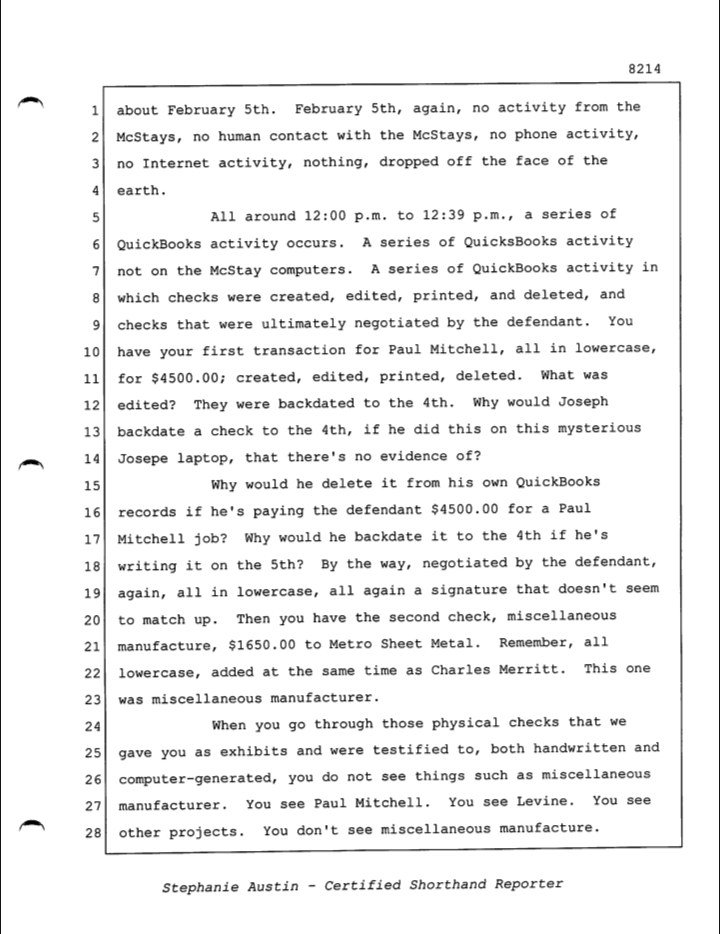
Mr. Imes gave the jury the motive in one line: the $42,000, the forged checks, and being sidelined: (RT 8213:22-26)
Why? Because he owes $42,000.00, he forged checks, he’s being sidelined. He’s not going to let that happen, because he’s a greedy, self-centered, self-interested man. And we’ll talk about more motive as we go along, but up to this point, that’s what you know about the defendant’s state of mind.
See the trial transcript (RT 8212-8214, Mr. Imes)


My answer
The money went where I said it went: into the two jobs and to Metro, which the parts below lay out. I told Joseph’s mother, in writing, what came in and what I took. Dan, who could see the QuickBooks and PayPal accounts, told her nothing had been taken out (Det. Hillen’s report, Bates 001818). DuGal testified that the money moving through EIP was “at the discretion of the defendant and Dan Cavanaugh,” and that when he “clarified it with them and with the family,” the answer was “yep, that was okay.” (The question was about the transfers he had asked Dan about; his answer was about money flowing in and out of EIP generally. When he was then asked whether those were transfers from Joseph’s PayPal account, Mr. Daugherty objected and the objection was sustained, RT 2521:14-27. He also said that “I for sure was suspicious of the money flow, there was no way to prove, without Joseph’s words, that the money flow was illegal,” RT 2482:25-27.) The State’s motive came four years later.
What the State already knew
DuGal, at trial, on money moving through EIP “at the discretion of the defendant and Dan Cavanaugh”: “when I clarified it with them and with the family, and I got a unilateral answer that yep, that was okay. I had no reason to question what they were doing at that point in the investigation. None.” (RT 2521, What I told them, and when).
The record
The money is laid out in five parts: February 22, 2010; the pages I wrote in Susan Blake’s car; Saudi Arabia: built, paid for, installed; where the money went, including the $42,000; and Metro was paid.
Claim 15, the money: 1 of 5
February 22, 2010
The day the Paul Mitchell wire came in, I told a detective on a recorded call that I was taking it to Metro. I withdrew $4,900 that day, and Metro’s own statement shows a $4,900 payment on February 22. In the trial transcripts I have, the jury never heard the call.
Three records from one day, and Metro’s own statement.
1. The Paul Mitchell wire came in
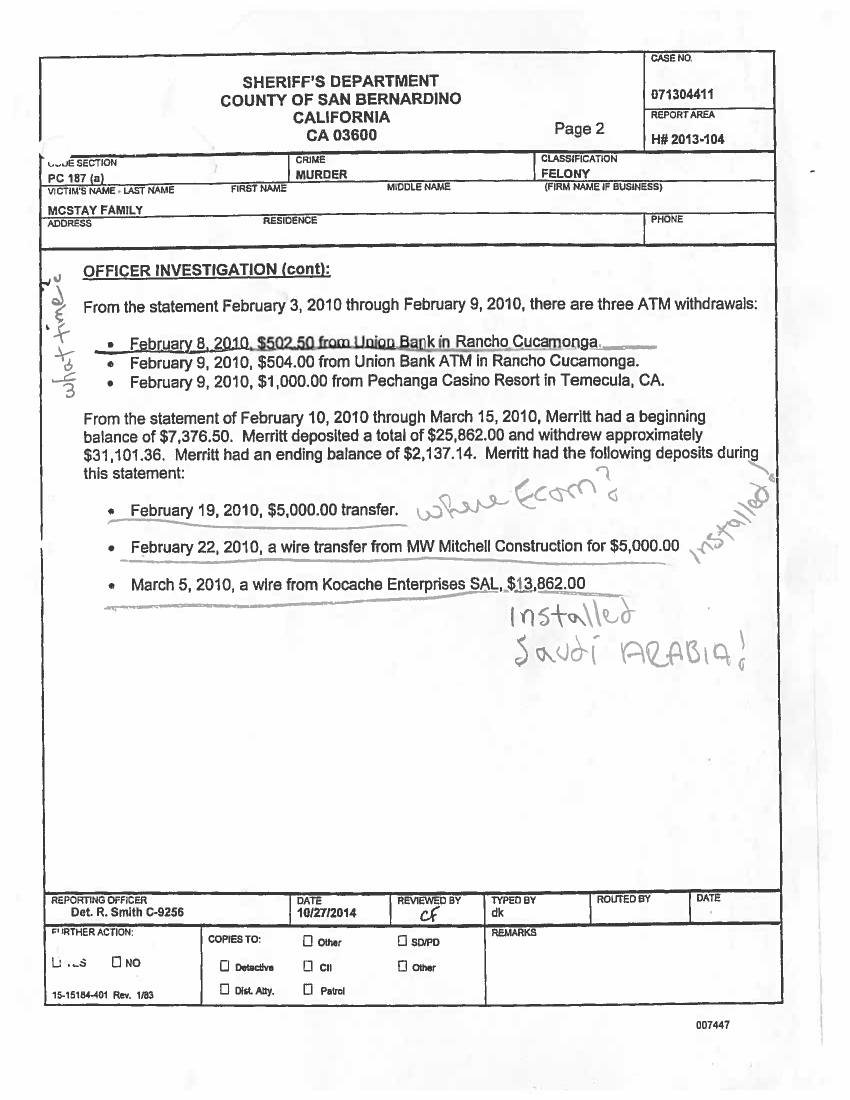
San Bernardino’s bank report (Bates 007447): “February 22, 2010, a wire transfer from MW Mitchell Construction for $5,000.00.” The defense flow chart, Exhibit 1123, box 7, shows the same wire into my account ending 2519.
See the bank report (Bates 007447)
2. I told San Diego what I was going to do with it
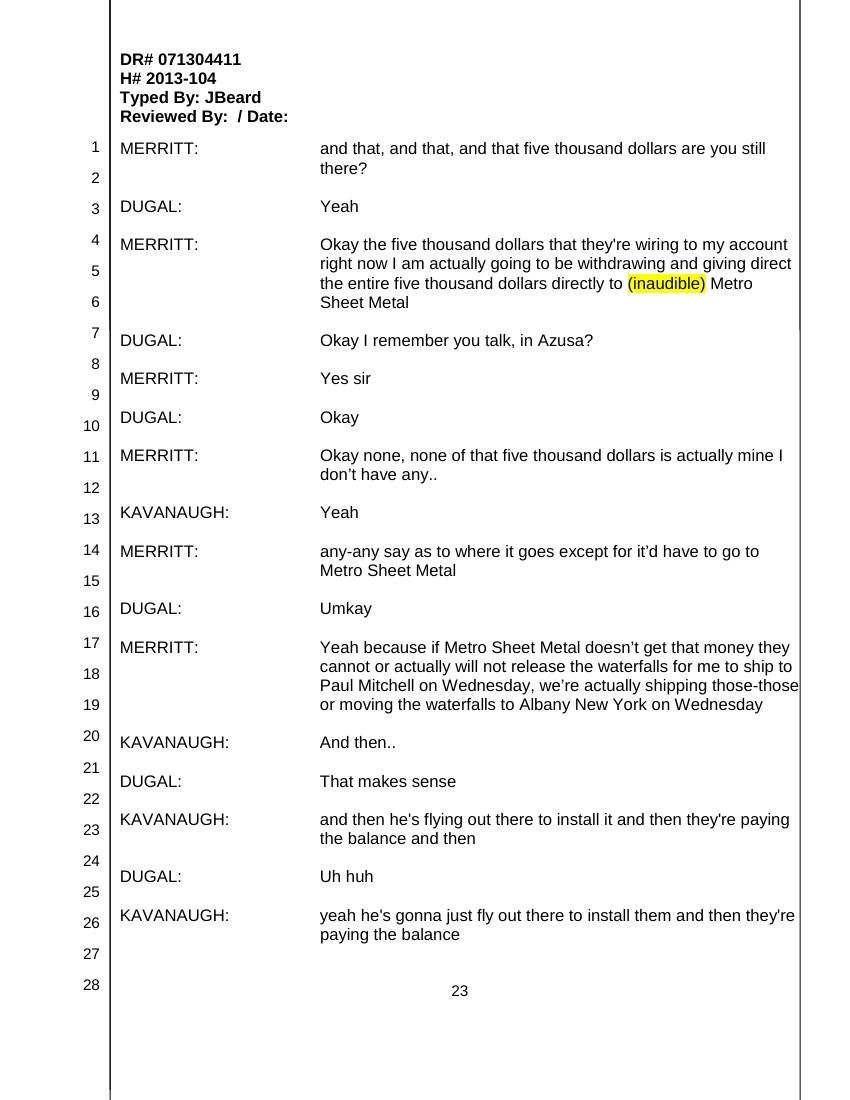
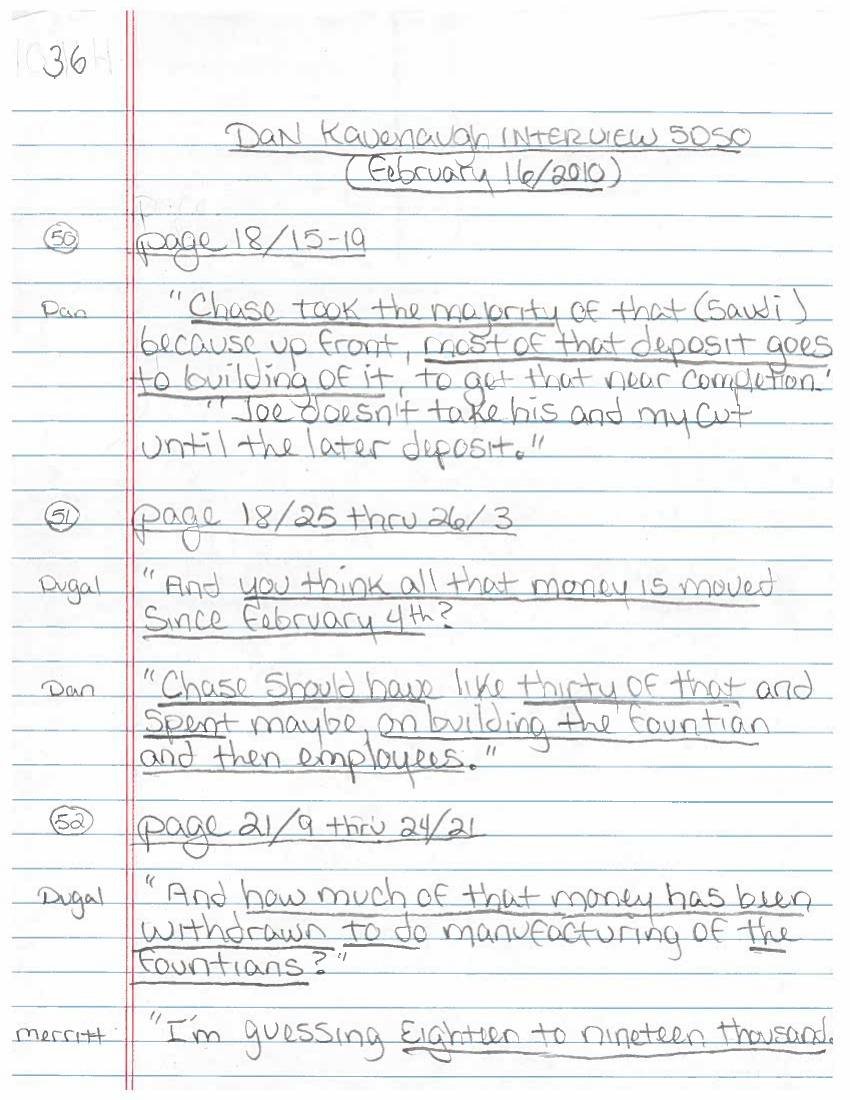
That day Det. DuGal was interviewing Dan Kavanaugh. With DuGal there, Dan called me and put me on speakerphone (the San Diego transcript file is titled “Daniel Kavanaugh 2-22-10 #2”). After DuGal’s questions about the fountains, Dan brought up the Paul Mitchell wire, and I told DuGal where every dollar of it was going: to Metro, which would not release the waterfalls without it. This is the whole exchange, to the end of that page of the transcript: (pp. 22:16-23:27)
Read the full exchange
KAVANAUGH: Okay and then one thing also in addition Chase we uh you’re accepting a five thousand dollar wire like today or tomorrow from Paul Mitchell which is part of the remaining balance on that, right?
MERRITT: Um the balance is going to be somewhere around eleven thousand
KAVANAUGH: But they are, they’re sending a five G wire to you for materials
MERRITT: Correct
KAVANAUGH: to finish that right now so that’s going to your personal account right?
MERRITT: Yes, yes it is
KAVANAUGH: Okay that was just another charge got sent
MERRITT: and that, and that, and that five thousand dollars are you still there?
DUGAL: Yeah
MERRITT: Okay the five thousand dollars that they’re wiring to my account right now I am actually going to be withdrawing and giving direct the entire five thousand dollars directly to (inaudible) Metro Sheet Metal
DUGAL: Okay I remember you talk, in Azusa?
MERRITT: Yes sir
DUGAL: Okay
MERRITT: Okay none, none of that five thousand dollars is actually mine I don’t have any..
KAVANAUGH: Yeah
MERRITT: any-any say as to where it goes except for it’d have to go to Metro Sheet Metal
DUGAL: Umkay
MERRITT: Yeah because if Metro Sheet Metal doesn’t get that money they cannot or actually will not release the waterfalls for me to ship to Paul Mitchell on Wednesday, we’re actually shipping those-those or moving the waterfalls to Albany New York on Wednesday
KAVANAUGH: And then..
DUGAL: That makes sense
KAVANAUGH: and then he’s flying out there to install it and then they’re paying the balance and then
DUGAL: Uh huh
KAVANAUGH: yeah he’s gonna just fly out there to install them and then they’re paying the balance
See the transcript (San Diego interview of Dan Kavanaugh, 2-22-10, pages 22, 23)

3. I took the money out
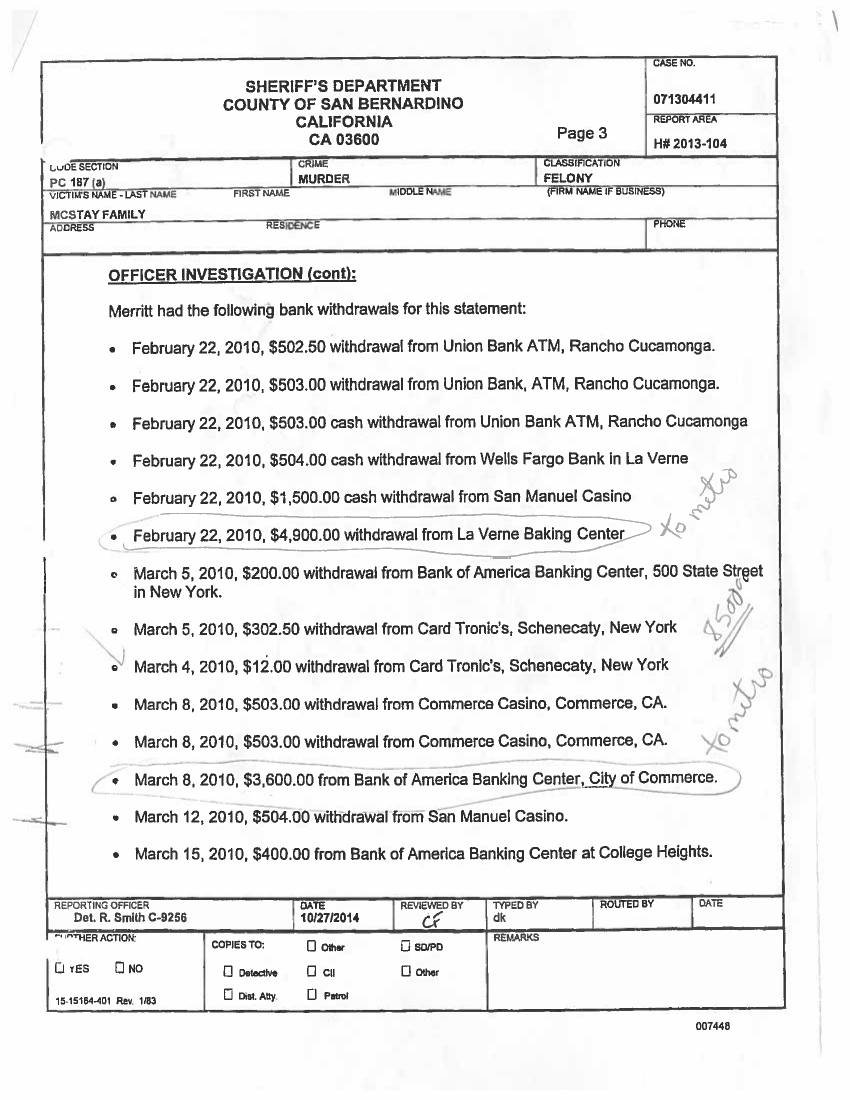
The same bank report (Bates 007448): “February 22, 2010, $4,900.00 withdrawal from La Verne Baking Center.” Exhibit 1123, box 8: “Charles Merritt pays $4,900 to Metro Sheet Metal on 2/22/10 to cover part of remaining balance on invoice.”
See the bank report (Bates 007448)
See Exhibit 1123 (flow of money, Paul Mitchell)

4. Metro’s own records show it was paid
Metro Sheet Metal’s own statement to Earth Inspired Products, dated 3/1/2010, lists invoice #3728 for the Paul Mitchell feature, $14,700.00; payments received of $6,350.00 by check #1116 on 02/04/2010 and $4,900.00 by direct deposit on 02/22/2010; and $3,450.00 still owing.
See Metro’s statement (March 1, 2010)

Exhibit 1123 sourced box 8 to my bank account and to “Metro Sheet Metal Statement dated 3/1/10.” Box 3 shows Metro’s invoice for the Paul Mitchell work: invoice #3728, February 2, 2010, $14,700.00, “as seen on statement dated 3/1/10.” Box 10 shows my $3,600.00 withdrawal on March 8, 2010, with the note: “This amount would cover the remaining balance to Metro Sheet Metal.”
At trial, the defense accountant wanted to show the jury this chart, with my $4,900 payment to Metro on it. The prosecution objected, and the court agreed.
What was argued (April 29, 2019, outside the jury’s presence)
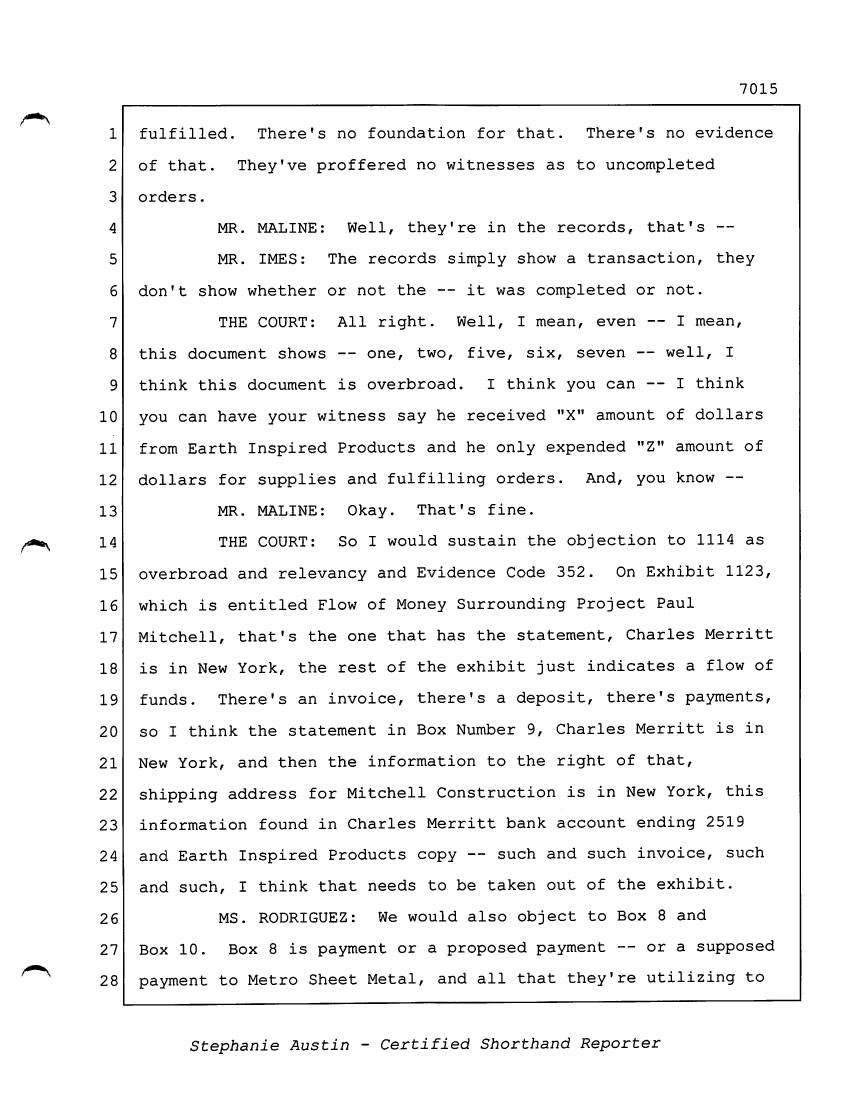
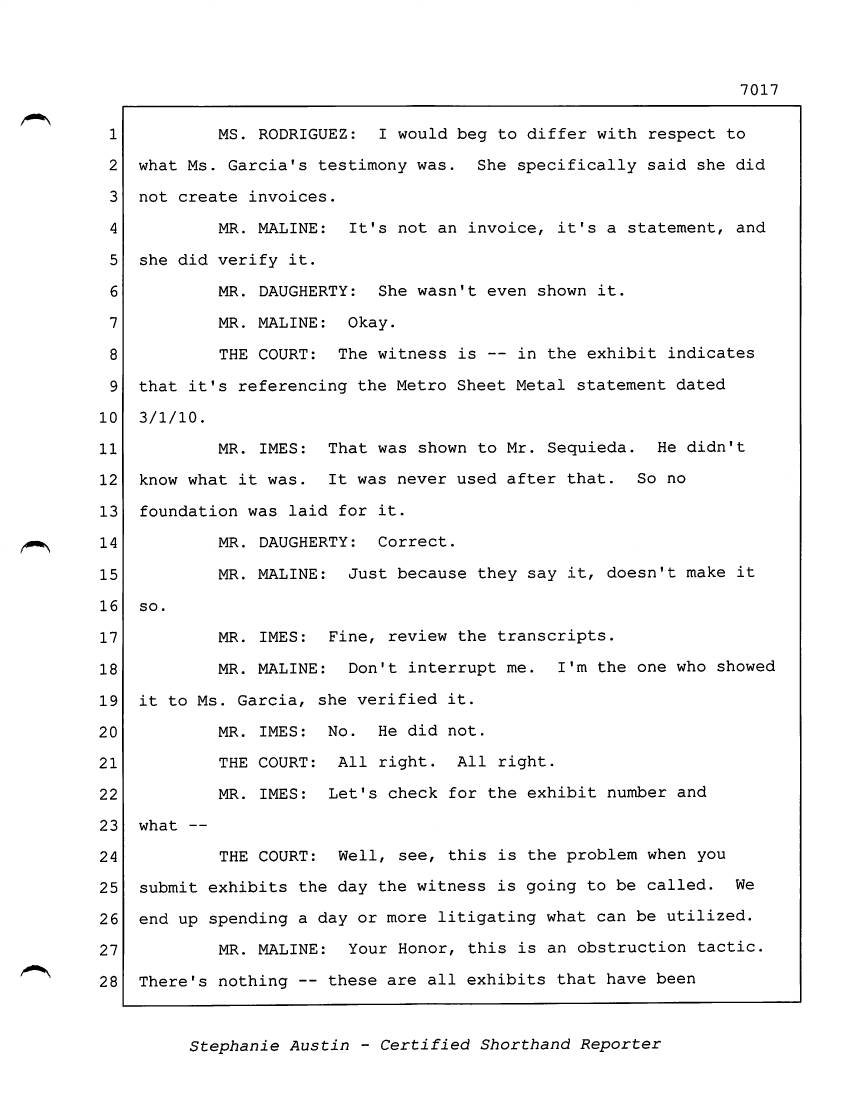
After the court struck box 9, Ms. Rodriguez objected to boxes 8 and 10. She called the payments to Metro “pure speculation”; Mr. Imes called them hearsay; Mr. Maline answered that Metro’s bookkeeper had verified the statement; Ms. Rodriguez replied that Ms. Garcia “specifically said she did not create invoices,” Mr. Daugherty that “She wasn’t even shown it,” and Mr. Imes that it “was shown to Mr. Sequieda. He didn’t know what it was” (RT 7017:1-13). This is how the argument began: (RT 7015:26-7016:28)
Read the full exchange
MS. RODRIGUEZ: We would also object to Box 8 and Box 10. Box 8 is payment or a proposed payment — or a supposed payment to Metro Sheet Metal, and all that they’re utilizing to make that leap is the fact that the defendant took out $4,900.00 from his bank account. There’s no evidence that he paid that money to Metro Sheet Metal.
MR. MALINE: Except the fact —
MS. RODRIGUEZ: If I could finish. And in Box Number 10, there’s a withdrawal for $3,600.00, and there’s no information that that was paid to Metro Sheet Metal. So this assumption that those monies were actually used for the Paul Mitchell project is pure speculation.
THE COURT: Well, if — if an accountant says he’s reviewed that and his conclusion is that it was for that purpose, and he’s coordinating it with other documents and expenditures, I think he can offer that opinion. He’s certainly subject to cross-examination on that issue, and I think that goes to weight, not admissibility.
MR. IMES: Actually, it’s probably based on hearsay. We’d ask for an offer of proof of what it’s based upon, outside the presence of the jury, because it seems quite subjective state-of-mind evidence, not something that would be borne out in a bank record, since it’s a cash withdrawal.
MS. RODRIGUEZ: And I would add that the Metro Sheet Metal statement that was dated March 1st, the witnesses that testified and were asked about that exhibit said they had no knowledge about it, so it’s not anything that’s actually in evidence.
MR. MALINE: Counsel forgets Carmen Garcia’s testimony. She verified that statement, and the $4,900.00 payment that was withdrawn was — is on that statement as paid.
See the trial transcript (RT 7015, 7016)

The ruling
When the court came back to it, it struck box 8 because Metro’s receipt of the $4,900 rested on Metro’s statement, Exhibit 740, which it had already kept out. It allowed box 10, my $3,600 withdrawal, but only as a withdrawal. Here is the ruling on boxes 8, 9 and 10: (RT 7024:22-7025:18)
Read the full exchange
THE COURT: So with regard then to — so on Box Number 8, Charles Merritt pays $4,900.00 to Metro Sheet Metal to cover part of remaining balance on invoice, that’s referring to the statement — Metro Sheet Metal statement of 3/1/2010, that’s stating as a fact that 4900 was paid to Metro Sheet Metal and that’s based solely on — that Metro Sheet Metal received that 4900 is based solely on Exhibit 740, which the Court sustained the objection to. So I don’t think the expert can refer to that. So I will sustain the objection to Box 8, as well as Box 9.
And then Box 10, Box 10 is Charles Merritt withdrawals $3,600.00 on 3/8/10, what’s wrong with that?
MS. RODRIGUEZ: Well, they’re proposing that that goes to Paul Mitchell and there’s no evidence that it did. Just because he makes a cash withdrawal of $3,600.00, how in the world are we tying that to the Paul Mitchell job?
THE COURT: The document — Exhibit 1123 doesn’t say that.
MS. RODRIGUEZ: Well, I understand that. My objection to that is that it’s just complete speculation to attribute that to the flow of money surrounding the Paul Mitchell project.
MR. MALINE: The Court did allow in the amount due. The jury’s heard that that was the amount due.
THE COURT: I will allow 10. 10 is just saying that he withdrew $3,600.00 at the Commerce Casino.
See the trial transcript (RT 7024, 7025)

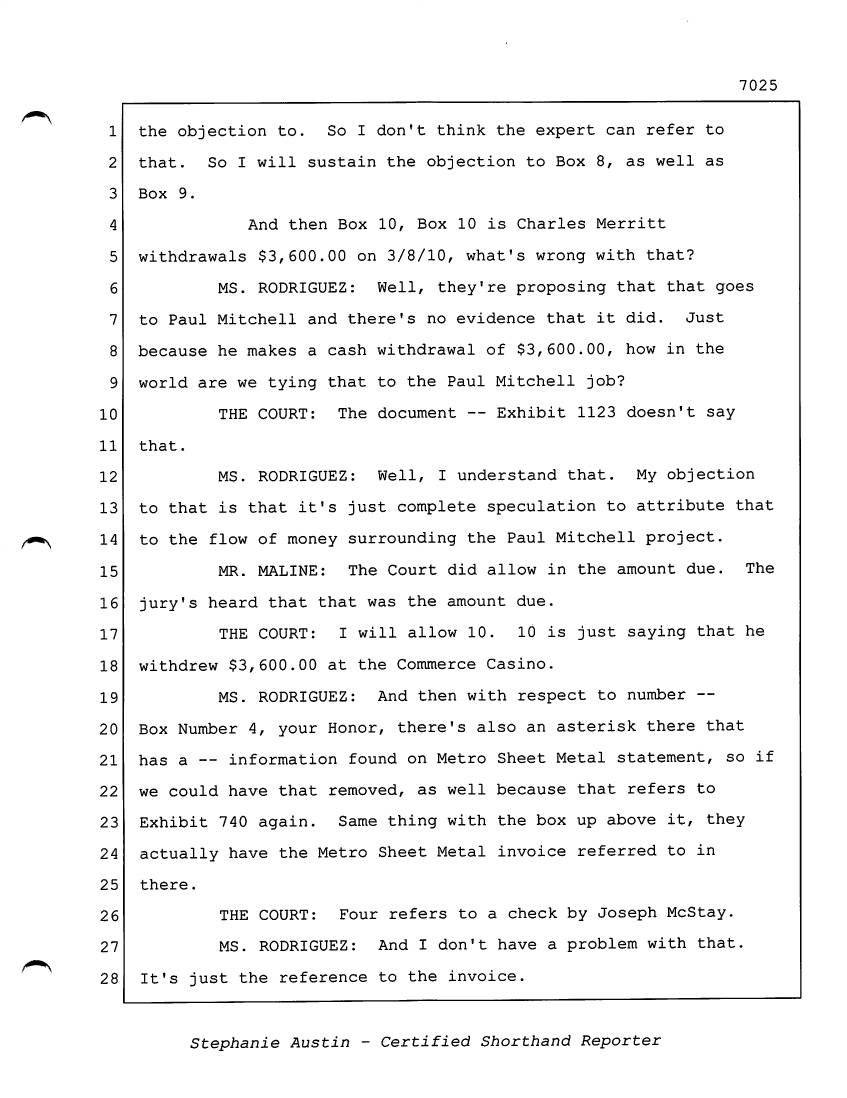
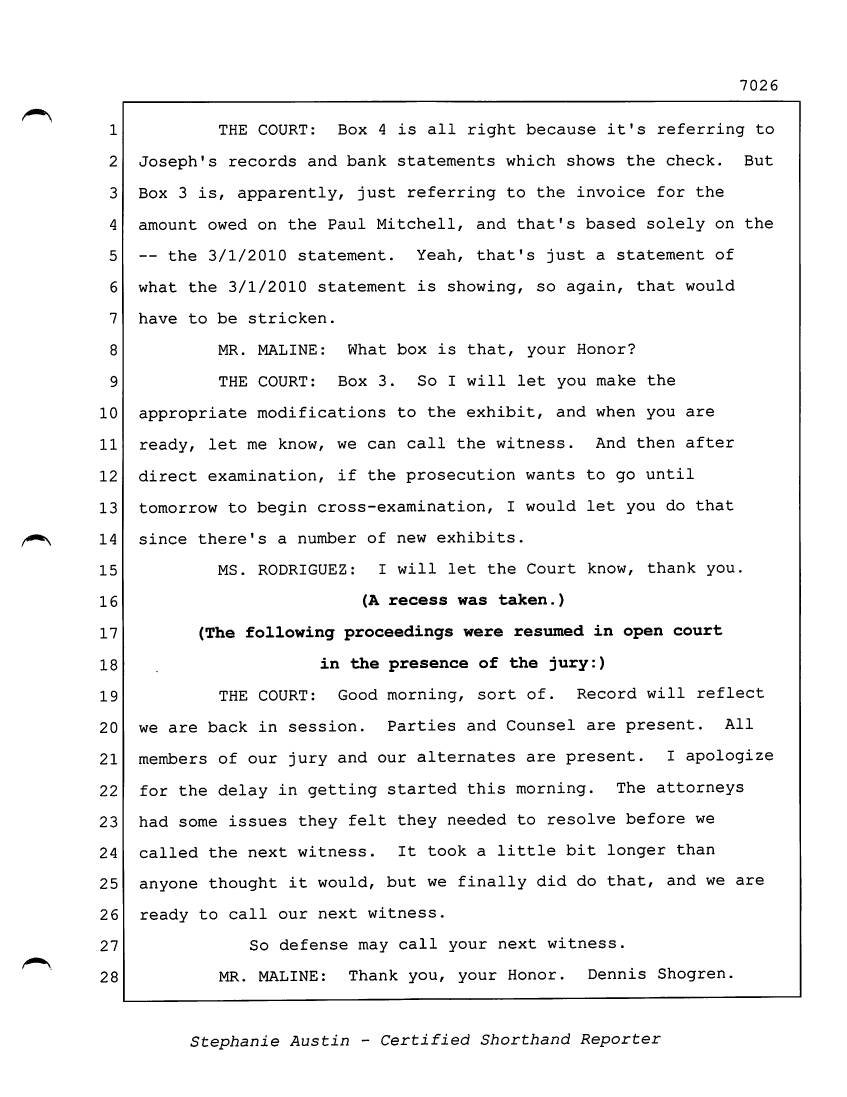
Exhibit 740 is Metro’s March 1, 2010 statement shown above. Because the court kept it out, box 3 (Metro’s invoice) and box 8 (my $4,900 to Metro) were removed from the chart, along with box 9, which was struck separately. The jury saw it as Exhibit 1133. The one thing the jury heard from the statement was that $3,450 was still due. (RT 7015, 7024-7026, 7086-7090)
See the trial transcript (RT 7017, 7026)
The missing link at trial was the San Diego interview of February 22, 2010. On a recorded line, to a detective, I said what I was going to do with the Paul Mitchell wire before I did it: take it out and give it to Metro, or Metro would not release the waterfalls. That same day the wire came in and I withdrew $4,900. Metro’s own statement shows the payment. The State called it speculation, and the court kept Metro’s statement out, except that the jury heard $3,450 was still due. In the trial transcripts I have, my own words to DuGal that day were never used. That interview was critical, and I told counsel so, both verbally and in my notes (What I gave counsel).
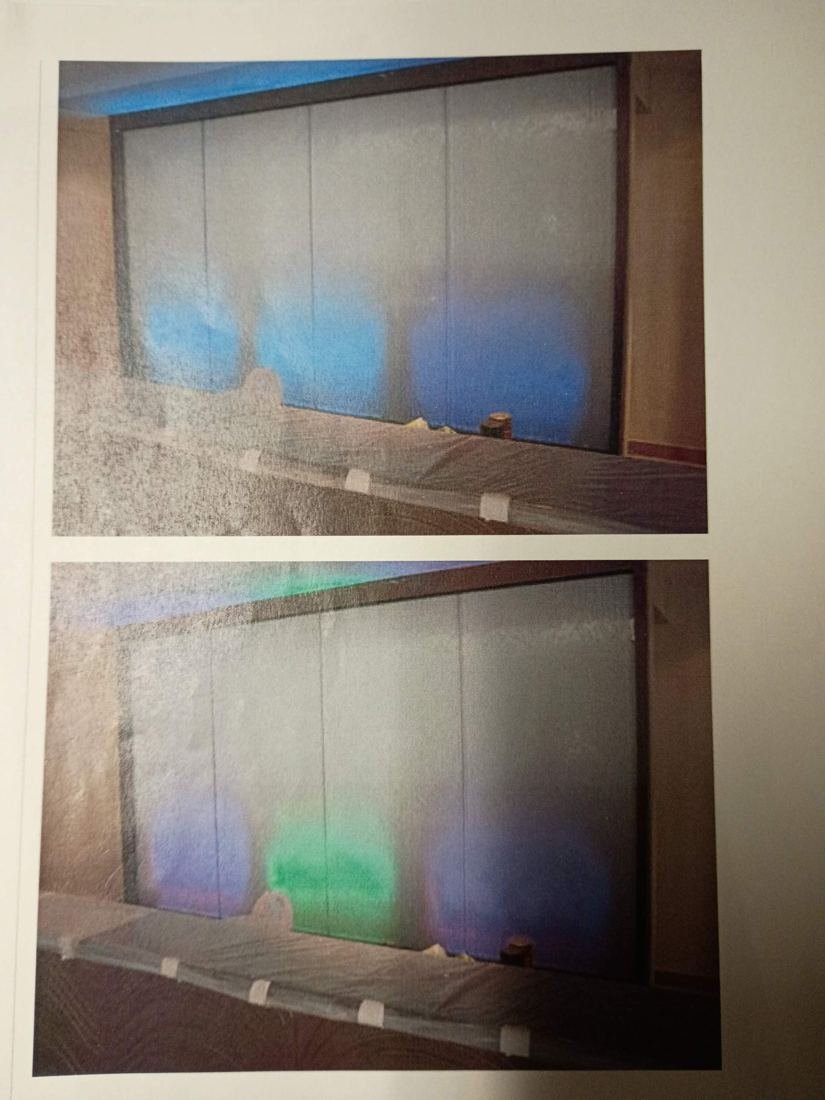
See the finished Paul Mitchell waterfall

Claim 15, the money: 2 of 5
The pages I wrote in Susan Blake’s car
When she was recalled, Susan Blake told the jury she never knew whether I finished the Saudi job or what I received. In her first testimony, as the court described it, I had reported to her that the job was done and that I had received $17,000 (RT 4995). In 2014 she told detectives I told her both. On March 17, 2010, I wrote out for her the money that had come in.
What the State said
When the court denied the defense motion for acquittal, it relied on what Susan Blake said I had told her: (RT 4995:23-4996:2)
THE COURT: Susan Blake ultimately did advance Mr. Merritt over $5,000 of her own funds, ostensibly to complete existing projects with the understanding she would be paid back when those projects were completed. Mr. Merritt subsequently reported to Ms. Blake that, indeed, the Saudi Arabia project had been completed and he had received $17,000 for that project. So Ms. Blake asked him to repay the $5,000 that he had — that she had advanced him. He did not do so.
See the trial transcript (RT 4995)

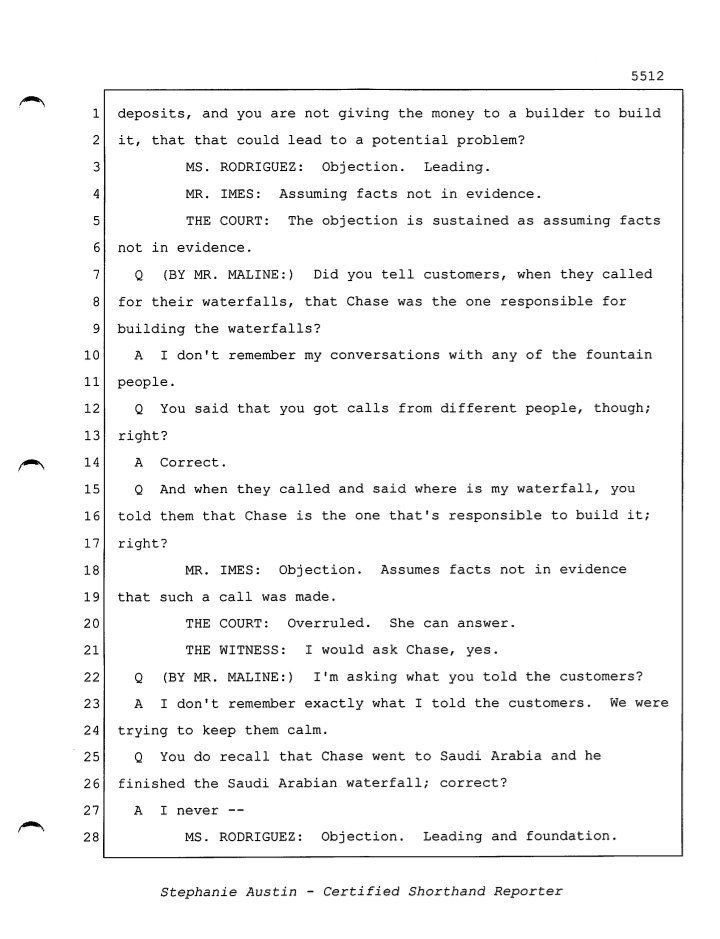
But in front of the jury, Mr. Maline asked her what she told customers who called about their waterfalls, whether I went to Saudi Arabia and finished the waterfall, and what I was paid. She said she would ask Chase, that she never got confirmation, that she didn’t know the amount, and that she never knew I completed the job or received the funds: (RT 5512:7-5514:14)
Read the full exchange
Q (BY MR. MALINE:) Did you tell customers, when they called for their waterfalls, that Chase was the one responsible for building the waterfalls?
A I don’t remember my conversations with any of the fountain people.
Q You said that you got calls from different people, though; right?
A Correct.
Q And when they called and said where is my waterfall, you told them that Chase is the one that’s responsible to build it; right?
MR. IMES: Objection. Assumes facts not in evidence that such a call was made.
THE COURT: Overruled. She can answer.
THE WITNESS: I would ask Chase, yes.
Q (BY MR. MALINE:) I’m asking what you told the customers?
A I don’t remember exactly what I told the customers. We were trying to keep them calm.
Q You do recall that Chase went to Saudi Arabia and he finished the Saudi Arabian waterfall; correct?
A I never —
MS. RODRIGUEZ: Objection. Leading and foundation.
THE COURT: Overruled. She can answer, if she knows.
THE WITNESS: I never received confirmation on that. I did tell Chase those funds need to go back in the bank of Joey’s.
Q (BY MR. MALINE:) Okay. And do you recall that when Chase was in Saudi Arabia that he sent you an e-mail?
A Not from Saudi — I don’t know.
Q I’m going to have you take a look at Exhibit 990, if you could read that and tell me if that refreshes your recollection.
A Okay.
Q Do you recall that?
A I don’t remember this e-mail.
Q Okay. I will take it out. There’s more pages.
A Oh, there’s more. Is this the same date?
Q If you look at page 2 on the bottom, that will give you the date.
A I don’t remember ever seeing this.
Q Okay. So you don’t recall these e-mails?
A No.
Q Okay. There was some questions asked of you regarding payment from Saudi Arabia, do you recall that?
A Yes.
Q And you indicated that Chase — your understanding was Chase got the money — I think you said it was like 16 or 17,000?
MS. RODRIGUEZ: Objection. Misstates testimony.
THE COURT: Overruled. She can answer if that’s correct.
Q (BY MR. MALINE:) Isn’t that what you testified to?
A I don’t know what the exact amount was.
Q But you indicated that Chase had received that money and you — and then they asked you if any of that money was ever given to you, do you recall that?
MS. RODRIGUEZ: Objection. Asked and answered. This was covered during her first testimony, your Honor.
THE COURT: Overruled. She can answer.
THE WITNESS: I never knew that he completed the job or received the funds, but that the funds should have went back, all of it, into Joey’s account.
Q (BY MR. MALINE:) Okay. But you recall Ms. Rodriguez asking you, when the money came in to Chase, did you get any of that money? Do you recall her asking that?
A I didn’t receive any money, any funds.
See the trial transcript (RT 5512, 5513, 5514)


What the record shows
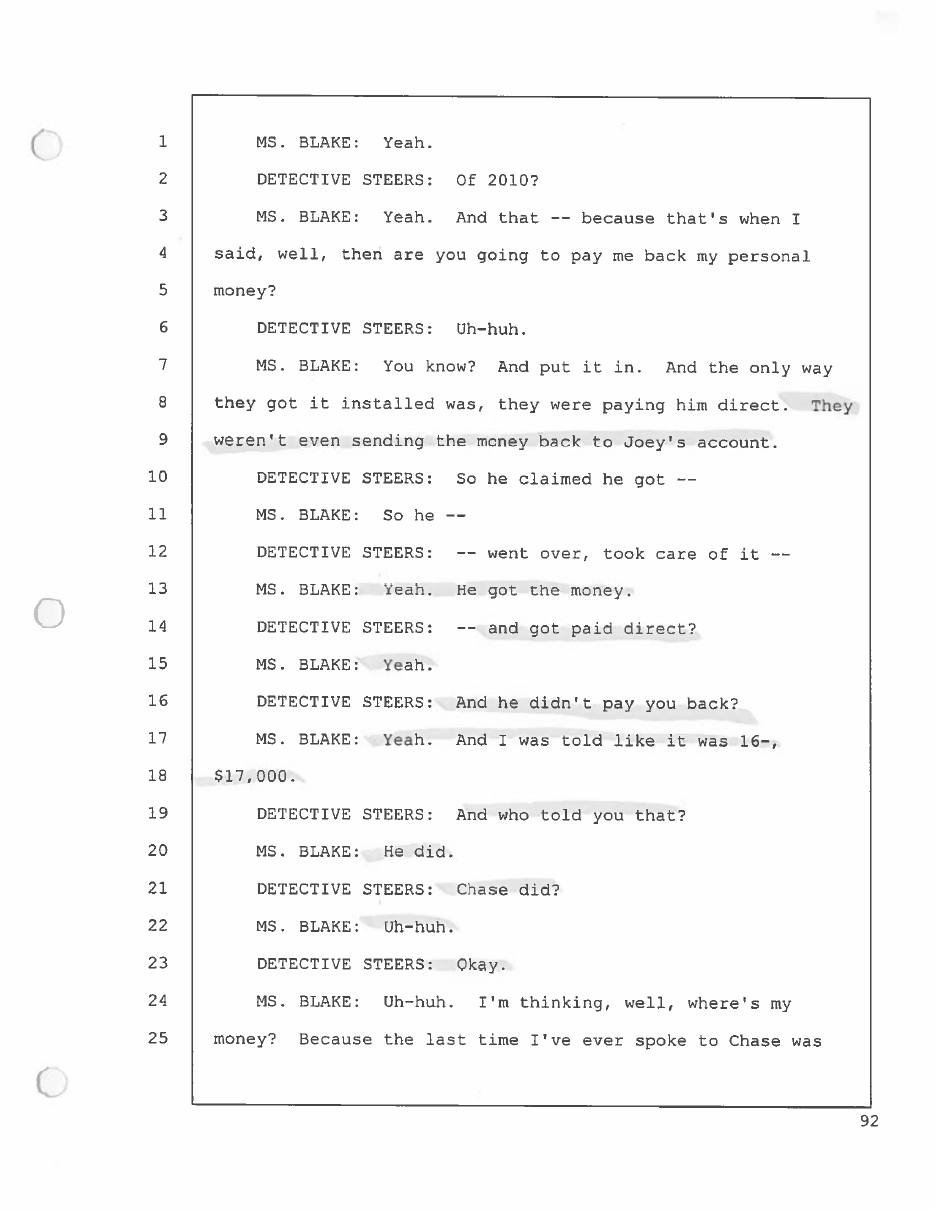
In her recorded interview with San Bernardino on August 13, 2014, she had told detectives the opposite: that I told her I went, and what I was paid: (pp. 91:3-92:23)
Read the full exchange
MS. BLAKE: And Chase was like, this isn’t how it works. I need this because this and this and this has to be done and this costs this. No. You’ve already had enough money. You’ve already had enough money. This stuff should be done. Because the last bit of money I remember giving Chase was like $250 to get his passport. And he was going to try to finish up a job in Saudi, because they called me.
DETECTIVE STEERS: Uh-huh.
MS. BLAKE: But I didn’t know who these — that was scary.
DETECTIVE STEERS: Uh-huh.
MS. BLAKE: People with accents like that are calling you at three in the morning time-wise, my time. And that he was going to finish it, you know, for the sake of Joey because this was kind of like his pride and joy, one of his biggest ones.
And — but as it turned out, I heard he did go over there in May. This is what I heard.
DETECTIVE STEERS: And who did you hear this from?
MS. BLAKE: Him.
DETECTIVE STEERS: Chase told you?
MS. BLAKE: Yeah.
DETECTIVE STEERS: That he went over in May?
MS. BLAKE: Yeah.
DETECTIVE STEERS: Of 2010?
MS. BLAKE: Yeah. And that — because that’s when I said, well, then are you going to pay me back my personal money?
DETECTIVE STEERS: Uh-huh.
MS. BLAKE: You know? And put it in. And the only way they got it installed was, they were paying him direct. They weren’t even sending the money back to Joey’s account.
DETECTIVE STEERS: So he claimed he got —
MS. BLAKE: So he —
DETECTIVE STEERS: — went over, took care of it —
MS. BLAKE: Yeah. He got the money.
DETECTIVE STEERS: — and got paid direct?
MS. BLAKE: Yeah.
DETECTIVE STEERS: And he didn’t pay you back?
MS. BLAKE: Yeah. And I was told like it was 16-, $17,000.
DETECTIVE STEERS: And who told you that?
MS. BLAKE: He did.
DETECTIVE STEERS: Chase did?
MS. BLAKE: Uh-huh.
DETECTIVE STEERS: Okay.
See Susan Blake’s interview (August 13, 2014, pages 91-92)

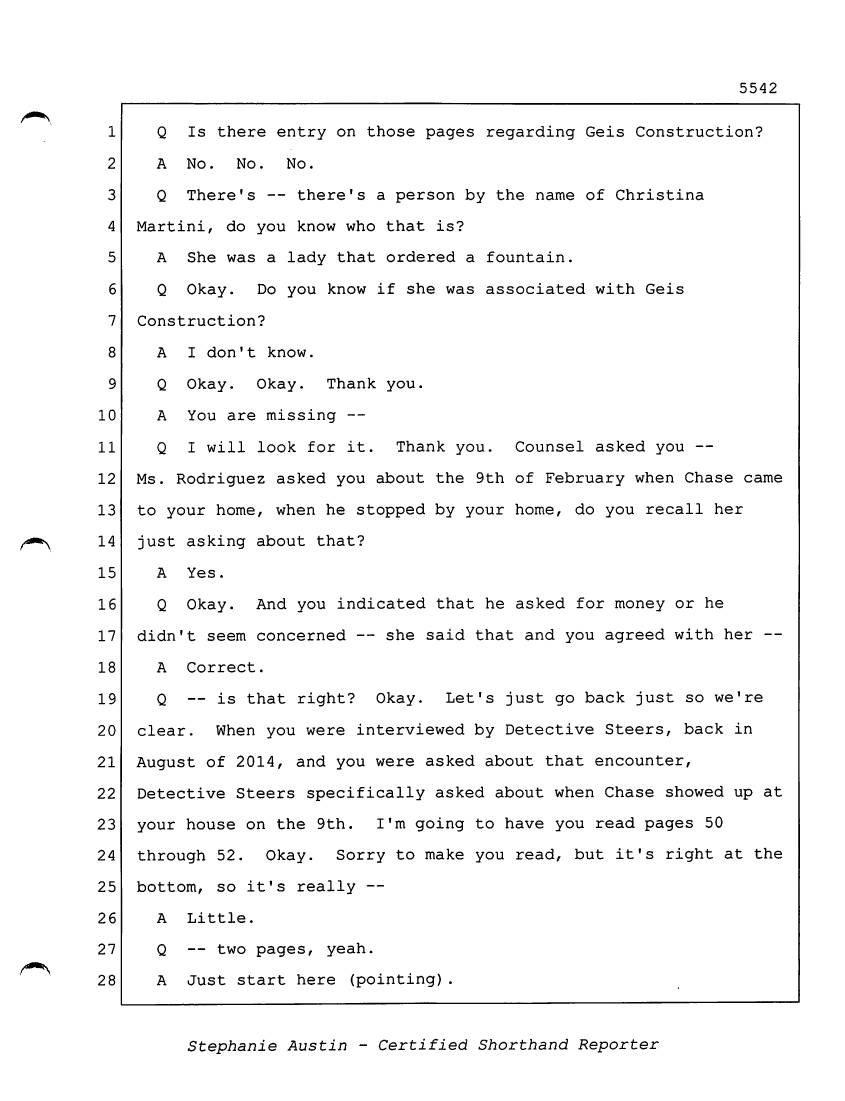
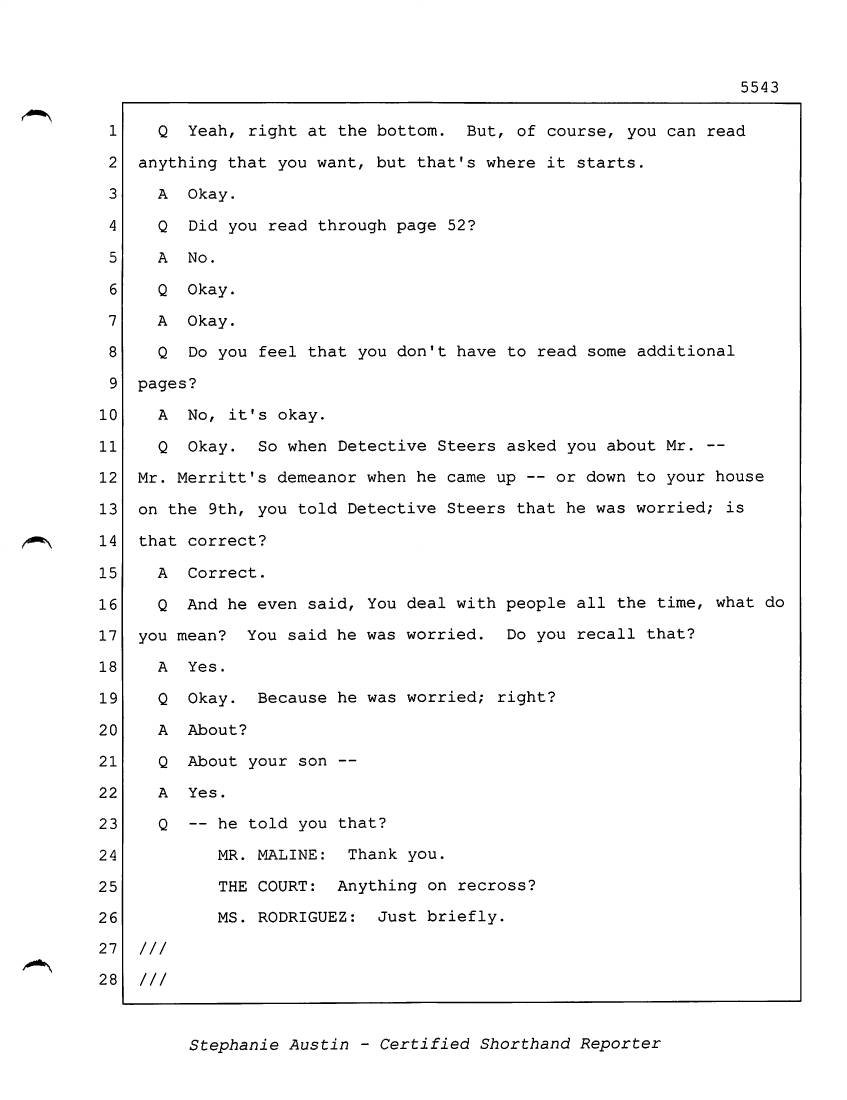
When she was recalled at trial, Mr. Maline asked her about the pages I had written out for her. She told him he was missing one: (RT 5541:6-5542:11)
Read the full exchange
THE WITNESS: I thought Chase was already paid for these — several of these waterfalls and they needed to be completed to be sent out.
Q (BY MR. MALINE:) And what made you think that?
A Because you have a handwritten paper that I gave you that Chase handwrote out and that he was paid for these.
Q Okay. And we went over every single account with you that you had a question about; correct?
A On that sheet at that time, yes.
Q Okay. So on that — on that account, on those — on those entries, was there anything about Geis Construction?
A I said I don’t remember the name Geis.
Q Okay.
A Maybe another name. It also states on that form that he was overpaid.
Q Is this — I’m going to show you if this is the form that you were talking about.
A What’s —
Q That’s just another —
A All right. No, you’re missing — you’re missing some of this.
Q Okay.
A Another page.
Q Is there entry on those pages regarding Geis Construction?
A No. No. No.
Q There’s — there’s a person by the name of Christina Martini, do you know who that is?
A She was a lady that ordered a fountain.
Q Okay. Do you know if she was associated with Geis Construction?
A I don’t know.
Q Okay. Okay. Thank you.
A You are missing —
Q I will look for it. Thank you.
See the trial transcript (RT 5541, 5542)
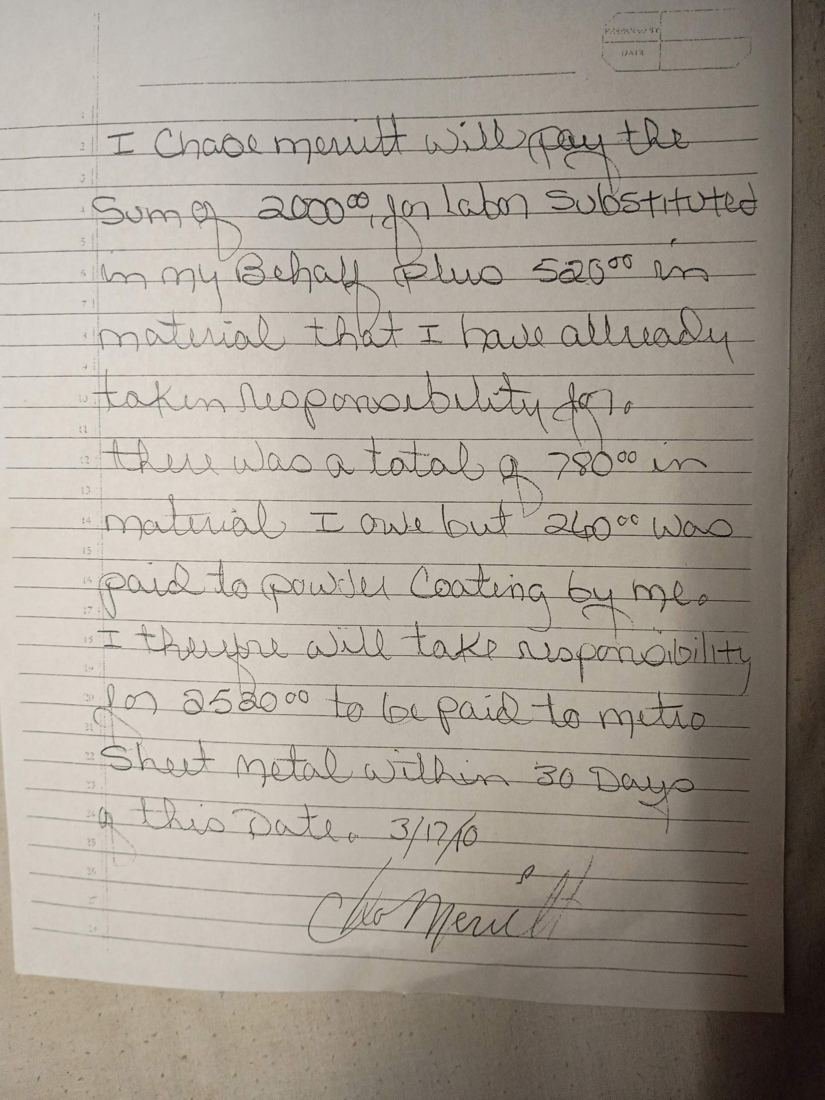
I wrote these three pages on March 17, 2010, all the same day, sitting in Susan Blake’s car while we went over the projects and the money. They account for everything that came in. On the Saudi line, the 13,862.00 is the wire I received from Kocache, and the 17,571.00 is what I had taken: the checks I wrote on Joseph’s account, which I was telling her about. By the State’s own check lists, those checks, including the two I wrote to Metro, total $17,745.00 (Bates 007415, 007417); my 2010 figure is $174 short of that. Where every dollar went is in the full accounting. The third page is my signed promise to pay Metro Sheet Metal $2,520.00 within 30 days. That was not for Joseph’s jobs. It was for a job she contracted after Joseph was gone, and Metro had told her she would be liable for it if I didn’t pay, so I signed it to settle her mind. I explained all of it to her. She knew better. Mr. Maline did not have all of these pages with him, and when she told him he was missing a page, he said he would look for it.
See my three pages from March 17, 2010


Claim 15, the money: 3 of 5
Saudi Arabia: built, paid for, installed
The prosecutor told the jury there was “even no evidence that it’s been built yet.” The customer’s own e-mail, the wires, my e-mails and my photos show it was built, paid for and installed.
What the State said
In closing, Mr. Imes told the jury there was “no indication that full deposits had been received” for the Saudi job when the February 2 check was written: (RT 8191:23-8192:6, quoted in full in What happened)
What is interesting to note, there is no indication that full deposits had been received for the Saudi Arabia project, at this point, or that Joseph McStay actually created these checks to give to the defendant. In fact, the defendant was at home during that time, where there was computer in the clubhouse that he could easily use. But again, checks that were created, printed, and deleted, by a man who had never really done that before, that was not his business practice; checks that could have been given to the defendant on the 31st, when he was physically there, or potentially given to him at this mysterious meeting that may have occurred or may not have occurred on February 4th.
See the trial transcript (RT 8190-8192, Mr. Imes)

On the February 8 check, he told them there was no evidence the job had even been built: (RT 8219:18-8220:8)
Read the full passage
But then what we have is a series, again, of QuickBooks activity that occurs right in the middle of the day from about 2:20 p.m. to about 3:51 p.m., and what was important in there — sorry — cell phone records — is that checks were again created. All of a sudden, a check to Charles Merritt, for Saudi Arabia final for $6500.00 was created, edited, backdated to the 4th, and then deleted after being printed. Right. Why would you — Joseph or whoever — be giving a check to the defendant for Saudi Arabia final when there’s no evidence that final payment’s been made, there’s even no evidence that it’s been built yet.
By the way, a check was written on the 5th for the deposit. So in a matter of three days, we went from deposit to final. I don’t think Mr. Sequieda’s opinion of the defendant’s construction ability included being able to build a really, really, fancy, really big Saudi Arabia project in three days. There’s no evidence to that. As a matter of fact, those reasonable explanations pointing towards innocence fall away when you look at the checks for the 8th in context for the 5th.
See the trial transcript (RT 8218-8221, Mr. Imes)


Later in his closing, he told the jury the checks were for projects that “hadn’t even started or hadn’t even been finished,” and that Joseph would never have given control to a person he was “attempting to sideline”: (RT 8223:18-8224:25)
Read the full passage
Joseph has now been off the grid for more than five days. The defendant has forged checks that he has cashed for projects that hadn’t even started or hadn’t even been finished. He has done nothing to find Joseph, that is until Carmen Garcia alerts him to Joe being missing. Uh-oh, someone knows Joe is missing. Someone can’t get ahold of Joe. Again, perspective, the defendant’s perspective. Were family members not knowing where Joe was? Sure, there’s evidence of that. Were probably other business entities not knowing where Joe is? Sure. There’s evidence of that.
But all of a sudden, this is the first person to put it right in the defendant’s face. Joe is missing. We can’t get ahold of Joe. Oops — let’s see. There’s no coincidence to this QuickBooks activity, ladies and gentlemen, none, whatsoever. The only innocent explanation requires you to believe that Joe was changing his entire business practice over night and giving control to a person that he was clearly not trusting and attempting to sideline. Is that a reasonable interpretation to that QuickBooks activity? No.
You would have to believe that Joe would have written checks to himself — written checks by himself in a way different than he has done in his entire career, using QuickBooks or his handwritten checkbook. You would have to believe that Joe would have to change his QuickBooks account habits over night, who the accounts were, how they were set up, adding vendors, deleting vendor — all of that activity would change over night.
All would all of a sudden change when checks are being written to and by the defendant to profit for projects that weren’t even started or completed. You would have to believe that Joe wanted to or would move QuickBooks in the first place. And there is, really, no credible evidence of that. You would have to ignore coincidence or believe that Joe wouldn’t think to update his shipping address for QuickBooks, if he did, in fact, place that order. But we know that he didn’t place that order. We know it came from the defendant’s phone.
See the trial transcript (RT 8223, 8224)


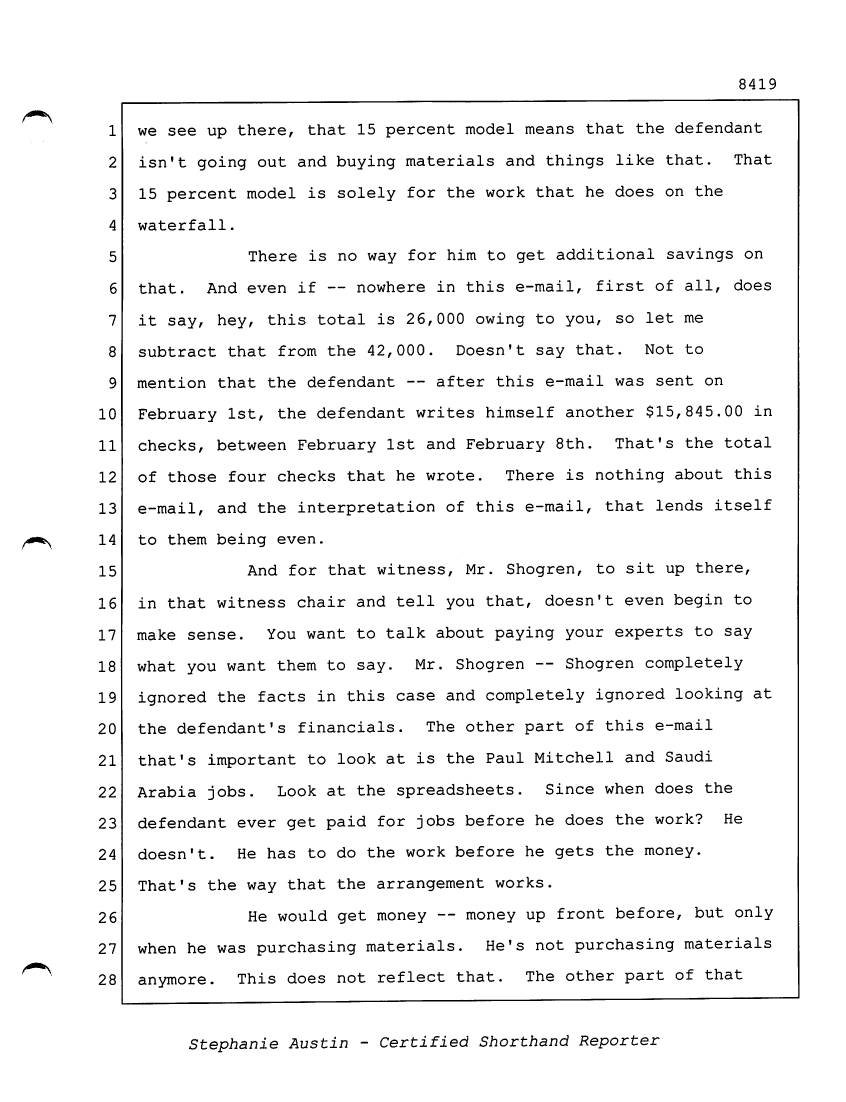
In rebuttal, Ms. Rodriguez told the jury I never got paid before doing the work (while conceding I “would get money — money up front before, but only when he was purchasing materials”), that the job wasn’t finished, and that I wasn’t owed the money yet: (RT 8419:20-8420:7)
The other part of this e-mail that’s important to look at is the Paul Mitchell and Saudi Arabia jobs. Look at the spreadsheets. Since when does the defendant ever get paid for jobs before he does the work? He doesn’t. He has to do the work before he gets the money. That’s the way that the arrangement works.
He would get money — money up front before, but only when he was purchasing materials. He’s not purchasing materials anymore. This does not reflect that.
The other part of that that’s important is, that when we looked at the bank records, what we saw was that Joseph received an initial deposit for the Saudi Arabia job but never the end of the money. All of that money — or the majority of it actually went to the defendant. So Joseph doesn’t owe that money yet because that job isn’t complete, the work hadn’t been performed, and the defendant wasn’t up to being paid yet for work that he had not yet done.
See the trial transcript (RT 8419, 8420)

What the record shows
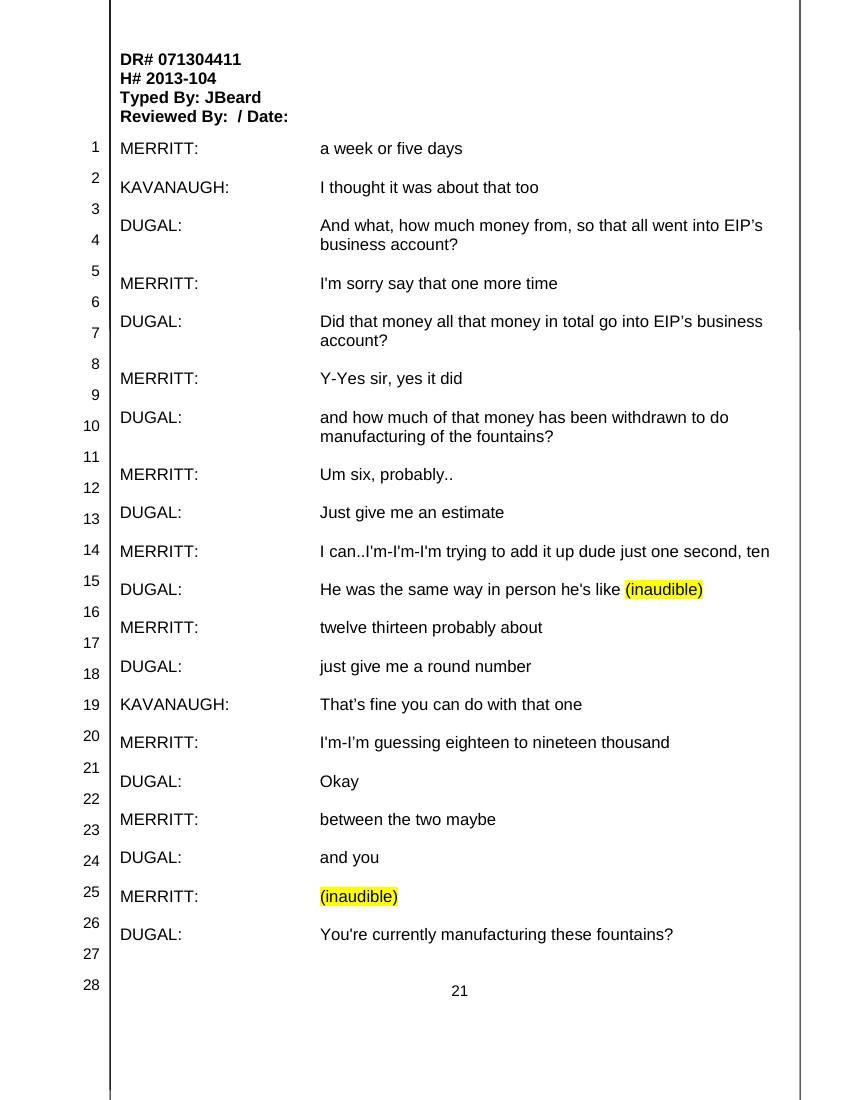
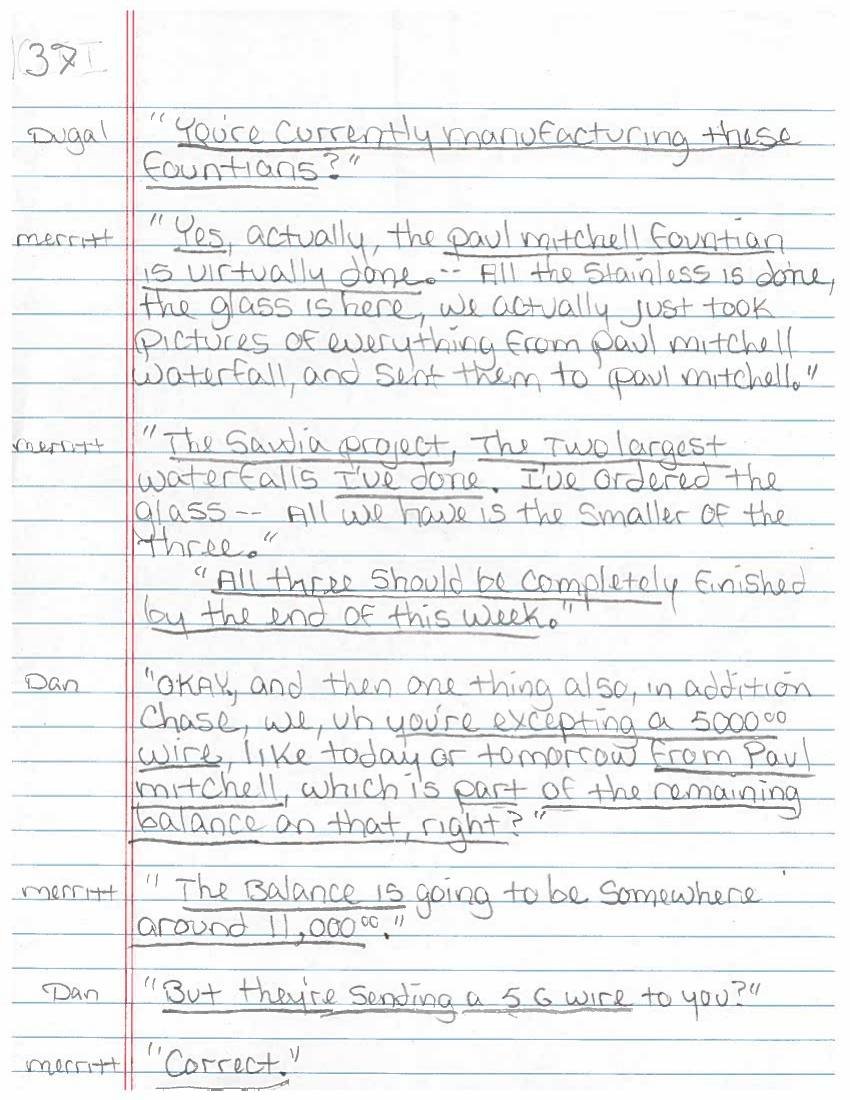
On February 22, 2010, on speakerphone with DuGal, I told him where both jobs stood: the Paul Mitchell fountain virtually done, and the three Saudi waterfalls to be finished that week: (transcript pp. 21:26-22:14)
DUGAL: You’re currently manufacturing these fountains?
MERRITT: I’m sorry say it again
DUGAL: Are you currently manufacturing those fountains or you acquire the-the material for ’em?
MERRITT: Yes actually Paul Mitch the Paul Mitchell fountain um is virtually done all everything all the stainless is done the glass is here we actually just took pictures of everything from Paul Mitchell waterfall and sent them, and sent them to Paul Mitchell or I mean uh Mark Mitchell to confirm that we are pretty much done with it
KAVANAUGH: And then Chase tell them.. tell
MERRITT: The Saudi Arabia (inaudible) two the two largest waterfalls I’ve done I ordered the glass in place and all we have is the smaller of the three which would be curve water feature all of the stainless steel is done it’s all (inaudible) we are now doing the (inaudible) which you see during (inaudible) into this week
KAVANAUGH: Hey Chase tell them..
MERRITT: all three should be completely finished be, by the end of this week
See the transcript (San Diego interview of Dan Kavanaugh, 2-22-10, pages 21, 22)
The customer was Rahage Trading Est. in Riyadh. Its procurement manager wrote to Susan Blake, in an e-mail headed “PO for Earth Inspired,” that the job was paid in full and that I was needed in Riyadh for the installation. This is the whole e-mail:
Subject: PO for Earth Inspired
Dear Susan,
Again and again we have settled COMPLETE payment INCLUSIVE of the installation supervison (US $4000)
Please refer to the attached Pro-forma invoice from EIP and the PO that we raised in conformity with it
I sent you 2 days ago the proof of payments made to you for the total value of the PO which is US $61,542.25
Trust this is very clear.
In return we hereby strongly claim that Mr. Chase needs to immediately arrive in Riyadh to supervise the assembly and installation of the waterfalls.
I will need to ask our Logistic department book him on the earliest flight as time is extremely critical and the handover is only 4 days away.
Please make sure Mr. Chase sends us his passport copy with the Saudi visa stamped on it.
Regards,
Procurement Manager
Rahage Trading Est.
See the e-mails (Exhibit 990 and the Rahage purchase order)



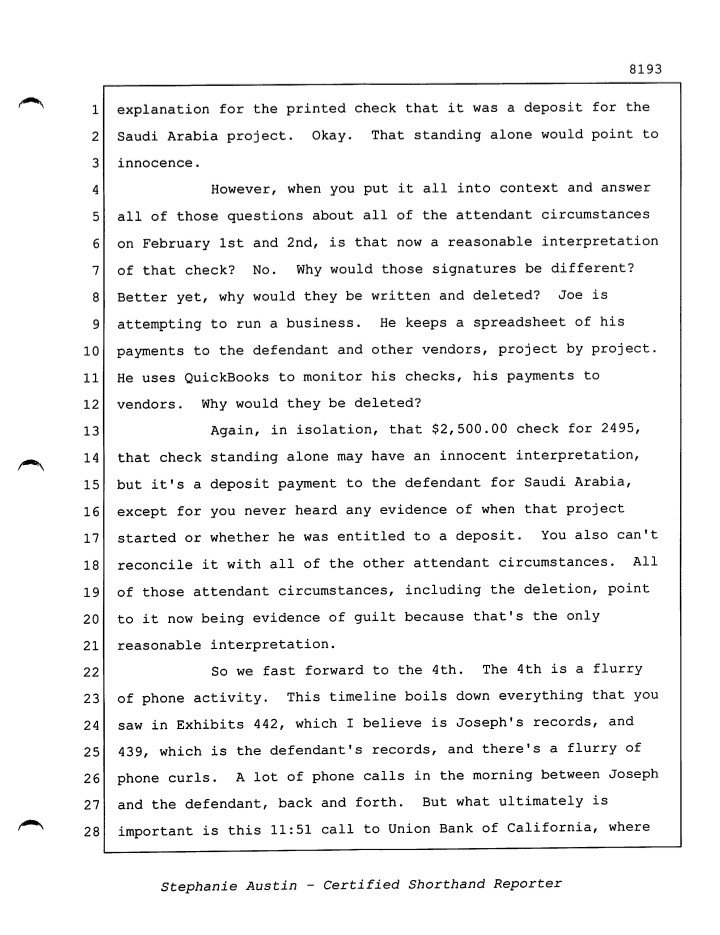
The State told the jury there was no proof the Saudi deposit had come in, or that I was entitled to a deposit check. Mr. Imes said it twice in closing. The first, quoted above, was that there was “no indication that full deposits had been received.” The second: (RT 8193:13-21)
Again, in isolation, that $2,500.00 check for 2495, that check standing alone may have an innocent interpretation, but it’s a deposit payment to the defendant for Saudi Arabia, except for you never heard any evidence of when that project started or whether he was entitled to a deposit. You also can’t reconcile it with all of the other attendant circumstances. All of those attendant circumstances, including the deletion, point to it now being evidence of guilt because that’s the only reasonable interpretation.
See the trial transcript (RT 8193)
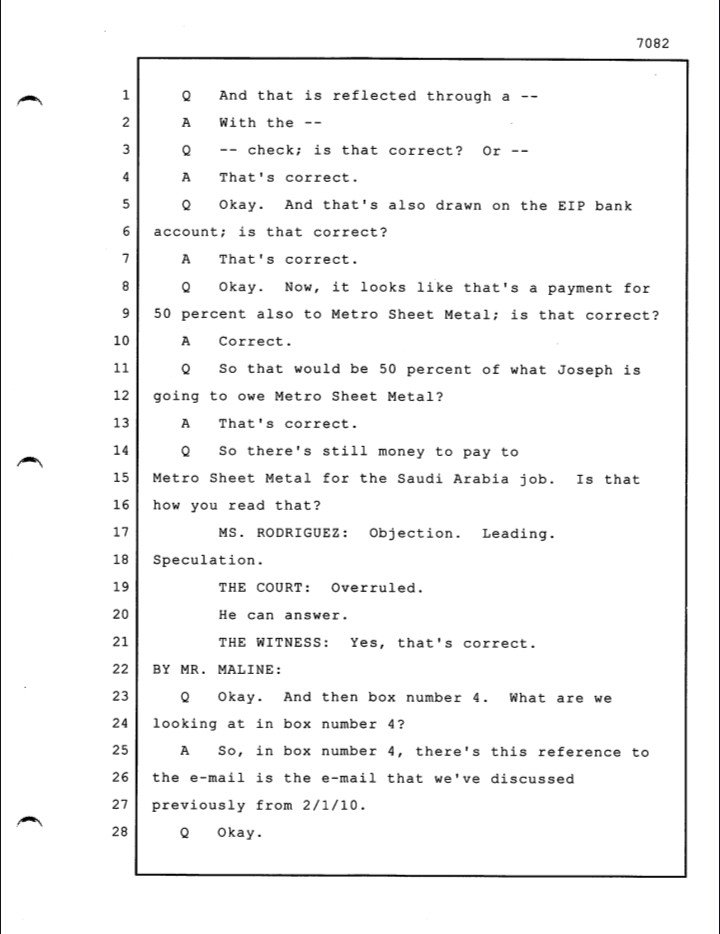
The jury had already heard the answer. Rahage’s payments came through Kocache Enterprises; both March 5 wires reference the purchase order. The defense accountant, Mr. Shogren, walked the jury through Exhibit 1115: the 50 percent deposit invoiced in QuickBooks, the deposit, $30,733.25, arriving by wire on January 22, and Joseph paying Metro its 50 percent the same day: (RT 7081:1-7082:13)
Read the full exchange
A QuickBooks. And it appears in a list of invoices. And the invoice is this — difficult to read — 30,771.25 is a 50 percent deposit against the sales price of 61542.
Q And that’s the 50 percent down that was — that you referred to earlier, correct?
A That’s correct.
Q So we should see, at some point, a 50,000-dollar payment from Saudi Arabia to Joseph, correct?
A That’s correct.
Q And did we see that?
A We did.
Q And where is that?
A So, on the 22nd of January, 30,733.25 came in by wire.
Q Okay. And was that — Is that — Underneath, it says this information was obtained from the bank account. EIP bank account. Is that correct?
A That’s correct.
Q And then January 22nd, there’s another transaction; is that correct?
A That’s correct. So, you’ll notice that the timing is the same on those. 1/22/10, when the payment is received, the deposit is received. That’s when the payments begin to flow to materials or suppliers. And this one went to Metro Sheet Metal for 9,250.
Q And that is reflected through a —
A With the —
Q — check; is that correct? Or —
A That’s correct.
Q Okay. And that’s also drawn on the EIP bank account; is that correct?
A That’s correct.
Q Okay. Now, it looks like that’s a payment for 50 percent also to Metro Sheet Metal; is that correct?
A Correct.
Q So that would be 50 percent of what Joseph is going to owe Metro Sheet Metal?
A That’s correct.
See the trial transcript (RT 7081, 7082)

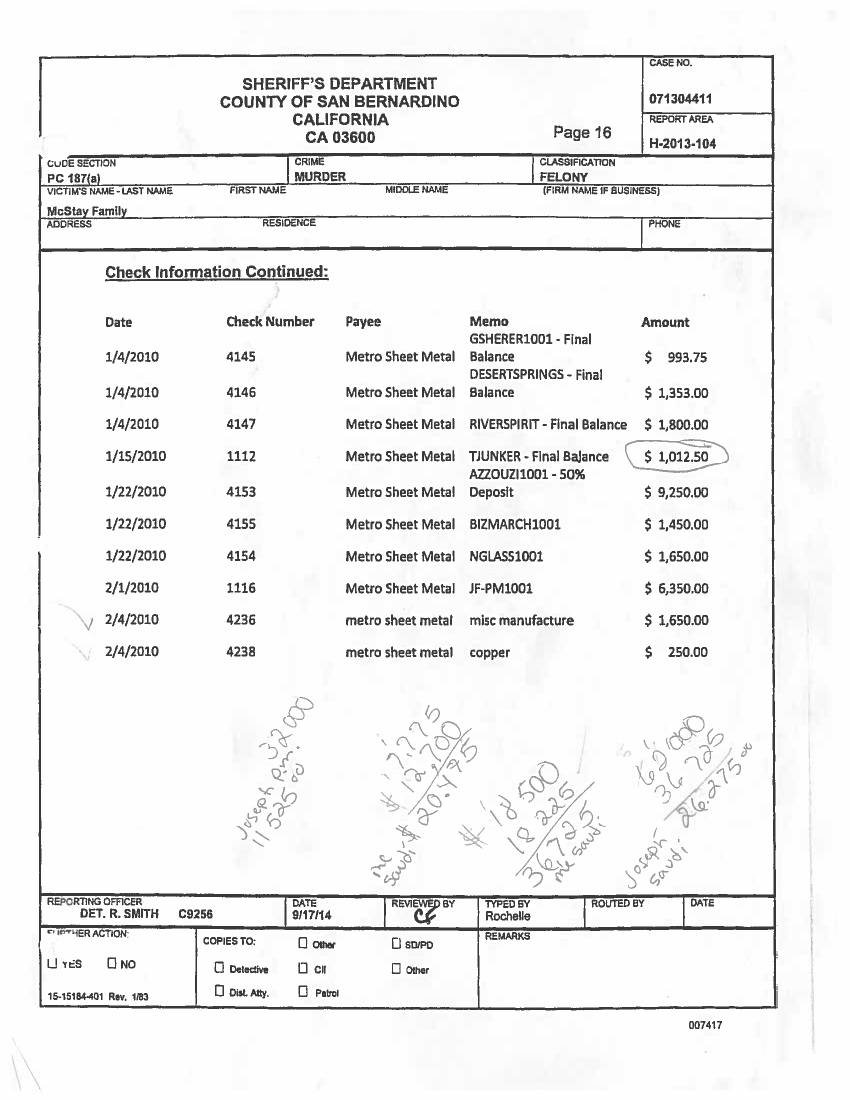
The Metro check is on the State’s own check list: #4153, $9,250.00, January 22, 2010, marked “AZZOUZI1001 – 50% Deposit.” (Bates 007417)
See the State’s check list (Bates 007417)
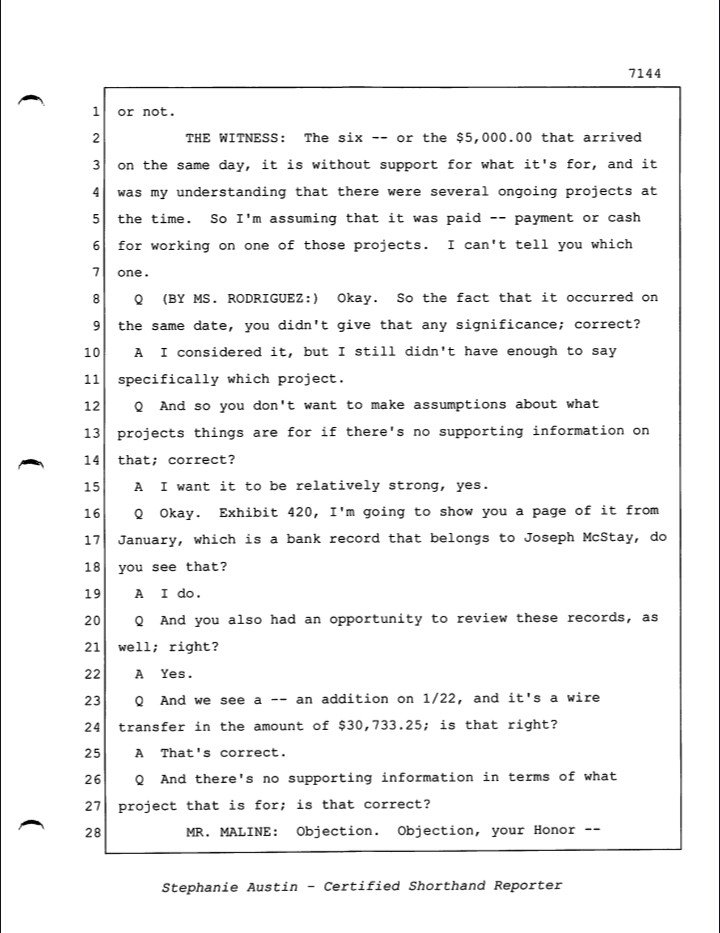
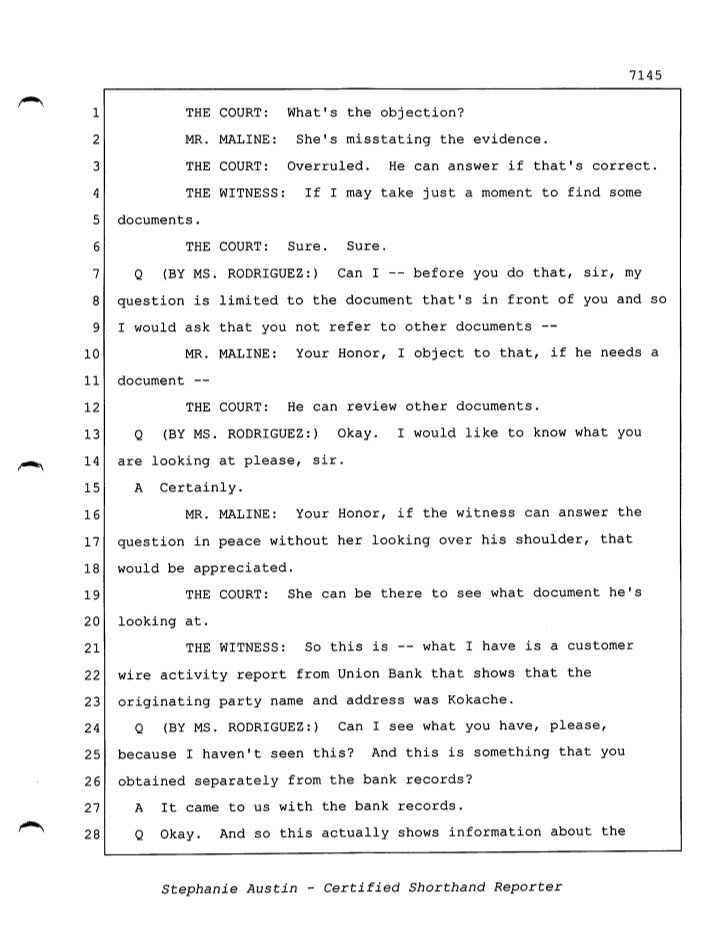
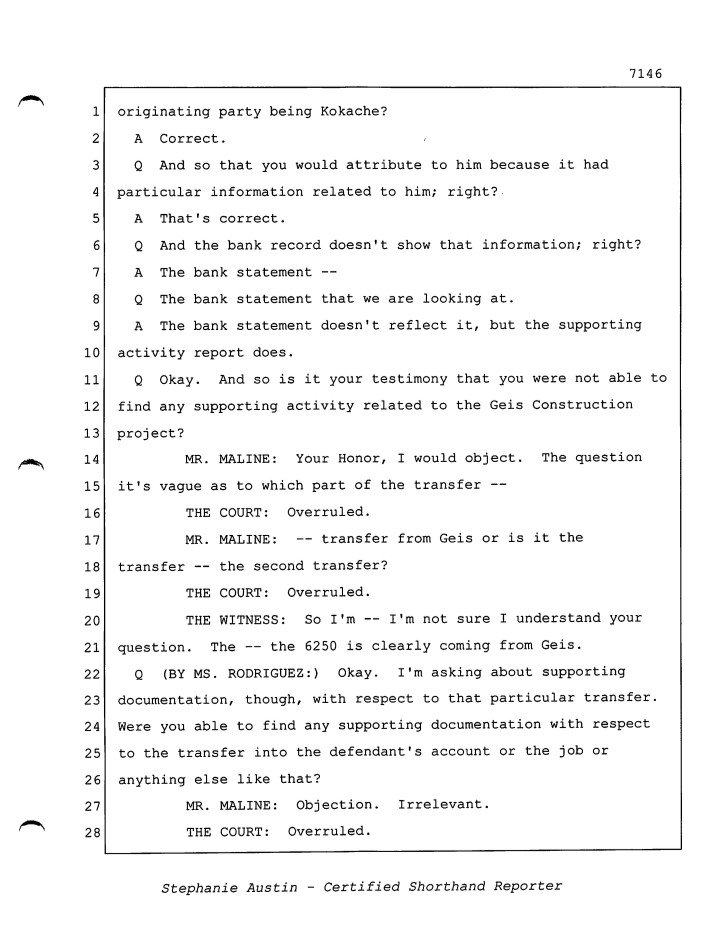
The next day, Ms. Rodriguez went after that same January 22 wire on cross-examination, suggesting nothing showed what it was for. Mr. Shogren answered from Union Bank’s wire report: the money came from Kocache: (RT 7144:16-7146:10)
Read the full exchange
Q Okay. Exhibit 420, I’m going to show you a page of it from January, which is a bank record that belongs to Joseph McStay, do you see that?
A I do.
Q And you also had an opportunity to review these records, as well; right?
A Yes.
Q And we see a — an addition on 1/22, and it’s a wire transfer in the amount of $30,733.25; is that right?
A That’s correct.
Q And there’s no supporting information in terms of what project that is for; is that correct?
MR. MALINE: Objection. Objection, your Honor —
THE COURT: What’s the objection?
MR. MALINE: She’s misstating the evidence.
THE COURT: Overruled. He can answer if that’s correct.
THE WITNESS: If I may take just a moment to find some documents.
THE COURT: Sure. Sure.
Q (BY MS. RODRIGUEZ:) Can I — before you do that, sir, my question is limited to the document that’s in front of you and so I would ask that you not refer to other documents —
MR. MALINE: Your Honor, I object to that, if he needs a document —
THE COURT: He can review other documents.
Q (BY MS. RODRIGUEZ:) Okay. I would like to know what you are looking at please, sir.
A Certainly.
MR. MALINE: Your Honor, if the witness can answer the question in peace without her looking over his shoulder, that would be appreciated.
THE COURT: She can be there to see what document he’s looking at.
THE WITNESS: So this is — what I have is a customer wire activity report from Union Bank that shows that the originating party name and address was Kokache.
Q (BY MS. RODRIGUEZ:) Can I see what you have, please, because I haven’t seen this? And this is something that you obtained separately from the bank records?
A It came to us with the bank records.
Q Okay. And so this actually shows information about the originating party being Kokache?
A Correct.
Q And so that you would attribute to him because it had particular information related to him; right?
A That’s correct.
Q And the bank record doesn’t show that information; right?
A The bank statement —
Q The bank statement that we are looking at.
A The bank statement doesn’t reflect it, but the supporting activity report does.
See the trial transcript (RT 7144, 7145, 7146)
The balance came from the same company. On March 5, 2010, Kocache wired $13,862.00 to me and $16,839.25 to Dan Kavanaugh, each marked “balance of payment of PO.” (Exhibit 1115, boxes 6-7; my $13,862.00 wire also appears in the bank report, Bates 007447)
Even so, Mr. Imes told the jury in closing that nobody had made the link. He named the company himself, said it was “presumably” the Saudi job, and said “No one ever connected the dot”: (RT 8259:17-22)
A BIG DEAL WAS MADE ABOUT THE SAUDI ARABIA PROJECT. WHAT DID THOSE RECORDS SHOW? THOSE RECORDS SHOW PAYMENTS COMING IN FROM THIS COMPANY, KOKESHI, WHICH PRESUMABLY IS THE SAUDI ARABIA PROJECT. NO ONE EVER CONNECTED THE DOT. AND WHERE DID THAT MONEY GO. HMM. TO DAN KAVANAUGH AND TO THE DEFENDANT.
See the trial transcript (RT 8259)
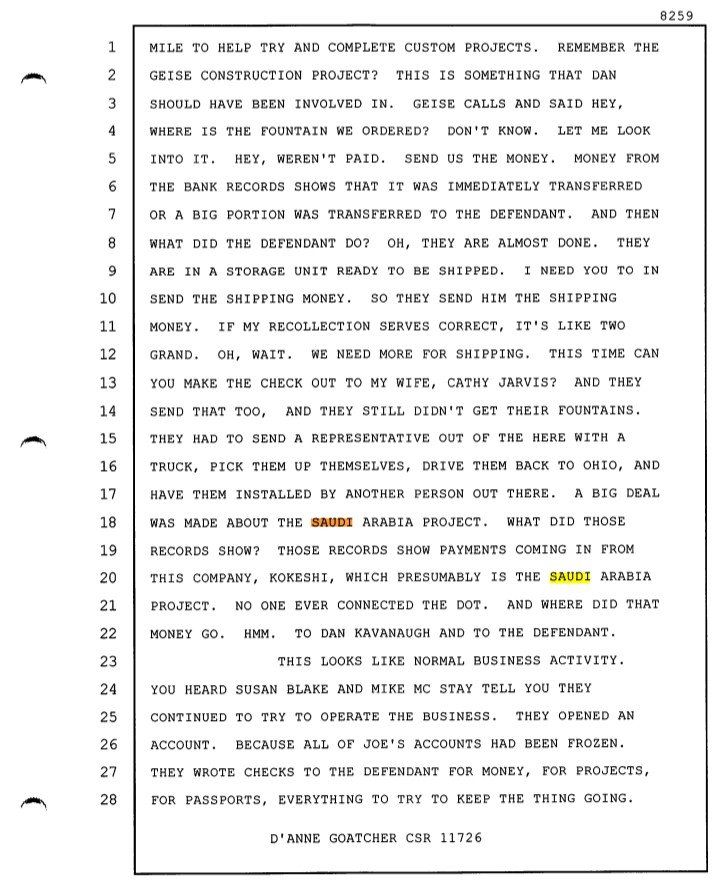
The dot had been connected twice in front of that jury: by the defense accountant on direct, and by the State’s own cross-examination the next day.
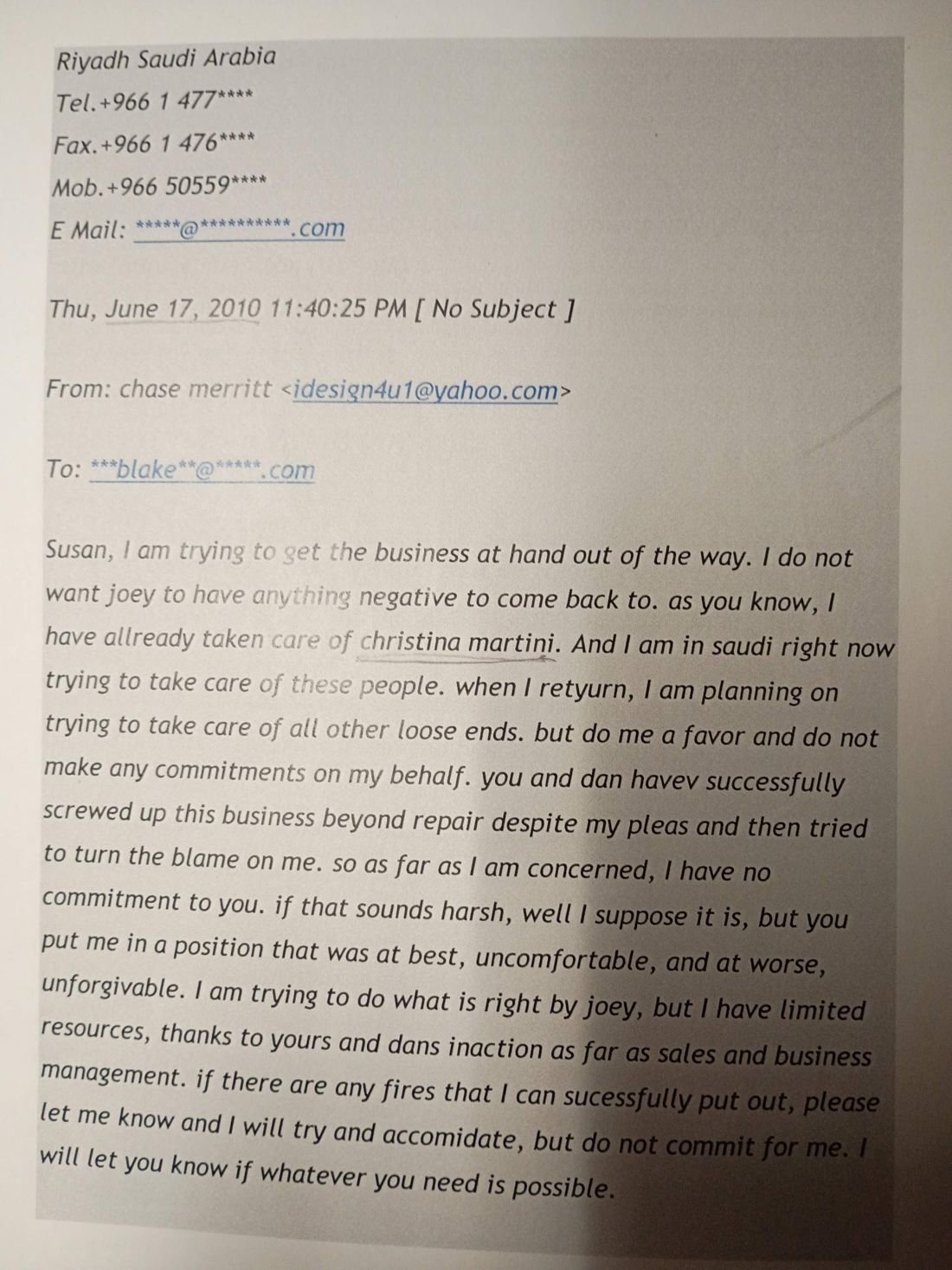
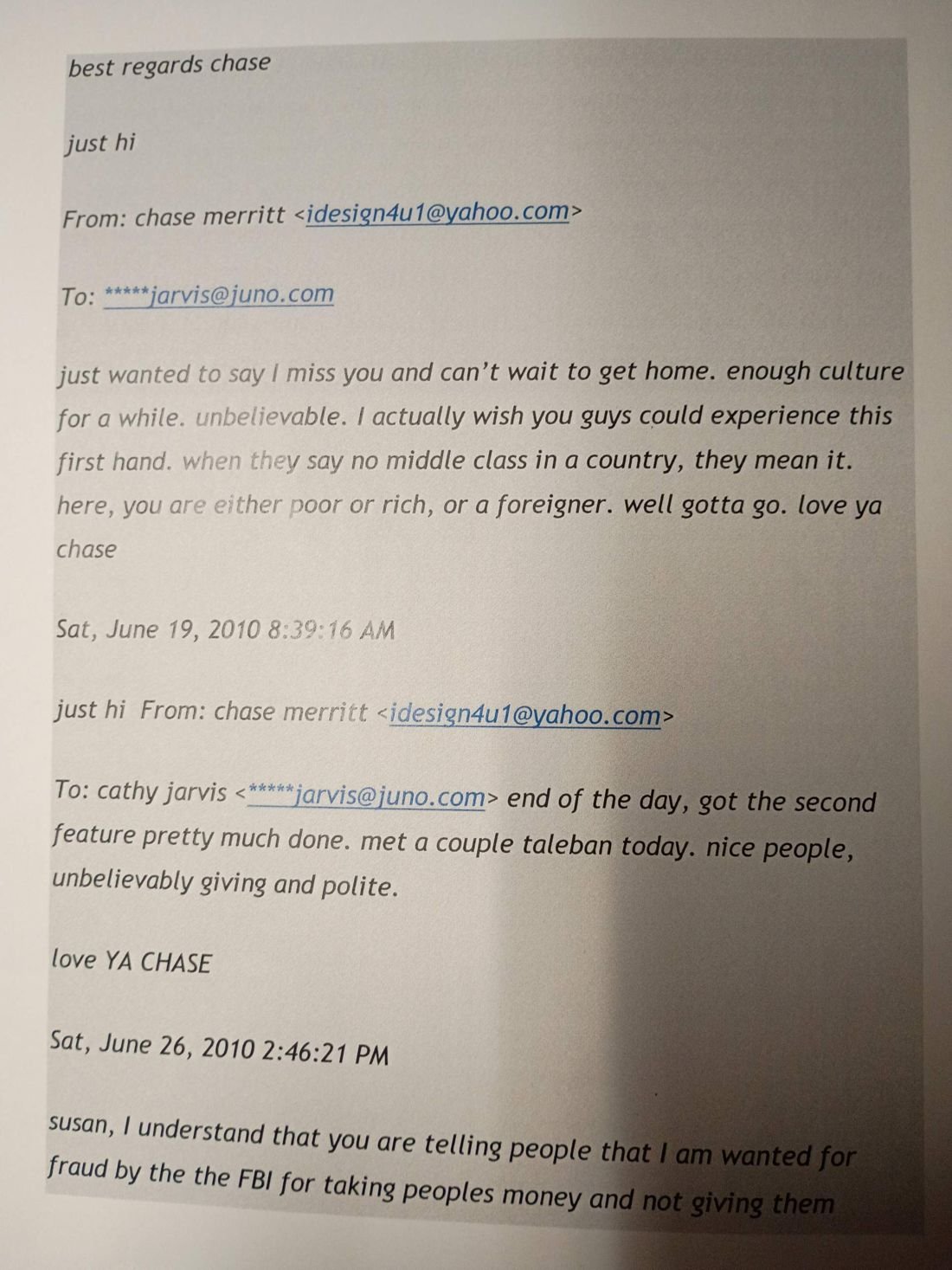
I wrote e-mails from Saudi Arabia, and after. On June 17, 2010, I wrote to Susan Blake from Riyadh. It is not a friendly e-mail; she and Dan had been telling people things about me, and I said so. But it puts me in Saudi Arabia, finishing the job:
Read the full passage
Thu, June 17, 2010 11:40:25 PM
From: chase merritt
Susan, I am trying to get the business at hand out of the way. I do not want joey to have anything negative to come back to. as you know, I have allready taken care of christina martini. And I am in saudi right now trying to take care of these people. when I retyurn, I am planning on trying to take care of all other loose ends. but do me a favor and do not make any commitments on my behalf. you and dan havev successfully screwed up this business beyond repair despite my pleas and then tried to turn the blame on me. so as far as I am concerned, I have no commitment to you. if that sounds harsh, well I suppose it is, but you put me in a position that was at best, uncomfortable, and at worse, unforgivable. I am trying to do what is right by joey, but I have limited resources, thanks to yours and dans inaction as far as sales and business management. if there are any fires that I can sucessfully put out, please let me know and I will try and accomidate, but do not commit for me. I will let you know if whatever you need is possible.
best regards chase
See the e-mails (Exhibit 990 and the Rahage purchase order)
Two days later I wrote to Cathy:
Sat, June 19, 2010 8:39:16 AM
just hi
end of the day, got the second feature pretty much done. met a couple taleban today. nice people, unbelievably giving and polite.
love YA CHASE
See the e-mails (Exhibit 990 and the Rahage purchase order)
And on June 26, to Susan again, that the Saudi waterfalls were installed:
Sat, June 26, 2010 2:46:21 PM
susan, I understand that you are telling people that I am wanted for fraud by the the FBI for taking peoples money and not giving them waterfalls. you and I know that that is not true. I was in saudi arabia and not able to get in touch with my client for a while, but telling them that I was wanted is slander.. so I hope for your sake that you will stop talking to people about me. saudi arabias falls are installed. but they still need the sponge, remote controls, and something else. all of which were at your friends shop. call me or reply please, and let me know you got this. I do not want to have any more problems with you and dan, but if you continue to push me into a corner, I will take legal action.
See the e-mails (Exhibit 990 and the Rahage purchase order)
At trial Mr. Maline showed Susan Blake the e-mails I sent her from Saudi Arabia. She did not remember them: (RT 5513:5-19)
Q (BY MR. MALINE:) Okay. And do you recall that when Chase was in Saudi Arabia that he sent you an e-mail?
A Not from Saudi — I don’t know.
Q I’m going to have you take a look at Exhibit 990, if you could read that and tell me if that refreshes your recollection.
A Okay.
Q Do you recall that?
A I don’t remember this e-mail.
Q Okay. I will take it out. There’s more pages.
A Oh, there’s more. Is this the same date?
Q If you look at page 2 on the bottom, that will give you the date.
A I don’t remember ever seeing this.
Q Okay. So you don’t recall these e-mails?
A No.
See the trial transcript (RT 5513)
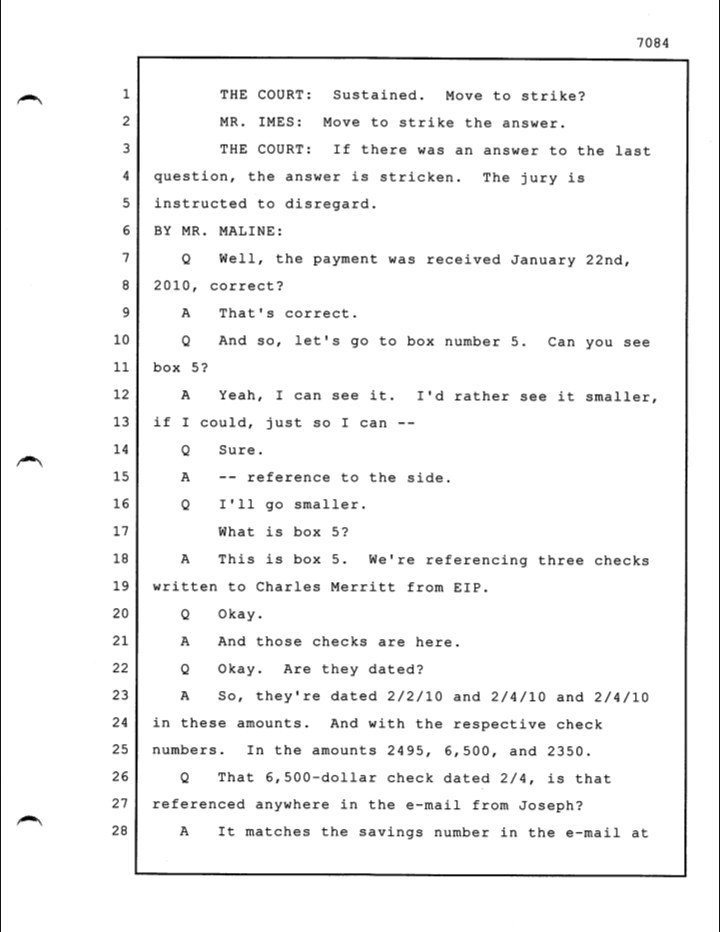
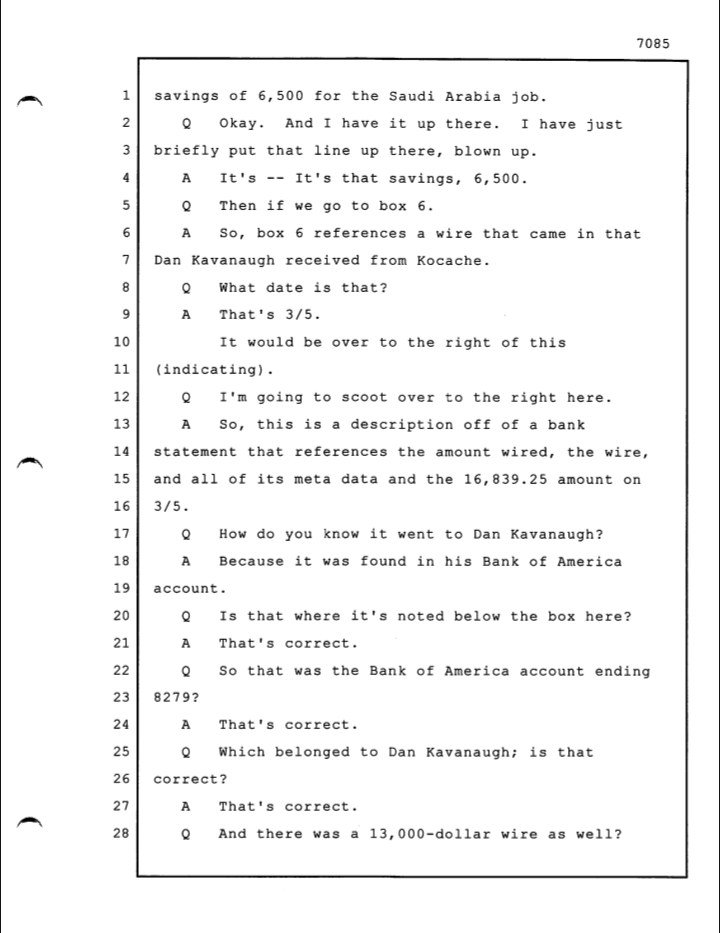
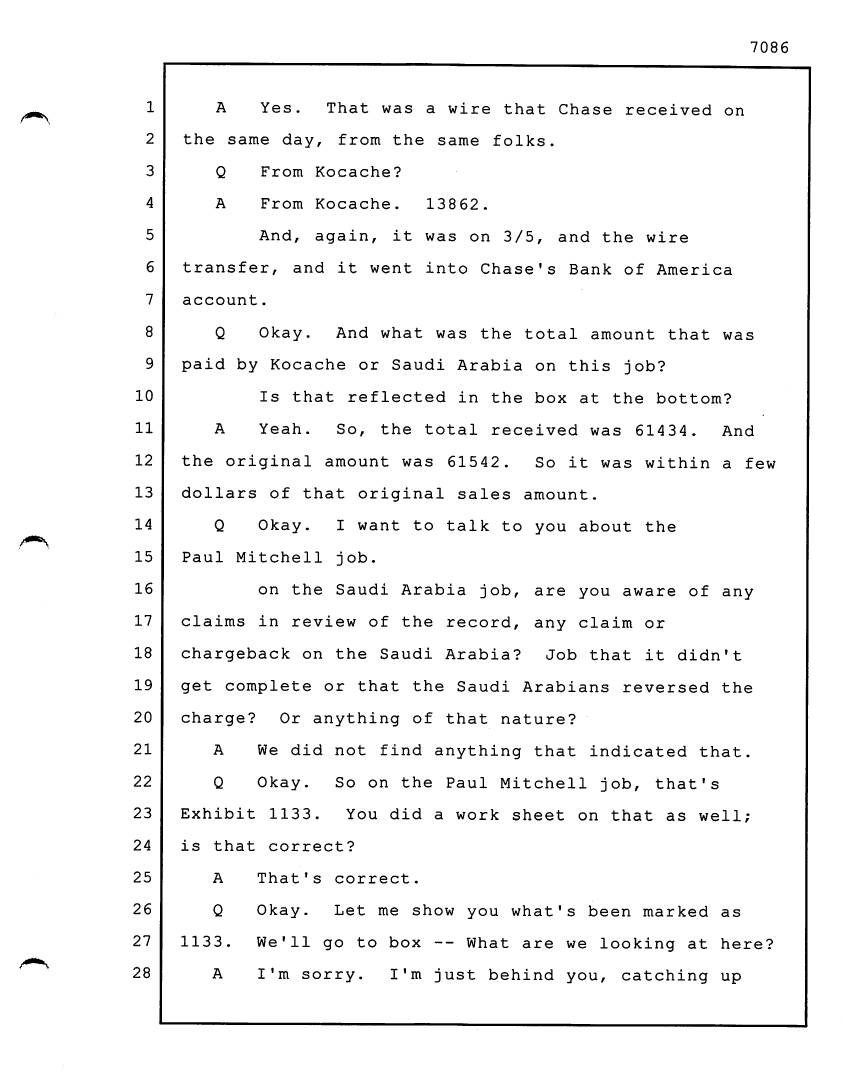
The defense accountant walked the jury through Exhibit 1115, the Saudi chart, box by box: the January 22 deposit, my three checks, the two March 5 wires from Kocache, and what the customer paid in all. Ms. Rodriguez’s objection to when my share started to accrue was overruled; Mr. Imes’s objection to the next question was sustained and that answer stricken. He found no claim that the job wasn’t finished: (RT 7083:7-7086:21)
Read the full exchange
Q Okay. So, let me just put that — Exhibit 419. And this is the e-mail, correct?
A Yes, that’s correct.
Q If you could just show the jury what you’re referring to?
A So, I was referring to this line here (indicating). And that’s the line that’s box 4, if you will, on the previous slide.
Q So, since that 50 percent deposit was received on January 22nd from Saudi Arabia, is that when the liability to Chase starts to accrue?
MS. RODRIGUEZ: Objection. Speculation.
THE COURT: Overruled.
He can answer.
THE WITNESS: Payments begin when the deposit is received from the customer.
BY MR. MALINE:
Q And is that why we don’t see it on the 2009 ledger?
A That’s correct.
MR. IMES: Objection. Calls for speculation. Lacks foundation.
THE COURT: Sustained. Move to strike?
MR. IMES: Move to strike the answer.
THE COURT: If there was an answer to the last question, the answer is stricken. The jury is instructed to disregard.
BY MR. MALINE:
Q Well, the payment was received January 22nd, 2010, correct?
A That’s correct.
Q And so, let’s go to box number 5. Can you see box 5?
A Yeah, I can see it. I’d rather see it smaller, if I could, just so I can —
Q Sure.
A — reference to the side.
Q I’ll go smaller.
What is box 5?
A This is box 5. We’re referencing three checks written to Charles Merritt from EIP.
Q Okay.
A And those checks are here.
Q Okay. Are they dated?
A So, they’re dated 2/2/10 and 2/4/10 and 2/4/10 in these amounts. And with the respective check numbers. In the amounts 2495, 6,500, and 2350.
Q That 6,500-dollar check dated 2/4, is that referenced anywhere in the e-mail from Joseph?
A It matches the savings number in the e-mail at savings of 6,500 for the Saudi Arabia job.
Q Okay. And I have it up there. I have just briefly put that line up there, blown up.
A It’s — It’s that savings, 6,500.
Q Then if we go to box 6.
A So, box 6 references a wire that came in that Dan Kavanaugh received from Kocache.
Q What date is that?
A That’s 3/5.
It would be over to the right of this (indicating).
Q I’m going to scoot over to the right here.
A So, this is a description off of a bank statement that references the amount wired, the wire, and all of its meta data and the 16,839.25 amount on 3/5.
Q How do you know it went to Dan Kavanaugh?
A Because it was found in his Bank of America account.
Q Is that where it’s noted below the box here?
A That’s correct.
Q So that was the Bank of America account ending 8279?
A That’s correct.
Q Which belonged to Dan Kavanaugh; is that correct?
A That’s correct.
Q And there was a 13,000-dollar wire as well?
A Yes. That was a wire that Chase received on the same day, from the same folks.
Q From Kocache?
A From Kocache. 13862.
And, again, it was on 3/5, and the wire transfer, and it went into Chase’s Bank of America account.
Q Okay. And what was the total amount that was paid by Kocache or Saudi Arabia on this job?
Is that reflected in the box at the bottom?
A Yeah. So, the total received was 61434. And the original amount was 61542. So it was within a few dollars of that original sales amount.
Q Okay. I want to talk to you about the Paul Mitchell job.
on the Saudi Arabia job, are you aware of any claims in review of the record, any claim or chargeback on the Saudi Arabia? Job that it didn’t get complete or that the Saudi Arabians reversed the charge? Or anything of that nature?
A We did not find anything that indicated that.
See the trial transcript (RT 7083, 7084, 7085, 7086)

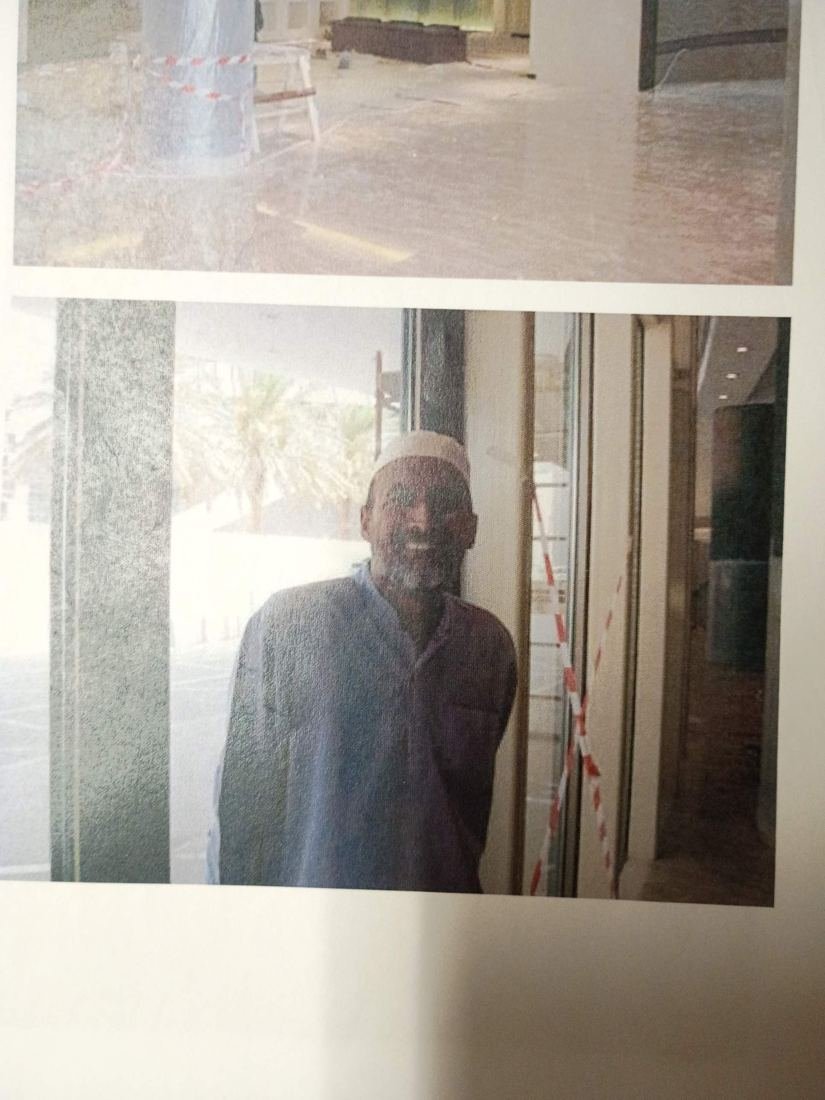
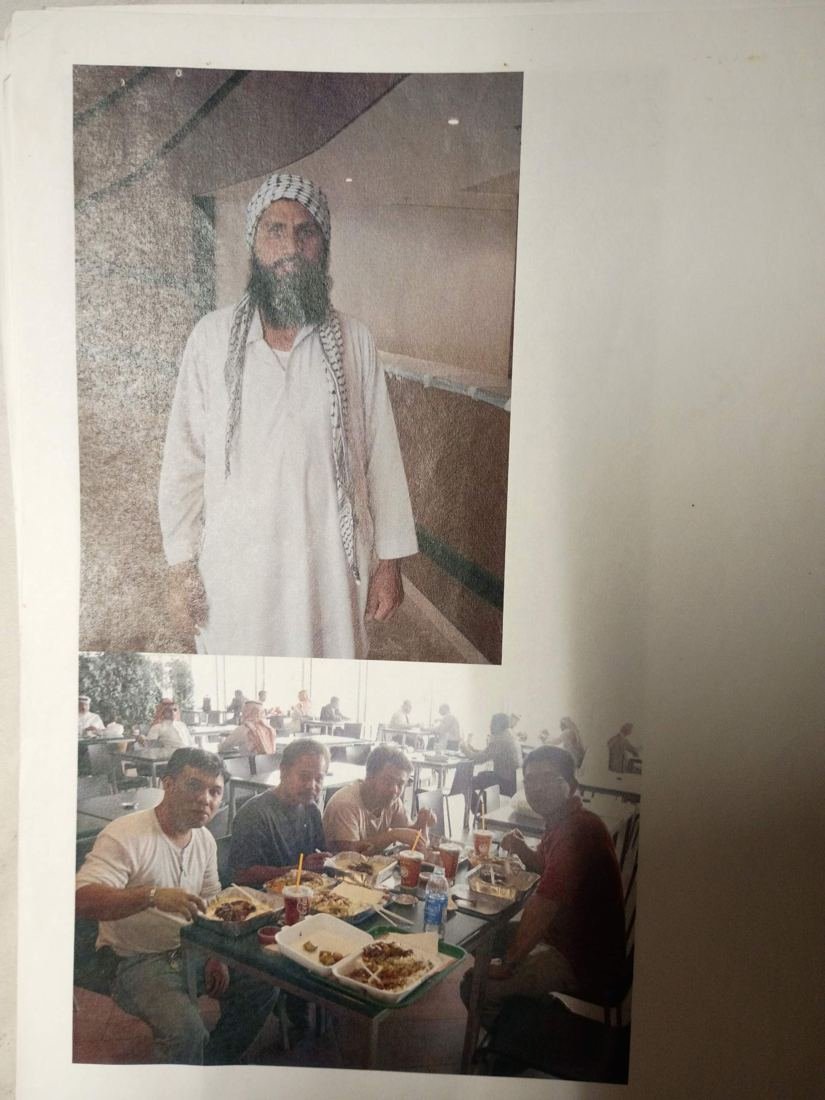
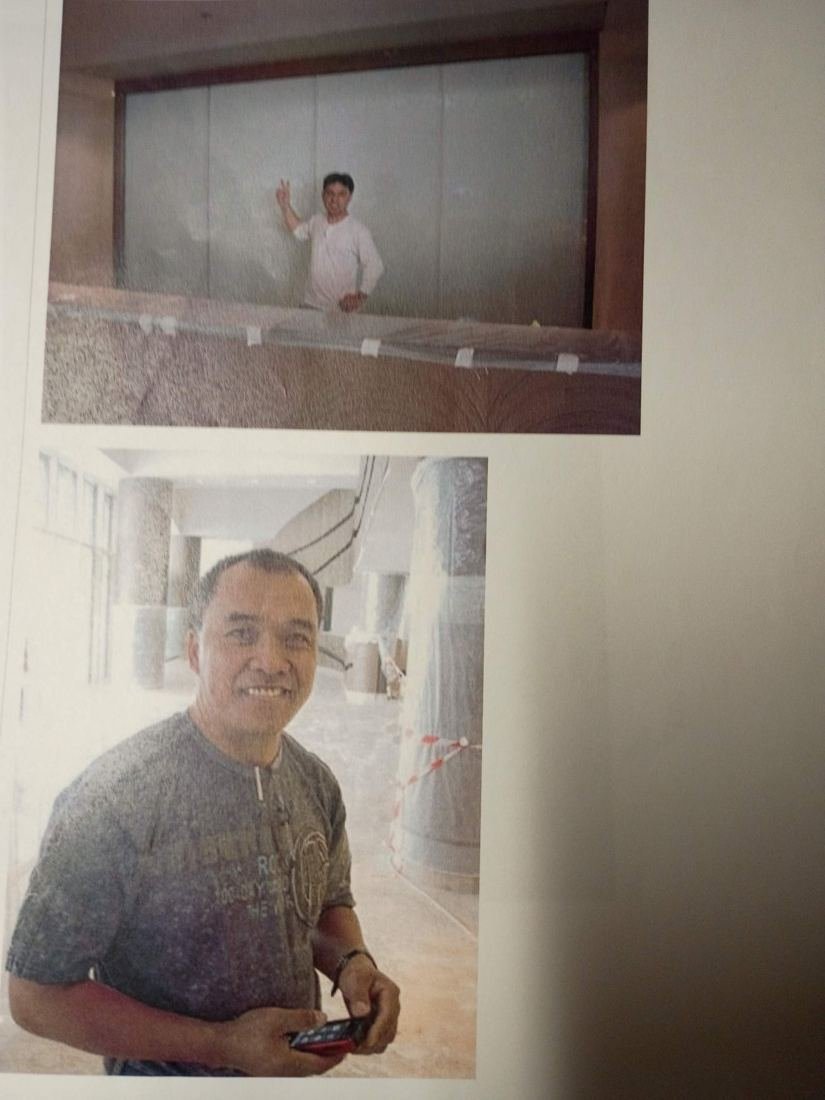
I built the Saudi waterfalls, flew to Riyadh and installed them, and I took these photos there. The customer paid in full. Mr. Imes told the jury there was “even no evidence that it’s been built yet.” Counsel had the e-mails, the wire records and the photos, and never countered him.
See my photos from Saudi Arabia



See the bank report (Bates 007447)
Claim 15, the money: 4 of 5
Where the money went
The State said I took the money because I owed Joseph $42,000. This is how the money on both jobs moved, and how Joseph and I split it.
The money, in short
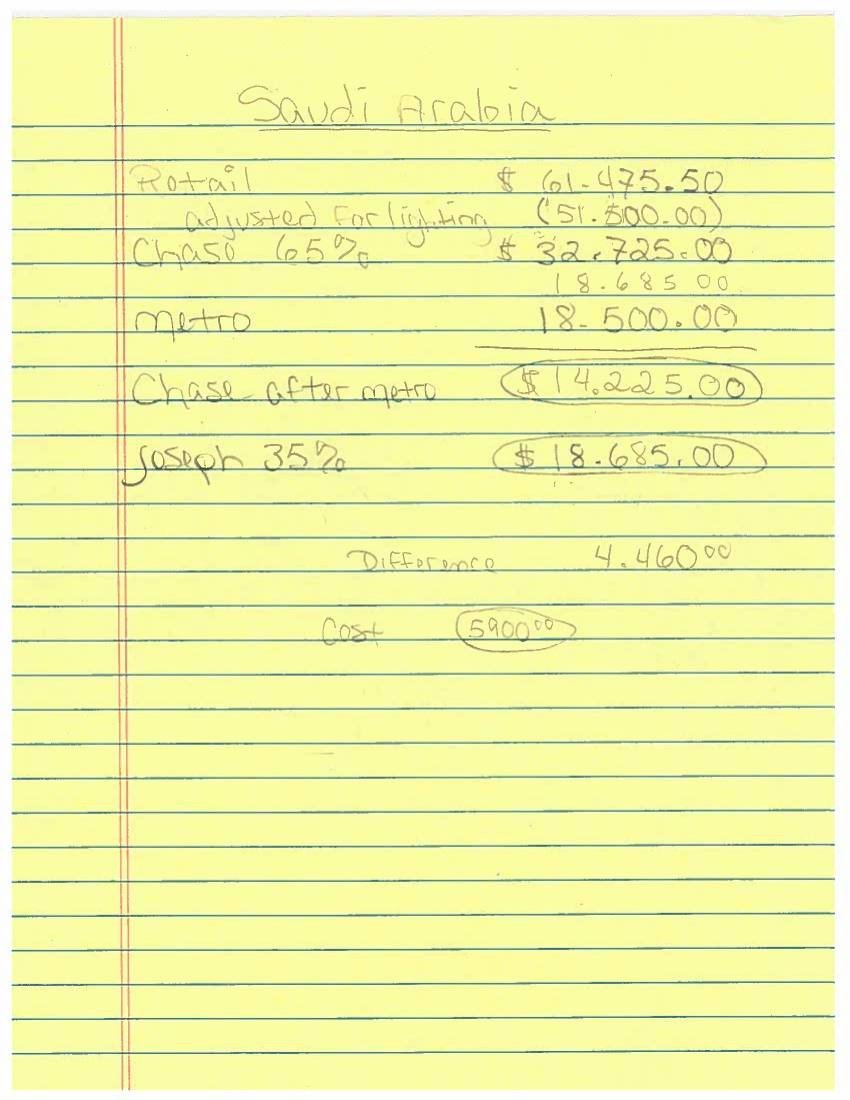
- Saudi Arabia: the customer paid $61,434 on a $61,542.50 invoice. I received $25,207: three checks, for $2,495, $6,500 and $2,350, and the $13,862 wire. Metro was paid $18,500 for its part: $9,250 by Joseph and, by my accounting, $9,250 by me.
- Paul Mitchell: a $31,500 job. I received $9,500: the $4,500 check and the $5,000 wire. Of that, I paid Metro $8,500: $4,900 on February 22 and $3,600 on March 8. Joseph had paid Metro $6,350 to start the work.
- Two more checks dated February 4 went straight to Metro: $1,650 and $250.
What I told San Diego in February 2010
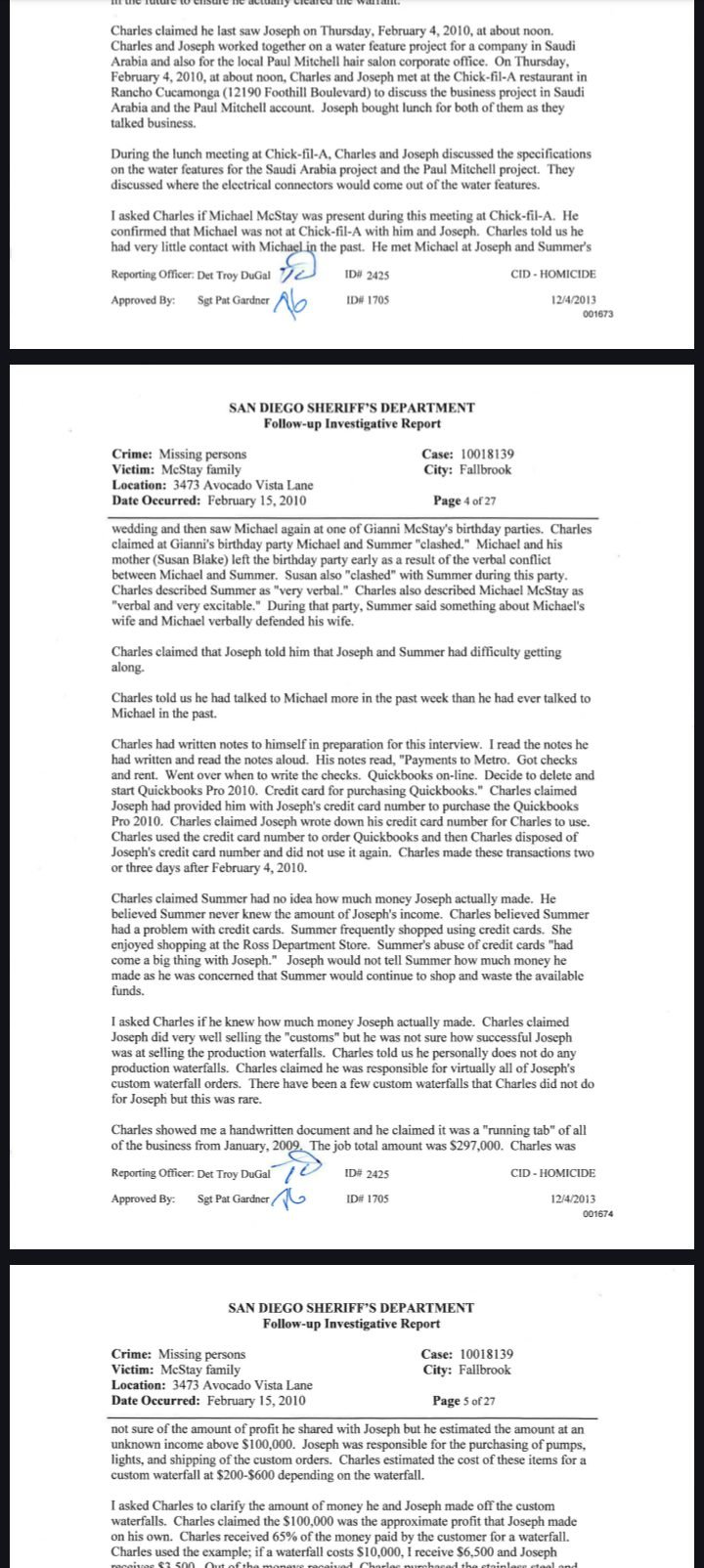
At my first interview, I explained to Det. DuGal how Joseph and I split the money. This is the whole paragraph of his follow-up report: (Bates 001675)
Read the full passage
“I asked Charles to clarify the amount of money he and Joseph made off the custom waterfalls. Charles claimed the $100,000 was the approximate profit that Joseph made on his own. Charles received 65% of the money paid by the customer for a waterfall. Charles used the example; if a waterfall costs $10,000, I receive $6,500 and Joseph receives $3,500. Out of the moneys received, Charles purchased the stainless steel and the glass for the waterfall. Charles also transported the parts of the waterfall during various stages of the construction of the waterfall. Joseph was only responsible for the pump, lights, and shipping of the waterfall. All of the money not used in building the waterfall was profit for each man. Charles estimated his actual cost for the primary material used in a $10,000 waterfall to be $2,500-$2,750. Then Charles had to pay to have the waterfall constructed or produced. He estimated his production cost for the $10,000 waterfall at $1,500-$1,800. (using the numbers provided by Charles, the overall cost for Charles to build the $10,000 waterfall was between $4,000-$4,550. He received $6,500 from Joseph for this product giving Charles an overall profit of $1,950-$2,500)”
See DuGal’s report (Bates 001673-001675)
The defense flow charts
The defense accountant traced the deposits, checks and wires on each job in two charts: Exhibit 1115 for Saudi Arabia and Exhibit 1123 for Paul Mitchell. The court let him use 1115, and a modified 1123 (February 22, 2010). Both were shown to the jury. The Paul Mitchell chart was shown, with boxes ordered removed, as Exhibit 1133. (RT 7011:16-7012:17, 7015-7026, 7086-7090)
See the trial transcript (RT 7011, 7012)


Saudi Arabia (Exhibit 1115)
- Invoice #1078, October 28, 2009: $61,542.50.
- January 22, 2010: $30,733.25 wired into Joseph’s account. The same day, Joseph paid Metro $9,250.00 (“AZZOUZI1001 – 50% Deposit”; check #4153 on the State’s list, Bates 007417).
- Checks to me on Joseph’s account: $2,495.00 (#4240, “depsit sa 1001”), $6,500.00 (#4241, “saudi arabia final”), $2,350.00 (#4242, “lighting install sa(1001)”).
- March 5, 2010: Kocache wired $16,839.25 to Kavanaugh and $13,862.00 to me.
See the Saudi flow of money (Exhibit 1115)

Paul Mitchell (Exhibit 1123)
- Invoice #1082, January 4, 2010: $31,500.00. January 25: $16,000.00 deposited into Joseph’s account.
- February 1, 2010: Joseph paid Metro $6,350.00 (check #1116, “JF-PM1001,” written February 1; Metro’s statement shows it received February 4).
- Check #4237 to me, dated February 4, $4,500.00, “paul mitchell.” February 22: $5,000.00 wire to me from MW Mitchell Construction.
See Exhibit 1123 (flow of money, Paul Mitchell)
Metro’s statement of March 1, 2010 (Exhibit 740)
$14,700.00 billed (invoice #3728), payments of $6,350.00 and $4,900.00, and $3,450.00 still owing.
See Metro’s statement (March 1, 2010)
My accounting
- Metro was paid $18,500.00 for Saudi: Joseph’s $9,250.00, and $9,250.00 I paid from other withdrawals from my account (my own accounting; I have not yet found the withdrawal records for it).
- Metro was paid $14,850.00 for Paul Mitchell: Joseph’s $6,350.00 to start the job, my $4,900.00 on February 22 and my $3,600.00 on March 8.
- The $3,600 on March 8 paid off the $3,450 still owing on Metro’s March 1 statement, $150 over the balance.
See my accounting (Folder D, pages 54, 55, 83, 109, 80)

Joseph’s e-mail of February 1, 2010 (Exhibit 419)
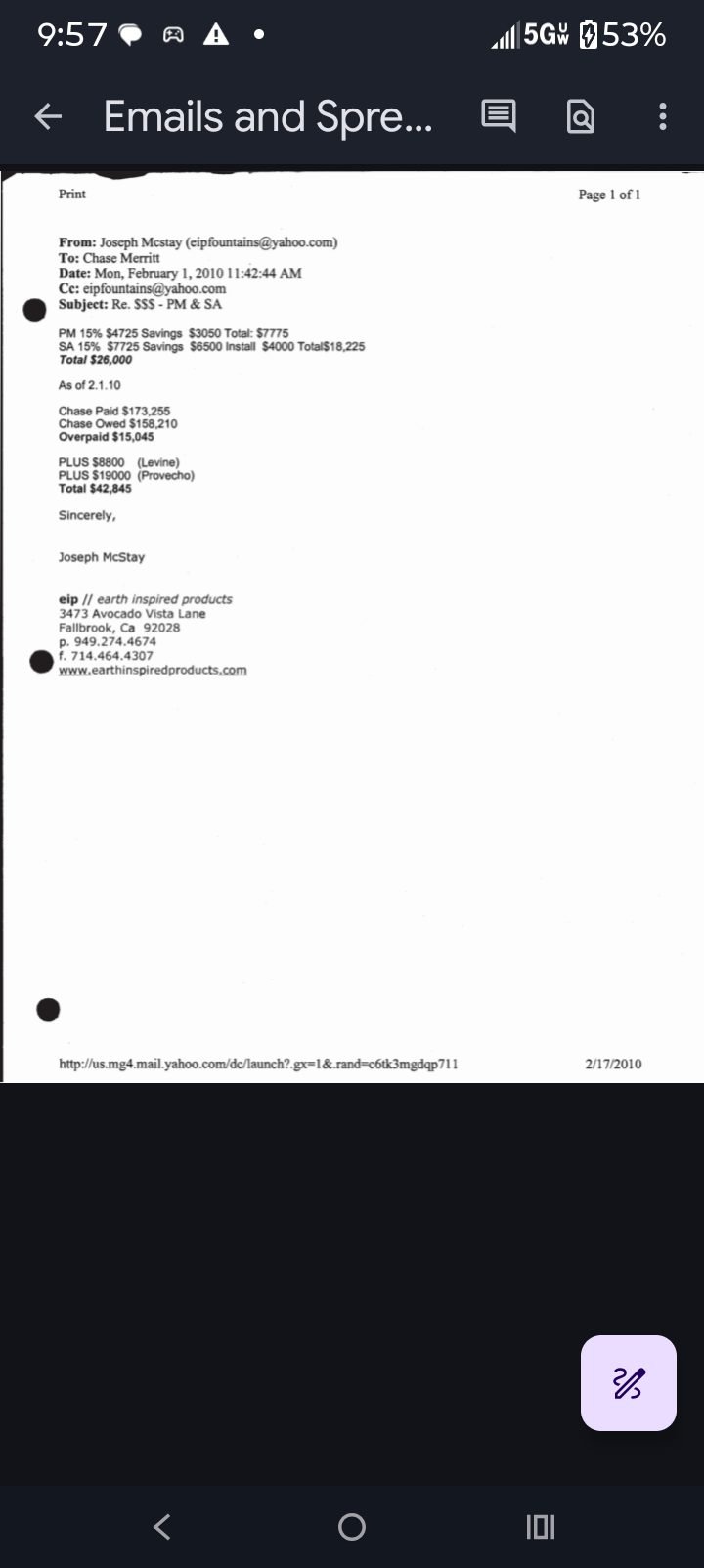
The $42,000 the State relied on comes from an e-mail Joseph sent me at 11:42 a.m. on February 1, 2010, headed “Re. $$$ – PM & SA.” The same e-mail first sets out what I was owed on the two jobs, Paul Mitchell (PM) and Saudi Arabia (SA). This is the whole e-mail:
PM 15% $4725 Savings $3050 Total: $7775
SA 15% $7725 Savings $6500 Install $4000 Total$18,225
Total $26,000
As of 2.1.10
Chase Paid $173,255
Chase Owed $158,210
Overpaid $15,045
PLUS $8800 (Levine)
PLUS $19000 (Provecho)
Total $42,845
See Joseph’s e-mail of February 1, 2010 (Exhibit 419)
The defense accountant read the Saudi part of it to the jury: (RT 7083:1-6)
A And in that is a reference to the Saudi Arabia 15 percent 7,725. That’s actually only 13 percent of the total invoice. But that it’s referenced there. There’s a savings of 6,500 referenced, and an install price of 4,000, with a total for this job owed to Chase of 18,225.
See the trial transcript (RT 7083)
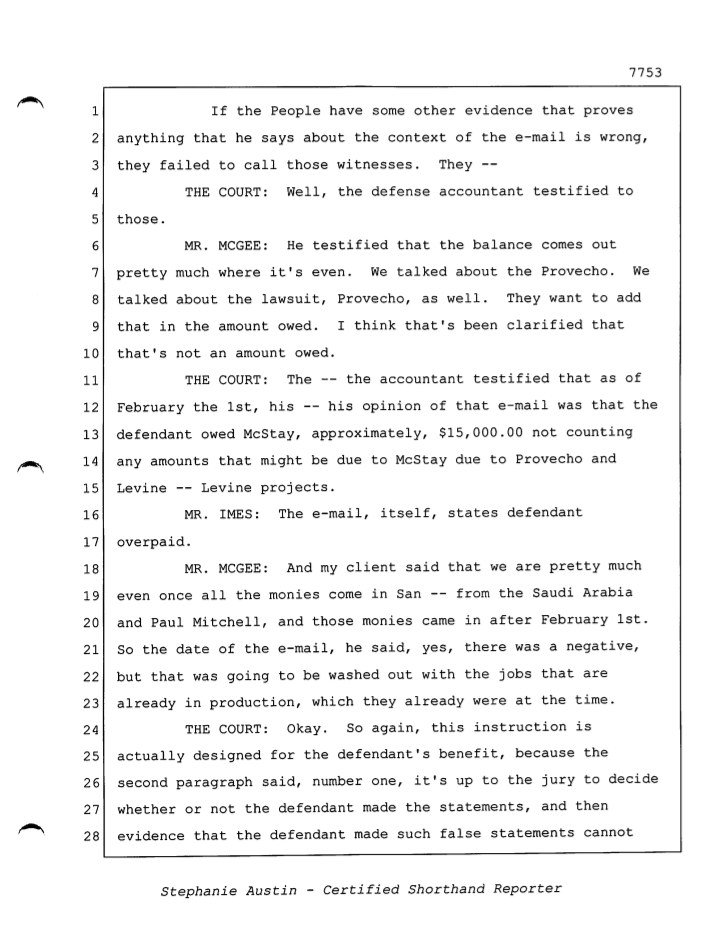
The e-mail also lists Levine ($8,800) and Provecho ($19,000). Those were not amounts I owed Joseph, and the accountant did not count them. The court said so, in summarizing his testimony: “The accountant testified that as of February the 1st, his — his opinion of that e-mail was that the defendant owed McStay, approximately, $15,000.00 not counting any amounts that might be due to McStay due to Provecho and Levine — Levine projects” (RT 7753:11-15). Mr. McGee had just told the court, “I think that’s been clarified that that’s not an amount owed” (RT 7753:9-10).
See the trial transcript (RT 7753)
Ms. Rodriguez answered him in rebuttal. She said I could not have had savings under the 15 percent model, that nothing in the e-mail said to subtract the $26,000 from the $42,000, and that after it I wrote myself another $15,845 in checks: (RT 8418:18-8419:14)
Read the full passage
And I want to talk about this e-mail that was sent by Joseph on February 1st. This is an assumption that we keep getting from defense counsel that they were even. Well, look at this e-mail — let me go back. Now, what we keep hearing from defense counsel is, you see this 26,000, that was money that was owing to the defendant.
And, in fact, Mr. Maline even told us yesterday that those savings up there represent additional money that the defendant could get if he could save money on the manufacturing. Well, what he forget to take into account, or what he failed to let you know, is that under that 15 percent model, which is what we see up there, that 15 percent model means that the defendant isn’t going out and buying materials and things like that. That 15 percent model is solely for the work that he does on the waterfall.
There is no way for him to get additional savings on that. And even if — nowhere in this e-mail, first of all, does it say, hey, this total is 26,000 owing to you, so let me subtract that from the 42,000. Doesn’t say that. Not to mention that the defendant — after this e-mail was sent on February 1st, the defendant writes himself another $15,845.00 in checks, between February 1st and February 8th. That’s the total of those four checks that he wrote. There is nothing about this e-mail, and the interpretation of this e-mail, that lends itself to them being even.
See the trial transcript (RT 8418, 8419)

By then Joseph and I had converted to the 15 percent arrangement: I made 15 percent plus any savings I could muster, and Joe paid for all materials and labor above mine. After Joseph disappeared, he could not make those payments, and the projects still had to be done. So I made it happen: I wrote the checks on Joseph’s behalf, to myself and to Metro, and I accepted the Saudi payments. If you add up what I got and what Joseph got, it comes to roughly the 35/65 split we used before the 15 percent model. I explained all of this to Susan Blake when I gave her my breakdown: at 65 percent, after I paid everything to get the projects done, I was at about 15 percent profit.
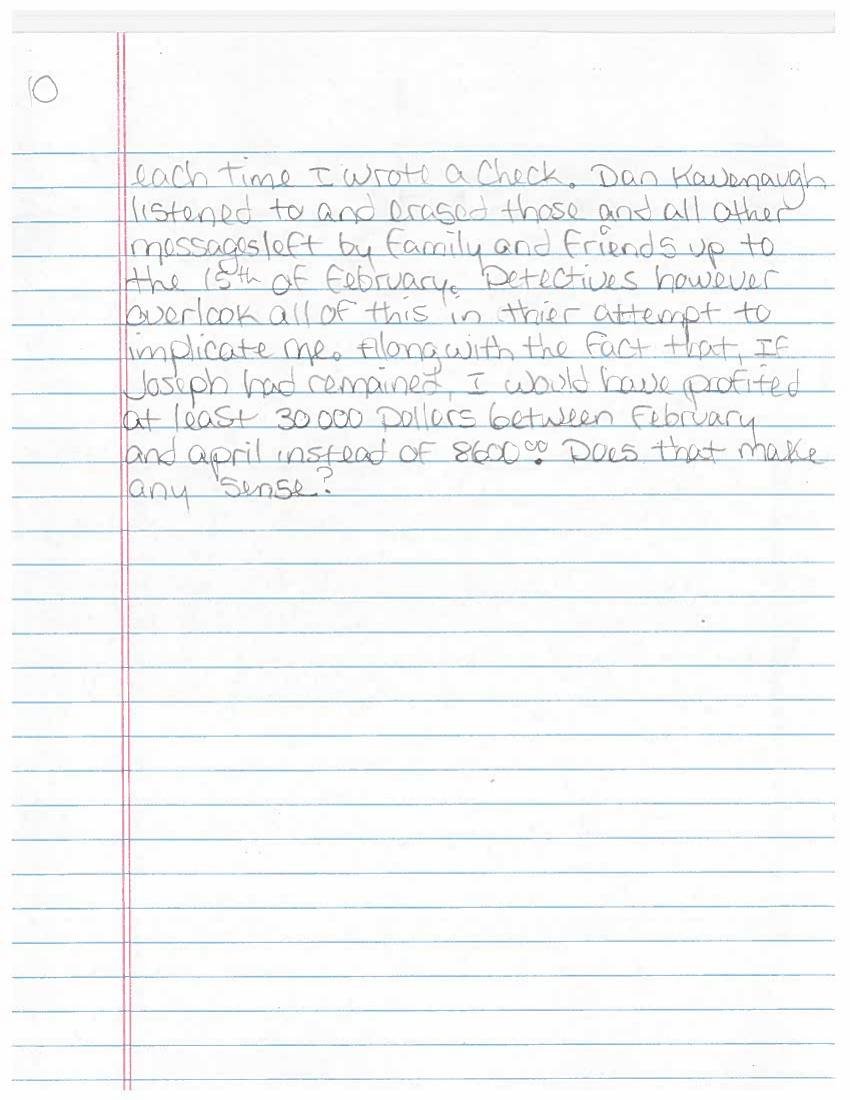
If Joseph had remained, I would have profited at least $30,000 between February and April, instead of $8,600. Does that make any sense?
Claim 15, the money: 5 of 5
Metro was paid
Much of the money I received went to Metro. Metro’s owner told detectives that when Joseph went missing, other than the insurance unit, Joseph owed him nothing for finished units except maybe a couple hundred dollars, and that I owed him nothing.
What the record shows
Dave Sequeida, Jr., of Metro Sheet Metal, was asked at trial about the damaged unit. He said it had been rebuilt, and that the insurance was to pay for it; for the money side he sent the jury to his father: (RT 2846:2-25)
Q (BY MR. MALINE:) Do you know what the dispute was regarding the damaged waterfall — water fountain?
A I don’t know if it was a dispute. They had already discussed that the insurance was going to pay for the unit. We remade the unit, rebuilt it. Shortly after that, the McStay family went missing.
Q You didn’t get your money when Joseph was still there and you had rebuilt that unit, you did not get paid for that unit; correct?
MR. IMES: Objection. Lacks foundation. Calls for speculation.
THE COURT: Overruled. He can answer if he knows.
THE WITNESS: Again, you would have to ask my father that.
Q (BY MR. MALINE:) When you mentioned earlier — you talked about the insurance or the damaged unit, do you remember that?
A Yeah.
Q So you know there was an issue regarding a damaged unit; correct?
A Yes, I had — had to rebuild it.
Q What was your understanding of the issue regarding the damaged unit?
A Again, I don’t handle the finances of that. I was in the back fabricating.
See the trial transcript (RT 2846)

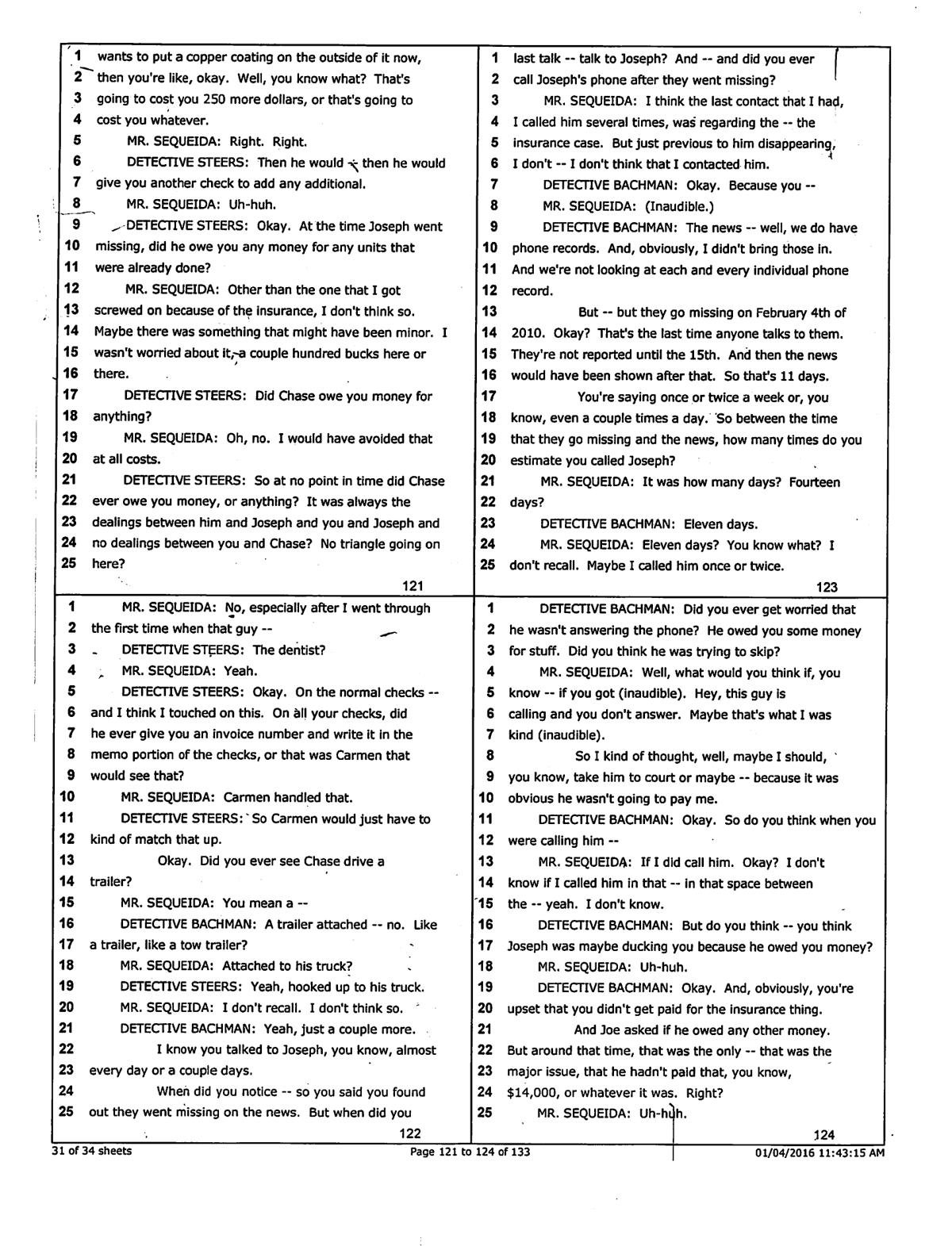
His father, Dave Sequeida, Sr., owner of Metro Sheet Metal, told San Bernardino detectives on September 30, 2014 that when Joseph went missing, he didn’t think Joseph owed him anything for finished units other than the insurance unit, maybe “a couple hundred bucks here or there,” and that I never owed him anything: (p. 121:9-122:4)
DETECTIVE STEERS: Okay. At the time Joseph went missing, did he owe you any money for any units that were already done?
MR. SEQUEIDA: Other than the one that I got screwed on because of the insurance, I don’t think so. Maybe there was something that might have been minor. I wasn’t worried about it, a couple hundred bucks here or there.
DETECTIVE STEERS: Did Chase owe you money for anything?
MR. SEQUEIDA: Oh, no. I would have avoided that at all costs.
DETECTIVE STEERS: So at no point in time did Chase ever owe you money, or anything? It was always the dealings between him and Joseph and you and Joseph and no dealings between you and Chase? No triangle going on here?
MR. SEQUEIDA: No, especially after I went through the first time when that guy —
DETECTIVE STEERS: The dentist?
MR. SEQUEIDA: Yeah.
See the Sequeida interview (September 30, 2014, pages 121-124)
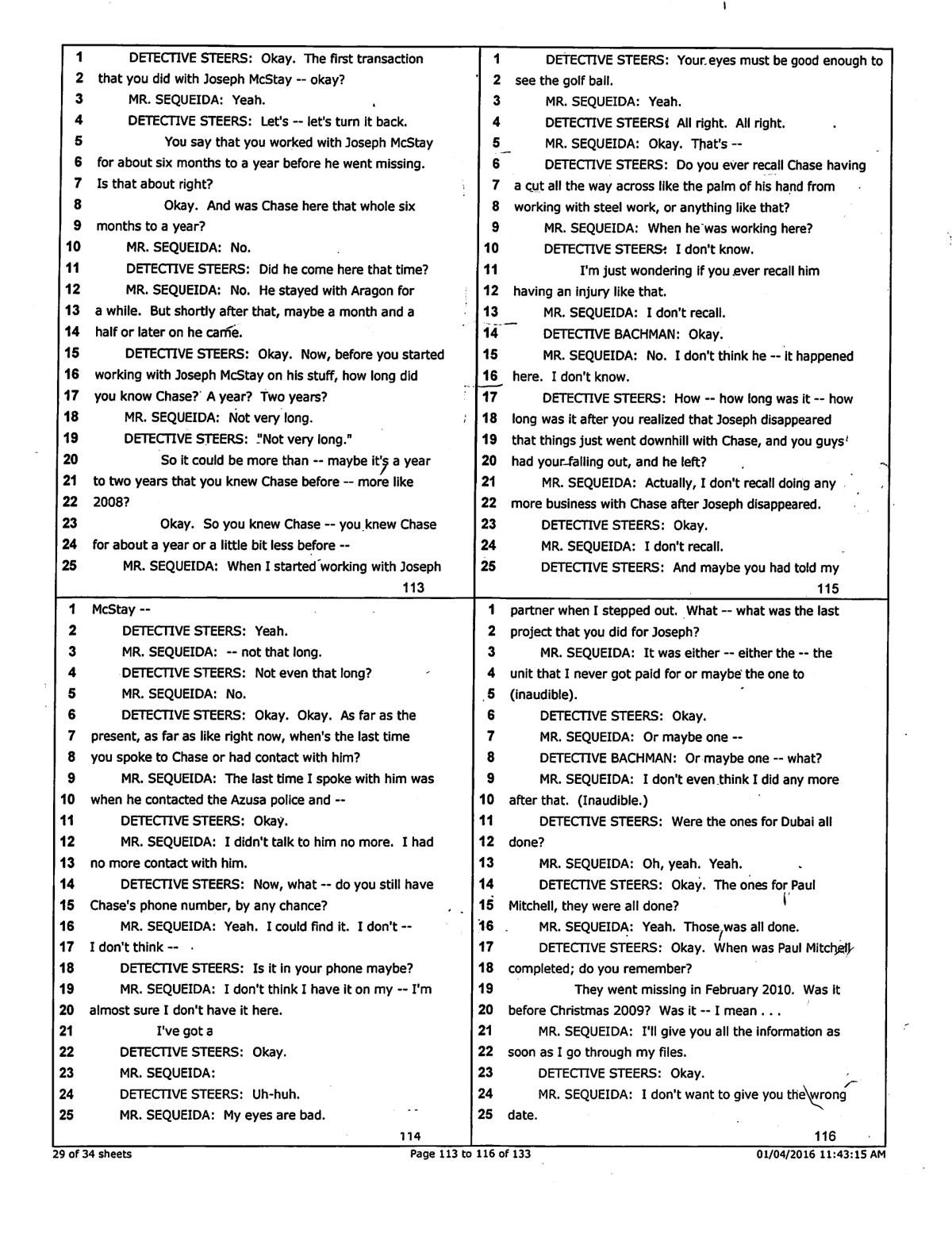
Asked about the last work he did for Joseph, he told them the Saudi waterfalls (“Dubai” in the interview) and the Paul Mitchell job were all done: (pp. 115:25-116:16)
DETECTIVE STEERS: And maybe you had told my partner when I stepped out. What — what was the last project that you did for Joseph?
MR. SEQUEIDA: It was either — either the — the unit that I never got paid for or maybe the one to (inaudible).
DETECTIVE STEERS: Okay.
MR. SEQUEIDA: Or maybe one —
DETECTIVE BACHMAN: Or maybe one — what?
MR. SEQUEIDA: I don’t even think I did any more after that. (Inaudible.)
DETECTIVE STEERS: Were the ones for Dubai all done?
MR. SEQUEIDA: Oh, yeah. Yeah.
DETECTIVE STEERS: Okay. The ones for Paul Mitchell, they were all done?
MR. SEQUEIDA: Yeah. Those was all done.
See the Sequeida interview (September 30, 2014, pages 113-116)
Later Bachman asked him about the calls to Joseph after the family went missing, and put a figure on the insurance unit himself: “$14,000, or whatever it was”: (p. 124:1-25)
Read the full exchange
DETECTIVE BACHMAN: Did you ever get worried that he wasn’t answering the phone? He owed you some money for stuff. Did you think he was trying to skip?
MR. SEQUEIDA: Well, what would you think if, you know — if you got (inaudible). Hey, this guy is calling and you don’t answer. Maybe that’s what I was kind (inaudible).
So I kind of thought, well, maybe I should, you know, take him to court or maybe — because it was obvious he wasn’t going to pay me.
DETECTIVE BACHMAN: Okay. So do you think when you were calling him —
MR. SEQUEIDA: If I did call him. Okay? I don’t know if I called him in that — in that space between the — yeah. I don’t know.
DETECTIVE BACHMAN: But do you think — you think Joseph was maybe ducking you because he owed you money?
MR. SEQUEIDA: Uh-huh.
DETECTIVE BACHMAN: Okay. And, obviously, you’re upset that you didn’t get paid for the insurance thing. And Joe asked if he owed any other money. But around that time, that was the only — that was the major issue, that he hadn’t paid that, you know, $14,000, or whatever it was. Right?
MR. SEQUEIDA: Uh-huh.
See the Sequeida interview (September 30, 2014, pages 121-124)
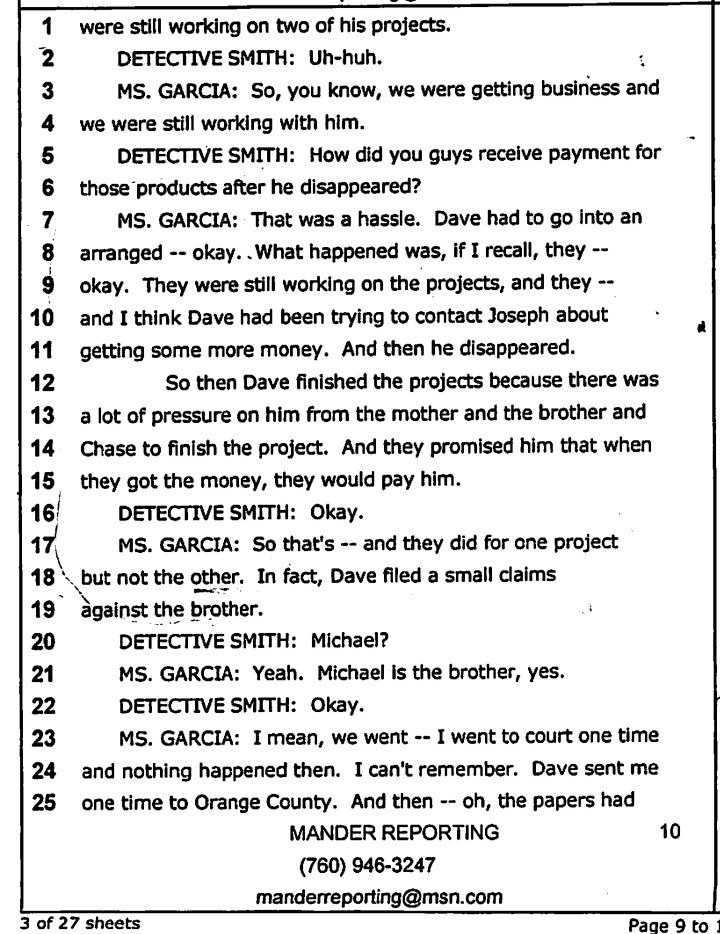
Carmen Garcia, who Sequeida said “was handling all the paperwork” at Metro, told Det. Smith a different story about one of the jobs: (Carmen Garcia interview, September 30, 2014, pp. 9:24-11:3)
Read the full exchange
MS. GARCIA: Well, it was all for the manufacturing of the — of the Items. In fact, when Joseph disappeared, we were still working on two of his projects.
DETECTIVE SMITH: Uh-huh.
MS. GARCIA: So, you know, we were getting business and we were still working with him.
DETECTIVE SMITH: How did you guys receive payment for those products after he disappeared?
MS. GARCIA: That was a hassle. Dave had to go into an arranged — okay. What happened was, if I recall, they — okay. They were still working on the projects, and they — and I think Dave had been trying to contact Joseph about getting some more money. And then he disappeared.
So then Dave finished the projects because there was a lot of pressure on him from the mother and the brother and Chase to finish the project. And they promised him that when they got the money, they would pay him.
DETECTIVE SMITH: Okay.
MS. GARCIA: So that’s — and they did for one project but not the other. In fact, Dave filed a small claims against the brother.
DETECTIVE SMITH: Michael?
MS. GARCIA: Yeah. Michael is the brother, yes.
DETECTIVE SMITH: Okay.
MS. GARCIA: I mean, we went — I went to court one time and nothing happened then. I can’t remember. Dave sent me one time to Orange County. And then — oh, the papers had never been served on the brother. And then Dave went a second time. I was already gone from the business. So I don’t really know what transpired there.
See the Garcia interview (pages 9, 10, 11)


She is conflating the jobs with the insurance unit. Metro’s own owner, the man who was owed the money, said the only thing still unpaid was the unit he “got screwed on because of the insurance,” and that the Saudi and Paul Mitchell work was “all done” (above). The $4,900 and $3,600 I paid Metro were for those two jobs.
There was no lawsuit against Michael. By her own account the papers were never served on him, she was gone from the business before anything more happened, and she doesn’t “really know what transpired there.”
Det. Smith’s report of the same interview goes further. It says that to Garcia’s knowledge, Metro “never received their percentage” on the two fountains (Bates 007391). That is not what she said in the interview itself: there she said they were paid “for one project but not the other” (p. 10:17-18), and Metro’s owner said otherwise (above). Either way, the report is wrong to say neither was paid.
Sequeida Sr. also told Bachman: (Sequeida interview, September 30, 2014, pp. 17:13-14, 19:5-7)
MR. SEQUEIDA: I never paid Chase or he never paid me, or anything else.
…
MR. SEQUEIDA: He paid it — sometimes he brought it himself. Most of time, Chase brought the checks. You know, a lot of times he just put it in the mail.
See the Sequeida interview (September 30, 2014, pp. 17-20)

That is technically correct. While Joseph was here, all the checks came from Joseph’s account, even the ones I wrote, and most of the time I was the one who brought them. After Joseph was gone I did only one job with Metro; for the others I used Walker in Rancho Cucamonga.
Just before that, Det. Smith asked her about the checks Metro received: (p. 9:14-21)
DETECTIVE SMITH: Okay. What about any — did you ever see anything odd in the checks?
MS. GARCIA: Actually, maybe the last check I thought it was kind of odd. I’m trying to remember why I thought it was odd. It might have been that the signature didn’t look right or — I remember thinking that the last check looked a little odd, but I can’t even — I can’t remember why. I think it might have been with the signature.
See the Garcia interview (page 9)
Of course it looked different. The last checks Metro got were the ones I wrote and signed in February, and I had told the detectives so: “I’m almost positive the Metro Sheet Metal check I wrote.” I also told them I had signed Joseph’s name “probably more than 30 or 40” times over the years (Claim 4). Her memory of an odd signature on the last check matches what I said. Det. Smith’s report says she picked out checks #4236 and #4238, both dated February 4, 2010, and “believed the two checks that were odd were delivered personally by Merritt” (Bates 007392).
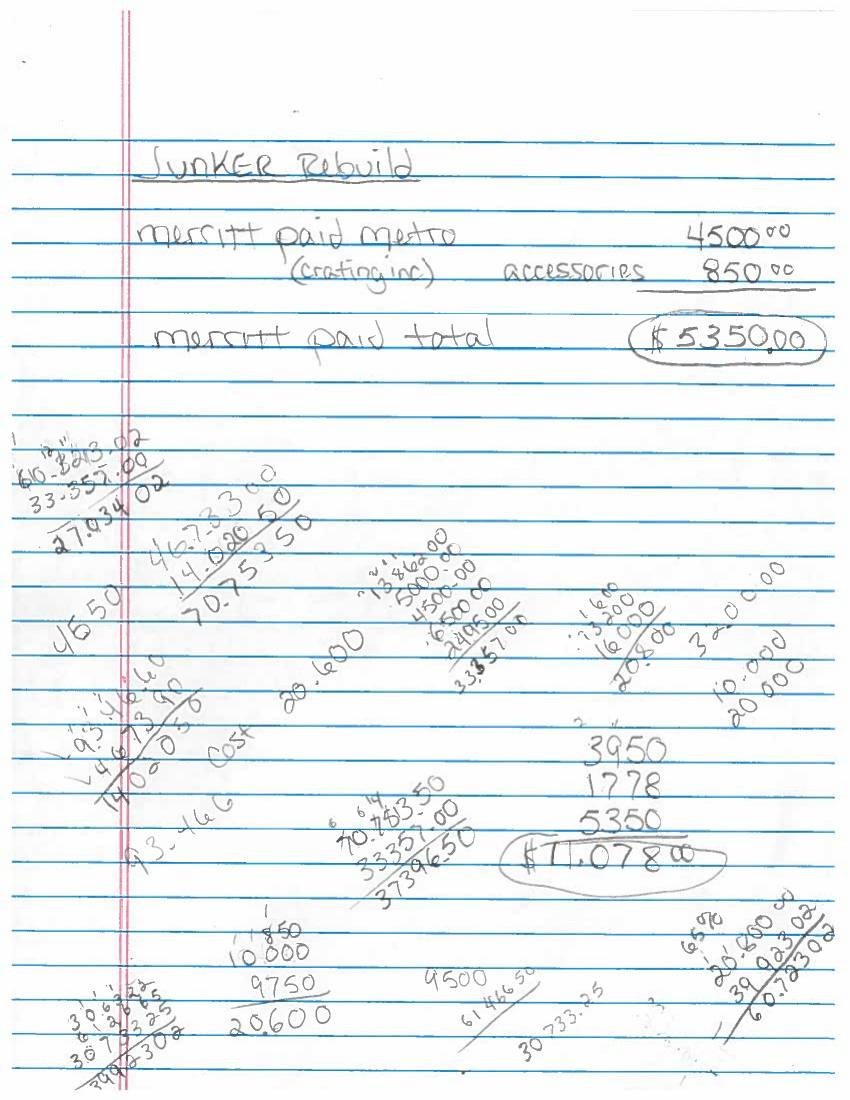
My accounting of the Junker rebuild
JUNKER Rebuild
merritt paid metro 4500.00
(crating inc) accessories 850.00
merritt paid total ($5350.00)
See what I gave counsel (Folder D, page 83)
I paid all the rest to Metro, on both jobs. Joseph wasn’t there to pay it, and Susan Blake didn’t. The only thing Metro said it was still owed was the rebuilt fountain, the Junker unit. That means Metro was paid for Saudi Arabia and for Paul Mitchell. Bachman’s “$14,000, or whatever it was” for the insurance unit is wrong. Sequeida Sr. himself put the cost at “12,000, maybe a little over” (Sequeida interview, p. 11:15-16). My own accounting shows the figure I put (Folder D, page 83). I told detectives I was paying Metro, on February 22, 2010 and again on October 22, 2014.
My lawyers
What I gave counsel, and what they did with it
I gave my lawyers these notes in 2017. They never used the February 22, 2010 interview.
On October 16, 2017, I gave James McGee my notes on the checks, with a full accounting of the checks (Folder D). He put them into my permanent file that day.
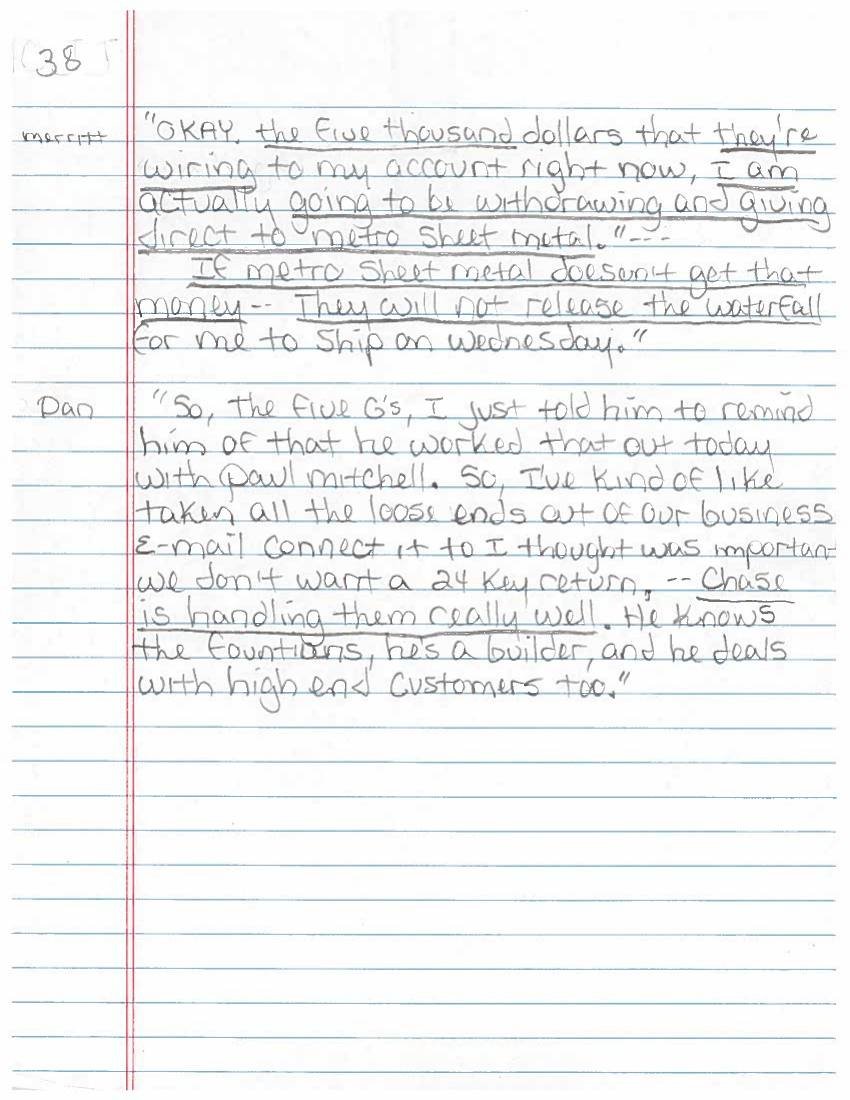
They quote the February 22, 2010 speakerphone call: the $5,000 wire, “withdrawing and giving direct to Metro Sheet Metal,” and “they will not release the waterfall.” They set out the calls to Joseph after each check, the State’s own bank report, on which I marked “to metro” beside the $4,900 and the $3,600, and my profit-split worksheets for each project.
My notes to counsel
On page 5 of my notes I pointed counsel to DuGal’s report of my February 17, 2010 interview, and to the speakerphone call:
Read the full passage
“on page 1674/P4 in SDSO synopsis of my interview on February 17th, 2010, where det. Dugal states, “Charles had written notes to himself in preperation for this interview I read the notes he had written and read the notes aloud. His notes read “Payments to metro, got checks and rent, went over when to write checks.” then goes on to state, “Charles made these transactions two or three days after February 4th, 2010.”
Then in an interview with Dan Kavanaugh, Det. Dugal has Dan phone me and put me on Speakerphone, this was on February 16th, 2010. Dugal asks me, “And how much of that money has been withdrawn to do manufacturing of the Fountians?” I answer “I’m guessing Eighteen to nineteen thousand.” Then we go on with a conversation outlining exactly where the money went.
“As if the discussions with SDSO, and the many times I outlined the fact that I wrote the checks isn’t enough. In SBCSO Summary, as well as many other places throughout thier discovery, It is very clear I never had any intention of hiting the fact that I wrote these checks.”
See what I gave counsel (Folder D, pages 75, 76)
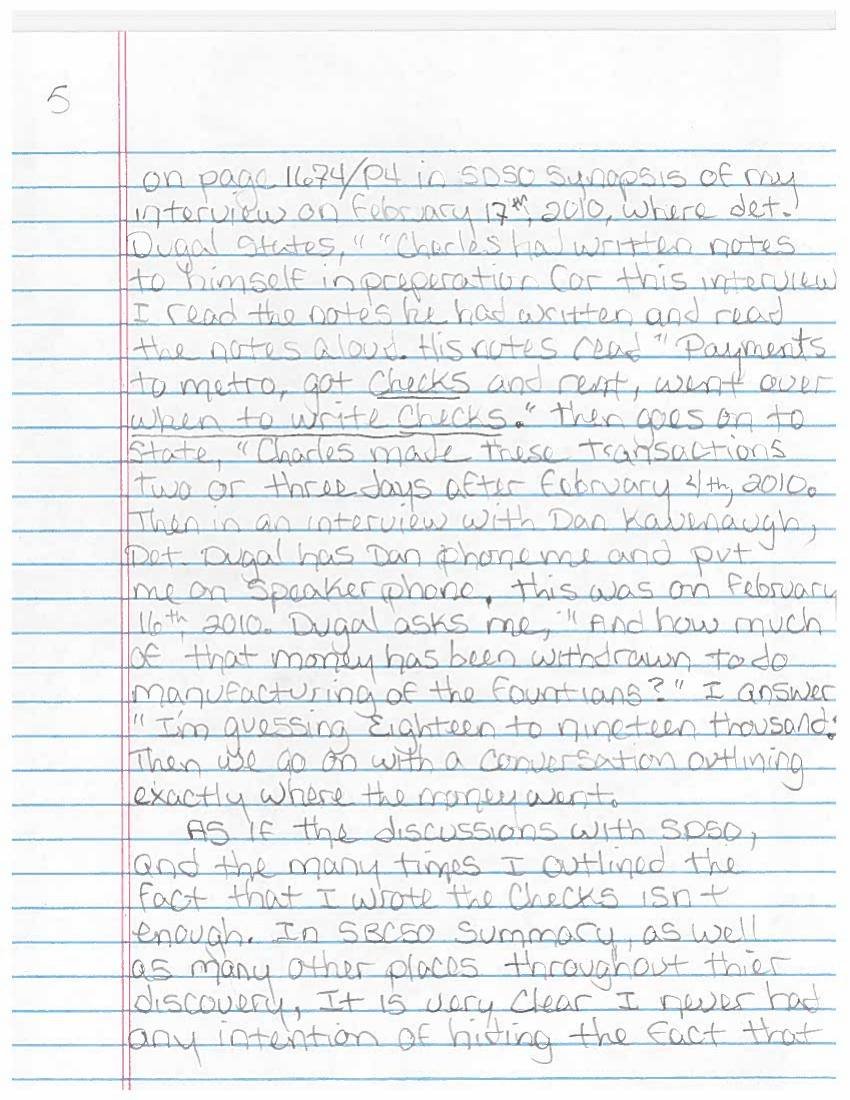
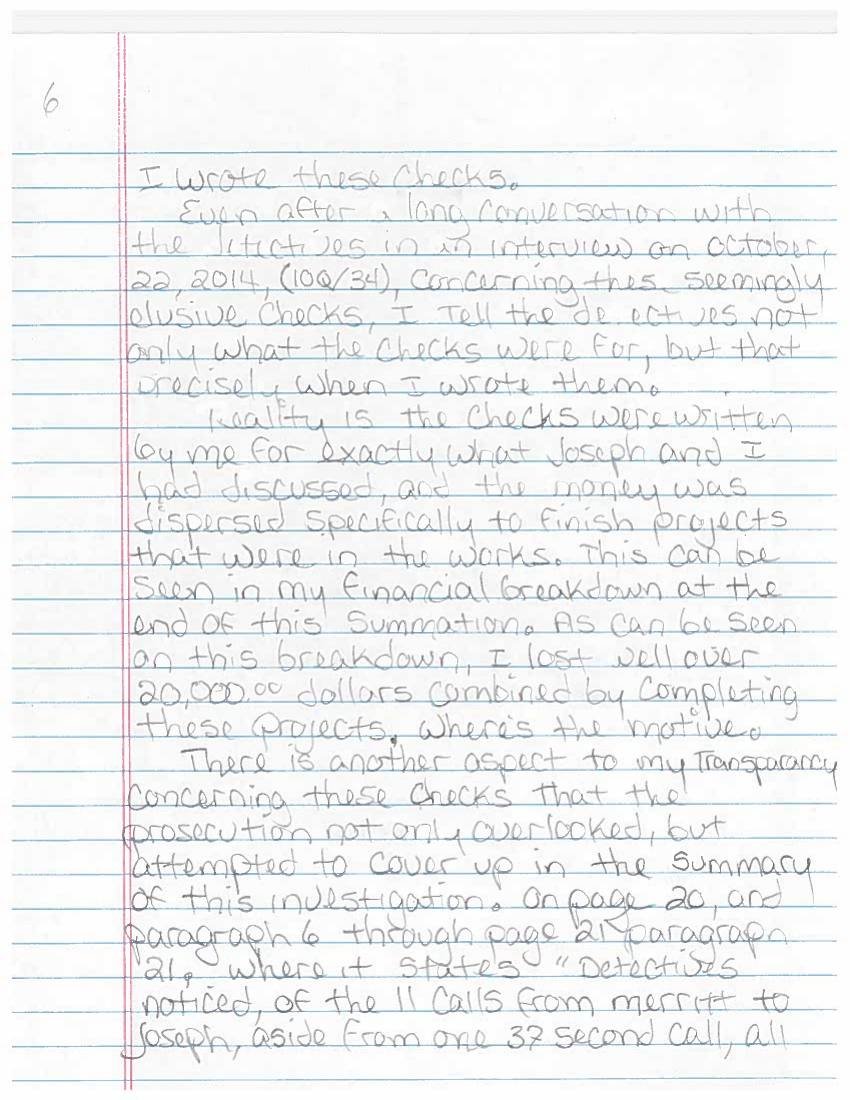
(The speakerphone call was February 22, 2010; my note had the date wrong.) On page 6, I went on:
“Reality is the checks were written by me for exactly what Joseph and I had discussed, and the money was dispersed specifically to finish projects that were in the works. This can be seen in my financial breakdown at the end of this summation. As can be seen on this breakdown, I lost well over 20,000.00 dollars combined by completing these projects, where’s the motive.”
See what I gave counsel (Folder D, page 76)
In the trial transcripts I have, the February 22, 2010 interview, and what I said in it, was never used. It showed I was forthright about the checks, with DuGal and with Kavanaugh, and it was critical in proving the $4,900 was for Metro. They ignored it, even though I gave them notes telling them to use it.
See what I gave counsel (Folder D, pages 36, 37, 38)
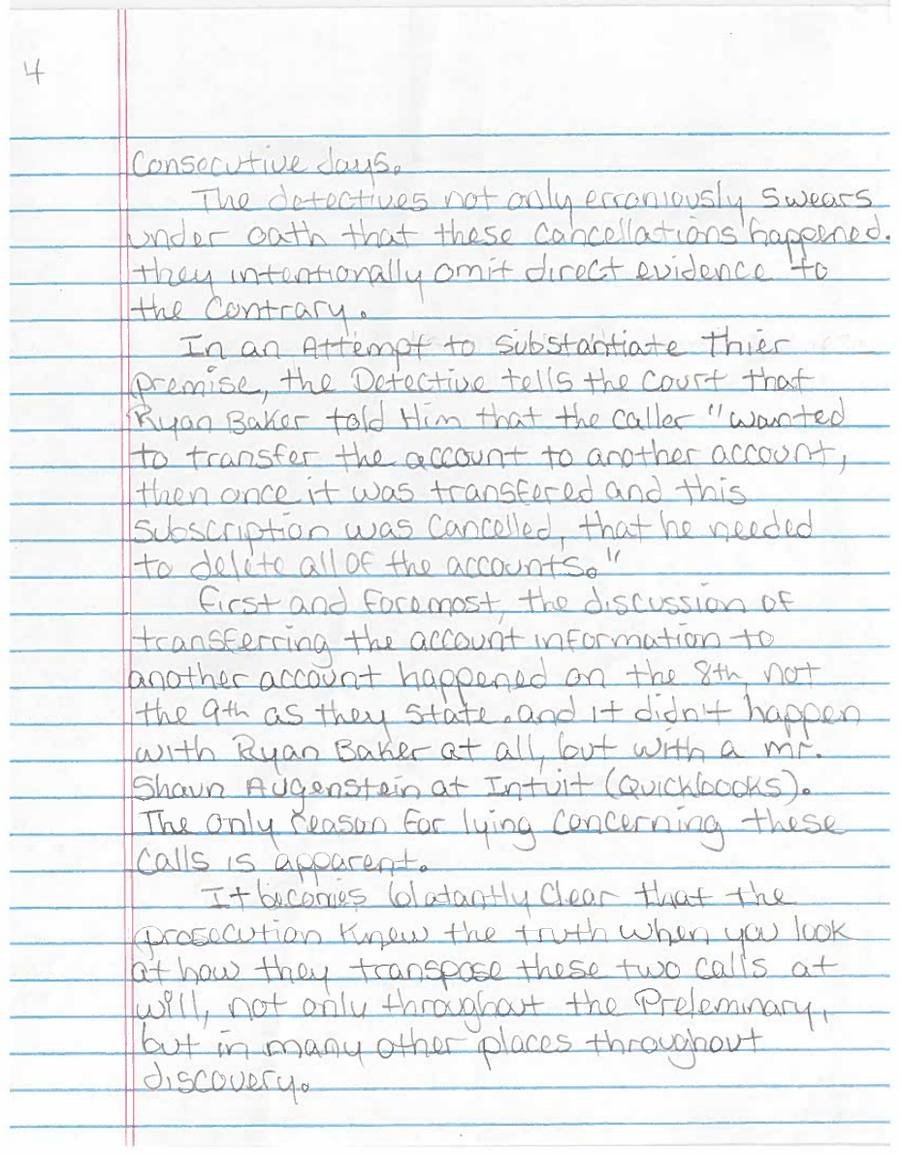
My QuickBooks notes, 2017 (Folder F)
In 2017 I gave my lawyers a second folder, on QuickBooks: 39 pages of passages I had copied by hand from the preliminary hearing, the interviews, the detectives’ reports and Bachman’s affidavit, each one tabbed to its page, and twelve pages of conclusions. The conclusions set out much of what is on this page: Hanke’s preliminary hearing testimony that the 2:44 cancellation “was done on a phone call,” when my 107-minute call did not begin until 3:11; Dron telling DuGal that people move from online to desktop “constantly”; Bachman swearing I “later admitted” what I had told San Diego in my first interview; DuGal telling QuickBooks I had never mentioned the calls; and why the old account was never deleted.
That was well over a year before the trial began in January 2019. Most of it was never used.
See my QuickBooks conclusions (Folder F, pages 1-12)




The motion for a new trial, January 2020
Before the motion for a new trial, I gave Mr. Maline a written list of what I wanted argued, and he agreed to argue it. His secretary, Stephanie Jefferson, typed it into my file on January 10 and 11, 2020, a week before the hearing. The checks and QuickBooks items on it include:
- “Second QB representative” and “Failure to call Shawn Flaustine” (page 2). I meant Shawn Augenstein, the representative who took the February 8 request.
- Under Mr. Maline’s own name: “Blake papers – didn’t use,” “1st ck. Written 3 wks after P.M. & S.A.,” and “Failure to call Josh Villanueva & Shawn Augustine” (page 4).
- Under Det. DuGal: “2-22-10 Kavenaugh int. (Def. intent),” “Specifically 4900 payment & 500 glass,” “Show forthrightness of def. (18-19 grand),” “Def. wrote checks,” “Def. called Q.B. (2-4 days after)” (page 11).
- “Checks: Omitted critical evidence” and “QuickBooks: Omitted critical witness (evidence)” (page 17).
See the list (pages 2, 4, 11, 17)


The whole list, which covers much more than the checks, is on the Advocates page.
At the hearing on January 17, 2020, Mr. Maline told the court:
MR. MALINE: “Yeah, before that, your Honor, I wanted to talk with my client. He wanted to talk to me during the break. He informed me, during the break, that he does not want me to continue as his lawyer, also some other issues that would necessitate me filing a — declaring a conflict based on what he has told me at this point. I don’t feel in good conscience based on what I have been told, that I could go forward. That’s where we’re at.” (RT 8869:16-23)
See the trial transcript (RT 8869)

The court held a sealed hearing and refused to relieve him (RT 8870, 8890). So he went on, by his own words under a conflict, and argued prosecutorial misconduct. In the transcript I find no argument about the February 22, 2010 call, my forthrightness, or Augenstein. He argued the cell-tower evidence, DNA, ineffective assistance, Dr. Rudin and prosecutorial misconduct, including the QuickBooks activity at 7:55 and 8:05 on February 4, and he called Mr. McGee as a witness (RT 8838-8930). He estimated 15 to 20 minutes for his misconduct argument, and the court gave him 15 (RT 8868:6-8). His written motion, filed 15 minutes before the hearing, is not reviewed here.
See the trial transcript (RT 8890)

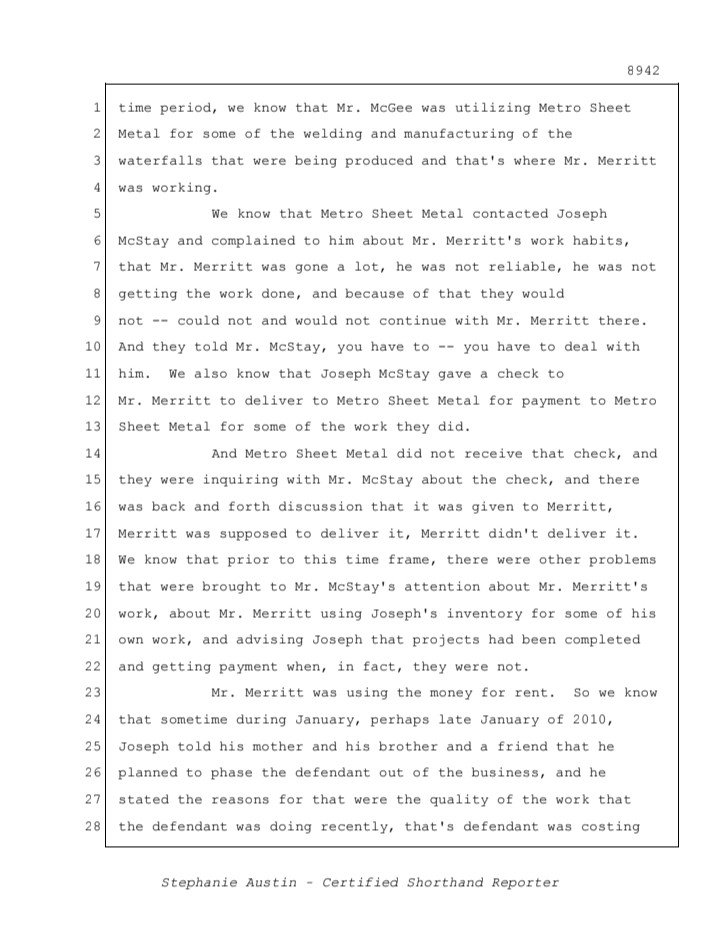
When the court denied the motion, it relied in part on the checks and QuickBooks: (RT 8943:7-11, 8943:20-27)
THE COURT: “Then we know on February 1st and February 2nd, there were checks to Mr. Merritt on Joseph’s account on the Union Bank. The checks were printed and cashed, but the record of those checks were deleted, and that was the first time that had ever occurred.
…
We know that from December 2009 through February 4th or 5th of 2010, nearly $40,000.00 in checks had been written from Joseph to Mr. Merritt, they were cashed by Mr. Merritt, but not deposited into any accounts, there was no receipts or accounting for the money. Certainly supports the — and corroborates the information that Joseph had said to others as to his reasons for wanting to terminate his relationship with Mr. Merritt.”
See the trial transcript (RT 8943)
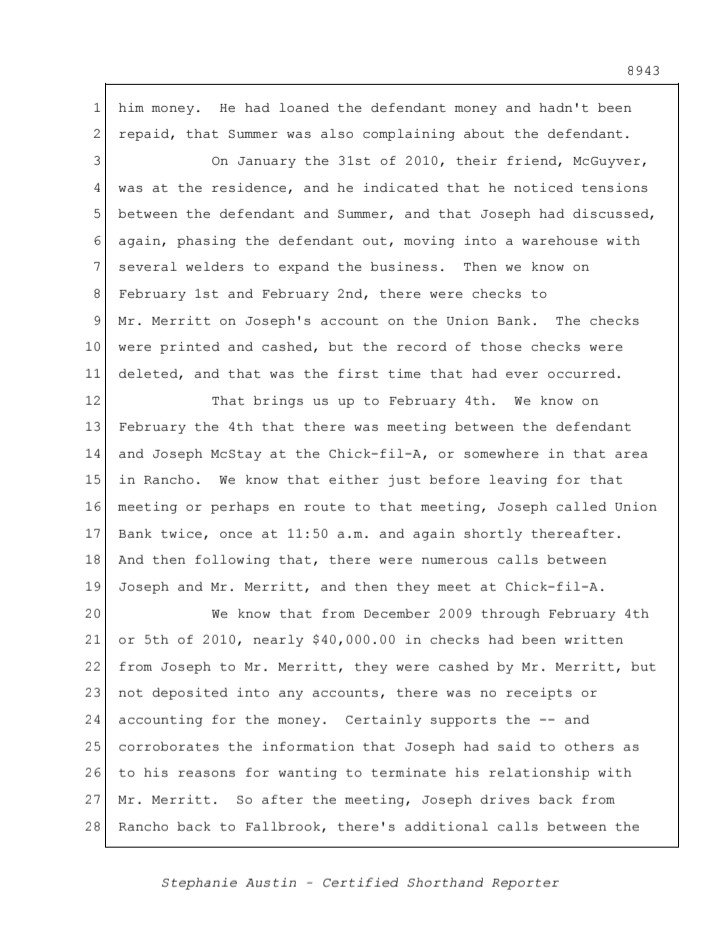
It went on to the request to delete the account and Baker’s e-mail (RT 8946:2-10, quoted under Claim 9). It also relied on a check Metro said I never delivered: “We also know that Joseph McStay gave a check to Mr. Merritt to deliver to Metro Sheet Metal for payment to Metro Sheet Metal for some of the work they did. And Metro Sheet Metal did not receive that check, and they were inquiring with Mr. McStay about the check, and there was back and forth discussion that it was given to Merritt, Merritt was supposed to deliver it, Merritt didn’t deliver it” (RT 8942:11-17). I never failed to deliver a check to Metro, and Joseph’s check records show it. My lawyers were not allowed to show the jury.
The undelivered check: every check Joseph wrote to Metro, and every check I negotiatedWhere the money went: every dollar, February to May 2010See the trial transcript (RT 8942)
Every one of those points is answered on this page, and many of the answers were on the list Mr. Maline had a week before the hearing.
February 1 and 2: the two February 1 checks were never cashed (Claim 2). Only my February 2 check was.
“No receipts or accounting”: on March 17, 2010, I wrote out for Susan Blake what had come in on the jobs and what I had taken, and DuGal testified that when he asked Dan, me and the family about money moving through EIP “at the discretion of the defendant and Dan Cavanaugh,” the answer was “yep, that was okay” (What I told them, and when). Where the money went is laid out under Claim 15.
“Wanted the account and all of the data deleted”: the day before, I had asked for the books to be moved to QuickBooks Pro, on Joseph’s card, with the instructions sent to him (Claim 8). And as the court said itself, the deletion “was never done.”
What they did instead
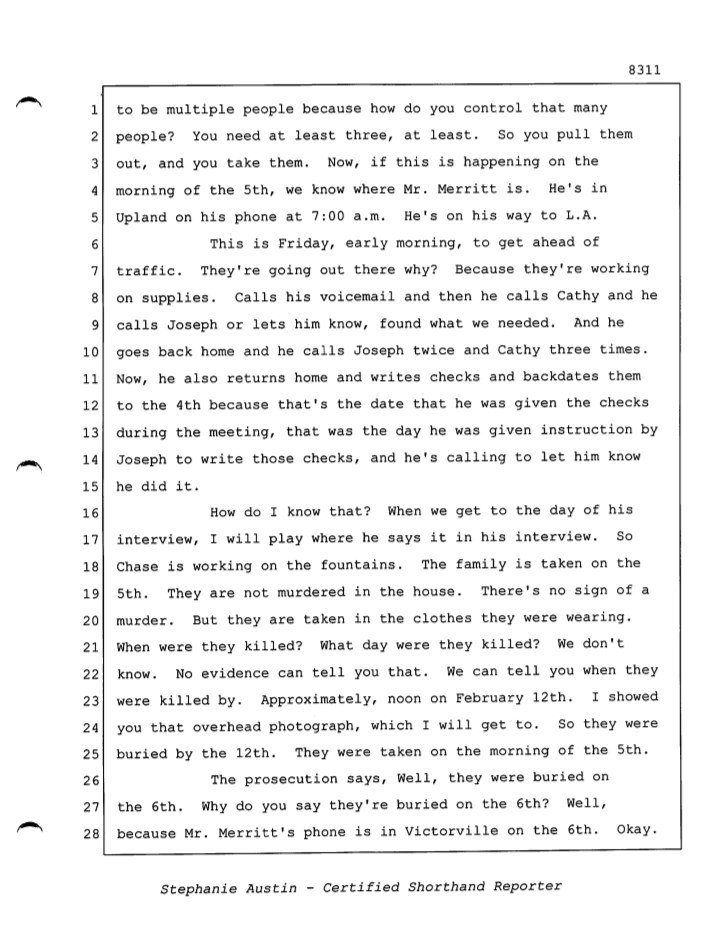
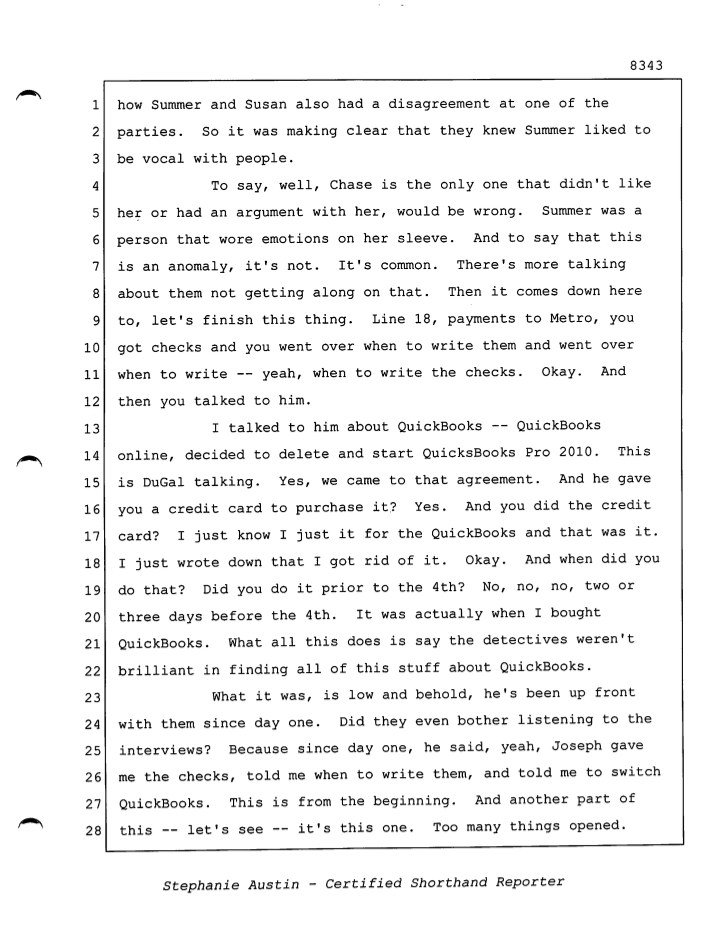
I told my lawyers from the start that I wrote these checks and made these calls. Mr. McGee did say so to the jury in his closing: (RT 8311:11-15, 8343:21-27)
MR. MCGEE: “Now, he also returns home and writes checks and backdates them to the 4th because that’s the date that he was given the checks during the meeting, that was the day he was given instruction by Joseph to write those checks, and he’s calling to let him know he did it.”
…
MR. MCGEE: “What it was, is low and behold, he’s been up front with them since day one. Did they even bother listening to the interviews? Because since day one, he said, yeah, Joseph gave me the checks, told me when to write them, and told me to switch QuickBooks. This is from the beginning.”
See the trial transcript (RT 8311, 8343)
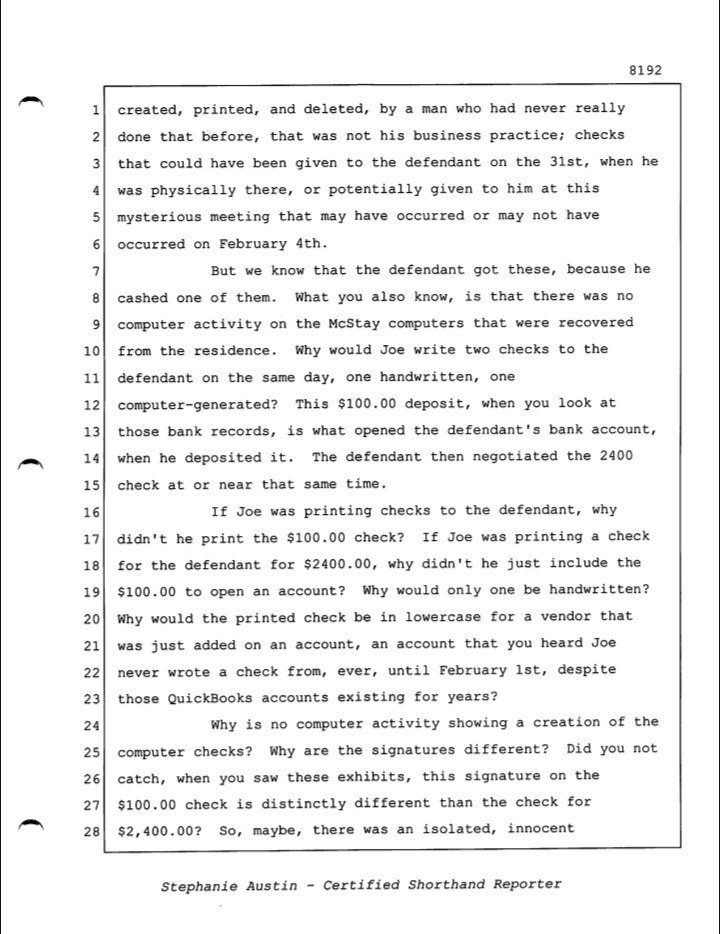
The State argued the signatures anyway, in both of its closing arguments. Mr. Imes, on my February 2 check and the $100 check: (RT 8192:24-8193:8)
MR. IMES: “Why is no computer activity showing a creation of the computer checks? Why are the signatures different? Did you not catch, when you saw these exhibits, this signature on the $100.00 check is distinctly different than the check for $2,400.00? So, maybe, there was an isolated, innocent explanation for the printed check that it was a deposit for the Saudi Arabia project. Okay. That standing alone would point to innocence.
However, when you put it all into context and answer all of those questions about all of the attendant circumstances on February 1st and 2nd, is that now a reasonable interpretation of that check? No. Why would those signatures be different? Better yet, why would they be written and deleted?”
See the trial transcript (RT 8192, 8193)
In rebuttal, the last argument the jury heard, Ms. Rodriguez told them “these signatures don’t match” and that the checks “were forged by the defendant” (RT 8422-8423, Claim 1).
Whose signature was on those checks only mattered if I had denied signing them. I never had. The two checks Mr. Imes compared were signed by two different people: Joseph signed the $100 handwritten check, and I signed the printed check later that same day (Claim 3). Of the February 2 check, I told Bachman in 2014 that I might have signed it, that Joseph was still here then, and that “I never wrote checks without him being okay with it” (Claim 4).
What was missing was the record itself, during the testimony. When Det. Smith told the jury I had admitted only receiving the checks, not writing them (“I’d have to review whatever transcript you are talking about”), Mr. McGee told the court “That statement is in evidence,” but nobody put my interview in front of him (RT 4138:13-23; What I told them, and when). When DuGal told the jury I had claimed a right to move money through PayPal, and was asked to find it in his reports, nobody came back to it after the break. And neither side called Shawn Augenstein, the representative who took the February 8 request; Ms. Rodriguez used that against me in rebuttal (Claim 8).
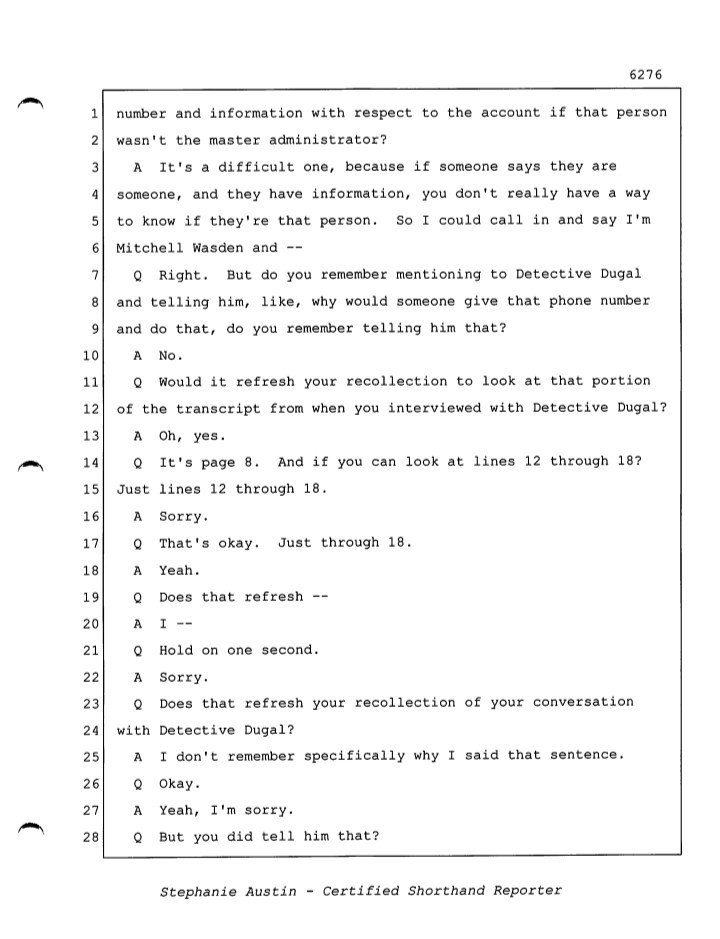
The recording of DuGal’s May 12, 2011 call with Annette Dron was in discovery, and I pointed my lawyers to it in my 2017 notes. In it, DuGal tells QuickBooks I never mentioned calling them, fifteen months after he read my notes about it aloud, and calls me a bad guy to the witness (Claim 12). Mr. Maline called Dron at trial, and she told the jury the request to move to Pro was one of their most frequent questions. But the recording was never played, and nobody asked DuGal about what he said in it. Mr. Maline’s office had sent Dron the audio and a transcript before she testified (RT 6250), but in front of the jury the transcript came out only to refresh her memory of one passage: Ms. Rodriguez pointed her to page 8, lines 12-18, and Mr. Maline then had her read pages 7 and 8 for context (RT 6276-6277, 6280).
See the trial transcript (RT 6250, 6276, 6277, 6280)

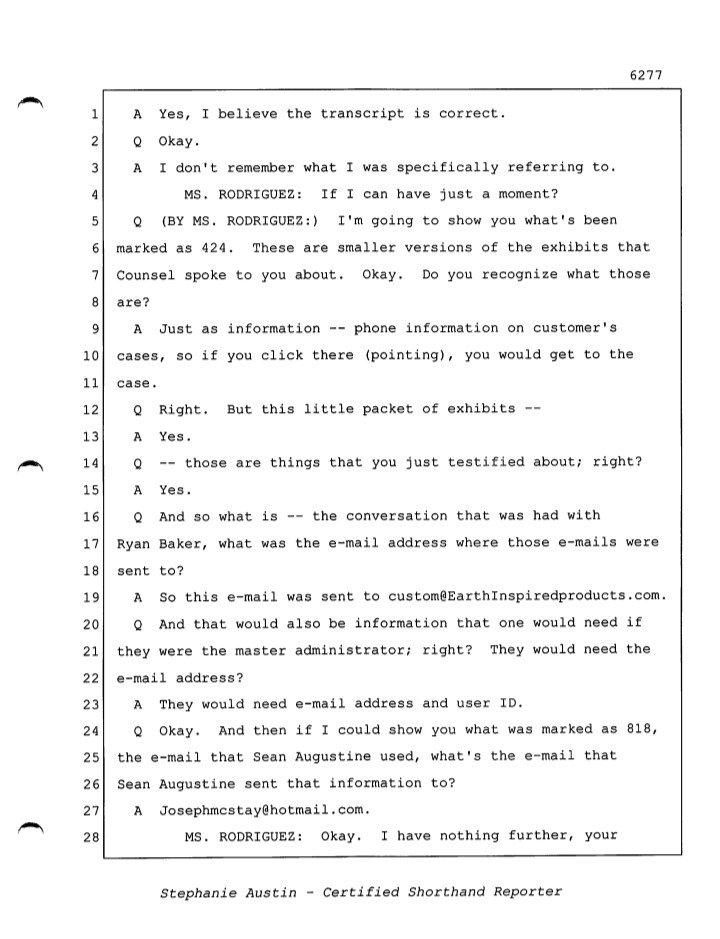
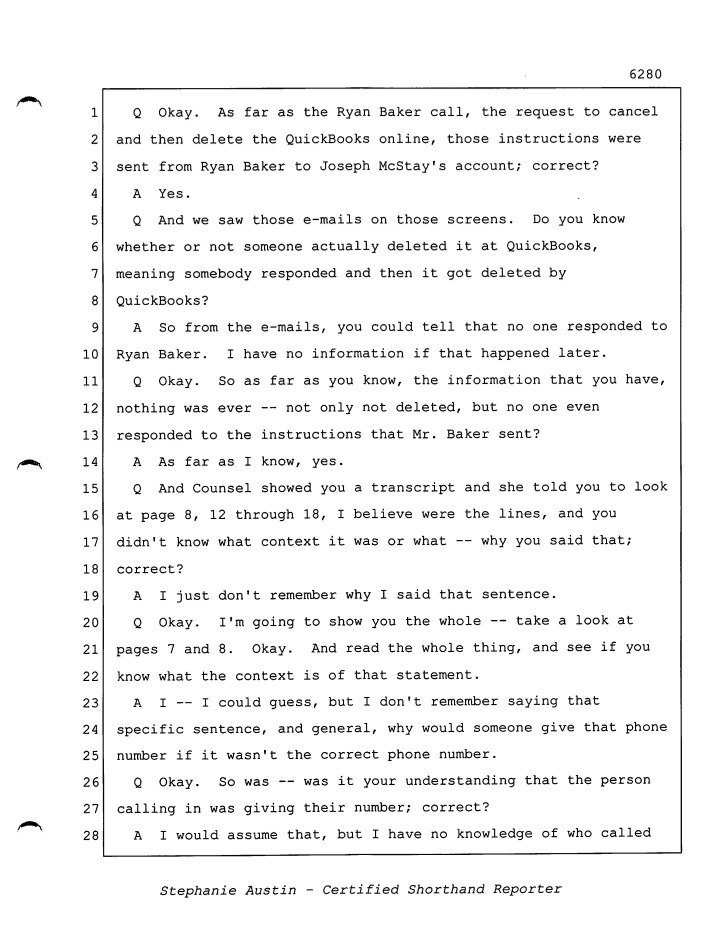
Mr. Maline did get the February 8 transfer request in front of the jury through Baker, over the State’s hearsay objection, and got Mike West to agree the data can be moved from online to a desktop copy (Claims 8 and 9). My lawyers also never used my phone record for January 31, the day the State said I took Joseph’s checks (Claim 1).
Who’s who
- Joseph McStay: owner of Earth Inspired Products (EIP).
- Me, Chase Merritt: I designed and built the custom waterfalls.
- Dan Kavanaugh: Joseph’s partner in EIP. He ran the website.
- Summer McStay: Joseph’s wife.
- Metro Sheet Metal, Azusa (Dave Sequeida Sr.): fabricated the sheet metal portion of the fountains.
- Susan Blake: Joseph’s mother.
- McGyver McCargar: a family friend who was painting at the McStay house.
- Rahage Trading, Riyadh (paid through Kocache Enterprises): the Saudi customer.
- MW Mitchell Construction: the Paul Mitchell job.
- Intuit: the company that makes QuickBooks. Joseph had two QuickBooks Online accounts: the main one (contact@earthinspiredproducts.com) and the custom one for the jobs he and I did (custom@earthinspiredproducts.com).
- Shawn Augenstein: the Intuit representative on the February 8, 2010 case. The trial transcript spells him “Augustine,” and Baker’s interview “Odgenstine.”
- Ryan Baker: the Intuit representative who took the February 9, 2010 call. He testified by video.
- Mike West: an Intuit investigator who testified about the account records.
- Annette Dron and Janet Taylor: Intuit employees who spoke with Det. DuGal in 2011. Dron testified for the defense on April 16, 2019.
- Det. Troy DuGal: San Diego Sheriff’s Department, 2010-2011.
- Dets. Eddie Bachman, Dan Hanke and R. Smith: San Bernardino County Sheriff’s Department, 2014. Det. Hanke handled the QuickBooks records.
- Mr. Daugherty, Mr. Imes and Ms. Rodriguez: the prosecutors.
- James McGee and Rajan Maline: my lawyers at trial. Mr. Terrell: my lawyer at the preliminary hearing.
The checks
As the State’s own case summary lists them (Det. Bachman, Bates 000022-000024), with the check numbers from the State’s check lists (Bates 007415, 007417):
- February 1: two checks to me, $2,500 each, memo “deposit” (#4092, #4093). Printed and deleted. Never given to me, never cashed.
- February 2: a check to me for $2,495, memo “deposit sa 1001” (#4240, dated February 2). I cashed it February 2 at Union Bank. (A $0.00 check was also created and printed; it was not cashed.)
- February 4, 7:59 p.m.: a check to me for $4,000, memo “paul mitchell.” Never printed; deleted at 8:05 p.m. Two print jobs were sent that night, and nothing readable was recovered from them (RT 3941-3942). Never negotiated.
- February 5, dated February 4: to me, $4,500, “paul mitchell” (#4237). Cashed February 5 at Union Bank.
- February 5, dated February 4: to Metro Sheet Metal, $1,650, “misc manufacture” (#4236), and $250, “copper” (#4238). Metro cashed them March 5.
- February 5, dated February 4: to me, $6,505, “balance sa (1001).” Not cashed.
- February 5, dated February 4: to me, $2,350, “lighting install sa (1001)” (#4242). Deposited February 5 at Bank of America. (The State’s summary first lists it as $2,300.50; the check was $2,350.00, as the summary itself later says and the bank report and check list show.)
- February 8, dated February 4: to me, $6,500, “saudi arabia final” (#4241). Deposited February 9 at Bank of America.
Much of the money I received went on to Metro and into the two jobs. “Where the money went,” under Claim 15, shows where it went.
See the State’s case summary (Bates 000022, 000023, 000024)


Exhibits and terms
- RT: the trial transcript (reporter’s transcript). “RT 7025:17-18” means page 7025, lines 17 to 18.
- Bates number: the page number stamped on each page of the discovery the State turned over.
- Exhibit 794: my AT&T phone record, February 2009 to February 2010.
- Joseph’s T-Mobile record: T-Mobile’s subpoena response to Det. DuGal, February 24, 2010 (Bates 005509-005512 on this page).
- Exhibits 1115 and 1123: the defense accountant’s flow-of-money charts for the Saudi and Paul Mitchell jobs. Both were shown to the jury. 1123 was shown, with boxes ordered removed, as Exhibit 1133.
- Exhibit 740: Metro Sheet Metal’s statement of March 1, 2010. The court kept it out, except that the jury heard $3,450 was still due.
- Exhibit 419: Joseph’s e-mail to me of February 1, 2010.
- Exhibit 990: my e-mail to Susan Blake from Riyadh.
- Folder D: my notes on the checks, given to James McGee October 16, 2017.
- Exhibit 794 items 9150-9179: my calls on February 8 and 9, 2010 (AT&T pages 374-375).
- INT_MCSTAY (INT) numbers: the pages Intuit produced to San Bernardino under the search warrant. Exhibits 808 and 809 are INT 000047-49 (custom account) and INT 000050-54 (main account).
- The custom account: Joseph’s second QuickBooks Online account, custom@earthinspiredproducts.com. The main account: contact@earthinspiredproducts.com.
- Activity log: the custom account’s “All activities by all users” log, printed October 13, 2014.
- MMA: master administrator, the one user who can close or delete a QuickBooks Online company.
- Prelim RT: the preliminary hearing transcript.
Sources
- Trial transcript, People v. Merritt, San Bernardino County Superior Court, Case No. FVI1404194 (RT): Sequeida Jr. 2846; Blake 4995 (court), 5512-5514, 5541-5542; exhibit rulings 7011-7026 (April 29, 2019); defense accountant 7080-7086; Det. DuGal 2475, 2482-2483, 2521; Annette Dron 6240-6281 (April 16, 2019); Jan. 31, 2019 hearing 3627-3640; Ryan Baker 3739-3780 (Feb. 6, 2019); Mike West 3975-3996 (Feb. 13, 2019); Det. Hanke 4054-4066 (Feb. 14, 2019); closing arguments 8190-8225 (Imes), 8420-8430 and 8448 (Rodriguez).
- San Diego Sheriff’s Department: interview of Daniel Kavanaugh, 2-22-10 #2 (pp. 18-24); DuGal follow-up report on my interview of February 17, 2010 (Bates 001673-001675), and the interview transcript (pp. 15, 28, 31).
- San Bernardino County Sheriff’s Department: bank report, Det. R. Smith, October 27, 2014 (Bates 007446-007448); case summary; interviews of Susan Blake (August 13, 2014) and Dave Sequeida Sr. (September 30, 2014); my interview (October 22, 2014).
- Trial exhibits: 794 (my AT&T record), 990 (my e-mail to Susan Blake from Riyadh), 1115 (Saudi flow of money, shown to the jury), 1123 (Paul Mitchell flow of money; shown to the jury, modified, as 1133), 740 (Metro’s March 1, 2010 statement), 419 (Joseph’s e-mail of February 1, 2010).
- My handwritten pages for Susan Blake, March 17, 2010; my photos from Saudi Arabia; the Rahage Trading purchase-order e-mail.
- Intuit records, INT_MCSTAY000004-000054; the custom account activity log and check audit histories (Exhibits 421, 425, 426, 427, 429).
- San Bernardino: search warrant to Intuit sworn August 21, 2014; Det. Hanke’s reports (Bates 000589; 007467-007470) and the interview of Ryan Baker, October 24, 2014; interview of Dan Kavanaugh, September 20, 2014; preliminary hearing testimony of Det. Hanke (pp. 101-124).
- San Diego: recorded calls with me, June 9 and June 21, 2011, and DuGal’s follow-up report on me (pp. 23-24); Det. Hillen’s report on Susan Blake (Bates 001818-001819); recorded call between Det. DuGal and Intuit, May 11, 2011; recorded calls with Annette Dron, May 12, 2011 (audio; my 2017 handwritten copy of the transcript) and May 24, 2011 (audio); my interview of February 17, 2010 (pp. 15-16, 31).
- My notes on the checks (Folder D), given to James McGee October 16, 2017.
Part 4 of 4
- The Checks, QuickBooks, and the Motive
- The Checks (Claims 1-7)
- The QuickBooks Calls (Claims 8-14)
- The Money (Claim 15) (you are here)