Where and when: what they told the jury they didn’t have to prove
From the preliminary hearing to the penalty phase, the prosecutors told one story about when and where: that I drove to the McStay home in Fallbrook on the evening of February 4, 2010, during a window they set themselves, from 5:48 p.m. to 9:32 p.m., and killed the family there. Everything they offered to put me at that house was built around that window: the phone records, the “off the grid” hours, the vehicle on the Mitchley video at 7:47 p.m., the computer activity in the house that night.
I answered that night with an alibi. I was home in Rancho Cucamonga with my family, and two witnesses said so. The judge gave the jury the alibi instruction, CALCRIM 3400, which told them the People had to prove I was present when the crime was committed. The judge also struck the only paragraph that would have let them convict me without proving I was there, because he found no evidence for it.
Then the judge raised a second instruction on his own, CALCRIM 207, as a “standard” one. It told the jury the People only had to prove the crime happened “reasonably close” to February 4. The instruction’s own Bench Notes say it should not be given when the evidence shows a specific time and place and the defense is alibi. Counsel had asked to be heard on it. My lawyers submitted. The prosecutors said nothing.
Then Mr. Imes stood up and told the jury, three times, that the People did not have to prove when or where. He tied it to the instructions the judge had just read. In the same closing he told them “it was the defendant at the McStay house that night,” and that the missing blood “could only be due to the killer’s actions in how he carried out the murder, or how he cleaned up the murder.” In rebuttal, Ms. Rodriguez told them nobody had said the family was murdered in that house, and that the morning of February 5 was “not even a possibility.” When my lawyer tried to ask the State’s own homicide investigator whether the evidence pointed to the morning of the 5th, the court sustained the objections as speculation. Later the judge used that same February 5 timeframe himself in his own rulings.
After the verdict, at the penalty phase, the prosecutors went back to the night of February 4, at the McStays’ front door. At the motion for new trial, the judge used that same window to reject my alibi: I “apparently wasn’t in the apartment from 5:48 to 9:30 p.m.,” and the checks written on the McStays’ computer from 7:55 to 8:03 that night were “done by the perpetrator.” Then, in the same ruling, he found that the killings did not happen inside the house, that there was “no answer” to when and where they happened, and that those “could be considered significant holes in the prosecution’s case,” on which “a jury could say that was sufficient for reasonable doubt and vote not guilty.”
The jury had been told it didn’t need to answer those questions.
The People’s only evidence that I was present was tied to the McStay house on the evening of February 4. The judge found the killings did not happen there, and that no one knows when or where they did. Nothing in the record puts me where and when the family was killed. The jury was told it didn’t have to decide that.
They all knew
Before any part of the story below, here is the sequence that matters most. Every step is in the record.
1. The prosecutor told the judge the People had to prove I was there, and asked to be let out of it. At the instruction conference on May 20, 2019, outside the jury, Mr. Imes asked the court to keep a paragraph in the alibi instruction that would allow a conviction even if I was not present, as long as I had helped someone else. His reason: “the specific language of 3400 is pretty decisive in saying presence … the People must prove that the defendant was present and committed the crime. And here, if the People do argue that he could have easily had an accomplice … then we don’t have to prove — you know, we must not prove that he was present because we can —” (RT 7773:4-13)
See RT 7773
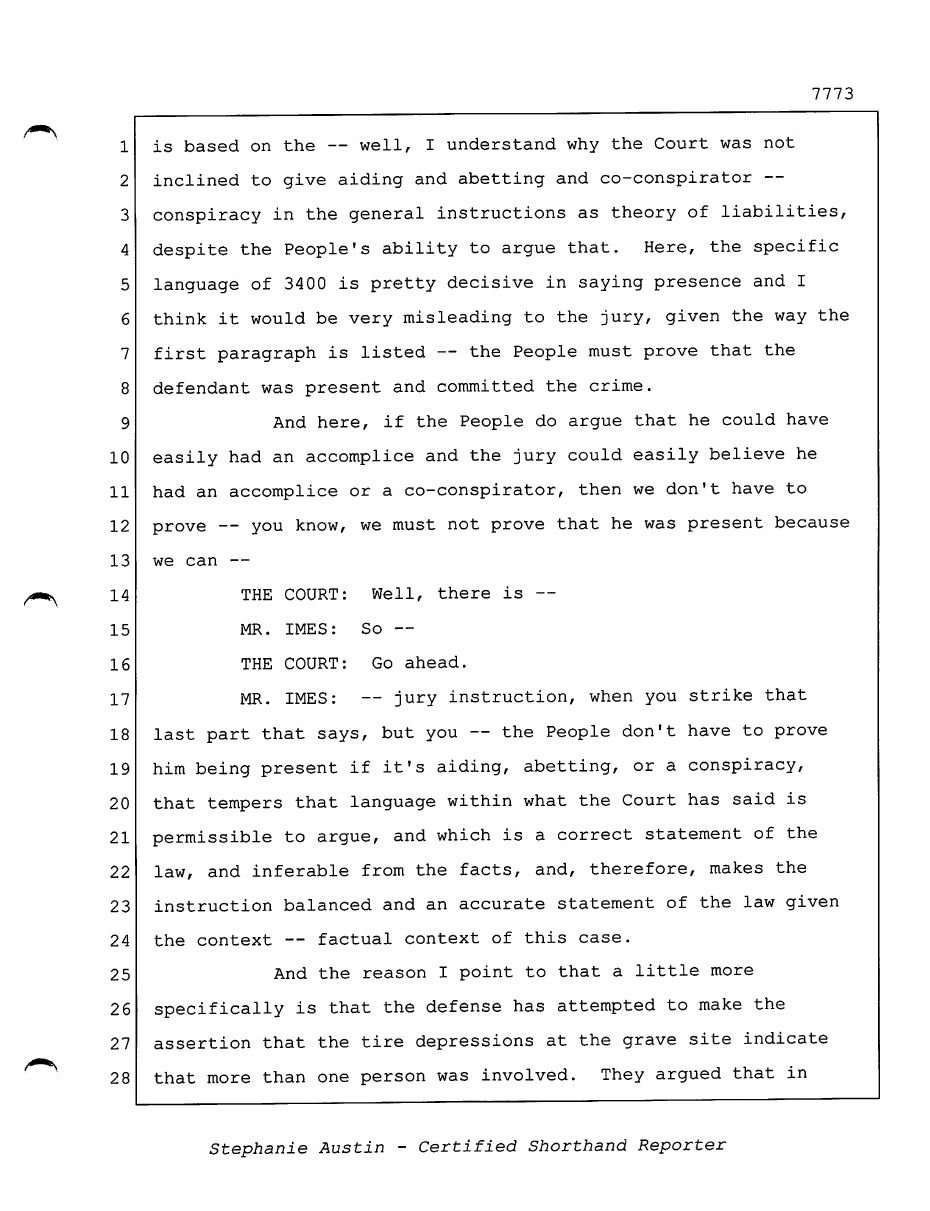
As I see it, being present at a crime means being there at its time and place. Mr. Imes was telling the judge that, unless that paragraph stayed in, the People had to prove where I was and when.
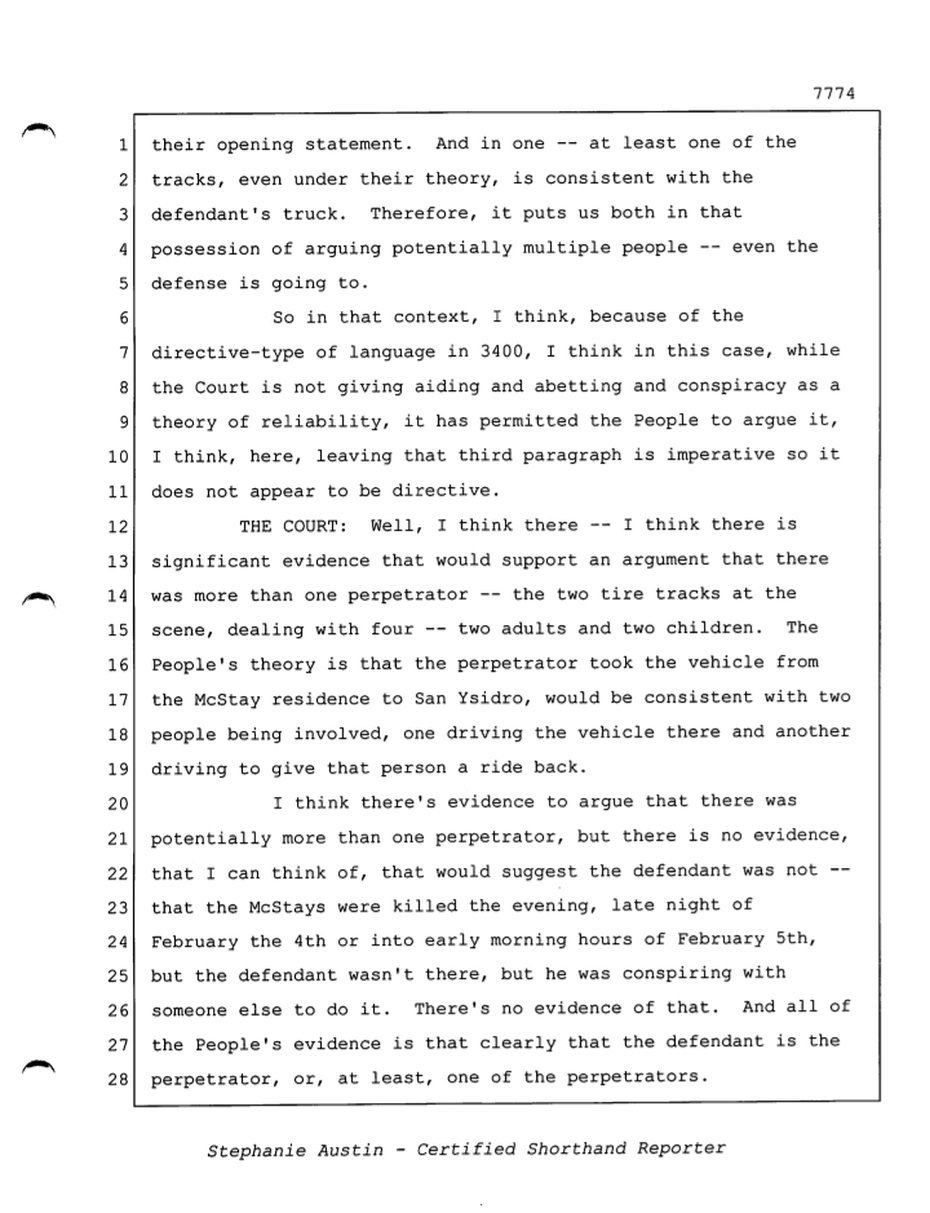
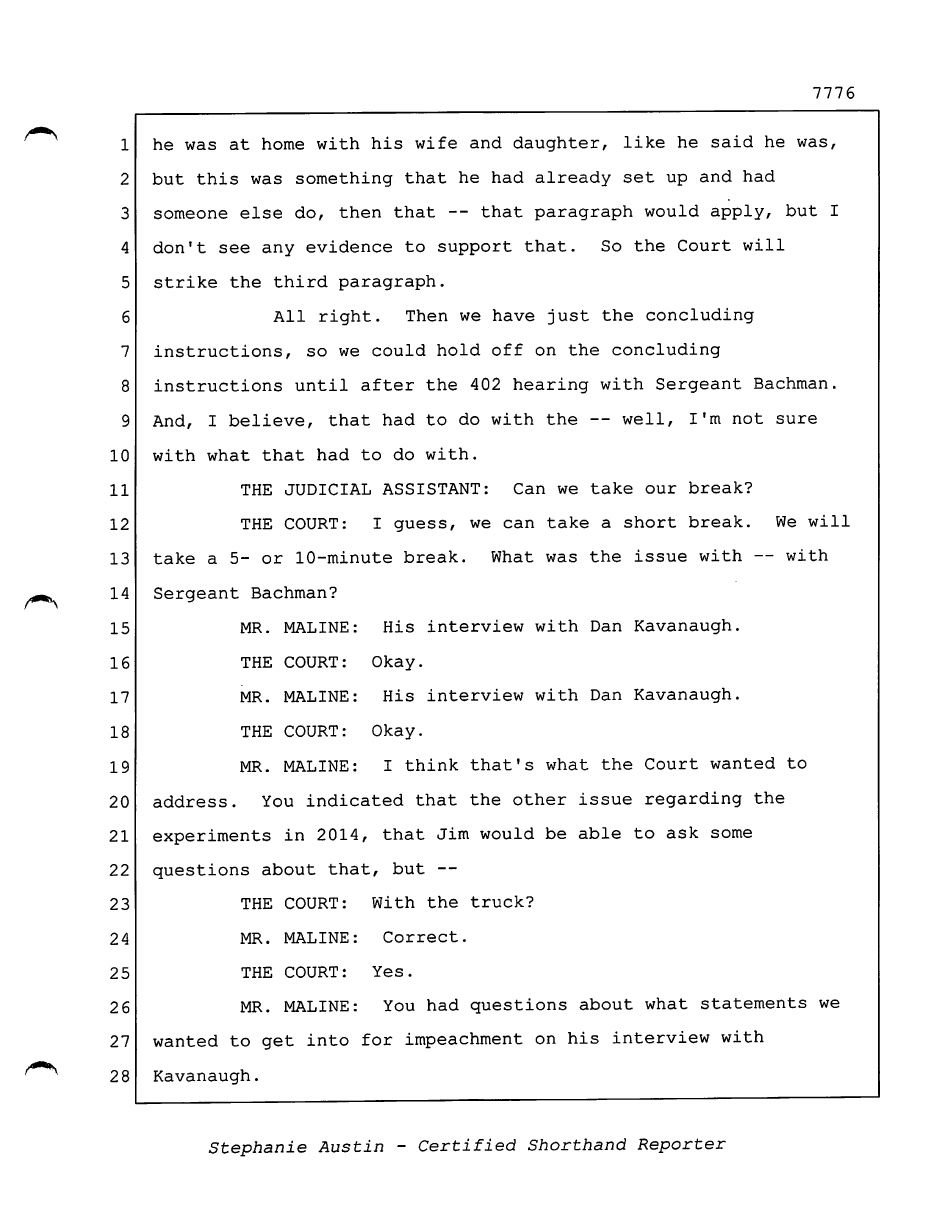
2. The judge refused, and struck the paragraph for lack of evidence. “There is no evidence, that I can think of, that would suggest the defendant was not — that the McStays were killed the evening, late night of February the 4th or into early morning hours of February 5th, but the defendant wasn’t there, but he was conspiring with someone else to do it. There’s no evidence of that. And all of the People’s evidence is that clearly that the defendant is the perpetrator, or, at least, one of the perpetrators.” (RT 7774:21-28) He struck the paragraph: “I don’t see any evidence to support that. So the Court will strike the third paragraph.” (RT 7776:3-5)
See RT 7774 and 7776
3. At the same conference, the judge raised CALCRIM 207 himself, and it went in. He brought it up as one of “the standard introductory instructions,” noted that counsel “wanted to be heard on that issue,” and described it: “it is alleged the crime occurred on or about February 4th. The People are not required that the crime took place exactly on that date, but only that it happened reasonably close to that date.” Mr. McGee began, “I did not —”. After a conference between my lawyers off the record, he said, “No, we will submit.” The prosecutors said nothing. The judge: “I understand there may be evidence issues that affect that, but I don’t think it affects the instruction. So we will give 207.” (RT 7742:3-21) The instruction’s own Bench Notes say it should not be given when the evidence shows a specific time and place and the defense is alibi.
See RT 7742

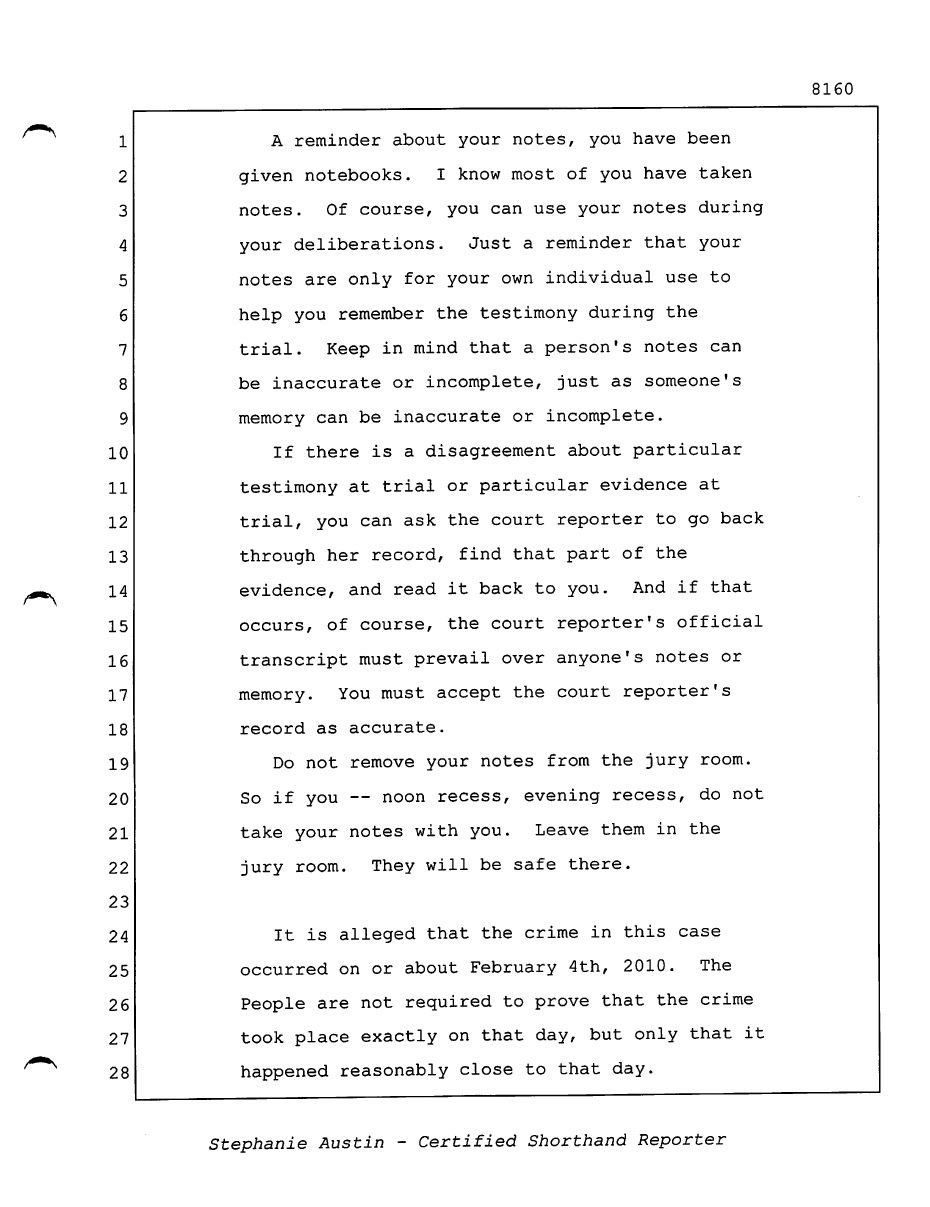
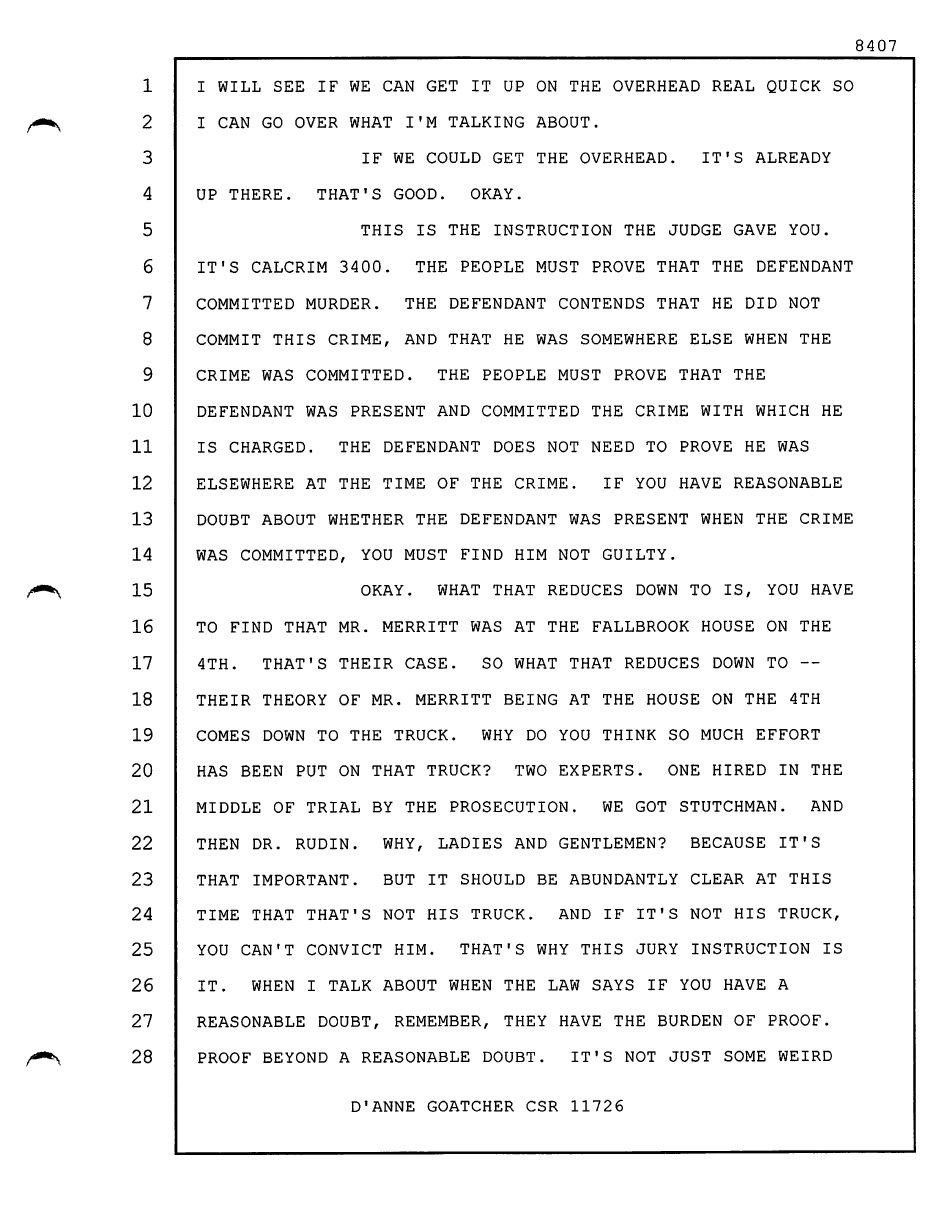
4. The judge read the jury both. First 207: “The People are not required to prove that the crime took place exactly on that day, but only that it happened reasonably close to that day.” (RT 8160:26-28) Then, near the end of the instructions, 3400: “The People must prove that the defendant was present and committed the crime with which he is charged … If you have a reasonable doubt about whether the defendant was present when the crime was committed, you must find him not guilty.” (RT 8181:8-14)
See RT 8160 and 8181
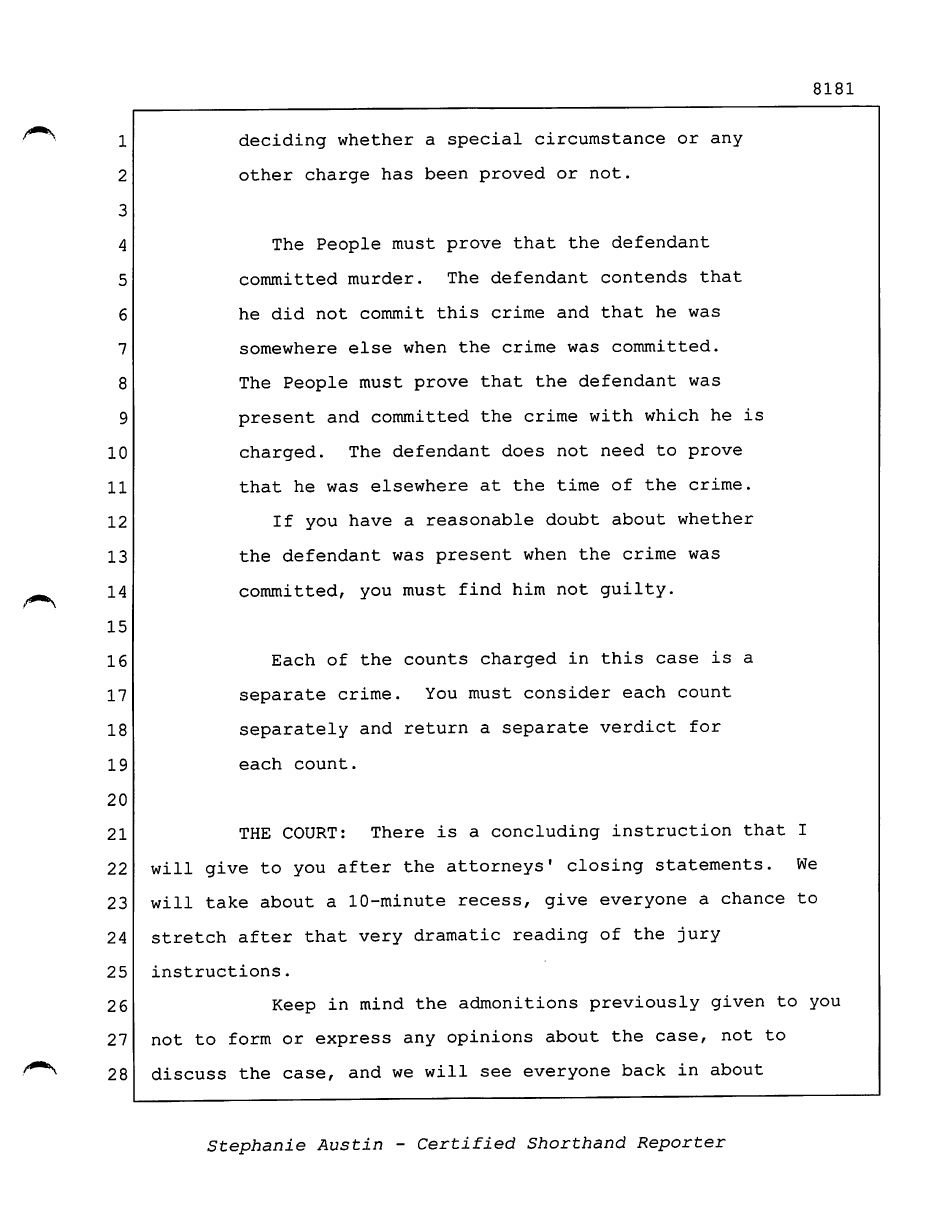
5. Minutes later, Mr. Imes told the jury the opposite of what he had told the judge. “It does not require us to prove where, it does not require us to prove when, and it does not require us to prove how.” (RT 8183:7-9) He said it twice more (RT 8240:22-25; 8269:16-18).
See RT 8183, 8240 and 8269
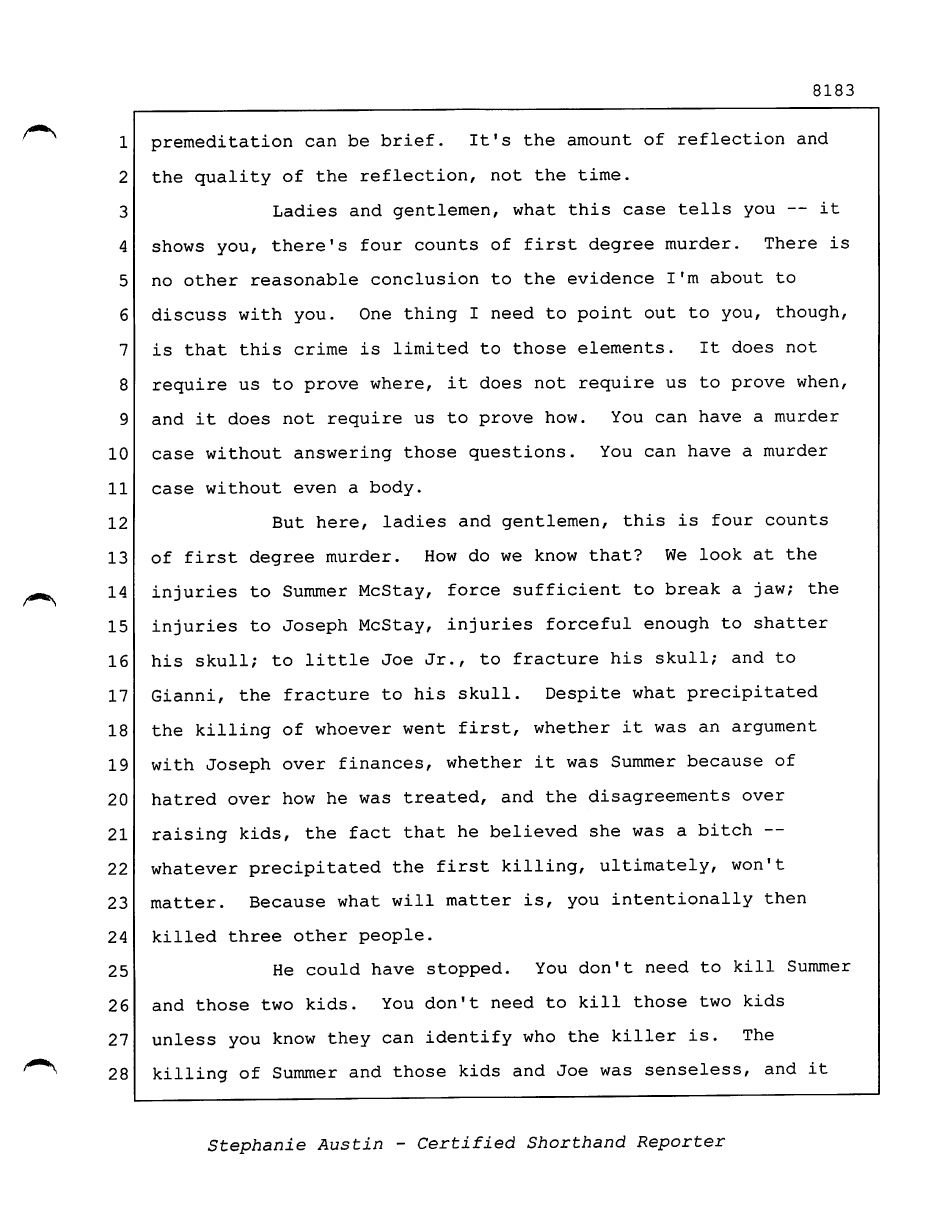

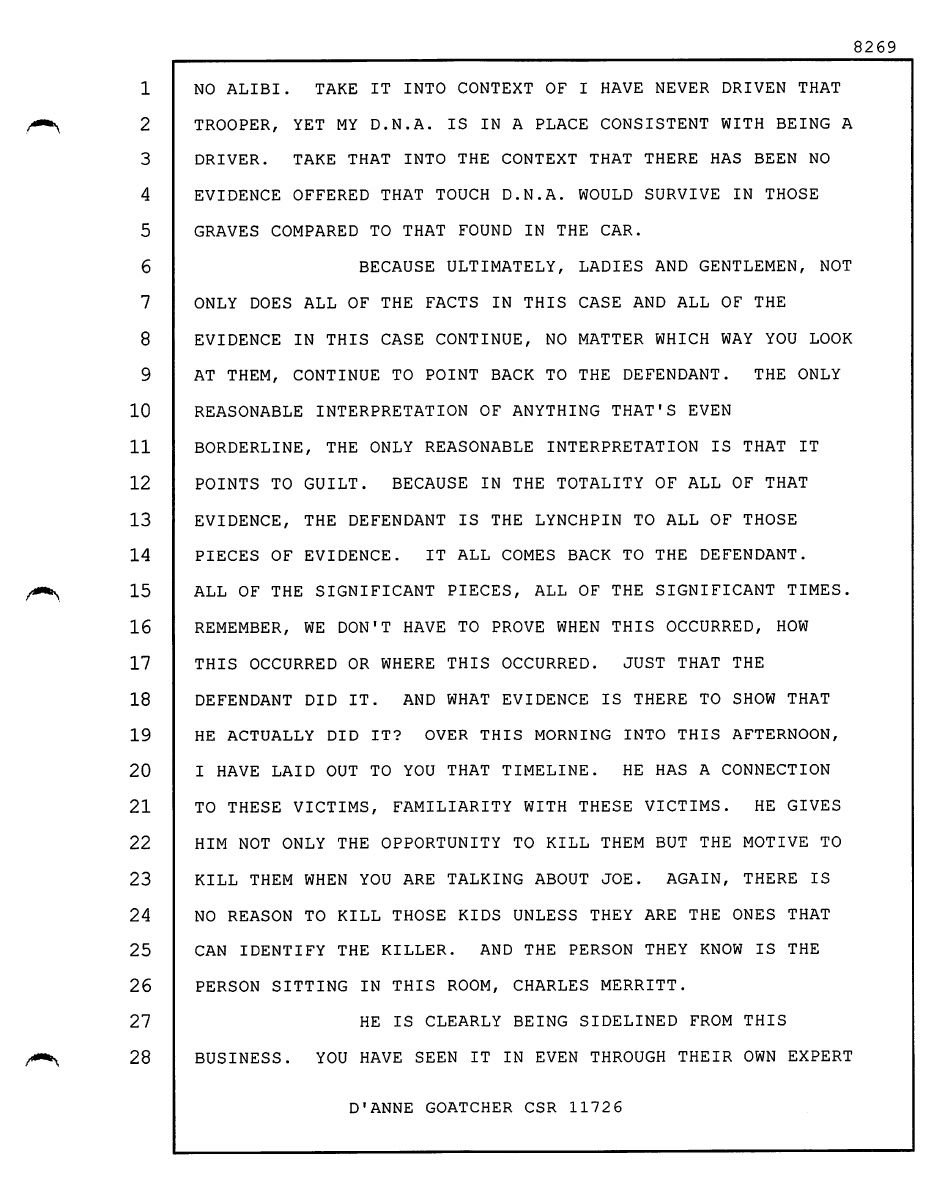
6. My lawyer told the jury 3400 was the whole case, without ever mentioning 207. Mr. Maline: “What that reduces down to is, you have to find that Mr. Merritt was at the Fallbrook house on the 4th. That’s their case. … And if it’s not his truck, you can’t convict him. That’s why this jury instruction is it.” (RT 8407:15-26)
See RT 8407
Without 207, the jury would have had nothing to set against 3400 or against Mr. Maline’s argument. On the evidence they actually had, the People would have had to prove I was at that house during the window they chose. With 207, and with Mr. Imes telling the jury what it meant, they did not.
In rebuttal, the prosecution then told the jury the morning of February 5 was “not even a possibility,” using a claim about daylight that was false (section 5). By the People’s own last word, it was the night of February 4 or nothing. That leaves 207 nothing to do except let the jury avoid deciding it.
I believe 207 was no accident. The judge raised it, my lawyers submitted to it, and the prosecutors accepted it, all knowing that the People’s case and my defense turned on one night and one place, and that this instruction would let the jury avoid deciding it. None of them can claim not to have understood what it would do. The prosecutor had just told the judge, in his own words, that 3400 required proof of presence.
↑ Back to the menu1. The night they chose
The prosecution, not the jury, chose what it was going to prove. It chose one event: me, at the McStay house in Fallbrook, during the evening of February 4, 2010, between 5:48 p.m. and 9:32 p.m., killing four people. They built every part of their case on that window, and they held to it from the preliminary hearing through the penalty phase. That matters because of what came later.
The preliminary hearing
The window started as a gap in my phone records. The detectives, the People’s opening and Mr. Imes’s closing then tied that gap to the killings, as the quotes below show. At the preliminary hearing, Mr. Daugherty built the window through the State’s cell phone expert, Special Agent Kevin Boles:
Q. “At 5:48 did the defendant receive a call from Joseph Sr., Joseph McStay Sr.?”
(Prelim RT 81:18–82:15)
A. “Yes, that’s accurate.”
Q. “How long did that call last?”
A. “Approximately 2 minutes and 37 seconds.”
Q. “After that phone call, when is the next phone activity on the defendant’s cell phone?”
A. “The next phone activity is at 9:32 p.m. on February 4th. — 9:32 is the next activity that generates a cell tower.”
Q. “Okay. That’s — you used the term second time, ‘that generates a cell tower’?”
A. “Correct.”
Q. “Was there any activity during that time period, that almost three and a half hours, a little over three and a half hours?”
A. “There are. I count six incoming phone calls that are routed to voicemail, according to the description here on the AT&T record.”
Q. “And were those calls — those are calls coming into the defendant’s cell phone?”
A. “Yes.”
See preliminary hearing RT 81 and 82
Page image to come.
He then fixed where the window ended:
Q. “So, after that little over three-and-a-half-hour time period at 9:32, what’s the first event that occurs on the defendant’s cell phone?”
(Prelim RT 82:26–83:18)
A. “The defendant originates a phone call to the same phone number that he had missed five calls from. And that generates a contact with a cell tower that’s located in the Mira Loma area of California.”
THE COURT: “What area?”
A. “Mira Loma, which is — it’s a Riverside county area. It’s approximately 10-12 miles south of the Rancho Cucamonga area.”
Q. “And how far North of the Fallbrook area?”
A. “— I would estimate 45-50 miles, something of that nature.”
See preliminary hearing RT 82 and 83
Page image to come.
And he put Joseph’s 8:28 p.m. call inside the same window:
Q. “February 4th, is there any record on the defendant’s cell phone records of a call received at 8:30 p.m. from the victim?”
(Prelim RT 85:11-21)
A. “— No sir.”
Q. “Sir, is it your opinion that the phone was either off or in airplane mode at the time?”
A. “That’s what it appears, in my experience.”
See preliminary hearing RT 85
Page image to come.
At the close of the hearing, the magistrate found: “The evidence clearly indicates that the victims of the homicide, the McStay family, disappeared on February 4th, 2010.” (Prelim RT 152:8-10)
See preliminary hearing RT 152
Page image to come.
The detectives’ conclusion
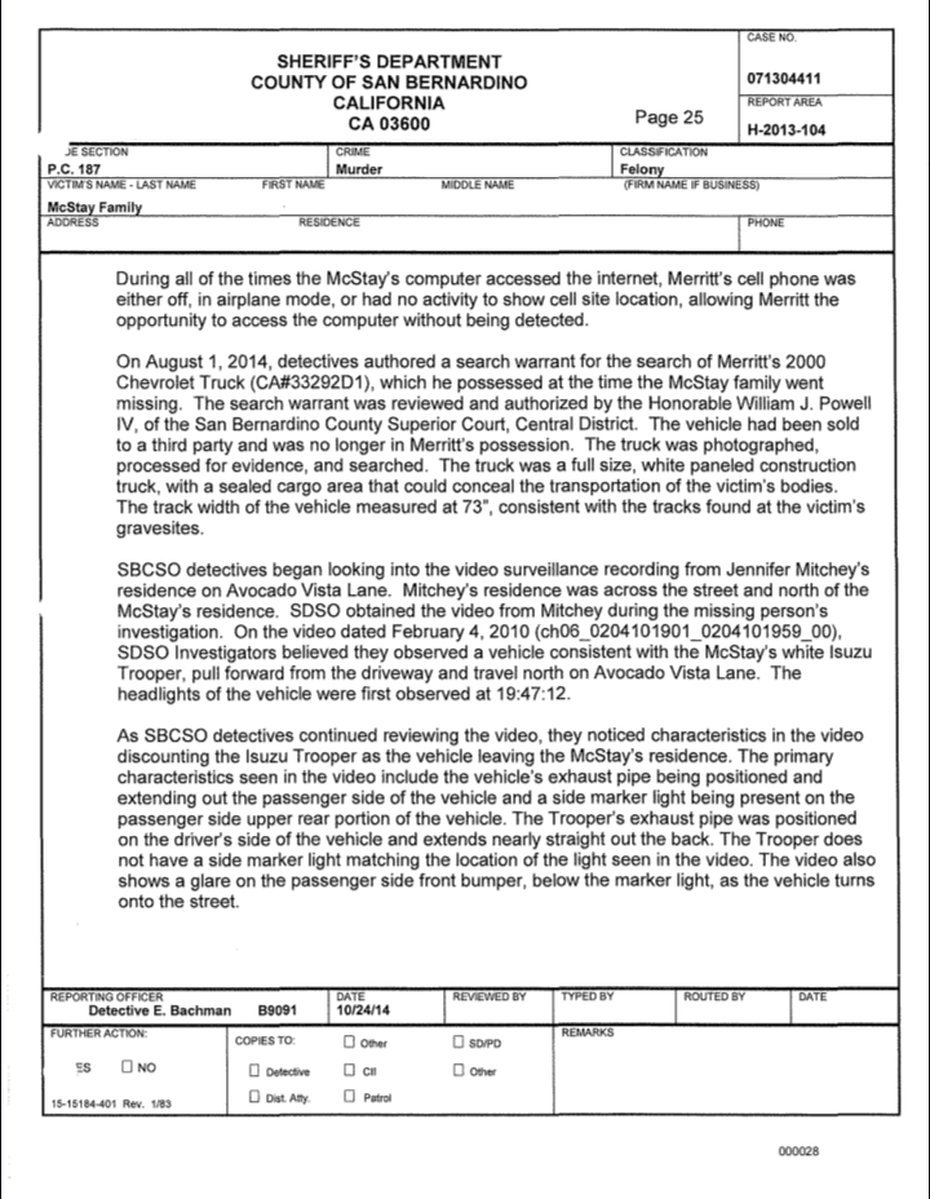
The San Bernardino Sheriff’s homicide detectives wrote down the theory the case went forward on. Detective Bachman’s report of October 24, 2014 describes the Mitchley video this way: “On the video dated February 4, 2010 (ch06_0204101901_0204101959_00), SDSO Investigators believed they observed a vehicle consistent with the McStay’s white Isuzu Trooper, pull forward from the driveway and travel north on Avocado Vista Lane. The headlights of the vehicle were first observed at 19:47:12.” (Bates 000028)
See Bates 000028
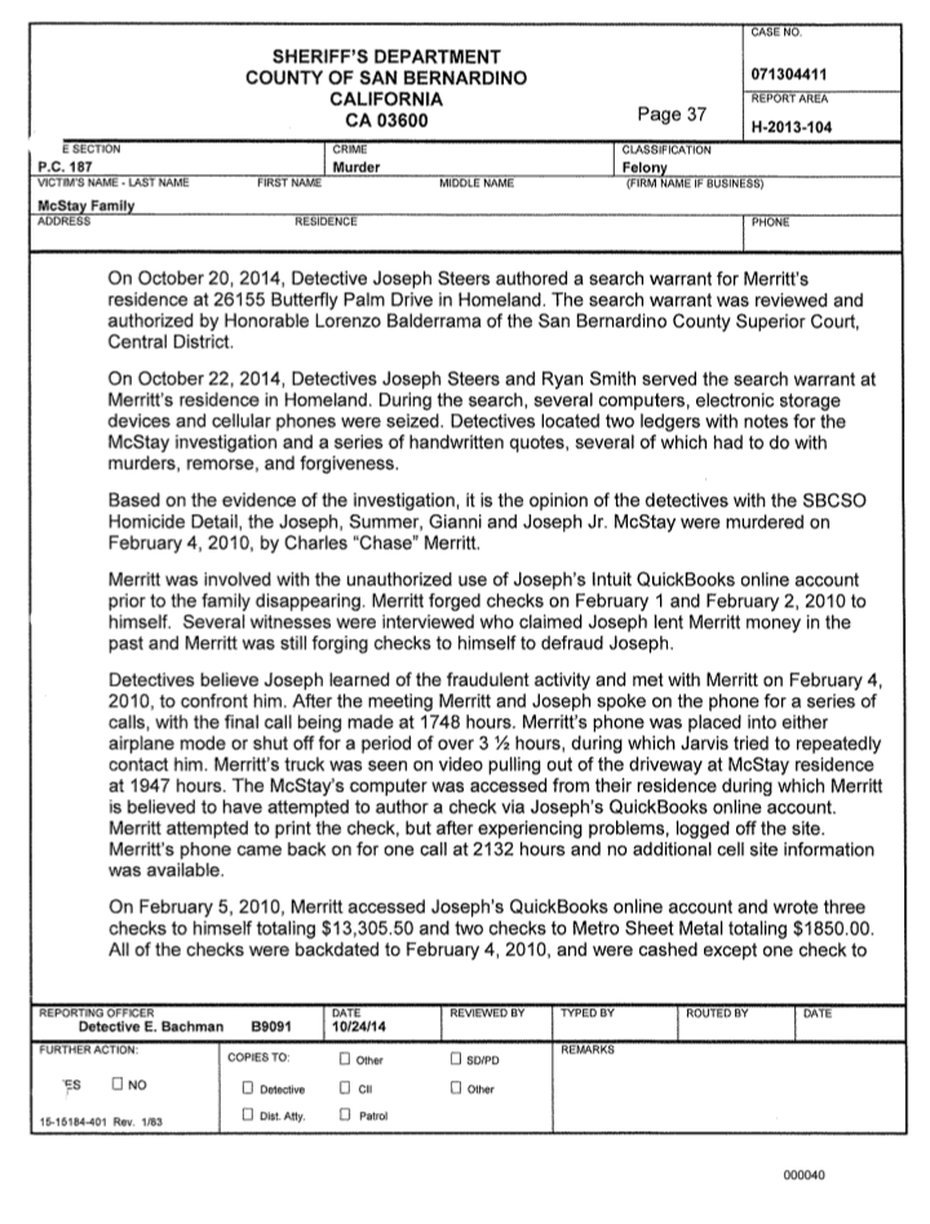
Twelve pages later, the same report states the detectives’ conclusion and the window:
“Based on the evidence of the investigation, it is the opinion of the detectives with the SBCSO Homicide Detail, the Joseph, Summer, Gianni and Joseph Jr. McStay were murdered on February 4, 2010, by Charles “Chase” Merritt.”
…
“Detectives believe Joseph learned of the fraudulent activity and met with Merritt on February 4, 2010, to confront him. After the meeting Merritt and Joseph spoke on the phone for a series of calls, with the final call being made at 1748 hours. Merritt’s phone was placed into either airplane mode or shut off for a period of over 3 ½ hours, during which Jarvis tried to repeatedly contact him. Merritt’s truck was seen on video pulling out of the driveway at McStay residence at 1947 hours. The McStay’s computer was accessed from their residence during which Merritt is believed to have attempted to author a check via Joseph’s QuickBooks online account. Merritt attempted to print the check, but after experiencing problems, logged off the site. Merritt’s phone came back on for one call at 2132 hours and no additional cell site information was available.”
(Bates 000040)
See Bates 000040
And: “Merritt claimed to be in the city of Rancho Cucamonga on the night of February 4th, 2010, the night investigators believe the family was murdered.” (Bates 1269:7-9)
See Bates 001269
Page image to come.
The People’s opening statement
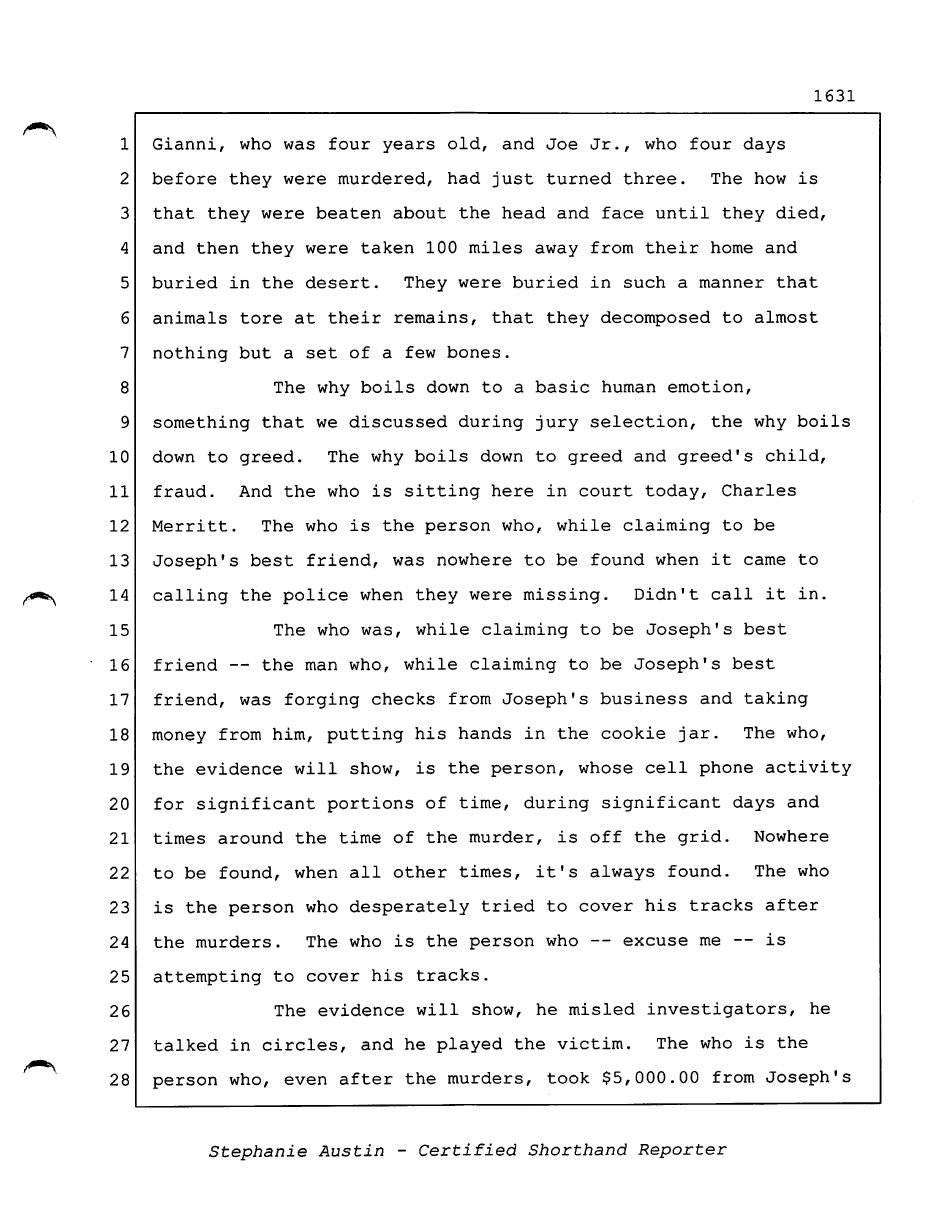
On January 7, 2019, in front of the jury, Mr. Daugherty told the jurors what happened, where, and how:
“The how is that they were beaten about the head and face until they died, and then they were taken 100 miles away from their home and buried in the desert.”
(RT 1631:2-5)
See RT 1631
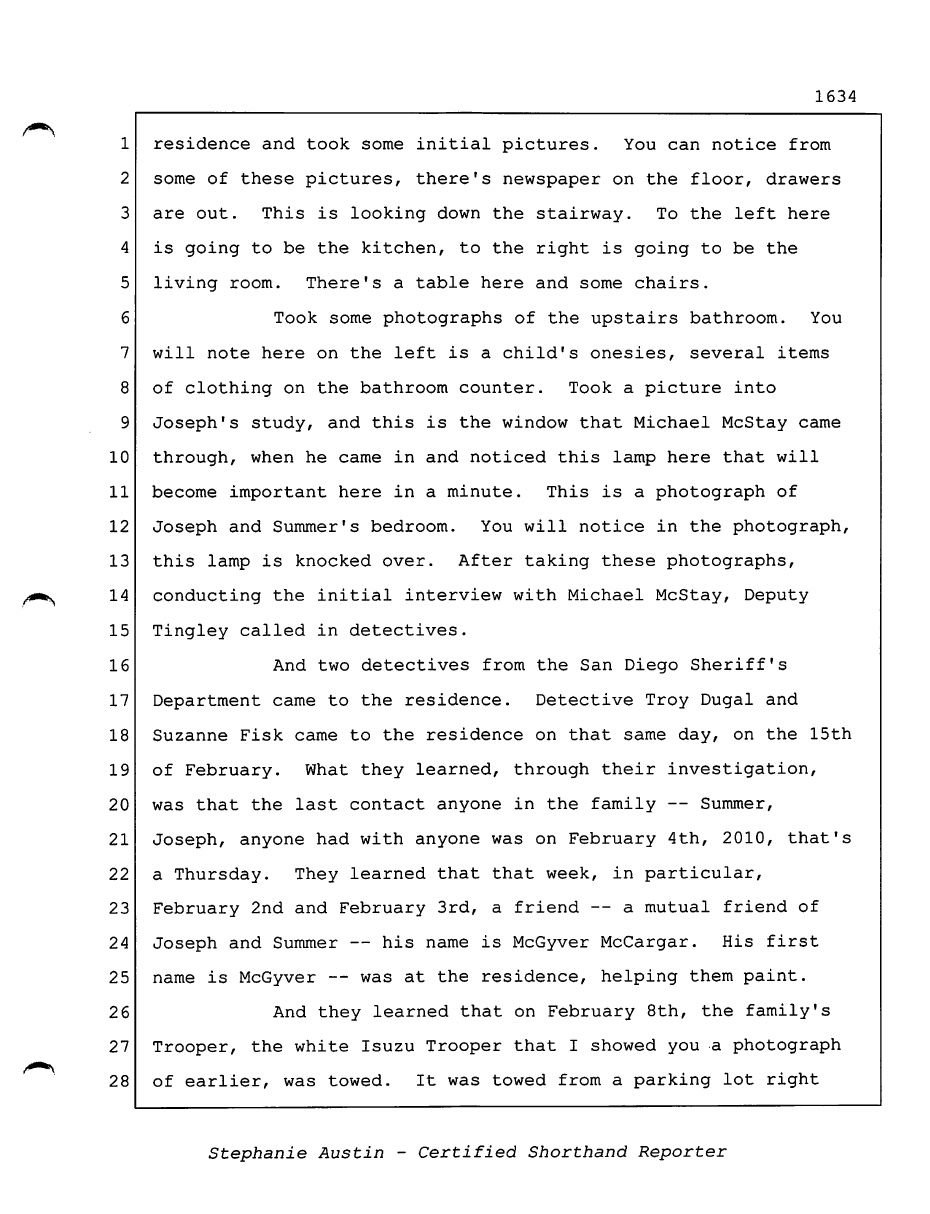
He fixed the date as the last contact anyone had with the family: “What they learned, through their investigation, was that the last contact anyone in the family — Summer, Joseph, anyone had with anyone was on February 4th, 2010, that’s a Thursday.” (RT 1634:19-22)
See RT 1634
He described the vehicle leaving the McStay house on the Mitchley video: “This video was from 7:47 on the night of February 4th.” (RT 1640:18-19)
See RT 1640
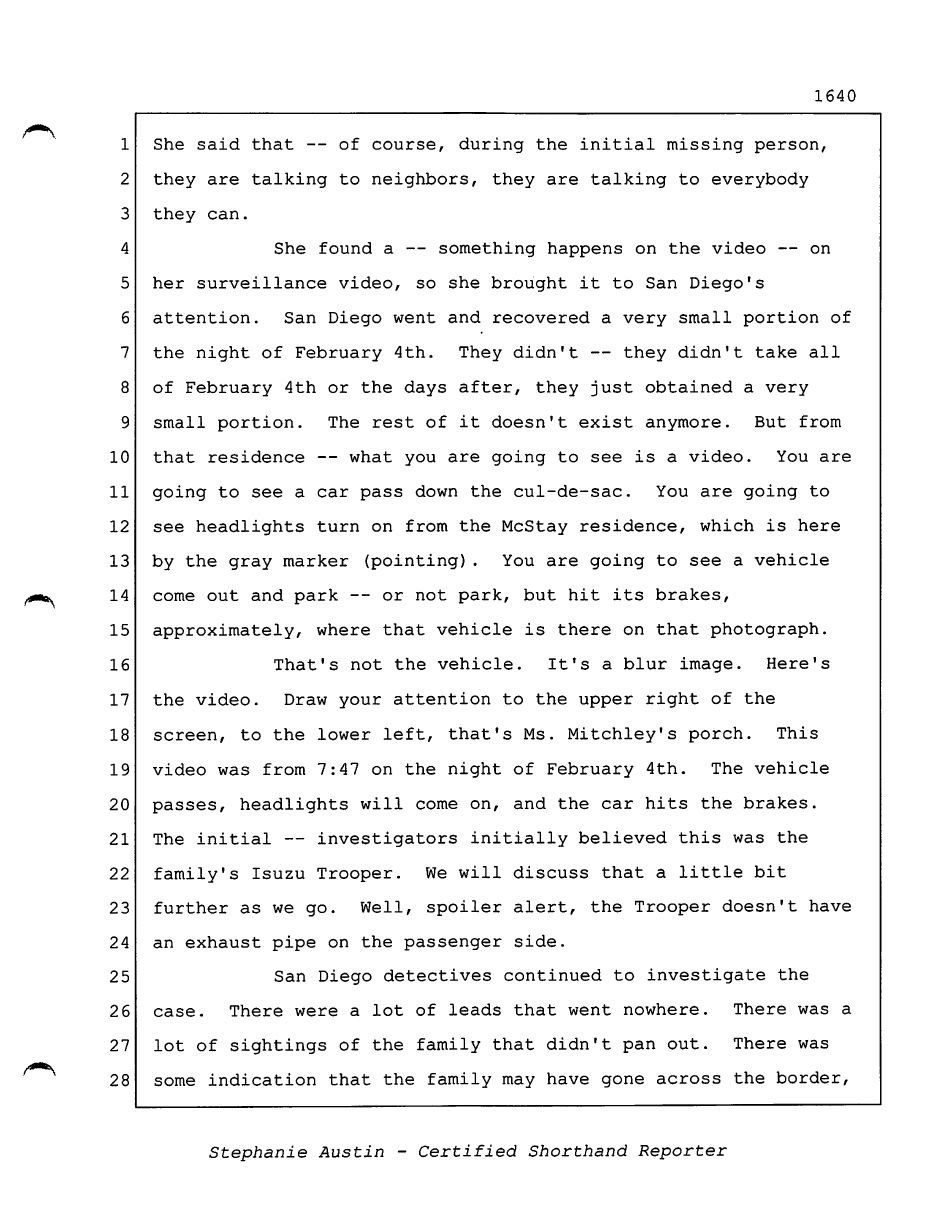
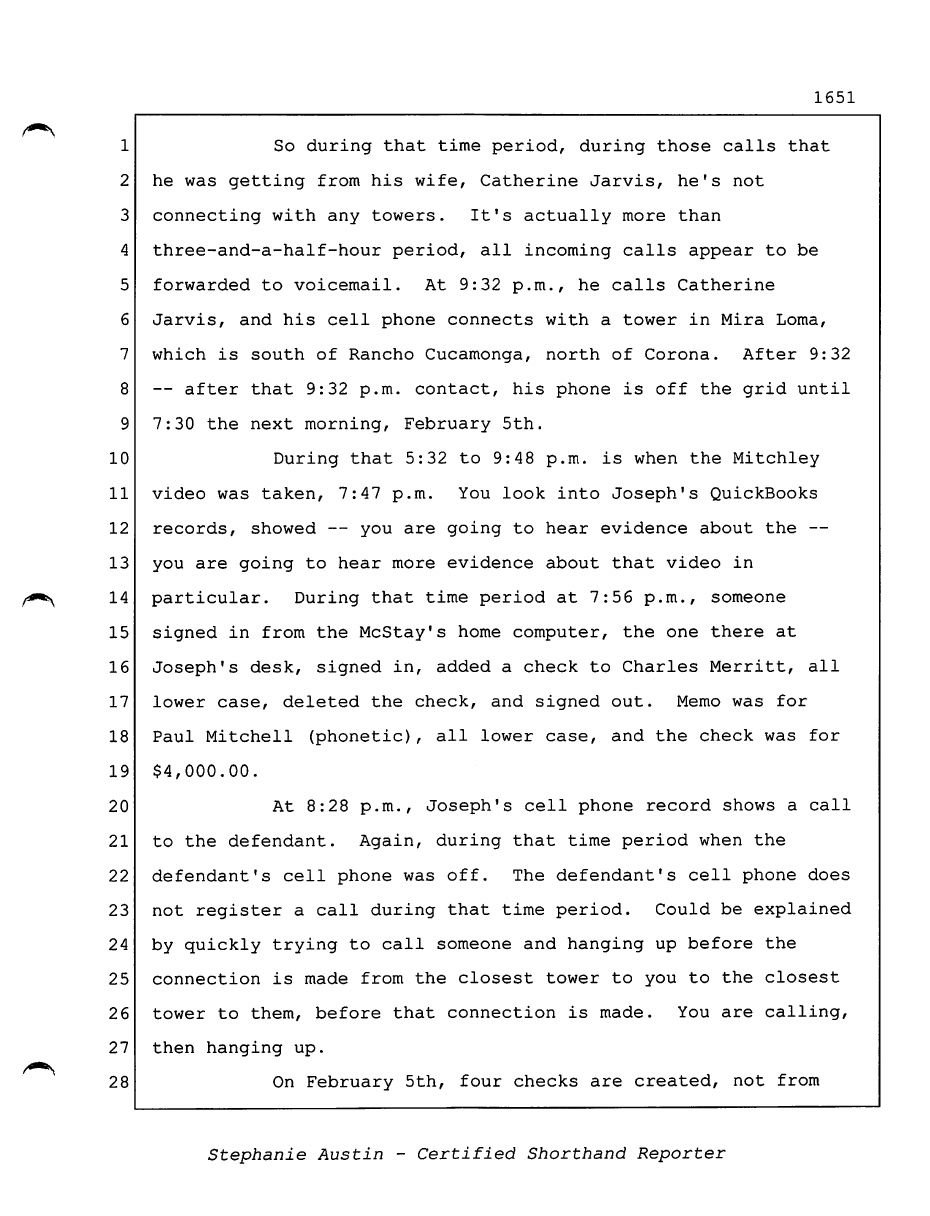
And he set out the window, and what the People said it meant:
“After that 5:48 p.m. contact with the defendant, the defendant’s cell phone goes off the grid. And that is to say, it’s either turned off, it’s in airplane mode, or it’s somewhere where it’s not connecting with any towers. 5:48 p.m. on February 4th to 9:32 p.m., his cell phone is not connecting to any towers.”
(RT 1650:16-21)
See RT 1650
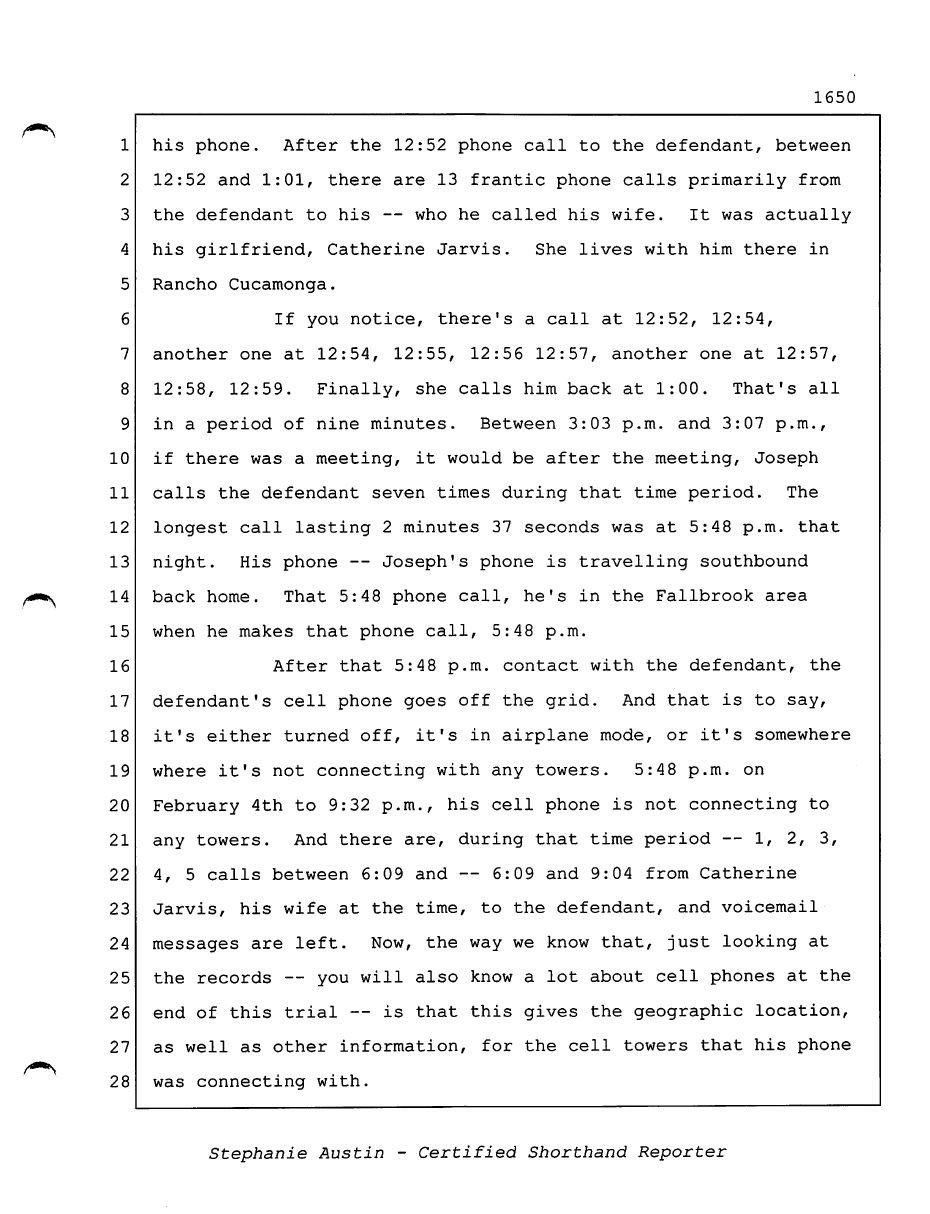
He put the 8:28 p.m. call inside the window, with the explanation the People kept through rebuttal:
“At 8:28 p.m., Joseph’s cell phone record shows a call to the defendant. Again, during that time period when the defendant’s cell phone was off. The defendant’s cell phone does not register a call during that time period. Could be explained by quickly trying to call someone and hanging up before the connection is made from the closest tower to you to the closest tower to them, before that connection is made. You are calling, then hanging up.”
(RT 1651:20-27)
See RT 1651
He told the jury the February 6 tower hits were “two days after the family was murdered” (RT 1656:25-26). And he finished by promising: “We can tell you the how, we can tell you the why, we can tell you the who.” (RT 1657:13-14)
See RT 1656 and 1657


My lawyers answered that night in their opening
The same day, Mr. McGee answered the event the People had chosen:
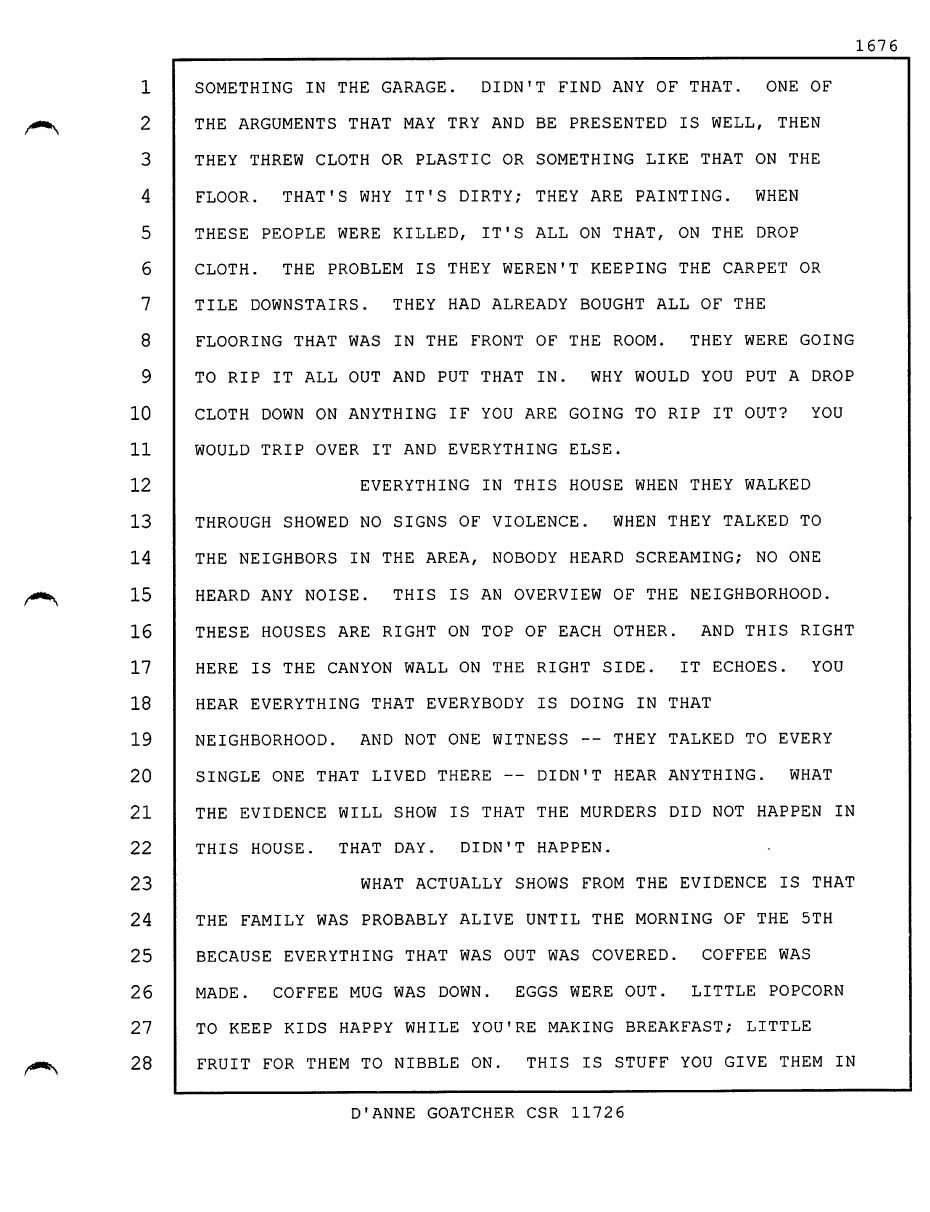
“What the evidence will show is that the murders did not happen in this house. That day. Didn’t happen. What actually shows from the evidence is that the family was probably alive until the morning of the 5th because everything that was out was covered. Coffee was made. Coffee mug was down. Eggs were out. Little popcorn to keep kids happy while you’re making breakfast; little fruit for them to nibble on. This is stuff you give them in the morning. The dogs were in the backyard. You will hear Summer loved those dogs. They always slept inside. First thing in the morning you have a dog inside all night is you put them out to go to the bathroom. They were outside. The clothes that they were all wearing when their bodies were recovered all indicate clothing you sleep in, wake up to. This family was alive until the morning. They were not killed in that house on the 4th.”
(RT 1676:20-1677:8)
See RT 1676 and 1677

And he named the truck video as the piece that placed me at the house in the window:
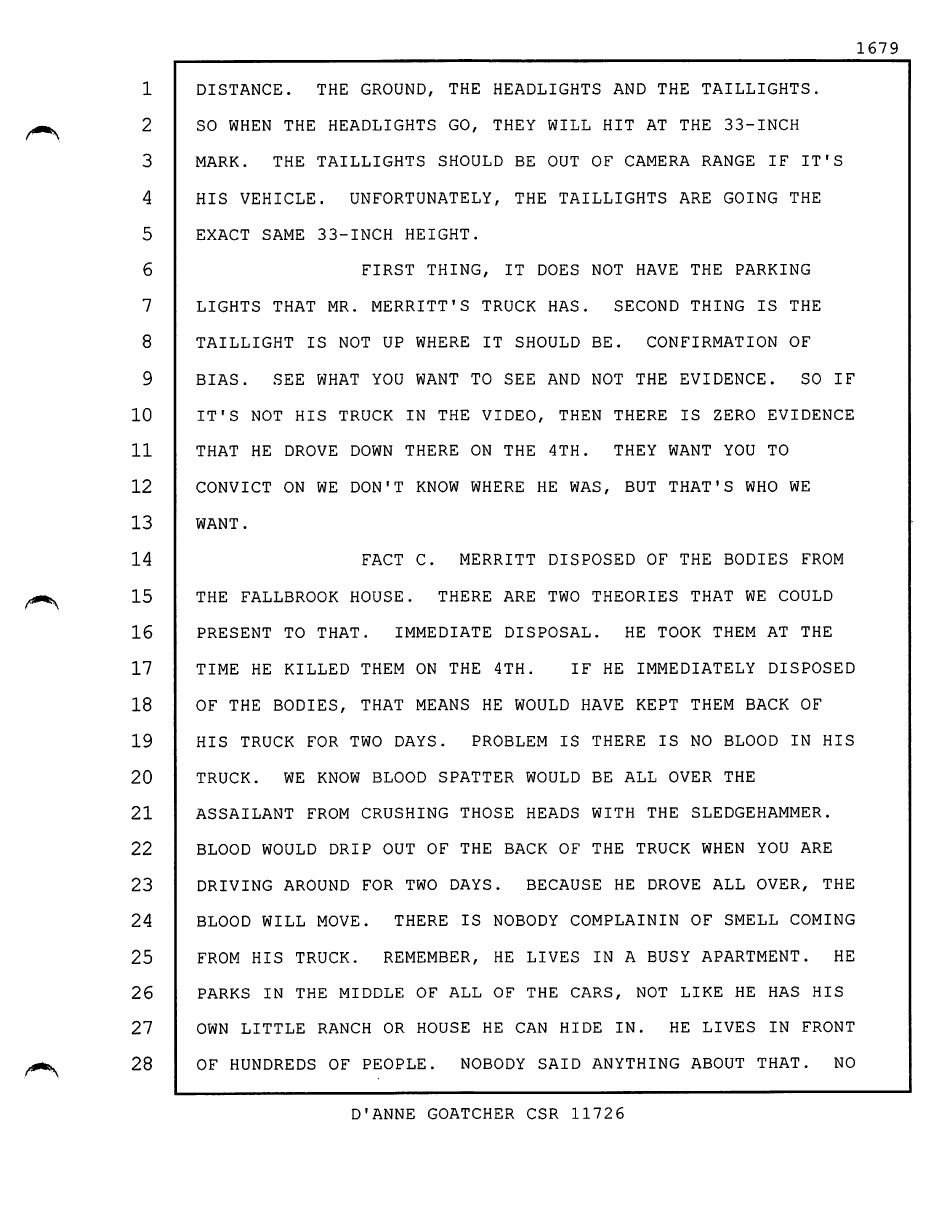
“First thing, it does not have the parking lights that Mr. Merritt’s truck has. Second thing is the taillight is not up where it should be. Confirmation of bias. See what you want to see and not the evidence. So if it’s not his truck in the video, then there is zero evidence that he drove down there on the 4th. They want you to convict on we don’t know where he was, but that’s who we want.”
(RT 1679:6-13)
See RT 1679
So from the first day of evidence, both sides knew what the case was about. The People said I was at the Fallbrook house on the evening of February 4. My defense denied it.
The motion for acquittal (section 1118.1)
On March 4, 2019, at the close of the People’s case and outside the jury, Mr. Imes restated the same window as the reason the case should go to the jury:
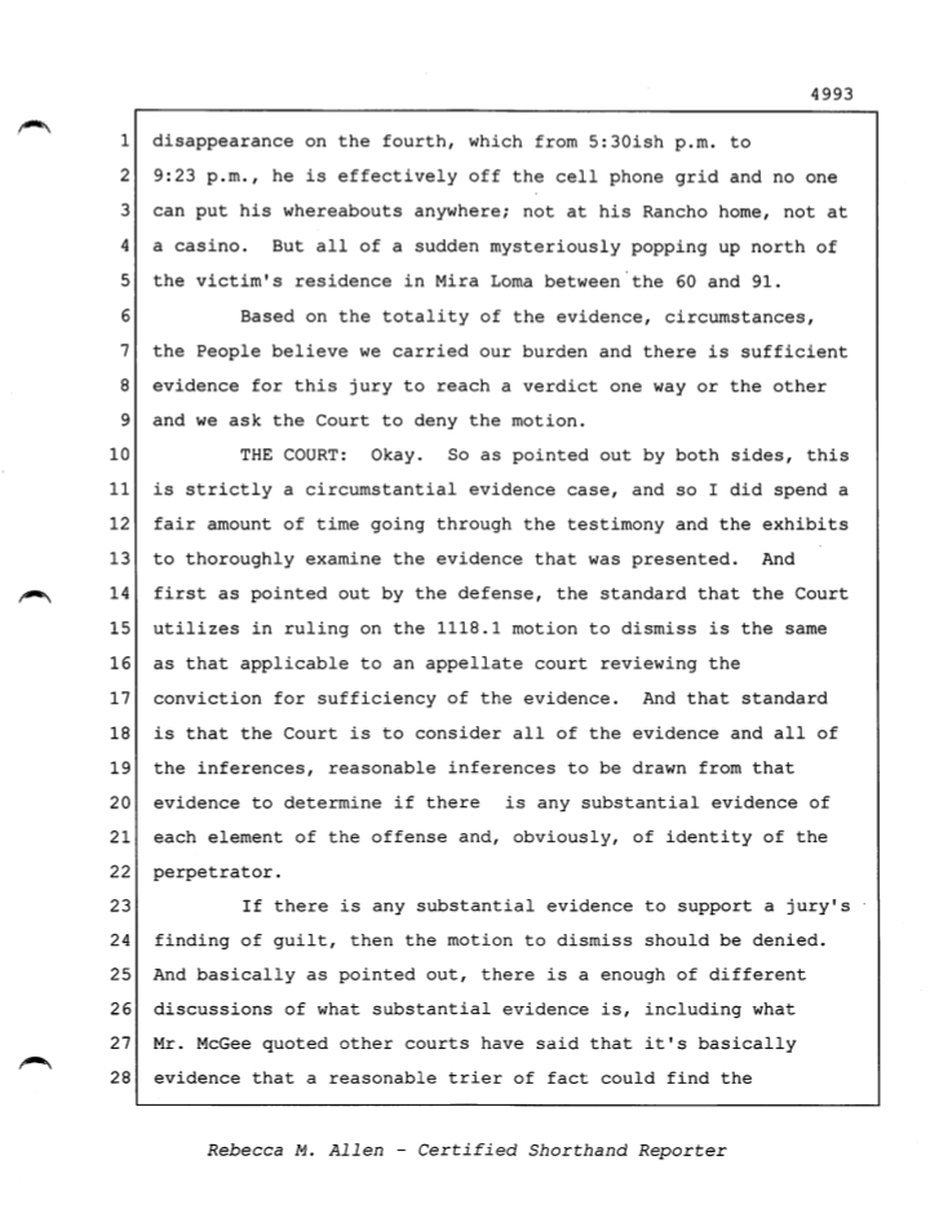
“The way the circumstances lay out on February 4th, I believe it is clear that he had been caught with his hand in the cookie jar, and it’s that that leads to the disappearance on the fourth, which from 5:30ish p.m. to 9:23 [sic: 9:32] p.m., he is effectively off the cell phone grid and no one can put his whereabouts anywhere; not at his Rancho home, not at a casino.”
(RT 4992:26-4993:4)
See RT 4992 and 4993

Mr. McGee’s argument at the same hearing said what that window required of the People:
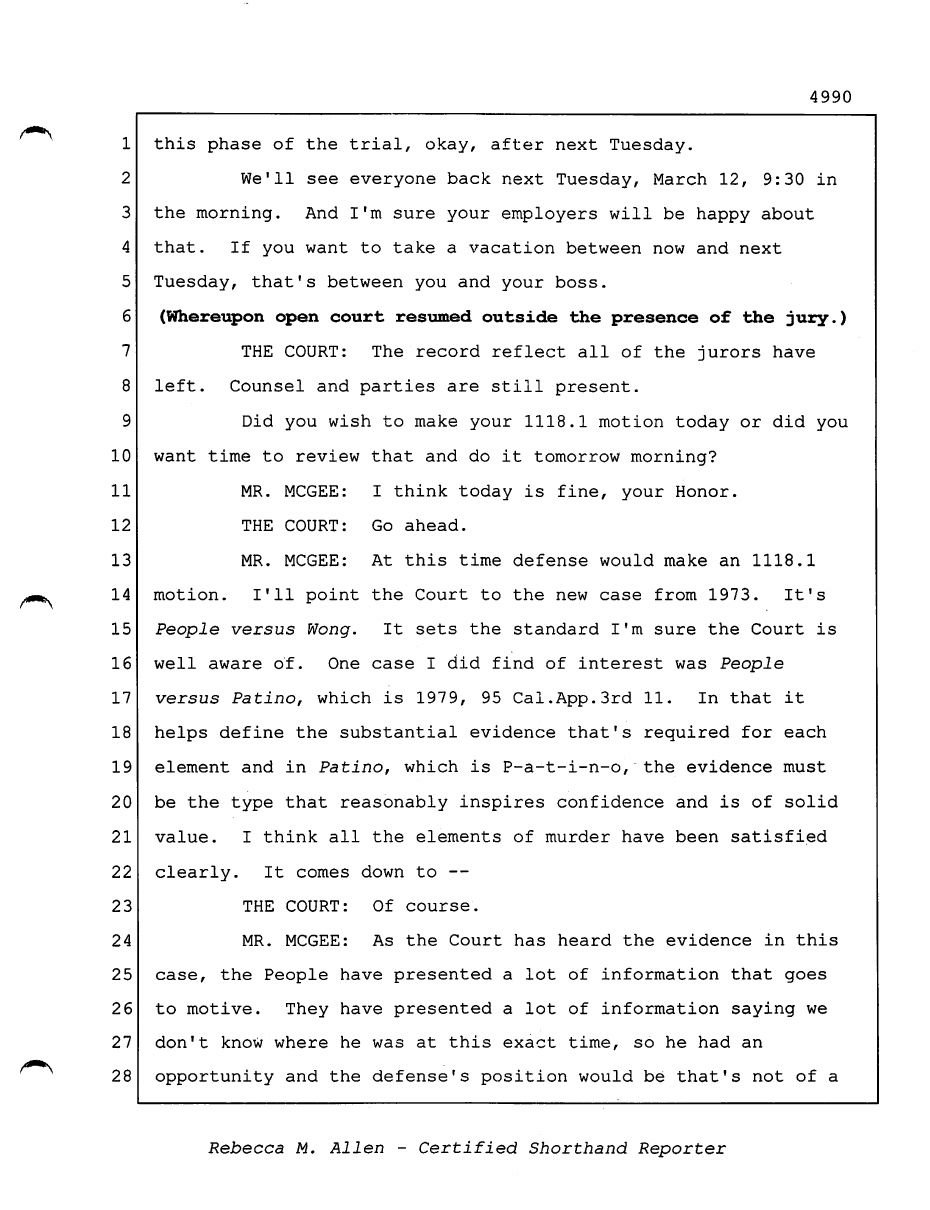
“They have presented a lot of information saying we don’t know where he was at this exact time, so he had an opportunity and the defense’s position would be that’s not of a solid value. They have zero direct evidence. Obviously this is a circumstantial case, and the evidence that is presented, many of the People’s own experts and witnesses even said it’s reasonable to say that this was here for another innocuous reason. There is no evidence of a murder occurring inside the home. No evidence of cleanup. There is nothing in the home that support the theory that the People are presenting that the family was killed inside the home on the night of the fourth. If it happened on any other day, they can’t put our client anywhere near the home.”
(RT 4990:26-4991:10)
See RT 4990 and 4991

That last sentence states exactly what was at stake, and it was said to the court almost three months before the instruction conference. If the event moved off the evening of February 4, the People had nothing placing me at the house at all.
Mr. Imes’s closing argument
On May 28, 2019, in front of the jury, Mr. Imes argued the same event and told the jury the verdict was a decision about it.
He described the window, and what he said happened inside it:
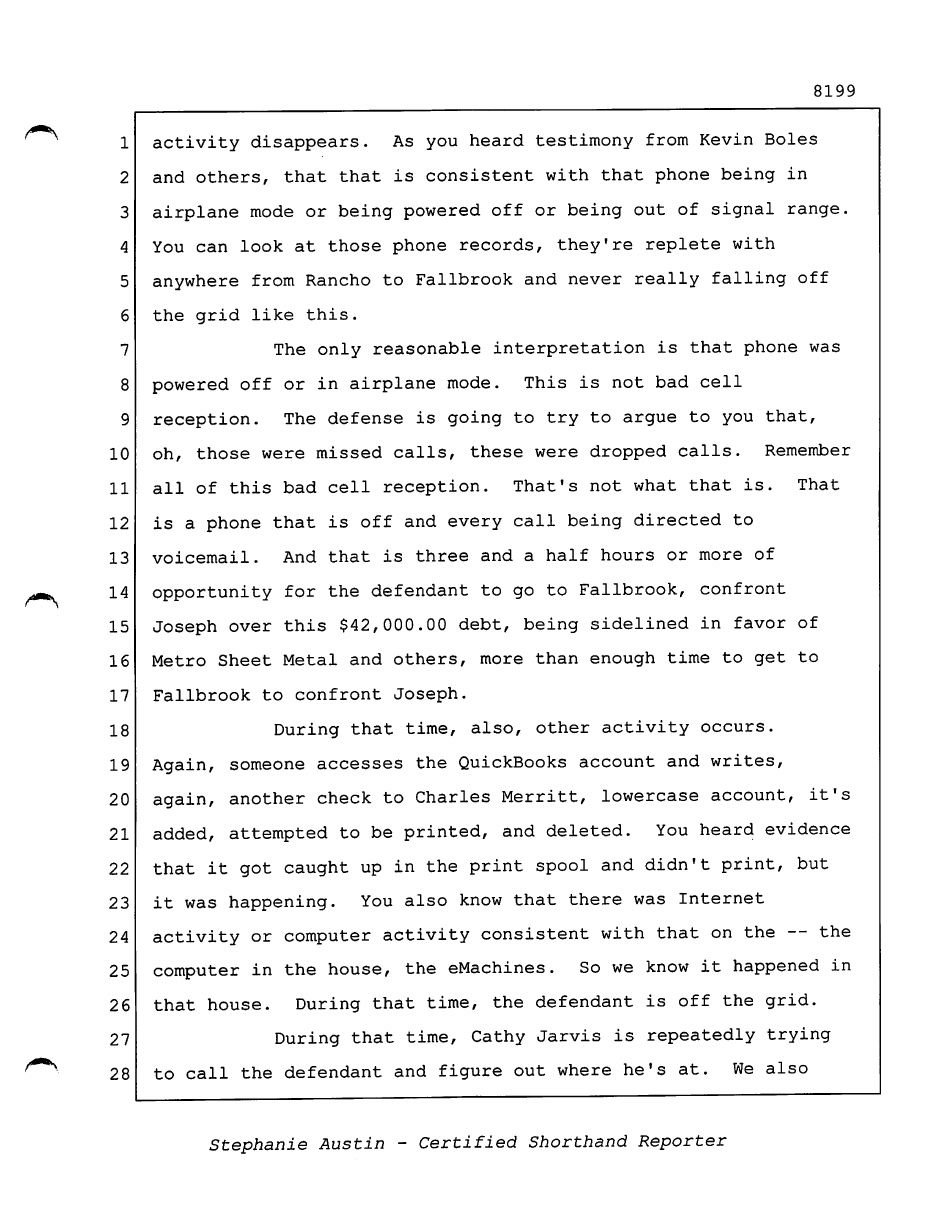
“And that is three and a half hours or more of opportunity for the defendant to go to Fallbrook, confront Joseph over this $42,000.00 debt, being sidelined in favor of Metro Sheet Metal and others, more than enough time to get to Fallbrook to confront Joseph. During that time, also, other activity occurs. Again, someone accesses the QuickBooks account and writes, again, another check to Charles Merritt, lowercase account, it’s added, attempted to be printed, and deleted. You heard evidence that it got caught up in the print spool and didn’t print, but it was happening. You also know that there was Internet activity or computer activity consistent with that on the — the computer in the house, the eMachines. So we know it happened in that house. During that time, the defendant is off the grid. During that time, Cathy Jarvis is repeatedly trying to call the defendant and figure out where he’s at. We also know during that time period that a vehicle is seen leaving the — or in front of the Mitchley house, from what appears to be the McStay house and drives down the street. That all occurs in this time-off period, this off-the-grid period. And the next time the defendant is located or has contact with other human beings is at 9:32 p.m., and his phone pings on a tower south of state Route 60 and east of the Interstate 15.”
(RT 8199:13-8200:7)
See RT 8199 and 8200

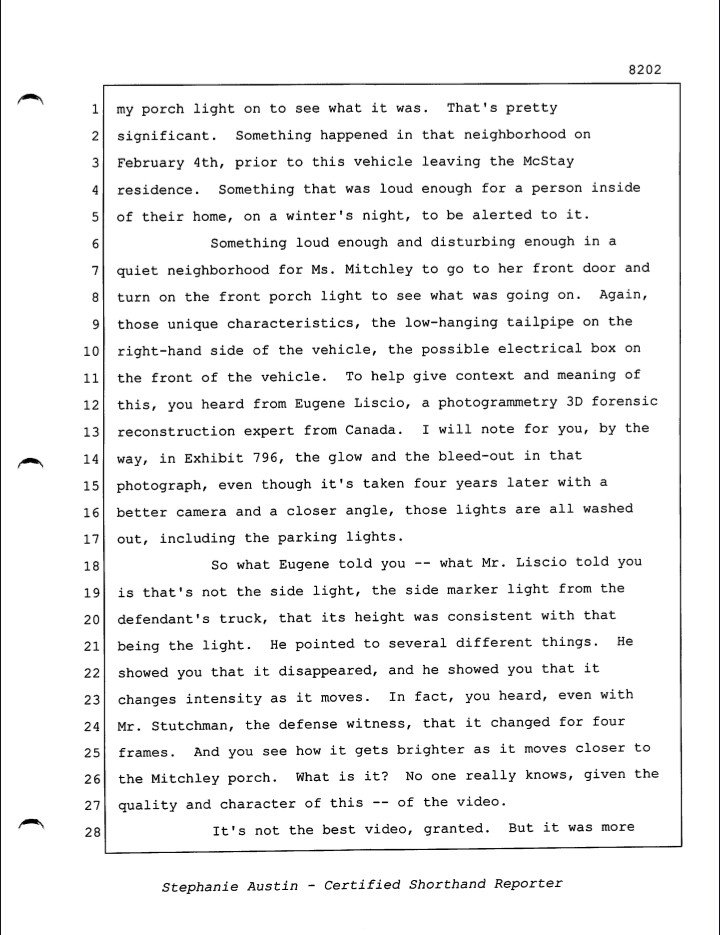
“Something happened in that neighborhood on February 4th, prior to this vehicle leaving the McStay residence. Something that was loud enough for a person inside of their home, on a winter’s night, to be alerted to it.”
(RT 8202:2-5)
See RT 8202
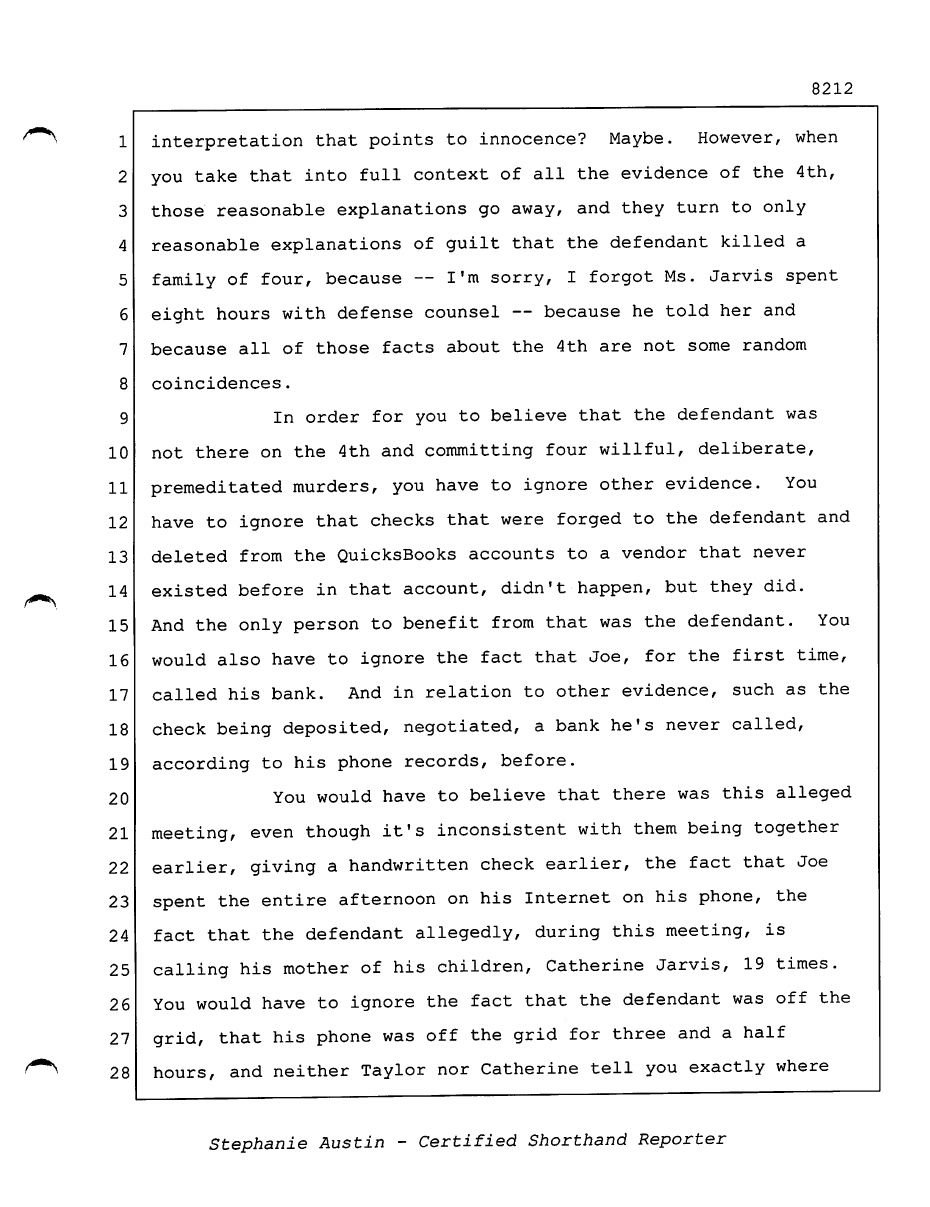
“In order for you to believe that the defendant was not there on the 4th and committing four willful, deliberate, premeditated murders, you have to ignore other evidence.”
(RT 8212:9-11)
See RT 8212
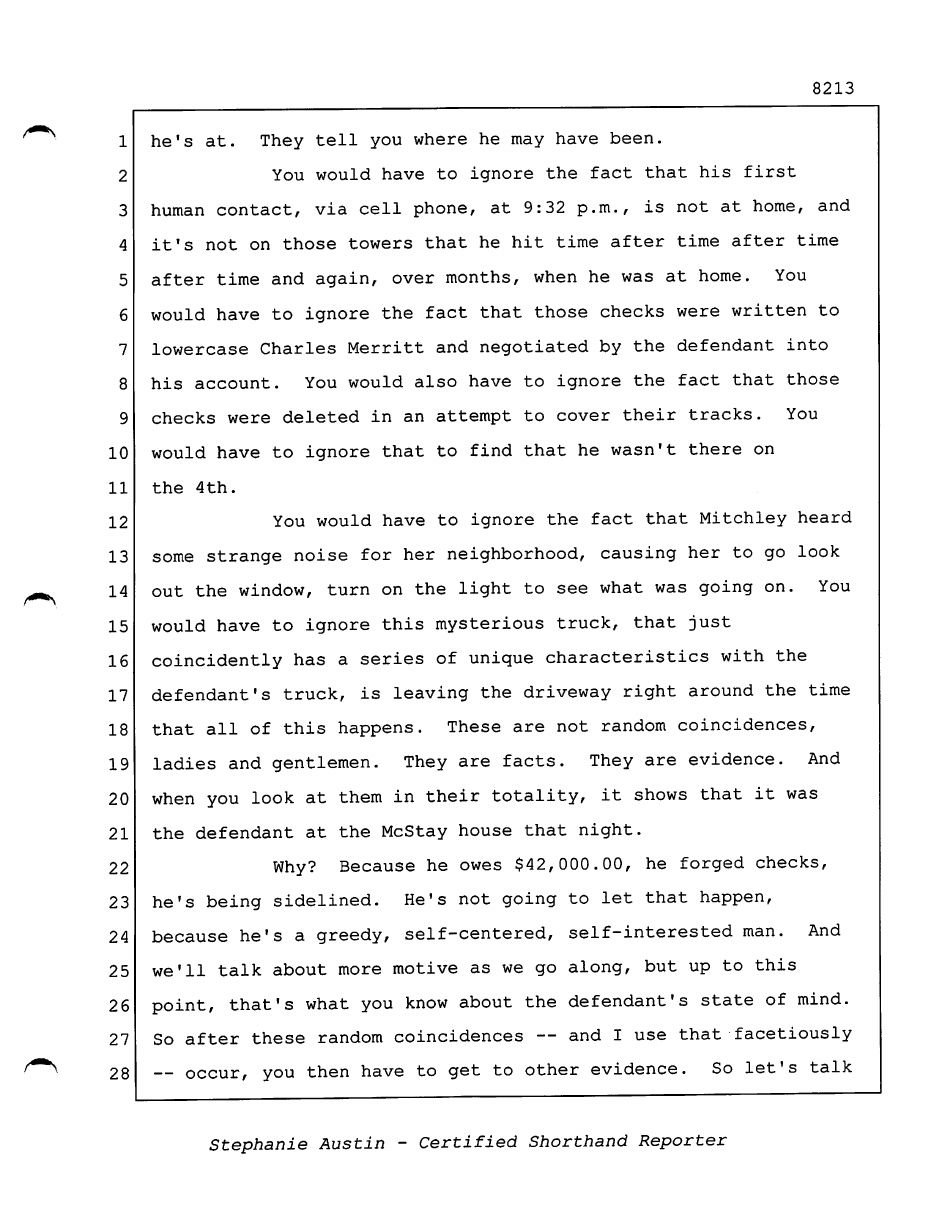
“These are not random coincidences, ladies and gentlemen. They are facts. They are evidence. And when you look at them in their totality, it shows that it was the defendant at the McStay house that night.”
(RT 8213:18-21)
See RT 8213
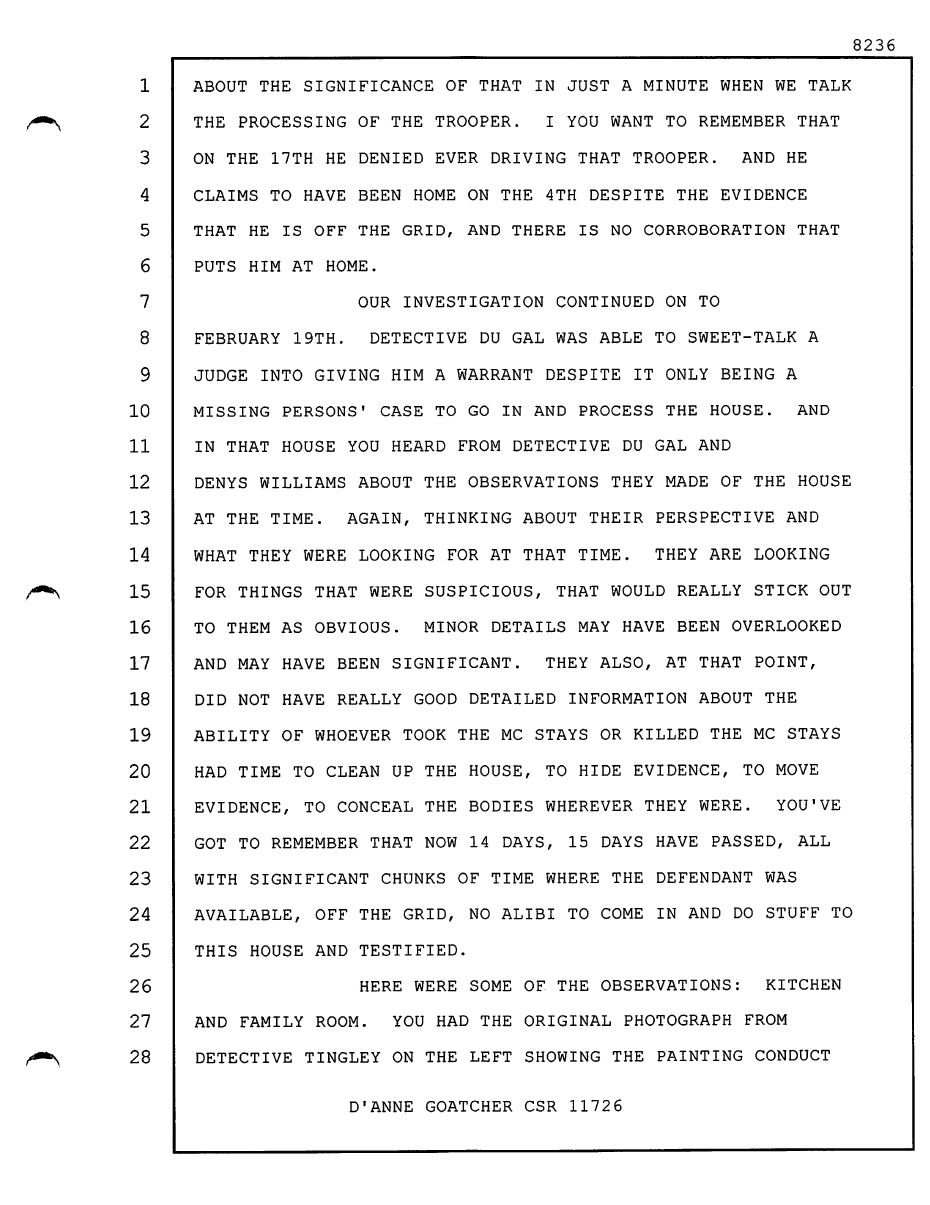
“And he claims to have been home on the 4th despite the evidence that he is off the grid, and there is no corroboration that puts him at home.”
(RT 8236:3-6)
See RT 8236
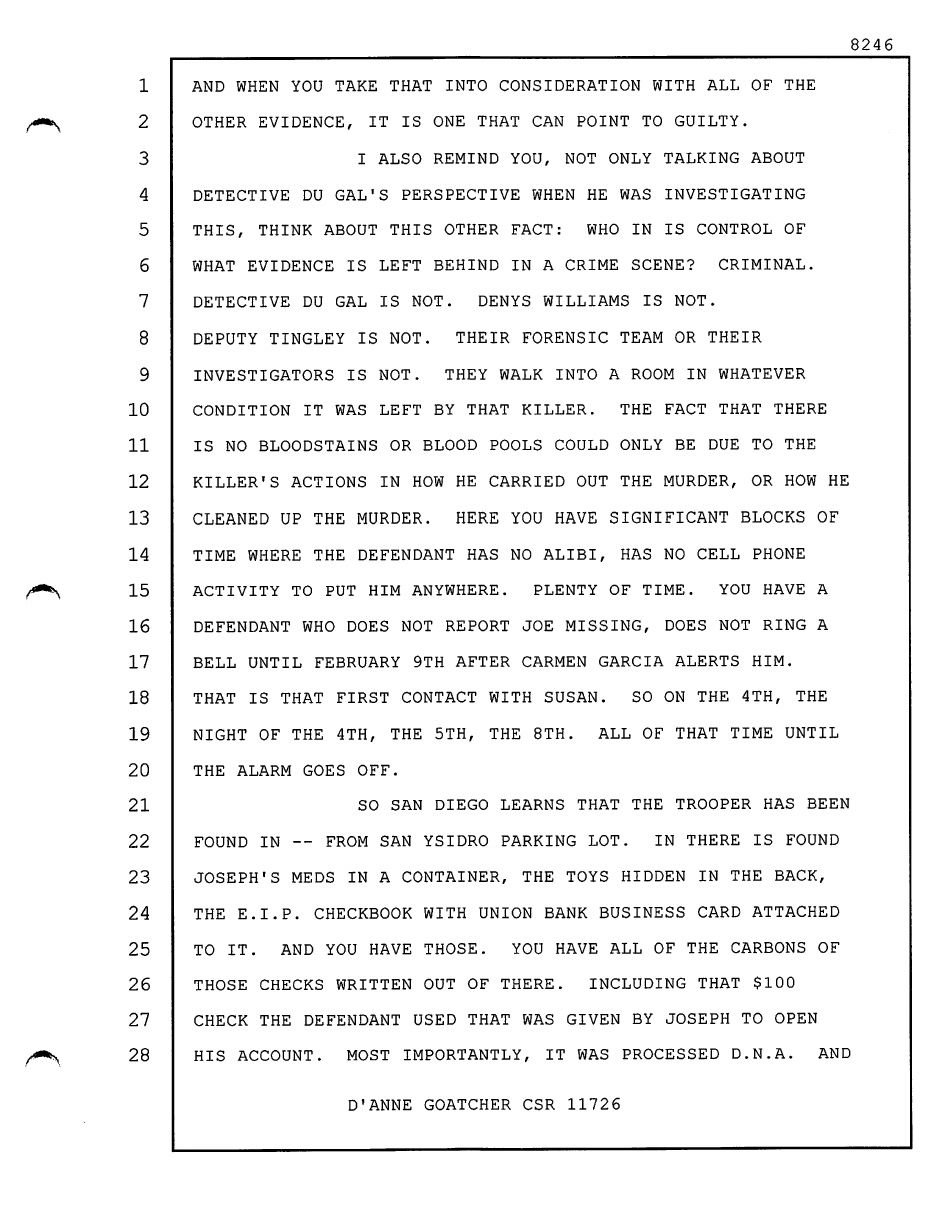
“He had time to establish it. The night of 4th he is off the grid in either airplane mode or powered off. And when he comes back to life on the network at 9:32, he is south of his home …”
(RT 8261:21-25)
See RT 8261
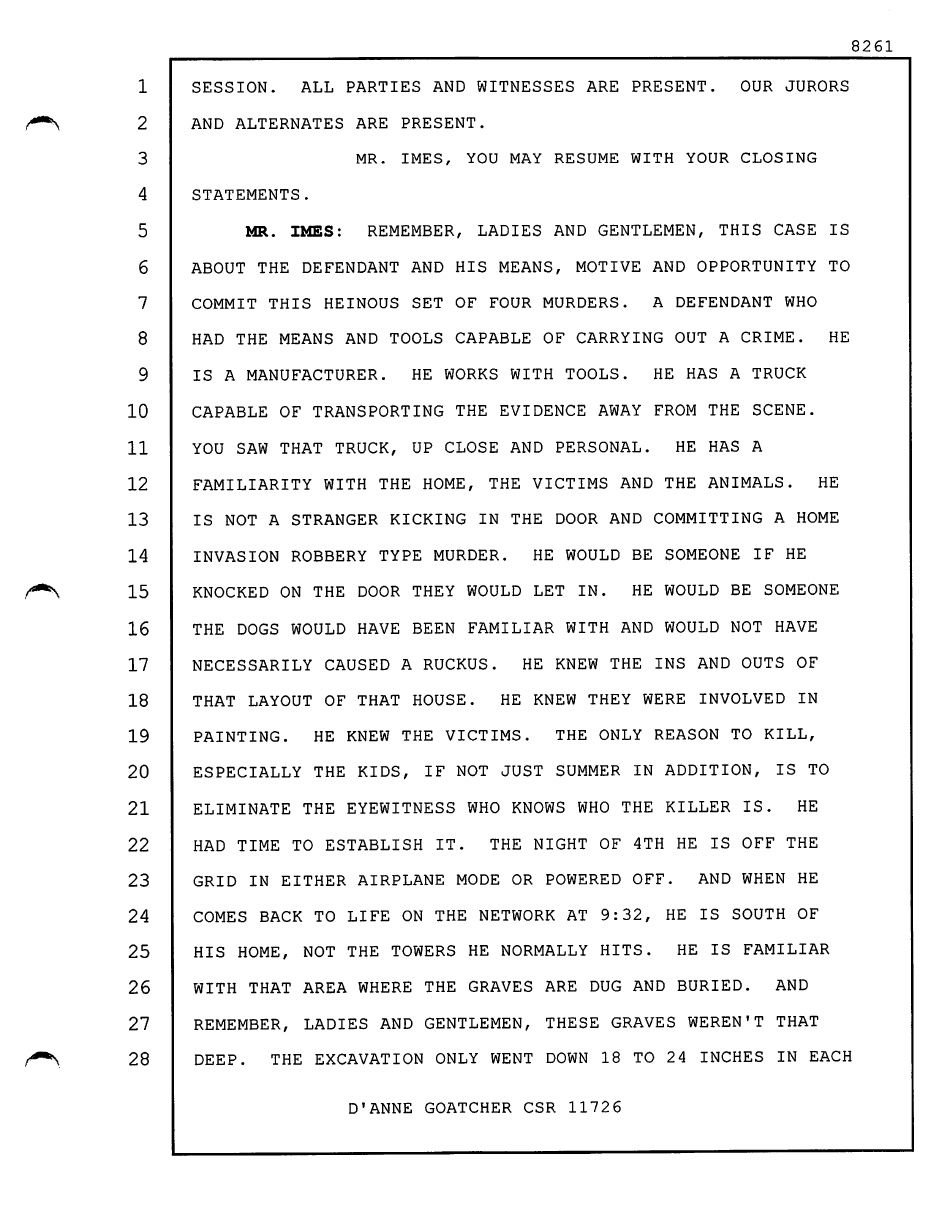
“He is off the grid on February 4th when presumably those murders occurred. He was off the grid at that — for three and a half hours. After which there is no contact from Joe or Summer. No other human contact, no other computer activity, no other financial activity, no other phone activity. And where is the defendant? Nobody knows.”
(RT 8270:13-19)
See RT 8270
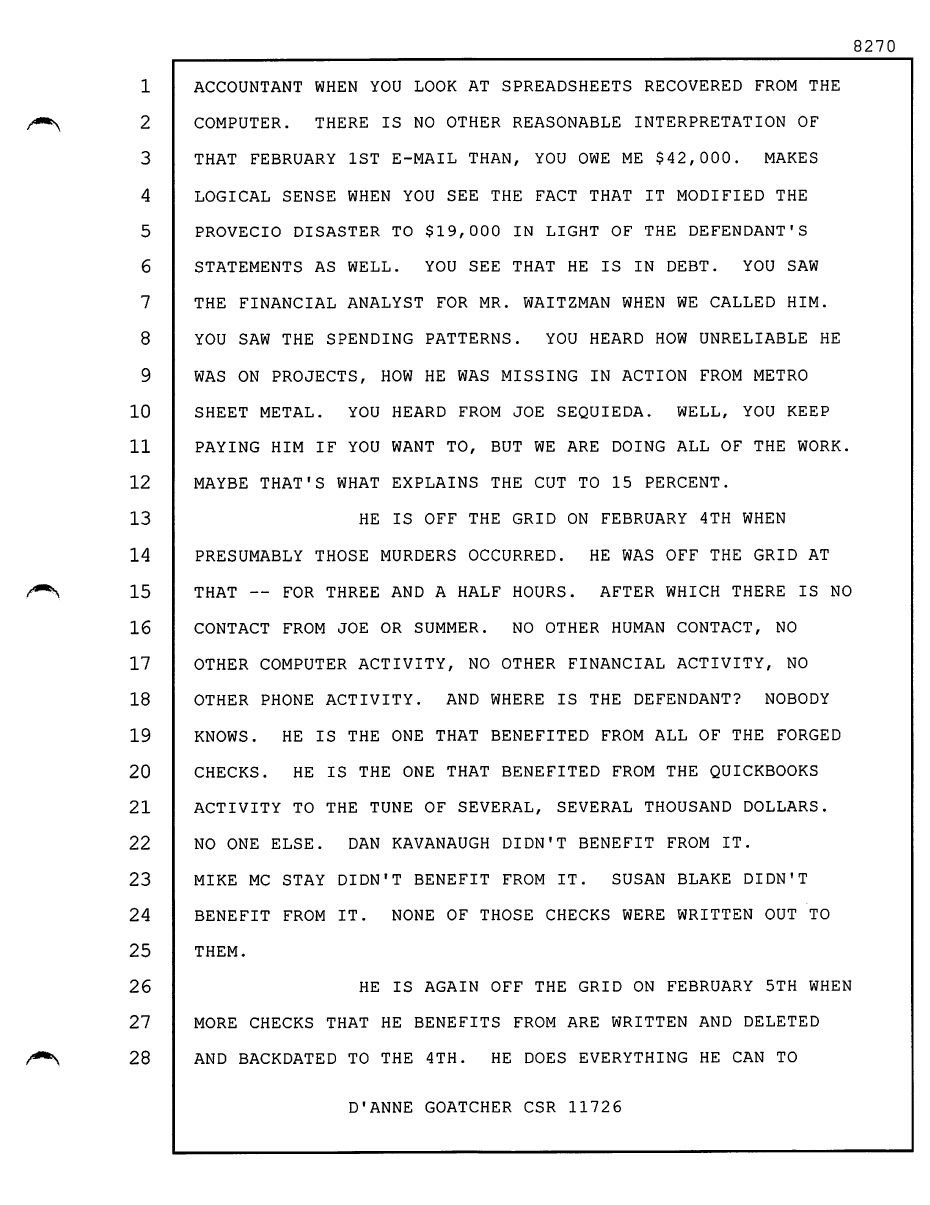
He described the killings: “It wasn’t just one debilitating blow to incapacitate someone and remove them from the scene. It was blow, after blow, after blow, to a child’s skull.” (RT 8184:2-5)
See RT 8184
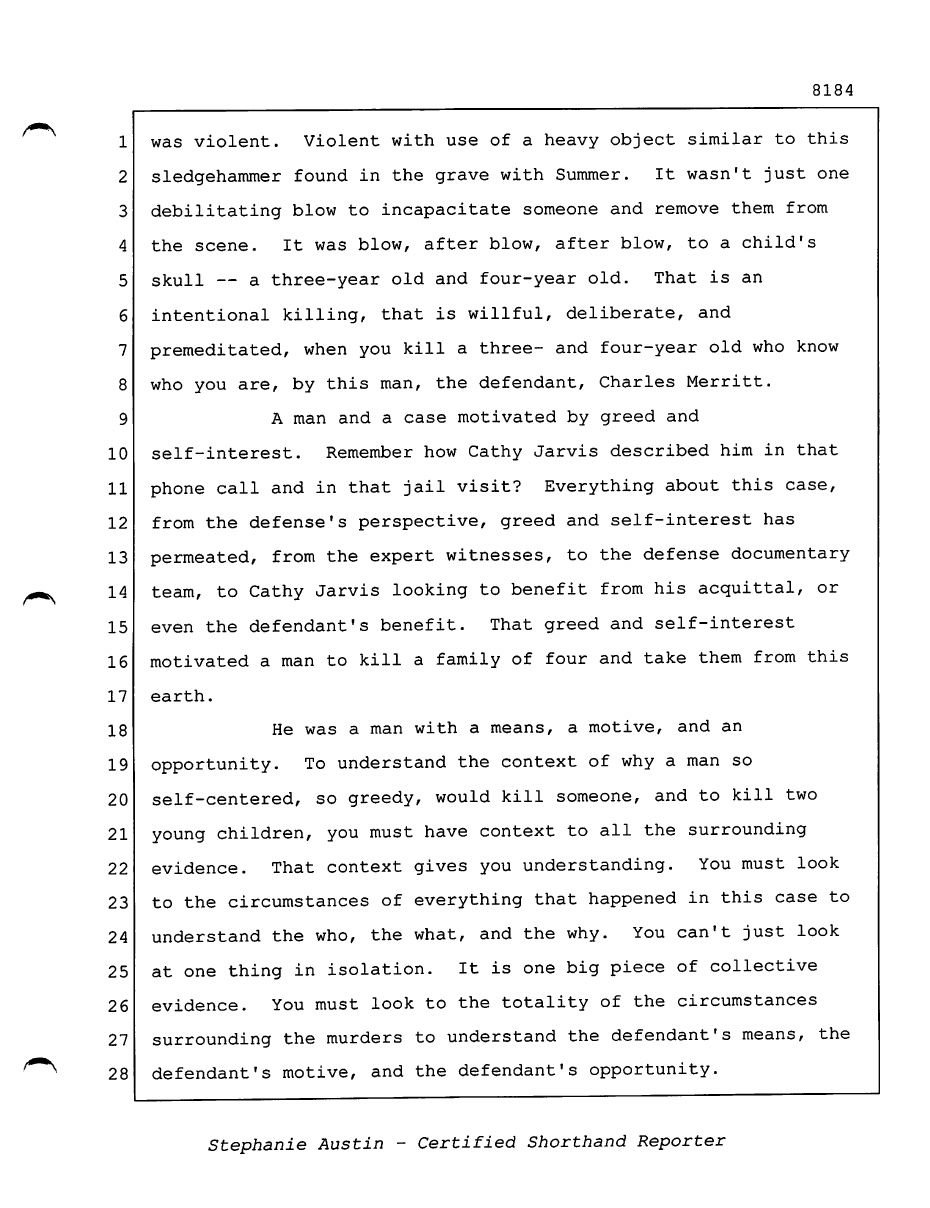
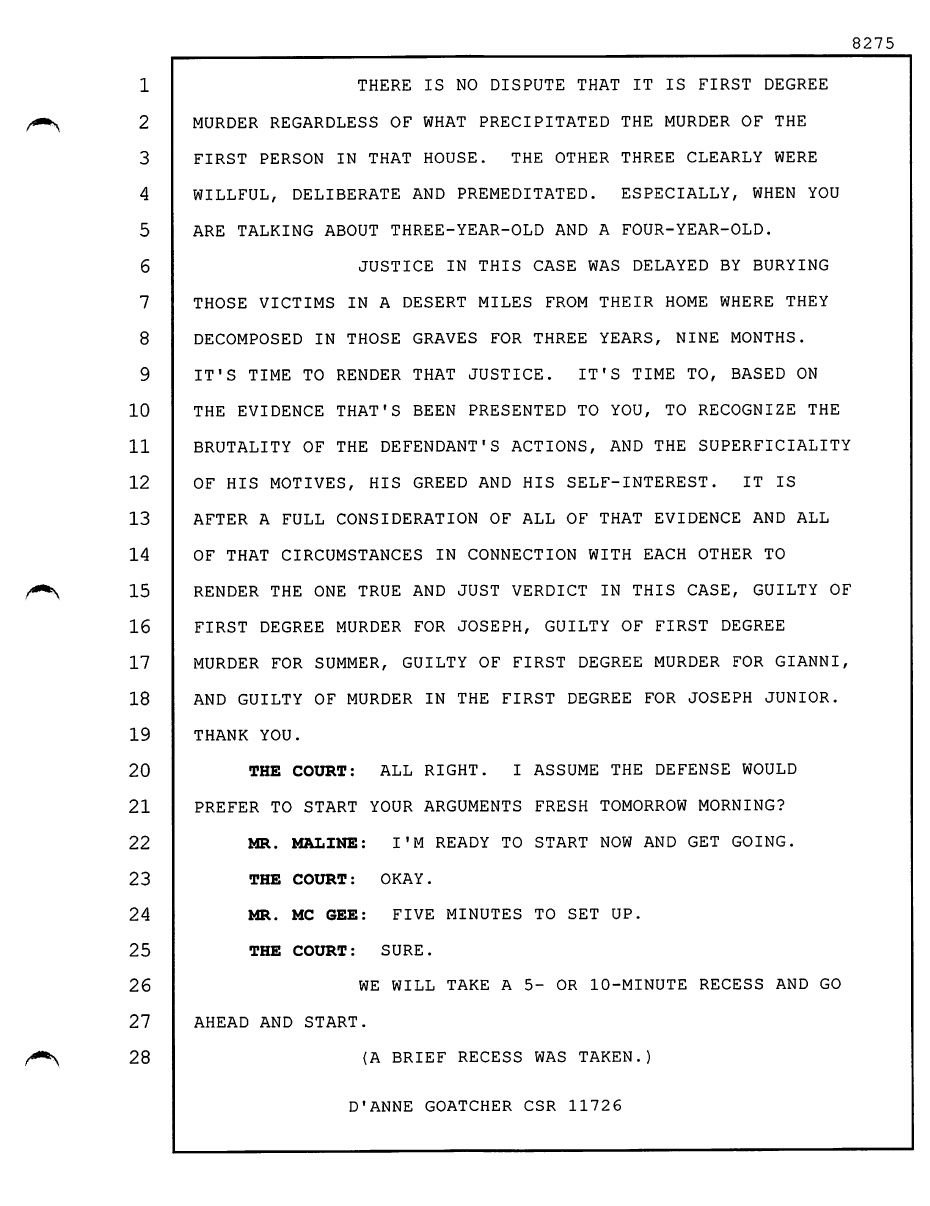
And he put them inside the house: “The fact that there is no bloodstains or blood pools could only be due to the killer’s actions in how he carried out the murder, or how he cleaned up the murder.” (RT 8246:10-13) And his last words to the jury on the degree of the crime: “There is no dispute that it is first degree murder regardless of what precipitated the murder of the first person in that house.” (RT 8275:1-3)
See RT 8246 and 8275
The defense closing
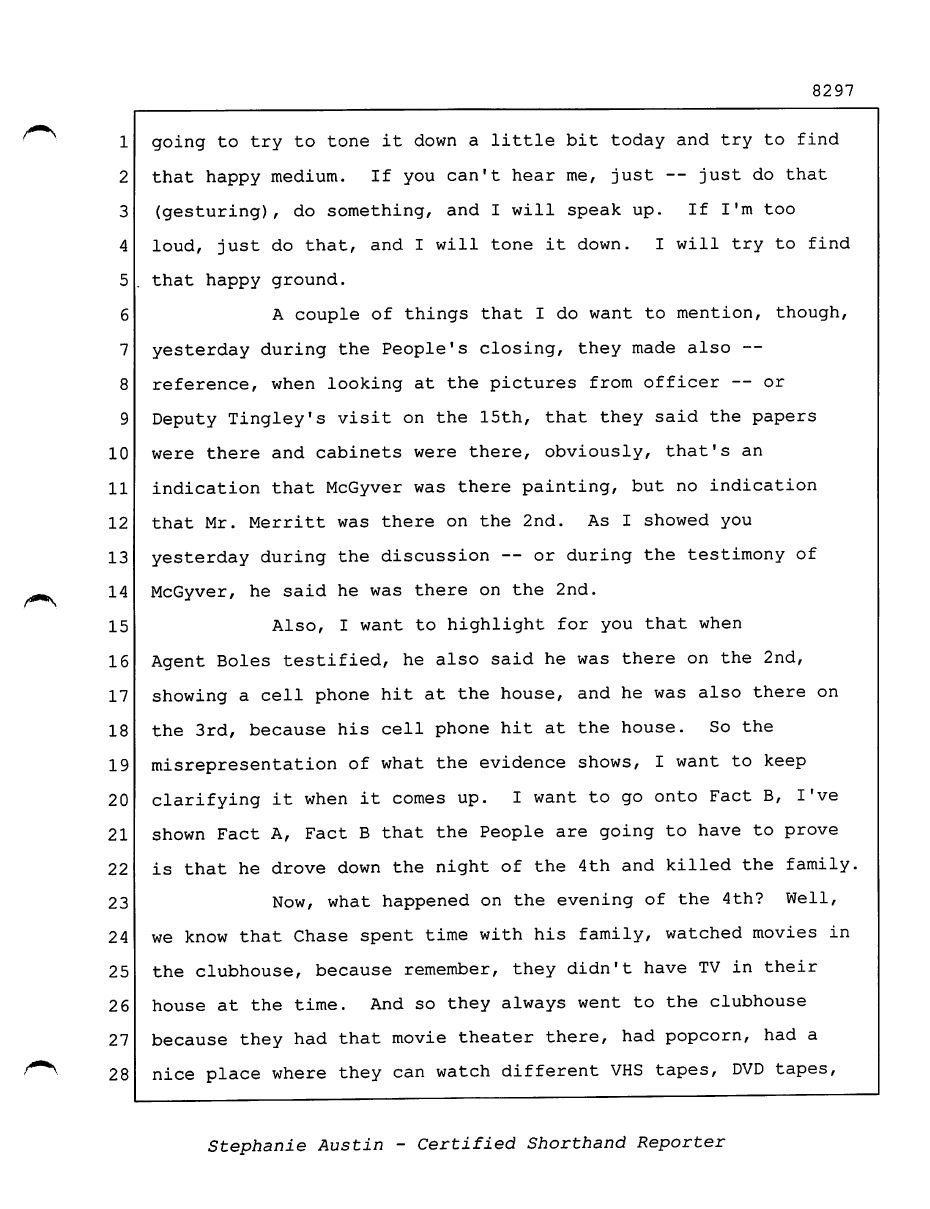
Mr. McGee, in front of the jury on May 29, 2019: “Fact B that the People are going to have to prove is that he drove down the night of the 4th and killed the family.” (RT 8297:21-22)
See RT 8297
Mr. Maline put CALCRIM 3400 on the screen and told the jury it governed the case:
“This is the instruction the judge gave you. It’s CALCRIM 3400. The People must prove that the defendant committed murder. The defendant contends that he did not commit this crime, and that he was somewhere else when the crime was committed. The People must prove that the defendant was present and committed the crime with which he is charged. The defendant does not need to prove he was elsewhere at the time of the crime. If you have reasonable doubt about whether the defendant was present when the crime was committed, you must find him not guilty.
Okay. What that reduces down to is, you have to find that Mr. Merritt was at the Fallbrook house on the 4th. That’s their case. So what that reduces down to — their theory of Mr. Merritt being at the house on the 4th comes down to the truck. Why do you think so much effort has been put on that truck? Two experts. One hired in the middle of trial by the prosecution. We got Stutchman. And then Dr. Rudin. Why, ladies and gentlemen? Because it’s that important. But it should be abundantly clear at this time that that’s not his truck. And if it’s not his truck, you can’t convict him. That’s why this jury instruction is it.”
(RT 8407:5-26)
See RT 8407
The penalty phase
The event did not change after the verdict. On June 19, 2019, both prosecutors argued it again.
Mr. Imes: “And then, of course, there was his opportunity to commit the crimes, to forge the checks on the 1st, the 2nd, the 5th, and the 8th; time to commit the murder on the 4th; there’s time to clean up after the murder, where he has no sign of making contact with other civilization during that time, at least on his phone or via the witnesses that you have heard from; and a chance to move evidence to a familiar area.” (RT 8699:3-9)
See RT 8699

In one sentence he separated the acts by date: checks on the 1st, 2nd, 5th and 8th, and the murder on the 4th. After the verdict, the State was still telling the jury the murder happened on the 4th.
Mr. Imes: “There was no damage to a door or window to force entry. That pointed to someone came into the house willingly, knowingly, acceptingly (sic). Who would have known that that night, of February 4th, the McStay family was letting a killer in their front door or in through their garage?” (RT 8696:1-5)
See RT 8696
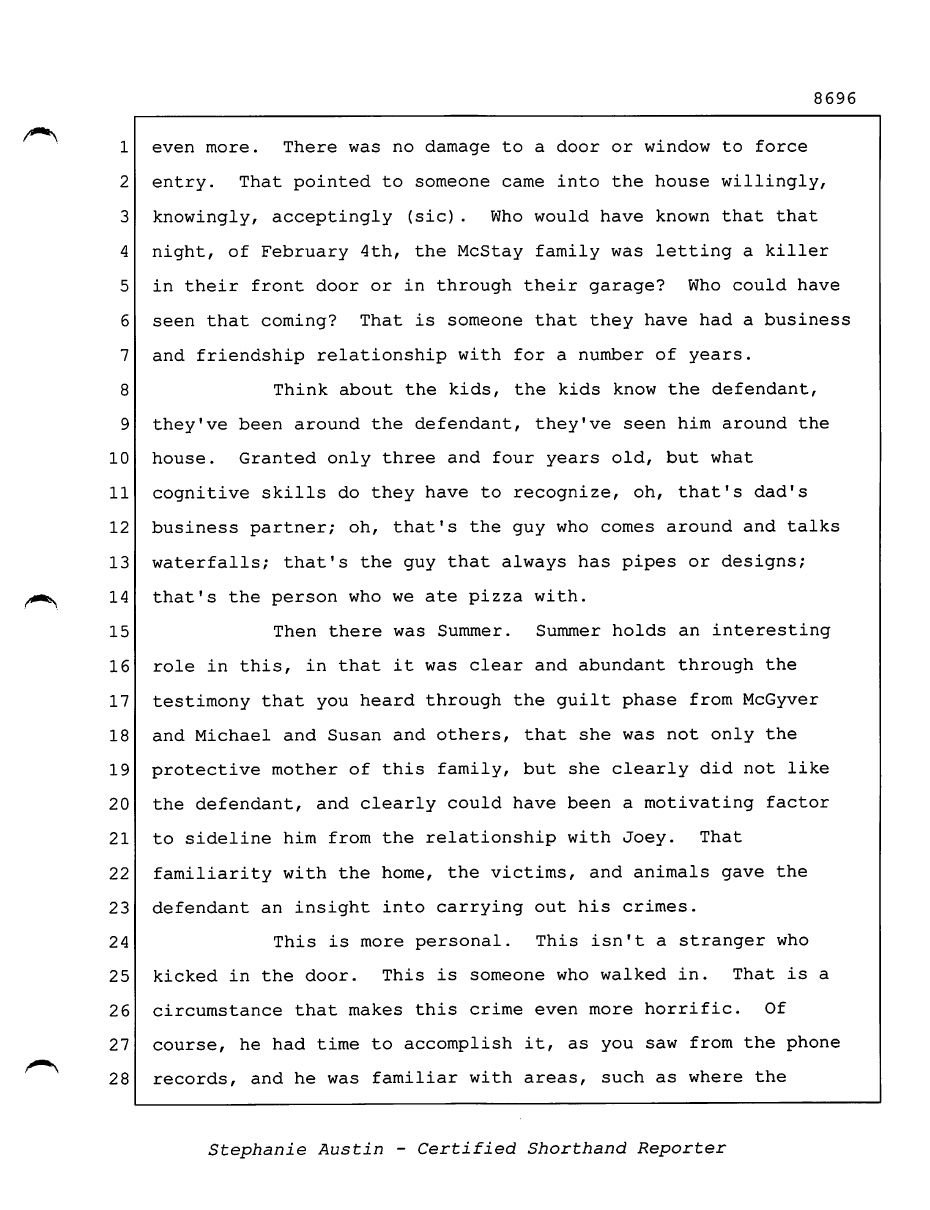
Mr. Imes: “Now, you can think about something else, that familiar face that would have been let in that door on the night of February 4th, since it wasn’t kicked in or no windows were broken, that turned into a monster of destruction, what would a mother’s instinct be? Who does she save first? Joe? “G”? Chubba?” (RT 8702:4-9)
See RT 8702
Mr. Daugherty: “Mr. Imes did a good job of describing for you brutality of what happened that night, February 4th. But your consideration in this phase of the trial is not limited to what happened February 4th. It’s not limited to the brutality of bashing someone’s skull in, bashing a child’s skull in and another child’s skull in, of beating Summer so bad that her skull was in multiple pieces. It’s not limited to that. Because the brutality of what happened that night continues to right now this day.” (RT 8710:20-28)
See RT 8710
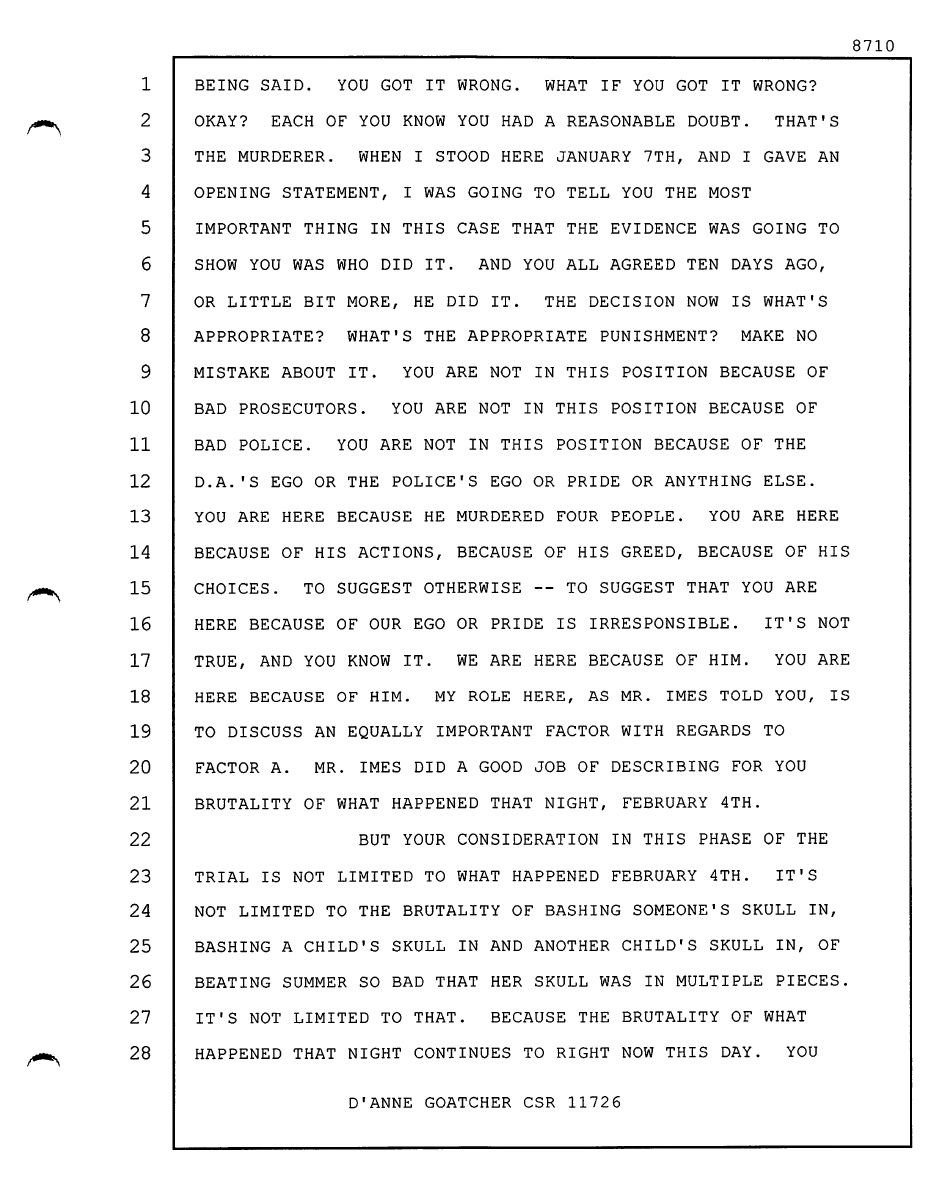
Mr. Daugherty’s own words, “not limited to what happened February 4th,” confirm that February 4 was the fixed point he was arguing from.
Mr. Daugherty: “What was going through her mind in that moment when he entered their house and started this evil, evil act?” (RT 8714:1-3) And: “Those two little boys who didn’t know fear and didn’t know to be scared and didn’t know pain and didn’t know hurt until he showed up at their door. They didn’t know any of that until that night.” (RT 8715:8-11)
See RT 8714 and 8715
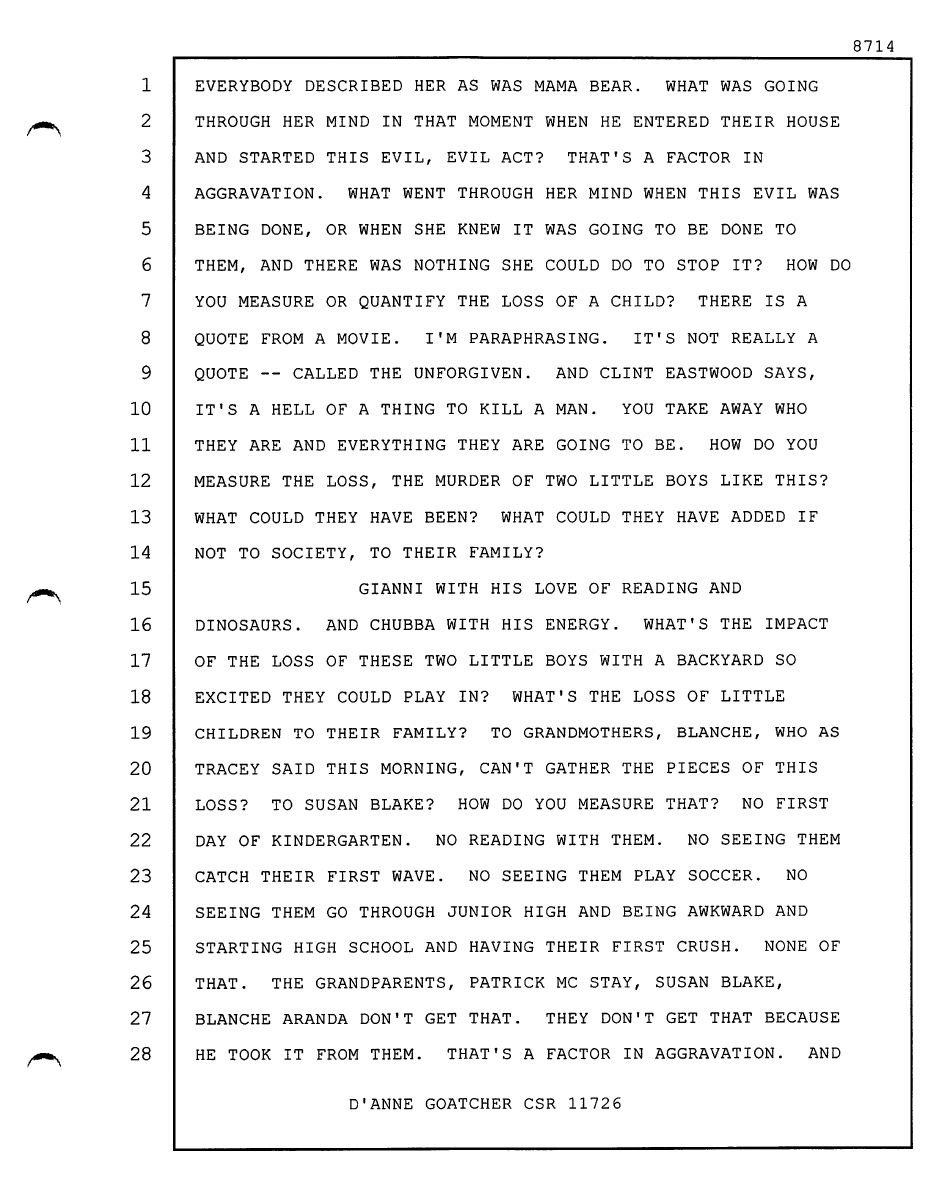

What that choice defined
The event the People chose was not just a date on a calendar. It defined the whole trial:
- what my alibi had to answer, and how far it reached
- the truck identification, and the two experts my lawyers brought in to answer it
- the cell phone evidence and the “off the grid” window
- the claimed opportunity
- the claimed confrontation over money earlier that day
- the Mitchley video at 7:47 p.m., which only matters at all if the event is the evening of February 4
The People fixed the time and the place, tried the case on them, and asked for a conviction on them. As I explain below, that is exactly the situation in which the instruction they then relied on is not supposed to be given.
Read the full record: Was my phone off?Read the full record: The Mitchley video↑ Back to the menu2. What the judge said the evidence showed
At the instruction conference on May 20, 2019, outside the jury, Mr. Imes asked the court to keep a paragraph in the alibi instruction that would have let the jury convict me even if I was not there, as long as I had helped someone else. He gave his reason:
“Here, the specific language of 3400 is pretty decisive in saying presence and I think it would be very misleading to the jury, given the way the first paragraph is listed — the People must prove that the defendant was present and committed the crime. And here, if the People do argue that he could have easily had an accomplice and the jury could easily believe he had an accomplice or a co-conspirator, then we don’t have to prove — you know, we must not prove that he was present because we can —”
(RT 7773:4-13)
See RT 7773
The People were asking to be excused from proving I was there. As I see it, being present at a crime means being there at its time and place, so Mr. Imes was telling the court that, without that paragraph, the People had to prove where I was and when. The court refused, and said why:
“I think there’s evidence to argue that there was potentially more than one perpetrator, but there is no evidence, that I can think of, that would suggest the defendant was not — that the McStays were killed the evening, late night of February the 4th or into early morning hours of February 5th, but the defendant wasn’t there, but he was conspiring with someone else to do it. There’s no evidence of that. And all of the People’s evidence is that clearly that the defendant is the perpetrator, or, at least, one of the perpetrators.”
(RT 7774:20-28)
See RT 7774
And then struck the paragraph:
“But if there was any evidence to suggest — okay — he was at home with his wife and daughter, like he said he was, but this was something that he had already set up and had someone else do, then that — that paragraph would apply, but I don’t see any evidence to support that. So the Court will strike the third paragraph.”
(RT 7775:28-7776:5)
See RT 7775 and 7776
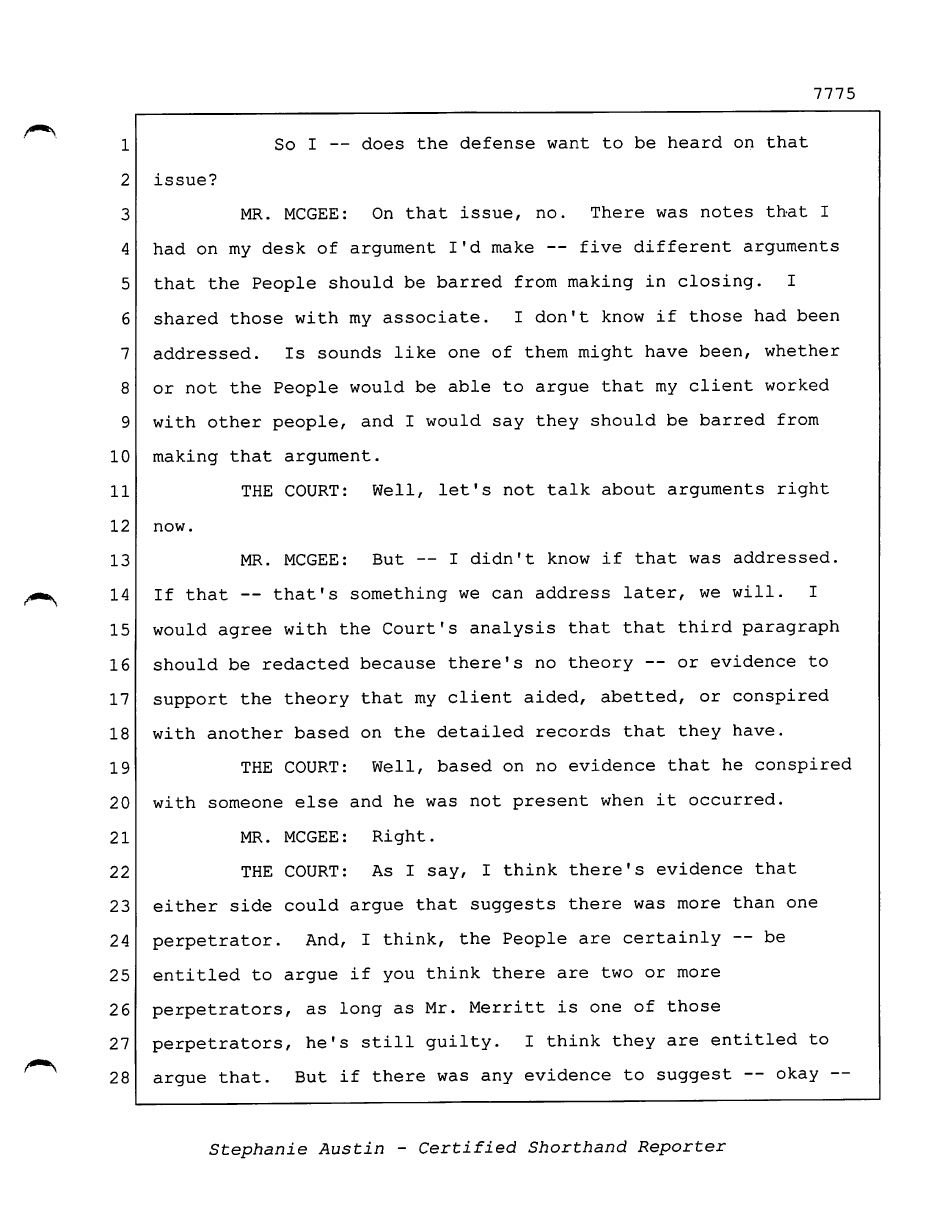
The paragraph the court struck said, in part, that the defendant could be guilty if he aided and abetted or conspired with someone else, “then he is guilty even if he was not present when the crime was committed.”
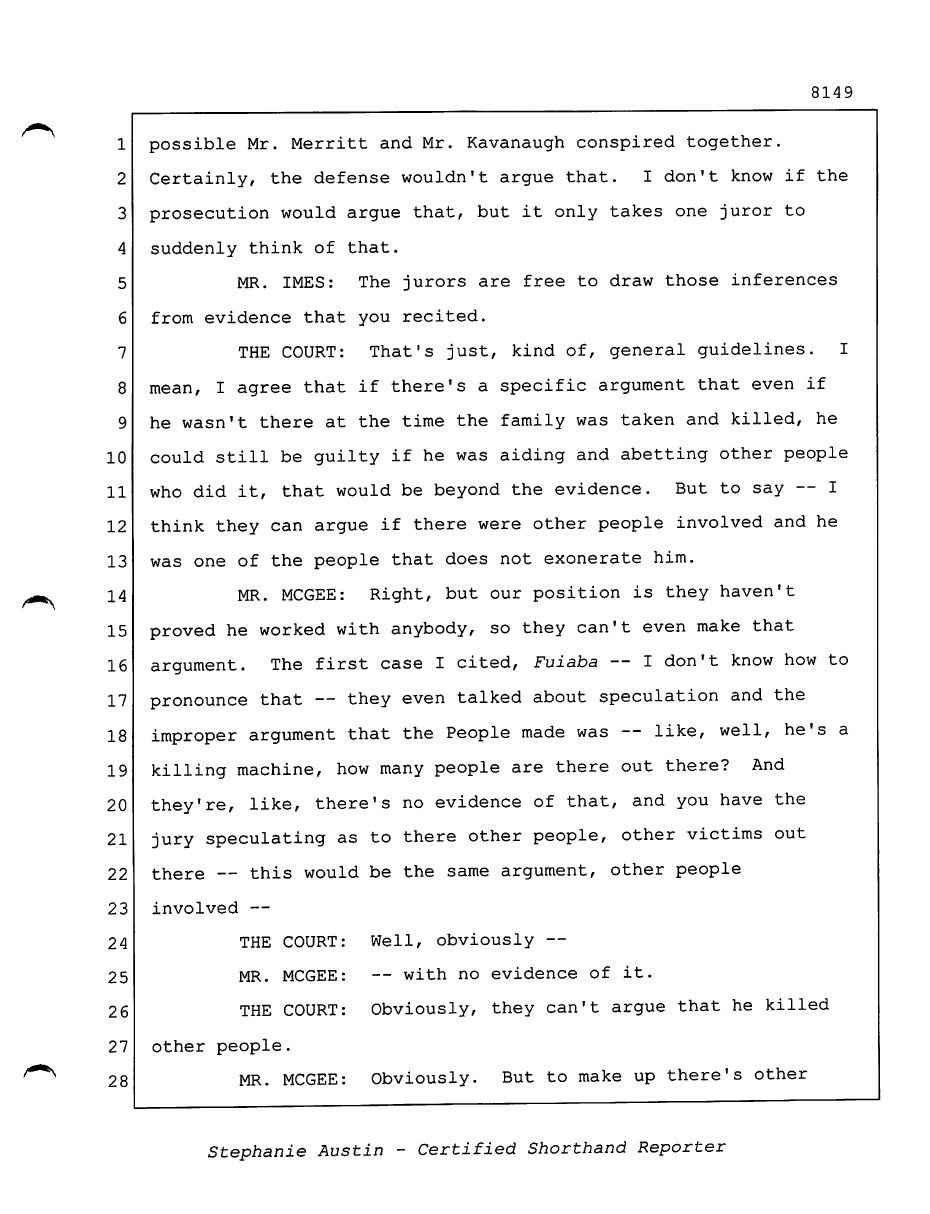
The court said it twice more four days later, on May 24. “I mean, I agree that if there’s a specific argument that even if he wasn’t there at the time the family was taken and killed, he could still be guilty if he was aiding and abetting other people who did it, that would be beyond the evidence.” (RT 8149:8-11) And: “I think an argument that, well, even if he wasn’t there when the family was taken or killed, he’s still guilty, if he aided somebody else in doing that, that would be beyond the evidence, I think.” (RT 8151:7-11)
See RT 8149 and 8151
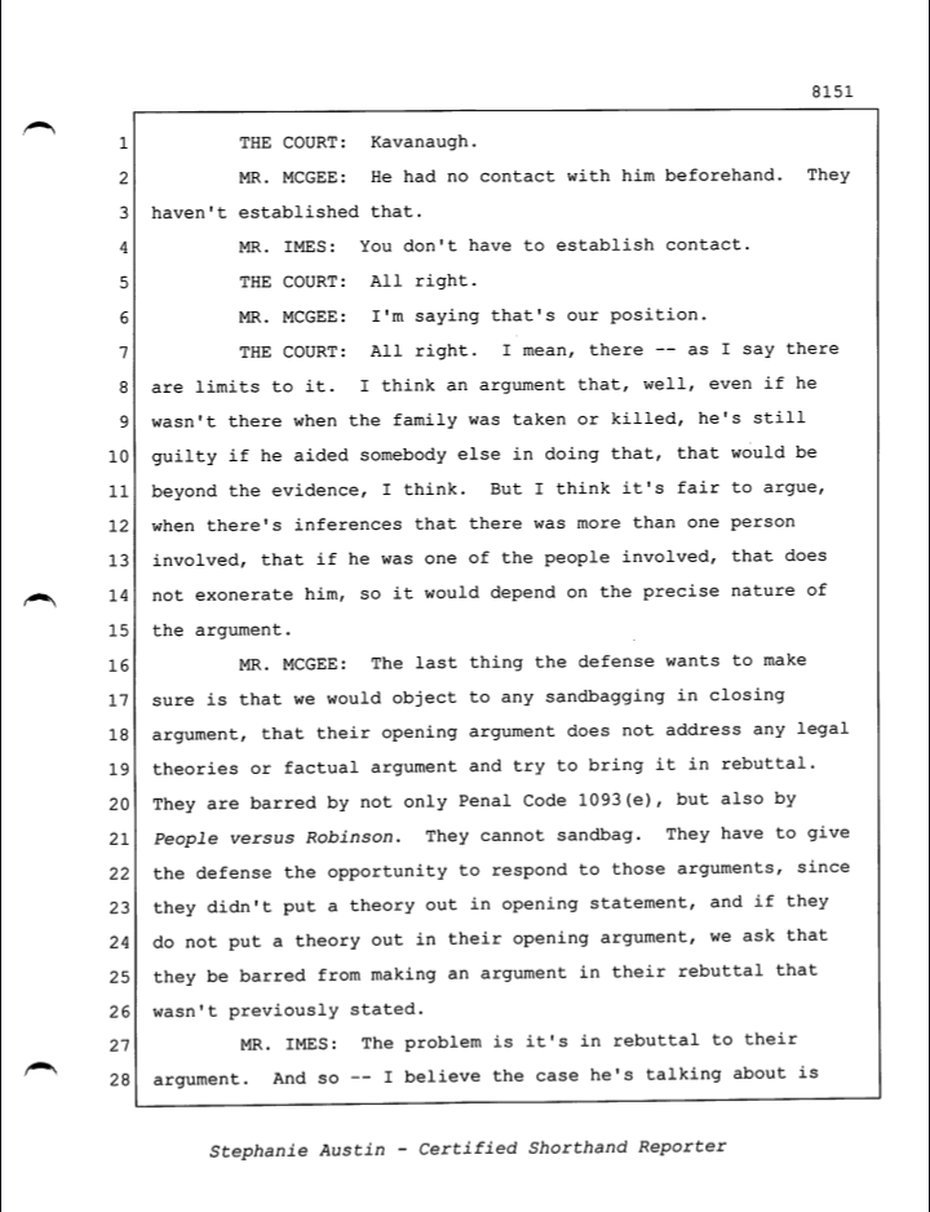
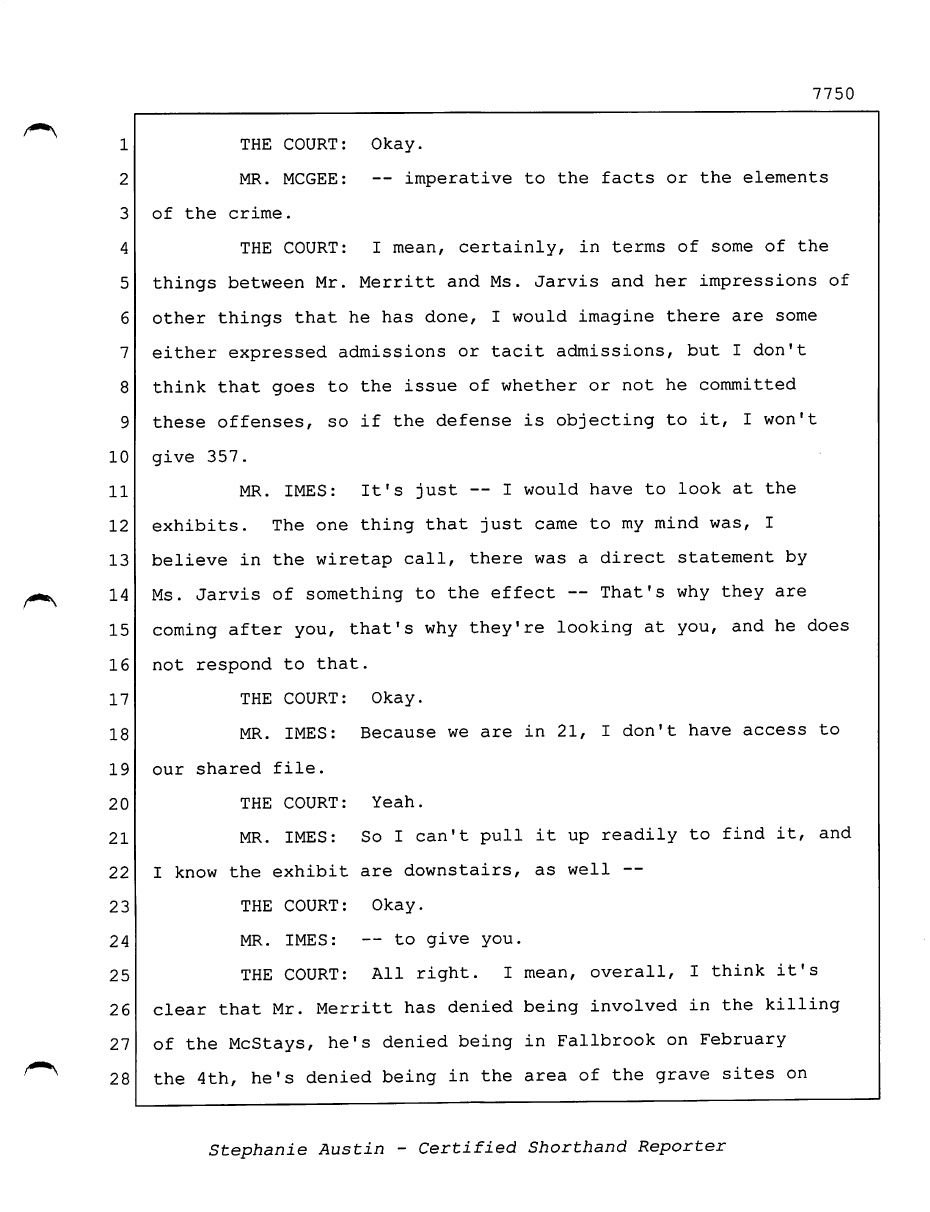
The court had also said what the real dispute was: “I mean, overall, I think it’s clear that Mr. Merritt has denied being involved in the killing of the McStays, he’s denied being in Fallbrook on February the 4th …” (RT 7750:25-28)
See RT 7750
I am not saying that being present is one of the legal elements of murder. What I am saying is narrower, and on this record it decides the matter. Under the theory the People chose and the instructions the court actually gave, my presence at the Fallbrook house on the evening of February 4 was the one fact the whole case rested on. The court struck the only other route to a guilty verdict because no evidence supported it. There was no way to convict me that did not go through my being at that house, at that time.
↑ Back to the menu3. The instructions the jury heard
CALCRIM 3400: the People must prove I was there
The court has no duty to give the alibi instruction on its own. It gives it when the defense asks and there is alibi evidence. A defendant isn’t entitled to it at all when the prosecution doesn’t rely on his being present when the crime was committed. My lawyers asked for it, and the court gave it. The court confirmed that at the hearing on the motion for new trial:
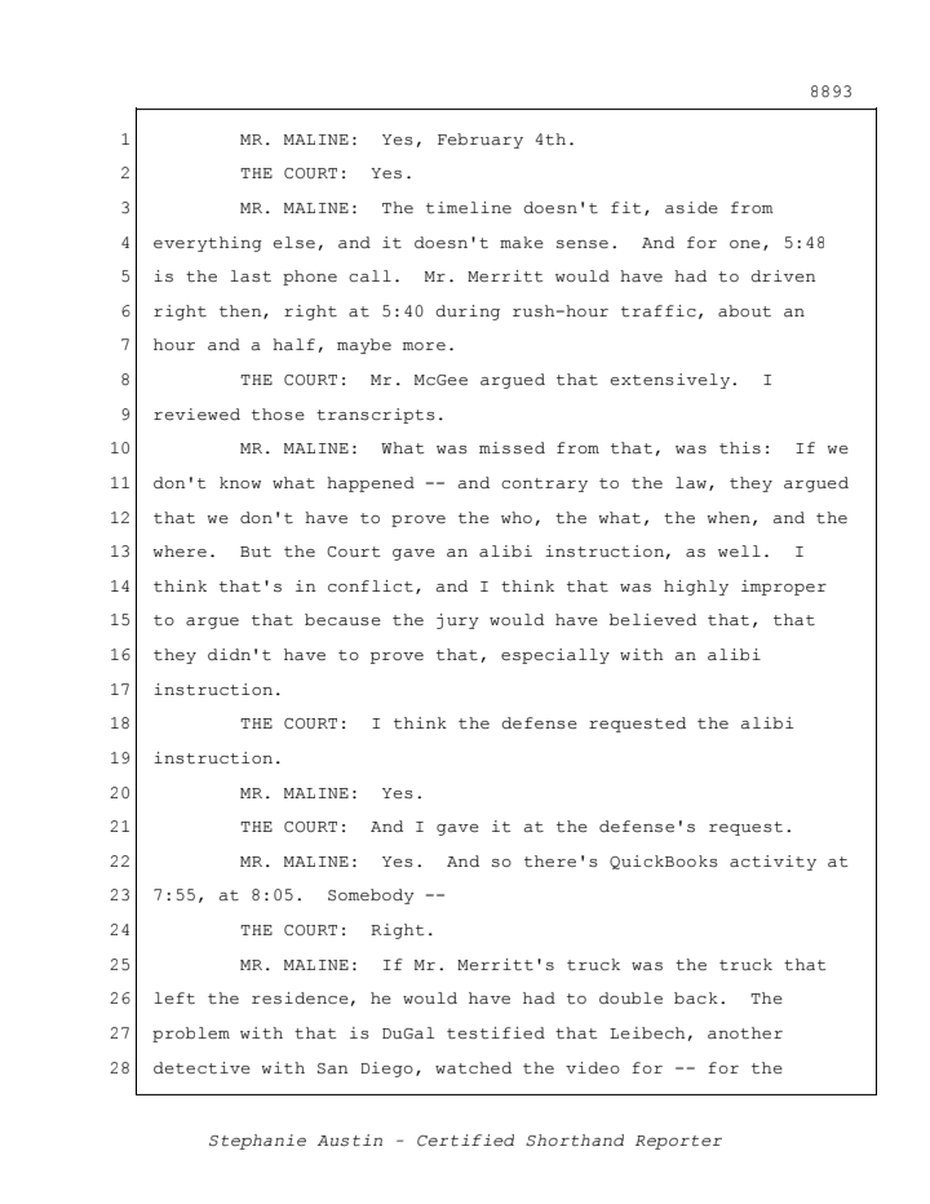
THE COURT: “I think the defense requested the alibi instruction.”
(RT 8893:18-21)
MR. MALINE: “Yes.”
THE COURT: “And I gave it at the defense’s request.”
See RT 8893
Giving it means the court agreed the People were relying on my being present when the crimes were committed. On May 28, 2019, near the end of the instructions, shortly before the closing arguments began, the judge read the jury this one:
“The People must prove that the defendant committed murder. The defendant contends that he did not commit this crime and that he was somewhere else when the crime was committed. The People must prove that the defendant was present and committed the crime with which he is charged. The defendant does not need to prove that he was elsewhere at the time of the crime. If you have a reasonable doubt about whether the defendant was present when the crime was committed, you must find him not guilty.”
(RT 8181:4-14)
See RT 8181
An alibi says the defendant was somewhere else at the time and place the crime happened. When the time and place are fixed, the instruction gives the jury a clear question to answer. When they aren’t, the instruction has nothing to test.
CALCRIM 207: “reasonably close to that day”
Earlier the same morning, the judge had read the jury this:
“It is alleged that the crime in this case occurred on or about February 4th, 2010. The People are not required to prove that the crime took place exactly on that day, but only that it happened reasonably close to that day.”
(RT 8160:24-28)
See RT 8160
CALCRIM 200: apply the instructions that fit the facts
And this, near the start:
“Some of the instructions that I give you now may not apply, depending upon what you find to be the facts. Do not assume that just because I give a particular instruction that I am suggesting anything about the facts. I am not. After you have decided what the facts are, then follow the instructions that do apply to the facts as you determine the facts to be.”
(RT 8159:6-13)
See RT 8159

Why CALCRIM 207 should not have been given
The Judicial Council’s own Bench Notes to CALCRIM 207, under “Instructional Duty,” say it plainly. Relying on People v. Jennings (1991) 53 Cal.3d 334, 358-359; People v. Jones (1973) 9 Cal.3d 546, 557; People v. Barney (1983) 143 Cal.App.3d 490, 497-498; People v. Gavin (1971) 21 Cal.App.3d 408, 415-416; and People v. Deletto (1983) 147 Cal.App.3d 458, 474-475, they state:
“This instruction should not be given: (1) when the evidence demonstrates that the offense was committed at a specific time and place and the defendant has presented a defense of alibi or lack of opportunity; or (2) when two similar offenses are charged in separate counts.”
The Notes also say the court has no duty to give it on its own.
The first situation the Note describes has two parts, and both were present here. The People’s evidence showed a specific time and place: the Fallbrook house, between 5:48 p.m. and 9:32 p.m. on February 4, 2010. They chose it at the preliminary hearing and kept it through the penalty phase. And I presented a defense of alibi and lack of opportunity to that event, which the court itself confirmed by giving CALCRIM 3400 when my lawyers asked for it.
The State could say its theory of a time and place is not the same as evidence that “demonstrates” one. The court answered that itself. Before instructing the jury, it found that “all of the People’s evidence is that clearly that the defendant is the perpetrator” and that there was no evidence the McStays were killed that evening “but the defendant wasn’t there” (RT 7774:20-28). After the verdict, it used the same window and the same house to reject my alibi (RT 8944:24-25; 8945:13-22, section 7 below).
See RT 7774
No party asked for CALCRIM 207 on the record, and nothing required it. The court raised it on its own as a “standard” instruction. My lawyers submitted, and the prosecutors said nothing. Giving it was the court’s choice, of an instruction its own authorities said not to give.
The court knew it was in dispute and gave it anyway
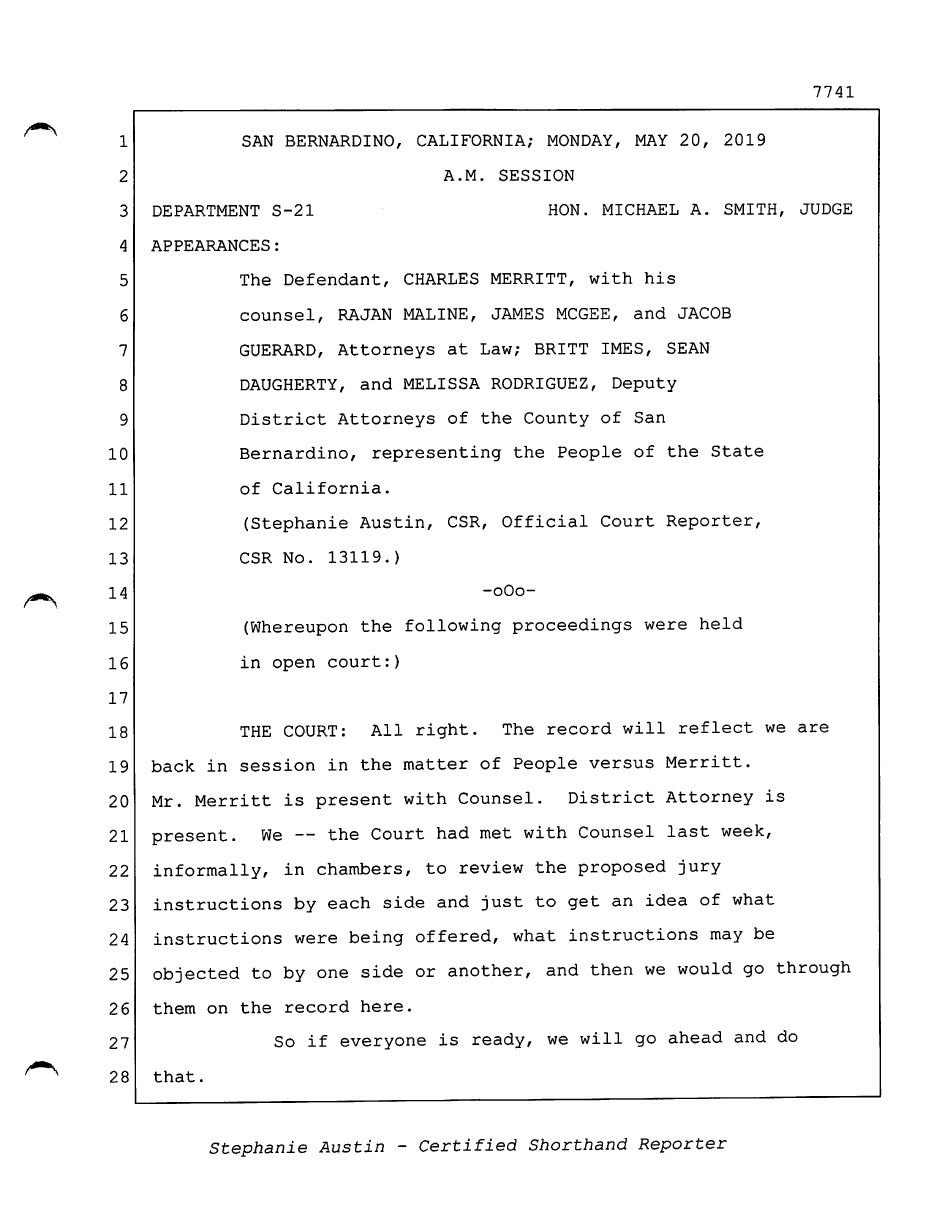
CALCRIM 207 was not overlooked. The week before, the court had met with counsel informally in chambers “to review the proposed jury instructions by each side and just to get an idea of what instructions were being offered, what instructions may be objected to by one side or another” (RT 7741:21-25). At the conference on May 20, 2019, outside the jury, the court raised 207 on that basis:
See RT 7741
THE COURT: “I understand there — there is some instructions that Counsel wanted to be heard on, so when we get to those, just indicate that you want to be heard on those and we will address those. So we have the standard introductory instructions — all of these are CALCRIM instructions. So we have CALCRIM 200, 201, 202. CALCRIM 207, I understand Counsel wanted to be heard on that issue? 207 is having to do with — it’s the introductory instruction that — it is alleged the crime occurred on or about February 4th. The People are not required that the crime took place exactly on that date, but only that it happened reasonably close to that date.”
(RT 7742:3-21)
MR. MCGEE: “I did not —”
MR. MALINE: “We talk —”
(Discussion between defense counsel.)
MR. MCGEE: “No, we will submit.”
THE COURT: “Okay. So the Court will give that standard instruction. I understand there may be evidence issues that affect that, but I don’t think it affects the instruction. So we will give 207.”
See RT 7742
Three things stand out.
First, the court itself identified 207 as an instruction counsel had asked to be heard on. The problem was known before the court ruled.
Second, Mr. McGee began to speak, “I did not —”, was interrupted by Mr. Maline, and after a conference off the record, he submitted. Whatever was said in that conference is not in the record.
Third, the court announced its ruling first, then mentioned the evidence problem, then waved it off: “I understand there may be evidence issues that affect that, but I don’t think it affects the instruction.” Under the Bench Notes, that is backwards. The instruction depends on the evidence. It is not to be given when the evidence demonstrates a specific time and place and the defense is alibi. The court named the right question and then reasoned past it.
Two rulings, one standard for each side
At the same conference, minutes apart, the court struck the aiding-and-abetting paragraph because “I don’t see any evidence to support that” (RT 7776:3-5). It gave CALCRIM 207 even though “there may be evidence issues that affect that” (RT 7742:19-20).
See RT 7776 and 7742
The instruction that would have widened the People’s theory beyond my being there was refused for lack of evidence. The instruction that excused the People from proving when their chosen event happened was given in spite of a known problem with the evidence. Evidence was required for one and excused for the other.
What 207 did in this case
In a case where the prosecution hasn’t fixed an event and no alibi is presented, CALCRIM 207 does no harm. This was not that case.
Here, CALCRIM 3400 tied the jury to the event the People alleged and tried. CALCRIM 207 cut it loose by allowing a conviction at some other time “reasonably close” to February 4. The jury could only give 207 any effect by letting the event move away from the People’s own theory. And once it moved, CALCRIM 3400 no longer tested the alibi I actually presented.
Someone reading the two instructions side by side, in the abstract, could square them: find the crime happened reasonably close to February 4, and still require proof that I was present. That answers nothing. A jury does not decide a case in the abstract. It decides it on the evidence in front of it, and the question is what this jury was actually allowed to do with these instructions on this evidence. Every piece of evidence offered to put me at the crime was tied to one event, the McStay house on the evening of February 4. The People offered no evidence of any other event, and nothing placing me anywhere else the family might have been. As Mr. McGee told the court at the close of the People’s case, “If it happened on any other day, they can’t put our client anywhere near the home.” (RT 4991:9-10) So once the jury was told the date could move and that when and where did not have to be proved, the only way left to find me “present” was to assume it. To follow 3400, the jury had to decide whether I was present at the event the People chose. To follow 207 the way the prosecutor told them to, the jury only had to decide that the People did not need to prove the event they had chosen and tried.
This was not about whether the crime happened at 8:00 or 8:30 within the People’s own window. As the prosecutor explained it to the jury, it let them drop the evening of February 4 altogether and convict on some other event that was never identified, never proved, and never answered by my defense.
That isn’t hypothetical on this record. The judge himself stretched the possible taking into the early morning of February 5, while also finding there was “no answer” to when and where the killings happened (section 7 below). A jury following 207 could put the crimes anywhere in that stretch. I cannot prove I was absent from an event that was never identified.
CALCRIM 200 told the jurors how to handle that. In the judge’s words, “Some of the instructions that I give you now may not apply, depending upon what you find to be the facts,” and “After you have decided what the facts are, then follow the instructions that do apply to the facts as you determine the facts to be.” (RT 8159:6-13) The jurors decided which instructions applied. That is the mechanism. Nothing told them that 207 could not be used to avoid deciding whether I was there. A juror who believed the prosecutor that no particular time or place had to be proved could decide that CALCRIM 3400, which turns on where I was “at the time of the crime,” didn’t apply to the facts as he found them, and set it aside. CALCRIM 200 is a standard instruction and I don’t claim it is unlawful. The error was giving 207 and then using it. CALCRIM 200 didn’t cure that. It opened the door for jurors to put the alibi instruction aside, and Mr. Imes walked them to it three times.
See RT 8159
No one has to show which instruction each juror privately followed. The record shows the route that was opened, who opened it, and that the prosecutor pointed the jury down it. That is the error.
My lawyer raised exactly this harm at the motion for new trial (section 7 below), and the court’s only answer was that the defense had asked for 3400.
Whether the two instructions can be read together or not, the result is the same. If they can be read together, it was only by the jury choosing between them, and the prosecutor told them which to choose. If they can’t, a correct instruction does not automatically cure a contradictory one, and no one can say which one the jury followed (Francis v. Franklin (1985) 471 U.S. 307, 318-322). Either way, the jury was never required to decide whether the People proved the event they chose.
↑ Back to the menu4. What Mr. Imes told the jury
Normally the answer to two instructions that pull in different directions is that jurors are presumed to follow the instructions as a whole and apply the correct law. That presumption works when there’s no evidence of how the jury resolved the conflict. Here the jury was told which one controlled.
On May 28, 2019, in front of the jury, about twenty minutes after the judge read CALCRIM 207 and minutes after he read CALCRIM 3400, Mr. Imes opened his closing argument with it:
“Ladies and gentlemen, what this case tells you — it shows you, there’s four counts of first degree murder. There is no other reasonable conclusion to the evidence I’m about to discuss with you. One thing I need to point out to you, though, is that this crime is limited to those elements. It does not require us to prove where, it does not require us to prove when, and it does not require us to prove how. You can have a murder case without answering those questions. You can have a murder case without even a body.”
(RT 8183:3-11)
See RT 8183
He came back to it, and tied it to the instructions the judge had just read:
“Remember back to the very beginning of my closing argument, and Judge reading the jury instructions to you, there was nothing in the elements of the crime that said I had to prove where it happened. Is it informative as to who did it? Sure. But to ignore the evidence connecting the graves to the house, and to claim that you can’t prove that a murder happened in that house is not an honest representation of the evidence that was found there.”
(RT 8240:22-8241:1)
See RT 8240 and 8241

And near the end:
“Remember, we don’t have to prove when this occurred, how this occurred or where this occurred. Just that the defendant did it.”
(RT 8269:16-18)
See RT 8269
That was three times. It wasn’t argument about how much weight to give the evidence. It was the State telling the jury which of the court’s instructions controlled, and pointing to the instructions to do it.
It was also the very position the court had already rejected. When Mr. Imes asked to keep the aiding-and-abetting paragraph so that the People “must not prove that he was present,” the court refused and struck the paragraph as unsupported by any evidence (RT 7773:4-13; 7775:28-7776:5). Eight days later, Mr. Imes told the jury the People did not need to prove where or when. The words were different from the paragraph the court struck, but they led to the same place: a conviction without proof that I was present at the event the People chose.
See RT 7773, 7775 and 7776
And it was worse than that. Mr. Imes did not just tell the jury that a little uncertainty about the minute didn’t matter. He told them they did not have to decide whether the People had proved the event they had chosen themselves and tried, the event my defense had prepared for and answered.
In the same closing, he claimed the very place he said he didn’t have to prove. Within one breath at RT 8240-8241 he told the jury the People did not have to prove where, and that claiming “you can’t prove that a murder happened in that house is not an honest representation of the evidence that was found there.” Twenty-seven pages earlier he had told them, “when you look at them in their totality, it shows that it was the defendant at the McStay house that night.” (RT 8213:20-21) And thirty-five pages later he closed with “the murder of the first person in that house.” (RT 8275:1-3)
See RT 8240, 8241, 8213 and 8275
In the People’s opening, Mr. Daugherty told the jury there would be unanswered questions: “We can’t answer all of the questions.” (RT 1657:5) The question he left open was whether someone helped. On the how, he promised an answer: “We can tell you the how, we can tell you the why, we can tell you the who.” (RT 1657:13-14) And: “The how is that they were beaten about the head and face until they died, and then they were taken 100 miles away from their home.” (RT 1631:2-5)
See RT 1657 and 1631
The People never formally changed the event. They never asked to amend the charge to allege a different or broader event, never asked to change the theory the case was tried on, and never argued to the jury that the murders happened at any time or place other than the Fallbrook house on the evening of February 4. The only thing that widened what the jury could convict on was the instruction, and the prosecutor’s description of it. The People never asked to change their theory. The instruction and the argument changed it for them, after my defense had been built and presented against the one they chose.
No one from the defense objected at RT 8183, 8240 or 8269, and the court said nothing to correct it.
Then they told the jury not to take any fact by itself
CALCRIM 3400 is an instruction about a single fact. It takes one question, whether I was present when the crime was committed, and tells the jury that a reasonable doubt about that one question requires a verdict of not guilty:
“If you have a reasonable doubt about whether the defendant was present when the crime was committed, you must find him not guilty.”
(RT 8181:12-14)
See RT 8181
The circumstantial evidence instruction, CALCRIM 224, which the judge read to the jury the same morning, said the same thing for every fact a guilty verdict depended on. It also told the jury what to do when the evidence could be read two ways:
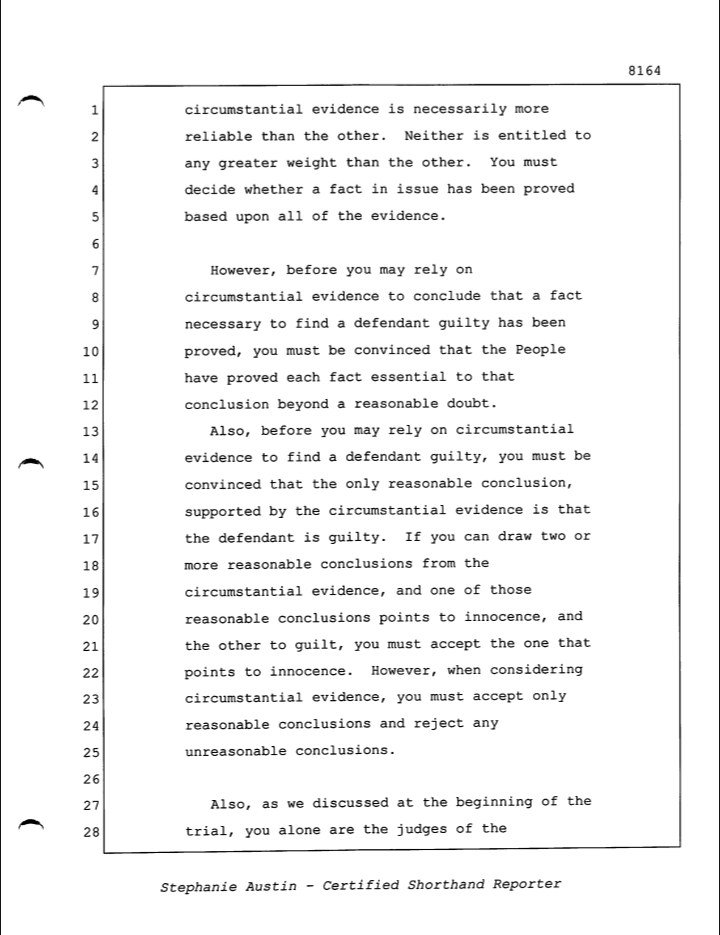
“However, before you may rely on circumstantial evidence to conclude that a fact necessary to find a defendant guilty has been proved, you must be convinced that the People have proved each fact essential to that conclusion beyond a reasonable doubt. Also, before you may rely on circumstantial evidence to find a defendant guilty, you must be convinced that the only reasonable conclusion, supported by the circumstantial evidence is that the defendant is guilty. If you can draw two or more reasonable conclusions from the circumstantial evidence, and one of those reasonable conclusions points to innocence, and the other to guilt, you must accept the one that points to innocence. However, when considering circumstantial evidence, you must accept only reasonable conclusions and reject any unreasonable conclusions.”
(RT 8164:7-25)
See RT 8164
None of that meant the jury had to ignore the rest of the evidence when it decided whether I was there. The People were free to argue that the money, the phones or anything else showed I was at the house. What CALCRIM 3400 settled was what came after that. If the jury still had a reasonable doubt that I was present, the instruction said they “must find him not guilty,” no matter how much other evidence there was.
Mr. Imes told the jury something very different. A few minutes after he told them the People didn’t have to prove where or when, he said this:
“He was a man with a means, a motive, and an opportunity. To understand the context of why a man so self-centered, so greedy, would kill someone, and to kill two young children, you must have context to all the surrounding evidence. That context gives you understanding. You must look to the circumstances of everything that happened in this case to understand the who, the what, and the why. You can’t just look at one thing in isolation. It is one big piece of collective evidence. You must look to the totality of the circumstances surrounding the murders to understand the defendant’s means, the defendant’s motive, and the defendant’s opportunity.”
(RT 8184:18-28)
See RT 8184
He went straight on:
“Because remember, as the judge just instructed you — and I’m not going to belabor the point of showing you the whole instruction and reading it to you again — circumstantial and direct evidence is of equal weight. And you must accept only those that are reasonable conclusions and reject those that are unreasonable. And the reason I spend a moment talking about this, ladies and gentlemen, is not that I want to relive the cherry pie scenario from voir dire and Little Johnny stealing a cherry pie, but the importance of that is what we learned and, hopefully, you’ve gleaned from that, and now the law that the judge has given you, is that you cannot look at facts in isolation. A single individual fact may have two reasonable interpretations, one points to guilt, one points to innocence. And that isolated individual fact, in that scenario, you would have to accept the one that points to innocence. The problem is, ladies and gentlemen, when you’re talking about the totality of a case that spans six months of your lives, almost six months, is you cannot look at those facts in isolation. One fact, and how it’s interpreted, and what it means, can be dictated by other pieces of evidence, stuff that you may not have made those connections when you listened to them or you may have forgotten, given the fact that we have been here almost six months. The importance of a fact that you heard from Michael or Susan on day one may not have had any significance or pointed to guilt until you heard facts from David Sequieda or Carmen Garcia or Elva Fonseca, weeks, almost a month later. That is why circumstantial evidence and understanding the law and how it interacts with the facts is important. You cannot isolate an individual fact just to say the person is presumed innocent. So, because we have been here for five months, I want to walk us back through the facts, a little bit, actually in a lot of detail, to remind you of things that are important, but also to make those connections for you to understand the significance and interpretation of them that point towards the defendant being a willful, deliberate killer.”
(RT 8185:1-8186:9)
See RT 8185 and 8186
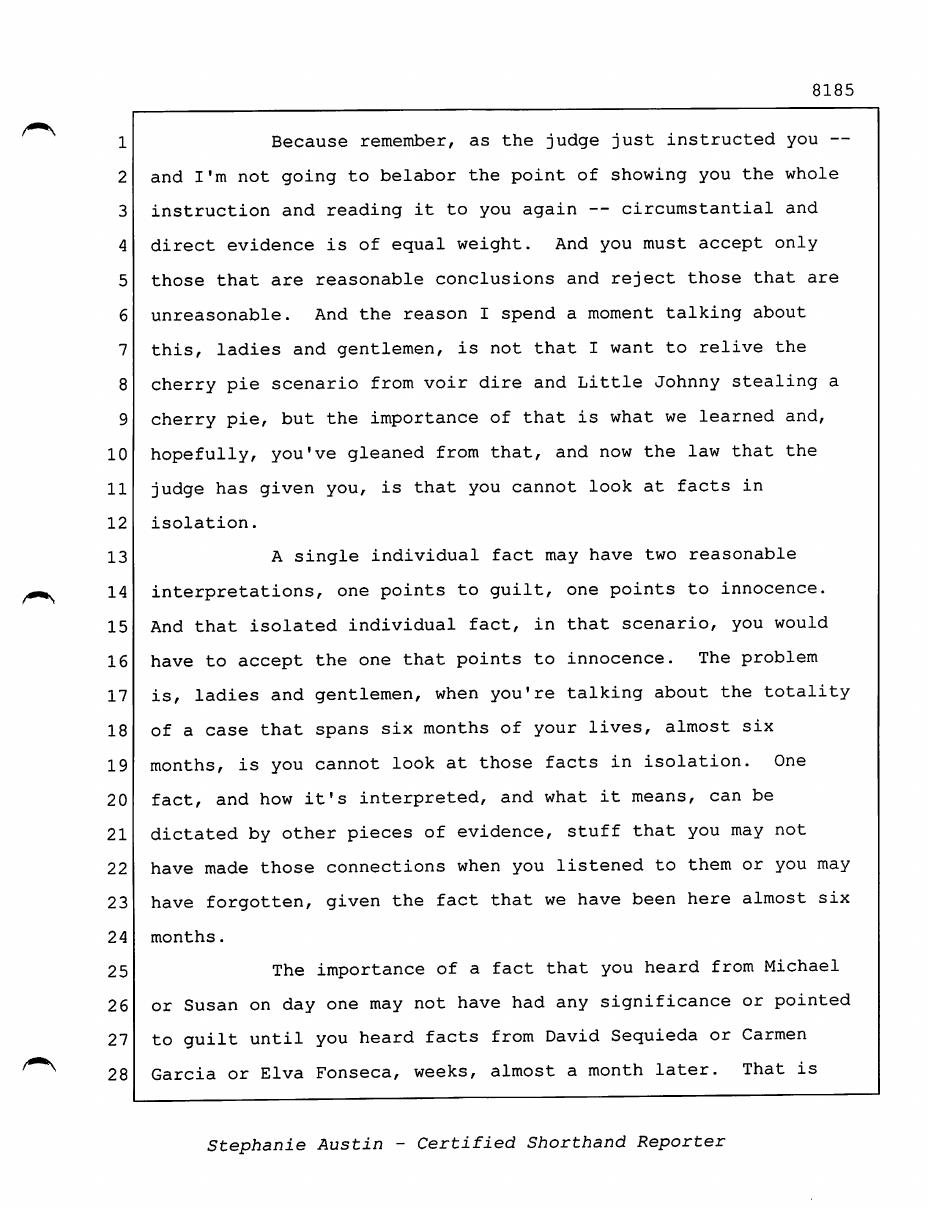
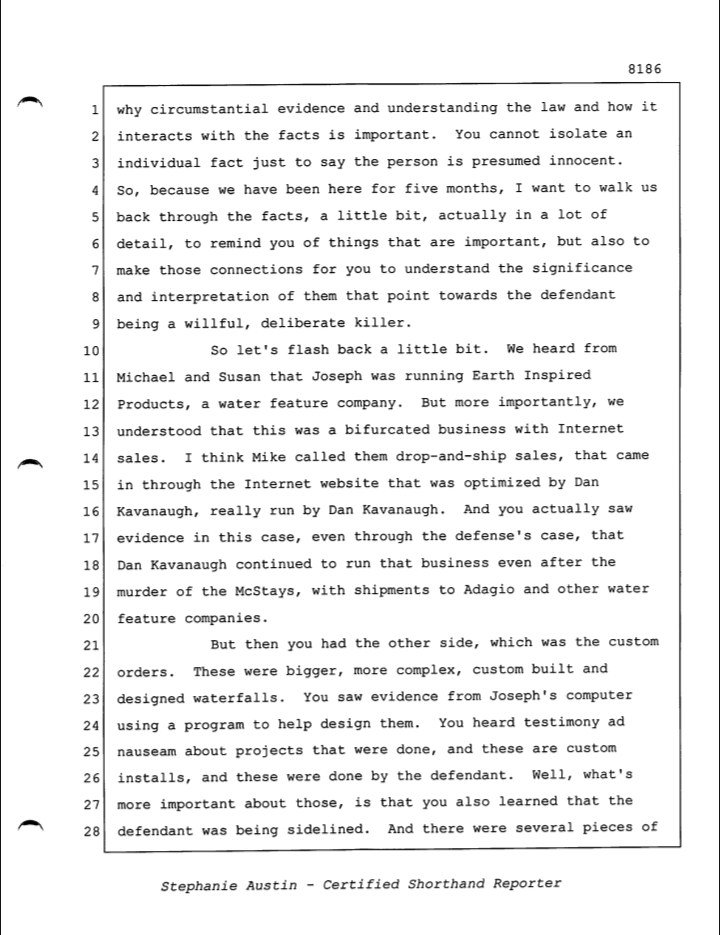
He told the jury the rule for a single fact with two reasonable readings: “you would have to accept the one that points to innocence.” Then he told them “the law that the judge has given you, is that you cannot look at facts in isolation,” and finished with “You cannot isolate an individual fact just to say the person is presumed innocent.”
The judge had told the jury what the presumption of innocence is. It isn’t something a defendant earns by pointing to a fact. It is where the jury starts:
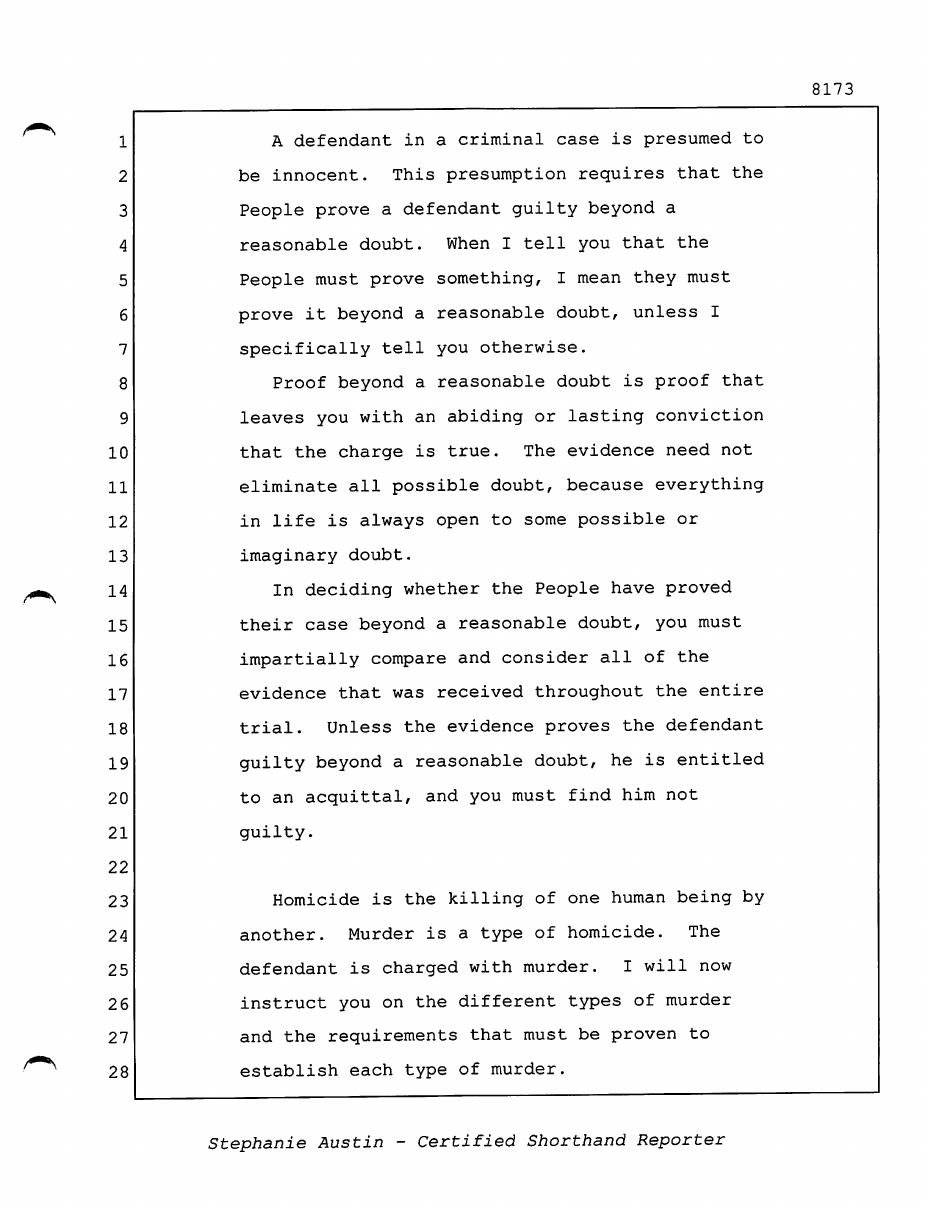
“A defendant in a criminal case is presumed to be innocent. This presumption requires that the People prove a defendant guilty beyond a reasonable doubt.”
(RT 8173:1-4)
See RT 8173
And CALCRIM 3400 told the jury that one fact, standing by itself, decided the case if the People didn’t prove it. Mr. Imes told the jury the law was that no fact could be taken by itself. This was false.
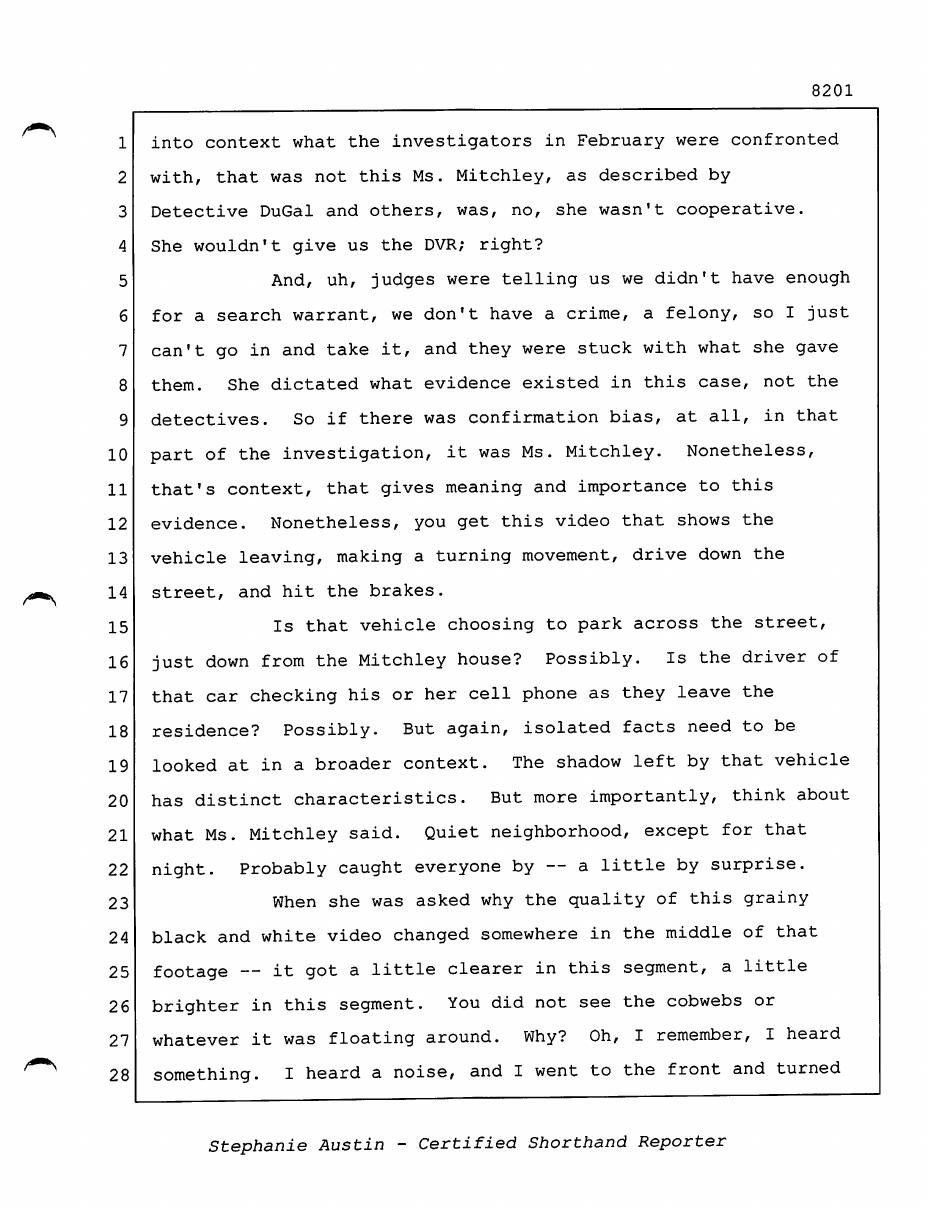
He then used it on the evening of the 4th itself. On the car in the Mitchley video, he admitted there were innocent readings, and told the jury to set them aside:
“Is that vehicle choosing to park across the street, just down from the Mitchley house? Possibly. Is the driver of that car checking his or her cell phone as they leave the residence? Possibly. But again, isolated facts need to be looked at in a broader context.”
(RT 8201:15-19)
See RT 8201
And near the end of his closing, in the breath before “Remember, we don’t have to prove when this occurred, how this occurred or where this occurred”:
“Because ultimately, ladies and gentlemen, not only does all of the facts in this case and all of the evidence in this case continue, no matter which way you look at them, continue to point back to the defendant. The only reasonable interpretation of anything that’s even borderline, the only reasonable interpretation is that it points to guilt. Because in the totality of all of that evidence, the defendant is the lynchpin to all of those pieces of evidence. It all comes back to the defendant. All of the significant pieces, all of the significant times.”
(RT 8269:6-15)
See RT 8269
CALCRIM 224 told the jury that when the evidence could reasonably be read either way, they must accept the reading that points to innocence. Mr. Imes told them that anything “even borderline” could only point to guilt.
The next day, Wednesday, May 29, Mr. Maline read CALCRIM 3400 to the jury and used it the way it is written. He took one fact, the truck in the Mitchley video, and told the jury what the instruction meant for it:
“Okay. What that reduces down to is, you have to find that Mr. Merritt was at the Fallbrook house on the 4th. That’s their case. So what that reduces down to — their theory of Mr. Merritt being at the house on the 4th comes down to the truck. Why do you think so much effort has been put on that truck? Two experts. One hired in the middle of trial by the prosecution. We got Stutchman. And then Dr. Rudin. Why, ladies and gentlemen? Because it’s that important. But it should be abundantly clear at this time that that’s not his truck. And if it’s not his truck, you can’t convict him. That’s why this jury instruction is it.”
(RT 8407:15-26)
See RT 8407
Ms. Rodriguez began the People’s rebuttal a few minutes later, that same afternoon (RT 8409:27-8410:16). The rebuttal is the last argument the jury hears, and the defense doesn’t get to answer it. Mr. Maline had just reminded the jury of that: “We don’t get to respond.” (RT 8409:22) She told them:
“And so what I want to do is to focus on the evidence. The evidence that you actually heard come from that witness stand. I also need to go over a little bit, one of the instructions, because there was an important part that was left off of it. And that’s CALCRIM 223 and 224. And the importance of that is that these instructions dictate to you the use of circumstantial evidence. And specifically to use circumstantial evidence, you must be convinced that the only reasonable conclusion is the defendant’s guilt. And what was left off is that you have to reject the unreasonable conclusions. And that’s important because you were provided with an equation, basically by the defense. Like this is some sort of mathematical equation that if you have A, and B and C, that will equal X. There is no specific equation for that. If you look at a fact and you have a fact that you determine to be unreasonable, which is what we are going to talk about, you have to reject that. You cannot accept that as a conclusion if the fact is unreasonable. And when this law was provided to you, that was specifically left off. You take all of the evidence together, the totality of it. You can’t isolate a certain fact and then reject everything from that. That’s not how it works.”
(RT 8412:1-23)
See RT 8412
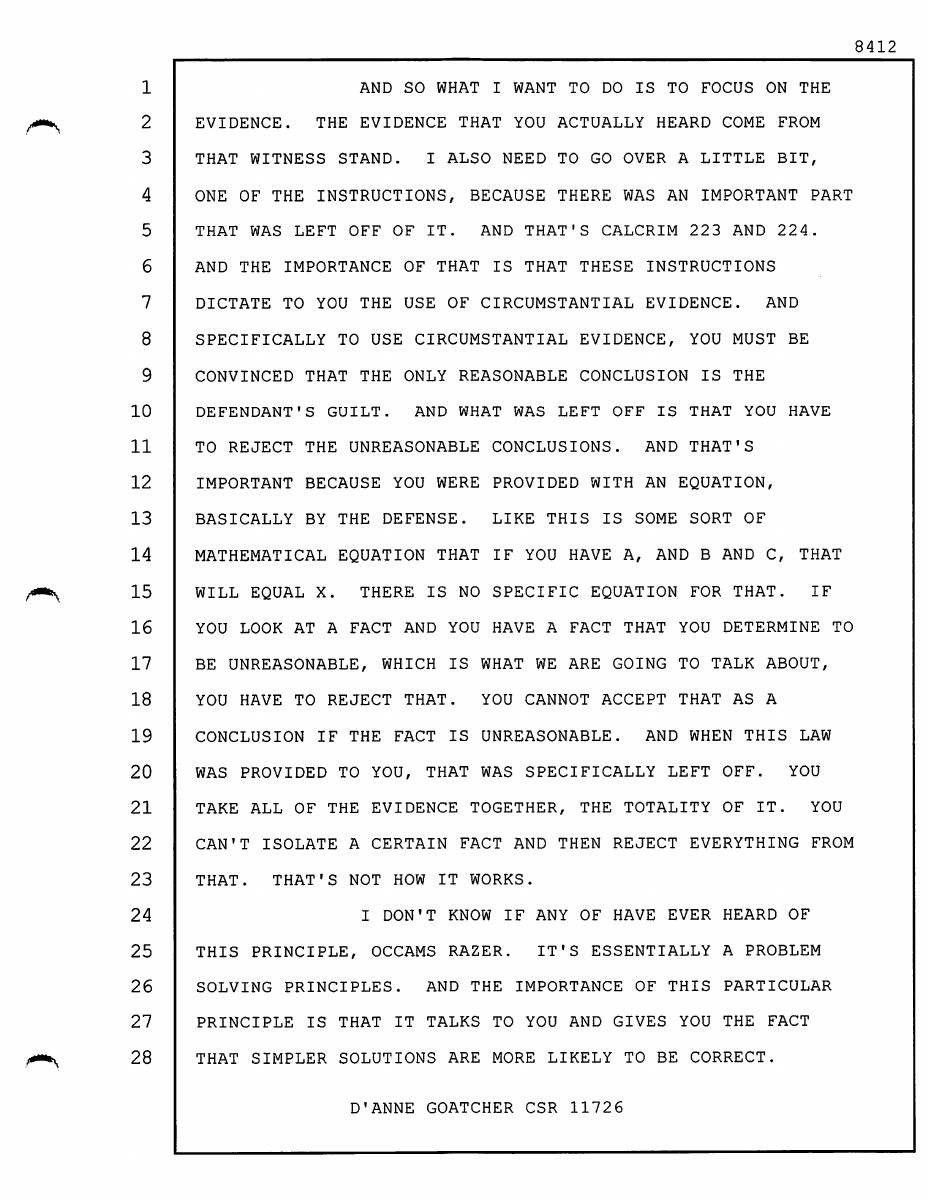
She said she was correcting CALCRIM 223 and 224 and what she called the defense’s “equation.” She didn’t name CALCRIM 3400 or Mr. Maline. But she said it minutes after Mr. Maline told the jury that if the truck wasn’t mine, 3400 meant they could not convict. As I see it, that is what she was answering, and the defense had no chance to reply.
As with CALCRIM 207, no one has to show what each juror privately did with this. The court read the jury an instruction that works by taking one fact by itself. The prosecutors then told the jury, again and again and finally in a rebuttal the defense could not answer, that no fact could be taken by itself and that anything “even borderline” pointed only to guilt. As I see it, a juror who followed the prosecutors’ description of the law had no way left to give CALCRIM 3400 any effect.
As I see it, the People knew where their case was weakest. The only evidence they had that I was present was tied to the evening of February 4, and the alibi instruction made my presence the one fact they had to prove. They felt the weight of that burden, and these arguments were meant to lighten it.
No one from the defense objected to any of these statements, and the court said nothing to correct them.
↑ Back to the menu5. The morning of February 5
The defense raised it, and the State’s investigator was not allowed to answer
My lawyers announced on the first day of evidence that the family was alive into the morning of February 5 (RT 1676:20-1677:8, quoted above).
See RT 1676 and 1677
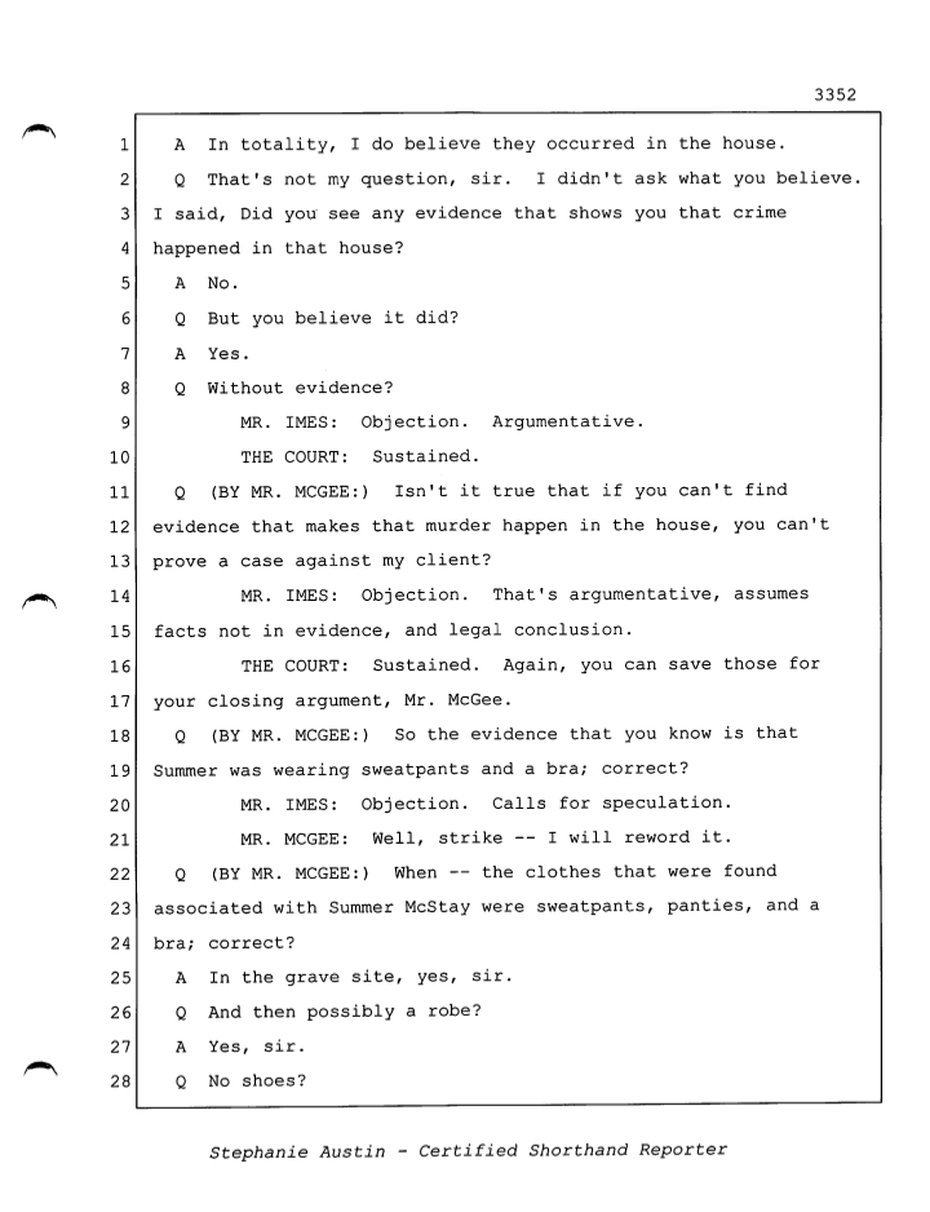
On January 29, 2019, Mr. McGee cross-examined Sergeant Joseph Steers, the San Bernardino homicide investigator who had gone back through San Diego’s investigation and the house. In front of the jury, Steers first conceded there was no evidence the murders happened in the house:
Q. “After reviewing the San Diego investigation, all their reports and photographs, and you returning to the house and doing your tests, is there anything in that house that you have found, you have read, or you have seen, that tells you those murders happened in the Fallbrook house?”
(RT 3351:22-3352:17)
A. “In totality?”
Q. “In totality, everything.”
A. “In totality, I do believe they occurred in the house.”
Q. “That’s not my question, sir. I didn’t ask what you believe. I said, Did you see any evidence that shows you that crime happened in that house?”
A. “No.”
Q. “But you believe it did?”
A. “Yes.”
Q. “Without evidence?”
MR. IMES: “Objection. Argumentative.”
THE COURT: “Sustained.”
Q. “Isn’t it true that if you can’t find evidence that makes that murder happen in the house, you can’t prove a case against my client?”
MR. IMES: “Objection. That’s argumentative, assumes facts not in evidence, and legal conclusion.”
THE COURT: “Sustained. Again, you can save those for your closing argument, Mr. McGee.”
See RT 3351 and 3352

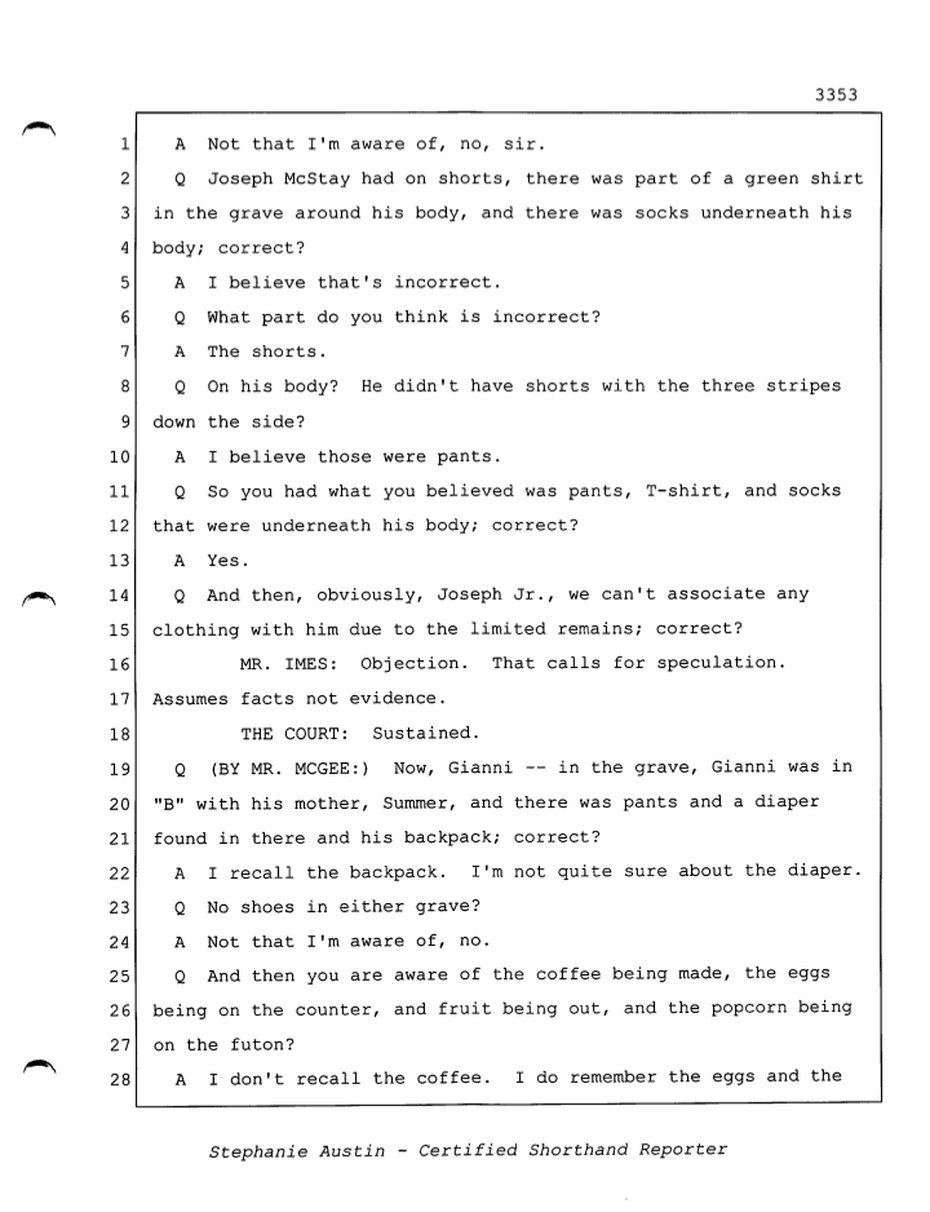
A little later, Mr. McGee asked about what the house showed:
Q. “And then you are aware of the coffee being made, the eggs being on the counter, and fruit being out, and the popcorn being on the futon?”
(RT 3353:25-3355:10)
A. “I don’t recall the coffee. I do remember the eggs and the fruit.”
Q. “Do you remember Ms. Blake telling you about the coffee on the counter when you interviewed her?”
MR. IMES: “Objection. That’s hearsay, beyond the scope, and cumulative.”
THE COURT: “Sustained as cumulative.”
Q. “If there’s eggs, coffee, and the clothes they are wearing — and you also thought that when Ms. McStay was, in any time, contacted by somebody involved in this crime, she was likely painting based on the drips you observed on her bra; correct?”
MR. IMES: “Objection. Relevance. Compound. Speculation.”
THE COURT: “Sustained as calling for speculation and conclusion.”
Q. “Doesn’t it all make sense to you that this probably happened in the morning?”
MR. IMES: “Objection. Calls for speculation.”
THE COURT: “Sustained.”
Q. “You are an experienced homicide detective; correct?”
A. “Yes, sir.”
Q. “And you are bringing your expertise to look at this evidence and see what you can deduce from the physical evidence; correct?”
A. “Yes, sir.”
Q. “And based on that, you had to direct your investigation?”
A. “Yes, sir.”
Q. “Now, were you the case agent?”
A. “No, sir.”
Q. “I wasn’t sure. You had to evaluate the evidence to see which direction to go; right?”
A. “Yes, sir.”
Q. “Doesn’t the evidence of what was — how the house was left, point to that this happening in the morning?”
MR. IMES: “Objection. Calls for speculation.”
THE COURT: “Sustained.”
MR. MCGEE: “One second, your Honor. I don’t have anything further of the witness.”
See RT 3353, 3354 and 3355
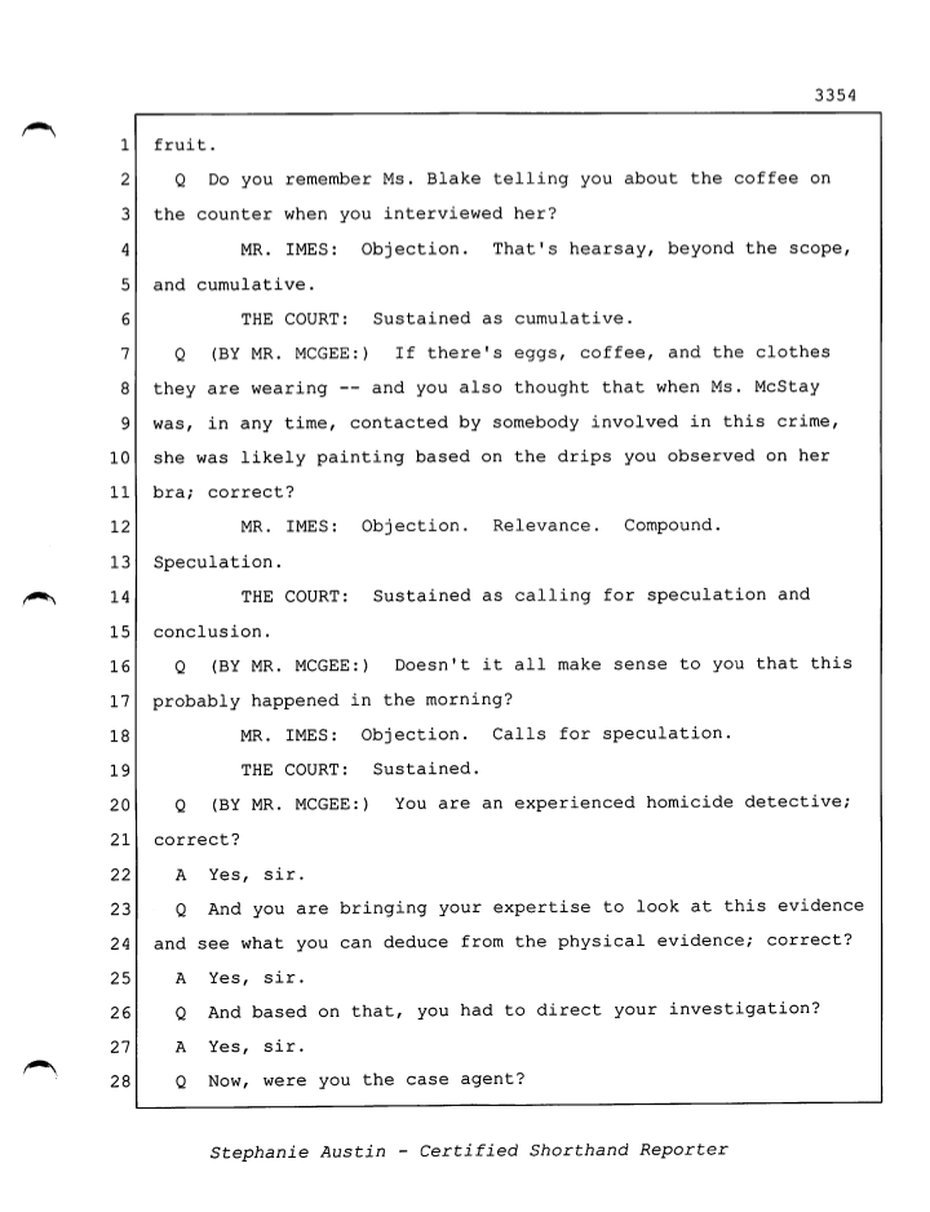
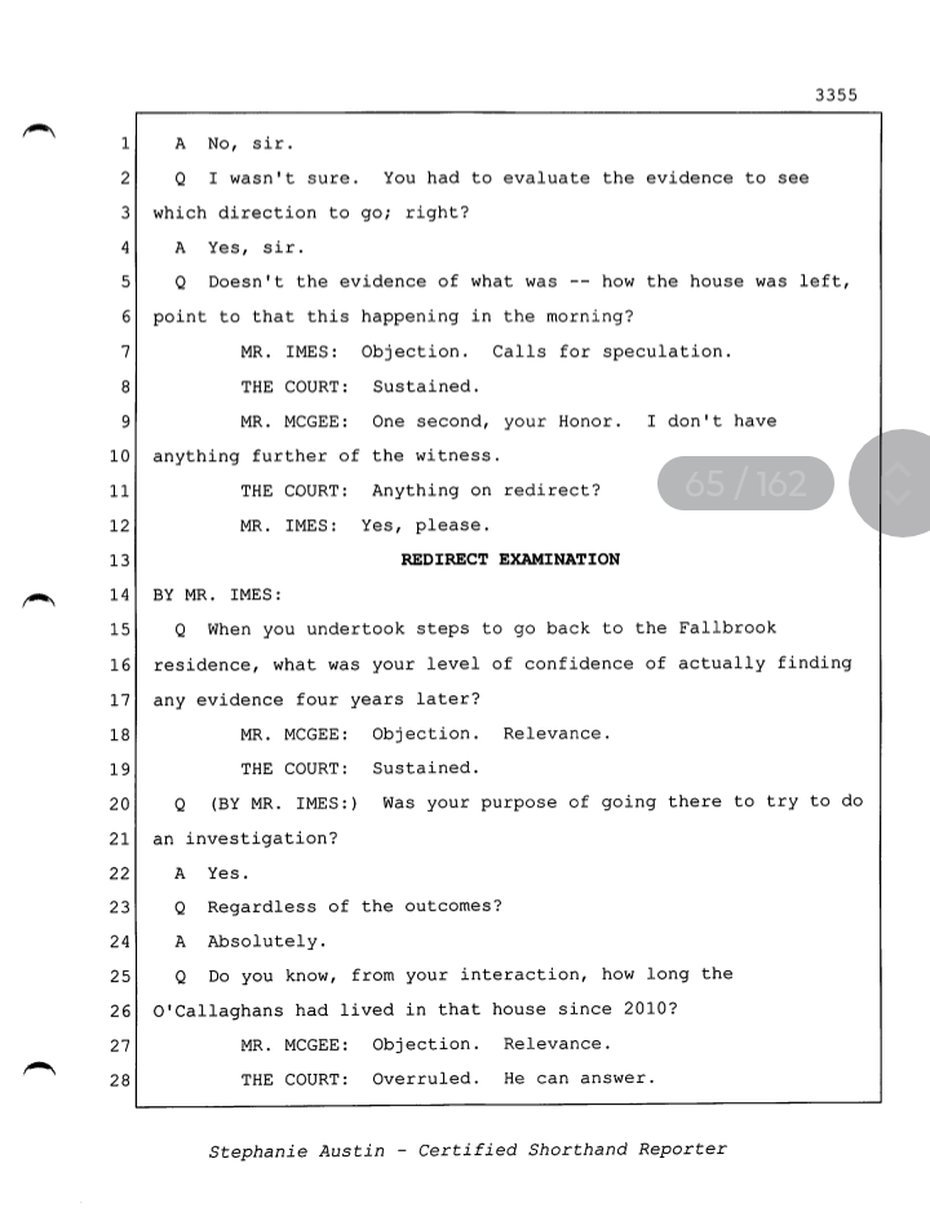
Mr. McGee established, three times, that this was an experienced homicide investigator whose job was to draw conclusions from the physical evidence and direct the investigation by them. Then he asked the question again in the terms the witness had just agreed to, and the objection was sustained again. Moments earlier, Sergeant Steers had been allowed to tell the jury his belief that the murders occurred in the house, with no evidence behind it, as he admitted. The questions that would have drawn a conclusion about the morning of February 5 from the physical evidence were all sustained as speculation. Mr. McGee then ended his examination without making an offer of proof, so the record does not say what Sergeant Steers would have answered.
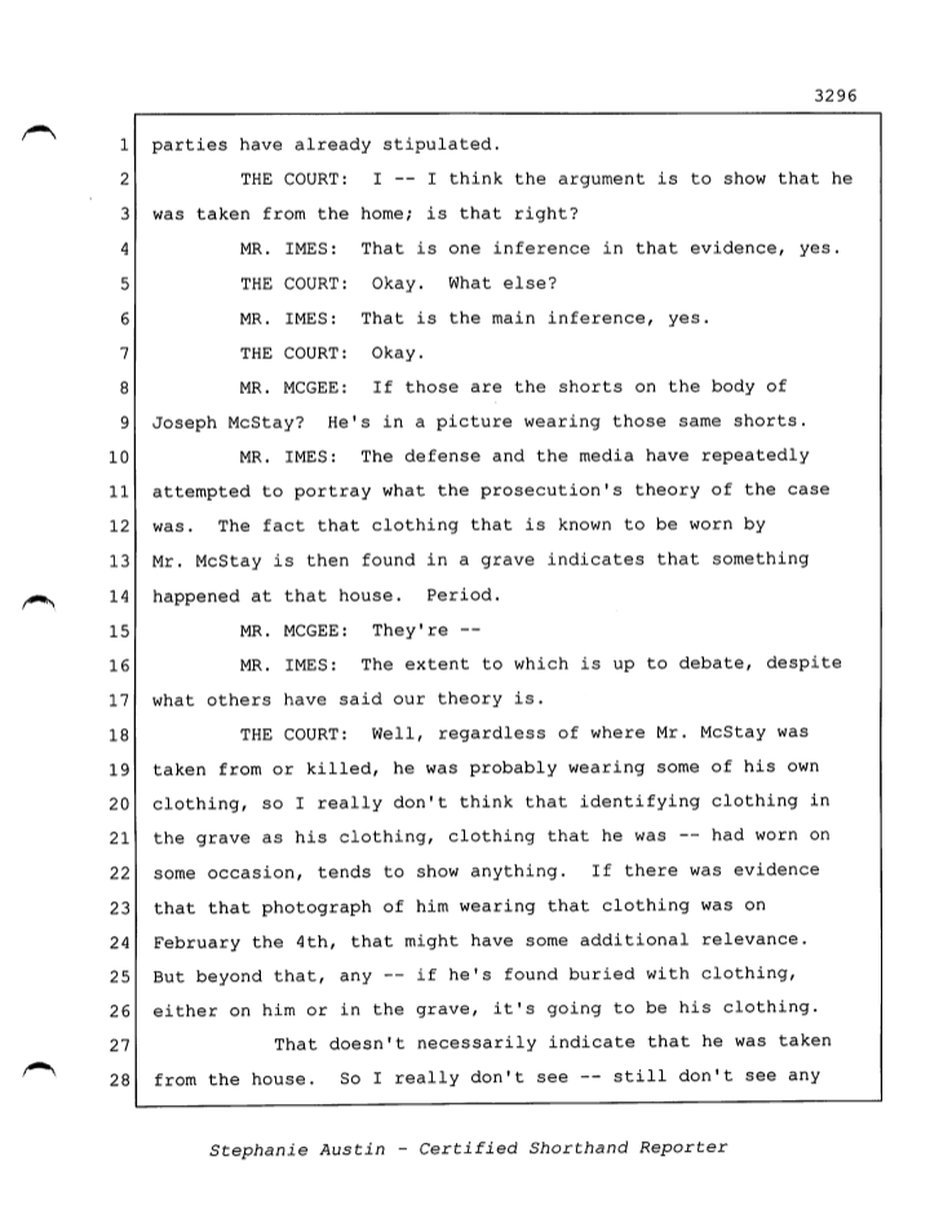
Earlier that same morning, in open court before the jury was brought in, the People’s own position on where it happened had been less than firm. When the court asked whether the clothing evidence was meant to show Joseph was taken from the home:
THE COURT: “I — I think the argument is to show that he was taken from the home; is that right?”
(RT 3296:2-28)
MR. IMES: “That is one inference in that evidence, yes.”
THE COURT: “Okay. What else?”
MR. IMES: “That is the main inference, yes.”
THE COURT: “Okay.”
MR. MCGEE: “If those are the shorts on the body of Joseph McStay? He’s in a picture wearing those same shorts.”
MR. IMES: “The defense and the media have repeatedly attempted to portray what the prosecution’s theory of the case was. The fact that clothing that is known to be worn by Mr. McStay is then found in a grave indicates that something happened at that house. Period.”
MR. MCGEE: “They’re —”
MR. IMES: “The extent to which is up to debate, despite what others have said our theory is.”
THE COURT: “Well, regardless of where Mr. McStay was taken from or killed, he was probably wearing some of his own clothing, so I really don’t think that identifying clothing in the grave as his clothing, clothing that he was — had worn on some occasion, tends to show anything. If there was evidence that that photograph of him wearing that clothing was on February the 4th, that might have some additional relevance. But beyond that, any — if he’s found buried with clothing, either on him or in the grave, it’s going to be his clothing. That doesn’t necessarily indicate that he was taken from the house.”
See RT 3296
Where I was that night, and the next morning
The jury heard where I was, from my wife and from the State’s own expert.
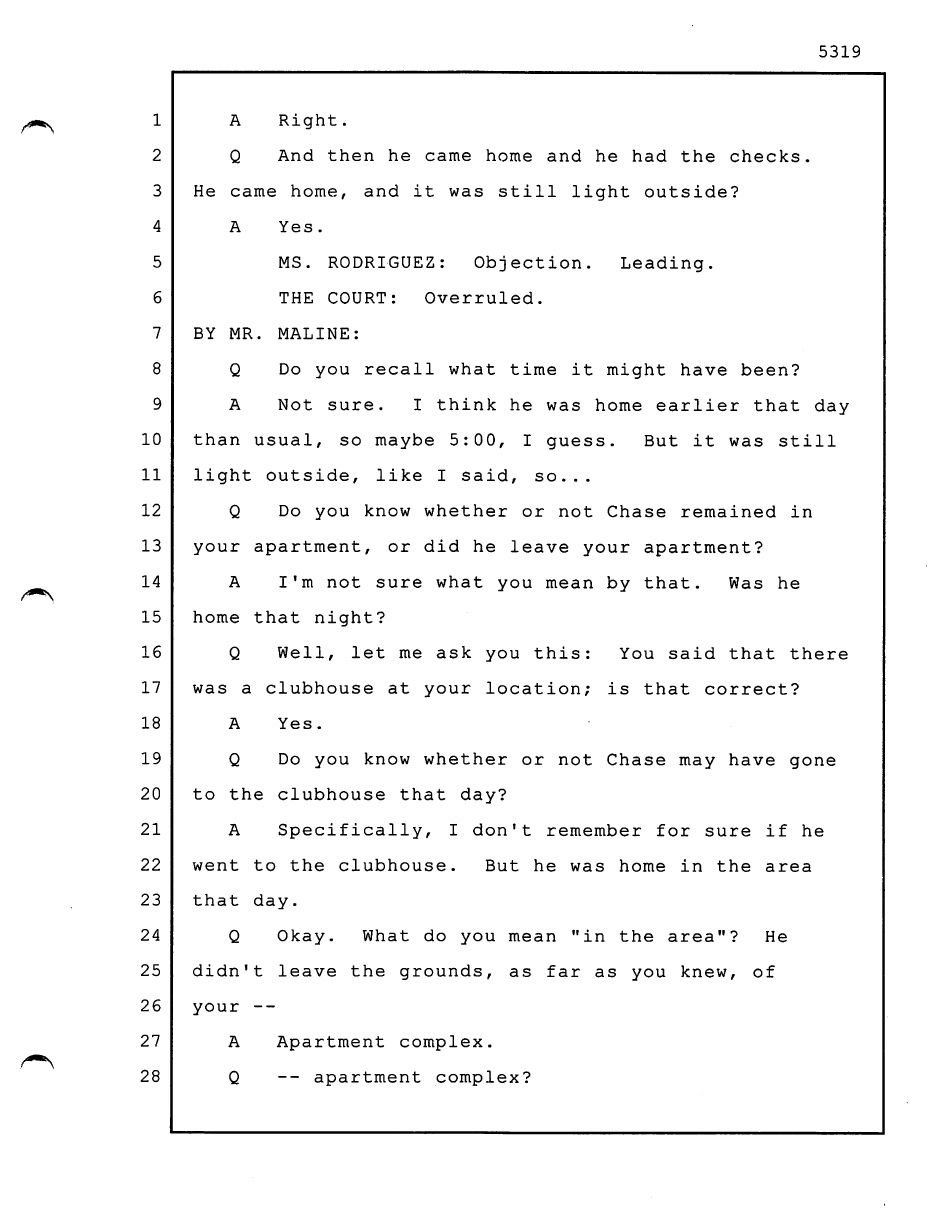
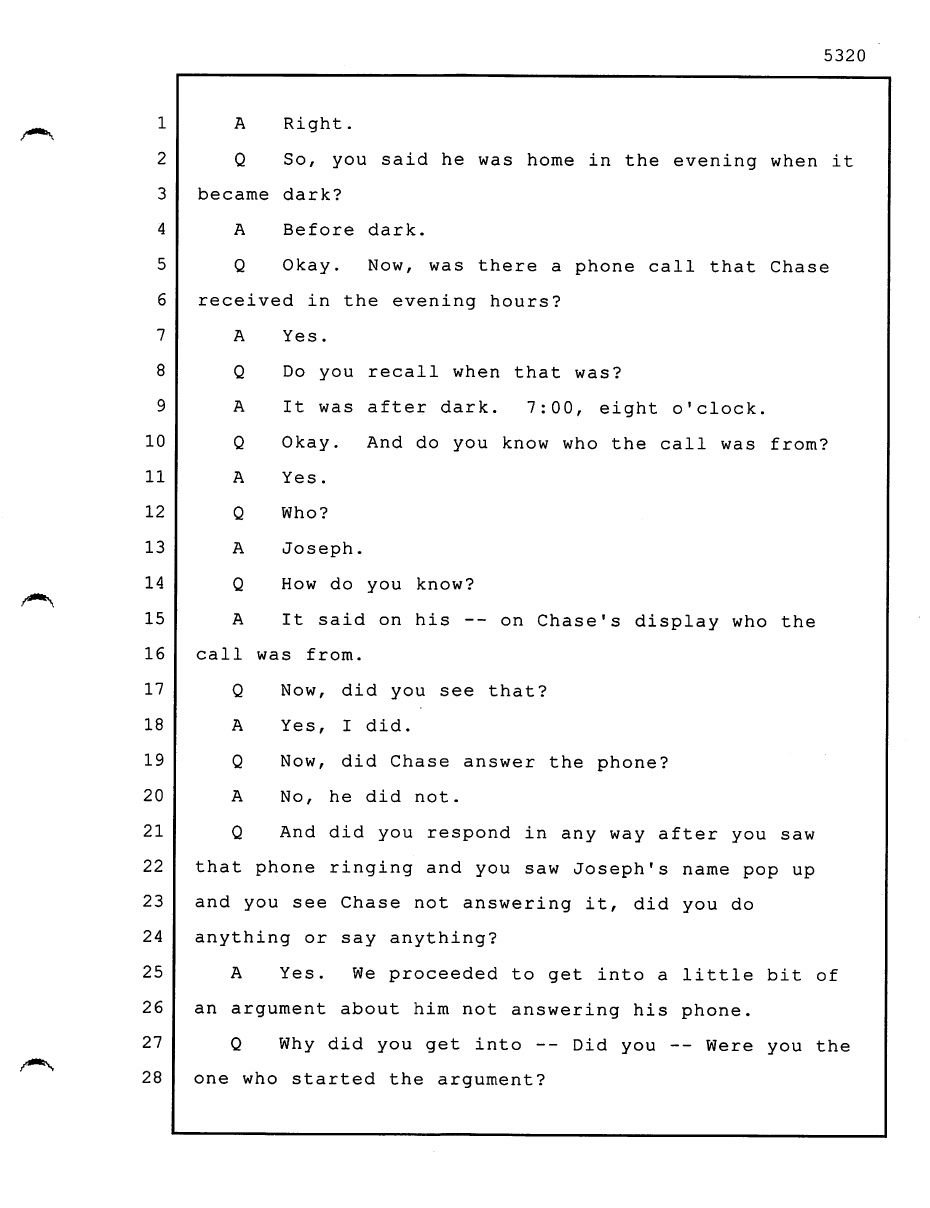
On March 13, 2019, on direct examination by Mr. Maline, Cathy testified:
Q. “Do you know whether or not Chase remained in your apartment, or did he leave your apartment?”
(RT 5319:12-5320:4)
A. “I’m not sure what you mean by that. Was he home that night?”
Q. “Well, let me ask you this: You said that there was a clubhouse at your location; is that correct?”
A. “Yes.”
Q. “Do you know whether or not Chase may have gone to the clubhouse that day?”
A. “Specifically, I don’t remember for sure if he went to the clubhouse. But he was home in the area that day.”
Q. “Okay. What do you mean ‘in the area’? He didn’t leave the grounds, as far as you knew, of your —”
A. “Apartment complex.”
Q. “— apartment complex?”
A. “Right.”
Q. “So, you said he was home in the evening when it became dark?”
A. “Before dark.”
She understood the question as whether I was home that night, and her answer was that I was home before dark and did not leave the grounds.
See RT 5319 and 5320
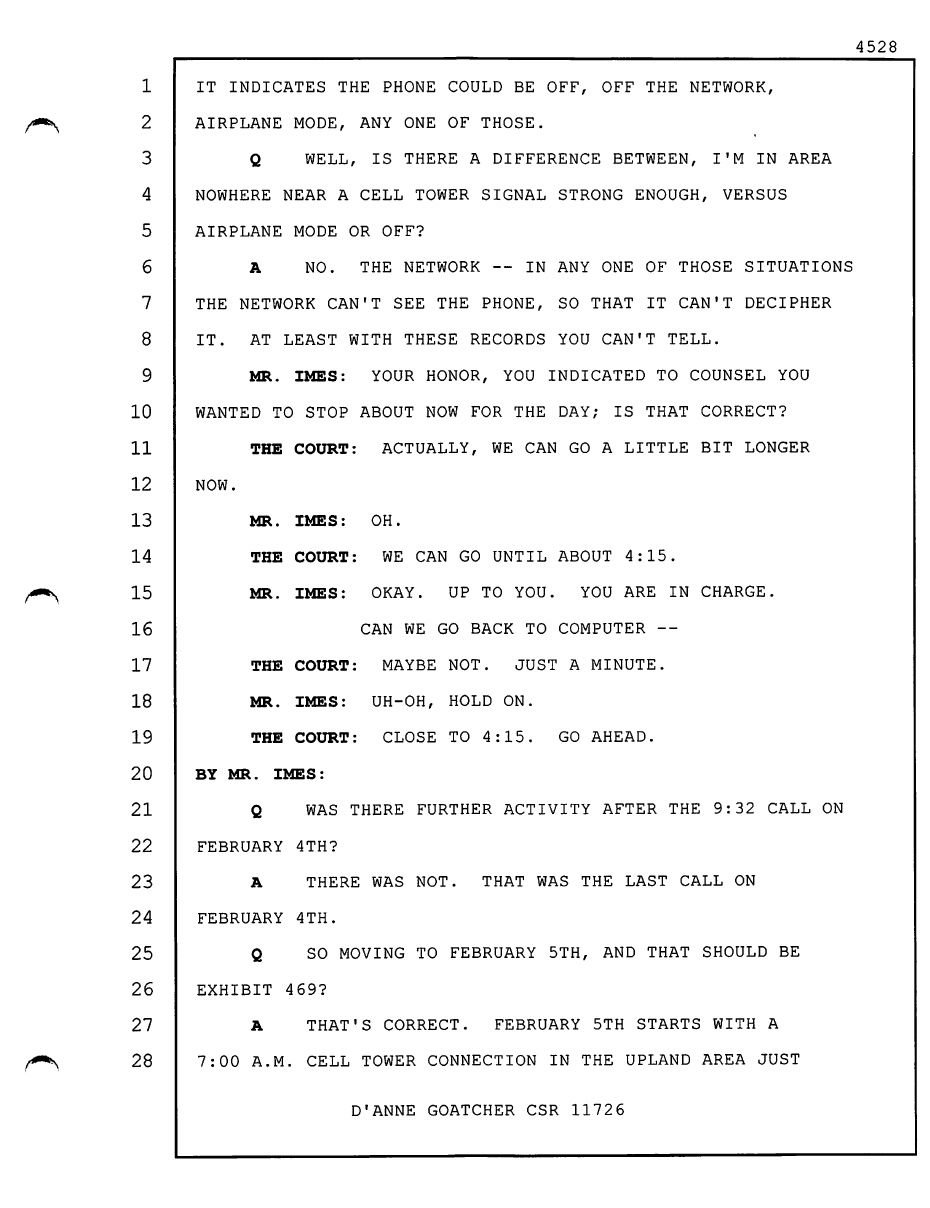
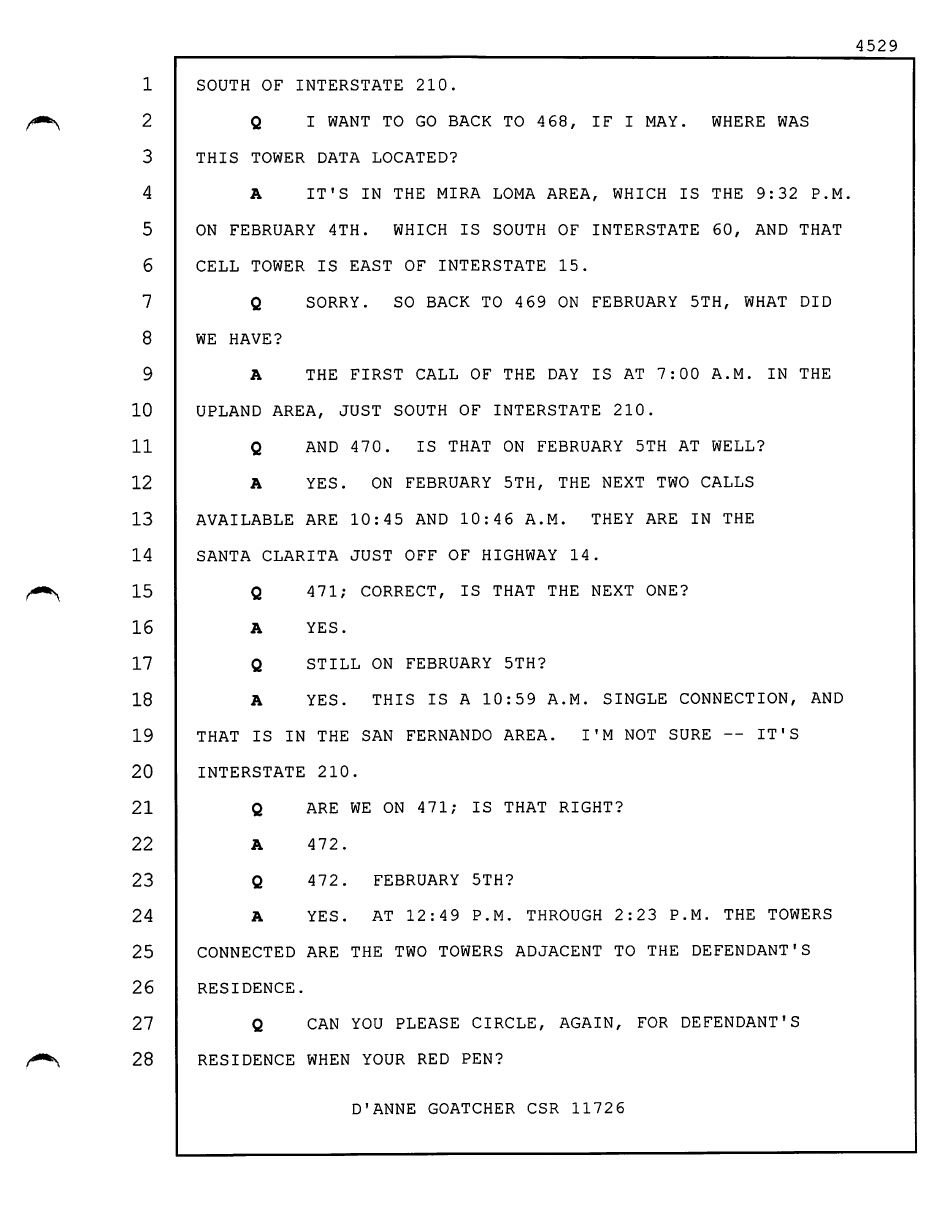
The State’s own cell phone expert, Special Agent Boles, testified on February 21, 2019, on direct examination by Mr. Imes, that after the 9:32 p.m. call there was no more activity that night, and that my phone’s next activity put me in the Upland area, just south of Interstate 210, at 7:00 the next morning:
Q. “Was there further activity after the 9:32 call on February 4th?”
(RT 4528:21-4529:1)
A. “There was not. That was the last call on February 4th.”
Q. “So moving to February 5th, and that should be Exhibit 469?”
A. “That’s correct. February 5th starts with a 7:00 a.m. cell tower connection in the Upland area just south of Interstate 210.”
He went on: “On February 5th, the next two calls available are 10:45 and 10:46 a.m. They are in the Santa Clarita just off of Highway 14.” The 10:59 a.m. call was “in the San Fernando area … it’s Interstate 210.” And from 12:49 p.m. to 2:23 p.m., “the towers connected are the two towers adjacent to the defendant’s residence.” (RT 4529:12-26)
See RT 4528 and 4529
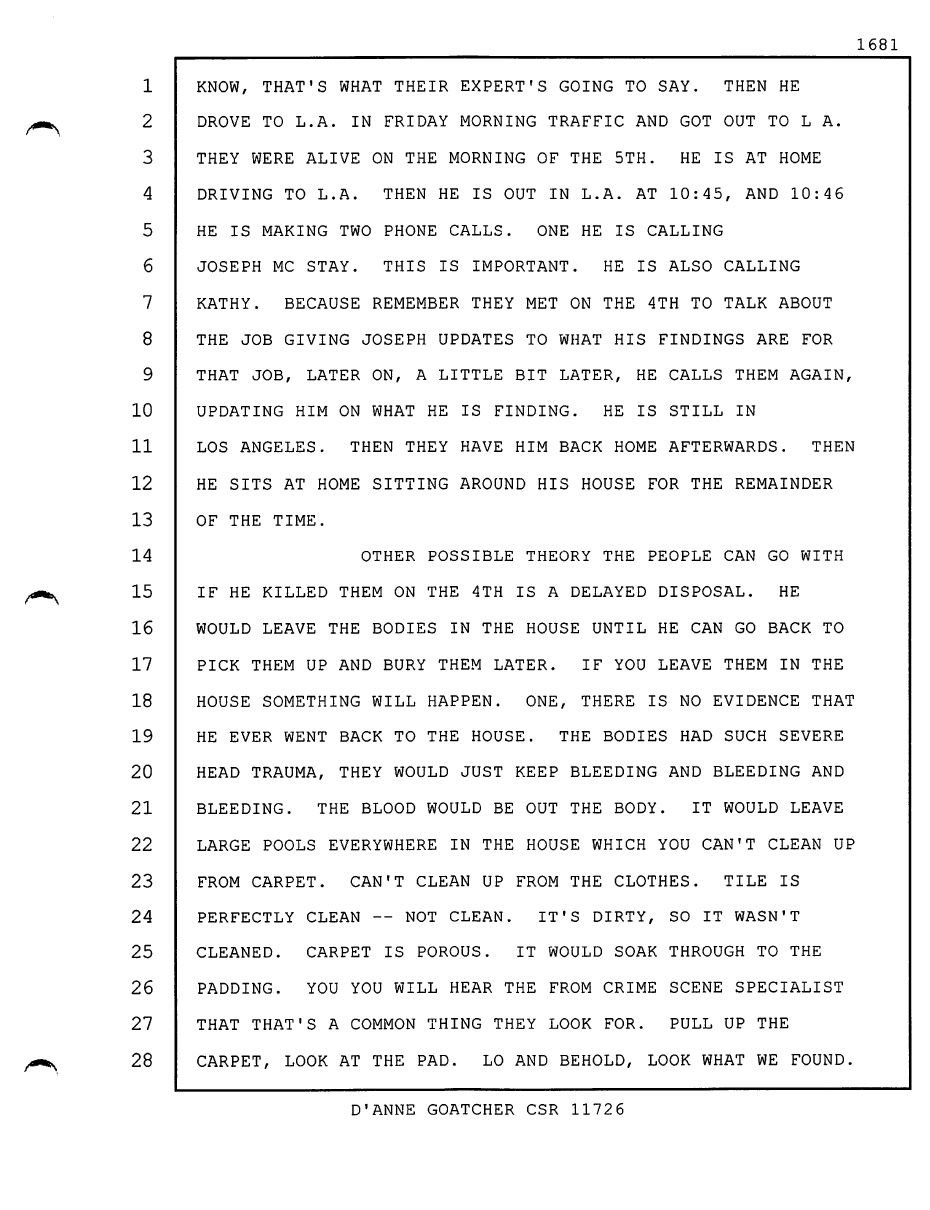
Mr. McGee told the jury the same in opening (“We know he was in Upland at 7:00 a.m. because, you know, that’s what their expert’s going to say,” RT 1680:28-1681:1) and in closing (“if this is happening on the morning of the 5th, we know where Mr. Merritt is. He’s in Upland on his phone at 7:00 a.m. He’s on his way to L.A.,” RT 8311:3-5).
See RT 1680, 1681 and 8311


So the morning of February 5 was not a gap in my alibi. Upland at 7:00 a.m. and Santa Clarita by 10:45 put me nowhere near Fallbrook that morning, and that came from the prosecution’s own witness.
The prosecution’s only answer to the night itself was a question. On March 14, 2019, Ms. Rodriguez recrossed Cathy:
Q. “And do you remember talking to detectives about the sleeping arrangements in your house at that time?”
(RT 5469:17-25)
A. “Yes.”
Q. “And, in fact, you and the defendant didn’t share a bedroom together, did you?”
A. “No.”
Q. “He slept on the sofa, right?”
A. “Yes.”
She asked nothing more about that night and went on to ask whether Joseph was “a pretty laid back guy.” She never asked Cathy whether I left. The suggestion that I might have slipped out during the night without Cathy knowing came only from the question.
The judge told the jury exactly what to do with that. As part of the instructions read on May 28, 2019:
“Also, the attorneys’ questions are not evidence. Only the witnesses’ answers or testimony is evidence. The attorneys’ questions are significant only if they help you to understand the witnesses’ testimony. Do not assume that something is true just because one of the attorneys asked a question that suggested that it might be true.”
(RT 8161:25-8162:4)
See RT 5469, 8161 and 8162

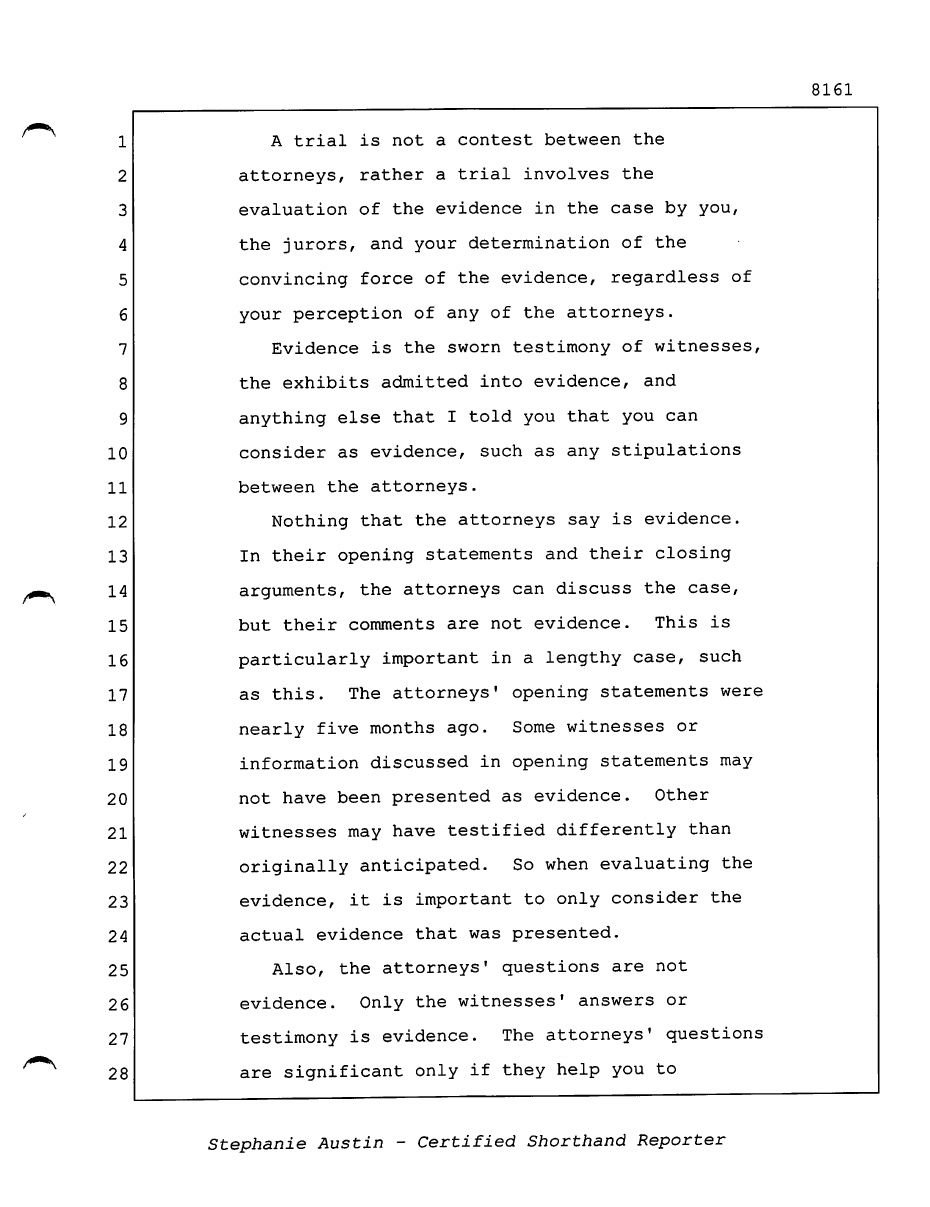
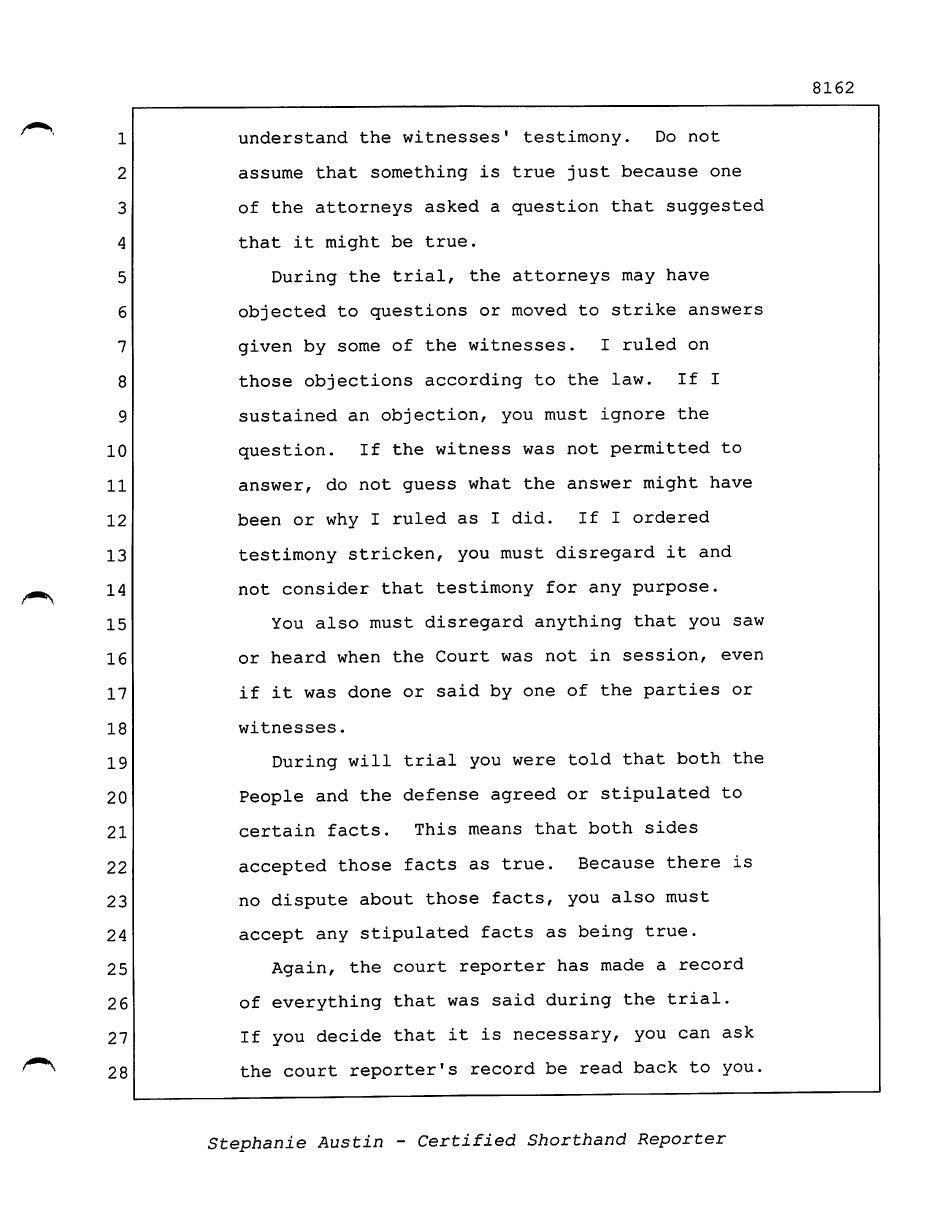
The answer in evidence was Cathy’s: I was home before dark and did not leave the grounds. That I slept on the sofa does not make it more likely that I left. No witness said I left, and no evidence put me anywhere but home that night or anywhere near Fallbrook the next morning. As I see it, under the court’s own instruction, the jury could not get from the fact that I slept on the sofa to the idea that I might have left in the night. There was nothing in evidence to carry it there.
Then the court used February 5 itself
On March 4, 2019, denying my motion for acquittal, the court said:
“The rest of the evidence strongly indicates that the McStay family was taken from the residence, either the evening of February 4th or early morning hours of February the 5th. The fact that there is no cell phone activity for either Joseph or Summer, that can really be attributed to either one of them, after the 5:30ish call, along with all the other circumstances, strongly indicates they were at least taken from the residence, as I say, the evening of sometime during the evening into the early morning hours — evening hours of February 4th, into the early morning hours of February the 5th.”
(RT 4999:22-5000:3)
See RT 4999 and 5000
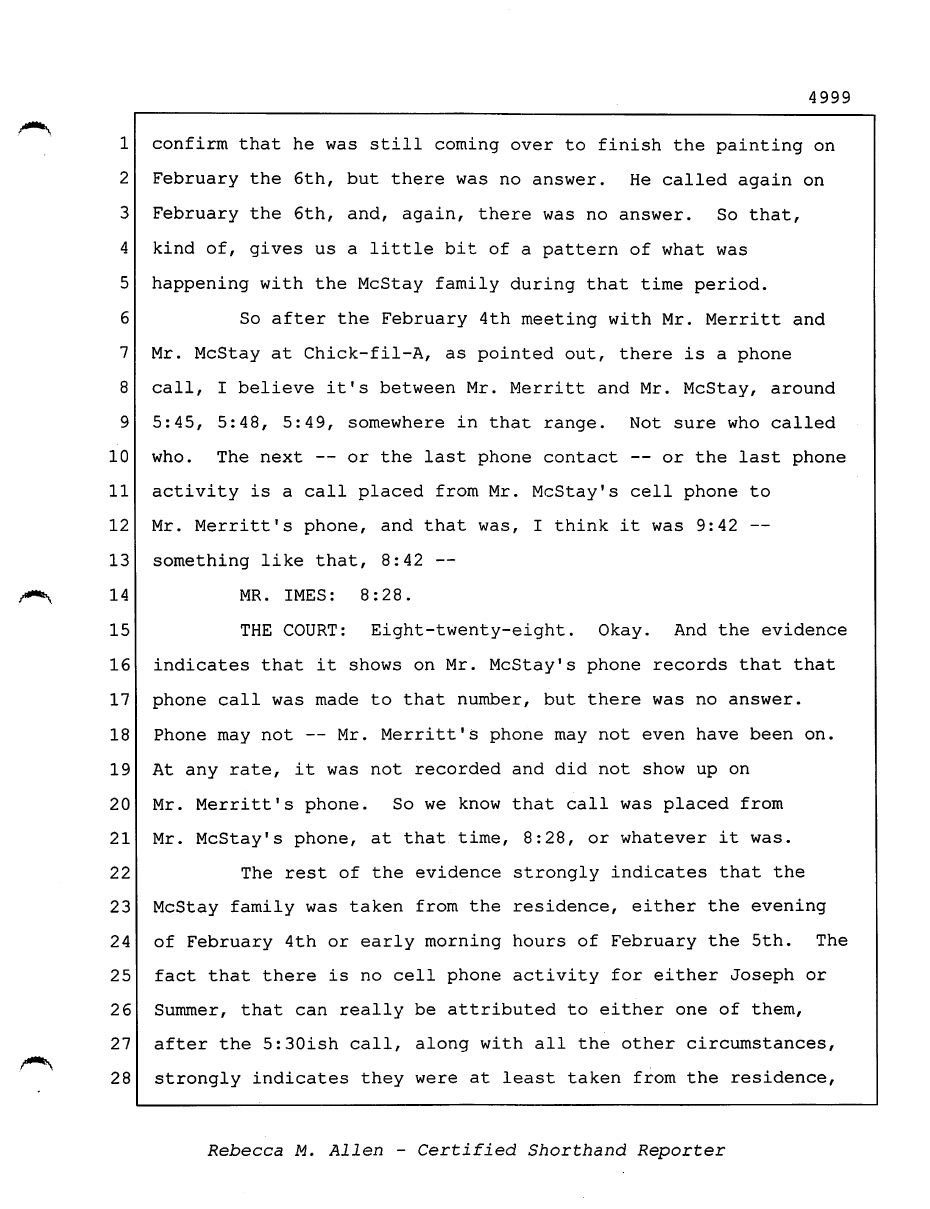
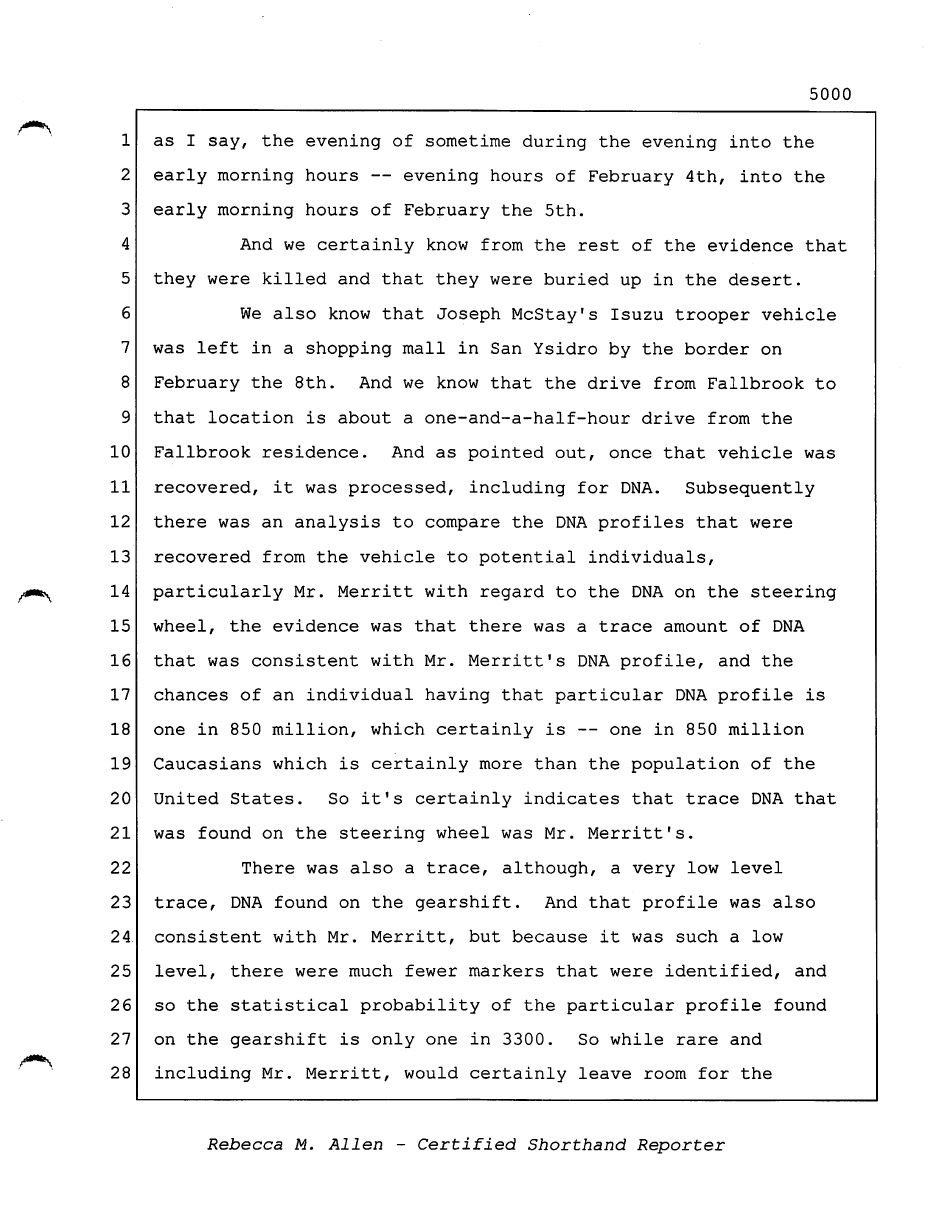
Two things about that. The reason given is an absence, no phone activity from Joseph or Summer after the 5:30 call, and an absence has no end point that can close a window. And the finding is about the family being taken, not about the killings.
It said the same at the motion for new trial: “The evidence, I think, clearly indicated that the McStay family was taken from their home suddenly or abruptly either the night of February the 4th or, perhaps, into the early morning hours of February the 5th.” (RT 8941:9-12) And again, correcting itself in the middle of the sentence to keep the same distinction: “I already indicated that we know that the bodies were taken either — I’m sorry — that the McStay family was taken either evening, late night, February 4th, early morning hours of February the 5th.” (RT 8946:26-8947:1)
See RT 8941, 8946 and 8947
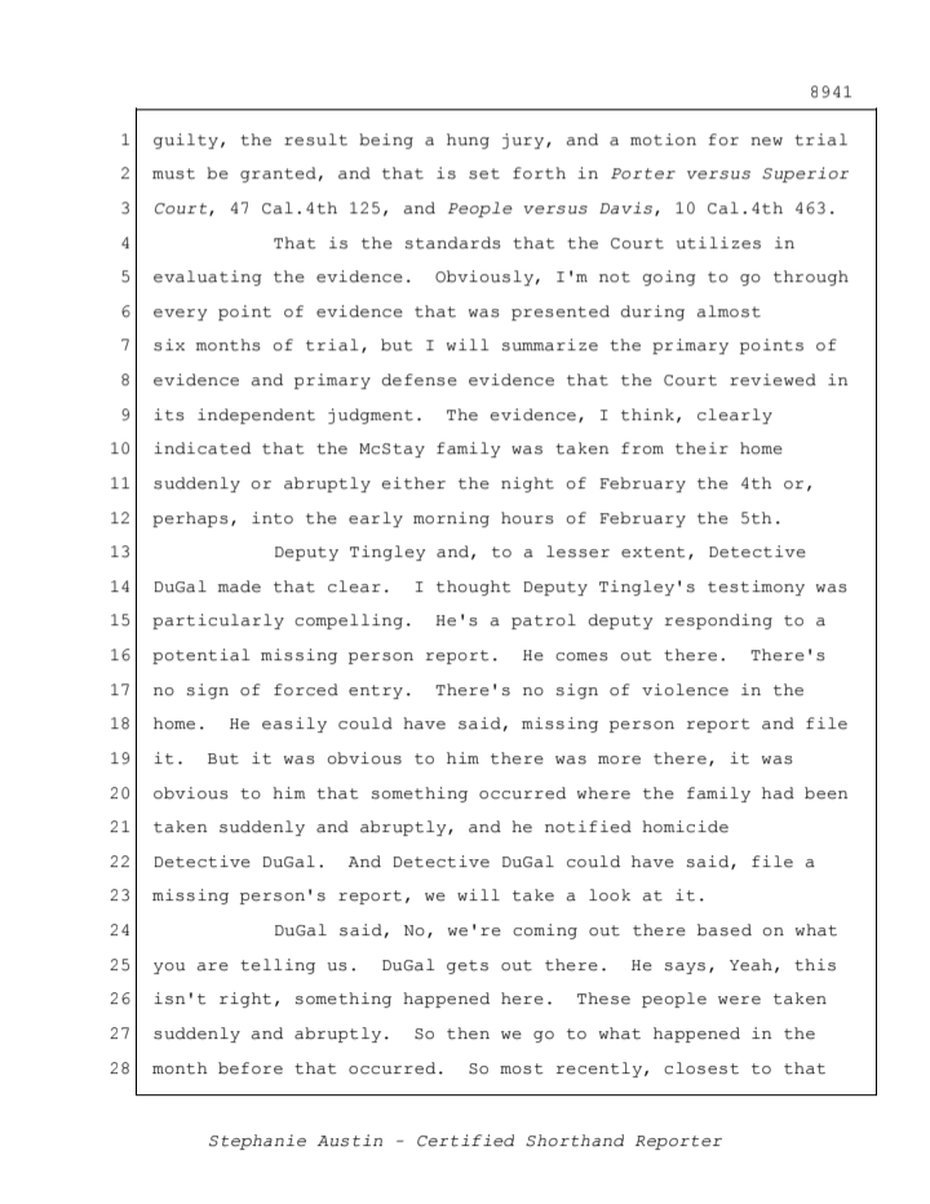
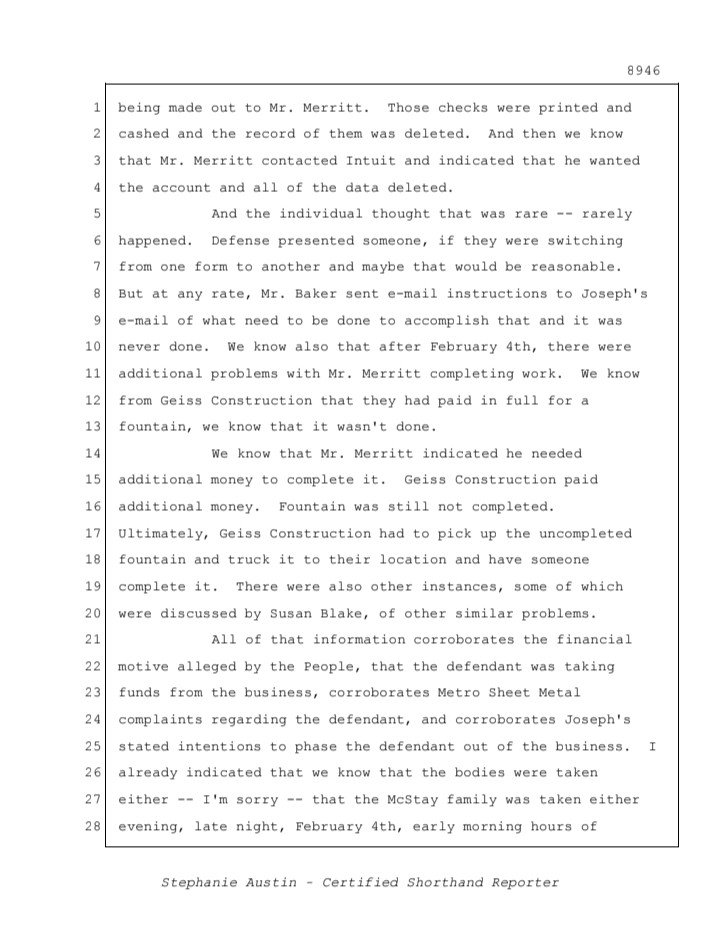
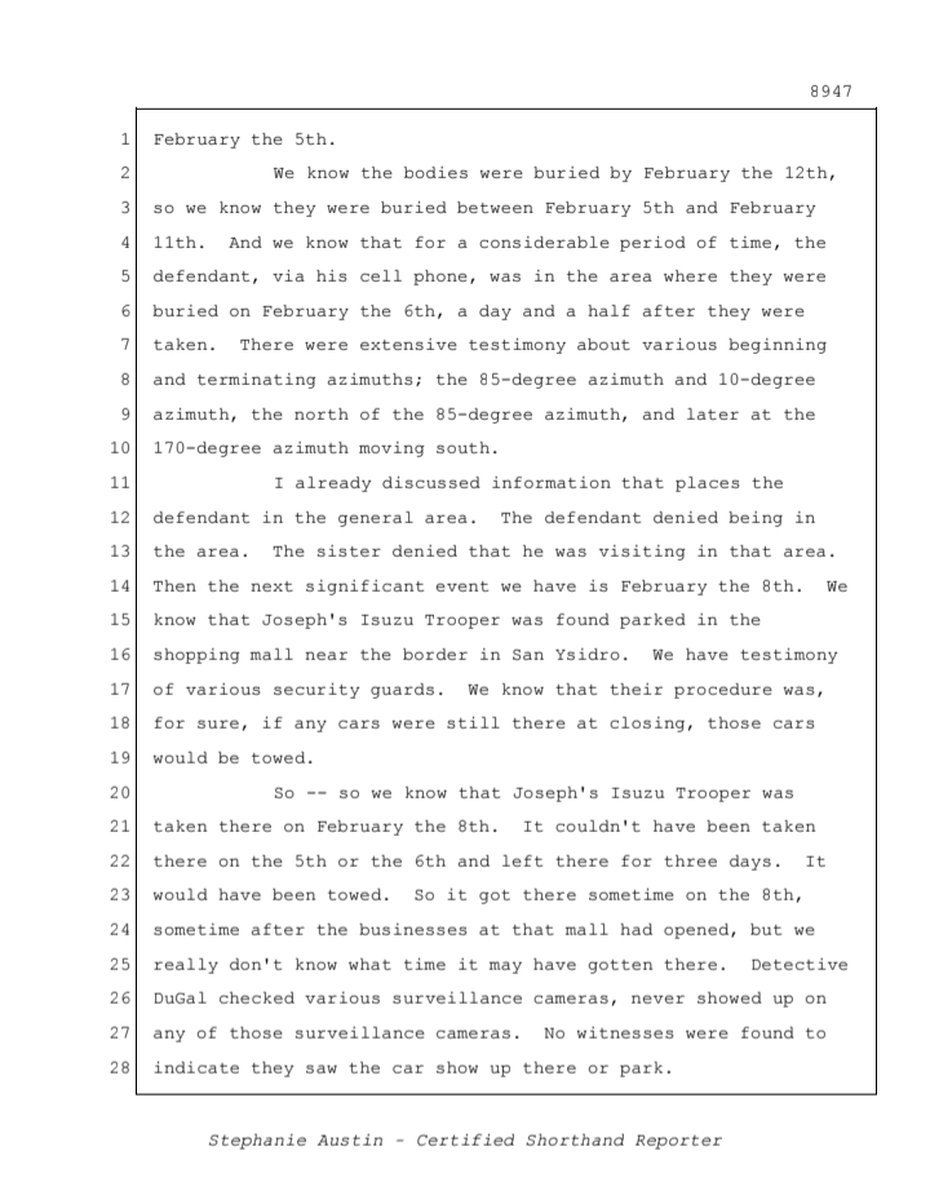
No evidence put the family’s taking or deaths in the early morning of February 5 except the opinion the defense tried to bring out from Sergeant Steers, and that was kept from the jury as speculation.
Then the prosecutor told the jury it was impossible
On May 30, 2019, in rebuttal, when my lawyers could no longer answer, Ms. Rodriguez told the jury:
“You have Mr. Maline arguing on the 4th, if that’s not his truck on the 4th, it’s not him. We have Mr. McGee saying this happened on the morning of the 5th. Completely different theory from the same defense team.
The morning of the 5th, let’s look at why that’s not even a possibility. Because the morning of the 5th, remember it’s daylight savings time, so it’s still — it get light, like, at 6:00 a.m. It’s bright out at 6:00 a.m.”
(RT 8431:7-18)
MR. MCGEE: “Objection, your Honor. Arguing facts not in evidence.”
THE COURT: “Overruled.”
See RT 8431
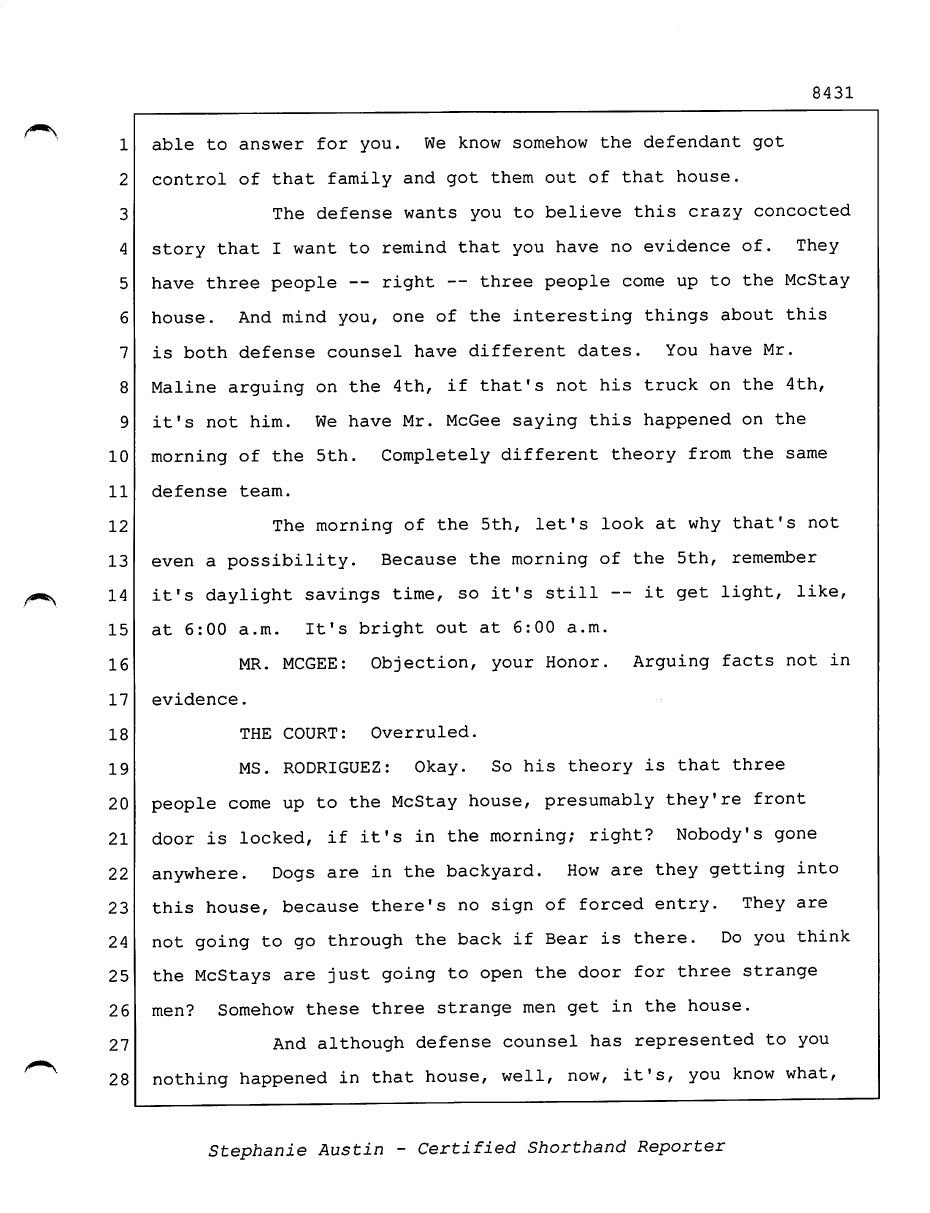
That was not true. Daylight saving time did not begin in 2010 until Sunday, March 14 (timeanddate.com). On February 5, 2010, Pacific Standard Time was in effect, and according to the Griffith Observatory’s published 2010 sunrise table for Los Angeles, the sky did not begin to lighten (civil twilight) until 6:21 a.m., and the sun rose at 6:47 a.m. At 6:00 a.m. it was dark. This was false.
No evidence of daylight or sunrise had been offered at trial. Mr. McGee objected that she was “arguing facts not in evidence,” and the court overruled him. She used that false fact to tell the jury the defense’s timeframe was “not even a possibility,” in rebuttal, when my lawyers could no longer answer.
And it matters for a second reason. In rebuttal, the prosecution told the jury that the morning of February 5 was impossible. The People’s own position, in their last words to the jury, was that it happened on the night of February 4 and at no other time. As I see it, that leaves CALCRIM 207 with no honest purpose in this case. The only thing “reasonably close to that day” could do was let the jury convict without deciding whether the People proved the night they chose.
A few lines before that, she told the jury:
“One thing I think that defense counsel and I and the prosecution team are both in agreement on, is that something happened in that house. Our versions of what happened in that house are very different. They want to say that we have said they were murdered in that house. Nobody has said to you that they were murdered in that house. Nobody from the prosecution team has stood up here and said to you, all four of those people were murdered in that house.”
(RT 8430:16-23)
See RT 8430
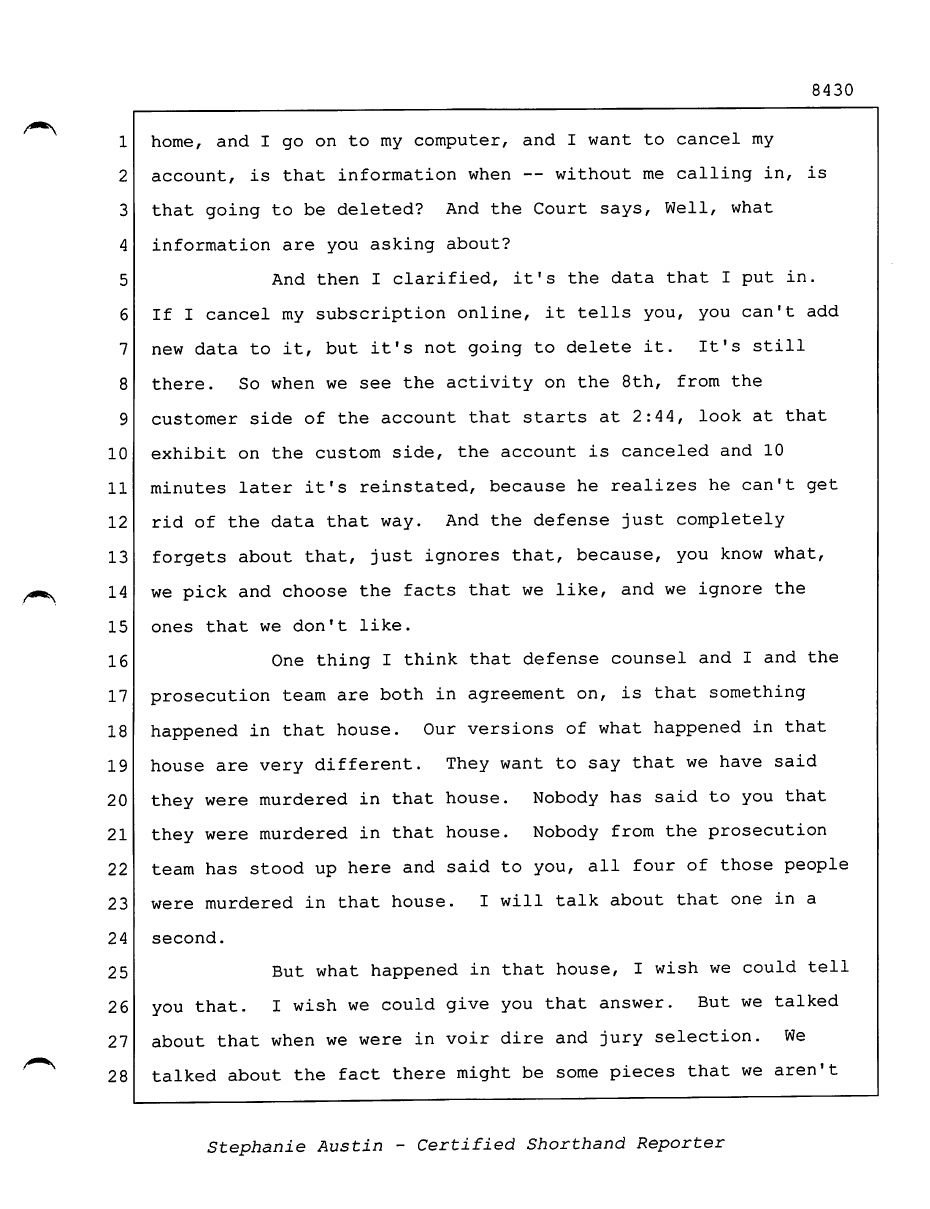
And a minute later, she shut the door on the other possibility: “There’s no evidence of three men coming and taking control. There’s no evidence they were transported anywhere else.” (RT 8432:19-22)
See RT 8432

Two days earlier Mr. Imes had told the same jury “it was the defendant at the McStay house that night” (RT 8213:20-21), that “there is no dispute that it is first degree murder regardless of what precipitated the murder of the first person in that house” (RT 8275:1-3), and that the lack of blood “could only be due to the killer’s actions in how he carried out the murder, or how he cleaned up the murder” (RT 8246:10-13). In opening, Mr. Daugherty had told them the family was beaten “until they died, and then they were taken 100 miles away from their home” (RT 1631:2-5). Her denial was carefully narrow, about “all four of those people.” But it covered over what the prosecution had argued about that house from the first day of trial to the last.
See RT 8213, 8275, 8246 and 1631
The same idea, three ways
So the same question, whether what happened at the house could have run into the early morning of February 5, was treated three different ways in the same case:
- Speculation, when the defense tried to get it from the State’s own homicide investigator (RT 3354-3355), right after he agreed that drawing conclusions from the physical evidence was his job.
- A fact the court relied on, when the court denied acquittal (RT 4999:22-5000:3) and denied a new trial (RT 8941:9-12; 8946:26-8947:1).
- “Not even a possibility,” when the prosecutor told the jury so in rebuttal, on the strength of a false claim about daylight, after my lawyers could no longer respond (RT 8431:12-15).
See RT 3354, 3355, 4999, 5000, 8941, 8946, 8947 and 8431
A defendant has a constitutional right to a meaningful opportunity to present a complete defense (Crane v. Kentucky (1986) 476 U.S. 683, 690-691). As I see it, the combination here took that away from me on the one question my defense depended on: the State’s investigator was kept from giving the conclusion, the prosecutor told the jury it was impossible, and an instruction told them the timing didn’t need to be decided at all.
Read the full record: Home that night↑ Back to the menu6. After the verdict: the night was fixed again
At sentencing, the court’s own findings needed exactly the specifics the guilt-phase rulings had let go.
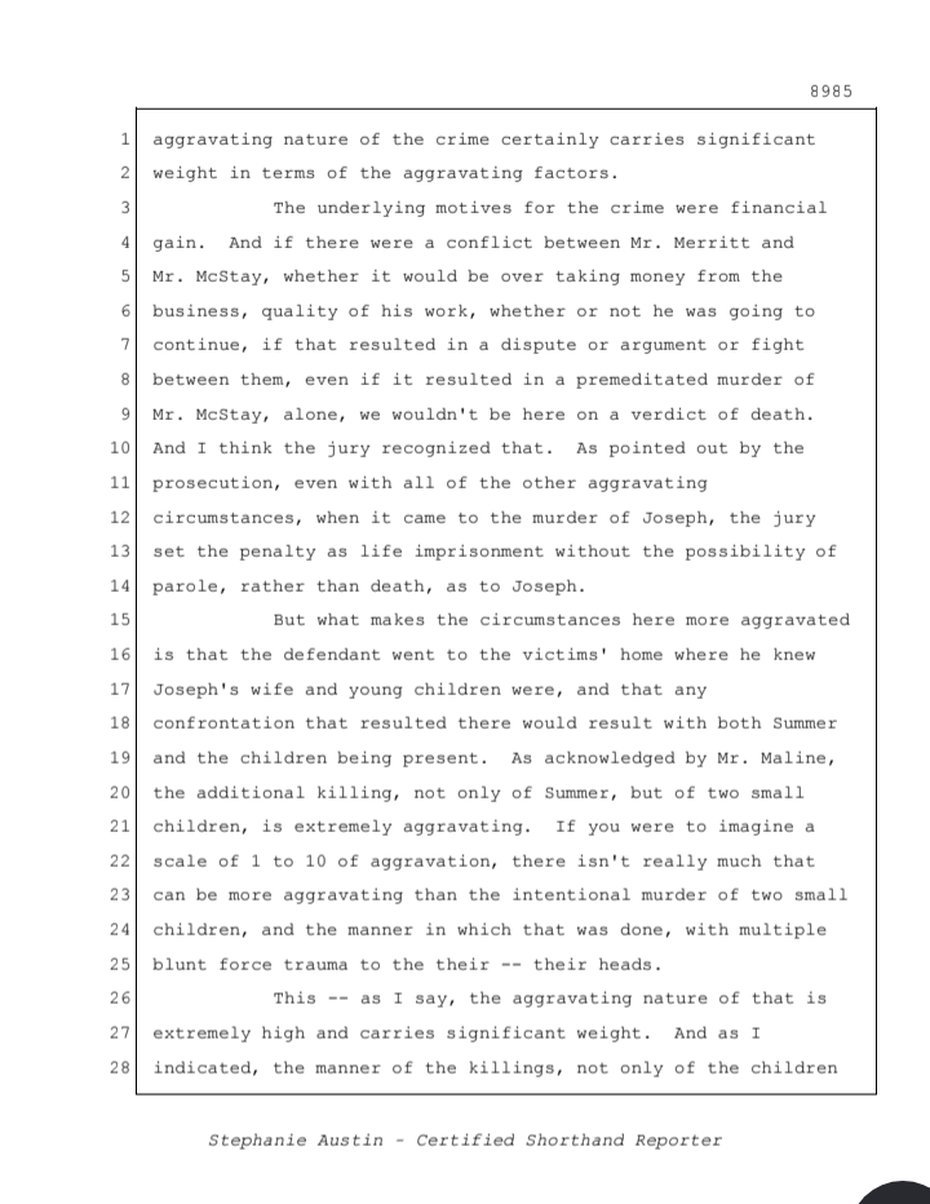
The court found as an aggravating circumstance: “But what makes the circumstances here more aggravated is that the defendant went to the victims’ home where he knew Joseph’s wife and young children were, and that any confrontation that resulted there would result with both Summer and the children being present.” (RT 8985:15-19)
See RT 8985
And: “So him arriving at their home, regardless of any conflict that they may have had during the course of the — earlier in the day on February the 4th, regardless of what may have occurred between Joseph and Mr. Merritt, he was someone that was known to them for a long period of time, that they have had a friendly relationship, as well as a business relationship, and there was no reason for either of them to suspect violence on the part of Mr. Merritt. So that makes them vulnerable to where they would allow Mr. Merritt into their home and not be on guard for a violent attack.” (RT 8986:18-28)
See RT 8986
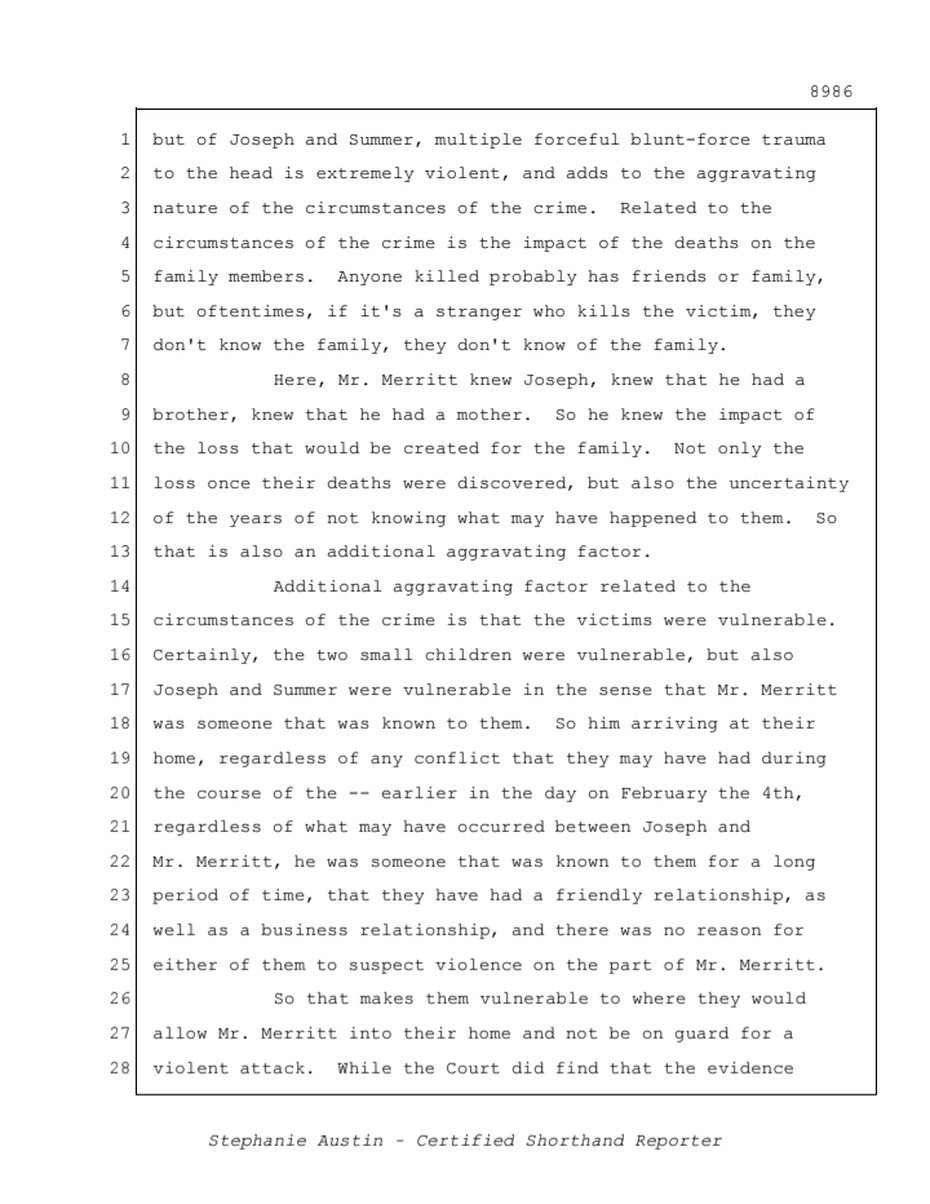
“Earlier in the day on February the 4th” refers to the lunch meeting that day. The arrival the court describes is later on February 4, the evening.
In the same breath, the court said again that the killing blows did not happen there: “While the Court did find that the evidence suggests the — multiple blunt-force traumas to the head, which would have resulted in significant bleeding and a significant bloody scene, did not occur inside of the house.” (RT 8986:28-8987:3)
See RT 8986 and 8987
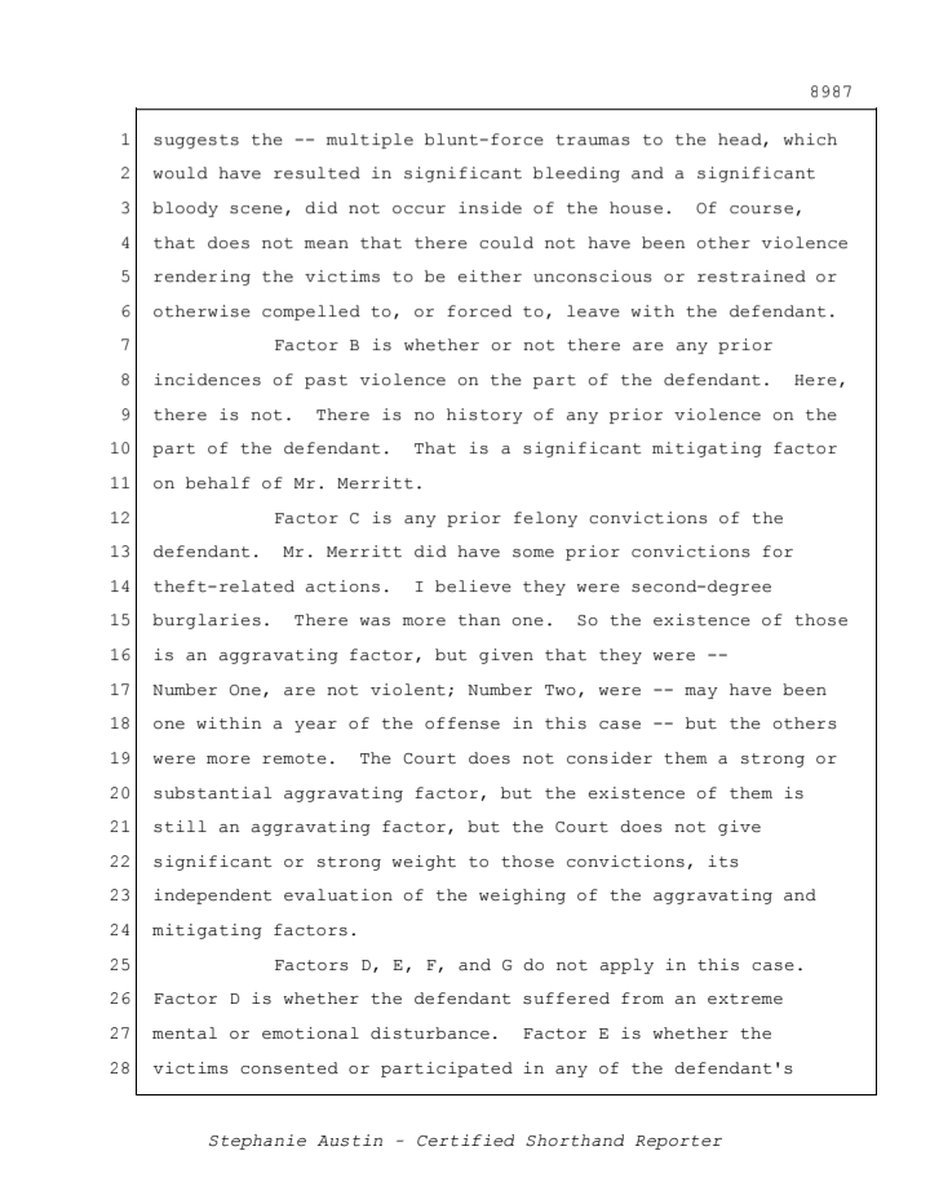
Then, without pointing to any evidence, the court supplied the bridge between the two: “Of course, that does not mean that there could not have been other violence rendering the victims to be either unconscious or restrained or otherwise compelled to, or forced to, leave with the defendant.” (RT 8987:3-6)
See RT 8987
No evidence of any such violence was named. The court had earlier noted that the responding deputy found “no sign of forced entry” and “no sign of violence in the home” (RT 8941:16-18). In its next sentence the court turned to a separate factor, my history, not the crime, and found: “Factor B is whether or not there are any prior incidences of past violence on the part of the defendant. Here, there is not. There is no history of any prior violence on the part of the defendant. That is a significant mitigating factor on behalf of Mr. Merritt.” (RT 8987:7-11)
See RT 8941 and 8987
The prosecution handled the scene the same way. The People had chosen not just a date but a whole event: entry at the Fallbrook home, a confrontation, the attack, the removal, and the burial. At the penalty phase, six lines after describing “that familiar face that would have been let in that door on the night of February 4th” who “turned into a monster of destruction,” Mr. Imes told the jury:
“As we told you in the beginning, we can’t answer a lot of questions because of three years, nine months, and seven days passing and not having a lot of forensic evidence. What exactly happened in the house that night, no one can tell you. Neither us, nor the defense, no law enforcement, not even a psychic.”
(RT 8702:10-15)
See RT 8702
When the People’s burden was raised, they backed away from it. During the penalty phase, when Mr. Imes told the jury “there’s no explanation why his phone was pinging off those towers on February 6th,” Mr. McGee objected:
MR. MCGEE: “Objection, your Honor. That’s burden shifting onto the defense.”
(RT 8699:14-18)
THE COURT: “Overruled.”
MR. MCGEE: “Ask to admonition.”
THE COURT: “Overruled.”
See RT 8699
CALCRIM 207 is about time, not place. But the prosecutor’s argument stretched it to cover both: the People did not have to prove “when this occurred, how this occurred or where this occurred” (RT 8269:16-18).
See RT 8269
The pattern is this. The event was concrete when guilt and death were being argued. It was flexible, or unknowable, whenever the lack of proof was raised. The State fixed the time and place when it was building guilt, walked away from both when the evidence didn’t support them, and relied on the instruction to tell the jury the missing proof didn’t matter.
↑ Back to the menu7. What the judge found at the motion for new trial
My lawyer raised the conflict, and the court did not answer it
At the hearing on the motion for new trial, Mr. Maline raised exactly this:
MR. MALINE: “What was missed from that, was this: If we don’t know what happened — and contrary to the law, they argued that we don’t have to prove the who, the what, the when, and the where. But the Court gave an alibi instruction, as well. I think that’s in conflict, and I think that was highly improper to argue that because the jury would have believed that, that they didn’t have to prove that, especially with an alibi instruction.”
(RT 8893:10-23)
THE COURT: “I think the defense requested the alibi instruction.”
MR. MALINE: “Yes.”
THE COURT: “And I gave it at the defense’s request.”
MR. MALINE: “Yes. And so there’s QuickBooks activity at 7:55, at 8:05.”
See RT 8893
The objection was that CALCRIM 207 and the prosecutor’s argument had taken CALCRIM 3400 out of play. The court’s answer, that the defense had asked for 3400, didn’t address it.
The court relied on the window to reject my alibi
Ruling on the motion, sitting as the “13th juror” and weighing the evidence independently, the court went straight to the window the People had chosen. “So after the meeting, Joseph drives back from Rancho back to Fallbrook, there’s additional calls between the defendant and Joseph, and that brings us to the night of February the 4th.” (RT 8943:27-8944:2)
See RT 8943 and 8944
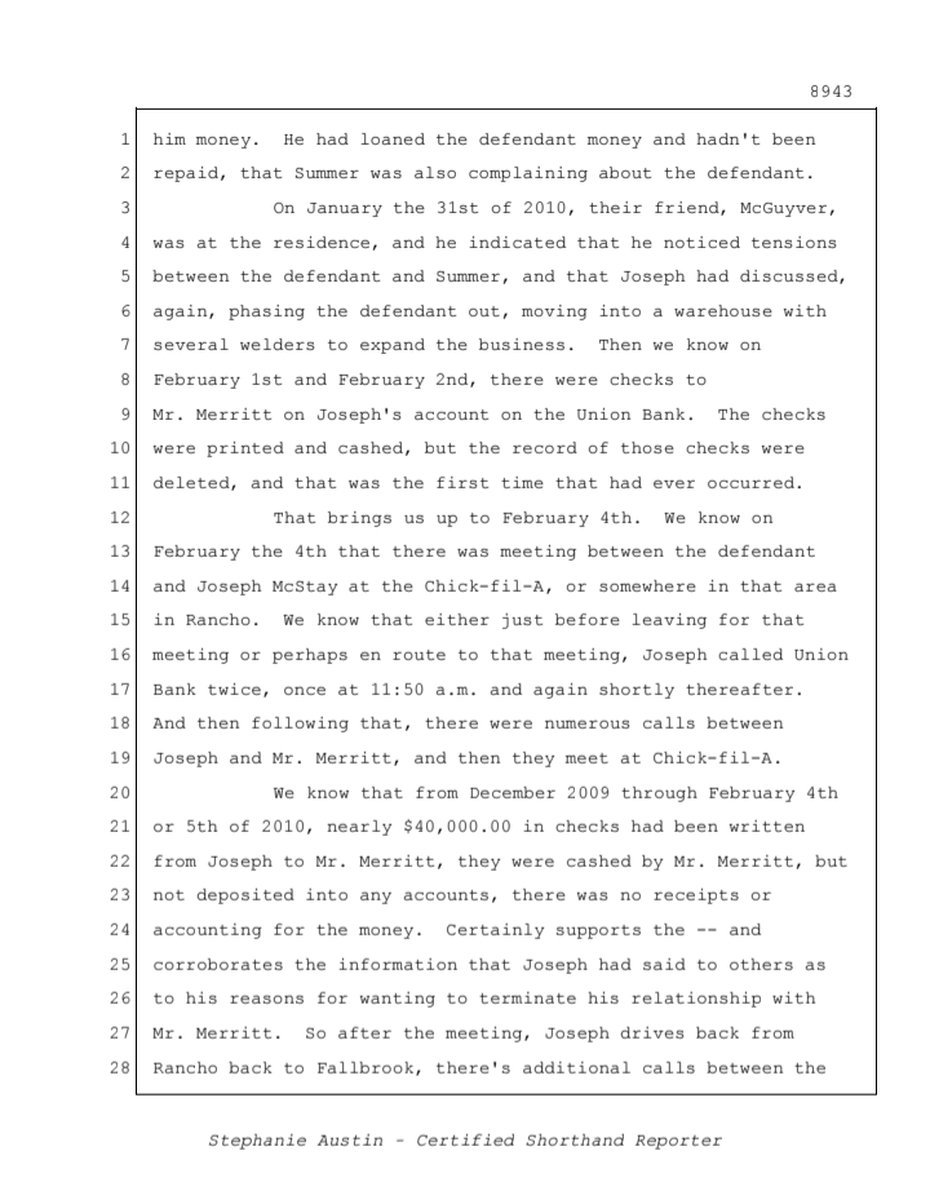
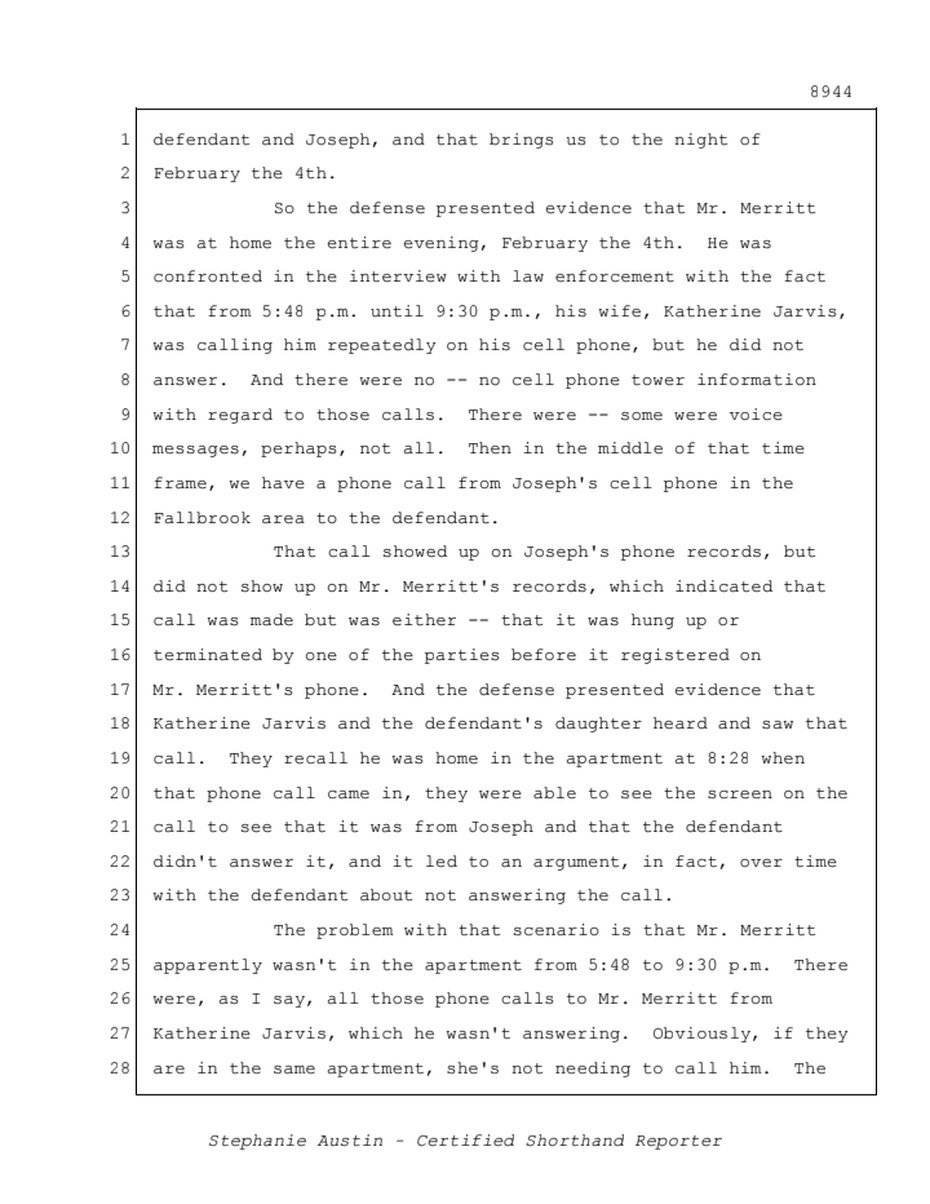
It used the window to reject my alibi:
“The problem with that scenario is that Mr. Merritt apparently wasn’t in the apartment from 5:48 to 9:30 p.m. There were, as I say, all those phone calls to Mr. Merritt from Katherine Jarvis, which he wasn’t answering.”
(RT 8944:24-27)
See RT 8944
And it put the perpetrator inside the McStay house during that window:
“So even at 9:32, he’s not back in the apartment. As we discussed this morning, there was activity inside the McStay residence. From 7:55 p.m. to 8:03, there was activity on one of the computers in which checks were made out — either actually made out to the defendant or there was an attempt to print out checks, but they didn’t print, and then the record of that was deleted. So, obviously, that was either done by Joseph, or it was done by the perpetrator. And, obviously, it wouldn’t make sense for anyone other than Mr. Merritt to be attempting to make out checks to Mr. Merritt.”
(RT 8945:13-22)
See RT 8945
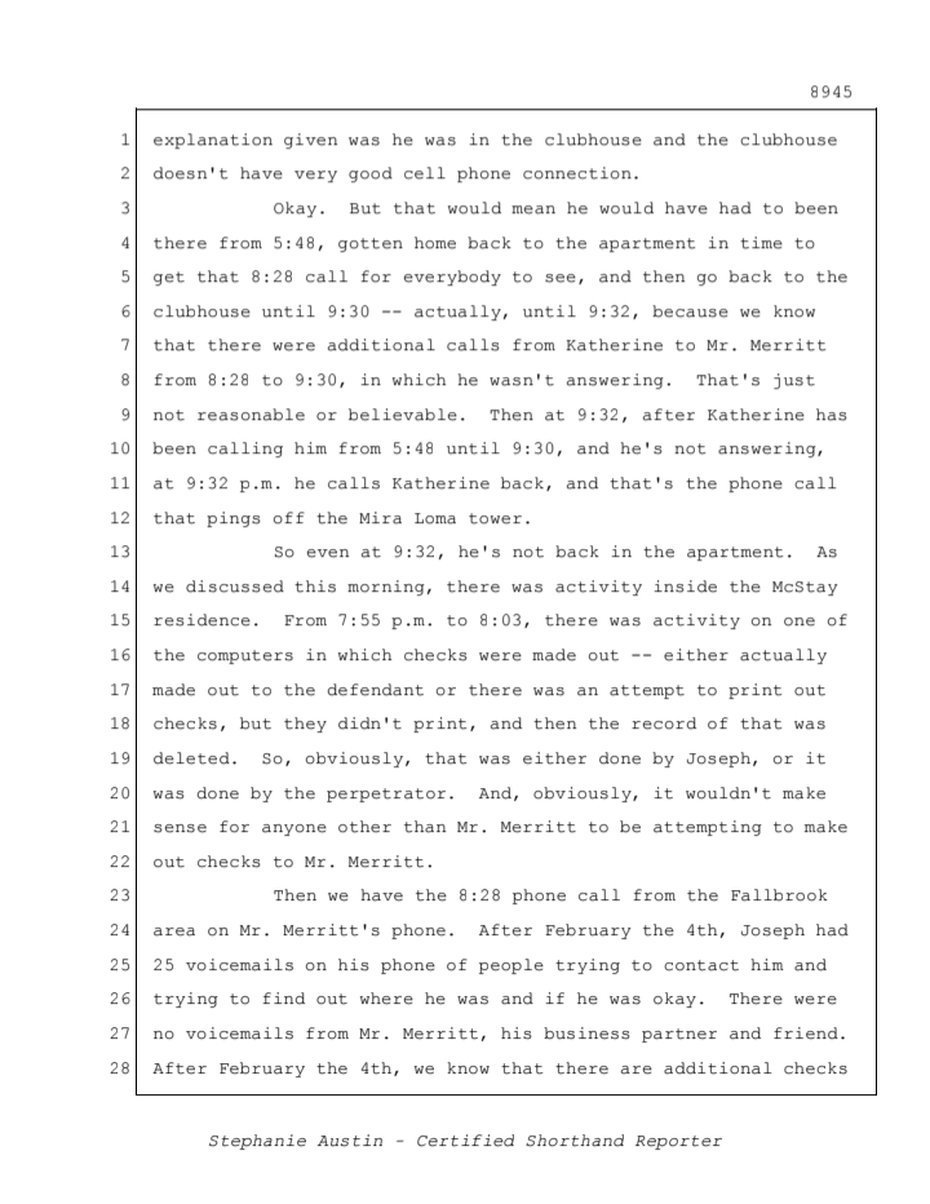
On the truck, it treated the family as still alive in the house after the vehicle on the video left: “And if it was not his truck, and a truck not his truck is leaving the area before the McStays were killed, where they were still in the residence with activity going on in the residence after that truck leaves, the fact that it’s not his truck doesn’t have any significance.” (RT 8957:28-8958:4)
See RT 8957 and 8958

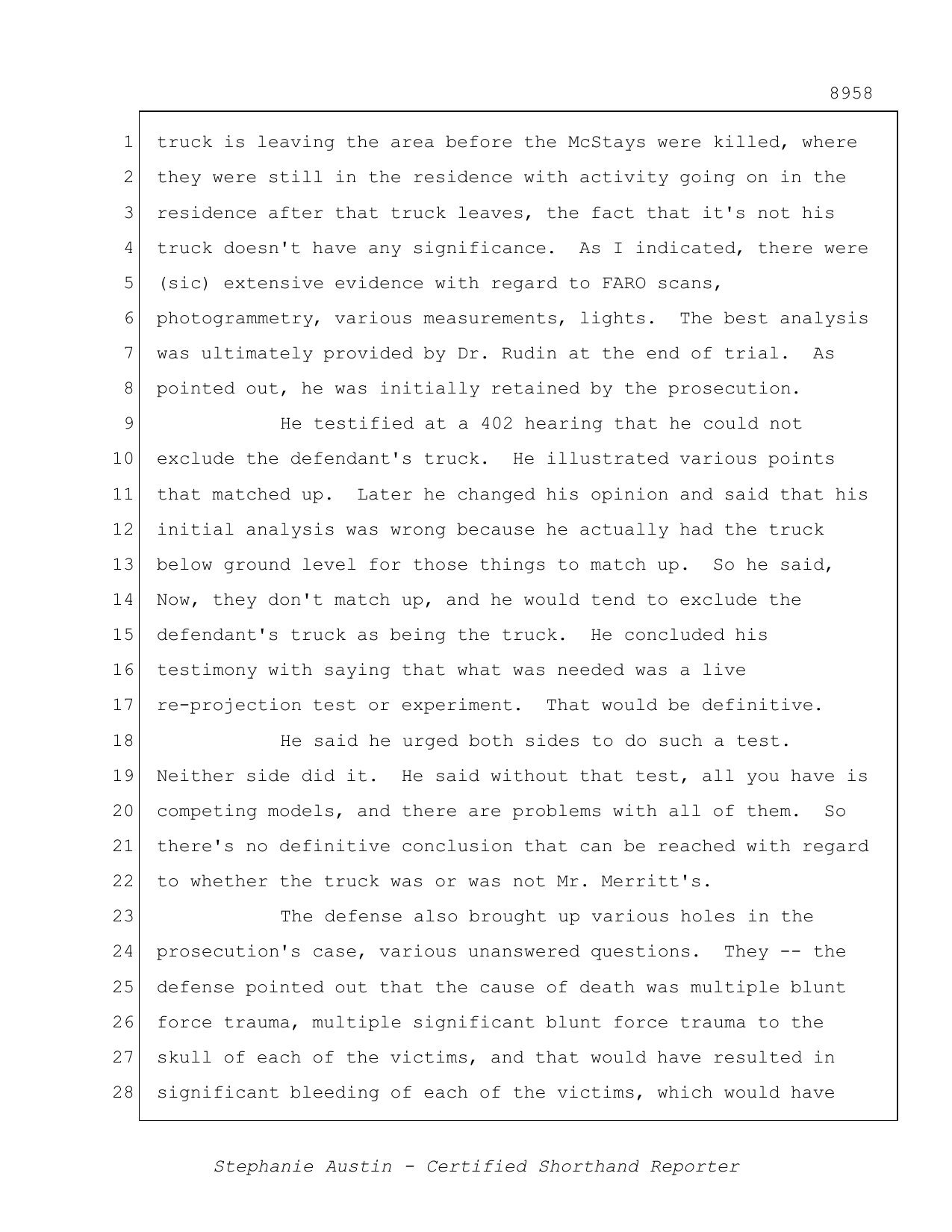
So when it needed to reject my alibi, the court fixed when and where I was: away from home during the 5:48 to 9:32 window on the evening of February 4, and at the McStay residence as “the perpetrator” writing checks on their computer. Fifteen pages later, it found there was no answer to when and where the killings happened.
The court’s own findings on when and where
Later in the same ruling, the court made these findings.
The killings did not happen inside the house:
“There was no evidence of any clean up. And although people can make superficial attempts at clean up, it is rarely, if ever, successful in being complete. So that leads to the conclusion that those blunt force traumas causing that extensive bleeding would not have been inflicted inside the residence.”
(RT 8959:4-8)
See RT 8959
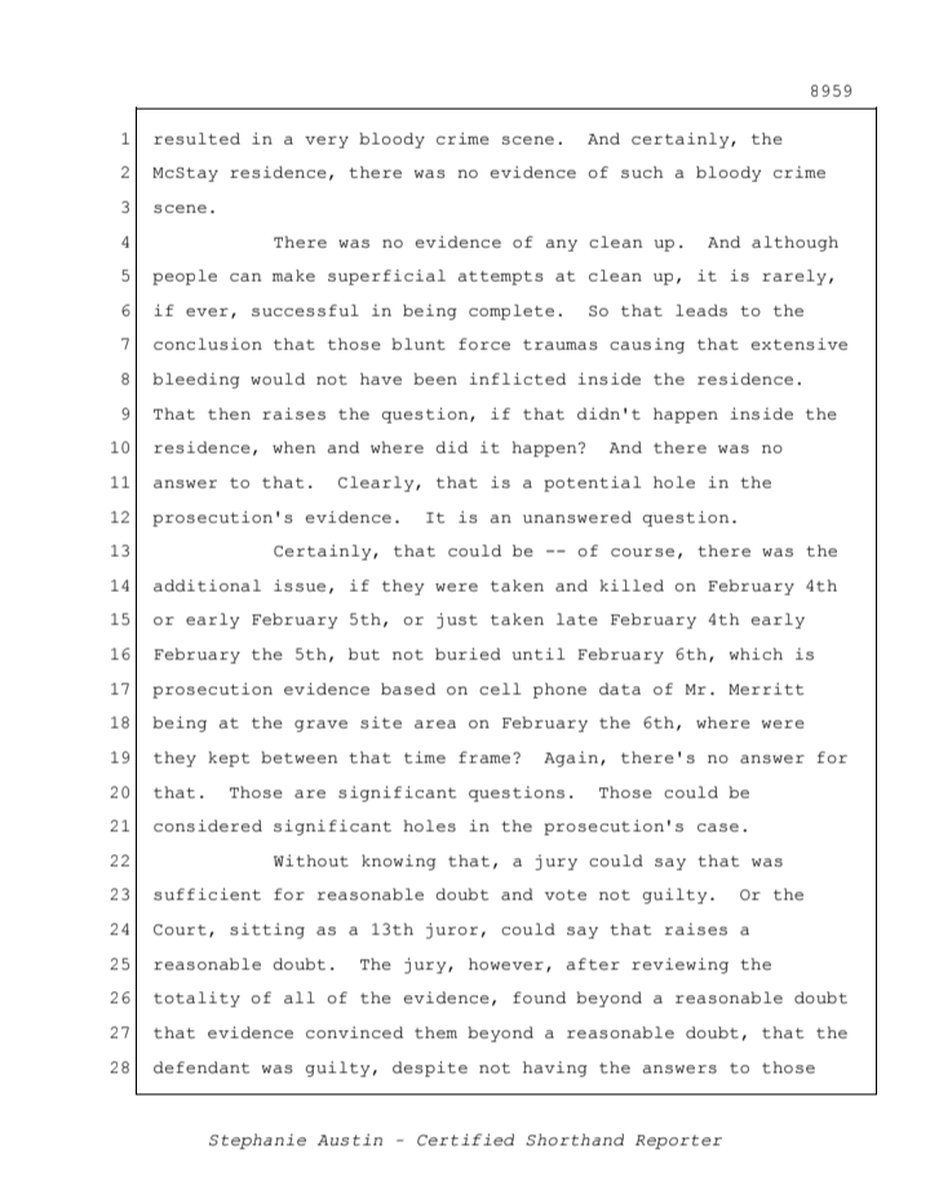
There was no answer to when and where:
“That then raises the question, if that didn’t happen inside the residence, when and where did it happen? And there was no answer to that. Clearly, that is a potential hole in the prosecution’s evidence. It is an unanswered question.”
(RT 8959:9-12)
See RT 8959
There was no answer to where the family was between being taken and being buried:
“Certainly, that could be — of course, there was the additional issue, if they were taken and killed on February 4th or early February 5th, or just taken late February 4th early February the 5th, but not buried until February 6th, which is prosecution evidence based on cell phone data of Mr. Merritt being at the grave site area on February the 6th, where were they kept between that time frame? Again, there’s no answer for that.”
(RT 8959:13-20)
See RT 8959
Those gaps could have supported a not-guilty verdict:
“Those are significant questions. Those could be considered significant holes in the prosecution’s case. Without knowing that, a jury could say that was sufficient for reasonable doubt and vote not guilty. Or the Court, sitting as a 13th juror, could say that raises a reasonable doubt.”
(RT 8959:20-25)
See RT 8959
And then the court relied on the totality and did not act on its own findings:
“The jury, however, after reviewing the totality of all of the evidence, found beyond a reasonable doubt that evidence convinced them beyond a reasonable doubt, that the defendant was guilty, despite not having the answers to those questions.”
(RT 8959:25-8960:1)
See RT 8959 and 8960
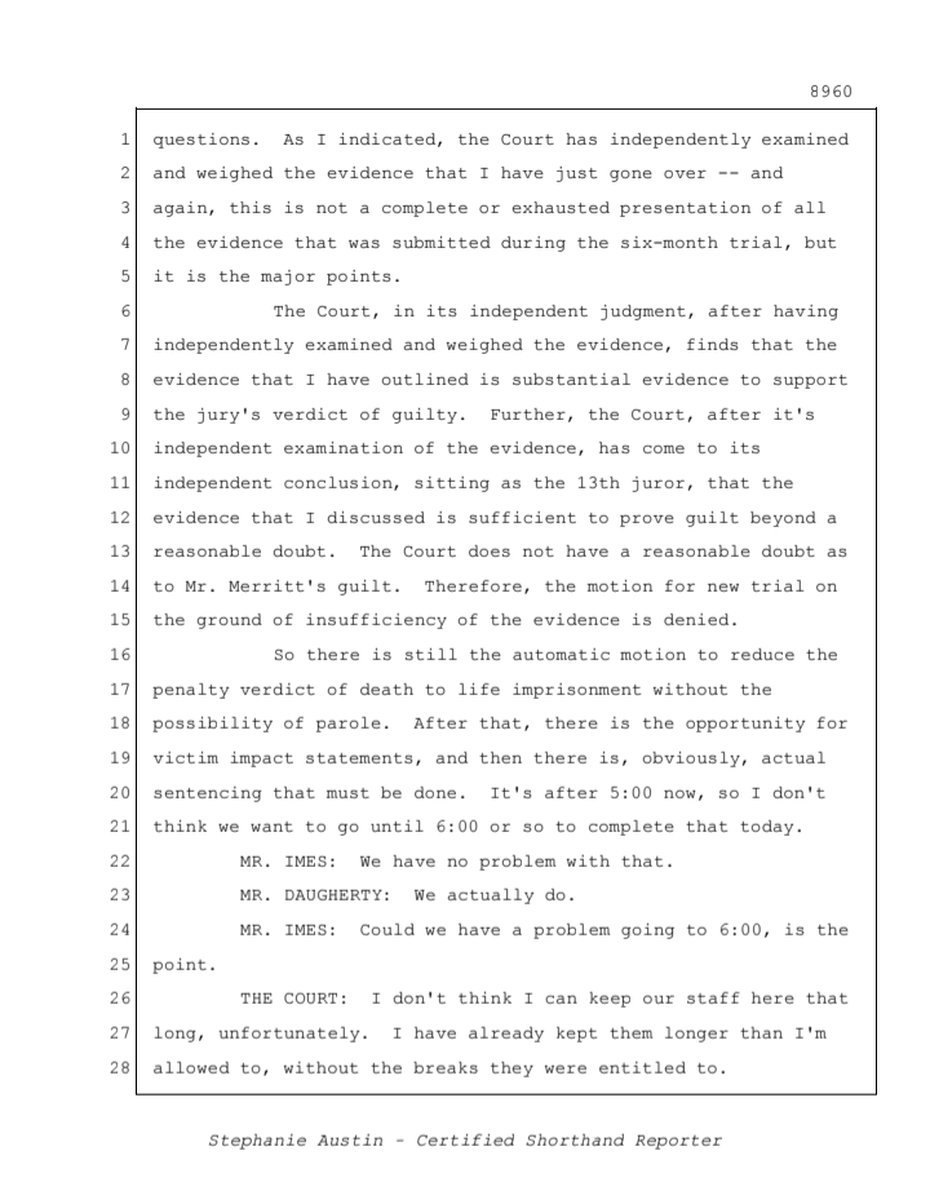
These are not my lawyers’ descriptions. They are the findings of the judge who heard nearly six months of trial, made on his own review of the evidence. He named the exact questions the prosecutor told the jury it did not have to answer: when, and where. He found there were no answers to them. And he found that a jury could have voted not guilty because of that.
The jury had been told those were questions it did not need to answer.
And the court’s finding that the killings did not happen inside the house does not fill the gap. Ruling out one place does not identify another. It does not say where the family was killed, or when, and it does not put me there. The judge said so himself: “there was no answer to that.”
So the question the court never asked is the one the whole case comes down to. The court used the house and the window to reject my alibi (RT 8944-8945). It then found the killings were not in the house, and that no one knows when or where they happened (RT 8959). If the only evidence that I was present was evidence about the house that night, what evidence put me there when the family was killed? Nothing in the record does. And the court never considered whether the instructions and Mr. Imes’s argument had let the jury skip that question entirely.
↑ Back to the menu8. Why it mattered
I want to put this as plainly as I can.
The prosecution chose the event: me, at the Fallbrook house, on the evening of February 4, between 5:48 and 9:32. I prepared my defense against that event and presented it. My lawyers brought in two experts whose only job was to show the truck on the video was not mine. CALCRIM 3400 required the People to prove I was there. The court had already struck the only instruction that would have allowed a conviction without my being there.
After the evidence closed, CALCRIM 207 and the prosecutor’s description of it allowed the jury to convict me on some other event, “reasonably close” to February 4, that was never identified, never proved, and never answered by my defense. My evidence was chosen to meet one specific event. The jury was allowed to convict on another. In an alibi case that is especially unfair, because a person cannot prove he was absent from an event no one ever named.
As I see it, the question was never only whether the jury believed my alibi. It was whether the jury could step around my alibi by putting the crimes at some other time reasonably close to February 4. On this record, they were allowed to, and they were invited to:
- CALCRIM 207 allowed a conviction on an approximate date.
- CALCRIM 3400 required my presence at the crime.
- CALCRIM 200 let jurors apply only the instructions they thought fit the facts as they found them.
- The prosecutor told the jury three times that the People did not need to prove when or where, and tied it to the court’s instructions.
- The prosecutors told the jury again and again that no fact could be taken by itself, though CALCRIM 3400 told them that a reasonable doubt about one fact, my presence, required a verdict of not guilty. Ms. Rodriguez said it again in rebuttal, minutes after Mr. Maline told the jury that if the truck wasn’t mine, they could not convict.
- The morning of February 5 was kept from the defense, then called impossible by the prosecutor in rebuttal.
- The trial judge himself found that the unanswered questions of when and where “could be considered significant holes” that could support reasonable doubt and a verdict of not guilty.
Here is the question at the center of all of it. The People’s only evidence that I was present was tied to the McStay house on the evening of February 4. The judge found the killings did not happen in that house, and that no one knows when or where they did. So what evidence put me there when they happened? Nothing in the record does. CALCRIM 207 doesn’t supply it. A prosecutor telling the jury that when and where don’t matter doesn’t supply it. And the verdict doesn’t supply it either.
A guilty verdict tells you the jury convicted. It does not tell you the jury got there by a lawful route. That is exactly why instructional error matters: a jury can return a guilty verdict by following a path it should never have been offered. Nobody can say this jury ever found that I was present at the event the prosecution chose. That was the single most disputed fact in the case. The judge who heard the evidence found the answers to when and where unknown, and found that a jury could have acquitted on that. In a death penalty case, the law demands more reliability, not less.
↑ Back to the menu9. How my lawyers answered it
My lawyers did argue the alibi instruction to the jury. Mr. McGee told them: “the People are going to have to prove is that he drove down the night of the 4th and killed the family” (RT 8297:21-22). Mr. Maline read CALCRIM 3400 to them and said: “if it’s not his truck, you can’t convict him. That’s why this jury instruction is it.” (RT 8407:24-26)
See RT 8297 and 8407
But:
- They submitted on 207. Before reaching it, the court noted that counsel wanted to be heard on it (RT 7742:8-9). When the court reached it, Mr. McGee began, “I did not —”, was interrupted by Mr. Maline, conferred off the record, and submitted (RT 7742:14-17). The reasons are not in the record. Mr. Maline’s own closing shows they understood 3400 to be the whole case. Submitting to 207 gave up the time that 3400 depended on.
- They never told the jury the two instructions conflicted, or that Mr. Imes had told them the opposite of 3400 three times.
- They never answered the “isolation” argument. Mr. McGee read the jury CALCRIM 220 and 224, including the rule that each fact essential to guilt must be proved beyond a reasonable doubt. Mr. Imes objected, and the objection was overruled (RT 8282:16-8283:8). Mr. Maline read CALCRIM 3400 and applied it to the truck (RT 8407:15-26). But neither of them told the jury that Mr. Imes’s “You cannot isolate an individual fact” was the opposite of 3400, and neither objected to it. In reading 224, Mr. McGee also left out its last sentence, that the jury “must accept only reasonable conclusions and reject any unreasonable conclusions.” Ms. Rodriguez used that in rebuttal: “what was left off is that you have to reject the unreasonable conclusions” (RT 8412:10-11).
- They did not object to Mr. Imes’s statements at RT 8183, 8240 or 8269, and did not ask for any correction.
- They argued the wider timeframe but never tied the alibi instruction to it. From opening statement on, they argued that the family was alive into the morning of February 5. That theory was not inconsistent with my alibi. It extended it. The evidence was in front of the jury: Cathy put me home that night (RT 5319:12-5320:4), and the State’s own expert put my phone in Upland at 7:00 a.m. and Santa Clarita by 10:45 (RT 4528:21-4529:14). Mr. McGee argued it in opening and closing. But having widened the timeframe, they needed to make sure the alibi instruction worked across it, by objecting to 207 or asking for an instruction that kept the alibi tied to whatever time the jury found. They did neither. And when Ms. Rodriguez suggested through a question that I might have left in the night (RT 5469:24), they did not go back to it on redirect.
- They dropped the February 5 line without a record. After two sustained objections, and after laying the foundation for the very conclusion the court excluded, Mr. McGee said, “One second, your Honor. I don’t have anything further of the witness” (RT 3355:9-10). No offer of proof was made. The February 5 timeframe was the defense theory announced in opening, the witness was the State’s own homicide investigator, and Mr. McGee had just laid the groundwork for the answer. There was no advantage in giving that up without a record.
- They raised the conflict only after the verdict, at the motion for new trial (RT 8893:10-17).
See RT 7742, 3355, 8893, 8282 and 8283
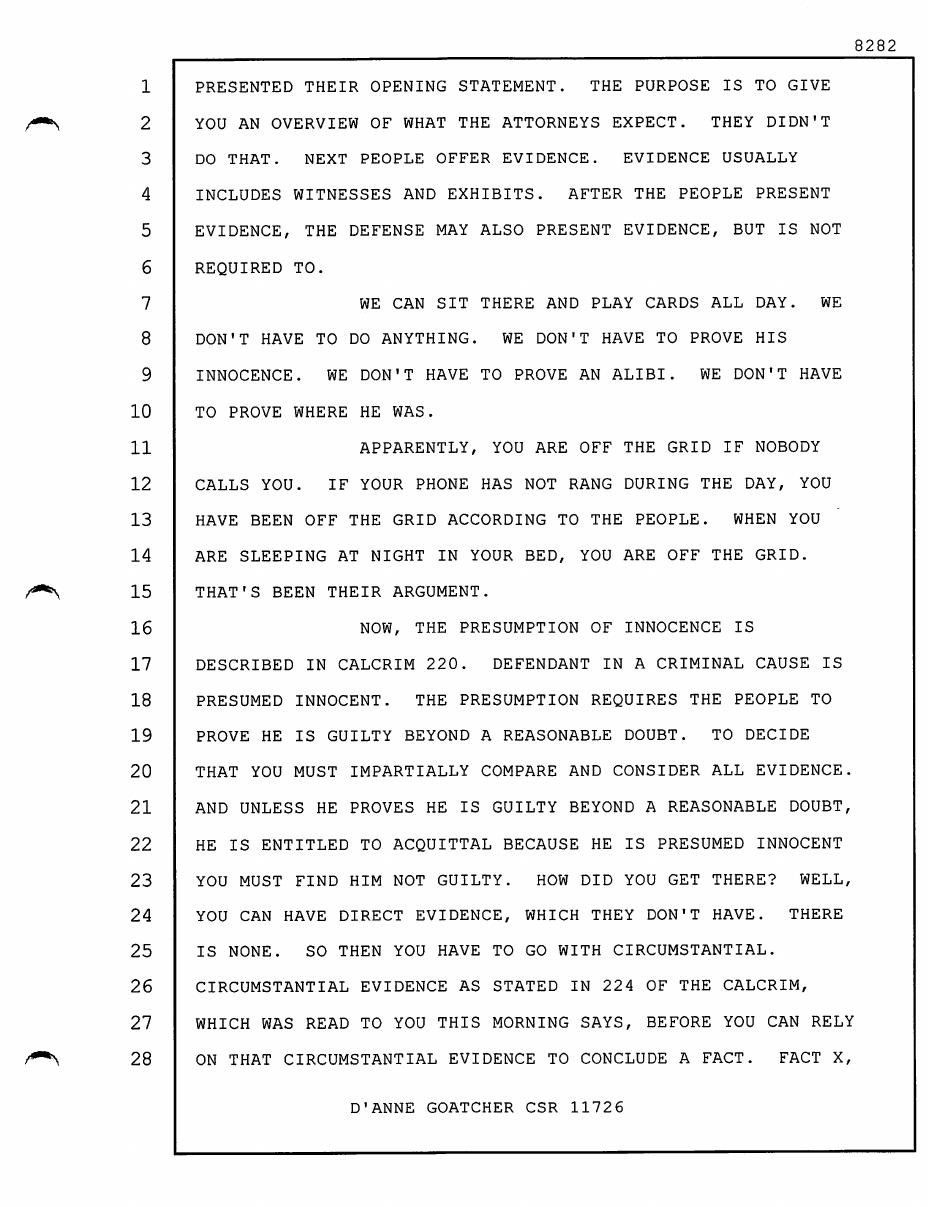
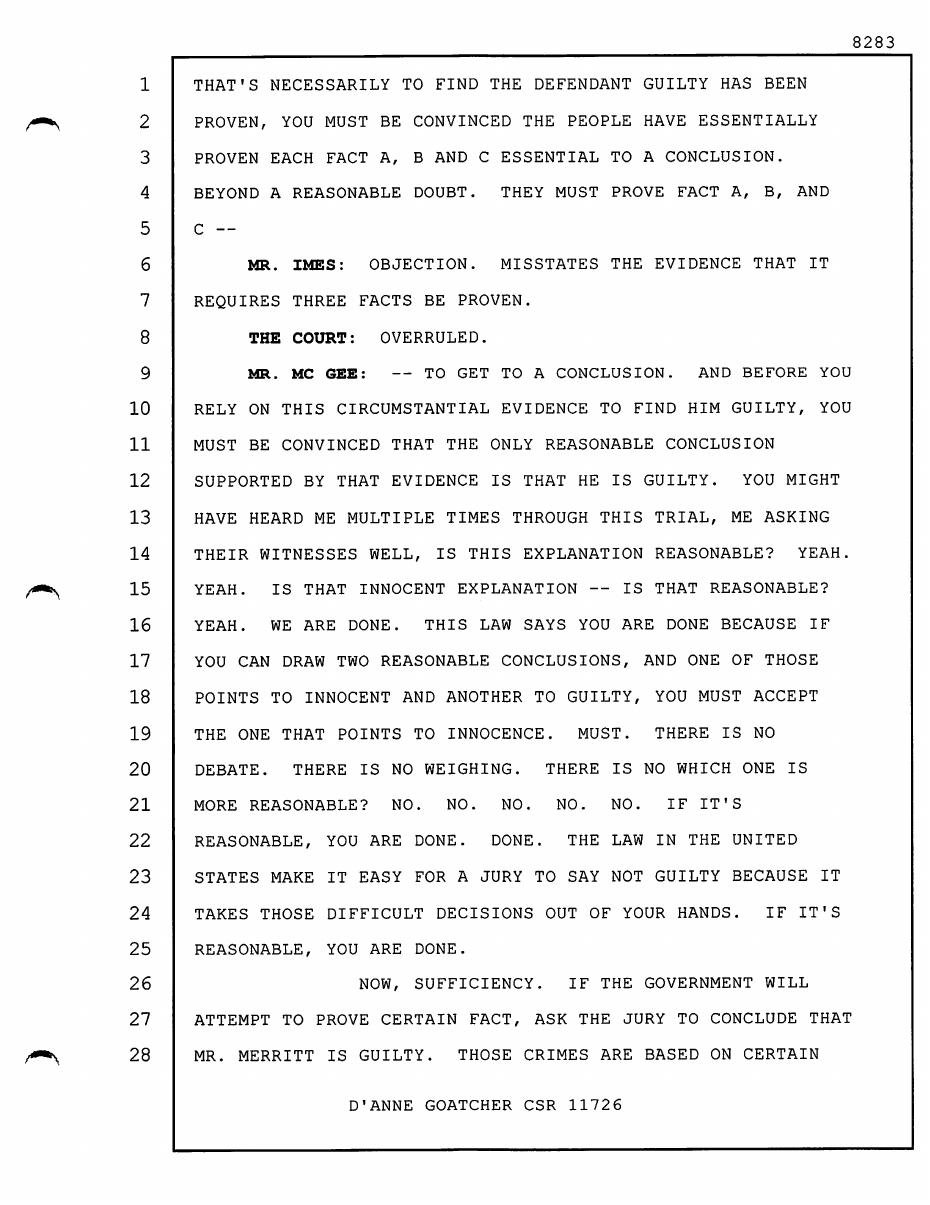
10. What should have happened
CALCRIM 207 should not have been given. Its own Bench Notes say not to give it when the evidence shows a specific time and place and the defense is alibi, and the People’s evidence was all aimed at one time and place: the McStay house on the night of February 4. The court raised it on its own, and nothing required it.
Once it was given, the jury should have been told it could not be used to avoid deciding whether I was present at the event the People alleged. Under CALCRIM 3400, that was the question the jury had to answer.
When Mr. Imes told the jury three times that the People did not have to prove when or where, the court should have corrected him in front of the jury, and my lawyers should have asked it to.
The morning of February 5 should have been treated one way. Either the State’s homicide investigator should have been allowed to say whether the house pointed to the morning, or the court should not have relied on February 5 itself when it denied acquittal and a new trial. And the prosecutor should not have been allowed to tell the jury, when my lawyers could no longer answer, that it was “not even a possibility.”
At the motion for new trial, when the court found there was “no answer” to when and where the killings happened and that a jury could have voted not guilty for that reason, the conflict my lawyer raised should have been answered, not set aside because the defense had asked for the alibi instruction.
The People chose the event they would prove. A fair trial would have held them to it. CALCRIM 3400 requires proof that I was present when the crime was committed. On the evidence the People actually presented, the only way to prove that was to prove I was at the McStay house on the evening of February 4, 2010. They offered nothing that put me anywhere else the family might have been. As I see it, what that leaves is a trial in which the jury is held to that, consistently with CALCRIM 3400 and with 207’s own Bench Notes, and is not told that when and where do not matter. That is the one thing this jury was never required to find.
↑ Back to the menu↩ Return to where you were