Alive on February 8?
The border footage my jury never saw
The State told my jury that Joseph and Summer McStay and their two little boys were killed in their home on the evening of February 4, 2010. Four days later, on February 8, two cameras at the San Ysidro border recorded a man, a woman and two small children. The first, a camera in a shopping-center parking lot, caught them from the front, near the parking area the family’s Isuzu Trooper was towed from that night. The second caught a group of four from behind at about 7:00 p.m., walking into Mexico.
What the jury was told. At my trial, Mr. Imes asked the San Diego detective who had worked the disappearance for three years about the surveillance from those lots: “Did you see anything of any evidentiary value on any of the surveillance tapes?” “From these lots?” “Yes.” “No.” (RT 2337:4-8) This was false. The parking-lot camera, Camera 16, had recorded a woman and two small children at 5:52 p.m. on February 8, and all four together, with a man, by 5:53, and the group again at 6:58 p.m. Camera 16 also recorded the McStays’ Trooper being towed from the lot at 11:08 p.m. Below are the frames from that parking-lot camera. My jury never saw them. It never saw the border video either.
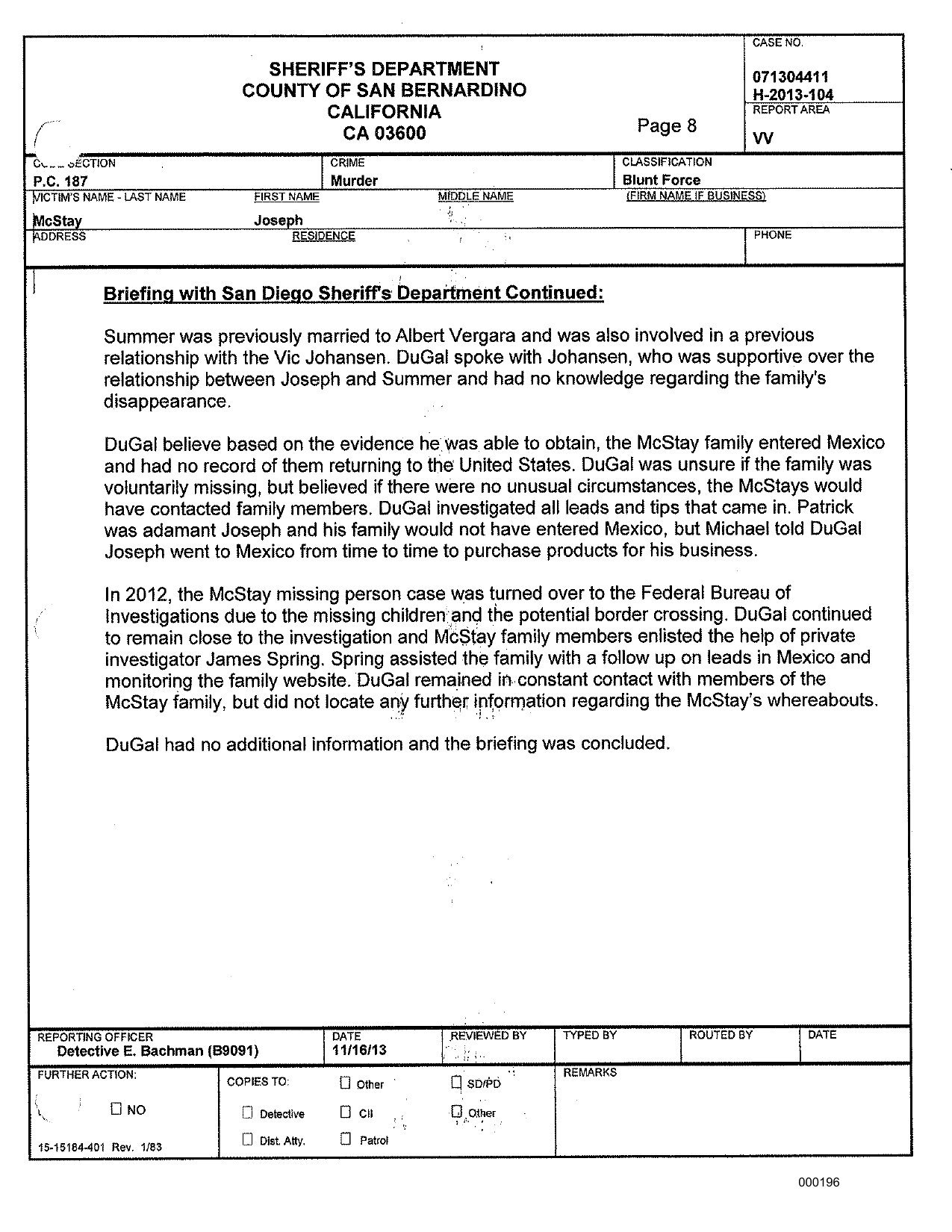
What the detective had written. The detective was asked whether he told family members that he “personally believed that it was Joseph, Summer, and the kids.” He answered: “No.” (RT 2468:19-24) Later: “It’s not my belief.” (RT 7611:4-7) His own reports do not use the words “I personally believe,” but he wrote that he “considered the circumstantial evidence as ‘probable’” (report of a March 29, 2010 call; Patrick McStay report), and they record him telling Joseph’s brother Michael in December 2011 that the evidence “made this likely that it was his family crossing the border” (Bates 001785). In November 2013 he told San Bernardino detectives that, “based on the evidence he was able to obtain, the McStay family entered Mexico” (Bates 000196). The jury heard the denial, not the reports. When my lawyer asked whether he had told family members in his interviews that the car being there and a family resembling the McStays crossing that day was “a pretty big coincidence,” the objection was sustained “as cumulative.” (RT 2470:11-16)
See the document (Bates 000196)
How the border video was kept out. When my lawyers tried to show it, Ms. Rodriguez told the court: “It’s not them.” (RT 7592:2-4) Her reason: “— went to Mexico and came back and drove up the hill and buried themselves?” (RT 7592:6-7) The court ruled: “There’s no foundation for the video. You cannot show the video.” (RT 7595:12-15) Yet the detective who requested the border footage, received it, reviewed it for three years, had it enhanced and showed it to the family was on the witness stand. California law lets a witness like that lay the foundation. (Evid. Code §§ 1400, 1401)
I want to be exact about what the jury did hear, because a skeptic will ask. The jury heard the detective say that it was “probable that it was them based on the family’s assessment,” but “almost equally probable it was not them” (RT 2469:27-2470:10). It heard him say that of the family members who watched it, “Not one person said, no, that’s not them,” and that “the mothers’ were much more affirmative” (RT 2469:12-24). What it never got was the pictures themselves, the detective’s own reports, or what the family said when they first watched it.
Two questions run through this page, and I keep them apart. First: do the parking-lot camera and the border camera show the same group of four? Second: was that group the McStays? The pictures bear on the first question directly. They cannot answer the second on their own; the border camera shows only backs, and the parking-lot frames are dark and grainy. Who they were was the jury’s question to weigh. The jury was never given the pictures to weigh it with.
Here is the record, so you can check it yourself.
The footage from February 8
These frames come from Camera 16, a parking-lot camera in the San Ysidro shopping-center lot. They are shown in the order the camera recorded them. They are dark, low-resolution night stills. I offer them not as proof of who the people are, but for what they plainly carry: time, place and path. Judge them yourself. That is what my jury was never allowed to do.
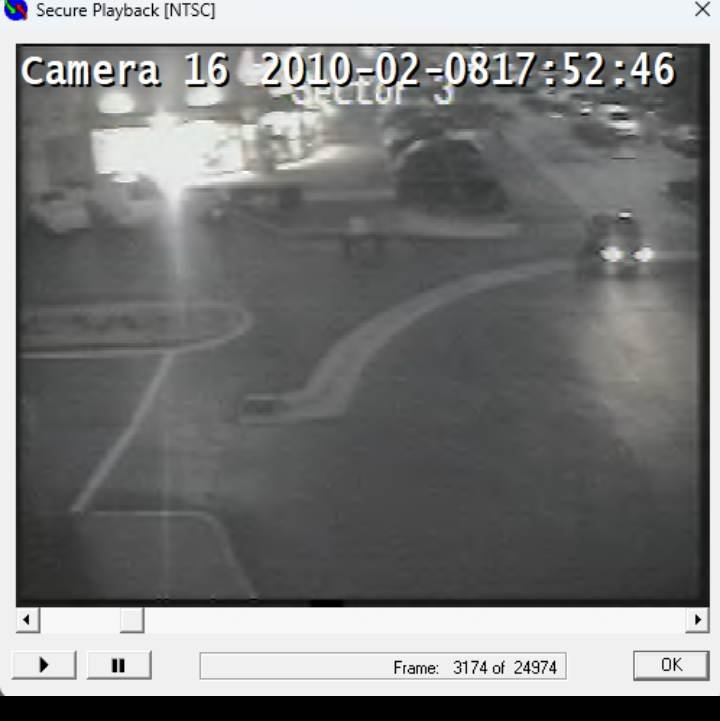
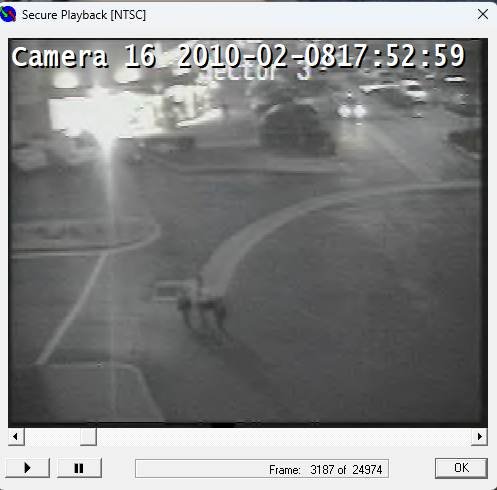
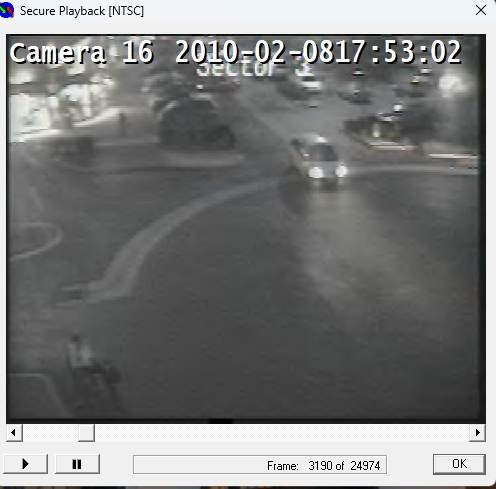
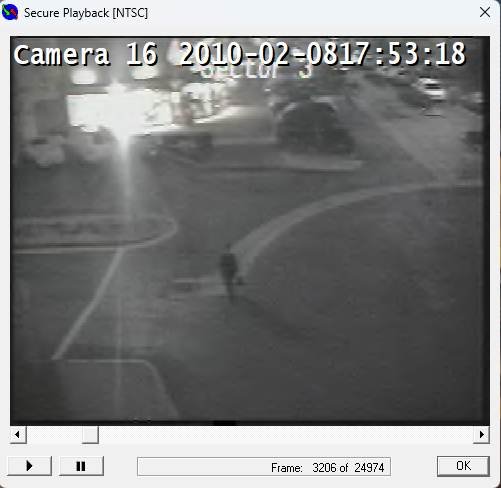
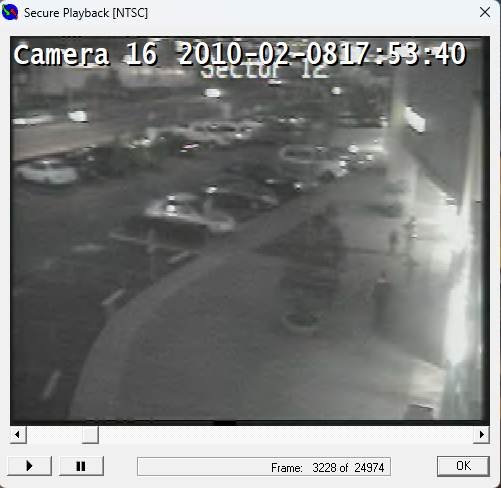
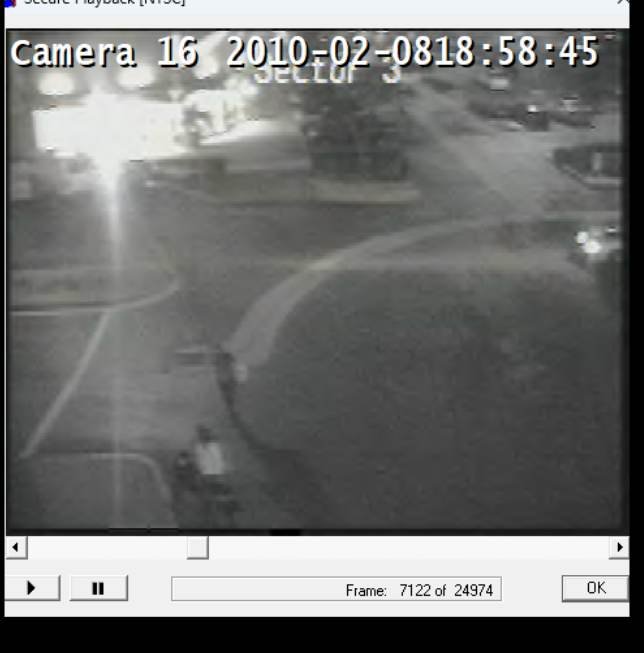
In order: a woman and two young children walk toward the camera, away from the crosswalk that leads to the parking area where the Trooper was later found (Image 1). A man comes into view behind them (Image 2) and closes the gap (Image 3). The group continues across the lot (Image 4). All four walk away from the camera in front of the duty-free store, one child turned back toward the man (Image 5). Just over an hour later, the group is in the same area again, moving toward the border crossing (Image 6).
The next image is a still from the border crossing itself. The parking-lot camera and the border cameras ran on separate systems, and no one has checked their clocks against each other.
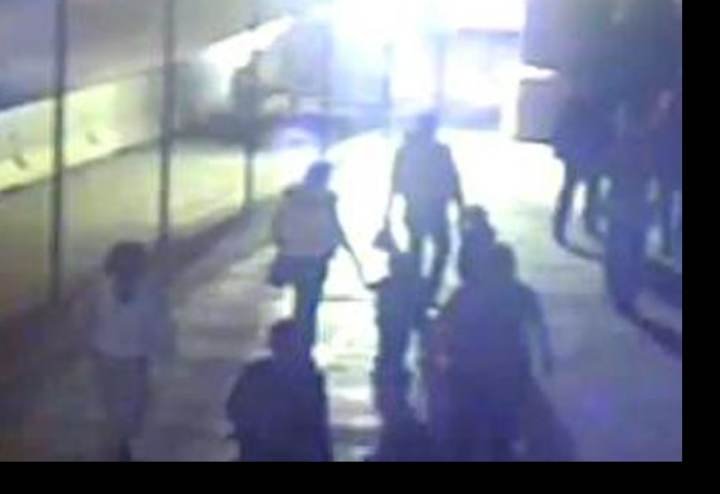
In my review of the footage, the same white bag and white coat appear in the parking-lot frames and the border frames. That is my observation. The frames are here so you can judge it.
The same Camera 16 recorded the rest of that night. At 11:08 p.m. it recorded the McStays’ Trooper being towed from the parking area the group had walked away from:
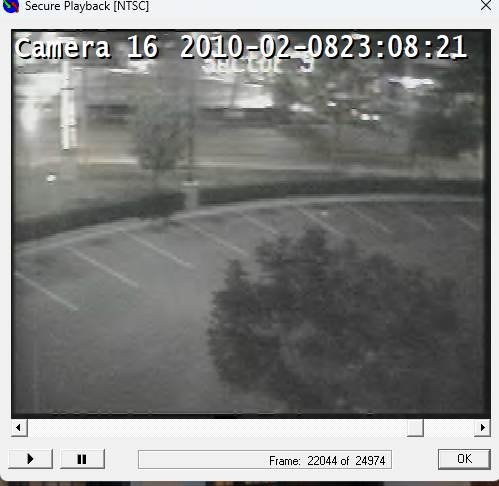
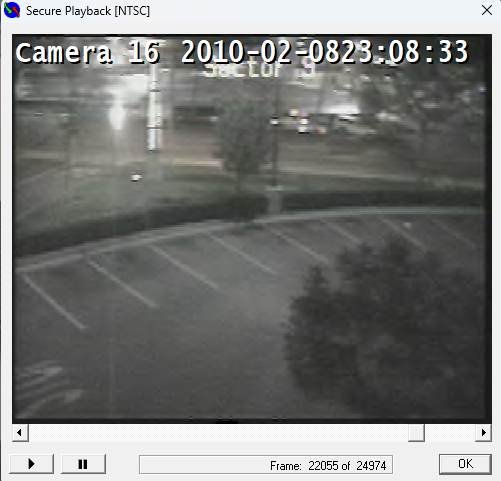
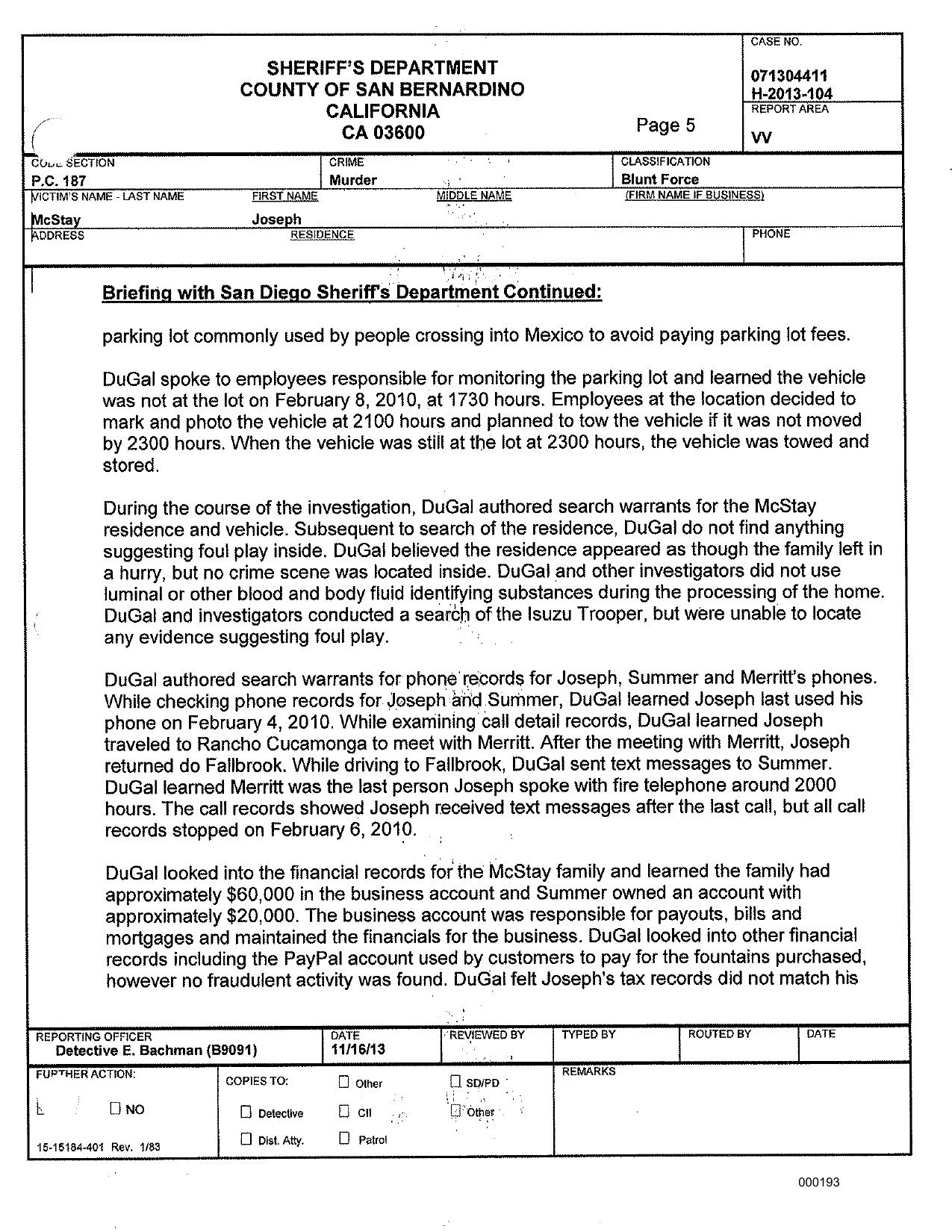
The State’s own records fix the tow on February 8. San Diego’s detective told San Bernardino detectives the lot’s employees marked and photographed the Trooper at 9:00 p.m. and towed it when it was still there at 11:00 p.m. (Bates 000193). These are frames from the same Camera 16 footage that the jury was told held nothing of evidentiary value.
See the document (Bates 000193)
Put plainly: A camera in the lot recorded a woman and two small children at 5:52 p.m. on February 8, and all four together, with a man, by 5:53, and the group again at 6:58 p.m. A border camera recorded a group of four crossing into Mexico that evening. The jury saw none of these frames.
What San Diego concluded
The family disappeared from Fallbrook, in San Diego County. For more than three years it was a missing-persons case, and the San Diego County Sheriff’s Department worked it. No bodies had been found. There was no murder theory to protect.
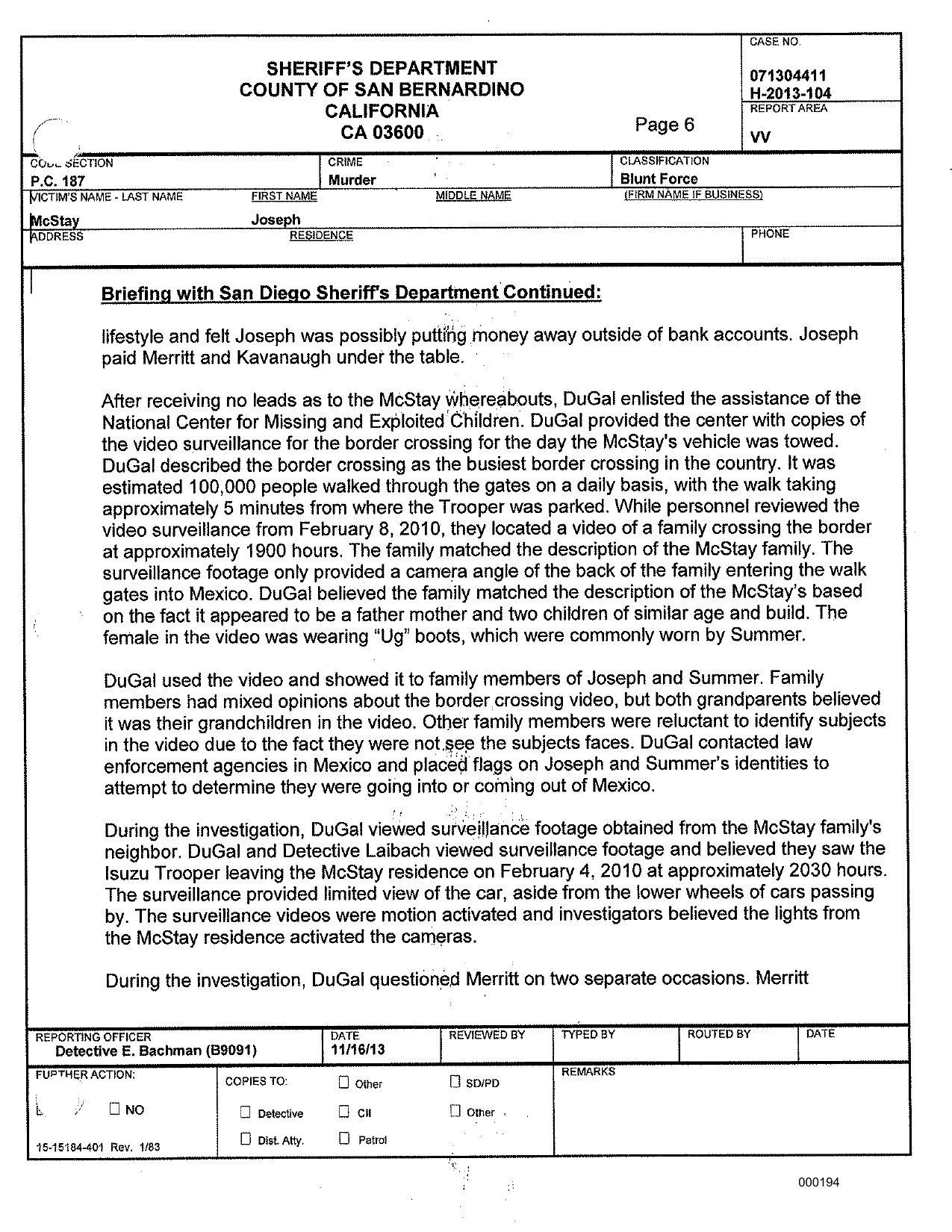
San Diego’s lead detective, Troy DuGal, enlisted the National Center for Missing and Exploited Children. He described the crossing to San Bernardino detectives in a November 13, 2013 briefing, and Detective Bachman wrote it down:
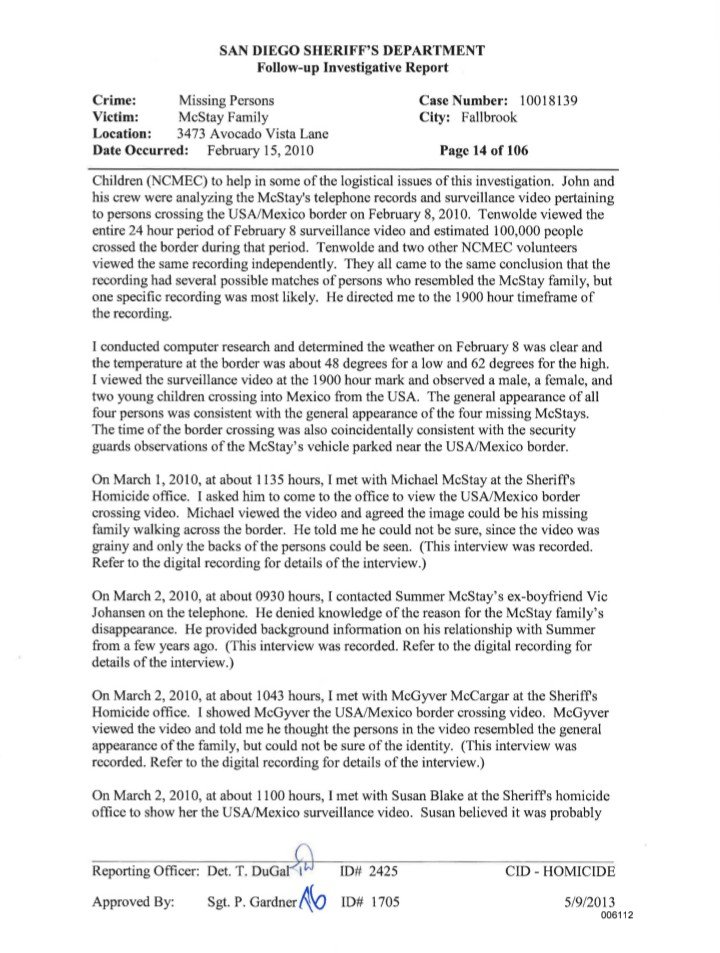
“DuGal described the border crossing as the busiest border crossing in the country. It was estimated 100,000 people walked through the gates on a daily basis, with the walk taking approximately 5 minutes from where the Trooper was parked. While personnel reviewed the video surveillance from February 8, 2010, they located a video of a family crossing the border at approximately 1900 hours. The family matched the description of the Mcstay family.” (Bates 000194)
See the document (Bates 000194)
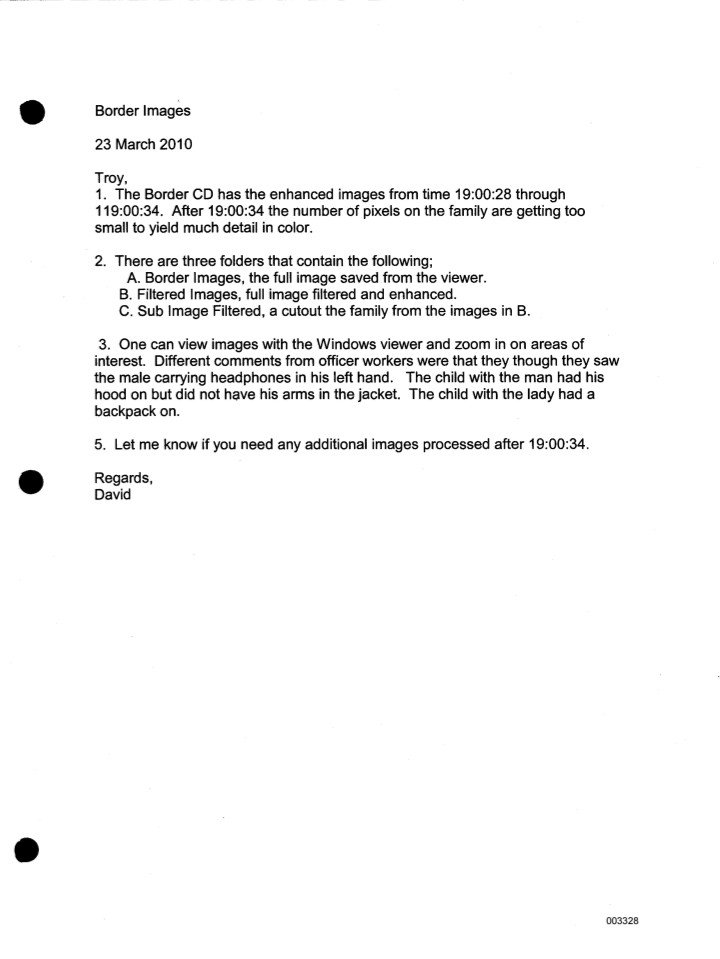
The Sheriff’s Department did not treat the border video as marginal. A memo to DuGal titled “Border Images,” dated 23 March 2010 and signed “David,” reads: “The Border CD has the enhanced images from time 19:00:28 through 19:00:34. After 19:00:34 the number of pixels on the family are getting too small to yield much detail in color.” The images were saved in three folders, including “Filtered Images, full image filtered and enhanced” and “Sub Image Filtered, a cutout the family from the images.” It goes on: “Different comments from officer workers were that they though they saw the male carrying headphones in his left hand. The child with the man had his hood on but did not have his arms in the jacket. The child with the lady had a backpack on.” (Bates 003328; the memo’s own spelling, and it types the second time as “119:00:34”)
See the document (Bates 003328)
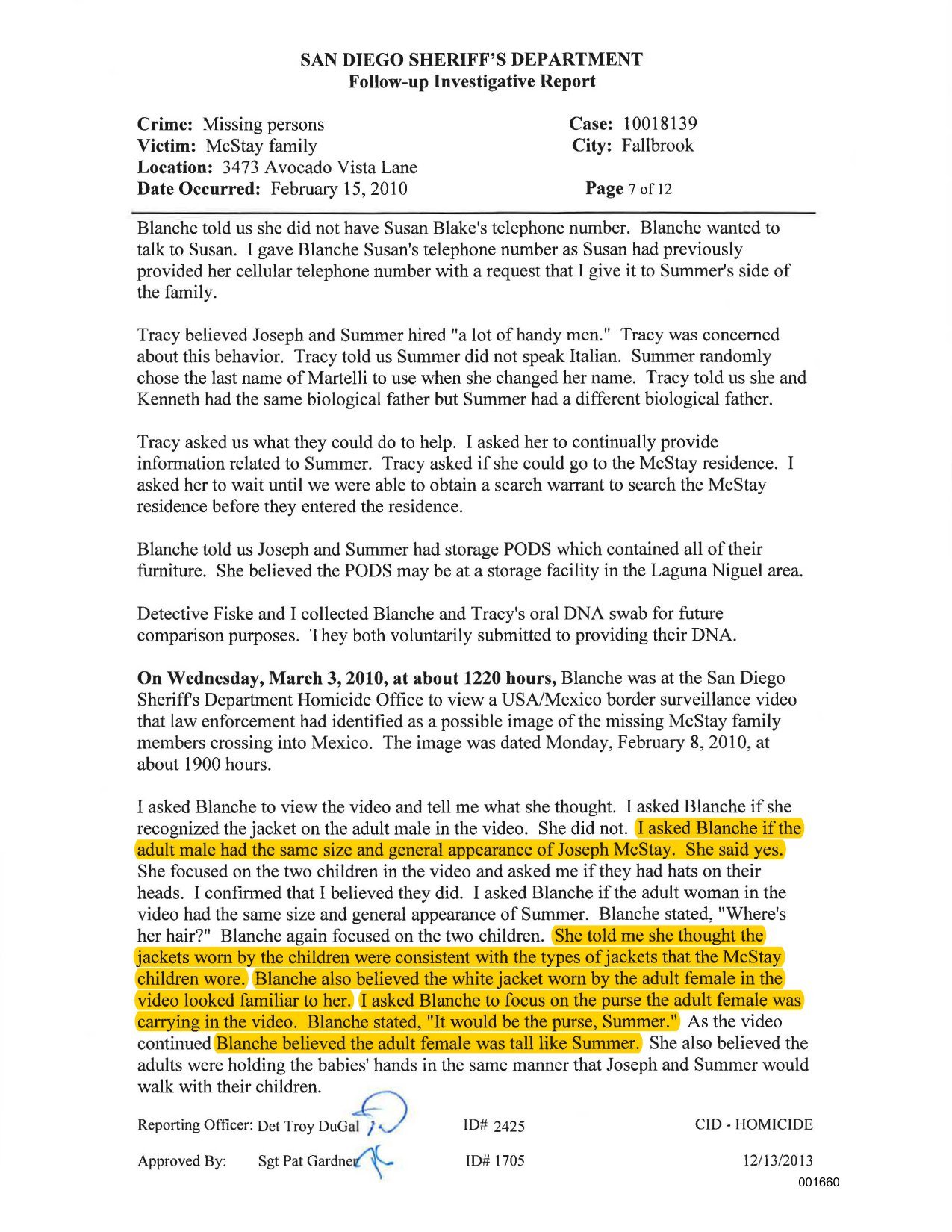
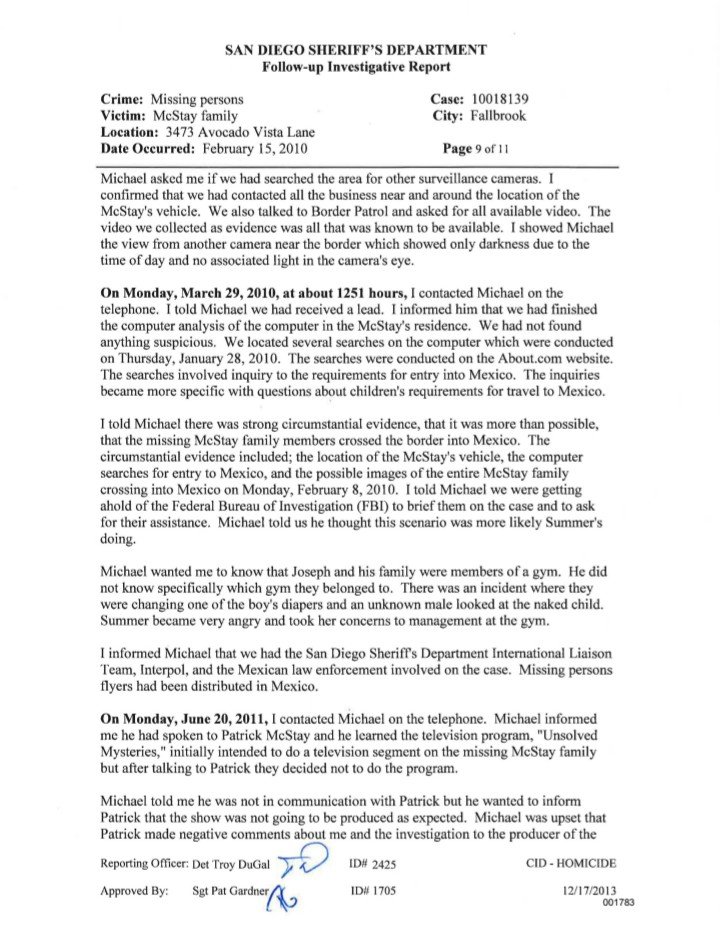
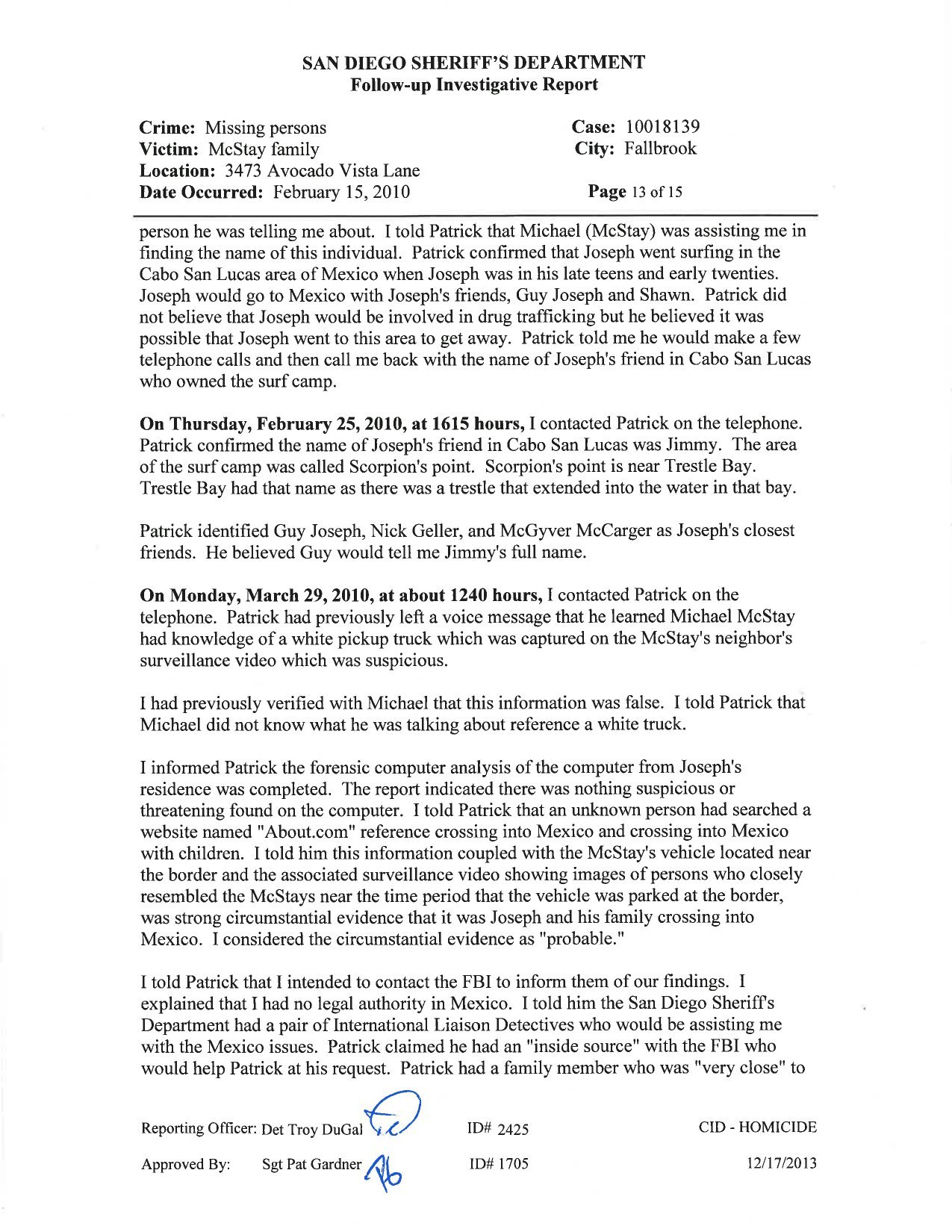
The detective’s own reports show where his assessment went:
See the documents (Bates 001660, 001783) and the DuGal report (Patrick McStay, page 13)
| Date of the conversation | What DuGal wrote |
|---|---|
| March 3, 2010 (Blanche Aranda report, Bates 001660) | “a possible image of the missing McStay family members crossing into Mexico” |
| March 29, 2010 (Michael McStay report, Bates 001783) | “I told Michael there was strong circumstantial evidence, that it was more than possible, that the missing McStay family members crossed the border into Mexico.” |
| March 29, 2010 (Patrick McStay report, p. 13 of 15) | “… strong circumstantial evidence that it was Joseph and his family crossing into Mexico. I considered the circumstantial evidence as ‘probable.’” |
| December 15, 2011 (Michael McStay report, Bates 001784-001785) | “… made this likely that it was his family crossing the border. I also told him I could not positively identify his family members from that video but the circumstantial evidence was strong.” |
| DuGal’s summary report (dated 5/9/2013, before the remains were found), Bates 006112 | “I viewed the surveillance video at the 1900 hour mark and observed a male, a female, and two young children crossing into Mexico from the USA. The general appearance of all four persons was consistent with the general appearance of the four missing McStays.” |
| November 13, 2013 briefing (Bachman report, Bates 000196) | “DuGal believe based on the evidence he was able to obtain, the Mcstay family entered Mexico and had no record of them returning to the United States.” |
A note on dates, so no one can say I hid it: DuGal typed these follow-up reports in December 2013 (the Blanche Aranda report is dated 12/13/2013; the Michael and Patrick McStay reports 12/17/2013), from the recorded interviews. The conversations themselves took place in 2010 and 2011, before the remains were found. Even writing them up after the remains were found, he wrote “probable” and “likely.”
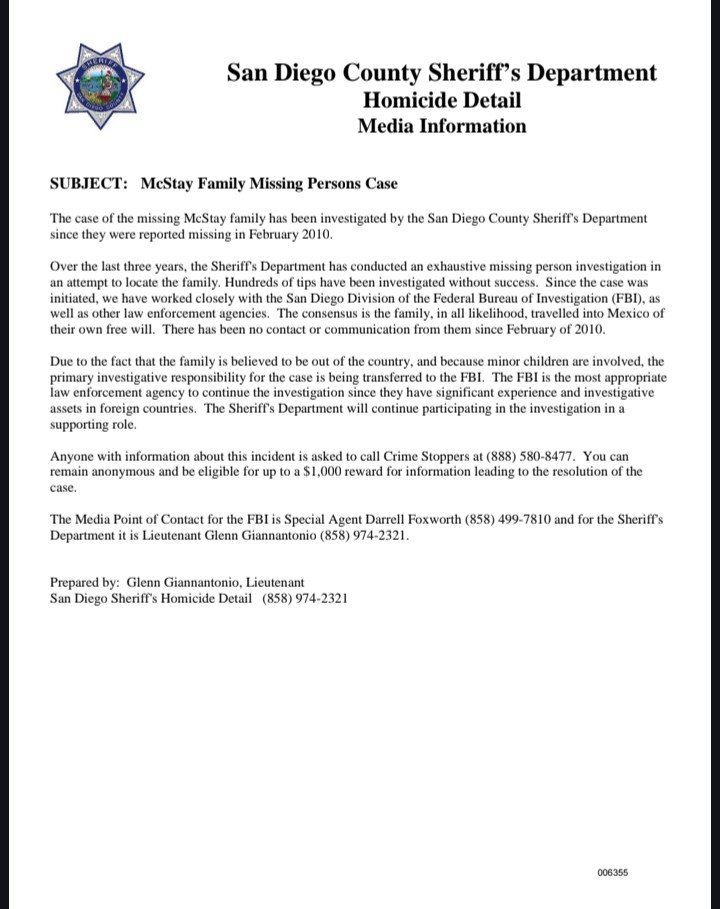
After what it called “the last three years” of investigation, the Sheriff’s Department issued a media release: “The consensus is the family, in all likelihood, travelled into Mexico of their own free will. There has been no contact or communication from them since February of 2010.” It gave the reason the case was moving to the FBI: “Due to the fact that the family is believed to be out of the country, and because minor children are involved, the primary investigative responsibility for the case is being transferred to the FBI.” (Media Information, prepared by Lt. Glenn Giannantonio, Bates 006355)
See the document (Bates 006355)
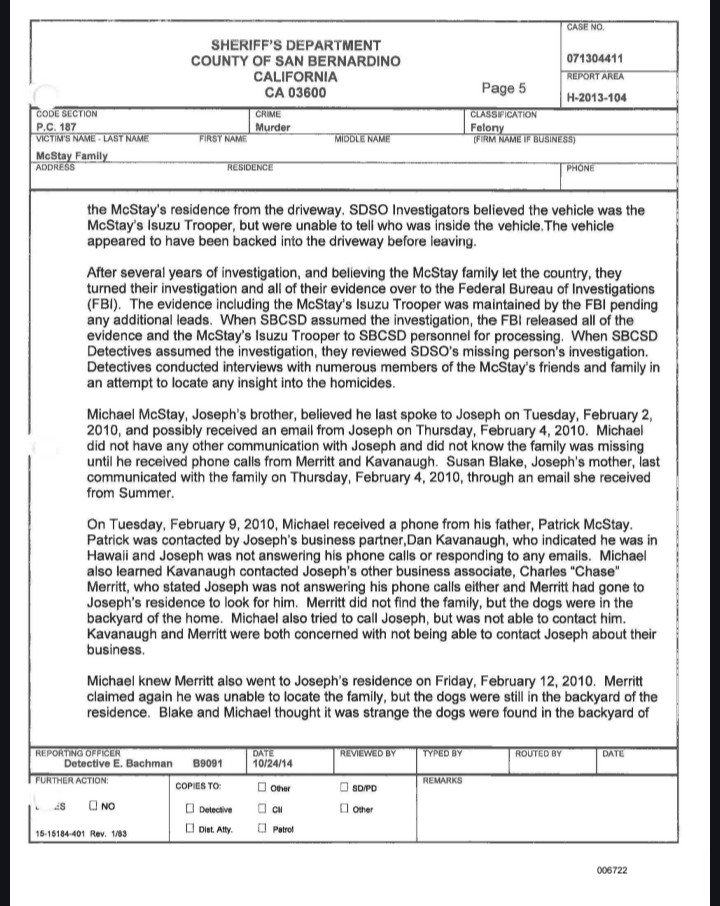
San Bernardino’s own detective, Edward Bachman, later described it the same way: “After several years of investigation, and believing the Mcstay family let [sic] the country, they turned their investigation and all of their evidence over to the Federal Bureau of Investigations (FBI).” (Bates 006722)See the document (Bates 006722)
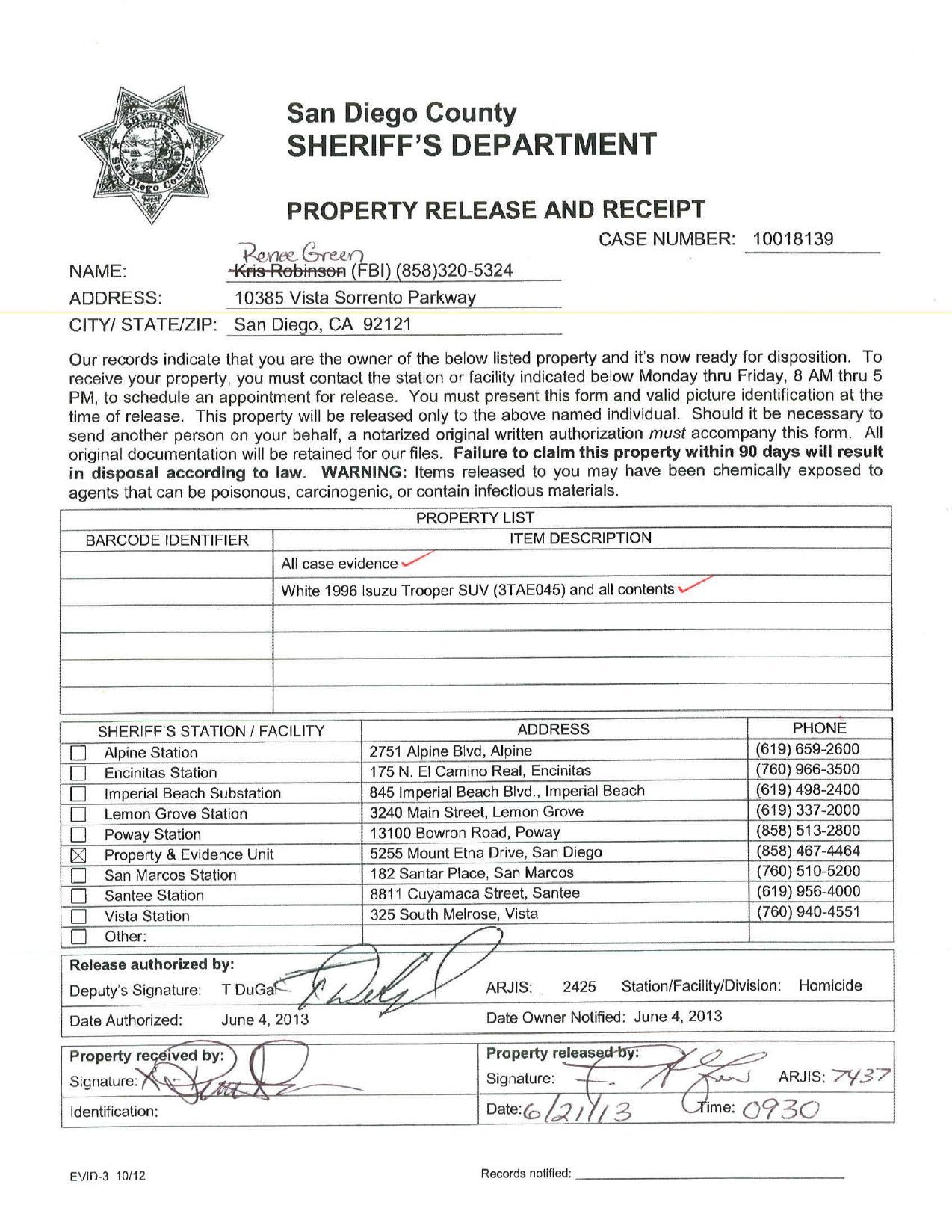
See the property release to the FBI and the document (Bates 006260)

Then the remains were found in the desert near Victorville in November 2013, and the case moved to San Bernardino County. San Bernardino took the opposite position: the crossers could not have been the McStays, because the McStays were already dead. One agency looked at the footage with no suspect to convict and concluded the family probably crossed. The other prosecuted me on the premise that they could not have.
Put plainly: San Diego, which investigated first and had no suspect, wrote that the crossing was “probable” and “likely” the McStays, said publicly they had “in all likelihood” gone to Mexico, and turned its evidence, including the videos, over to the FBI. San Bernardino prosecuted on the opposite premise.
“No record”: San Diego already knew
San Bernardino’s strongest-sounding point was that no official record shows the McStays crossing, and none shows them coming back. It sounds decisive. But San Diego knew that too. The same 2013 briefing records that DuGal believed the family “entered Mexico and had no record of them returning to the United States.” (Bates 000196) He reached his conclusion with that gap in front of him.
At a gate DuGal estimated 100,000 people walk through every day, a five-minute walk from where the Trooper sat (Bates 000194), San Diego treated the video as the record. “No record” was not a new fact that overturned San Diego’s conclusion. It was an old fact San Diego had weighed.
Nobody disputes that the McStays died. The question was when. If the group in the footage was the McStays, walking into Mexico alive on February 8, they were not killed on February 4.
Put plainly: The lack of a crossing record was not new. San Diego knew it and still concluded the family entered Mexico.
What the family said in 2010, and at trial
In 2010, while it was still a missing-persons case, San Diego detectives showed the border video to the people who knew the McStays best and wrote down what they said. Here is what each said then, beside what the jury heard. I include the parts that cut against me.
Susan Blake, Joseph’s mother (viewed March 2, 2010)
In 2010 (detective’s report): She could not tell if the man or woman was Joseph or Summer; the woman “looked like a bigger woman and Summer is much thinner”; the children “look to be the size of Gianni and Joseph Jr., but she can’t tell.” After about ten minutes, “the gait of the female in the video appears to be similar to Summer’s gait, and the gait of one of the children appears to be similar” to Joseph Jr.’s. “The adult male’s gait does not match Joseph senior’s gait. Susan stated, ‘It does not look like my son.’” Asked about Joseph having been to Mexico, she said that when she said he would never go, “she meant Tijuana not resort type places.” (Det. Hillen report, Bates 001819-001820)See the documents (Bates 001819, 001820)
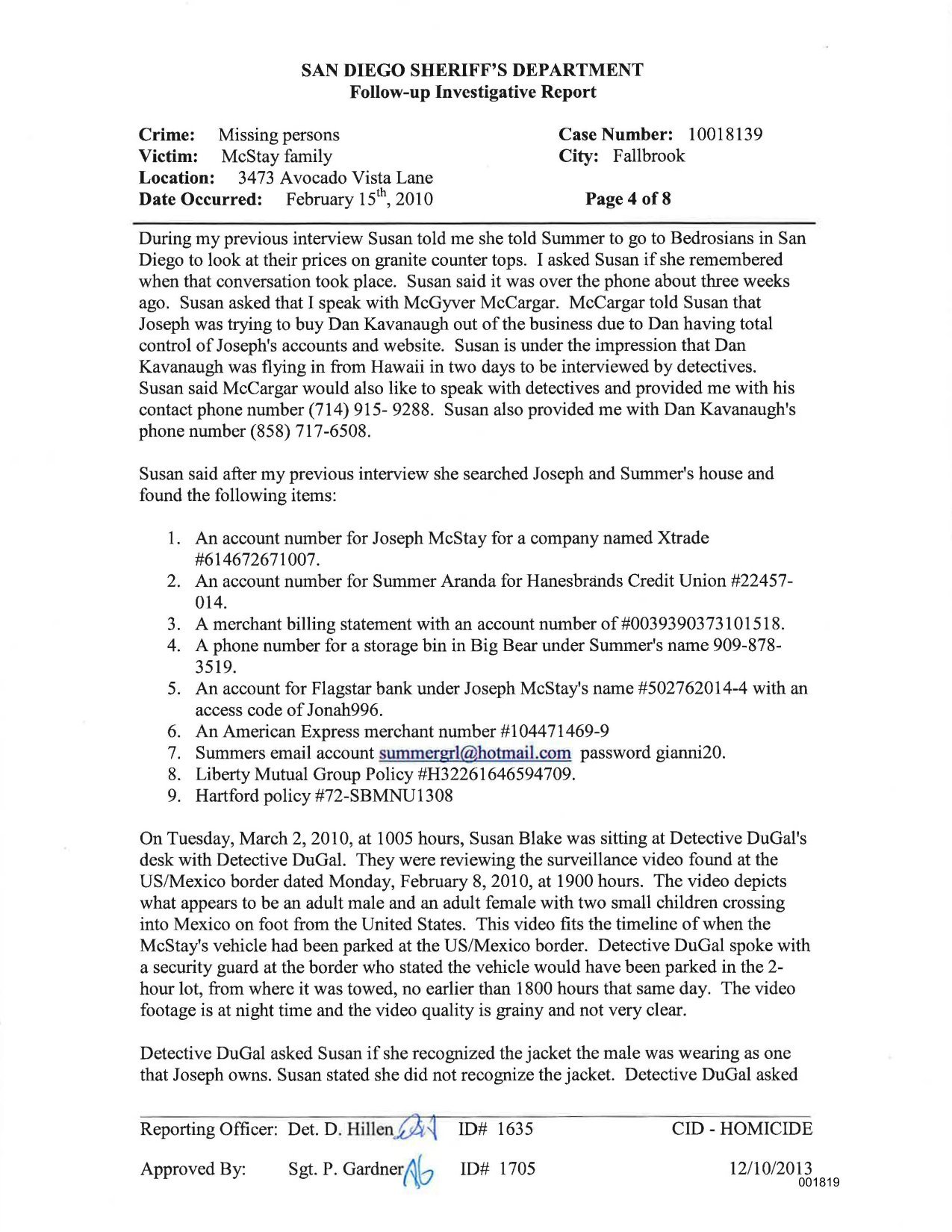

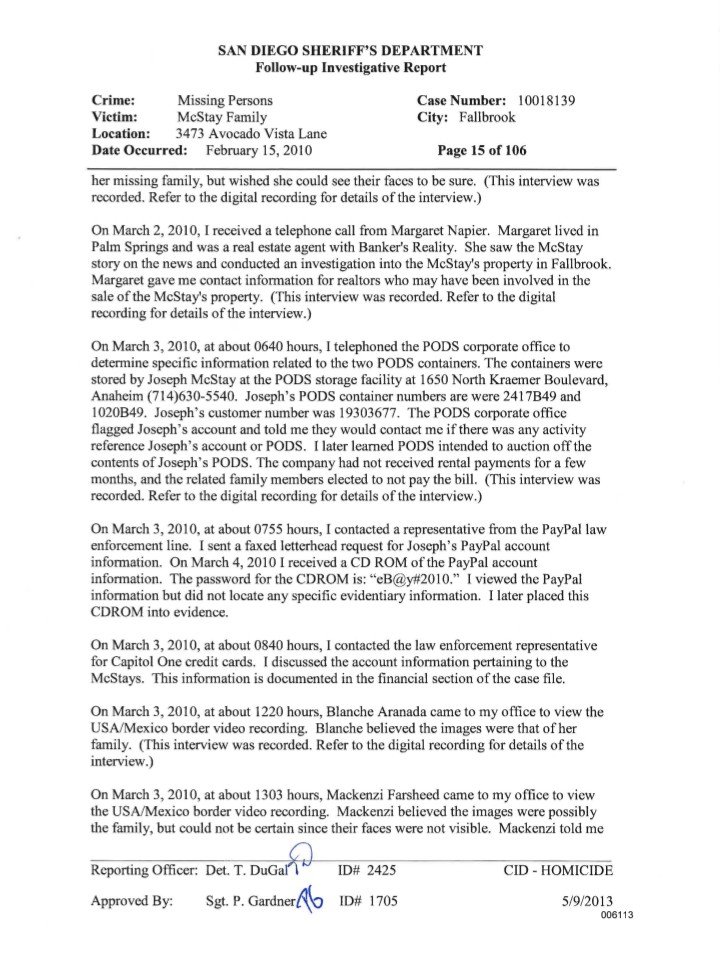
See the documents (Bates 006112, 006113)
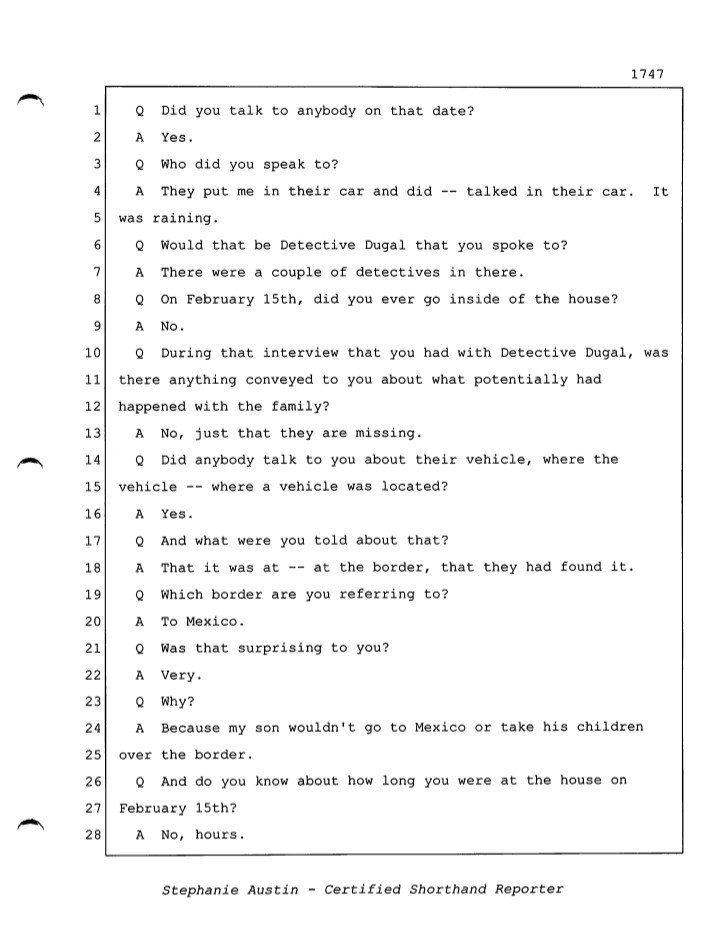
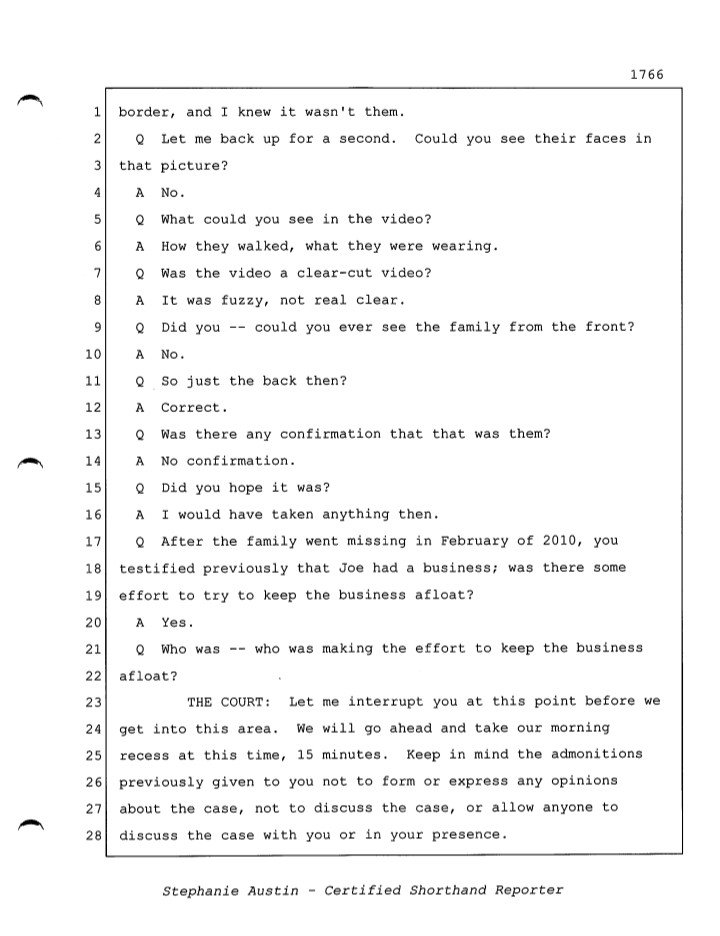
At trial: Asked why the Trooper at the border surprised her: “Because my son wouldn’t go to Mexico or take his children over the border.” (RT 1747:21-25) Of the video DuGal showed her: “He showed us a video of a family of four going over the border, and I knew it wasn’t them.” She could not see faces; it was “fuzzy, not real clear,” “just the back”; “No confirmation.” Did she hope it was them? “I would have taken anything then.” (RT 1765:22-1766:16)See the trial transcript (RT 1747, 1765, 1766)

Michael McStay, Joseph’s brother (viewed March 1, 2010)
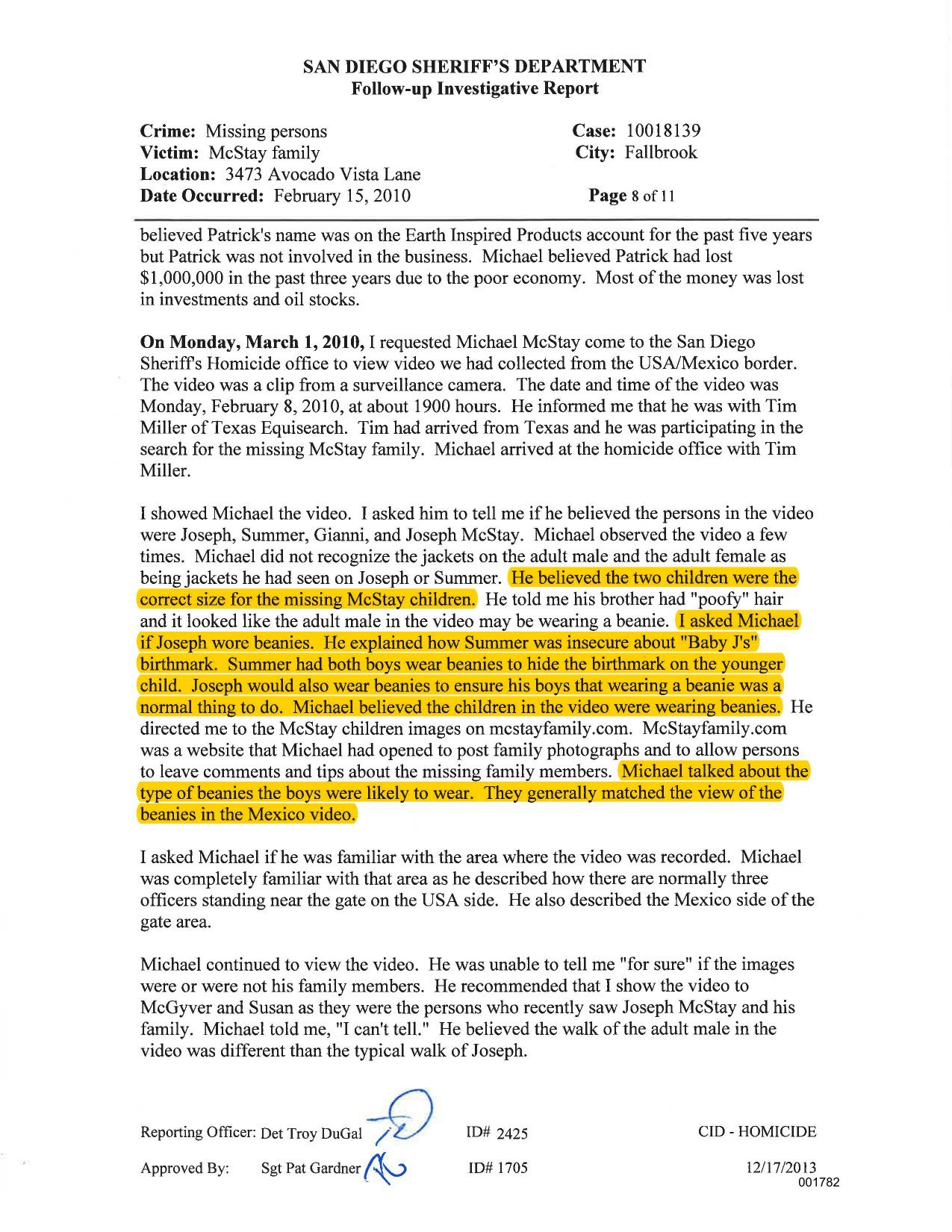
In 2010 (detective’s report): He “believed the two children were the correct size for the missing McStay children.” He explained that Summer had both boys wear beanies to hide the younger child’s birthmark, and “believed the children in the video were wearing beanies”; the beanies the boys were likely to wear “generally matched the view of the beanies in the Mexico video.” He was “unable to tell me ‘for sure’ if the images were or were not his family members”: “I can’t tell.” He “believed the walk of the adult male in the video was different than the typical walk of Joseph.” (DuGal report, Bates 001782)See the document (Bates 001782)
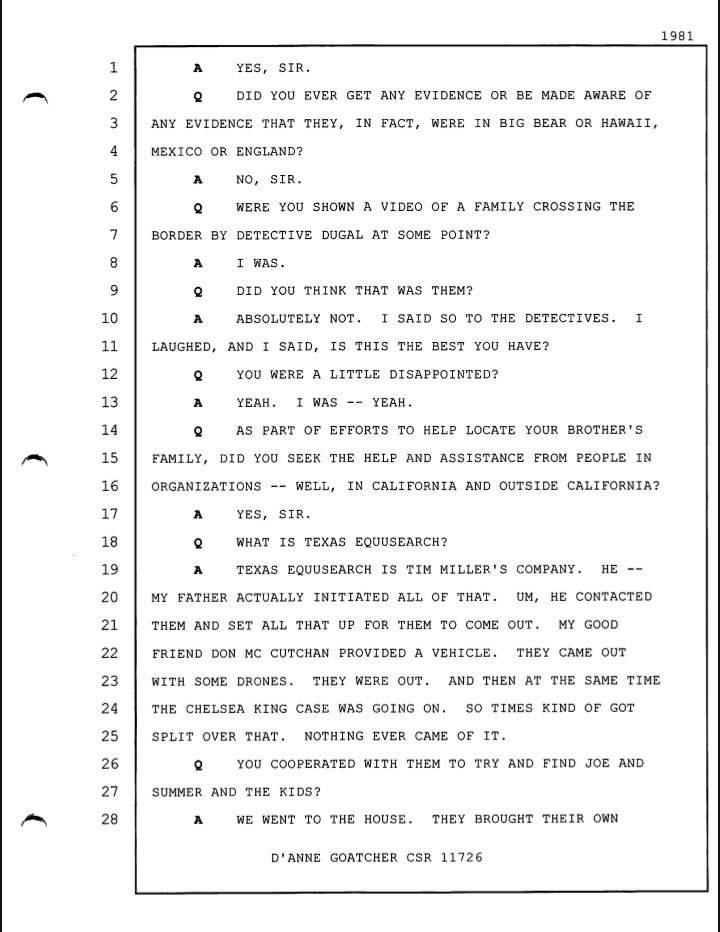
At trial: Asked whether he thought the video was them: “Absolutely not. I said so to the detectives. I laughed, and I said, is this the best you have?” (RT 1981:10-11) His 2010 report records “I can’t tell,” not “absolutely not.”See the trial transcript (RT 1981)
Blanche Aranda, Summer’s mother (viewed March 3, 2010)
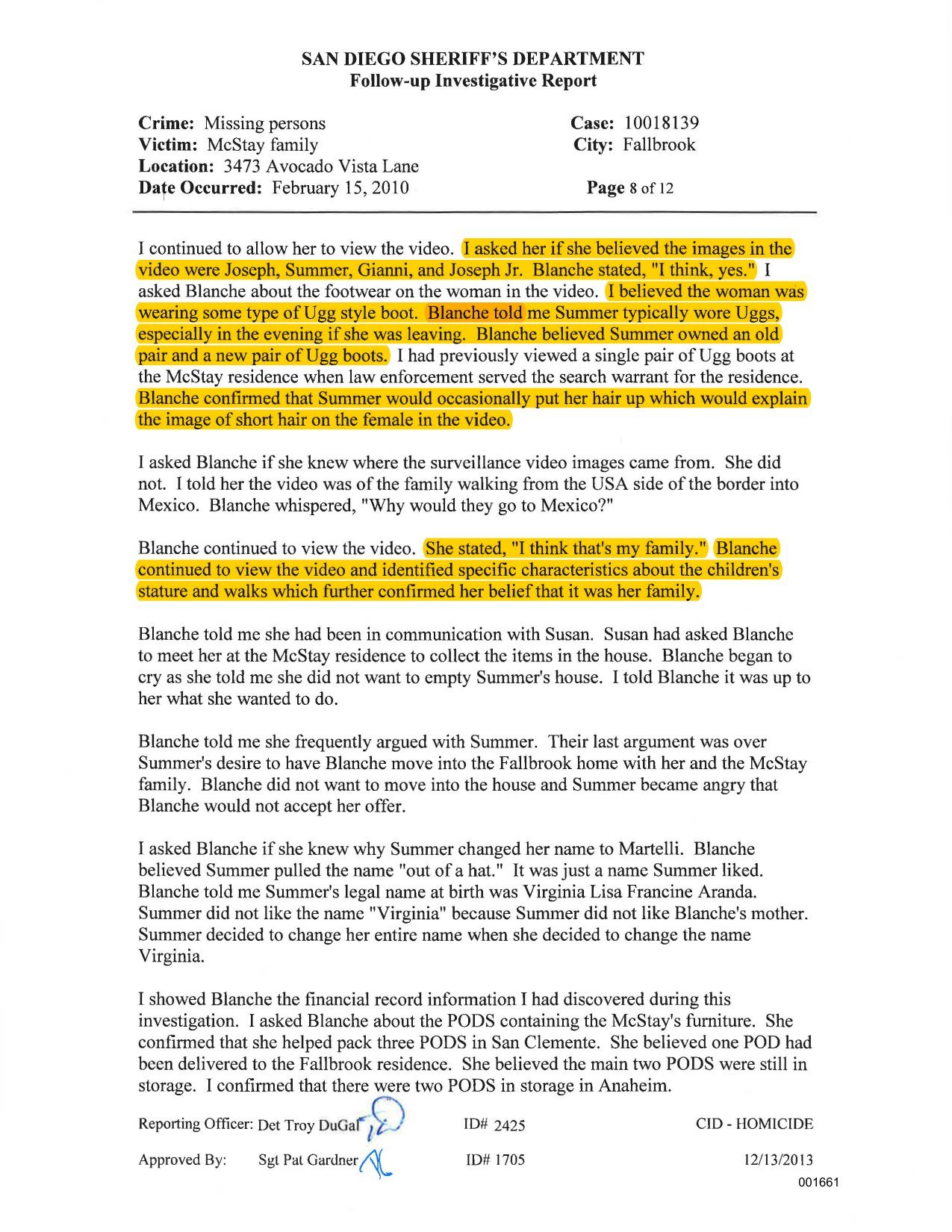
In 2010 (detective’s report): Asked about the purse the woman carried: “It would be the purse, Summer.” Asked whether the four were Joseph, Summer, Gianni and Joseph Jr.: “I think, yes.” Still watching: “I think that’s my family.” (DuGal report, Bates 001660-001661)See the documents (Bates 001660, 001661)
At trial: Not quoted on this page.
Tracy Russell, Summer’s sister (viewed March 3, 2010)
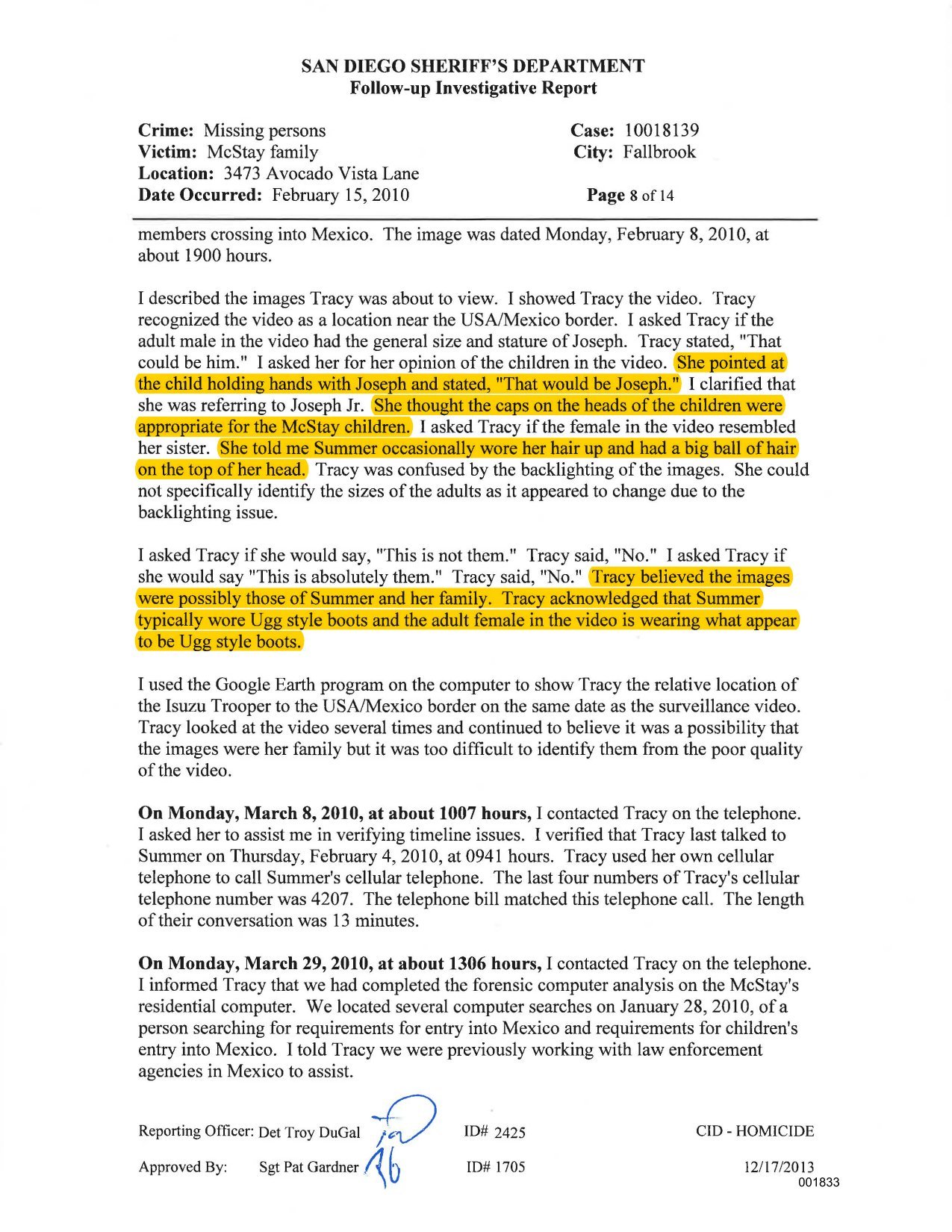
In 2010 (detective’s report): Of the man: “That could be him.” Of the child holding his hand: “That would be Joseph” (Joseph Jr.). Would she say “This is not them”? “No.” Would she say “This is absolutely them”? “No.” She “continued to believe it was a possibility that the images were her family but it was too difficult to identify them from the poor quality of the video.” (DuGal report, Bates 001833)See the document (Bates 001833)
See the document (Bates 006165)
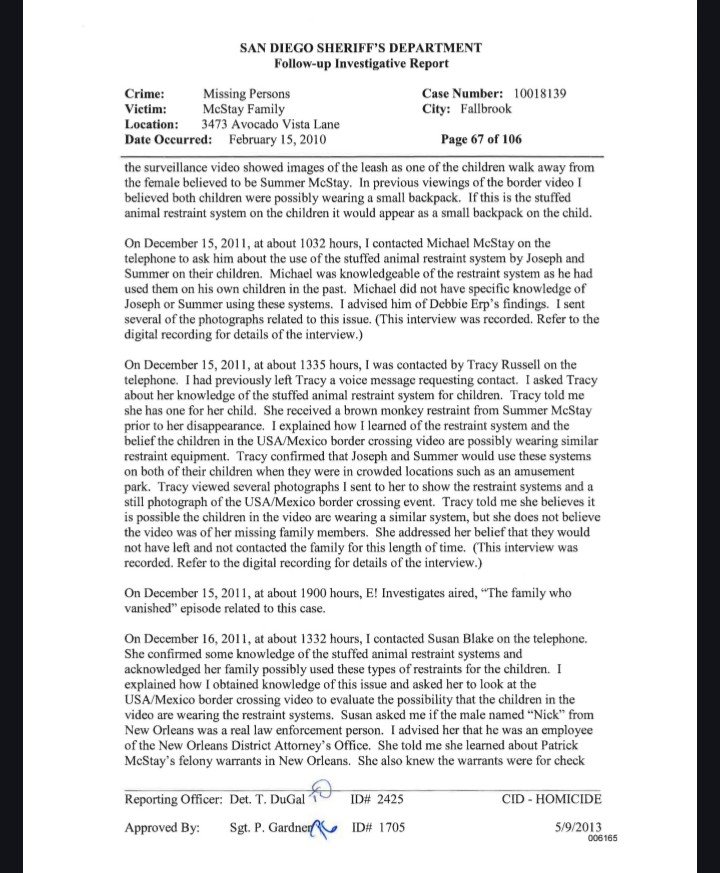
At trial: Not quoted on this page.
McGyver McCargar, a family friend (viewed March 2, 2010)
In 2010 (detective’s report): He “thought the persons in the video resembled the general appearance of the family, but could not be sure of the identity.” (Bates 006112) Later that month he “found a photograph of Summer wearing a white jacket similar to the one worn by the female in the border crossing video.” (Hillen report, Bates 001773)See the document (Bates 001773)
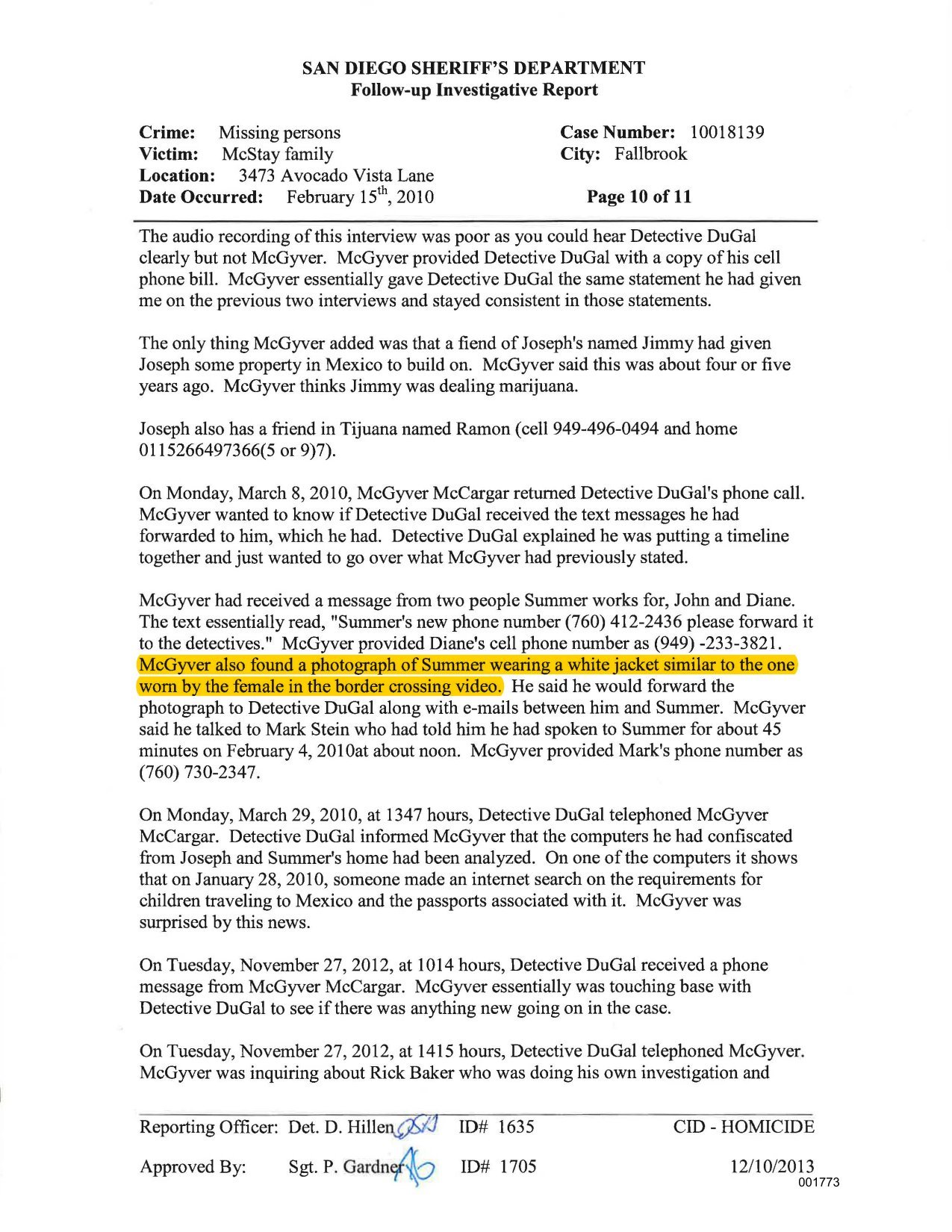
At trial: Not quoted on this page.
Mackenzi Farsheed, a family friend (viewed March 3, 2010)
In 2010 (detective’s report): DuGal’s summary: “Mackenzi believed the images were possibly the family, but could not be certain since their faces were not visible. Mackenzi told me the boys always wore beanies and Summer usually wore Ugg boots with her pants tucked into the boots. The family of four seen on the video crossing into Mexico exhibited these general appearances.” (Bates 006113-006114) DuGal’s full report of the viewing: “Mackenzi immediately noticed there were beanies on the two children in the video. Mackenzi told me the McStay boys always wore beanies. Mackenzi believed the jacket worn by the adult female in the video was consistent with Summer’s style of jackets. Mackenzi believed the image of the adult female was Summer. Mackenzi told me Summer typically wore Ugg boots with her jeans tucked into the tops of the boots. Mackenzi noticed the adult female in the video wore her pants and Ugg boots the same way. I pointed out the fact the adult female in the video was displaying short hair and I had knowledge that Summer had long hair. Mackenzi demonstrated how Summer would tie her hair into a bun on the top of her head. Mackenzi believed she could see a bun on the top of the adult female’s head in the video.” On the other side: “She did not believe Summer would go into Mexico and especially go to Mexico with Summer’s children.” And her conclusion: “Mackenzi acknowledged that she could not positively say that it was the missing McStay family but she believed the female could be Summer. Mackenzi told me; on the other hand, she would definitely not eliminate the possibility that this was the missing McStay family. She believed that the adult female’s image was more telling than the adult male’s image.” (Bates 001757) Earlier, she had told him she “did not believe Summer would take her children across the border.” (Bates 001756)See the documents (Bates 001756, 001757)
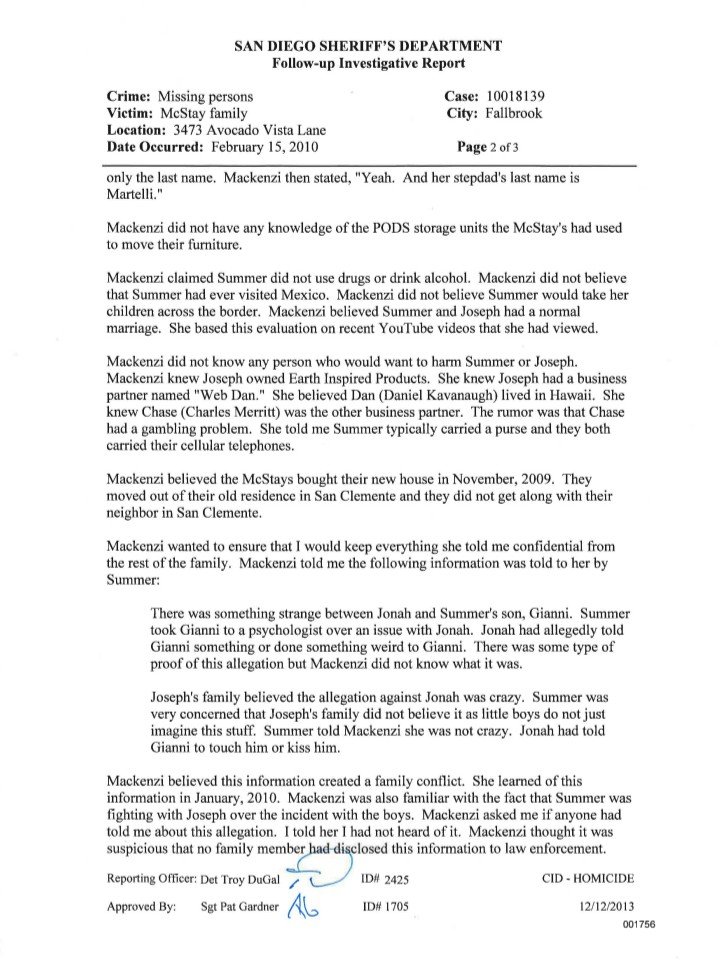
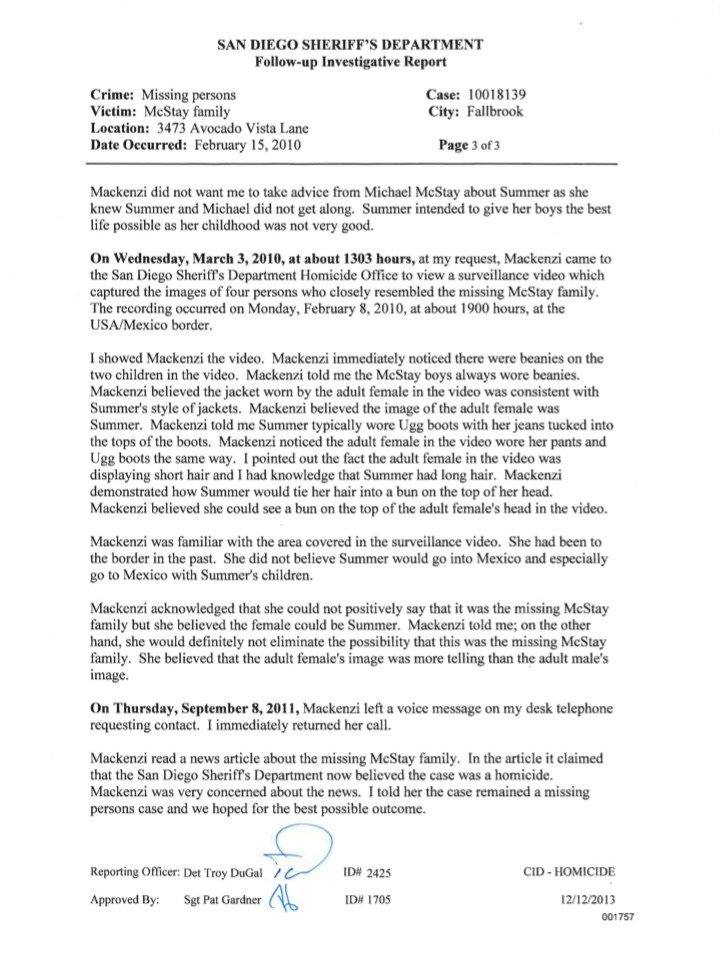
At trial: Not quoted on this page.
Detective DuGal summed up the family’s first reactions to San Bernardino in 2013: “Family members had mixed opinions about the border crossing video, but both grandparents believed it was their grandchildren in the video. Other family members were reluctant to identify subjects in the video due to the fact they were not [seeing] the subjects faces.” (Bates 000194)
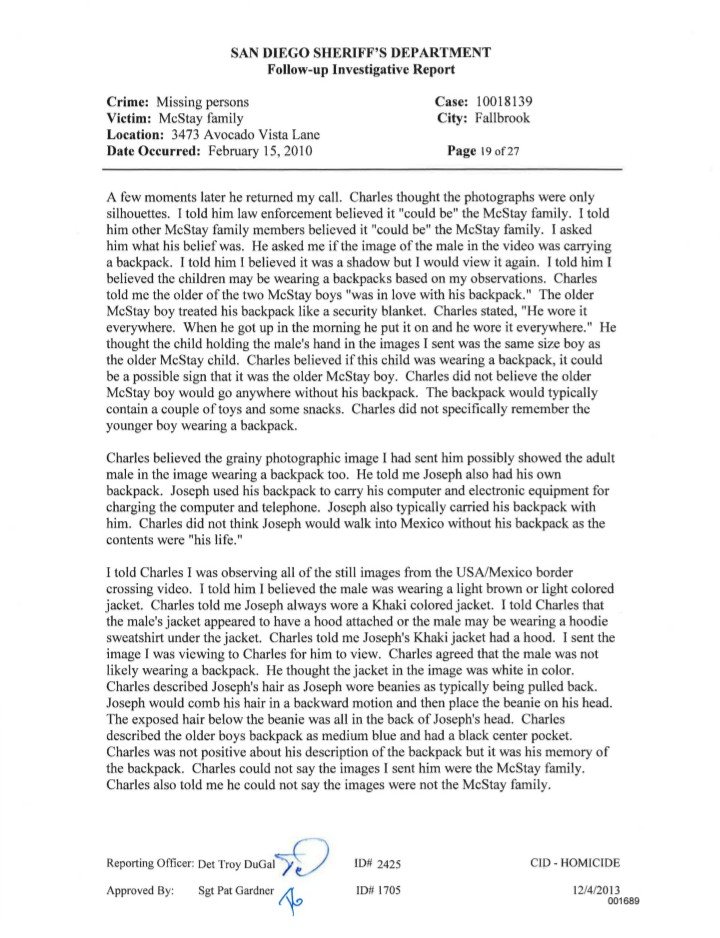
DuGal also asked me. In his report of a phone call with me, he wrote: “I told him law enforcement believed it ‘could be’ the McStay family. I told him other McStay family members believed it ‘could be’ the McStay family.” What I told him cut both ways, and it is all on the page: I thought the stills were “only silhouettes”; the child holding the man’s hand was the same size as the older McStay boy, who “was in love with his backpack”; but Joseph “always wore a Khaki colored jacket,” the man’s jacket looked white, and I “did not think Joseph would walk into Mexico without his backpack.” In the end I “could not say the images I sent him were the McStay family” and “could not say the images were not the McStay family.” (DuGal report on Charles Merritt, Bates 001689)
See the document (Bates 001689)
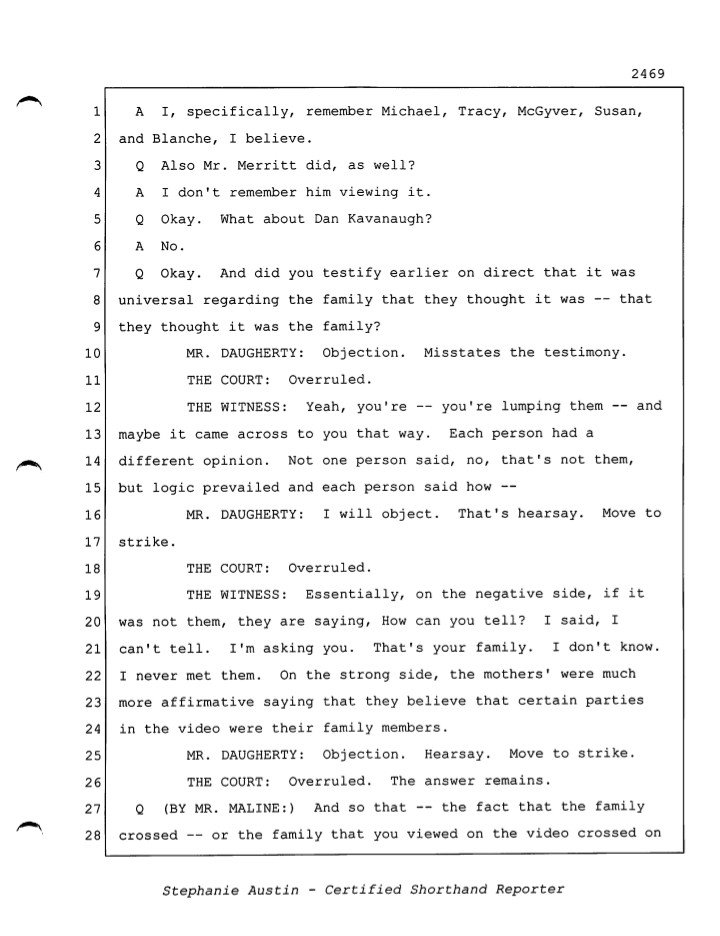
The jury did hear DuGal’s own summary of those viewings, from the witness stand, over the prosecution’s objections:
THE WITNESS: “Yeah, you’re — you’re lumping them — and maybe it came across to you that way. Each person had a different opinion. Not one person said, no, that’s not them, but logic prevailed and each person said how –”
…
THE WITNESS: “Essentially, on the negative side, if it was not them, they are saying, How can you tell? I said, I can’t tell. I’m asking you. That’s your family. I don’t know. I never met them. On the strong side, the mothers’ were much more affirmative saying that they believe that certain parties in the video were their family members.”
THE COURT: “Overruled. The answer remains.”
(RT 2469:12-26)
See the trial transcript (RT 2469)
Set that beside the trial testimony above. Susan Blake told the jury “I knew it wasn’t them,” and Michael McStay said “Absolutely not. I said so to the detectives.” The detective they spoke to testified that not one person told him that. The jury heard both and was shown nothing to settle it.
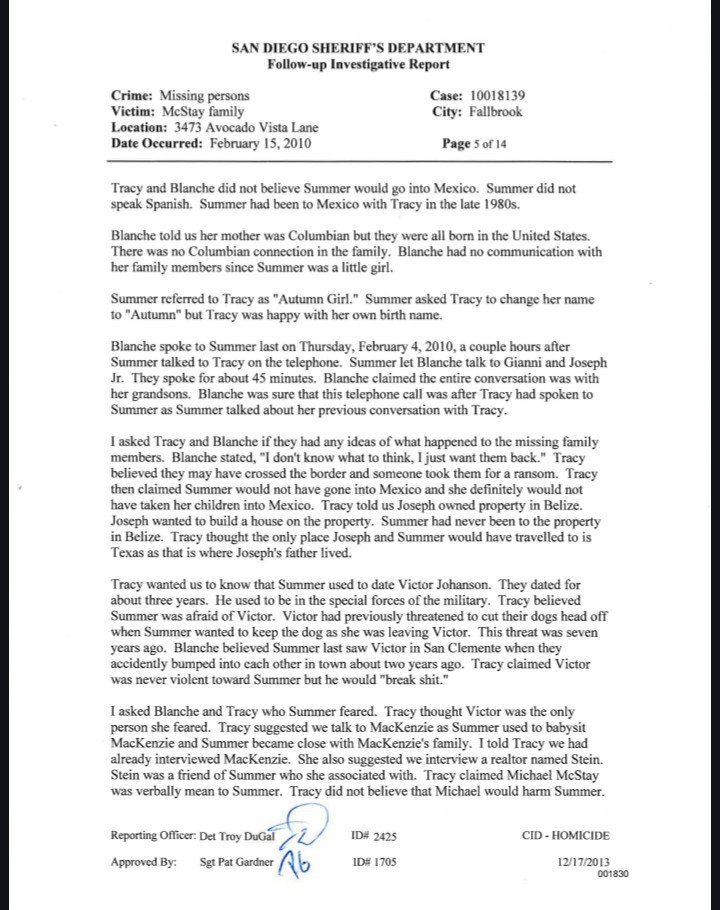
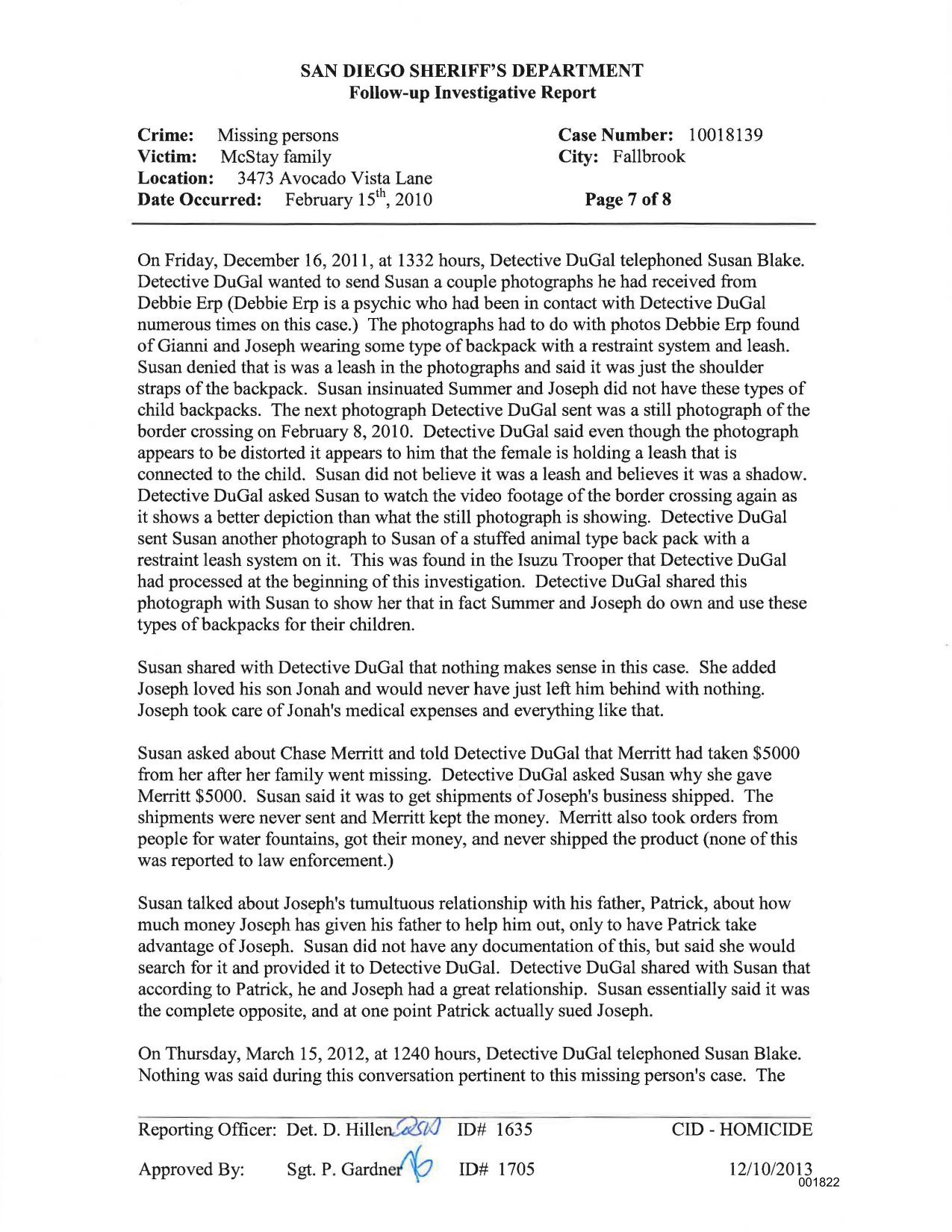
The file also holds family statements that point the other way, and they belong here. In February 2010, before anyone had seen the video, Tracy said Summer was overprotective of her children and “it was unlikely that she would take the children to Mexico,” and Tracy and Blanche “did not believe Summer would go into Mexico.” (Bates 001827, 001830) Patrick “was adamant Joseph and his family would not have entered Mexico, but Michael told DuGal Joseph went to Mexico from time to time to purchase products for his business.” (Bates 000196) In December 2011, Susan did not believe a leash showed in a border still and said it was “a shadow.” The same report says she “insinuated Summer and Joseph did not have these types of child backpacks,” and that DuGal then sent her a photograph of the stuffed-animal backpack found in the Trooper. (Hillen report, Bates 001822) DuGal’s own report of that call says she “acknowledged her family possibly used these types of restraints for the children.” (Bates 006165)
See the documents (Bates 001827, 001830, 001822)

None of this identifies the group by itself, any more than the frames do. What it shows is that, when the images were fresh and no murder theory was at stake, the people closest to the family did not rule them out, and the most common reason they gave for hesitating was no faces. The parking-lot camera was the only one that caught the group from the front.
Put plainly: In 2010 the family’s answers ranged from “I can’t tell” to “I think that’s my family,” and the reason given for doubt was the missing faces. At trial, two of them said they knew it was not them; the detective testified no one had told him that.
Other reports the jury never heard
Two more reports in the San Diego file bear on whether the family was alive after February 4. Neither is a viewing of the tape, and I give each with its limits.
A sighting in Tijuana. On March 3, 2010, on a tip relayed through U.S. Customs, Detectives Gurrola and Padilla interviewed Jose Luis Suarez Hernandez at the San Ysidro Port of Entry. He said that about three weeks earlier he was standing by his truck in Tijuana when five people approached him: “a male, a female, and two young children of unknown gender. These four persons appeared to be a family.” They were with an unknown Hispanic man. The family offered him “an unknown amount of cash” for a ride to Rosarito; the man with them urged them to keep walking, and they walked away. That night his wife showed him a newspaper article about the case. He viewed the photographs of the missing McStay family “and believed it was the same family that he had observed.” The interview was recorded. (Bates 006114)
See the document (Bates 006114)
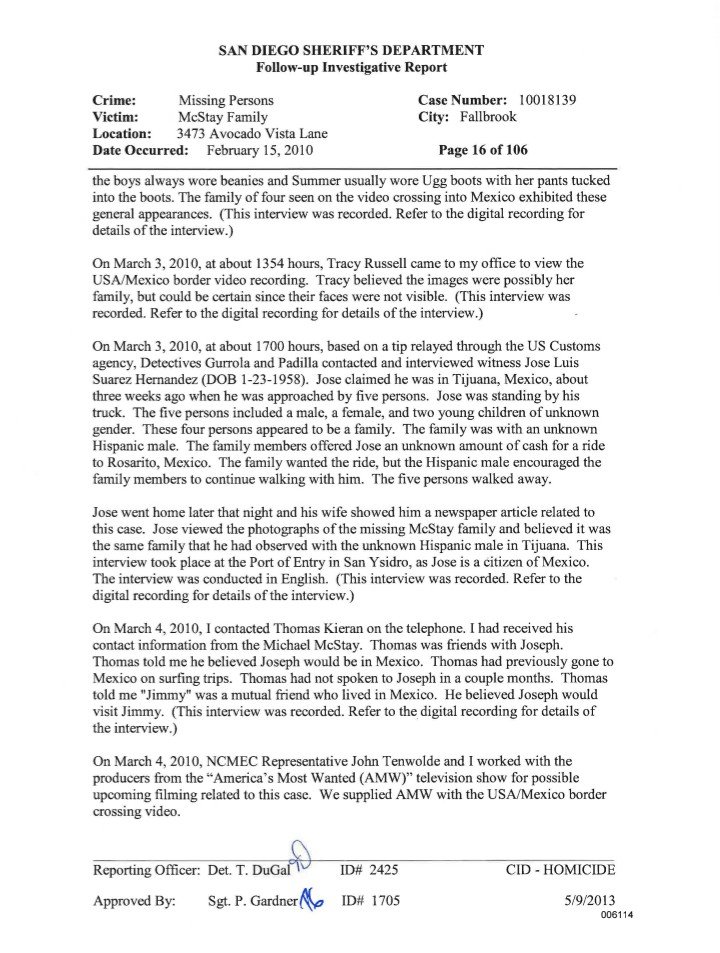
Its limits: he recognized the family from a newspaper article that same night, and spoke to detectives about three weeks later; and “about three weeks ago” puts it only roughly in mid-February, not on a specific date.
The neighbors. In the first canvass of Avocado Vista Lane, on February 15 and 16, 2010, the McStays’ neighbors Bill and Angelia Chadwick told a deputy they “last saw them on the Sunday after the Super Bowl. The husband, wife, and two children were getting into their car. The children were all bundled up and were wearing knit hats.” (Deputy’s report, February 16, 2010, Bates 005944)
See the document (Bates 005944)
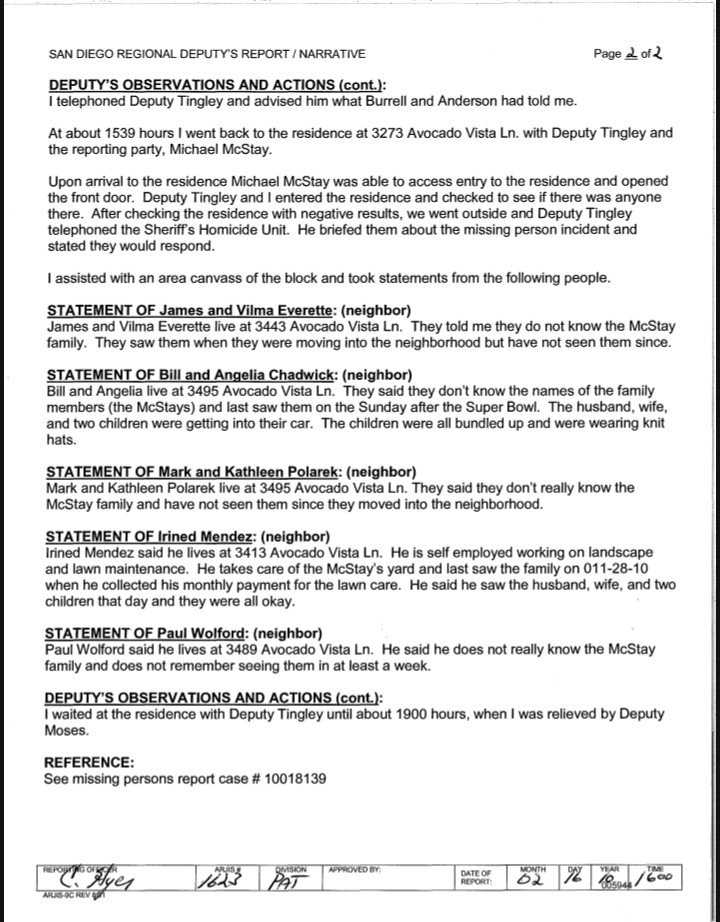
Super Bowl Sunday in 2010 was February 7. Read literally, “the Sunday after the Super Bowl” is February 14, the day before the canvass. That reading is hard to fit with the rest of the record: by then the Trooper had been towed from San Ysidro (February 8) and the family’s dogs had been left in the yard. The Chadwicks may have meant Super Bowl Sunday itself. The report does not say which. No one ever went back to ask the Chadwicks which Sunday they meant. Either date is after February 4, the day the State says the family was killed. Its limits: it is a deputy’s summary of what the neighbors said, and no one tested it in court.
Put plainly: A man in Tijuana and two neighbors in Fallbrook described seeing the family after February 4. Each account has limits, and the jury heard neither.
What the jury heard instead
At trial, Mr. Imes asked DuGal about the surveillance from the lots:
ADA IMES: “Okay. Did you see anything of any evidentiary value on any of the surveillance tapes?”
DET. DUGAL: “From these lots?”
ADA IMES: “Yes.”
DET. DUGAL: “No.”
(RT 2337:4-8)
See the trial transcript (RT 2337)
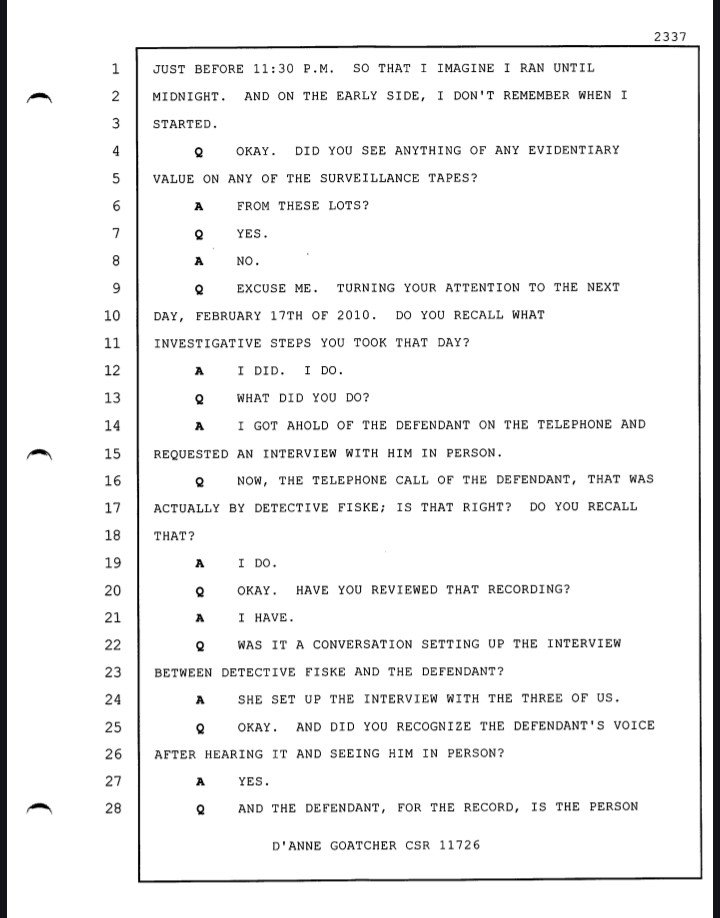
↑ See the Camera 16 frames this answer was about
On cross-examination, my lawyer asked him whether the crossing and the Trooper’s location led him to believe it was the family:
DET. DUGAL: “Not as definitive as you put it. In law … we deal with probable cause. I believe it was probable that it was them based on the family’s assessment. But it was almost equally probable it was not them, because we had no facial features and it was a grainy video from behind them, you know, dim-lit area. It did fit for a time frame. That’s it.” (RT 2469:27-2470:10)
See the trial transcript (RT 2470)
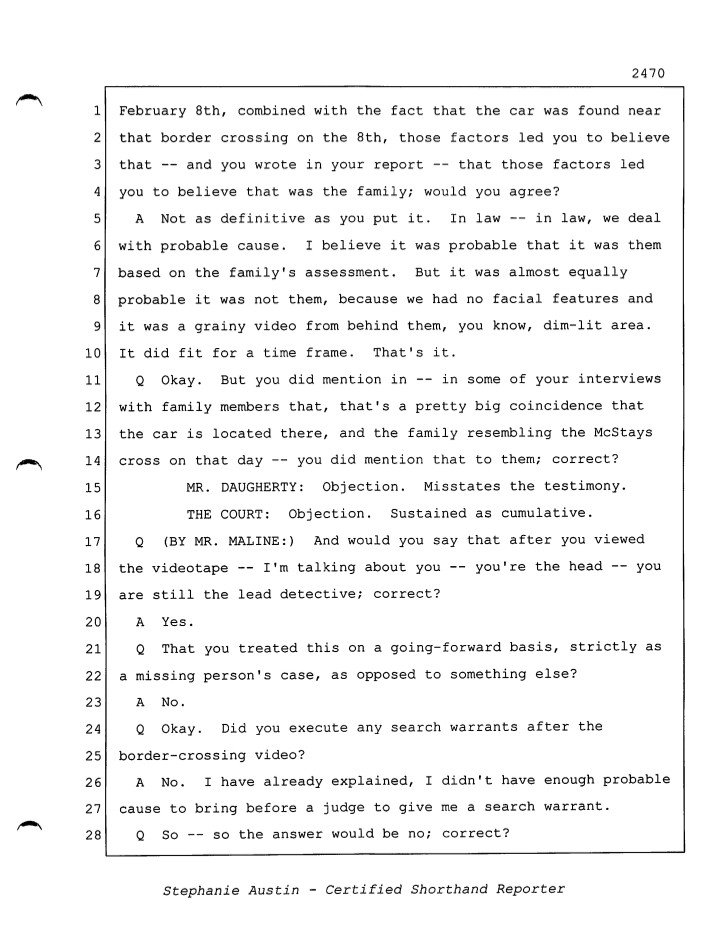
“Almost equally probable it was not them” appears nowhere in the reports quoted above. And two of the weaknesses he named, no faces and a view from behind, are exactly what the front-view parking-lot footage bore on.
Asked whether he had told family members he personally believed it was Joseph, Summer and the boys, he said “No,” and again “No” to “You never said that?” (RT 2468:19-24). Later: “It’s not my belief. … I don’t know the McStays, so it’s not my belief.” (RT 7611:4-7) His follow-up report, typed December 17, 2013, records that on December 15, 2011 he told Michael the evidence “made this likely that it was his family crossing the border.” (Bates 001784-001785) Telling Michael the evidence made it “likely” is not word for word the same as telling him “I personally believe it is them,” and I do not claim it is. But it is a far more favorable assessment than the one the jury was left with. When my lawyer asked whether he had told family members in his interviews that the car being there and a family resembling the McStays crossing that day was “a pretty big coincidence,” the objection was sustained “as cumulative.” (RT 2470:11-16) The State had those reports. It did not put them before the jury.
See the trial transcript (RT 2468, 7611) and the document (Bates 001785)
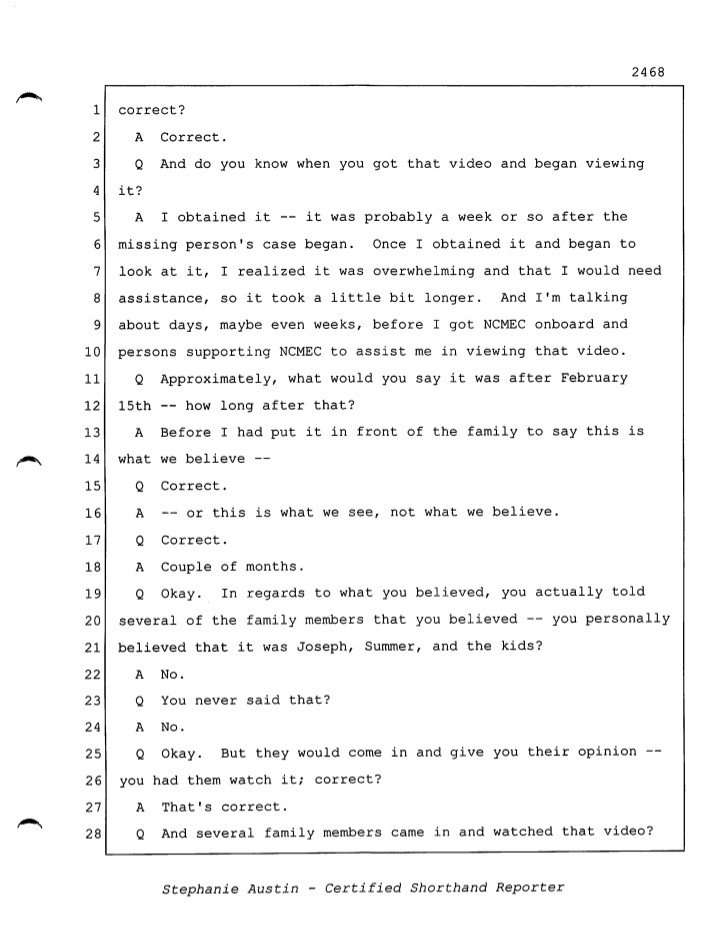
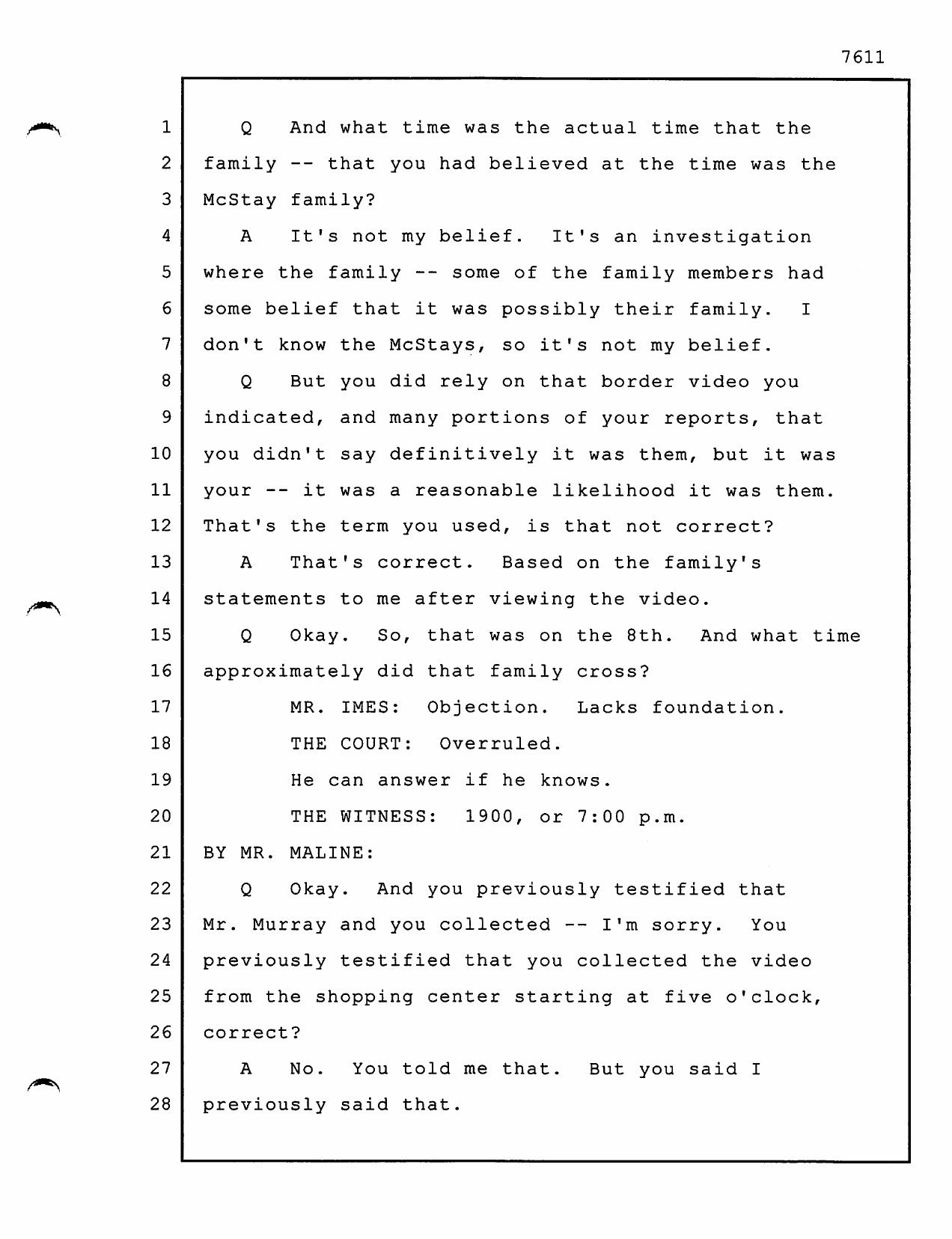

The “No” about the lot surveillance was drawn out by Mr. Imes and left to stand. This was false.
Put plainly: The jury heard “No” about the lot surveillance and “almost equally probable it was not them.” It did not hear the detective’s own written “likely” and “probable,” and the court sustained the objection to the question that would have brought them out.
The ruling that kept the border video out
My lawyers tried to show the border video to the jury. Here is how it was kept out, in order.
See the trial transcript (RT 7592, 7595, 7598)
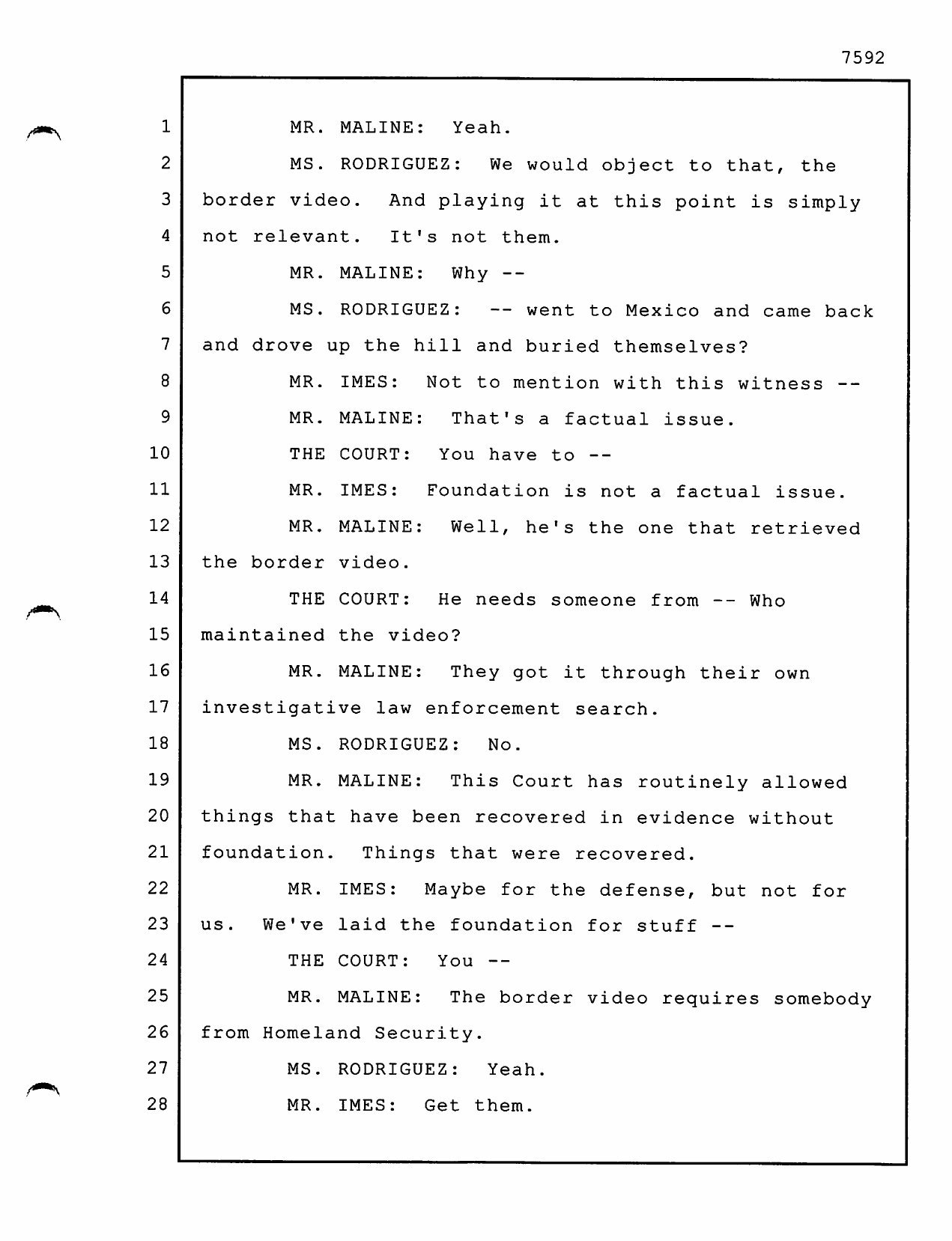
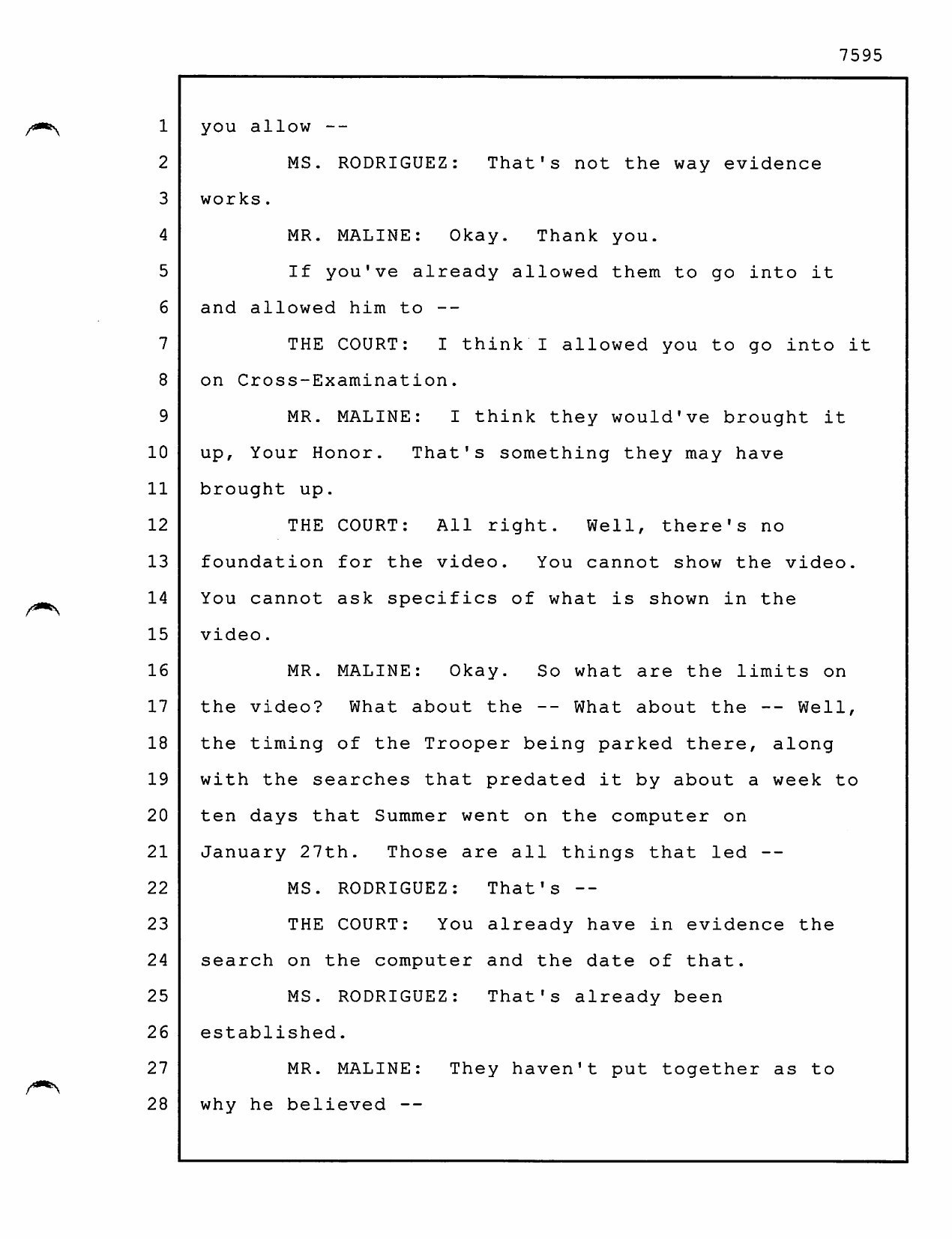
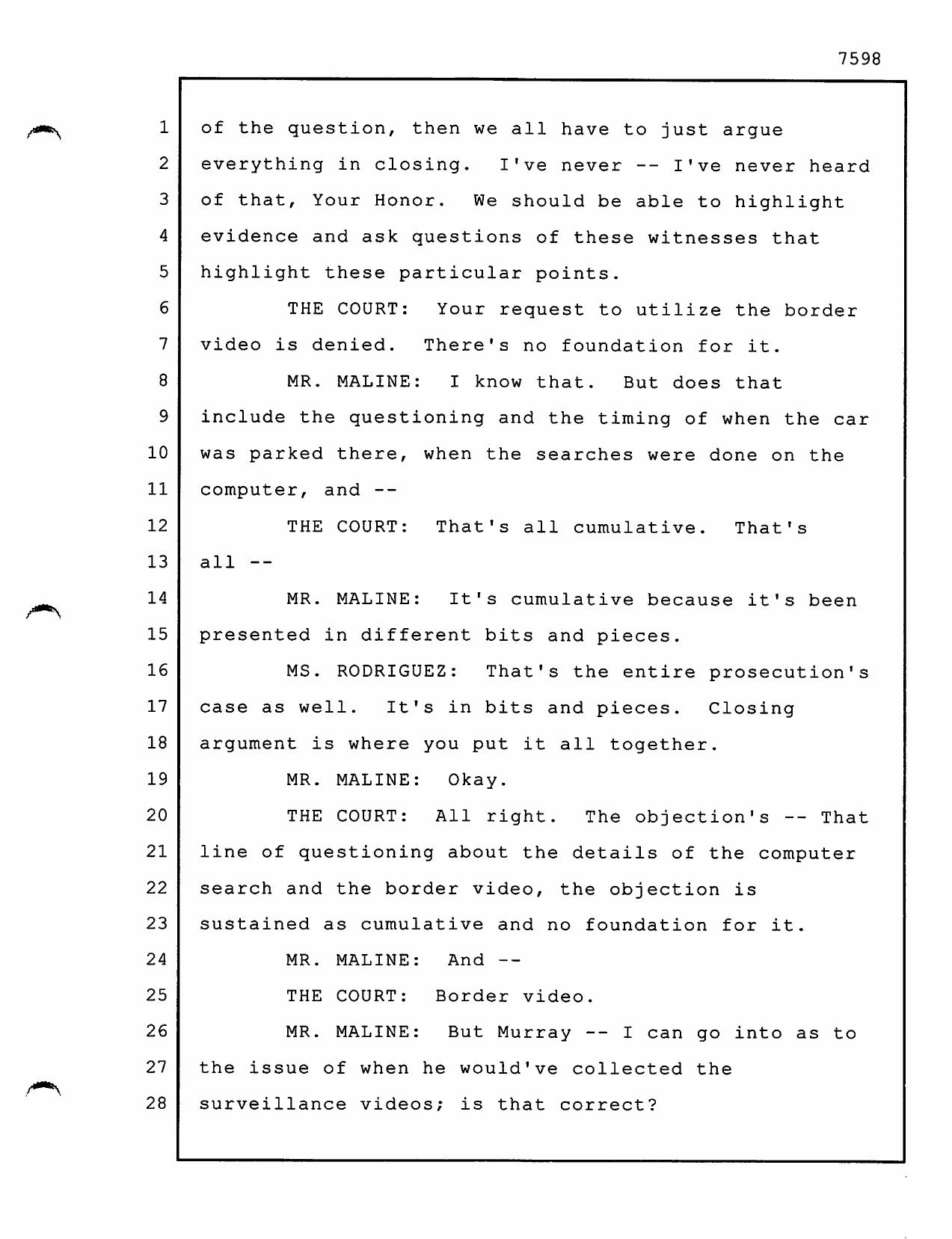
| Transcript | What was said |
|---|---|
| RT 7592:2-4 (Ms. Rodriguez) | “We would object to that, the border video. And playing it at this point is simply not relevant. It’s not them.” |
| RT 7592:6-7 (Ms. Rodriguez) | “— went to Mexico and came back and drove up the hill and buried themselves?” |
| RT 7592:11 (Mr. Imes) | “Foundation is not a factual issue.” |
| RT 7592:14-15 (court) | “He needs someone from — Who maintained the video?” |
| RT 7592:16-17 (my lawyer) | “They got it through their own investigative law enforcement search.” |
| RT 7592:18 (Ms. Rodriguez) | “No.” |
| RT 7592:25-26 (my lawyer) | “The border video requires somebody from Homeland Security.” |
| RT 7592:28 (Mr. Imes) | “Get them.” |
| RT 7595:12-15 (court) | “There’s no foundation for the video. You cannot show the video. You cannot ask specifics of what is shown in the video.” |
| RT 7598:6-7 (court) | “Your request to utilize the border video is denied. There’s no foundation for it.” |
In the same conversation, the judge described the very reading the video supported:
THE COURT: “He testified the first time that he showed the video to the family and asked the family if that could be the McStay family, and they said, yeah, it could be.” (RT 7594:18-21)
THE COURT: “… McStays drove there, they parked the car, they went into Mexico. End of story. Something happened after that. All of that is in evidence already.” (RT 7597:15-26)
See the trial transcript (RT 7594, 7597)
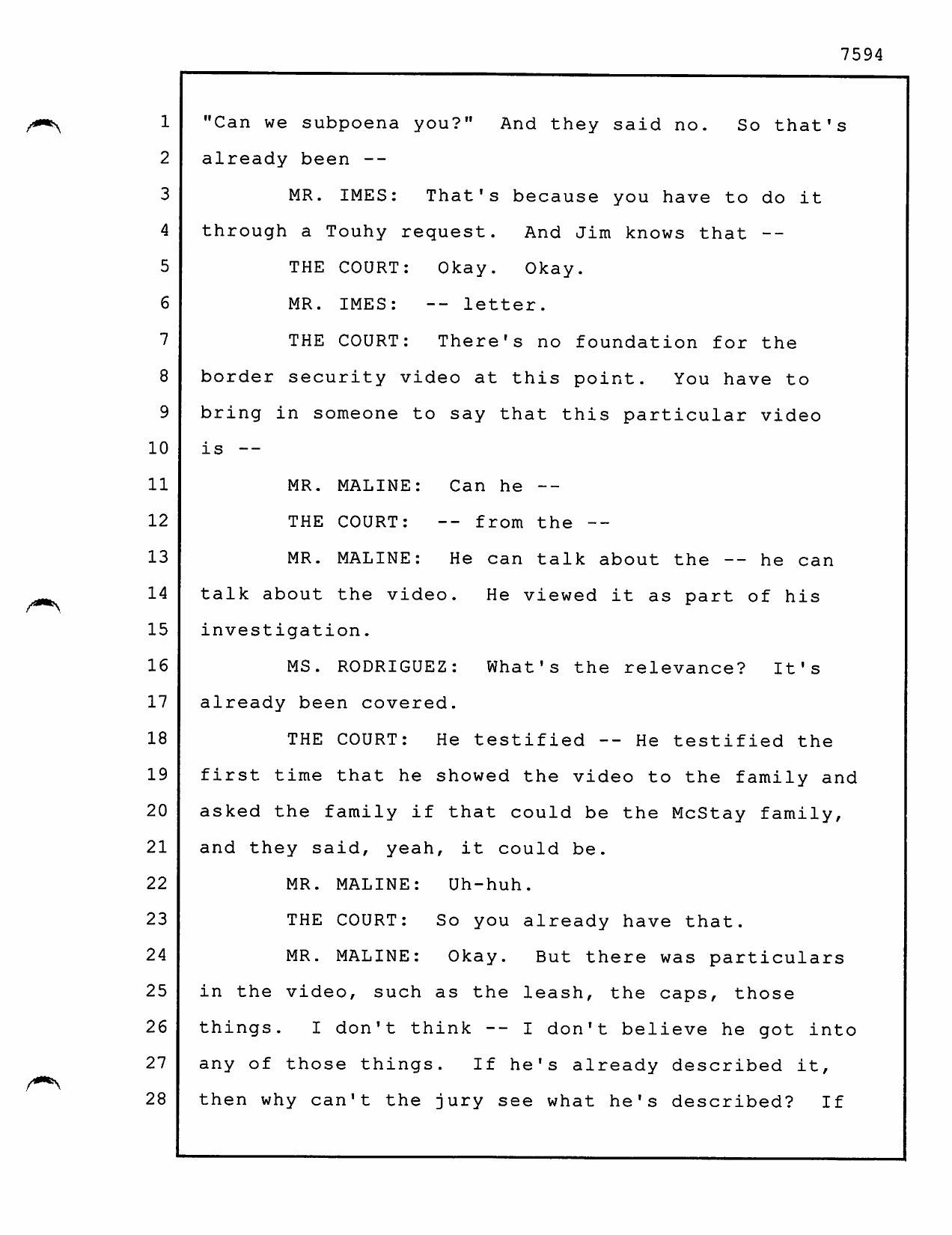
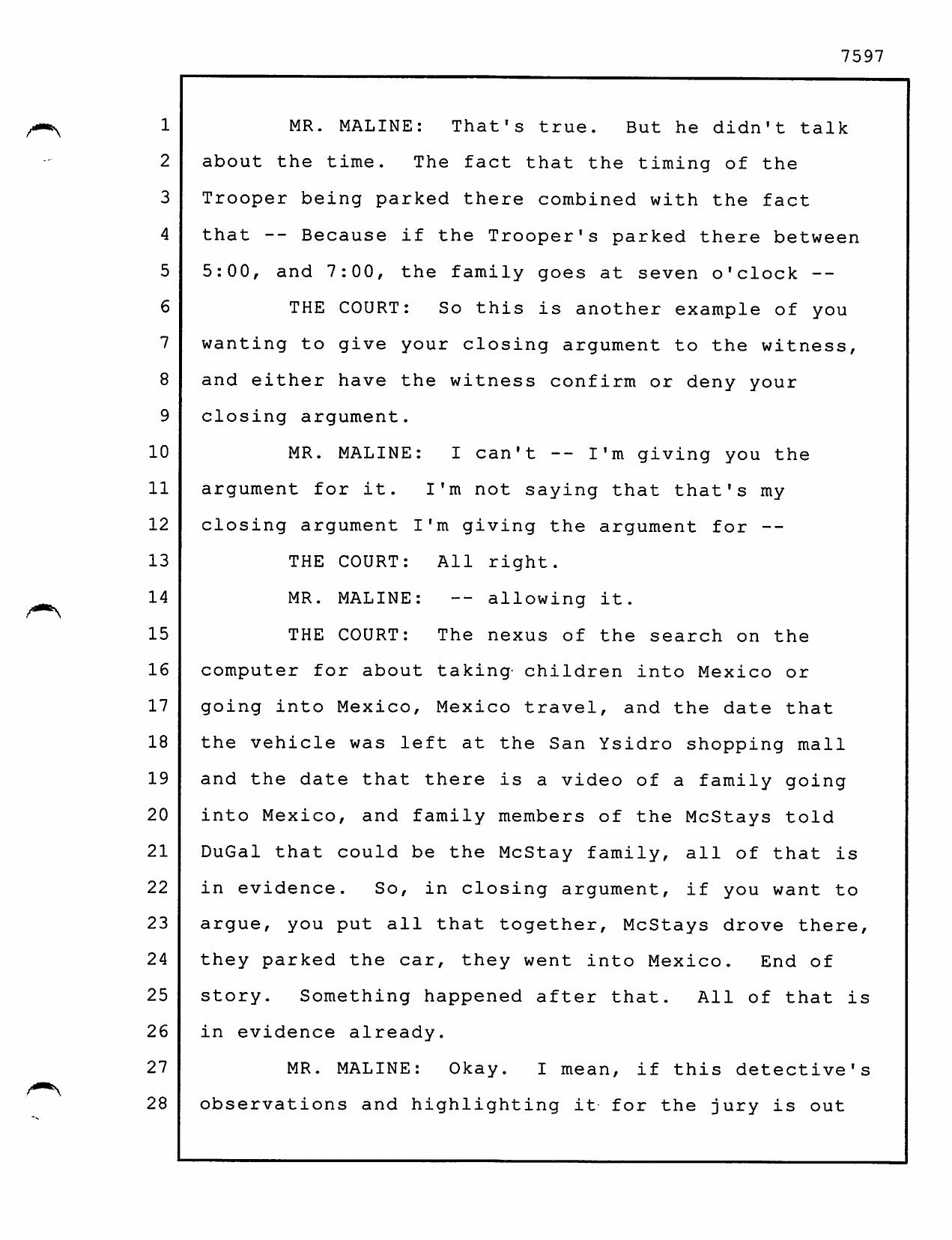
The State will point to the judge’s words “All of that is in evidence already”: the jury already heard that the family saw the video. It heard the words. It did not see the pictures, and the pictures were the point.
The law. To show a recording to a jury, California asks only for evidence sufficient to support a finding that it is what it is claimed to be. Any witness with knowledge can supply that, and so can the contents of the recording itself. (Evid. Code §§ 1400, 1401, 1421) In People v. Goldsmith (2014) 59 Cal.4th 258, a red-light traffic-camera case, the California Supreme Court held that photos and video from an automated camera may be authenticated by circumstantial evidence and that the person who made or maintained the recording does not have to testify. Whether a better witness could be found goes to how much weight the jury gives the video, not to whether the jury may see it.
DuGal was such a witness, and he was on the stand. His report says “We also talked to Border Patrol and asked for all available video” (Bates 001783). He received it, reviewed it over three years, had it filtered and enhanced, showed it to the family, and relied on it in his reports. Whether his testimony would have been enough depended on the questions asked and the offer of proof made. No one asked them, and no offer was made. What the law did not require was a federal custodian.
Who did what. Ms. Rodriguez objected that “It’s not them,” and gave as her reason, “— went to Mexico and came back and drove up the hill and buried themselves?” (RT 7592:2-7), stating the State’s theory as fact. When my lawyer said the video came through law enforcement’s own search, she said “No.” That was false: DuGal’s own report says “We also talked to Border Patrol and asked for all available video” (Bates 001783). Before my lawyer mentioned Homeland Security, Mr. Imes raised foundation and the court asked, “Who maintained the video?” (RT 7592:8-15). My lawyer answered with the wrong test, a federal custodian, and Mr. Imes answered “Get them” rather than point out that the witness on the stand could lay the foundation. The court adopted the idea and excluded the video. My lawyers cited no authentication statute, made no offer of proof, and did not walk DuGal through the request, the receipt, the review and the enhancement. A court is responsible for applying the law whichever side hands it the wrong test. But the failure came from all three sides, not from the bench alone.
Put plainly: The border video was excluded for want of a federal custodian, which California law does not require, while the detective who obtained and reviewed it was on the stand and was never asked the foundation questions. The State objected, my lawyer supplied the wrong test, and the court adopted it.
The parking-lot footage in my own lawyers’ files
The front-view parking-lot footage was never excluded, because it was never offered. It was not hidden from my lawyers. It was produced to them, inside tens of thousands of surveillance frames, and it was in their files. It never reached the jury. The only description the jury ever heard of the lot surveillance was “No.”
I can find no reason to leave it out. It was not cumulative: the jury saw no image of the February 8 group at all, because the border video was excluded. It was not something the defense had to explain away: it was the defense, the visual support for exactly what my lawyers argued in closing. And San Diego, the government’s own first agency, had already concluded the family most likely left on their own.
Did my lawyers review the footage and choose not to use it, or never review it at all? The record does not say. It says only that the pictures were in their files and the jury never saw them.
Put plainly: The front-view footage was in my lawyers’ own files and was never offered. The record does not say why.
What else pointed to the family
The reading that the McStays drove to the border and walked across did not rest on the video alone. Here is the rest of it. For each item I say what is fact and what is inference.
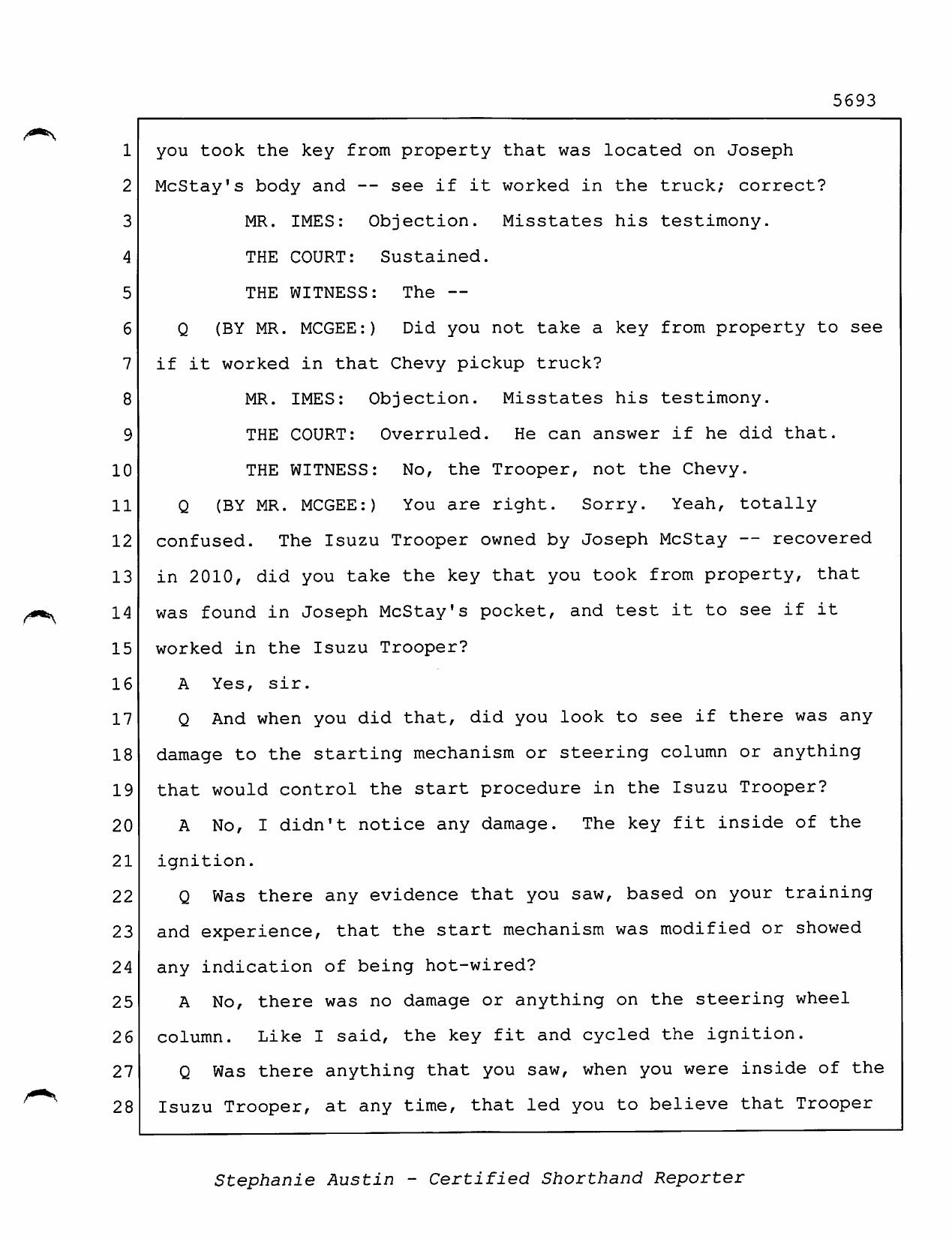
The key. The ignition key recovered from Joseph’s pocket when the graves were excavated fit the Trooper’s ignition: “the key fit and cycled the ignition” (RT 5693:11-26). That is a fact. That Joseph drove the Trooper to the border is an inference. A working key does not by itself say who drove last.
See the trial transcript (RT 5693)
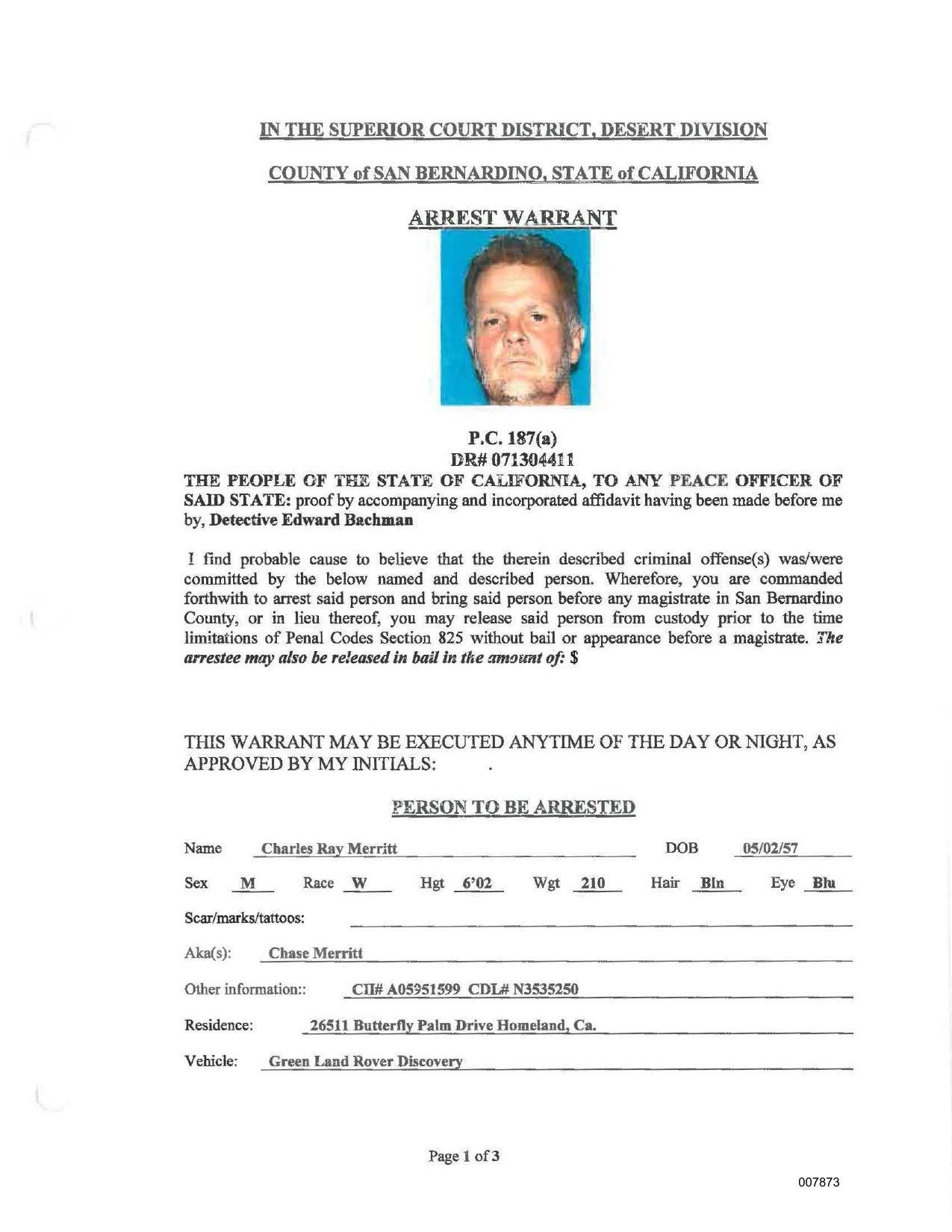
The seat. DuGal, who processed the Trooper and is 6′1″, testified the driver’s seat was set for someone smaller than he, consistent with a man of 5′9″, Joseph’s height (RT 2524:28-2528:15). I am 6′2″; Bachman’s own arrest warrant lists me at 6′02″ and 210 pounds (Arrest Warrant, DR# 071304411, Bates 007873). The point does not depend on the inch: the seat was set for someone smaller than me.
See the trial transcript (RT 2524-2528) and the document (Bates 007873)
Transcript page images to be added.
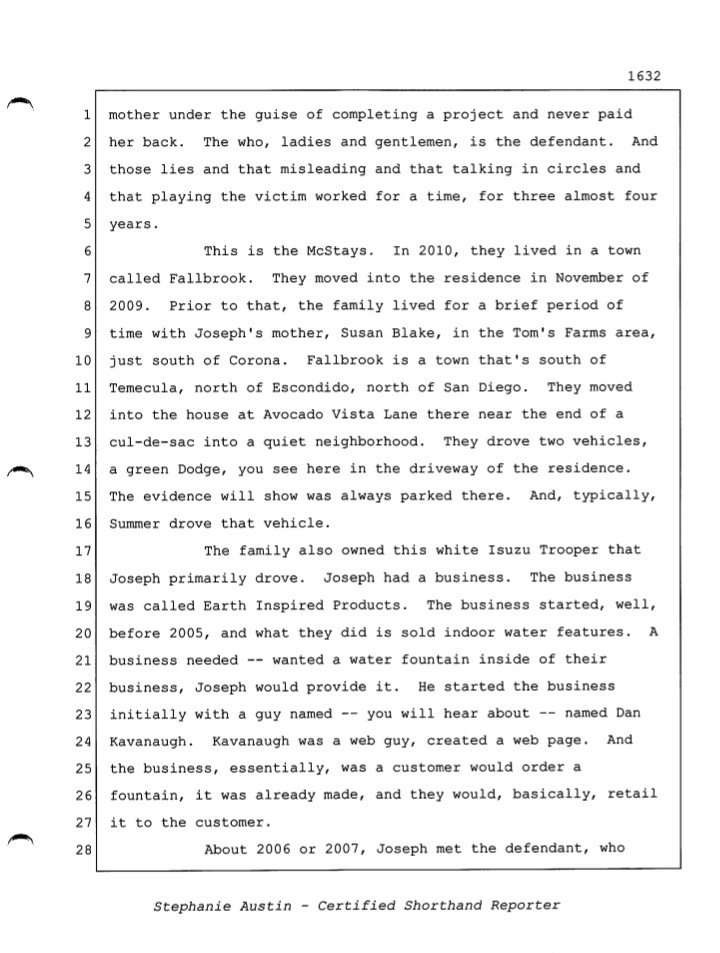
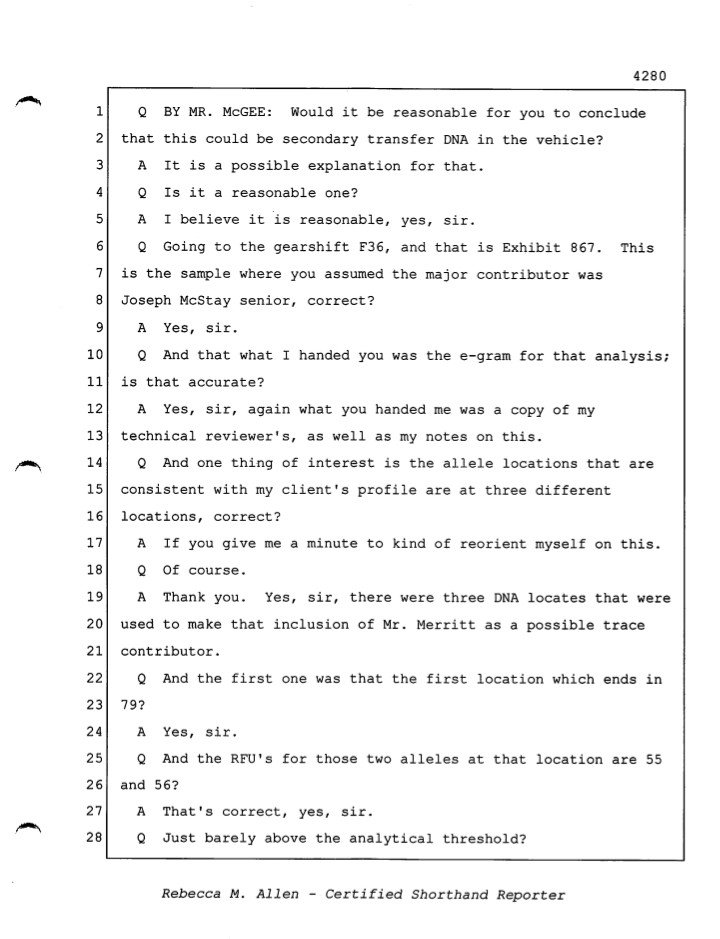
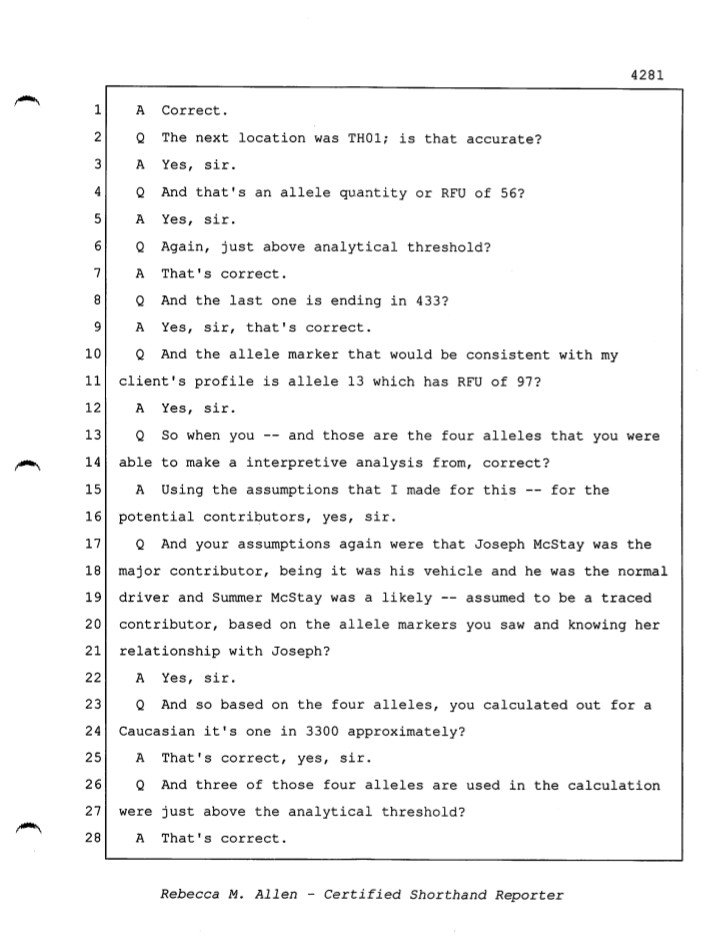
Who drove the Trooper. The prosecution’s own opening told the jury the Trooper was one “that Joseph primarily drove” (RT 1632:17-18). The State’s DNA expert, Donald Jones, agreed on cross-examination that his analysis of the driver-area samples assumed Joseph was the major contributor, “being it was his vehicle and he was the normal driver” (RT 4280:6-9; RT 4281:17-22). That is the State’s own premise, not a DNA identification of the last driver.
See the trial transcript (RT 1632, 4280, 4281)
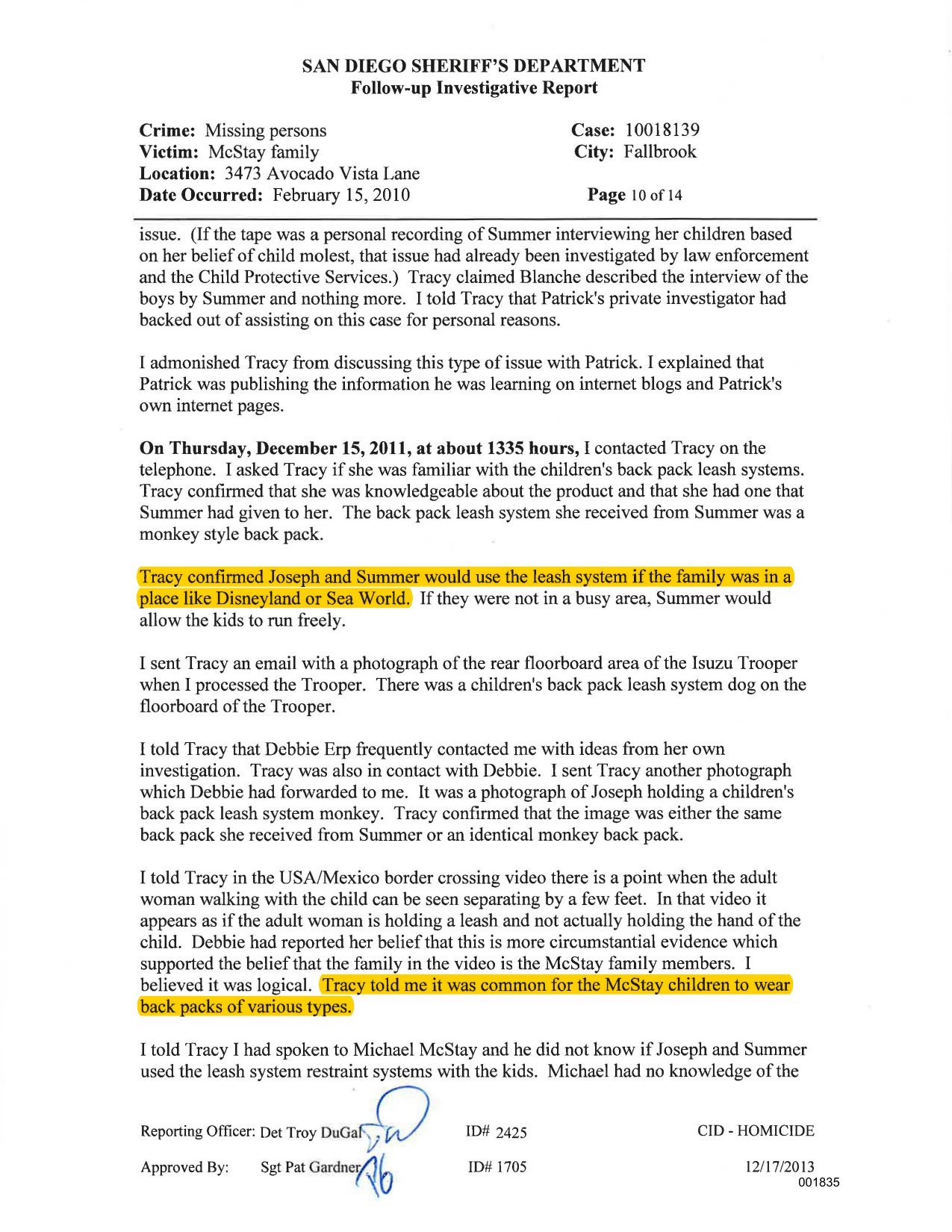
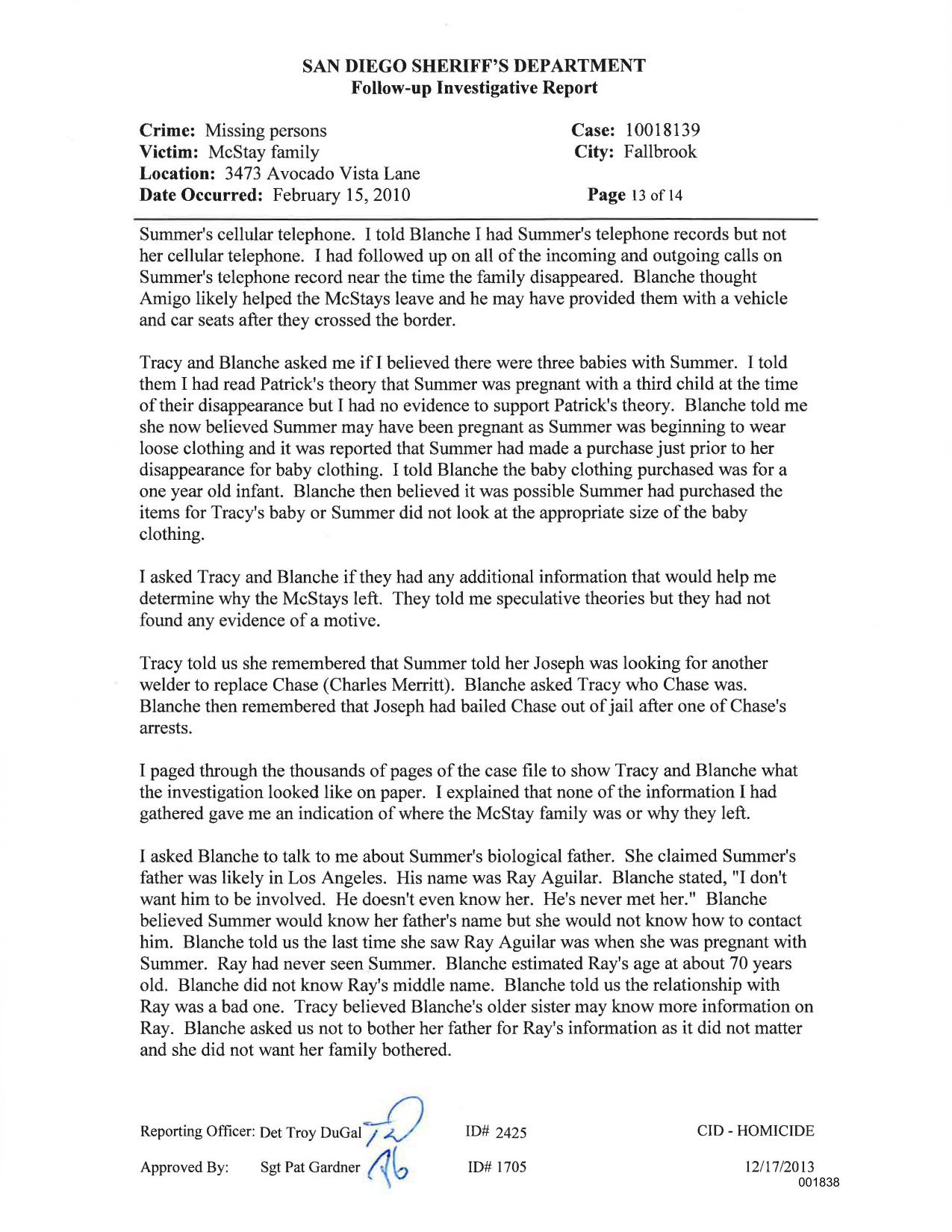
The leash. When DuGal processed the Trooper, there was “a children’s back pack leash system dog on the floorboard” (Bates 001835). Summer’s sister Tracy told him Summer had given her a monkey-style backpack leash, that Joseph and Summer used the leash system in busy places like Disneyland or Sea World, and that a photo of Joseph holding a monkey backpack leash showed the same one or an identical one (Bates 001835). The “Border Images” memo recorded that “the child with the lady had a backpack on” (Bates 003328), and in December 2011 DuGal wrote that in the video “it appears as if the adult woman is holding a leash and not actually holding the hand of the child” (Bates 001835). Re-viewing the frames Debbie Erp pointed him to, he wrote: “it appears that the adult and child are not holding hands but rather tethered together with a leash. After I viewed the video, I believed her assessment was possible.” (Bates 001784-001785) Michael did not believe he had seen the children wearing this type of backpack restraint (Bates 001784). Whether that is a leash is an inference from a dark video; Susan Blake thought it was a shadow (Bates 001822).
See the document (Bates 001835)
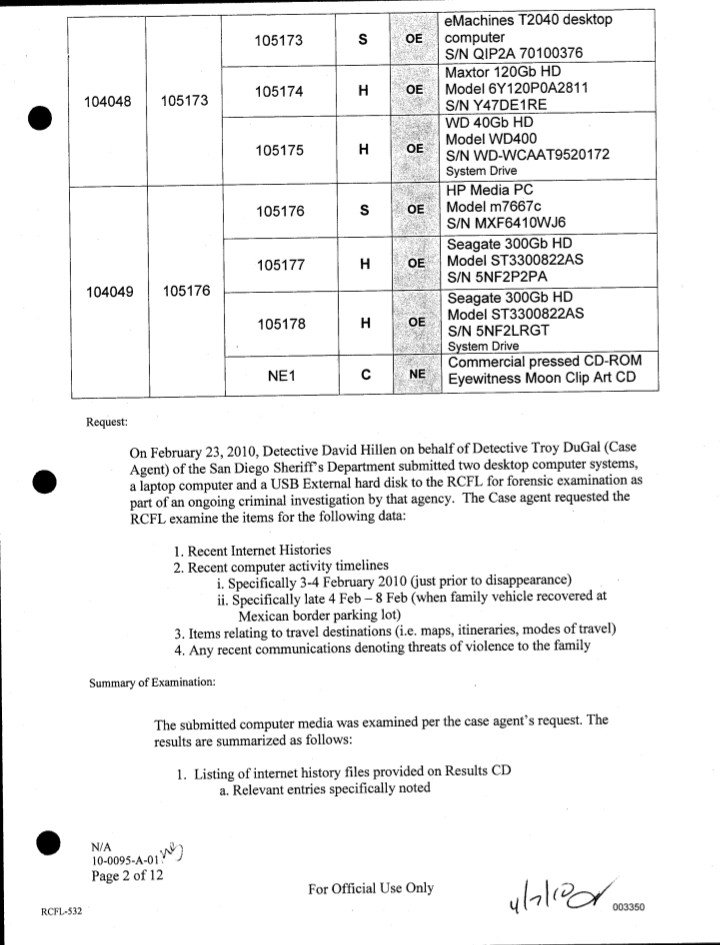
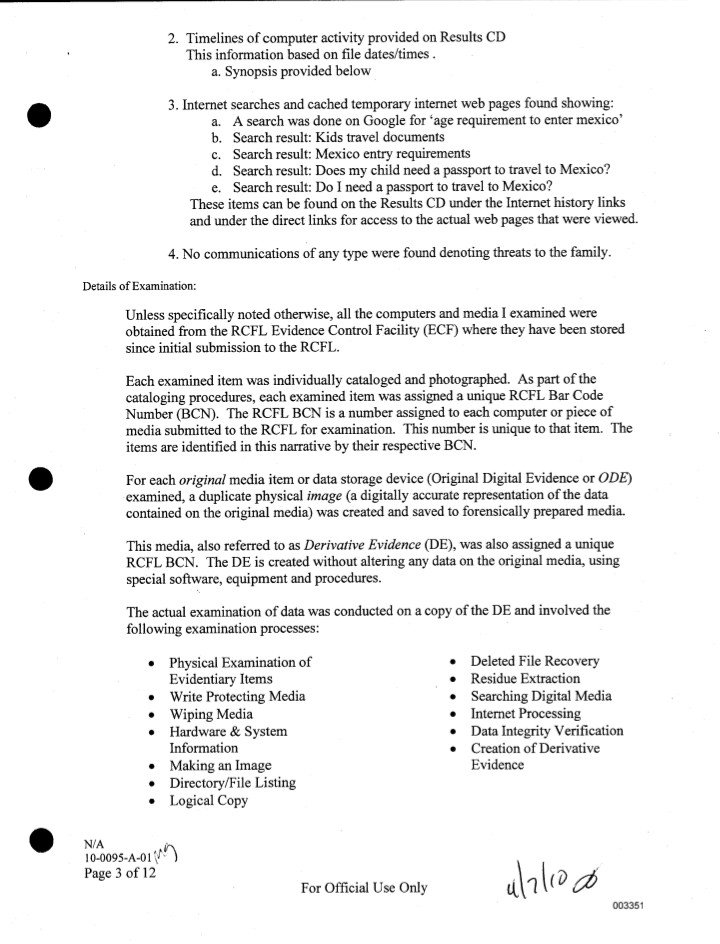
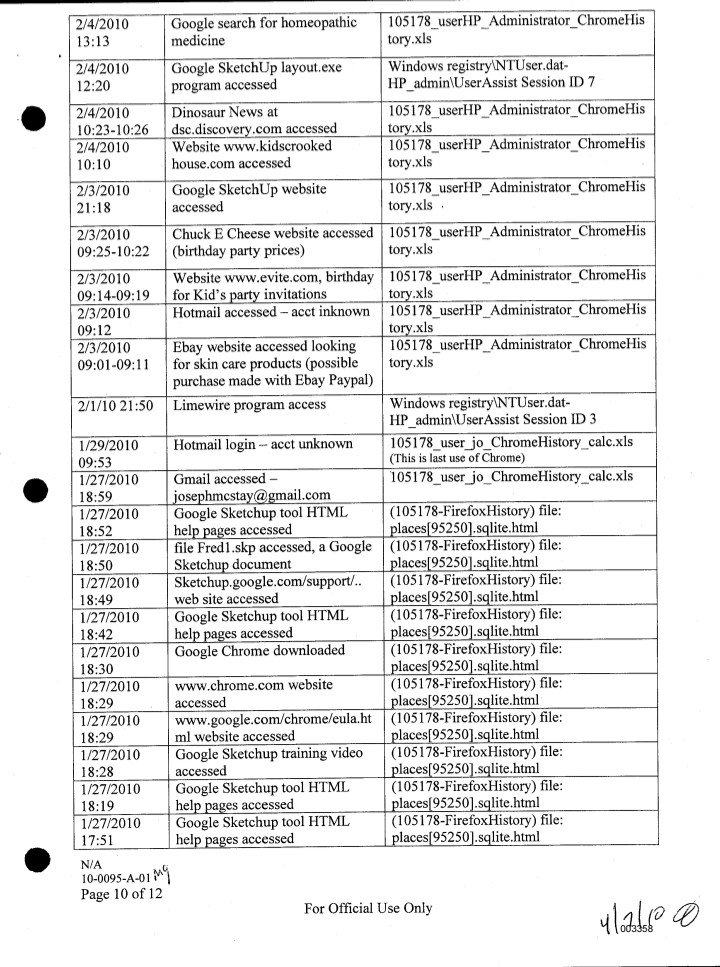
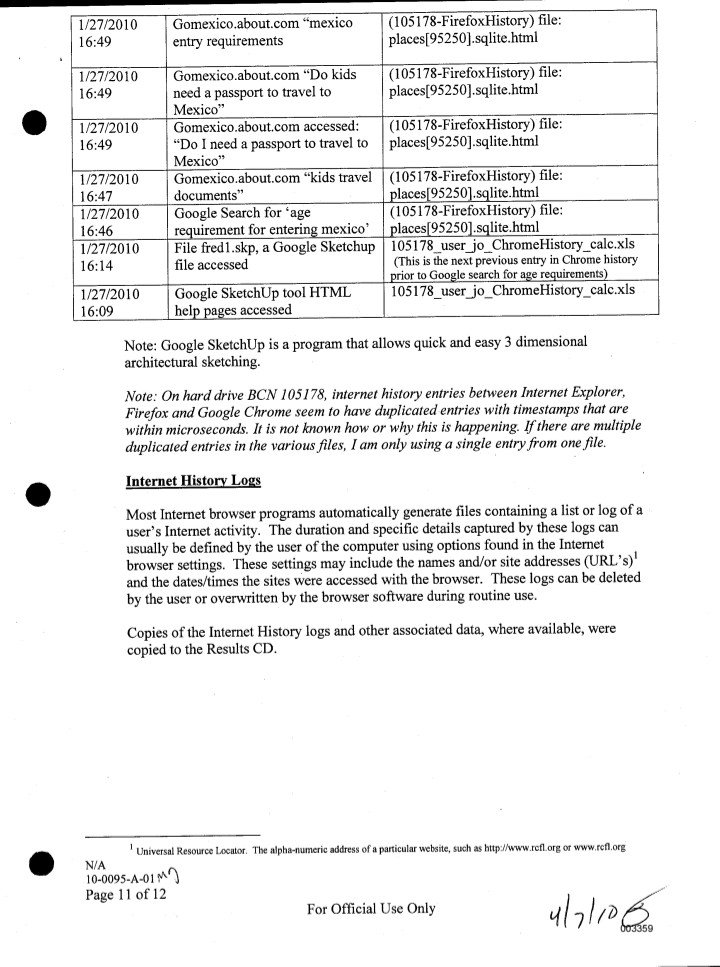
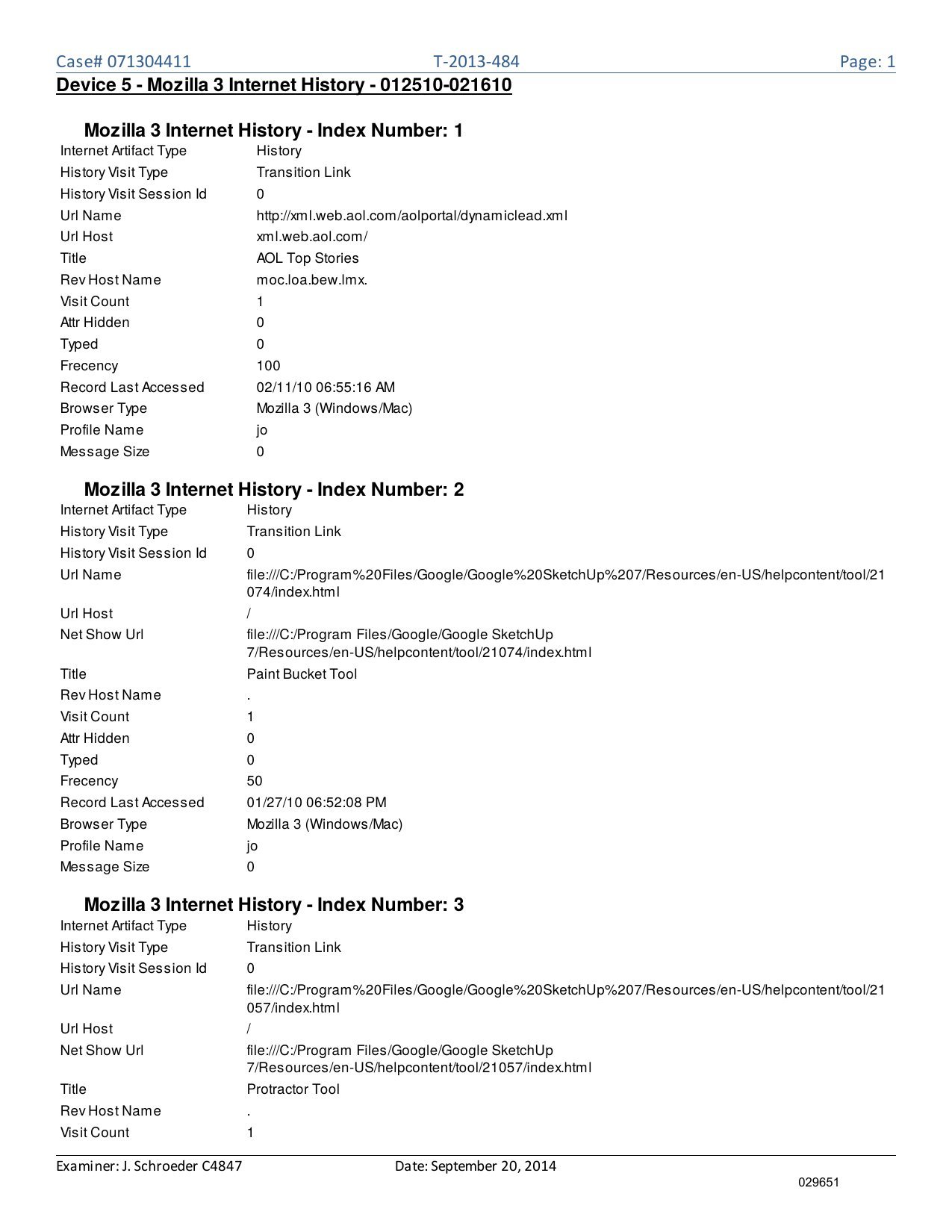
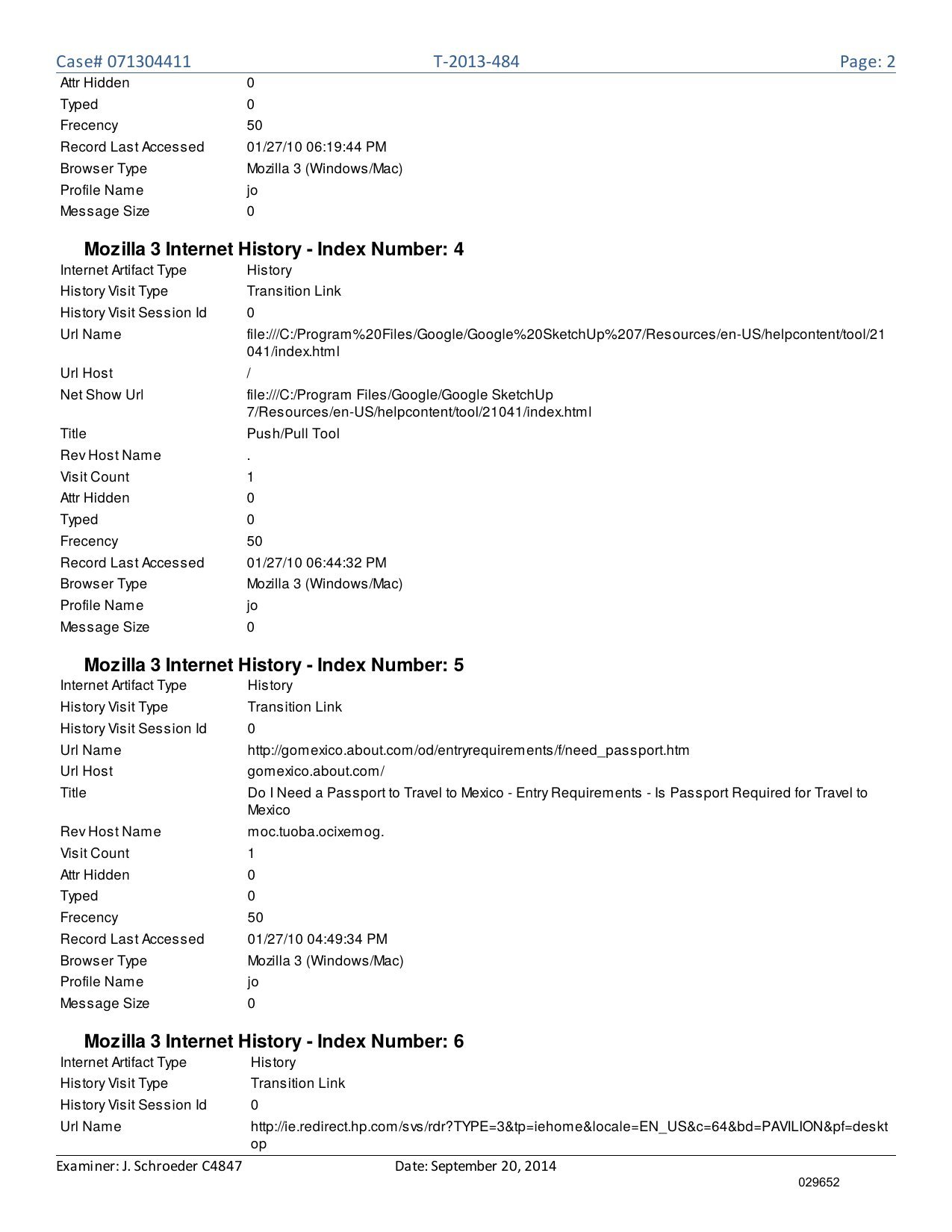
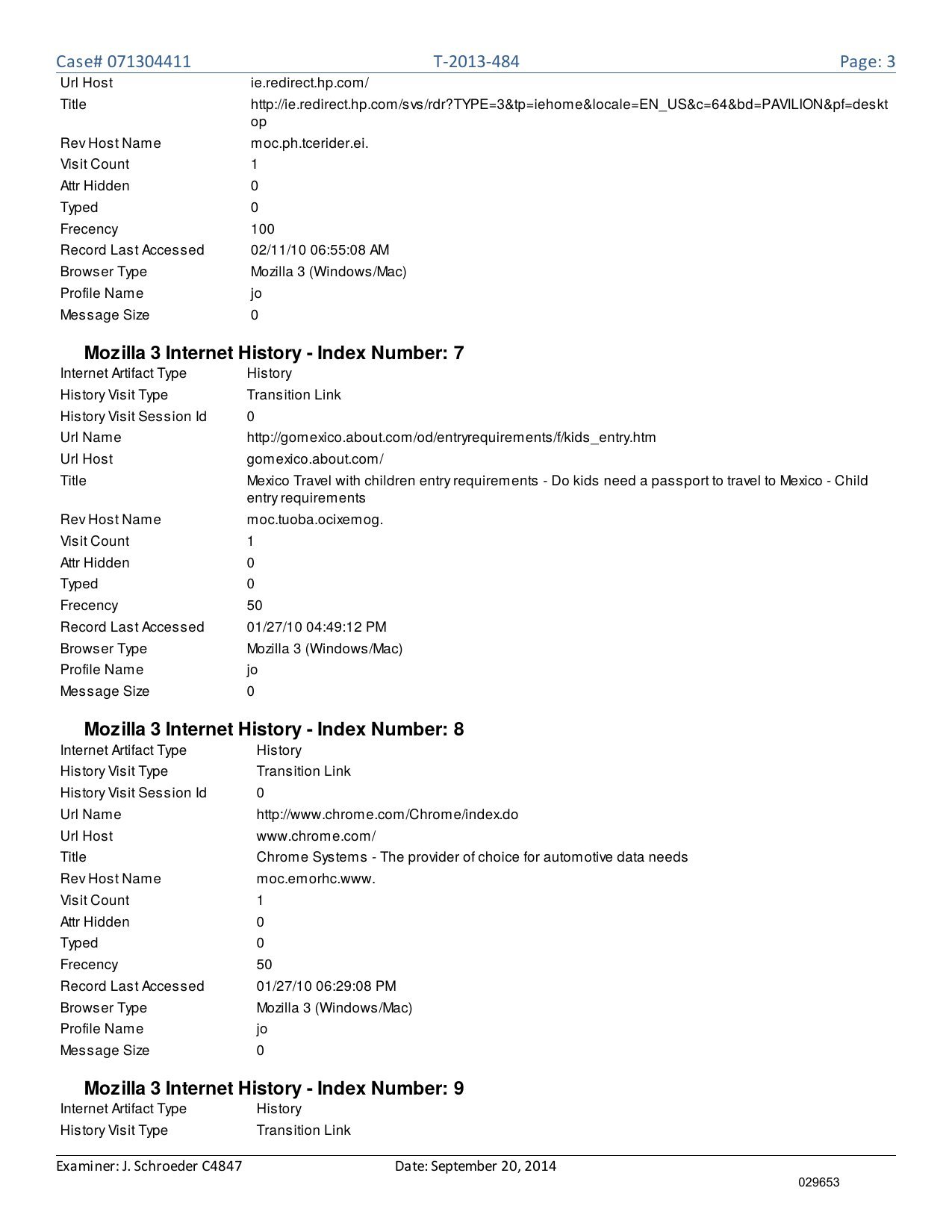
The family computer. While it was still a missing-persons case, the government’s forensic examiner searched the family’s computers, with one request expressly for “any recent communications denoting threats of violence to the family.” (RCFL Report of Examination, Lab No. 10-0095-A-01, Bates 003350) On January 27, 2010, at 4:46 p.m., a Google search was run for “age requirement for entering mexico”; in the next three minutes the results “kids travel documents,” “Do I need a passport to travel to Mexico,” “Do kids need a passport to travel to Mexico” and “mexico entry requirements” were opened (Bates 003358-003359). A later San Bernardino Sheriff’s examination of the browser history shows those pages at 4:49 p.m. under the profile name “jo” (examiner J. Schroeder, report T-2013-484, Sept. 20, 2014, Bates 029651-029653). DuGal told San Bernardino detectives that “Summer used Craigslist to locate Spanish and Italian Rosetta Stone language software” (Bates 000195). On threats: “No communications of any type were found denoting threats to the family.” (Bates 003350-003351) In his reports and briefing, DuGal described the searches more loosely (January 28, 2010 in some reports; December 2009 and attributed to Summer in the 2013 briefing, Bates 000195). The forensic reports are the primary record.
See the documents (Bates 003350, 003351, 003358, 003359, 029651, 029652, 029653)
Put plainly: The key, the seat, the State’s own premise about who drove, the leash and the travel searches all fit the reading that the family drove to the border themselves. Each is an inference, not proof of who was in the footage.
The child, and the way he ran
The problem with the border video, as the investigators themselves said, was that it showed only backs. The parking-lot camera caught the same group from the front. Among those frames is one of a small child in mid-stride: both arms held out from the body, elbows bent, forearms turned outward, roughly parallel to the ground.
The McStays’ youngest son ran that way. The family had home video of him running down a hallway at home, arms out, forearms turned, elbows bent. Here they are side by side: on the left, the enlarged figure from the San Ysidro lot on February 8, 2010; on the right, the McStay child running at home.
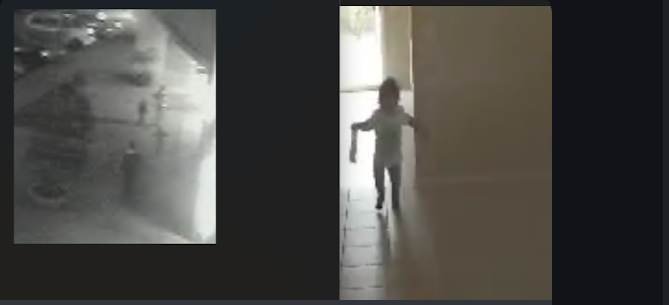
I do not offer this as proof. A grainy frame is not a fingerprint. It is the kind of front-view detail the border video could never supply, the detail the detective said was missing. It was the jury’s to see and weigh. The jury never got the chance.
Put plainly: One front-view frame shows a child running the way the McStays’ youngest ran at home. It is not proof. It is the kind of detail a jury could have weighed.
The February 12 photograph
One fact must be stated plainly. My own lawyers introduced at trial an aerial photograph of the grave area taken February 12, 2010, showing ground disturbance.
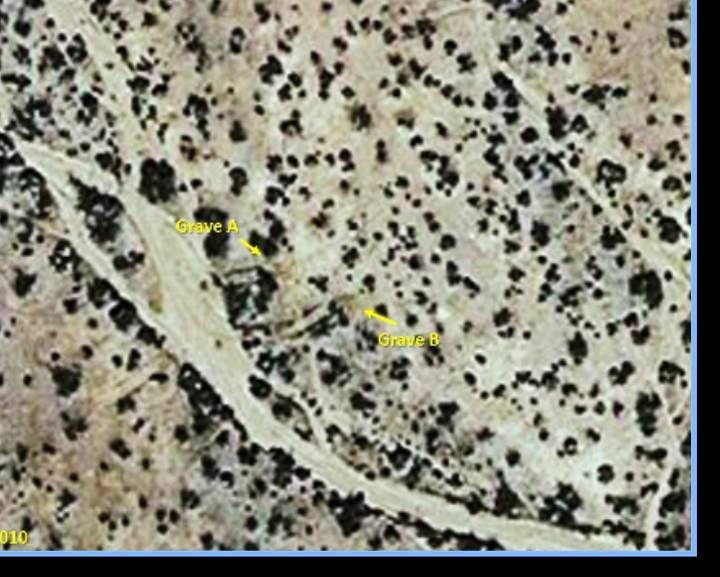
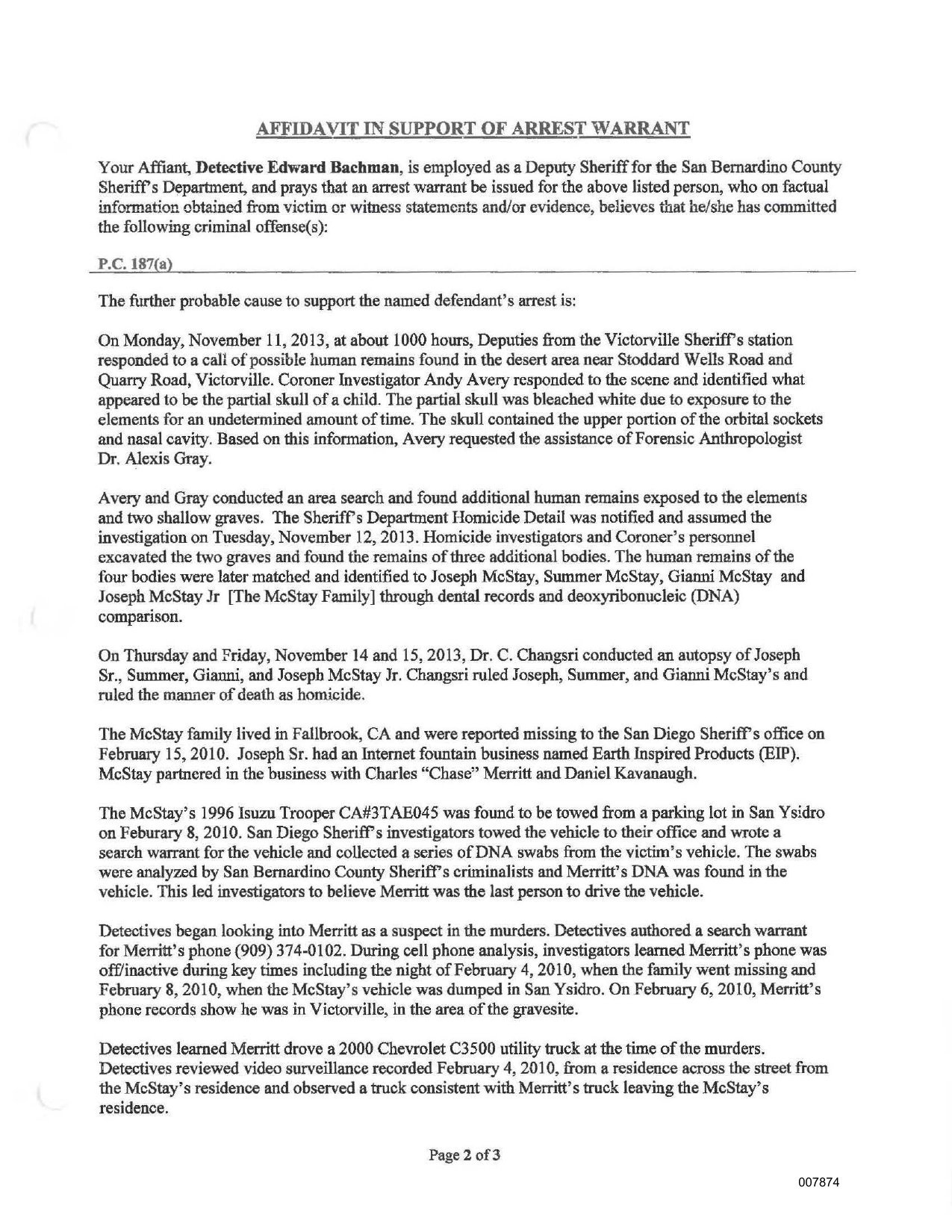
This photograph does not help me on its own. Disturbance visible by February 12 is consistent with a burial on February 6, which is what the State claimed. It is also consistent with a burial between February 8 and February 12. The photograph sets a latest date; it does not set an earliest one. The remains themselves carried no date: the State’s own warrant affidavit described a partial skull “bleached white due to exposure to the elements for an undetermined amount of time.” (Affidavit of Det. Bachman, Bates 007874)
See the document (Bates 007874)
So the photograph cannot decide between the State’s timeline and mine. The border footage could have. If the group on February 8 was the McStays, the February 12 photograph means they were buried within four days of crossing, and the State’s February 4 killing and February 6 burial are both wrong. My lawyers put in the photograph, whose meaning for me depended entirely on the February 8 crossing, without the pictures of the crossing.
I carry no burden to date the burial. The State chose February 4 as its account of when and where the family was killed, and built its case on that date: my whereabouts that night, the phone records, the Trooper seen leaving. A family walking into Mexico on February 8 contradicts that account.
Put plainly: The photograph does not decide the date. It is consistent with the State’s February 6 burial and with a burial after February 8. The footage could have decided between them.
What the State could say
“The jury heard about the video.” It heard DuGal call it “probable” and “almost equally probable it was not them,” and heard him say not one family member told him “that’s not them” (RT 2469:12-24). It did not see one frame. It heard “No” about the lot surveillance, and it heard family members dismiss the video at trial, without their 2010 words.
“There is no record they crossed or came back.” San Diego knew that and concluded they probably crossed anyway (Bates 000196). See “No record” above.
“The video is grainy and shows no faces.” True of the border video. That is why the front-view parking-lot footage mattered. How much a grainy frame is worth is for a jury to decide after seeing it.
“The Trooper was not in the lot until after 5:30 p.m.” The lot employees told DuGal the Trooper was not there at 5:30 p.m. (Bates 000193), and a security guard said it would have been parked “no earlier than 1800 hours” (Hillen report, Bates 001819). The first Camera 16 frames are stamped 5:52 p.m. I am not hiding that. Those frames show the group walking toward the camera, away from the crosswalk to the parking area; they do not show where the group came from. The 6:58 p.m. frame, after the guard’s time, shows the group again, heading toward the border. No one ever checked the camera’s clock against the guards’ times, because no one ever put the footage before the jury.
See the document (Bates 001819)
“Some of the family did not recognize them.” Susan said the man’s gait did not match Joseph’s, and Michael said the man’s walk was different. That is in “What the family said in 2010, and at trial,” above. So are Blanche’s “I think that’s my family” and Tracy’s refusal to say “This is not them.” A jury could weigh all of it. It was given none of it.
“DuGal told the family in 2012 he did not know where they were.” In June 2012 he told Tracy and Blanche that none of the information he had gathered gave him “an indication of where the McStay family was or why they left.” (Bates 001838) That is consistent with “probable”: not knowing where in Mexico a family went is different from doubting they went. Bachman’s notes of the November 13, 2013 briefing record that “DuGal was unsure if the family was voluntarily missing, but believed if there were no unusual circumstances, the McStays would have contacted family members” (Bates 000196). Whether they left willingly is a different question from whether they crossed alive on February 8.
See the document (Bates 001838)
“Someone staged the crossing.” A staging theory needs actors: four people, two of them children of the right sizes, with the family’s kind of backpack leash, a purse Summer’s mother took for Summer’s, and boots consistent with the ones Summer wore, while the family’s own leash sat in the Trooper, its seat was set for a man of Joseph’s size, and its key lay in Joseph’s pocket in the grave. The State identified no decoys, produced no evidence that anyone other than Joseph drove the Trooper to the border, and offered no account of how the key got back into his pocket.
The State’s arrest-warrant affidavit put it this way: “Merritt’s DNA was found in the vehicle. This led investigators to believe Merritt was the last person to drive the vehicle.” (Bates 007874.) In 2010 I told detectives I had never driven the Trooper. In my 2014 interview I corrected that: I remembered once repositioning it in the parking lot at the paintball park. Other than that, I never drove it. The affidavit’s inference does not put me at the wheel on February 8, and no evidence did.
Put plainly: Each likely comeback has an answer in the State’s own record, and none of them explains why the jury saw no frame at all.
The chain, and where it breaks
The State’s reasoning about the footage ran like this:
| Link | Where it stands |
|---|---|
| 1. The McStays were killed at home on February 4. | The charged theory. No eyewitness, no confession, and no crime scene found in the home (DuGal: “no crime scene was located inside,” Bates 000193). |
| 2. So the group crossing on February 8 cannot be the McStays. | This assumes link 1. It uses the conclusion to rule out the evidence that tests the conclusion. |
| 3. So the footage has no evidentiary value. | This follows only from link 2. The agency that investigated first, without link 1, reached the opposite view. |
| 4. So the jury need not see it. | Here the chain closes on itself. The jury was asked to accept link 1 without seeing the evidence that could break it. |
The break is at link 2. The footage was the test of the State’s date. The State answered the test by assuming the date.
Put plainly: The State used its February 4 date to dismiss the footage that tested that date.
Three separate questions
These failures had different authors, and they raise different questions. I keep them apart.
- The court. Excluding the border video on a “foundation” standard California law does not require, when the detective who obtained and reviewed it was on the stand, is a ruling error. It kept the rear-view footage from the jury.
- My own lawyers. The front-view parking-lot footage was in their files and never offered. They also answered the court’s foundation question for the border video with the federal-custodian premise and preserved nothing under the authentication statutes. Evidence a lawyer already holds and does not present is a question about the defense itself: ineffective assistance of counsel (Strickland v. Washington).
- The State. Mr. Imes drew out “No” about the lot surveillance from a detective whose own reports called the crossing likely and “probable,” and then Mr. Daugherty objected when my lawyer asked whether he had told family members the car and the crossing were “a pretty big coincidence”; the court sustained it as cumulative (RT 2470:11-16). Whether testimony the State knew to be misleading was left uncorrected is a question under Napue v. Illinois. Whether producing the footage inside tens of thousands of frames, then telling the jury the tapes held nothing, amounted to withholding favorable evidence is a separate question under Brady v. Maryland and Kyles v. Whitley. The footage itself was produced, so I do not claim it was hidden from my lawyers.
The case was investigated in one county and prosecuted in another. The law charges a prosecutor with knowledge of what the investigating agencies working on the case hold (Kyles v. Whitley). San Bernardino received San Diego’s case file on a Blu-ray disc at the November 2013 briefing (Bates 000189).
The instruction. My jury was instructed with CALCRIM No. 224 on circumstantial evidence: “If you can draw two or more reasonable conclusions from the circumstantial evidence, and one of those reasonable conclusions points to innocence and another to guilt, you must accept the one that points to innocence.” The instruction applies only if the jury finds the innocent conclusion reasonable. Whether a jury that had seen the footage would have found it reasonable, no one can say. A jury that never saw the footage could not weigh it at all.
Put plainly: The court excluded one video, my lawyers left the other unused, and the State told the jury the tapes held nothing. Three different failures, three different legal questions.
What I believe
This part is my opinion.
I believe a family walking on film four days after the State said they were dead was the most important evidence in my case, and no one put it in front of my jury. The court kept out the rear view. My lawyers left the front view in their files. The State told the jury the tapes held nothing of value and objected when my lawyer asked whether the detective had told family members it was “a pretty big coincidence”; the court sustained it as cumulative.
The instruction told the jurors to take the path to innocence where the evidence forked, and they were never shown the fork.
San Bernardino inherited the evidence. It did not acquire the right to bury it.
↑ Back to the menuSources
- Camera 16 (Las Americas lot) surveillance stills, February 8, 2010, 17:52:46-18:58:45 and 23:08:21-23:08:33; border-crossing video still, February 8, 2010, about 19:00. Produced in discovery.
- San Bernardino County Sheriff’s Department, Det. E. Bachman, “Briefing with San Diego Sheriff’s Department,” report dated 11/16/13 (briefing of November 13, 2013), Bates 000189-000196.
- San Diego Sheriff’s Department “Border Images” memorandum, March 23, 2010, Bates 003328.
- San Diego Sheriff’s Department follow-up reports by Det. Troy DuGal: Blanche Aranda (dated 12/13/2013), Bates 001660-001661; Michael McStay (dated 12/17/2013), Bates 001782-001785; Patrick McStay (dated 12/17/2013), p. 13 of 15 (entry of March 29, 2010; no Bates number on my copy); McGyver McCargar (Hillen, dated 12/10/2013), Bates 001773; Tracy Russell (dated 12/17/2013), Bates 001827, 001830, 001833, 001835, 001838.
- San Diego Sheriff’s Department follow-up report by Det. D. Hillen, Susan Blake (dated 12/10/2013), Bates 001819-001822.
- San Diego Sheriff’s Department: DuGal summary follow-up report (dated 5/9/2013), Bates 006112-006114, 006164-006165; DuGal report on Charles Merritt, Bates 001689; DuGal report on Mackenzi Farsheed, Bates 001756-001757; Deputy’s report of the February 15-16, 2010 neighborhood canvass, Bates 005944.
- San Diego County Sheriff’s Department media release (“Media Information”), 2013, Bates 006355.
- San Diego Sheriff’s Department property release and receipt to the FBI, authorized June 4, 2013, released June 21, 2013; evidence inventory, Bates 006260.
- San Bernardino County Sheriff’s Department, Det. E. Bachman, case summary dated October 24, 2014, Bates 006722.
- Regional Computer Forensics Laboratory, Report of Examination, Lab No. 10-0095-A-01, April 2, 2010, Bates 003350-003359; San Bernardino County Sheriff’s Department, examiner J. Schroeder, report T-2013-484, September 20, 2014, Bates 029651-029653.
- Arrest warrant and affidavit of Det. E. Bachman, DR# 071304411, Bates 007873-007874.
- Reporter’s Transcript, People v. Merritt, San Bernardino County Superior Court No. FVI1404194: RT 1632 (opening statement, January 7, 2019); RT 1747 and 1765-1766 (Susan Blake, January 8, 2019); RT 1981 (Michael McStay, January 9, 2019); RT 2337 (DuGal, direct); RT 2468-2470 and 2524-2528 (DuGal); RT 4280-4281 (Donald Jones); RT 5693 (the key, April 3, 2019); RT 7592-7598 and 7611 (May 7, 2019) (the border-video ruling and DuGal).
- Evidence Code sections 1400, 1401, 1421; People v. Goldsmith (2014) 59 Cal.4th 258; Strickland v. Washington (1984) 466 U.S. 668; Napue v. Illinois (1959) 360 U.S. 264; Brady v. Maryland (1963) 373 U.S. 83; Kyles v. Whitley (1995) 514 U.S. 419; CALCRIM No. 224.
Where I describe what I saw in the footage, I say so; that is my own observation.
↑ Back to the menu