The first couple of lines (Susan Blake)
I write this with respect for Susan Blake and for all she has lost. I would rather not have to show where her accounts differ. But the court called her testimony critical evidence, so her own words are here, side by side.
Susan Blake is Joseph’s mother. She was the State’s very first witness at my trial. The State used her to show a motive: that Joseph was about to push me out of his business.
Her accounts went back and forth, and this page shows all of them, including the ones that hurt me. What matters is how the State got the last answer the jury heard, and what the court later said the witnesses had told it. In the order it happened:
The interview, August 2014. When a detective asked her directly whether Joseph wanted a new builder or welder, she answered: “No. He didn’t say as much about Chase, wanting to get Chase out. He wanted to get more Dan out.” (Interview, p. 158:1-8)
On the stand, January 8, 2019. Asked why she never told the detective that Joseph wanted to phase me out, she said: “Not phase him out. He wanted his business to have other welders there to keep business going, making it grow.” (RT 1849:13-1850:1)
The court, March 4, 2019. The court said Joseph told her “it was his intent or desire to phase, actually, both Mr. Merritt and Mr. Kavanaugh out of the business,” and called her testimony “critical evidence.” (RT 4994:8-18)
Recalled, March 18, 2019. Asked whether Joseph was going to buy Dan and Chase out, she said: “Just Dan.” (RT 5535:17) The State then had her review only “the first couple of lines” of page 158 of her interview, and asked whether she told the detective “that Joey was going to buy Dan and Chase out.” She said, “Yes.” (RT 5535:22-28) Those first lines are the detective’s words. The next lines are his direct question and her answer, the “No” above.
The new-trial ruling, January 2020. The court said “we know” Joseph “told his mother and his brother and a friend that he planned to phase the defendant out of the business.” (RT 8942:23-8943:2) His mother said “Not phase him out.” His brother said Joseph asked him to “learn how to weld,” and drew his own conclusion about why. The friend described tension in the room. He never testified that Joseph discussed phasing me out.
Here is the record, so you can check it yourself.
What she told detectives, August 2014
On August 13, 2014, Detective Joe Steers and Detective Dan Hanke interviewed her. The interview was recorded, and a certified transcript was made. On this subject the detectives raised the same idea three times. Twice it was a detective who put “Chase” and “Dan” together, and she said “Uh-huh.” But when Detective Hanke asked her directly whether Joseph wanted a new builder or welder, her final answer on that question was “No.” She explained that Joseph wanted Dan out, not Chase.
Detective Steers asked her whether Joseph had ever talked to her about Dan. She told him about a conversation with Joseph late in 2009:
DETECTIVE STEERS: “And talk to me, did Joey ever talk to you about Dan before he went missing?”
MS. BLAKE: “Yeah, I knew about Dan.”
DETECTIVE STEERS: “And —“
MS. BLAKE: “Yep. But he didn’t look that good when I met him.”
DETECTIVE STEERS: “He didn’t look that good, huh?”
MS. BLAKE: “Huh-uh.”
DETECTIVE STEERS: “Okay.”
MS. BLAKE: “Joey, I have to say, in — in — in December when me and him had talked and stuff, he had said, you know, mom, I’m thinking about combining my business. I want to get rid of Dan and — him [Joseph] and Chase have it like — like you — you know, you suggested. Like why don’t I buy a warehouse and work out of a warehouse like you did when you worked at GreenWorks? And then I’m in full control of everything being welded here, I.T. here. And that was his goal.”
DETECTIVE STEERS: “Back in September he said this?”
MS. BLAKE: “This was like — not in September. This was like probably November.”
DETECTIVE STEERS: “Okay. Before he moved into Fallbrook or after?”
MS. BLAKE: “Before.”
DETECTIVE STEERS: “Right before he moved into Fallbrook?”
MS. BLAKE: “Yeah. So he had kind of said he was going to maybe not — you know, work away to get rid of Dan. And — and — and he had actually slipped and said, you know, I’m going to give him some money, or whatever. I really — see the prices we explained from Orange County and the prices of warehouses in — not — maybe Temecula or Murrieta in that area, the warehouses you could — you could buy things.”
DETECTIVE STEERS: “Right.”
MS. BLAKE: “And so he says — his want — his goal was to get his company under one roof and not doing all this work all over the place and having control and know it. That’s Dan — I mean, that’s not Dan. That’s Chase.”
(Interview, pp. 78:7-79:17. The bracketed name is mine.)
See the Susan Blake interview (pages 78-79)
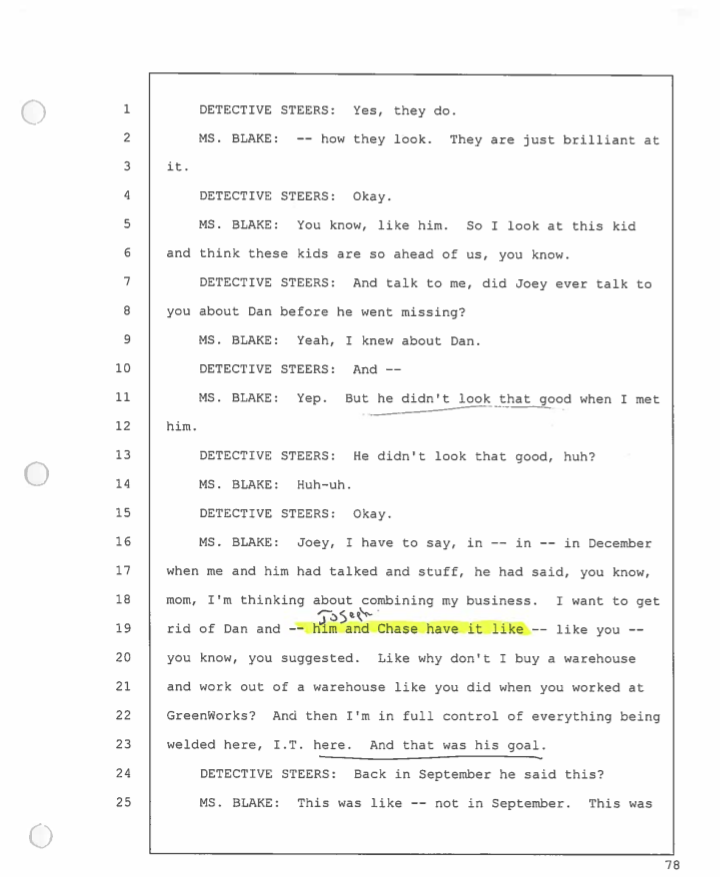
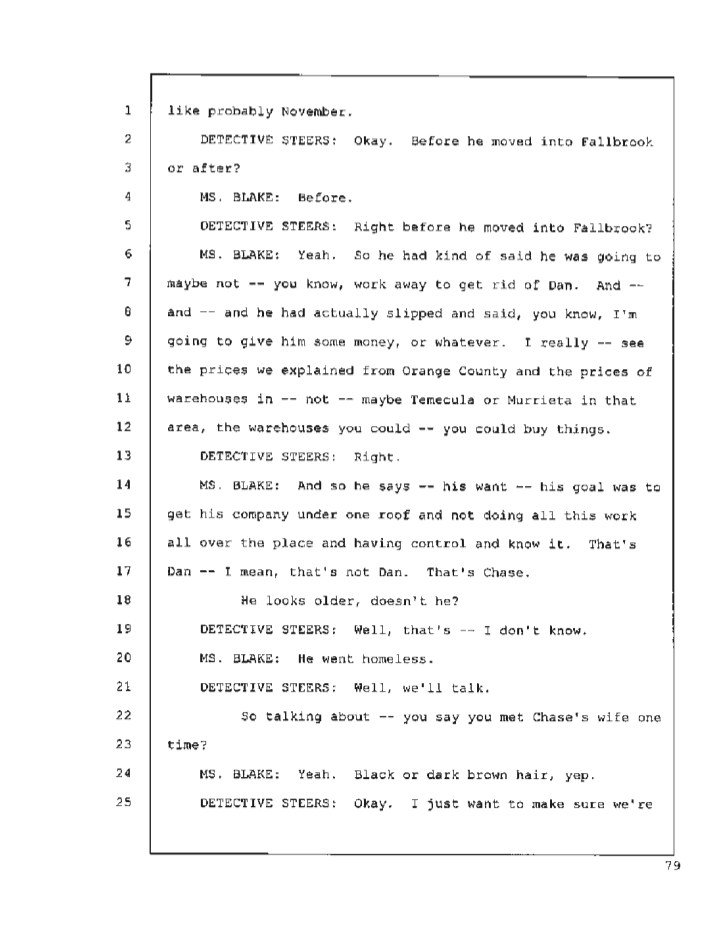
Recorded interview of Susan Blake, August 13, 2014, certified transcript, pp. 78-79.
I include her last line there, “That’s Chase,” because the State could point to it. Read it in context: she is describing Joseph wanting the work under one roof, under his control.
Later, Detective Steers summed up the plan himself:
DETECTIVE STEERS: “Right. And you talked in November of 2009. You talked about basically paying out — basically separating his situation with Chase and with Dan, paying them both out and centralizing like in a warehouse-type area like in Temecula or Murrieta, somewhere around there, so you could start doing business, everything right there local under his control?”
MS. BLAKE: “Uh-huh.”
DETECTIVE STEERS: “Okay.”
MS. BLAKE: “And then he’s like, mom, you could help me — you’re so good at sales. You could help sell these things. Because those were a piece of cake compared to what I did.”
DETECTIVE STEERS: “Right. No. I completely understand.”
(Interview, p. 95:2-14)
See the Susan Blake interview (page 95)
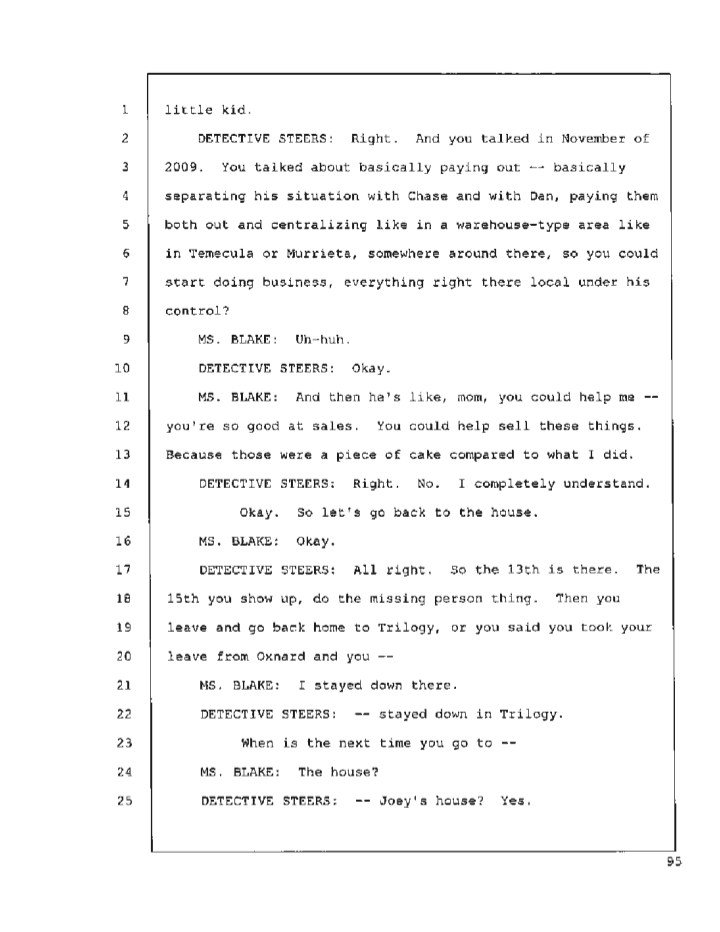
Recorded interview of Susan Blake, August 13, 2014, certified transcript, p. 95.
Near the end of the interview, she told Detective Hanke that Joseph was buying Dan out. The detective then summed up what she had said in his own words, and asked her directly:
MS. BLAKE: “Well, and I also knew that Joey was wanting to get his own I.T. guy and — and — and mentioned from Joey to me that, I’m buying him out, mom. So I just thought Dan the man was going to be gone, and then he’d still have Chase and the welders and everybody in one spot. That was his goal.”
DETECTIVE HANKE: “That was my next question. So you talked about buying Dan — that Joey was going to buy Dan and Chase out.”
MS. BLAKE: “Uh-huh.”
DETECTIVE HANKE: “Did he ever tell you that he was planning on getting a new — you say I.T. guy — but did he ever say that he wanted a new builder or welder?”
MS. BLAKE: “No. He didn’t say as much about Chase, wanting to get Chase out. He wanted to get more Dan out. Because Dan acted as if he could just flip the switch and shut his whole business down. And Joey couldn’t get it back up and this and that. So his — his concern was to buy him out — and he’s told me this, Joey — and then start over. And he said he’s talked to other people about, you know, it getting it going, to where he could control it in an office in his building.”
(Interview, pp. 157:19-158:15)
See the Susan Blake interview (pages 157-158)
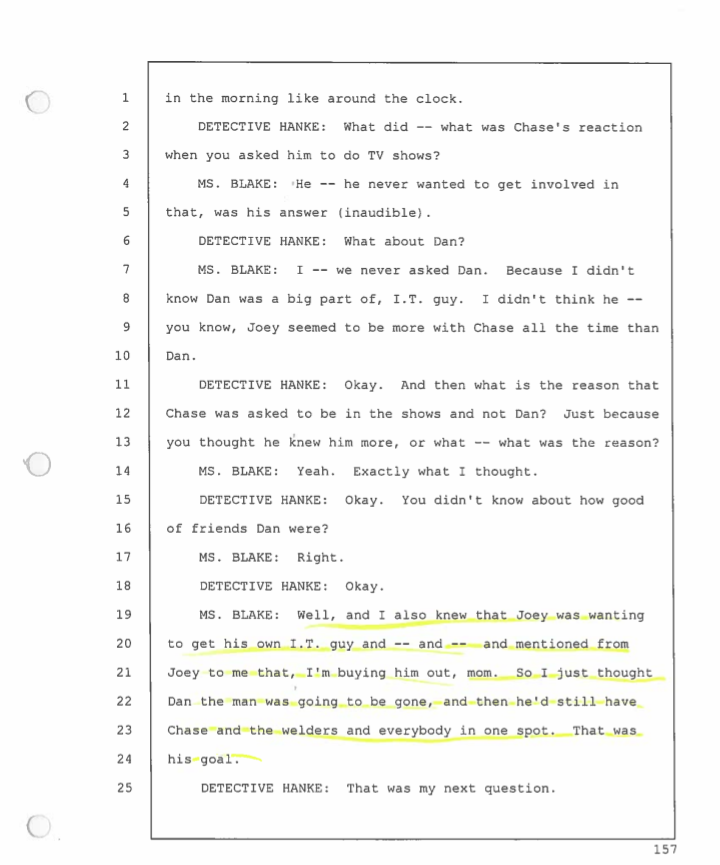
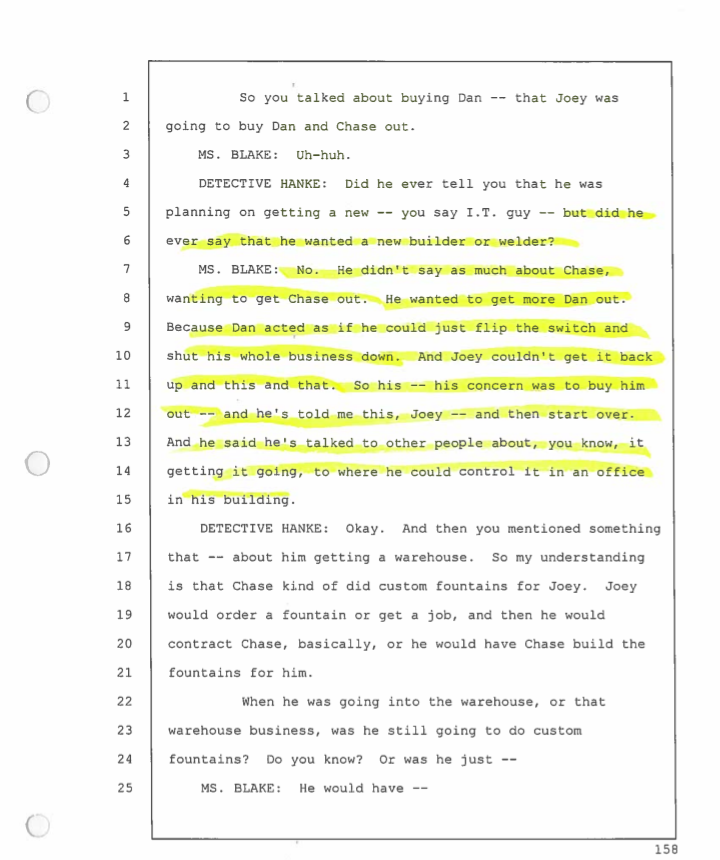
Recorded interview of Susan Blake, August 13, 2014, certified transcript, pp. 157-158.
Then Detective Hanke described my role, and asked whether Joseph would still do custom fountains in the warehouse:
DETECTIVE HANKE: “Okay. And then you mentioned something that — about him getting a warehouse. So my understanding is that Chase kind of did custom fountains for Joey. Joey would order a fountain or get a job, and then he would contract Chase, basically, or he would have Chase build the fountains for him.
When he was going into the warehouse, or that warehouse business, was he still going to do custom fountains? Do you know? Or was he just —“
MS. BLAKE: “He would have —“
DETECTIVE HANKE: “— going to sell fountains?”
MS. BLAKE: “No. No. No. He did both.”
DETECTIVE HANKE: “Okay.”
MS. BLAKE: “He was smart enough to get with different fountain companies, like one was in Florida and this and that, and have just a website. And he had the rights. And we went to the trade shows to sell these bigger fountains that were maybe like five feet tall, or whatever.”
DETECTIVE HANKE: “Okay.”
MS. BLAKE: “And basically, they are already built by this other company. So it was a click. I paid you for the fountain. It shipped. And he literally —“
DETECTIVE HANKE: “So he’s a middle man?”
MS. BLAKE: “— collect the difference of the money. But then he built the customs. So he did all the sales work. I mean, he was the whole backbone. He did all of the design and all of the sketching and everything for it. Then he would get the subs to make — if it had to be welded or if the glass was sketched, then he — that’s the part that he wanted under the roof.”
DETECTIVE HANKE: “Okay.”
MS. BLAKE: “Even if they worked for him.”
DETECTIVE HANKE: “Sure.”
MS. BLAKE: “But —“
DETECTIVE HANKE: “Okay. So he (inaudible).”
MS. BLAKE: “There is where he made the big, big dollars.”
DETECTIVE HANKE: “Okay.”
MS. BLAKE: “I saw invoices.”
DETECTIVE HANKE: “Okay.”
MS. BLAKE: “I never thought a fountain was $30,000.”
DETECTIVE STEERS: “Depends on the fountain.”
MS. BLAKE: “Or 60-. It’s a hotel.”
(Interview, pp. 158:16-160:7)
See the Susan Blake interview (pages 158-160)
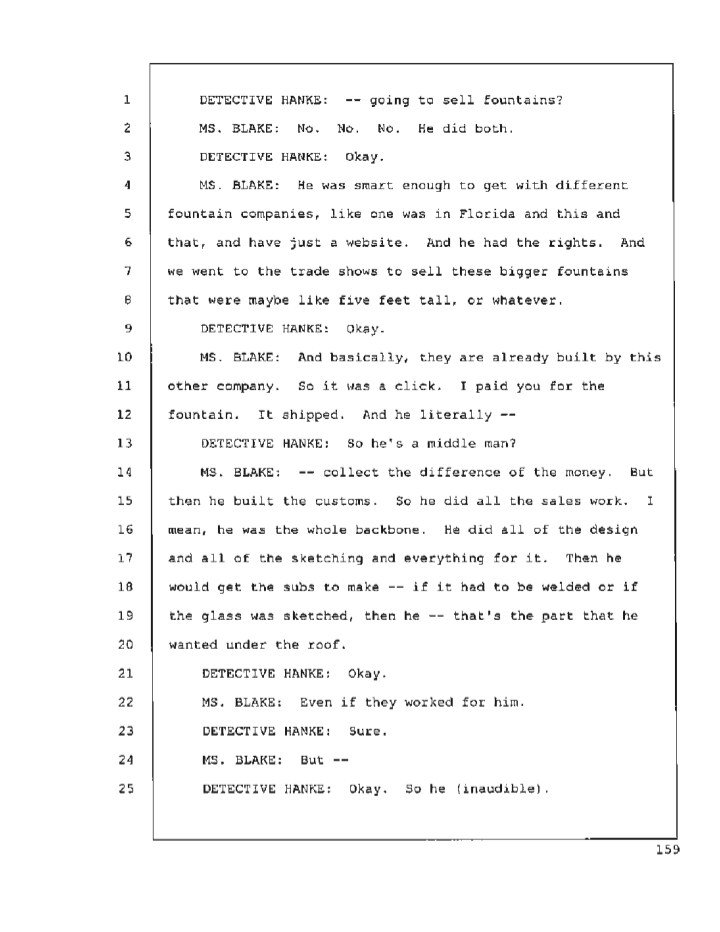
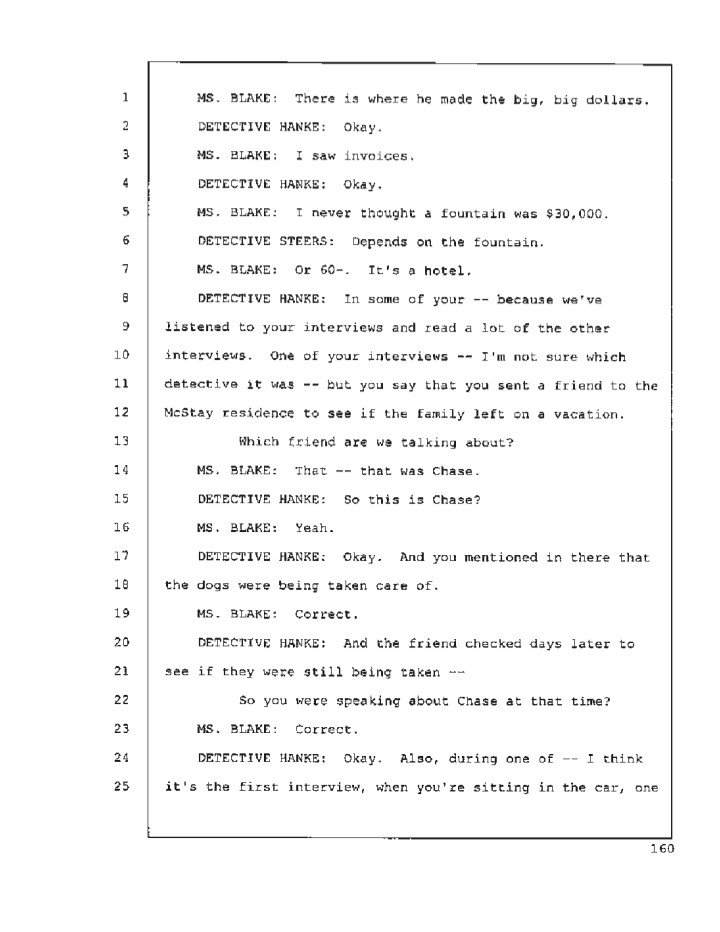
Recorded interview of Susan Blake, August 13, 2014, certified transcript, pp. 158-160.
“Dan and Chase out” were Detective Hanke’s words, right after she said Joseph would “still have Chase.” When he asked her directly, her answer was “No,” and the reasons she gave were about Dan. And asked whether Joseph would keep doing custom fountains in the warehouse, she said, “No. No. No. He did both.” The welding and the glass were “the part that he wanted under the roof.” The detective had just described that work as mine.
↑ Back to the menuOn the stand, January 8, 2019
On direct examination, the prosecutor did not ask her about a phase-out, about buying me out, or about welders. It came up on cross-examination by my attorney, Mr. Maline. He had her review page 78 of her interview, then read it to her. (RT 1722-1794; 1848:6-10)
Q “OKAY. YOU TOLD DETECTIVE STEERS THAT IN DECEMBER WHEN ME AND HIM TALKED, MEANING YOUR SON JOSEPH?”
A “UH-HUH.”
Q “AND YOU TALKED. HE SAID, YOU KNOW, MOM, I’M THINKING ABOUT COMBINING MY BUSINESS. I WANT TO GET RID OF DAN. DID YOU TELL DETECTIVE STEERS THAT?”
A “I DID.”
Q “AND THAT’S WHAT YOU REMEMBER YOUR SON JOSEPH TELLING YOU; CORRECT?”
A “HE WANTED TO BUY OUT DAN.”
Q “OKAY. AND HAVE HIM AND CHASE, MEANING JOSEPH AND CHASE. HAVE IT LIKE, YOU KNOW YOU SUGGESTED, LIKE I BUY A WAREHOUSE AND WORK OUT OF A WAREHOUSE LIKE YOU DID WHEN YOU WORKED AT GREEN WORKS. THIS IS YOUR SON JOSEPH TELLING YOU; CORRECT?”
MS. RODRIGUEZ: “OBJECTION AS TO HEARSAY AND IMPROPER IMPEACHMENT.”
THE COURT: “IT’S NOT IMPEACHMENT.”
MR. MALINE: “GOES TO HER STATE OF MIND.”
MS. RODRIGUEZ: “READING A TRANSCRIPT INTO THE RECORD.”
THE COURT: “SUSTAINED AS TO THE FORM OF THE QUESTION.”
THE WITNESS: “YES. HE WANTED A BUYOUT.”
MR. MALINE: “SUSTAINED MEANS YOU DON’T ANSWER. IT’S OKAY. IT’S OKAY. I WILL TRY ANOTHER WAY. OKAY.”
Q “BASED ON THIS CONVERSATION THAT YOU ARE RELAYING TO DETECTIVE STEERS, YOU KNEW THAT JOSEPH WANTED TO COMBINE HIS OPERATIONS INTO A ONE WAREHOUSE; CORRECT?”
A “THAT’S CORRECT.”
Q “WHERE HIM AND CHASE WOULD BE IN ONE SPOT WHERE THEY COULD BUILD WATERFALLS BECAUSE THEY HAD ALL THESE BIG PROJECTS; RIGHT?”
A “WRONG.”
Q “OKAY. THEY DIDN’T WANT TO GO INTO ONE WAREHOUSE?”
A “THEY DID, BUT IT WASN’T ONLY CHASE. HE WANTED OTHER WELDERS. HE WANTED TO PHASE OUT CHASE ALSO.”
Q “WELL, YOU DIDN’T TELL DETECTIVE STEERS THAT?”
A “I’M SORRY, BUT THAT’S WHAT HE TOLD ME.”
Q “OKAY. BUT IS THERE ANY REASON WHY YOU DID NOT TELL DETECTIVE STEERS HE WANTED TO PHASE OUT CHASE AS WELL?”
A “NOT PHASE HIM OUT. HE WANTED HIS BUSINESS TO HAVE OTHER WELDERS THERE TO KEEP BUSINESS GOING, MAKING IT GROW.”
Q “OKAY. SO HE WANTED TO HAVE MORE THAN ONE?”
A “SEVERAL WELDERS.”
Q “OKAY. IN ONE LOCATION?”
A “CORRECT.”
(RT 1848:11-1850:1)
See the trial transcript (RT 1848-1850)
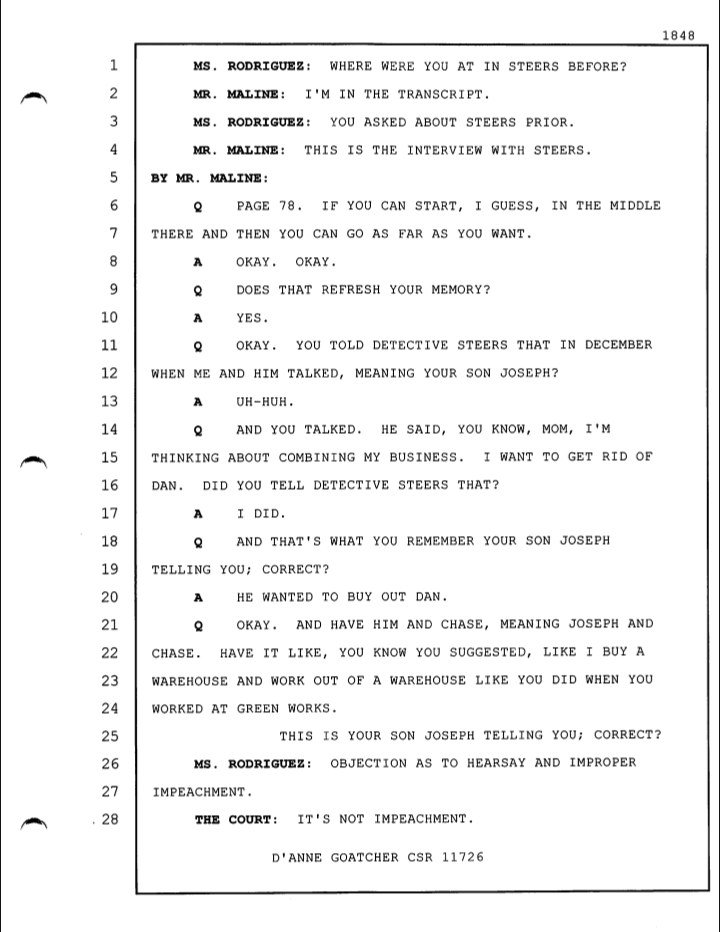
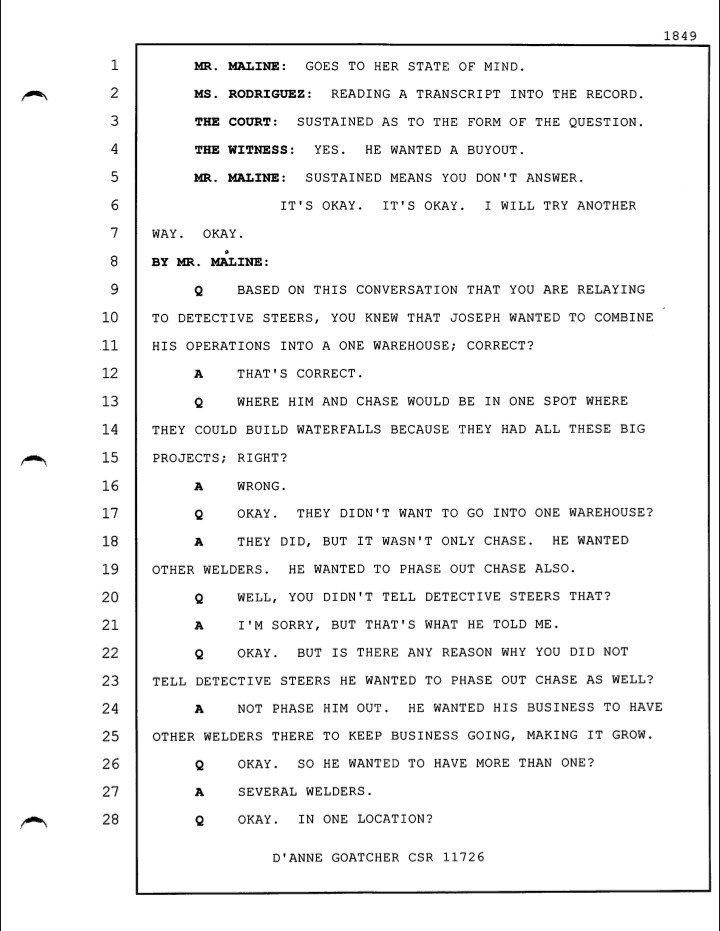
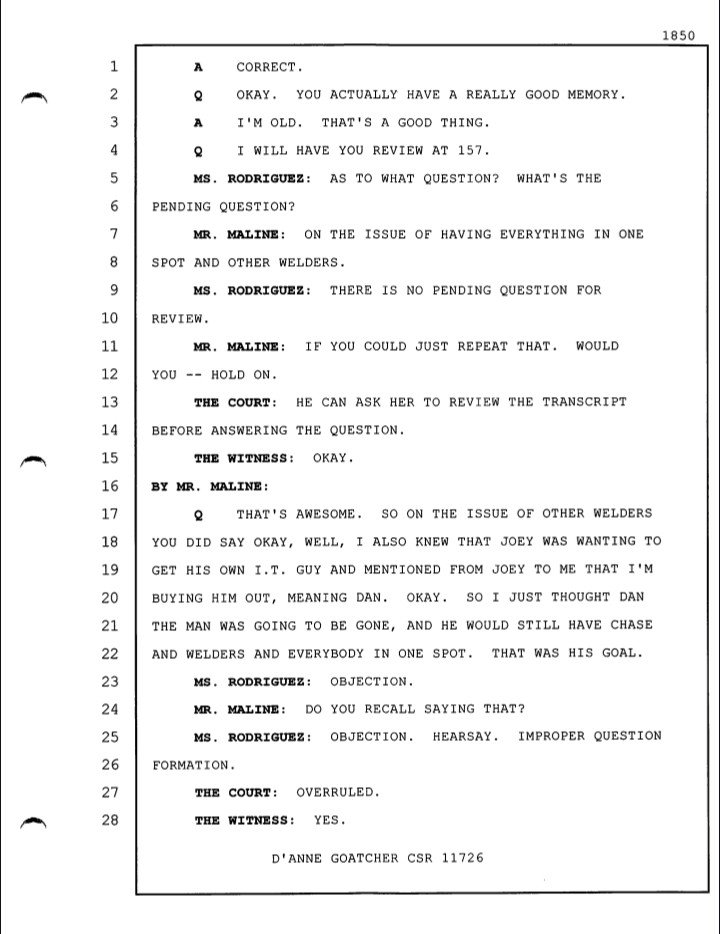
Reporter’s Transcript, January 8, 2019, RT 1848-1850.
She first said he wanted to phase me out, and stood by it when Mr. Maline pointed out that she never told Detective Steers that: “I’m sorry, but that’s what he told me.” Asked again why she hadn’t told him, she corrected herself: “Not phase him out.” Then she explained what she meant: other welders, several of them, in one location, “to keep business going, making it grow.” That was not a second version told somewhere else. It was her own correction of what she had just said, in front of the jury.
Mr. Maline then had her review page 157 of the interview, and read her own words to her:
Q “I WILL HAVE YOU REVIEW AT 157.”
MS. RODRIGUEZ: “AS TO WHAT QUESTION? WHAT’S THE PENDING QUESTION?”
MR. MALINE: “ON THE ISSUE OF HAVING EVERYTHING IN ONE SPOT AND OTHER WELDERS.”
MS. RODRIGUEZ: “THERE IS NO PENDING QUESTION FOR REVIEW.”
MR. MALINE: “IF YOU COULD JUST REPEAT THAT. WOULD YOU — HOLD ON.”
THE COURT: “HE CAN ASK HER TO REVIEW THE TRANSCRIPT BEFORE ANSWERING THE QUESTION.”
THE WITNESS: “OKAY.”
Q “THAT’S AWESOME. SO ON THE ISSUE OF OTHER WELDERS YOU DID SAY OKAY, WELL, I ALSO KNEW THAT JOEY WAS WANTING TO GET HIS OWN I.T. GUY AND MENTIONED FROM JOEY TO ME THAT I’M BUYING HIM OUT, MEANING DAN. OKAY. SO I JUST THOUGHT DAN THE MAN WAS GOING TO BE GONE, AND HE WOULD STILL HAVE CHASE AND WELDERS AND EVERYBODY IN ONE SPOT. THAT WAS HIS GOAL.”
MS. RODRIGUEZ: “OBJECTION.”
MR. MALINE: “DO YOU RECALL SAYING THAT?”
MS. RODRIGUEZ: “OBJECTION. HEARSAY. IMPROPER QUESTION FORMATION.”
THE COURT: “OVERRULED.”
THE WITNESS: “YES.”
(RT 1850:4-28)
See the trial transcript (RT 1850)
Reporter’s Transcript, January 8, 2019, RT 1850.
On redirect the same day, the prosecutor asked first about Dan, then about money:
Q “NOW, I WANT TO ASK YOU ABOUT SOME CONVERSATIONS THAT YOU HAD WITH YOUR SON PREVIOUSLY. THERE WAS SOME CONVERSATIONS THAT YOU JUST TESTIFIED TO THAT YOU HAD WITH YOUR SON JOE.”
A “YES.”
Q “OKAY. AND THOSE CONVERSATIONS CENTERED AROUND HAVING DAN MOVE OUT OF THE COMPANY; IS THAT CORRECT?”
A “YES. JOEY WAS TRYING — BUYING HIM OUT.”
Q “OKAY. AND WERE YOU AWARE OF ANY ISSUES, OR DO YOU REMEMBER TALKING TO DETECTIVE STEERS ABOUT ANY ISSUES THAT YOUR SON HAD WITH RESPECT TO THE DEFENDANT AND MONEY?”
A “REPEAT THAT AGAIN.”
Q “DO YOU REMEMBER TALKING TO DETECTIVE STEERS ABOUT A CONVERSATION THAT YOU HAD WITH YOUR SON JOE ABOUT SOME CONCERNS THAT JOE HAD REGARDING THE DEFENDANT AND MONEY?”
A “YES.”
Q “WHAT WERE THOSE CONCERNS THAT JOE HAD?”
A “MY SON WAS SAYING HE WAS COSTING HIM A LOT OF MONEY OF COMPLAINTS HE WAS GETTING THROUGH CUSTOMER SERVICE ON THE FOUNTAINS, AND THAT HE HAD LENT MONEY TO CHASE. TECHNICALLY, CHASE OWED HIM QUITE A BIT OF MONEY.”
Q “DO YOU RECALL TELLING DETECTIVE STEERS ANYTHING THAT JOE, YOUR SON, TOLD YOU ABOUT THE DEFENDANT HAVING A GAMBLING PROBLEM?”
A “YES. HE TOLD ME HE HAD A PROBLEM.”
Q “AND DO YOU REMEMBER WHAT YOU TOLD THE DETECTIVE WITH RESPECT TO THAT?”
A “I DON’T REMEMBER WHAT I TOLD —”
Q “WOULD IT REFRESH YOUR RECOLLECTION TO REVIEW THAT PORTION OF THE TRANSCRIPT?”
A “SURE.”
Q “SHOWING YOU PAGE 50. WE WILL START WITH LINE 16 THROUGH 21. JUST THOSE FIVE LINES, 16 THROUGH 21.”
A “OKAY.”
Q “DOES THAT REFRESH YOUR RECOLLECTION?”
A “YES. YES.”
Q “WHAT WAS IT YOU TOLD THE DETECTIVE THAT YOUR SON JOE HAD TOLD YOU ABOUT THE DEFENDANT?”
A “MY SON WAS LOOKING FOR SOME MORE WELDERS. UM, THAT CHASE HAD A GAMBLING PROBLEM AND HE HAD PAID HIM SOME MONEY TO GET HIM OUT OF, I GUESS, A SCRAMBLE OR DEBTS OR WHATEVER. BUT, IT WAS COSTING A LOT OF MONEY.”
(RT 1854:18-1856:3)
See the trial transcript (RT 1854-1856)
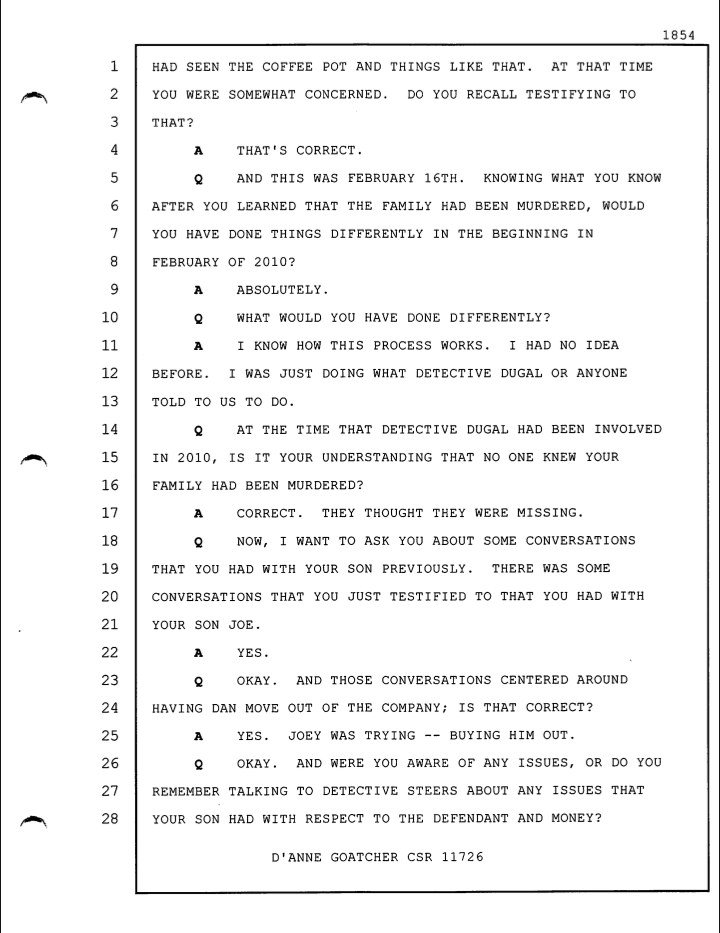
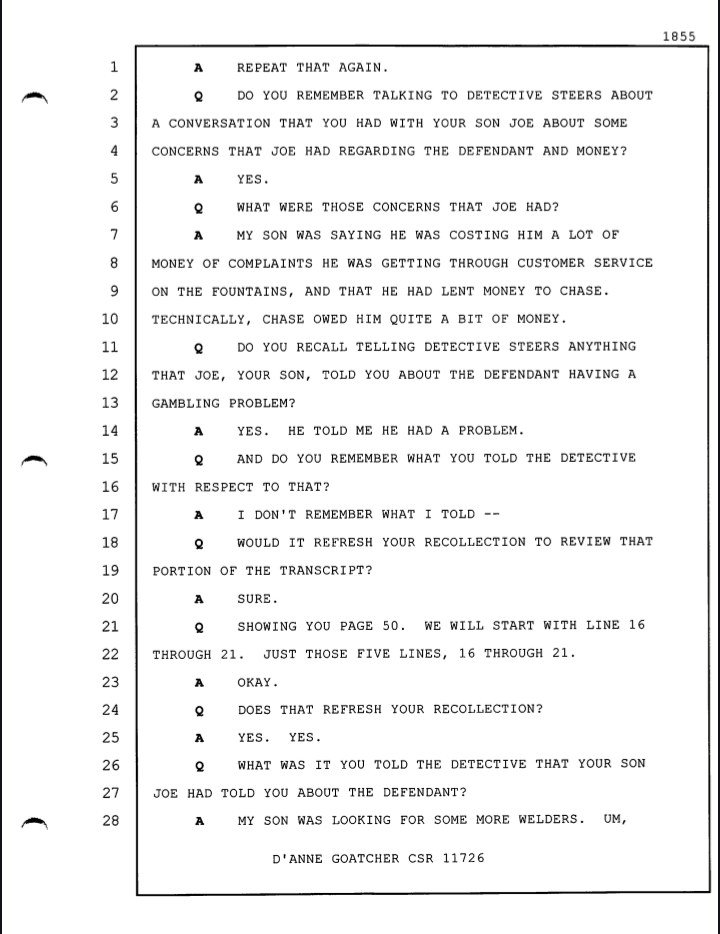
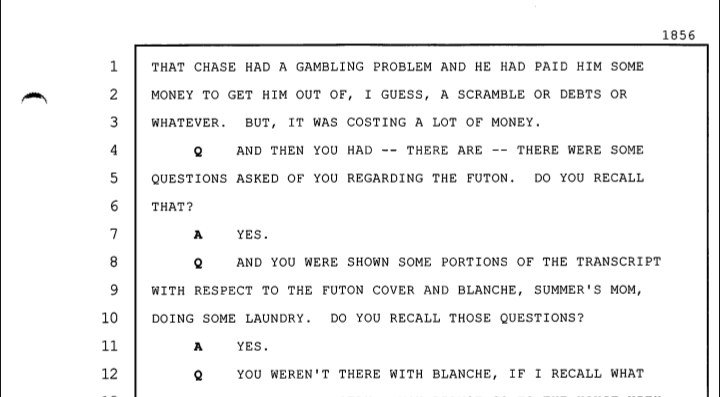
Reporter’s Transcript, January 8, 2019, RT 1854-1856.
What the rest of the record shows about the money
Her answers about money and gambling are her account of what Joseph told her. When the State came back to gambling with her in March, it asked whether I couldn’t use the bank accounts because Joey had paid off gambling debts for me. The court struck her answer and told the jury to disregard it. When Ms. Rodriguez tried again, through her earlier testimony, the court sustained the objection:
Q (BY MS. RODRIGUEZ:) “And to your knowledge, the reason that the defendant didn’t have access to the bank accounts was because Joey had paid off some gambling debts for him; right?”
A “Correct.”
MR. MCGEE: “Objection. Foundation.”
THE COURT: “Sustained.”
MR. MCGEE: “Move to strike.”
THE COURT: “Lack of foundation and calls for speculation and conclusion.”
Q (BY MS. RODRIGUEZ:) “Well, you testified —“
MR. MCGEE: “Your Honor, move to strike.”
THE COURT: “If there was an answer, it is stricken, and the jury instructed to disregard the last answer.”
Q (BY MS. RODRIGUEZ:) “You testified previously in this case, do you recall that?”
A “Yes.”
Q “And you specifically were asked about the defendant and his gambling habits, do you recall that?”
A “Yes.”
MR. MCGEE: “And I would object as to foundation to this line of questioning.”
THE COURT: “Sustained as cumulative as to going over what she previously testified to in that regard.”
(RT 5533:16-5534:10)
See the trial transcript (RT 5533-5534)
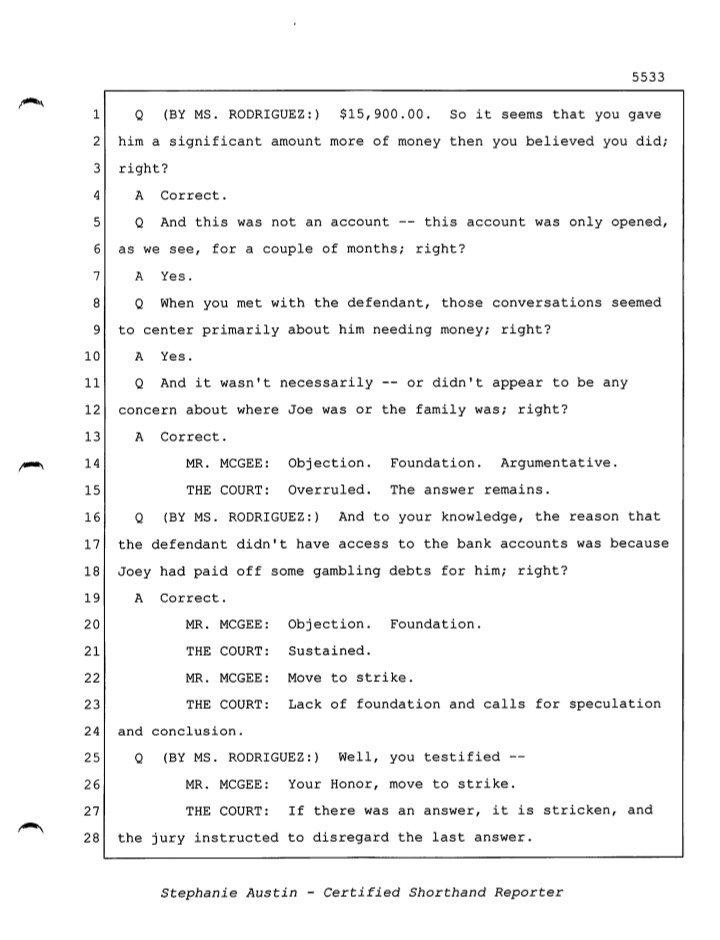
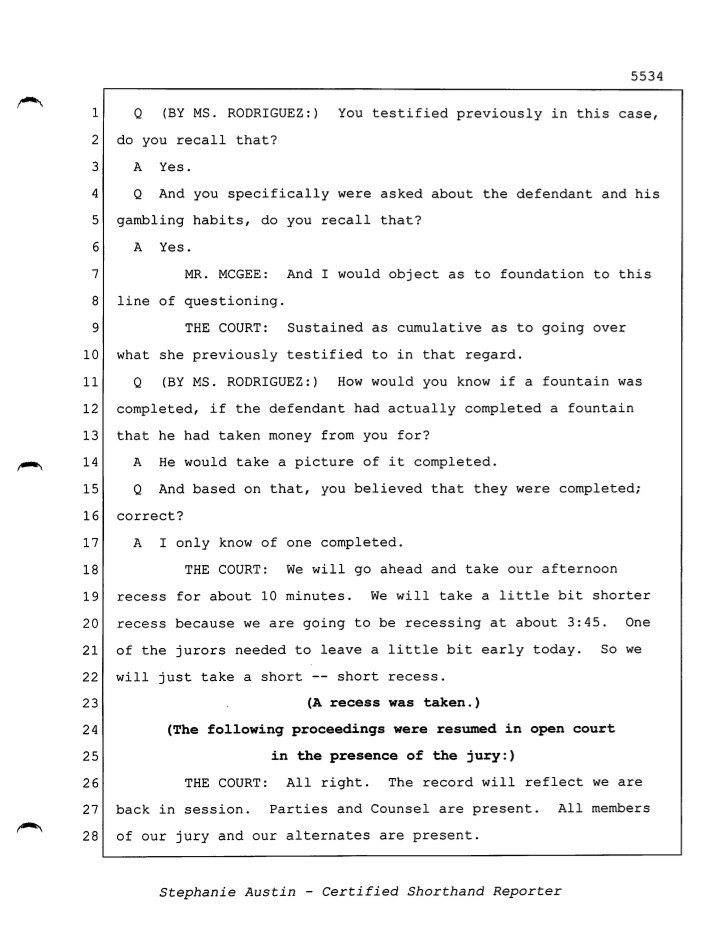
Reporter’s Transcript, March 18, 2019, RT 5533-5534.
On Joseph lending me money, Cathy Jarvis told the jury:
Q “And Joe had actually bailed him out financially, hadn’t he?”
A “I don’t know what you mean by that.”
Q “Well, were there times where Joe bailed out the defendant financially?”
A “There were times Joe advanced Chase money, if he needed to pay for something, but he always paid it back.”
Q “You’re sure of that?”
A “As far as I know, yes.”
(RT 5359:2-9)
See the trial transcript (RT 5359)
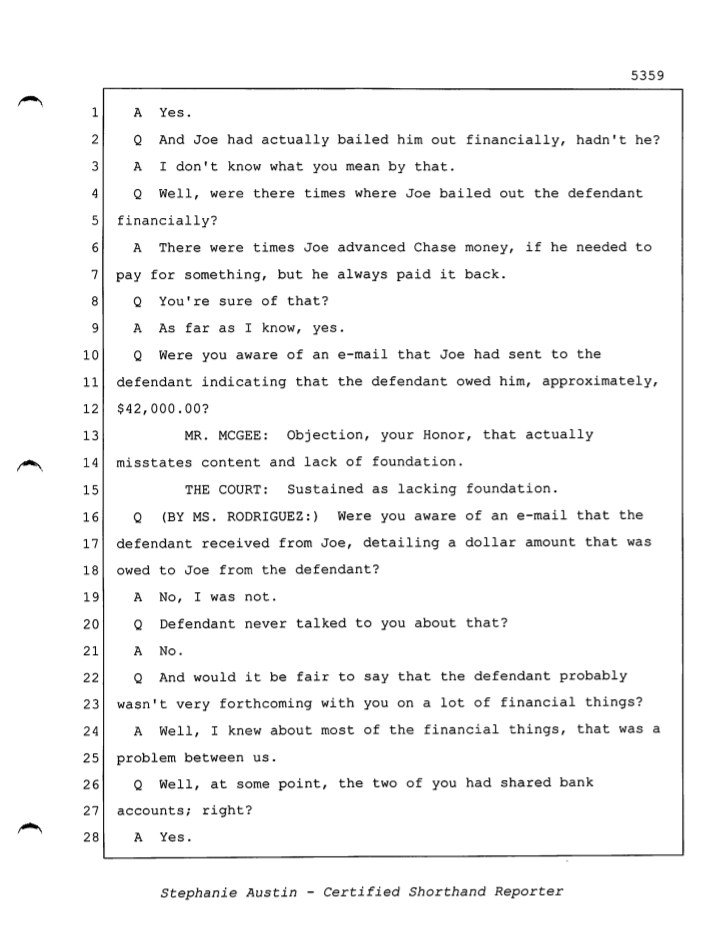
Reporter’s Transcript, March 14, 2019, RT 5359.
And the judge himself, questioning the accountant near the end of his testimony, established that the balance between Joseph and me ran both ways. He then went over the last balance, and the Provecho and Levine side notes:
Q “So I wanted to clarify one thing with regard to, like, maybe two or three exhibits. You had a couple of exhibits that showed the relationship of money owed between Mr. Merritt and Mr. McStay; correct — over a period of time?”
A “Yes.”
Q “And that changed as payments were made and work was done; correct?”
A “That’s correct.”
Q “So I think at one point, Mr. Merritt may have owed over $10,000.00 to Mr. McStay, and at other points, Mr. McStay may have owed more than $10,000.00 to Mr. Merritt; correct?”
A “That’s correct.”
[RT 7363:8-22 left out here: the judge asks about a January 10 figure, by his notes $790 overpaid to me, and they cannot find it on the exhibit.]
Q “I don’t see a January 10th on there. Okay. Maybe that’s not as critical. If I understood your testimony — or the way I understand it, the last date that you have a balance between the two of them is January 28th of 2010, and February 1st of 2010, and that balance was that Mr. Merritt owed Mr. McStay $15,045.00; is that right?”
A “That’s correct.”
Q “So that’s the end of that long —“
A “Yes.”
Q “— running balance back and forth?”
A “That’s correct.”
Q “Okay. Then that 15,045 — we also have two side notes on the Provecho job and the Levine — or Levine job; correct?”
A “That’s correct.”
Q “And that reflects — those side notes reflect that Mr. Merritt was initially paid based on what — on the arrangement, when the deposits were made to the EIP; correct?”
A “That’s correct.”
Q “And then subsequently there was a dispute between Provecho and Levine where some of that money came — was taken back by them?”
A “That’s correct.”
Q “And Joseph was noting that, you got paid this, there’s — some of that money came back for me, so there might be something between us, is that right? Is that your understanding?”
A “That’s my understanding that this was a notice, if you will, of something that’s pending.”
Q “Okay. Okay. But in your — your opinion, did not rise to the level of an additional amount actually owed to Joseph?”
A “That’s correct.”
Q “It was just something that, we need to talk about this?”
A “That’s correct.”
(RT 7362:24-7364:26)
See the trial transcript (RT 7362-7364)
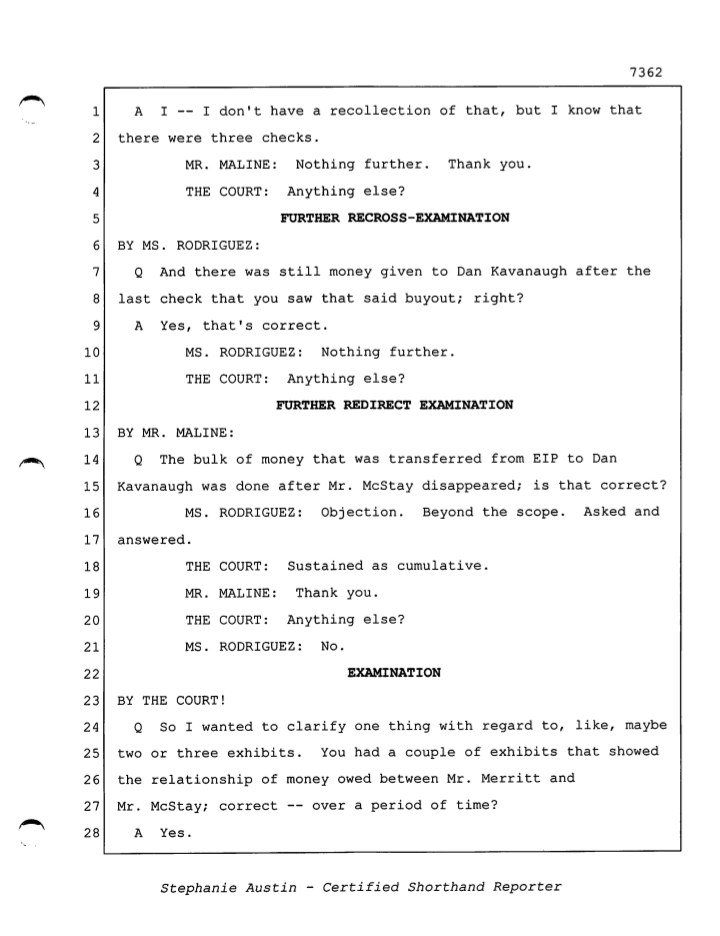
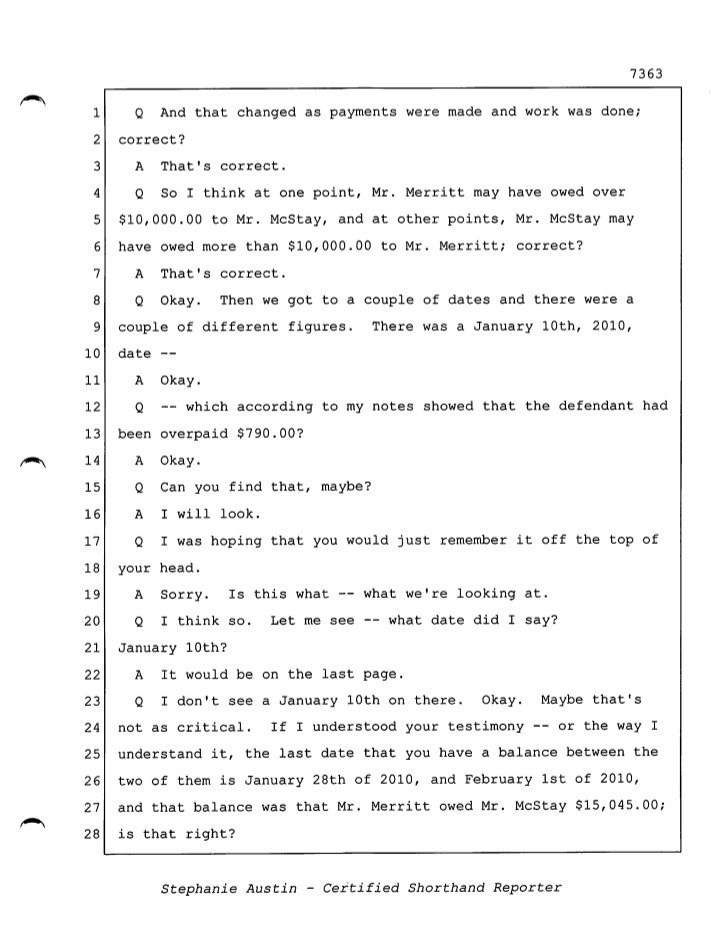
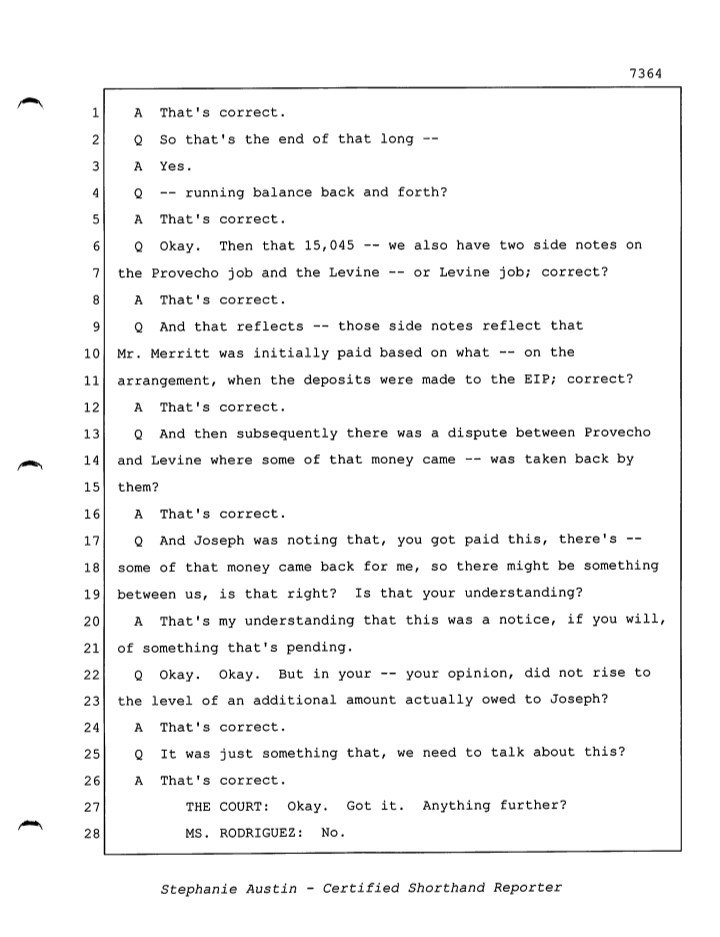
Reporter’s Transcript, May 1, 2019, RT 7362-7364.
So the ledger’s last balance, on February 1, 2010, had me owing Joseph $15,045. The Provecho and Levine side notes were, in the accountant’s words, “a notice … of something that’s pending,” not an added debt. (RT 7363:24-7364:26)
On February 1, 2010, Joseph’s own e-mail to me listed $26,000 he owed me on two new jobs, against the $15,045 I had been overpaid. The accountant testified that the $26,000 was owed once the 50 percent deposits came in, and that both deposits had been received by February 1. Once those jobs were counted, he owed me about $11,000. The e-mail is taken up on Closing argument: what they told the jury, card 4. (Exhibit 419; RT 7047:22-26, 7048:3-18, 7049:11-28)
↑ Back to the menuRecalled, March 18, 2019
My defense called her back to the stand. This time her answers went the other way, then back again. All of them are here.
Mr. Maline began with what she had said in January, then asked what she had told Detective Steers:
Q “Okay. And I think you indicated — and I could be wrong. You can correct me if I was wrong — I think you indicated that he was looking for other welders; was that your testimony?”
A “Correct, at the end of December.”
Q “Okay. That would be ’09, right, going into 2010?”
A “Yes.”
Q “Now, you also recall being interviewed in 2014 and you were asked about that — there was an interview by Detective Steers in August of 2014, do — do you recall being interviewed by Detective Steers at that time?”
A “Yes.”
Q “Okay. And he — he asked you the same question about whether you were going to get rid of Chase or Dan, what was the situation regarding Joseph’s business as it pertained to Dan and Chase, do you recall him asking about that?”
A “Yes.”
Q “Do you recall what you told Detective Steers?”
A “Yes.”
Q “What did you tell him?”
A “Joey wanted to get a warehouse closer down where he lived in Fallbrook or Vista, so he could be over it with more control, and that he asked me for welders. Since I’m in the building business, did I know of anyone because he wanted to weed Chase out and Dan he was paying off, so he would have been completed, also.”
Q “So he wanted — your understanding was he wanted to get rid of Dan; correct?”
A “Yes.”
Q “And what about Chase? Did he want to get rid of Chase and replace him with other welders was that your understanding?”
A “Exactly.”
Q “Or add welders — to keep Chase and just add additional welders?”
MS. RODRIGUEZ: “Objection. Leading.”
THE WITNESS: “No, he wanted to get rid of him.”
THE COURT: “Overruled. The answer remains.”
(RT 5489:3-5490:10)
See the trial transcript (RT 5489-5490)
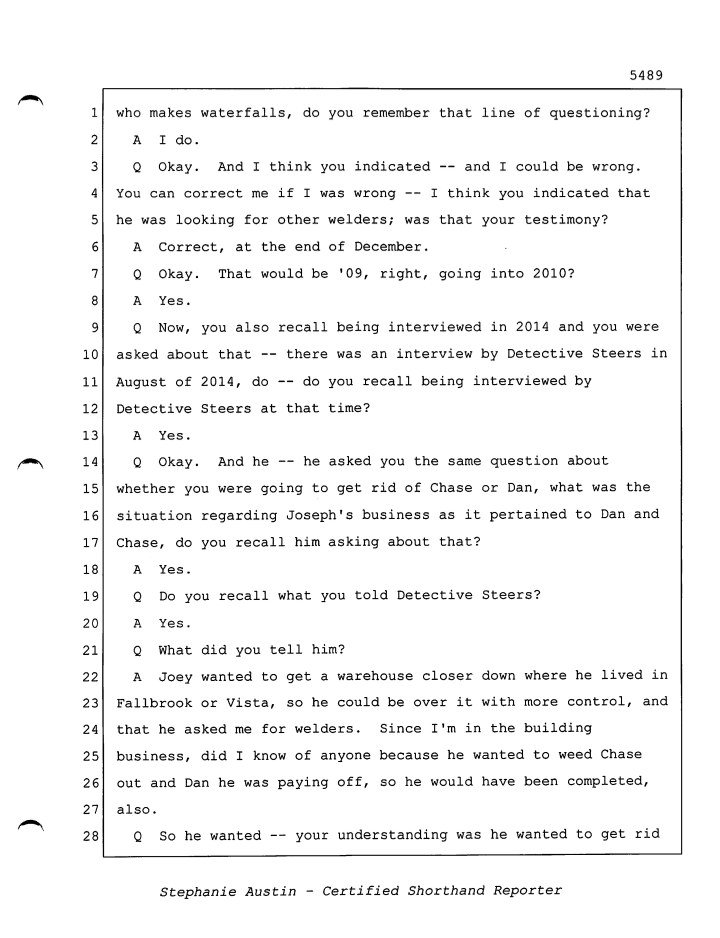
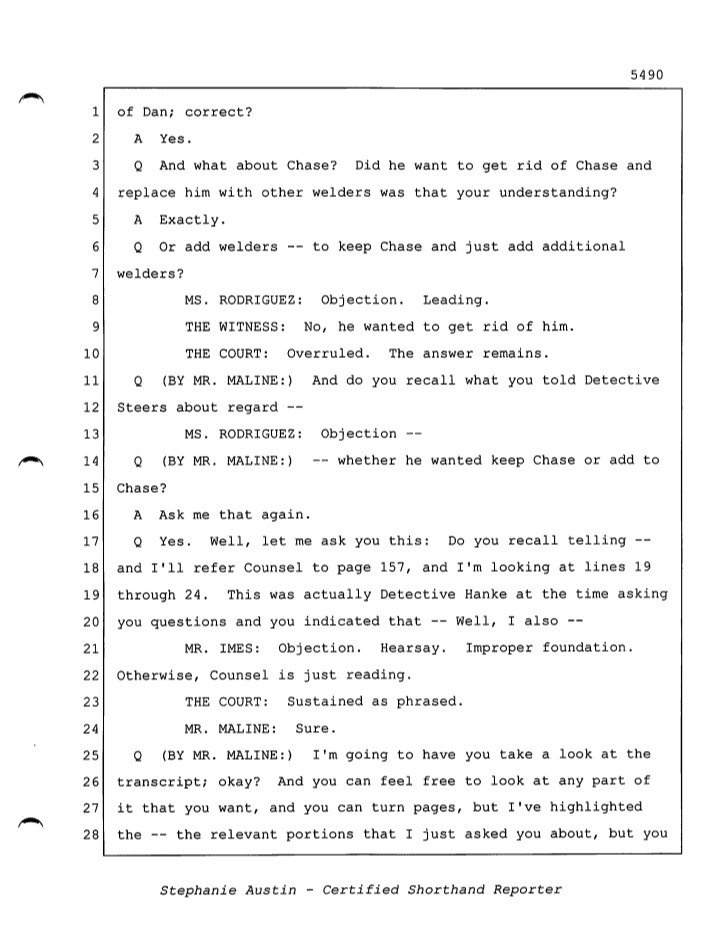
Reporter’s Transcript, March 18, 2019, RT 5489-5490.
Mr. Maline then tried to take her to what she had told Detective Hanke. The court would not let him read the interview to her:
Q (BY MR. MALINE:) “And do you recall what you told Detective Steers about regard —“
MS. RODRIGUEZ: “Objection —“
Q (BY MR. MALINE:) “— whether he wanted keep Chase or add to Chase?”
A “Ask me that again.”
Q “Yes. Well, let me ask you this: Do you recall telling — and I’ll refer Counsel to page 157, and I’m looking at lines 19 through 24. This was actually Detective Hanke at the time asking you questions and you indicated that — Well, I also —“
MR. IMES: “Objection. Hearsay. Improper foundation. Otherwise, Counsel is just reading.”
THE COURT: “Sustained as phrased.”
MR. MALINE: “Sure.”
Q (BY MR. MALINE:) “I’m going to have you take a look at the transcript; okay? And you can feel free to look at any part of it that you want, and you can turn pages, but I’ve highlighted the — the relevant portions that I just asked you about, but you can feel free to look at whatever pages you would like.”
A “Okay.”
Q “Whatever you feel is necessary.”
A “You didn’t have any other highlight.”
Q “Okay. Did that refresh your memory as to what you told Detective Hanke?”
A “Yes.”
Q “Isn’t it true you told Detective Hanke that Joseph wanted to get additional welders and add to and keep Chase?”
A “No.”
Q “Okay. So let’s just read it, so there’s no misunderstanding as to what you said. Well —“
MR. IMES: “Objection. Lacks foundation for the transcript and it would be hearsay.”
THE COURT: “Sustained. You can call the witness for impeachment later, if you wish.”
MR. MALINE: “If I could have permission now to do that, that’s what I would request.”
THE COURT: “When you are done with this witness, if you want to call the other witness who did the interview for impeachment, you can do that.”
MR. MALINE: “Okay.”
(RT 5490:11-5491:22)
See the trial transcript (RT 5490-5491)
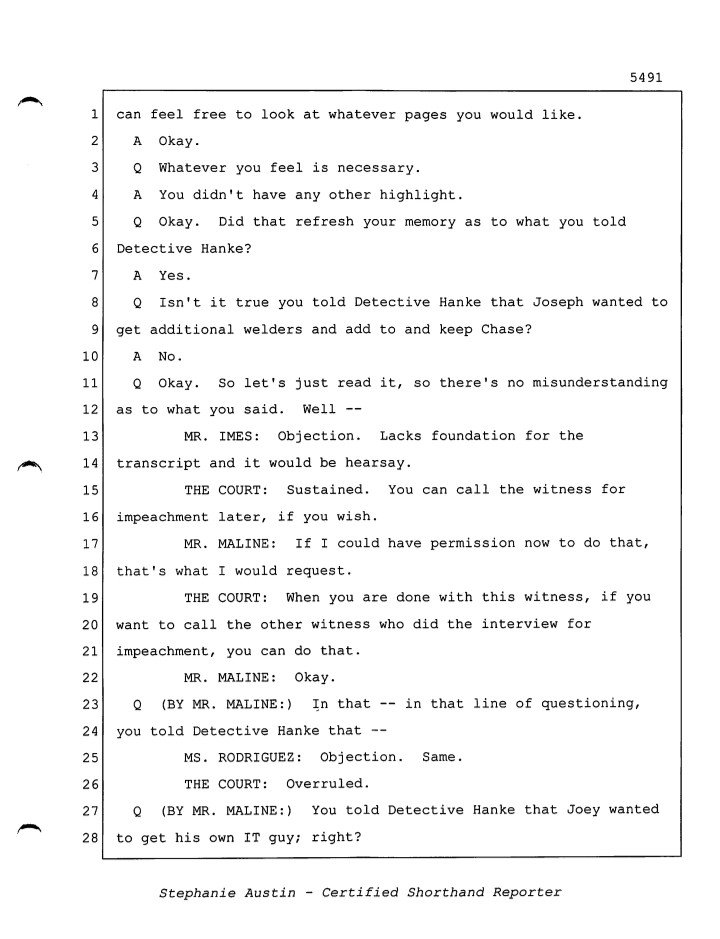
Reporter’s Transcript, March 18, 2019, RT 5490-5491.
The court did not let Mr. Maline read her the page. It told him he could call the detective who did the interview, to impeach her with it. My lawyers never called him. (See what my own defense did, and did not do.)
Mr. Maline went on:
Q (BY MR. MALINE:) “In that — in that line of questioning, you told Detective Hanke that —“
MS. RODRIGUEZ: “Objection. Same.”
THE COURT: “Overruled.”
Q (BY MR. MALINE:) “You told Detective Hanke that Joey wanted to get his own IT guy; right?”
A “That is correct.”
Q “And Joseph thought, at that point, Dan would be gone; correct?”
MS. RODRIGUEZ: “Objection. Leading and hearsay.”
THE COURT: “Overruled.”
THE WITNESS: “I’m not sure when Dan would have been gone.”
Q (BY MR. MALINE:) “But that’s what you told Detective Hanke —“
A “Yes, he was paying him off.”
Q “And you also told Detective Hanke that he’d still have Chase and the welders and everybody in one spot; isn’t that —“
MR. IMES: “Objection. Hearsay. Lacks foundation.”
THE COURT: “Overruled.”
Q (BY MR. MALINE:) “Isn’t that what you told him?”
A “Yes.”
Q “Okay. And what you meant by that was Joey’s vision of having one warehouse would include Chase and the other — other welders?”
MS. RODRIGUEZ: “Objection. Leading.”
THE COURT: “Overruled.”
THE WITNESS: “That’s what he talked about.”
(RT 5491:23-5492:22)
See the trial transcript (RT 5491-5492)
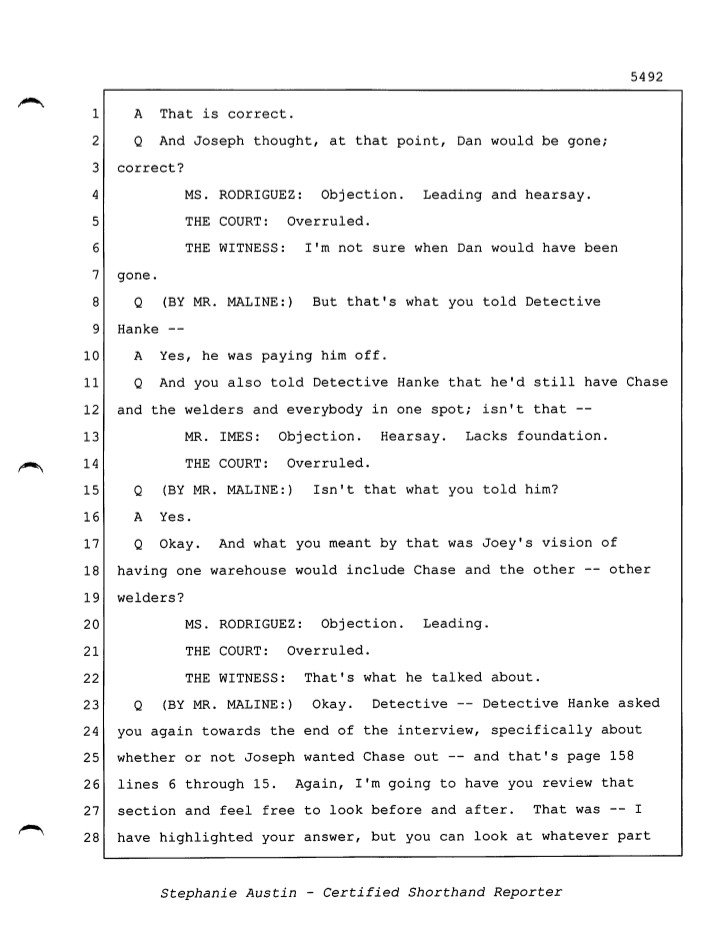
Reporter’s Transcript, March 18, 2019, RT 5491-5492.
Asked whether she had told Detective Hanke that Joseph wanted to add welders and keep Chase, she said “No.” A minute later she agreed she had told him that Joseph would “still have Chase and the welders and everybody in one spot,” and that this was “what he talked about.” That was not a correction. It was two opposite answers about the same interview, a minute apart.
Then Mr. Maline took her to page 158. He said out loud which lines he meant, “page 158 lines 6 through 15.” Her answer begins at line 7:
Q (BY MR. MALINE:) “Okay. Detective — Detective Hanke asked you again towards the end of the interview, specifically about whether or not Joseph wanted Chase out — and that’s page 158 lines 6 through 15. Again, I’m going to have you review that section and feel free to look before and after. That was — I have highlighted your answer, but you can look at whatever part you would like.”
MS. RODRIGUEZ: “I’m sorry. Where are you at, Counsel?”
MR. MALINE: “Page 158.”
THE WITNESS: “Okay.”
Q (BY MR. MALINE:) “Does that refresh your memory?”
A “Yes.”
Q “Okay. So Detective Hanke asked you specifically whether or not Joey wanted a new builder or welder; right?”
A “Yes, he asked me about welders.”
Q “Okay. And you indicated — you answered, No, he didn’t say much about Chase, trying to get Chase out?”
MR. IMES: “Objection. Leading. Hearsay. Lacks foundation for actually the transcript he’s —“
THE COURT: “Overruled.”
Q (BY MR. MALINE:) “He wanted to get more — Dan out; right?”
A “Dan first, yes.”
Q “Okay. Because Dan acted as if he could just flip a switch and shut his whole business down?”
A “Correct.”
MS. RODRIGUEZ: “Objection. Leading. Hearsay.”
THE COURT: “Overruled.”
Q (BY MR. MALINE:) “And Joey couldn’t get it back up and this and that. So his concern was to buy him out, and he’s told me this, Joey, and then start over?”
MS. RODRIGUEZ: “Objection. Is there a question or is Counsel just reading the transcript?”
THE COURT: “Sustained.”
Q (BY MR. MALINE:) “In other words, you knew about Dan’s threat to shut down the business; correct?”
MS. RODRIGUEZ: “Objection.”
MR. IMES: “Objection. Calls for hearsay, speculation.”
THE COURT: “Sustained. Calls for hearsay and speculation and conclusion.”
(RT 5492:23-5494:5)
See the trial transcript (RT 5492-5494)
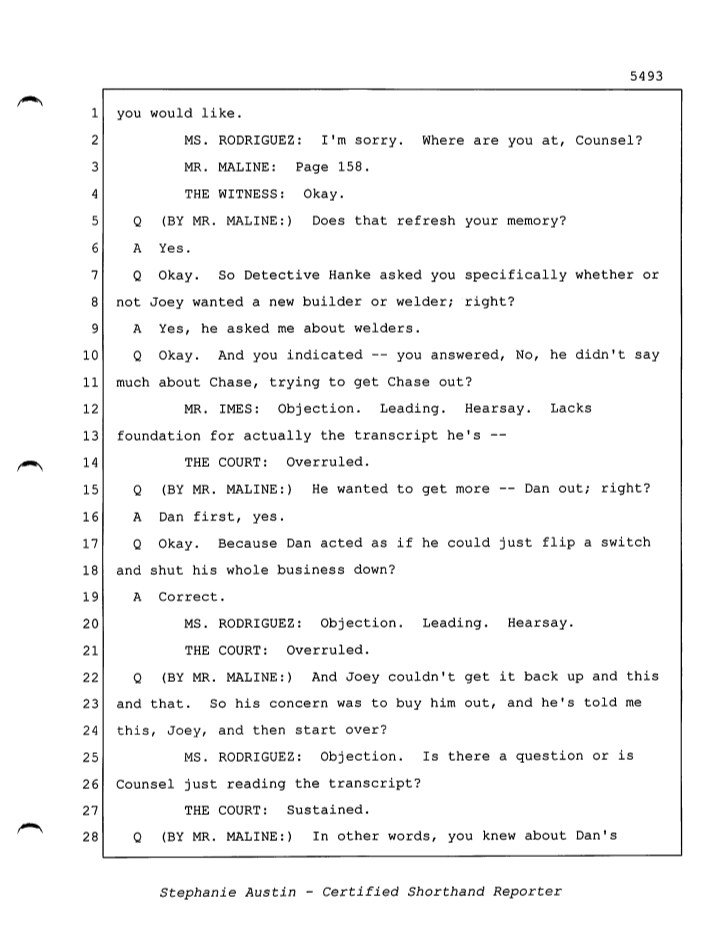
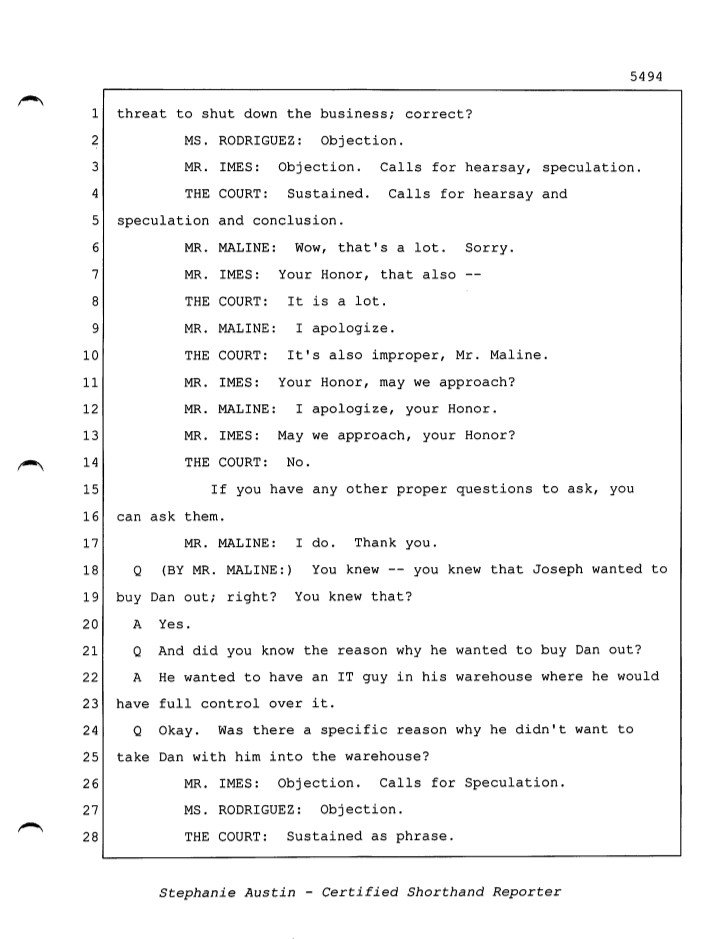
Reporter’s Transcript, March 18, 2019, RT 5492-5494.
So the jury heard Mr. Maline put her 2014 answer to her, from the page she had just reviewed, and the court let the question stand over Mr. Imes’s objection. She never answered that question; Mr. Maline went on to the next one. A minute earlier, she had agreed she told Detective Hanke that Joseph would “still have Chase and the welders and everybody in one spot.” To the next question she said, “Dan first, yes.” Then she agreed that Dan “acted as if he could just flip a switch and shut his whole business down.” When Mr. Maline read her the sentence after that, the court sustained Ms. Rodriguez’s objection that he was “just reading the transcript.”
“Dan first” could be read to mean Chase second. I include it for that reason. But on the page she had just reviewed, her answer was “No. He didn’t say as much about Chase, wanting to get Chase out. He wanted to get more Dan out.” Nothing on that page says Chase second.
The court told Mr. Maline his last question was “also improper.” He then asked her why Joseph wanted Dan out:
MR. MALINE: “Wow, that’s a lot. Sorry.”
MR. IMES: “Your Honor, that also —“
THE COURT: “It is a lot.”
MR. MALINE: “I apologize.”
THE COURT: “It’s also improper, Mr. Maline.”
MR. IMES: “Your Honor, may we approach?”
MR. MALINE: “I apologize, your Honor.”
MR. IMES: “May we approach, your Honor?”
THE COURT: “No. If you have any other proper questions to ask, you can ask them.”
MR. MALINE: “I do. Thank you.”
Q (BY MR. MALINE:) “You knew — you knew that Joseph wanted to buy Dan out; right? You knew that?”
A “Yes.”
Q “And did you know the reason why he wanted to buy Dan out?”
A “He wanted to have an IT guy in his warehouse where he would have full control over it.”
Q “Okay. Was there a specific reason why he didn’t want to take Dan with him into the warehouse?”
MR. IMES: “Objection. Calls for Speculation.”
MS. RODRIGUEZ: “Objection.”
THE COURT: “Sustained as phrase.”
Q (BY MR. MALINE:) “Do you know why Joseph didn’t want to take Dan with him and wanted to buy him out instead?”
A “I don’t know why.”
Q “Okay. Did you tell Detective Hanke that it was because Dan had threatened to shut the business down?”
MS. RODRIGUEZ: “Objection. Improper. Violates in limine.”
THE COURT: “Sustained.”
(RT 5494:6-5495:8)
See the trial transcript (RT 5494-5495)
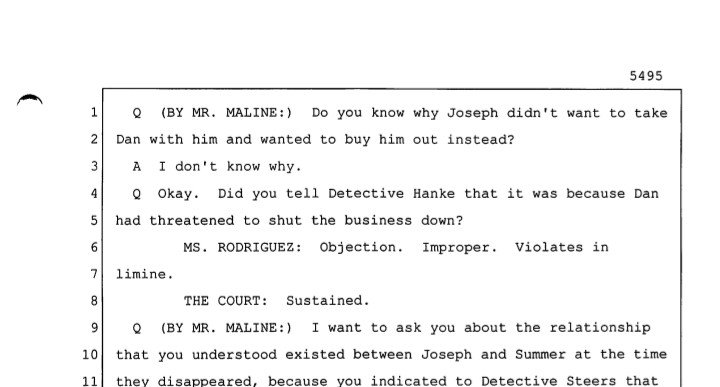
Reporter’s Transcript, March 18, 2019, RT 5494-5495.
Before trial, the court had kept out Dan’s instant-message threat to destroy Joseph’s business. Asked why Joseph wanted to buy Dan out instead of taking him along, she said, “I don’t know why.” When Mr. Maline asked whether she had told Detective Hanke it was because Dan had threatened to shut the business down, the prosecutor, Ms. Rodriguez, objected that the question “violates in limine,” and the court sustained it. The jury heard about the buyout, and one “Correct” about Dan’s flip-a-switch attitude. It never heard about the threat itself.
↑ Back to the menuPage 158: “The first couple of lines”
On March 18, after Mr. Maline’s questions, the prosecutor, Ms. Rodriguez, cross-examined Ms. Blake. Earlier in that cross, on a different document (a report about whether the tables at the house had been cleaned), she asked Ms. Blake to keep reading past the highlighting:
Q “Showing that same exhibit, page 28857, defense counsel asked you, specifically, if you noticed any blood or anything on the tables, if you could read the next line that’s not highlighted. Right up here, ma’am.”
(RT 5525:26-5526:1)
See the trial transcript (RT 5525-5526)
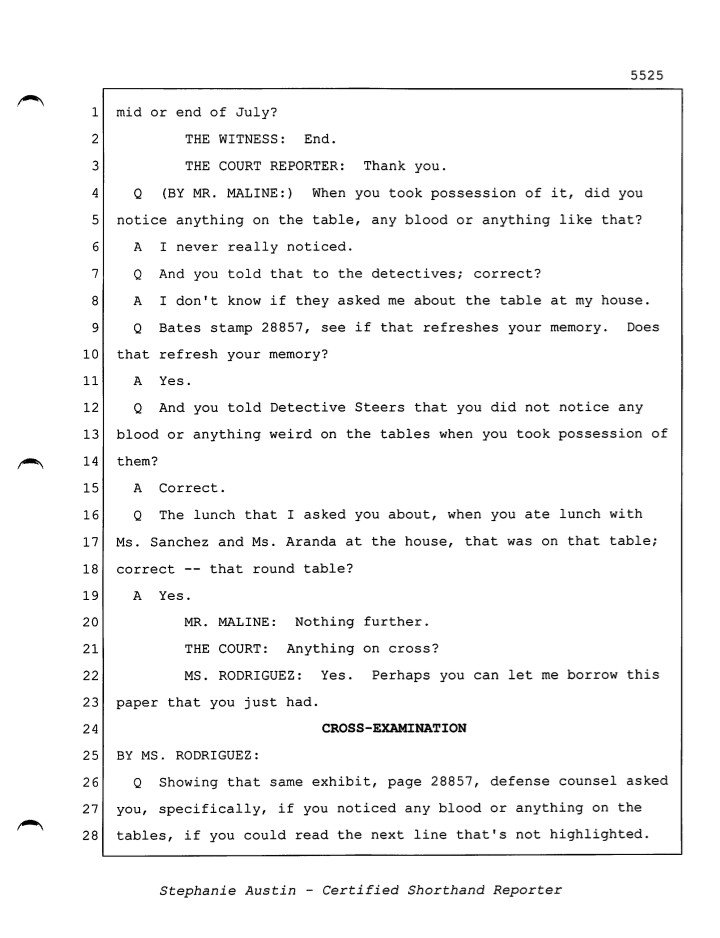
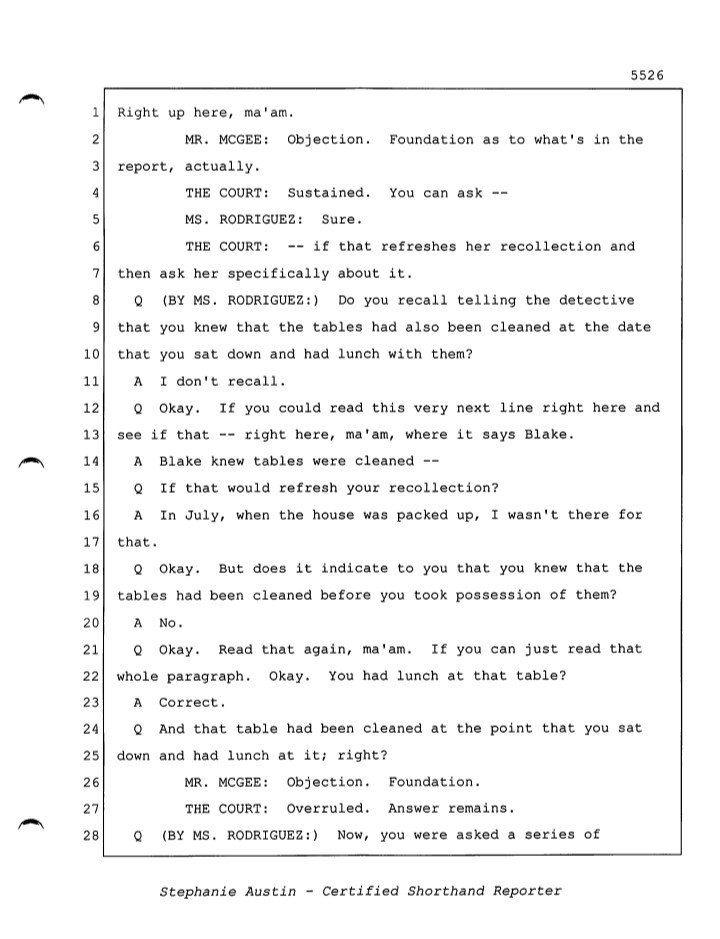
Reporter’s Transcript, March 18, 2019, RT 5525-5526.
A few questions later, Ms. Rodriguez told her:
Q “Okay. Read that again, ma’am. If you can just read that whole paragraph. Okay. You had lunch at that table?”
A “Correct.”
(RT 5526:21-23)
See the trial transcript (RT 5526)
Reporter’s Transcript, March 18, 2019, RT 5526.
After the afternoon recess, Ms. Rodriguez came back to the subject Mr. Maline had just covered. On page 158, her instruction went the other way. (RT 5534:18-5535:5)
Q “Now, Ms. Blake, you were asked a series of questions about — that specifically related to whether or not your son, Joey, had wanted to get rid of Chase as a welder, do you recall that?”
A “Yes.”
Q “In fact, you were given a particular section to review where you indicated that he was also attempting to get rid of Dan Kavanaugh, do you recall that?”
A “Correct.”
Q “And do you recall being asked that Joey was going to buy Dan and Chase out?”
A “Just Dan.”
Q “Well, let me ask you to review page 158 of that transcript.”
THE COURT: “This is of an interview?”
MS. RODRIGUEZ: “This is of an interview with Detective Steers.”
Q (BY MS. RODRIGUEZ:) “If you could just review the first couple of lines there. That’s it. Do you recall talking to that — with — talking about that with Detective Steers?”
A “Yes.”
Q “And did you tell Detective Steers that Joey was going to buy Dan and Chase out?”
A “Yes.”
(RT 5535:6-28)
See the trial transcript (RT 5534-5535)
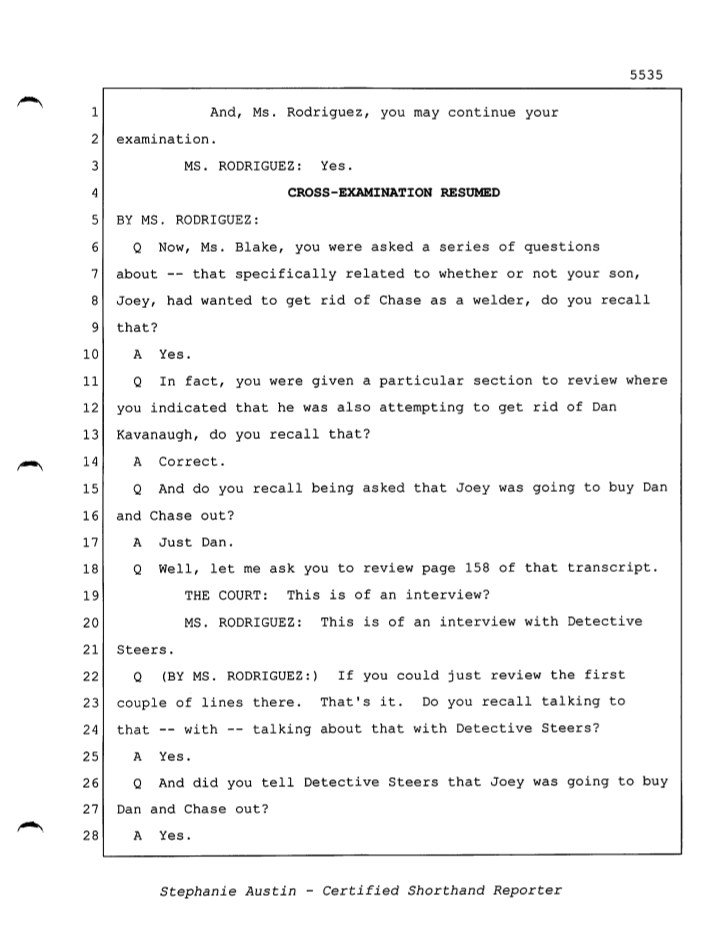
Reporter’s Transcript, March 18, 2019, RT 5534-5535.
First, Ms. Blake answered the prosecutor’s question: “Just Dan.” She did not say Joseph intended to buy both of us out. She said Dan.
Ms. Rodriguez then directed her to page 158 of the recorded interview, but not to the whole exchange. Her instruction was explicit: “If you could just review the first couple of lines there. That’s it.”
Those first lines are Detective Hanke’s words, “Joey was going to buy Dan and Chase out,” followed by Ms. Blake’s “Uh-huh.” Right after them, on the same page, Detective Hanke asked whether Joseph had ever said he wanted a new builder or welder. Ms. Blake answered: “No. He didn’t say as much about Chase, wanting to get Chase out. He wanted to get more Dan out.” (Interview, p. 158:1-8)
Ms. Rodriguez did not direct her to that answer.
And it was not something the prosecutor had overlooked. Earlier that afternoon, Mr. Maline had given Ms. Blake that very page, with the lines spelled out: “page 158 lines 6 through 15.” Ms. Rodriguez asked him where he was, and he told her: “Page 158.” She then heard him put Ms. Blake’s answer to her in front of the jury. When she resumed her cross-examination after the recess, she said so herself: Ms. Blake had been “given a particular section to review.” (RT 5492:23-5493:16, 5535:11-13)
Earlier in this same cross-examination, when Ms. Rodriguez wanted Ms. Blake to read more of a different document, she told her to read past the highlighting: “if you could read the next line that’s not highlighted,” and then, “If you can just read that whole paragraph.” She knew the importance of reading what came next. On page 158, where the next lines contradicted what she was trying to establish, her instruction was the opposite: “the first couple of lines there. That’s it.” (RT 5525:26-28, 5526:21-22, 5535:22-23)
After reading those lines, Ms. Blake changed her answer from “Just Dan” to “Yes.”
Ms. Rodriguez did not ask why. She did not ask about the answer that came right after those lines. She did not ask Ms. Blake to reconcile the detective’s summary with the answer that followed it on the same page. She got the answer she wanted and moved on.
From where I sat, I watched Ms. Rodriguez grab the transcript from Ms. Blake’s hands before she could read further. That is what I personally saw. The reporter’s transcript records the spoken limit, “That’s it,” but not the physical act.
The point is not that Ms. Blake never agreed with the detective’s summary. She did. The point is that she qualified it right away, on the same page, and the prosecutor knew it. The jury was shown the agreement without the qualification. A witness who had just said “Just Dan” was led through a chosen part of her own interview until she said “Yes.”
One more detail, so the record is exact: the page 158 questions were Detective Hanke’s, not Detective Steers’s, as Ms. Rodriguez told the court. Both detectives were in the room.
Ms. Rodriguez went on to other subjects, the February 16 visit and Ms. Blake’s checks, and ended her cross-examination two pages later. Mr. Maline questioned her again on redirect and further redirect. He asked about checks, deposits and money. He never returned to page 158, to “Just Dan,” or to welders, and neither of my lawyers objected to what had been left out. Her last answer on whether Joseph meant to buy us both out was “Yes.” Neither of my lawyers went back to what followed it on page 158. (RT 5536:1-5537:23, 5537:24-5546)
The prosecutor did not have to change a single word of the recorded interview to change what the jury understood it to mean. She only had to decide where the witness would stop reading.
↑ Back to the menuEverything she said, in order
Here is everything she said on this subject, in order. It is not one statement taken back once. It went back and forth.
| Where | What she said |
|---|---|
| Interview, Aug. 13, 2014, p. 78 | Joseph wanted to “get rid of Dan,” and “him and Chase have it.” |
| Interview, p. 79 | His goal was one roof, under his control. “That’s Dan — I mean, that’s not Dan. That’s Chase.” |
| Interview, p. 95 | Detective Steers: “paying them both out.” She: “Uh-huh.” |
| Interview, p. 157 | “Dan the man was going to be gone, and then he’d still have Chase and the welders.” |
| Interview, p. 158 | Detective Hanke: “buy Dan and Chase out.” She: “Uh-huh.” Asked directly: “No. … He wanted to get more Dan out.” |
| Trial, Jan. 8, 2019, RT 1849 | “He wanted to phase out Chase also.” Two answers later: “Not phase him out.” |
| Trial, Jan. 8, 2019, RT 1850 | Yes, she said he would “still have Chase.” |
| Trial, Mar. 18, 2019, RT 5489-5490 | “Weed Chase out.” “No, he wanted to get rid of him.” |
| Trial, Mar. 18, 2019, RT 5491-5492 | First “No,” then “Yes,” then “That’s what he talked about.” |
| Trial, Mar. 18, 2019, RT 5493-5495 | “Dan first, yes.” Then “Correct”: Dan acted as if he could shut the business down. Then, asked why Joseph wanted Dan out: “I don’t know why.” |
| Trial, Mar. 18, 2019, RT 5535 | “Just Dan.” Then, shown the first lines of p. 158: “Yes.” |
Her last answer, “Yes,” was not the end of a clear account. It came after “Just Dan,” and it came from a page whose next lines said the opposite.
↑ Back to the menuWhat the court relied on
On January 24, 2019, the court ruled that Ms. Fonseca’s testimony could come in, and said it would support Ms. Blake’s testimony. The court had first understood her account to be about 2009. It was about 2007:
THE COURT: “Yes. So I did review that, and as I indicated the first time we had discussed that, and I ruled that I felt that it was admissible because it dealt directly with the dealings between the defendant and Mr. McStay and Earth Inspired Products. I was under the impression that that occurred in the 2009-time period. And the last discussion, when it was brought up, it was mentioned that that actually occurred in 2007. And my first reaction is, it may be less probative if it occurred in 2007 as opposed to 2009.
Then when I considered it in light of other evidence and other acts involving the defendant and issues between the defendant and Mr. McStay and Earth Inspired Products, I don’t think the time frame is as critical. In fact, it may be more probative to show an ongoing course of conduct, as opposed to a single incident. We have the evidence with Mr. Sequeida to some issues between the defendant and Earth Inspired Products and Mr. McStay and dealing with checks. We have Ms. Fonseca dealing with similar financial issues between them.
We had — we already had testimony about Ms. Blake providing funds to finish a fountain that may not have been finished, and then we have some evidence dealing with Geis Construction and issues involving transactions involving Mr. Merritt and Mr. Kavanaugh. So I think that Ms. Fonseca’s testimony demonstrates — if accepted by the jury to be true, demonstrates, or could demonstrate, an ongoing course of conduct between the defendant and Mr. McStay and Earth Inspired Products, and that would support Ms. Blake’s testimony that Mr. McStay had indicated his intent, at some point, to discontinue the association with both Mr. Merritt and Mr. Kavanaugh — Mr. Merritt because of financial issues.”
(RT 3049:22-3050:23)
See the trial transcript (RT 3049-3050)
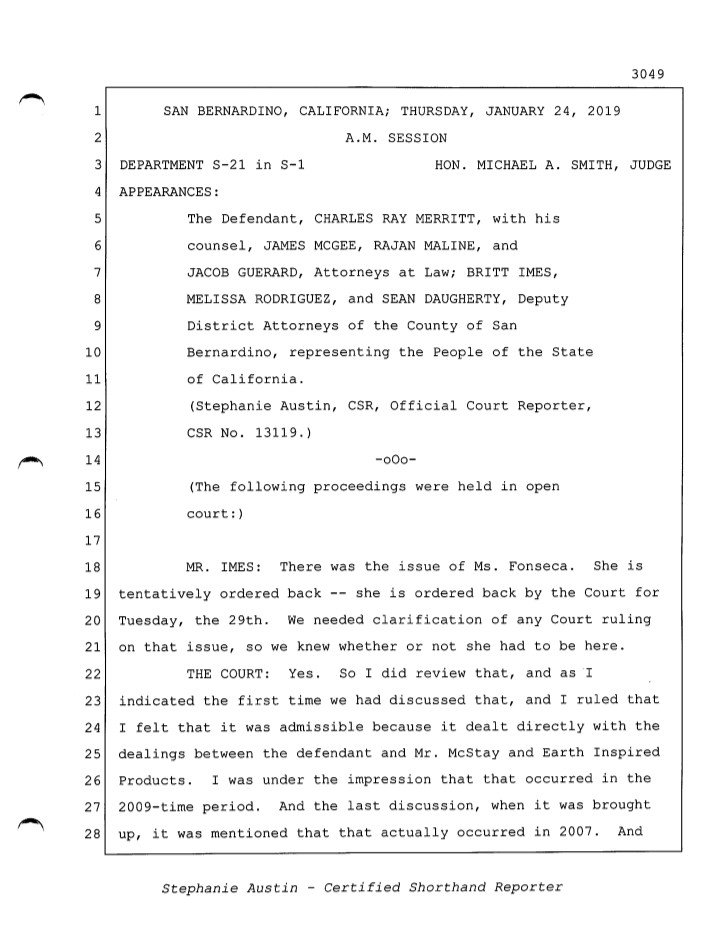
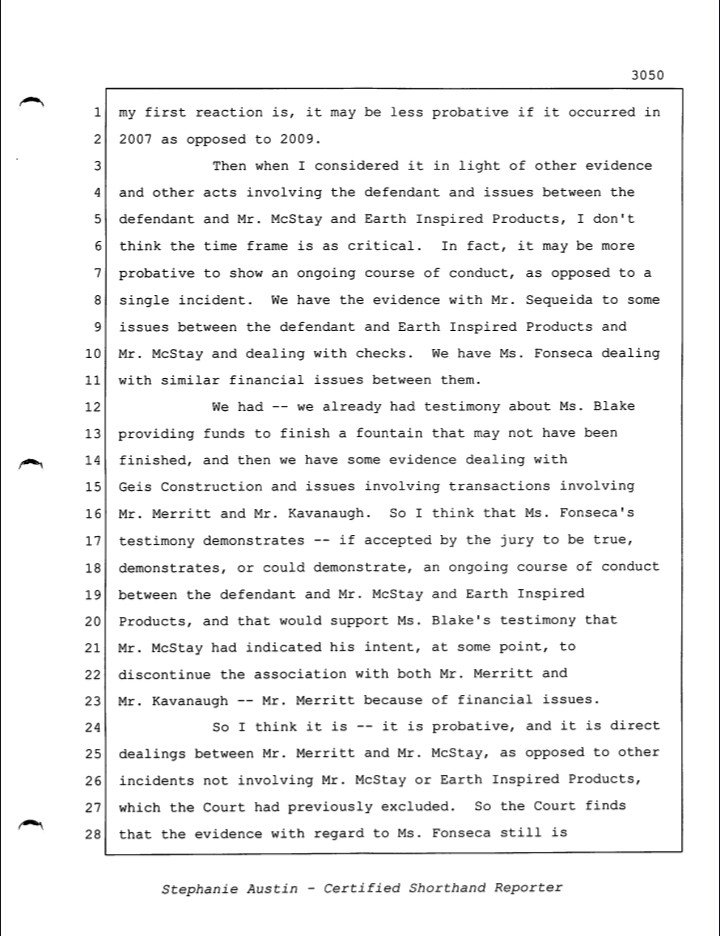
Reporter’s Transcript, January 24, 2019, RT 3049-3050.
That was a ruling on whether evidence could come in, not a finding that the motive was proven. But it described Ms. Blake’s testimony one way only. By then she had already said, “Not phase him out.”
On March 4, 2019, the court ruled on the motion to dismiss under Penal Code section 1118.1.
The court described how it had gone about that ruling:
THE COURT: “Okay. So as pointed out by both sides, this is strictly a circumstantial evidence case, and so I did spend a fair amount of time going through the testimony and the exhibits to thoroughly examine the evidence that was presented.”
(RT 4993:10-13)
See the trial transcript (RT 4993)
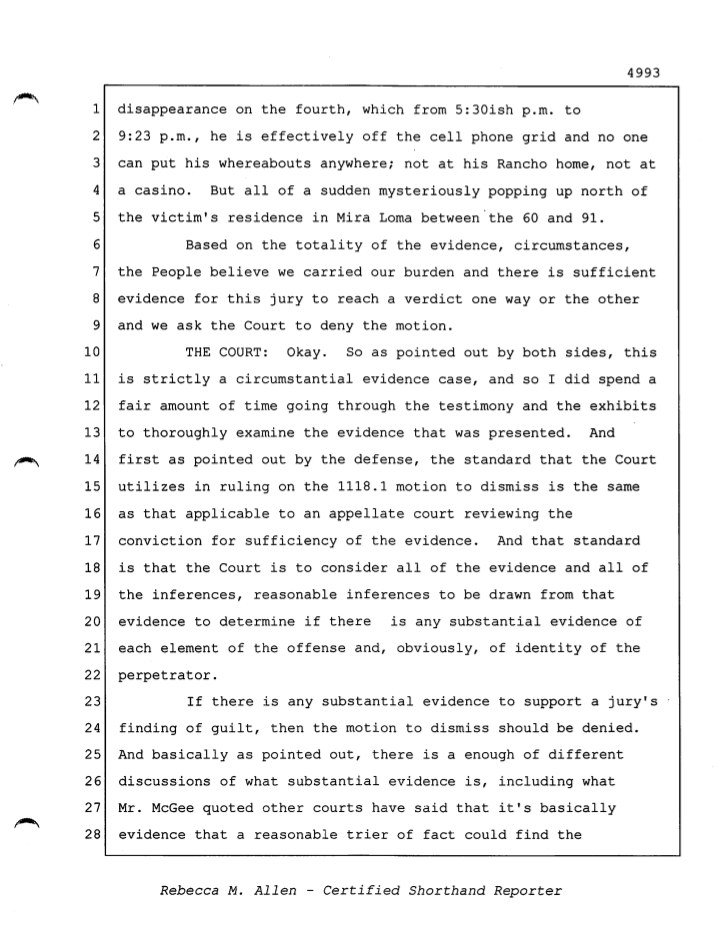
Reporter’s Transcript, March 4, 2019, RT 4993.
Then it started with Ms. Blake:
“So we start off, really, with the testimony of Susan Blake, the very first witness in the trial. And it turns out at least from my perspective, when combined with much of the other evidence, her testimony is critical evidence. She lays out the basic foundations that Joseph was in a business, Earth Inspired Products to create, manufacture, fountains and waterfalls and that Mr. Merritt was involved in that business with him as was Mr. Kavanaugh. So she lays out that foundation.
She then indicates that Mr. McStay, Joseph McStay, had indicated to her that it was his intent or desire to phase, actually, both Mr. Merritt and Mr. Kavanaugh out of the business and, otherwise, indicated that indeed there was already a plan in place to buy out Mr. Kavanaugh that was almost complete, but that he also intended to phase Mr. Merritt out of the business and get a warehouse where he could have more welders to fabricate more waterfalls.
And she indicated — Ms. Blake indicated that Mr. McStay indicated to her the reasons why Joseph McStay wanted to phase Mr. Merritt out of the business. They were that Mr. Merritt had money problems; that Mr. McStay had loaned money to Mr. Merritt, but had not been paid back. That part of Mr. Merritt’s money problems were as a result of gambling. And we saw from the accountant’s examination of Mr. Merritt’s bank records, that that depiction that Joseph McStay gave to Susan Blake, his mother, appears to be accurate. Mr. Merritt did have money problems. His bank account was often overdrawn or down to a zero balance. Indeed, the accounts ultimately were closed because they were so far overdrawn.
Analysis of the accounts also indicates a significant portion of Mr. Merritt’s income or money in his accounts was utilized for gambling or playing poker — depending on whether or not you consider poker a game of chance or a game of skill — but, at any rate, at casinos. So that’s substantiating the information that Ms. Blake related.”
(RT 4994:8-4995:13)
See the trial transcript (RT 4994-4995)
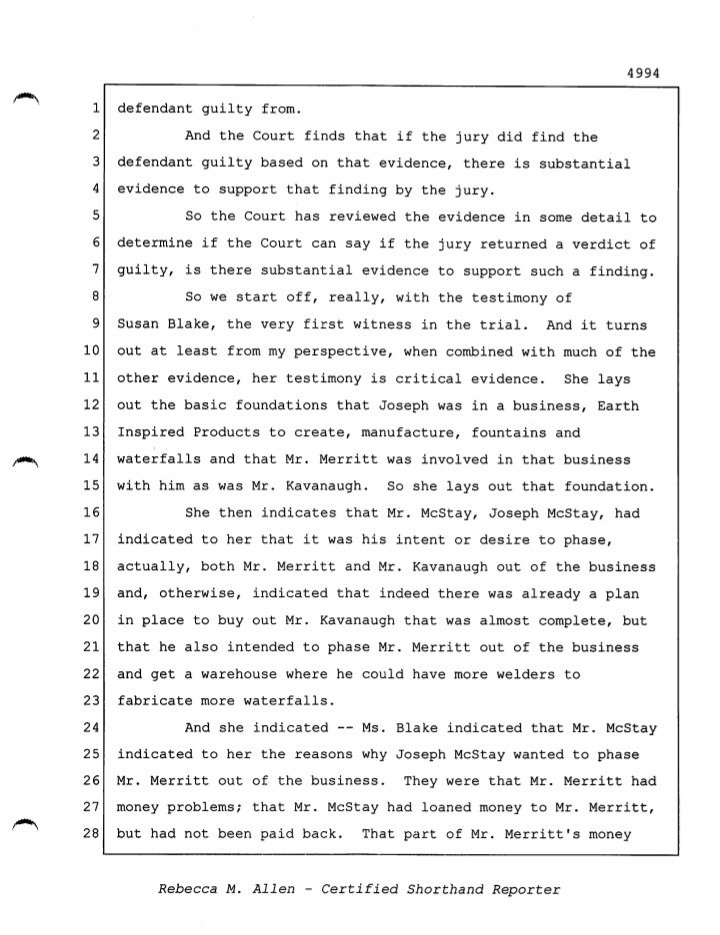

Reporter’s Transcript, March 4, 2019, RT 4994-4995.
The court came back to Ms. Blake twice more. Each time, the court named what it said backed her up: first Ms. Fonseca’s account of 2007, then Metro Sheet Metal in late 2009 and early 2010:
“We also learned additional financial issues not only of Mr. Merritt, but between Mr. Merritt and Mr. McStay, that were reported to Joseph McStay. We learned from Ella Fonseca who was a bookkeeper from Mr. Merritt’s company, I Design or I Design For You that in 2007, Mr. Merritt was working with Joseph McStay, doing fountains for him. And Mr. McStay would pay for water pumps to be used for the fountains, but that Ms. Fonseca indicated Mr. Merritt actually used those funds to purchase pumps for projects of his own, rather than on Mr. McStay’s projects. And she indicated that she informed Mr. McStay of this. And that Mr. Merritt would report that certain fountains commissioned by McStay were completed and asked for payment when, in fact, they were not completed. And, again, Ms. Fonseca indicated she reported all of this information to Joseph McStay.
And that Mr. McStay — either the defendant told Ms. Fonseca or Mr. McStay that he needed the money for rent and to pay expenses of his business to keep his business open and Mr. McStay continued to pay in order to help Mr. Merritt out.
Again, substantiating the information provided by Susan Blake. We learn of additional financial issues, again, between Mr. Merritt and Mr. McStay, close to the time of the disappearance of the McStay family through Joe Sequeida from Metro Sheet Metal. At that point in time, late 2009, early 2010, Mr. Merritt was still producing or working with Mr. McStay to produce or fabricate fountains. Mr. Merritt was doing that at that Metro Sheet Metal. Metro Sheet Metal was fabricating the fountains. Mr. Merritt did his portion. Metro Sheet Metal did their portion. When the fountains were completed, Mr. McStay would pay Metro Sheet Metal for the project. And there was an issue where Mr. McStay gave a check – and the way Mr. McStay would deliver those checks is he would give Mr. Merritt the check to deliver to Metro Sheet Metal. And early 2010, Mr. McStay gave Mr. Merritt a check to give to Metro Sheet Metal, but the check was never given to Metro Sheet Metal.
And Mr. Sequeida, either he or his father, him being present, told Mr. McStay that they did not receive the check and there was a discussion it was given to Mr. Merritt. He was supposed to deliver it. And ultimately, Mr. Merritt indicated, yes, he got the check and he used the check for supplies.
There were no receipts for the supplies. There’s no verification of any specific supplies. Bottom line, Metro Sheet Metal did not get paid the sums that they should have been paid by the check that was given to Mr. Merritt.
So, again, not only does it show financial issues with Mr. Merritt but, more importantly, it shows that, again, close in time to the time that the McStay family disappeared, this was actually communicated to Joseph McStay.
There were — Metro Sheet Metal also advised Joseph McStay that there were increasingly times where Mr. Merritt was not present at Metro Sheet Metal to complete the work that was necessary. And they told Joseph McStay that they could not continue with Mr. Merritt at Metro Sheet Metal because he was unreliable and he was gone a lot and that it would be up to Mr. McStay to deal with Mr. Merritt.
And, again, that corroborates and supports the information that Susan Blake provided as to Joseph McStay’s feelings and intent with regard to Mr. Merritt.”
(RT 4996:5-4998:6)
See the trial transcript (RT 4996-4998)
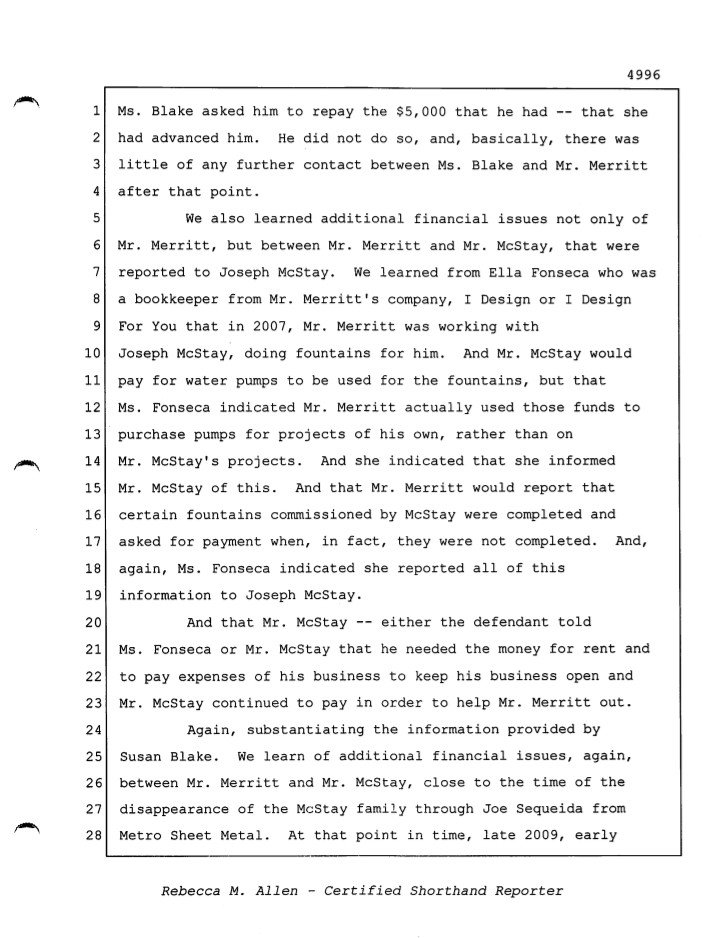
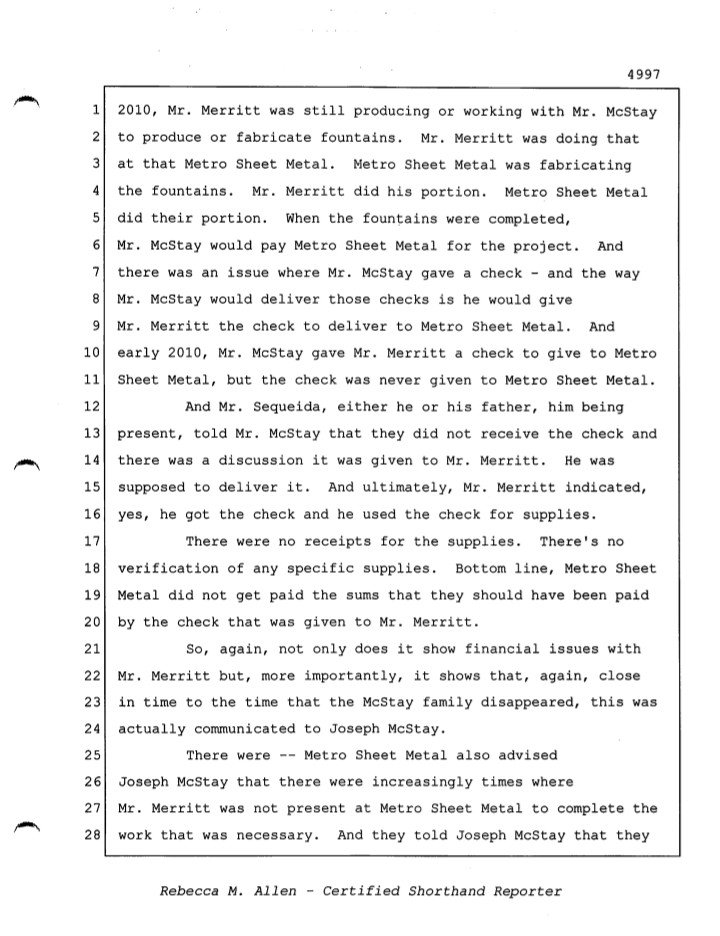
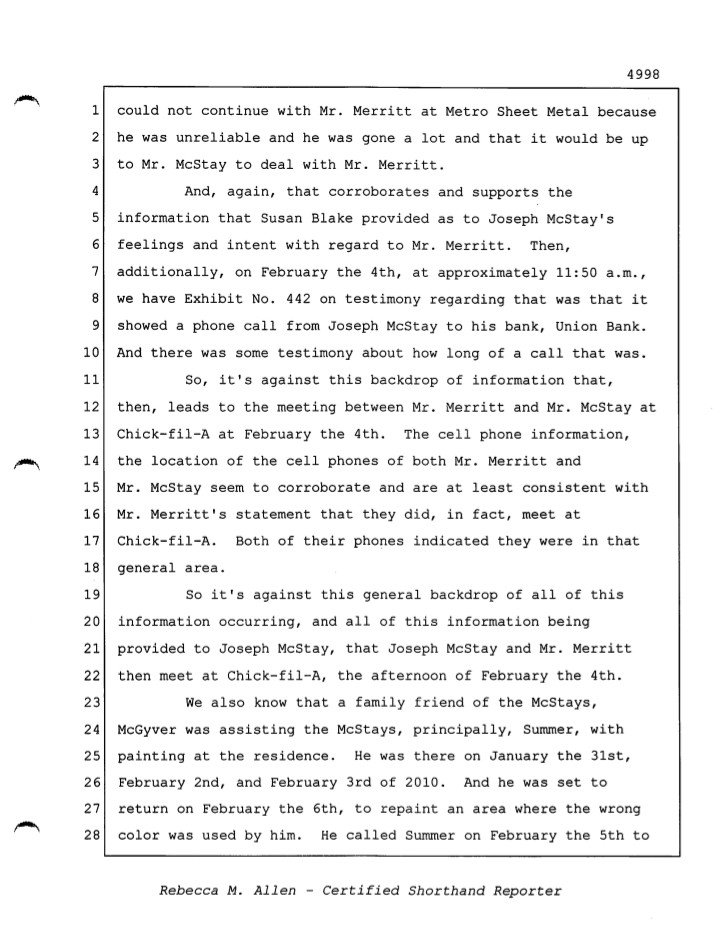
Reporter’s Transcript, March 4, 2019, RT 4996-4998.
The court’s account of Ms. Fonseca’s testimony has three parts: that in 2007 I used Joseph’s money for water pumps on my own projects, that I reported fountains as finished and asked for payment before they were, and that I said I needed the money for rent and to keep my business open. There is a glaring difference between what Ms. Fonseca testified to and the facts. I paid for every pump I used. I had no pumps I hadn’t already paid for.
What Metro told Joseph was about Metro and me: whether I would keep working in their shop. It was not about Joseph’s work with me, and it says nothing about what Joseph intended. Even in the court’s words, Metro left it “up to Mr. McStay.” How does that support the claim that he was about to fire me?
On the money itself, see what the rest of the record shows: the court struck Ms. Blake’s answer to the State’s gambling-debt question in March, Cathy testified that when Joe advanced me money, “he always paid it back,” and on February 1, 2010, Joseph owed me about $11,000. Overdrawn bank accounts are not evidence of what Joseph planned.
The court also relied on Ms. Blake for “the pattern of Mr. Merritt having money problems and needing additional money and not paying back what he said he would pay back” after the family disappeared (RT 4995:14-4996:4). Where the Money Went answers it.
Nowhere in the ruling does the court mention “Not phase him out” or “still have Chase.” (RT 4993:10-5007:6)
The court then explained the standard it was applying:
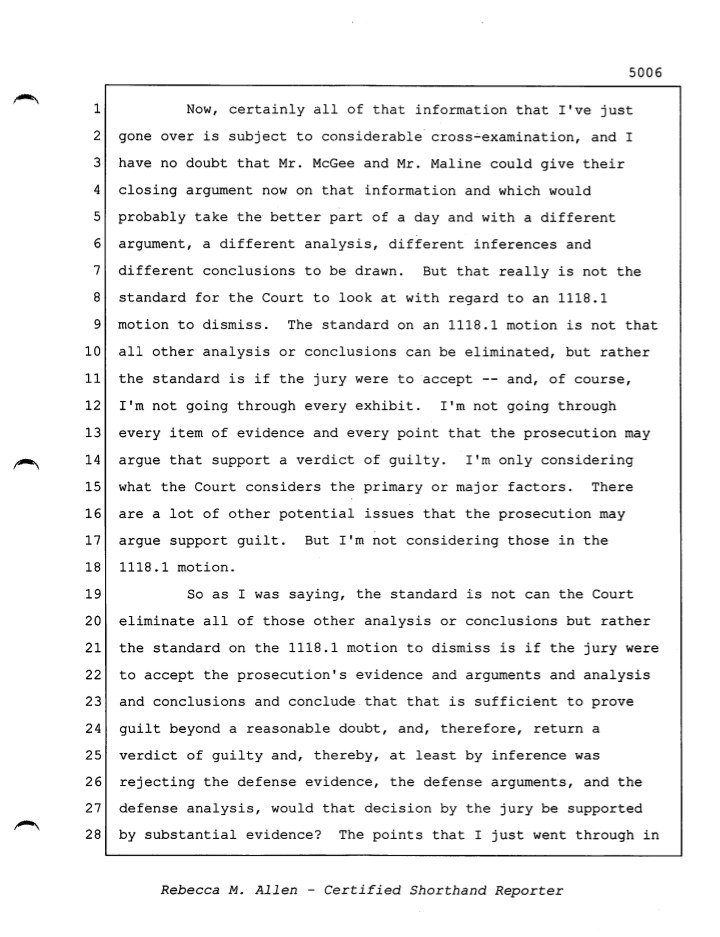
“Now, certainly all of that information that I’ve just gone over is subject to considerable cross-examination, and I have no doubt that Mr. McGee and Mr. Maline could give their closing argument now on that information and which would probably take the better part of a day and with a different argument, a different analysis, different inferences and different conclusions to be drawn. But that really is not the standard for the Court to look at with regard to an 1118.1 motion to dismiss. The standard on an 1118.1 motion is not that all other analysis or conclusions can be eliminated, but rather the standard is if the jury were to accept — and, of course, I’m not going through every exhibit. I’m not going through every item of evidence and every point that the prosecution may argue that support a verdict of guilty. I’m only considering what the Court considers the primary or major factors. There are a lot of other potential issues that the prosecution may argue support guilt. But I’m not considering those in the 1118.1 motion.
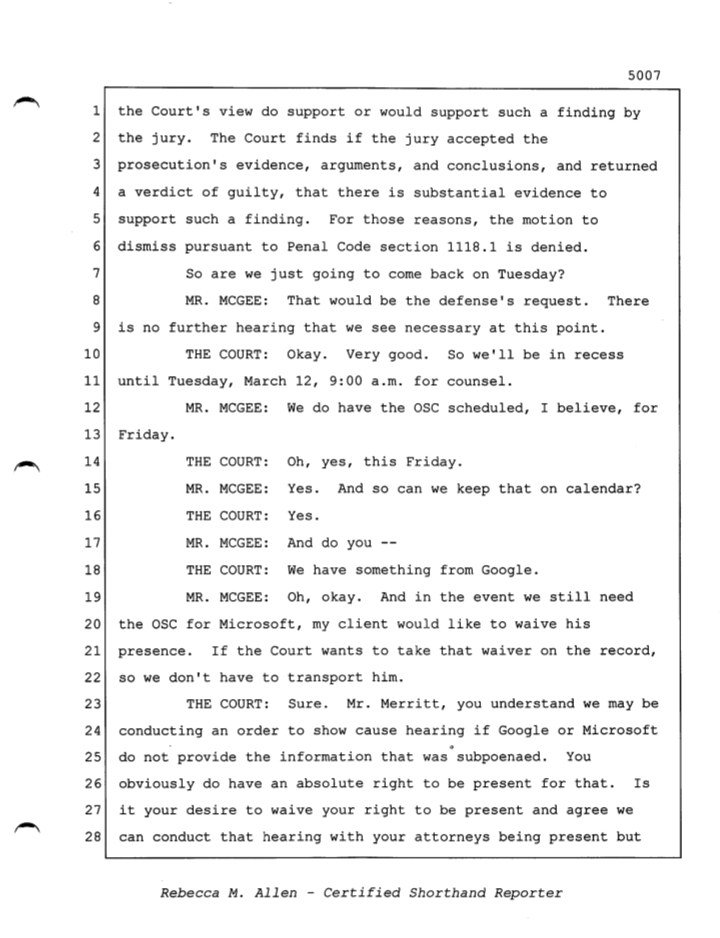
“So as I was saying, the standard is not can the Court eliminate all of those other analysis or conclusions but rather the standard on the 1118.1 motion to dismiss is if the jury were to accept the prosecution’s evidence and arguments and analysis and conclusions and conclude that that is sufficient to prove guilt beyond a reasonable doubt, and, therefore, return a verdict of guilty and, thereby, at least by inference was rejecting the defense evidence, the defense arguments, and the defense analysis, would that decision by the jury be supported by substantial evidence? The points that I just went through in the Court’s view do support or would support such a finding by the jury. The Court finds if the jury accepted the prosecution’s evidence, arguments, and conclusions, and returned a verdict of guilty, that there is substantial evidence to support such a finding. For those reasons, the motion to dismiss pursuant to Penal Code section 1118.1 is denied.”
(RT 5006:1-5007:6)
See the trial transcript (RT 5006-5007)
Reporter’s Transcript, March 4, 2019, RT 5006-5007.
Put the dates side by side. On January 8, 2019, Ms. Blake told the jury “Not phase him out,” and agreed she had told Detective Hanke that Joseph would “still have Chase.” Eight weeks later, on March 4, the court said it had spent “a fair amount of time going through the testimony,” described her testimony as Joseph intending “to phase Mr. Merritt out of the business,” called it “critical evidence,” and three times said other evidence substantiated or corroborated it. Nothing she said the other way appears in the ruling. Her “Just Dan” came two weeks after it, on March 18. (RT 1849:13-1850:28; 4993:10-13, 4994:8-4995:13, 4996:24-25, 4998:4-6)
So the order matters. The court had already called her testimony critical before Ms. Rodriguez led her from “Just Dan” to “Yes” on March 18. That “Yes” did not produce the ruling. It backed up a view the court already held. And in January 2020, ruling on the new-trial motion, the court went further still: “So we know” (RT 8942:23).
The 1118.1 standard matters, and I do not claim the court had to believe her “Not phase him out” over her other answers. My point is narrower. The court described what she said as if she had said one thing, and called it critical. She had said both.
↑ Back to the menuThe friend and the brother
McGyver McCargar
McGyver McCargar, a longtime friend of Joseph’s, testified for the prosecution on January 14, 2019. He was at the house painting on January 31 and February 2, 2010, when Joseph and I were there talking. He did describe tension:
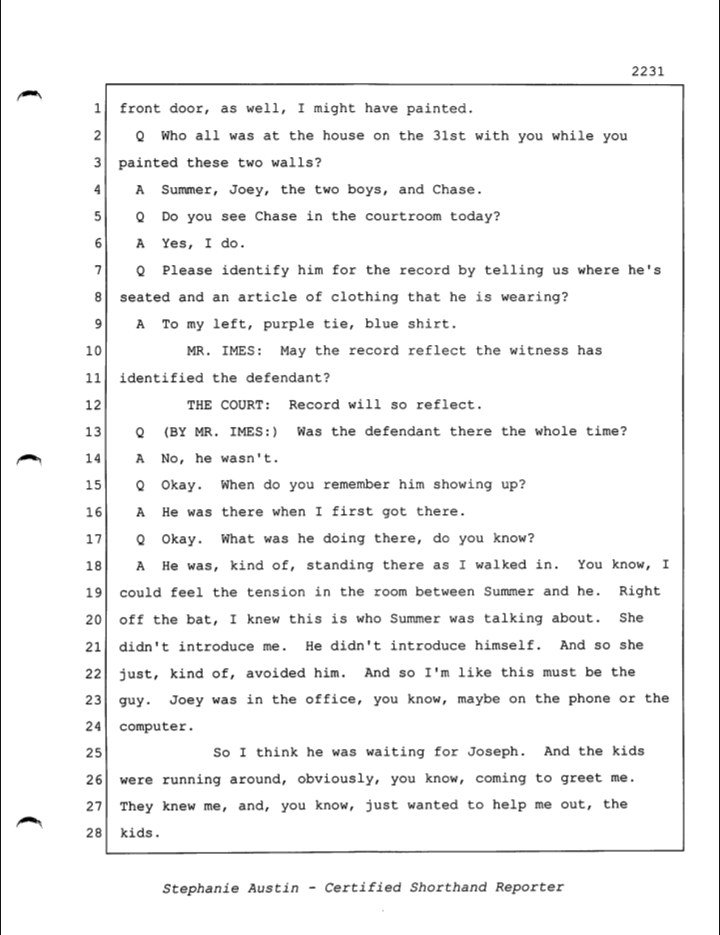
Q “Okay. What was he doing there, do you know?”
A “He was, kind of, standing there as I walked in. You know, I could feel the tension in the room between Summer and he. Right off the bat, I knew this is who Summer was talking about. She didn’t introduce me. He didn’t introduce himself. And so she just, kind of, avoided him. And so I’m like this must be the guy. Joey was in the office, you know, maybe on the phone or the computer.”
(RT 2231:17-24)
See the trial transcript (RT 2231)
Reporter’s Transcript, January 14, 2019, RT 2231.
Who Summer “was talking about” goes back to his direct. He said that in January 2010, “Summer called me and mentioned another partner that Joey had been working with” (RT 2222:23-25). Asked whether she “expressed some concerns about Chase,” he said, “She did,” and he agreed his answer to her was to “simply let Joe deal with those things” (RT 2223:6-11). What she called about, he said, was “to complain about this guy that was over at the house, trying to tell her how to raise her kids” (RT 2226:2-6). He agreed she was also frantic with remodeling the house, which came out “after I questioned her about what else was happening” (RT 2226:7-10). None of that was about Joseph’s business, or about Joseph wanting me out.
He said that on February 3, with me not there, Joseph talked with him about the business. The State could point to this, so it is here:
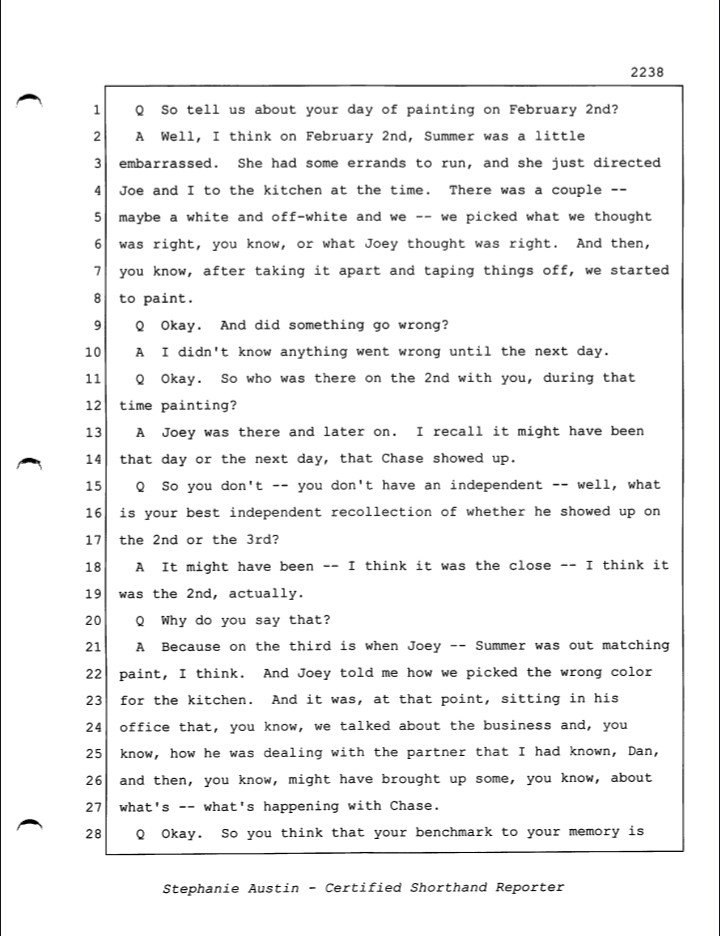
Q “Why do you say that?”
A “Because on the third is when Joey — Summer was out matching paint, I think. And Joey told me how we picked the wrong color for the kitchen. And it was, at that point, sitting in his office that, you know, we talked about the business and, you know, how he was dealing with the partner that I had known, Dan, and then, you know, might have brought up some, you know, about what’s — what’s happening with Chase.”
Q “Okay. So you think that your benchmark to your memory is the wrong paint, having — picking the wrong paint, sitting in the office talking, as being on the 3rd and the defendant not being there?”
A “Correct.”
(RT 2238:20-2239:4)
See the trial transcript (RT 2238-2239)
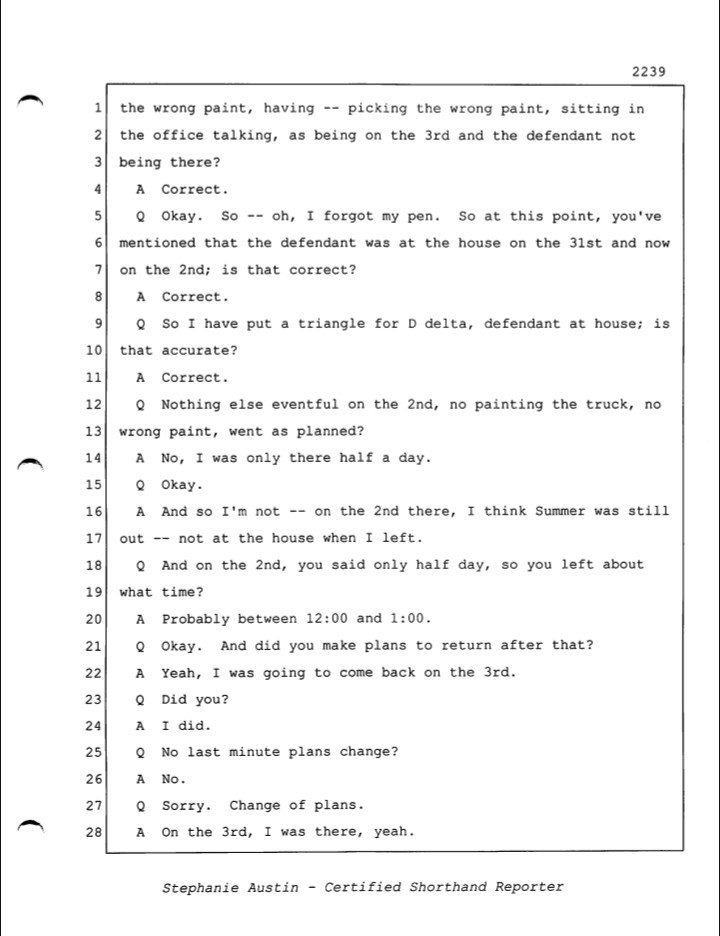
Reporter’s Transcript, January 14, 2019, RT 2238-2239.
He did not say what was said about me. And he called Dan “the partner.”
The one buyout he described was Dan’s, and it was already done:
Q “Okay. So when you spoke with Joseph and you are talking about working with Dan, Joseph expressed to you that — his plans to buy Dan out?”
A “Yeah. He — not planned, he — he had already done — he’d done that finally.”
Q “And as part of the buyout was cash and a vehicle?”
A “Correct.”
(RT 2265:12-18)
See the trial transcript (RT 2265)
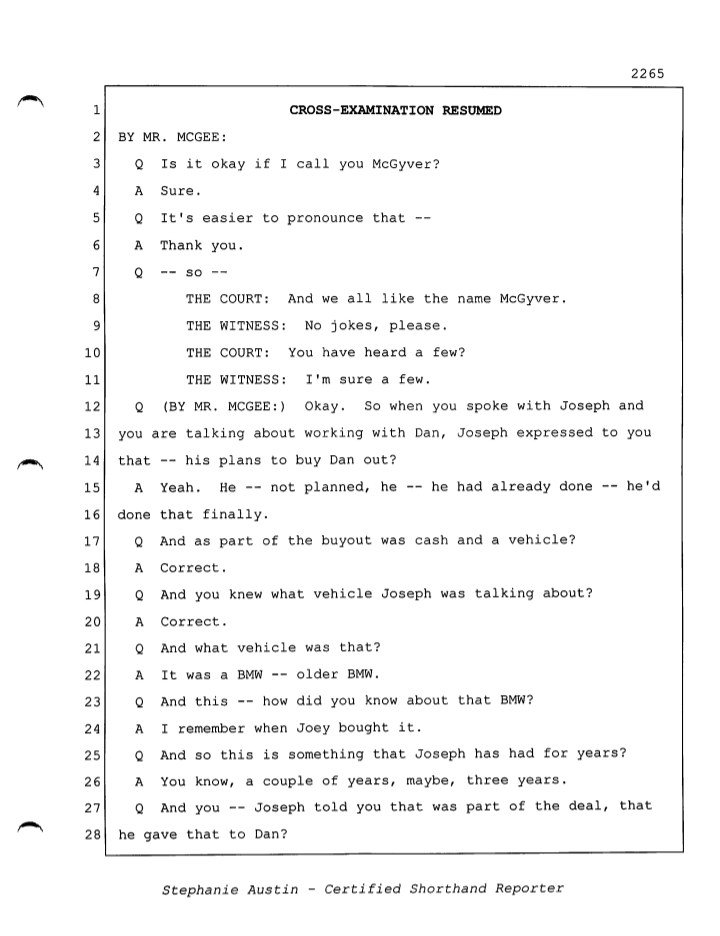
Reporter’s Transcript, January 14, 2019, RT 2265.
On cross-examination, he was asked about the conversations he saw between Joseph and me:
Q “Now, while you were at the house on the 31st and the 2nd, you mentioned on direct that you saw my client at the house talking with Joseph?”
A “Correct.”
Q “And they were having conversations — and I know detectives asked you if you could hear what they were talking about and you could; correct — in passing?”
A “Well, you know, he was standing there, basically, that first day, and then I was too busy painting and, you know, trying to keep the kids under control.”
Q “And do you remember telling the detectives they were talking about LED lights?”
A “Correct.”
Q “And they were talking about how these are the next best thing for waterfalls?”
A “Correct.”
Q “And they were actually in the front room with LED lights, kind of, lighting them up to show how they work?”
A “Correct.”
Q “So they were talking about how this is something we have to implement into all of our waterfalls in the future?”
A “Correct.”
Q “And the detectives try to direct you to, well, were they arguing about money? Do you remember that part of the conversation?”
A “No.”
Q “No, I mean, with the detective?”
A “No — restate that question.”
Q “Do you remember the detective tried to turn that conversation to say, Well, were they talking about money? Like, Chase asking for money?”
MR. IMES: “Objection. Assumes facts not in evidence.”
THE COURT: “Sustained. And argumentative as phrased.”
Q (BY MR. MCGEE:) “Do you remember telling detectives that Chase was not asking for money?”
A “I don’t recall that.”
Q “Do you recall Chase asking about money?”
A “I don’t recall that.”
Q “It was — the sole conversation was talking about the lights and the waterfall and the projects coming up?”
A “Correct.”
(RT 2266:2-2267:14)
See the trial transcript (RT 2266-2267)
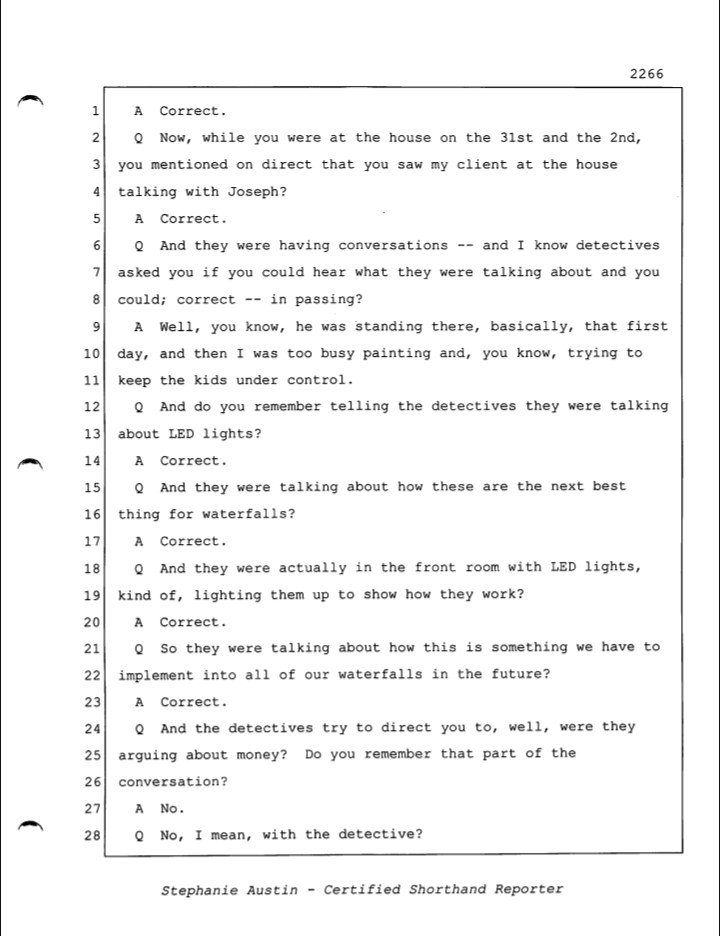
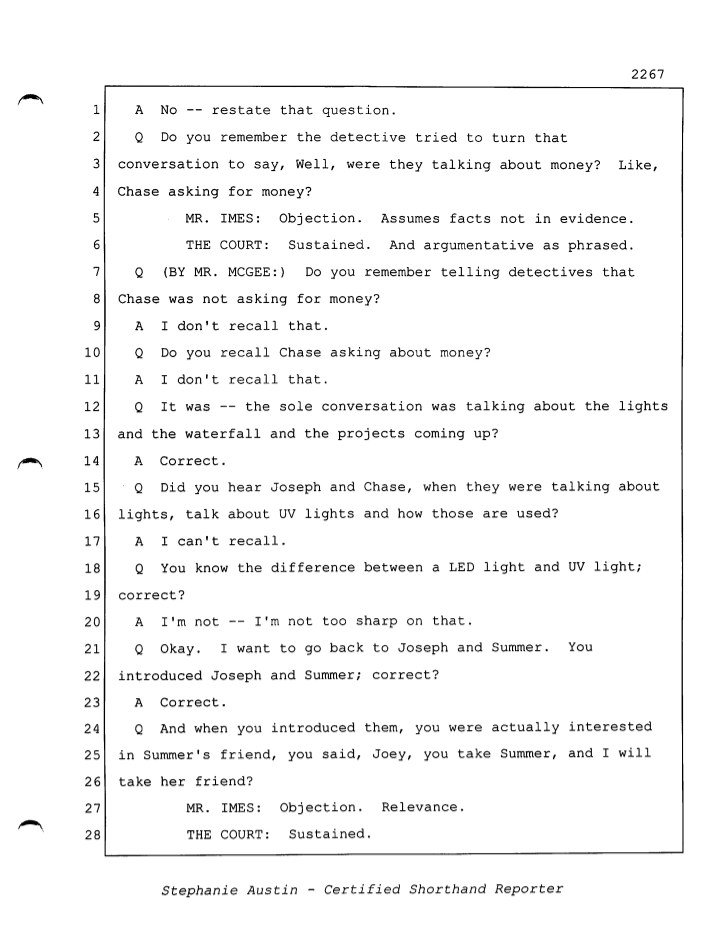
Reporter’s Transcript, January 14, 2019, RT 2266-2267.
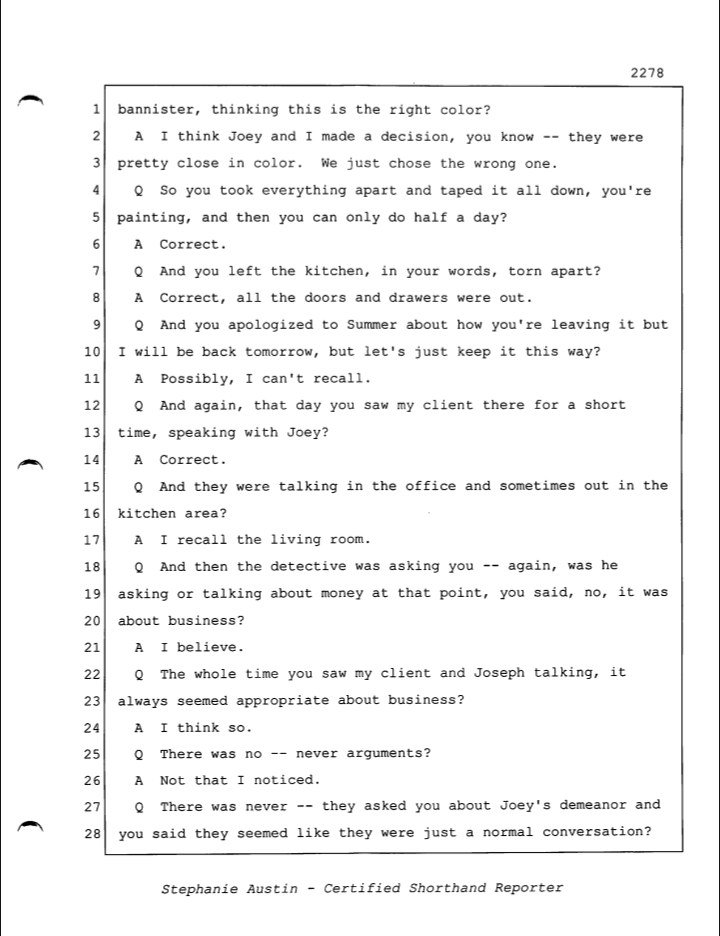
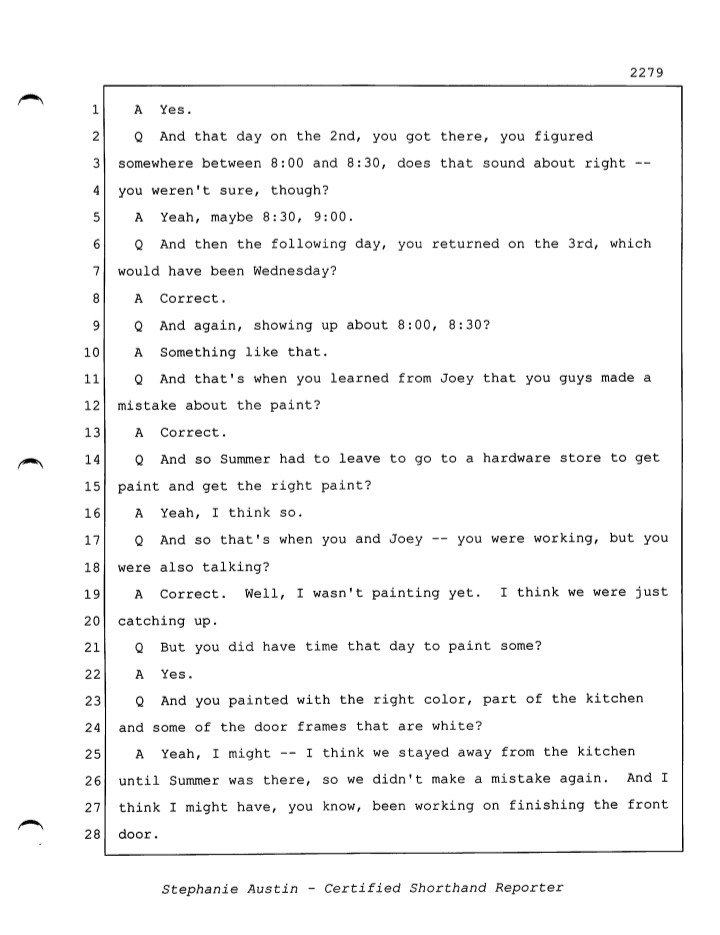
Later in the same cross-examination, McGyver was asked:
Q “And again, that day you saw my client there for a short time, speaking with Joey?”
A “Correct.”
Q “And they were talking in the office and sometimes out in the kitchen area?”
A “I recall the living room.”
Q “And then the detective was asking you — again, was he asking or talking about money at that point, you said, no, it was about business?”
A “I believe.”
Q “The whole time you saw my client and Joseph talking, it always seemed appropriate about business?”
A “I think so.”
Q “There was no — never arguments?”
A “Not that I noticed.”
Q “There was never — they asked you about Joey’s demeanor and you said they seemed like they were just a normal conversation?”
A “Yes.”
(RT 2278:12-2279:1)
See the trial transcript (RT 2278-2279)
Reporter’s Transcript, January 14, 2019, RT 2278-2279.
McGyver never said Joseph planned to phase me out, sideline me, or replace me with other welders. The nearest he came is the line above: Joseph “might have brought up some” about “what’s happening with Chase,” with nothing said about what. (His complete testimony: RT 2219-2312.)
Michael McStay
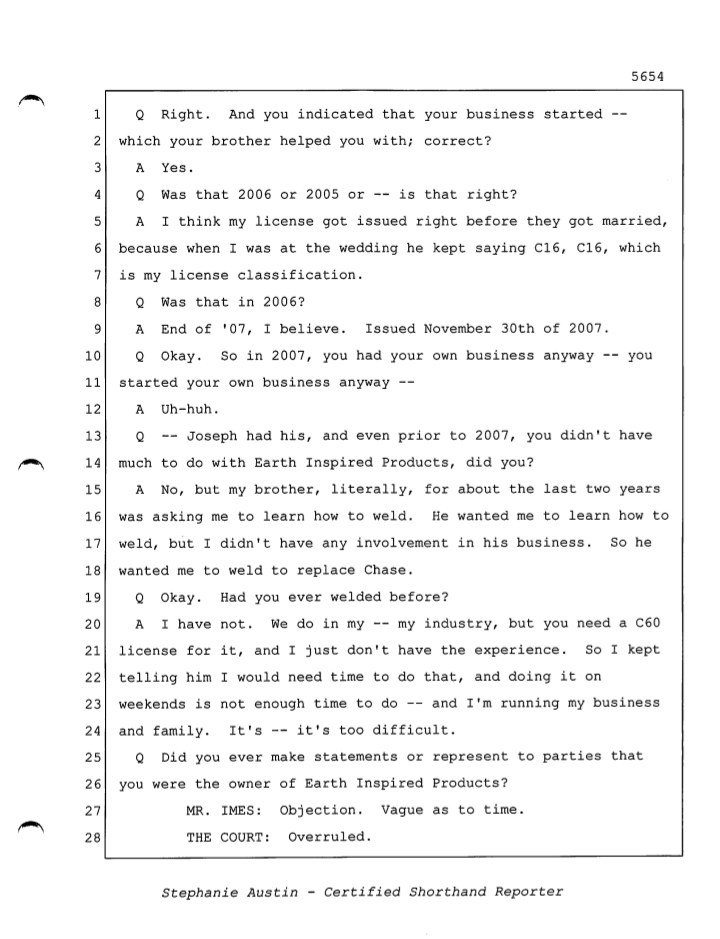
Joseph’s brother, Michael McStay, testified twice: for the prosecution in January 2019, and for my defense on April 3, 2019. This is the only place in his testimony where he spoke of replacing me:
Q “Okay. So in 2007, you had your own business anyway — you started your own business anyway —“
A “Uh-huh.”
Q “— Joseph had his, and even prior to 2007, you didn’t have much to do with Earth Inspired Products, did you?”
A “No, but my brother, literally, for about the last two years was asking me to learn how to weld. He wanted me to learn how to weld, but I didn’t have any involvement in his business. So he wanted me to weld to replace Chase.”
Q “Okay. Had you ever welded before?”
A “I have not. We do in my — my industry, but you need a C60 license for it, and I just don’t have the experience. So I kept telling him I would need time to do that, and doing it on weekends is not enough time to do — and I’m running my business and family. It’s — it’s too difficult.”
(RT 5654:10-24)
See the trial transcript (RT 5654)
Reporter’s Transcript, April 3, 2019, RT 5654.
Michael’s testimony is evidence of how he understood his brother. I do not dismiss it. But what he says Joseph asked of him was to “learn how to weld.” “So he wanted me to weld to replace Chase” is Michael’s own conclusion. He did not say Joseph told him he planned to replace me.
↑ Back to the menuWhat the jury was told
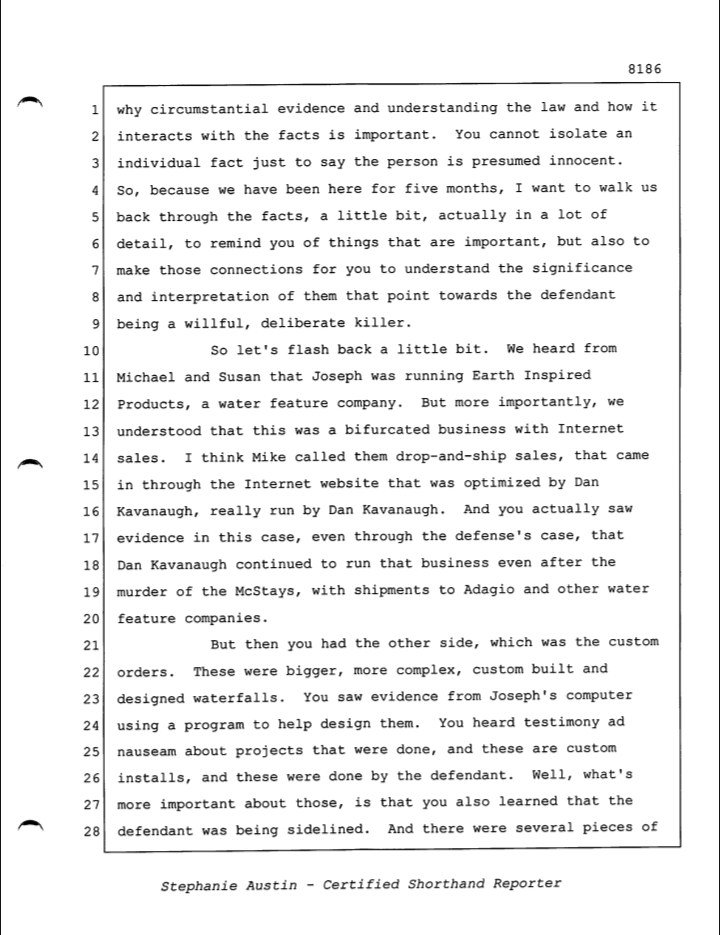
In closing argument on May 28, 2019, the prosecutor, Mr. Imes, told the jury:
“Well, what’s more important about those, is that you also learned that the defendant was being sidelined. And there were several pieces of operative evidence that you may not have connected those dots to understand it is that the defendant being sidelined.
One is, there were project failures — Provecho, Levine. You heard from David Sequieda about having to make up work because the defendant wasn’t doing it or he was doing a sloppy job or he was nowhere to be found. You heard from Susan and Michael — I think even McGyver, if I recall correctly — that Joseph was looking for other fabricators and welder-type people to do the work. You heard that Joseph was trying to consolidate the business and take more localized control over it. And you also understood, from Fonseca and Sequieda and Carmen Garcia, that Joseph was aware of the problems with the defendant.”
(RT 8186:26-8187:13)
See the trial transcript (RT 8186-8187)
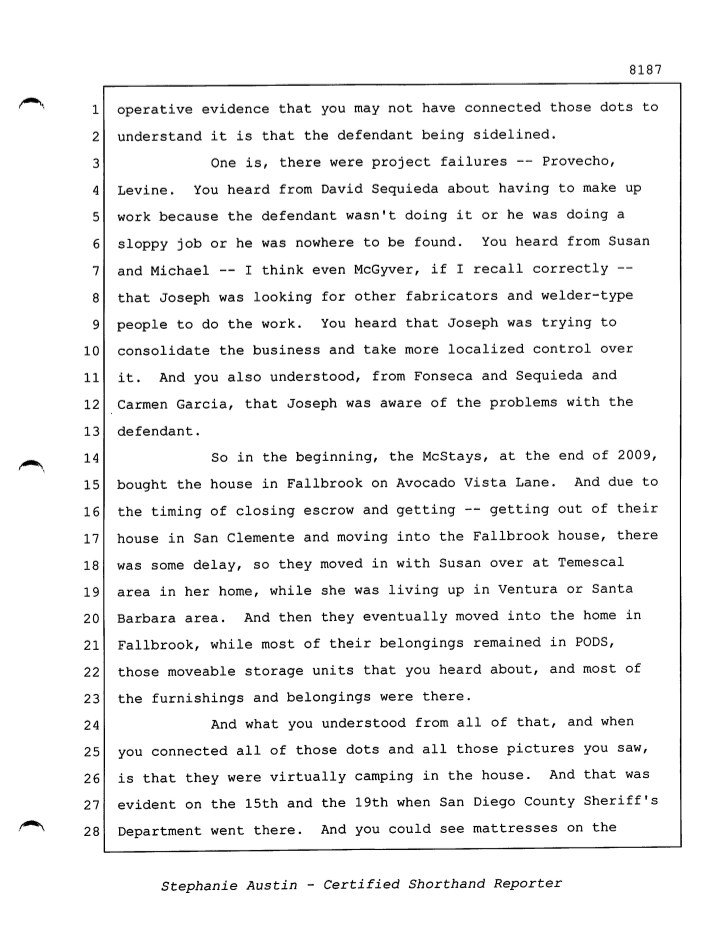
Reporter’s Transcript, May 28, 2019, RT 8186-8187.
Looking for other welders is one thing. Replacing me is another. On the stand, Susan Blake had drawn that very line: “Not phase him out. He wanted his business to have other welders there to keep business going, making it grow.” And “consolidate the business and take more localized control over it” is the warehouse under one roof that she described. Under that roof, she told Detective Hanke, he would “still have Chase.” (RT 1849:24-25; Interview, p. 157:22-23)
Provecho is answered on Provecho: Joseph’s state of mind.
Later in the same closing argument, Mr. Imes said:
“Joseph calls a place called Walker Welding, according to those records. Why? Well, put it into context with what you heard from Mike and Susan and McGyver — another fabricator.”
(RT 8195:1-3)
See the trial transcript (RT 8195)
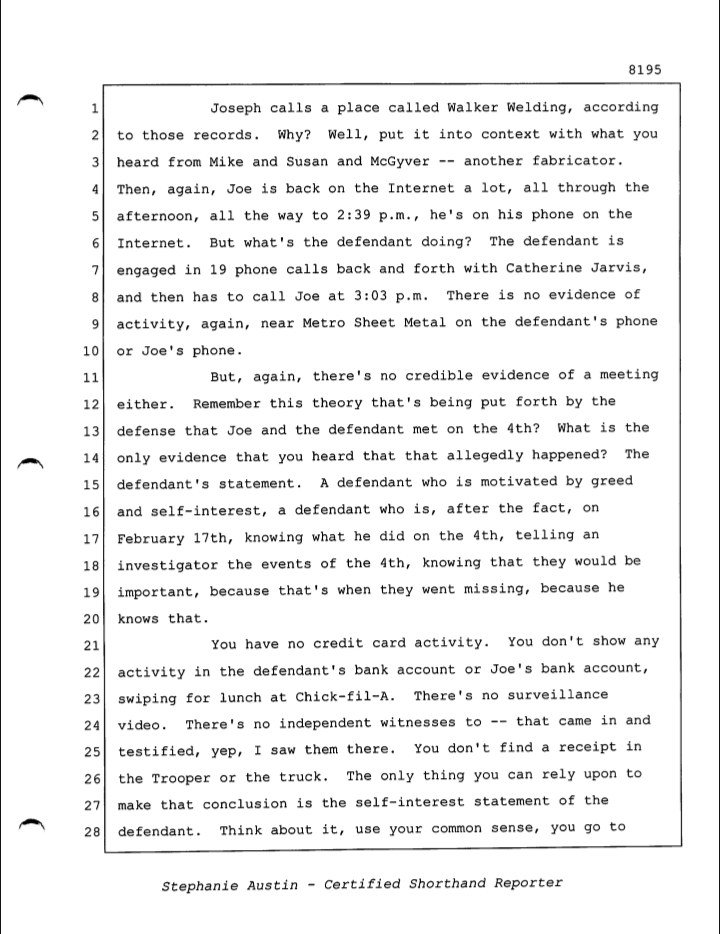
Reporter’s Transcript, May 28, 2019, RT 8195.
What that call really was: The Walker call.
Mr. Imes then told the jury what he said happened at the February 4 meeting, putting part of it in Joseph’s voice:
“But look at that alleged meeting in context. There’s another interpretation to this, that that meeting occurred somewhere in this last 30 minutes of that afternoon, and that meeting was very quick, and that meeting was — I know you forged checks, I know you cashed that $2500.00 check, I am done with you.
I was already of the mindset of sidelining you and looking for other fabricators, I had already moved business to Metro Sheet Metal, I’ve already called Walker Welding, and now, the straw that breaks the camel’s back is you violated our friendship and our business relationship, you wrote checks from my QuickBooks account, you cashed them, you owe me $42,000.00 because of your mess up on Levine and Provecho disaster —”
MR. MCGEE: “Objection. Arguing facts not in evidence —”
THE COURT: “Overruled.”
MR. MCGEE: “— ask to admonish the jury.”
MR. IMES: “That is a reasonable conclusion and inference that could be drawn from all of the evidence that you have seen up to the 4th. It’s circumstantial. Sure. Six of you could believe there was never a meeting based on that evidence. Six of you can believe some other interpretation that there was a meeting and that it was very short-lived in this time period. Those are reasonable conclusions to be drawn. That’s up to you to decide. Either way, they point towards the defendant, not towards innocence.
They point towards the defendant in trouble. They point towards the defendant’s state of mind that he owes $42,000.00. I’ve been caught cashing a check that I did — that I wasn’t given properly, and I forged, and now, I’m in a meeting with my boss, either way, it points to the defendant.”
(RT 8196:10-8197:11)
See the trial transcript (RT 8196-8197)
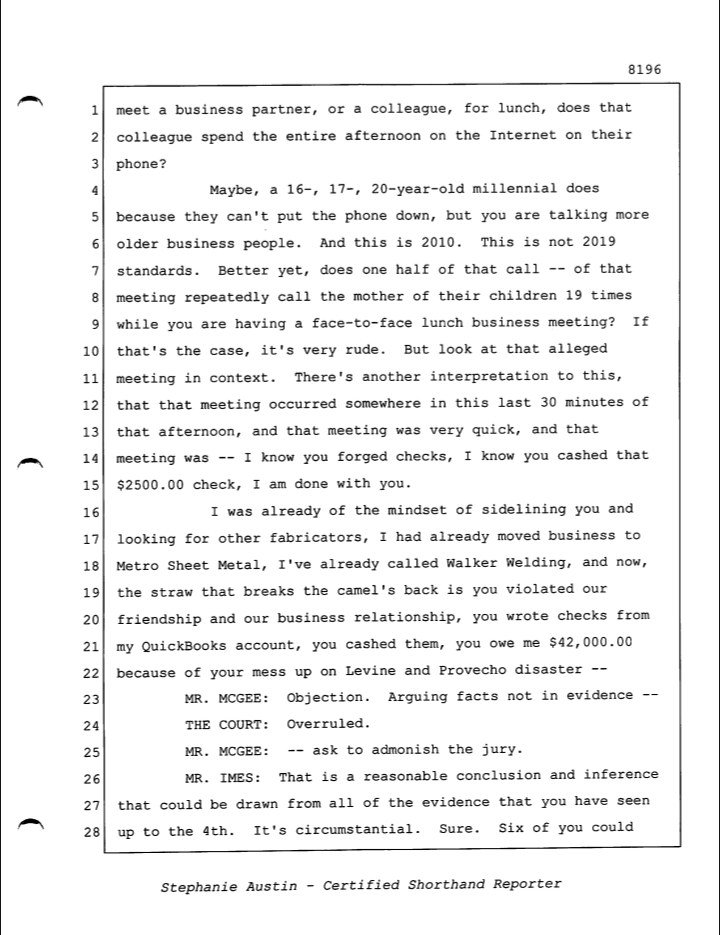
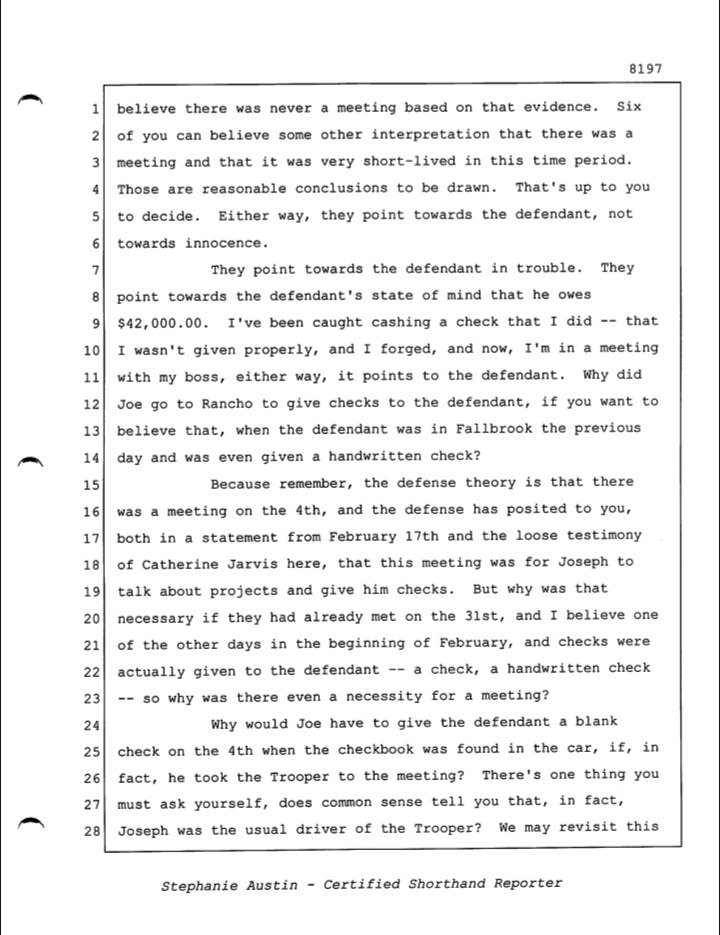
Reporter’s Transcript, May 28, 2019, RT 8196-8197.
The checks are answered on The Checks, the Money, and the Motive, and Provecho on Provecho: Joseph’s state of mind. The $42,000 e-mail is answered on Closing argument: what they told the jury, card 4.
Mr. Imes came back to the debt and the sidelining when he talked about the gap in my phone records:
“The only reasonable interpretation is that phone was powered off or in airplane mode. This is not bad cell reception. The defense is going to try to argue to you that, oh, those were missed calls, these were dropped calls. Remember all of this bad cell reception. That’s not what that is. That is a phone that is off and every call being directed to voicemail. And that is three and a half hours or more of opportunity for the defendant to go to Fallbrook, confront Joseph over this $42,000.00 debt, being sidelined in favor of Metro Sheet Metal and others, more than enough time to get to Fallbrook to confront Joseph.”
(RT 8199:7-17)
See the trial transcript (RT 8199)
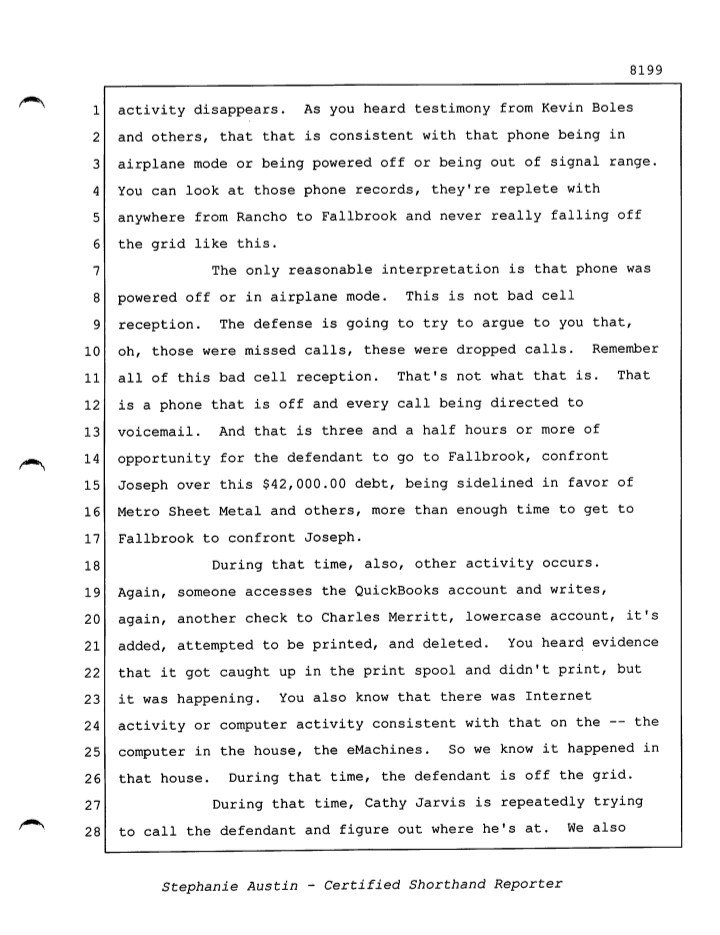
Reporter’s Transcript, May 28, 2019, RT 8199.
And when he summed up the night of February 4:
“And when you look at them in their totality, it shows that it was the defendant at the McStay house that night.
Why? Because he owes $42,000.00, he forged checks, he’s being sidelined. He’s not going to let that happen, because he’s a greedy, self-centered, self-interested man. And we’ll talk about more motive as we go along, but up to this point, that’s what you know about the defendant’s state of mind.”
(RT 8213:19-26)
See the trial transcript (RT 8212-8214)

Reporter’s Transcript, May 28, 2019, RT 8212-8214.
Later, on the checks, he said:
“There’s no coincidence to this QuickBooks activity, ladies and gentlemen, none, whatsoever. The only innocent explanation requires you to believe that Joe was changing his entire business practice over night and giving control to a person that he was clearly not trusting and attempting to sideline. Is that a reasonable interpretation to that QuickBooks activity? No.”
(RT 8224:2-8)
See the trial transcript (RT 8224)

Reporter’s Transcript, May 28, 2019, RT 8224.
The QuickBooks checks are answered on The Checks, the Money, and the Motive.
A prosecutor may argue reasonable inferences. But “sidelined” was presented as something the jury had “learned,” from witnesses whose own words were mixed or qualified.
↑ Back to the menuThe new-trial ruling
On January 17, 2020, ruling on my motion for a new trial, the court first listed what Metro Sheet Metal had complained of, and earlier problems it attributed to me. Then it said “So we know”:
“We know that Metro Sheet Metal contacted Joseph McStay and complained to him about Mr. Merritt’s work habits, that Mr. Merritt was gone a lot, he was not reliable, he was not getting the work done, and because of that they would not — could not and would not continue with Mr. Merritt there. And they told Mr. McStay, you have to — you have to deal with him. We also know that Joseph McStay gave a check to Mr. Merritt to deliver to Metro Sheet Metal for payment to Metro Sheet Metal for some of the work they did.
And Metro Sheet Metal did not receive that check, and they were inquiring with Mr. McStay about the check, and there was back and forth discussion that it was given to Merritt, Merritt was supposed to deliver it, Merritt didn’t deliver it. We know that prior to this time frame, there were other problems that were brought to Mr. McStay’s attention about Mr. Merritt’s work, about Mr. Merritt using Joseph’s inventory for some of his own work, and advising Joseph that projects had been completed and getting payment when, in fact, they were not.
Mr. Merritt was using the money for rent. So we know that sometime during January, perhaps late January of 2010, Joseph told his mother and his brother and a friend that he planned to phase the defendant out of the business, and he stated the reasons for that were the quality of the work that the defendant was doing recently, that’s defendant was costing him money. He had loaned the defendant money and hadn’t been repaid, that Summer was also complaining about the defendant.”
(RT 8942:5-8943:2)
See the trial transcript (RT 8942-8943)
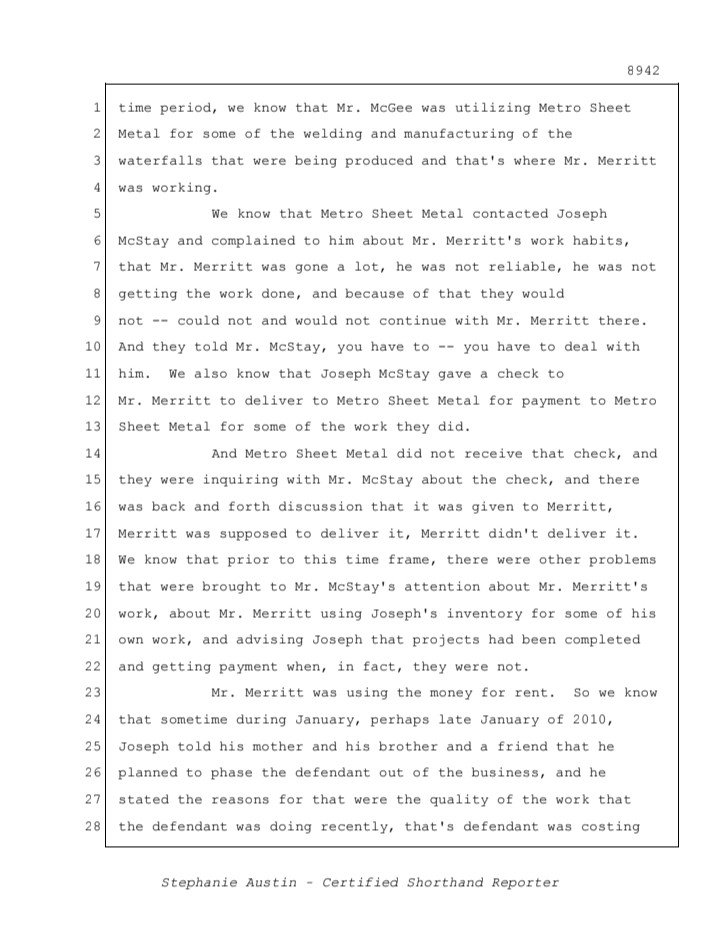
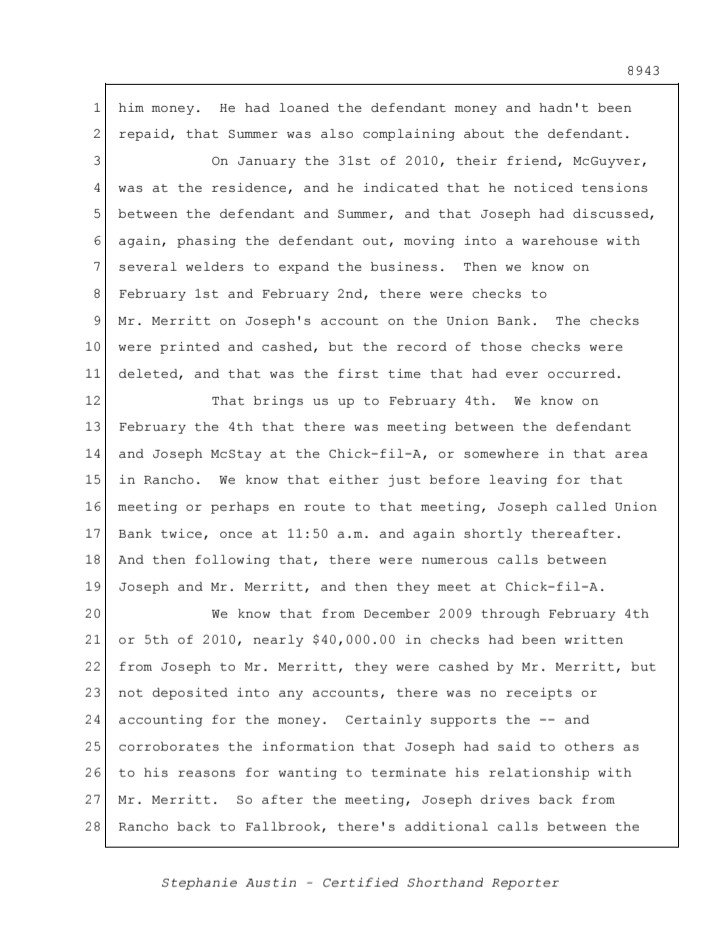
Reporter’s Transcript, January 17, 2020, RT 8942-8943.
On the reasons the court gave: “the quality of the work” is answered by Joseph’s own words on the one job the State named, on Provecho: Joseph’s state of mind. The money is answered above. On Summer, the friend’s own words were that he felt tension “between Summer and he.”
The court’s next sentence names the friend:
“On January the 31st of 2010, their friend, McGuyver, was at the residence, and he indicated that he noticed tensions between the defendant and Summer, and that Joseph had discussed, again, phasing the defendant out, moving into a warehouse with several welders to expand the business.”
(RT 8943:3-7)
See the trial transcript (RT 8943)
Reporter’s Transcript, January 17, 2020, RT 8943:1-7.
“So we know.” That is no longer one reading of conflicting testimony. It states the plan as a settled fact, told to three people. Here is what each of them actually said on the stand:
- His mother, Susan Blake: “Not phase him out,” along with the other answers above, which went both ways. (RT 1849:24)
- His brother, Michael: Joseph asked him to “learn how to weld.” “So he wanted me to weld to replace Chase” was Michael’s own conclusion. (RT 5654:15-18)
- The friend, McGyver: he did describe tension, “between Summer and he,” and the court had that part right. In his complete testimony, he never said Joseph discussed phasing me out or a warehouse with several welders. The only buyout he described was Dan’s, already done. (RT 2231:19; 2219-2312; 2265:12-18)
These are three different problems, not one. A mother who corrected herself on the stand, and whose answers went back and forth. A brother’s conclusion. And a friend credited with a conversation about phasing me out, a warehouse, and several welders. The court did not choose between versions of one witness’s account. It combined three different accounts into a single fact: that Joseph had told three people he planned to phase me out.
The timing does not match either. The court said Joseph told them “sometime during January, perhaps late January of 2010.” Ms. Blake placed her conversation with Joseph in November or December 2009: “in December” (Interview, p. 78:16), “like probably November” (Interview, p. 79:1), and at trial “at the end of December” (RT 5489:6). Michael said Joseph had been asking him to learn to weld “for about the last two years” (RT 5654:15-16). The only one of the three who saw Joseph in late January was McGyver, and what he described was tension in the room, not a plan.
The court went on, about the checks:
“We know that from December 2009 through February 4th or 5th of 2010, nearly $40,000.00 in checks had been written from Joseph to Mr. Merritt, they were cashed by Mr. Merritt, but not deposited into any accounts, there was no receipts or accounting for the money. Certainly supports the — and corroborates the information that Joseph had said to others as to his reasons for wanting to terminate his relationship with Mr. Merritt.”
(RT 8943:20-27)
See the trial transcript (RT 8943)
Reporter’s Transcript, January 17, 2020, RT 8943.
The checks are answered on The Checks, the Money, and the Motive.
The court came back to Joseph’s “stated intentions” after describing events that came later:
“We know also that after February 4th, there were additional problems with Mr. Merritt completing work. We know from Geiss Construction that they had paid in full for a fountain, we know that it wasn’t done.
We know that Mr. Merritt indicated he needed additional money to complete it. Geiss Construction paid additional money. Fountain was still not completed. Ultimately, Geiss Construction had to pick up the uncompleted fountain and truck it to their location and have someone complete it. There were also other instances, some of which were discussed by Susan Blake, of other similar problems.
All of that information corroborates the financial motive alleged by the People, that the defendant was taking funds from the business, corroborates Metro Sheet Metal complaints regarding the defendant, and corroborates Joseph’s stated intentions to phase the defendant out of the business.”
(RT 8946:10-25)
See the trial transcript (RT 8946)
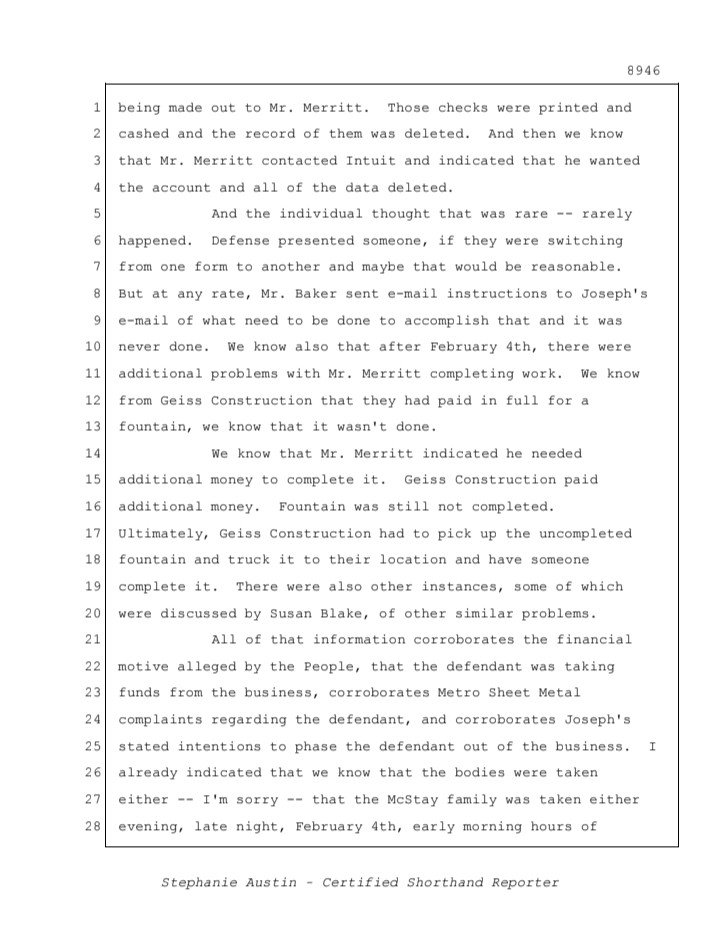
Reporter’s Transcript, January 17, 2020, RT 8946.
Everything in that passage happened after February 4, after Joseph was gone, and the court read it as proof of what Joseph intended. If what happened after February 4 says anything about Joseph’s intentions, it points the other way.
Joseph’s mother kept the business going with me. She told my jury there was no money coming in:
“I was trying to keep customers, or whoever was calling me, calm to hopefully find my kids and hopefully keep the business going. Obviously, there wasn’t money coming in. I was paying for money going out.”
(RT 1834:9-12)
See the trial transcript (RT 1834)
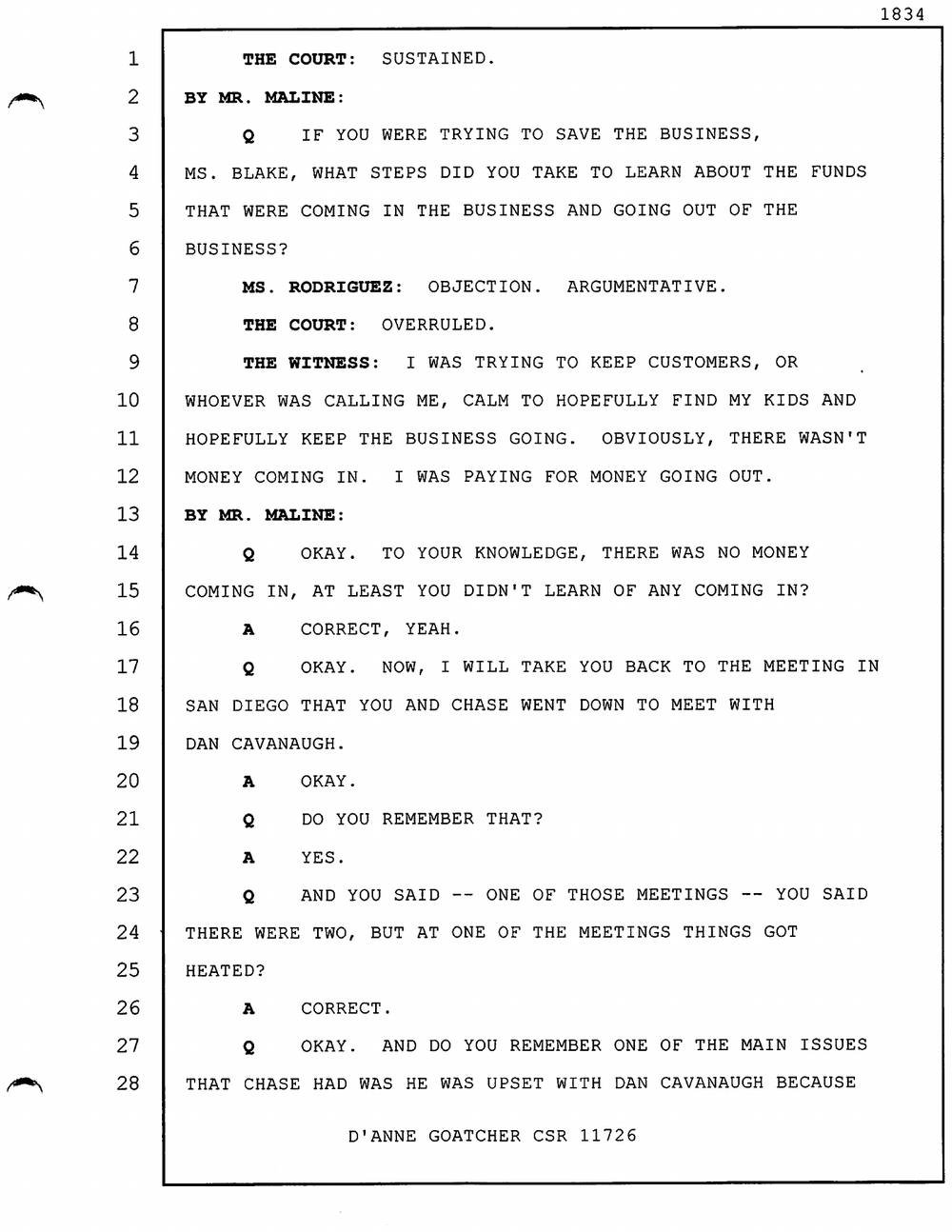
Reporter’s Transcript, January 8, 2019, RT 1834.
The account she signed on was in Earth Inspired Products’ name. Between March 16 and May 7, 2010, it took in $36,460, including a $6,250 wire from Geis Construction on May 7, and that same day she wrote me three checks for the work (RT 5544-5545). She is the witness who told the jury Joseph wanted to phase me out. I don’t believe she would have kept working with me, and paying me, if Joseph had ever told her that.
Her account, every deposit and every check, is on Where the Money Went.
And the court spoke of Joseph phasing me out once more, describing my defense:
“Second prong of the defense evidence was to attempt to show that Mr. Kavanaugh was at least in the same position and had the same motivations that the prosecution alleged that Mr. Merritt had. Mr. Kavanaugh had set up the web page for the business, he was doing the web page work, getting paid for it, maybe getting a percentage of the profits, and Joseph was also phasing out Mr. Kavanaugh, just as he was phasing out or intended to phase out Mr. Merritt.”
(RT 8950:7-14)
See the trial transcript (RT 8950)
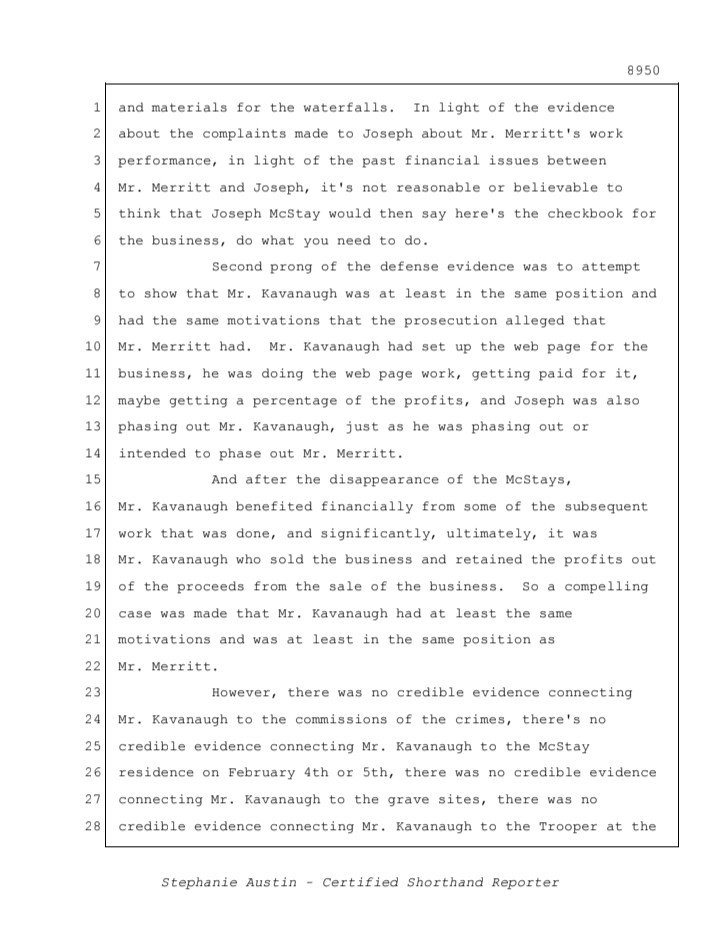
Reporter’s Transcript, January 17, 2020, RT 8950.
My attorney, Mr. Maline, said nothing about it that day. Four days later, on January 21, he answered it in general terms:
“The Court had that opportunity at the 1118. And it doesn’t matter what the Court is going to believe in terms of the Court’s slant on the evidence. It really doesn’t matter, because everything the Court says about what Ms. Blake said or what Michael said, it doesn’t matter because they were impeached with earlier statements that were contradictory.”
(RT 8978:10-16)
See the trial transcript (RT 8978)
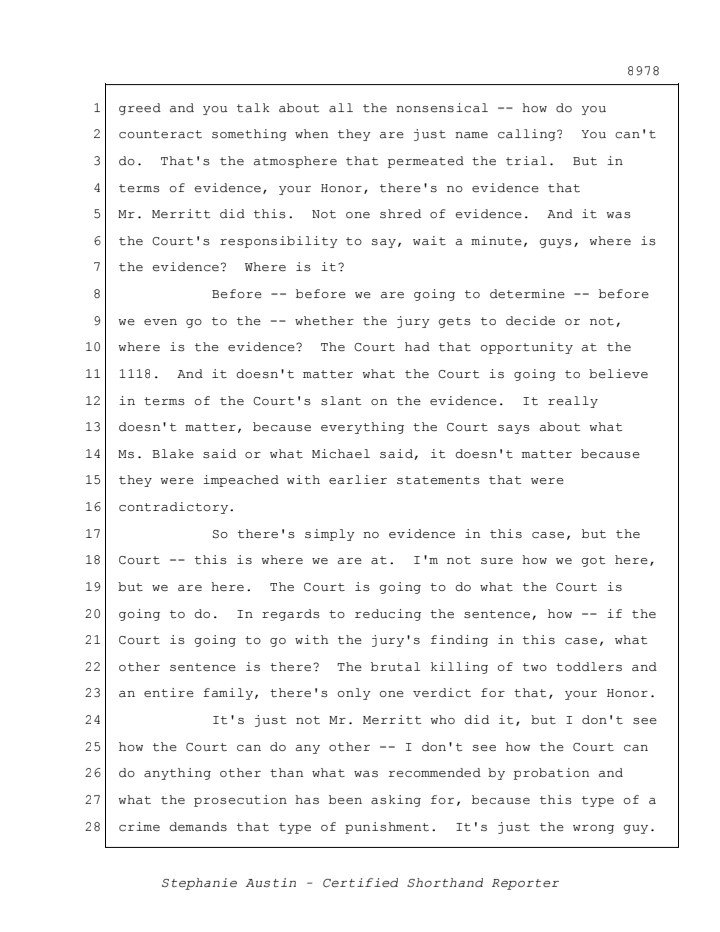
Reporter’s Transcript, January 21, 2020, RT 8978.
He did not point the court to “Not phase him out,” to page 158, or to what McGyver actually said. He did not mention McGyver at all.
↑ Back to the menuBuying out Dan is not firing me
The State’s theory used several different ideas as if they were one: buying out Dan, moving into a warehouse, hiring more welders, replacing me, and ending Joseph’s work with me. They are not the same thing.
Dan’s buyout was a real transaction. McGyver described it: cash and a car, already done. Susan Blake described Joseph paying Dan off. McGyver called Dan “the partner.” (RT 2238:25, 2265:12-18, 5492:10)
No witness described the terms of any buyout of me. The State’s own detective described my role: “Chase kind of did custom fountains for Joey. Joey would order a fountain or get a job, and then he would contract Chase, basically, or he would have Chase build the fountains for him.” Susan Blake told the detectives the same thing in her own words. (Interview, p. 158:16-21)
MS. BLAKE: “But I did know he was a subcontractor. Joey has told me. And he helps build the fountains and does like the welding part and stuff like that.”
(Interview, p. 36:2-4)
See the Susan Blake interview (page 36)
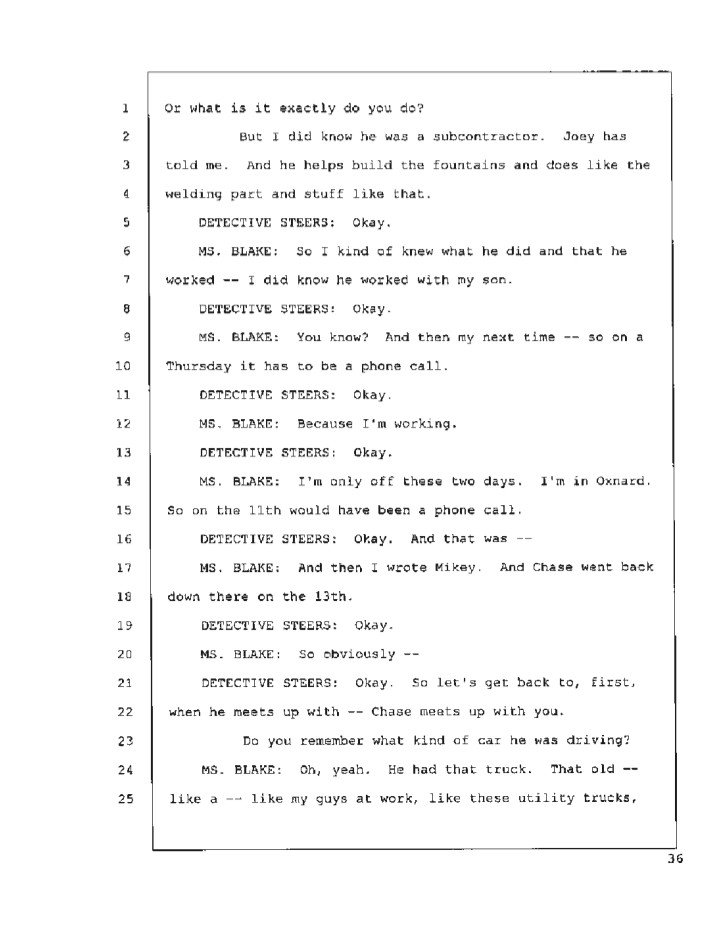
Recorded interview of Susan Blake, August 13, 2014, certified transcript, p. 36.
I had my own companies, Waterfalls by Chase and Idesign4u. Joseph’s was Earth Inspired Products. I made the custom fountains, through my own company.
The State itself treated me as a separate business. In closing, Mr. Imes told the jury that on Joseph’s QuickBooks account, “Charles Merritt is added as a vendor,” and that “Charles Merritt already existed as a vendor or a payee in the other side, properly capitalized.” He told them Joseph “keeps a spreadsheet of his payments to the defendant and other vendors, project by project.” And when he called Walker Welding “another fabricator,” the word “another” put me in the same place: an outside fabricator Joseph paid for work. A vendor is paid for work. Ending that relationship is not the same transaction as buying out a business partner, and no witness identified anything Joseph proposed to buy from me. (RT 8190:7-11, 8193:9-10, 8195:3)
See the trial transcript (RT 8190, 8193)
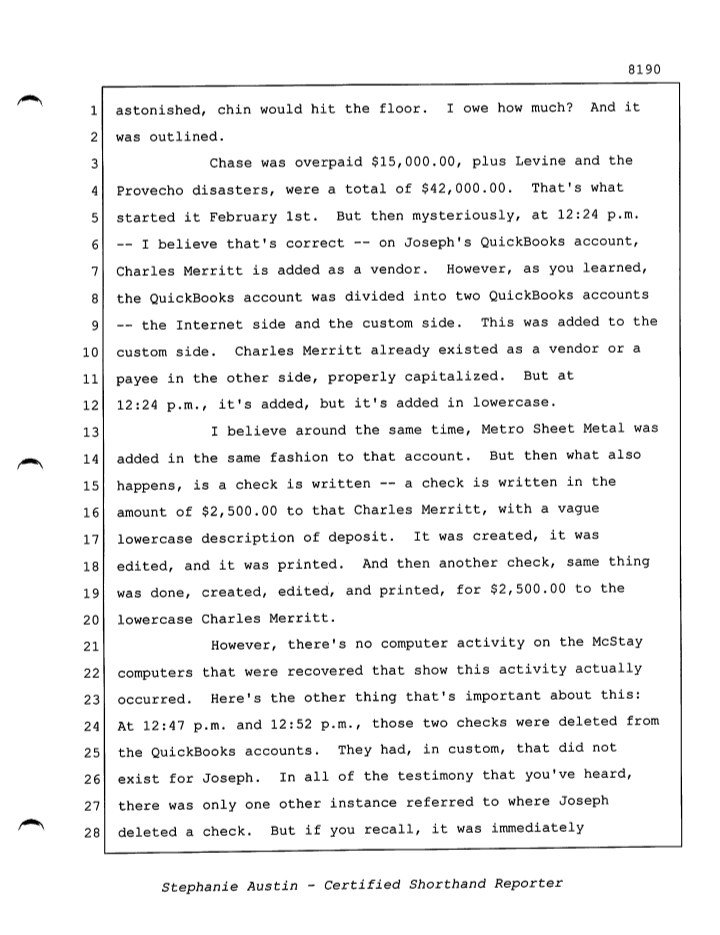
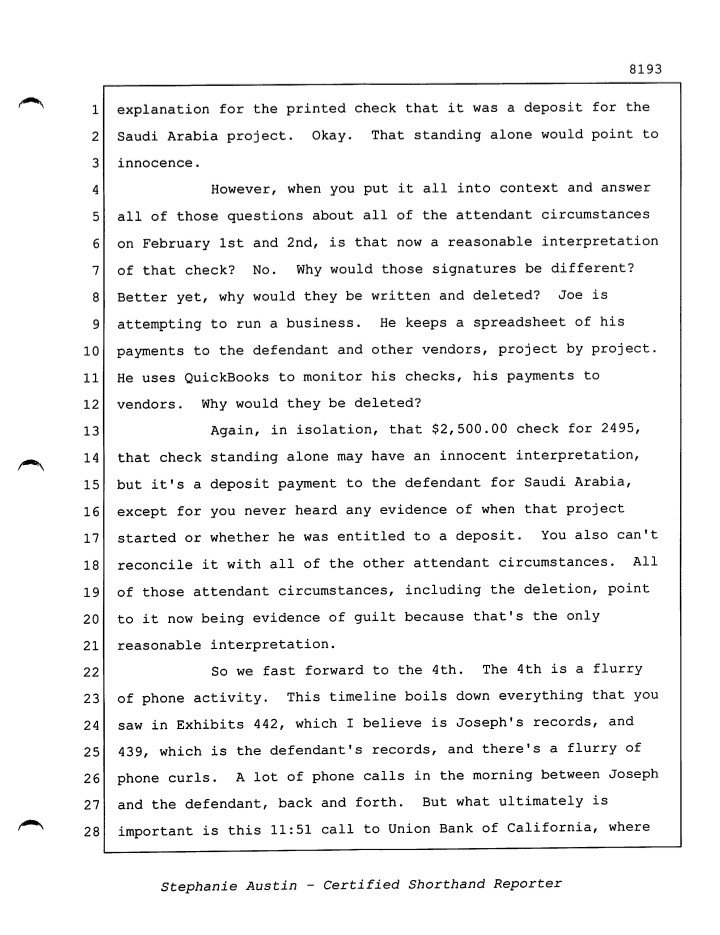
Reporter’s Transcript, May 28, 2019, RT 8190-8193.
No witness said what “buying Chase out” would even have meant.
Buying out is not firing, and adding is not replacing. Even a buyout of some kind would not show that Joseph meant to stop using me. And wanting more welders, in one place, is what Susan Blake herself described as growth: “to keep business going, making it grow.” Her answer about the warehouse was that Joseph wanted the subcontracted welding “under the roof,” “even if they worked for him.” (RT 1849:24-25; Interview, p. 159:18-22)
A plan to grow the business with more welders is consistent with keeping me. To turn it into a plan to push me out, the State needed evidence connecting the two. The record does not supply it.
↑ Back to the menuWhat the State could say
Here is what the State could say, and the answer to each.
- “She said it more than once.” She did: “phase out Chase also,” “weed Chase out,” and “he wanted to get rid of him.” She also said “Not phase him out,” “still have Chase,” “That’s what he talked about,” and “Just Dan.” A witness who says both cannot be described as having said only one. (RT 1849:19, 5489:25-26, 5490:9)
- “She agreed with the detectives in 2014.” She said “Uh-huh” twice, both times to a detective’s summary that put Chase and Dan together. The one time she was asked directly, she said “No,” and talked about Dan. (Interview, pp. 95, 158)
- “She said ‘That’s Chase.’” She did, about Joseph’s goal of having the work under one roof, under his control. Later in the same interview she said that under one roof he would “still have Chase and the welders.” (Interview, pp. 79:14-17, 157:22-23)
- “Joseph may have changed his mind.” Possibly. But no witness said when Joseph gave up the plan she described in 2014, under which he would “still have Chase,” or described a later conversation where he said so.
- “Michael said ‘to replace Chase.’” He did, as his conclusion about why Joseph wanted him to learn to weld. He did not say Joseph told him so.
- “The 1118.1 standard does not resolve conflicts for the defense.” Agreed. The problem is not the standard. It is that the court described her testimony as one-sided, called it critical, and later said “we know.”
The chain, and where it breaks
To use Susan Blake’s testimony as a motive for murder, the State needed every link of this chain to hold:
| Link | What the record shows |
|---|---|
| 1. Joseph planned to push me out. | His mother said both. Asked directly in 2014: “No.” On the stand: “Not phase him out.” |
| 2. He told others the same. | The brother gave his own conclusion. The friend described tension, and a buyout of Dan. |
| 3. “More welders” meant replacing me. | Her own words: “to keep business going, making it grow.” Under one roof, he would “still have Chase.” |
Even if every link held, the State would still need to show that I knew of such a plan. That is a separate question, and this page does not need to reach it. The chain breaks at its foundation. The State treated Joseph’s supposed plan to push me out as an established fact. But the witness it relied on corrected that characterization herself, on the stand. Her recorded interview, when she was asked directly, said Joseph wanted Dan out and would “still have Chase.” The prosecutor later got a different answer by stopping her at the part of that interview that supported the State’s theory. And Joseph’s brother and friend did not testify to the same thing. What the State presented as a settled plan was built from corrected testimony, an interview shown in part, and conclusions credited to witnesses who had not testified to them. The State’s other sidelining claims, the Walker call, Metro Sheet Metal, and the debt, are taken up on their own pages.
↑ Back to the menuWhat my own defense did, and did not do
On January 8, Mr. Maline drew out “Not phase him out” and “still have Chase.” On March 18, he took her to page 158, but his question about her answer there went unanswered, and he moved on.
That same afternoon, when the court would not let him read the interview to her, it told him he could call the detective who did the interview to impeach her: “When you are done with this witness, if you want to call the other witness who did the interview for impeachment, you can do that.” My lawyers never called him. (RT 5491:11-22)
After the prosecutor showed her only the first lines of page 158 and got “Yes,” neither of my lawyers objected that the question left out her answer on the same page. On redirect, Mr. Maline did not return to it. The jury was left with “Yes.”
In closing, Mr. McGee argued that I was never fired: “first their theory is he got fired, which we know he didn’t,” and “They didn’t call anybody who is going to replace Chase if he’s fired.” (RT 8320:1-2, 8349:13-14)
See the trial transcript (RT 8320, 8349)
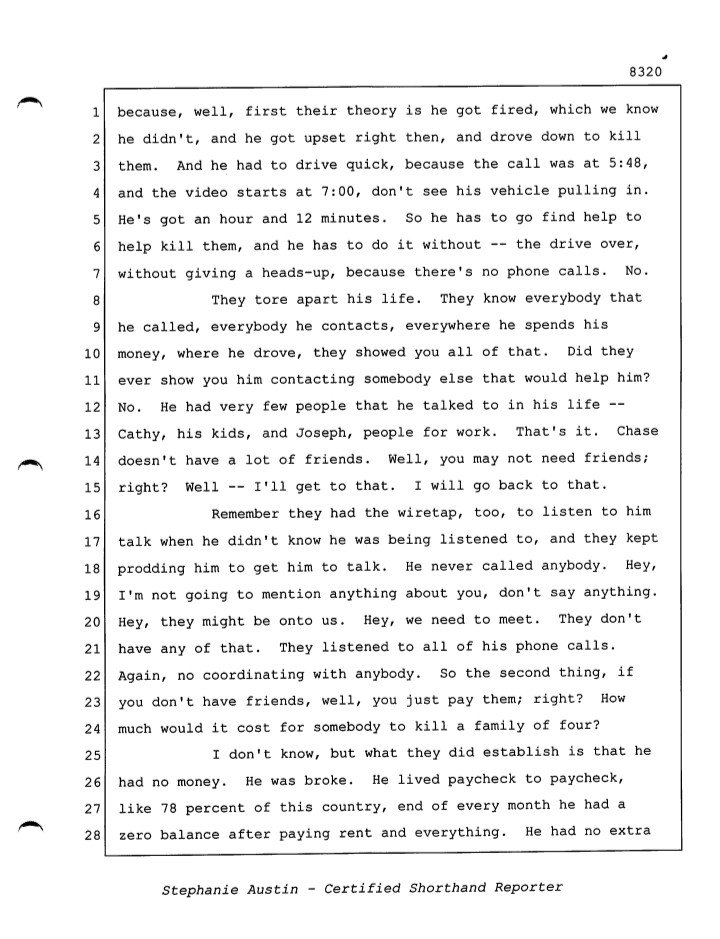
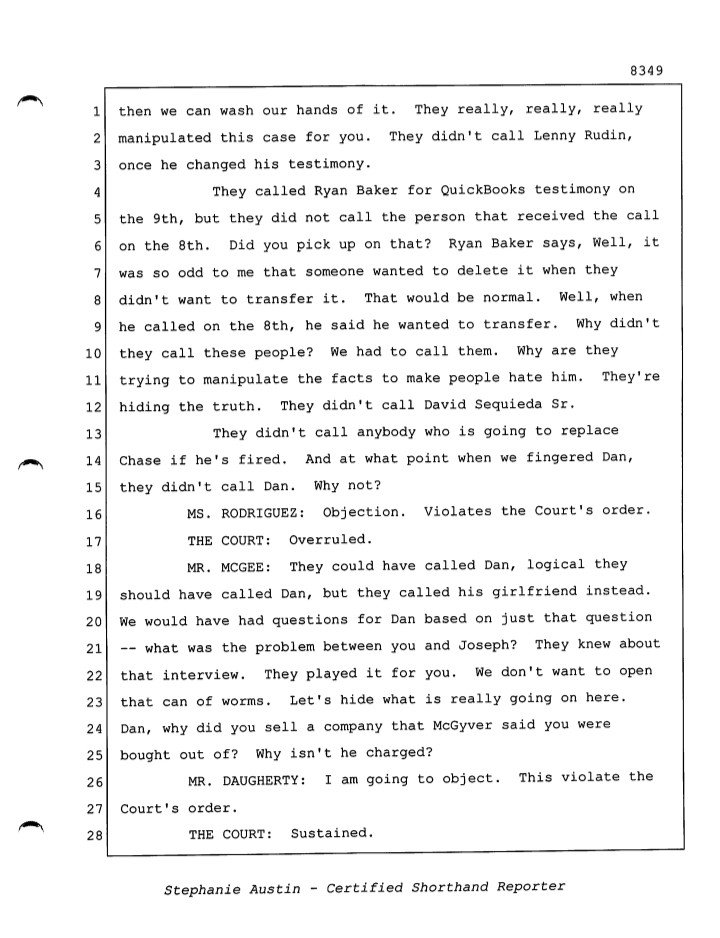
Reporter’s Transcript, Mr. McGee’s closing argument, RT 8320 and 8349.
At the new-trial hearing, when the court said “we know” Joseph told his mother, his brother, and a friend, Mr. Maline said nothing that day. Four days later he said only that Ms. Blake and Michael “were impeached with earlier statements that were contradictory.” He did not show the court which statements, and he never mentioned McGyver. (RT 8978:15-16)
↑ Back to the menuThe law, in plain words
On January 8, 2019, the evening she first testified, after the jurors had gone for the day, the court put on the record why it had overruled the hearsay objections to her accounts of what Joseph said about Mr. Kavanaugh and me:
THE COURT: “WITH REGARD TO THE QUESTIONS THAT WERE ASKED OF SUSAN BLAKE ABOUT THE CONVERSATIONS SHE HAD WITH HER SON JOSEPH ABOUT HIS CONVERSATIONS WHERE HE WAS RELATING HIS PLANS AND INTENTS WITH REGARD TO MR. CAVANAUGH AND MR. MERRITT, COURT OVERRULED THE HEARSAY OBJECTIONS. COURT DID THAT BASED ON EVIDENCE CODE SECTION 1250 THAT THOSE WERE STATEMENTS OF JOSEPH MC STAY’S INTENT OR INTENTIONS OR PLANS AND THEREFORE PART OF THE STATE OF MIND AND ADMISSIBLE TO SHOW THAT HE AT LEAST INTENDED TO CARRY THAT OUT. SO IT WOULD BE ADMISSIBLE AS STATE OF MIND UNDER EVIDENCE CODE 1250.”
(RT 1883:17-27)
See the trial transcript (RT 1883)
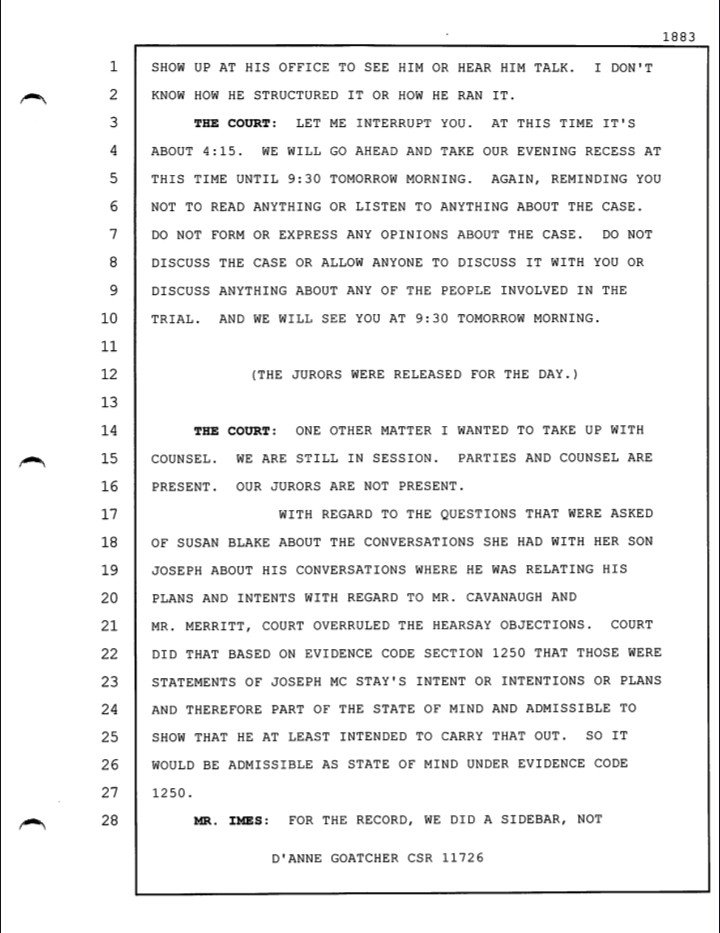
Reporter’s Transcript, January 8, 2019, RT 1883.
That ruling let the jury hear what Joseph told her as evidence of what he intended. It did not decide which of her accounts was true.
Before deliberations, the jury was told how to judge circumstantial evidence. This is CALCRIM 224, as it was read to them:
“However, before you may rely on circumstantial evidence to conclude that a fact necessary to find a defendant guilty has been proved, you must be convinced that the People have proved each fact essential to that conclusion beyond a reasonable doubt.
Also, before you may rely on circumstantial evidence to find a defendant guilty, you must be convinced that the only reasonable conclusion, supported by the circumstantial evidence is that the defendant is guilty. If you can draw two or more reasonable conclusions from the circumstantial evidence, and one of those reasonable conclusions points to innocence, and the other to guilt, you must accept the one that points to innocence. However, when considering circumstantial evidence, you must accept only reasonable conclusions and reject any unreasonable conclusions.”
(RT 8164:7-25)
See the trial transcript (RT 8164)
Reporter’s Transcript, May 28, 2019, RT 8164.
More welders could mean replacement. It could also mean growth, which is what the witness herself said. The State was free to argue replacement. Calling it “sidelining” did not make it something the jury had “learned,” and it did not remove her own answer pointing the other way.
↑ Back to the menuWhat I believe
I believe what Ms. Rodriguez did with page 158 was a trick. She did it to a vulnerable witness, a mother who had lost her son and his family, and it worked: the last thing the jury heard from her on this point was “Yes.”
I believe the court, which said it had thoroughly examined the testimony, described only the half of her testimony that supported a motive, called it critical, and after the trial said “we know” Joseph told three people something their own testimony does not show. That is how a motive for murder was built.
Decide for yourself.
The State’s motive, piece by piece
Mr. Imes’s closing gave the jury these reasons I was being “sidelined.” This table shows where each one is taken up on this site.
| What the jury was told | Where it is taken up |
|---|---|
| Project failures: “Provecho, Levine” (RT 8187:3-4) | Provecho: Joseph’s state of mind |
| “You heard from Susan”: Joseph was looking for other fabricators (RT 8187:6-9) | This page |
| Joseph was trying to “consolidate the business and take more localized control over it” (RT 8187:9-11) | This page (What the jury was told) |
| “Fonseca and Sequieda and Carmen Garcia”: Joseph was aware of problems (RT 8187:11-13) | Mr. Sequeida and Carmen Garcia: Closing argument: what they told the jury, card 5 |
| Joseph called “Walker Welding” (RT 8195:1-3; 8196:18) | The Walker call |
| Joseph had moved business to Metro Sheet Metal (RT 8196:17-18; 8199:13-16) | Closing argument: what they told the jury, card 5 |
| A $42,000.00 debt and forged checks (RT 8196:20-22; 8213:22-23) | The Checks, the Money, and the Motive; Provecho: Joseph’s state of mind. The February 1 e-mail: Closing argument: what they told the jury, card 4 |
| “…and Michael”: the same (RT 8187:6-9) | This page (The friend and the brother) |
Sources
- Recorded interview of Susan Blake by Detectives Joe Steers and Dan Hanke, August 13, 2014. Certified transcript, Case FVI1404194, File ID 2013-104 SUSAN.BLAKE.081314.1809. Transcribed by Jordan M. Flores, CSR 13757 (Mander Reporting). Pages 36, 78-79, 95, 157-160.
- Reporter’s Transcript, January 8, 2019, RT 1718-1884 (Susan Blake: direct 1722, cross 1794, redirect 1853; the court’s Evidence Code 1250 ruling, 1883).
- Reporter’s Transcript, January 14, 2019, RT 2216-2369 (McGyver McCargar, RT 2219-2312).
- Reporter’s Transcript, January 24, 2019, RT 3049-3053 (Fonseca ruling).
- Reporter’s Transcript, March 14, 2019 (Cathy Jarvis, RT 5359).
- Reporter’s Transcript, May 1, 2019 (the court’s questions to the accountant, RT 7362-7364).
- Reporter’s Transcript, March 4, 2019, RT 4993-5007 (ruling on the Penal Code section 1118.1 motion).
- Reporter’s Transcript, March 18, 2019, RT 5484-5555 (Susan Blake, recalled by the defense: direct 5488, cross 5525, redirect 5537, recross 5544, further redirect 5545).
- Reporter’s Transcript, April 3, 2019, RT 5643-5698 (Michael McStay, recalled by the defense). The cover page of this volume is misprinted “February 3, 2019”; the first page of proceedings reads “Wednesday, April 3, 2019.”
- Reporter’s Transcripts, January 8-10, 2019 (Michael McStay, called by the prosecution, RT 1862-2070).
- Reporter’s Transcripts, May 28-29, 2019, RT 8154-8416 (instructions and closing arguments).
- Reporter’s Transcript, January 17 and 21, 2020, RT 8836-9003 (motion for new trial).
Where I describe what I saw in the courtroom, I state what I know personally.
↑ Back to the menu