Provecho: Joseph’s state of mind
The State said Joseph was firing me, at least in part, over Provecho. Joseph’s own words say otherwise.
Why this page matters
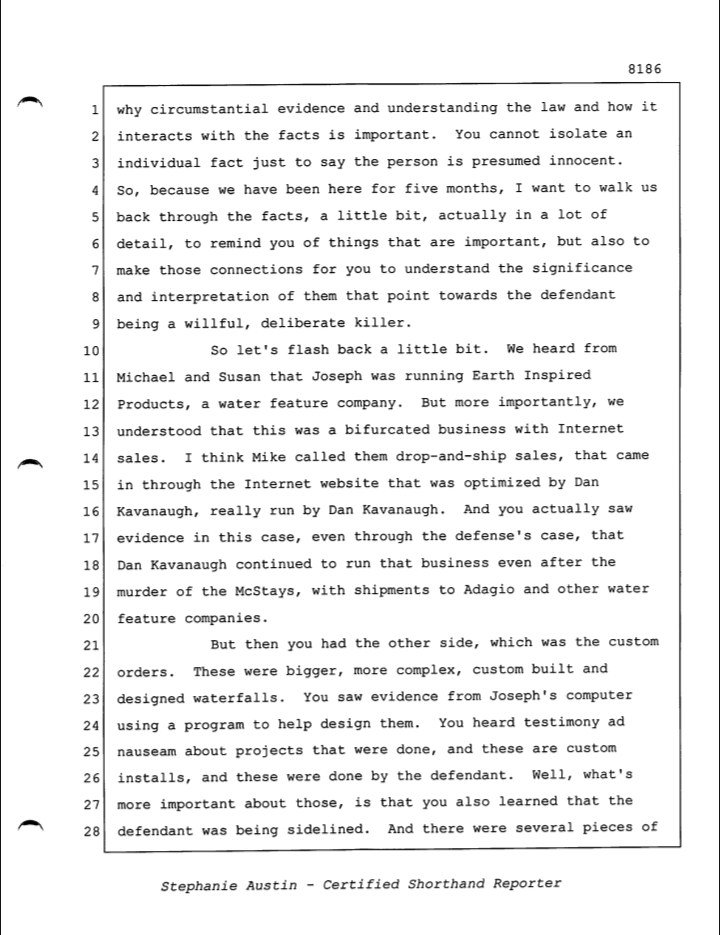
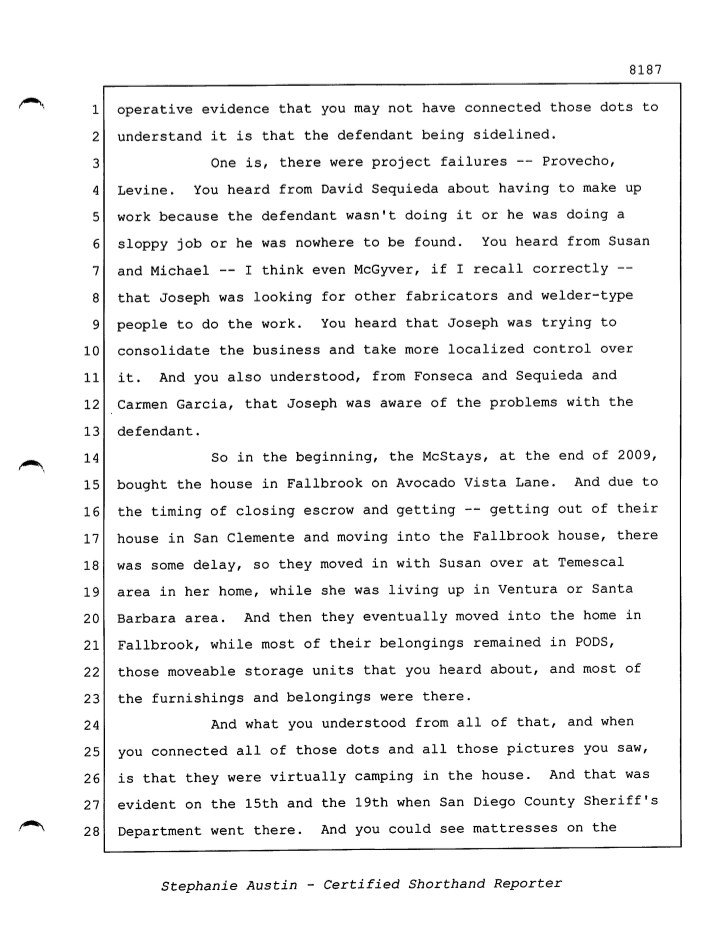
The State’s motive rested on what was in Joseph’s mind. It told the jury that Joseph had decided to cut me out of the business, and that by February 4 he was ready to fire me. One of the reasons it gave for that state of mind was a job called Provecho. Early in his closing argument, Mr. Imes told the jury that Joseph was sidelining me, and the first reason he named was Provecho: (RT 8186:26-8187:4)
Well, what’s more important about those, is that you also learned that the defendant was being sidelined. And there were several pieces of operative evidence that you may not have connected those dots to understand it is that the defendant being sidelined.
One is, there were project failures — Provecho, Levine.
See the trial transcript (RT 8186-8187)
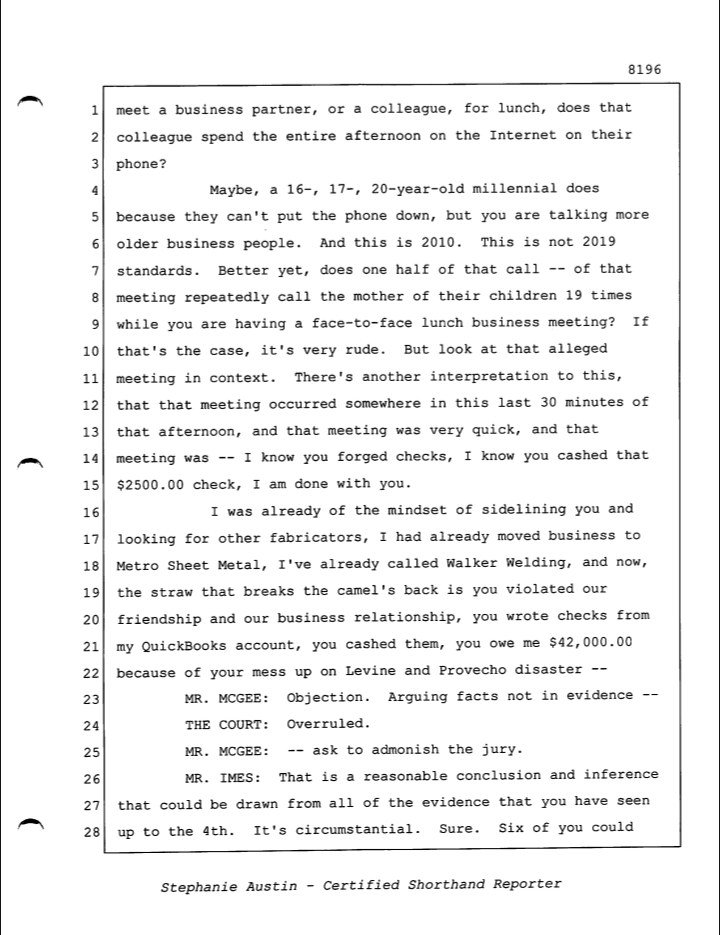
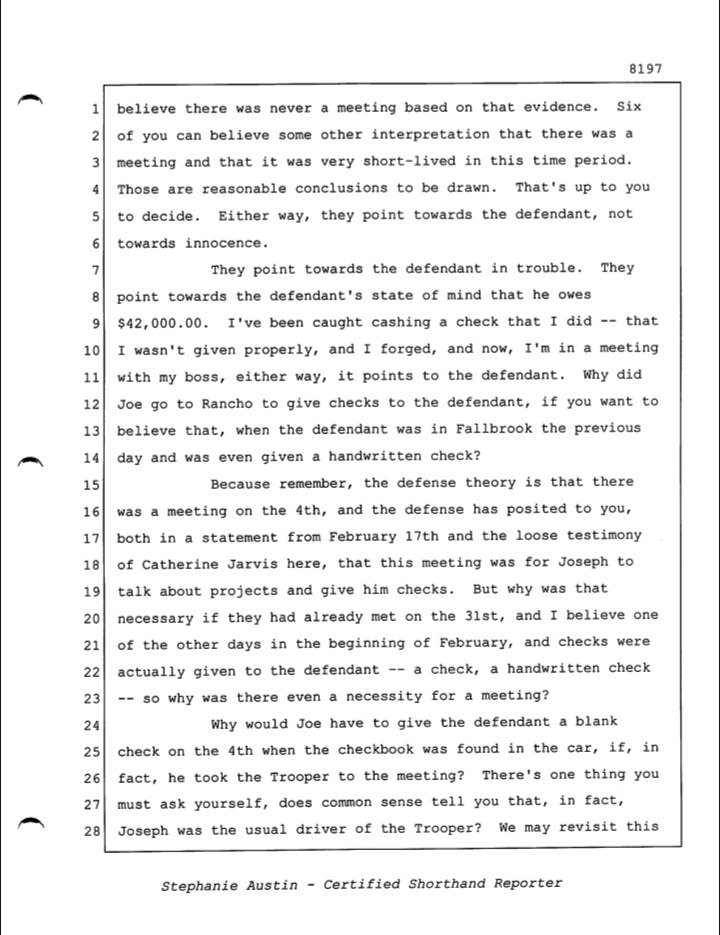
Later he put it in Joseph’s own voice, as if Joseph were firing me on February 4. Mr. McGee objected, and the court overruled him: (RT 8196:16-8197:6)
I was already of the mindset of sidelining you and looking for other fabricators, I had already moved business to Metro Sheet Metal, I’ve already called Walker Welding, and now, the straw that breaks the camel’s back is you violated our friendship and our business relationship, you wrote checks from my QuickBooks account, you cashed them, you owe me $42,000.00 because of your mess up on Levine and Provecho disaster —
MR. MCGEE: Objection. Arguing facts not in evidence —
THE COURT: Overruled.
MR. MCGEE: — ask to admonish the jury.
MR. IMES: That is a reasonable conclusion and inference that could be drawn from all of the evidence that you have seen up to the 4th. It’s circumstantial. Sure. Six of you could believe there was never a meeting based on that evidence. Six of you can believe some other interpretation that there was a meeting and that it was very short-lived in this time period. Those are reasonable conclusions to be drawn. That’s up to you to decide. Either way, they point towards the defendant, not towards innocence.
See the trial transcript (RT 8196-8197)
That is the State’s picture of Joseph’s state of mind: a man who blamed me for Provecho and was done with me. So the question this page answers is not whether the job had problems with the client. It is what Joseph himself believed about my work on it. He put that in writing, in 2008, more than once. Not one of those writings blames me.
The State turned Provecho into a motive in three steps. A customer who wouldn’t pay became my bad work. A disputed business loss became a debt I owed. And my promise to help Joseph if he lost his lawsuit became an admission that I already owed him. This page takes each step in turn, starting with what Joseph himself wrote at the time.
↑ Back to the menuWhat Provecho was
Provecho was a restaurant on Wilshire Boulevard in Los Angeles. In April 2008, its interior designer, Laurel Hagopian, ordered a custom water wall from Joseph’s company, Earth Inspired Products (EIP). I was the fabricator, through my company, I Design 4 U. The client paid a 50 percent deposit of $14,860 by credit card. I installed the two main parts of the water wall on July 3, 2008. On August 14, 2008, the client filed a PayPal chargeback on the deposit. (Bates 003419-003421)
See the pages (Bates 003419, 003420, 003421)
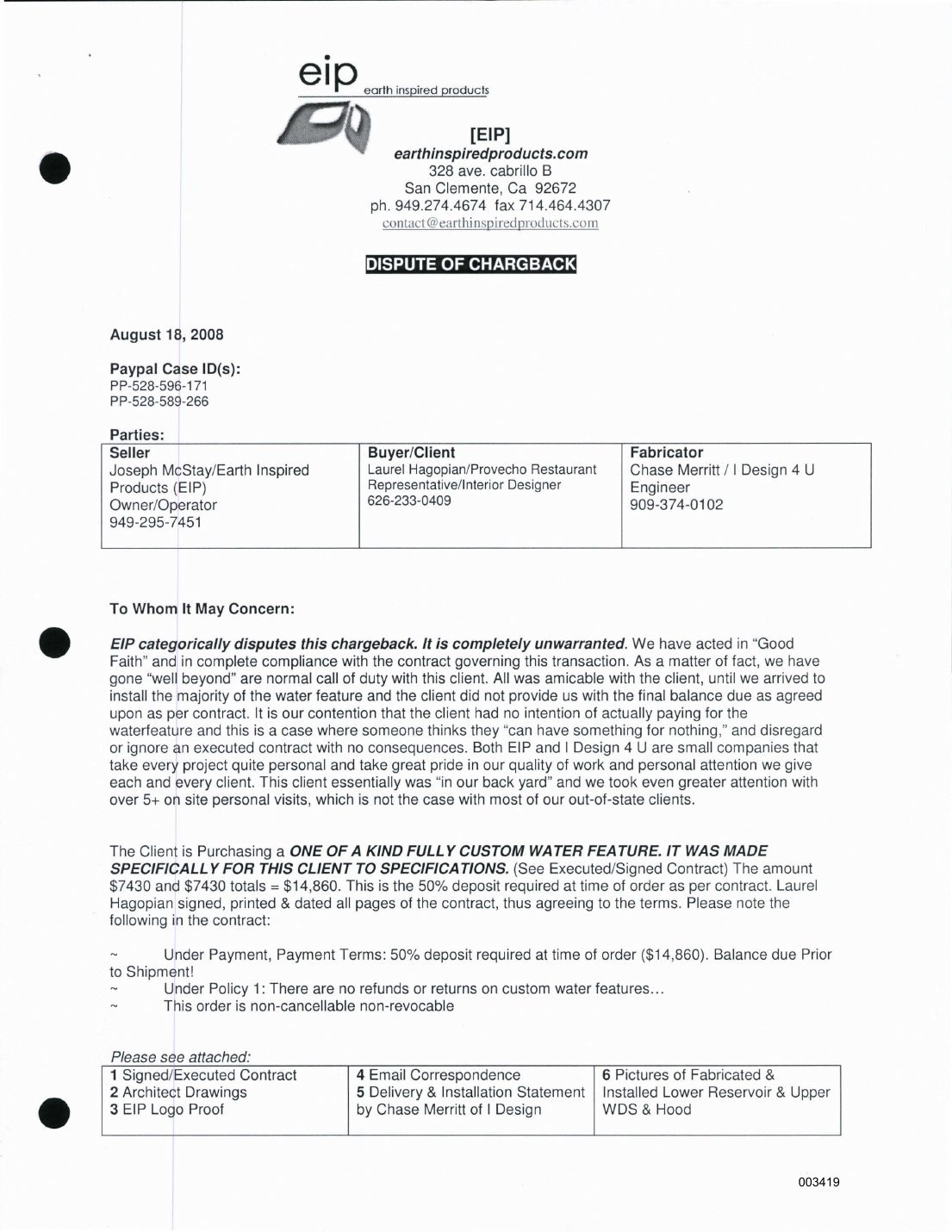
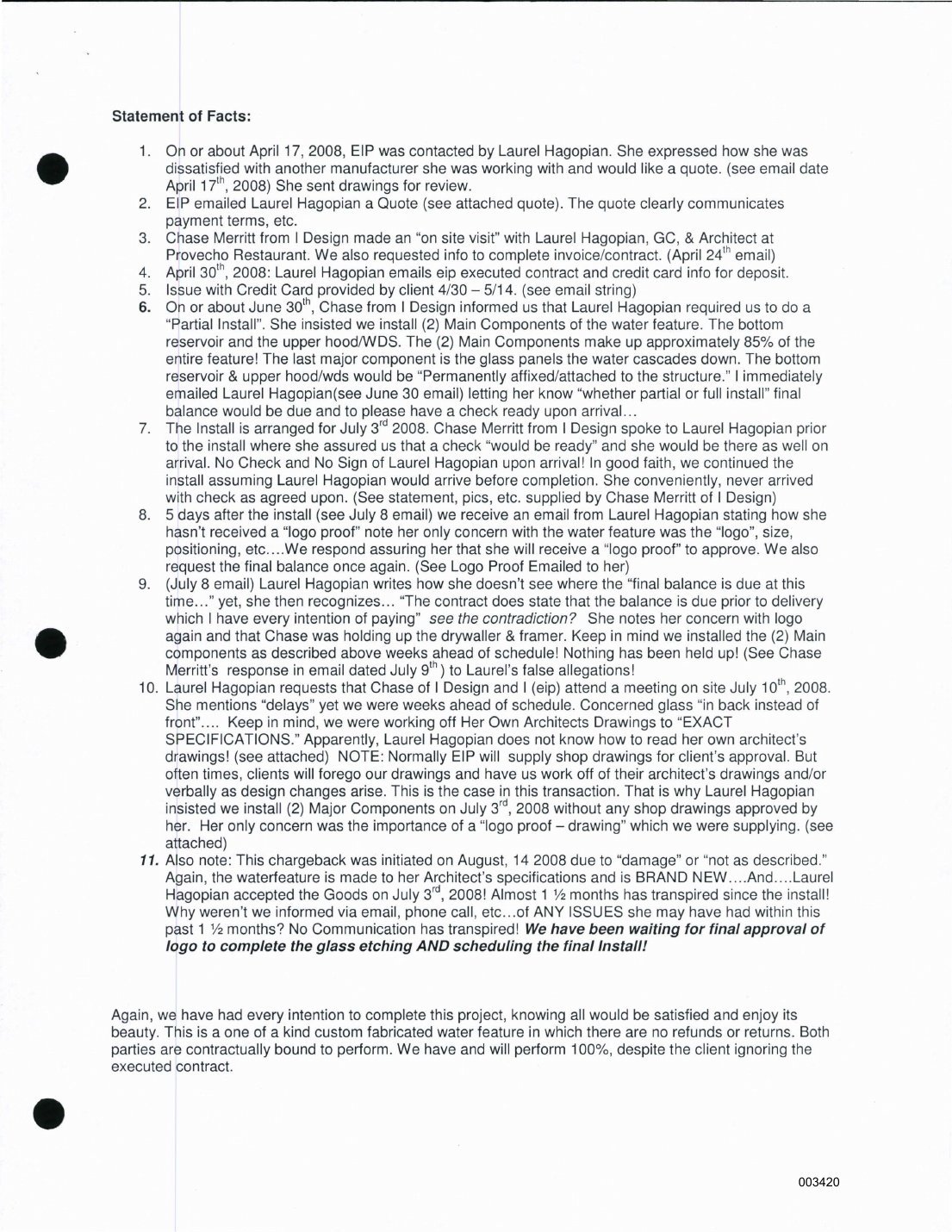
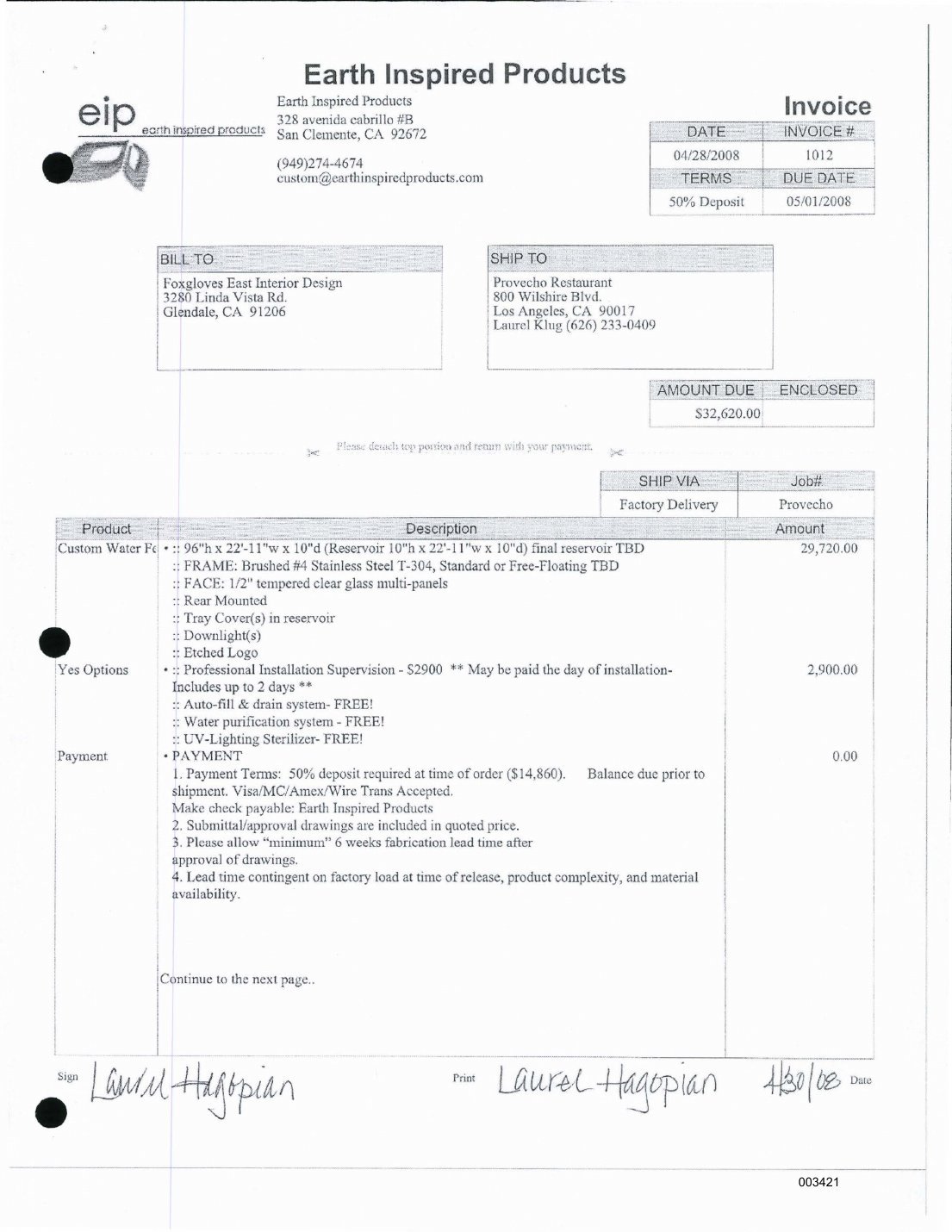
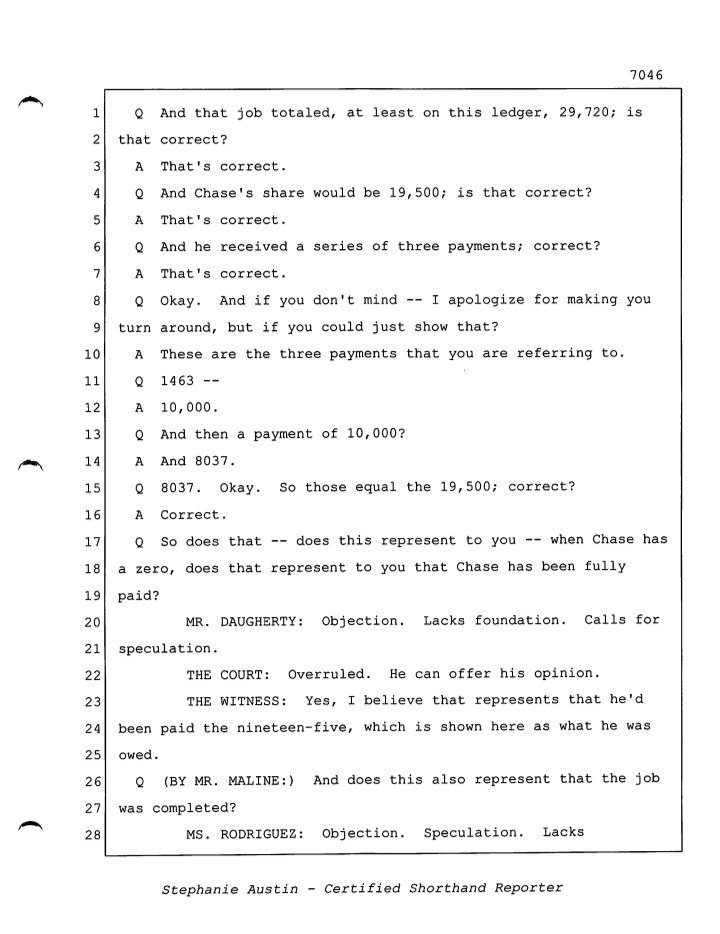
On Joseph’s ledger, the whole job was $29,720, and my share was $19,500. (RT 7046:1-5)
See the trial transcript (RT 7046)
The invoice, which Joseph called her “invoice/contract,” set out when she had to pay. Half came with the order. The rest was due before the water wall left for delivery: (Bates 003419, 003421)
See the page (Bates 003419)
PAYMENT
1. Payment Terms: 50% deposit required at time of order ($14,860). Balance due prior to shipment. Visa/MC/Amex/Wire Trans Accepted.
Make check payable: Earth Inspired Products
2. Submittal/approval drawings are included in quoted price.
3. Please allow “minimum” 6 weeks fabrication lead time after approval of drawings.
4. Lead time contingent on factory load at time of release, product complexity, and material availability.
See the document (Bates 003421)
The same invoice says EIP would deliver and install the water wall itself, and its last page repeats the rule: “50% Deposit Required. Balance Due Prior to Shipping/Delivery.” The installation supervision, $2,900, was a separate charge that “May be paid the day of installation.” (Bates 003421-003423)
See the document (Bates 003422-003423)
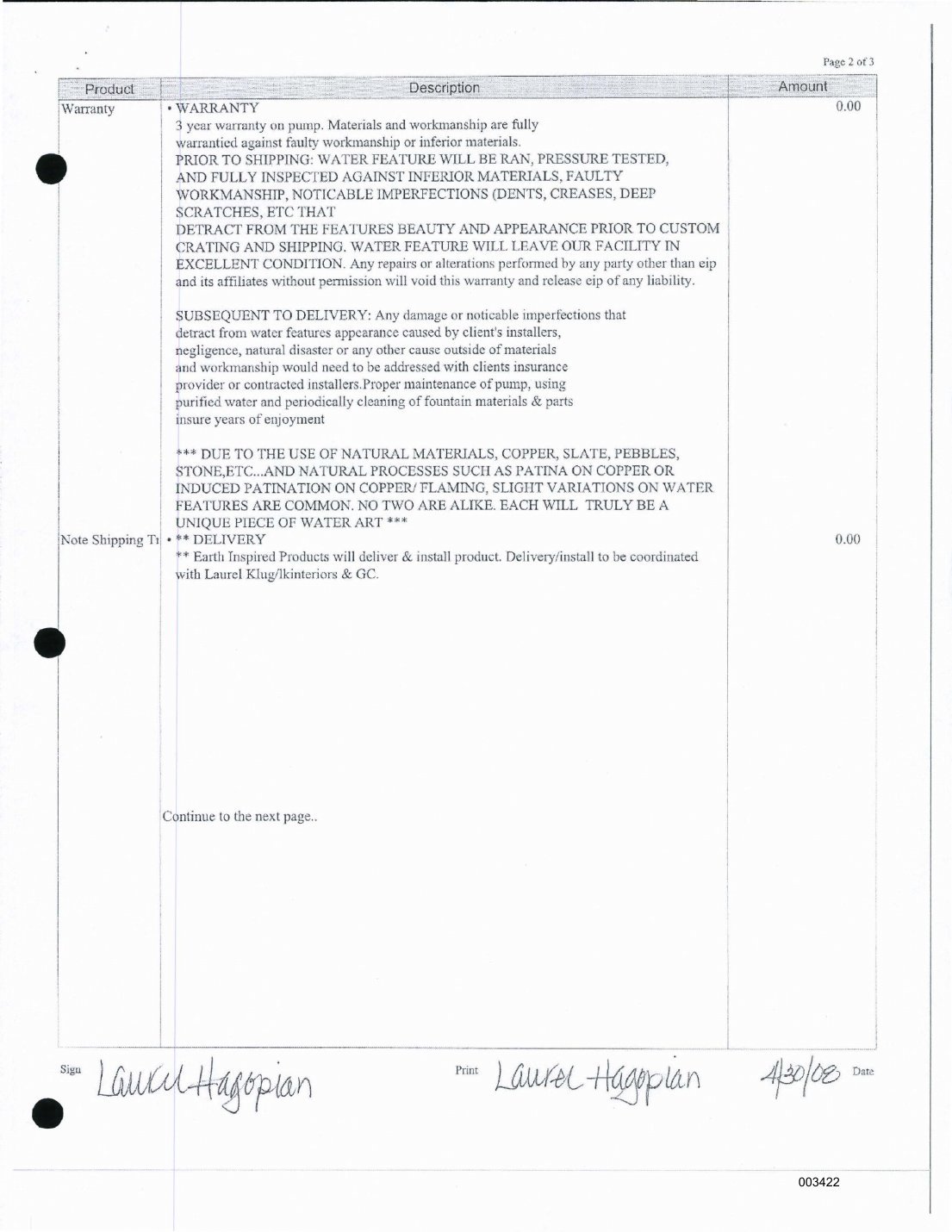
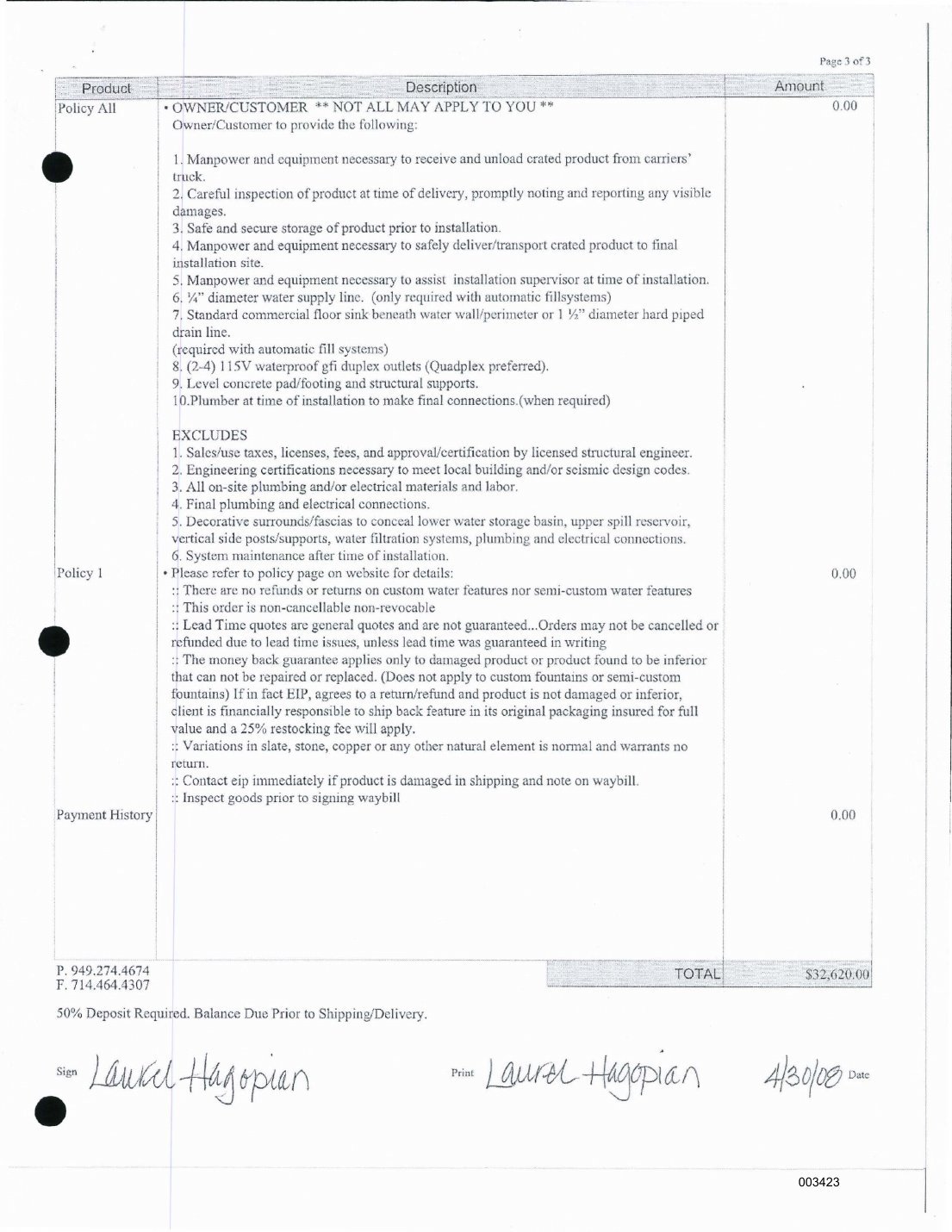
That is the rule Joseph and I were both holding her to in the e-mails below. The final $14,860 was owed before we installed, not after. When she didn’t bring the check, we installed anyway, in good faith, and then stopped further work until the balance was paid.
↑ Back to the menuWhat Joseph wrote at the time
Before the install. On June 30, 2008, Joseph wrote to Laurel Hagopian. He said a partial install was fine, and asked her to have the final payment ready for me that day: (E-mail, June 30, 2008, Bates 002320)
Hi Laurel,
Apparently, Chase is ready to install…=He mentioned a “partial install”….which is fine, but just so you know.=.. whether partial or full, we’ll need the final balance of $14,860 fo[r] the waterfeature…. Can you have a check ready the day of install and gi[v]e to Chase?… The other fee is directly to Chase for “Professional Instal[l]ation Supervision: $2900…. You can pay directly to him. If he’ll accept [p]artial thats fine. Discuss with him….
Give Chase a call (909-374-0102) to dis[c]uss the above aspects & make install arrangements…
Sincerely,
Joseph
See the document (Bates 002320)
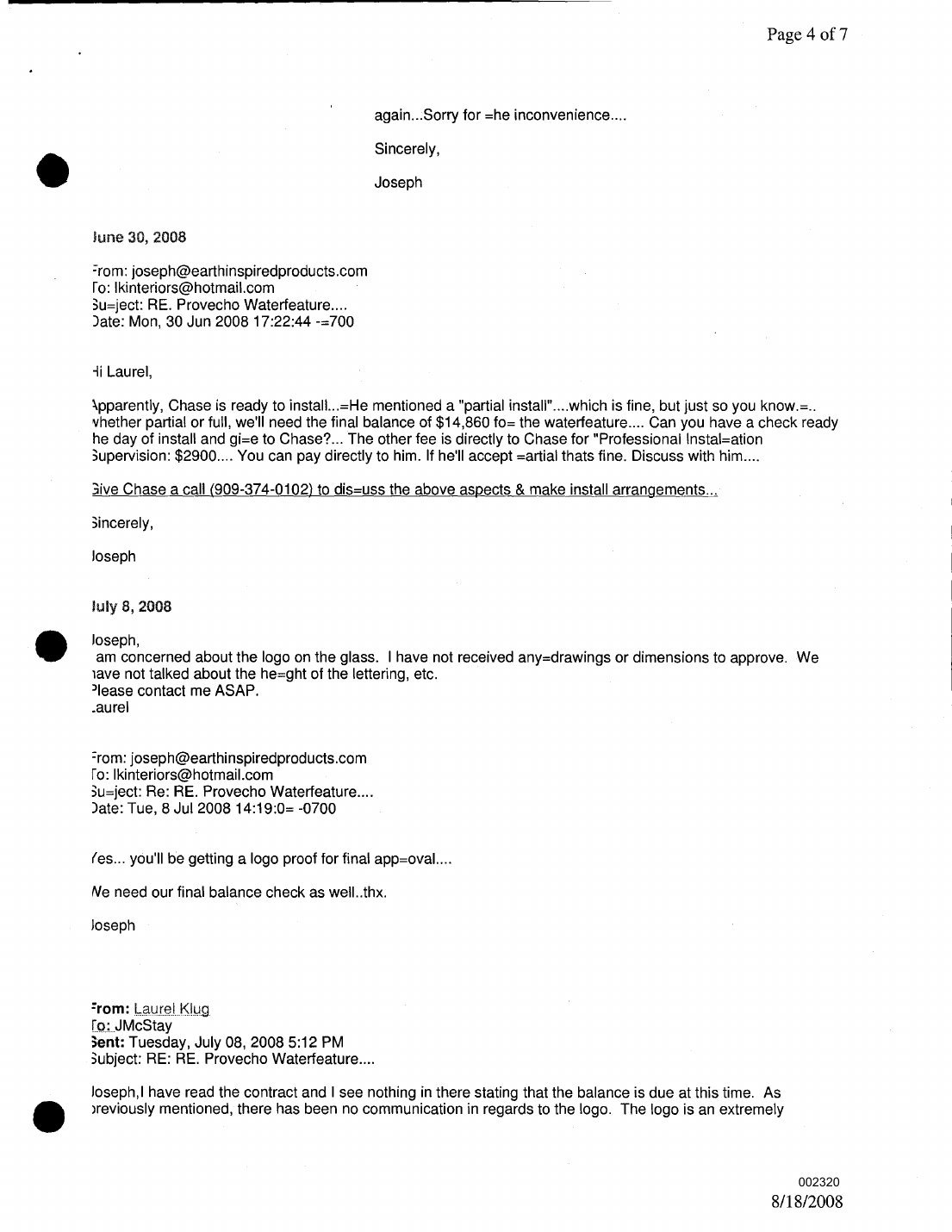
(The printout of these e-mails shows ”=” where a character was lost when they were printed. Where the missing letter is clear, it is restored in [brackets]. Where it isn’t, the ”=” is left as printed.)
After the install. Five days after the install, Ms. Hagopian wrote that she saw nothing in the contract making the balance due yet, that I had held up her construction, and that she couldn’t reach me. I answered the next morning. My e-mail was addressed to her and sent to Joseph: (E-mail, July 9, 2008, Bates 002321)
From: chase merritt <idesign4u1@yahoo.com>
To: JMcStay <joseph@earthinspiredproducts.com>
Sent: Wednesday, July 9, 2008 7:57:29 AM
Subject: Re: RE. Provecho Waterfeature….WTF!!!!!!!!!!!!!!
Laurel, I in no way held up your installation of your drywall or anything else for that matter. It has been over two weeks since I met with your contractor, plumber and electrician, and since that meeting, where all the criteria for this feature was outlined in detail, NOTHING on the wall, plumbing, or electrical had been accomplished prior to my installation of the hood and trough. Even though you voiced that it was imperative that I get it installed right away so the drywall could be completed up top. Our conversation prior to the installation of these units was that you would meet me there with a check the morning of, and conveniently you did not show up until after we left the site. I have, in no way been unavailable to you, either by phone, or E-Mail. This project has progressed even faster than we had discussed was necessary and I do not appreciate the YOUR lack of planning being directed in my direction. As discussed, We do require full payment prior to installation of this project, not after installation as you stated in your E-Mail. You told me directly that you would have a check ready for me when I was there installing, which is obvious that you had no intention of. I don’t appreciate your accusations of unprofessionalism when we have been on top of your project diligently from the onset. I will not proceed any further with this project until the feature is paid in full, including the installation costs. We gave you a great price for this feature, and one of the ways we are able to do so is because we protect ourselves from nonpayment after the feature is installed by requiring payment prior to installation. You were amicable to this fact throughout this process and only now are trying to change direction. Our contract clearly states that full payment is to be made PRIOR to installation. If you have any question, please feel free to call me at any time. At this time, We are suspending any further progress with this project until you have fulfilled your obligation. And concerning the trough, The glass is supposed to be 3” from the back of the feature, that is where the drawings clearly show and where we discussed in detail with your contractor and architect. The plumber and I thoroughly discussed the issues with the plumbing and, at least on this end, there is no confusion about how it is supposed to happen. I have no idea where you are coming from with these issues but I assure you that everything on this end is thoroughly understood and implemented. I talked to your plumber in conjunction with your contractor so there would not be any confusion and if there is, I can assure you that it is not on this end. The look of the stainless trough is just as you ordered, except for the fact that the protective coating has to be removed after everything else is done, but I explained this to you over the phone. Again, our contract clearly states that the payment is to be made PRIOR to delivery and install. I am assuming that you did your due diligence on the decision to use us for this feature and that you decided to do so because we were the best choice, not only for price, but for quality and service. So, why is all this becoming an issue now? I have to assume the worse, and in so doing, I apologize ahead of time if this offends you in any way. But I will not proceed with this project any further until joseph is paid and the install fee is paid according to our contract. Again, I apologize if this seems a bit direct, but the reason we can do this feature at this cost is because we are thorough with our contracts and our way of doing business in general. please respond as soon as possible, because joseph actually requested that I not come tomorrow if the financial issues cannot be settled.
thanks, chase
See the document (Bates 002321)
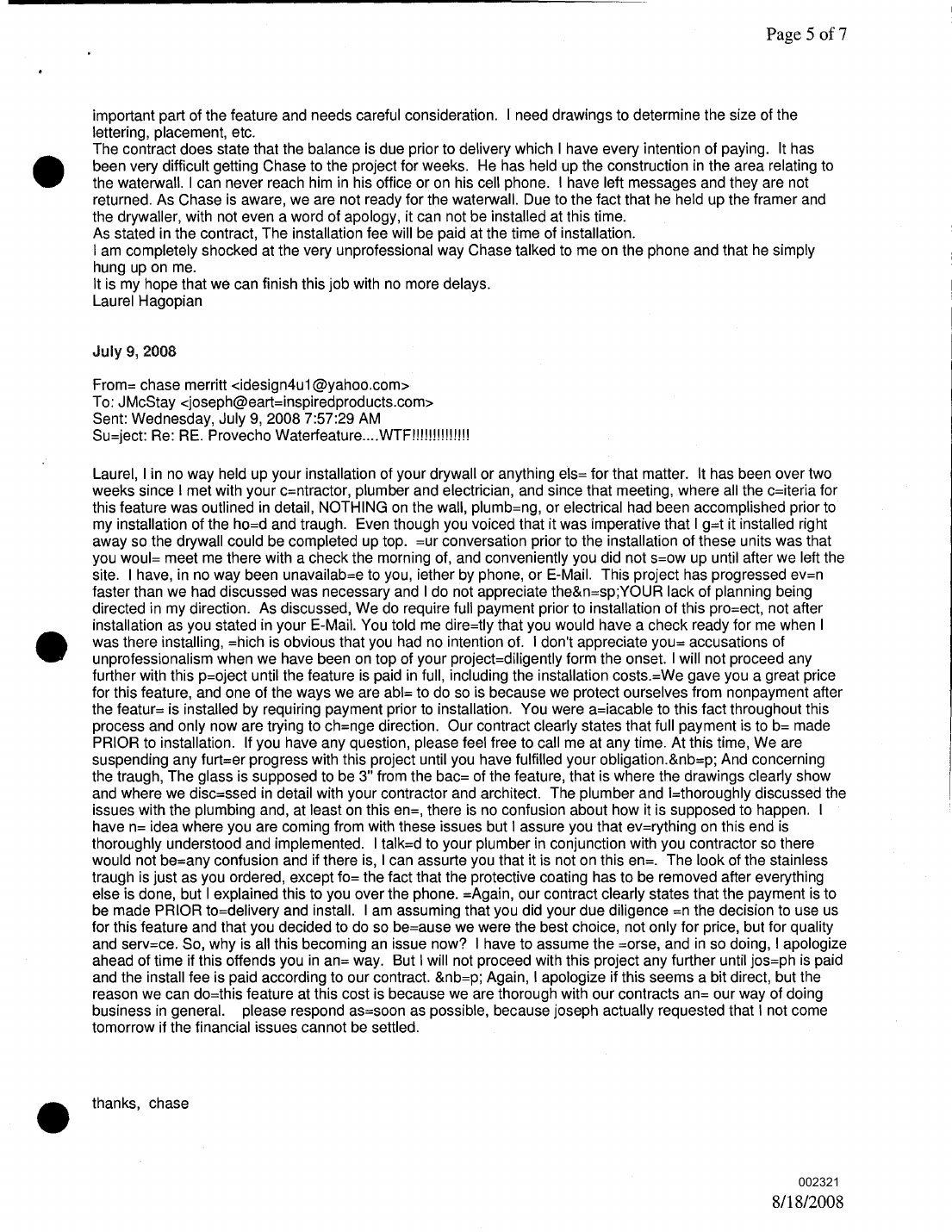
(In this e-mail of mine, the letters lost in printing are restored and my spelling is corrected. Nothing else is changed.)
In the printout of these e-mails, Joseph’s own answer to her comes right after mine. It isn’t dated, and it goes through her complaints point by point: (Bates 002322)
From Joseph:
Please review your original quote (attache[d]) and you invoice/contract:
1 The email quote [c]learly states: 50% deposit to to begin. Balance due prior to shipping!
2 Invoice/Contract[:] under line item “payment” Balance due prior to shipping. I person[a]lly emailed you regarding the final balance. Chase also, discussed with [y]ou prior to initial installation the “final balance.” You agreed and were [t]o have a check upon Chase’s arrival. Upon arrival, no check, no Laurel[ ]to be found. Is this done in Good Faith? Not a Part, Not even a screw,[ ]much less a waterfeature would leave ANY of our competitors factories with[o]ut the final balance paid in full. The same policy holds true to MicroSoft[,] McDonald’s, etc… and the list goes on and on of past project[s]… The same policy applies to you as well. You fully knew the terms upon [i]nitial contact, via email and your contract…yet chose not to follow. Y[o]ur “intent” means nothing to us….As far as we are concerned, you showe[d] your “intent” when your 1) knew the terms 2) agreed to the terms 3) did n[o]t follow terms you agreed to…
3 We worked off off“your own shop drawings submitted to us by you and your architect”….Please review your own drawings… The Glass is to be 3” from backside of reser[v]oir. Outside of your drawings, cetain aspects such as overall height, [w]idth, etc…may change to accomodate your particular situation, yet wo[u]ld only be changed if approved by your GC or architect.
4 Due to your pati[c]ular situation and Chase having to meet with your GC & architect on occasion to come up with the “final design & dimensions” I could not [c]omplete your “logo proof” until I had these final dimensions. Now, I hav[e] the final dimensions, more importantly the final “overall glass visibli[l]ity” to complete logo variations for approval.
5 Chase met with y[o]ur “people” weeks ago giving them final instructions…..“None” of the ins[t]ructions were followed, nor completed….“NONE.”
6 Chase has physic[a]lly met you/your people on site (4) times. We have done everything in Good[ ]Faith….We would like it reciprocated.
7 Chase will be ha[p]py to meet with you and your people on site and I will be happy to complet[e] your logo proof for approval. And we will be happy to arrange the final i[n]stall….but, Final Balance must be paid before we proceed any futher pe[r] contract/agreement. If check is available at time of appointment, fine.[ ]If not, will have to meet once final payment received.
Please call Chase to discuss 909-3[7]4-0102
or myself 949-295-7451
See the document (Bates 002322)
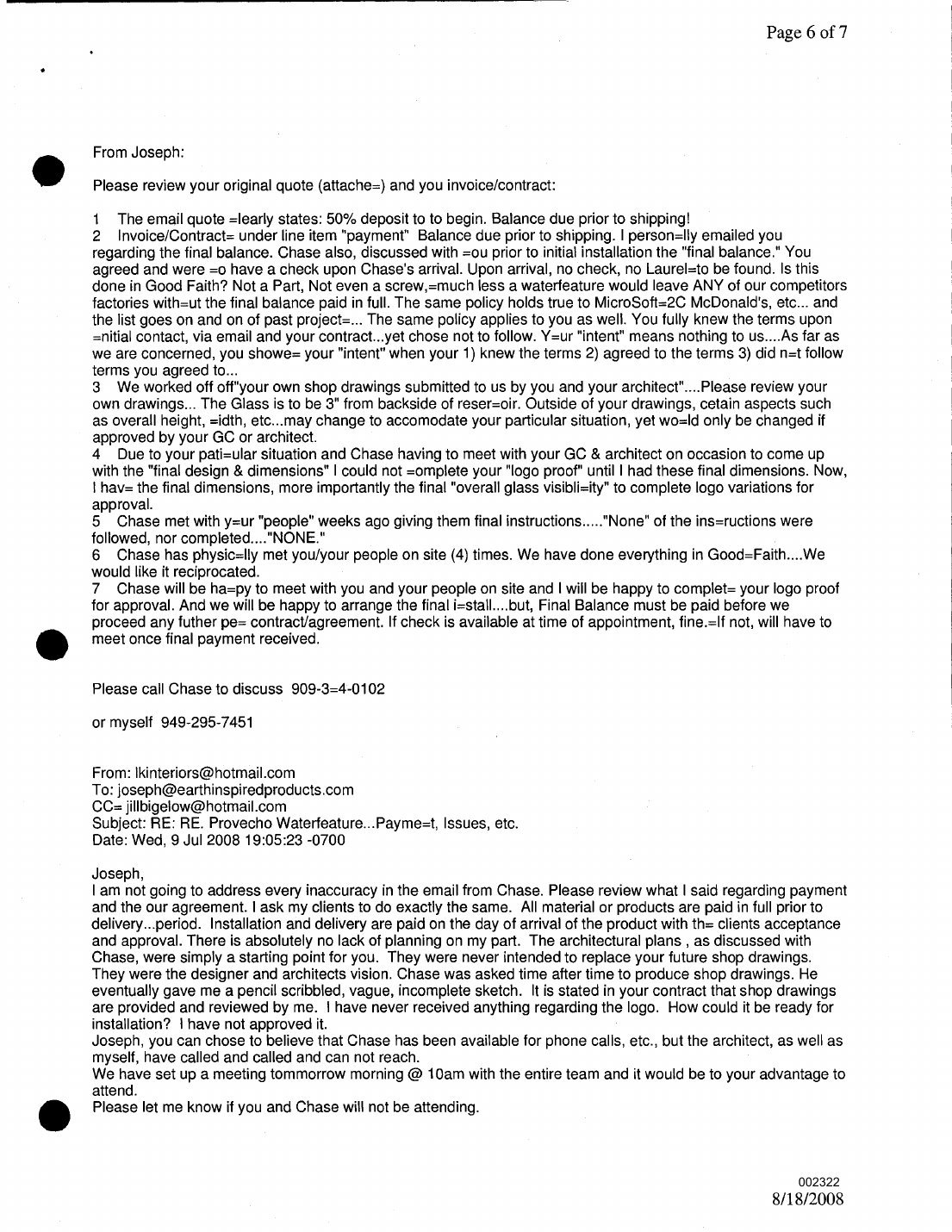
In his answer to her, Joseph defended the job and blamed the client for not paying. In his letter to PayPal, just below, he wrote that both his company and mine “take great pride in our quality of work.”
To PayPal. When the client took the deposit back, Joseph disputed it. This is his letter to PayPal, dated August 18, 2008, in full. It names me as the fabricator: (Bates 003419-003420)
August 18, 2008
Paypal Case ID(s):
PP-528-596-171
PP-528-589-266
Parties:
Seller: Joseph McStay/Earth Inspired Products (EIP), Owner/Operator, 949-295-7451
Buyer/Client: Laurel Hagopian/Provecho Restaurant, Representative/Interior Designer, 626-233-0409
Fabricator: Chase Merritt / I Design 4 U, Engineer, 909-374-0102
To Whom It May Concern:
EIP categorically disputes this chargeback. It is completely unwarranted. We have acted in “Good Faith” and in complete compliance with the contract governing this transaction. As a matter of fact, we have gone “well beyond” are normal call of duty with this client. All was amicable with the client, until we arrived to install the majority of the water feature and the client did not provide us with the final balance due as agreed upon as per contract. It is our contention that the client had no intention of actually paying for the waterfeature and this is a case where someone thinks they “can have something for nothing,” and disregard or ignore an executed contract with no consequences. Both EIP and I Design 4 U are small companies that take every project quite personal and take great pride in our quality of work and personal attention we give each and every client. This client essentially was “in our back yard” and we took even greater attention with over 5+ on site personal visits, which is not the case with most of our out-of-state clients.
The Client is Purchasing a ONE OF A KIND FULLY CUSTOM WATER FEATURE. IT WAS MADE SPECIFICALLY FOR THIS CLIENT TO SPECIFICATIONS. (See Executed/Signed Contract) The amount $7430 and $7430 totals = $14,860. This is the 50% deposit required at time of order as per contract. Laurel Hagopian signed, printed & dated all pages of the contract, thus agreeing to the terms. Please note the following in the contract:
~ Under Payment, Payment Terms: 50% deposit required at time of order ($14,860). Balance due Prior to Shipment!
~ Under Policy 1: There are no refunds or returns on custom water features…
~ This order is non-cancellable non-revocable
Please see attached: 1 Signed/Executed Contract; 2 Architect Drawings; 3 EIP Logo Proof; 4 Email Correspondence; 5 Delivery & Installation Statement by Chase Merritt of I Design; 6 Pictures of Fabricated & Installed Lower Reservoir & Upper WDS & Hood
Statement of Facts:
1. On or about April 17, 2008, EIP was contacted by Laurel Hagopian. She expressed how she was dissatisfied with another manufacturer she was working with and would like a quote. (see email date April 17th, 2008) She sent drawings for review.
2. EIP emailed Laurel Hagopian a Quote (see attached quote). The quote clearly communicates payment terms, etc.
3. Chase Merritt from I Design made an “on site visit” with Laurel Hagopian, GC, & Architect at Provecho Restaurant. We also requested info to complete invoice/contract. (April 24th email)
4. April 30th, 2008: Laurel Hagopian emails eip executed contract and credit card info for deposit.
5. Issue with Credit Card provided by client 4/30 – 5/14. (see email string)
6. On or about June 30th, Chase from I Design informed us that Laurel Hagopian required us to do a “Partial Install”. She insisted we install (2) Main Components of the water feature. The bottom reservoir and the upper hood/WDS. The (2) Main Components make up approximately 85% of the entire feature! The last major component is the glass panels the water cascades down. The bottom reservoir & upper hood/wds would be “Permanently affixed/attached to the structure.” I immediately emailed Laurel Hagopian(see June 30 email) letting her know “whether partial or full install” final balance would be due and to please have a check ready upon arrival…
7. The Install is arranged for July 3rd 2008. Chase Merritt from I Design spoke to Laurel Hagopian prior to the install where she assured us that a check “would be ready” and she would be there as well on arrival. No Check and No Sign of Laurel Hagopian upon arrival! In good faith, we continued the install assuming Laurel Hagopian would arrive before completion. She conveniently, never arrived with check as agreed upon. (See statement, pics, etc. supplied by Chase Merritt of I Design)
8. 5 days after the install (see July 8 email) we receive an email from Laurel Hagopian stating how she hasn’t received a “logo proof” note her only concern with the water feature was the “logo”, size, positioning, etc….We respond assuring her that she will receive a “logo proof” to approve. We also request the final balance once again. (See Logo Proof Emailed to her)
9. (July 8 email) Laurel Hagopian writes how she doesn’t see where the “final balance is due at this time…” yet, she then recognizes… “The contract does state that the balance is due prior to delivery which I have every intention of paying” see the contradiction? She notes her concern with logo again and that Chase was holding up the drywaller & framer. Keep in mind we installed the (2) Main components as described above weeks ahead of schedule! Nothing has been held up! (See Chase Merritt’s response in email dated July 9th) to Laurel’s false allegations!
10. Laurel Hagopian requests that Chase of I Design and I (eip) attend a meeting on site July 10th, 2008. She mentions “delays” yet we were weeks ahead of schedule. Concerned glass “in back instead of front“…. Keep in mind, we were working off Her Own Architects Drawings to “EXACT SPECIFICATIONS.” Apparently, Laurel Hagopian does not know how to read her own architect’s drawings! (see attached) NOTE: Normally EIP will supply shop drawings for client’s approval. But often times, clients will forego our drawings and have us work off of their architect’s drawings and/or verbally as design changes arise. This is the case in this transaction. That is why Laurel Hagopian insisted we install (2) Major Components on July 3rd, 2008 without any shop drawings approved by her. Her only concern was the importance of a “logo proof – drawing” which we were supplying. (see attached)
11. Also note: This chargeback was initiated on August, 14 2008 due to “damage” or “not as described.” Again, the waterfeature is made to her Architect’s specifications and is BRAND NEW….And….Laurel Hagopian accepted the Goods on July 3rd, 2008! Almost 1 ½ months has transpired since the install! Why weren’t we informed via email, phone call, etc…of ANY ISSUES she may have had within this past 1 ½ months? No Communication has transpired! We have been waiting for final approval of logo to complete the glass etching AND scheduling the final Install!
Again, we have had every intention to complete this project, knowing all would be satisfied and enjoy its beauty. This is a one of a kind custom fabricated water feature in which there are no refunds or returns. Both parties are contractually bound to perform. We have and will perform 100%, despite the client ignoring the executed contract.
See the document (Bates 003419-003420)
Joseph’s letter lists, as attachment 5, a “Delivery & Installation Statement by Chase Merritt of I Design.” This is that statement, my own letter to PayPal, dated the next day: (Bates 003424)
I Design 4 U
8/19/08
To Whom it may concern:
Concerning the manufacturing and subsequent install of a custom built water feature at the Provecho Restaurant at 800 Wilshire Blvd. Los Angeles, Ca. as ordered by Fox East Interior design at 3280 Linda Vista Rd. Glendale, Ca.
I received this order through Earth inspired Products on or about 5/16/08 and processed through on the same day. Production of this unit was completed per detailed instructions of clients architect and was ready for install on or about 6/29/08 and client was informed of readiness. Laurel Hagopian @ Fox East Interior Design then informed us that they would like to have installation as soon as possible but wanted the glass of this feature to be installed later in the project because of concern of breakage and space constraints with kitchen appliance install. She was then informed of the requirement of full payment to both Earth Inspired Products and to I design for the installation costs. Client then agreed to meet us at the jobsite to deliver the final check prior to install. When we arrived at jobsite, the client had not yet arrived. A phone call ensued whereby client advised us of traffic and appointment constraints and assured us she would be at site before we finished install to give us the check. So, in good faith, we proceeded with the install as planned. After the completion of the install the client had still not shown up. We phoned her to get an E.T.A and got no answer on either of her phone #s. We had other business to attend to, so we advised Joseph McStay at Earth Inspired Products of the completion of our work and the no show of the client. A subsequent appt. later that week was made to meet with the client and then receive the final payment, but at that appt. the client informed me that a check would not be tendered until the project is complete, even though she was well aware of our contractual policies regarding this. We at I Design performed in good faith, fulfilled the requirements of our contract with client and sincerely believe that this client never had the intention of payment according to Her contract.
** Please see attached photo we took after install
Sincerely,
Chase Merritt
Owner
See the document (Bates 003424)
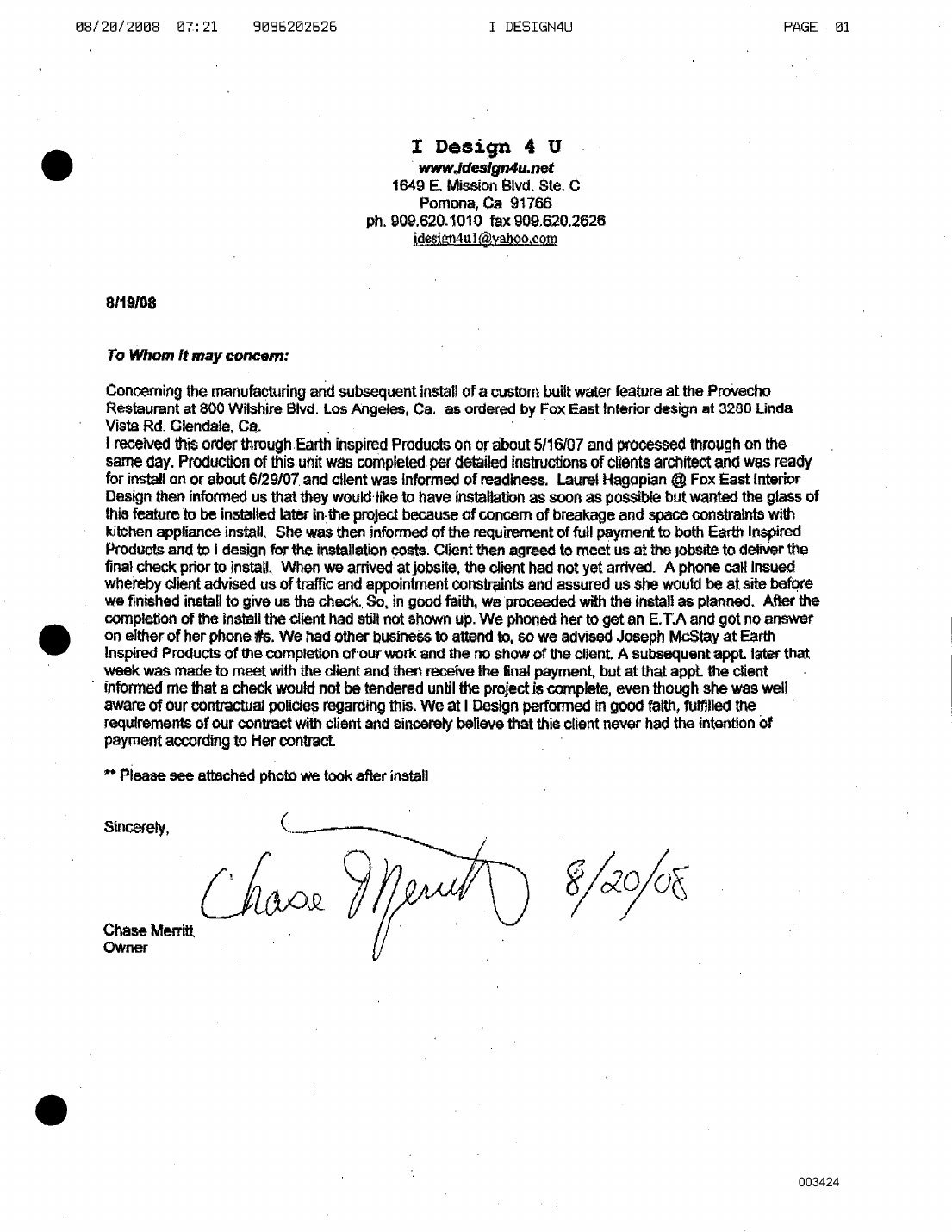
(In this letter of mine, two dates I mistyped as “5/16/07” and “6/29/07” are corrected to 2008, the year of the job, and “insued” is corrected to “ensued.” Nothing else is changed. The copy in discovery is the one I faxed on August 20, 2008, signed that day.)
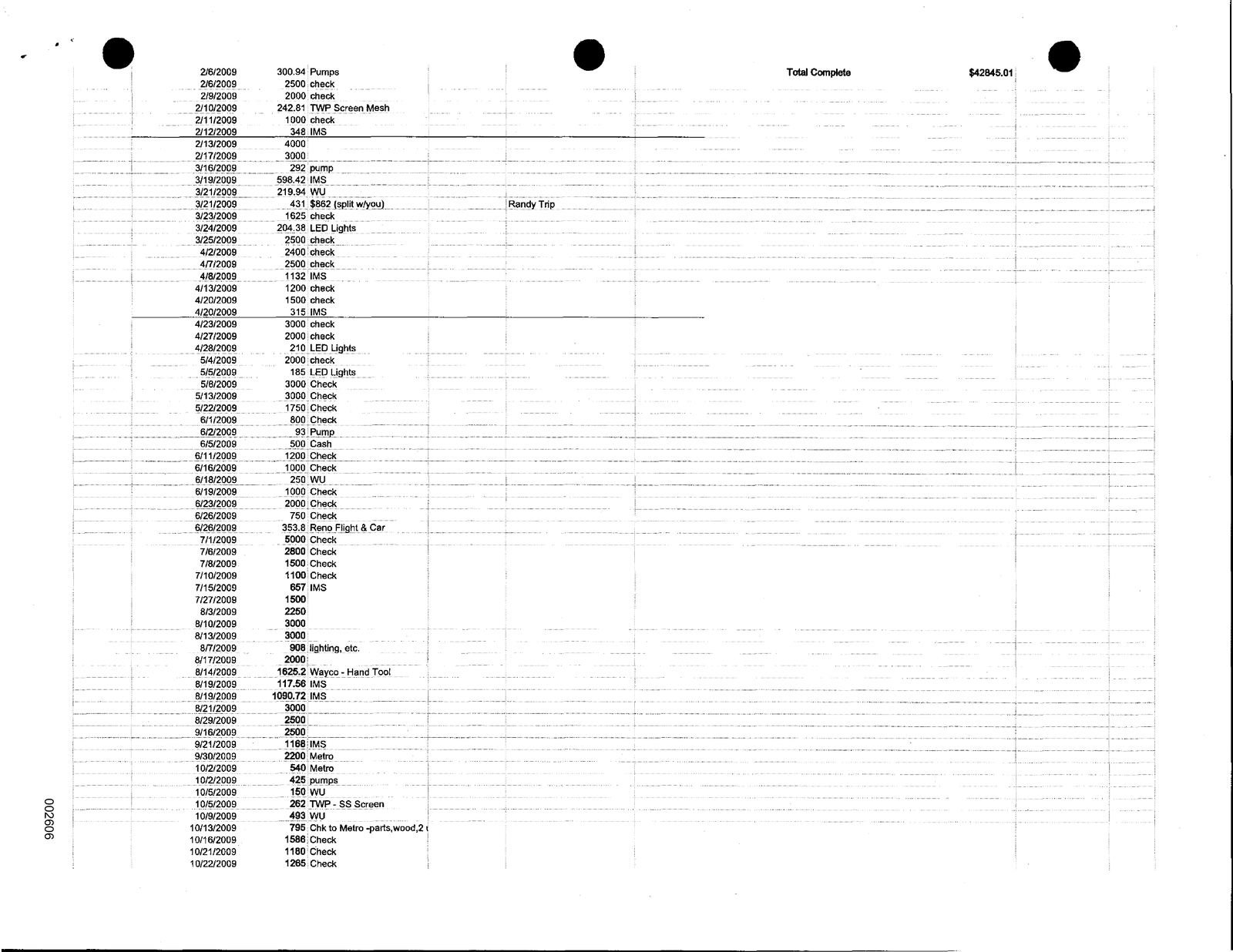
This is Joseph’s state of mind about Provecho, in his own words, written when it happened. He wrote that we went “well beyond” our “normal call of duty,” that the client “had no intention of actually paying,” that her complaints about me were “false allegations,” and that “Nothing has been held up!” He kept giving me his custom jobs after it; his ledgers list my share on job after job through December 2009. (Bates 002604)
See the page (Bates 002604)
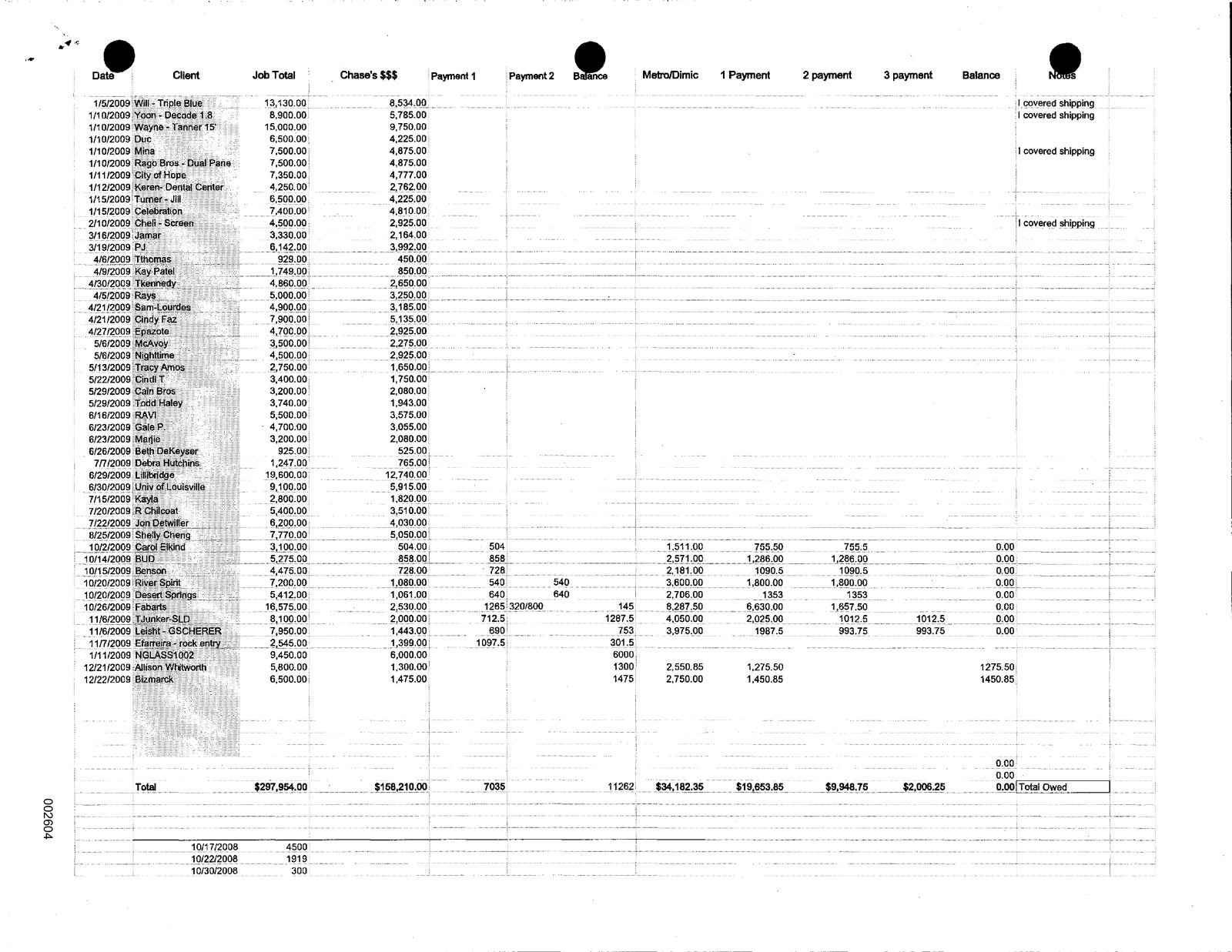
Joseph did not leave his opinion of Provecho for detectives, prosecutors or jurors to reconstruct years later. He wrote it down himself, while the dispute was happening. He defended my work, rejected the customer’s complaints about me, and put the blame on the customer. Then he kept sending me his custom jobs. If the State wanted Provecho to be a reason Joseph was getting rid of me in February 2010, it needed evidence that Joseph later changed his mind. A prosecutor’s description of the job is not that evidence.
↑ Back to the menuHow Joseph kept Provecho in his books
Several amounts come up on this page. Here is what each one was:
- $29,720: the Provecho job total on Joseph’s 2008 ledger. (RT 7046:1-3)
See the trial transcript (RT 7046)
- $19,500: my share of that job, paid to me in full. (RT 7046:4-25)
See the trial transcript (RT 7046)
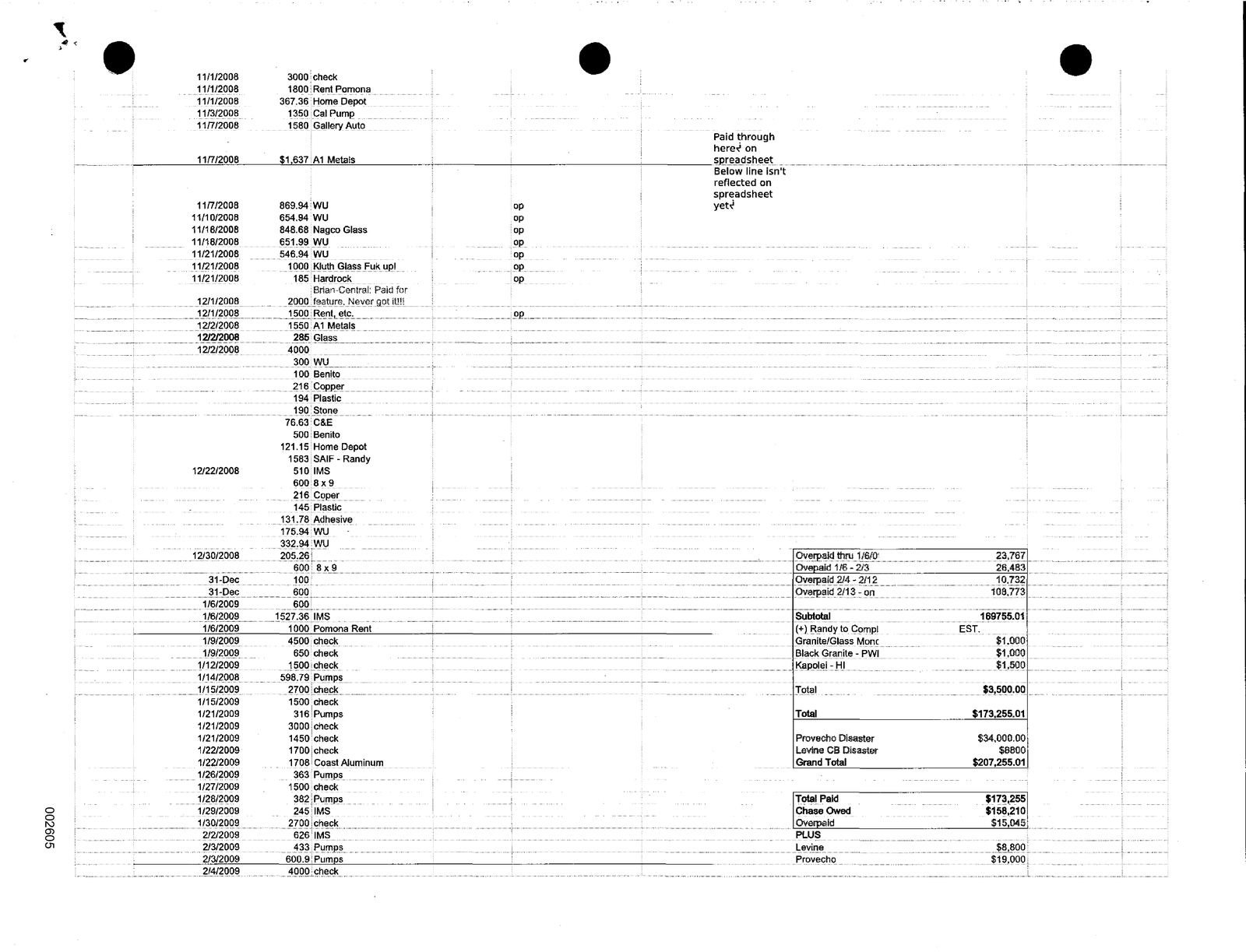
- $34,000: Joseph’s side note, “Provecho Disaster.” (Bates 002605)
- $19,000: the Provecho figure in Joseph’s February 1, 2010 e-mail, and the amount on the jail-visit recording. (Exhibit 419; RT 7165:1-7)
See the trial transcript (RT 7165)
- $15,045: the running balance between Joseph and me on February 1, 2010, which leaves out both Provecho and Levine. (RT 7153:12-28)
See the trial transcript (RT 7153)
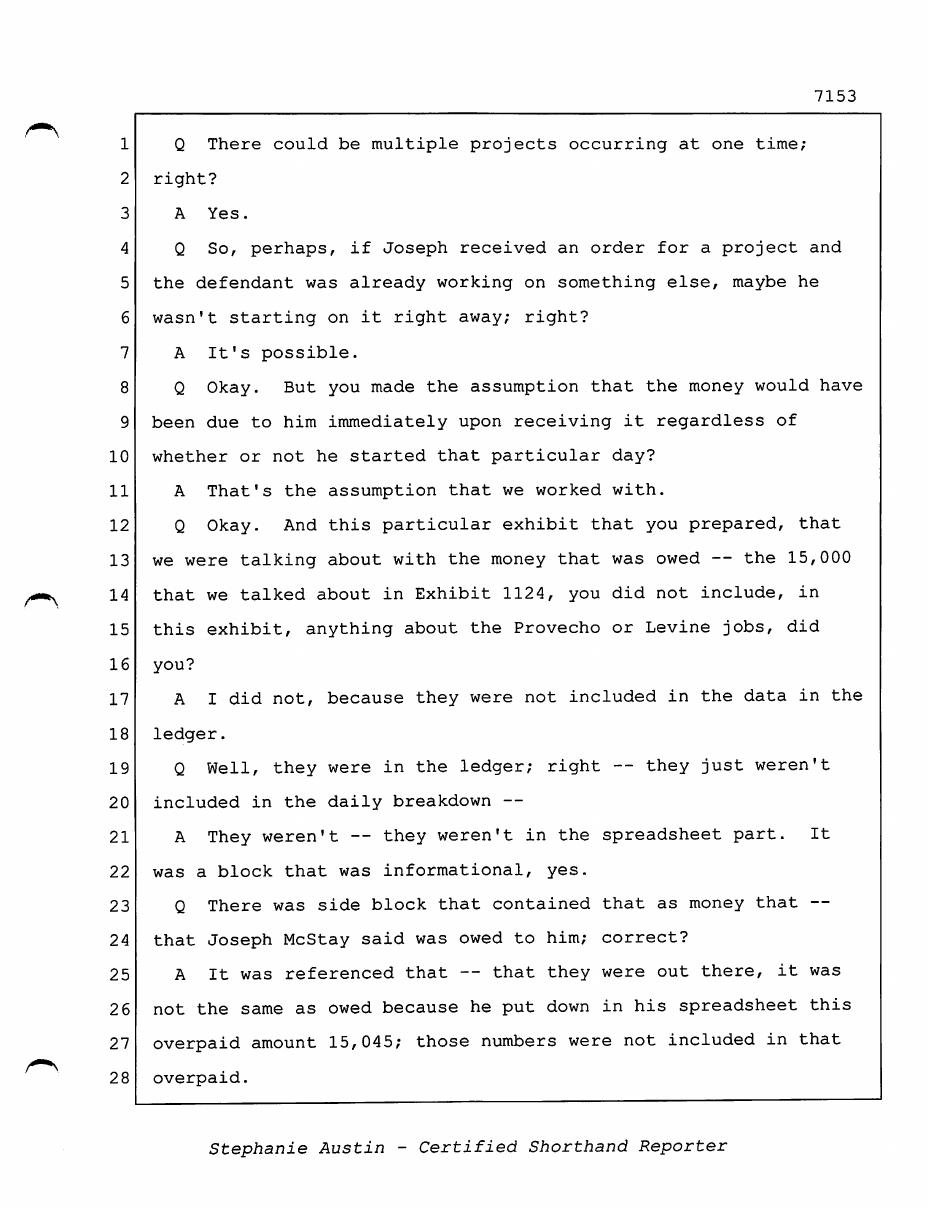
- $42,845: the e-mail’s total once the Levine and Provecho side notes are added to the $15,045. This is what the State called my debt.
See the page (Bates 002605)
See the trial transcript (RT 7153)
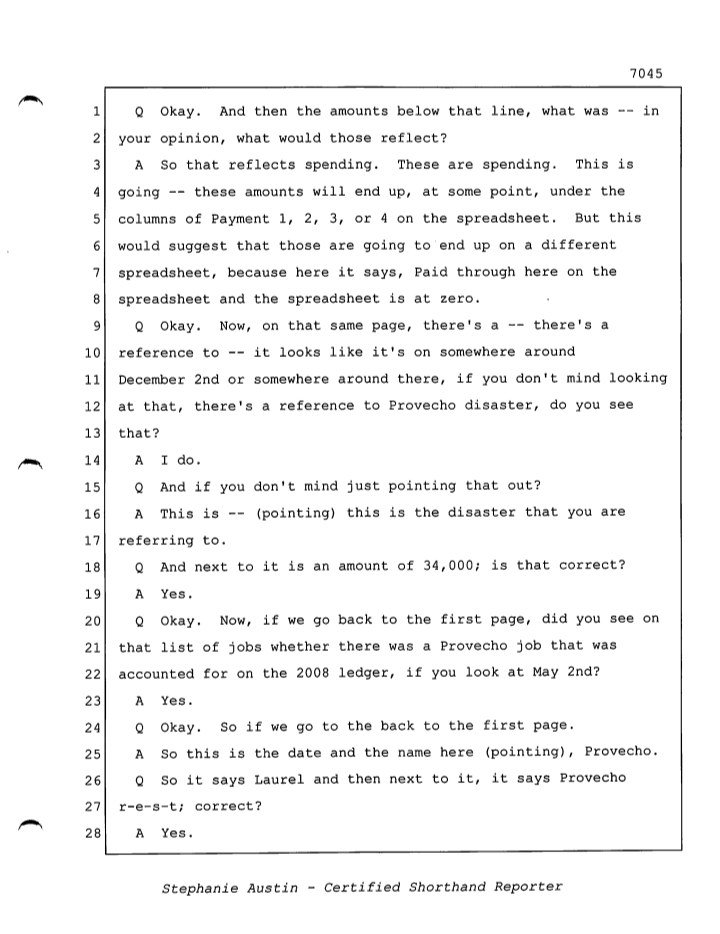
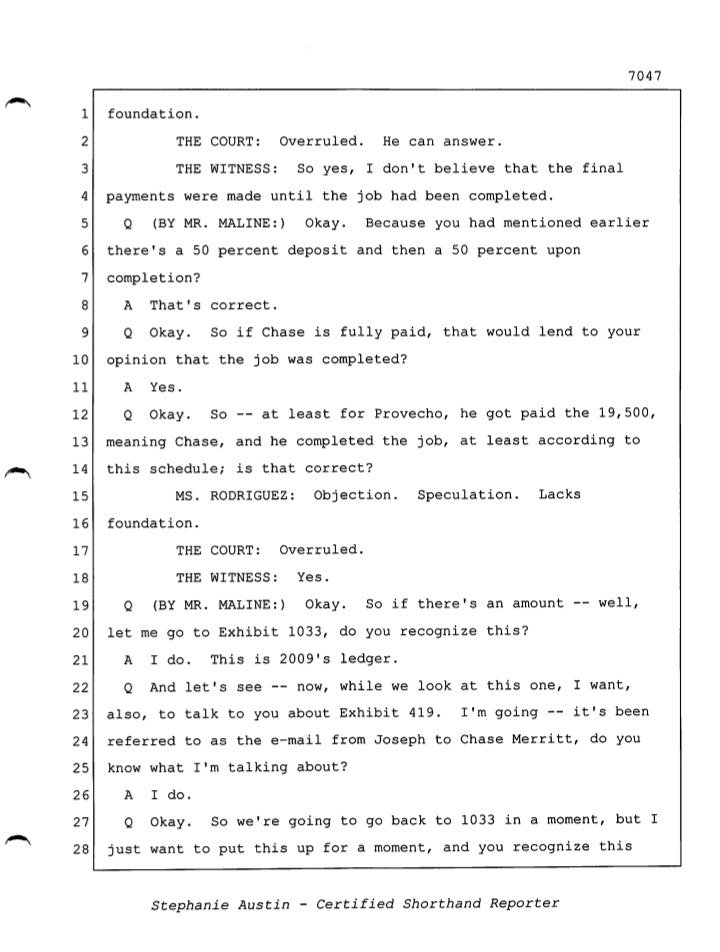
Joseph’s 2008 ledger lists the Provecho job like any other: the job total, my share, and the payments he made me. The defense accountant, Mr. Shogren, walked the jury through it: (RT 7045:20-7047:18)
Q Okay. Now, if we go back to the first page, did you see on that list of jobs whether there was a Provecho job that was accounted for on the 2008 ledger, if you look at May 2nd?
A Yes.
Q Okay. So if we go to the back to the first page.
A So this is the date and the name here (pointing), Provecho.
Q So it says Laurel and then next to it, it says Provecho r-e-s-t; correct?
A Yes.
Q And that job totaled, at least on this ledger, 29,720; is that correct?
A That’s correct.
Q And Chase’s share would be 19,500; is that correct?
A That’s correct.
Q And he received a series of three payments; correct?
A That’s correct.
Q Okay. And if you don’t mind — I apologize for making you turn around, but if you could just show that?
A These are the three payments that you are referring to.
Q 1463 —
A 10,000.
Q And then a payment of 10,000?
A And 8037.
Q 8037. Okay. So those equal the 19,500; correct?
A Correct.
Q So does that — does this represent to you — when Chase has a zero, does that represent to you that Chase has been fully paid?
MR. DAUGHERTY: Objection. Lacks foundation. Calls for speculation.
THE COURT: Overruled. He can offer his opinion.
THE WITNESS: Yes, I believe that represents that he’d been paid the nineteen-five, which is shown here as what he was owed.
Q (BY MR. MALINE:) And does this also represent that the job was completed?
MS. RODRIGUEZ: Objection. Speculation. Lacks foundation.
THE COURT: Overruled. He can answer.
THE WITNESS: So yes, I don’t believe that the final payments were made until the job had been completed.
Q (BY MR. MALINE:) Okay. Because you had mentioned earlier there’s a 50 percent deposit and then a 50 percent upon completion?
A That’s correct.
Q Okay. So if Chase is fully paid, that would lend to your opinion that the job was completed?
A Yes.
Q Okay. So — at least for Provecho, he got paid the 19,500, meaning Chase, and he completed the job, at least according to this schedule; is that correct?
MS. RODRIGUEZ: Objection. Speculation. Lacks foundation.
THE COURT: Overruled.
THE WITNESS: Yes.
See the trial transcript (RT 7045-7047)
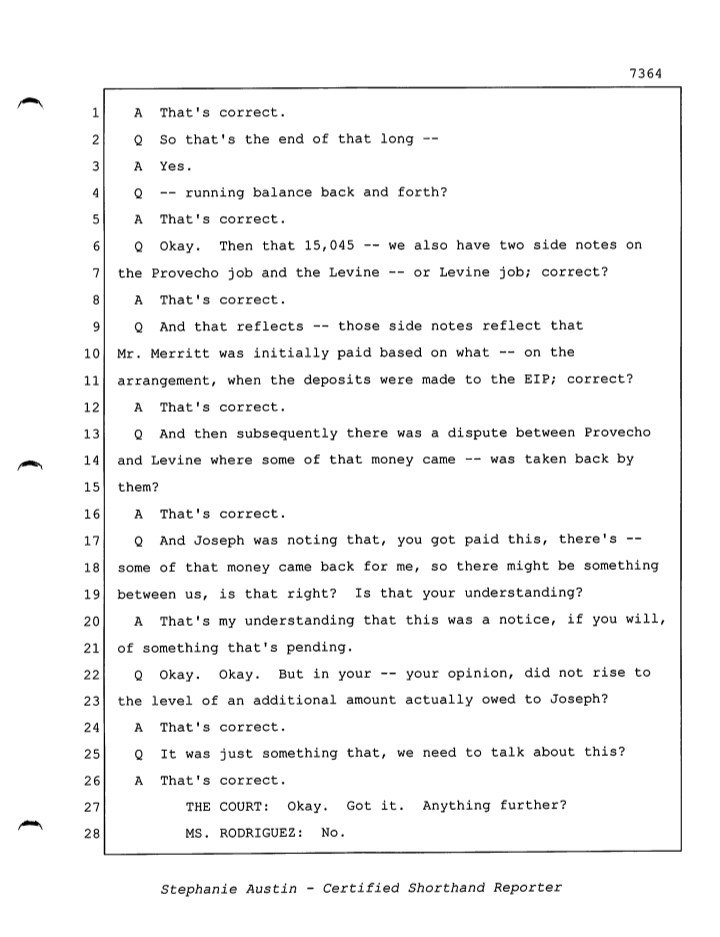
Joseph also kept a box off to the side of his ledger. In it he wrote “Provecho Disaster $34,000.00” and “Levine CB Disaster $8800” (Levine was the other old job named in the February 1 e-mail), and a “Grand Total” that adds the $34,000 to what he had paid me. Below that are the same lines as the e-mail: “Overpaid $15,045,” then “PLUS” Levine $8,800 and Provecho $19,000. The $15,045, the running balance between us, includes neither job. When the judge asked the accountant about those side notes, the accountant agreed they were “a notice, if you will, of something that’s pending,” and not “an additional amount actually owed to Joseph.” That exchange is quoted in full on Closing argument: what they told the jury, card 4. (Bates 002605; RT 7364:6-26)
See the trial transcript (RT 7364) and the discovery page (Bates 002605)
“Disaster” is Joseph’s word. His letter to PayPal says what he thought went wrong: a client who “had no intention of actually paying.”
Joseph’s books say the same thing as his letter: he paid me in full for the job, and he never counted Provecho against me in the balance between us.
↑ Back to the menuWhat the State asked the accountant about Provecho
On cross-examination, Ms. Rodriguez asked the accountant whether the ledger’s zero for Provecho was wrong. The court stopped the question, and he showed the jury why the zero was right: (RT 7155:9-7156:15)
Q I’m going — we’re going to put on the overhead, the 2008 ledger. You started yours from the date of 11/7/2008, your exhibit on the schedule of amounts; right?
A Yes.
Q So in Exhibit 1029, which we will put up on the overhead —
THE BAILIFF: The computer?
MS. RODRIGUEZ: Yes, please.
Q (BY MS. RODRIGUEZ:) Do you have that in front of you?
A I’m sorry. What did you ask?
Q Do you have that exhibit in front of you?
A Well, I can see it on my screen; is that what you were asking?
Q Yes. And do you see that Provecho job there highlighted?
A Yes.
Q So that is included on the spreadsheet?
A I would direct your attention, if you let me see the rest of it, the balance due is zero off to the right. You — you’ve zoomed out so it can’t be seen. You will see that the balance that column —
Q Are you talking about the last column on the side?
A Yes. And it says zero, so at that time there’s nothing owed to either party from that job.
Q Were you aware that that column was incorrect?
MR. MALINE: Objection. Misstates the evidence.
THE WITNESS: So —
THE COURT: Wait, just — just a minute.
THE WITNESS: Sorry.
THE COURT: The objection is sustained as assuming facts not in evidence.
Q (BY MS. RODRIGUEZ:) Did you ever go through and add that column, sir?
A So the — the relevant adding to do to this is the — what adds up to the 19,500. So if you take the 10,000; the 1,463; and the 8,037; those add to 19,500. The zero is correct on that line.
See the trial transcript (RT 7155-7156)
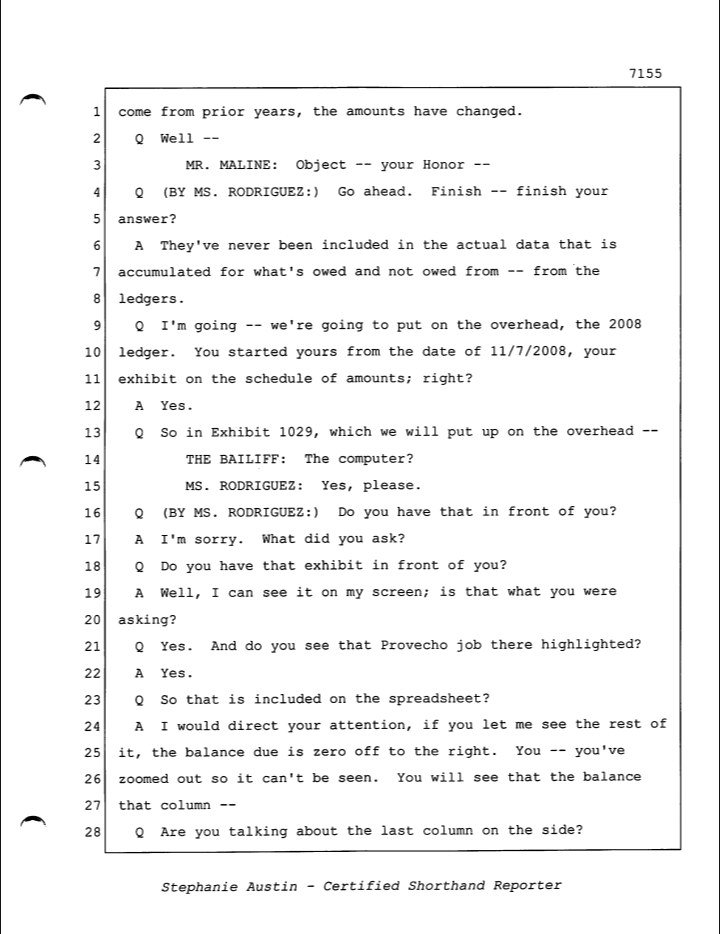
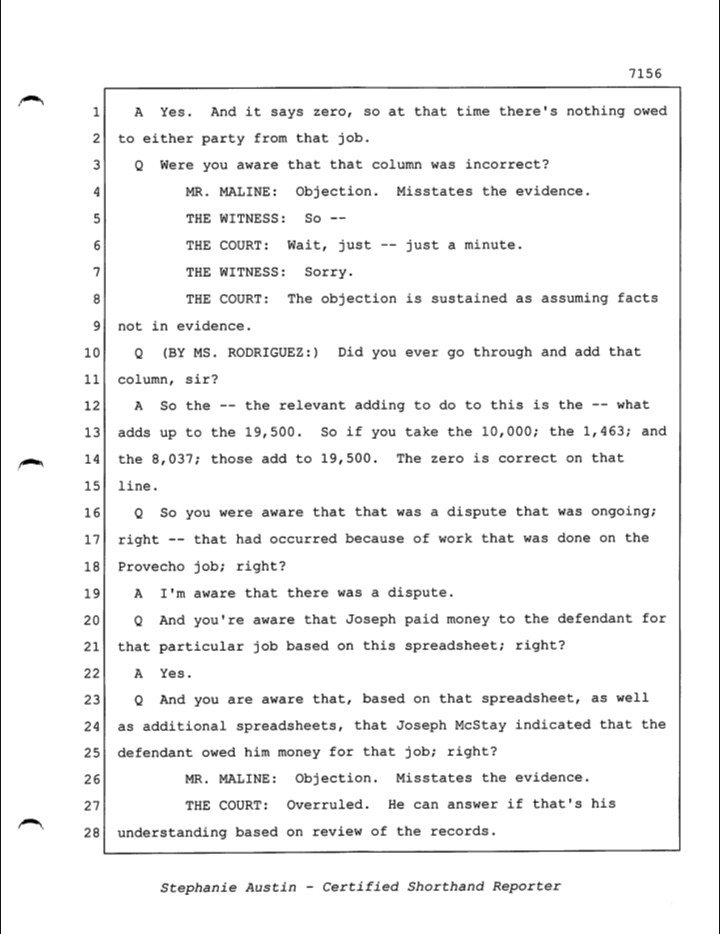
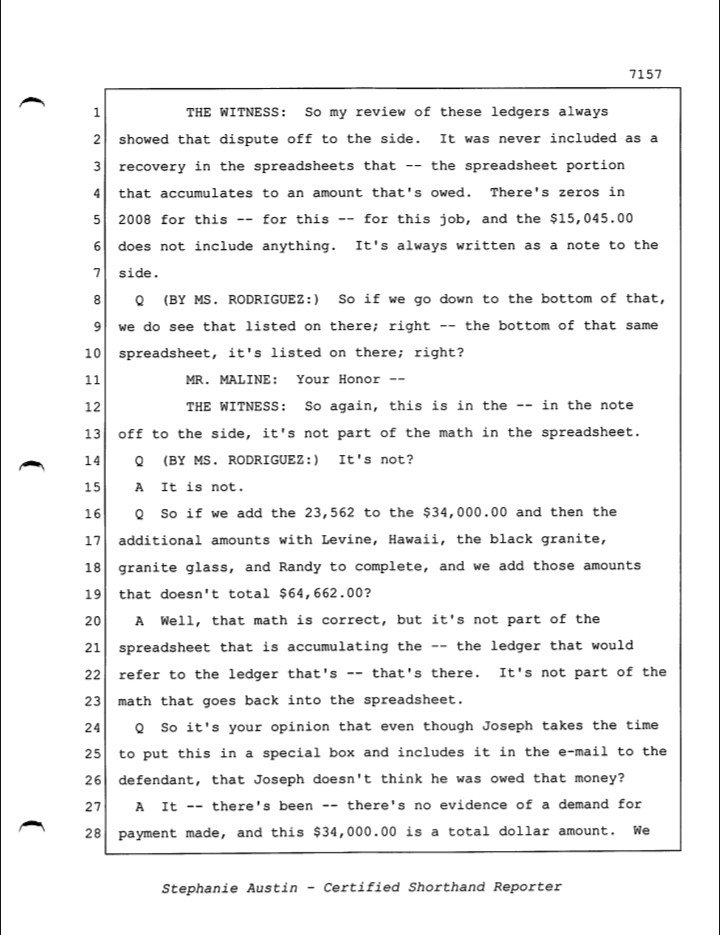
In the accountant’s words, the zero means “at that time there’s nothing owed to either party from that job.” My $19,500 share had been paid in full. Whether the later loss on the job created a debt is a separate question, and on that he told the jury there was “no evidence of a demand for payment.” (RT 7156:1-2, 7046:15-25, 7157:27-28)
See the trial transcript (RT 7046, 7157)
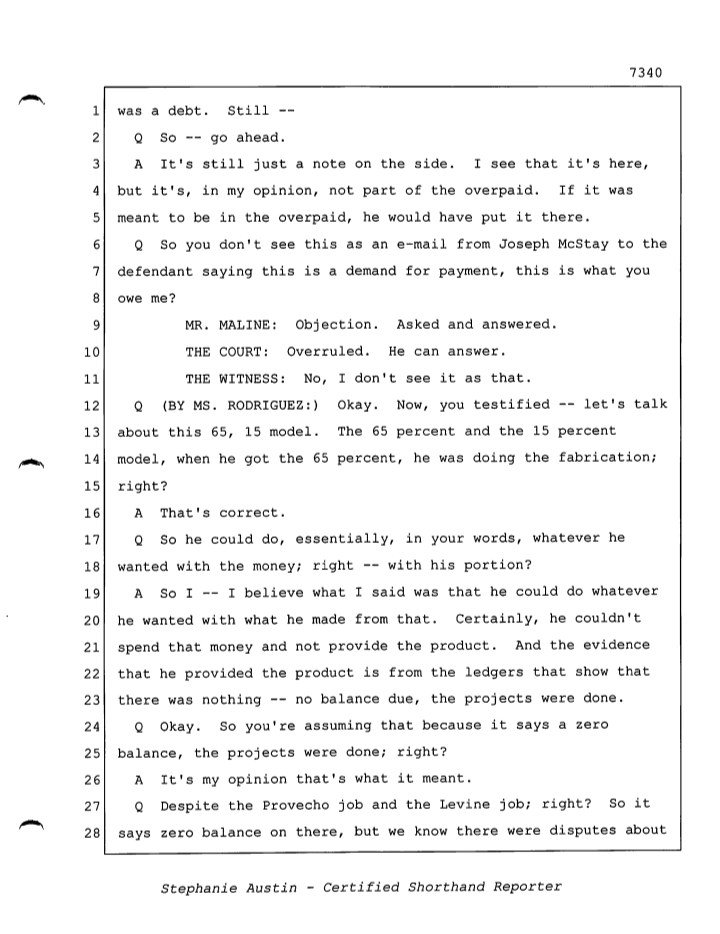
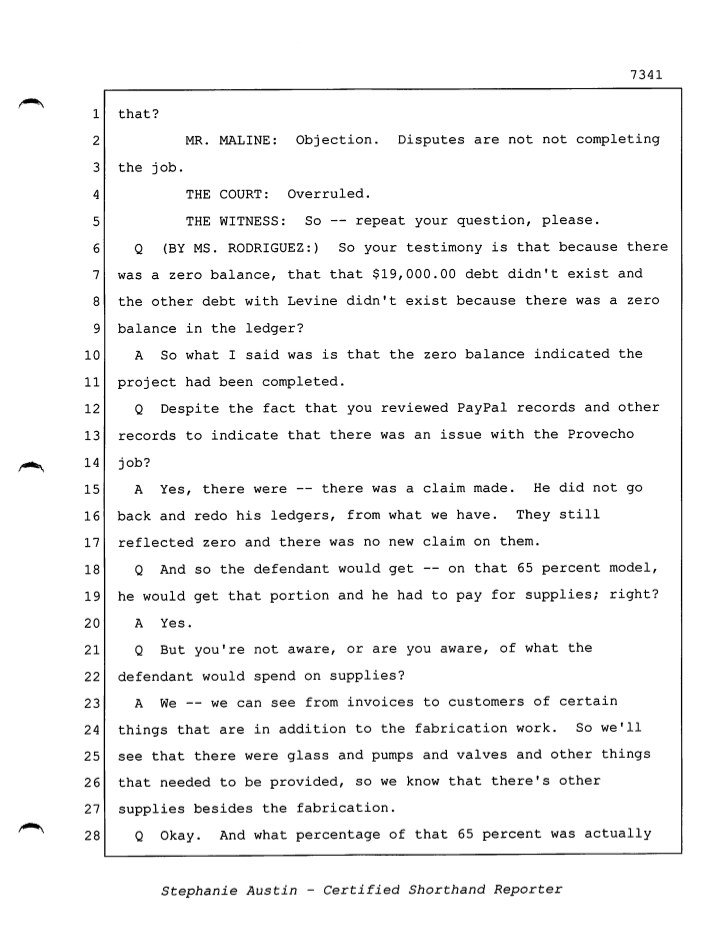
On May 1, on recross, Ms. Rodriguez came back to the ledger’s zeros and asked about the PayPal claim. He answered that, from what he had, Joseph never redid his ledger because of it: (RT 7340:24-7341:17)
Q Okay. So you’re assuming that because it says a zero balance, the projects were done; right?
A It’s my opinion that’s what it meant.
Q Despite the Provecho job and the Levine job; right? So it says zero balance on there, but we know there were disputes about that?
MR. MALINE: Objection. Disputes are not not completing the job.
THE COURT: Overruled.
THE WITNESS: So — repeat your question, please.
Q (BY MS. RODRIGUEZ:) So your testimony is that because there was a zero balance, that that $19,000.00 debt didn’t exist and the other debt with Levine didn’t exist because there was a zero balance in the ledger?
A So what I said was is that the zero balance indicated the project had been completed.
Q Despite the fact that you reviewed PayPal records and other records to indicate that there was an issue with the Provecho job?
A Yes, there were — there was a claim made. He did not go back and redo his ledgers, from what we have. They still reflected zero and there was no new claim on them.
See the trial transcript (RT 7340-7341)
How the State kept calling it a debt
Joseph listed the $19,000 beside the balance between us, never in it. The State treated it as a debt anyway, and kept doing so after the judge told Ms. Rodriguez to ask about it the way he had stated it, with the condition in it.
The State presented the $19,000 as a debt I owed Joseph. Between February and May 2019, it did so four times. Each time, either the judge or the evidence said otherwise. Here is each one, in order.
1. February 2019: the judge reads the e-mail
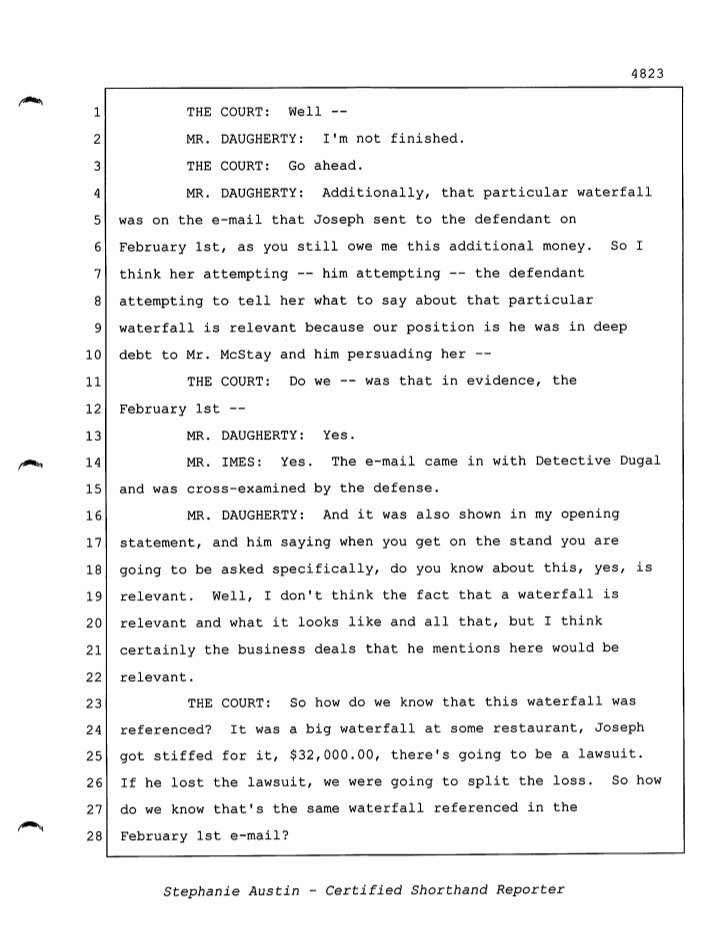
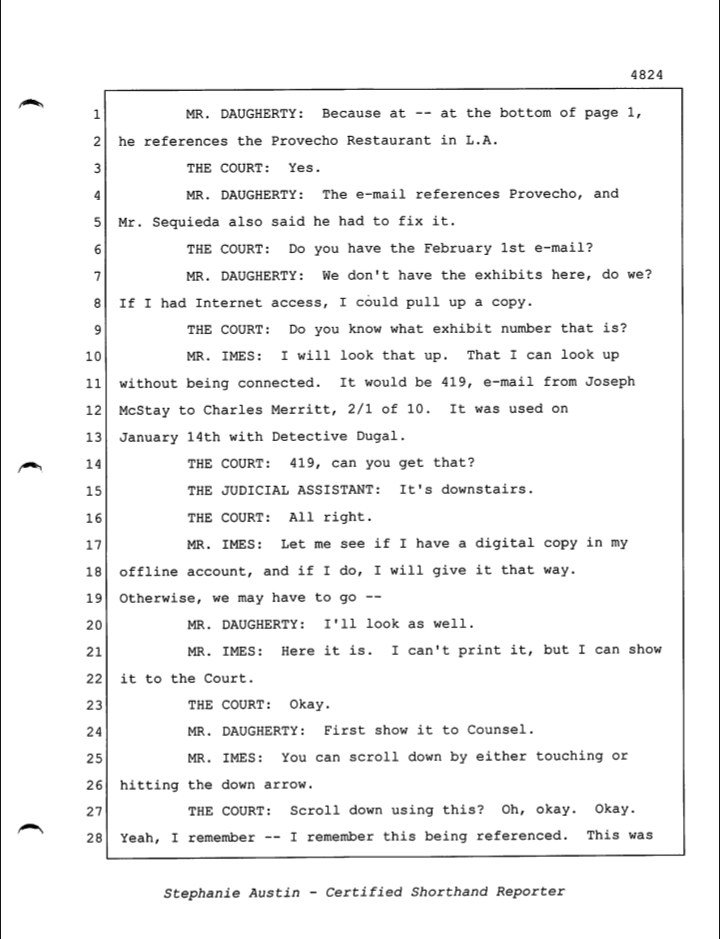
Before Cathy Jarvis testified, the lawyers argued, with the jury out of the room, over a recorded jail visit between Cathy and me on February 3, 2019, in which we talked about the Provecho waterfall (RT 4825:14-17, 4838:11-17). The judge described what the recording said and asked how anyone knew it was the same waterfall as the one in Joseph’s February 1 e-mail. The e-mail was brought up on a screen, and the judge read it: (RT 4823:23-4825:13)
THE COURT: So how do we know that this waterfall was referenced? It was a big waterfall at some restaurant, Joseph got stiffed for it, $32,000.00, there’s going to be a lawsuit. If he lost the lawsuit, we were going to split the loss. So how do we know that’s the same waterfall referenced in the February 1st e-mail?
MR. DAUGHERTY: Because at — at the bottom of page 1, he references the Provecho Restaurant in L.A.
THE COURT: Yes.
MR. DAUGHERTY: The e-mail references Provecho, and Mr. Sequieda also said he had to fix it.
THE COURT: Do you have the February 1st e-mail?
MR. DAUGHERTY: We don’t have the exhibits here, do we? If I had Internet access, I could pull up a copy.
THE COURT: Do you know what exhibit number that is?
MR. IMES: I will look that up. That I can look up without being connected. It would be 419, e-mail from Joseph McStay to Charles Merritt, 2/1 of 10. It was used on January 14th with Detective Dugal.
THE COURT: 419, can you get that?
THE JUDICIAL ASSISTANT: It’s downstairs.
THE COURT: All right.
MR. IMES: Let me see if I have a digital copy in my offline account, and if I do, I will give it that way. Otherwise, we may have to go —
MR. DAUGHERTY: I’ll look as well.
MR. IMES: Here it is. I can’t print it, but I can show it to the Court.
THE COURT: Okay.
MR. DAUGHERTY: First show it to Counsel.
MR. IMES: You can scroll down by either touching or hitting the down arrow.
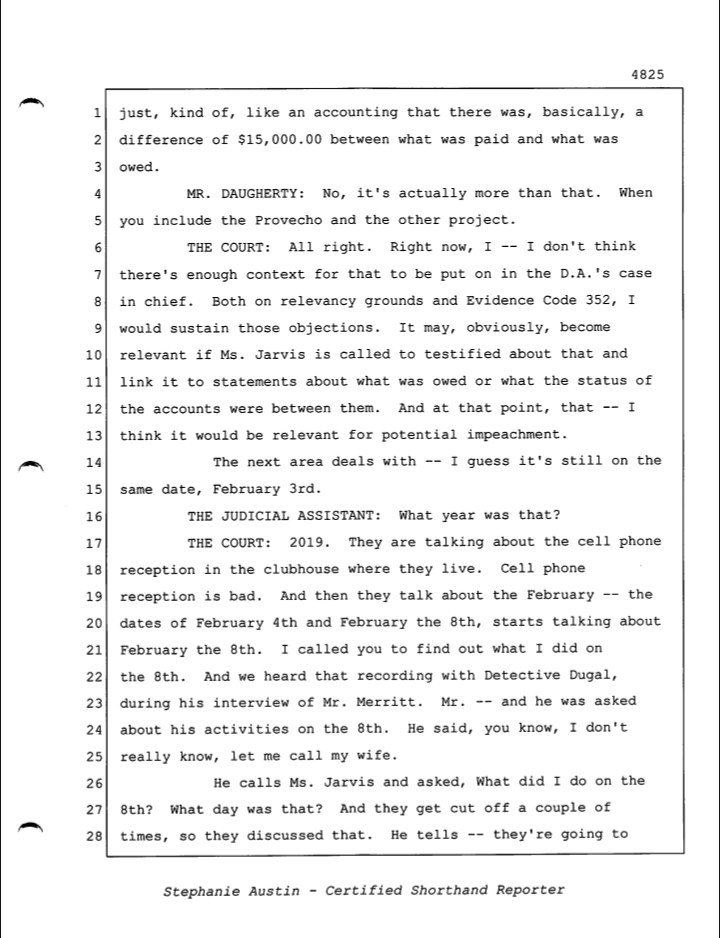
THE COURT: Scroll down using this? Oh, okay. Okay. Yeah, I remember — I remember this being referenced. This was just, kind of, like an accounting that there was, basically, a difference of $15,000.00 between what was paid and what was owed.
MR. DAUGHERTY: No, it’s actually more than that. When you include the Provecho and the other project.
THE COURT: All right. Right now, I — I don’t think there’s enough context for that to be put on in the D.A.’s case in chief. Both on relevancy grounds and Evidence Code 352, I would sustain those objections. It may, obviously, become relevant if Ms. Jarvis is called to testified about that and link it to statements about what was owed or what the status of the accounts were between them. And at that point, that — I think it would be relevant for potential impeachment.
See the trial transcript (RT 4823-4825)
See the trial transcript (RT 4838)
So the judge kept the recording’s waterfall talk out of the State’s case. He left one exception: it might be used to impeach Cathy if she testified about it and tied it to what was owed between Joseph and me.
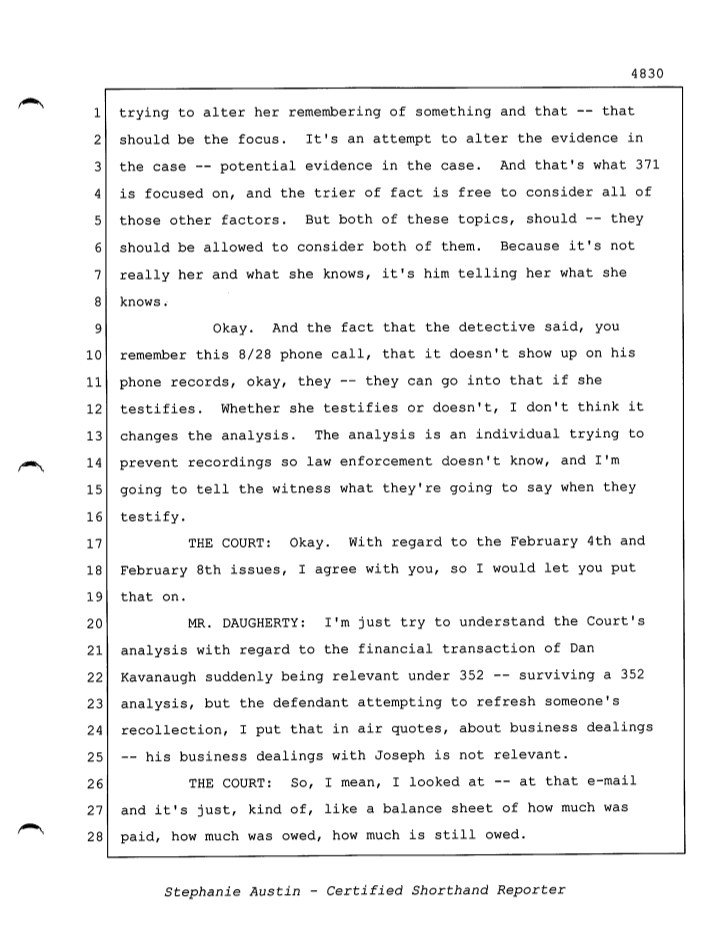
A few minutes later, the judge called the e-mail a balance sheet. Mr. Daugherty answered with his own arithmetic, said again that Mr. Sequeida had redone the job, and said I had admitted owing Joseph: (RT 4830:26-4831:16)
THE COURT: So, I mean, I looked at — at that e-mail and it’s just, kind of, like a balance sheet of how much was paid, how much was owed, how much is still owed.
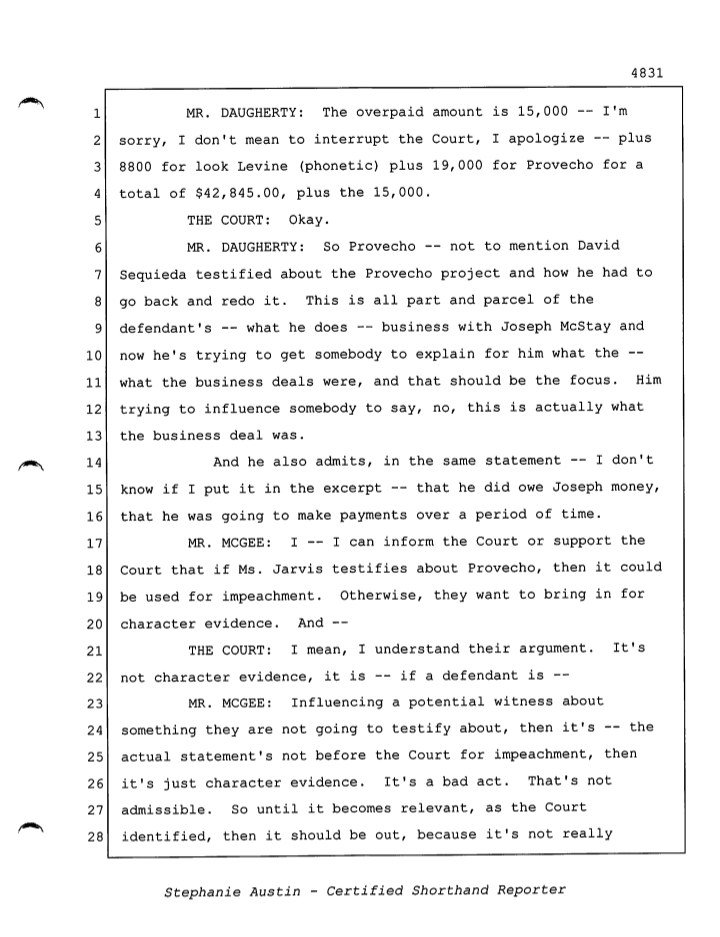
MR. DAUGHERTY: The overpaid amount is 15,000 — I’m sorry, I don’t mean to interrupt the Court, I apologize — plus 8800 for look Levine (phonetic) plus 19,000 for Provecho for a total of $42,845.00, plus the 15,000.
THE COURT: Okay.
MR. DAUGHERTY: So Provecho — not to mention David Sequieda testified about the Provecho project and how he had to go back and redo it. This is all part and parcel of the defendant’s — what he does — business with Joseph McStay and now he’s trying to get somebody to explain for him what the — what the business deals were, and that should be the focus. Him trying to influence somebody to say, no, this is actually what the business deal was.
And he also admits, in the same statement — I don’t know if I put it in the excerpt — that he did owe Joseph money, that he was going to make payments over a period of time.
See the trial transcript (RT 4830-4831)
One of those three claims was false. The other two were misleading.
- The arithmetic: misleading. The e-mail’s own total is $15,045 + $8,800 + $19,000 = $42,845. He gave that correct total himself, and his stated total of $42,845 already included the $15,045 overpayment. But he had started with “The overpaid amount is 15,000,” cut himself off to apologize to the judge, and then ended with “plus the 15,000.” (RT 4831:1-4) Those additional words would count that amount twice, producing approximately $57,845. The e-mail itself contains no such additional $15,000 obligation.
See the trial transcript (RT 4831)
- Mr. Sequeida: the testimony that didn’t exist. This is the claim that was false, and of the three it is the most serious, because it turned a customer who wouldn’t pay into a job I did badly. Mr. Daugherty told the judge that Mr. Sequeida “said he had to fix it,” and that he “testified about the Provecho project and how he had to go back and redo it.” He said this while arguing to admit the recording. That testimony did not exist. I have checked Mr. Sequeida’s whole trial testimony and his recorded interviews with detectives in September 2014. He never said it, and none of the interviews mentions Provecho at all. His company, Metro Sheet Metal, didn’t begin working with Joseph until the fall of 2009. Joseph’s own 2009 ledger shows his first payment to Metro on September 30, 2009, and the first entry in its “Metro/Dimic” column on a job dated October 2, 2009, more than a year after Provecho was installed in July 2008. I believe Mr. Daugherty made it up to sway the court. (RT 4824:4-5, 4831:6-8; Bates 002604, 002606, 003420)
See the trial transcript (RT 4824, 4831) and the pages (Bates 002606, 003420)
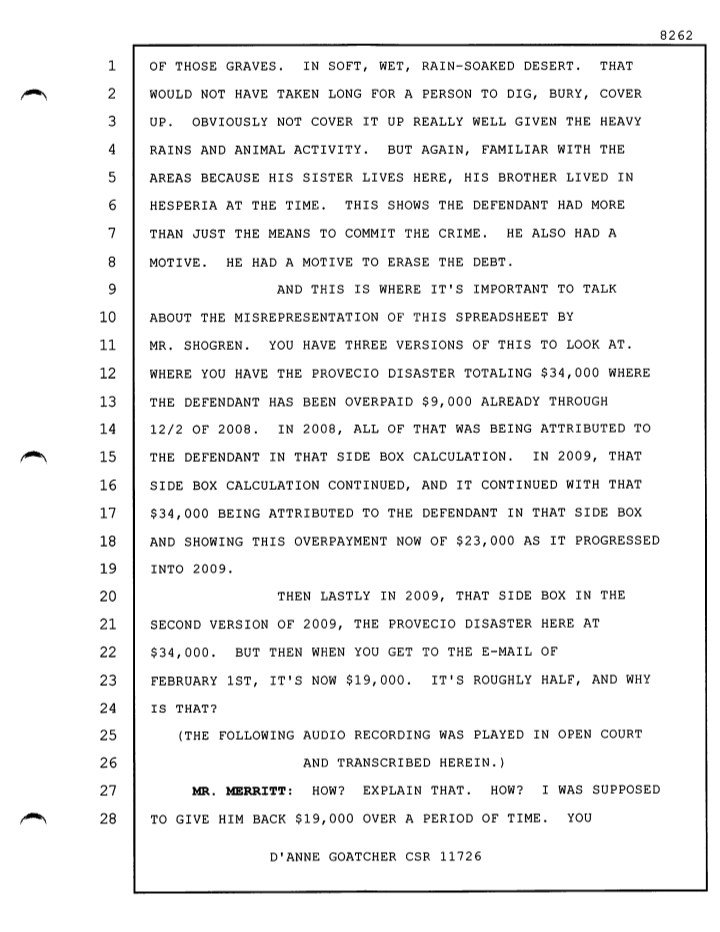
- “He did owe Joseph money”: misleading. It left out the condition. My recorded words, as the State later played them for the jury, were “I WAS SUPPOSED TO GIVE HIM BACK $19,000 OVER A PERIOD OF TIME” (RT 8262:27-28). What I said was that if Joseph lost the dispute, I would pay him, because it was a big hit for him. The judge’s own description of the recording, at the top of this section, puts it the same way: “there’s going to be a lawsuit. If he lost the lawsuit, we were going to split the loss.” (RT 4823:25-26)
See the trial transcript (RT 8262, 4823)
See the page (Bates 002604)
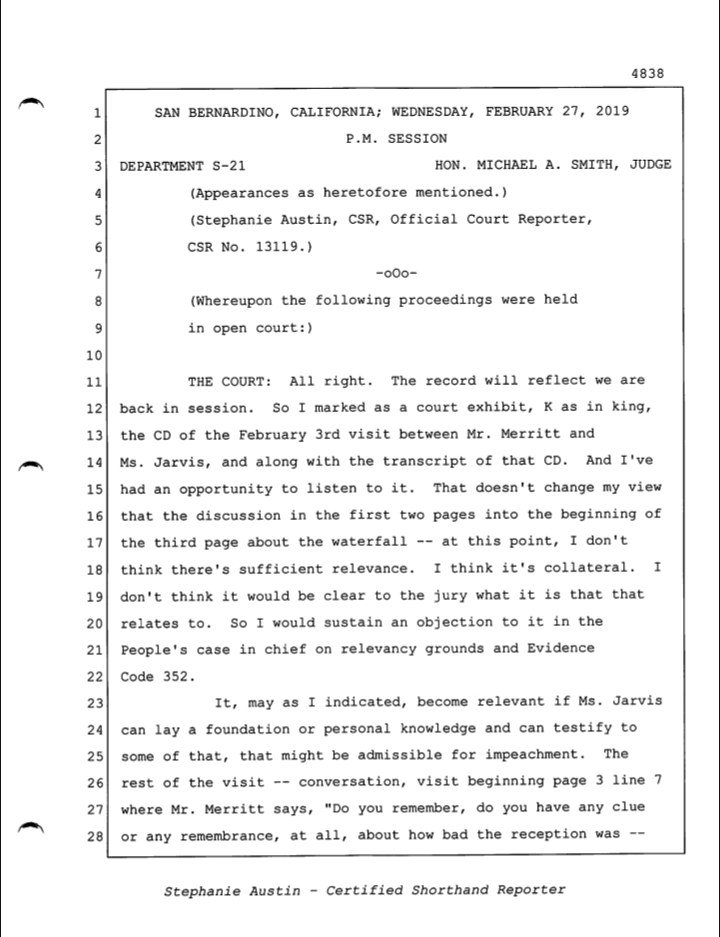
It didn’t change the ruling. When court came back into session on the afternoon of February 27, 2019, the judge had listened to the recording himself, and he kept the waterfall talk out again: (RT 4838:11-25)
THE COURT: All right. The record will reflect we are back in session. So I marked as a court exhibit, K as in king, the CD of the February 3rd visit between Mr. Merritt and Ms. Jarvis, and along with the transcript of that CD. And I’ve had an opportunity to listen to it. That doesn’t change my view that the discussion in the first two pages into the beginning of the third page about the waterfall — at this point, I don’t think there’s sufficient relevance. I think it’s collateral. I don’t think it would be clear to the jury what it is that that relates to. So I would sustain an objection to it in the People’s case in chief on relevancy grounds and Evidence Code 352.
It, may as I indicated, become relevant if Ms. Jarvis can lay a foundation or personal knowledge and can testify to some of that, that might be admissible for impeachment.
See the trial transcript (RT 4838)
Put in order, here is what happened at that hearing. The judge looked at the e-mail and saw “just, kind of, like an accounting” and “a balance sheet.” To change his mind, Mr. Daugherty told him three things: that the e-mail added up to more than it does, that Mr. Sequeida had to redo Provecho, and that I had admitted owing Joseph. One of the three was false and the other two were misleading, and the judge kept the waterfall talk out anyway. But the same three ideas, a big debt, bad work, and my own admission, are what the State went on to put in front of the jury.
2. March 14, 2019: the State asks Cathy about a $42,000 debt
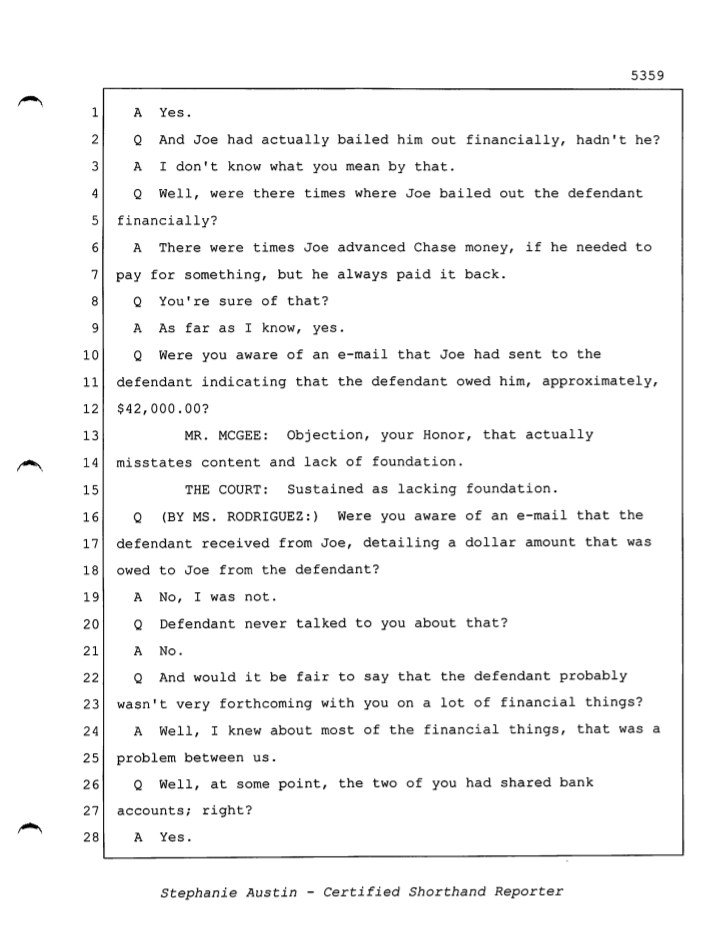
When Cathy testified, Ms. Rodriguez asked her about the e-mail as if it showed I owed Joseph $42,000. The court sustained Mr. McGee’s objection. Ms. Rodriguez asked again in other words: (RT 5359:2-21)
Q And Joe had actually bailed him out financially, hadn’t he?
A I don’t know what you mean by that.
Q Well, were there times where Joe bailed out the defendant financially?
A There were times Joe advanced Chase money, if he needed to pay for something, but he always paid it back.
Q You’re sure of that?
A As far as I know, yes.
Q Were you aware of an e-mail that Joe had sent to the defendant indicating that the defendant owed him, approximately, $42,000.00?
MR. MCGEE: Objection, your Honor, that actually misstates content and lack of foundation.
THE COURT: Sustained as lacking foundation.
Q (BY MS. RODRIGUEZ:) Were you aware of an e-mail that the defendant received from Joe, detailing a dollar amount that was owed to Joe from the defendant?
A No, I was not.
Q Defendant never talked to you about that?
A No.
See the trial transcript (RT 5359)
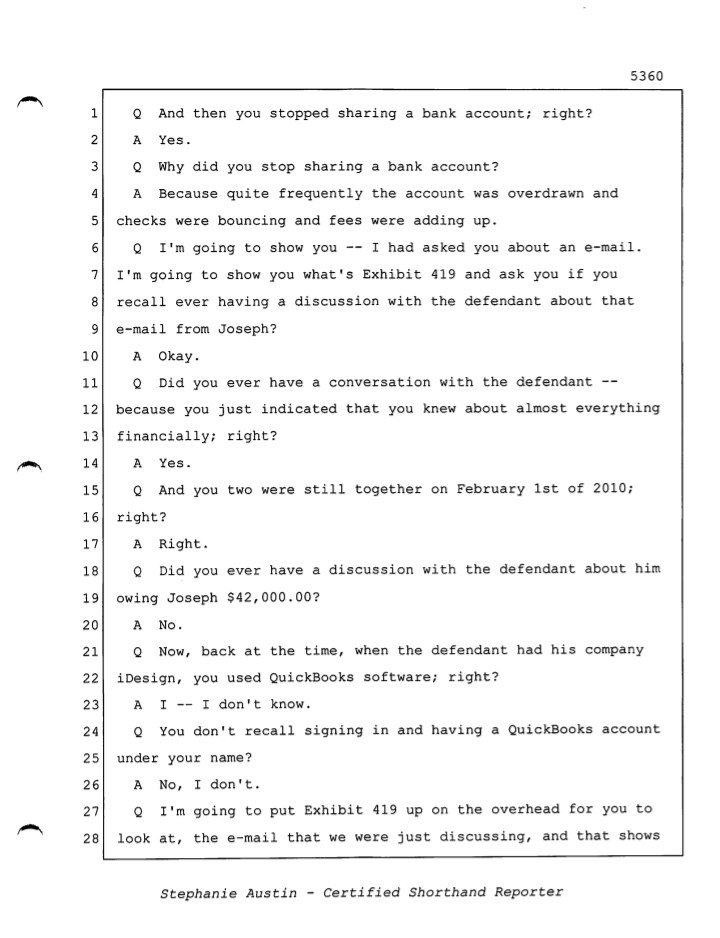
A few questions later, she showed Cathy the e-mail and asked a third time. This time there was no objection: (RT 5360:6-20)
Q I’m going to show you — I had asked you about an e-mail. I’m going to show you what’s Exhibit 419 and ask you if you recall ever having a discussion with the defendant about that e-mail from Joseph?
A Okay.
Q Did you ever have a conversation with the defendant — because you just indicated that you knew about almost everything financially; right?
A Yes.
Q And you two were still together on February 1st of 2010; right?
A Right.
Q Did you ever have a discussion with the defendant about him owing Joseph $42,000.00?
A No.
See the trial transcript (RT 5360)
Then Ms. Rodriguez asked Cathy about Provecho herself. Cathy told the jury what she knew: there was a problem with payment, and Joseph was going to sue the restaurant: (RT 5361:3-24)
Q And were you familiar with any of those projects that are listed on there, the Provecho?
A Provecho is familiar.
Q How is that familiar?
A It was — well, it was going in a restaurant, and I think there was some — some problem that happened with payment on Provecho, and I think Joseph was going to be suing the restaurant over a payment and —
Q Where — where did you get that information in terms of Joseph suing Provecho over a payment?
A That was discussions that I had with Chase.
Q When did you have those discussions?
A When the projects were happening.
Q Isn’t it true that you actually had those discussions during a visit that you had with him?
A We also discussed it during a visit, yes.
Q Through the glass; right?
A Yes.
Q And that is when he told you that you needed to remember that project; right?
A He didn’t need to do that, because I did remember that project.
See the trial transcript (RT 5361)
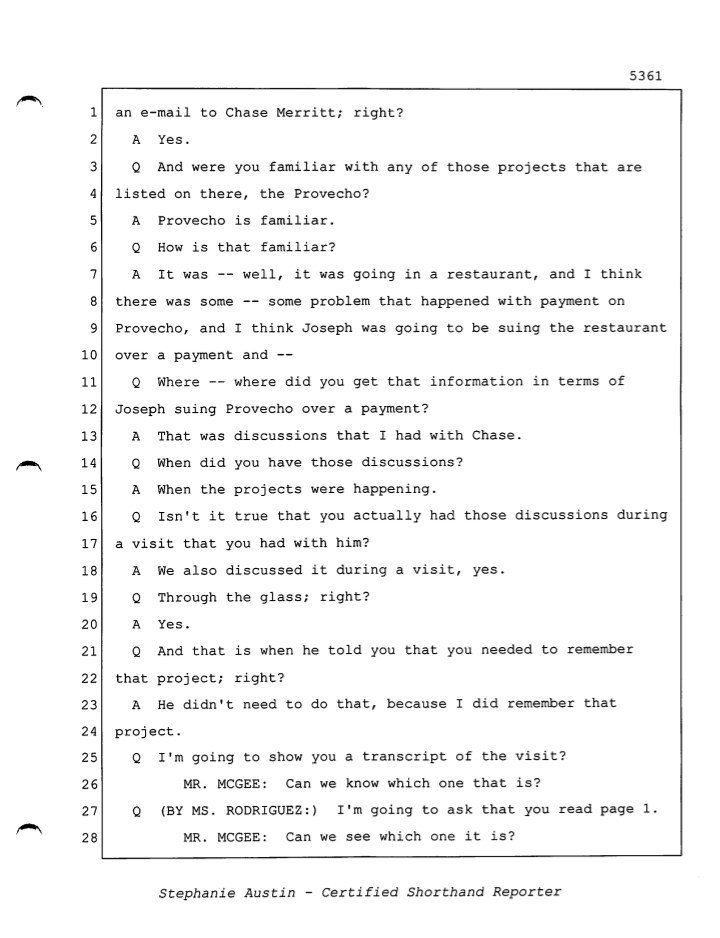
With Cathy now testifying about Provecho, Ms. Rodriguez had her read the transcript of our jail visit and questioned her about whether I had told her what to say (RT 5361:25-5365:7). One of the lines she read back was Cathy’s own, telling me what she remembered about Provecho: (RT 5364:10-16)
See the trial transcript (RT 5362, 5363, 5365)
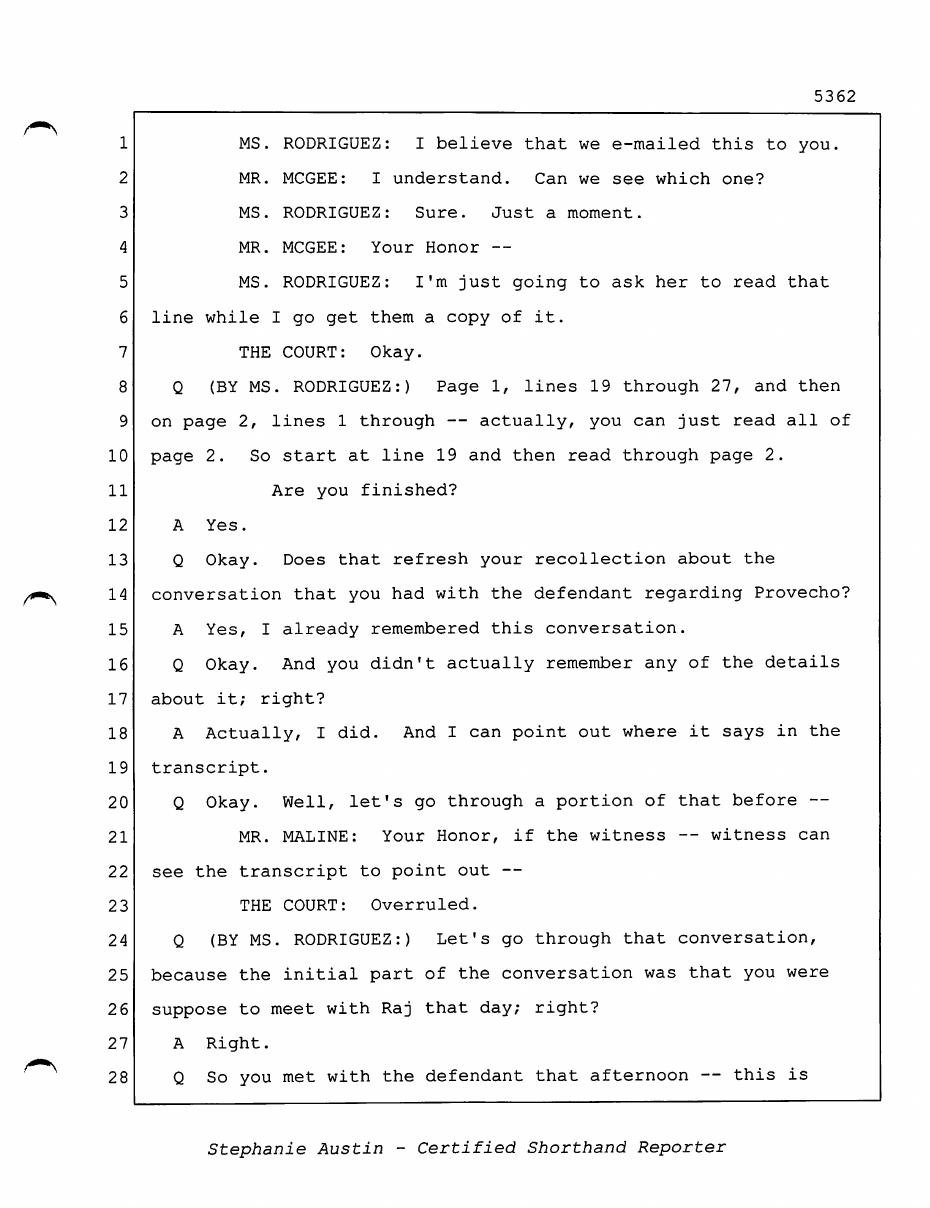
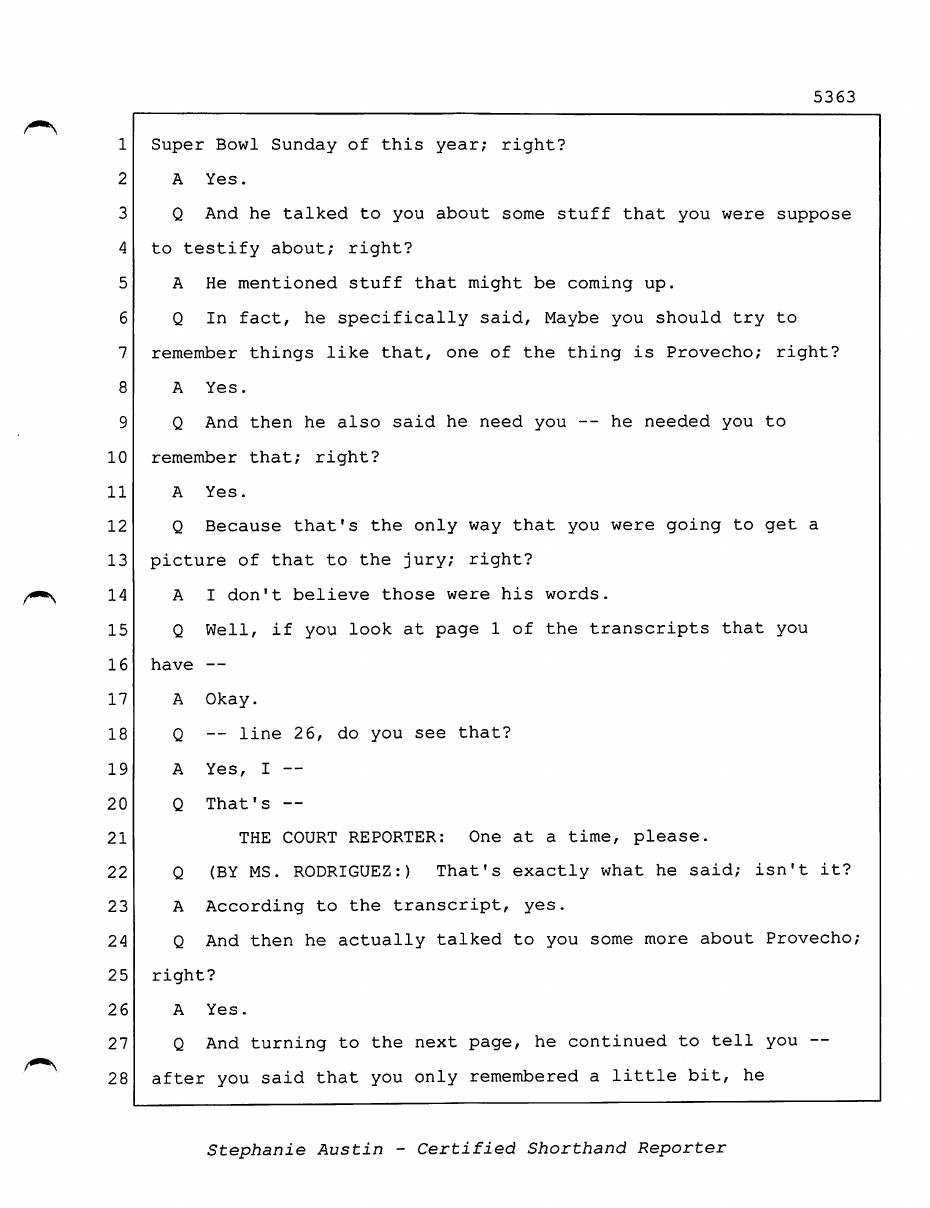
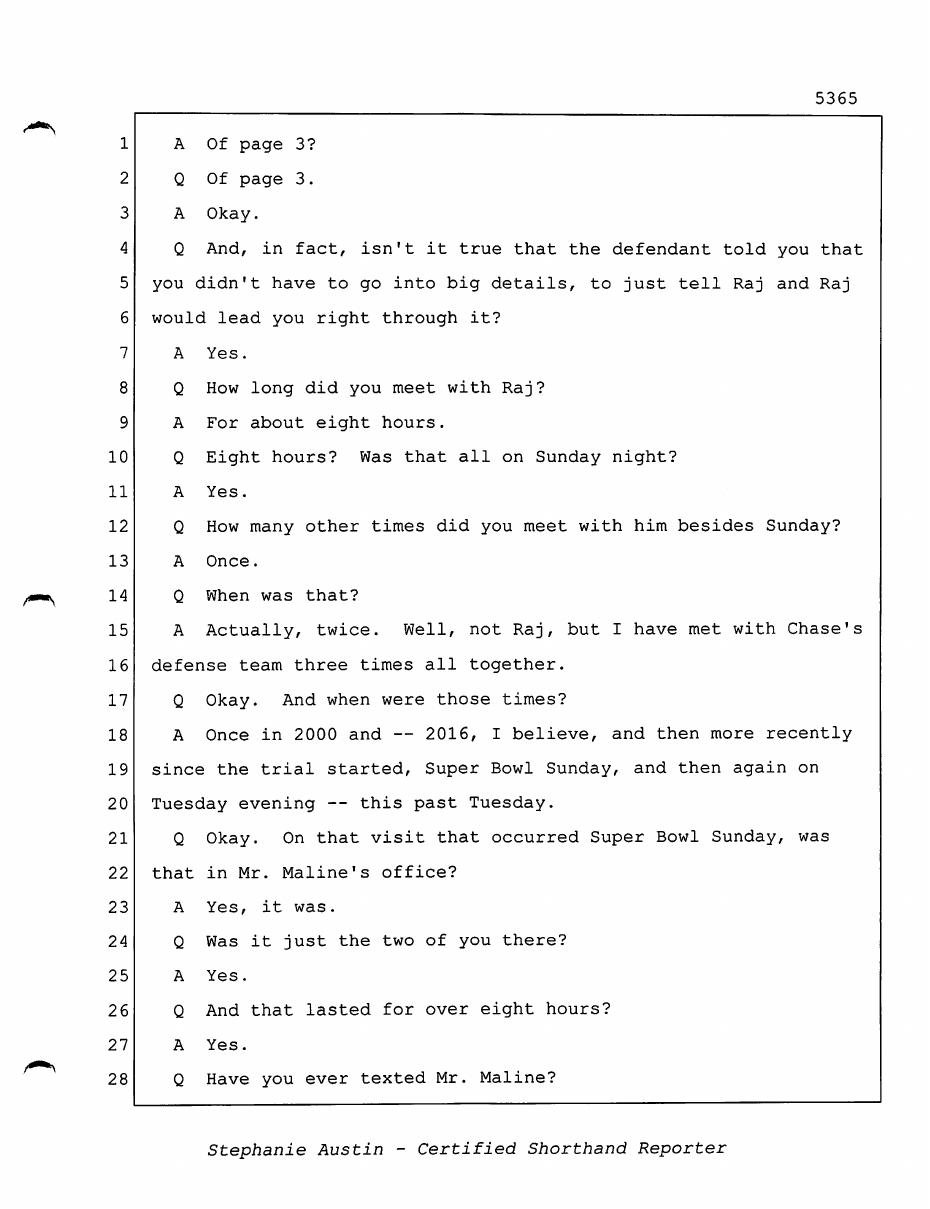
Q Do you remember that part of the conversation where —
A Yes.
Q — you said, I don’t remember, like, the specific details?
A Yes.
Q I remember you talking about not having been paid for that, but you didn’t know anything else about the details of it; right?
A Yes.
See the trial transcript (RT 5364)
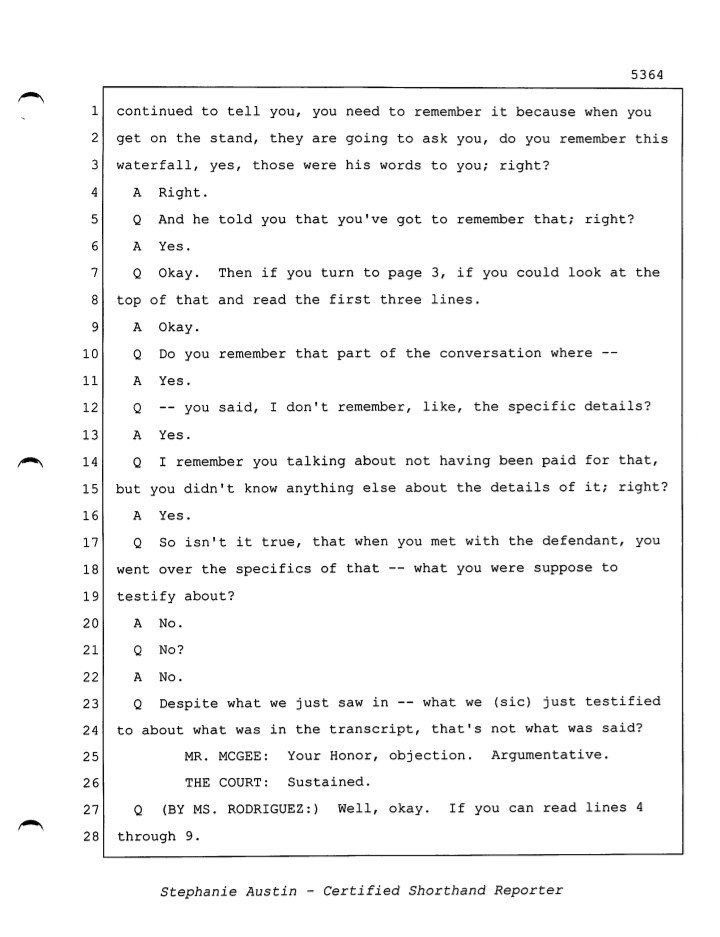
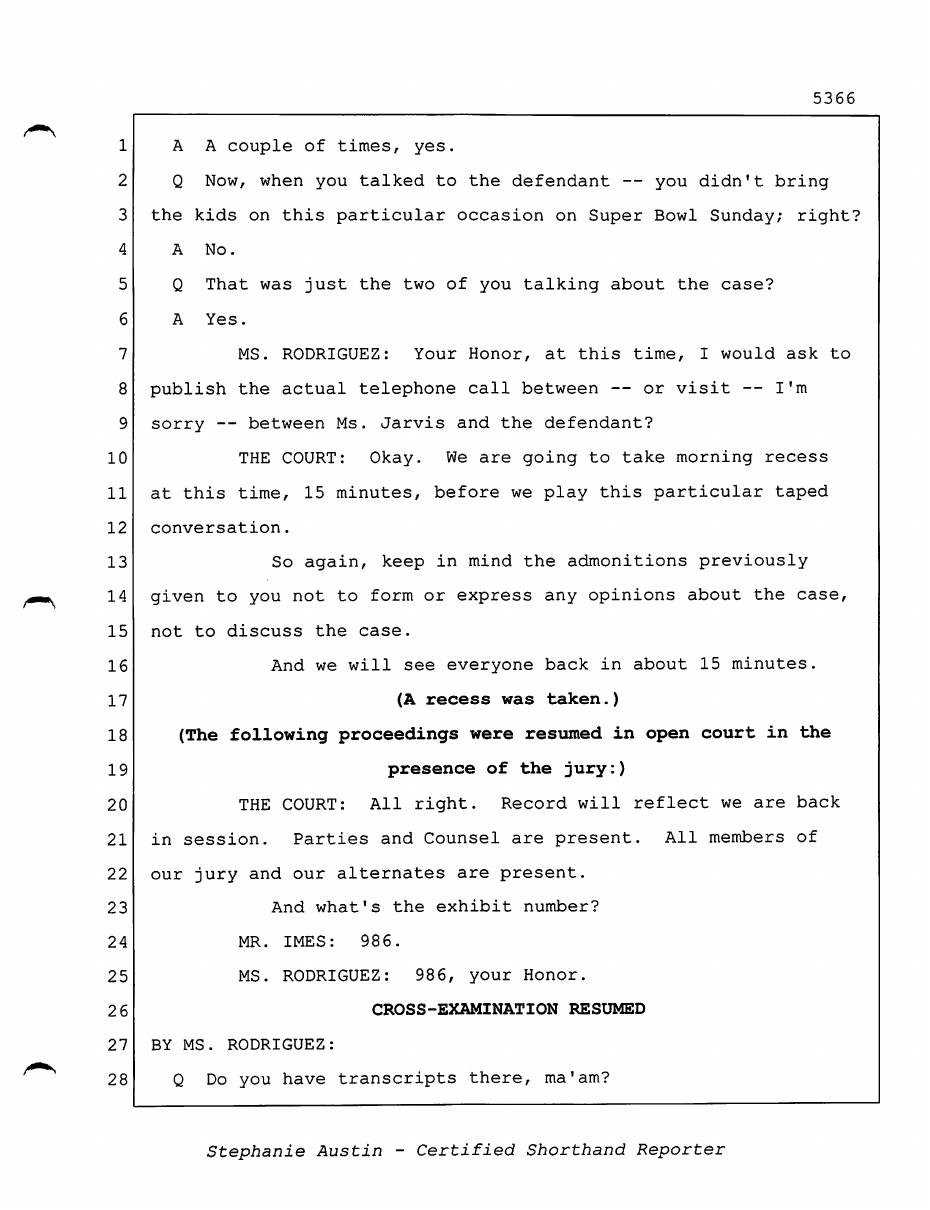
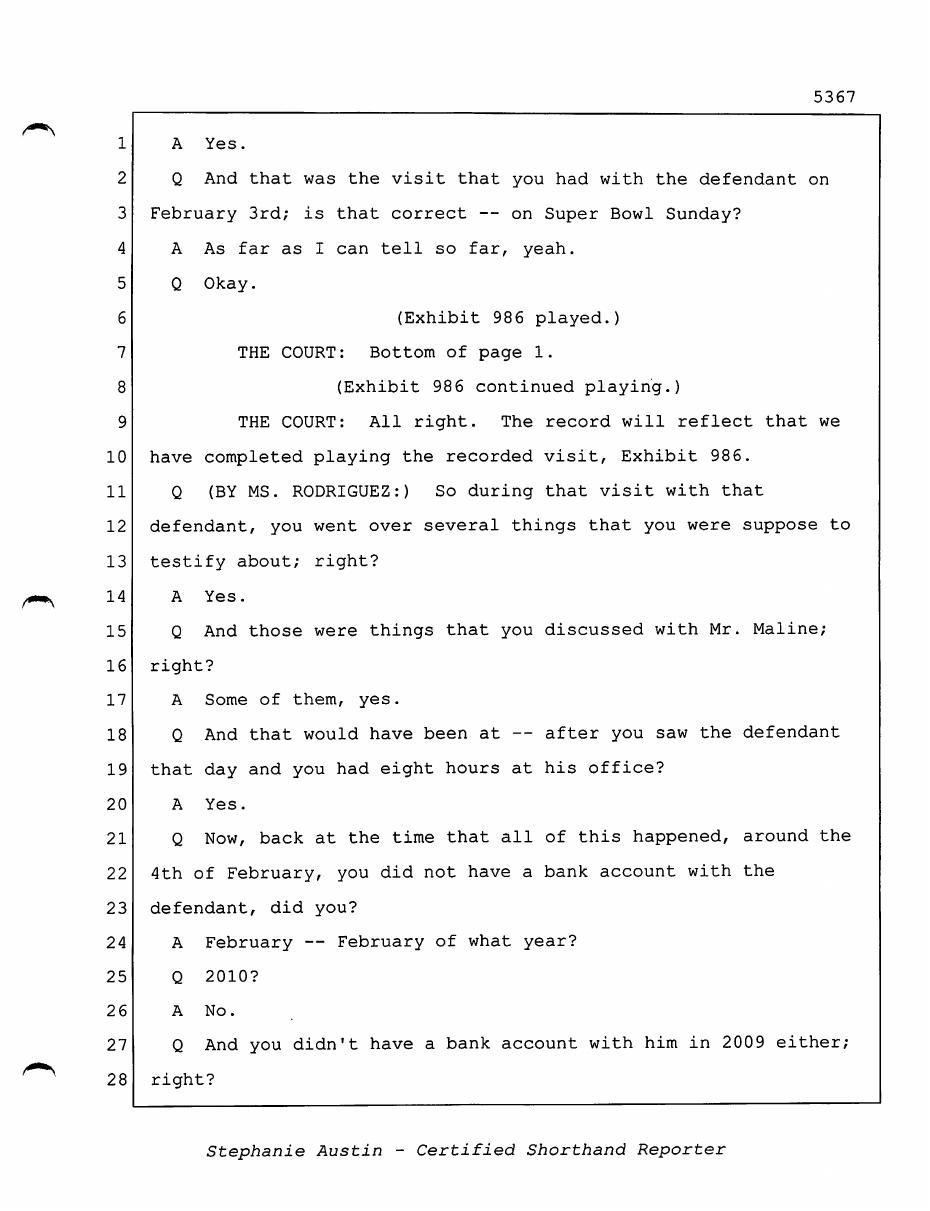
In one question, Ms. Rodriguez put it to Cathy that she had told me she remembered me “talking about not having been paid for that.” Cathy agreed. Ms. Rodriguez then played the recording for the jury, as Exhibit 986. (RT 5366:7-5367:8)
See the trial transcript (RT 5366, 5367)
3. April 30, 2019: the court says how the $19,000 may be asked
Seven weeks later, Ms. Rodriguez cross-examined the accountant. She added the $34,000 into a total of her own, and then asked whether it would matter that I had told someone Joseph agreed to split the loss with me. Then came the “denied any work” question: (RT 7157:16-7159:12)
Q So if we add the 23,562 to the $34,000.00 and then the additional amounts with Levine, Hawaii, the black granite, granite glass, and Randy to complete, and we add those amounts that doesn’t total $64,662.00?
A Well, that math is correct, but it’s not part of the spreadsheet that is accumulating the — the ledger that would refer to the ledger that’s — that’s there. It’s not part of the math that goes back into the spreadsheet.
Q So it’s your opinion that even though Joseph takes the time to put this in a special box and includes it in the e-mail to the defendant, that Joseph doesn’t think he was owed that money?
A It — there’s been — there’s no evidence of a demand for payment made, and this $34,000.00 is a total dollar amount. We just looked at the job that was what — portion of that was that was Chase’s and it was 19,500.
Q Were you aware of information where the defendant indicated that Joseph had agreed to split that amount with him?
A I have not seen any documentation.
Q And if you were aware of that, if the defendant, in fact, told somebody that they needed to remember that Joseph McStay agreed to split some of that with him, would that change your opinion as to whether or not that money was owed to Joseph?
A At — at the time that — that there was a demand, I would say yes. I have not seen any evidence of a demand for payment or settlement.
Q Whether or not we are talking about demand, I’m asking you if you heard that the defendant specifically told somebody —
MR. MALINE: Objection. Asked and answered.
Q (BY MS. RODRIGUEZ:) — Joseph McStay had agreed to split that amount with him or to cover some of that, would that change your analysis as to whether or not the defendant believed he owed Joseph that money?
A I don’t know how to speak to what the defendant believed. I don’t believe from an accountant’s perspective that that constitutes debt.
Q But yet, you know how to speak to Joseph McStay’s state of mind with —
MR. MALINE: Objection. Argumentative.
MS. RODRIGUEZ: — with respect to e-mail —
THE COURT: Objection sustained as argumentative.
MR. MALINE: And, your Honor, I would object to Counsel trying to get statements to the jury on a question she knows is objectionable.
THE COURT: That objection’s overruled. I’ll rule on individual questions and answers and objections, just as I do with the prosecution’s objections to the defense.
Q (BY MS. RODRIGUEZ:) Were you aware of information where the defendant denied actually doing any work on the Provecho job?
A No.
Q Would that change your opinion?
MR. MALINE: Objection. Misstates the evidence, your Honor.
THE COURT: Sustained as assuming facts not in evidence.
See the trial transcript (RT 7157-7159)
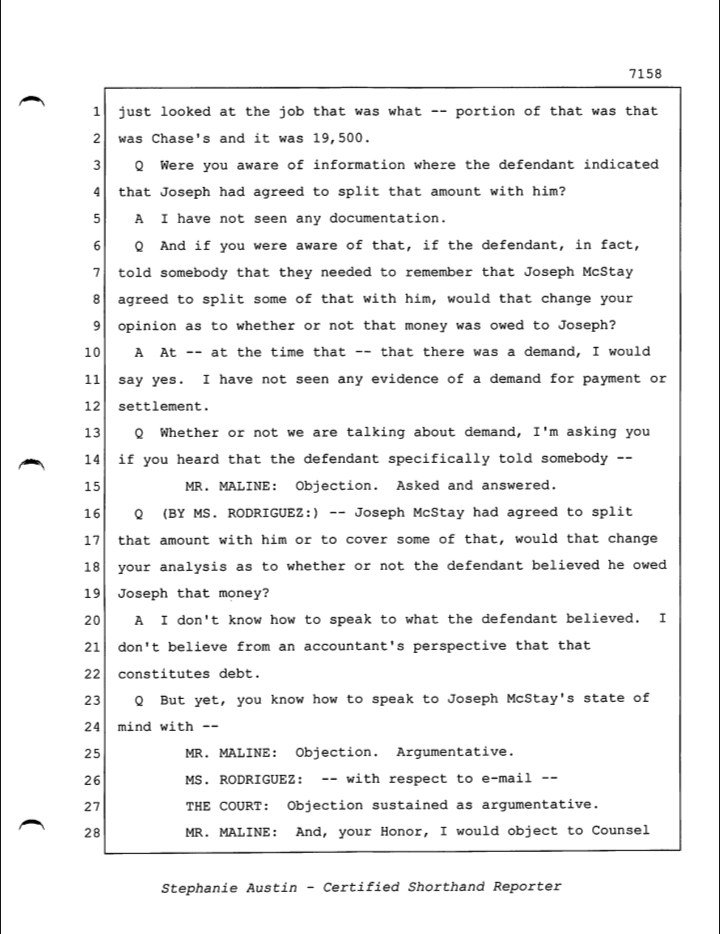
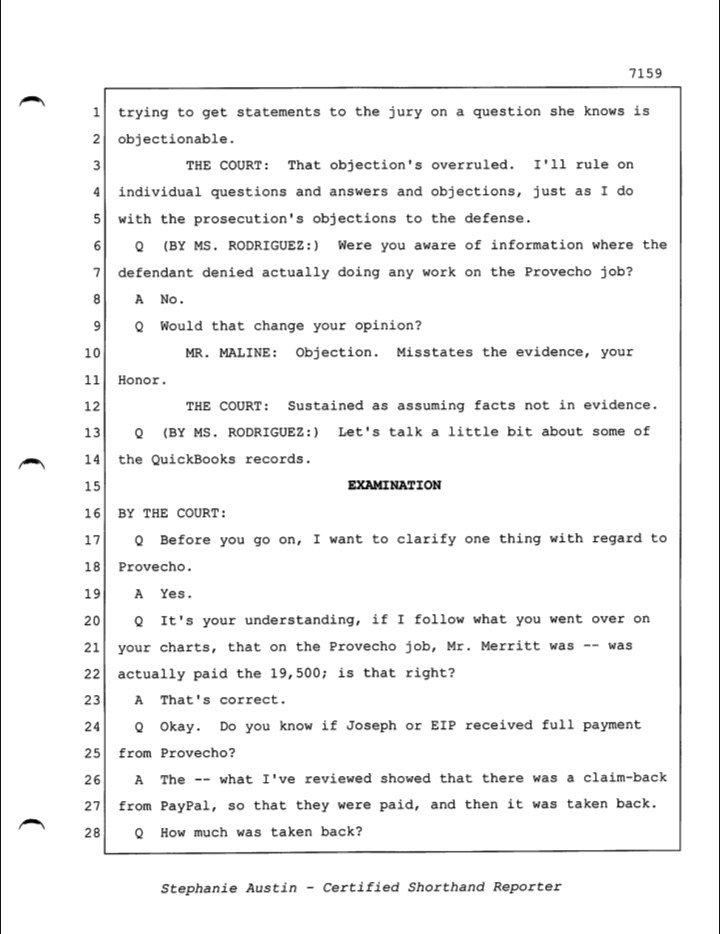
I never denied working on Provecho. I built it and installed it. Joseph’s letter to PayPal names me as the fabricator, and my own letter to PayPal the next day describes the production and the install. There was no such denial in the evidence, and the court said so. Her question put something in front of the jury that was simply not true.
A few pages later, she asked whether it would change his opinion if I had told someone I owed Joseph that money. Mr. Maline objected, and the lawyers went to the bench. There the judge read what the recording actually says, and told her exactly how she could ask about it: (RT 7164:17-7166:4)
Q Okay. And if I indicate to you that the defendant had told somebody that he owed that money to Joseph, would that change your opinion?
MR. MALINE: Objection. That misstates the evidence.
THE COURT: Again, assumes facts not in evidence.
MS. RODRIGUEZ: Your Honor, may I be heard on that?
THE COURT: Sure. Counsel approach.
(The following proceedings were held at the bench:)
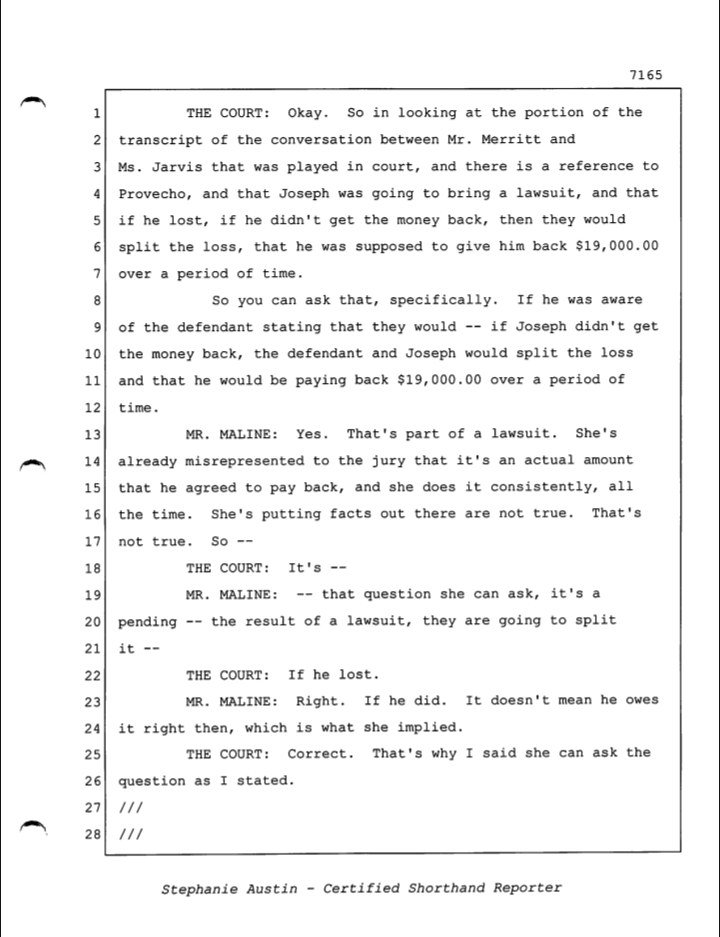
MS. RODRIGUEZ: I provided the Court a copy of a transcript between Jarvis and the defendant, during a visit that was recorded, where the defendant said he was supposed to pay Joseph back $19,000.00 over time.
THE COURT: Okay. So in looking at the portion of the transcript of the conversation between Mr. Merritt and Ms. Jarvis that was played in court, and there is a reference to Provecho, and that Joseph was going to bring a lawsuit, and that if he lost, if he didn’t get the money back, then they would split the loss, that he was supposed to give him back $19,000.00 over a period of time.
So you can ask that, specifically. If he was aware of the defendant stating that they would — if Joseph didn’t get the money back, the defendant and Joseph would split the loss and that he would be paying back $19,000.00 over a period of time.
MR. MALINE: Yes. That’s part of a lawsuit. She’s already misrepresented to the jury that it’s an actual amount that he agreed to pay back, and she does it consistently, all the time. She’s putting facts out there are not true. That’s not true. So —
THE COURT: It’s —
MR. MALINE: — that question she can ask, it’s a pending — the result of a lawsuit, they are going to split it —
THE COURT: If he lost.
MR. MALINE: Right. If he did. It doesn’t mean he owes it right then, which is what she implied.
THE COURT: Correct. That’s why I said she can ask the question as I stated.
(The following proceedings were resumed in open court in the presence of the jury:)
THE COURT: All right. The last objection is sustained as phrased. You may continue.
See the trial transcript (RT 7164-7166)
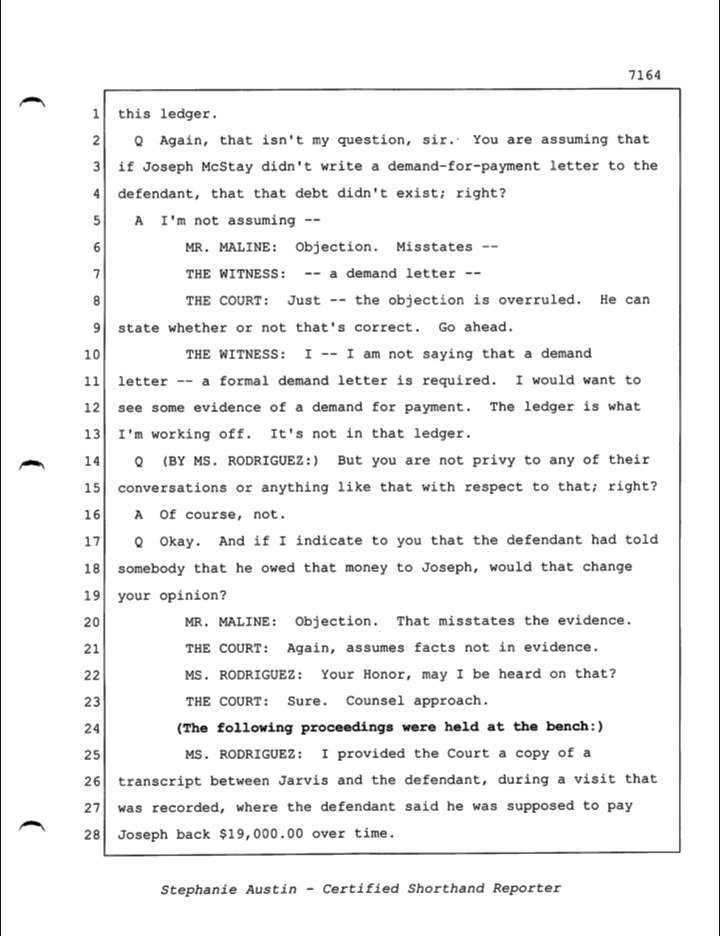
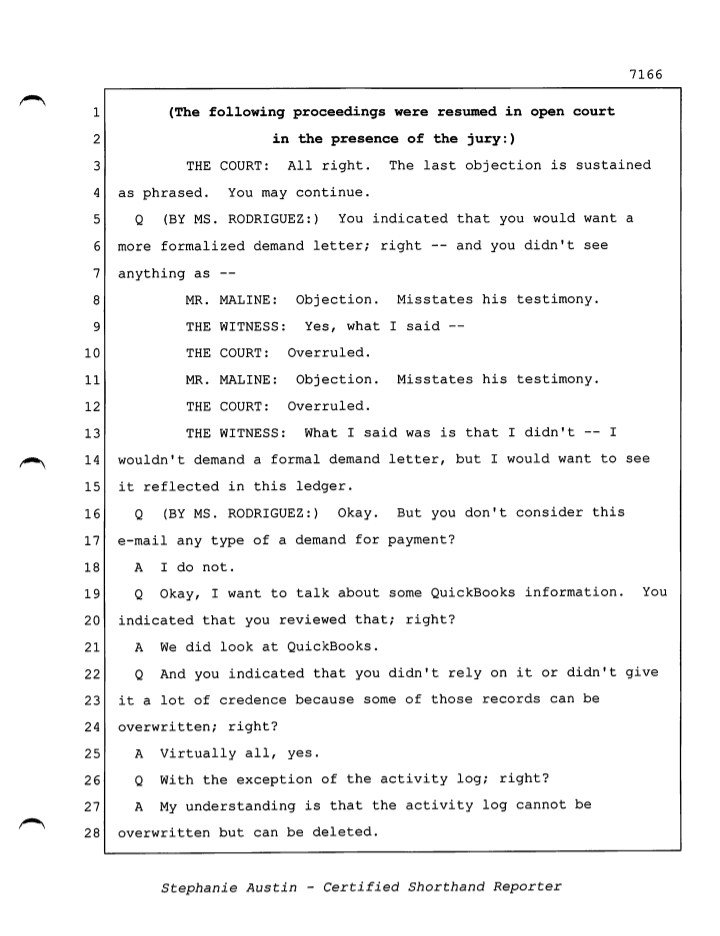
Here is what the judge ruled, in plain terms. Ms. Rodriguez wanted to tell the jury that I had said I owed Joseph $19,000. The judge read what the recording actually said: Joseph was going to sue, and if he lost and didn’t get the money back, we would split the loss, with me paying back $19,000 over a period of time. So he sustained the objection to her question, and told her she could ask it only one way, with the condition in it. When Mr. Maline said that leaving the condition out made it sound like I owed the money “right then,” the judge agreed: “Correct.”
Ms. Rodriguez never asked the question the way the judge allowed. Her next questions were whether the accountant wanted a formal demand letter, and whether he considered the e-mail “any type of a demand for payment.” He answered, “I do not.” Then she moved on to QuickBooks. (RT 7166:5-19) The next day, on recross, she called it “that $19,000.00 debt” anyway. (RT 7341:6-9, quoted above)
See the trial transcript (RT 7166, 7341)
4. May 28, 2019: closing argument
In closing, Mr. Imes did the very thing the judge had pointed out at the bench. He pointed to the $34,000 in Joseph’s ledger and the $19,000 in the e-mail, and played one line of the recording, without the condition, as my “admission” of a debt: (RT 8262:9-8263:12)
AND THIS IS WHERE IT’S IMPORTANT TO TALK ABOUT THE MISREPRESENTATION OF THIS SPREADSHEET BY MR. SHOGREN. YOU HAVE THREE VERSIONS OF THIS TO LOOK AT. WHERE YOU HAVE THE PROVECIO DISASTER TOTALING $34,000 WHERE THE DEFENDANT HAS BEEN OVERPAID $9,000 ALREADY THROUGH 12/2 OF 2008. IN 2008, ALL OF THAT WAS BEING ATTRIBUTED TO THE DEFENDANT IN THAT SIDE BOX CALCULATION. IN 2009, THAT SIDE BOX CALCULATION CONTINUED, AND IT CONTINUED WITH THAT $34,000 BEING ATTRIBUTED TO THE DEFENDANT IN THAT SIDE BOX AND SHOWING THIS OVERPAYMENT NOW OF $23,000 AS IT PROGRESSED INTO 2009.
THEN LASTLY IN 2009, THAT SIDE BOX IN THE SECOND VERSION OF 2009, THE PROVECIO DISASTER HERE AT $34,000. BUT THEN WHEN YOU GET TO THE E-MAIL OF FEBRUARY 1ST, IT’S NOW $19,000. IT’S ROUGHLY HALF, AND WHY IS THAT?
(THE FOLLOWING AUDIO RECORDING WAS PLAYED IN OPEN COURT AND TRANSCRIBED HEREIN.)
MR. MERRITT: HOW? EXPLAIN THAT. HOW? I WAS SUPPOSED TO GIVE HIM BACK $19,000 OVER A PERIOD OF TIME. YOU REMEMBER? I KNOW YOU GOT TO REMEMBER THAT.
(END OF AUDIO RECORDING.)
MR. IMES: SO WHEN YOU GO BACK TO THAT E-MAIL, THE TOTAL IS $42,000. IT SHOWED THAT THAT DEBT FOR PROVECIO DISASTER WAS ONLY $19,000. IT CHANGED BETWEEN THE SPREADSHEET AND THAT E-MAIL BEING SENT. IT’S CONSISTENT WITH THE DEFENDANT’S OWN ADMISSION DURING THE JAILHOUSE VISIT WITH CATHY JARVIS, A PIECE OF EVIDENCE MR. SHOGREN EITHER CONVENIENTLY OVERLOOKED OR INTENTIONALLY DISREGARDED BECAUSE HIS MISSION WAS TO DOWNPLAY THE DEBT THE DEFENDANT HAD DESPITE THE EVIDENCE BEING CONSISTENT IN FRONT OF HIS FACE.
See the trial transcript (RT 8262-8263)
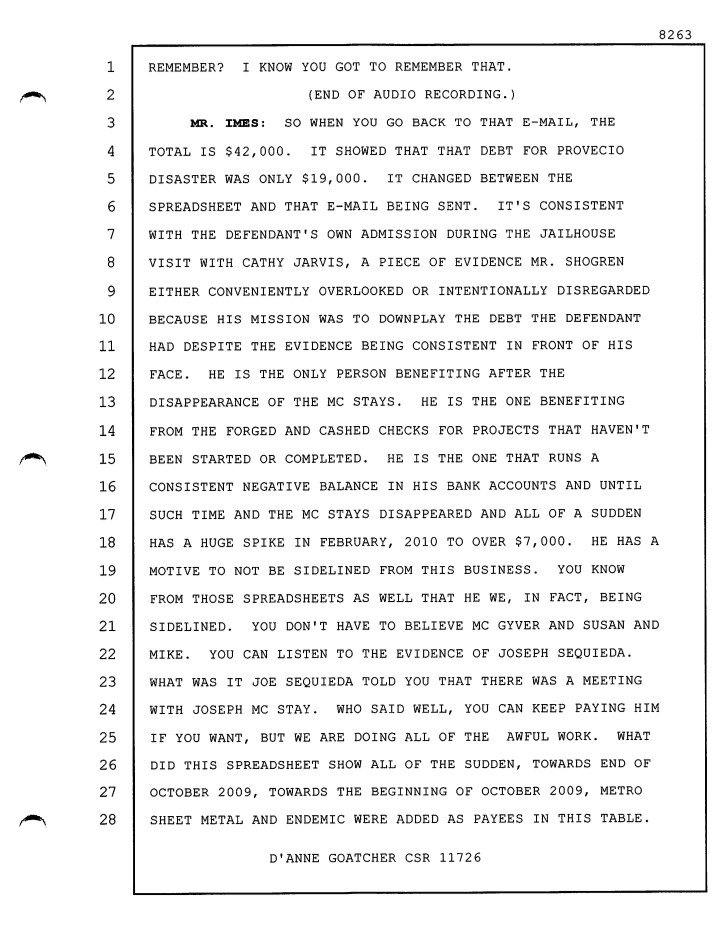
Set three statements side by side.
What the judge said the recording meant, in February, before any of this reached the jury: (RT 4823:24-26; quoted in full in step 1)
THE COURT: It was a big waterfall at some restaurant, Joseph got stiffed for it, $32,000.00, there’s going to be a lawsuit. If he lost the lawsuit, we were going to split the loss.
See the trial transcript (RT 4823)
What the judge told Ms. Rodriguez she could ask, on April 30: (RT 7165:8-12; quoted in full in step 3)
THE COURT: So you can ask that, specifically. If he was aware of the defendant stating that they would — if Joseph didn’t get the money back, the defendant and Joseph would split the loss and that he would be paying back $19,000.00 over a period of time.
See the trial transcript (RT 7165)
What Mr. Imes played to the jury in closing, on May 28: (RT 8262:27-8263:1; quoted in full above)
MR. MERRITT: HOW? EXPLAIN THAT. HOW? I WAS SUPPOSED TO GIVE HIM BACK $19,000 OVER A PERIOD OF TIME. YOU REMEMBER? I KNOW YOU GOT TO REMEMBER THAT.
See the trial transcript (RT 8262-8263)
The words did not change. Their meaning changed when the condition was taken off.
By May 28, this was not a question of what the recording said. Here is what each prosecutor did. On April 30, Ms. Rodriguez tried to put the $19,000 to the accountant as money I had said I owed. The judge read the recording at the bench, sustained the objection to Ms. Rodriguez’s question, and told her to ask it the way he had stated it, with the condition in it. When Mr. Maline said that leaving it out implied I owed the money “right then,” the judge said “Correct.” Ms. Rodriguez was at that bench and heard all of it. She never asked the question the way the judge allowed, and the next day she called it “that $19,000.00 debt” anyway. Mr. Imes was in court that day too; minutes earlier he had objected to one of the judge’s own questions to the accountant (RT 7160:21-23). The transcript doesn’t show whether he was at the bench. Four weeks later, he played the line without the condition, called it “the defendant’s own admission,” and blamed the accountant for not counting it as a debt. The accountant had already told the jury why he didn’t: “I don’t believe from an accountant’s perspective that that constitutes debt.” The recording never changed. Only where it was cut off did.
See the trial transcript (RT 7160)
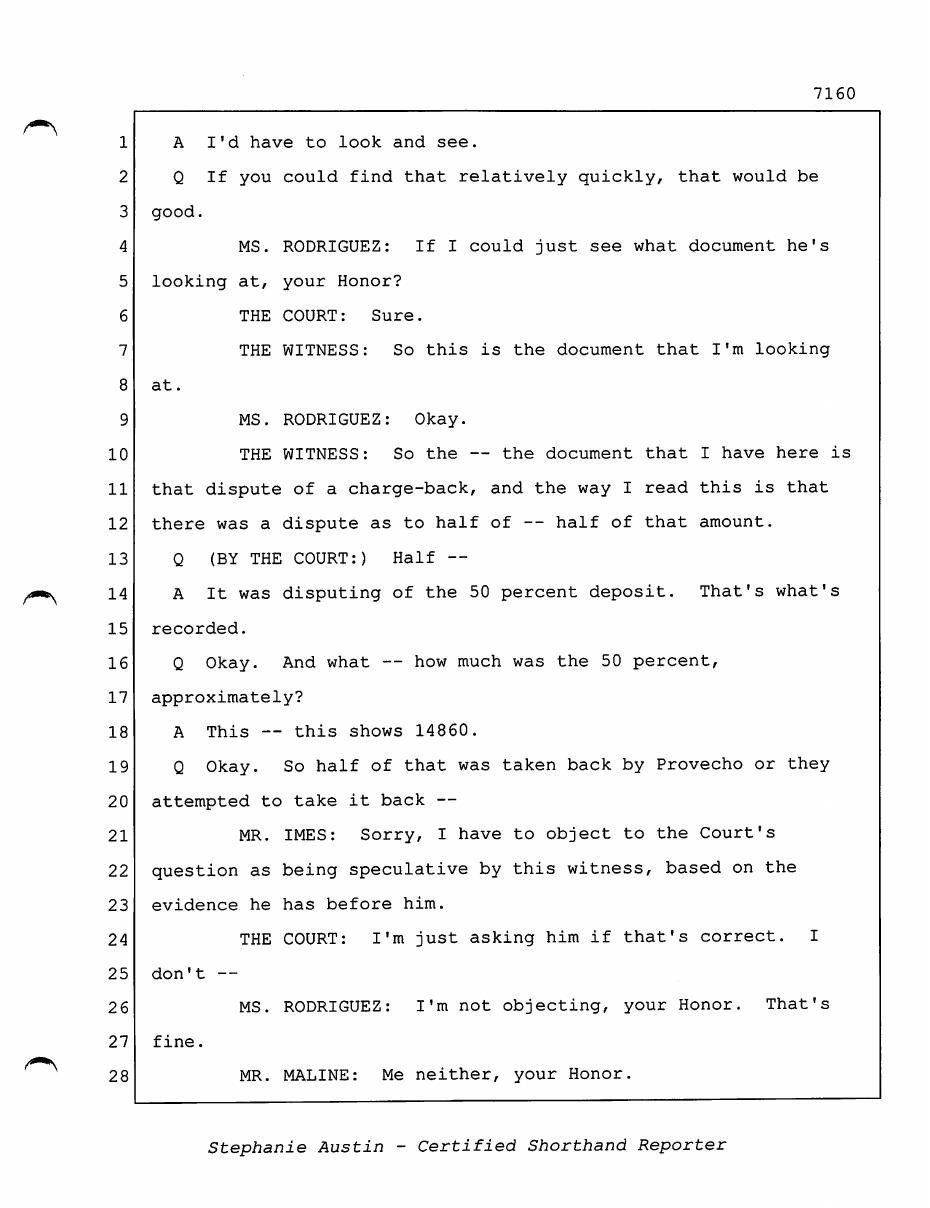
There is a real difference between owing someone money and agreeing to help him absorb a loss if a lawsuit fails. The first is a debt that exists now. The second is a promise that only comes due if something else happens first. The State took away that difference and presented the second as proof of the first. Then it used that debt to give me a motive for murder.
Mr. Imes also asked why the figure dropped from $34,000 to $19,000: “why is that?” The answer is that the two numbers measure different things. As I knew it, the $34,000 was Joseph’s figure for his whole loss on the job, the revenue he lost when the client refused to pay, and the $19,000 was my part of it: what Joseph had paid me for my work. Joseph’s ledger shows the two pieces: the whole job at $29,720, and my share at $19,500, paid in full. The accountant told the jury the same: “this $34,000.00 is a total dollar amount … portion of that was that was Chase’s and it was 19,500.” The records don’t show how Joseph arrived at $34,000, or why the e-mail says $19,000 instead of $19,500. They don’t need to. Neither figure was ever part of the running balance between Joseph and me, and the two were never one debt that shrank by half. The State could call the $19,000 a debt only by ignoring the condition Joseph and I had put on sharing the loss. It was my share of a job the customer refused to pay for, and it came due only if Joseph lost the dispute. (RT 7046:1-25, 7153:17-28, 7157:1-15, 7157:28-7158:2)
See the trial transcript (RT 7046, 7153, 7157, 7158)
What the restaurant’s owner said
One other person spoke to detectives about Provecho: the restaurant’s owner. She isn’t Joseph, so she doesn’t answer what Joseph thought. Her account is here so nothing is left out. (Cathy Jarvis’s testimony about Provecho is quoted above.)
Jill Bigelow, who owned the restaurant, spoke to Det. Bachman by phone in December 2014. This is his summary, in full: (SBSD report, December 8, 2014, Bates 008046)
On Monday, December 8, 2014, at approximately 1040 hours, I interviewed Jill Bigelow via telephone from Sheriff’s Headquarters. The following is a summary of Bigelow’s recorded statement.
On contact with Bigelow I explained to her I was conducting follow up with regard to the McStay family homicide investigation. Bigelow dealt with Charles “Chase” Merritt and Joseph McStay prior to the murders as she owned Provecho restaurant and was in business with Earth Inspired Products to build a 20’ x 50’ water wall for the business. Bigelow did not deal regularly with Merritt, but saw him once or twice at the business. Bigelow was not sure if she dealt with McStay, claiming her mother was the person who remained in contact with everyone for the construction.
Bigelow did not remember being at the business when Merritt had a violent outburst with Bigelow’s mother and claimed she may have just heard the story from her mom. Bigelow remembered there was a lack of trust due to the payments needing to be made for the work down on the fountain. Bigelow knew they agreed to pay around $50,000 – $60,000 for the water wall, and they were able to get the money back because of a chargeback they did on the credit card.
Bigelow was unsure the if the main reason for Merritt being fired was over craftsmanship, but knew they did not use them for the water wall and did not receive a finished product. Bigelow was never physically afraid of Merritt and had not dealt with him since the business arrangement was terminated.
Bigelow had no additional information and I concluded the interview.
See the document (Bates 008046)
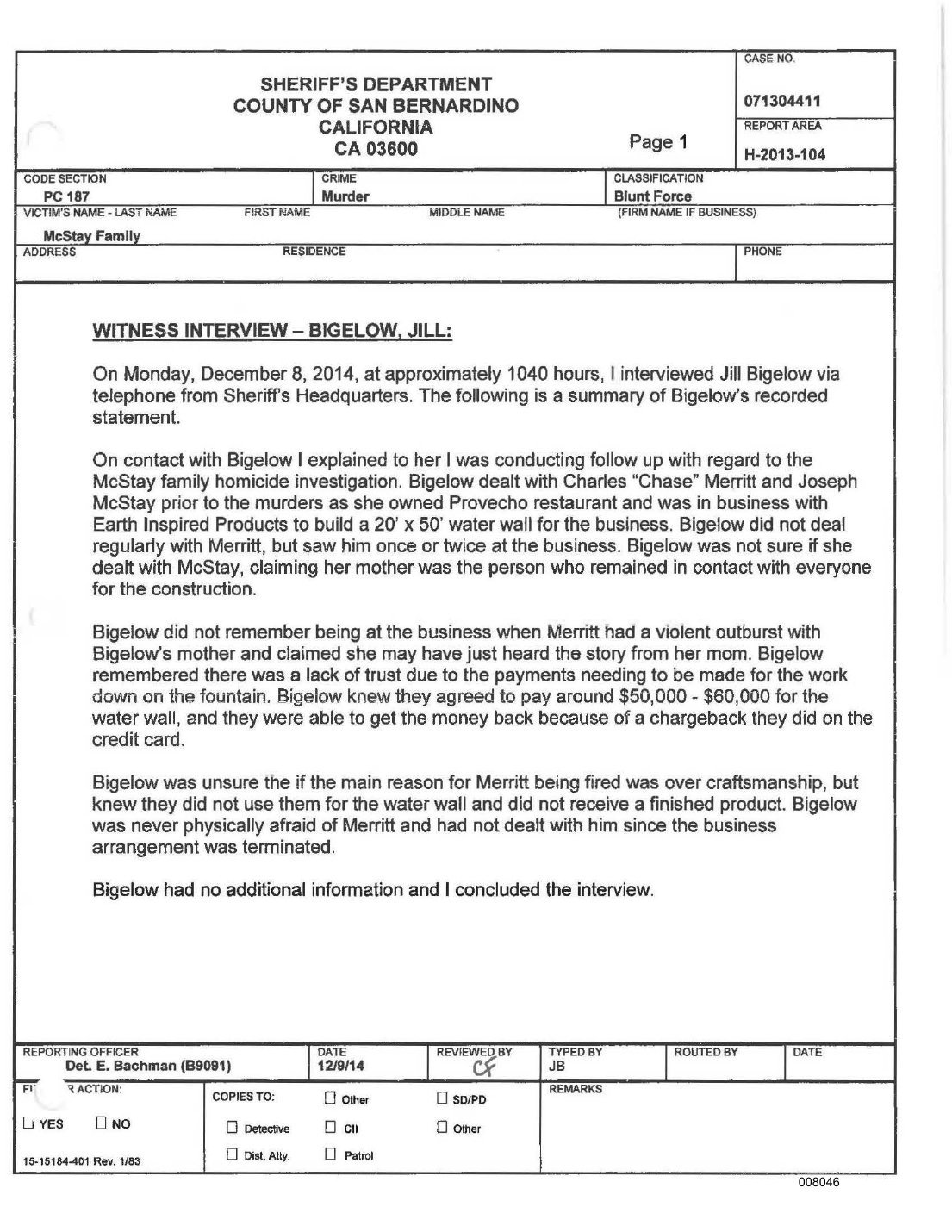
Ms. Bigelow didn’t remember being there for what the report calls an outburst, and wasn’t sure why the job ended. What she did know fits Joseph’s letter: the dispute was over payment, and the restaurant got its money back through a chargeback on the credit card. Her words “did not receive a finished product” fit it too. Joseph wrote that the two main pieces, “approximately 85% of the entire feature,” were installed, and that he was waiting on her approval of the logo to finish the glass and schedule the final install. The contract put the balance due before shipment. Her account shows an unfinished install and a payment dispute. It does not show that Joseph blamed my work.
What became of the wall is in a photograph. I stopped work on it before the logo was etched; Joseph’s letter says he was still waiting for her approval of the logo to finish the glass. This photo, posted on the restaurant’s Yelp listing while Provecho was open, shows my wall in the dining room, with water running down the glass and “PROVECHO” etched across it. I don’t know who did the etching. (Bates 003420)
See the page (Bates 003420)
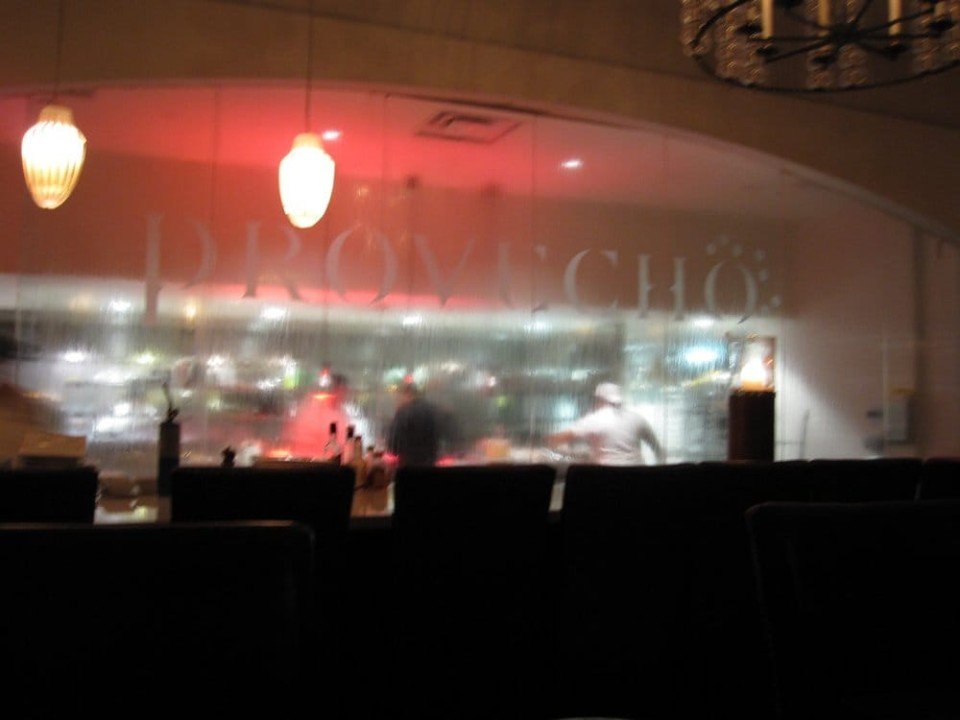
Someone finished the wall I built, and the restaurant kept it and used it.
↑ Back to the menuClosing
The State told the jury that Joseph was getting ready to fire me, partly because of Provecho. It described the job as my failure, treated the loss as a debt I owed, and played my own recorded words as an admission that I owed Joseph $19,000.
Joseph’s own writings tell a different story. When the dispute happened, he defended my work. He blamed the customer for refusing to honor the contract, called her complaints about me false, and wrote that we had gone “well beyond” our “normal call of duty.” He paid me my full share and kept giving me his custom jobs.
His ledger kept the money he paid me separate from the Provecho dispute. The accountant told the jury the job showed a zero balance, and that the side notes were never counted as debts in the running balance between Joseph and me.
When Ms. Rodriguez tried to use my recorded jail visit to prove a debt, the judge read the recording and pointed to what her question left out: Joseph first had to lose his lawsuit, and only then would we share the loss. He sustained the objection and told her how she could ask it. When Mr. Maline said that leaving out the condition implied I owed the money “right then,” the judge said “Correct.” Four weeks later, Mr. Imes played the recording to the jury without that condition and called it my admission.
The point is not whether I said those words. I did. The point is what they meant when I said them, what the prosecutors had been told they meant, and what the jury was led to believe once the condition was gone.
A customer who wouldn’t pay became my bad work. A disputed business loss became my personal debt. A promise to share that loss if a lawsuit failed became an admission that I already owed it. Each step served the same purpose: to make Provecho a reason Joseph wanted me gone, and a reason I would kill him.
The State was entitled to argue reasonable inferences from the evidence. It was not entitled to change what the evidence meant by leaving out the very words that gave it its meaning.
Joseph left his own account of Provecho, in writing, when it happened. The State’s picture of Joseph’s state of mind is the prosecutor’s. It isn’t Joseph’s.
↑ Back to the menuSources
- Trial transcript, People v. Merritt, San Bernardino County Superior Court, Case No. FVI1404194 (RT): hearing on the jail-visit recording 4823-4825, 4830-4831, 4838 (February 2019); Cathy Jarvis 5359-5367 (March 14, 2019); defense accountant 7045-7047, 7155-7159, 7164-7166 (April 30, 2019), 7340-7341 (May 1, 2019); closing argument 8186-8187, 8196-8197, 8262-8263 (May 28, 2019).
- Joseph McStay’s letter to PayPal, August 18, 2008, with the invoice/contract and my letter of August 19, 2008 (Bates 003419-003424).
- E-mails between Joseph, Laurel Hagopian and me, June 30 to July 9, 2008 (Bates 002320-002322).
- Joseph’s ledgers for 2008 and 2009 (Bates 002604-002606).
- Mr. Sequeida’s trial testimony, and his recorded interviews with detectives, September 30, 2014.
- San Bernardino County Sheriff’s Department report: interview of Jill Bigelow, Det. Bachman, December 8, 2014 (Bates 008046).