James McGee and Rajan Maline: advocates or puppets?
Motive
The State alleged I had a motive. These are the things my own lawyers did, or failed to do, that helped the State make that claim or weakened my answer to it. Each section ends with a link to the full record.
The storage keys
What they did
The storage unit: brought the “shared” shed into the record themselves.
Mr. McGee’s own question, “IS THAT WHERE MR. MC STAY RENTED THE POD?”, drew the detective’s answer that the shed was one “MR. MERRITT AND MC STAY HAD.” Mr. McGee let it stand (RT 3448:6-9).
Why it mattered: Mr. McGee did not object. An objection for lack of foundation (the detective had no ownership records, RT 3504:25-28) would have done two things: exposed that the claim had nothing behind it, and kept out the erroneous link between Joseph and a storage unit I rented, the link the State’s key argument depended on. He neither challenged the answer’s foundation nor moved to strike it, so the jury was left with it unchallenged. When the detective repeated it two days later, Mr. McGee made exactly that objection, and the court sustained it (RT 3488:8-16). By then the first answer had stood for two days.
What they failed to do
The keys: never examined them.
The keychain was on the defense list of items to view from August 15, 2017, seventeen months before trial, and no one ever looked. The single key, the one the State’s argument depended on, wasn’t on the list at all. The prosecutor, Mr. Imes, argued the two keys went “INFERABLY TO THE SAME LOCK” (RT 8245:8-9), and no one showed the jury they didn’t.
Why it mattered: The cuts on the two keys are different. Examining them would have done two things: shown the jury that the prosecution argued a fact its own evidence contradicted, and severed the alleged link between the keys and the storage unit.
What they failed to do
The keys: told the jury they never looked.
In closing, Mr. McGee said, “I would have loved to have looked at those keys a little bit closer” (RT 8335:16-17).
Why it mattered: It told the jury the defense had never done the one thing that would have shown the State’s key argument had no evidence behind it, and gave the jury the impression defense counsel didn’t care enough about the case to do even the most menial of tasks.
What they failed to do
The storage unit: never showed the jury who paid for it.
My payment to AMS Storage was in the State’s own discovery (Bates 010011), and the defense never used it. Joseph’s records show no payment for the unit, and the State had no record of any kind that he shared it.
Why it mattered: The State claimed the unit was shared without a single record to support it. My bank record shows I paid for it, Joseph’s show he never did, and I went on using the unit afterward. Showing that would have done two things: exposed that the State’s “shared” claim had nothing behind it, and severed the alleged link between Joseph and the unit.
What they failed to do
Closing: no objection when the State told the jury things no witness said.
In closing, Mr. Imes told the jury the two keys went “INFERABLY TO THE SAME LOCK” (RT 8245:8-9), that David Sequeida “MOVED THE DEFENDANT OUT OF A STORAGE UNIT” (RT 8245:20-21), and that it was “REASONABLY INFERABLE THAT ONE OF THOSE KEYS WAS RETURNED TO JOSEPH MC STAY FROM SOMEONE ELSE” (RT 8245:17-26). No witness compared the cuts or tried either key in a lock. Sequeida testified that the unit’s contents did not go with us: “YOU KNOW WE DON’T HAVE THE ROOM FOR THIS RIGHT NOW” (RT 2786:9-10). No witness testified that any key was returned to Joseph. Neither of my lawyers objected.
Why it mattered: Mr. McGee knew there was no testimony behind what Mr. Imes said. In his own closing the next day, he told the jury, “I didn’t hear testimony about that, did you?” (RT 8335:13-19). An objection when Mr. Imes said it, that he was arguing facts not in evidence and misstating Sequeida’s testimony, was the way to have the court deal with it in front of the jury. Raised a day later in argument, it was one lawyer’s word against another’s.
Read the full record: The storage keys↑ Back to the menuSusan Blake
What they failed to do
Susan Blake: let the prosecutor turn her interview on its head, without objection.
Earlier in her testimony, Mr. Maline had walked Susan Blake through page 158 of her interview. She confirmed what she had told Detective Hanke: that Joseph would “still have Chase and the welders and everybody in one spot” (“Yes,” RT 5492:11-16). Asked whether Joey’s vision of one warehouse included Chase and the other welders, she said, “That’s what he talked about” (RT 5492:17-22). Mr. Maline then put her page 158 answer to her, that Joseph “didn’t say much about Chase, trying to get Chase out”; she did not answer that question (RT 5493:10-14). Asked whether he wanted to get Dan out, she said, “Dan first, yes” (RT 5493:15-16). Then Ms. Rodriguez asked her whether she recalled being asked that Joey was going to buy Dan and Chase out. She answered, “Just Dan.” Ms. Rodriguez had her review only “the first couple of lines” of that same page 158 (“That’s it.”), then asked again: “And did you tell Detective Steers that Joey was going to buy Dan and Chase out?” This time she answered, “Yes” (RT 5535:15-28). Neither of my lawyers objected, even though on that same page, when the detective asked her directly whether Joseph wanted a new welder, she had said: “No. He didn’t say as much about Chase, wanting to get Chase out. He wanted to get more Dan out” (Interview, p. 158:1-8).
Why it mattered: Her own first answer was “Just Dan,” and the jury had already heard, through Mr. Maline, what page 158 said. Neither of my lawyers objected. An objection that the question misstated her interview, with page 158:1-8 showing her answer was “No,” would have done two things: shown the jury that the prosecutor presented a statement the witness’s own interview contradicted, and taken away the last answer the jury heard from her on whether Joseph was getting rid of me, the heart of the alleged motive, which the court called “critical evidence” (RT 4994). With no objection, the jury was left with her “Yes.”
What they failed to do
Susan Blake, at the new-trial hearing: let the court rely on her account again, with no specific answer.
At the new-trial hearing, when the court relied on Ms. Blake’s account again (RT 8942-8943), Mr. Maline said nothing that day. Four days later he said only that Ms. Blake and Michael “were impeached with earlier statements that were contradictory” (RT 8978:15-16). He did not point the court to page 158 or to her own words on the stand, “Not phase him out.”
Why it mattered: A specific answer, pointing to her interview (p. 158:1-8) and her own words on the stand, “Not phase him out” (RT 1849:24), would have done two things: shown the court its ruling rested on an account her own interview and testimony contradicted, and made the court confront that contradiction before relying on her account, at the one hearing meant to catch trial error. A general remark about impeachment left the court’s reliance unchallenged.
Read the full record: The first couple of lines (Susan Blake)↑ Back to the menuThe Walker call
What they failed to do
The Walker call: objected once, then never showed the jury where the call went.
The prosecutor, Mr. Imes, told the jury, “Joseph calls a place called Walker Welding, according to those records,” and “put it into context with what you heard from Mike and Susan and McGyver — another fabricator” (RT 8195:1-3). Then, speaking as Joseph, Mr. Imes said he had “already called Walker Welding” (RT 8196:18). Mr. McGee objected, “Arguing facts not in evidence,” and the court overruled him (RT 8196:23-24). After that, the defense let it go. Joseph’s own phone record shows the call went to a number in Hopewell, Virginia, and the defense never showed the jury that.
Why it mattered: The objection was overruled, and nothing was put in front of the jury to answer the claim. Joseph’s phone record showing Hopewell, Virginia, was already an exhibit, and the State’s 2014 reports identifying the Virginia customer were in the State’s own discovery. Pointing the jury to them would have done two things: shown the jury the State argued facts its own records contradicted, and severed the alleged link between that call and my being replaced. Instead, the jury heard “Walker Welding” and “another fabricator,” and nothing to answer it.
Later, I confirmed where the call went another way. One phone call would have answered the question. A few months ago, a friend of mine called that number. The owner of the Virginia business told her she remembered Joseph’s call: he was checking that she was satisfied with a waterfall she had bought.
Read the full record: The Walker call↑ Back to the menuThe checks
What they failed to do
The checks: never used my own words to a detective, from February 22, 2010.
On February 22, 2010, Dan Kavanaugh called me on speakerphone while Det. DuGal was in the room. I said then what I would do with the $5,000 Paul Mitchell wire: take it out and give it to Metro, because Metro would not release the waterfalls. The wire came in that day, and I withdrew $4,900. On October 16, 2017, I gave Mr. McGee my notes pointing him to that call (Folder D, pp. 5-6). What I said on that call was never used at trial.
Why it mattered: When the defense accountant tried to show the jury my $4,900 payment to Metro, the prosecutor, Ms. Rodriguez, called it speculation, and the court kept Metro’s statement out (RT 7015-7026). The State also told the jury I lied about the checks and the money. My own words to a detective, recorded before the money moved, were the direct answer to both, and the defense could have offered them for exactly that reason. My words would have answered “speculation” with what I said I would do, before I did it, and shown the jury that in February 2010 I told a detective exactly what I was doing with the money, the opposite of the State’s claim that I hid it.
What they failed to do
Deleting the checks: never showed the jury why.
I deleted the checks from QuickBooks so Dan Kavanaugh would not see them, the way Joseph and I had discussed. Dan told San Bernardino detectives in 2014 that he could get into Joseph’s QuickBooks, that he knew about a second account for the custom jobs Joseph and I did, and that he reset the passwords on both (Kavanaugh interview, September 20, 2014, pp. 23, 65, 140). Det. Hanke’s report records Dan’s belief that Joseph created the second account “so Kavanaugh could not see the deals between Joseph and Merritt,” and Dan’s threat to take the website down (Bates 007288, 007291). That report was in my lawyers’ files. They never used it.
Why it mattered: In rebuttal, Ms. Rodriguez told the jury that keeping the checks from Dan made no sense: “How does giving checks to the defendant hide anything from Dan? It doesn’t even make sense, and you don’t have evidence of that either” (RT 8422:5-12). The evidence was in the State’s own reports. Putting it in front of the jury would have shown, from the State’s own records, why keeping the checks from Dan made sense, and given the jury a reason for the deleting other than “consciousness of guilt.”
What they failed to do
January 31: never answered the State’s only witness with my phone record.
The State said I took Joseph’s checks from his house before February 1. Its only witness putting me there was McGyver McCargar. He testified that I was already there when he arrived that Sunday, January 31 (RT 2231:2-2232:7). On cross-examination he put his arrival closer to noon, and said I was there “earlier on, closer to when I first got there” (RT 2271:8-2272:27). That puts me in Fallbrook around midday. My phone record, a People’s exhibit, shows every one of my calls that day on my home tower in Rancho Cucamonga, including at 11:11, 11:38, 12:35, 12:41, 1:00, 1:12 and 2:42 (Exhibit 794, items 8836-8845). Fallbrook is at least a two-hour round trip, and there is no gap in that stretch, the middle of the day, anywhere near long enough for it. My lawyers were told this and never used it. In closing, Mr. McGee repeated the same timeline himself (RT 8332:6-15).
Why it mattered: McCargar was the State’s only evidence that I was at Joseph’s house before February 1. Without him, the State had nothing to say I had the checks before then, or that I, rather than Joseph, made the two February 1 checks in QuickBooks. The State’s own exhibit contradicted its January 31 story, and pointing the jury to it would have removed the foundation of Ms. Rodriguez’s rebuttal: “He got those checks when he went there on January 31st” (RT 8422:26-28). Instead, my own lawyer repeated her timeline.
What they failed to do
Rebuttal: let the State misstate the money, with no objection, when it had the last word.
In rebuttal, Ms. Rodriguez told the jury three things about the money that the evidence contradicted. Mr. McGee objected to other parts of her rebuttal, but not to these. She said, “There is no way for him to get additional savings on that” (RT 8419:5-6). Joseph’s own February 1 e-mail lists savings on both jobs, “SA 15% $7725 Savings $6500” and “PM 15% $4725 Savings $3050” (Exhibit 419), and the defense accountant had told the jury my $6,500 check matched the Saudi savings (RT 7084:26-7085:4). She said, “Since when does the defendant ever get paid for jobs before he does the work? He doesn’t” (RT 8419:22-24). She went on: “He would get money — money up front before, but only when he was purchasing materials. He’s not purchasing materials anymore” (RT 8419:26-28). I bought the materials for the Saudi job, as I did for Paul Mitchell. The accountant had testified, over the State’s objection, that “Payments begin when the deposit is received from the customer” (RT 7083:15-22). And she said Joseph got the Saudi deposit “but never the end of the money,” that “the majority of it actually went to the defendant,” and that the job wasn’t complete (RT 8420:1-7). The accountant had testified that the balance came in on March 5, $16,839.25 to Dan Kavanaugh and $13,862 to me, and that he found no claim the job wasn’t finished (RT 7085:5-7086:21).
Why it mattered: Rebuttal is the State’s last word, and the defense can’t answer it. An objection that she was misstating the evidence was the only way to correct her in front of the jury. Without one, the last thing the jury heard about the money was the State’s version, and the evidence said otherwise.
What they failed to do
My 2014 interview: let a detective who wasn’t there tell the jury the opposite of what I said.
Mr. McGee asked Det. Ryan Smith whether I had admitted in my October 22, 2014 interview to writing the checks. Smith was not in that interview. He told the jury, “My understanding is Mr. Merritt admitted to receiving checks on the 4th, not writing them. I’d have to review whatever transcript you are talking about.” Mr. McGee had just told the court, “That statement is in evidence.” Yet nobody showed Smith the transcript, and Mr. McGee never moved to strike an answer Smith had no firsthand knowledge to give. He moved on (RT 4138:8-23).
Why it mattered: In that interview I told the detectives I wrote the checks (pp. 121, 137, 140, 187, 201). Those pages, put in front of Smith, would have corrected what the jury heard from a witness with no firsthand knowledge, and shown that I never denied writing the checks. Instead, the jury was left with Smith’s answer.
What they failed to do
Saudi Arabia: let the State argue against evidence the jury had already heard.
In closing, Mr. Imes told the jury there was “no indication that full deposits had been received” (RT 8191:23-8192:6) and “even no evidence that it’s been built yet” (RT 8219:18-8220:8). He named the company that paid, Kocache, said it was “presumably” the Saudi job, and said “No one ever connected the dot” (RT 8259:17-22). He also said I “forged checks that he has cashed for projects that hadn’t even started or hadn’t even been finished” (RT 8223:19-20). The defense accountant had connected the Kocache payment to the Saudi job twice: on direct, tracing the January 22 deposit wire to the Saudi job (RT 7081:1-7082:13), and on the State’s own cross-examination the next day, answering from Union Bank’s wire report that the money came from Kocache (RT 7144:16-7146:10). He also told the jury the customer paid $61,434 on a $61,542 job, and that he found no claim the job wasn’t finished (RT 7086:11-21). No one objected to any of what Mr. Imes said, and the defense never pointed the jury back to that testimony. Counsel also had my photos of the installed waterfalls.
Why it mattered: The State’s case was that I took money I wasn’t owed. Reminding the jury of what it had already heard would have shown that the Saudi deposit was in, from the customer, before the February 2 check was written, and that the job was built, installed and paid for: the money I received was for work I did.
Read the full record: The Checks, the Money, and the Motive↑ Back to the menuThe accounting
What they failed to do
My accounting: had it since 2017, never presented it.
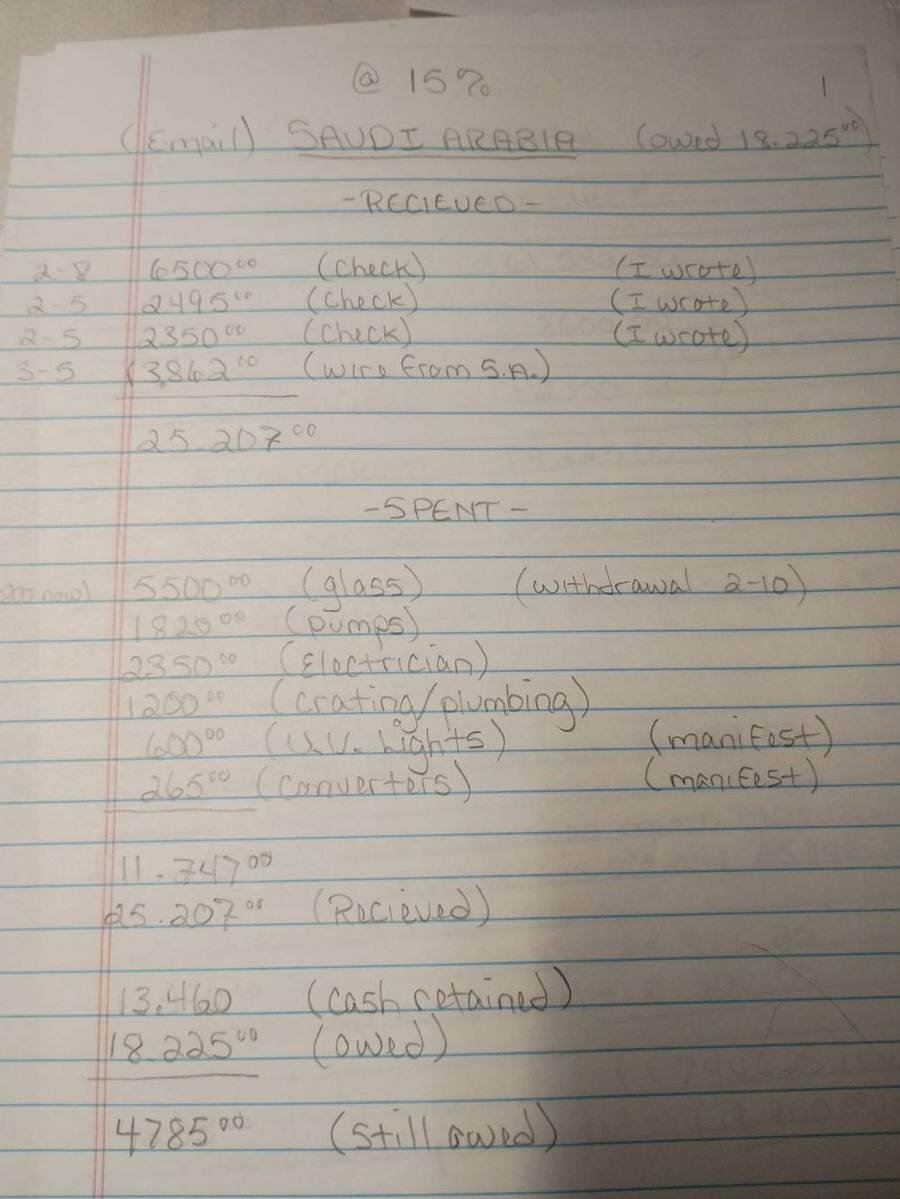
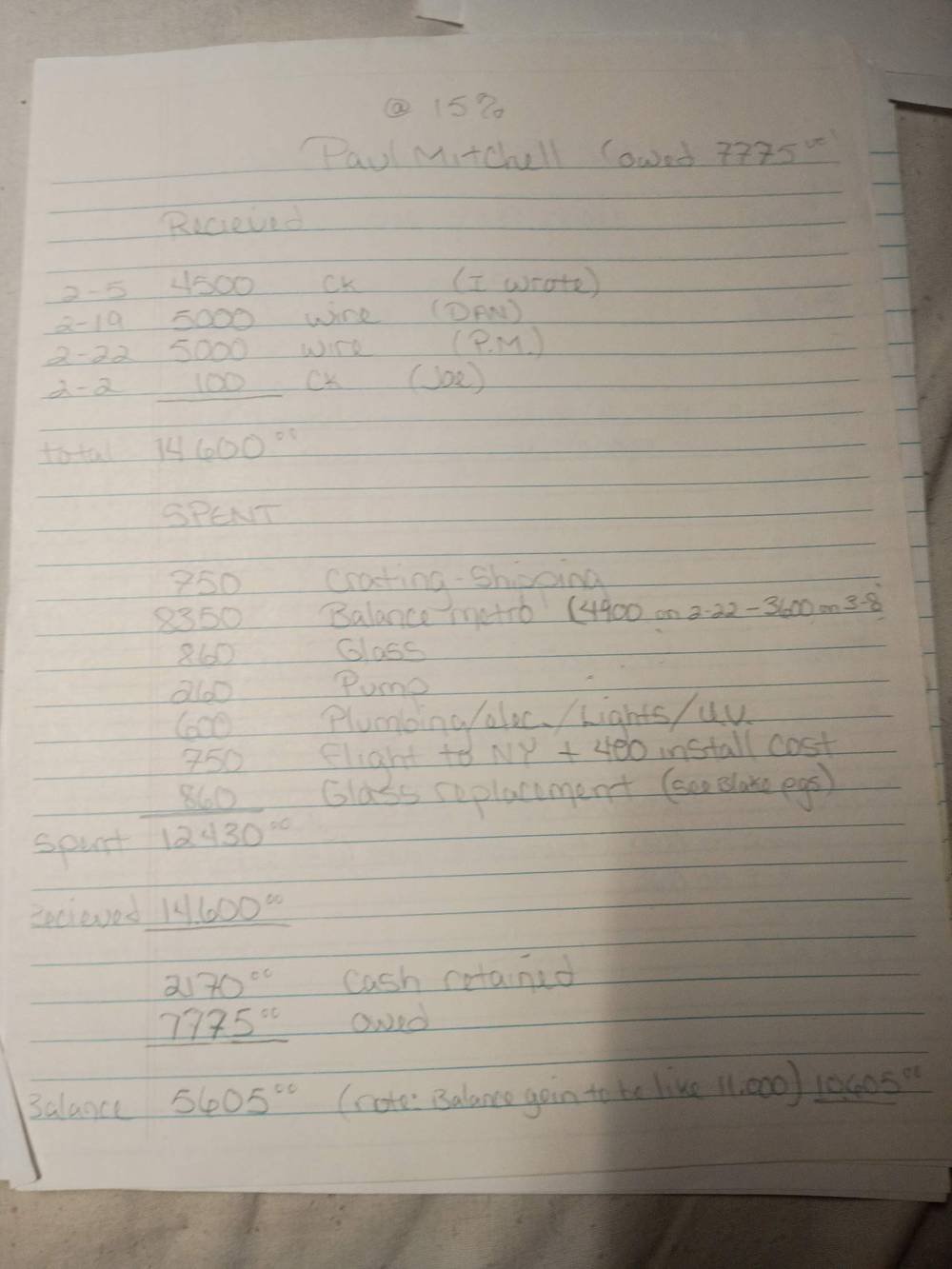
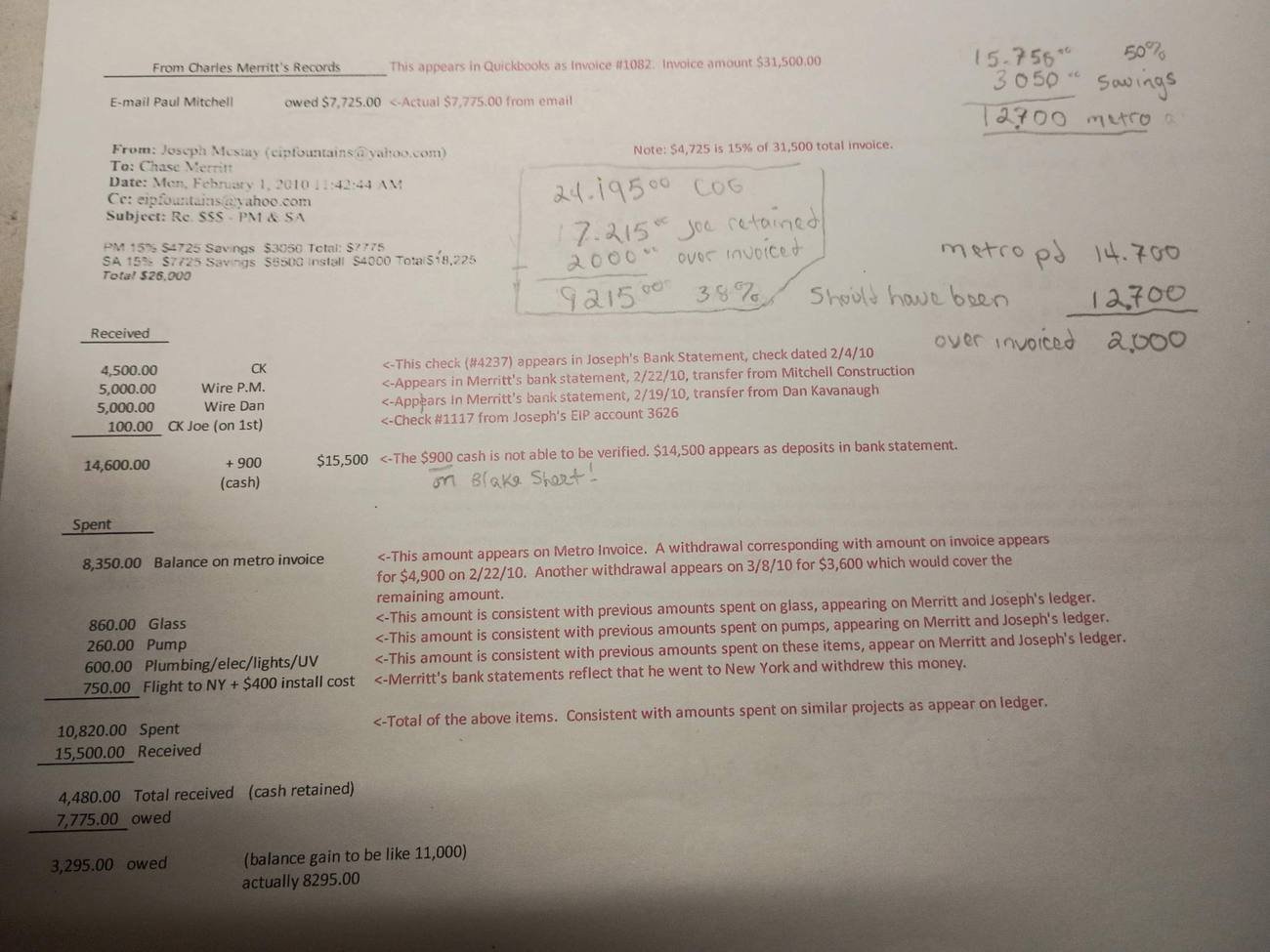
I worked out by hand where every dollar went on the Saudi Arabia and Paul Mitchell jobs, and on the jobs after Joseph was gone, from my own records. I gave the sheets to Mr. Maline in 2017, and went over them with the defense accounting expert on a jail visit. My lawyers built trial exhibits from them, headed “From Charles Merritt’s Records.” The full accounting never reached the jury.
Why it mattered: In rebuttal, Ms. Rodriguez told the jury, “He was the one taking the money” (RT 8443:4-5). Denying my motion for a new trial, the court said “there was no receipts or accounting for the money” (RT 8943:20-27). There was an accounting. It showed that, on Joseph’s own figures, I kept $10,370 less than I was owed on the two jobs he and I were finishing.
See my sheets and the exhibits built from them

What they failed to do
Susan Blake’s account: subpoenaed it, then sat down at “36,000.”
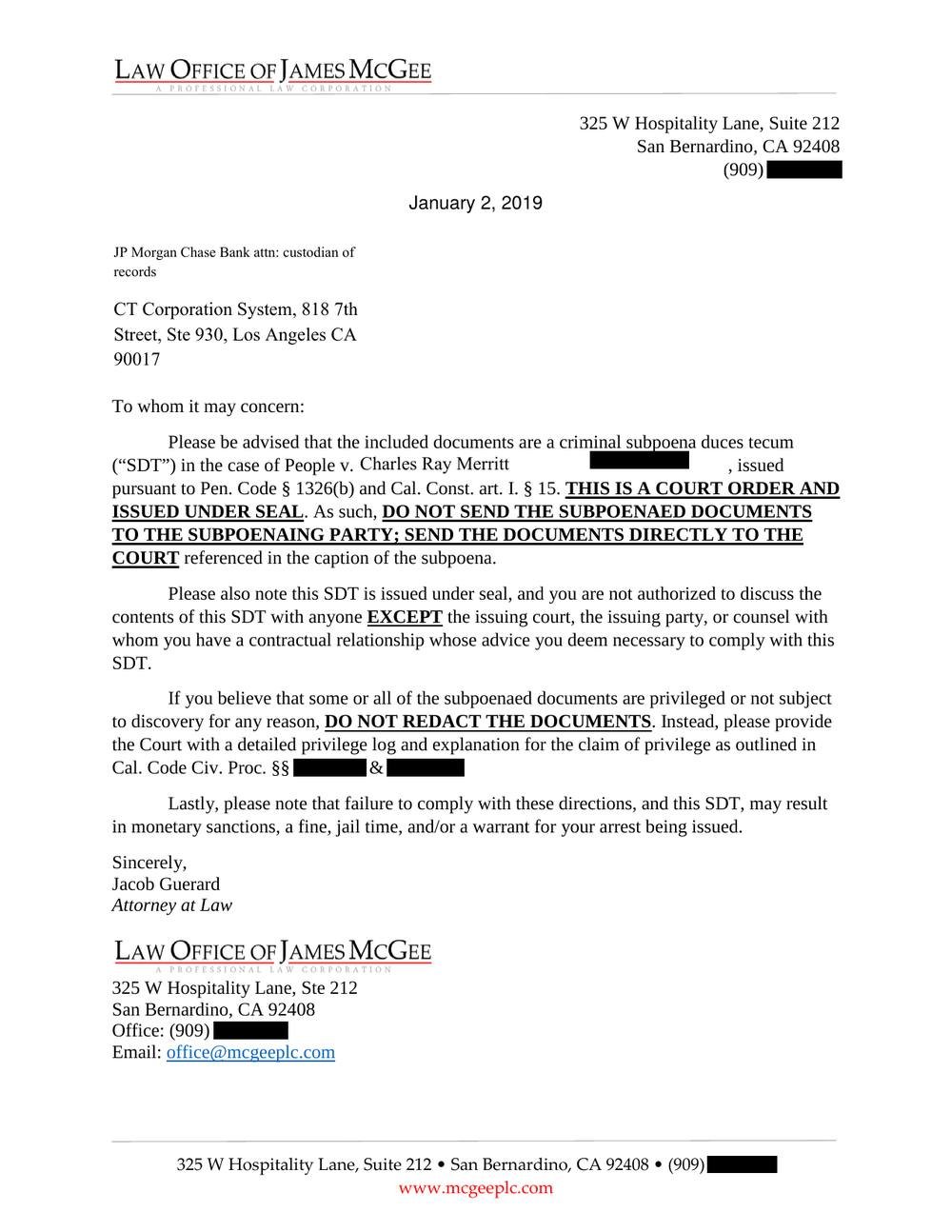
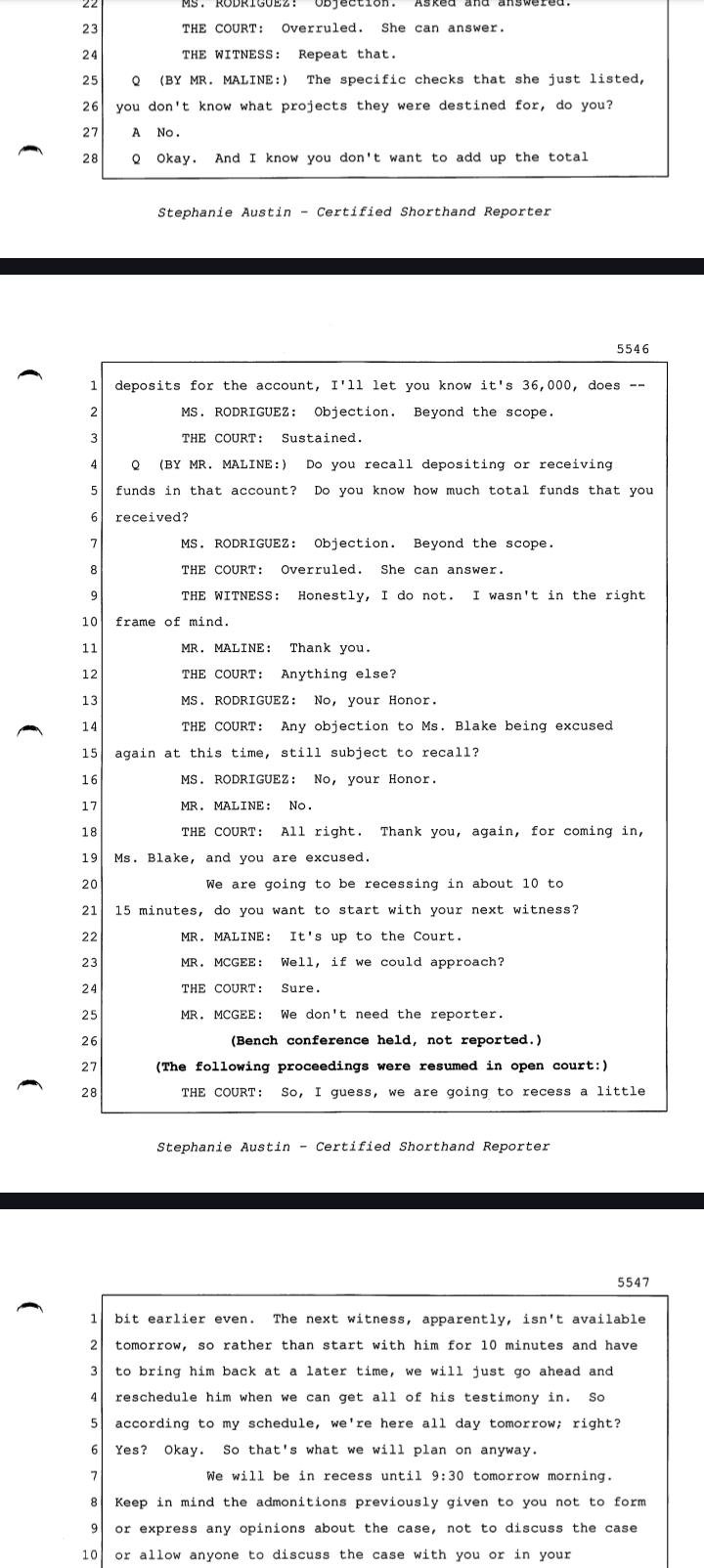
On January 2, 2019, six days before Susan Blake testified, my lawyers subpoenaed the Chase account she ran in Earth Inspired Products’ name. On January 8 she told the jury, “Obviously, there wasn’t money coming in. I was paying for money going out” (RT 1834:9-12). Chase returned the records to the court on January 29. On March 18, with the statements in hand, Mr. Maline started to tell the jury the total, “I’ll let you know it’s 36,000,” and Ms. Rodriguez’s objection was sustained. He asked her one more question, she said she didn’t know how much came in, and he said “Thank you” and sat down (RT 5546:1-11).
Why it mattered: The account took in $36,460, and $19,950 was paid out to Susan Blake herself, by check and cash withdrawal. The jury never heard either figure. Her testimony that no money came in, the State’s picture of the business after Joseph, was never answered.
See the subpoena and RT 5546
What they failed to do
The new-trial hearing: the money was Mr. Maline’s, and he left it out.
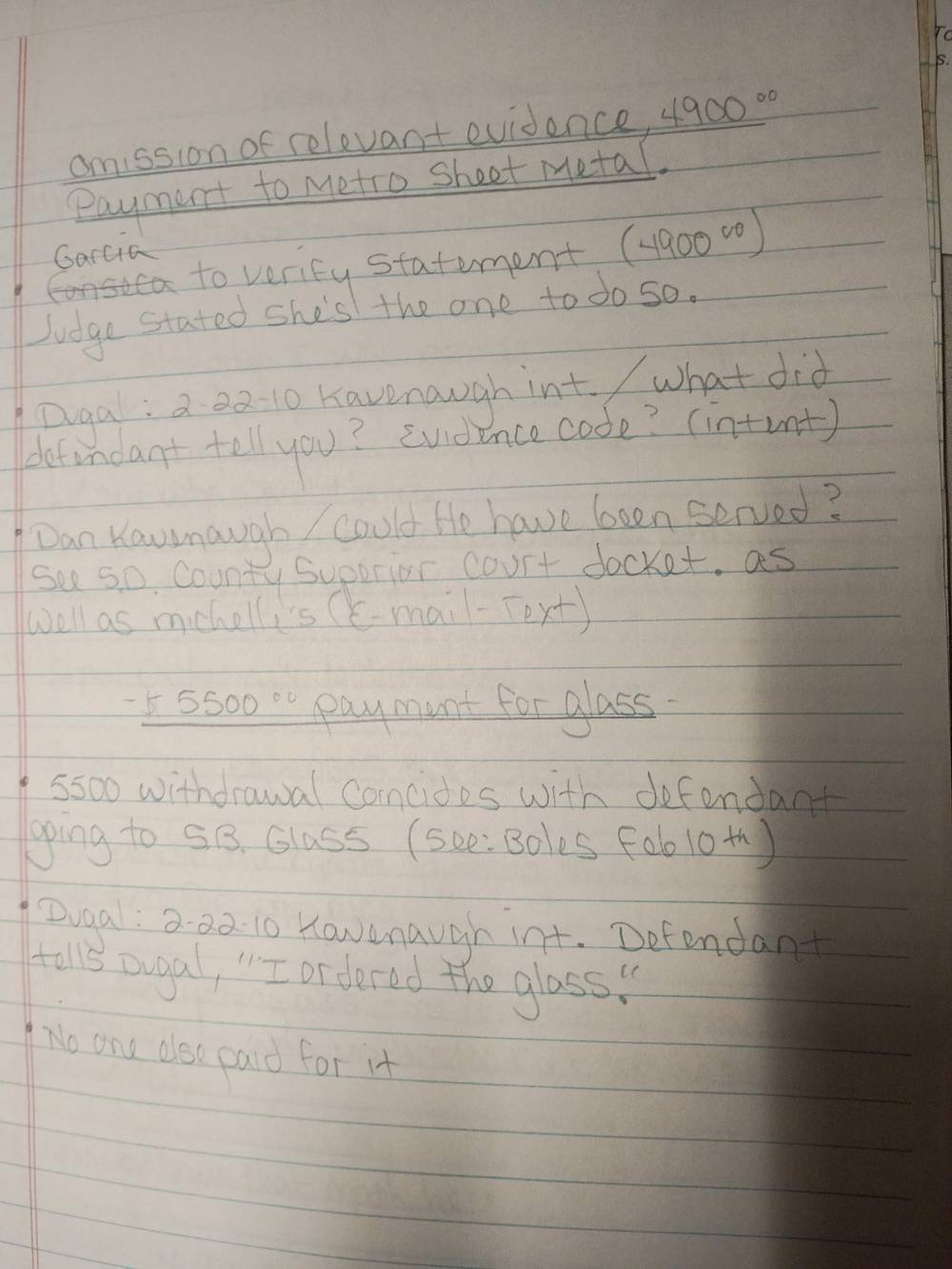
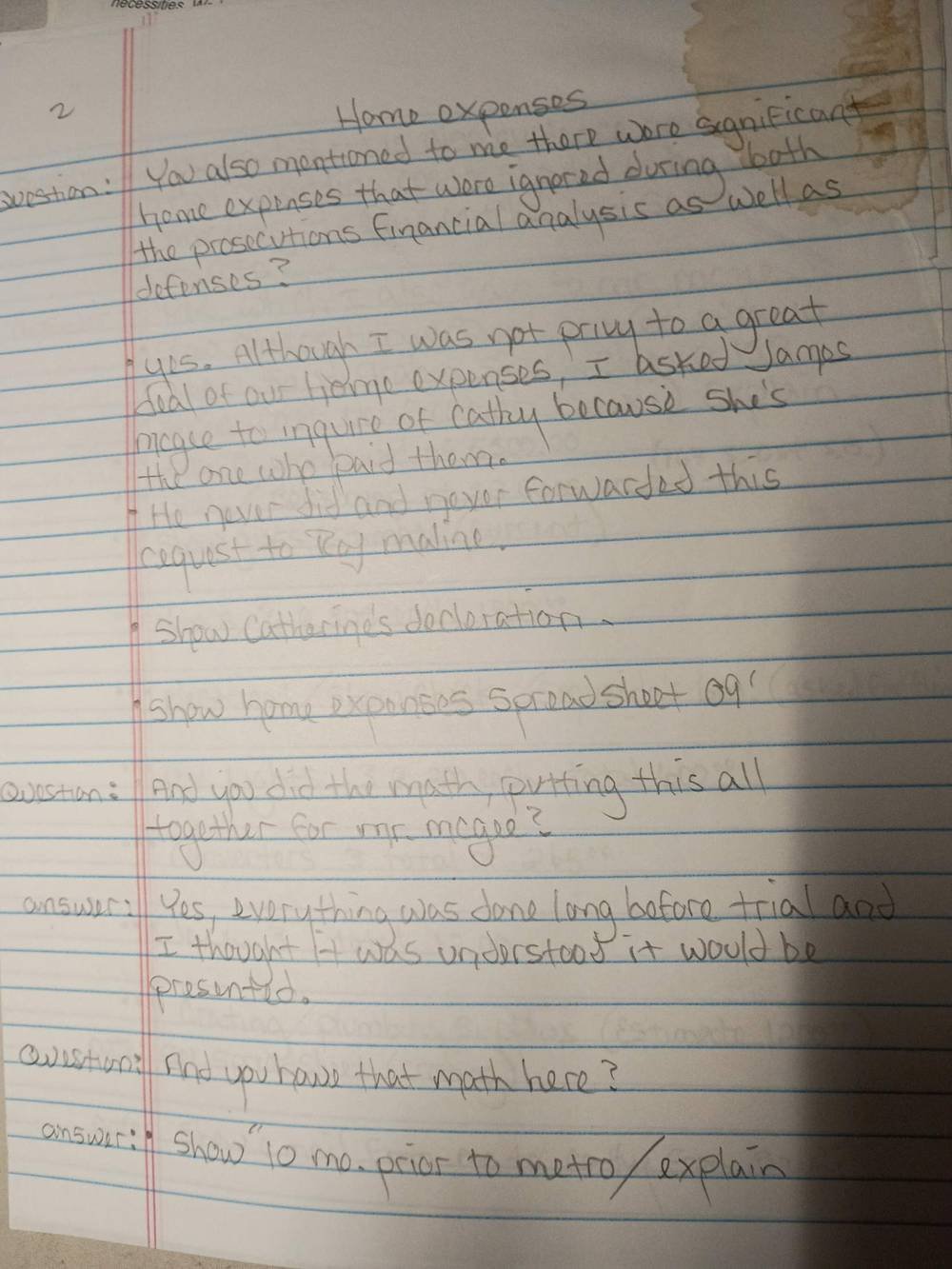
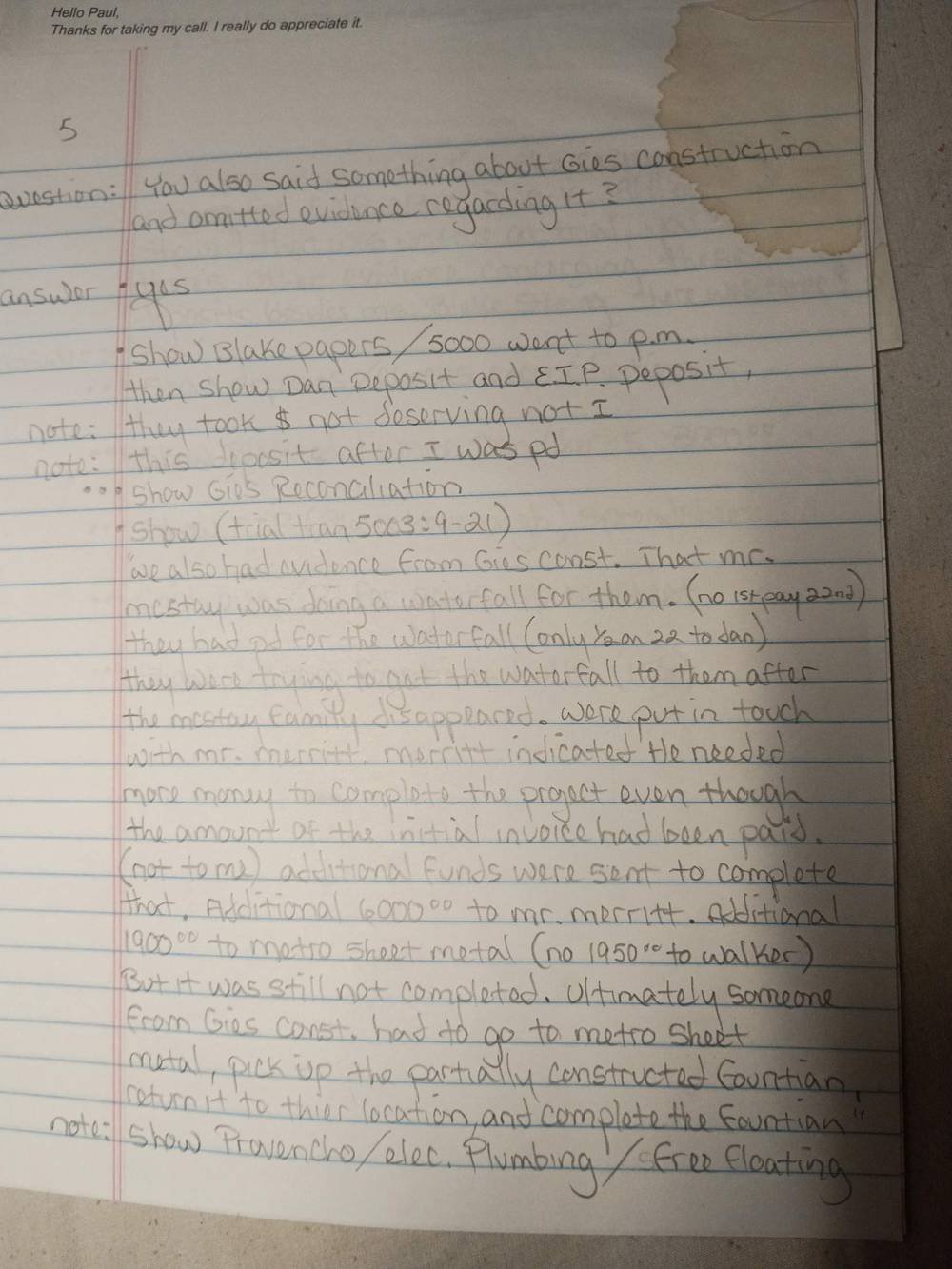
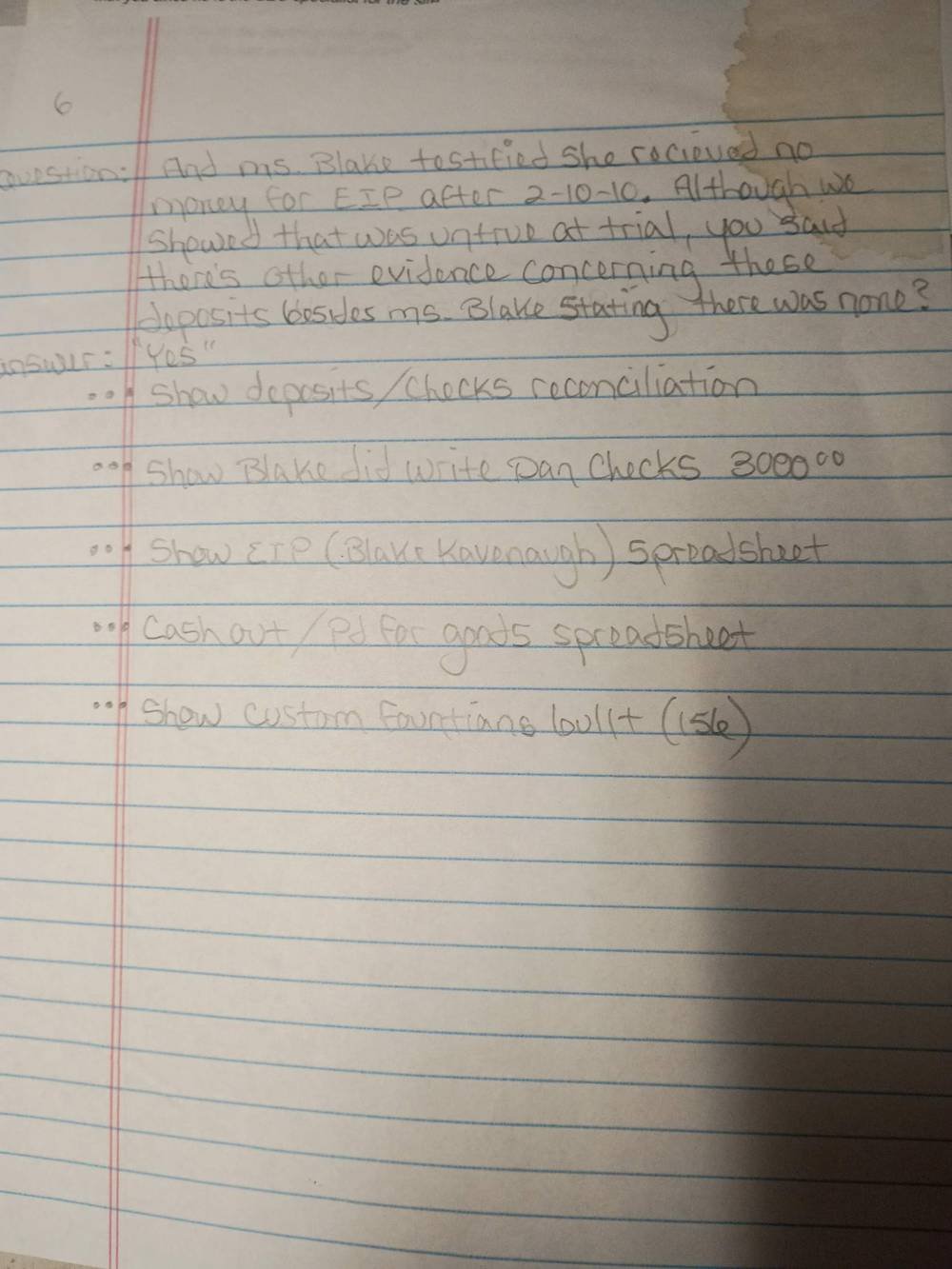
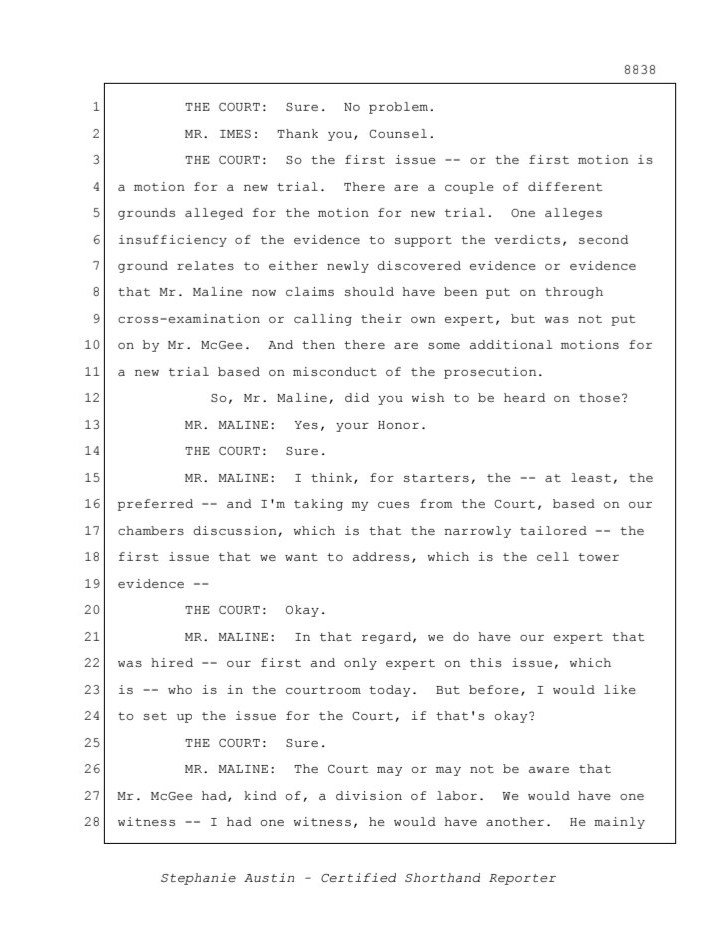
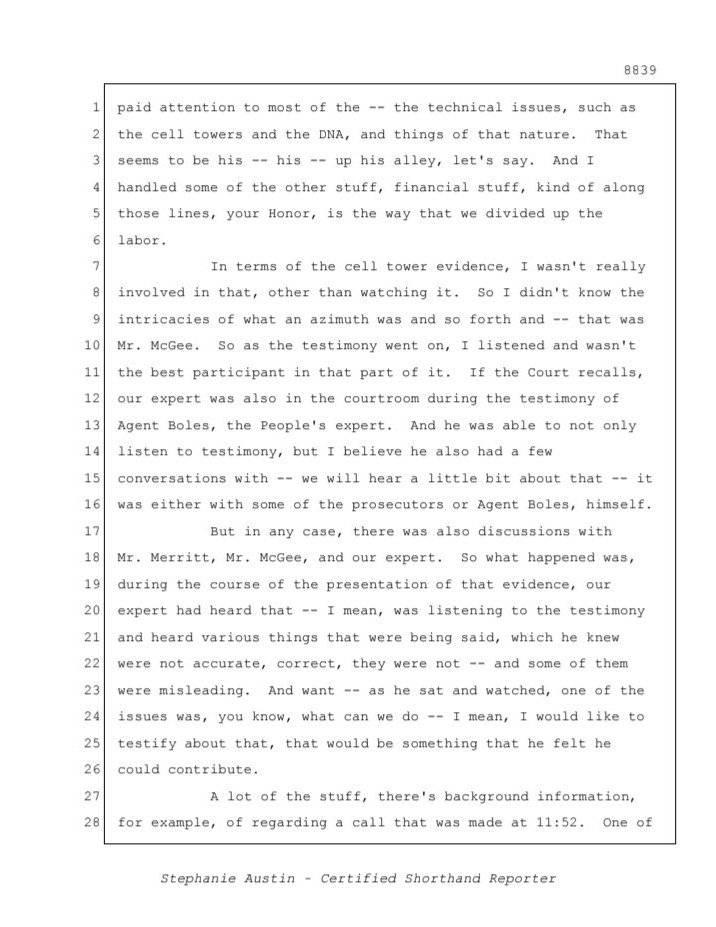
At the hearing on my motion for a new trial, Mr. Maline told the court the defense had divided the work: Mr. McGee took “the technical issues, such as the cell towers and the DNA,” and “I handled some of the other stuff, financial stuff” (RT 8838:26-8839:6). Before the hearing I wrote out for him the questions I wanted him to ask me on the stand, and what I would show: the $4,900 to Metro, the $5,500 for glass, our home expenses, my Saudi and Paul Mitchell sheets, the Geis job, and Susan Blake’s deposits and checks. He did not call me. When he examined Mr. McGee, he did not ask a single question about the money (RT 8908-8929).
Why it mattered: The court denied the motion in part because there was “no … accounting for the money.” The accounting was in Mr. Maline’s hands, and the money was his part of the defense. Raising it would have meant raising his own failure. I believe that is why he left it out.
See my notes to Mr. Maline and RT 8838-8839


Why Joseph kept Dan out
What they failed to do
The reason Joseph hid the custom jobs from Dan: in my lawyers’ files, never argued.
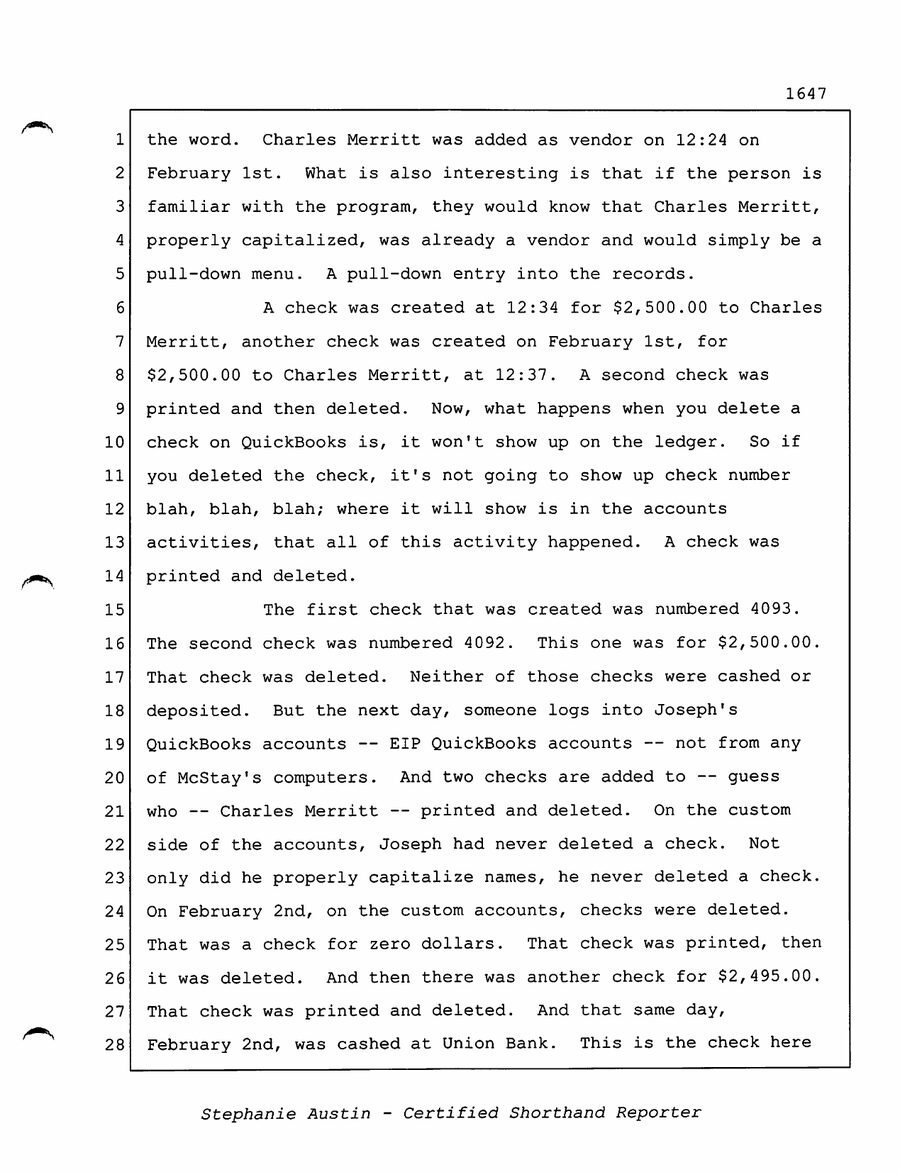
The State built its motive on the checks deleted in QuickBooks and on the second QuickBooks account. In his opening statement, Mr. Daugherty told the jury (RT 1647:20-23):
MR. DAUGHERTY: And two checks are added to — guess who — Charles Merritt — printed and deleted. On the custom side of the accounts, Joseph had never deleted a check. Not only did he properly capitalize names, he never deleted a check.
My answer has always been that Joseph and I kept the custom jobs out of sight of his partner, Dan Kavanaugh. That is why the checks were deleted and why there was a second account. Part 1 sets it out. What follows is why Joseph had reason to, and most of it comes from the State’s own file and from Dan himself.
What I told the detectives
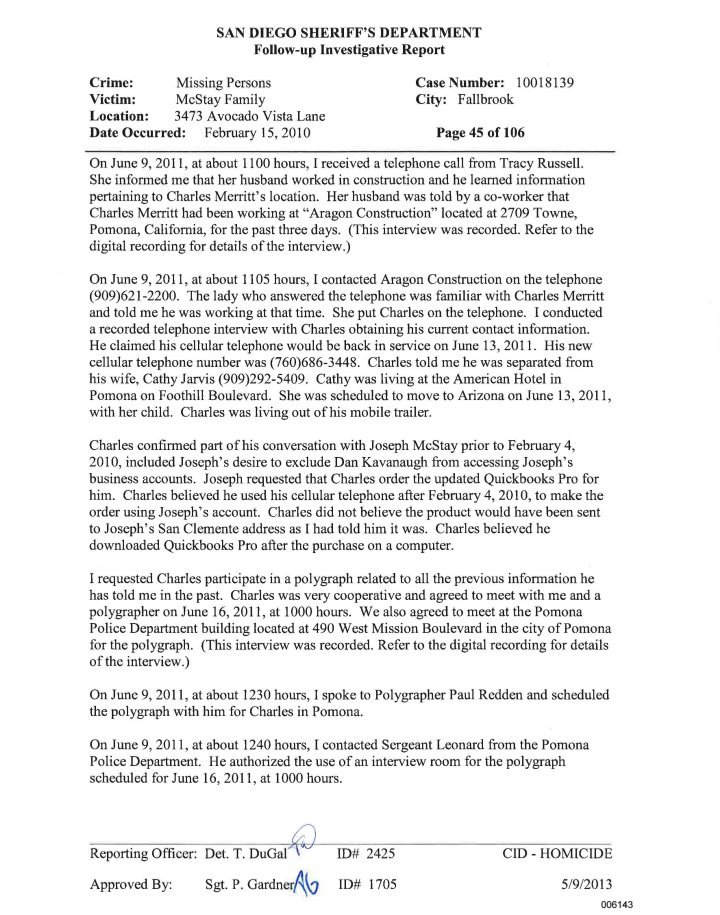
On June 9, 2011, Det. DuGal of the San Diego Sheriff’s Department wrote down what I told him (Bates 006143):
“Charles confirmed part of his conversation with Joseph McStay prior to February 4, 2010, included Joseph’s desire to exclude Dan Kavanaugh from accessing Joseph’s business accounts.”
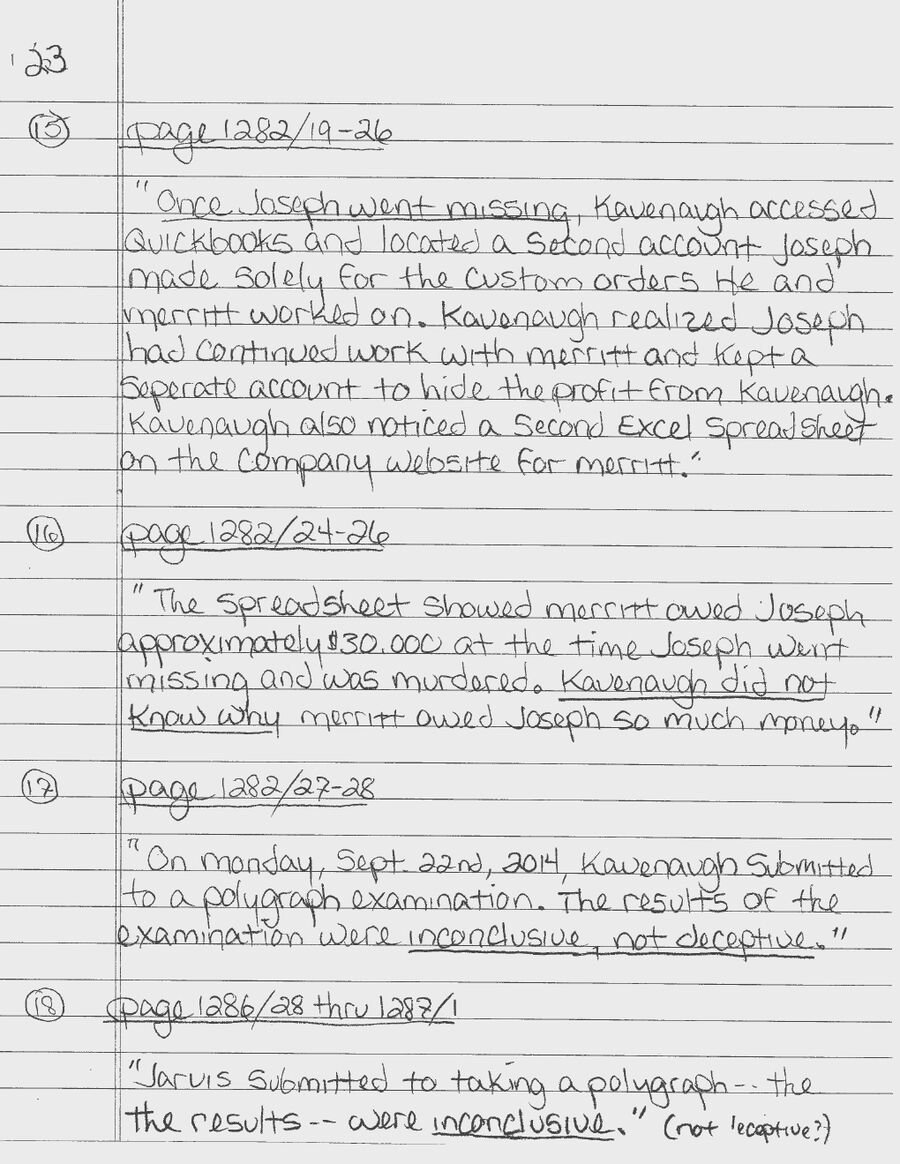
The detectives’ own affidavit says the same thing. After Joseph went missing, it says, Dan found the second QuickBooks account, the one for the custom orders Joseph and I worked on, and realized Joseph had kept a separate account “to hide the profit from Kavanaugh” (p. 1282:19-26). I don’t have that page of the affidavit in front of me; the image below is the copy I made of it in my notes for my lawyers.
See the San Diego report and my copy of the affidavit
What Dan told the detectives
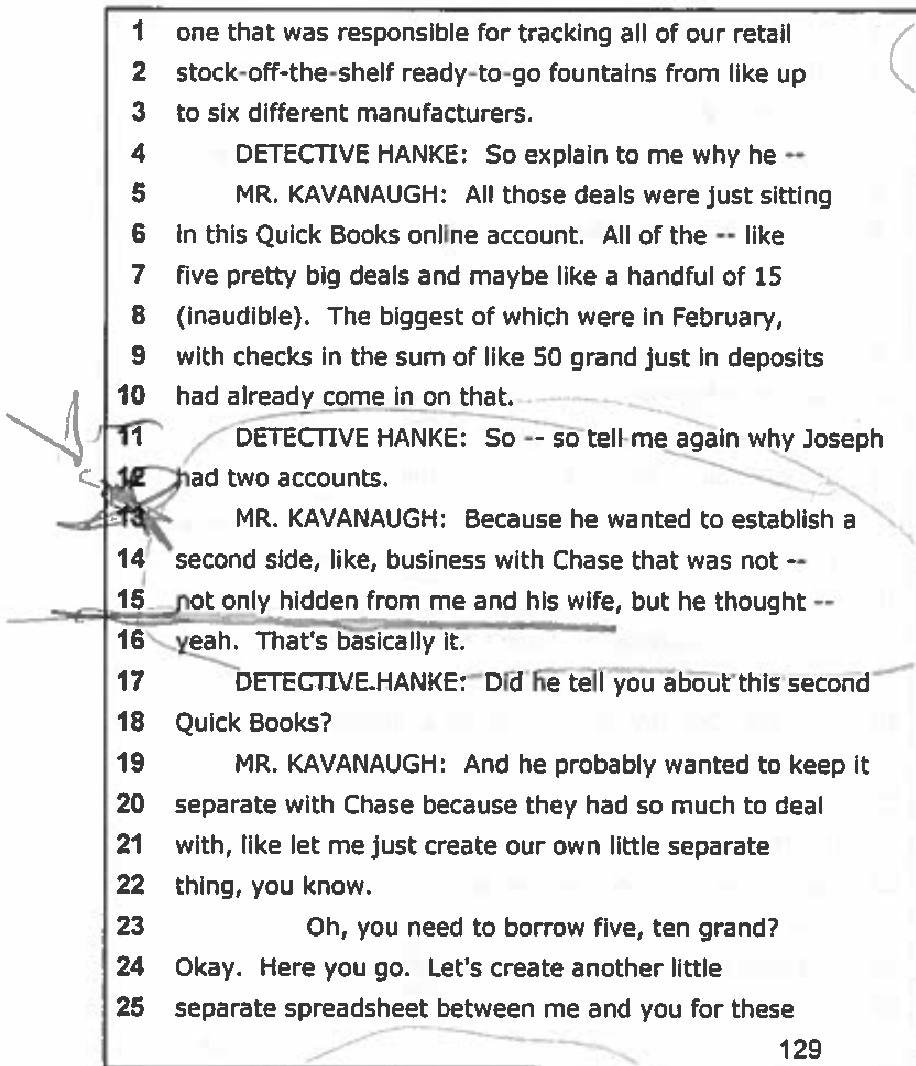
On September 20, 2014, Det. Hanke interviewed Dan. Dan said it himself (p. 129:11-16):
DETECTIVE HANKE: So — so tell me again why Joseph had two accounts.
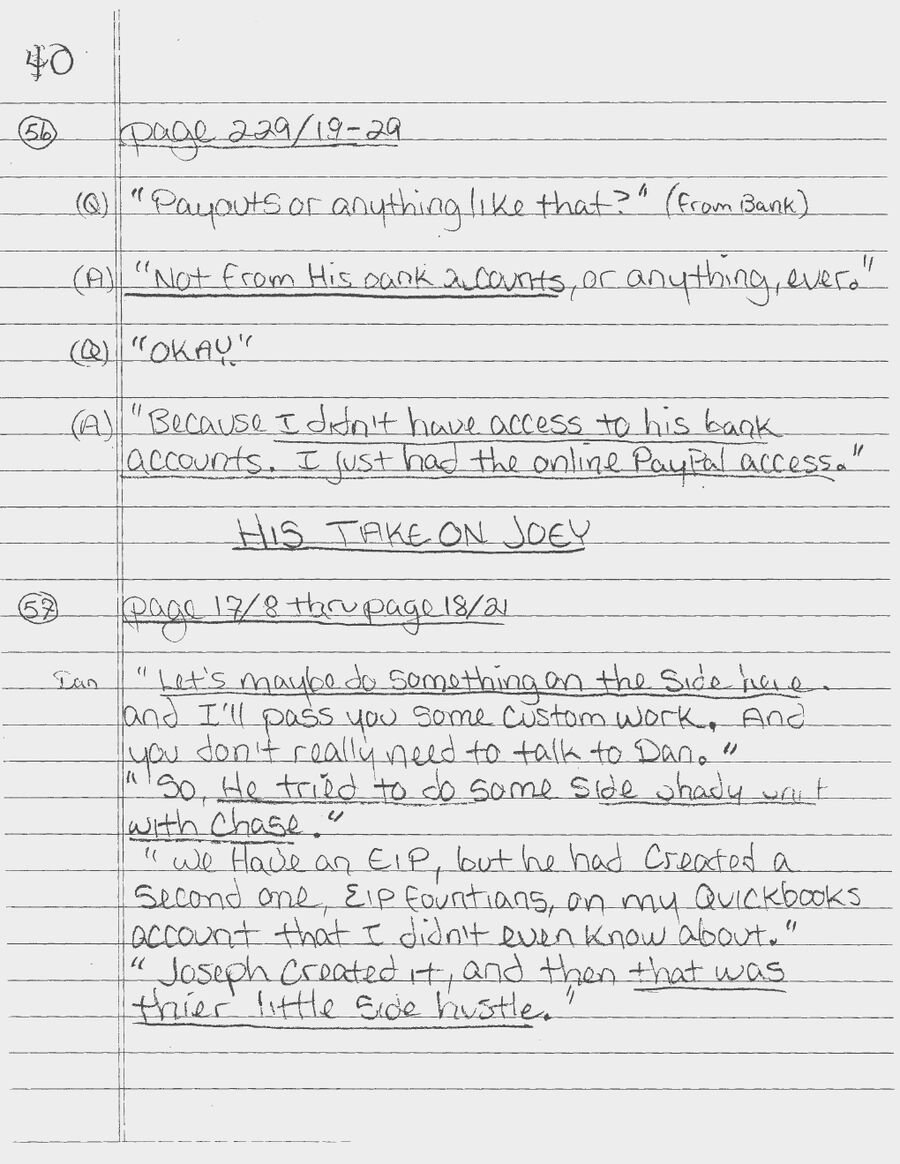
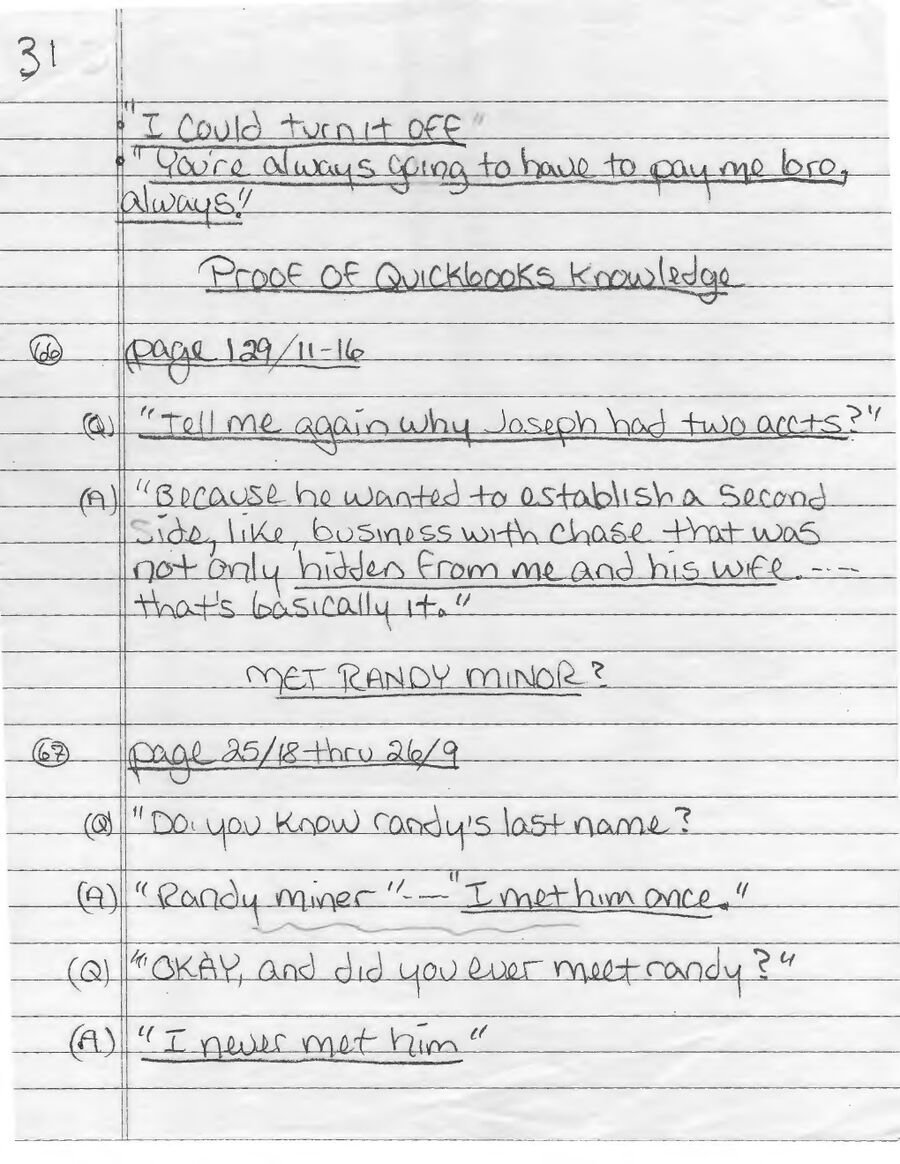
MR. KAVANAUGH: Because he wanted to establish a second side, like, business with Chase that was not — not only hidden from me and his wife, but he thought — yeah. That’s basically it.
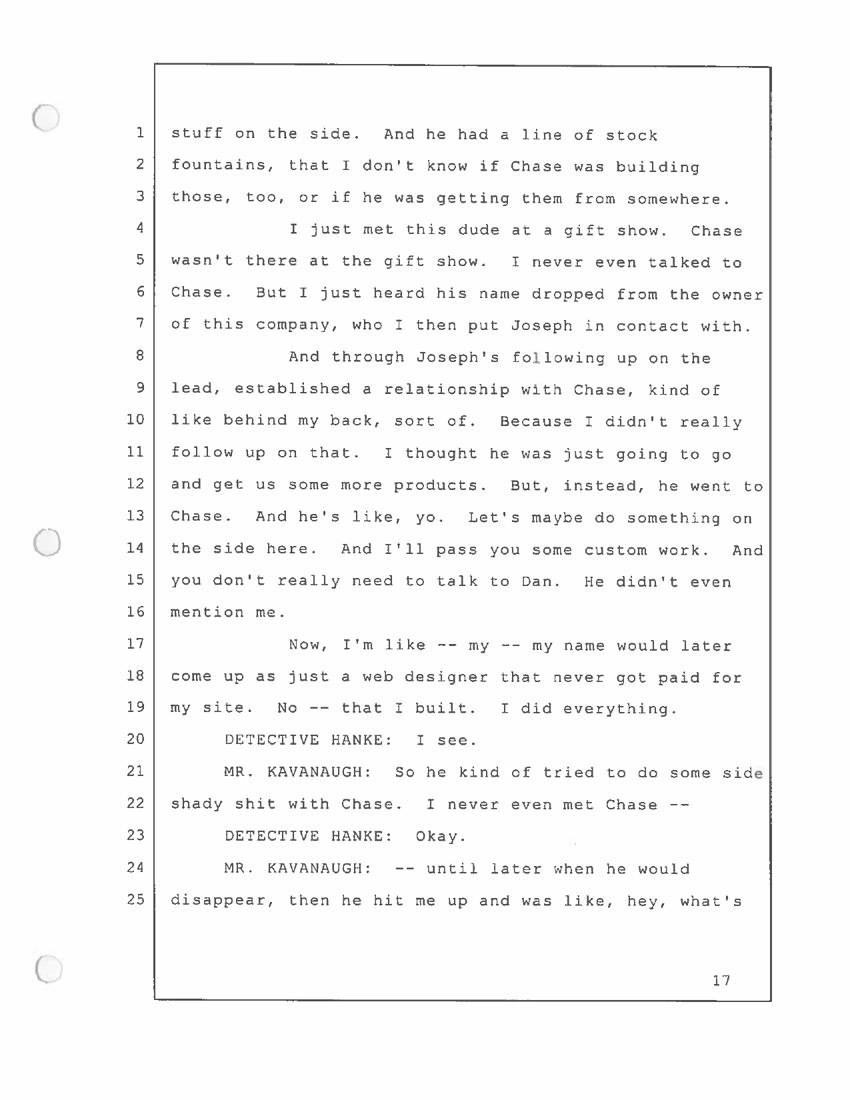
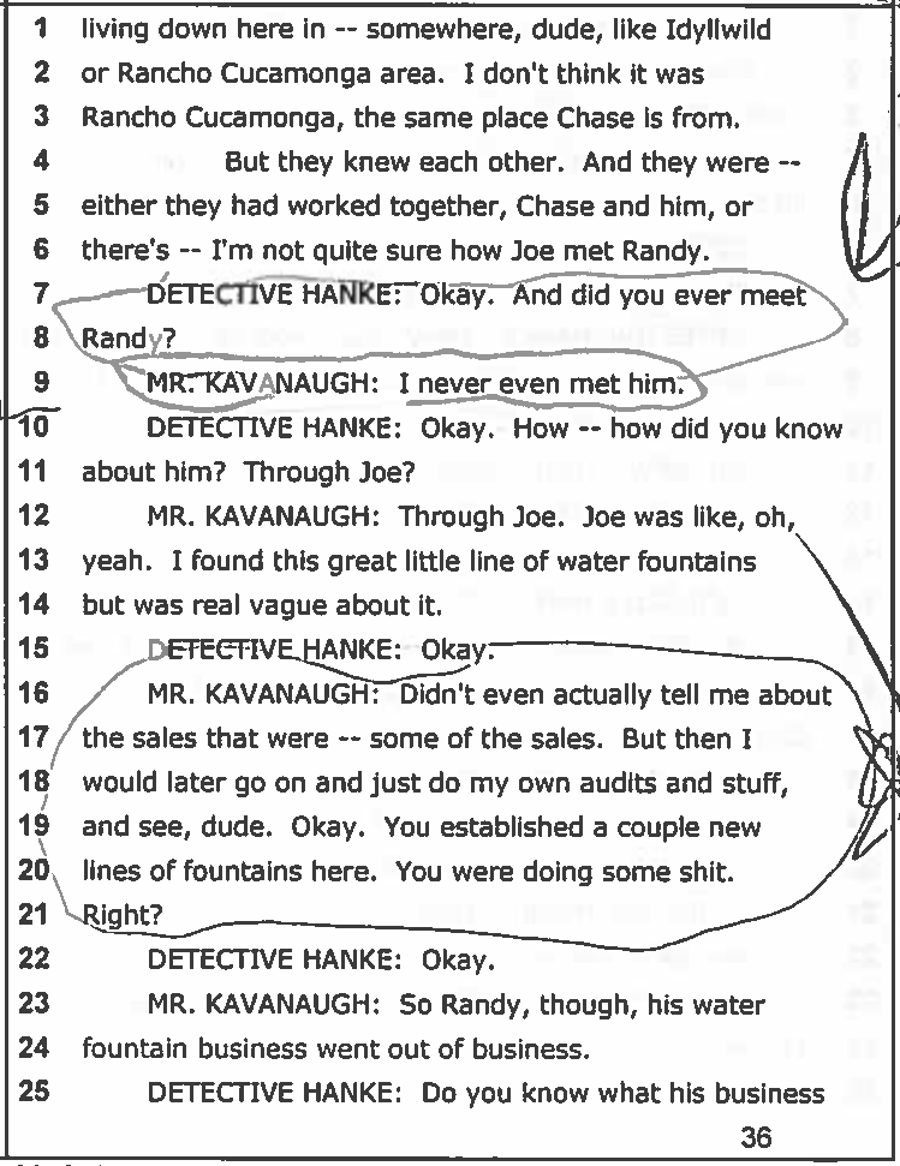
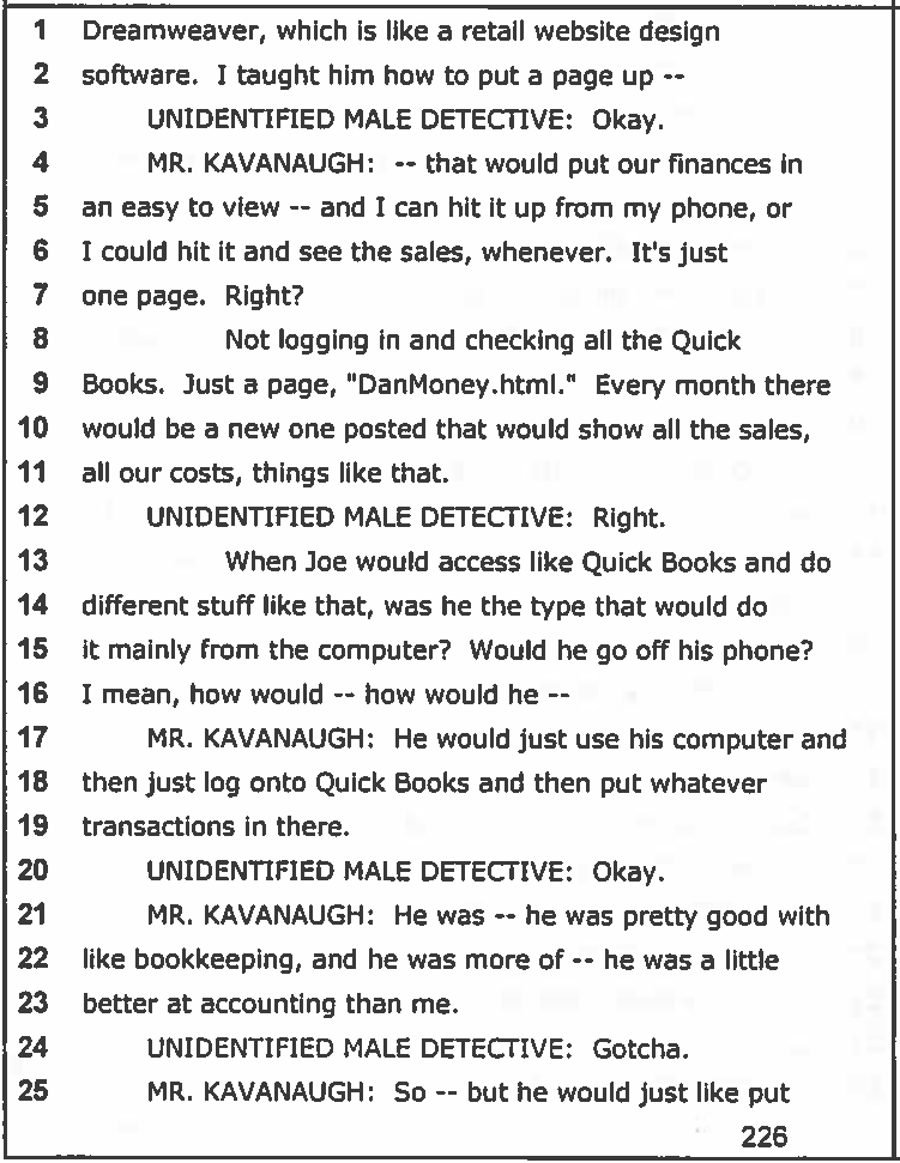
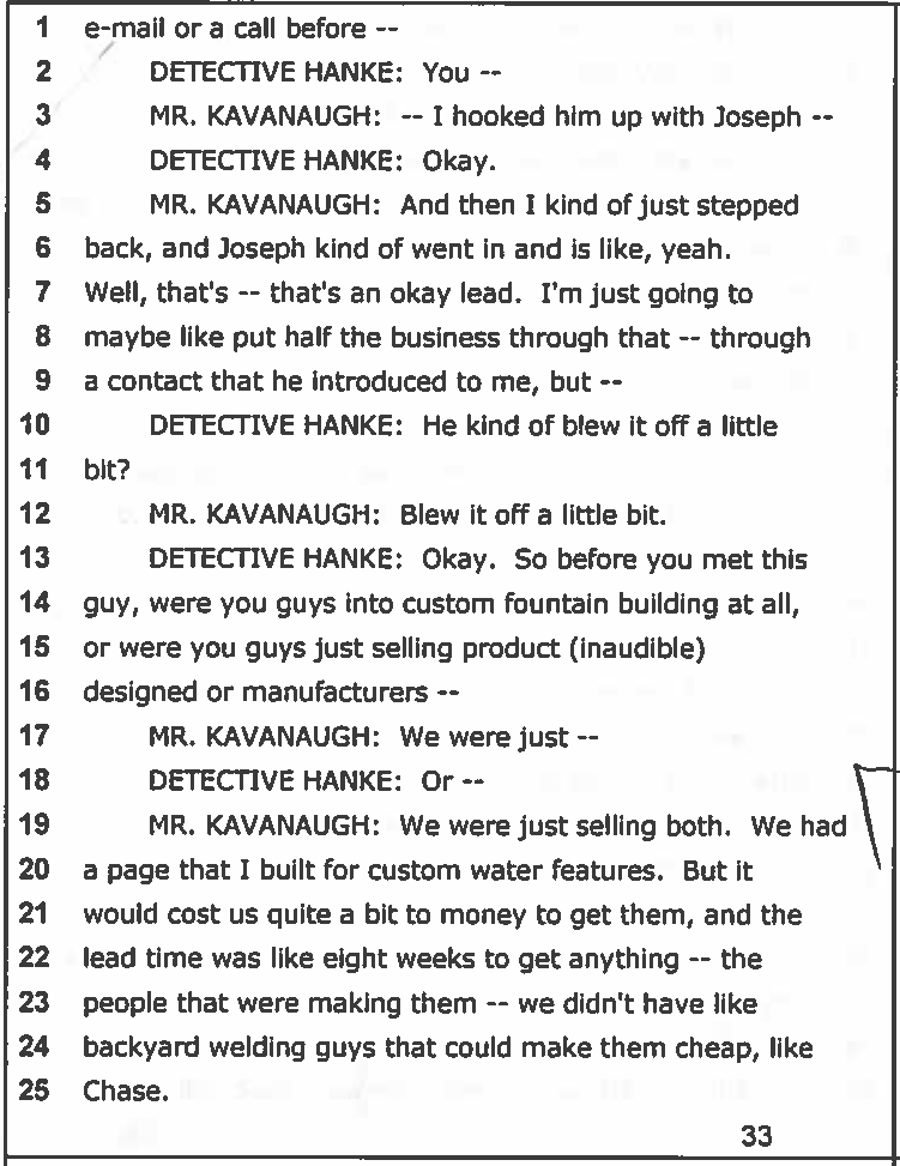
Dan described Joseph telling me, “And I’ll pass you some custom work. And you don’t really need to talk to Dan” (p. 17:13-15). And he made it plain he was watching. Of the custom work: “Didn’t even actually tell me about the sales that were — some of the sales. But then I would later go on and just do my own audits and stuff” (p. 36:16-19). Of the leads coming through the site: “The money of which I would be none the wiser to. Unless I went in and I saw all of the submissions” (p. 227:14-16).
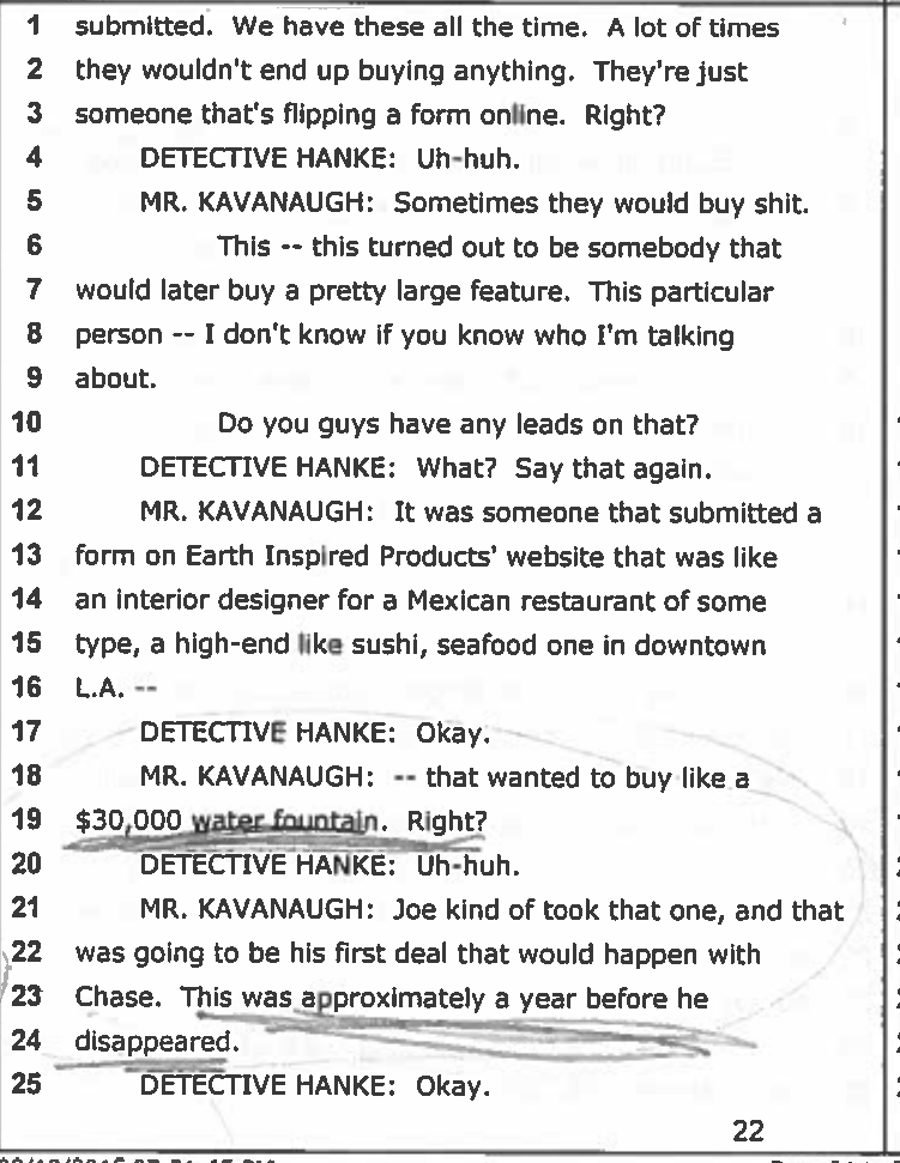
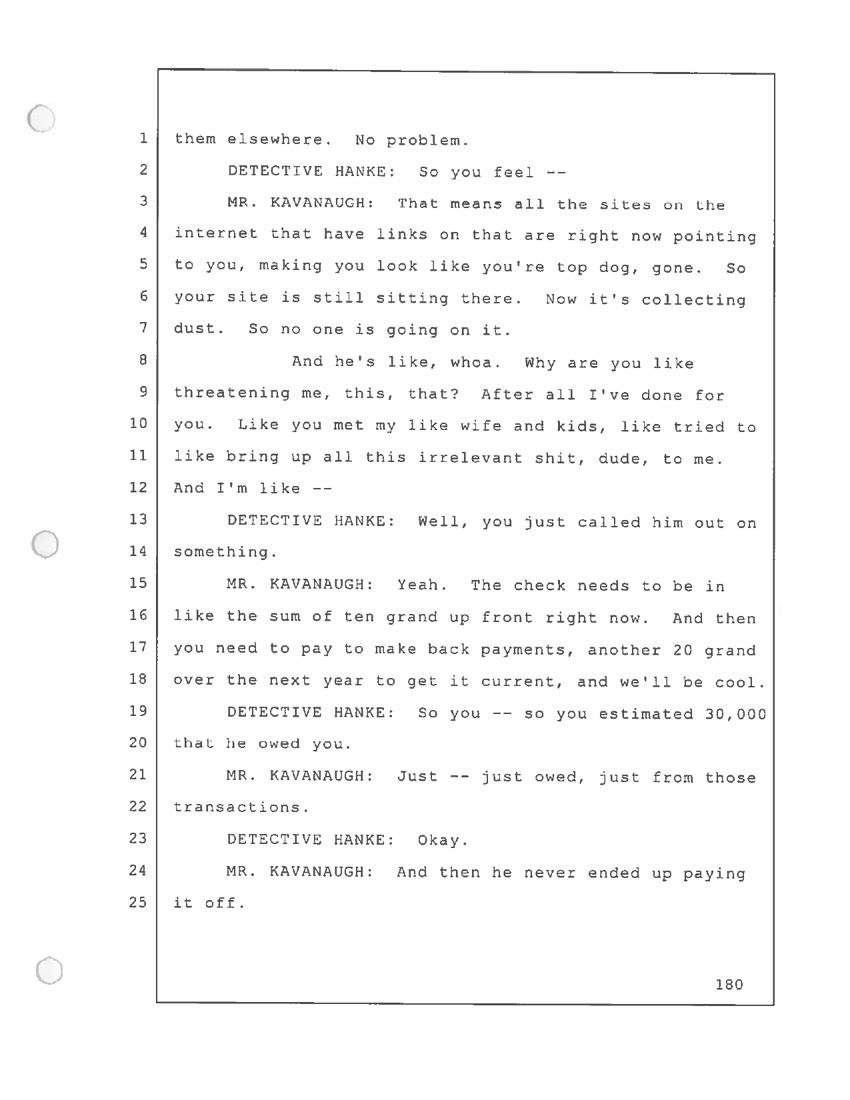
Dan told Hanke what he did when he caught Joseph on a lead. It was the restaurant job, Joseph’s first deal with me, “approximately a year before he disappeared” (p. 22:21-24). This is how Dan told it to Hanke (pp. 179:5-180:1, 180:8-12):
MR. KAVANAUGH: Dude, I know that it’s hard to believe, but I can see everything that comes to the site. Stuff doesn’t slip through the cracks with me.
…
I’m like, dude. You need to pay up to the tune of like 20 “Gs,” and you can make it in payments to get current on what you owe.
DETECTIVE HANKE: Okay.
MR. KAVANAUGH: Otherwise, I will take the whole site and just — I won’t delete it, but I will redirect all my like marketing efforts and powers that be that are off-site to you, not in your control, and redirect them elsewhere. No problem.
…
And he’s like, whoa. Why are you like threatening me, this, that? After all I’ve done for you. Like you met my like wife and kids, like tried to like bring up all this irrelevant shit, dude, to me.
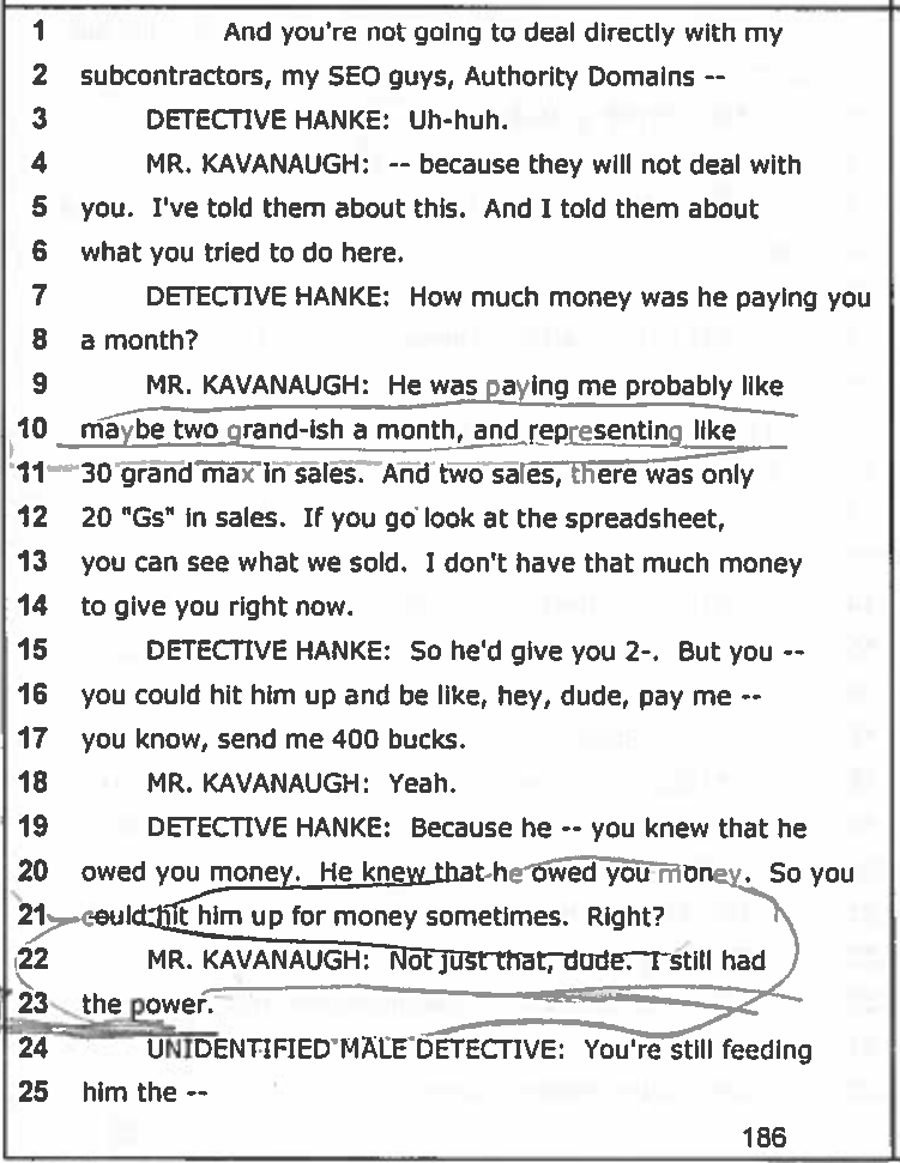
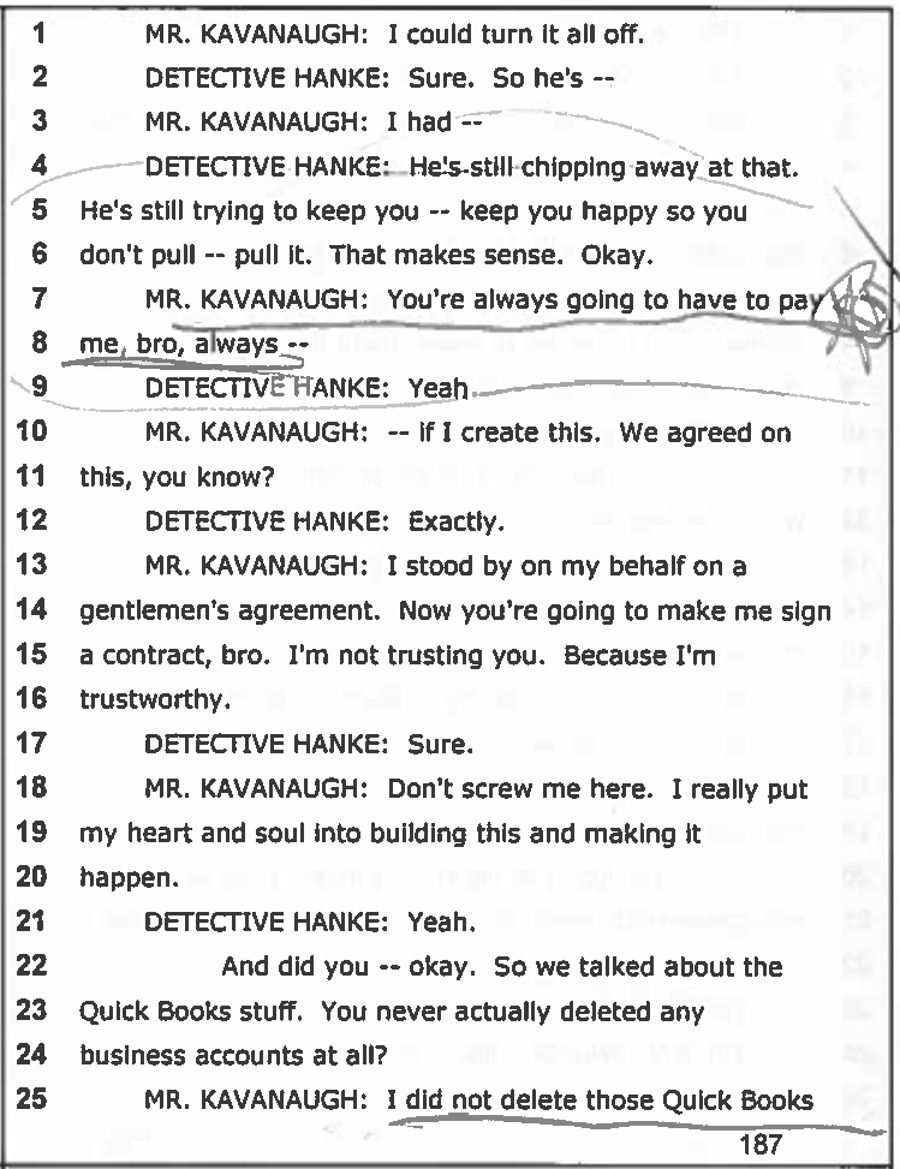
And later in the same interview, Dan said (pp. 186:21-23, 187:1, 187:7-8):
MR. KAVANAUGH: Not just that, dude. I still had the power.
…
MR. KAVANAUGH: I could turn it all off.
…
MR. KAVANAUGH: You’re always going to have to pay me, bro, always —
See Dan’s interview pages

Joseph’s own words, a year before
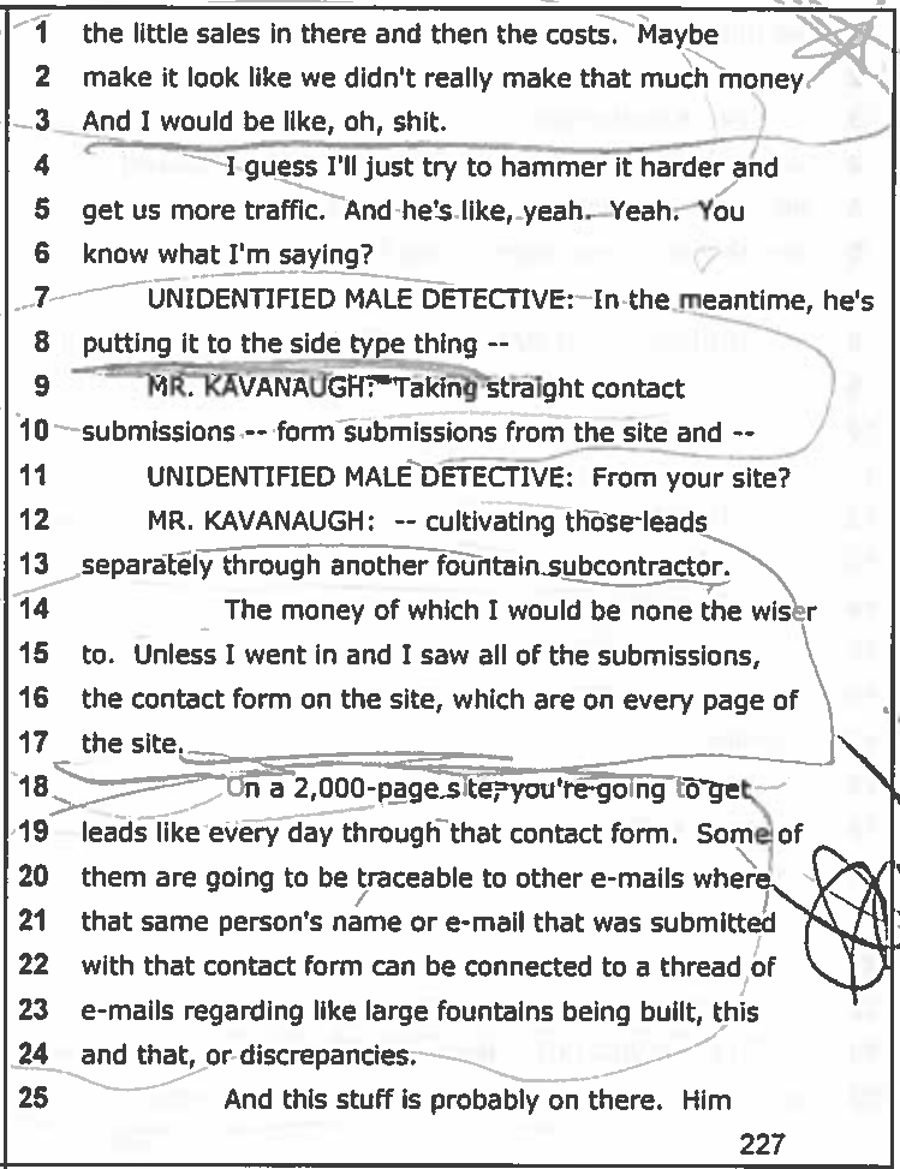
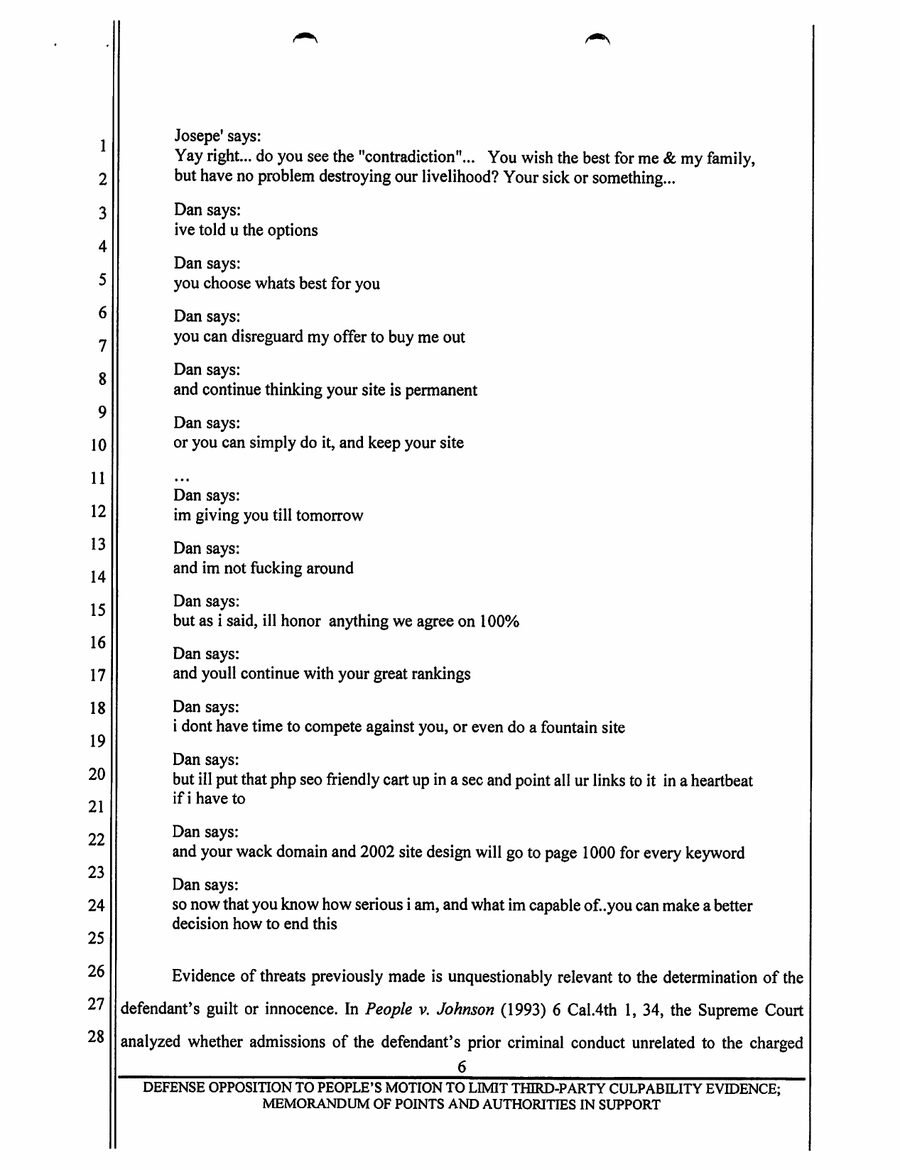
The instant messages from January 29, 2009, and Joseph’s e-mail the same day, are on Part 1 in full. Dan wrote: “it will be about 30 days from today that your site is gone from the search engines if u just wanna ignore me,” “i made an offer to let u have the site / and buy me out,” and “im giving you till tomorrow / and im not fucking around.” Joseph wrote that day: “Dan has become quite malicious towards me to the point of affecting my family,” and “Fountains are my life, EIP feeds my family. I can’t have EIP disappear off the face of the earth.” The harm Joseph meant was to the business that fed his family. Dan’s threat in those messages is the same one he described to Det. Hanke.
See Joseph’s e-mail, as sent to my lawyers (3 pages)


Joseph buying Dan out
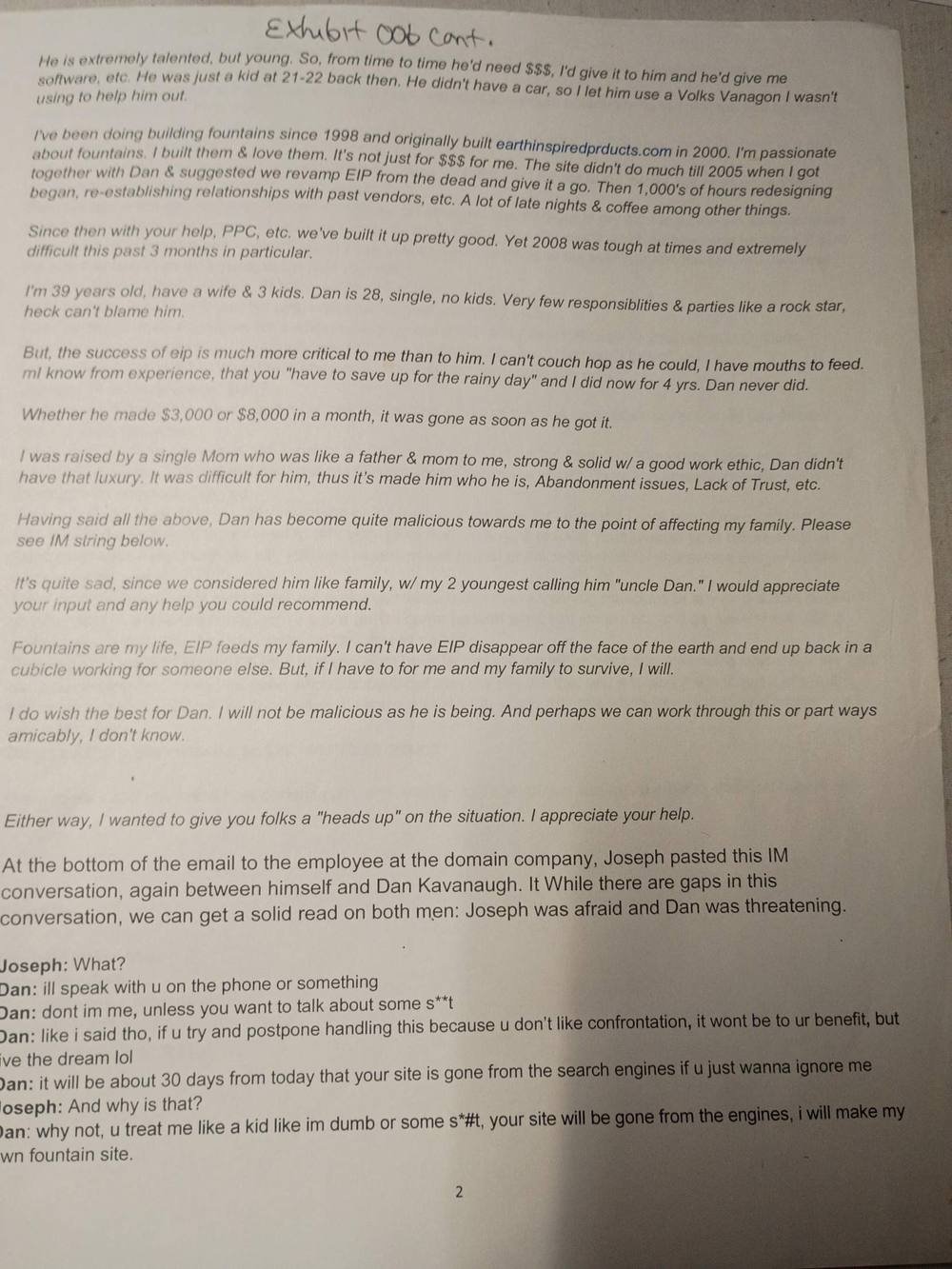
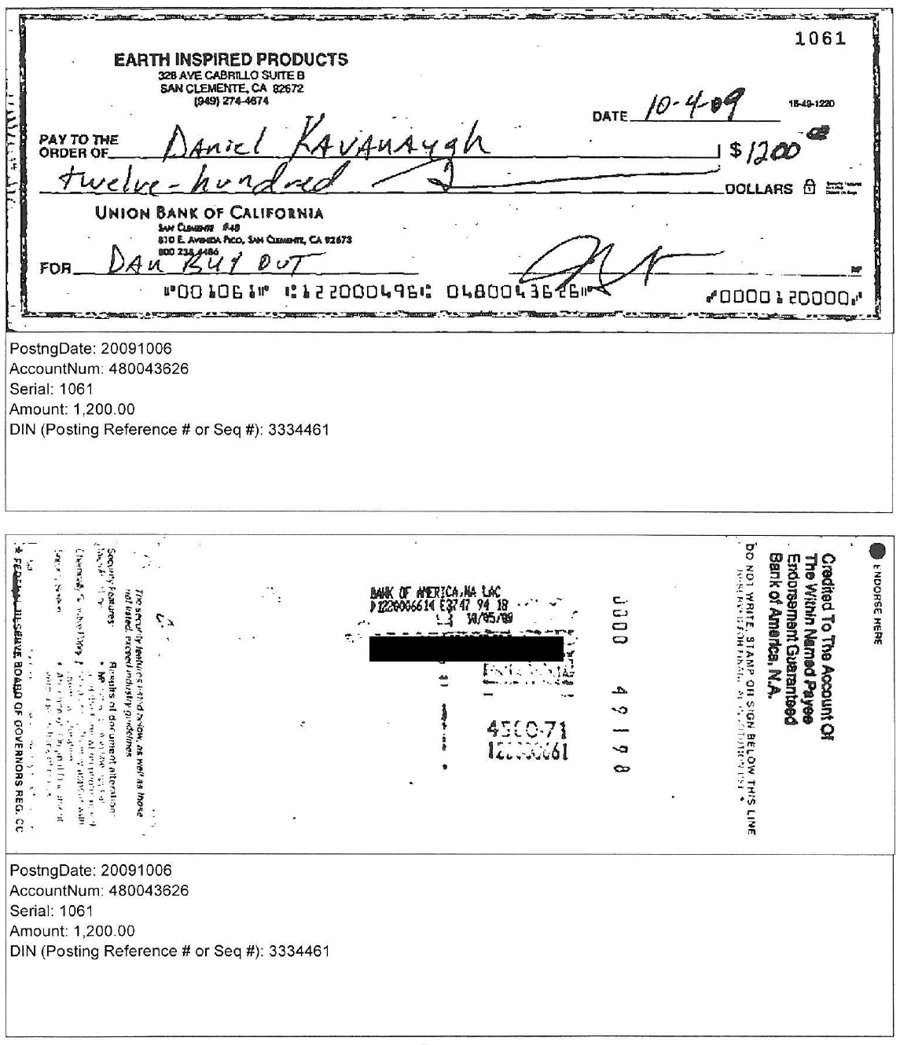
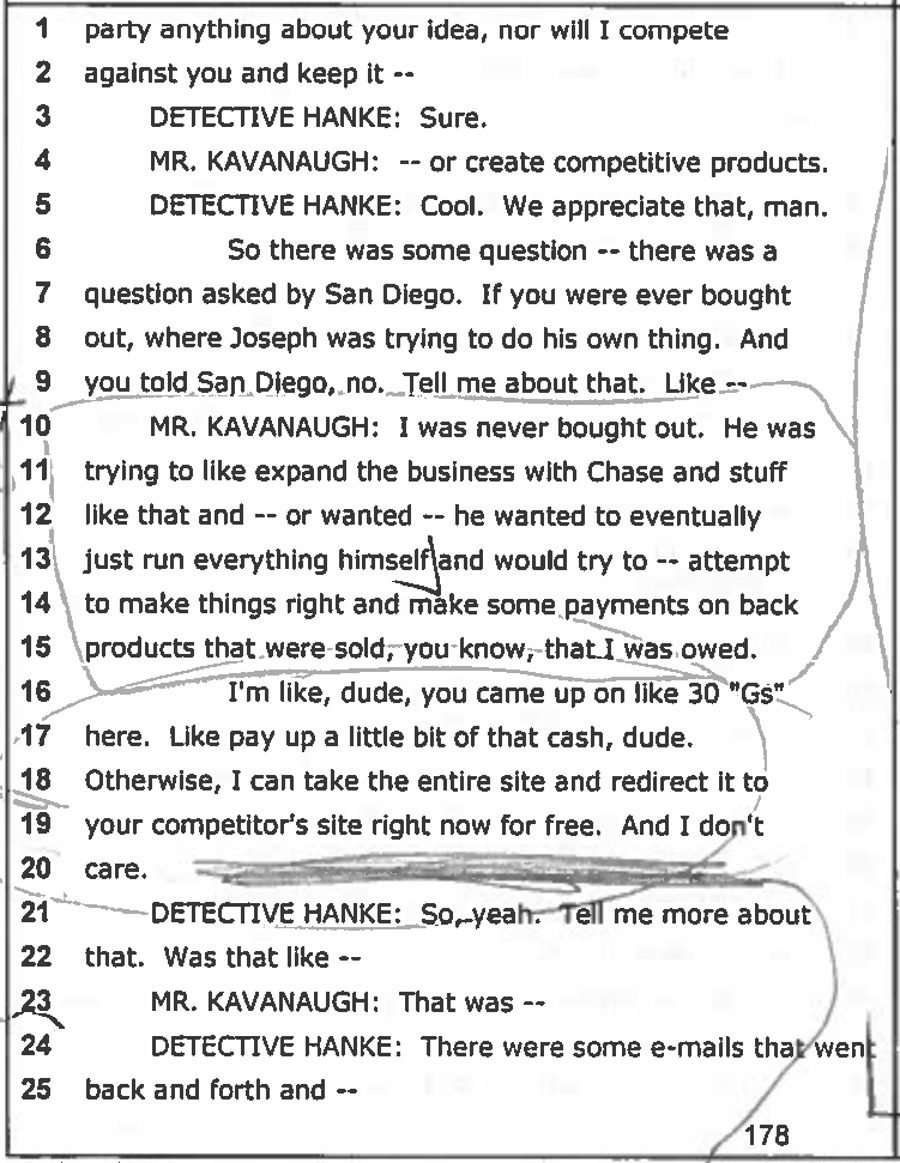
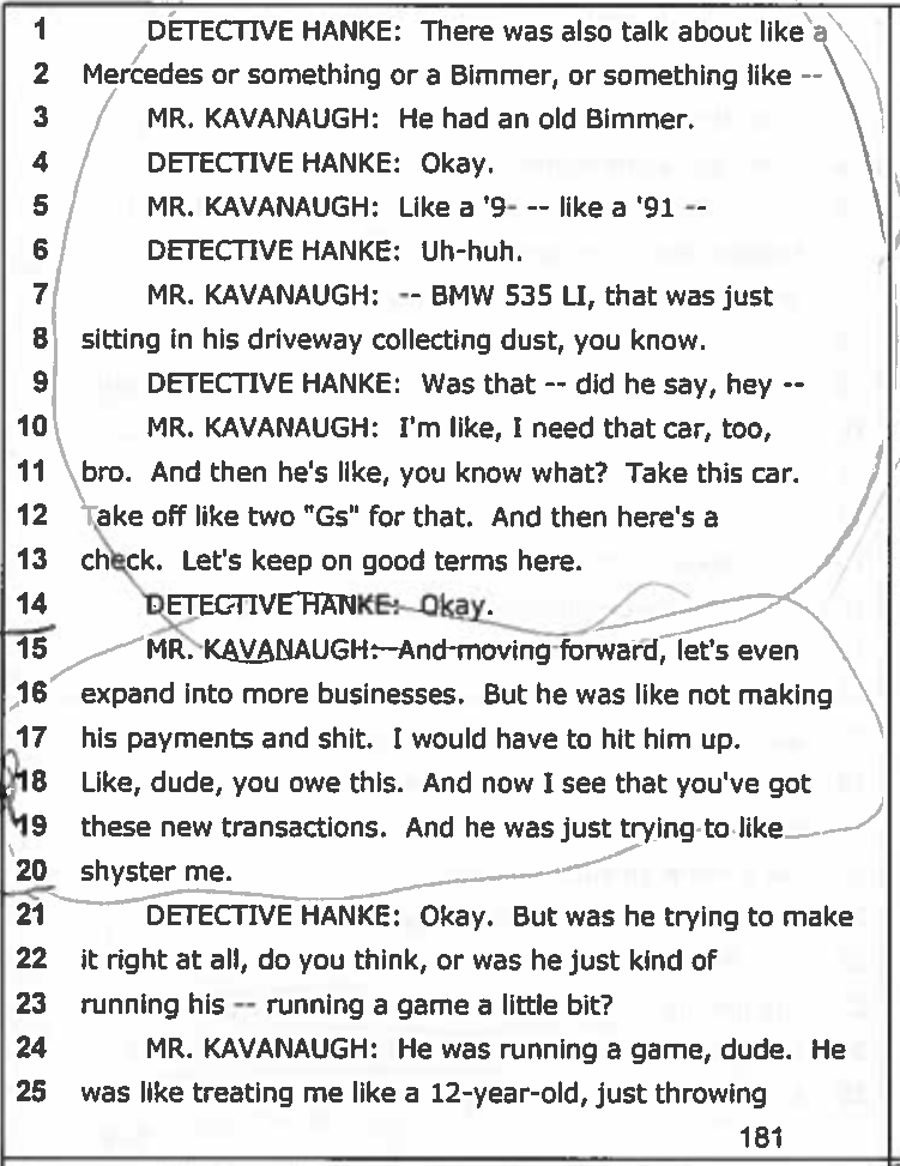
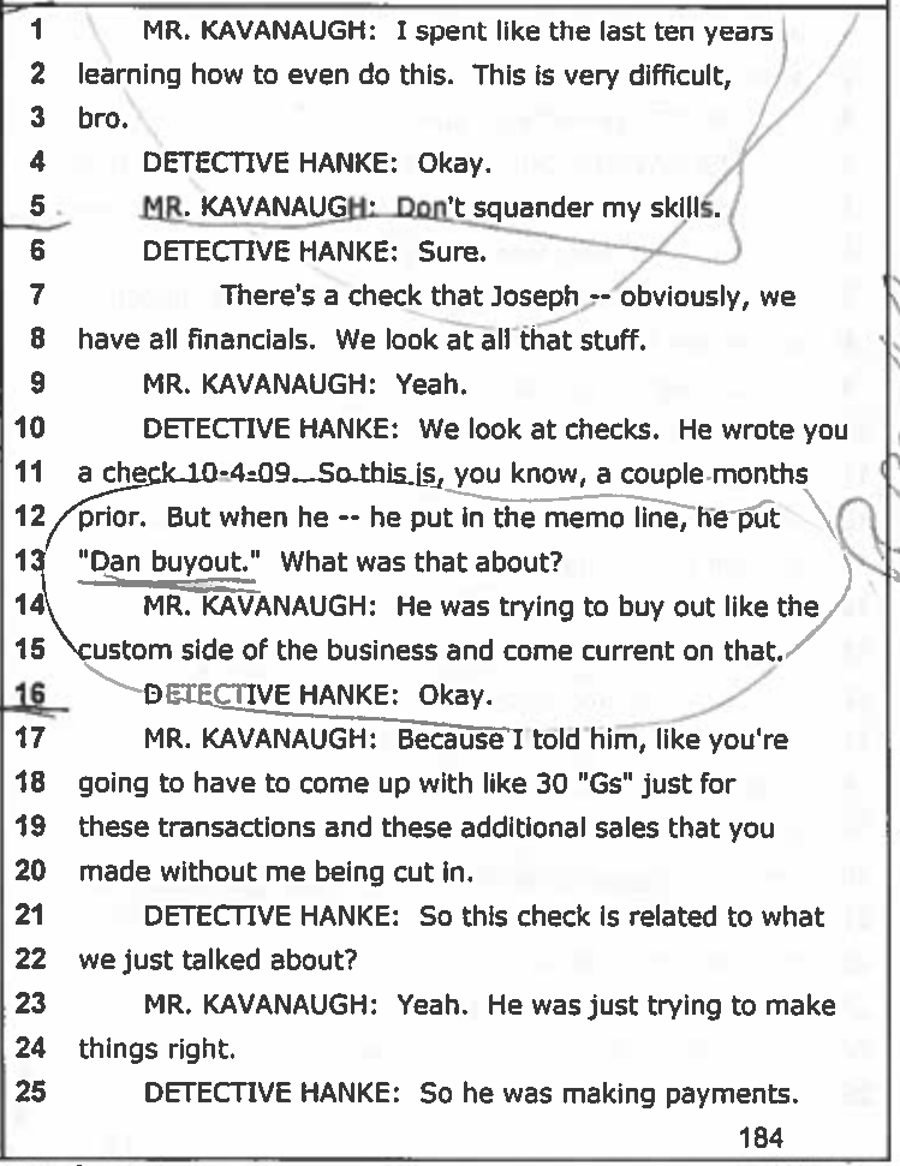
On October 4, 2009, Joseph wrote check #1061 from the Earth Inspired Products account to “Daniel Kavanaugh” for $1,200. On the memo line: “DAN BUY OUT.” Dan deposited it at Bank of America the next day. He told Det. Hanke, “I was never bought out” (p. 178:10). Shown the check, he said: “He was trying to buy out like the custom side of the business and come current on that” (p. 184:14-15). He also said Joseph gave him his old BMW: “Take this car. Take off like two ‘Gs’ for that. And then here’s a check” (p. 181:11-13).
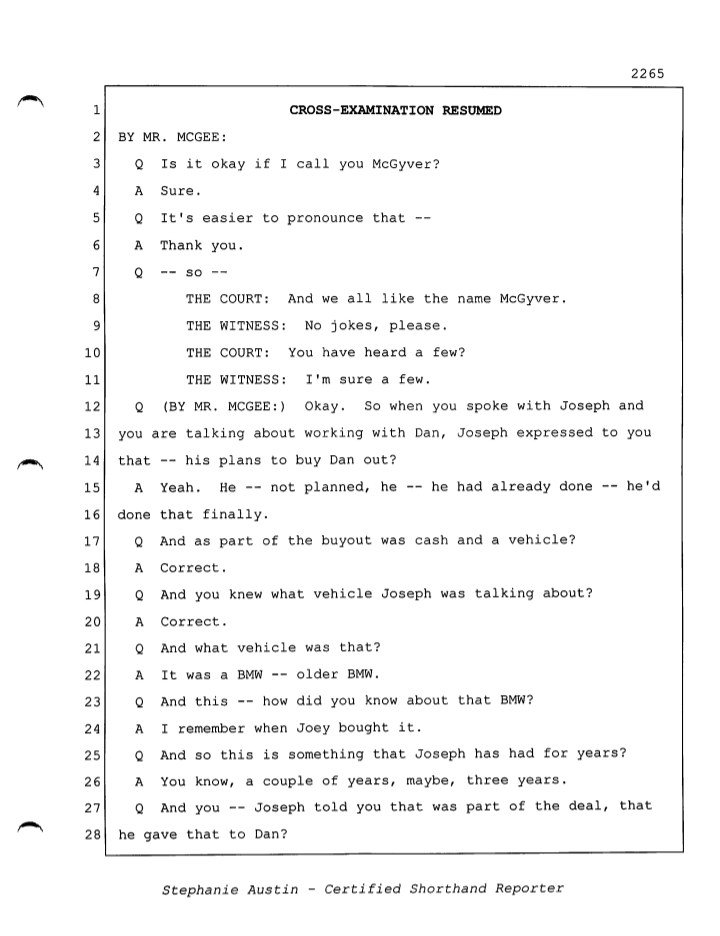
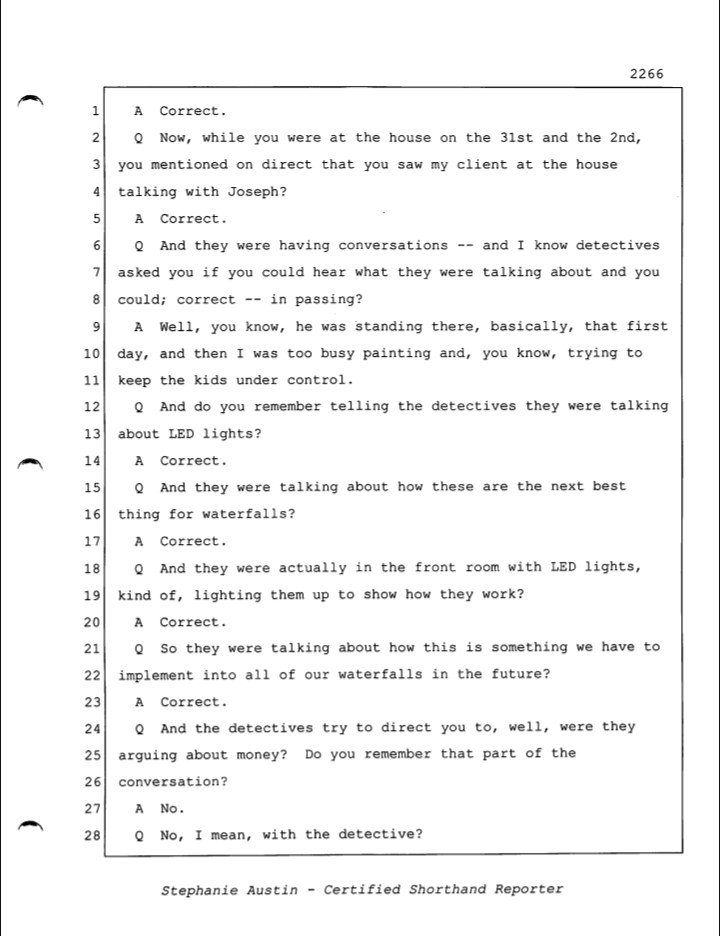
At trial, Mike McCargar told the jury what Joseph had told him (RT 2265:12-18):
Q (BY MR. MCGEE:) Okay. So when you spoke with Joseph and you are talking about working with Dan, Joseph expressed to you that — his plans to buy Dan out?
A Yeah. He — not planned, he — he had already done — he’d done that finally.
Q And as part of the buyout was cash and a vehicle?
A Correct.
See the check and the testimony
Dan’s claims about the money
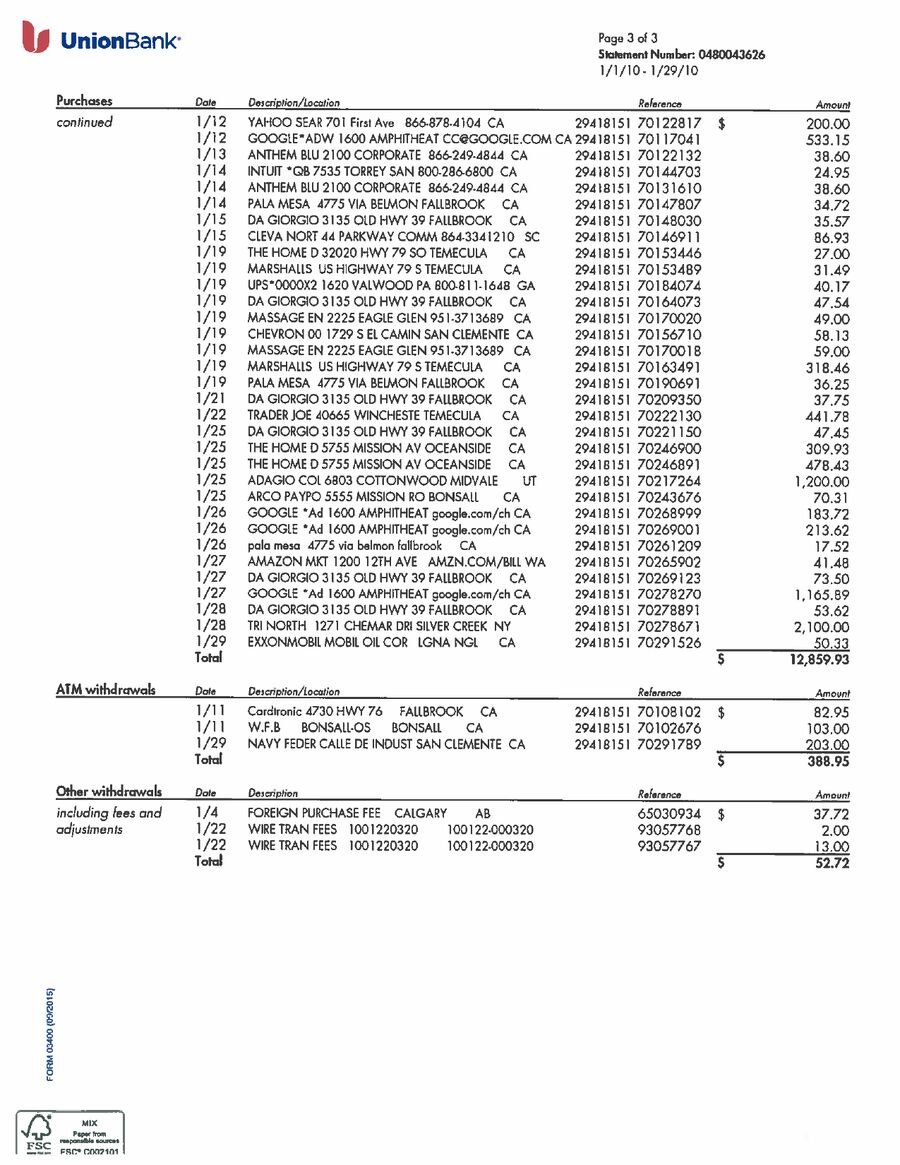
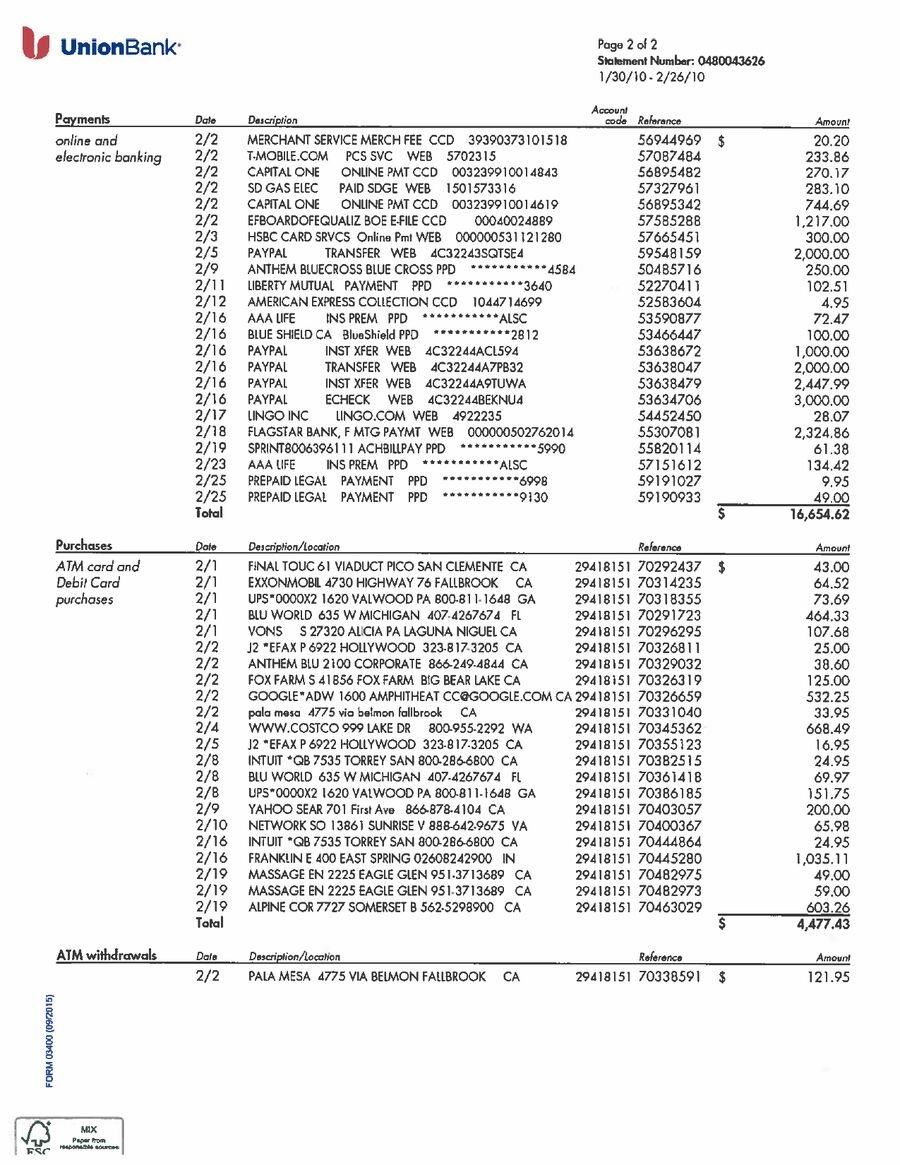
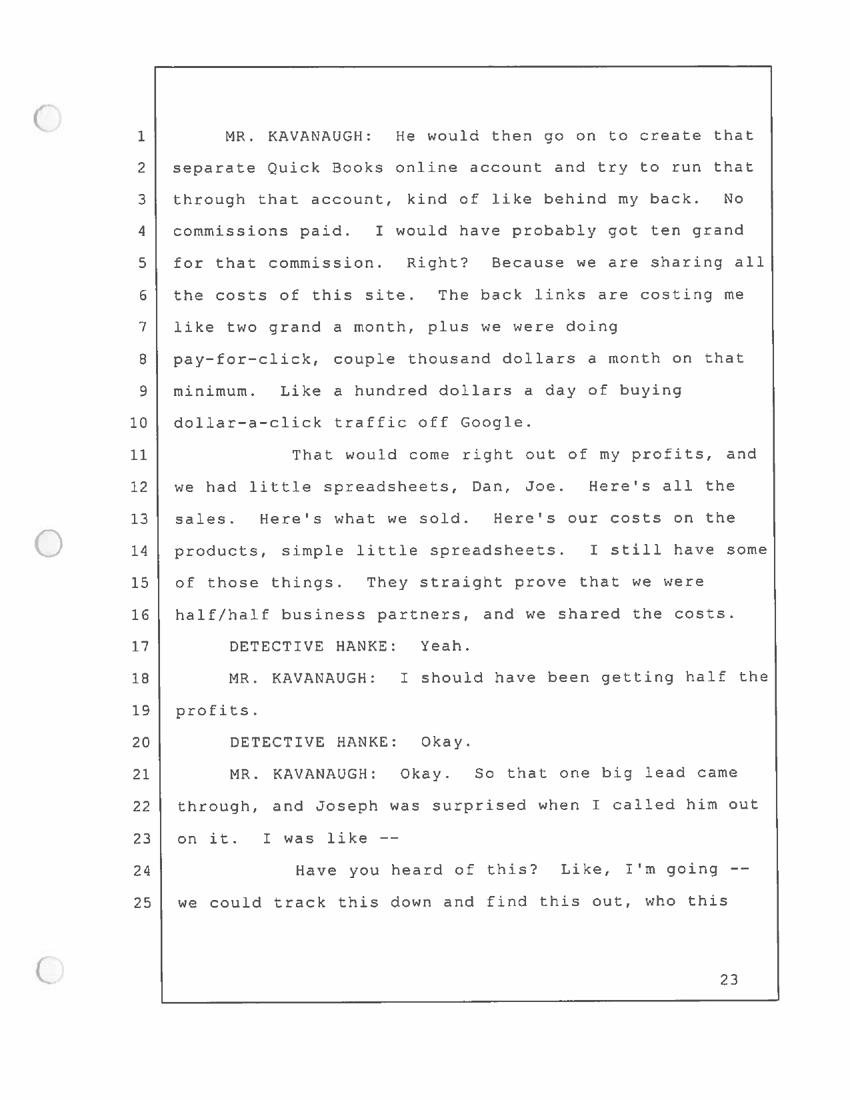
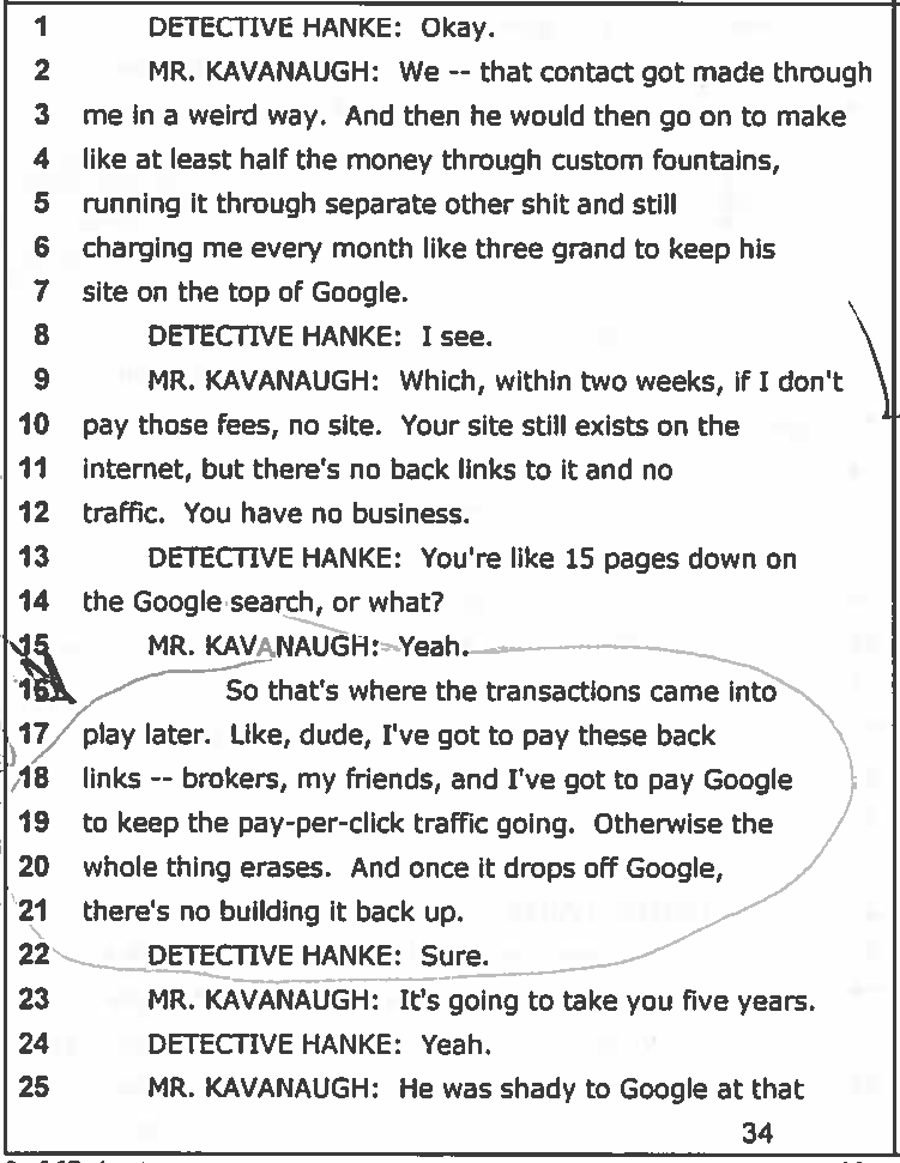
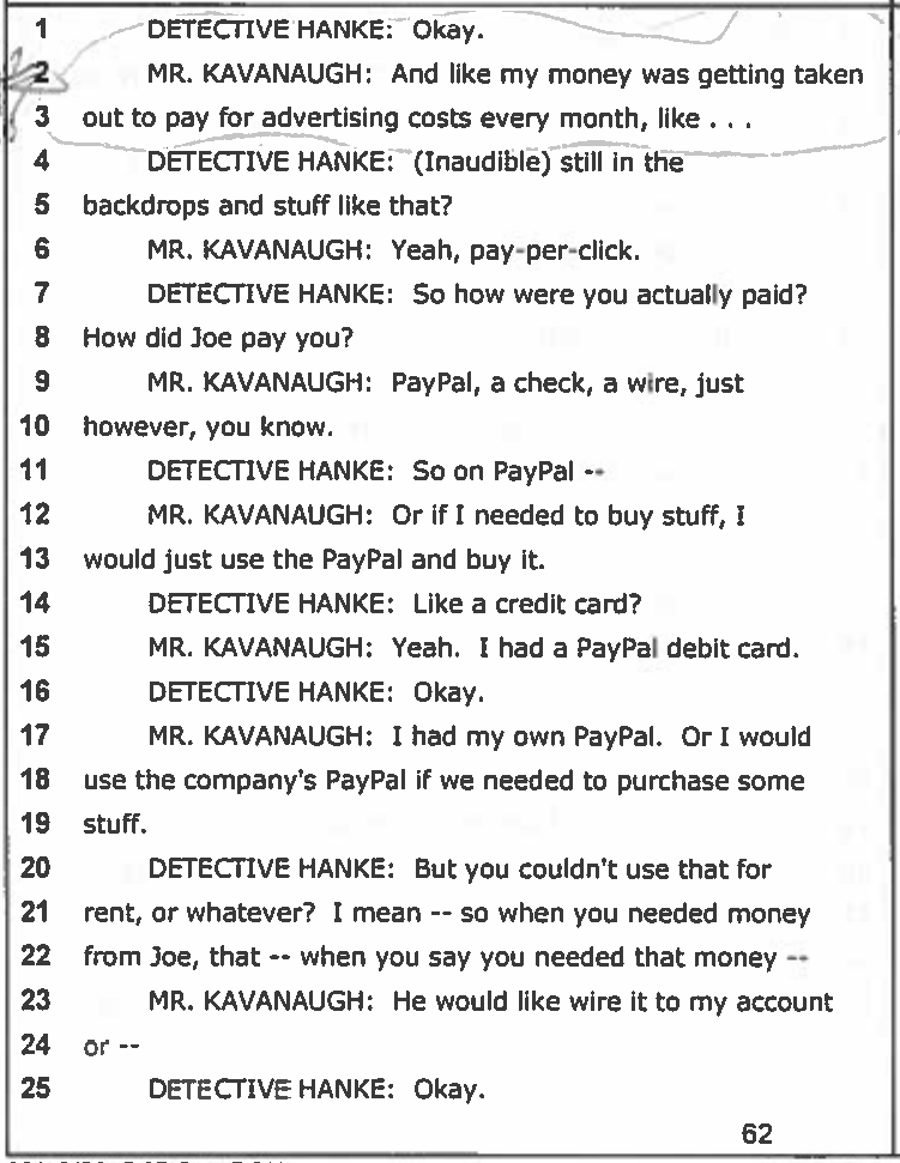
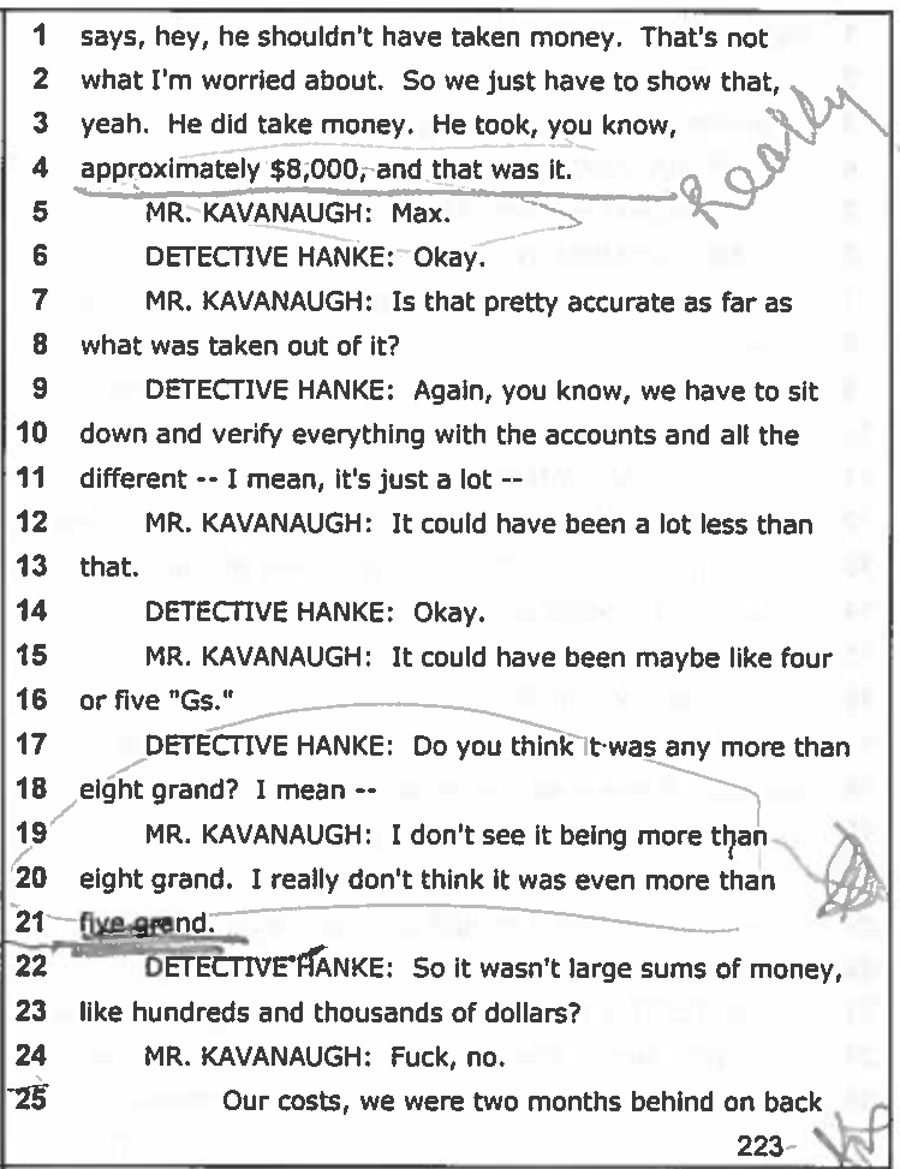
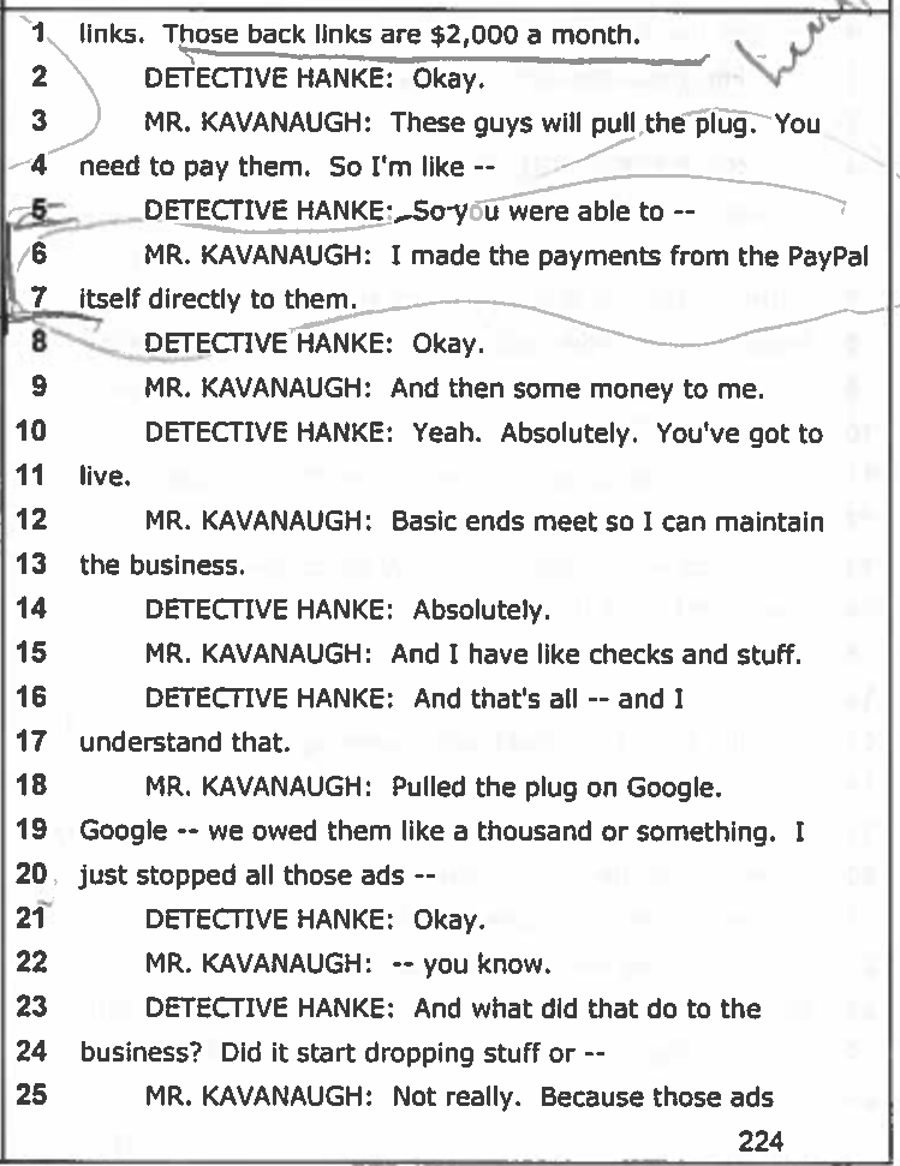
Dan told Det. Hanke he was the one carrying the costs. “Because we are sharing all the costs of this site. The back links are costing me like two grand a month, plus we were doing pay-for-click, couple thousand dollars a month on that minimum” (p. 23:4-8). Joseph was “still charging me every month like three grand to keep his site on the top of Google,” and “within two weeks, if I don’t pay those fees, no site” (p. 34:5-10). “And like my money was getting taken out to pay for advertising costs every month” (p. 62:2-3).
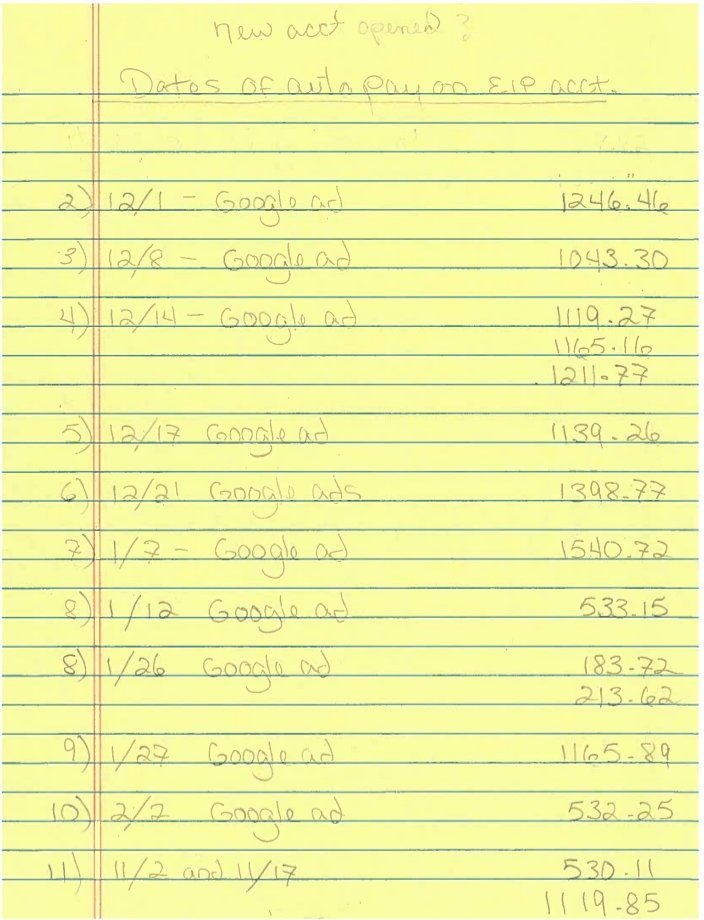
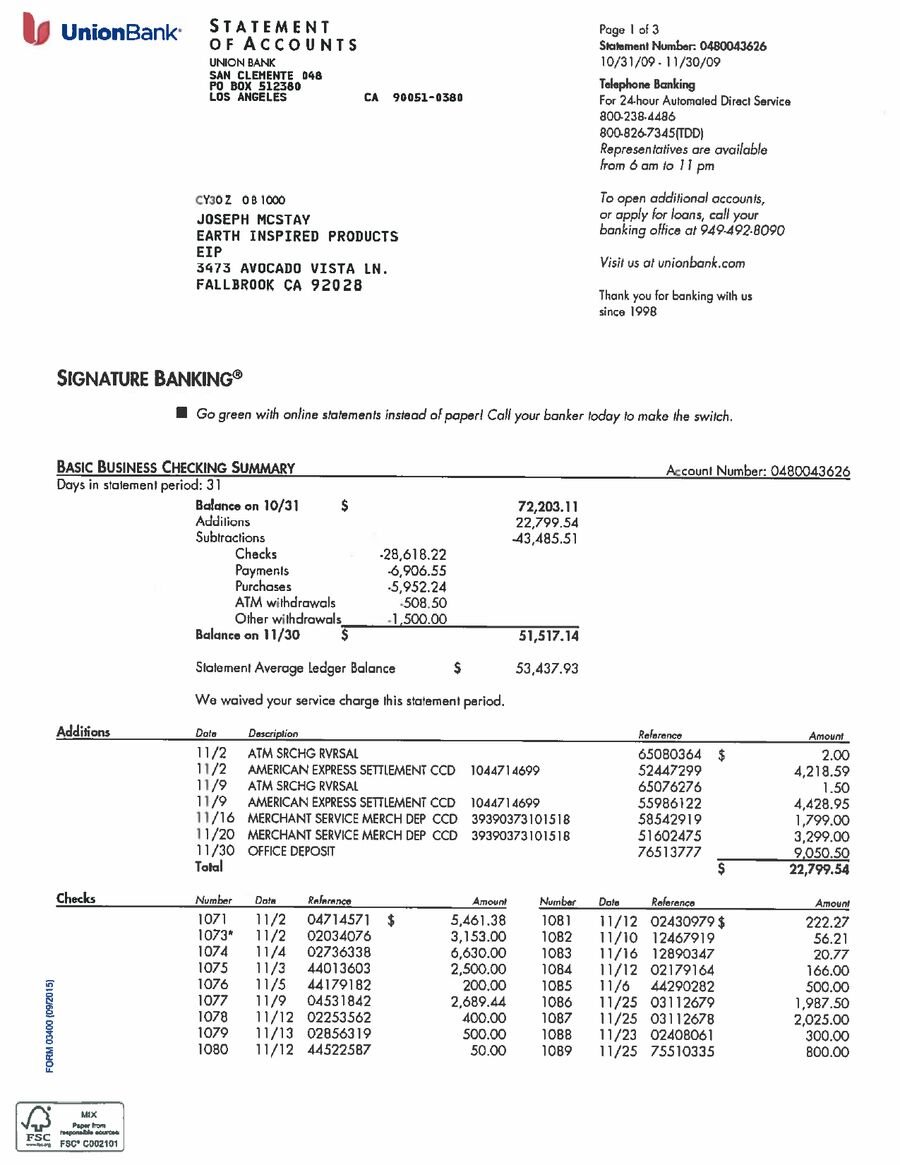
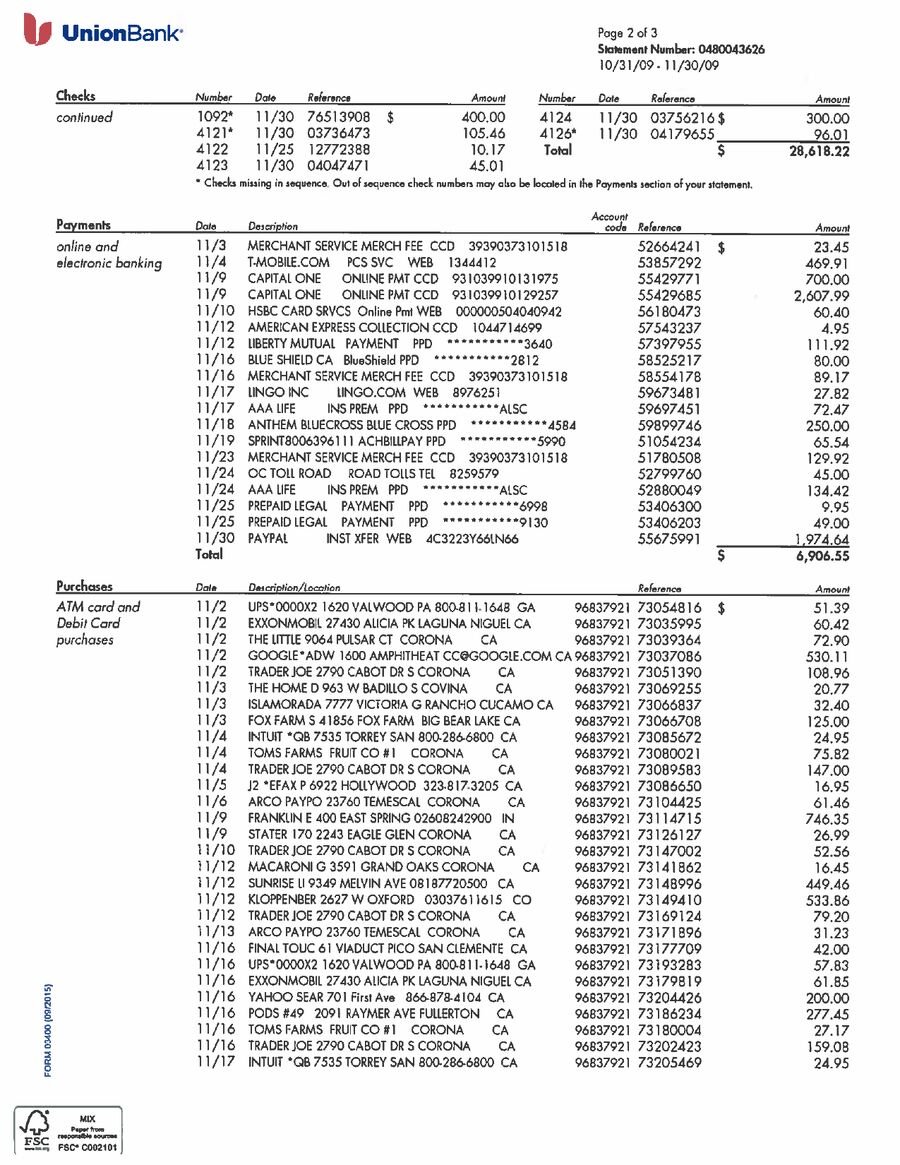
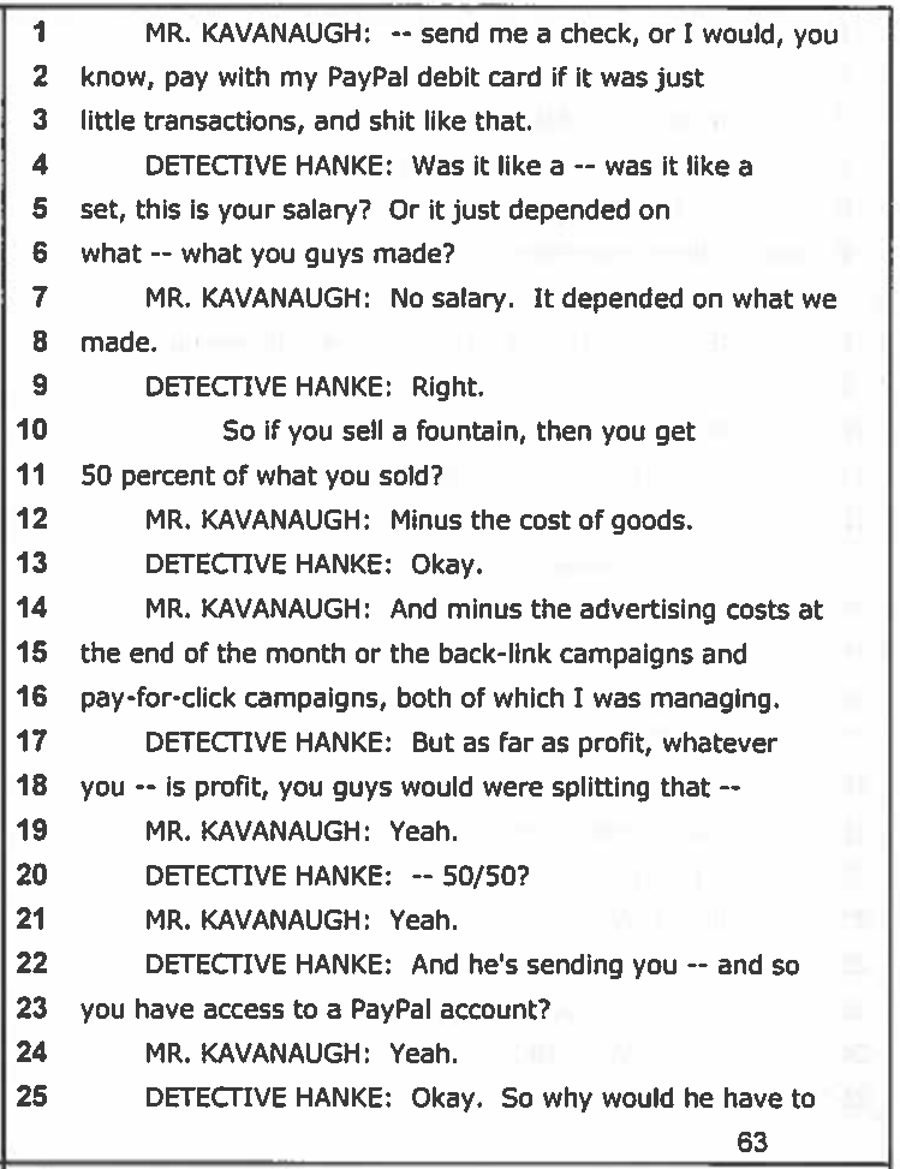
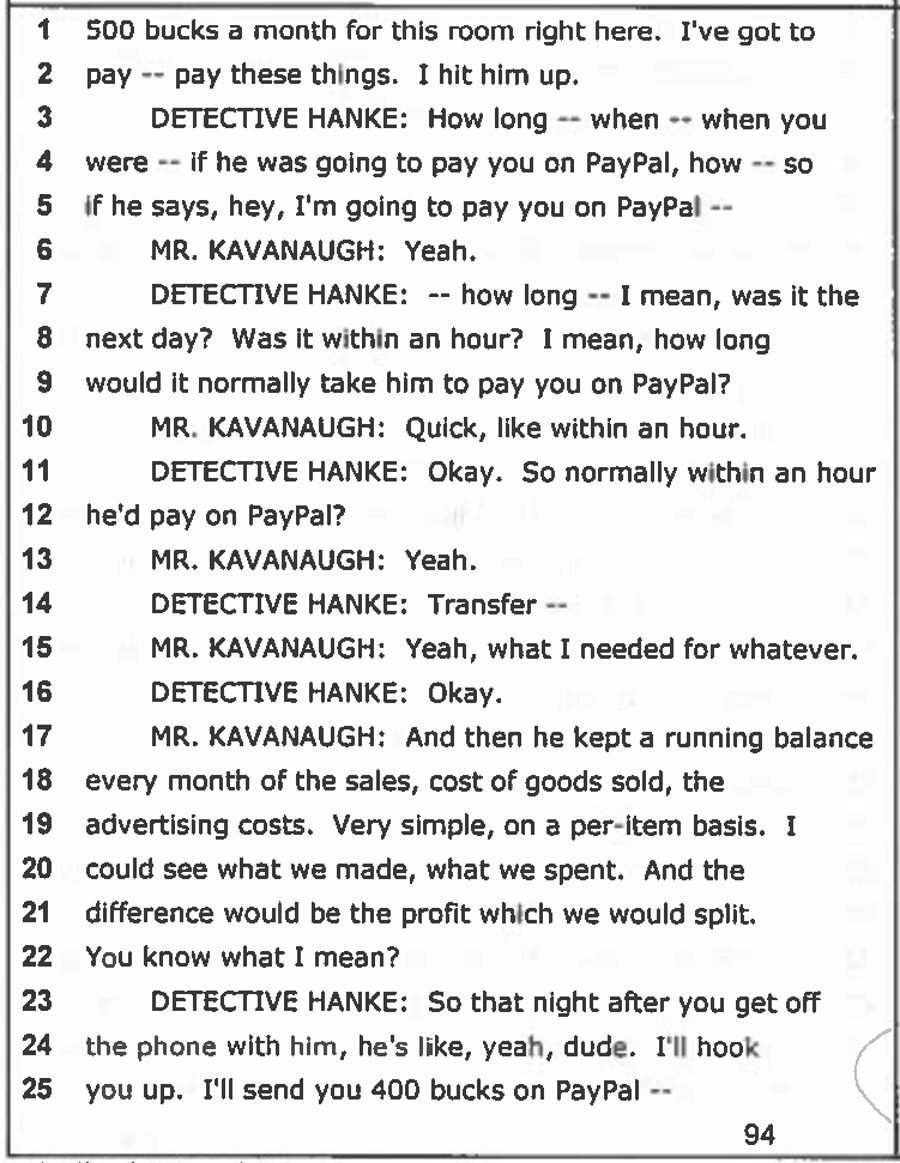
The records don’t support it. Joseph paid them. The Google ad charges came out of the Earth Inspired Products account at Union Bank, every month. I listed the auto-pays for my lawyers, and every one of them is on Joseph’s statements, from $530.11 on November 2, 2009 to $532.25 on February 2, 2010. As Joseph told me, Dan was paid for his work; he wasn’t expected to pay anything out. Dan’s own description of the split says the same (p. 63:10-16):
DETECTIVE HANKE: So if you sell a fountain, then you get 50 percent of what you sold?
MR. KAVANAUGH: Minus the cost of goods.
DETECTIVE HANKE: Okay.
MR. KAVANAUGH: And minus the advertising costs at the end of the month or the back-link campaigns and pay-for-click campaigns, both of which I was managing.
The $2,000 a month in back links is what Dan paid after Joseph was gone, out of the business’s own PayPal: “Those back links are $2,000 a month. … I made the payments from the PayPal itself directly to them” (pp. 223:25-224:7).
See my note to my lawyers, Joseph’s statements, and Dan’s pages
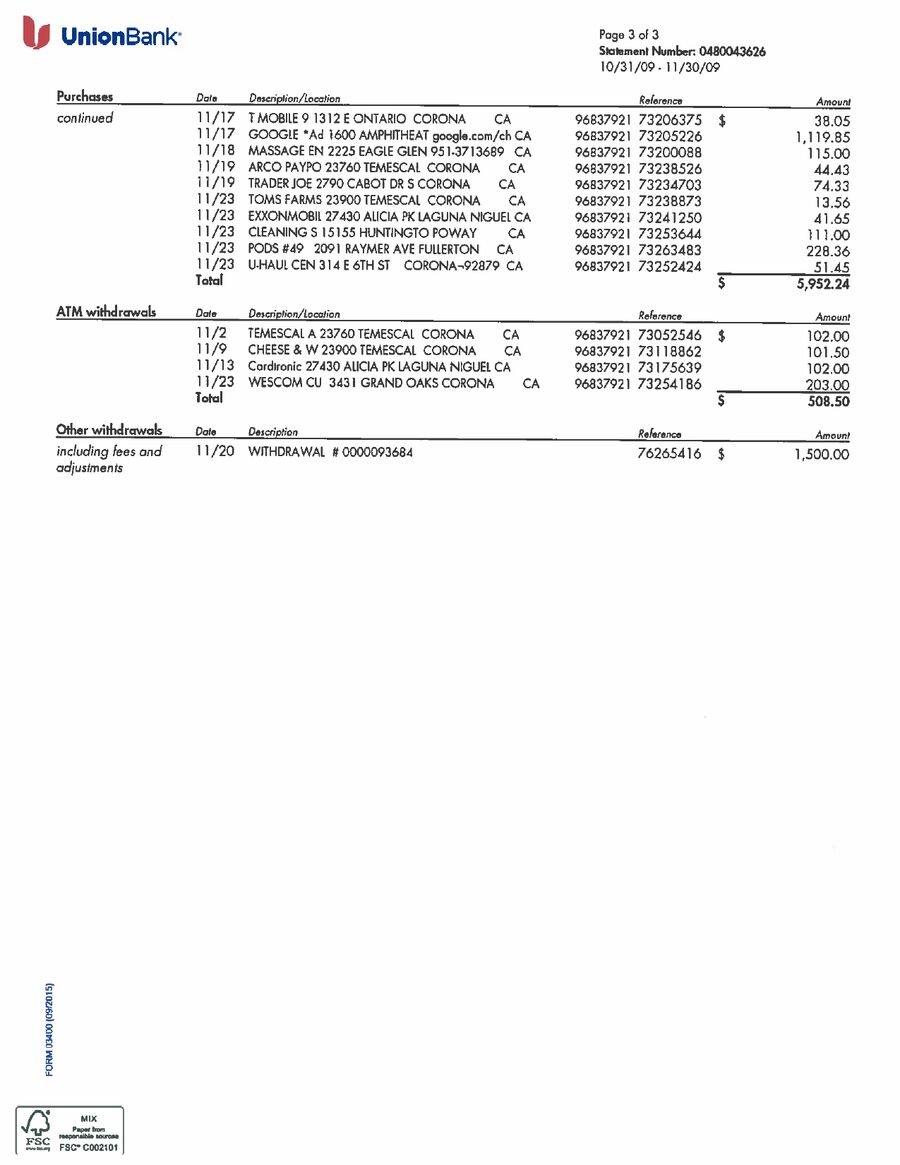
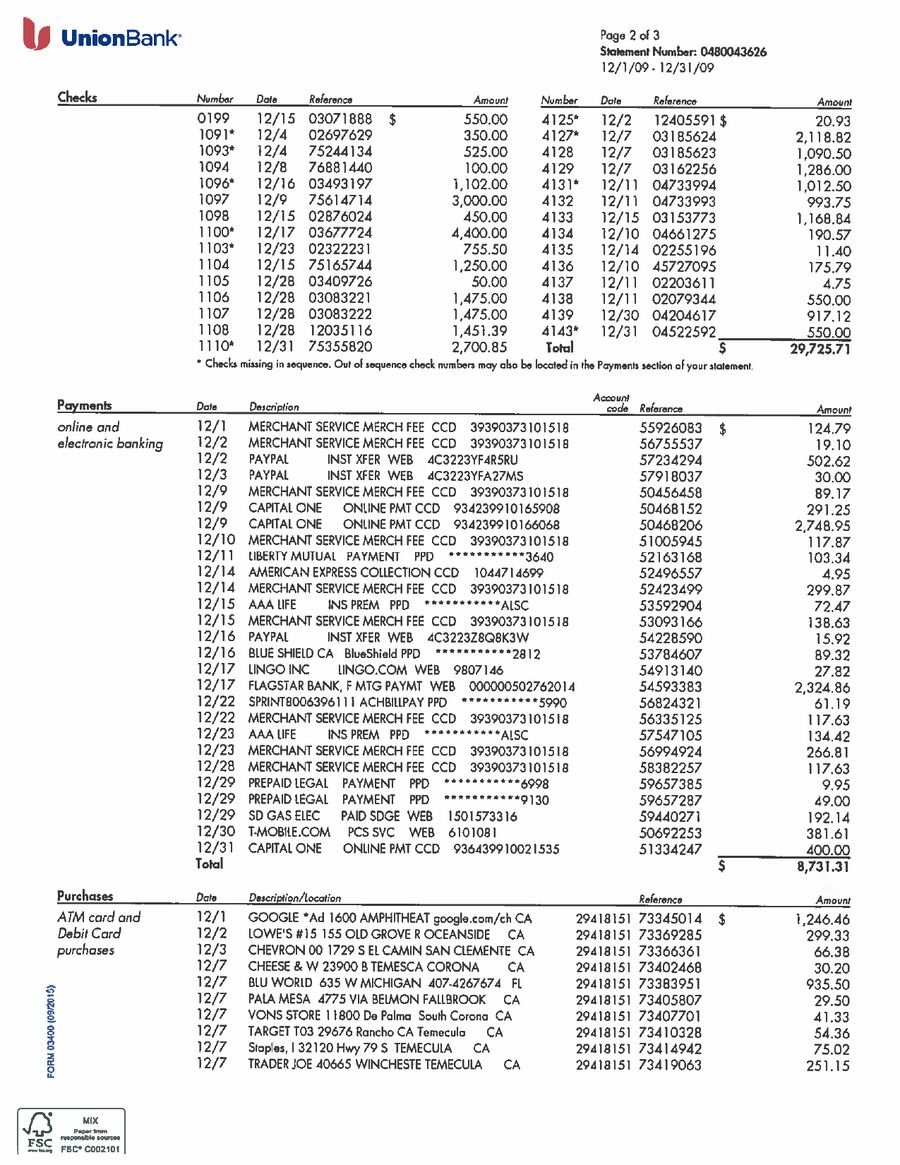
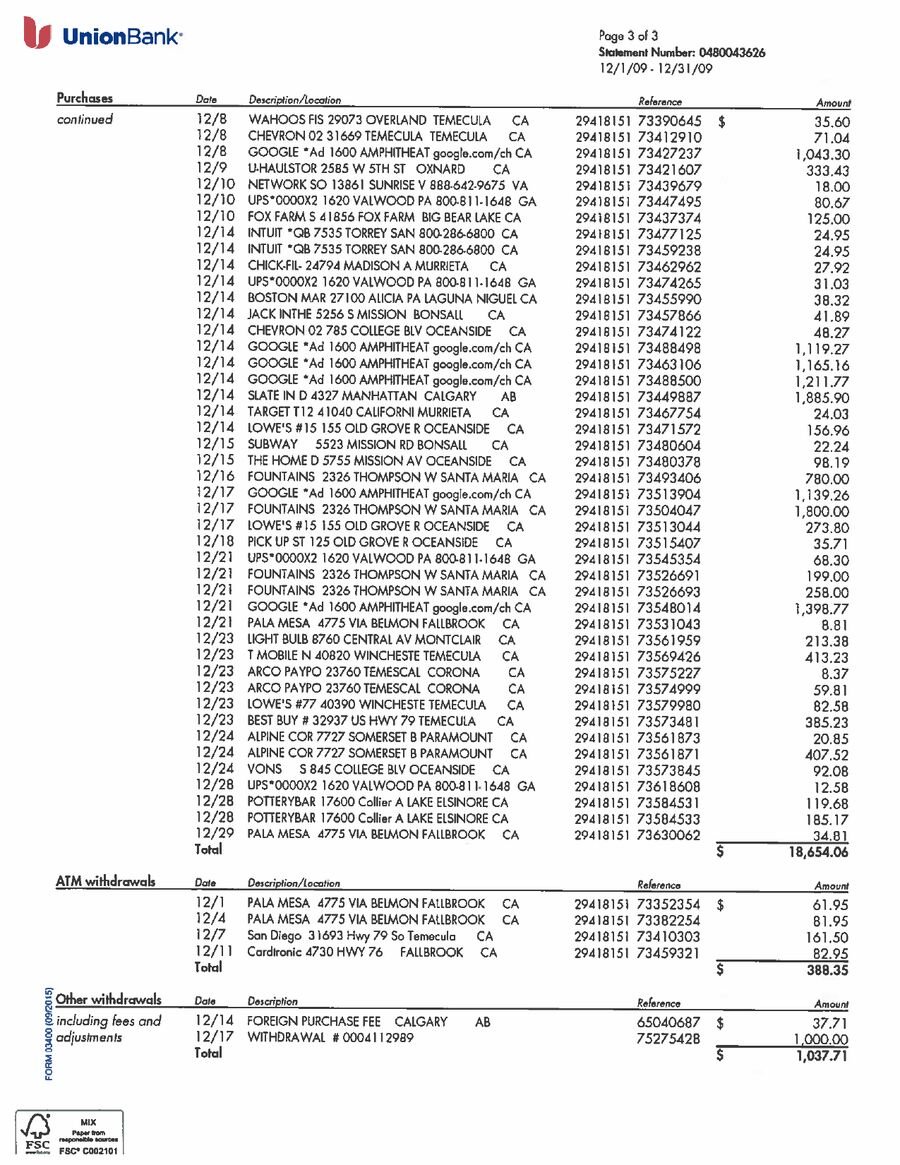
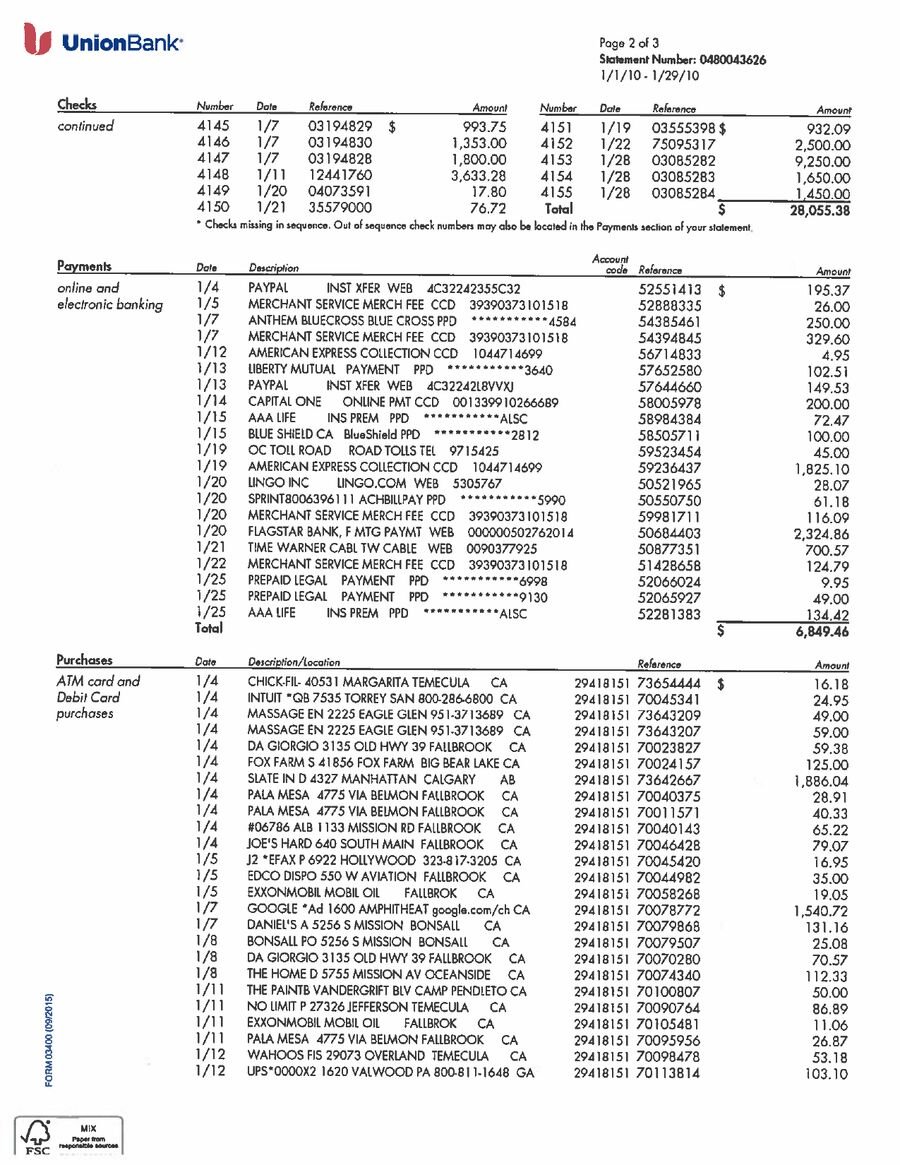
Why it mattered: The State told the jury Joseph never deleted a check, and asked it to believe I did it to steal from him. The record held the reason the custom side was kept from Dan, in Dan’s own words, in the detectives’ affidavit, and in what I told the detectives in 2011. The jury heard none of it for that purpose.
See the trial transcript (RT 1647)
What they did instead
No SODDI, I told them. They argued Dan did it, and the judge ruled on that.
I told my lawyers, over and over, not to run a SODDI defense, “some other dude did it.” I knew it would never fly, and it would make the jury believe we were trying to smoke-and-mirrors them. I told them what all of this showed: that Joseph had a reason to hide QuickBooks and his other accounts from Dan, which backs up what I said about the deleted checks and the QuickBooks.
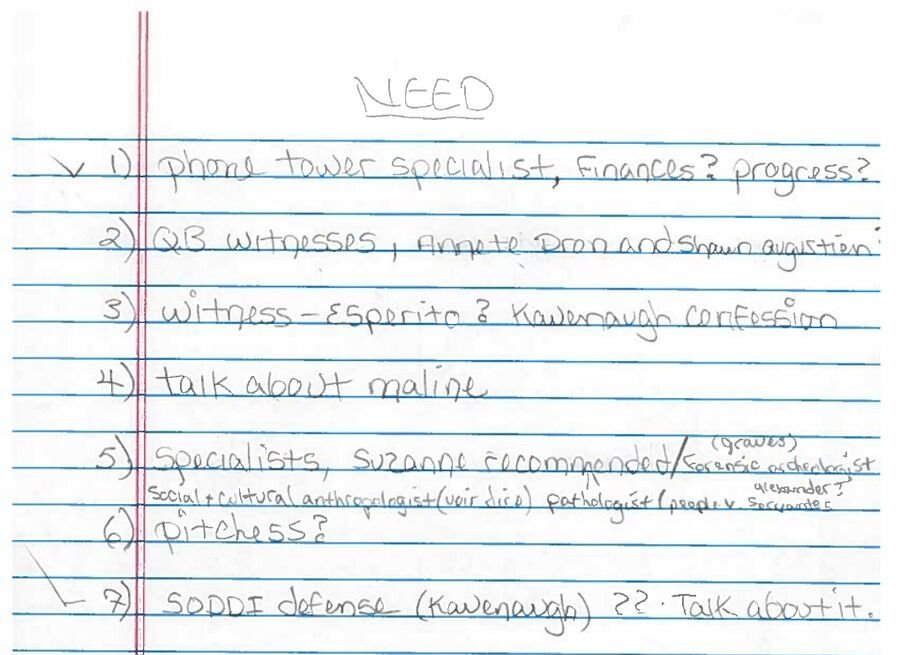
My notes for them on Dan are about his frame of mind. I grouped Dan’s own words under headings like “His take on Joey” and “Proof of QuickBooks knowledge.” The pages on the voicemails answer the State’s claim that I deleted Joseph’s voicemails. Dan’s statement to Lance Espiritu and his own “professional weirdo” story go to his frame of mind and his credibility. On my list for them in July 2017, item 7 reads: “SODDI defense (Kavanaugh) ?? Talk about it.”
See my notes and my 2017 list
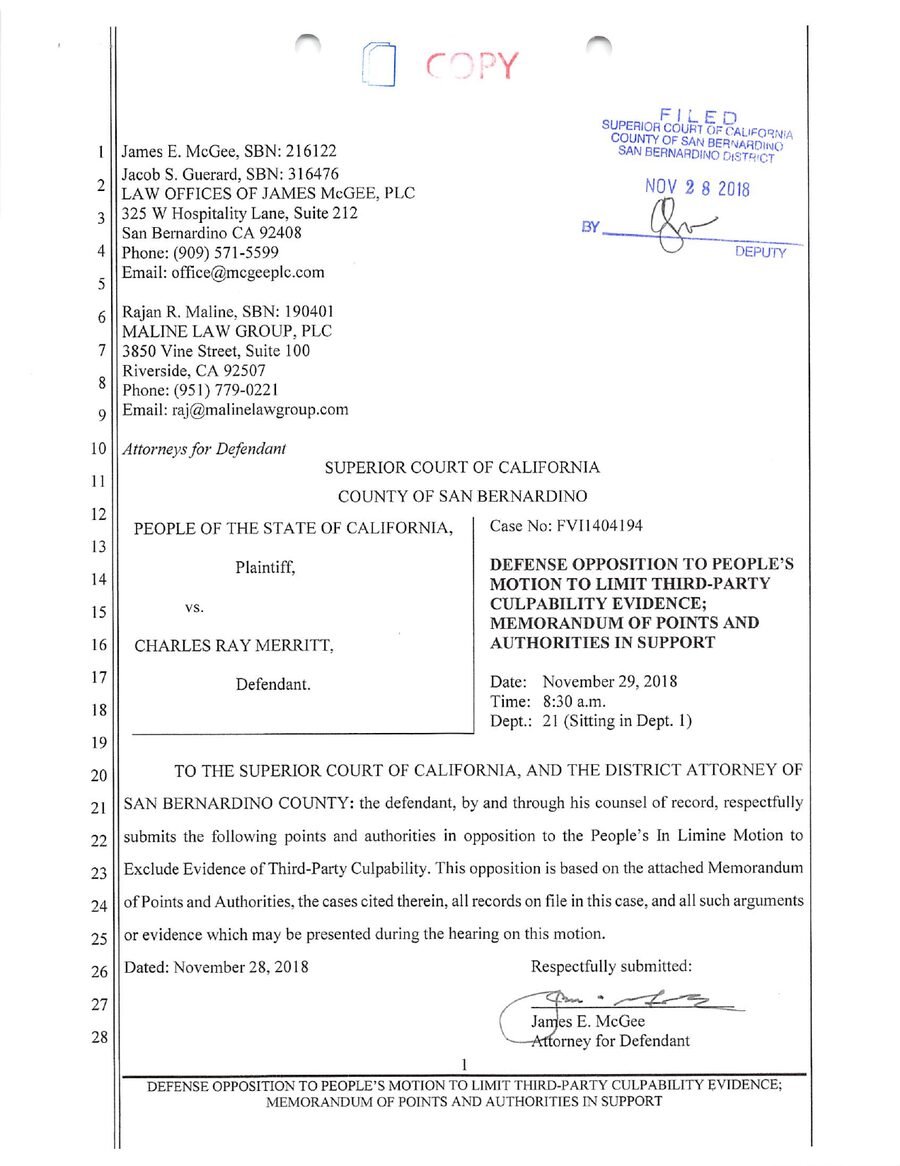
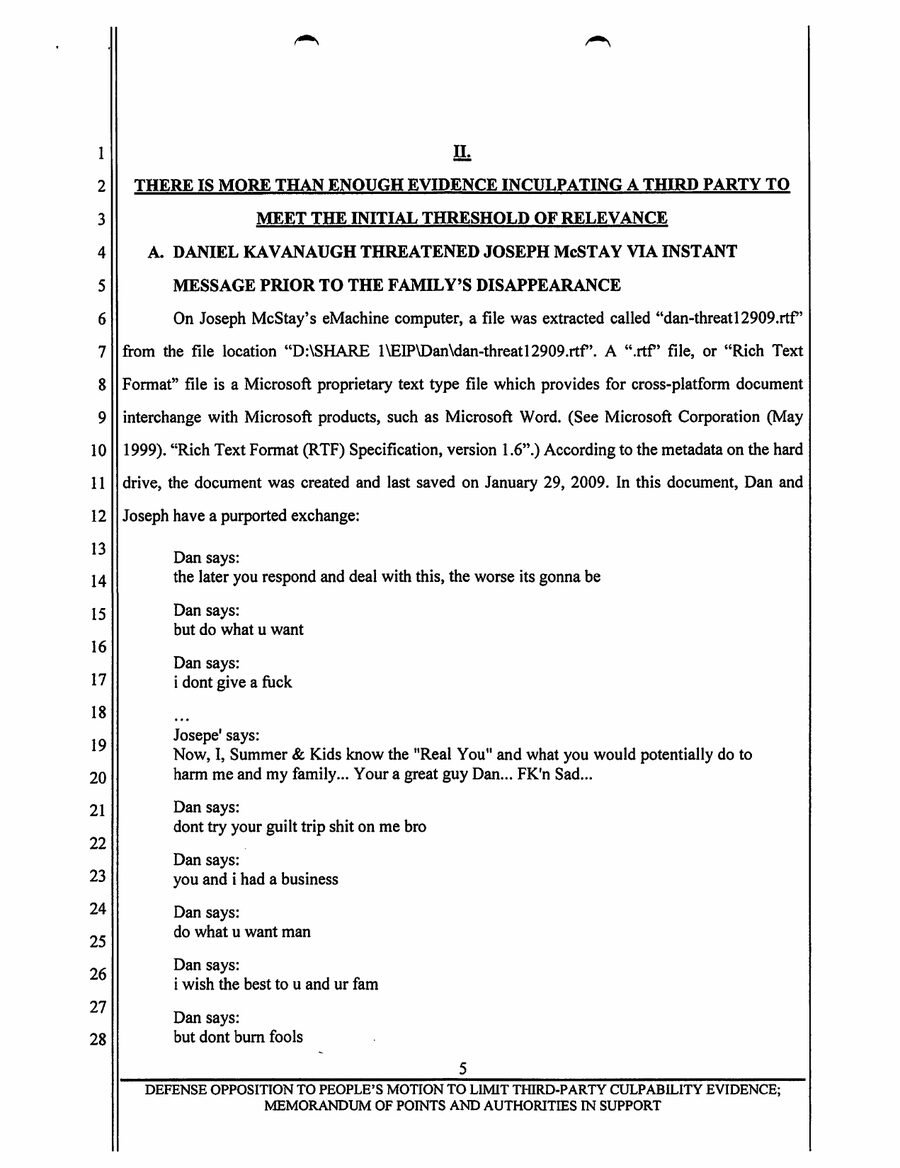
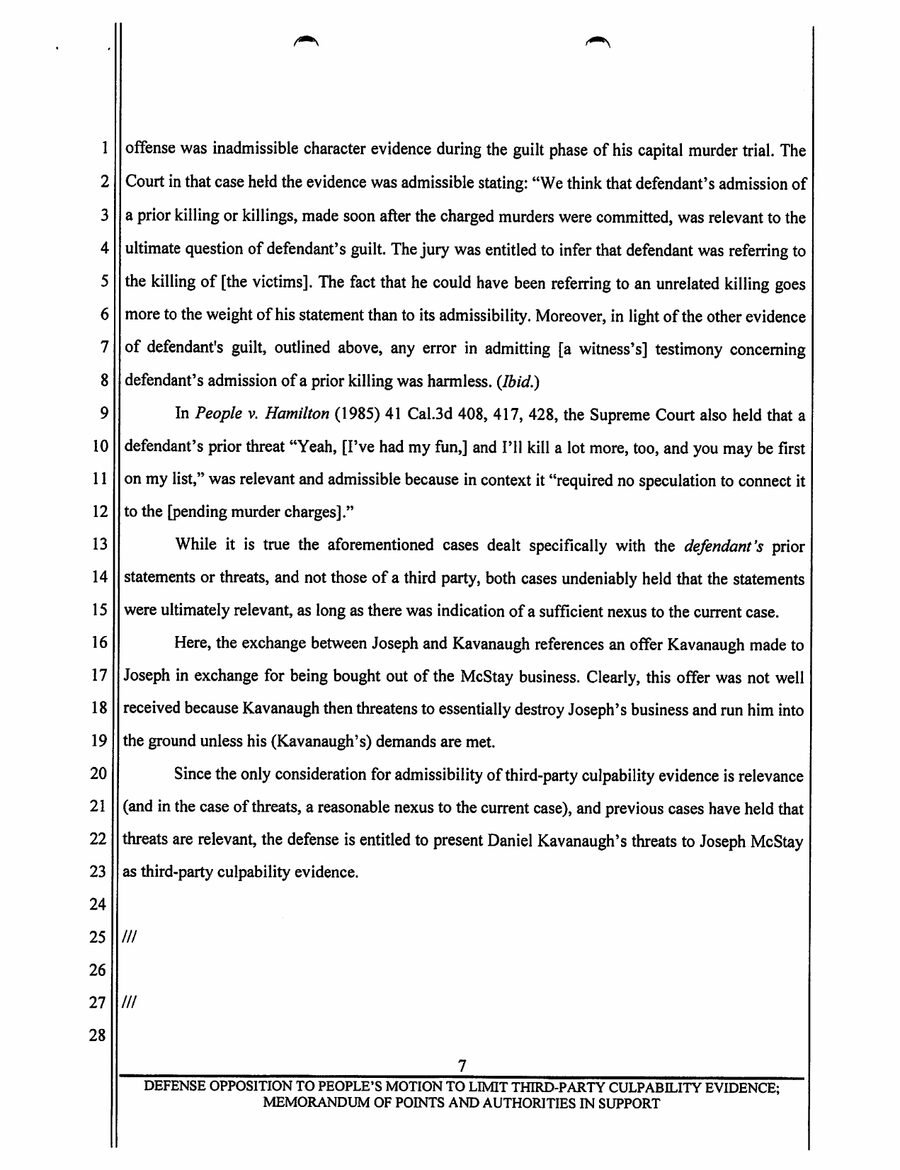
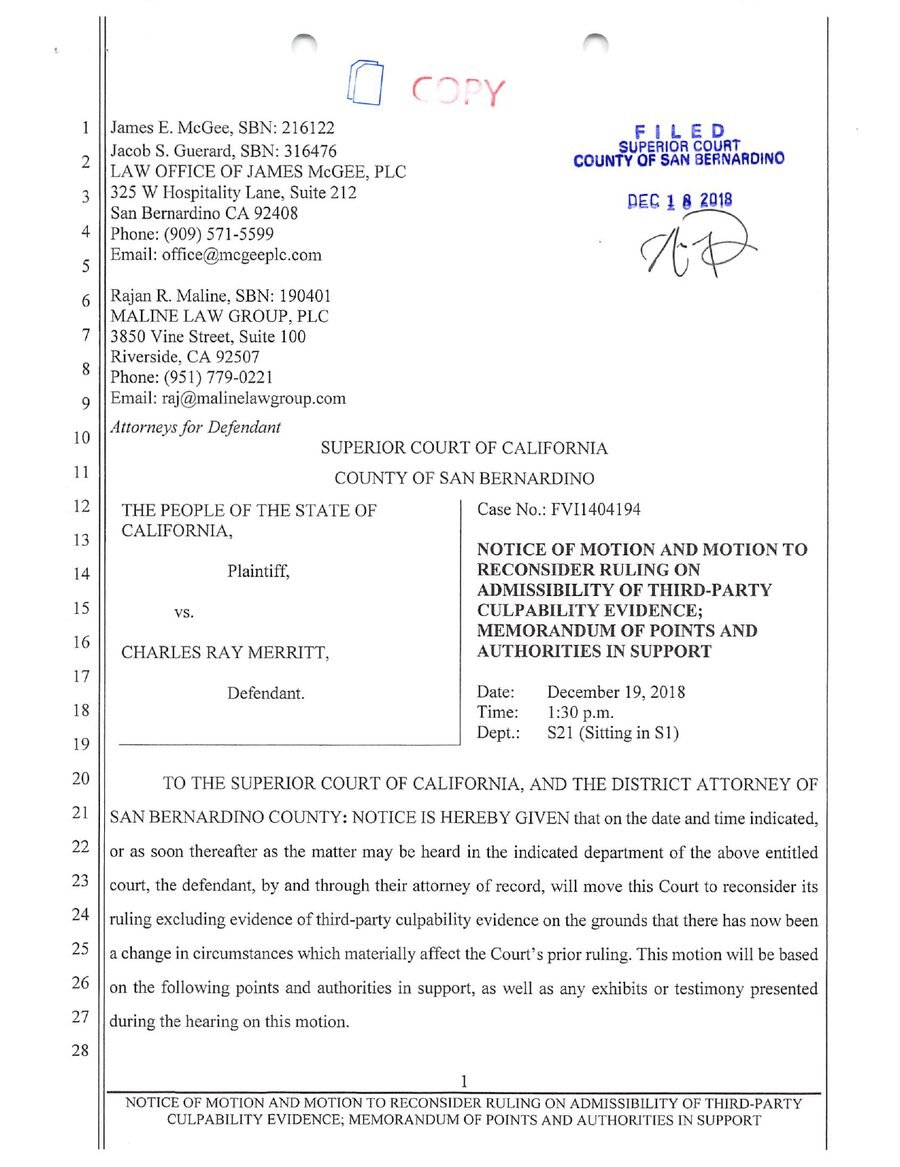
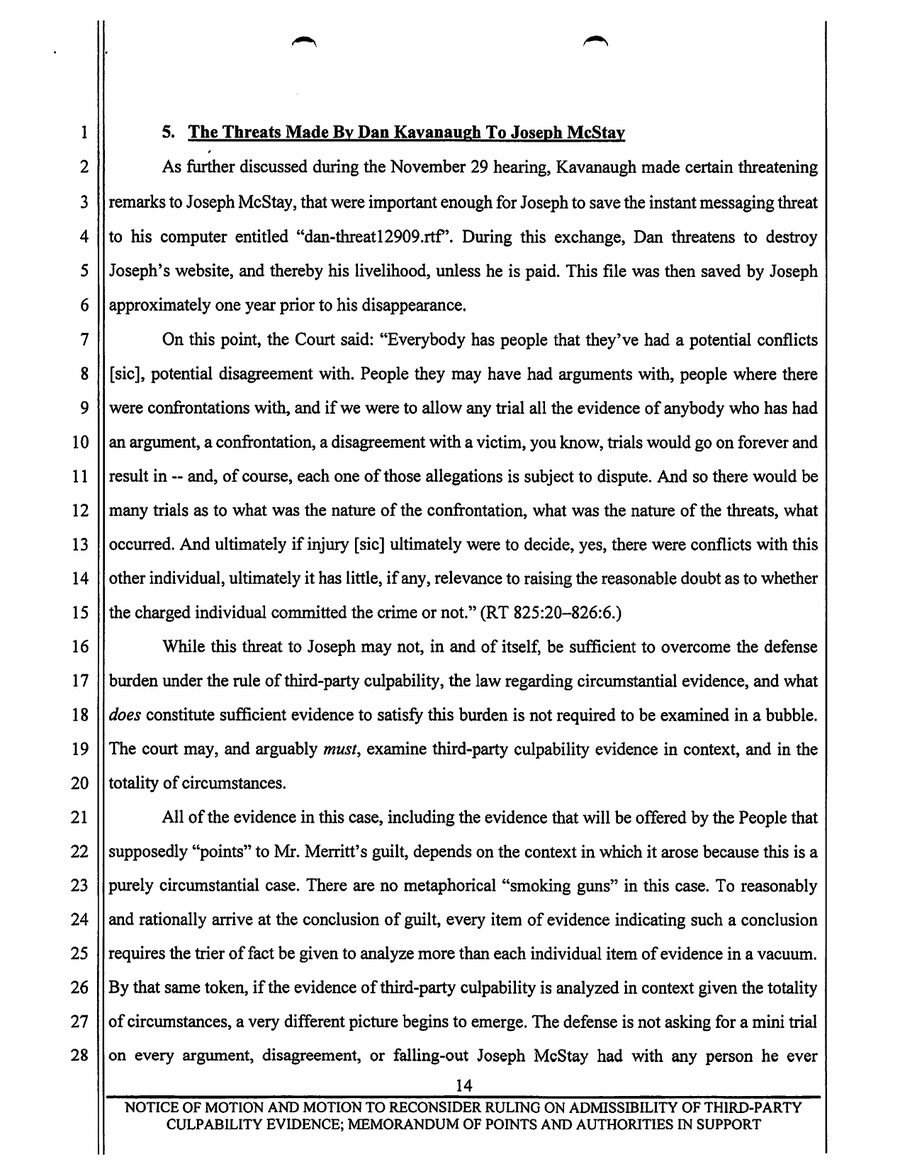
They ran the SODDI defense anyway. On November 28, 2018, their opposition to the State’s motion led with the instant messages: “DANIEL KAVANAUGH THREATENED JOSEPH McSTAY VIA INSTANT MESSAGE PRIOR TO THE FAMILY’S DISAPPEARANCE.” It argued that “the defense is entitled to present Daniel Kavanaugh’s threats to Joseph McStay as third-party culpability evidence” (pp. 5-7). Joseph’s e-mail, which Mechele Muir had sent their office on September 10, is not in it.
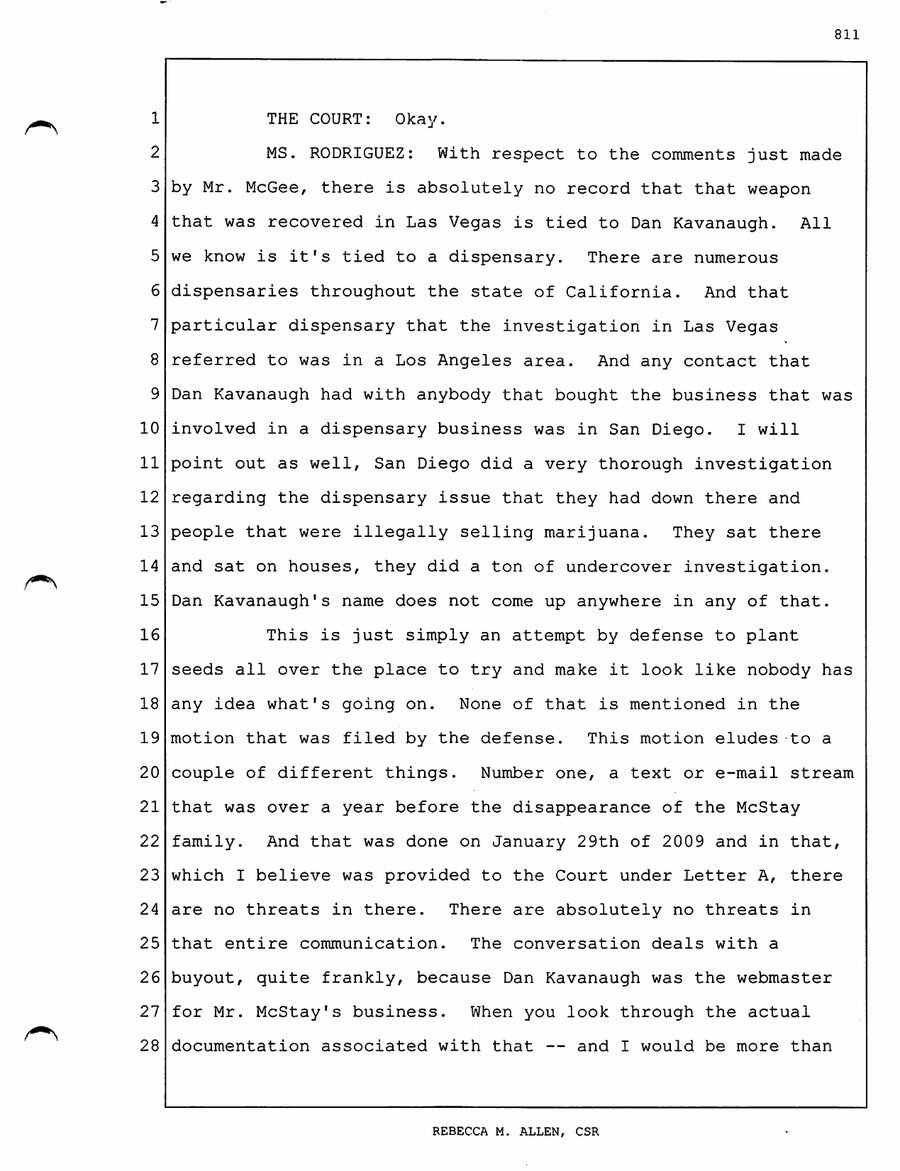
The next day Ms. Rodriguez told the judge (RT 811:23-27):
MS. RODRIGUEZ: … there are no threats in there. There are absolutely no threats in that entire communication. The conversation deals with a buyout, quite frankly, because Dan Kavanaugh was the webmaster for Mr. McStay’s business.
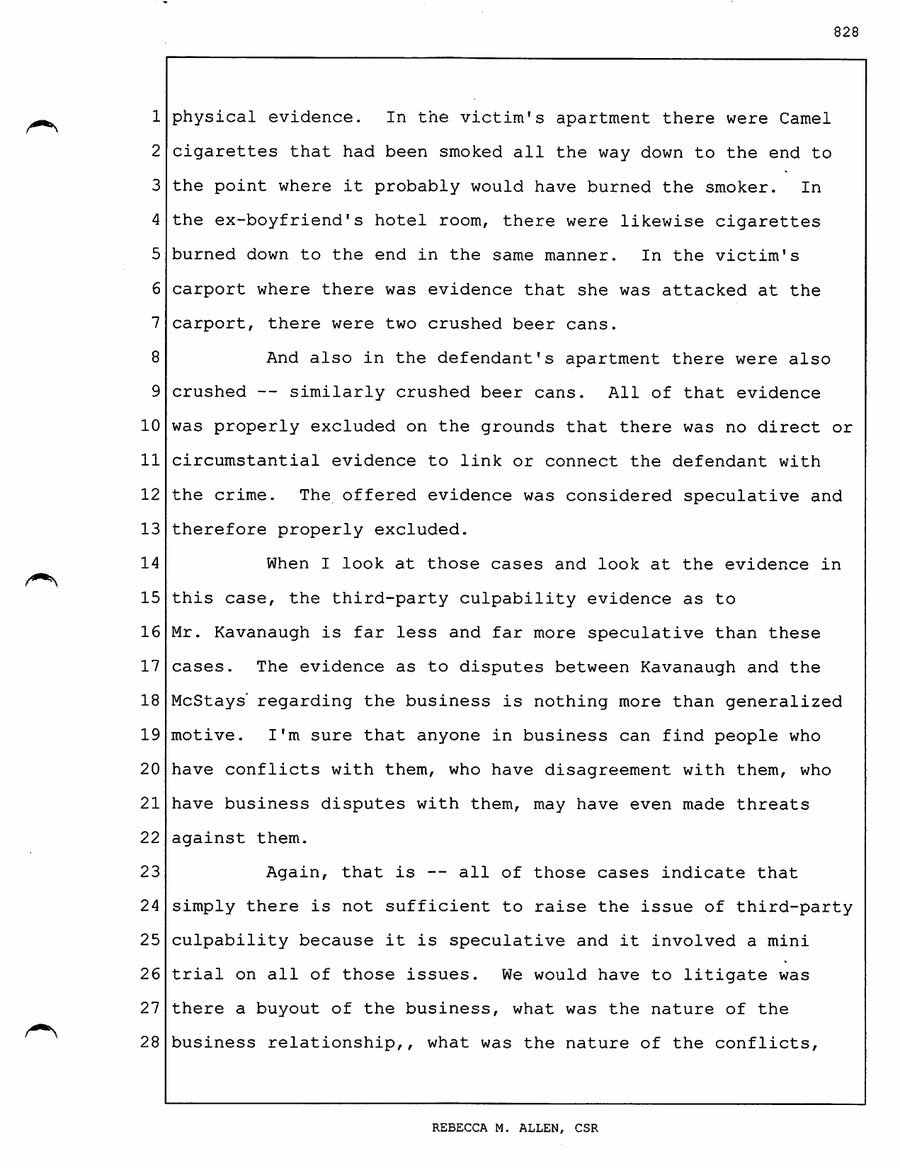
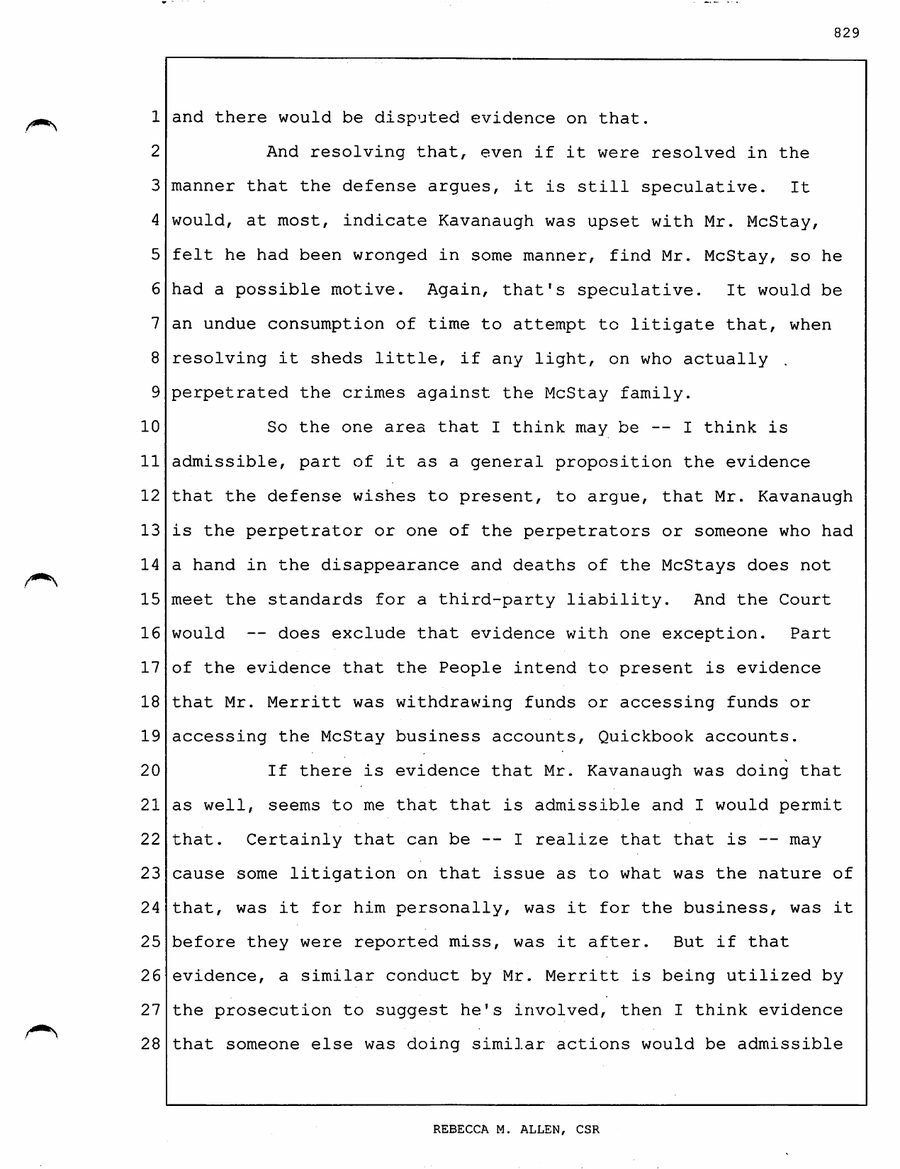
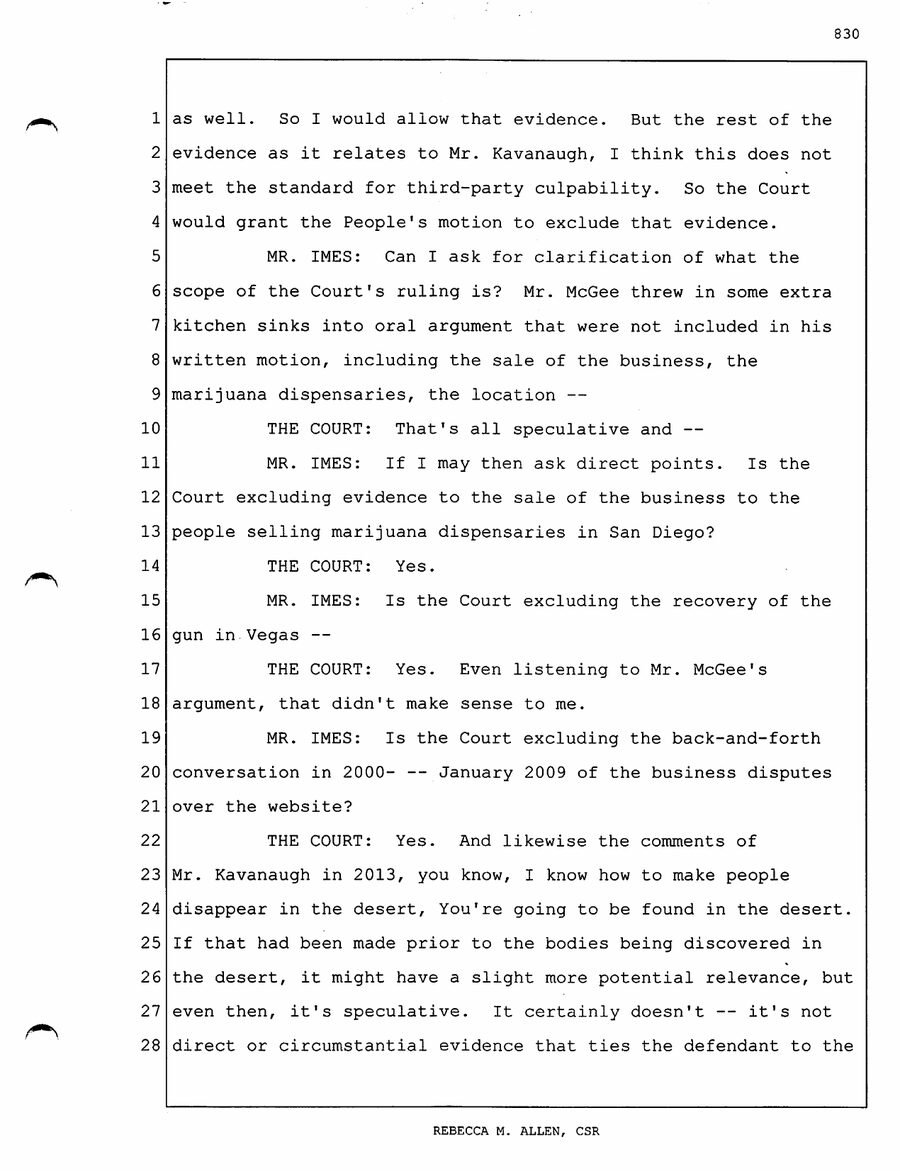
The judge granted the State’s motion. He ruled on what he was asked: whether the evidence showed Dan committed the crime (RT 828:14-22, 830:1-4):
THE COURT: When I look at those cases and look at the evidence in this case, the third-party culpability evidence as to Mr. Kavanaugh is far less and far more speculative than these cases. The evidence as to disputes between Kavanaugh and the McStays’ regarding the business is nothing more than generalized motive. I’m sure that anyone in business can find people who have conflicts with them, who have disagreement with them, who have business disputes with them, may have even made threats against them.
…
But the rest of the evidence as it relates to Mr. Kavanaugh, I think this does not meet the standard for third-party culpability. So the Court would grant the People’s motion to exclude that evidence.
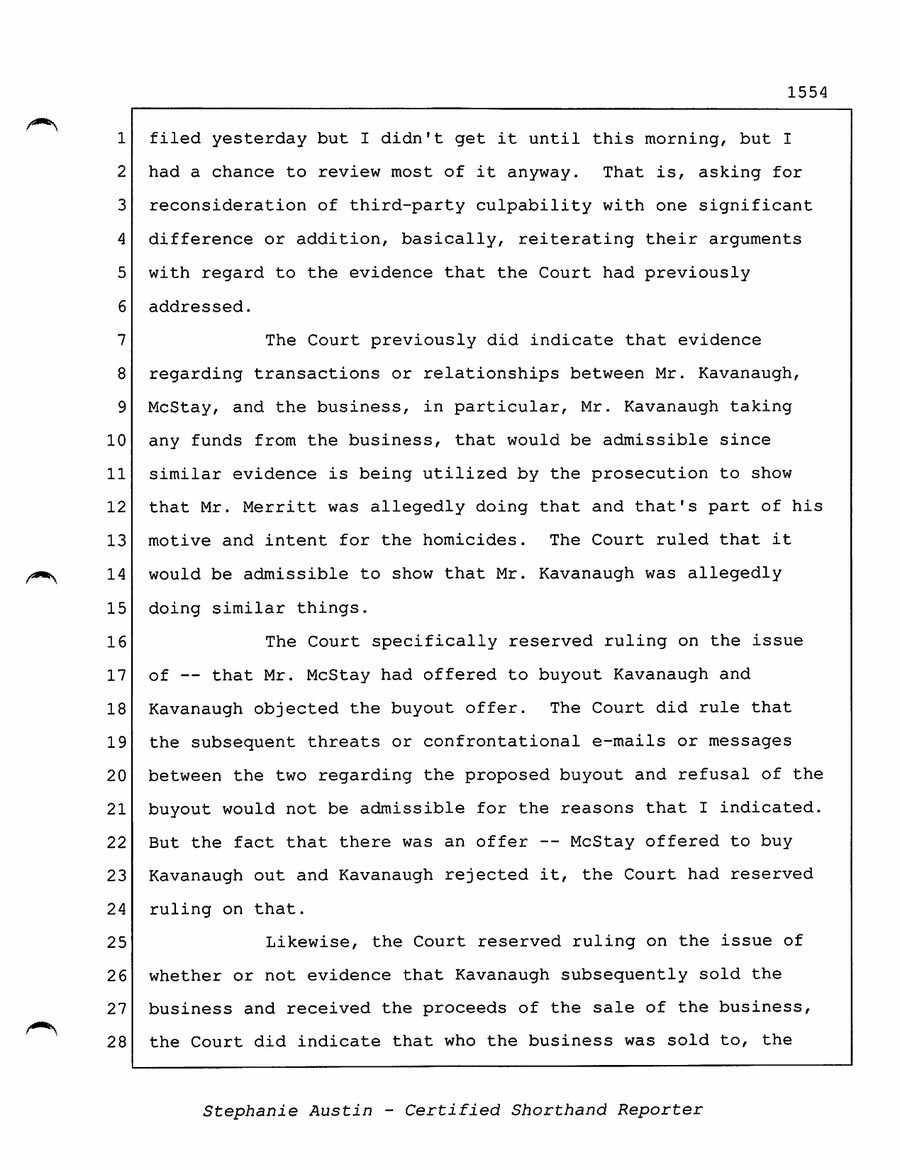
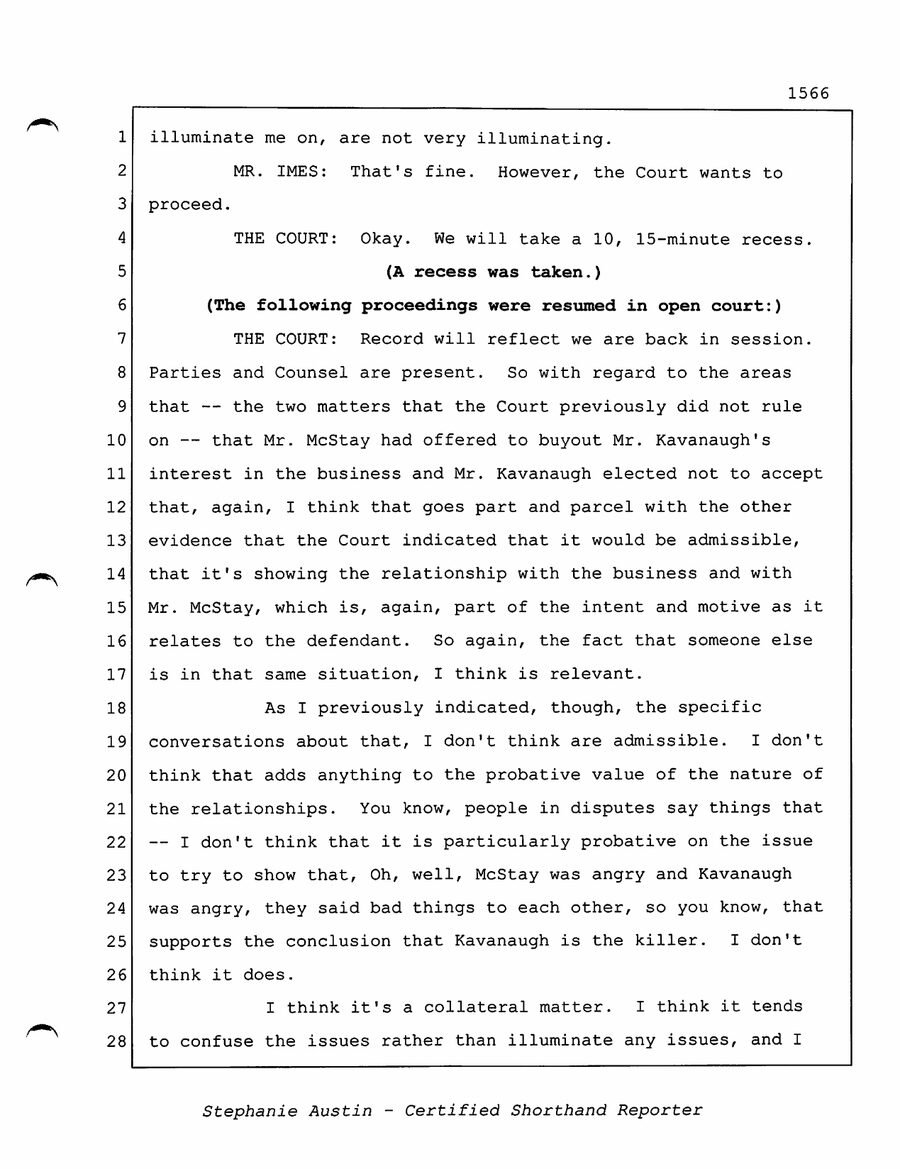
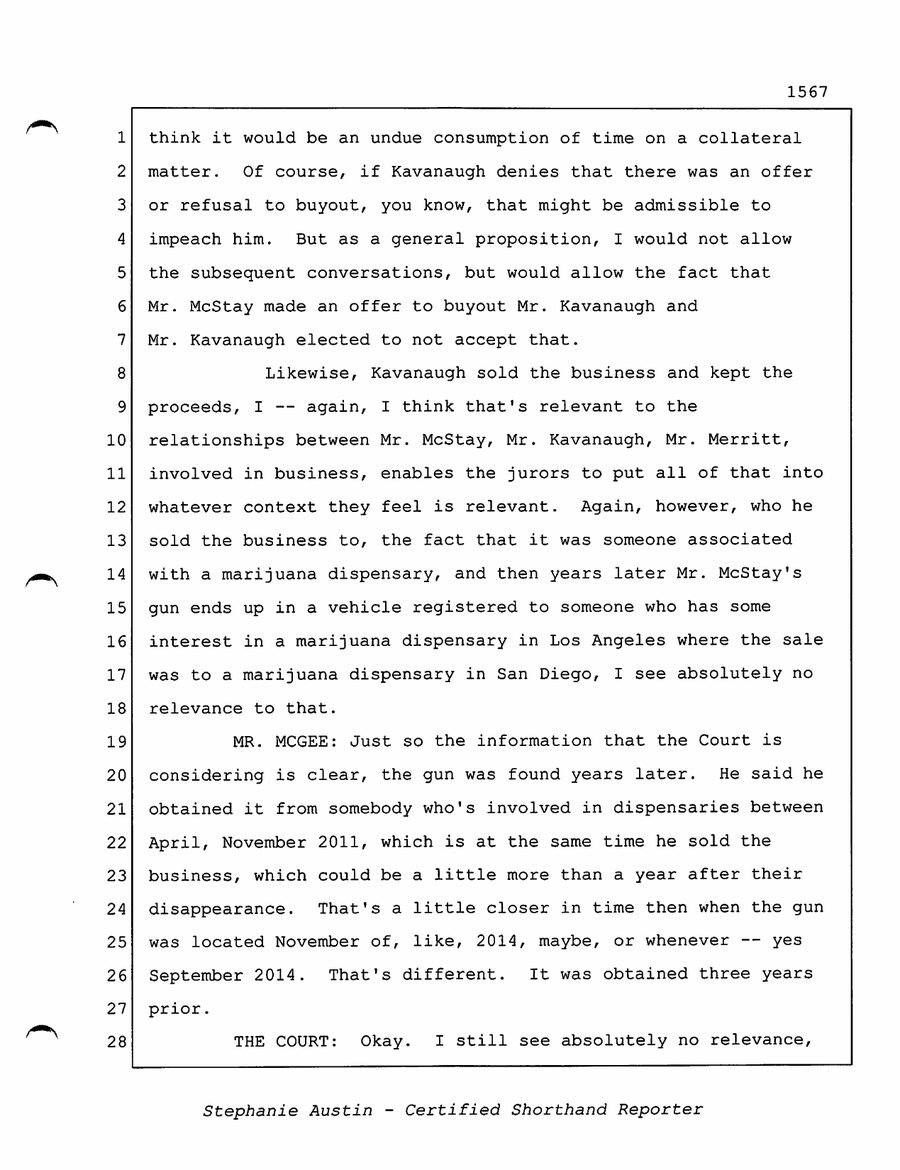
On December 18 they asked him to reconsider, again as third-party culpability. On December 19 he held to it: “The Court did rule that the subsequent threats or confrontational e-mails or messages between the two regarding the proposed buyout and refusal of the buyout would not be admissible for the reasons that I indicated” (RT 1554:18-21). He did let in that Joseph offered to buy Dan out, and that Dan sold the business and kept the proceeds (RT 1566:8-1567:11).
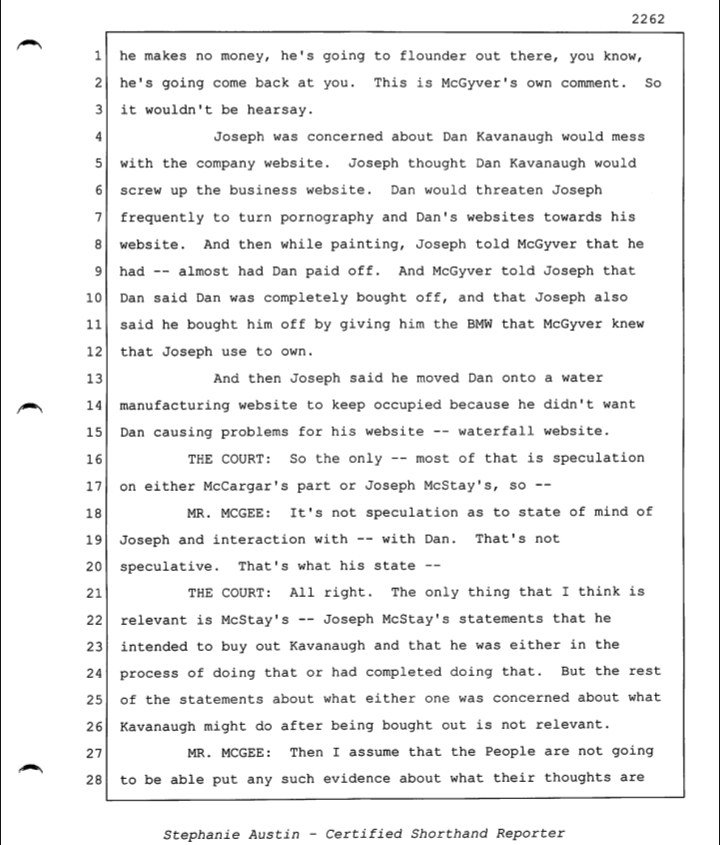
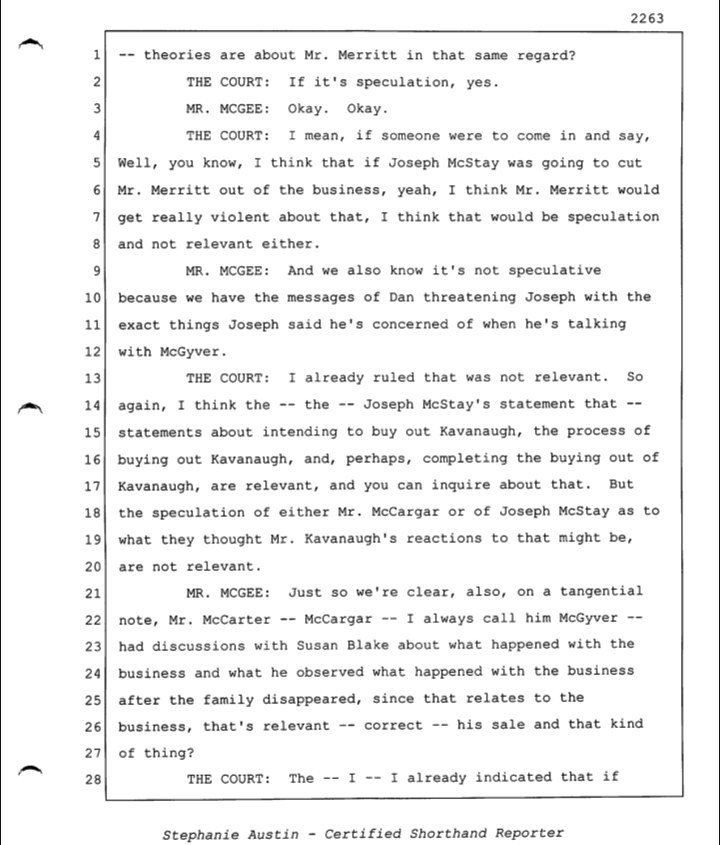
On January 14, 2019, with Mike McCargar on the stand and the jury out, Mr. McGee argued Joseph’s “state of mind,” but only as what Joseph feared Dan would do after the buyout. The judge ruled that out, and when Mr. McGee raised the messages, he said (RT 2263:13-20):
THE COURT: I already ruled that was not relevant. So again, I think the — the — Joseph McStay’s statement that — statements about intending to buy out Kavanaugh, the process of buying out Kavanaugh, and, perhaps, completing the buying out of Kavanaugh, are relevant, and you can inquire about that. But the speculation of either Mr. McCargar or of Joseph McStay as to what they thought Mr. Kavanaugh’s reactions to that might be, are not relevant.
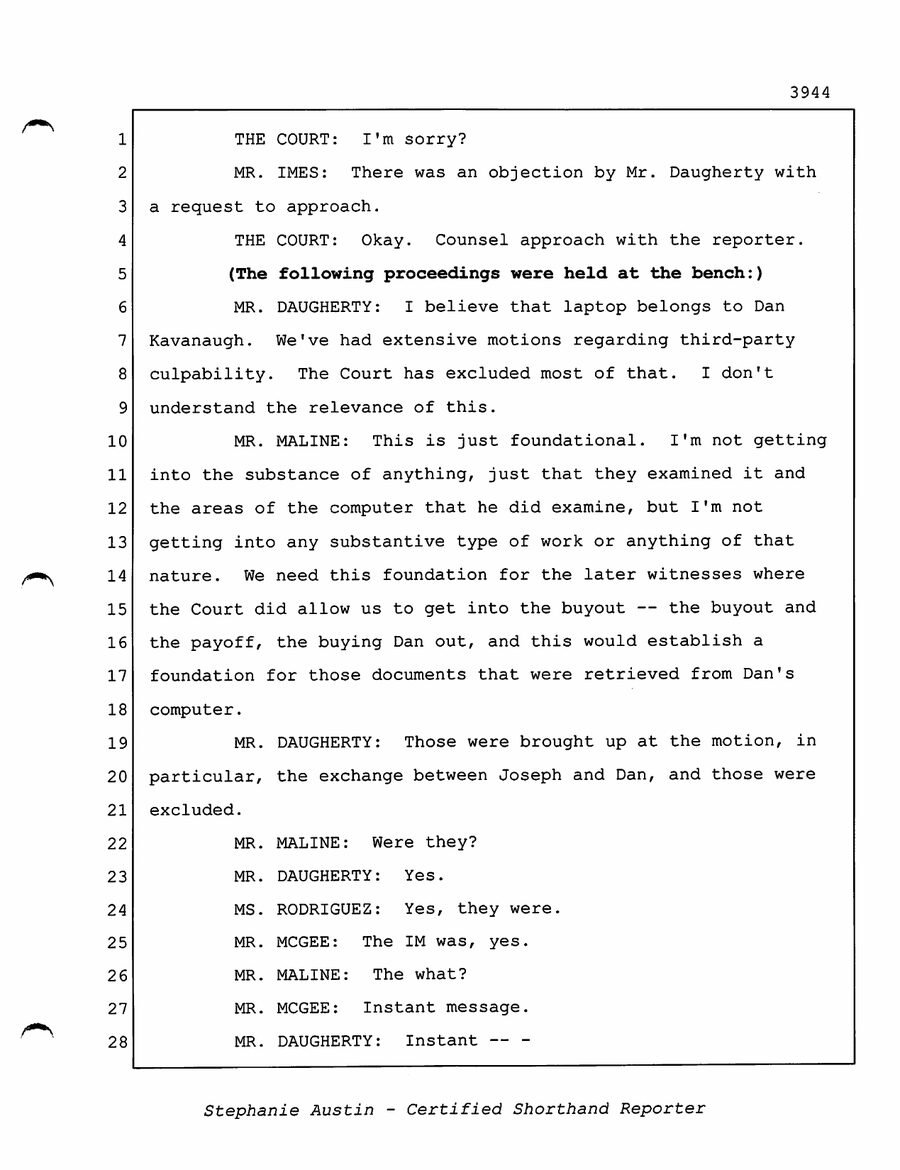
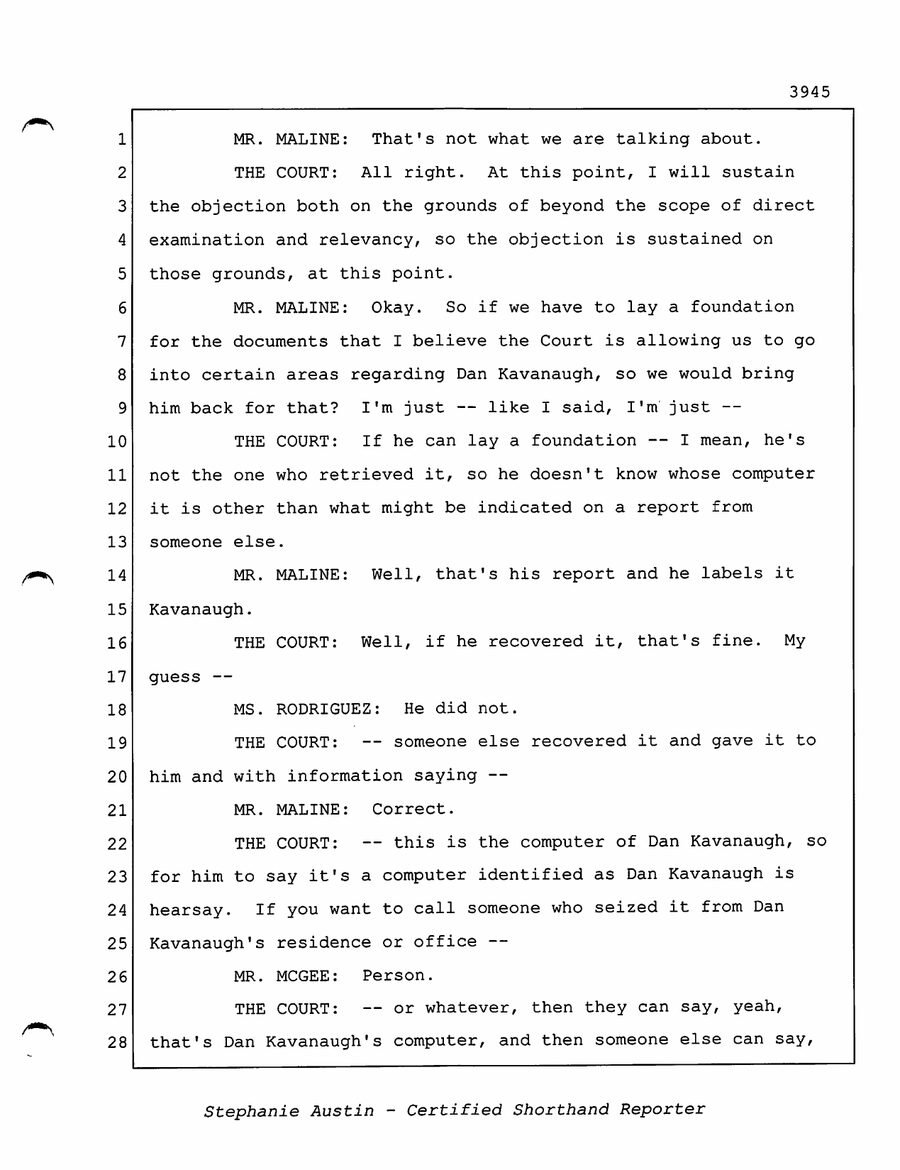
On February 13, at the bench, Mr. Maline was laying a foundation for documents from Dan’s computer when Mr. Daugherty objected (RT 3944:19-3945:1):
MR. DAUGHERTY: Those were brought up at the motion, in particular, the exchange between Joseph and Dan, and those were excluded.
MR. MALINE: Were they?
MR. DAUGHERTY: Yes.
MS. RODRIGUEZ: Yes, they were.
MR. MCGEE: The IM was, yes.
MR. MALINE: The what?
MR. MCGEE: Instant message.
MR. DAUGHERTY: Instant — –
MR. MALINE: That’s not what we are talking about.
Why it mattered: Every time, the Dan evidence was offered to say Dan did it, and the judge ruled on that. Not once did my lawyers tell him what I had told them it was for: Joseph’s reason to keep Dan out of QuickBooks and the custom accounts, the answer to the State’s deleted checks. He never ruled on that, because it was never put to him. And when Ms. Rodriguez told him there were “absolutely no threats,” no one showed him Joseph’s own words.
See the filings and the hearings
Taken together
These aren’t separate mistakes. The State’s motive came down to one claim: that Joseph was cutting me out, and that I had taken money he didn’t owe me. The storage unit, Susan Blake, the Walker call, the checks and the accounting were each a piece of that claim. Every time, the answer was already in the record or in my lawyers’ files, and every time it went unused. In some cases, my own lawyers repeated the State’s version for it.
And when the reason Joseph kept Dan out of his accounts was in their files, my lawyers argued instead that Dan did it.
More coming soon.
Decide for yourself.