The Undelivered Check
Part of the money
- The Money (Part 4)
- The Undelivered Check (you are here)
- Where the Money Went
The judge said Joseph McStay gave me a check to deliver to the shop that built our fountains, that I kept it, and that I spent the money on supplies. He used that, twice, as proof I was taking money from Joseph. It never happened. Joseph’s bank records show every check he wrote to that shop, and every one went into the shop’s account. His own books show the shop paid in full on every job. Every check I cashed was made out to me.
The accusation, and the record
| What was said | What the record shows |
|---|---|
| Joseph gave me a check to deliver to Metro. | No one who testified saw it. The only witness heard “bits and pieces” of a phone call, and couldn’t say what check, what amount, what month or what job (card 2). |
| Metro never got it. | All 26 checks Joseph wrote to Metro went into Metro’s account (card 3). Metro’s bookkeeper told the jury that every job had been paid except one, a remake that was to be paid from an insurance claim (RT 3569). |
| I used it for supplies. | Every check I cashed was made out to me, every one is in the bank record, and none was for Metro (card 5). |
| “Metro Sheet Metal did not get paid the sums that they should have been paid” (the judge, RT 4997). | Joseph’s own ledger shows $0.00 owed to Metro on every job (card 4). |
| “We also know that Joseph McStay gave a check to Mr. Merritt” (the judge, RT 8942). | The jury was told the story was not offered to prove a check was given (card 1). Metro’s statement showing the checks received was kept out (card 6). |
Who’s who
- Joseph McStay: my partner. His company, Earth Inspired Products, sold the fountains and paid for them from its Union Bank account.
- Metro Sheet Metal: the shop in Azusa that built the metal part of each fountain. I put in the lights and plumbing there and crated the fountains for shipping. (Bates 007394; RT 2774:6-13)
- Dave Sequeida Sr.: Metro’s owner. He is the one who dealt with Joseph about money.
- Dave Sequeida Jr. (“Joe”): his son, who worked in the shop. He is the witness who told the jury about the check.
- Carmen Garcia: Metro’s office manager. She did the invoicing, took in the payments, and recorded each one to its job. (RT 3517, 3530)
- Det. Ryan Smith and Det. Eddie Bachman: San Bernardino detectives who interviewed the Sequeidas and Carmen Garcia in 2014.
- Mr. Imes, Ms. Rodriguez, Mr. Daugherty: the prosecutors. Mr. McGee, Mr. Maline: my lawyers. The court: Judge Michael A. Smith.
- RT 2781:5 means trial transcript page 2781, line 5. Bates numbers are the page numbers stamped on the State’s reports. Under each quote, “See the…” opens a picture of the page it came from.
1 of 8
The accusation
The claim was not that a check was lost or late. It was that Joseph gave me Metro’s money, that I kept it and spent it on supplies, and that I admitted it. That is diversion, and an admission. The only person who told the jury about it was Dave Sequeida Jr., on January 17, 2019.
1. How Metro was paid
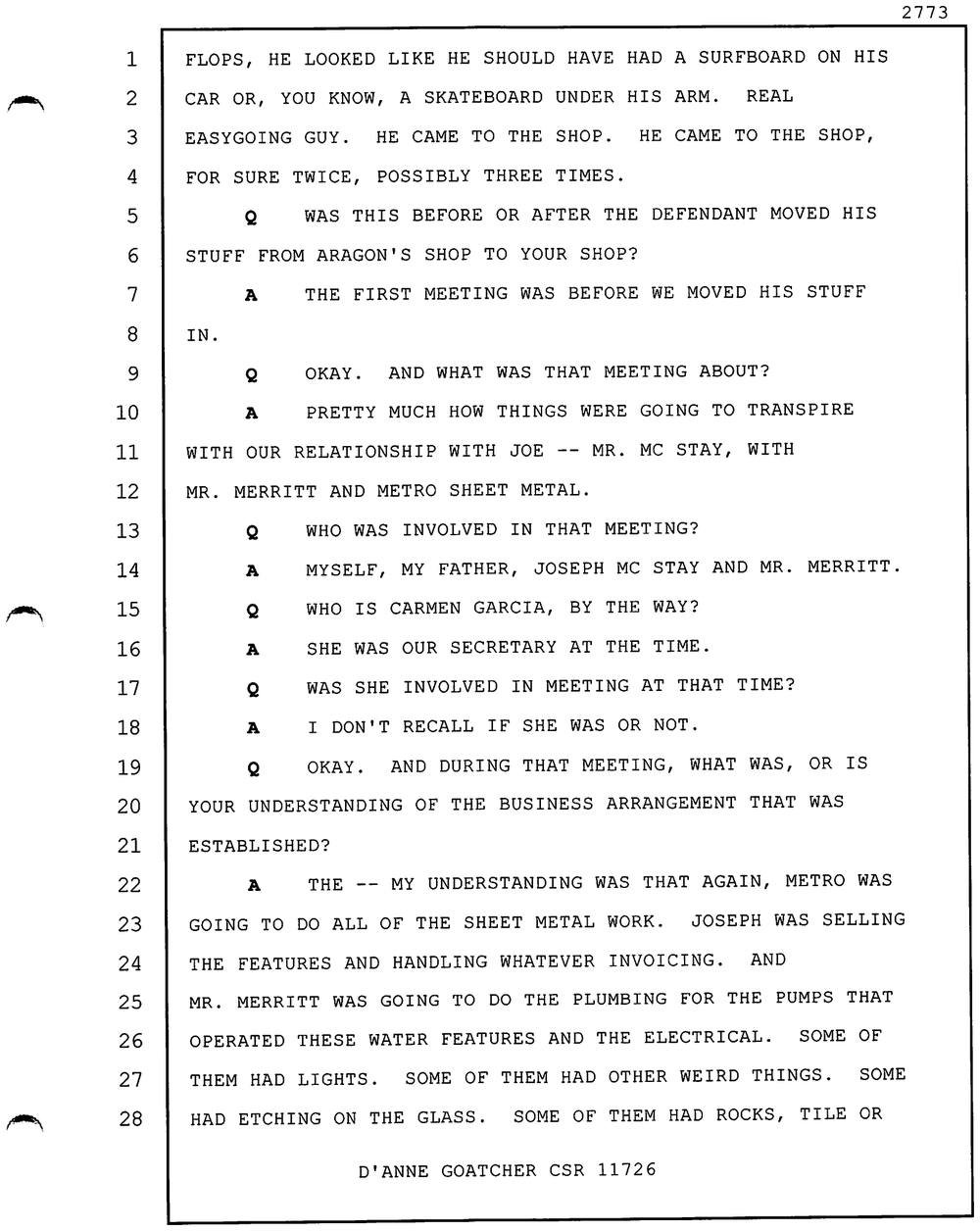
Mr. Imes asked him how Metro got paid: (RT 2774:14-21)
Q Okay. And who was responsible for paying you for your work?
A We were getting paid through Mr. McStay.
Q How would that occur?
A Check.
Q Okay. How would you get those checks?
A Sometimes Mr. Merritt would drop them off to us. Other times they were mailed.
See the transcript (RT 2774)
2. The check
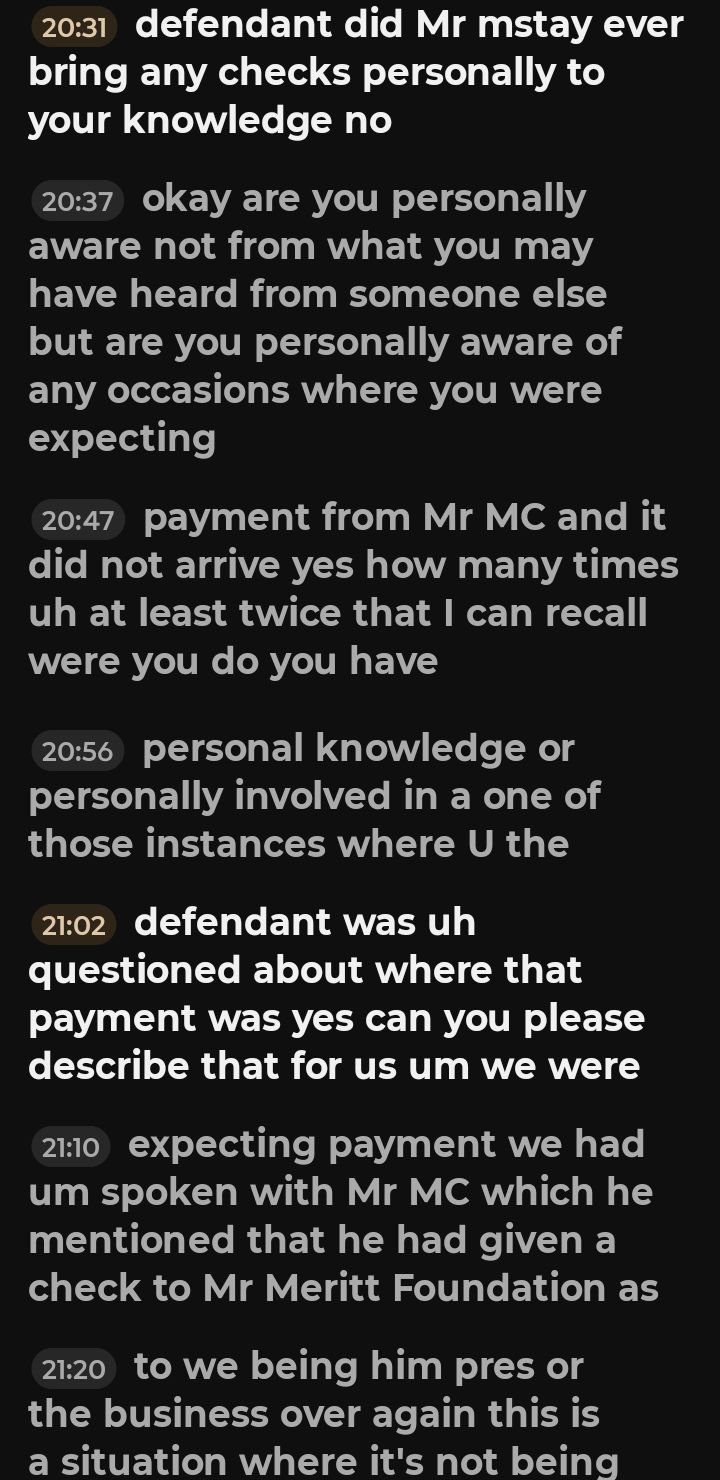
Page 2780 of the transcript, where this begins, is missing from my copy. The trial video has it (Law & Crime video, 20:31-21:53). This is YouTube’s automatic transcript of that minute, with names spelled correctly and my reading of unclear words in brackets:
Read that minute
Q … Did Mr. McStay ever bring any checks personally, to your knowledge?
A No.
Q Okay. Are you personally aware, not from what you may have heard from someone else, but are you personally aware of any occasions where you were expecting payment from Mr. McStay and it did not arrive?
A Yes.
Q How many times?
A Uh, at least twice that I can recall.
Q Were you — do you have personal knowledge or [were you] personally involved in one of those instances where the defendant was questioned about where that payment was?
A Yes.
Q Can you please describe that for us?
A Um, we were expecting payment. We had, um, spoken with Mr. McStay, which he mentioned that he had given a check to Mr. Merritt —
MR. McGEE: Foundation as to “we,” being him [personally] or the business.
THE COURT: [Overruled.] Again, this is a situation where it’s not being offered to prove that Mr. McStay actually gave the [check], but it’s offered to show that’s what they were advised of, and they then did something or had a conversation, and whatever the conversation is may or may not be relevant, but so you know that this is what they were told. That’s why they had the conversation.
See the video transcript (20:31-22:17)
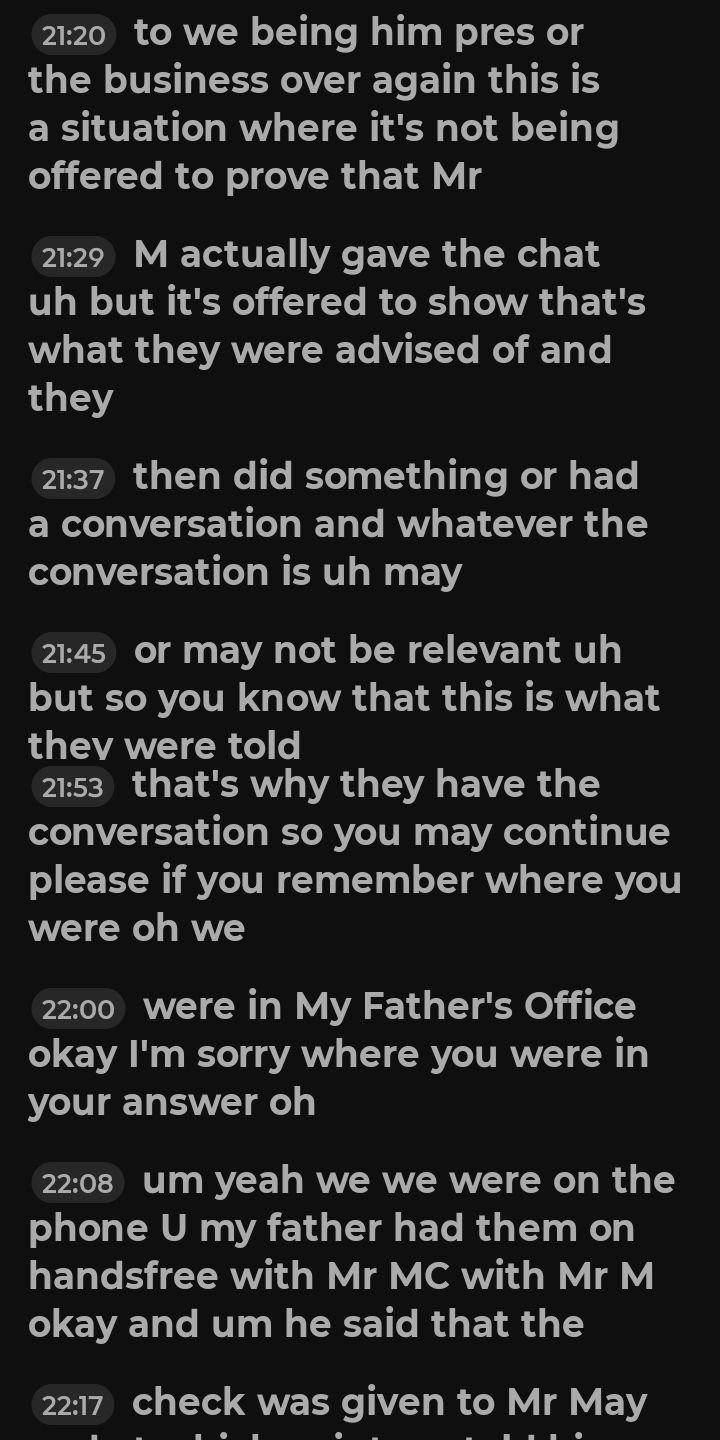
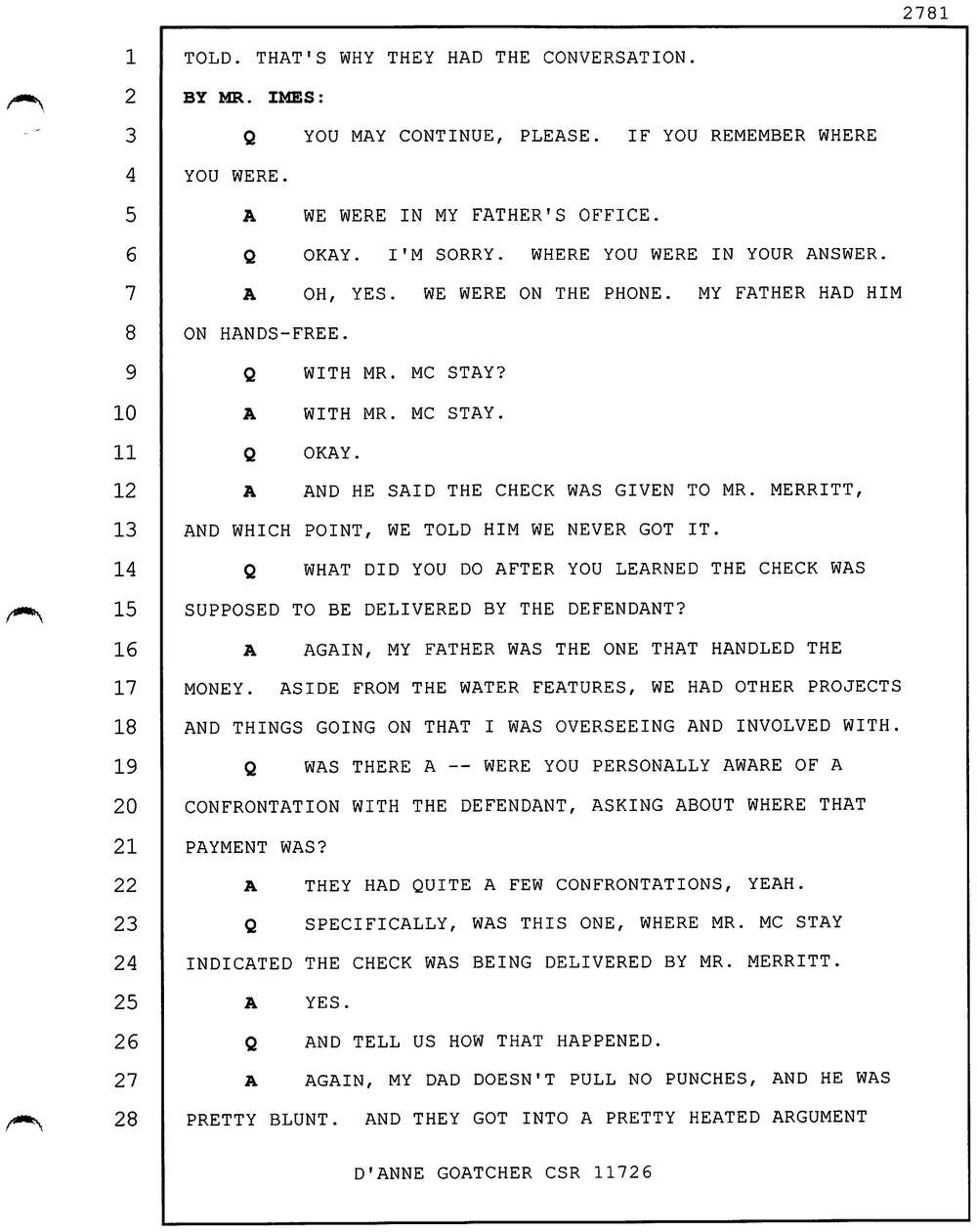
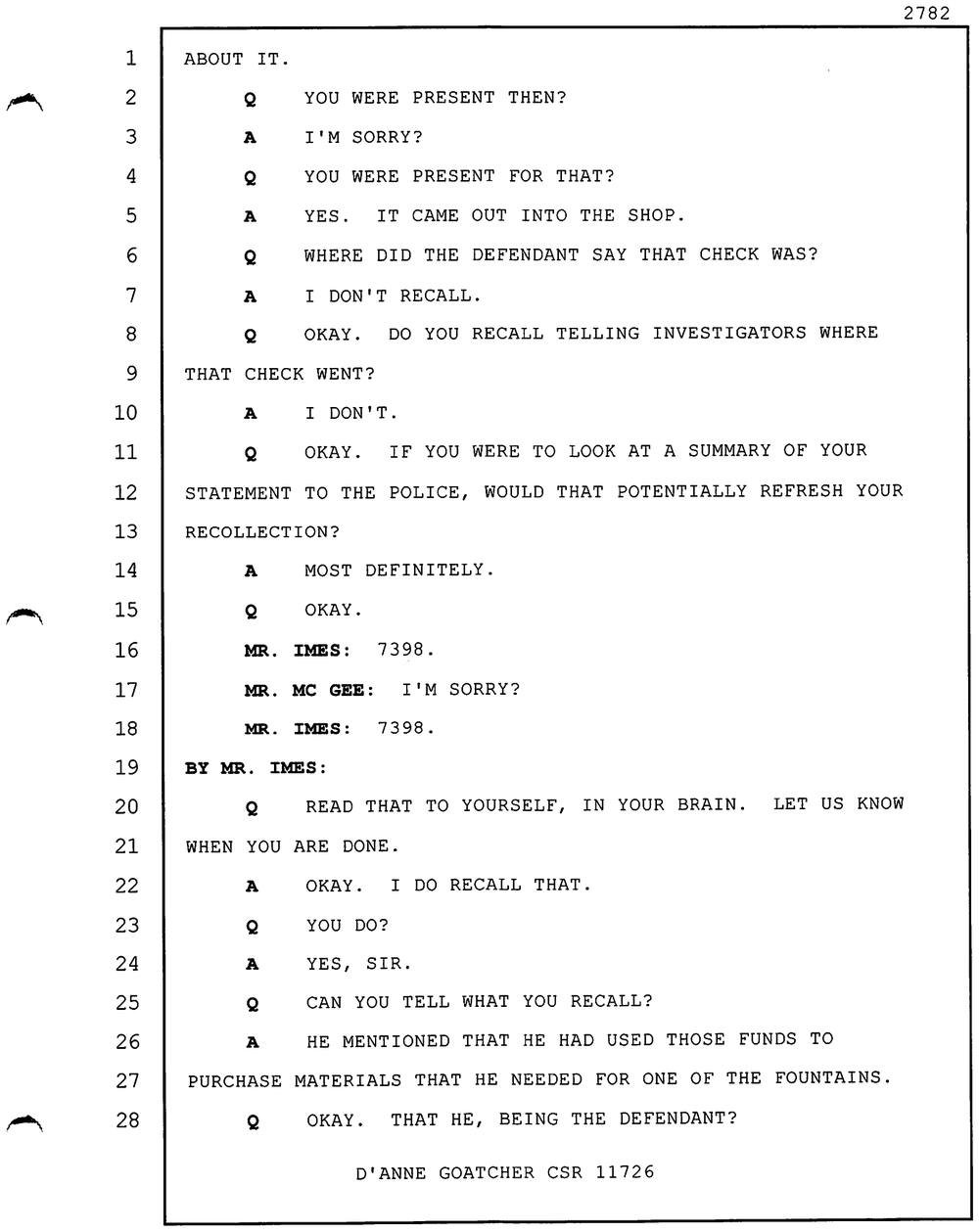
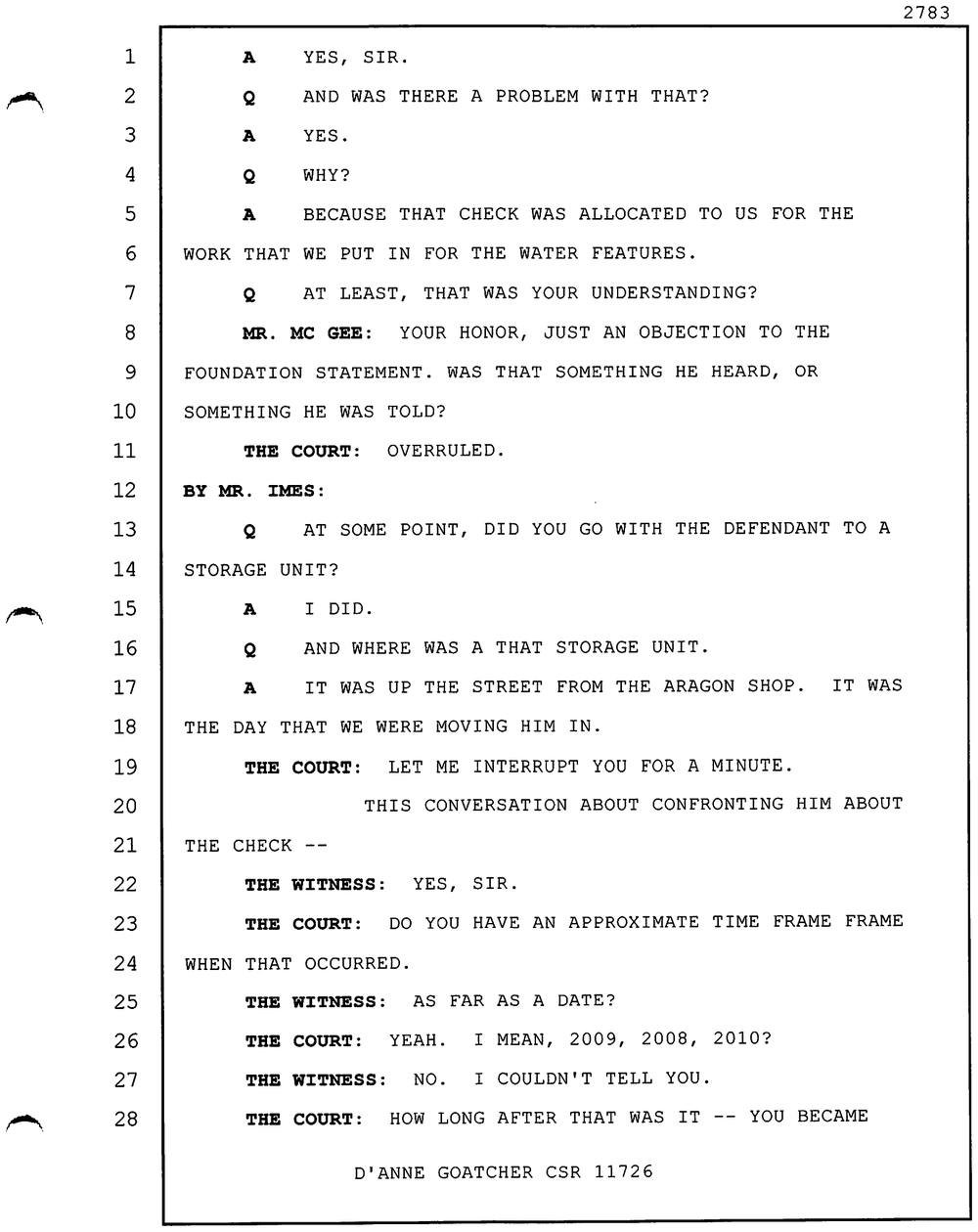
Notice what the judge told the jury there: the story was “not being offered to prove that Mr. McStay actually gave the [check].” The court reporter’s transcript picks up on the next page, at the end of that ruling: (RT 2781:1-2783:11)
Read his testimony
Told. That’s why they had the conversation.
BY MR. IMES:
Q You may continue, please. If you remember where you were.
A We were in my father’s office.
Q Okay. I’m sorry. Where you were in your answer.
A Oh, yes. We were on the phone. My father had him on hands-free.
Q With Mr. McStay?
A With Mr. McStay.
Q Okay.
A And he said the check was given to Mr. Merritt, and which point, we told him we never got it.
Q What did you do after you learned the check was supposed to be delivered by the defendant?
A Again, my father was the one that handled the money. Aside from the water features, we had other projects and things going on that I was overseeing and involved with.
Q Was there a — were you personally aware of a confrontation with the defendant, asking about where that payment was?
A They had quite a few confrontations, yeah.
Q Specifically, was this one, where Mr. McStay indicated the check was being delivered by Mr. Merritt.
A Yes.
Q And tell us how that happened.
A Again, my dad doesn’t pull no punches, and he was pretty blunt. And they got into a pretty heated argument about it.
Q You were present then?
A I’m sorry?
Q You were present for that?
A Yes. It came out into the shop.
Q Where did the defendant say that check was?
A I don’t recall.
Q Okay. Do you recall telling investigators where that check went?
A I don’t.
Q Okay. If you were to look at a summary of your statement to the police, would that potentially refresh your recollection?
A Most definitely.
Q Okay.
MR. IMES: 7398.
MR. McGEE: I’m sorry?
MR. IMES: 7398.
BY MR. IMES:
Q Read that to yourself, in your brain. Let us know when you are done.
A Okay. I do recall that.
Q You do?
A Yes, sir.
Q Can you tell what you recall?
A He mentioned that he had used those funds to purchase materials that he needed for one of the fountains.
Q Okay. That he, being the defendant?
A Yes, sir.
Q And was there a problem with that?
A Yes.
Q Why?
A Because that check was allocated to us for the work that we put in for the water features.
Q At least, that was your understanding?
MR. McGEE: Your Honor, just an objection to the foundation statement. Was that something he heard, or something he was told?
THE COURT: Overruled.
See the transcript (RT 2781-2783)
The “admission” came from a detective’s summary of Sequeida Jr.’s 2014 interview, which Mr. Imes handed him to refresh his memory. This is that summary, Det. Bachman’s report: (Bates 007398)
Joe never recalled anything being wrong with any checks from McStay or Merritt, but remembered on several occasions Merritt brought checks for McStay to Metro Sheet Metal. Joe remembered toward the end of the dealings with Merritt, McStay claimed he sent a deposit check to Metro Sheet Metal with Merritt, but the check never arrived. Dave confronted Merritt about the missing check and Merritt claimed he used the money to purchase supplies and other things necessary. This caused problems between Dave and Merritt as Merritt did not have the authority to use the money owed to Metro Sheet Metal to purchase his own supplies. Joe was unsure what happened when Dave told McStay about the missing check and did not know if this caused any problems in their business dealings.
See Det. Bachman’s report (Bates 007398)
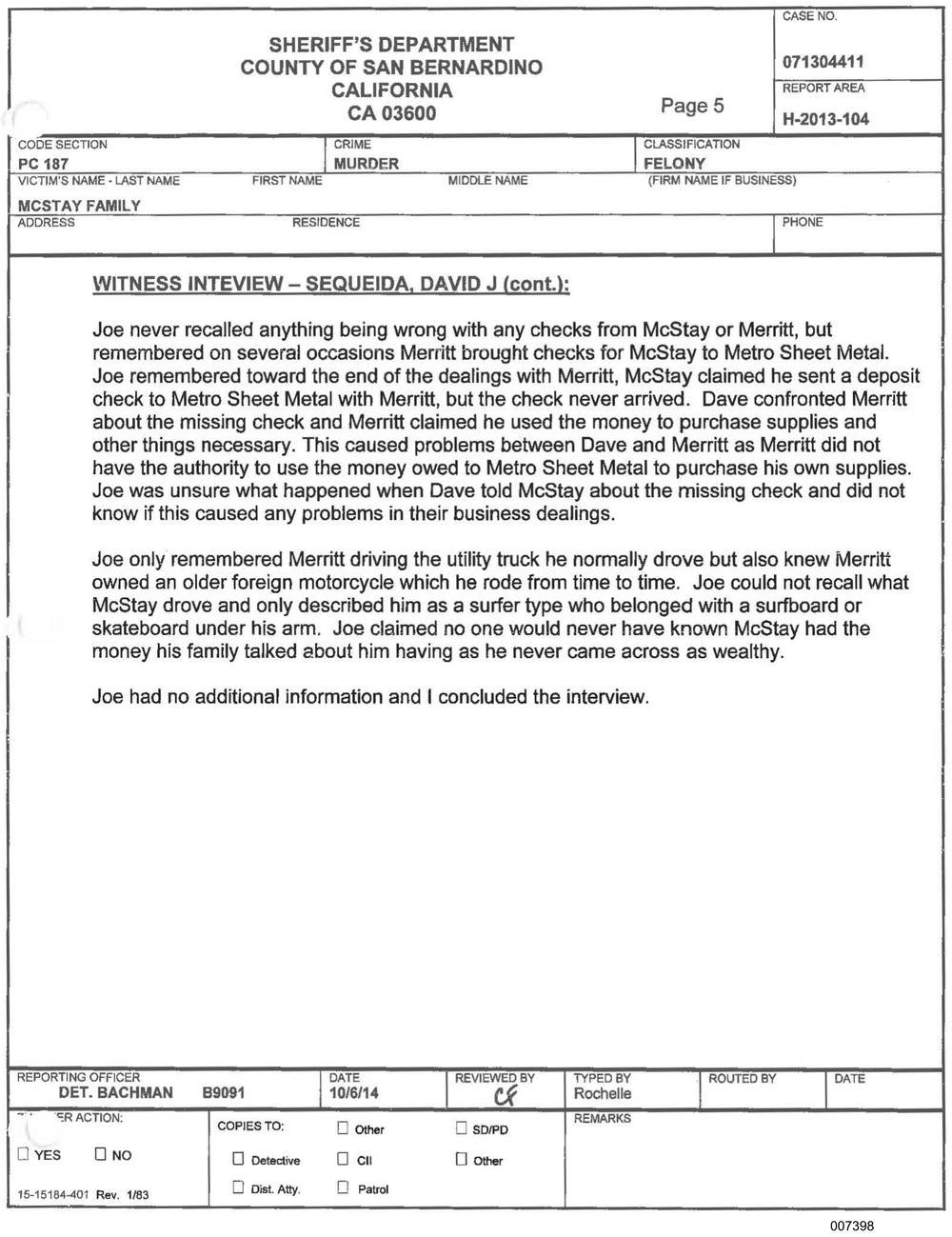
So the accusation has two parts: that Metro’s money was diverted to me, and that I admitted it. I did carry Joseph’s checks to Metro, and Metro got them. If I never kept one, there was nothing to divert and nothing to admit. The rest of this page is the record on both.
2 of 8
The only witness
Sequeida Jr. didn’t handle Metro’s money, didn’t look at the checks, and wasn’t on the call. He couldn’t say what check, what amount, what month or what job. He remembered my “admission” only after reading a detective’s summary.
1. He didn’t remember the admission
On direct, Mr. Imes asked him what I said about the check: (RT 2782:6-27)
Q Where did the defendant say that check was?
A I don’t recall.
Q Okay. Do you recall telling investigators where that check went?
A I don’t.
Q Okay. If you were to look at a summary of your statement to the police, would that potentially refresh your recollection?
A Most definitely.
Q Okay.
MR. IMES: 7398.
MR. McGEE: I’m sorry?
MR. IMES: 7398.
BY MR. IMES:
Q Read that to yourself, in your brain. Let us know when you are done.
A Okay. I do recall that.
Q You do?
A Yes, sir.
Q Can you tell what you recall?
A He mentioned that he had used those funds to purchase materials that he needed for one of the fountains.
See the transcript (RT 2782)
2. He wasn’t on the call
On January 17 he told the jury he was in his father’s office for the speakerphone call with Joseph (RT 2781:3-13, card 1). Five days later, on cross-examination: (RT 2843:17-28)
Q Okay. And was it you that called Joseph or was it your father that called Joseph?
A No, my father was the one that was communicating with Joseph.
Q Did you happen to be there for that conversation?
A No.
Q So when you testified that you heard that conversation on direct examination, you testified — you didn’t actually hear it?
A When my father spoke to Joseph about it, I was in and out of his office.
Q So you heard, what, bits and pieces of it?
A Yes, sir.
See the transcript (RT 2843)
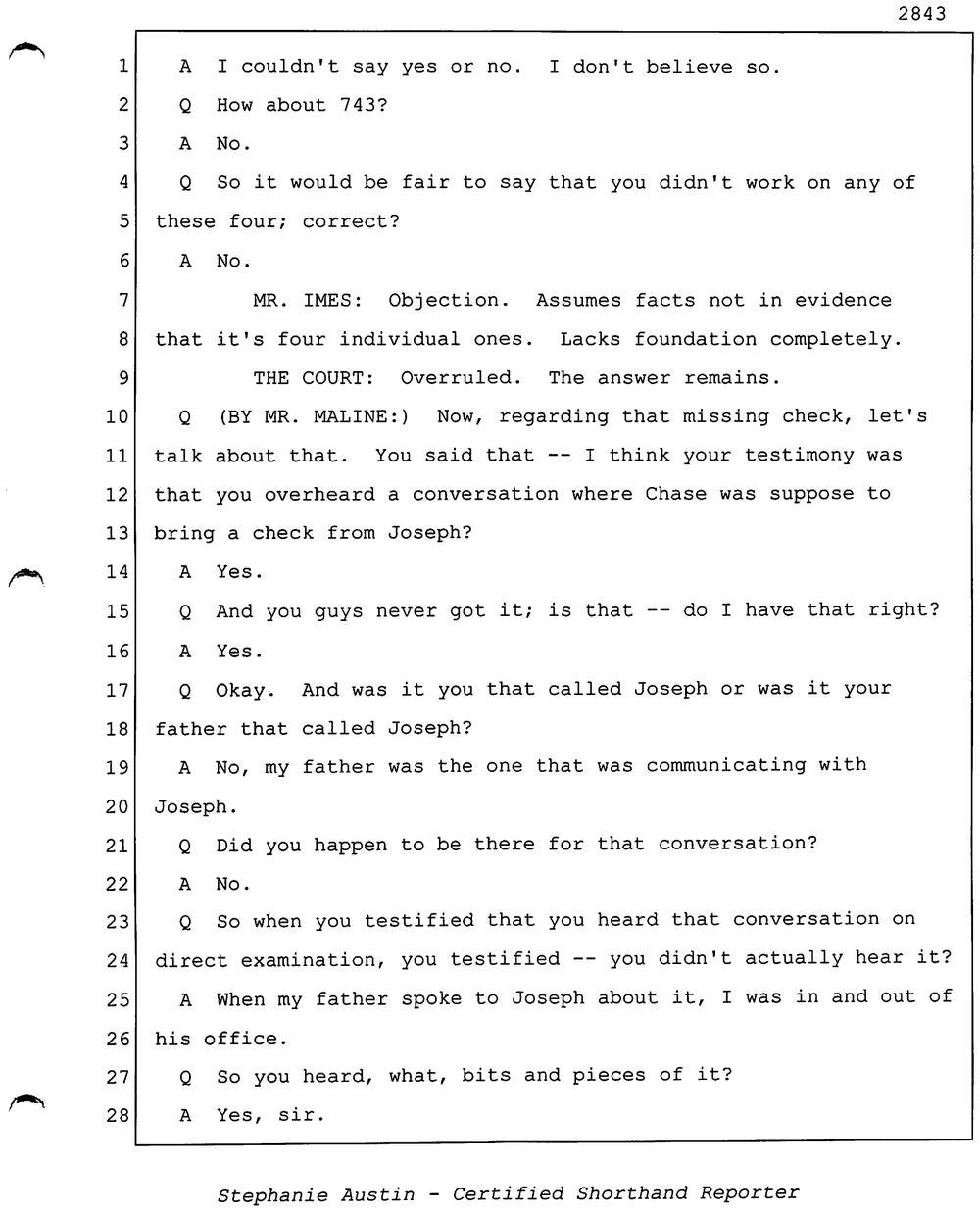
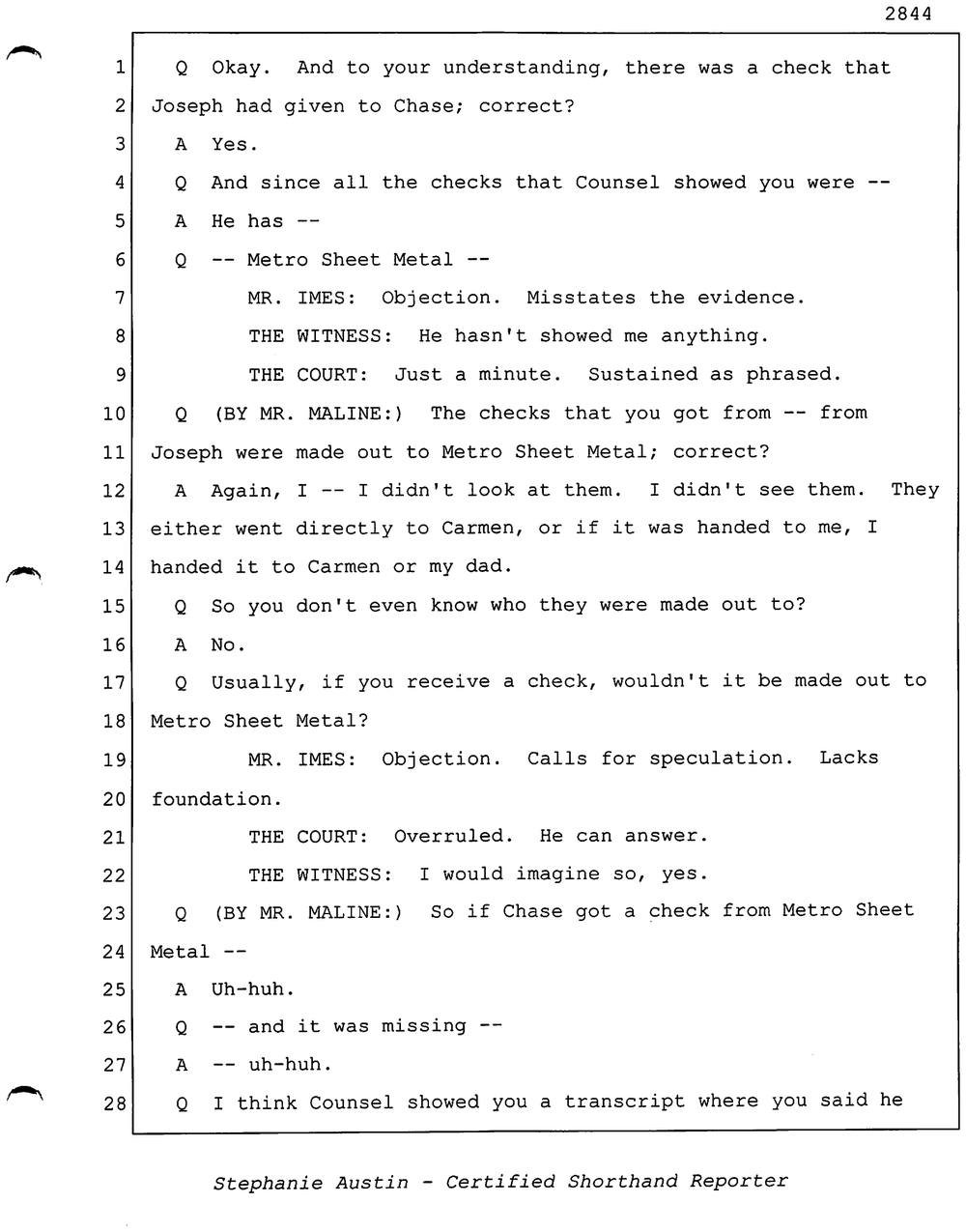
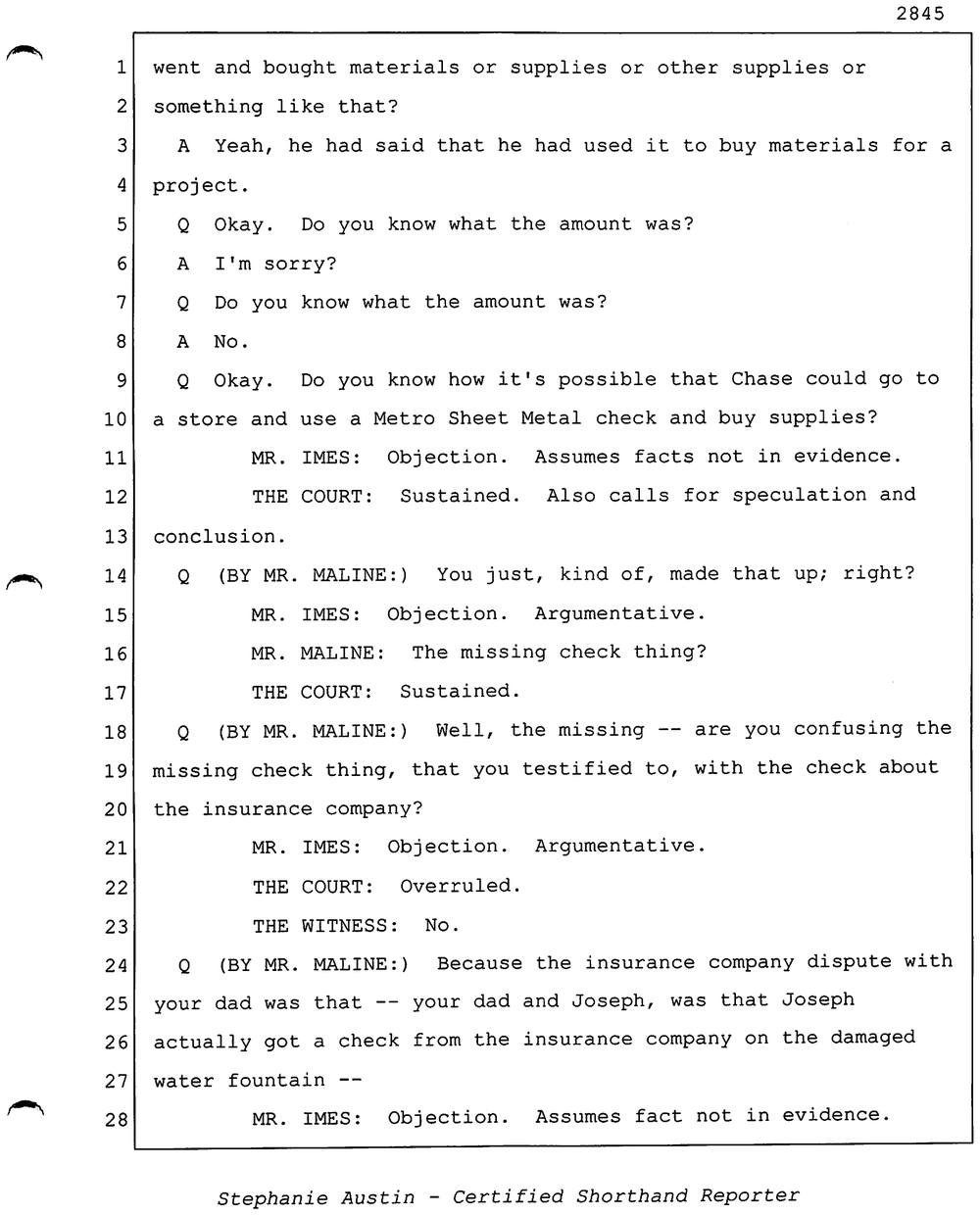
The rest of that cross-examination, in which he said he never looked at the checks and didn’t know the amount: (RT 2843:10-2845:23)
Read the exchange
Q (BY MR. MALINE:) Now, regarding that missing check, let’s talk about that. You said that — I think your testimony was that you overheard a conversation where Chase was suppose to bring a check from Joseph?
A Yes.
Q And you guys never got it; is that — do I have that right?
A Yes.
Q Okay. And was it you that called Joseph or was it your father that called Joseph?
A No, my father was the one that was communicating with Joseph.
Q Did you happen to be there for that conversation?
A No.
Q So when you testified that you heard that conversation on direct examination, you testified — you didn’t actually hear it?
A When my father spoke to Joseph about it, I was in and out of his office.
Q So you heard, what, bits and pieces of it?
A Yes, sir.
Q Okay. And to your understanding, there was a check that Joseph had given to Chase; correct?
A Yes.
Q And since all the checks that Counsel showed you were —
A He has —
Q — Metro Sheet Metal —
MR. IMES: Objection. Misstates the evidence.
THE WITNESS: He hasn’t showed me anything.
THE COURT: Just a minute. Sustained as phrased.
Q (BY MR. MALINE:) The checks that you got from — from Joseph were made out to Metro Sheet Metal; correct?
A Again, I — I didn’t look at them. I didn’t see them. They either went directly to Carmen, or if it was handed to me, I handed it to Carmen or my dad.
Q So you don’t even know who they were made out to?
A No.
Q Usually, if you receive a check, wouldn’t it be made out to Metro Sheet Metal?
MR. IMES: Objection. Calls for speculation. Lacks foundation.
THE COURT: Overruled. He can answer.
THE WITNESS: I would imagine so, yes.
Q (BY MR. MALINE:) So if Chase got a check from Metro Sheet Metal —
A Uh-huh.
Q — and it was missing —
A — uh-huh.
Q I think Counsel showed you a transcript where you said he went and bought materials or supplies or other supplies or something like that?
A Yeah, he had said that he had used it to buy materials for a project.
Q Okay. Do you know what the amount was?
A I’m sorry?
Q Do you know what the amount was?
A No.
Q Okay. Do you know how it’s possible that Chase could go to a store and use a Metro Sheet Metal check and buy supplies?
MR. IMES: Objection. Assumes facts not in evidence.
THE COURT: Sustained. Also calls for speculation and conclusion.
Q (BY MR. MALINE:) You just, kind of, made that up; right?
MR. IMES: Objection. Argumentative.
MR. MALINE: The missing check thing?
THE COURT: Sustained.
Q (BY MR. MALINE:) Well, the missing — are you confusing the missing check thing, that you testified to, with the check about the insurance company?
MR. IMES: Objection. Argumentative.
THE COURT: Overruled.
THE WITNESS: No.
See the transcript (RT 2843-2845)
3. He couldn’t say when, or which job
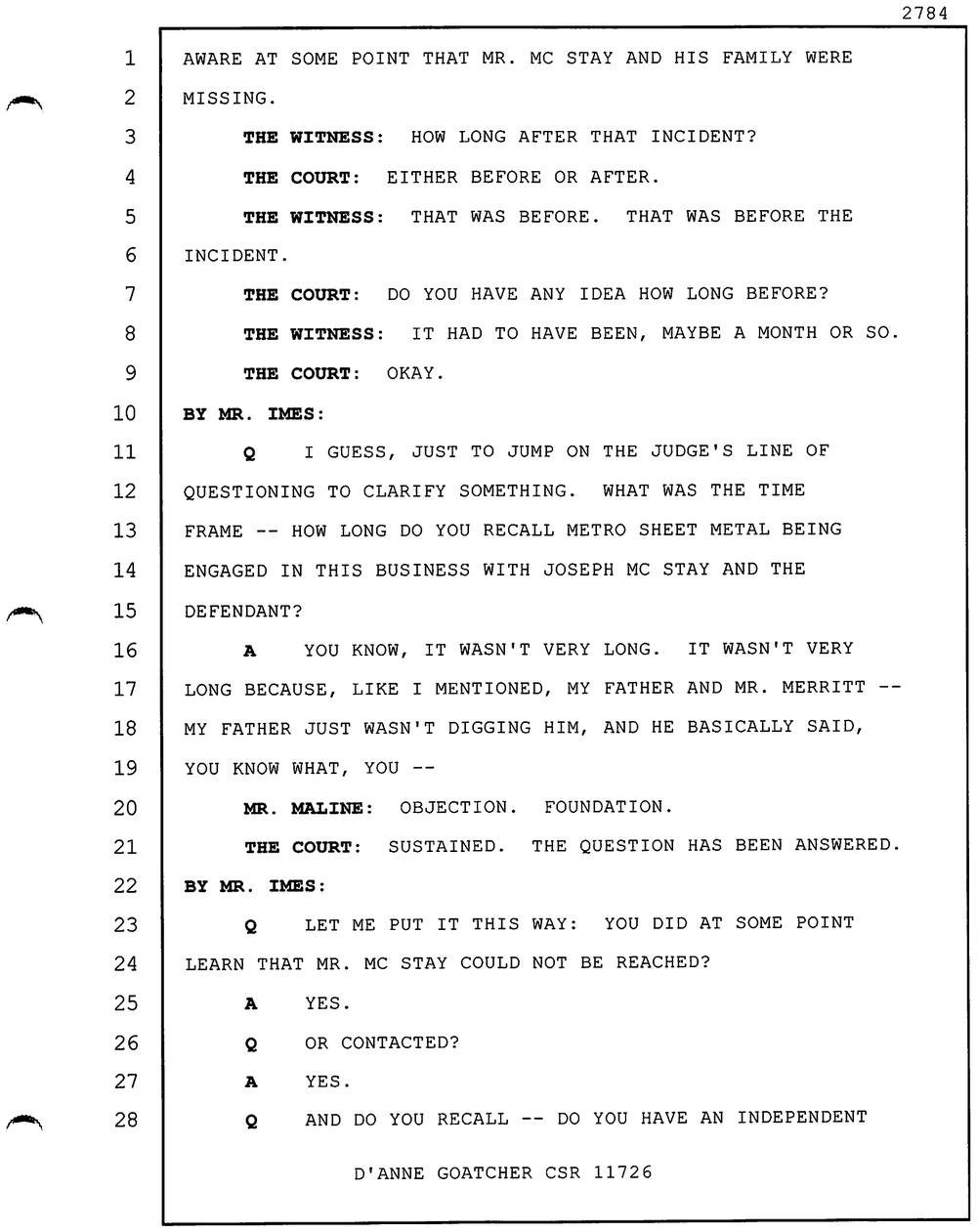
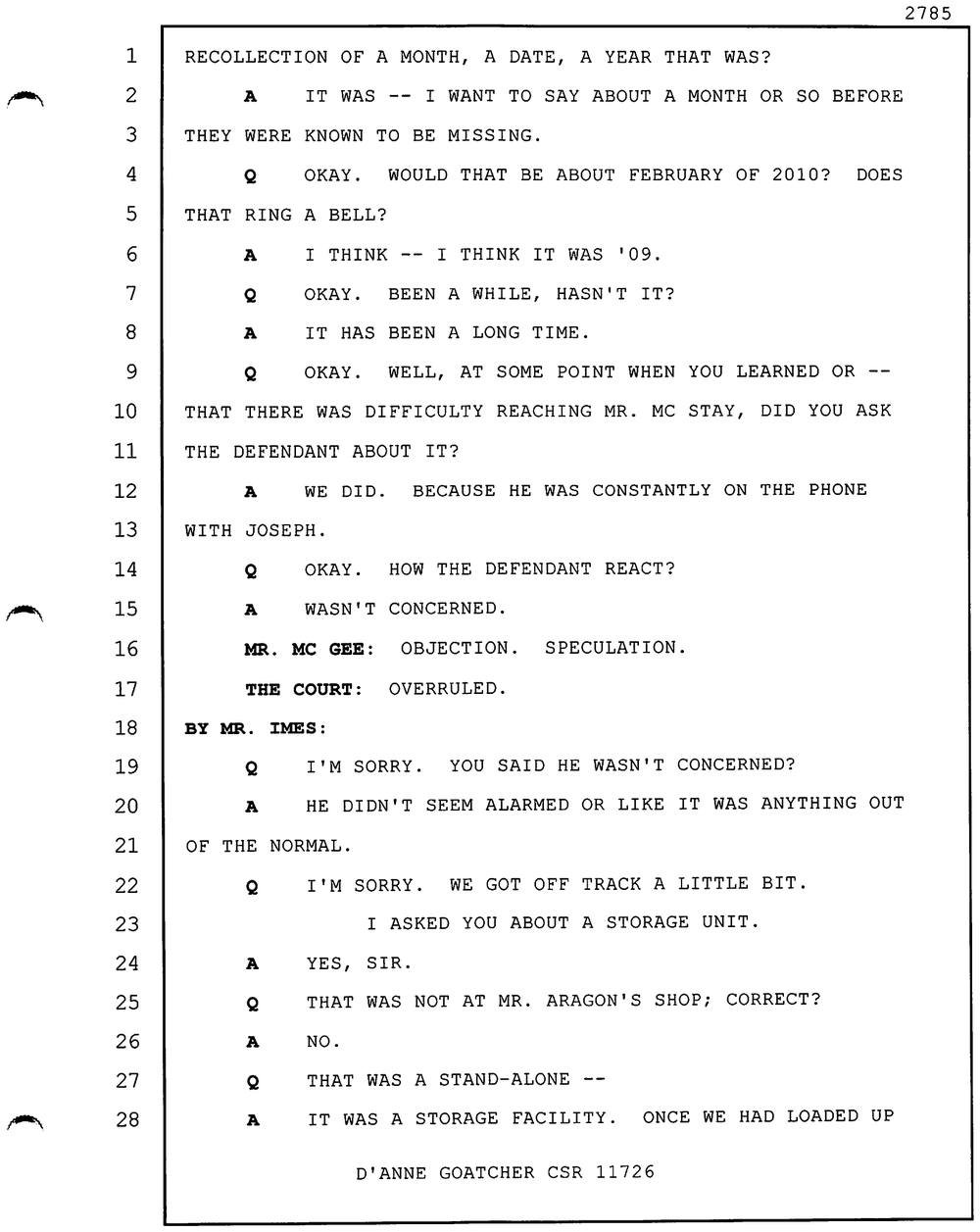
The judge asked him when the confrontation over the check happened: (RT 2783:19-2784:9; 2784:28-2785:8)
THE COURT: Let me interrupt you for a minute. This conversation about confronting him about the check —
THE WITNESS: Yes, sir.
THE COURT: Do you have an approximate time frame frame when that occurred.
THE WITNESS: As far as a date?
THE COURT: Yeah. I mean, 2009, 2008, 2010?
THE WITNESS: No. I couldn’t tell you.
THE COURT: How long after that was it — you became aware at some point that Mr. McStay and his family were missing.
THE WITNESS: How long after that incident?
THE COURT: Either before or after.
THE WITNESS: That was before. That was before the incident.
THE COURT: Do you have any idea how long before?
THE WITNESS: It had to have been, maybe a month or so,
THE COURT: Okay.
Q And do you recall — do you have an independent recollection of a month, a date, a year that was?
A It was — I want to say about a month or so before they were known to be missing.
Q Okay. Would that be about February of 2010? Does that ring a bell?
A I think — I think it was ’09.
Q Okay. Been a while, hasn’t it?
A It has been a long time.
See the transcript (RT 2783-2785)
And before he left the stand, which job: (RT 2850:11-18)
EXAMINATION
BY THE COURT:
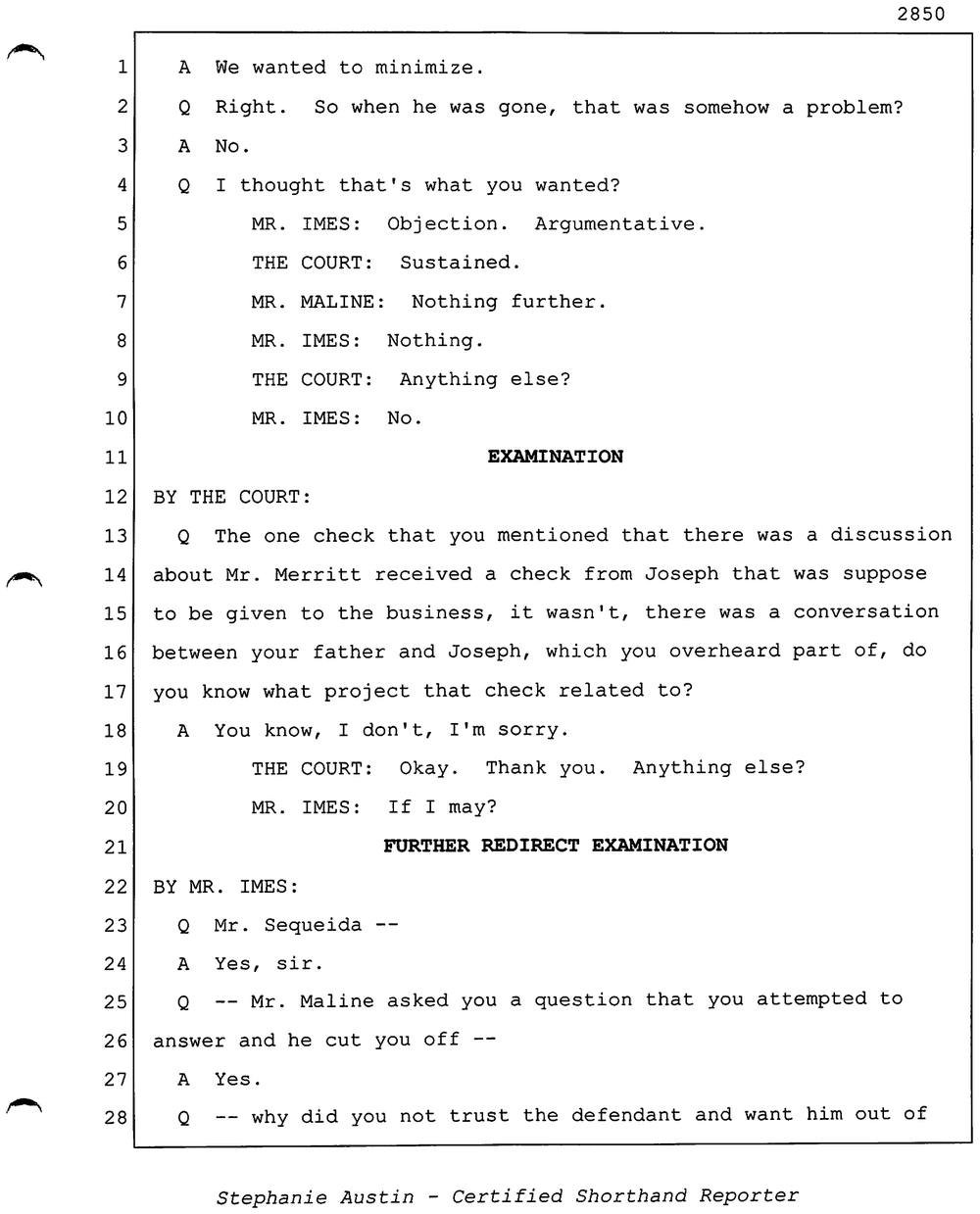
Q The one check that you mentioned that there was a discussion about Mr. Merritt received a check from Joseph that was suppose to be given to the business, it wasn’t, there was a conversation between your father and Joseph, which you overheard part of, do you know what project that check related to?
A You know, I don’t, I’m sorry.
See the transcript (RT 2850)
4. What else he said
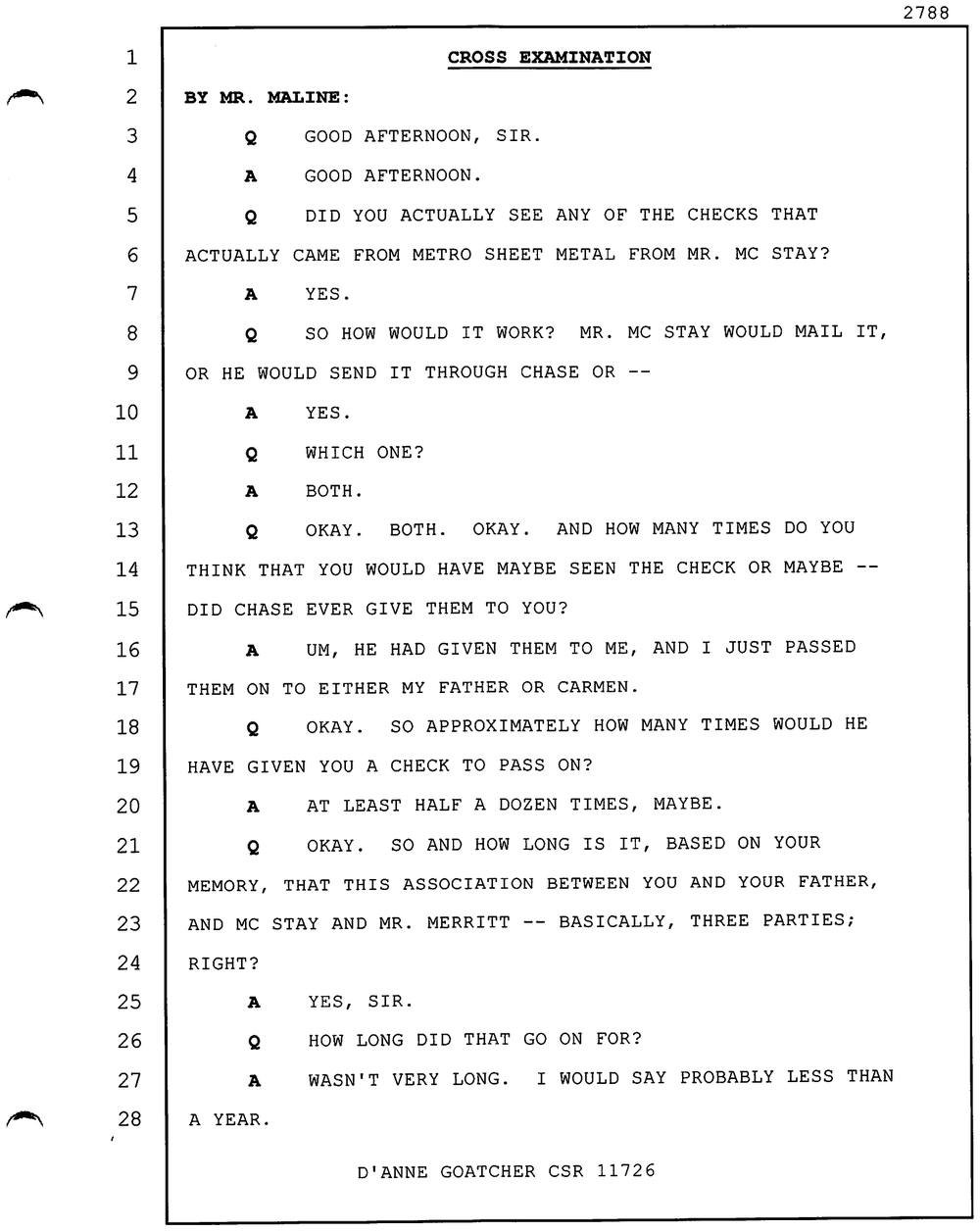
He said payments failed to arrive “at least twice” (card 1), and described only one of those times, the missing check. He also said I had handed him checks for Metro many times: (RT 2788:5-20)
Q Did you actually see any of the checks that actually came from Metro Sheet Metal from Mr. McStay?
A Yes.
Q So how would it work? Mr. McStay would mail it, or he would send it through Chase or —
A Yes.
Q Which one?
A Both.
Q Okay. Both. Okay. And how many times do you think that you would have maybe seen the check or maybe — did Chase ever give them to you?
A Um, he had given them to me, and I just passed them on to either my father or Carmen.
Q Okay. So approximately how many times would he have given you a check to pass on?
A At least half a dozen times, maybe.
See the transcript (RT 2788)
And Det. Bachman’s 2014 summary of Sequeida Jr.’s interview begins: “Joe never recalled anything being wrong with any checks from McStay or Merritt.” (Bates 007398, card 1)
3 of 8
Every check Joseph wrote to Metro
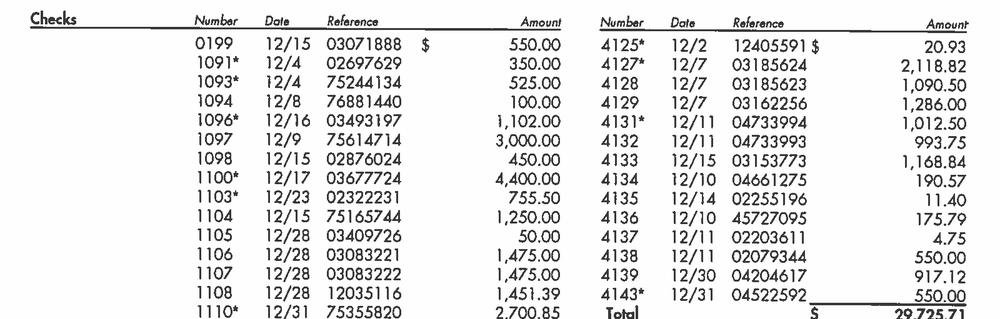
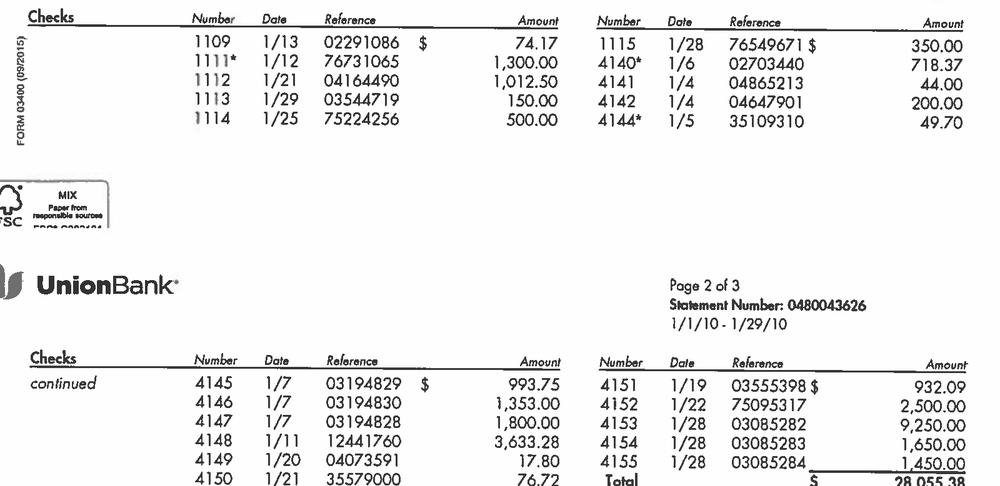
Det. Smith pulled every check to Metro out of Joseph’s bank statements. There are 26. Every one cleared into Metro’s account.
1. The State’s own list
Det. Smith searched Joseph’s Union Bank statements from the day the account opened until it was frozen, and listed every check to Metro. He wrote that Joseph put the job name on each one: (Bates 007402)
Each time Joseph writes a check to Metro Sheet Metal, Joseph includes the job name.
See Det. Smith’s report (Bates 007402)

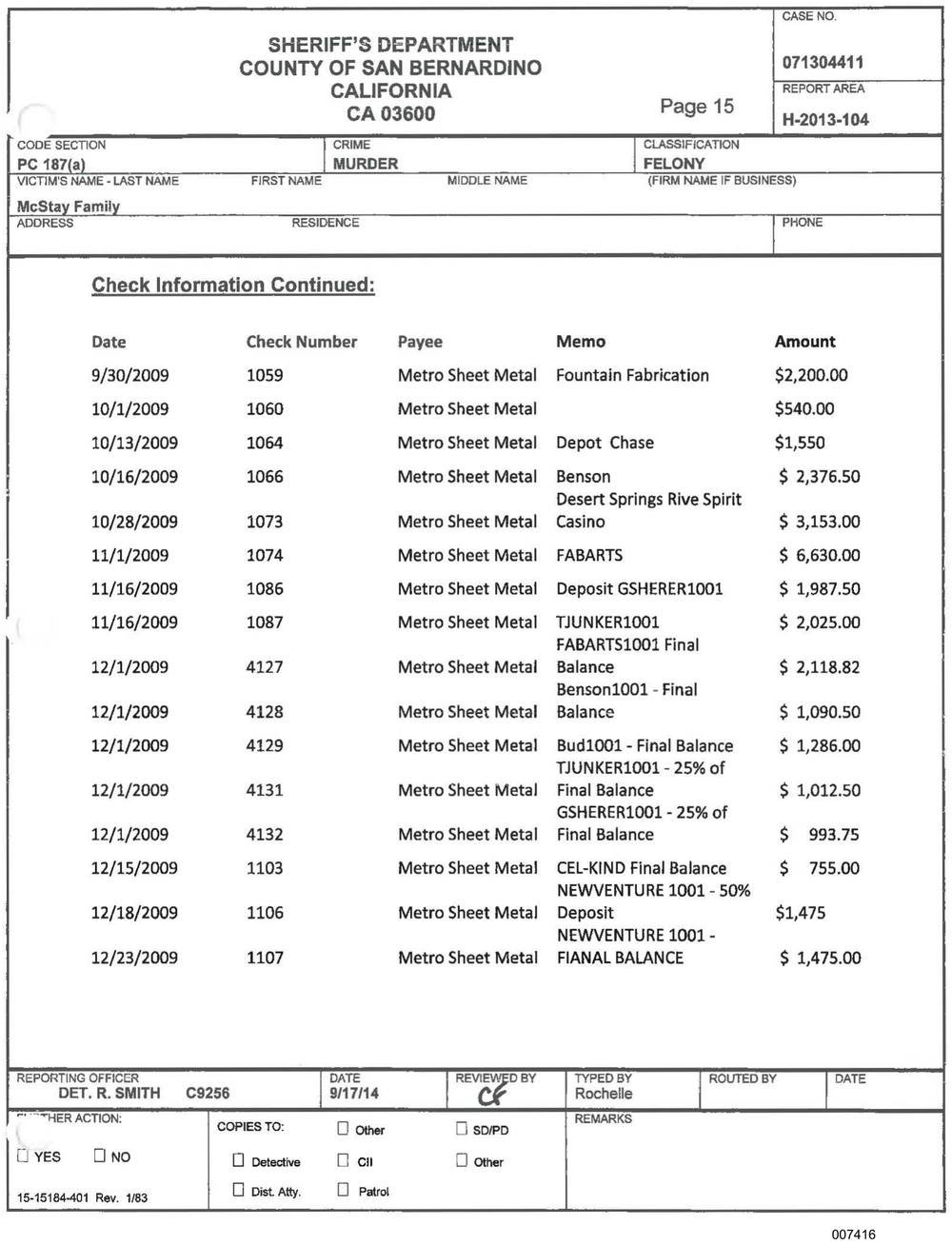
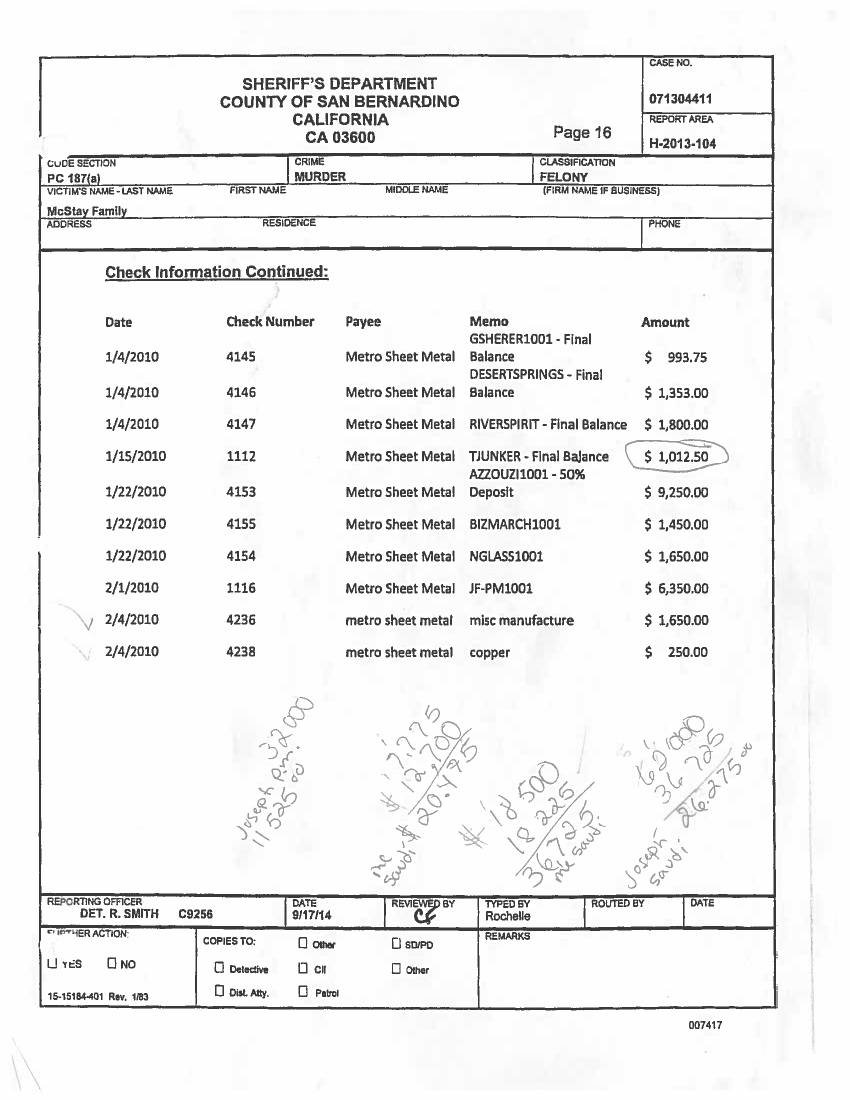
Det. Smith’s list of Metro’s checks: (Bates 007416-007417)
See the State’s list of Metro checks (Bates 007416-007417)
And Det. Smith’s own total: (Bates 007409)
From 09/09 through 02/04/2010, Metro Sheet Metal received twenty six checks totaling $56,427.82. All of these checks, with the exception of two checks dated 02/04/10, are written in Joseph’s typical check writing fashion.
See Det. Smith’s report (Bates 007409)
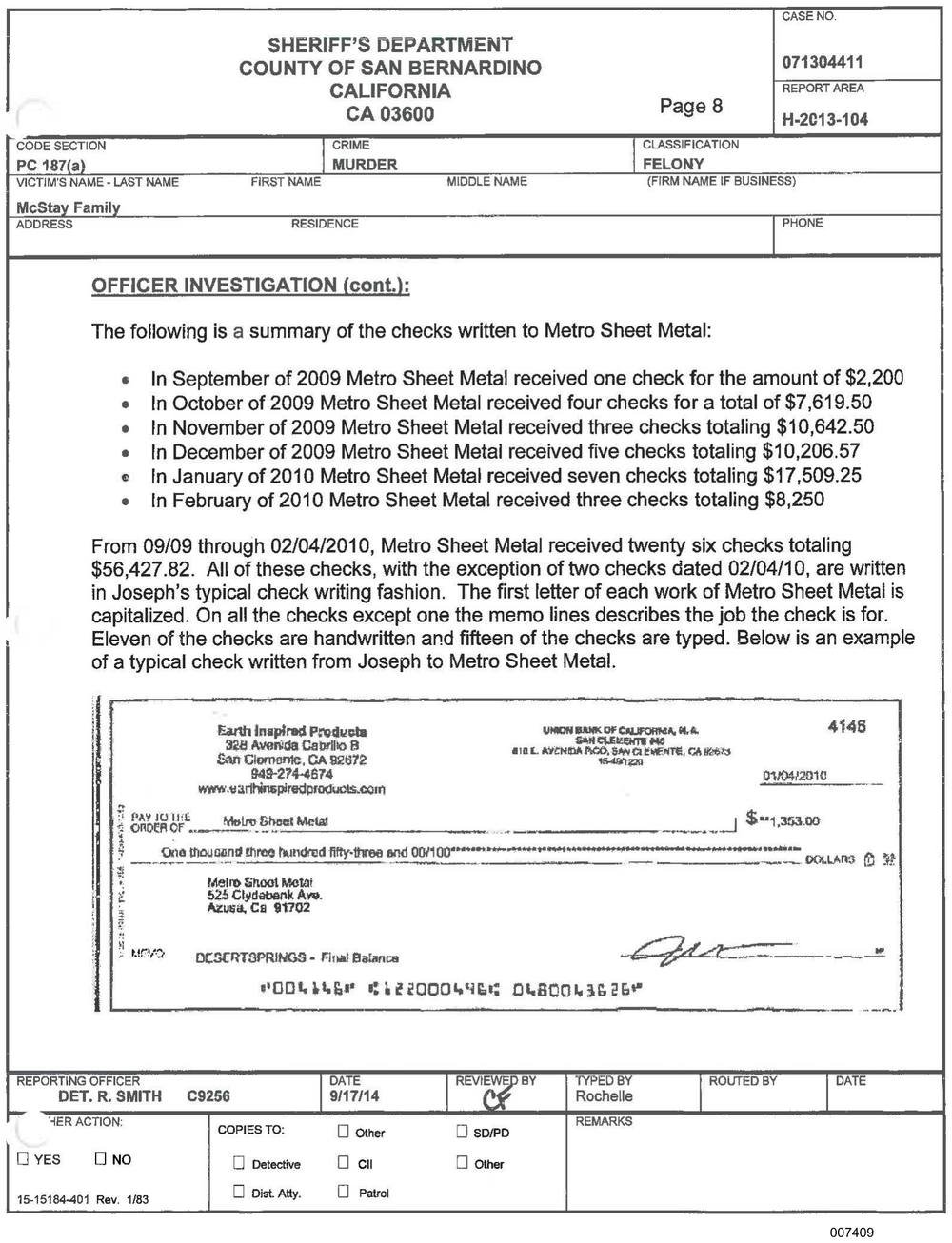
By Joseph’s bank, the 26 checks come to $56,433.82, six dollars more. The bank paid #1064 at $1,555.50, not the $1,550 on the State’s list, and #1103 at $755.50, not $755.
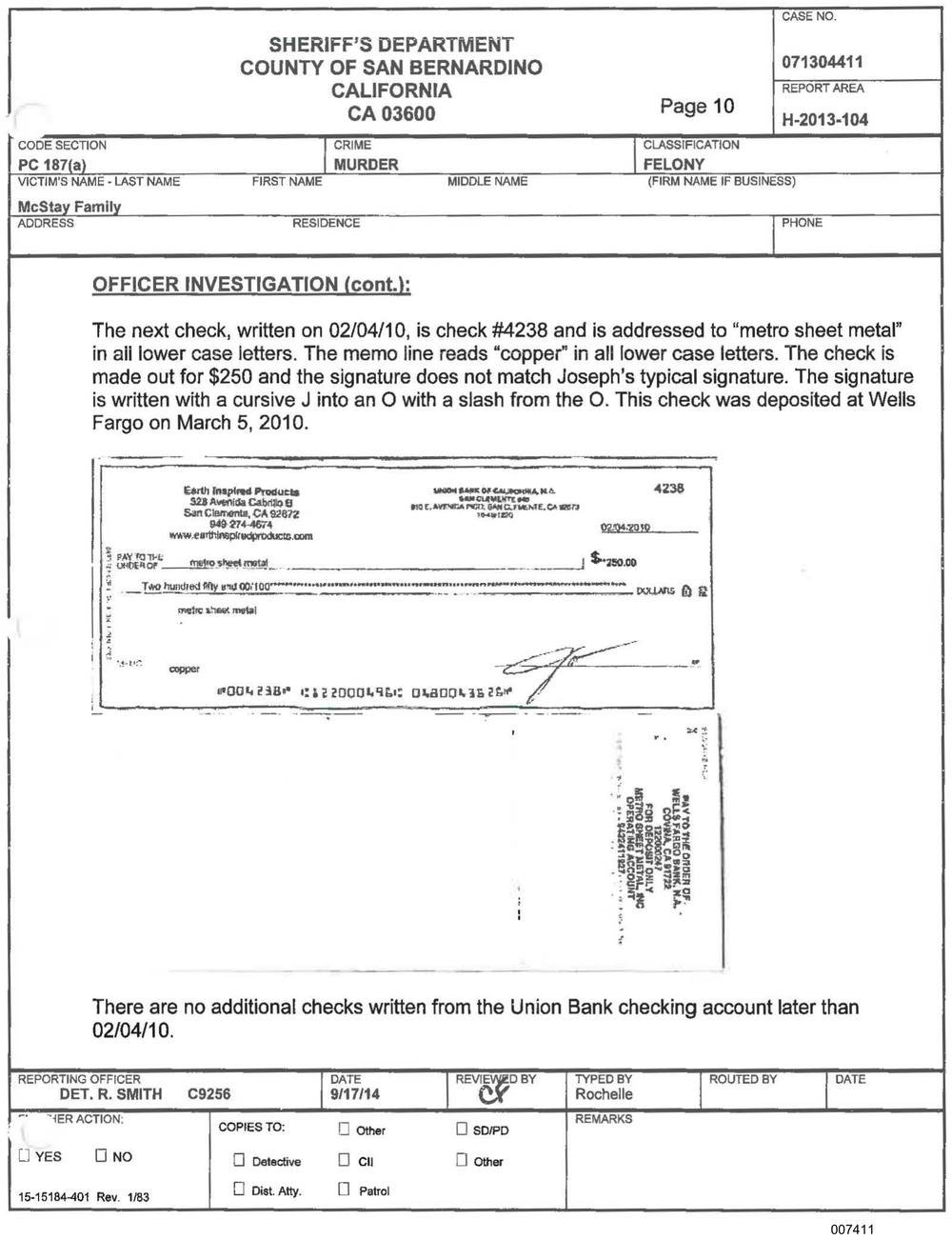
The two dated February 4 are the two I wrote to Metro, $1,650 and $250. Metro cashed both. And there was nothing after them: (Bates 007411)
There are no additional checks written from the Union Bank checking account later than 02/04/10.
See Det. Smith’s report (Bates 007411)
2. Job by job
The job names are Joseph’s, from the memo line of each check; most are a customer’s name with a number. The second column has the date Joseph wrote on the check. The third is the date his bank paid it into Metro’s account, from his statements.
| Job | Check, date written, amount | Cleared into Metro’s account |
|---|---|---|
| No job named: “Fountain Fabrication” | #1059, 9/30/09, $2,200.00 | 10/2/09 |
| No memo | #1060, 10/1/09, $540.00 | 10/5/09 |
| “Depot Chase” | #1064, 10/13/09, $1,555.50 | 10/14/09 |
| Benson | #1066, 10/16/09, $2,376.50 #4128, 12/1/09, $1,090.50 (final balance) | 10/26/09 12/7/09 |
| Desert Springs and River Spirit Casino | #1073, 10/28/09, $3,153.00 #4146, 1/4/10, $1,353.00 (Desert Springs, final) #4147, 1/4/10, $1,800.00 (River Spirit, final) | 11/2/09 1/7/10 1/7/10 |
| FABARTS | #1074, 11/1/09, $6,630.00 #4127, 12/1/09, $2,118.82 (final balance) | 11/4/09 12/7/09 |
| GSHERER | #1086, 11/16/09, $1,987.50 (deposit) #4132, 12/1/09, $993.75 (25% of final) #4145, 1/4/10, $993.75 (final balance) | 11/25/09 12/11/09 1/7/10 |
| TJUNKER | #1087, 11/16/09, $2,025.00 #4131, 12/1/09, $1,012.50 (25% of final) #1112, 1/15/10, $1,012.50 (final balance) | 11/25/09 12/11/09 1/21/10 |
| Bud | #4129, 12/1/09, $1,286.00 (final balance) | 12/7/09 |
| CEL-KIND | #1103, 12/15/09, $755.50 (final balance) | 12/23/09 |
| NEWVENTURE | #1106, 12/18/09, $1,475.00 (50% deposit) #1107, 12/23/09, $1,475.00 (final balance) | 12/28/09 12/28/09 |
| Saudi Arabia (AZZOUZI) | #4153, 1/22/10, $9,250.00 (50% deposit) | 1/28/10 |
| NGLASS | #4154, 1/22/10, $1,650.00 | 1/28/10 |
| BIZMARCH | #4155, 1/22/10, $1,450.00 | 1/28/10 |
| Paul Mitchell (JF-PM) | #1116, 2/1/10, $6,350.00 | 2/4/10 |
| The two checks I wrote to Metro | #4236, 2/4/10, $1,650.00 (“misc manufacture”) #4238, 2/4/10, $250.00 (“copper”) | 3/5/10 3/5/10 |
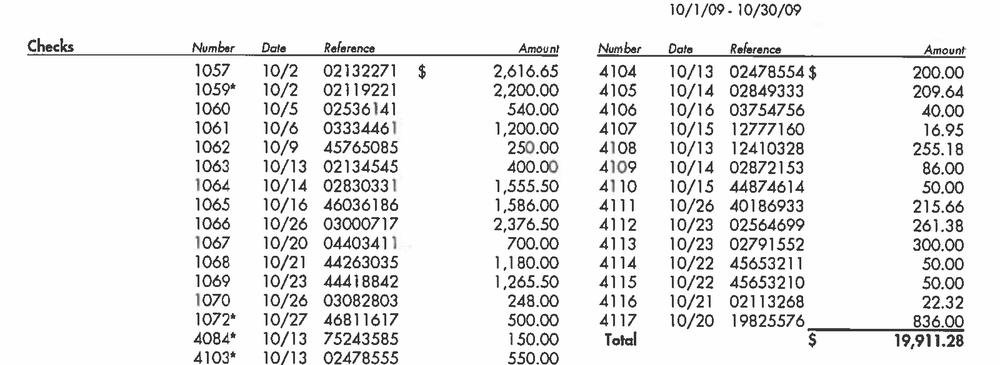
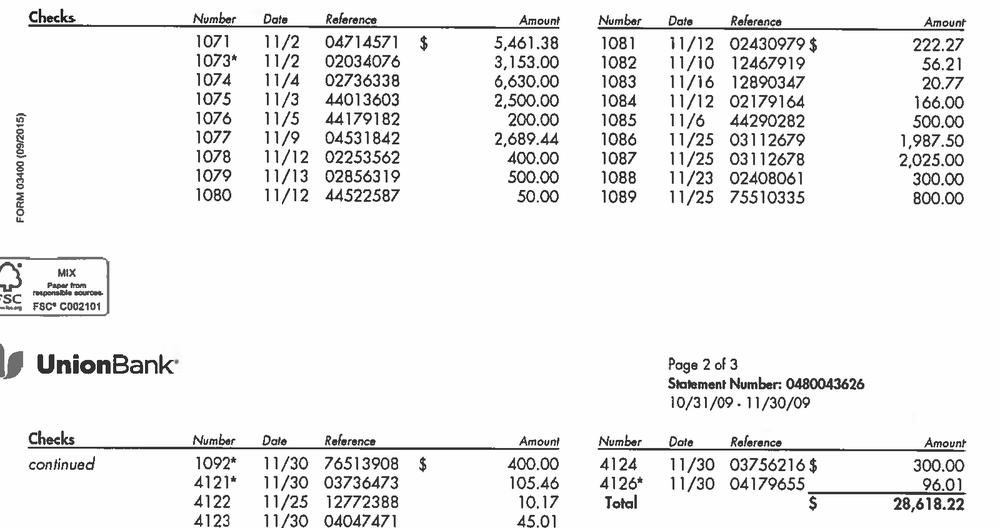
For 23 of the 26, the bank’s copy of the check, front and back, is in the records, and the back of every one carries Metro’s deposit stamp. The bank’s copies of #1059, #1060 and #1064 were not produced; all three are on Joseph’s October statement as paid.
See the 23 checks, front and back























See the checks paid on Joseph’s statements, October 2009 to March 2010


3. The deposit checks
Det. Bachman’s report says the missing check was a deposit check (card 1). Every deposit check Joseph wrote Metro is on the list, and every one went into Metro’s account: GSHERER (#1086), NEWVENTURE (#1106), and Saudi Arabia (#4153, January 22, 2010).
4. Metro’s own statement
Metro’s statement to Joseph’s company, dated March 1, 2010, starts January with a balance of $0.00. The only job still open on it is Paul Mitchell, which shows Joseph’s check #1116 received February 4, a $4,900 payment on February 22, which was mine, and $3,450 still due. I paid that off on March 8 (Part 4). The jury never saw this statement (card 6).
See Metro’s statement (March 1, 2010)

4 of 8
Joseph’s own books
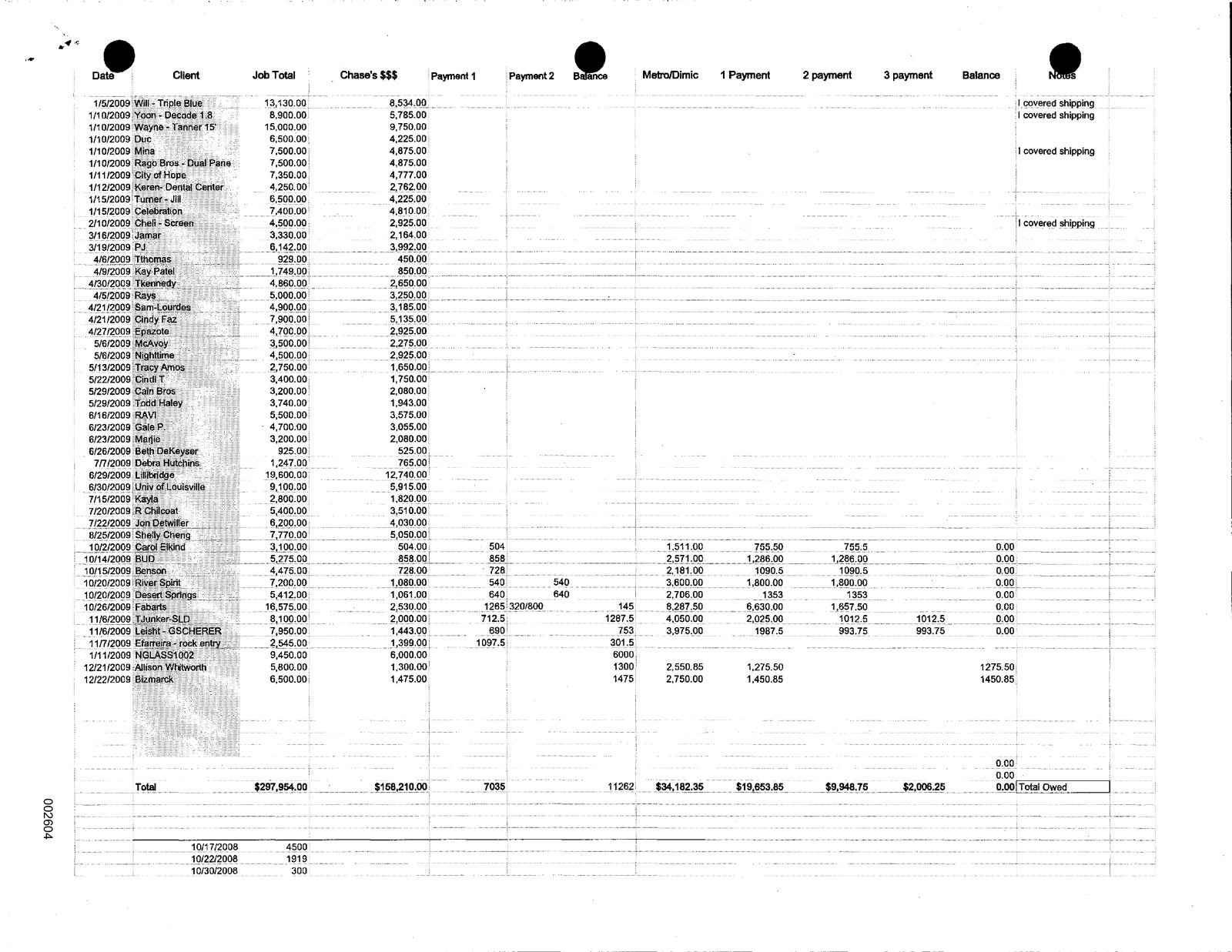
Joseph kept a spreadsheet of every job: what it owed me, what it owed Metro, and each payment he made. On every Metro job in it, the balance owed to Metro is $0.00, and his bank records show the checks that paid it.
1. The ledger
This is Joseph’s spreadsheet of his 2009 jobs (Bates 002604). For each job it lists the job total, my share (“Chase’s $$$”) and his payments to me, then what the job owed Metro (“Metro/Dimic”), his payments to Metro, and the balance. Metro’s jobs start in October 2009, near the bottom of the page.
See Joseph’s ledger (Bates 002604)
2. Every Metro job, paid to zero
Here is each Metro job on Joseph’s ledger, set against the checks in his bank records. Where one check paid two jobs, Joseph wrote both on its memo line: #1066 says “Pat Benson – Bud,” and #1073 says “Desert Springs – River Spirit Casino.” Dates are the dates written on the checks.
| Job | Owed to Metro (Joseph’s ledger) | Checks into Metro’s account | Paid |
|---|---|---|---|
| TJUNKER | $4,050.00 | #1087, 11/16/09, $2,025.00 #4131, 12/1/09, $1,012.50 #1112, 1/15/10, $1,012.50 | $4,050.00 |
| GSCHERER | $3,975.00 | #1086, 11/16/09, $1,987.50 #4132, 12/1/09, $993.75 #4145, 1/4/10, $993.75 | $3,975.00 |
| Benson | $2,181.00 | #1066, 10/16/09, $1,090.50 of $2,376.50 #4128, 12/1/09, $1,090.50 | $2,181.00 |
| Bud | $2,571.00 | #1066, 10/16/09, $1,286.00 of $2,376.50 #4129, 12/1/09, $1,286.00 | $2,572.00 |
| River Spirit | $3,600.00 | #1073, 10/28/09, $1,800.00 of $3,153.00 #4147, 1/4/10, $1,800.00 | $3,600.00 |
| Desert Springs | $2,706.00 | #1073, 10/28/09, $1,353.00 of $3,153.00 #4146, 1/4/10, $1,353.00 | $2,706.00 |
| Carol Elkind (CEL-KIND) | $1,511.00 | #1064, 10/13/09, $755.50 of $1,555.50 #1103, 12/15/09, $755.50 | $1,511.00 |
| FABARTS | $8,287.50 | #1074, 11/1/09, $6,630.00 #4127, 12/1/09, $2,118.82 | $8,748.82 |
On every job the ledger shows $0.00 still owed to Metro, and the bank shows the money went to Metro. On Bud, the two checks come to $1 more than the ledger’s figure. On FABARTS, Joseph’s bank paid Metro $461.32 more than the ledger shows. The checks themselves are in card 3.
3. When the money for Metro was mine, Joseph paid Metro
Joseph’s list of his payments to me, on the next pages of the same ledger, charges four Metro payments to my account: $2,200 “Metro” (9/30/09), $540 “Metro” (10/2/09), $795 “Chk to Metro -parts,wood,2 uvs, gas,etc” (10/13/09), and $1,650 “Check – NGLASS – Metro” (1/22/10). Each one went straight to Metro by check: #1059, #1060, #1064 and #4154. Even when the money was my share, Joseph paid Metro himself and wrote it down. (Bates 002606-002607)
See Joseph’s ledger (Bates 002606-002607)
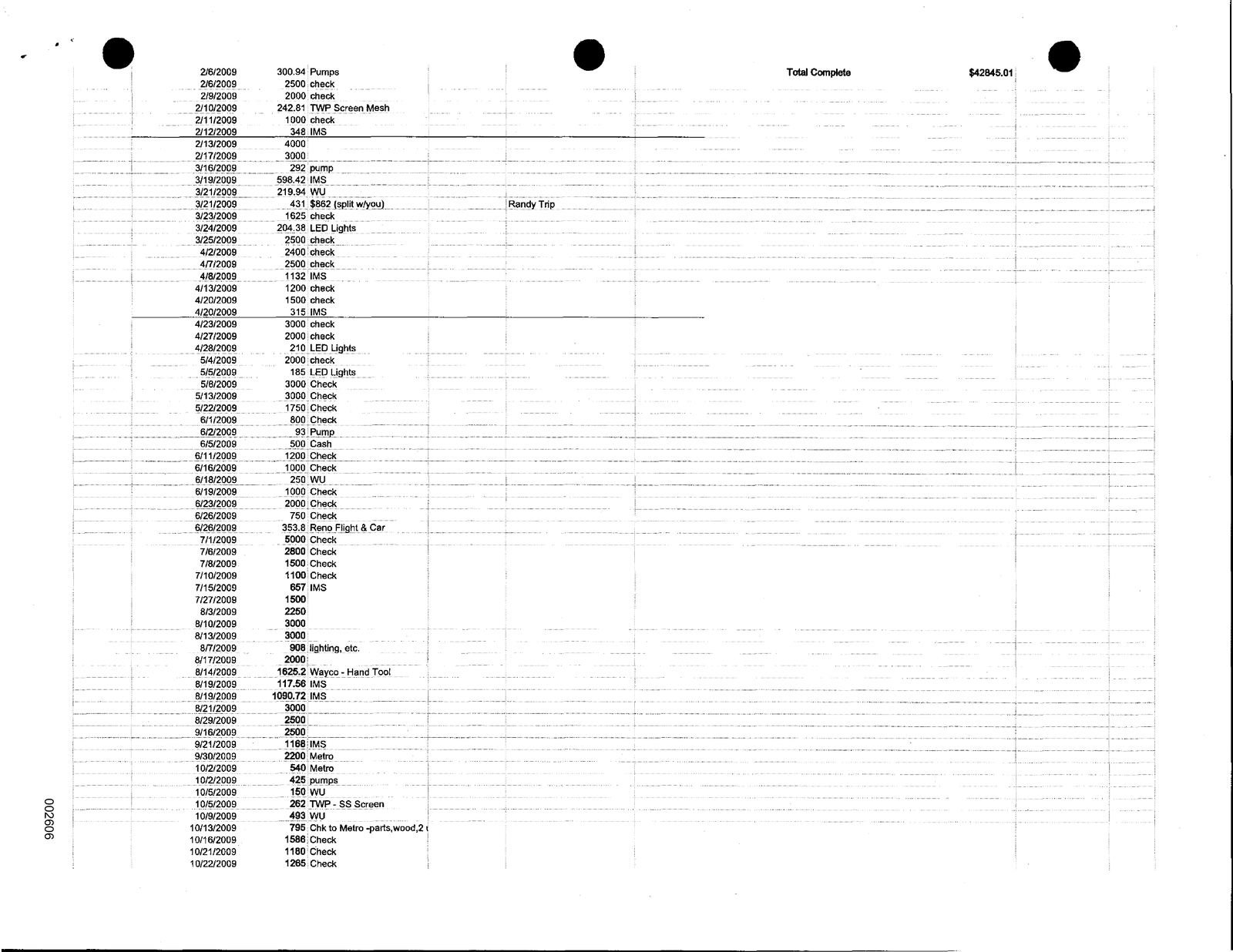
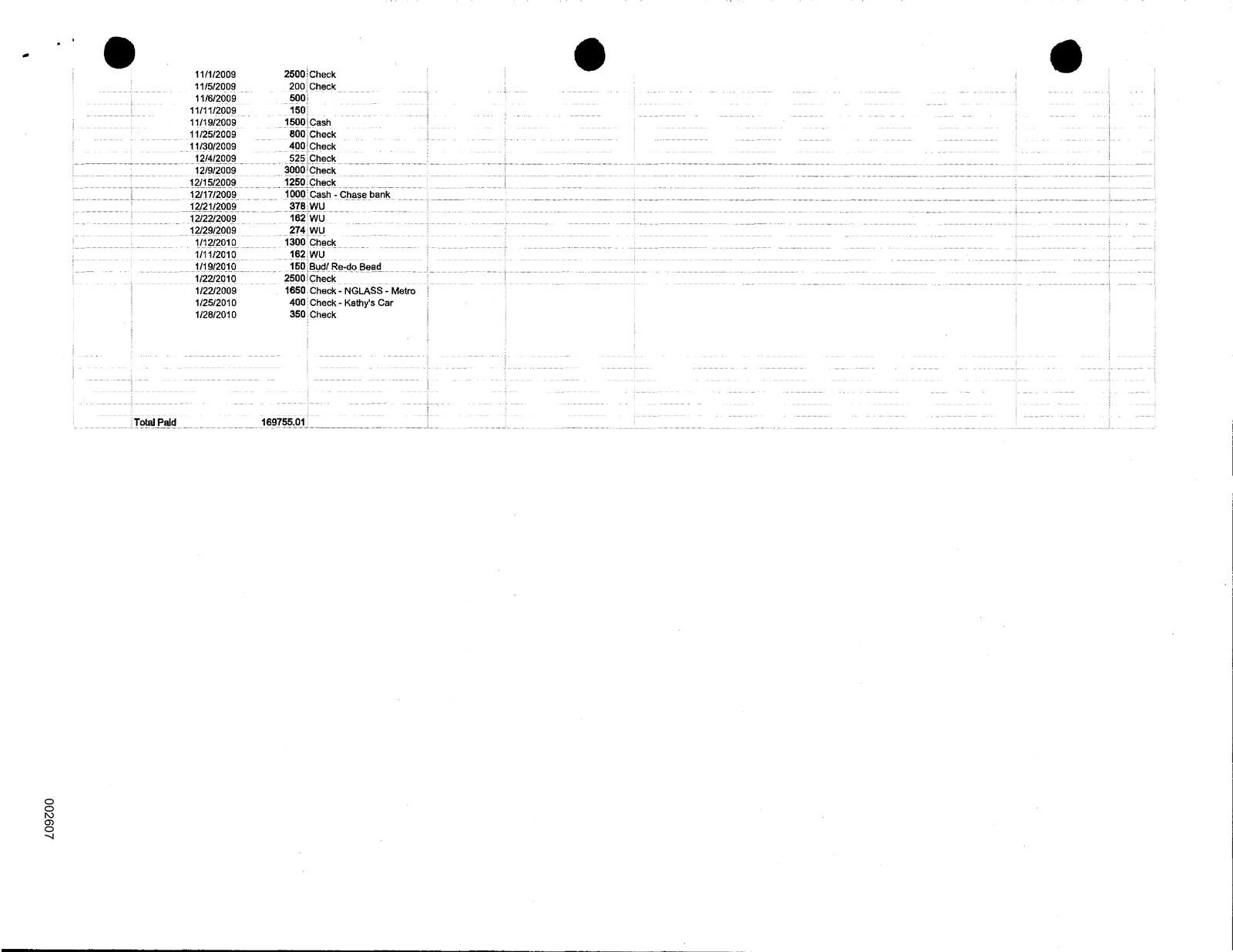
The same list of payments to me books the checks Joseph gave me as my pay. Not one is marked for Metro.
4. The last jobs
The list of jobs stops in late December 2009, with two new jobs still open: Allison Whitworth and Bizmarck. After that, Joseph’s bank paid Metro for NEWVENTURE (#1106 and #1107, December 18 and 23), Bizmarck (#4155, January 22), NGLASS (#4154, January 22) and the Saudi Arabia deposit (#4153, January 22), all into Metro’s account. Paul Mitchell and Saudi Arabia, the last two jobs, I paid off after Joseph was gone (Part 4).
Joseph’s own books, his bank records and Metro’s statement all say the same thing: Metro was paid on every job, by Joseph’s checks into Metro’s account, within weeks of the work. And none of the checks Joseph gave me was meant for Metro.
5 of 8
Every check I cashed, and what it was for
Every check I cashed or deposited from Joseph’s account in those months was made out to me, and every one had a purpose. Not one was for Metro. Every time Joseph paid Metro, he made the check out to Metro.
From October 2009 until Joseph was gone, from the State’s list, Joseph’s statements and Joseph’s own ledger (card 4). In the last column, Ledger means Joseph’s own entry (Bates 002604-002607); Memo is what is written on the check; Inferred is my reading of the ledger; My account is what I remember. (Bates 007414-007415)
| Check | Amount | What it was for |
|---|---|---|
| #1065 written 10/16/09 cleared 10/16/09 | $1,586.00 | Ledger: my share of BUD ($858) and Benson ($728) |
| #1068 written 10/21/09 cleared 10/21/09 | $1,180.00 | Ledger: my share of River Spirit ($540) and Desert Springs ($640) |
| #1069 written 10/22/09 cleared 10/23/09 | $1,265.50 | Ledger: my first payment on FABARTS ($1,265) |
| #1072 written 10/27/09 cleared 10/27/09 | $500.00 | Made out to me. Not on Joseph’s list of payments to me. |
| #1075 written 11/1/09 cleared 11/3/09 | $2,500.00 | Ledger: my share of TJunker ($712.50), GSCHERER ($690) and Efarreira ($1,097.50) |
| #1076 written 11/4/09 cleared 11/5/09 | $200.00 | Ledger: booked as paid to me |
| #1085 written 11/6/09 cleared 11/6/09 | $500.00 | Ledger: booked as paid to me |
| #1089 written 11/25/09 cleared 11/25/09 | $800.00 | Ledger: booked as paid to me. Inferred: likely the “800” on the FABARTS line |
| #1092 written 11/30/09 cleared 11/30/09 | $400.00 | Ledger: booked as paid to me |
| #1093 written 12/4/09 cleared 12/4/09 | $525.00 | Ledger: booked as paid to me |
| #1094 written 12/7/09 cleared 12/8/09 | $100.00 | Memo: “I Design” (my business). Not on Joseph’s list. |
| #1097 written 12/9/09 cleared 12/9/09 | $3,000.00 | Ledger: booked as paid to me |
| #1104 written 12/15/09 cleared 12/15/09 | $1,250.00 | Ledger: booked as paid to me |
| #1110 written 12/30/09 cleared 12/31/09 | $2,785.00 | Not on Joseph’s list. The bank paid it as $2,700.85, the amount written in words. My account: likely my shares of Whitworth ($1,300) and Bizmarck ($1,475), which come to $2,775. I am not certain. |
| #1111 written 1/12/10 cleared 1/12/10 | $1,300.00 | Ledger: booked as paid to me |
| #4152 written 1/22/10 cleared 1/22/10 | $2,500.00 | Ledger: booked as paid to me |
| #1114 written 1/25/10 cleared 1/25/10 | $500.00 | Ledger: “Check – Kathy’s Car,” $400; the check itself is $500. My account: for Cathy Jarvis’s car |
| #1115 written 1/28/10 cleared 1/28/10 | $350.00 | Ledger: booked as paid to me |
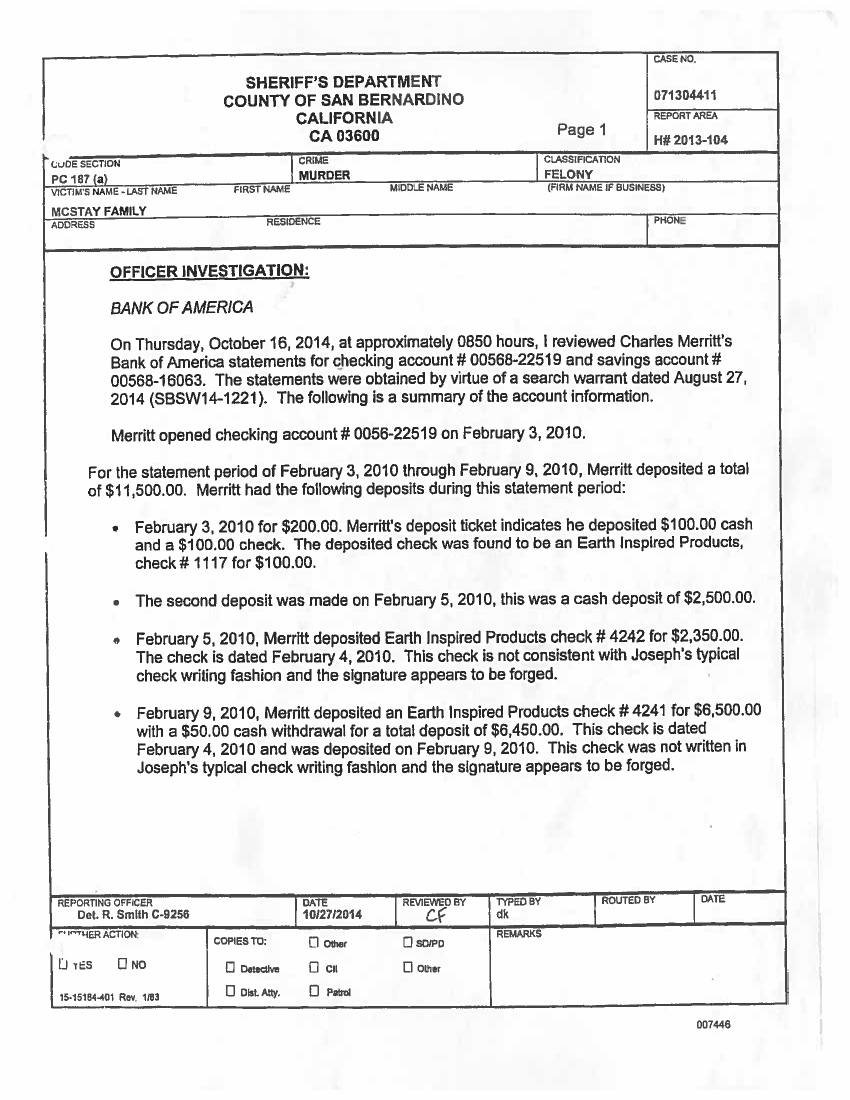
| #1117 written 2/2/10 cleared 2/3/10 | $100.00 | Bank report: deposited into the account I opened that day (Bates 007446) |
| #4240 written 2/2/10 cleared 2/2/10 | $2,495.00 | Memo: “deposit sa 1001.” I wrote it (Part 2) |
| #4237 written 2/4/10 cleared 2/5/10 | $4,500.00 | Memo: “paul mitchell.” I wrote it (Part 2) |
| #4241 written 2/4/10 cleared 2/9/10 | $6,500.00 | Memo: “saudi arabia final.” I wrote it (Part 2) |
| #4242 written 2/4/10 cleared 2/5/10 | $2,350.00 | Memo: “lighting install sa(1001).” I wrote it (Part 2) |
See the State’s list of checks to me (Bates 007414-007415)
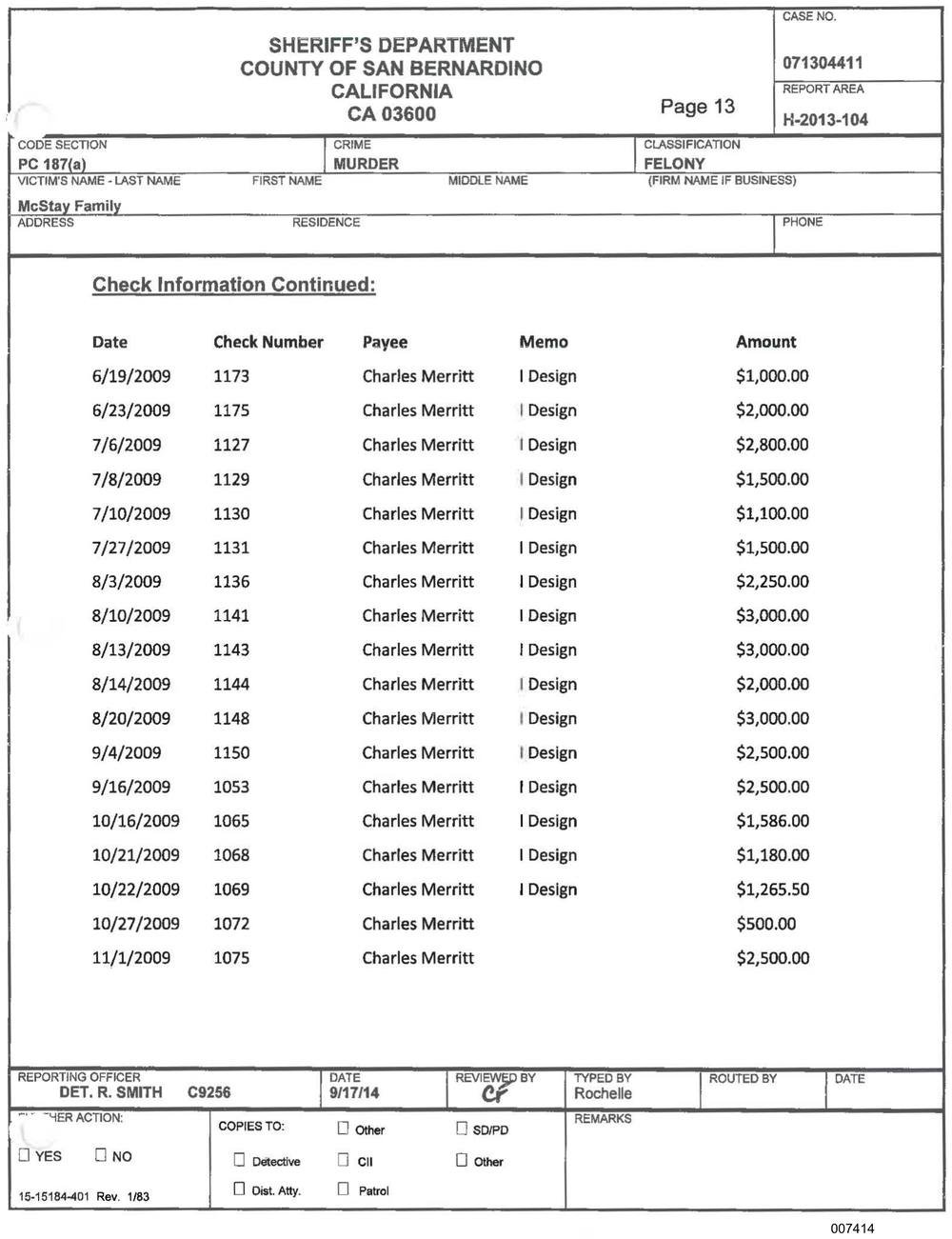
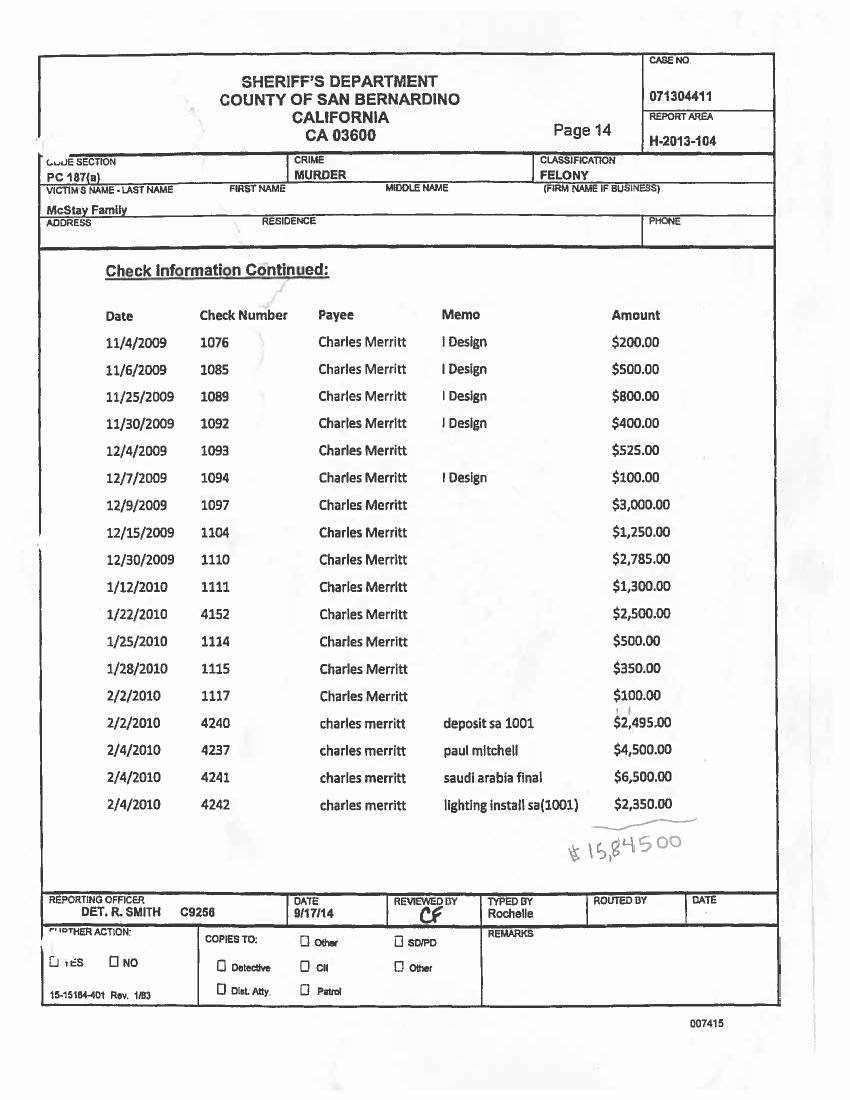
See every check, front and back (22 checks)






















See Joseph’s ledger (Bates 002604-002607)
The $100 check #1117 went into the account I opened on February 3, 2010: “The deposited check was found to be an Earth Inspired Products, check# 1117 for $100.00.” (Bates 007446)
See the bank report (Bates 007446)
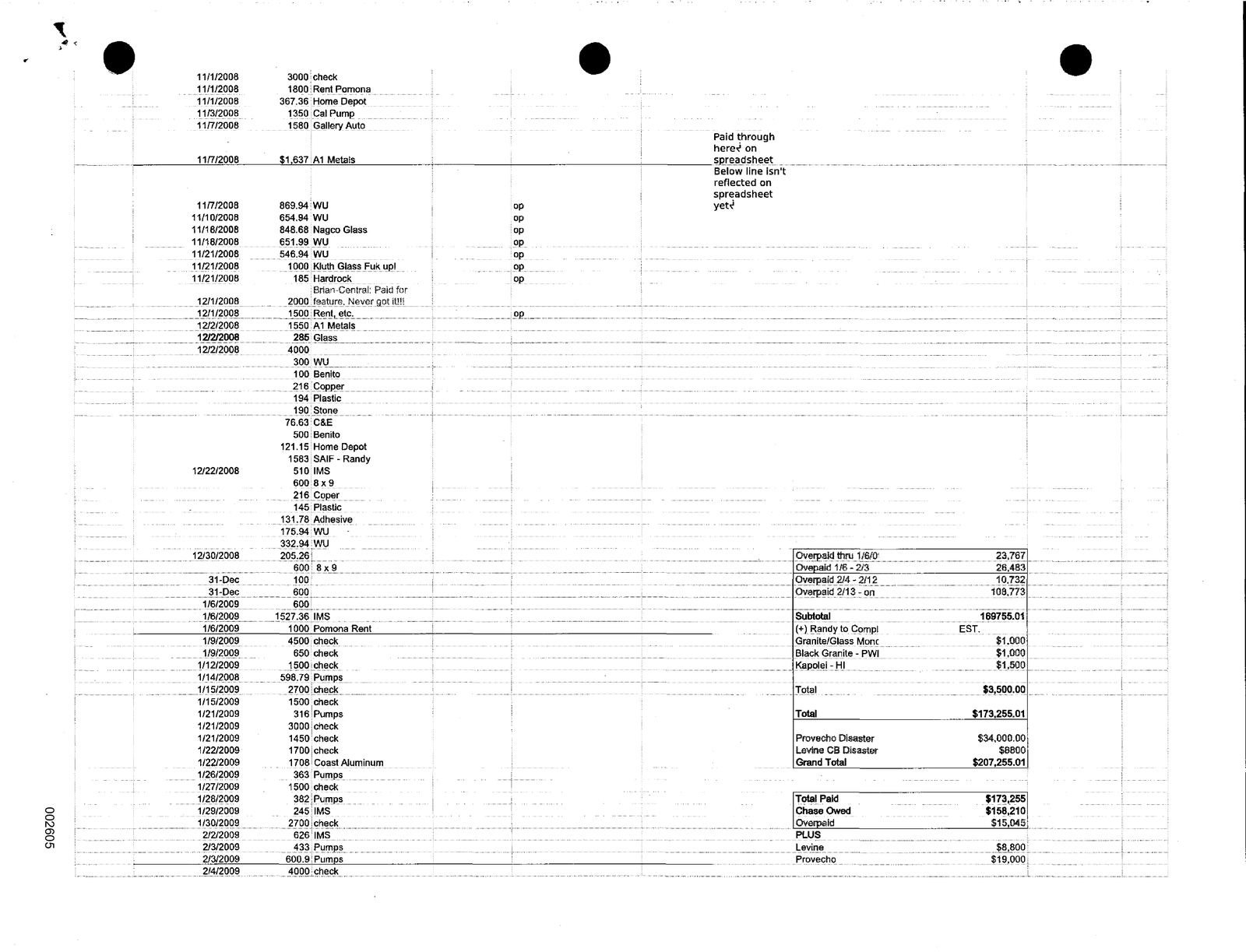
Joseph’s own bottom line counts the checks in the table above as my pay. On the same ledger he totaled it: “Total Paid $173,255,” “Chase Owed $158,210,” “Overpaid $15,045.” (Bates 002605) What that $15,045 was, and why it was not a debt, is in Part 4 and Provecho.
See Joseph’s totals (Bates 002605)
So where could a Metro check have gone?
For me to have “used the check for supplies,” one of three things would have to be true:
- I cashed a check made out to Metro. There is no such check. All 26 went into Metro’s account (card 3).
- Joseph wrote me a check that was really Metro’s money. Then it was Joseph who wrote my name on it and booked it as my pay. Every time he paid Metro, even from my share, he made the check out to Metro (card 4).
- Joseph handed me a blank check and I filled it in. If that were the State’s claim, it would prove Joseph let me write his checks, the very thing the State told the jury he would never do (below).
None of them happened. There was no misappropriation.
Det. Smith’s own description of how Joseph wrote checks to me: (Bates 007402)
In documenting the checks made out to Charles Merritt, I Design4U, Cash, or Catherine Jarvis I observed all the checks were handwritten from 10/2008 until 01/22/10. I also observed patterns in Joseph McStay’s check writing and signature. I noticed Joseph always capitalized the first letter of every word of the payee.
See Det. Smith’s report (Bates 007402)
And in her closing, Ms. Rodriguez told the jury: (RT 8420:20-8421:2)
MS. RODRIGUEZ: The other part that we need to talk about is this assertion that the defendant received blank checks from Joe on that date. Why in the world is Joe going to give financial responsibility to a convicted felon with a gambling problem?
MR. MCGEE: Objection. Improper argument. Move to admonish.
THE COURT: Sustained. There’s no evidence that Mr. McStay was aware of the fact that the defendant had a burglary conviction that was referenced during the testimony, so the jury is instructed to disregard that portion of the argument.
See the transcript (RT 8420-8421)


The rest of that argument, and my answer to it, are in Part 2. The four checks I wrote in February, and why, are in Part 2.
6 of 8
The proof the jury wasn’t allowed to see
My lawyers tried to show the jury Metro’s own statement, which shows the checks arriving. The judge kept it out because Sequeida Jr. didn’t keep Metro’s books: “That would be Carmen’s job.” Two weeks later Carmen Garcia testified that she made Metro’s invoices. No one showed her the statement. Three months later, to keep it out again, the prosecutor, Ms. Rodriguez, told the court Garcia had said the opposite.
1. Metro’s statement
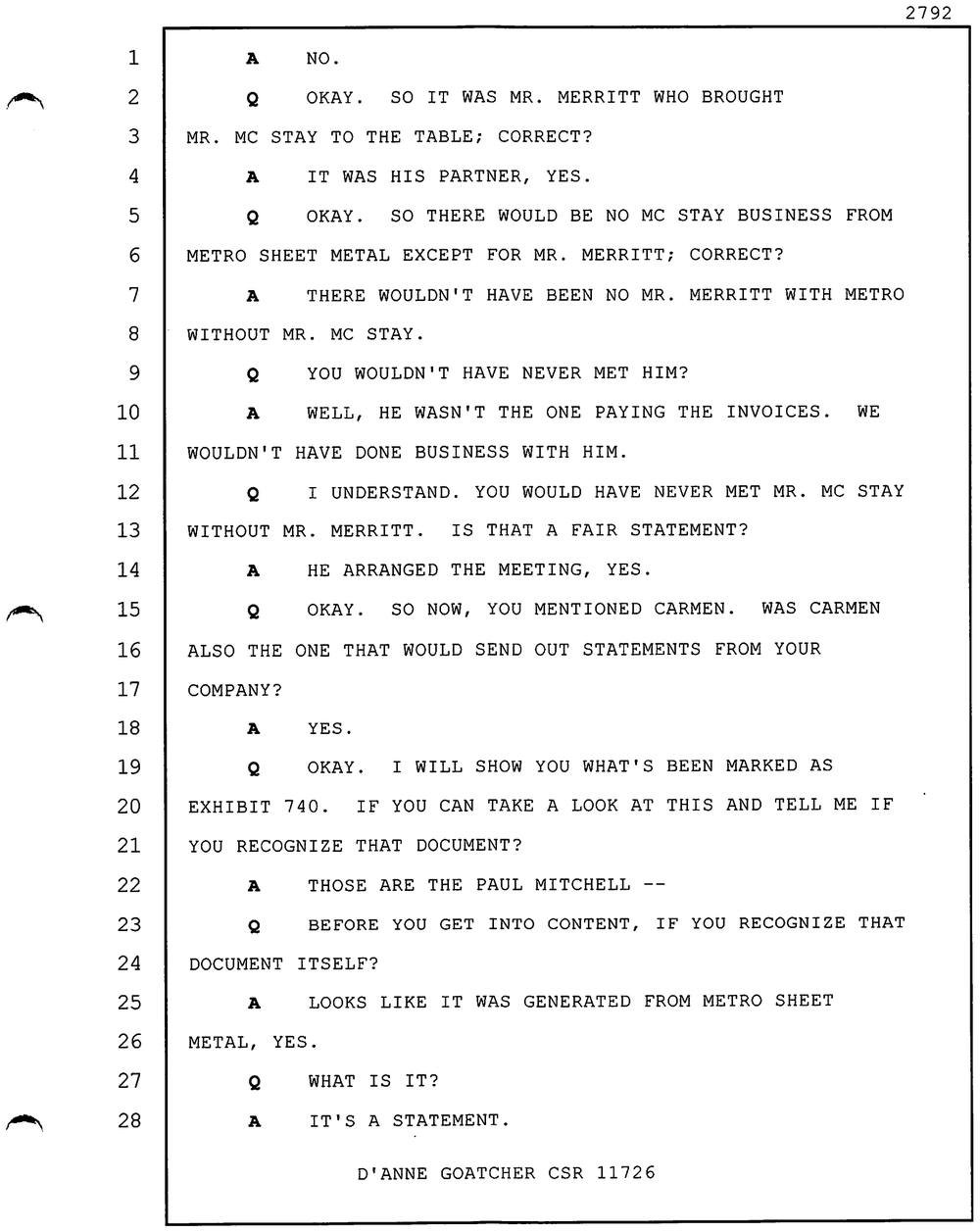
On cross-examination Mr. Maline showed Sequeida Jr. Metro’s March 1 statement, Exhibit 740: (RT 2792:19-28)
Q Okay. I will show you what’s been marked as Exhibit 740. If you can take a look at this and tell me if you recognize that document?
A Those are the Paul Mitchell —
Q Before you get into content, if you recognize that document itself?
A Looks like it was generated from Metro Sheet Metal, yes.
Q What is it?
A It’s a statement.
See the transcript (RT 2792)
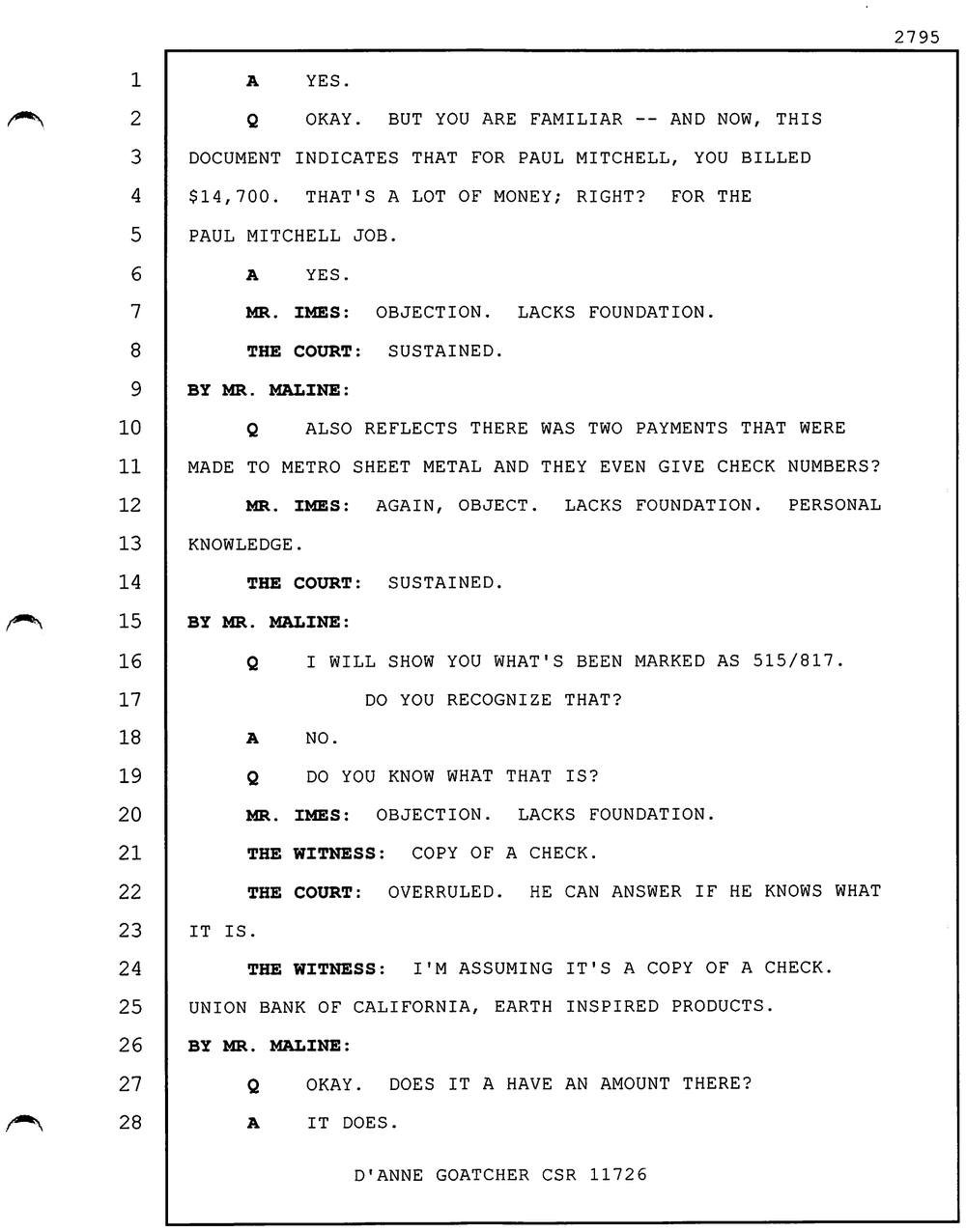
Then Mr. Maline showed him the carbon copy of Joseph’s check #1116 to Metro, dated February 1, 2010, the same check the statement lists as received on February 4: (RT 2795:15-2796:21)
BY MR. MALINE:
Q I will show you what’s been marked as 515/817. Do you recognize that?
A No.
Q Do you know what that is?
MR. IMES: Objection. Lacks foundation.
THE WITNESS: Copy of a check.
THE COURT: Overruled. He can answer if he knows what it is.
THE WITNESS: I’m assuming it’s a copy of a check. Union Bank of California, Earth Inspired Products.
BY MR. MALINE:
Q Okay. Does it a have an amount there?
A It does.
Q And what is that?
A $6,350.08.
Q Whose that made out to?
A Metro Sheet Metal.
Q Okay. Is this one of the checks that Mr. Merritt gave to you?
A Again, when he gave them to me, they were in an envelope.
Q You didn’t look at them then?
A No.
Q Okay. I’m going to see if I can put this on the overhead. Does this check have a date on it that you were able to see?
A February 1st, 2010.
MR. McGEE: Just for the record, your Honor, we are showing Exhibits 515 and 17.
THE COURT: Okay. Actually, that appears to be, not the check itself, but a carbon copy of the check.
MR. MALINE: Correct.
See the transcript (RT 2795-2796)
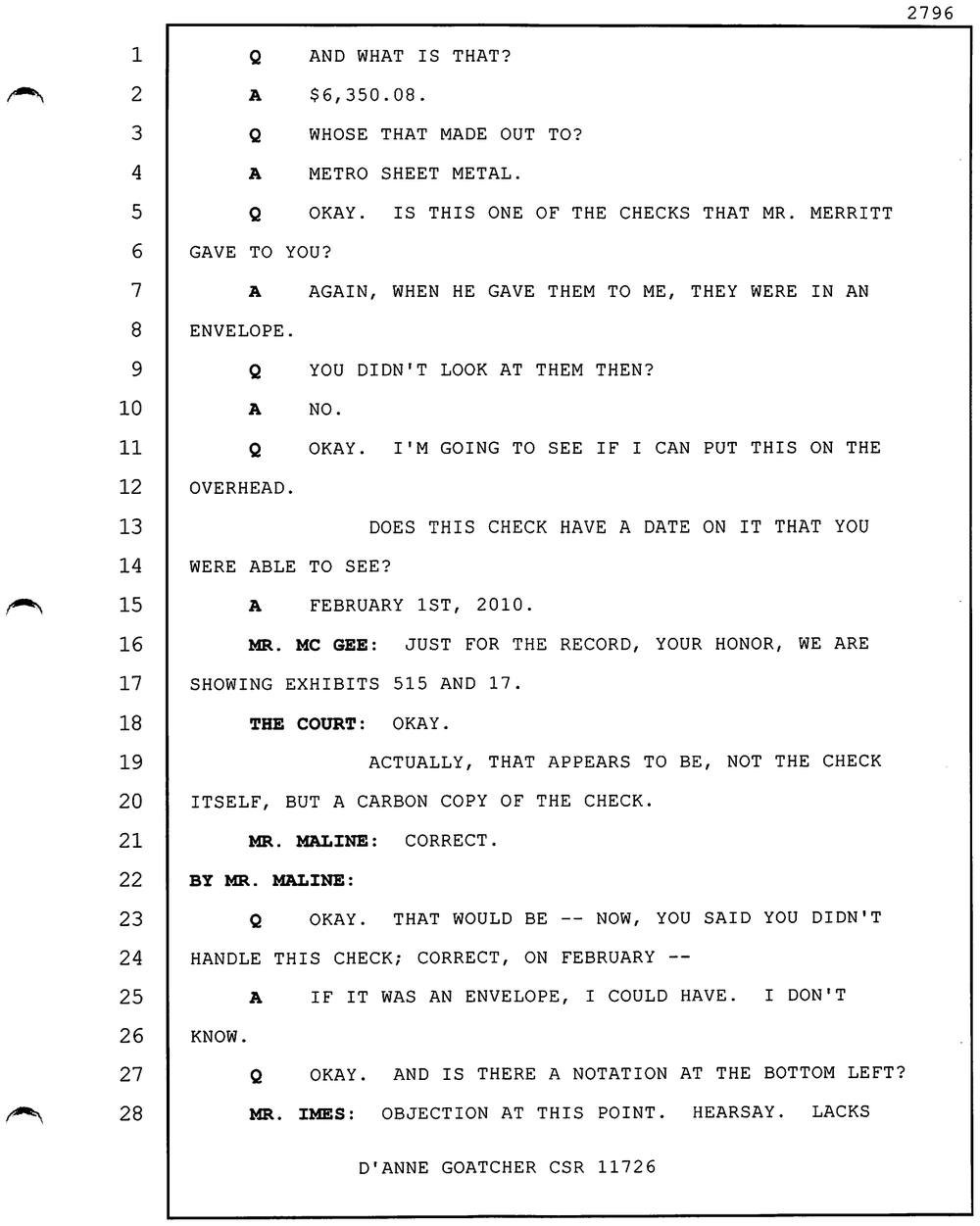
Sequeida Jr. read the amount as $6,350.08. The check and Metro’s statement both say $6,350.00.
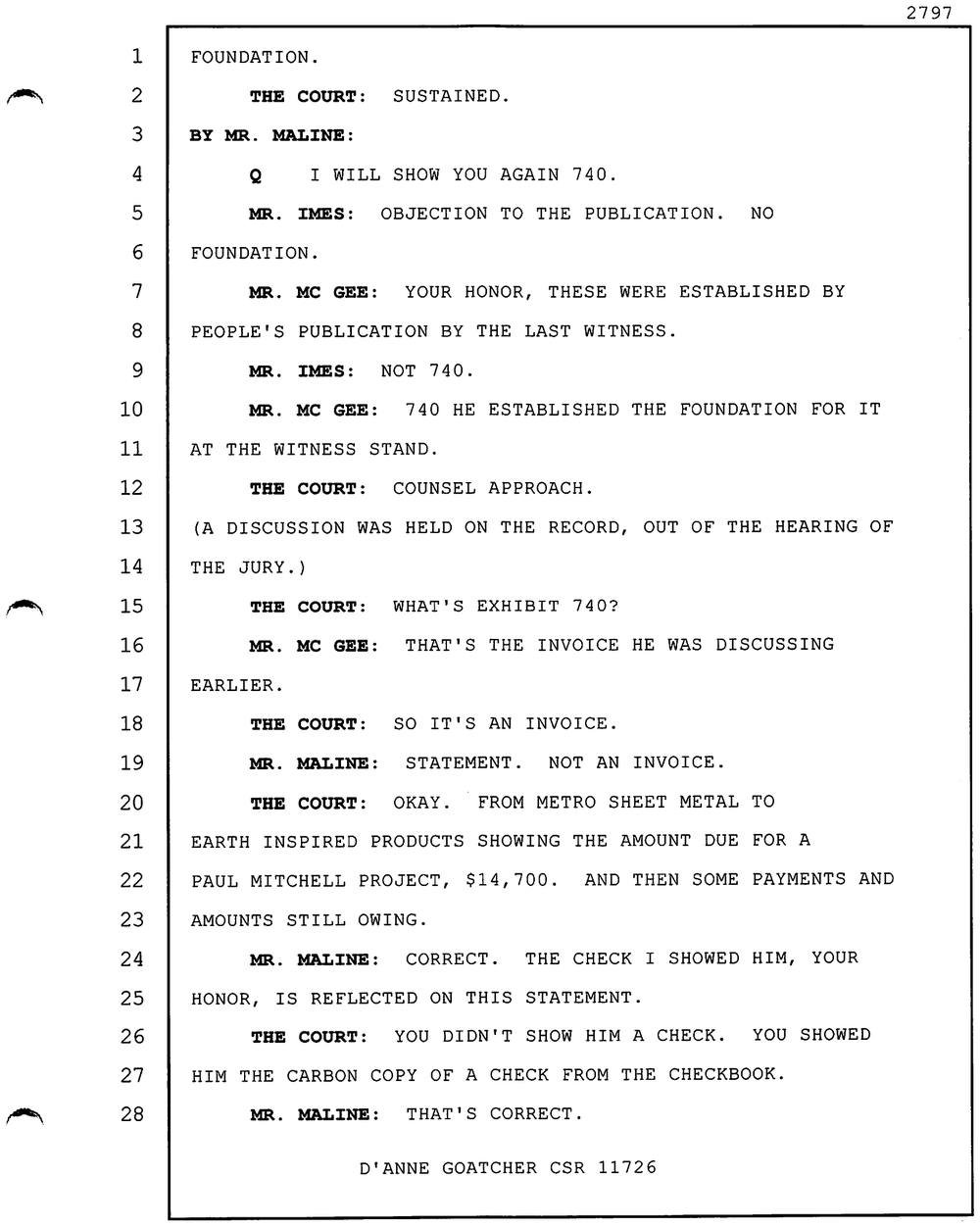
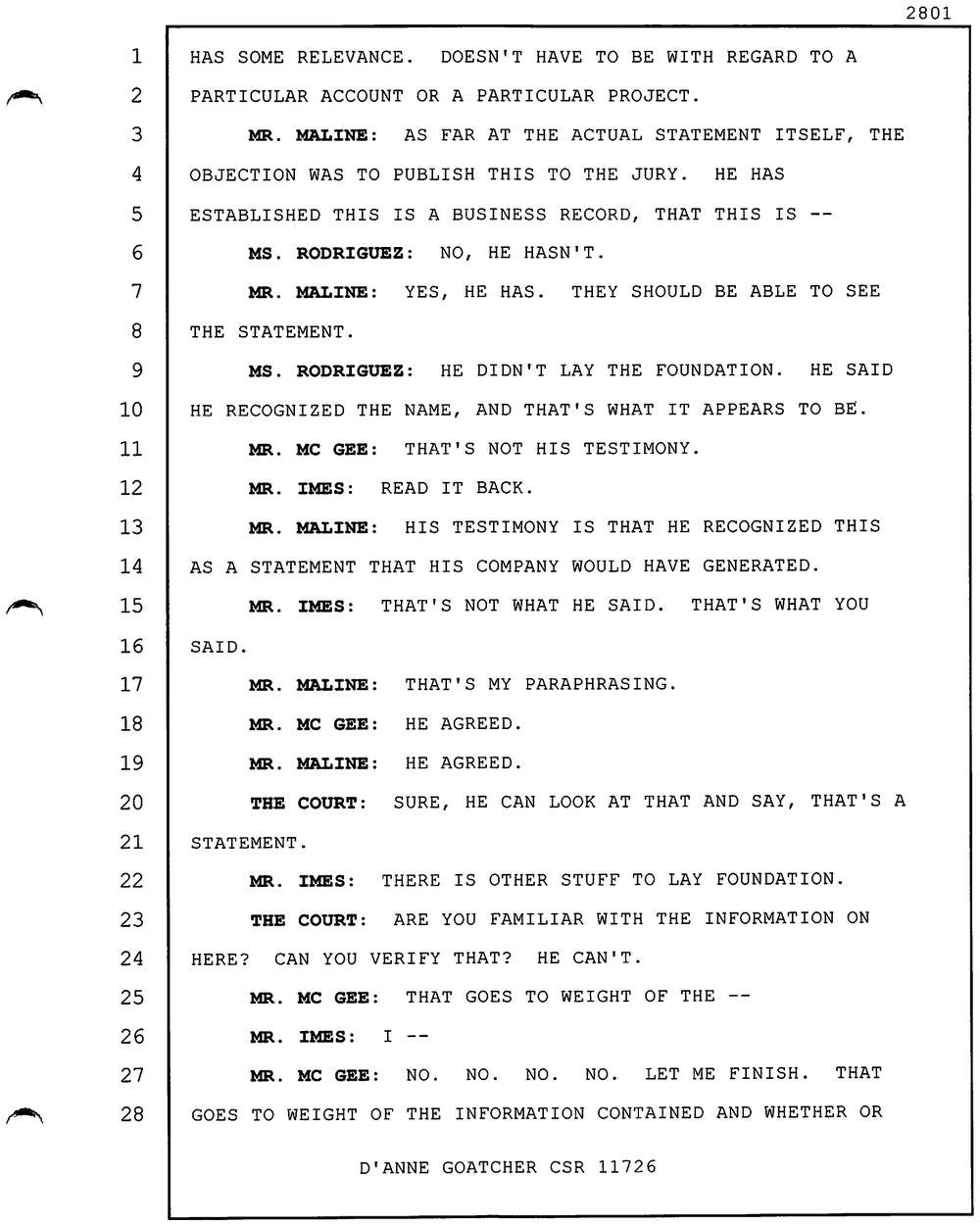
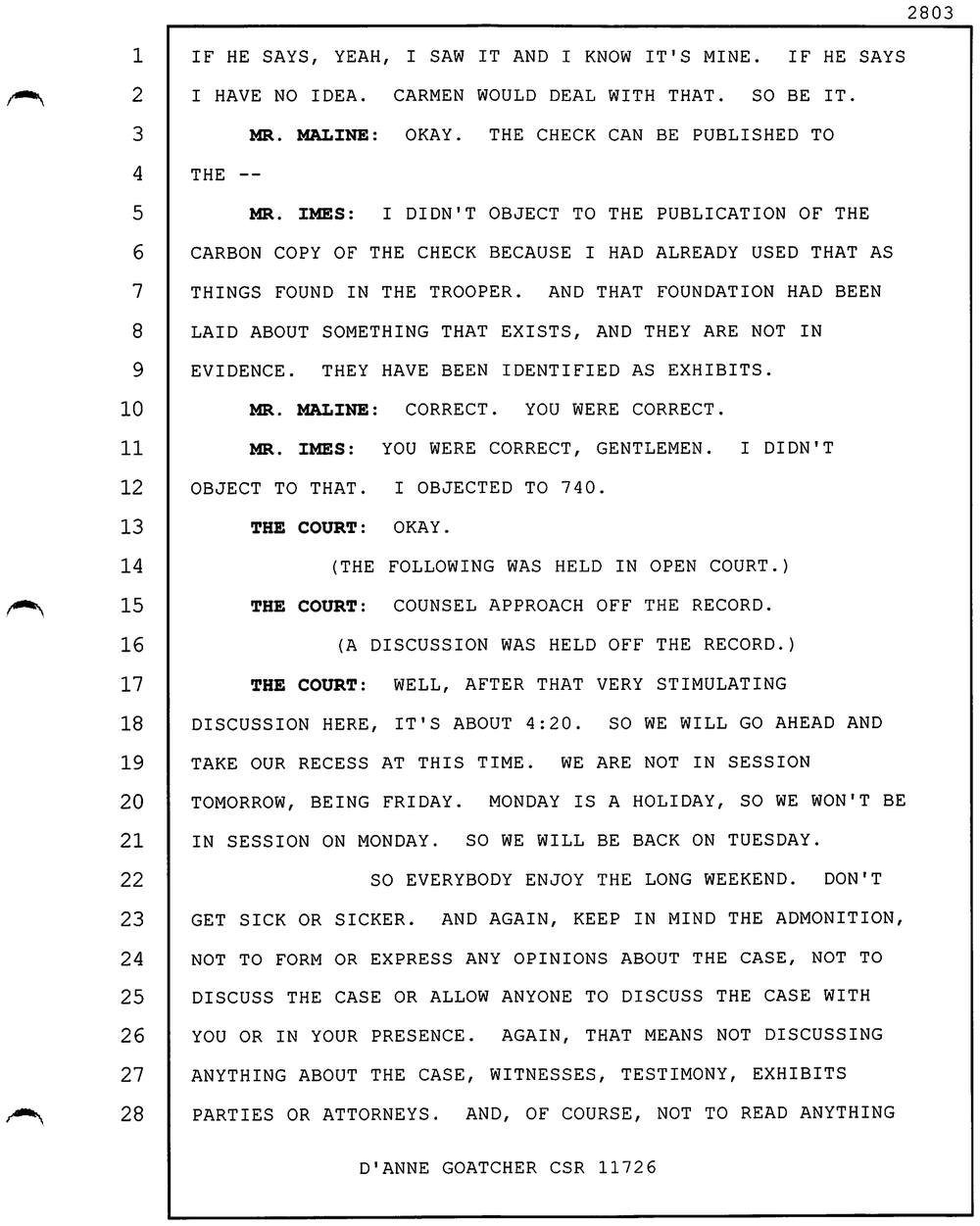
The carbon came from Joseph’s checkbook, which the State had already shown the jury as found in Joseph’s Trooper. Mr. Imes said the carbons “are not in evidence. They have been identified as exhibits.” (RT 2803:5-9) When Mr. Maline showed Metro’s statement again, the State objected, and the lawyers went to the bench. The whole conference: (RT 2797:12-2803:13)
Read the whole bench conference
THE COURT: Counsel approach.
(A DISCUSSION WAS HELD ON THE RECORD, OUT OF THE HEARING OF THE JURY.)
THE COURT: What’s Exhibit 740?
MR. McGEE: That’s the invoice he was discussing earlier.
THE COURT: So it’s an invoice.
MR. MALINE: Statement. Not an invoice.
THE COURT: Okay. From Metro Sheet Metal to Earth Inspired Products showing the amount due for a Paul Mitchell project, $14,700. And then some payments and amounts still owing.
MR. MALINE: Correct. The check I showed him, your Honor, is reflected on this statement.
THE COURT: You didn’t show him a check. You showed him the carbon copy of a check from the checkbook.
MR. MALINE: That’s correct.
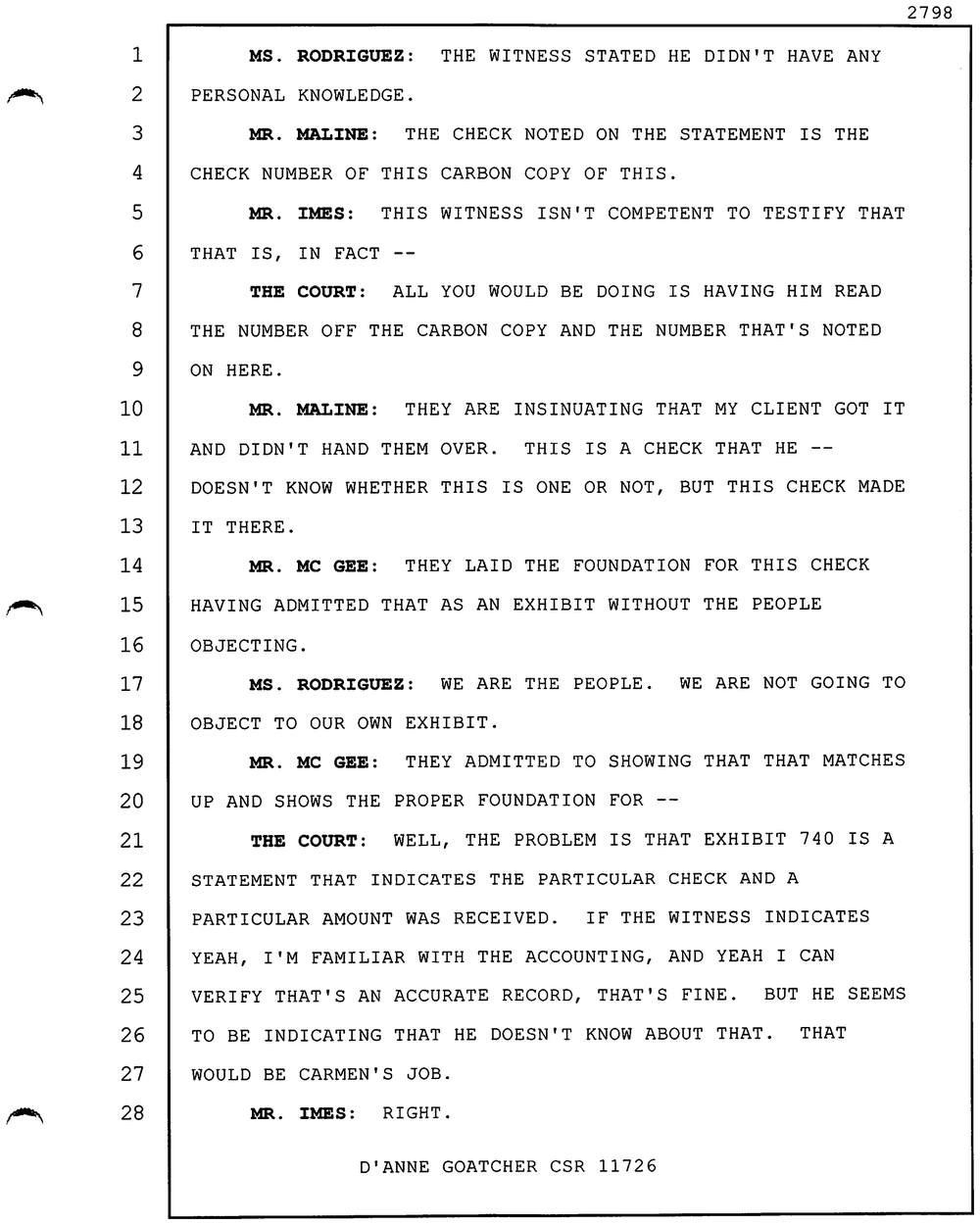
MS. RODRIGUEZ: The witness stated he didn’t have any personal knowledge.
MR. MALINE: The check noted on the statement is the check number of this carbon copy of this.
MR. IMES: This witness isn’t competent to testify that that is, in fact —
THE COURT: All you would be doing is having him read the number off the carbon copy and the number that’s noted on here.
MR. MALINE: They are insinuating that my client got it and didn’t hand them over. This is a check that he — doesn’t know whether this is one or not, but this check made it there.
MR. McGEE: They laid the foundation for this check having admitted that as an exhibit without the People objecting.
MS. RODRIGUEZ: We are the People. We are not going to object to our own exhibit.
MR. McGEE: They admitted to showing that that matches up and shows the proper foundation for —
THE COURT: Well, the problem is that Exhibit 740 is a statement that indicates the particular check and a particular amount was received. If the witness indicates yeah, I’m familiar with the accounting, and yeah I can verify that’s an accurate record, that’s fine. But he seems to be indicating that he doesn’t know about that. That would be Carmen’s job.
MR. IMES: Right.
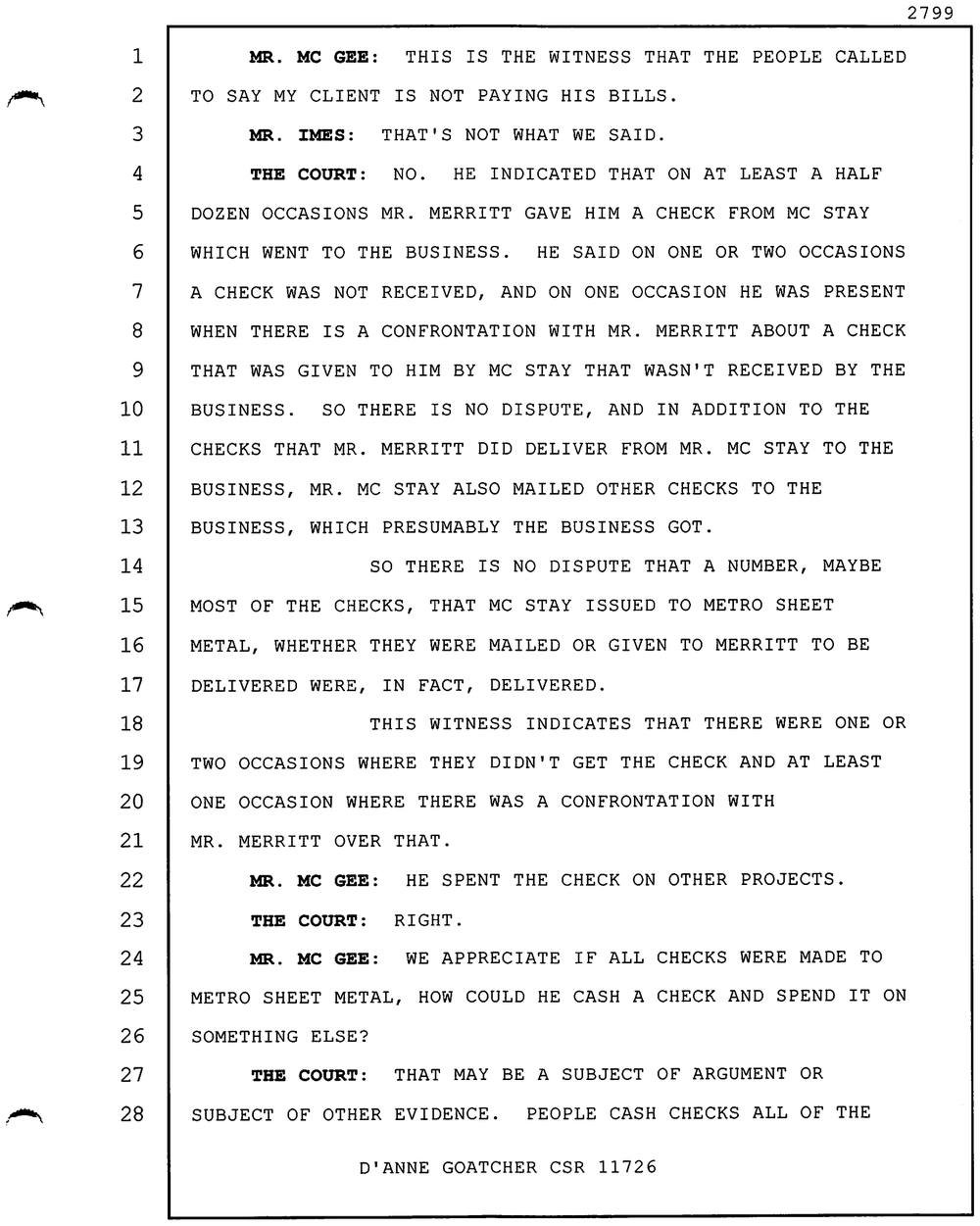
MR. McGEE: This is the witness that the People called to say my client is not paying his bills.
MR. IMES: That’s not what we said.
THE COURT: No. He indicated that on at least a half dozen occasions Mr. Merritt gave him a check from McStay which went to the business. He said on one or two occasions a check was not received, and on one occasion he was present when there is a confrontation with Mr. Merritt about a check that was given to him by McStay that wasn’t received by the business. So there is no dispute, and in addition to the checks that Mr. Merritt did deliver from Mr. McStay to the business, Mr. McStay also mailed other checks to the business, which presumably the business got. So there is no dispute that a number, maybe most of the checks, that McStay issued to Metro Sheet Metal, whether they were mailed or given to Merritt to be delivered were, in fact, delivered. This witness indicates that there were one or two occasions where they didn’t get the check and at least one occasion where there was a confrontation with Mr. Merritt over that.
MR. McGEE: He spent the check on other projects.
THE COURT: Right.
MR. McGEE: We appreciate if all checks were made to Metro Sheet Metal, how could he cash a check and spend it on something else?
THE COURT: That may be a subject of argument or subject of other evidence. People cash checks all of the time that aren’t made out to them, unfortunately. Sometimes legitimately. Sometimes not.
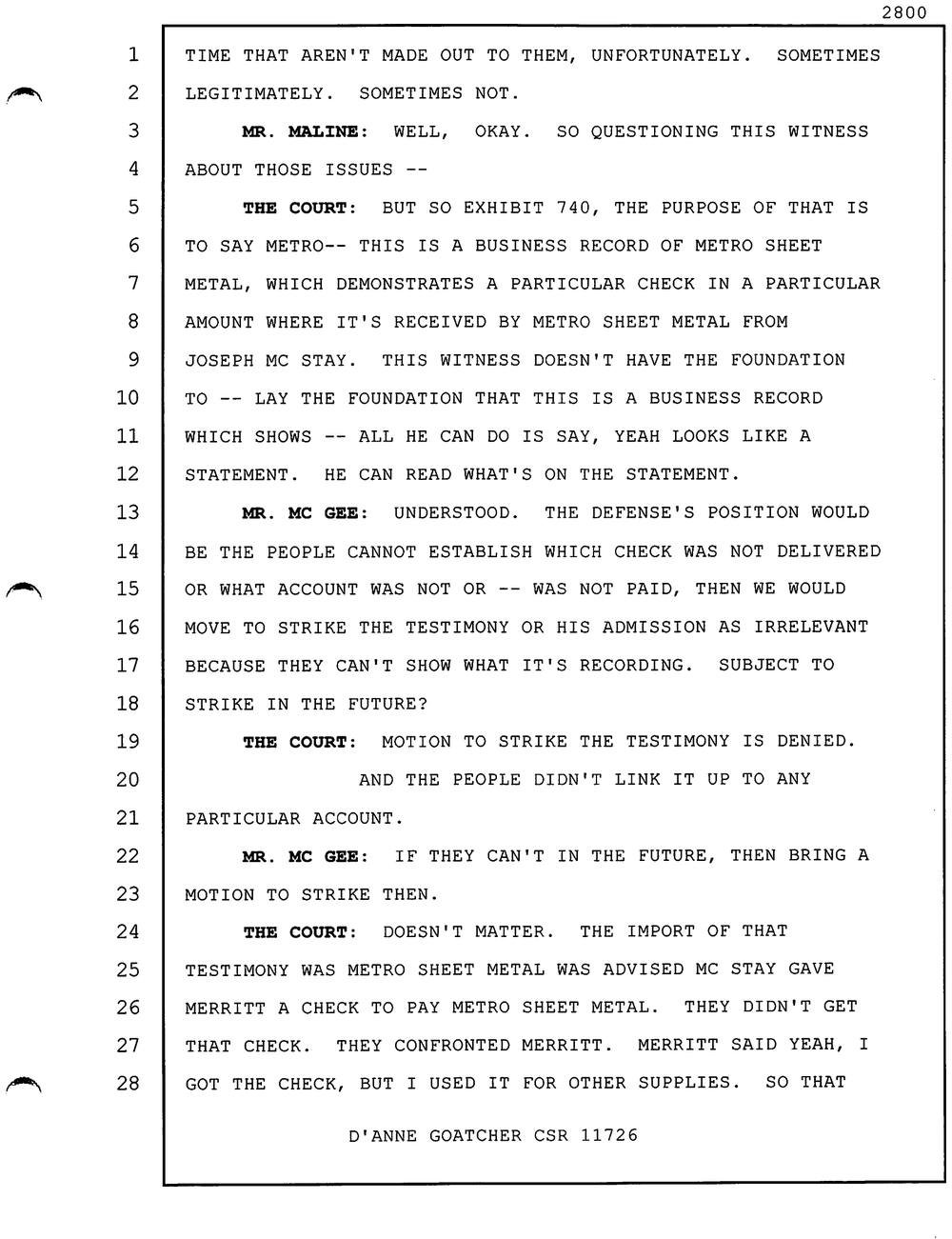
MR. MALINE: Well, okay. So questioning this witness about those issues —
THE COURT: But so Exhibit 740, the purpose of that is to say Metro— this is a business record of Metro Sheet Metal, which demonstrates a particular check in a particular amount where it’s received by Metro Sheet Metal from Joseph McStay. This witness doesn’t have the foundation to — lay the foundation that this is a business record which shows — all he can do is say, yeah looks like a statement. He can read what’s on the statement.
MR. McGEE: Understood. The defense’s position would be the People cannot establish which check was not delivered or what account was not or — was not paid, then we would move to strike the testimony or his admission as irrelevant because they can’t show what it’s recording. Subject to strike in the future?
THE COURT: Motion to strike the testimony is denied. And the People didn’t link it up to any particular account.
MR. McGEE: If they can’t in the future, then bring a motion to strike then.
THE COURT: Doesn’t matter. The import of that testimony was Metro Sheet Metal was advised McStay gave Merritt a check to pay Metro Sheet Metal. They didn’t get that check. They confronted Merritt. Merritt said yeah, I got the check, but I used it for other supplies. So that has some relevance. Doesn’t have to be with regard to a particular account or a particular project.
MR. MALINE: As far at the actual statement itself, the objection was to publish this to the jury. He has established this is a business record, that this is —
MS. RODRIGUEZ: No, he hasn’t.
MR. MALINE: Yes, he has. They should be able to see the statement.
MS. RODRIGUEZ: He didn’t lay the foundation. He said he recognized the name, and that’s what it appears to be.
MR. McGEE: That’s not his testimony.
MR. IMES: Read it back.
MR. MALINE: His testimony is that he recognized this as a statement that his company would have generated.
MR. IMES: That’s not what he said, that’s what you said.
MR. MALINE: That’s my paraphrasing.
MR. McGEE: He agreed.
MR. MALINE: He agreed.
THE COURT: Sure, he can look at that and say, that’s a statement.
MR. IMES: There is other stuff to lay foundation.
THE COURT: Are you familiar with the information on here? Can you verify that? He can’t.
MR. McGEE: That goes to weight of the —
MR. IMES: I —
MR. McGEE: No. No. No. No. Let me finish. That goes to weight of the information contained and whether or not he can substantiate it. He said that is what appears to be one of our statements, and this is something that we do in the normal course of business.
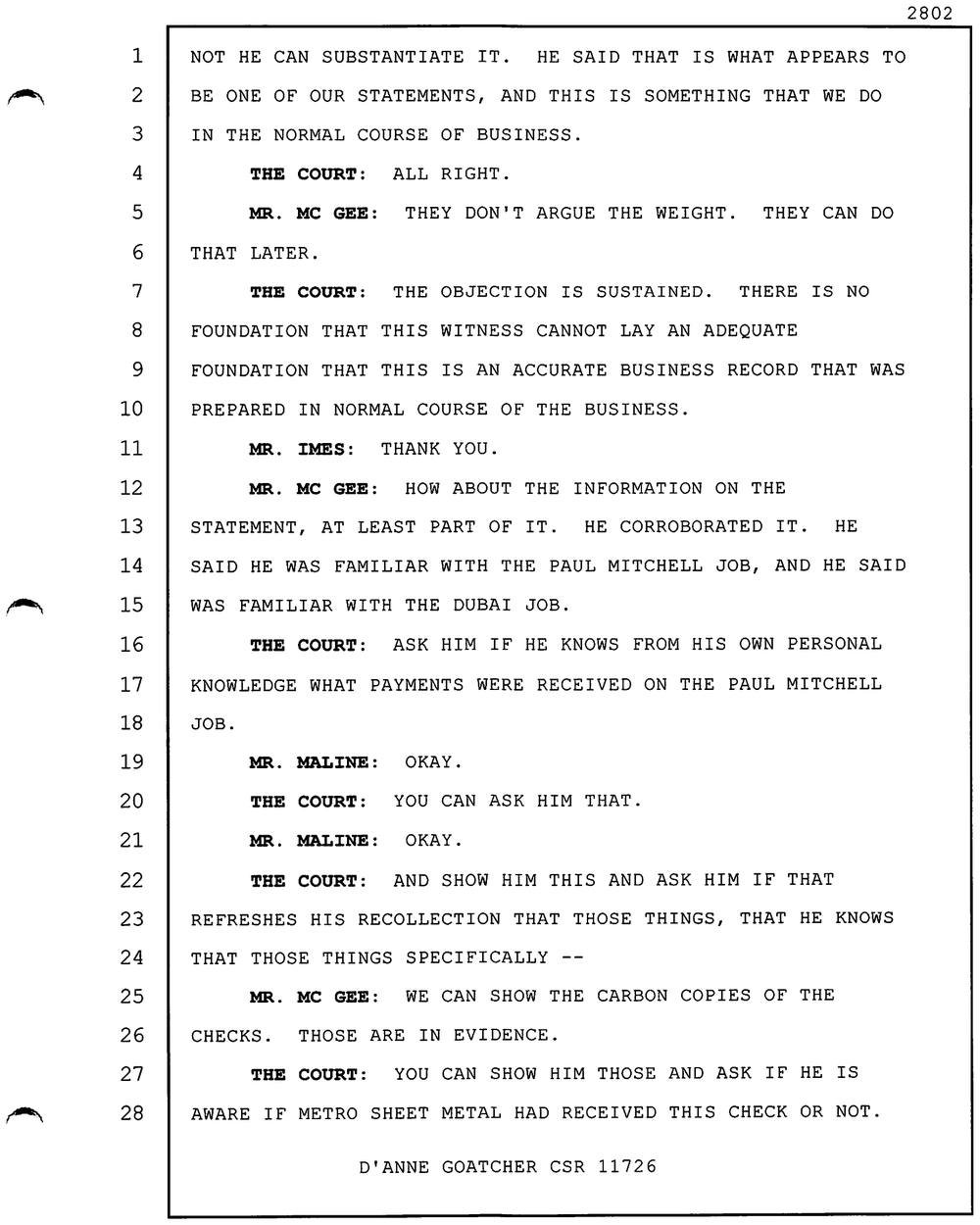
THE COURT: All right.
MR. McGEE: They don’t argue the weight. They can do that later.
THE COURT: The objection is sustained. There is no foundation that this witness cannot lay an adequate foundation that this is an accurate business record that was prepared in normal course of the business.
MR. IMES: Thank you.
MR. McGEE: How about the information on the statement, at least part of it. He corroborated it. He said he was familiar with the Paul Mitchell job, and he said was familiar with the Dubai job.
THE COURT: Ask him if he knows from his own personal knowledge what payments were received on the Paul Mitchell job.
MR. MALINE: Okay.
THE COURT: You can ask him that.
MR. MALINE: Okay.
THE COURT: And show him this and ask him if that refreshes his recollection that those things, that he knows that those things specifically —
MR. McGEE: We can show the carbon copies of the checks. Those are in evidence.
THE COURT: You can show him those and ask if he is aware if Metro Sheet Metal had received this check or not. If he says, yeah, I saw it and I know it’s mine. If he says I have no idea. Carmen would deal with that. So be it.
MR. MALINE: Okay. The check can be published to the —
MR. IMES: I didn’t object to the publication of the carbon copy of the check because I had already used that as things found in the Trooper. And that foundation had been laid about something that exists, and they are not in evidence. They have been identified as exhibits.
MR. MALINE: Correct. You were correct.
MR. IMES: You were correct, gentlemen. I didn’t object to that. I objected to 740.
THE COURT: Okay.
See the transcript (RT 2797-2803)
2. What the judge decided
He said the statement needed someone who kept Metro’s books: (RT 2798:21-27)
THE COURT: Well, the problem is that Exhibit 740 is a statement that indicates the particular check and a particular amount was received. If the witness indicates yeah, I’m familiar with the accounting, and yeah I can verify that’s an accurate record, that’s fine. But he seems to be indicating that he doesn’t know about that. That would be Carmen’s job.
See the transcript (RT 2798)
He agreed that most of the checks had reached Metro: (RT 2799:4-21)
THE COURT: No. He indicated that on at least a half dozen occasions Mr. Merritt gave him a check from McStay which went to the business. He said on one or two occasions a check was not received, and on one occasion he was present when there is a confrontation with Mr. Merritt about a check that was given to him by McStay that wasn’t received by the business. So there is no dispute, and in addition to the checks that Mr. Merritt did deliver from Mr. McStay to the business, Mr. McStay also mailed other checks to the business, which presumably the business got. So there is no dispute that a number, maybe most of the checks, that McStay issued to Metro Sheet Metal, whether they were mailed or given to Merritt to be delivered were, in fact, delivered. This witness indicates that there were one or two occasions where they didn’t get the check and at least one occasion where there was a confrontation with Mr. Merritt over that.
See the transcript (RT 2799)
When Mr. McGee asked how I could spend a check made out to Metro, the judge answered: (RT 2799:24-2800:2)
MR. McGEE: We appreciate if all checks were made to Metro Sheet Metal, how could he cash a check and spend it on something else?
THE COURT: That may be a subject of argument or subject of other evidence. People cash checks all of the time that aren’t made out to them, unfortunately. Sometimes legitimately. Sometimes not.
See the transcript (RT 2799-2800)
Mr. McGee then moved to strike the story, because the State couldn’t say which check it was. The judge refused: (RT 2800:13-2801:2)
MR. McGEE: Understood. The defense’s position would be the People cannot establish which check was not delivered or what account was not or — was not paid, then we would move to strike the testimony or his admission as irrelevant because they can’t show what it’s recording. Subject to strike in the future?
THE COURT: Motion to strike the testimony is denied. And the People didn’t link it up to any particular account.
MR. McGEE: If they can’t in the future, then bring a motion to strike then.
THE COURT: Doesn’t matter. The import of that testimony was Metro Sheet Metal was advised McStay gave Merritt a check to pay Metro Sheet Metal. They didn’t get that check. They confronted Merritt. Merritt said yeah, I got the check, but I used it for other supplies. So that has some relevance. Doesn’t have to be with regard to a particular account or a particular project.
See the transcript (RT 2800-2801)
He kept Metro’s statement from the jury, (RT 2802:7-10)
THE COURT: The objection is sustained. There is no foundation that this witness cannot lay an adequate foundation that this is an accurate business record that was prepared in normal course of the business.
See the transcript (RT 2802)
and said again who could speak to it: (RT 2802:27-2803:2)
THE COURT: You can show him those and ask if he is aware if Metro Sheet Metal had received this check or not. If he says, yeah, I saw it and I know it’s mine. If he says I have no idea. Carmen would deal with that. So be it.
See the transcript (RT 2802-2803)
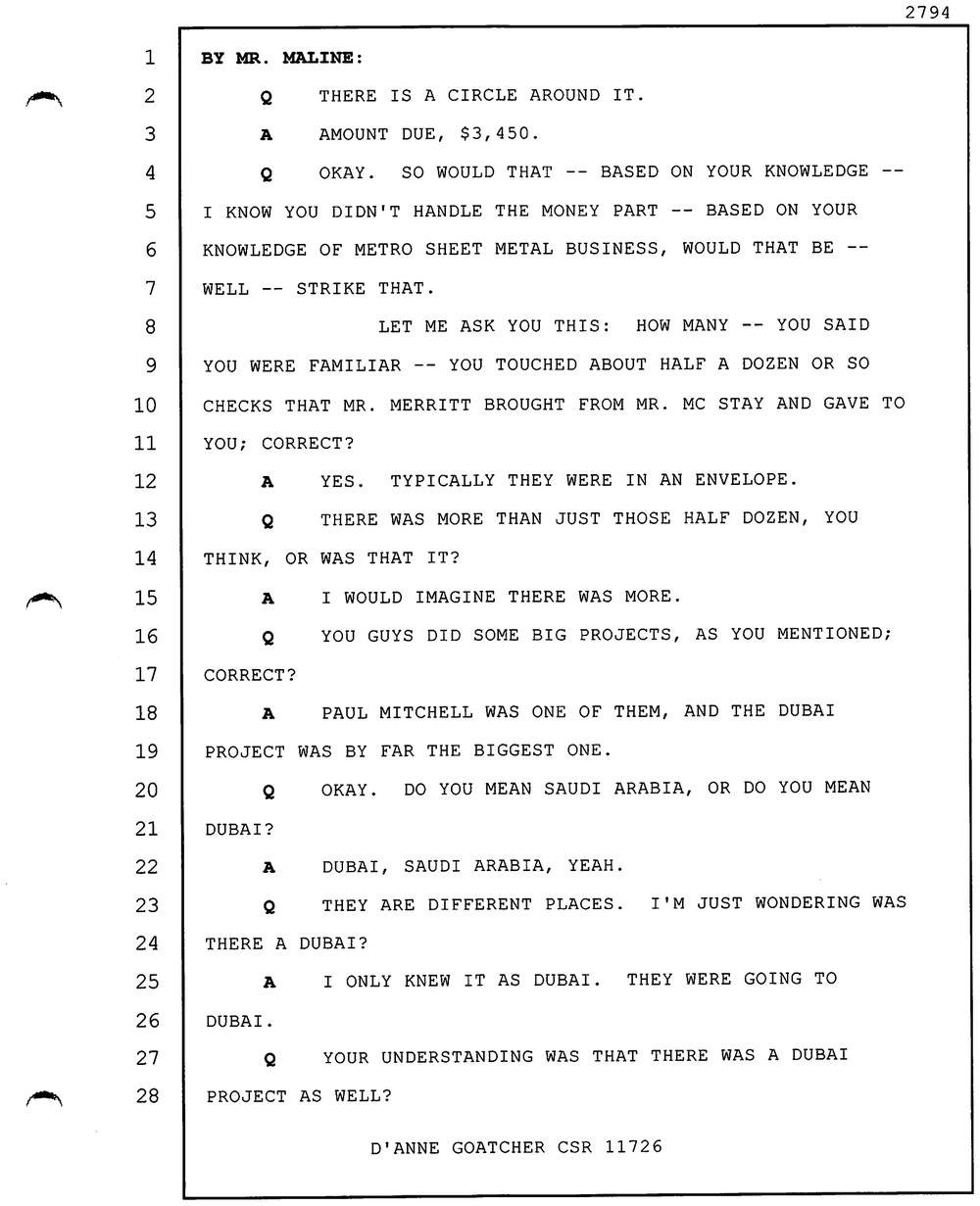
That is the ruling I call ludicrous. The State never had to say which check I supposedly kept, or show that any check to Metro was cashed by anyone but Metro. The judge said it didn’t matter. Metro’s own accounting of what it had received was kept out. The jury heard only one number from it, that $3,450 was still due (RT 2794:3).
See the transcript (RT 2794)
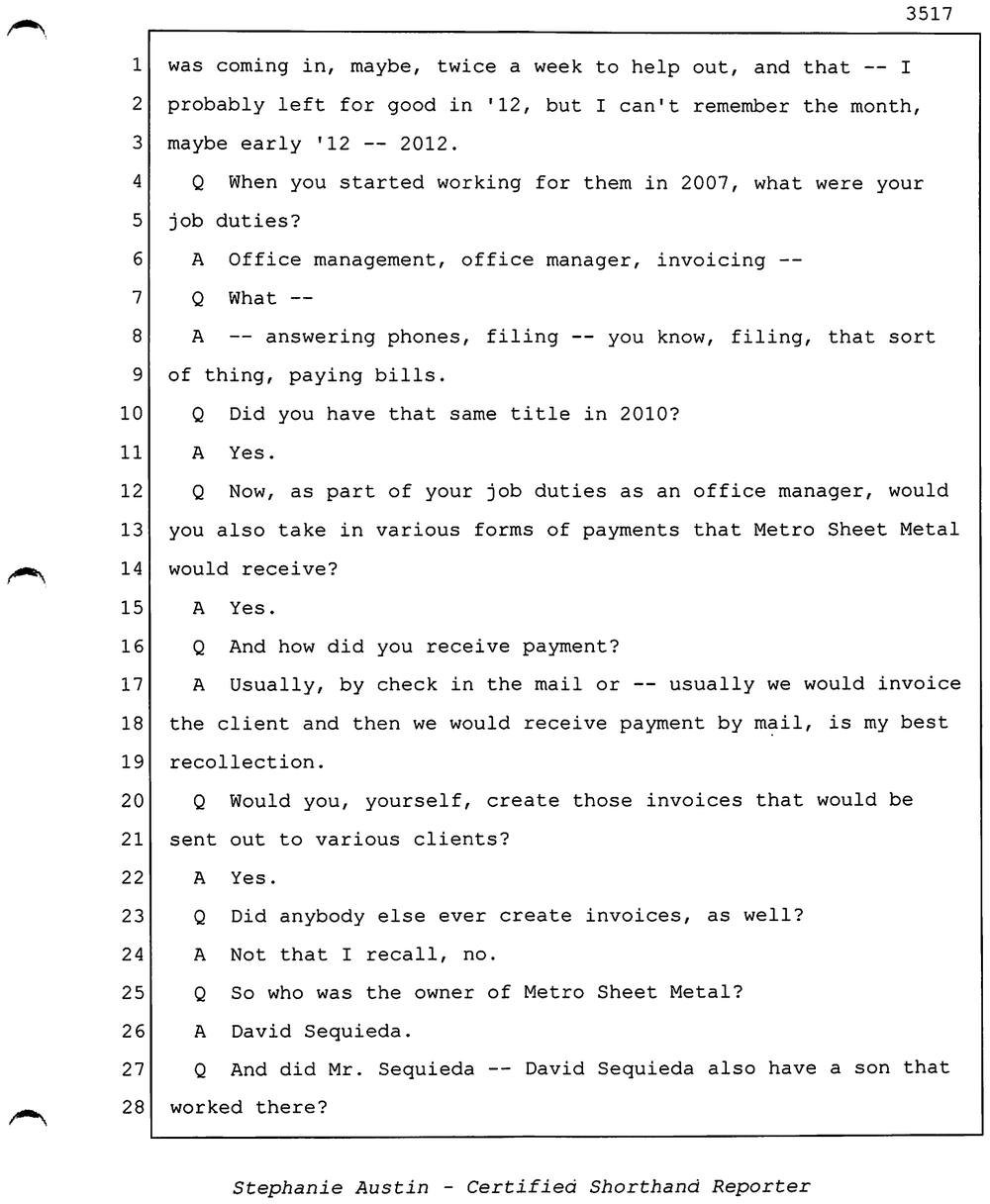
3. Carmen Garcia
Carmen Garcia testified for the State on January 31, 2019, two weeks after that ruling. Ms. Rodriguez asked her about her job: (RT 3517:4-24)
Q When you started working for them in 2007, what were your job duties?
A Office management, office manager, invoicing —
Q What —
A — answering phones, filing — you know, filing, that sort of thing, paying bills.
Q Did you have that same title in 2010?
A Yes.
Q Now, as part of your job duties as an office manager, would you also take in various forms of payments that Metro Sheet Metal would receive?
A Yes.
Q And how did you receive payment?
A Usually, by check in the mail or — usually we would invoice the client and then we would receive payment by mail, is my best recollection.
Q Would you, yourself, create those invoices that would be sent out to various clients?
A Yes.
Q Did anybody else ever create invoices, as well?
A Not that I recall, no.
See the transcript (RT 3517)
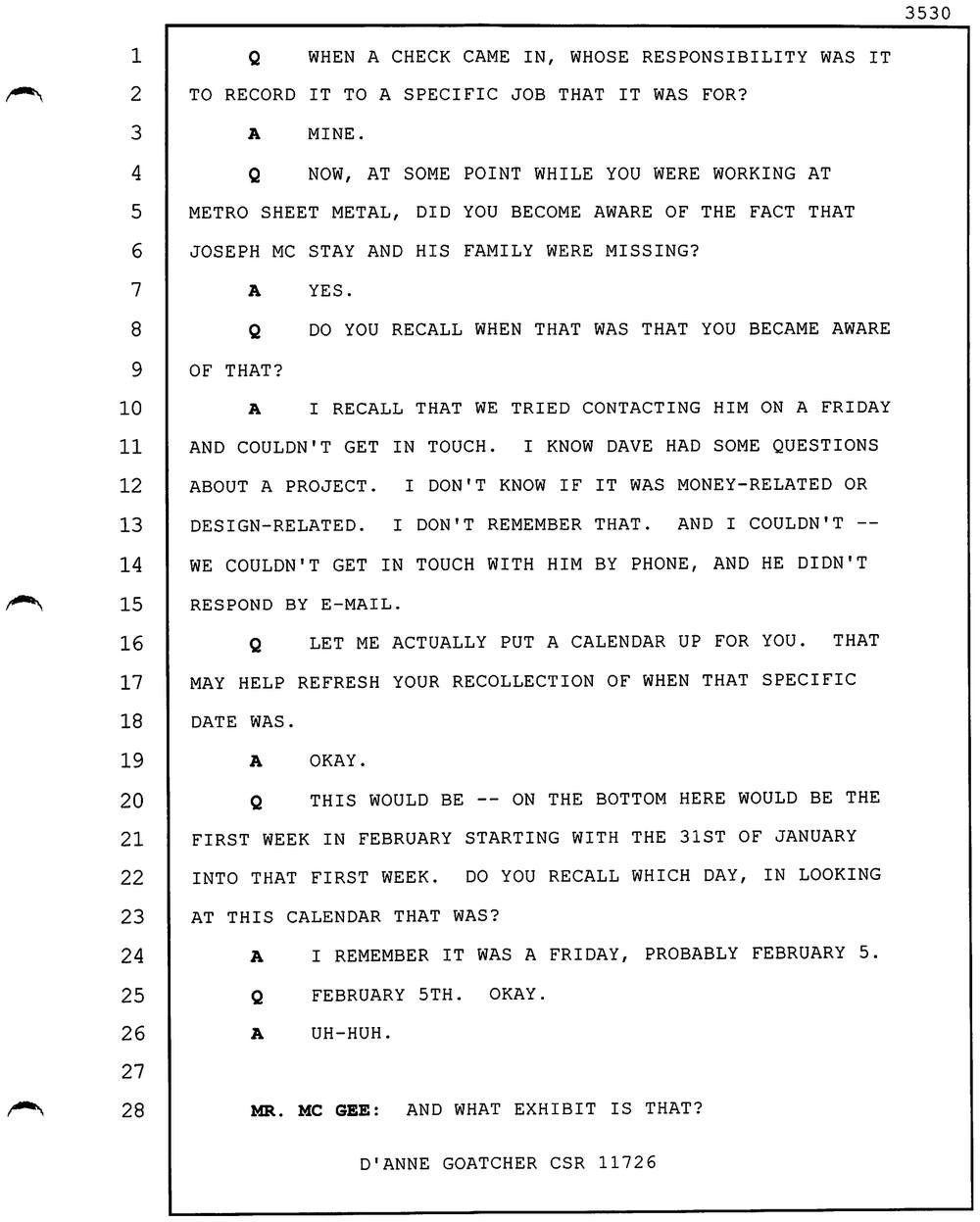
She recorded every payment to its job: (RT 3530:1-3)
Q When a check came in, whose responsibility was it to record it to a specific job that it was for?
A Mine.
See the transcript (RT 3530)
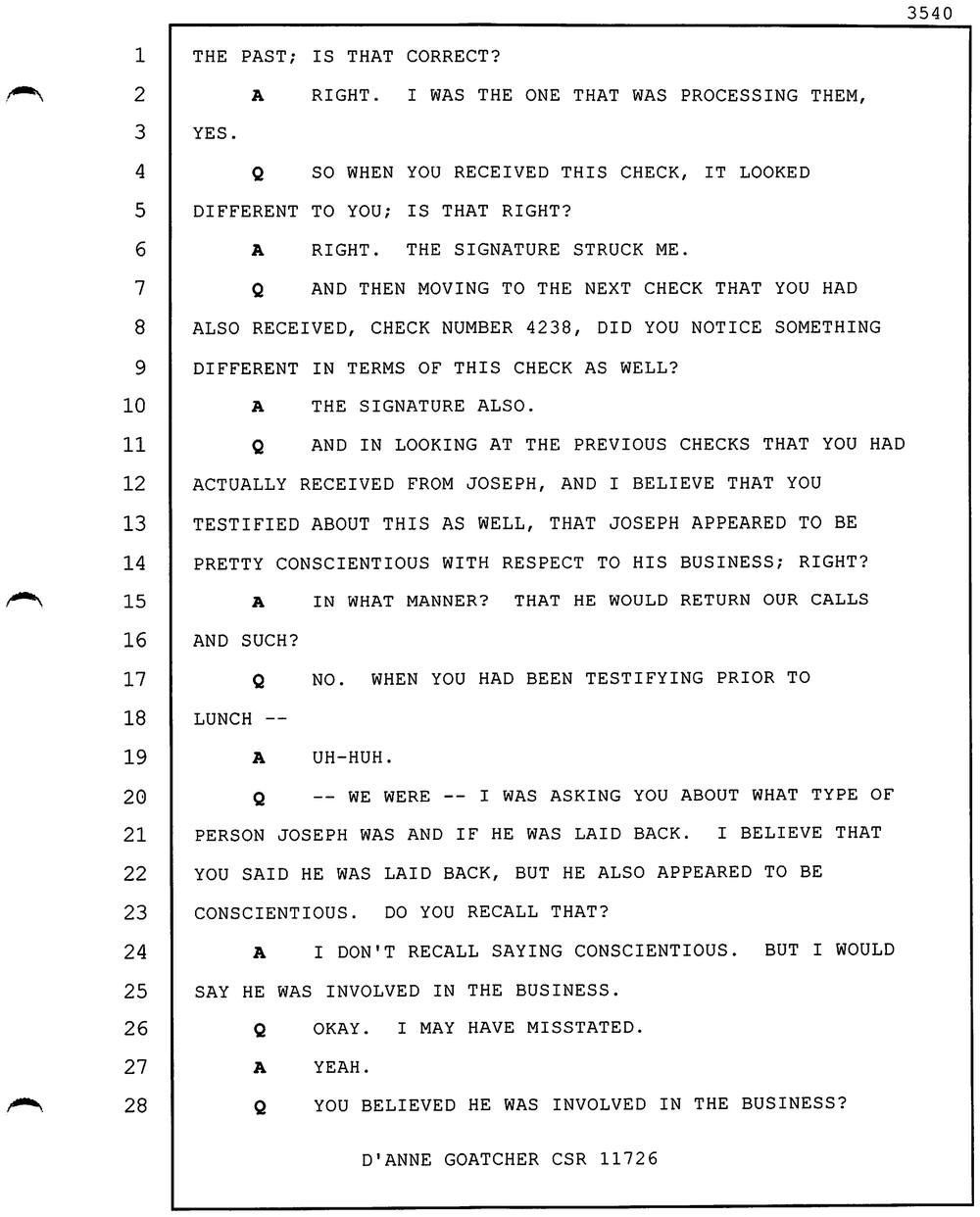
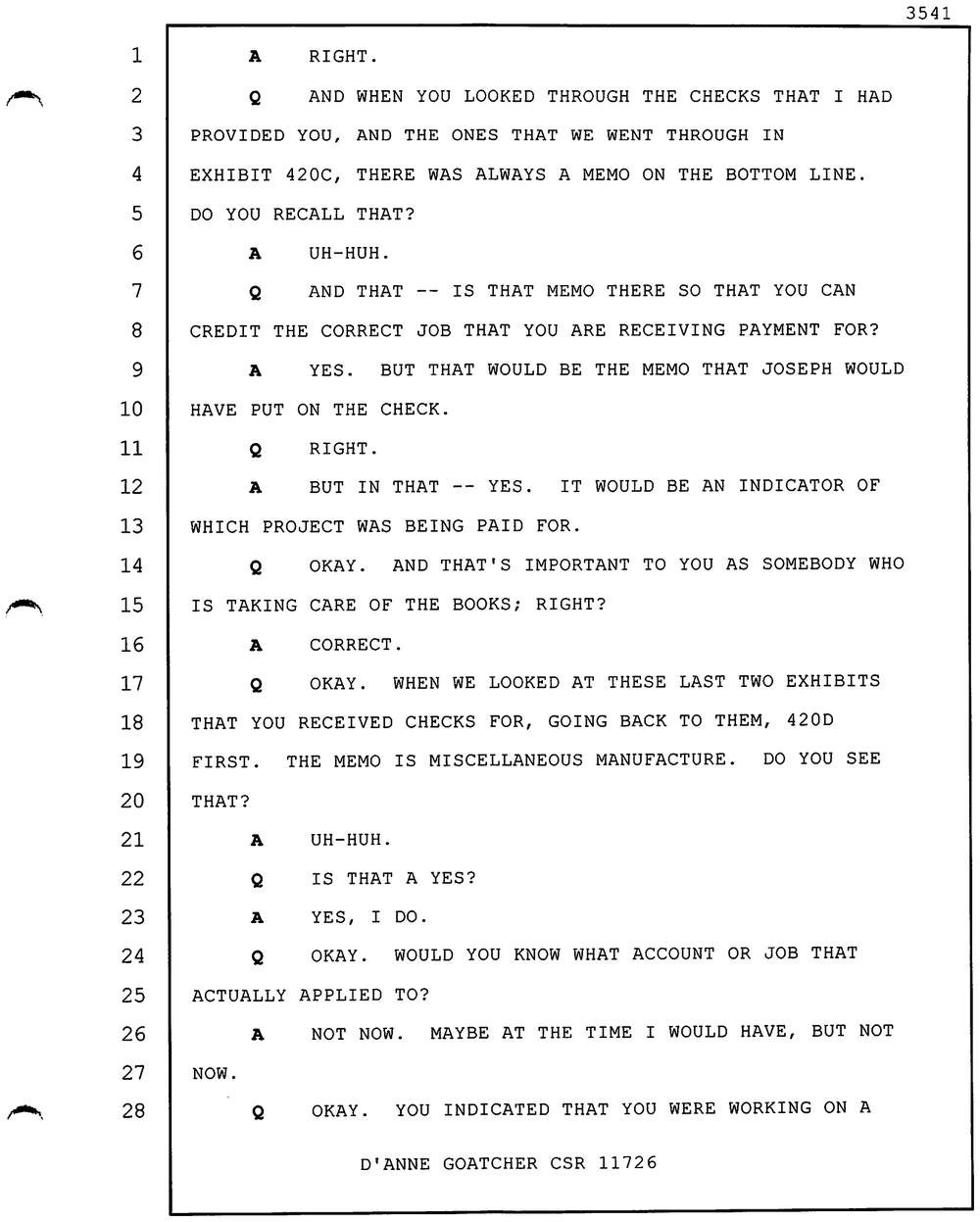
She processed Joseph’s checks, and used his memo line to credit the right job: (RT 3539:28-3540:3; 3541:2-16)
Q … You had occasion to receive multiple checks from Joseph in the past; is that correct?
A Right. I was the one that was processing them, yes.
…
Q And when you looked through the checks that I had provided you, and the ones that we went through in Exhibit 420C, there was always a memo on the bottom line. Do you recall that?
A Uh-huh.
Q And that — is that memo there so that you can credit the correct job that you are receiving payment for?
A Yes. But that would be the memo that Joseph would have put on the check.
Q Right.
A But in that — yes. It would be an indicator of which project was being paid for.
Q Okay. And that’s important to you as somebody who is taking care of the books; right?
A Correct.
See the transcript (RT 3540-3541)
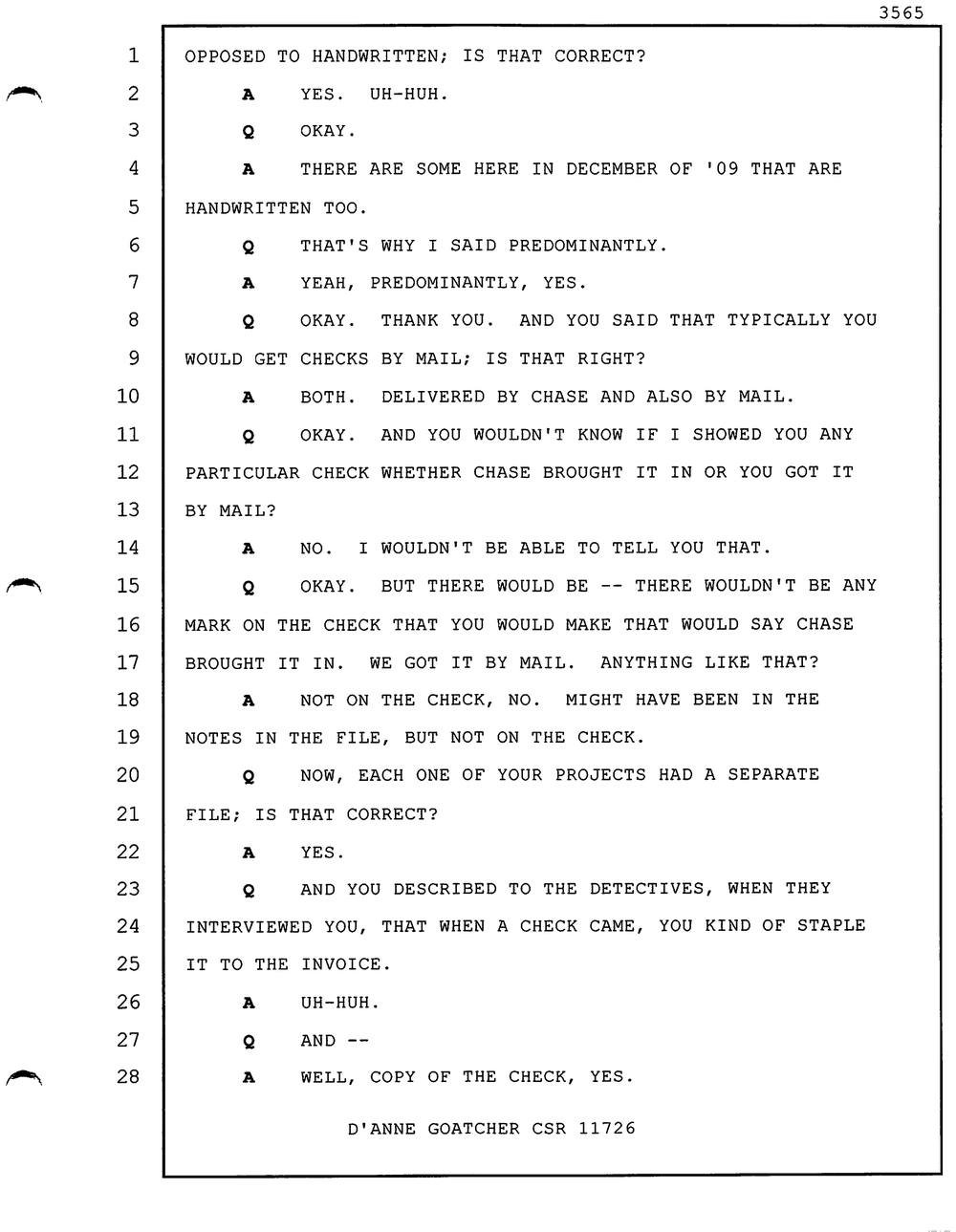
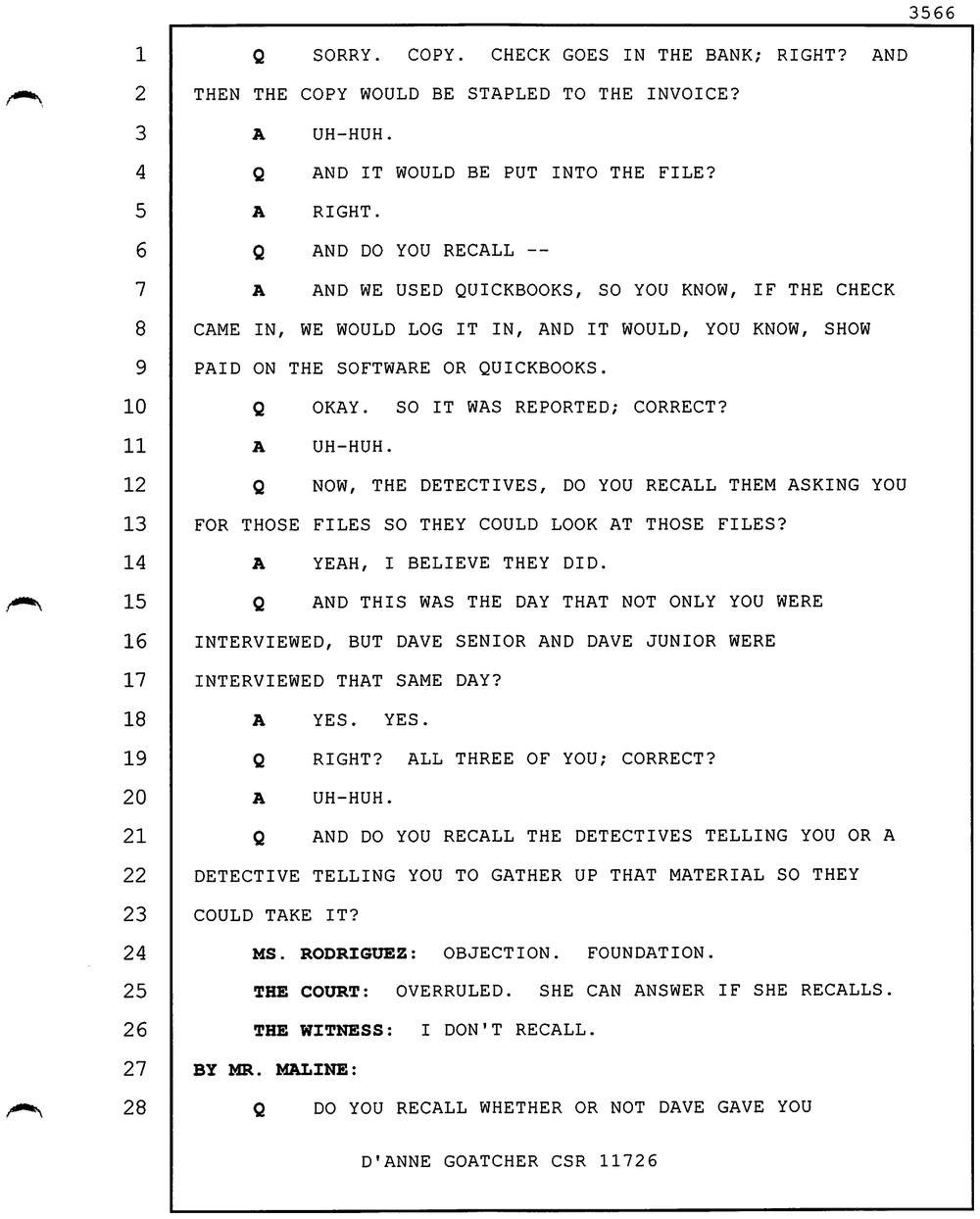
On cross-examination she described how each payment was filed and logged: (RT 3565:20-3566:11)
Q Now, each one of your projects had a separate file; is that correct?
A Yes.
Q And you described to the detectives, when they interviewed you, that when a check came, you kind of staple it to the invoice.
A Uh-huh.
Q And —
A Well, copy of the check, yes.
Q Sorry. Copy. Check goes in the bank; right? And then the copy would be stapled to the invoice?
A Uh-huh.
Q And it would be put into the file?
A Right.
Q And do you recall —
A And we used QuickBooks, so you know, if the check came in, we would log it in, and it would, you know, show paid on the software or QuickBooks.
Q Okay. So it was reported; correct?
A Uh-huh.
See the transcript (RT 3565-3566)
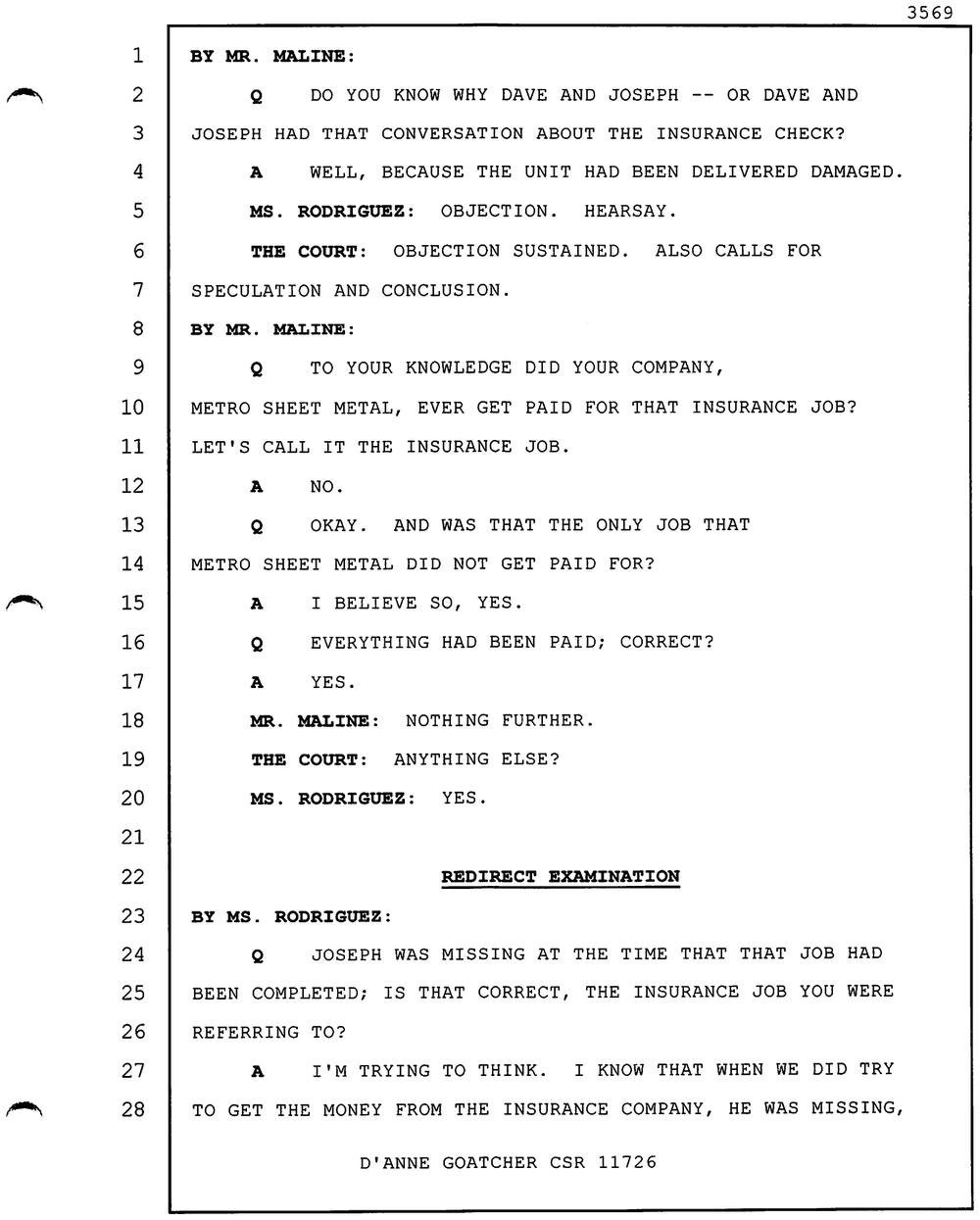
And she told the jury Metro had been paid on every job but one: (RT 3569:9-17)
Q To your knowledge did your company, Metro Sheet Metal, ever get paid for that insurance job? Let’s call it the insurance job.
A No.
Q Okay. And was that the only job that Metro Sheet Metal did not get paid for?
A I believe so, yes.
Q Everything had been paid; correct?
A Yes.
See the transcript (RT 3569)
The one unpaid job was a fountain damaged in delivery, which Joseph asked Metro to remake and said he would pay for when the insurance came in (RT 3556:6-14; card 8). It was not a check given to me.
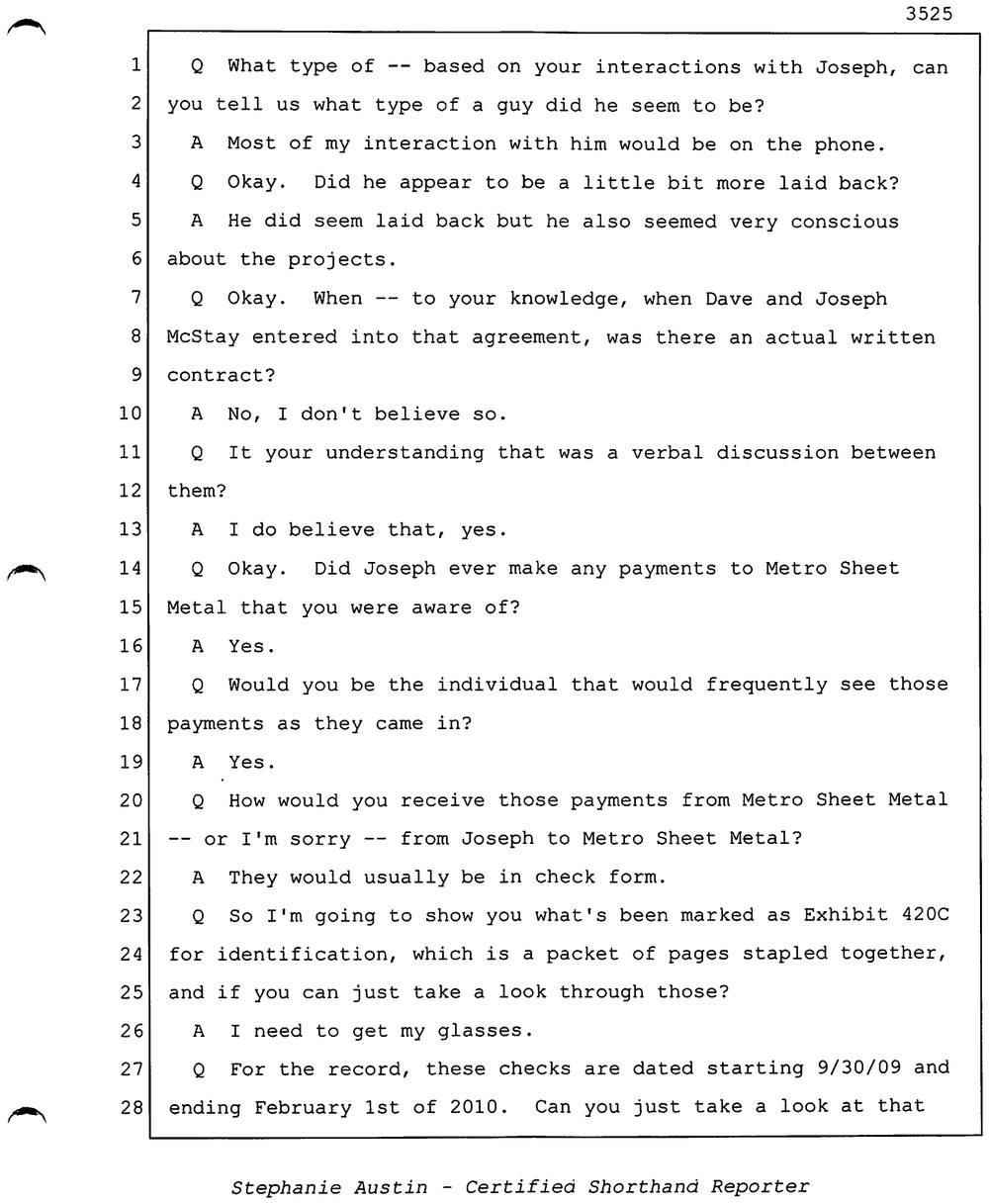
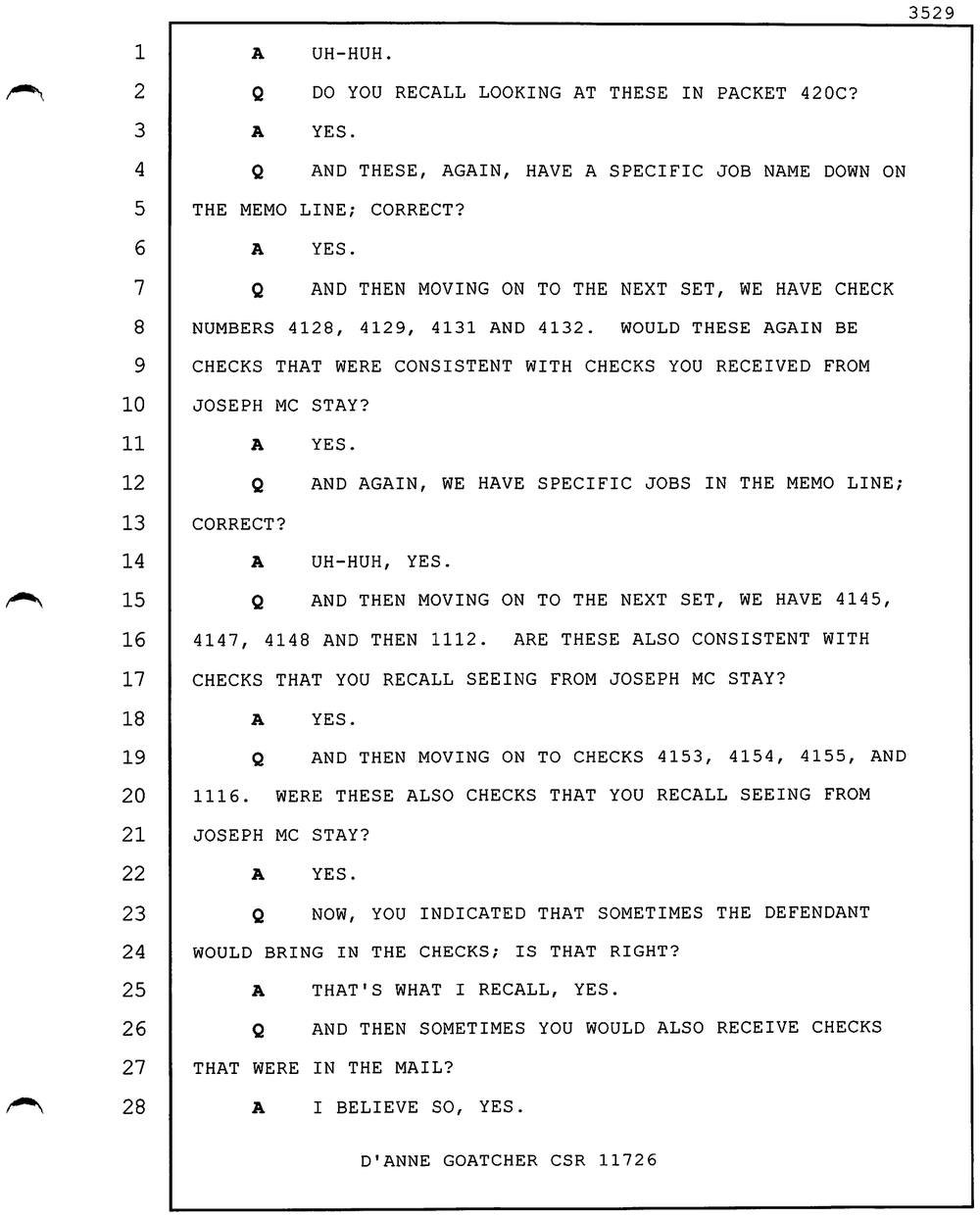
Ms. Rodriguez went through Joseph’s Metro checks with her one by one, Exhibit 420C, including #1116 (RT 3525-3529). She was the person the judge had said could speak to Metro’s statement. No one showed her Exhibit 740, and no one asked her about a missing check. She was never recalled.
See the transcript (RT 3525-3529)
4. What the lawyers told the judge in April
Three months later, when the defense accountant tried to show the jury my $4,900 payment to Metro from the same statement, the lawyers argued about Ms. Garcia: (RT 7016-7017:20)
MS. RODRIGUEZ: And I would add that the Metro Sheet Metal statement that was dated March 1st, the witnesses that testified and were asked about that exhibit said they had no knowledge about it, so it’s not anything that’s actually in evidence.
MR. MALINE: Counsel forgets Carmen Garcia’s testimony. She verified that statement, and the $4,900.00 payment that was withdrawn was — is on that statement as paid.
MS. RODRIGUEZ: I would beg to differ with respect to what Ms. Garcia’s testimony was. She specifically said she did not create invoices.
MR. MALINE: It’s not an invoice, it’s a statement, and she did verify it.
MR. DAUGHERTY: She wasn’t even shown it.
MR. MALINE: Okay.
THE COURT: The witness is — in the exhibit indicates that it’s referencing the Metro Sheet Metal statement dated 3/1/10.
MR. IMES: That was shown to Mr. Sequieda. He didn’t know what it was. It was never used after that. So no foundation was laid for it.
MR. DAUGHERTY: Correct.
MR. MALINE: Just because they say it, doesn’t make it so.
MR. IMES: Fine, review the transcripts.
MR. MALINE: Don’t interrupt me. I’m the one who showed it to Ms. Garcia, she verified it.
MR. IMES: No. He did not.
See the transcript (RT 7016-7017)

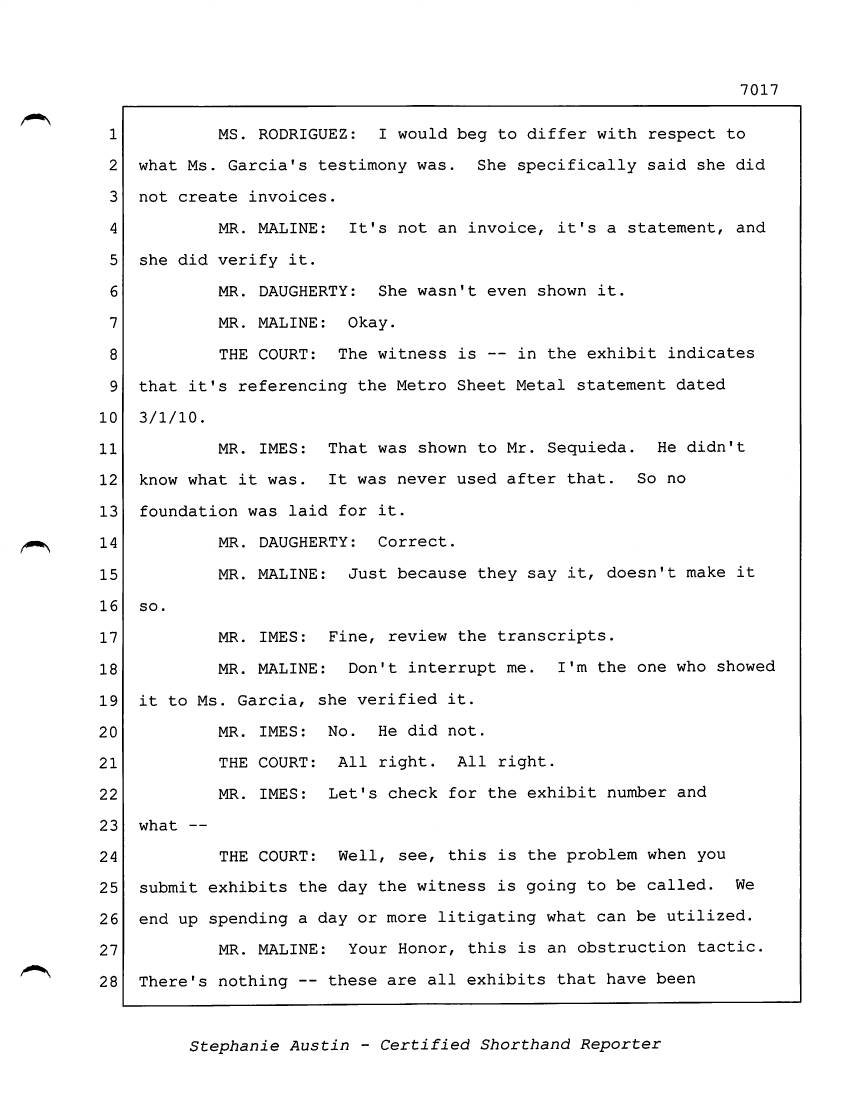
Ms. Rodriguez lied to the court. She told the judge Ms. Garcia “specifically said she did not create invoices.” Ms. Garcia had said the opposite, under oath, and the question that drew it was Ms. Rodriguez’s own: “Would you, yourself, create those invoices that would be sent out to various clients?” “Yes.” “Did anybody else ever create invoices, as well?” “Not that I recall, no.” (RT 3517:20-24, above) She knew what the witness said, because she asked it. She said otherwise for one reason: to keep Metro’s statement, and my $4,900 payment on it, away from the jury.
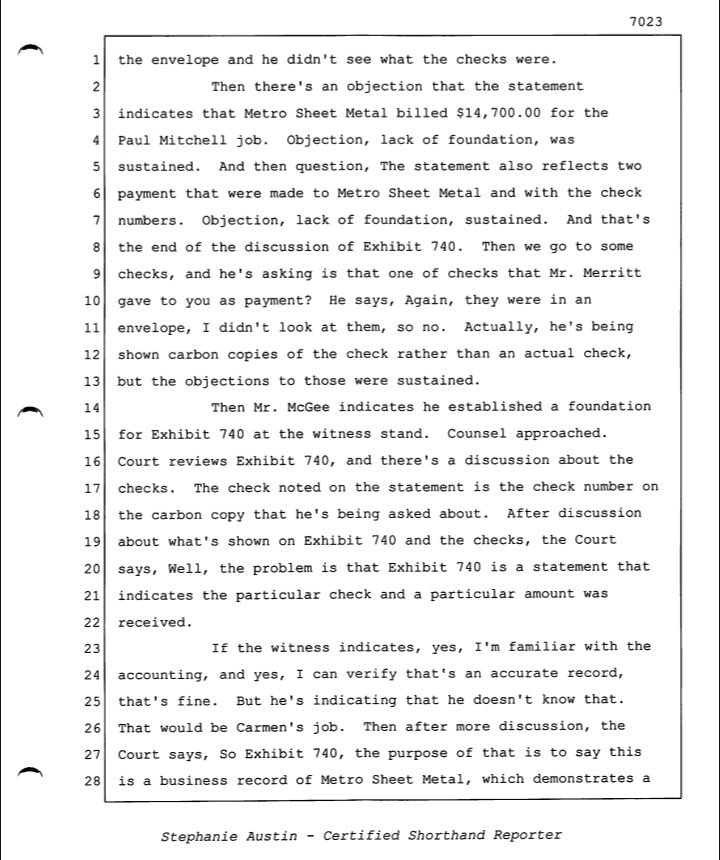
The court then struck my $4,900 payment to Metro from the accountant’s chart, because it rested on the statement it had already kept out (RT 7023:14-7024:21). That ruling, quoted in full, is in Part 4.
See the transcript (RT 7023-7024)

My own lawyer was no better. Three times Mr. Maline told the court Ms. Garcia had verified the statement: “She verified that statement,” “she did verify it,” and “I’m the one who showed it to Ms. Garcia, she verified it.” None of it was true. He never showed her Exhibit 740; it appears nowhere in her testimony (above). So the judge heard two false accounts of the same witness, one from each side, and neither was what she actually said: that she made Metro’s invoices and recorded every payment, and that no one ever showed her the statement. The judge had said it was Carmen’s job. She was on the stand two weeks after he said it, and my lawyers never put the statement in front of her. What else my lawyers left undone on the money is on Advocates or Puppets: Motive.
Nine days later, in a dispute over scheduling, Mr. Maline complained that the court let the prosecutor “say these types of things on a regular basis.” The judge answered: (RT 7675:27-7676:12)
MR. MALINE: Your Honor, you don’t think — I mean, you allow this conduct to go on. I mean, you allow the prosecutor to sit up here and say these types of things on a regular basis.
THE COURT: I —
MR. MALINE: It impedes —
THE COURT: I’ve allowed both sides to do — say things and do things that were improper and making allegations that were either partially true or not true, at all. And we could certainly sidetrack the entire trial and have a whole trial just on the conduct of counsel. That, of course, would be to the benefit of the defense because we would never finish the trial, so I’m not going to do that. I’m going to keep focus on the trial and let other — others deal with misconduct of counsel at a later point.
See the transcript (RT 7675-7676)
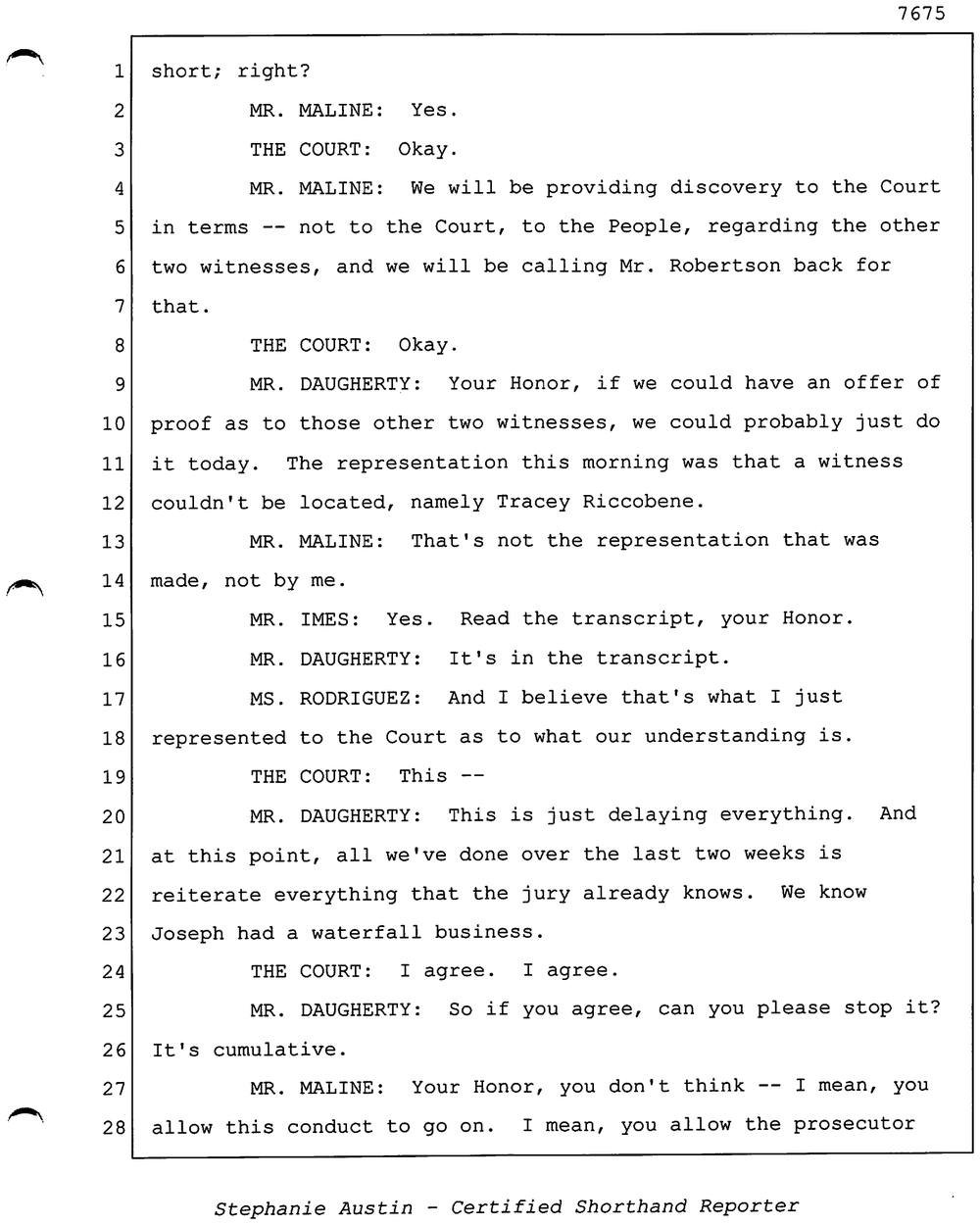
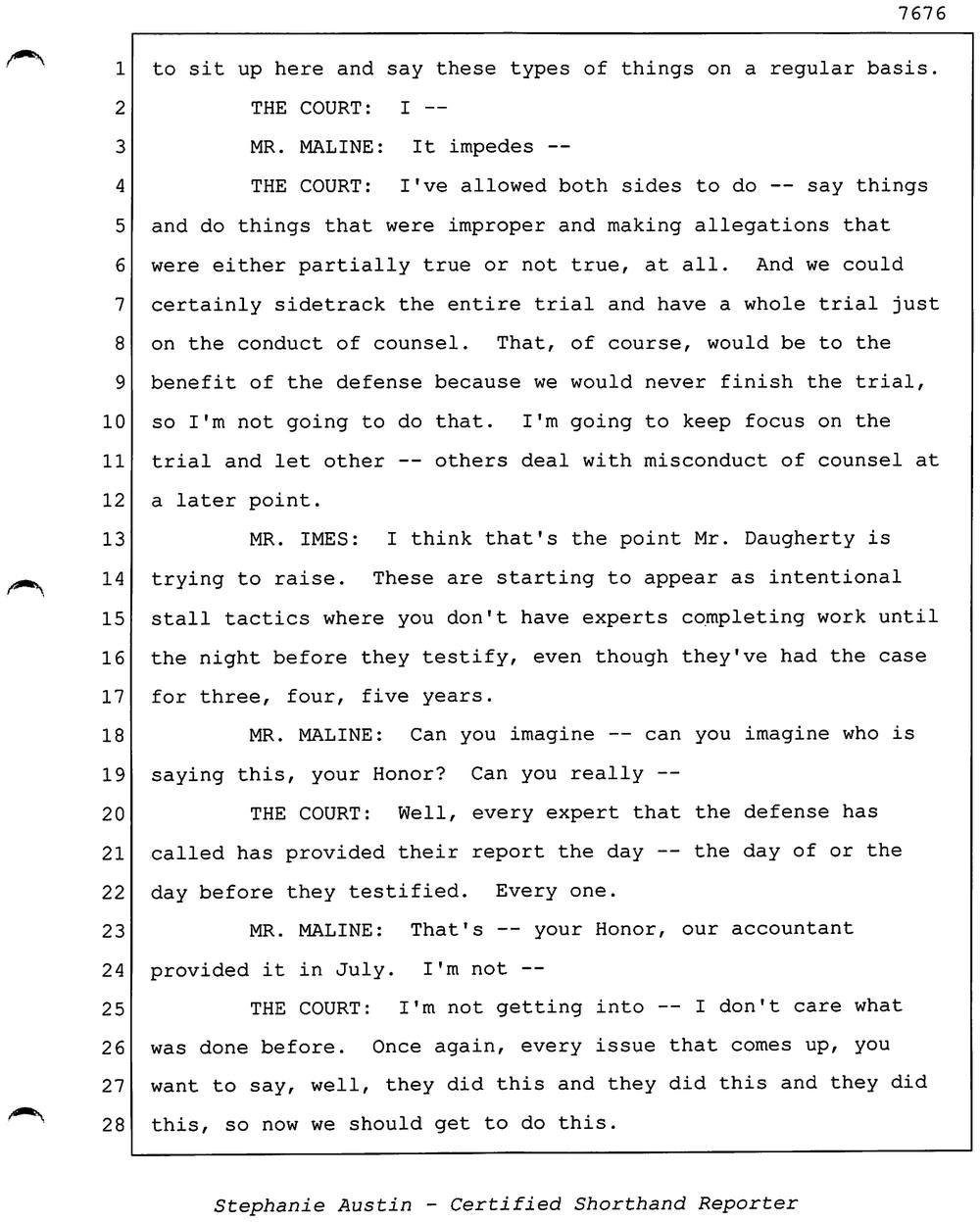
That is how the court handled what the lawyers told it: statements “partially true or not true, at all” were allowed, from both sides, and left for others to deal with “at a later point.” On Exhibit 740, neither false statement was corrected, and the evidence stayed out.
7 of 8
What the judge made of it
The judge decided what the jury could hear about the check: the story without a check, a date or a job, and not Metro’s statement. Then, twice, he relied on what was left. The second time, he stated it as a fact he had found himself.
1. Refusing to acquit me (March 4, 2019)
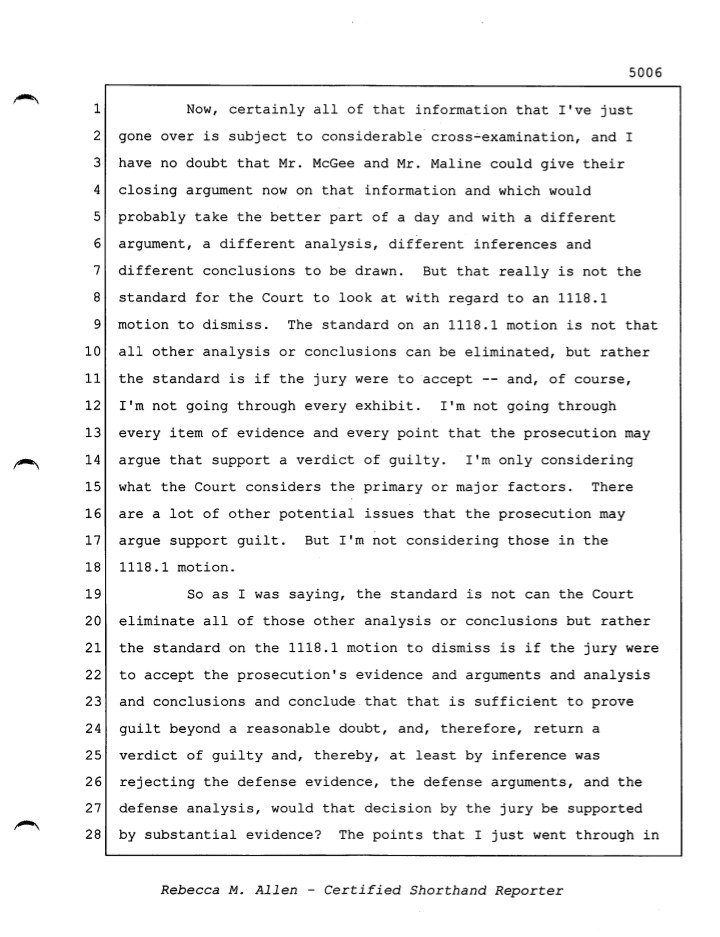
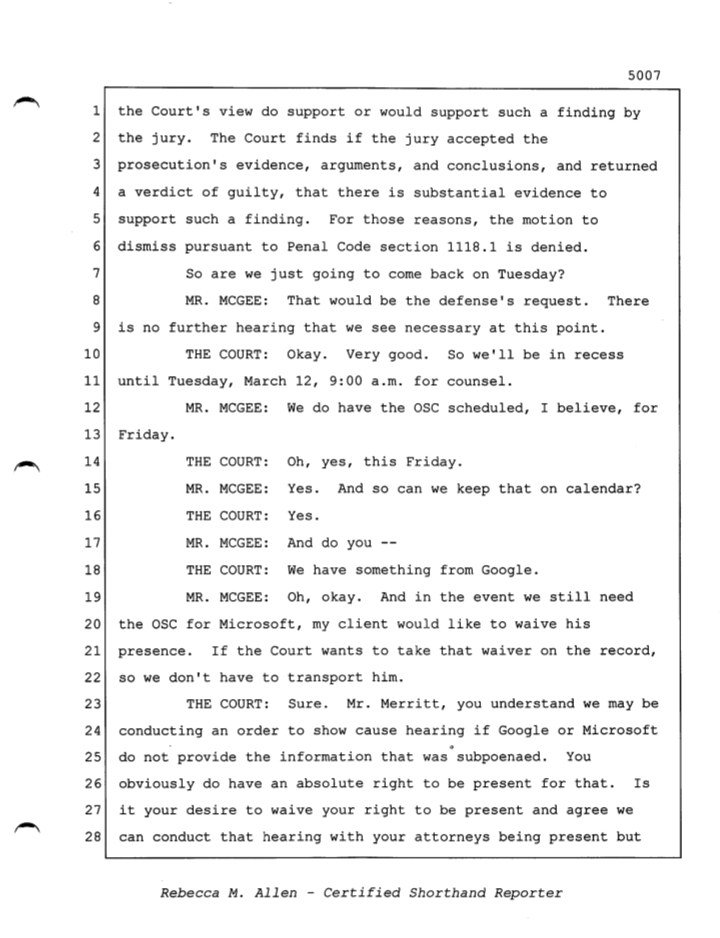
At the close of the State’s case, my lawyers asked the judge to acquit me for lack of evidence. On that motion the judge takes the State’s evidence at its best. He described the standard: (RT 5006:19-5007:6)
So as I was saying, the standard is not can the Court eliminate all of those other analysis or conclusions but rather the standard on the 1118.1 motion to dismiss is if the jury were to accept the prosecution’s evidence and arguments and analysis and conclusions and conclude that that is sufficient to prove guilt beyond a reasonable doubt, and, therefore, return a verdict of guilty and, thereby, at least by inference was rejecting the defense evidence, the defense arguments, and the defense analysis, would that decision by the jury be supported by substantial evidence? The points that I just went through in the Court’s view do support or would support such a finding by the jury. The Court finds if the jury accepted the prosecution’s evidence, arguments, and conclusions, and returned a verdict of guilty, that there is substantial evidence to support such a finding. For those reasons, the motion to dismiss pursuant to Penal Code section 1118.1 is denied.
See the transcript (RT 5006-5007)
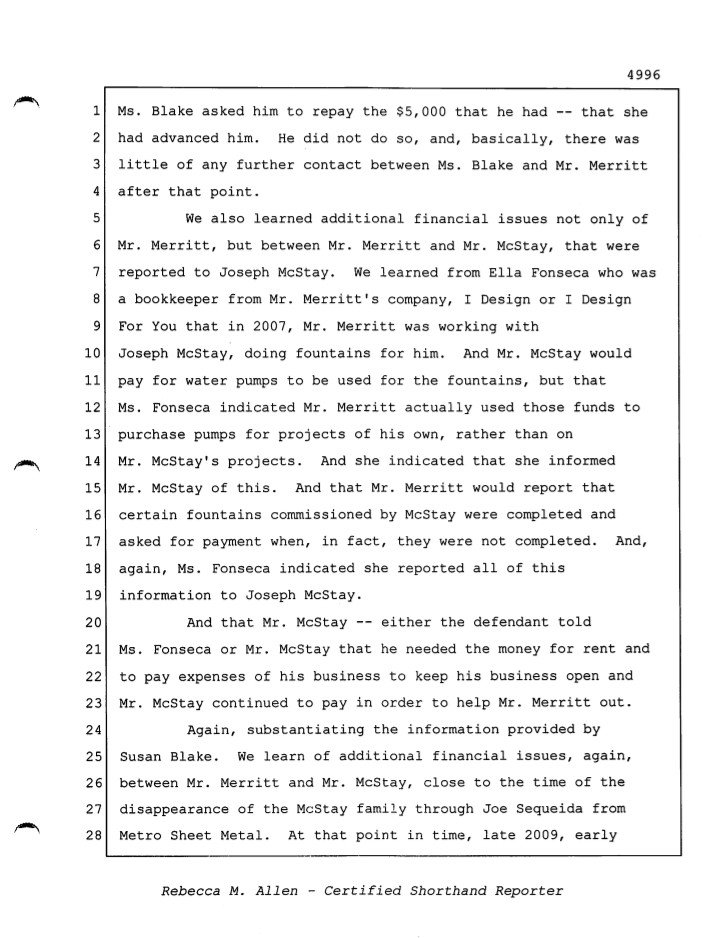
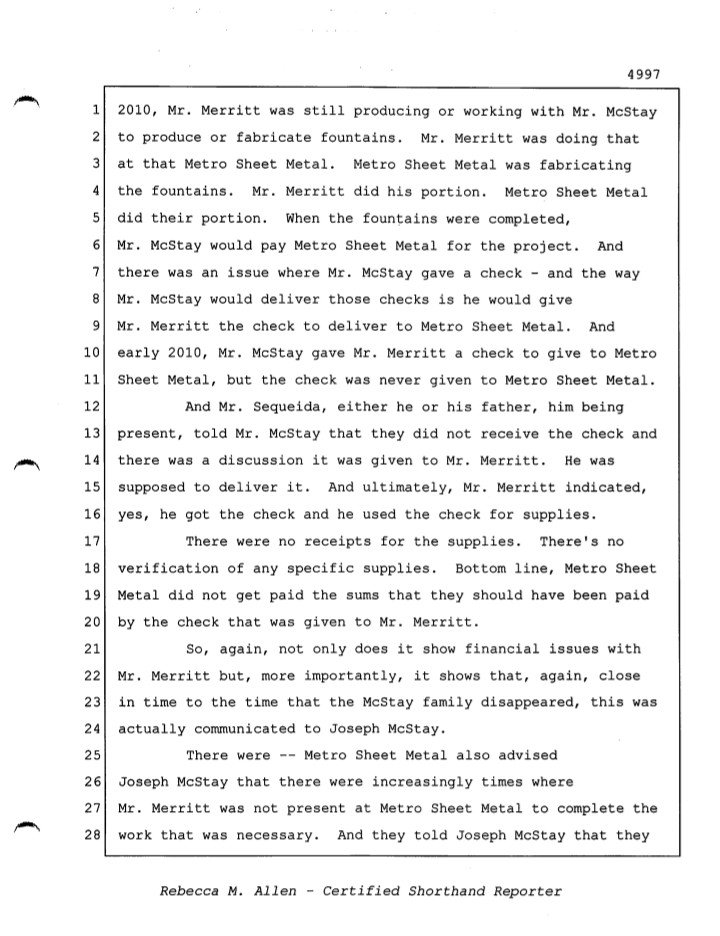
One of the points he went through was the check: (RT 4996:24-4997:24)
Read the judge’s words
We learn of additional financial issues, again, between Mr. Merritt and Mr. McStay, close to the time of the disappearance of the McStay family through Joe Sequeida from Metro Sheet Metal. At that point in time, late 2009, early 2010, Mr. Merritt was still producing or working with Mr. McStay to produce or fabricate fountains. Mr. Merritt was doing that at that Metro Sheet Metal. Metro Sheet Metal was fabricating the fountains. Mr. Merritt did his portion. Metro Sheet Metal did their portion. When the fountains were completed, Mr. McStay would pay Metro Sheet Metal for the project. And there was an issue where Mr. McStay gave a check – and the way Mr. McStay would deliver those checks is he would give Mr. Merritt the check to deliver to Metro Sheet Metal. And early 2010, Mr. McStay gave Mr. Merritt a check to give to Metro Sheet Metal, but the check was never given to Metro Sheet Metal.
And Mr. Sequeida, either he or his father, him being present, told Mr. McStay that they did not receive the check and there was a discussion it was given to Mr. Merritt. He was supposed to deliver it. And ultimately, Mr. Merritt indicated, yes, he got the check and he used the check for supplies.
There were no receipts for the supplies. There’s no verification of any specific supplies. Bottom line, Metro Sheet Metal did not get paid the sums that they should have been paid by the check that was given to Mr. Merritt.
So, again, not only does it show financial issues with Mr. Merritt but, more importantly, it shows that, again, close in time to the time that the McStay family disappeared, this was actually communicated to Joseph McStay.
See the transcript (RT 4996-4997)
He first kept the evidence out, then used what was left. The jury had been told the story was not offered to prove a check was given (card 1); his ruling said “Mr. McStay gave Mr. Merritt a check.” The witness who said he was present had said, five days later, that he wasn’t (card 2). And “Metro Sheet Metal did not get paid the sums that they should have been paid”: five weeks earlier, Metro’s bookkeeper had told the jury that everything had been paid except the insurance remake (card 6). Had Metro’s statement come in, the record in front of him would have shown Joseph’s checks received.
2. Refusing me a new trial
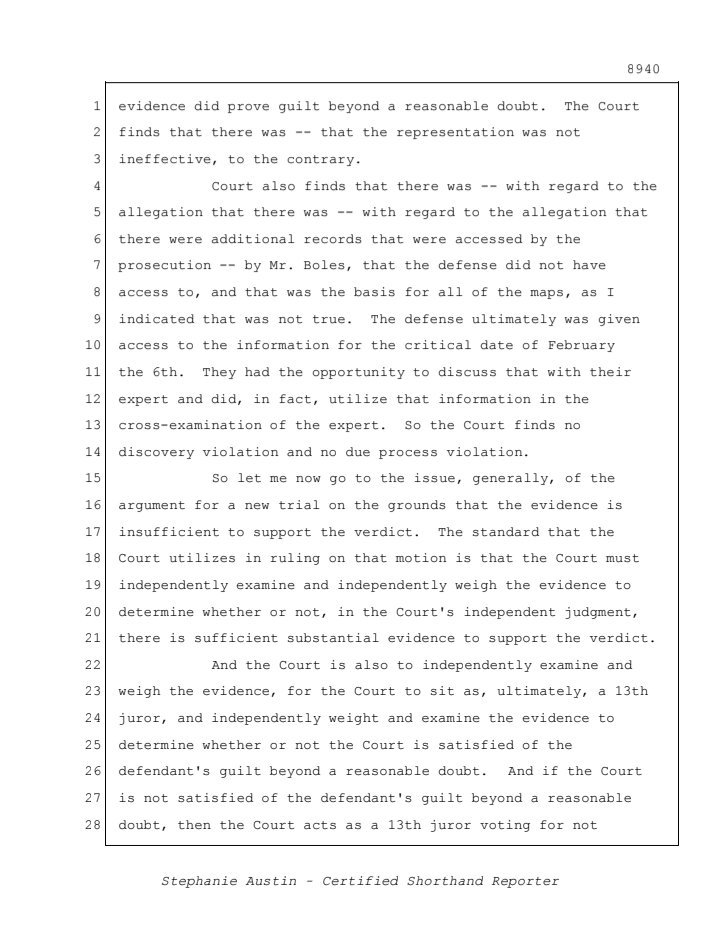
On the motion for a new trial, the judge does not take the State’s evidence at its best. He weighs it himself, as a thirteenth juror. He described that standard: (RT 8940:15-8941:3)
So let me now go to the issue, generally, of the argument for a new trial on the grounds that the evidence is insufficient to support the verdict. The standard that the Court utilizes in ruling on that motion is that the Court must independently examine and independently weigh the evidence to determine whether or not, in the Court’s independent judgment, there is sufficient substantial evidence to support the verdict.
And the Court is also to independently examine and weigh the evidence, for the Court to sit as, ultimately, a 13th juror, and independently weight and examine the evidence to determine whether or not the Court is satisfied of the defendant’s guilt beyond a reasonable doubt. And if the Court is not satisfied of the defendant’s guilt beyond a reasonable doubt, then the Court acts as a 13th juror voting for not guilty, the result being a hung jury, and a motion for new trial must be granted, and that is set forth in Porter versus Superior Court, 47 Cal.4th 125, and People versus Davis, 10 Cal.4th 463.
See the transcript (RT 8940-8941)
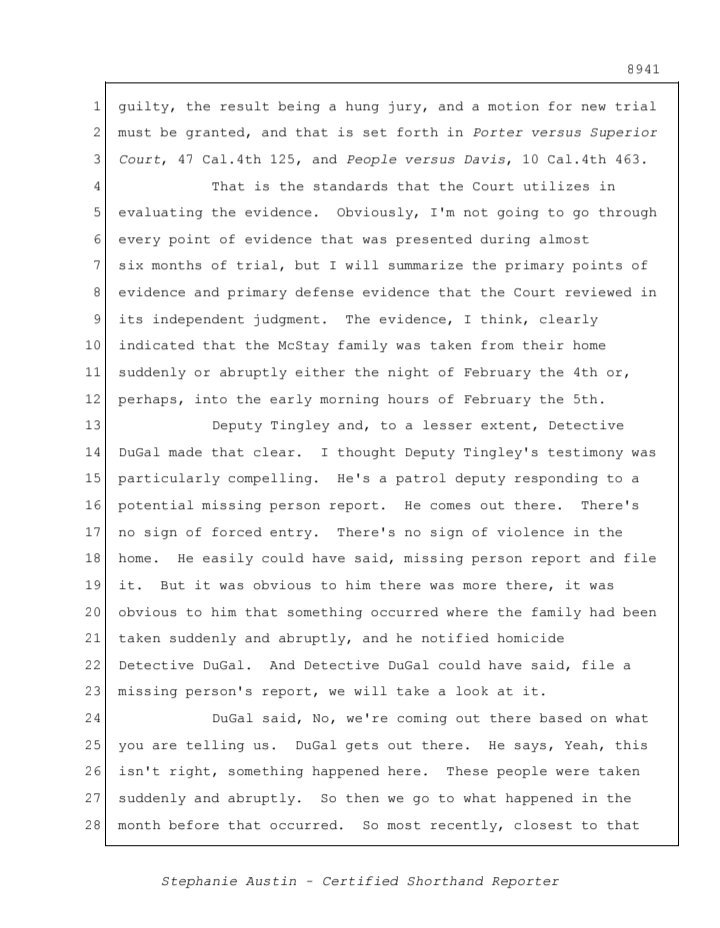
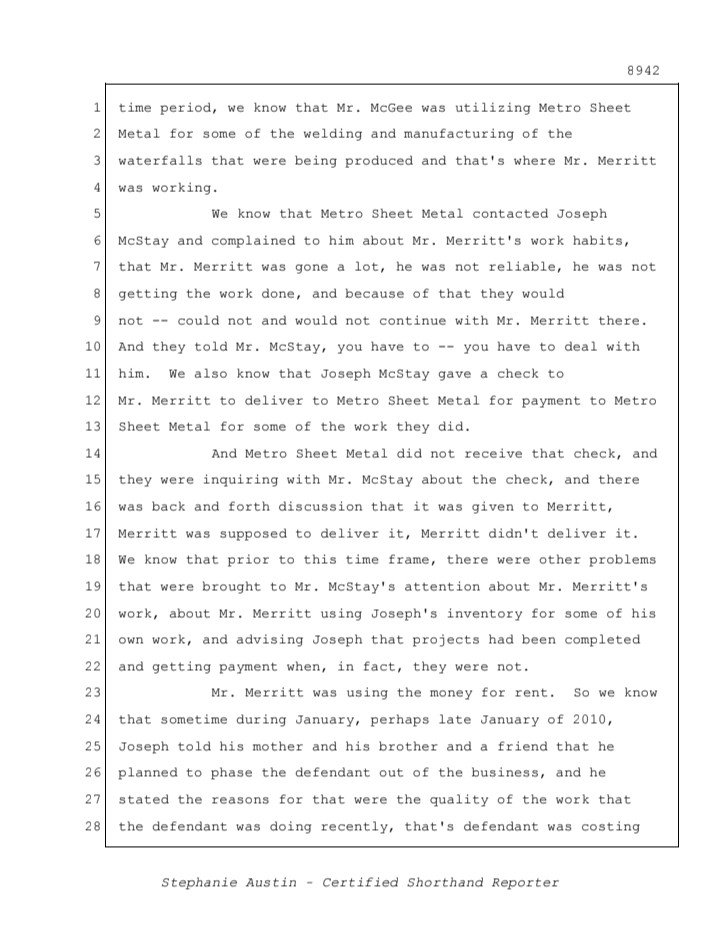
Then, weighing the evidence himself, he said: (RT 8942:5-17)
We know that Metro Sheet Metal contacted Joseph McStay and complained to him about Mr. Merritt’s work habits, that Mr. Merritt was gone a lot, he was not reliable, he was not getting the work done, and because of that they would not — could not and would not continue with Mr. Merritt there. And they told Mr. McStay, you have to — you have to deal with him. We also know that Joseph McStay gave a check to Mr. Merritt to deliver to Metro Sheet Metal for payment to Metro Sheet Metal for some of the work they did.
And Metro Sheet Metal did not receive that check, and they were inquiring with Mr. McStay about the check, and there was back and forth discussion that it was given to Merritt, Merritt was supposed to deliver it, Merritt didn’t deliver it.
See the transcript (RT 8942)
And a few pages later, what he said it proved: (RT 8946:21-25)
All of that information corroborates the financial motive alleged by the People, that the defendant was taking funds from the business, corroborates Metro Sheet Metal complaints regarding the defendant, and corroborates Joseph’s stated intentions to phase the defendant out of the business.
See the transcript (RT 8946)
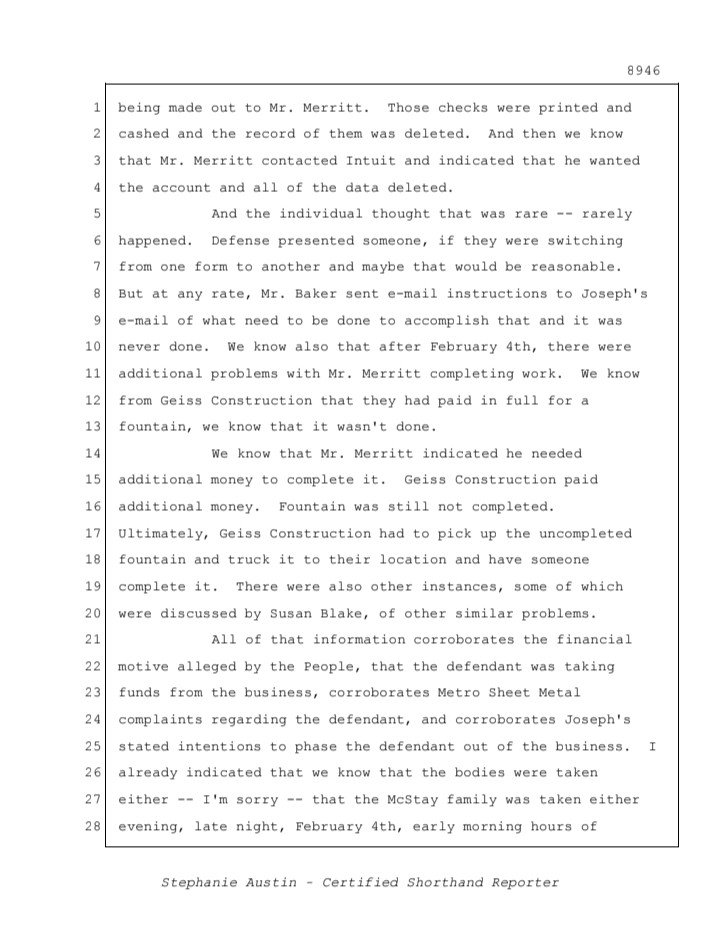
This time it was his own finding. The jury had been told the story was not proof a check was given. The judge, weighing the evidence himself, said “We also know” it was. He had in front of him a witness who couldn’t say what check, what amount, what month or what job; Joseph’s 26 checks to Metro, every one in Metro’s account; and Metro’s bookkeeper saying everything had been paid. He found the opposite, and called it “taking funds from the business.” Metro’s complaints about my work are a separate claim.
8 of 8
Fact check, both ways
What in the record cuts against me, and my answer; then what helps me that is not already above.
What cuts against me
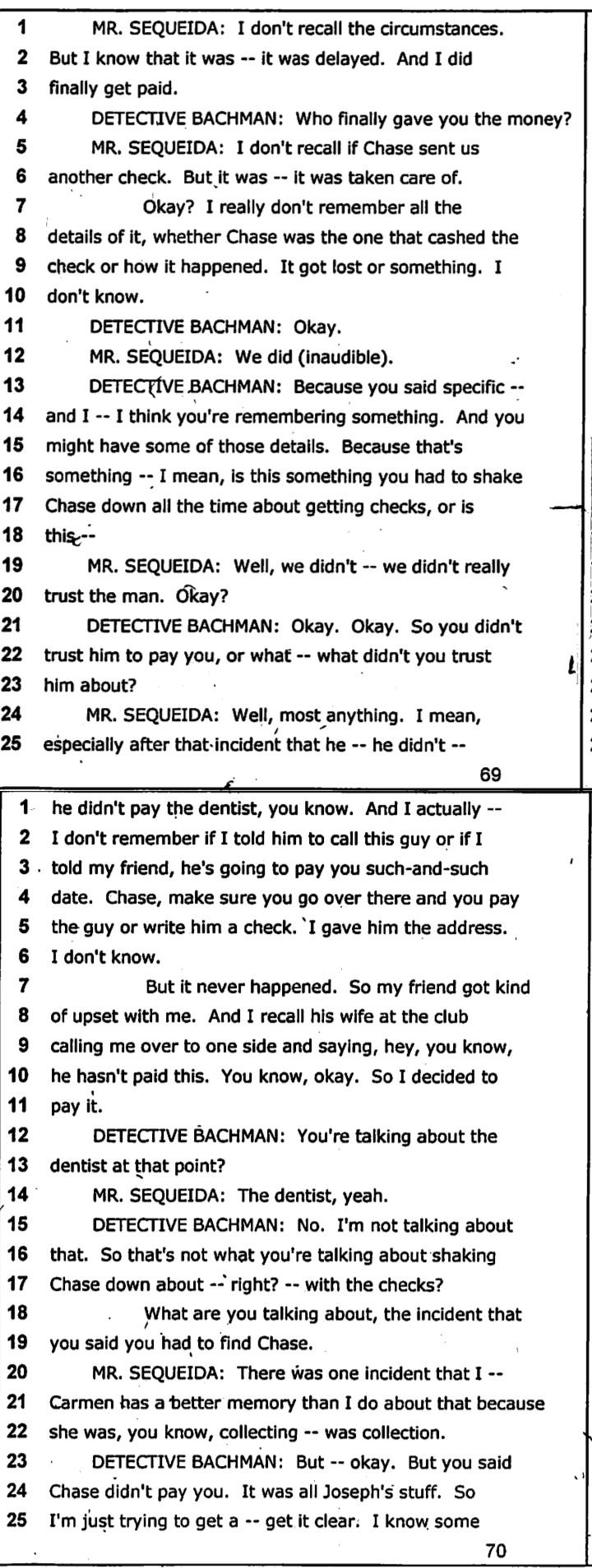
1. Sequeida Sr. remembered a delayed check. The owner, who dealt with Joseph, told Det. Bachman on September 30, 2014 there “might have been one time” when a check I was bringing was late. He ended: “it was delayed. And I did finally get paid.” The whole exchange: (pp. 68:12-69:10)
Read the exchange
MR. SEQUEIDA: Might have been one time. I think that — God, Chase was supposed to pay a check and he didn’t, or something like that. And we got — we had to shake him down to get it.
DETECTIVE BACHMAN: Tell me about that situation.
MR. SEQUEIDA: I don’t have too many details. I just remember that there was an occasion that — but it got resolved.
DETECTIVE BACHMAN: Okay. You said Chase did — was supposed to pay you for something?
MR. SEQUEIDA: I think he was bringing a check from — from Joseph.
DETECTIVE BACHMAN: But you had to shake Chase down?
MR. SEQUEIDA: I don’t recall the circumstances. But I know that it was — it was delayed. And I did finally get paid.
DETECTIVE BACHMAN: Who finally gave you the money?
MR. SEQUEIDA: I don’t recall if Chase sent us another check. But it was — it was taken care of. Okay? I really don’t remember all the details of it, whether Chase was the one that cashed the check or how it happened. It got lost or something. I don’t know.
See the interview (pp. 67-70)
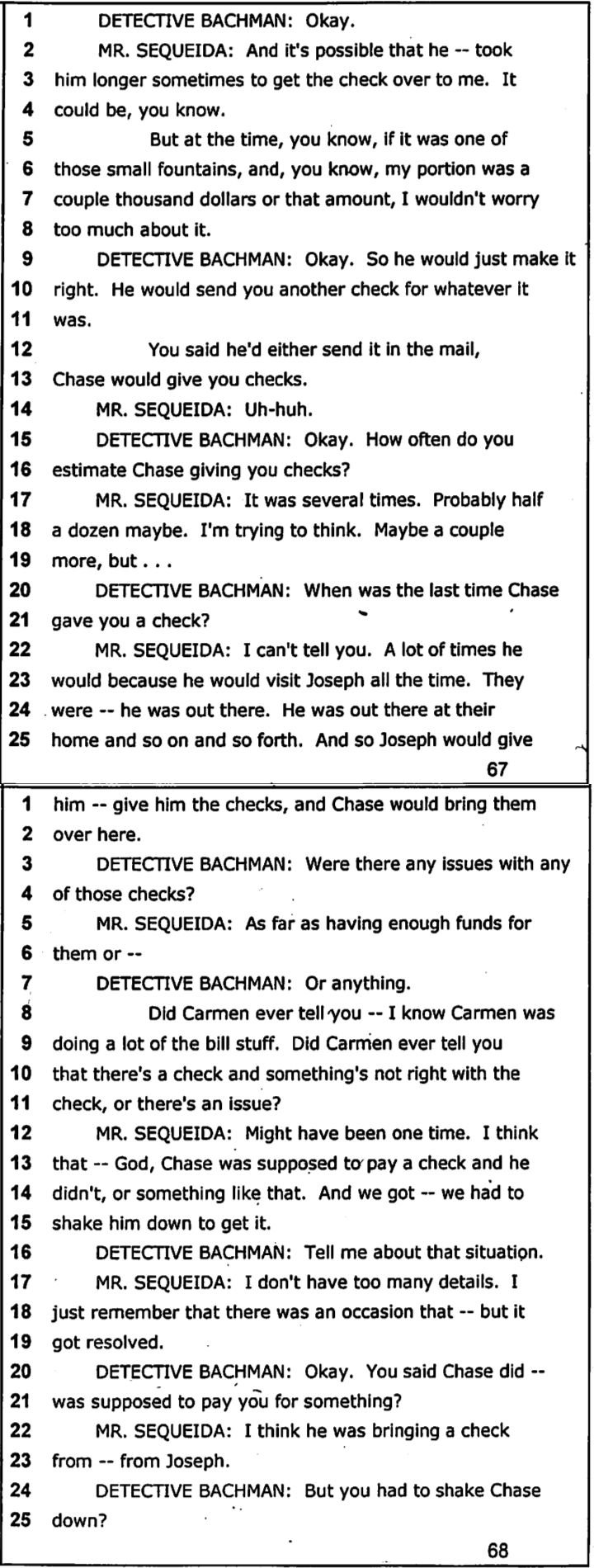
Just before, he said a late check wouldn’t have worried him: (p. 67:2-8)
MR. SEQUEIDA: And it’s possible that he — took him longer sometimes to get the check over to me. It could be, you know. But at the time, you know, if it was one of those small fountains, and, you know, my portion was a couple thousand dollars or that amount, I wouldn’t worry too much about it.
See the interview (p. 67)
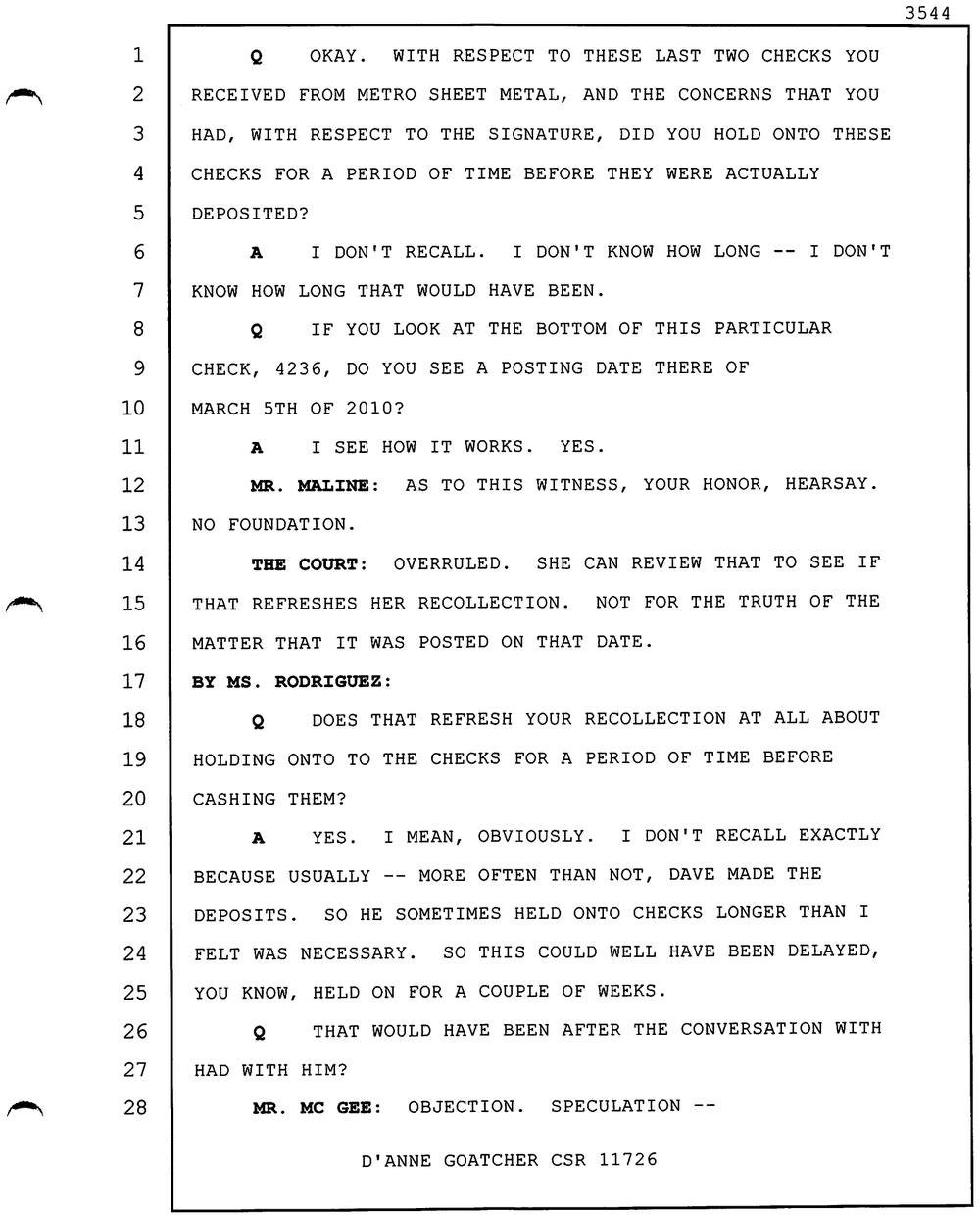
My answer: he is the man who spoke with Joseph, and he says he was paid. A late check is not money taken, and the accusation was money taken (card 1). His bookkeeper also told the jury that Dave made most of the deposits and “sometimes held onto checks longer than I felt was necessary” (RT 3544:21-25).
See the transcript (RT 3544)
2. Sequeida Sr. said I bought too many supplies. A few pages later: (p. 72:3-10)
MR. SEQUEIDA: These guys weren’t getting along, fine. And (inaudible) and all that. Chase would abuse some of the liberties that Joseph would give him to buy supplies, like — like screws and nuts and bolts and nails. He would buy a big pile of stuff like that. I said, Chase, we don’t need that much. Ah, Joseph is paying for it. But — but he would do that, buy (inaudible) personable than this other guy.
See the interview (pp. 71-72)
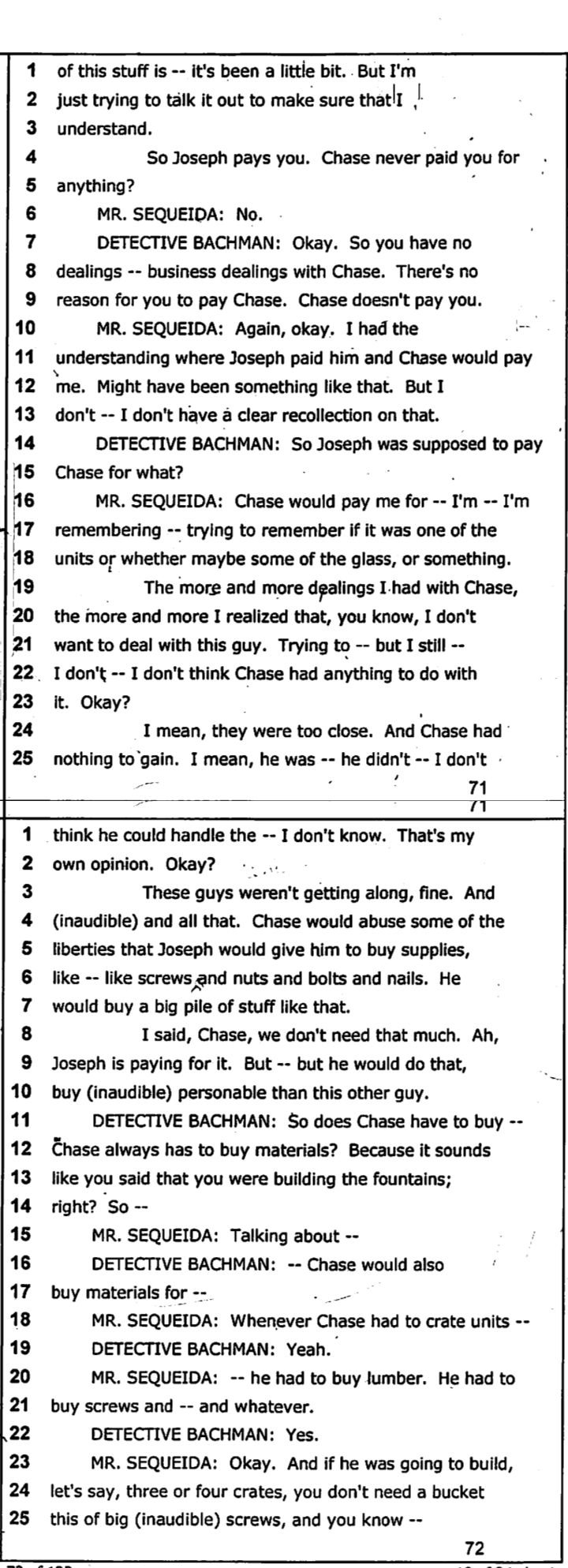
My answer: he said it himself, “Joseph is paying for it.” Those were Joseph’s supplies, bought with Joseph’s money and his permission, for the crating I was responsible for. That is not Metro’s money.
3. Sequeida Jr. said I paid Metro nothing after Joseph was gone. Mr. Imes asked him: (RT 2787:8-22)
Q Was there ever a formal separation between the defendant and Metro Sheet Metal?
A No. Shortly after that, me and my father parted ways again.
Q Okay. Do you recall ever, after the McStays went missing, the defendant paying you or your dad or Metro Sheet Metal, money for completed projects?
A No, sir.
MR. McGEE: Objection. Foundation. He wasn’t at the business anymore.
MR. IMES: I asked whether he was aware.
THE COURT: Overruled. The answer will remain.
BY MR. IMES:
Q You said no?
A No,
See the transcript (RT 2787)
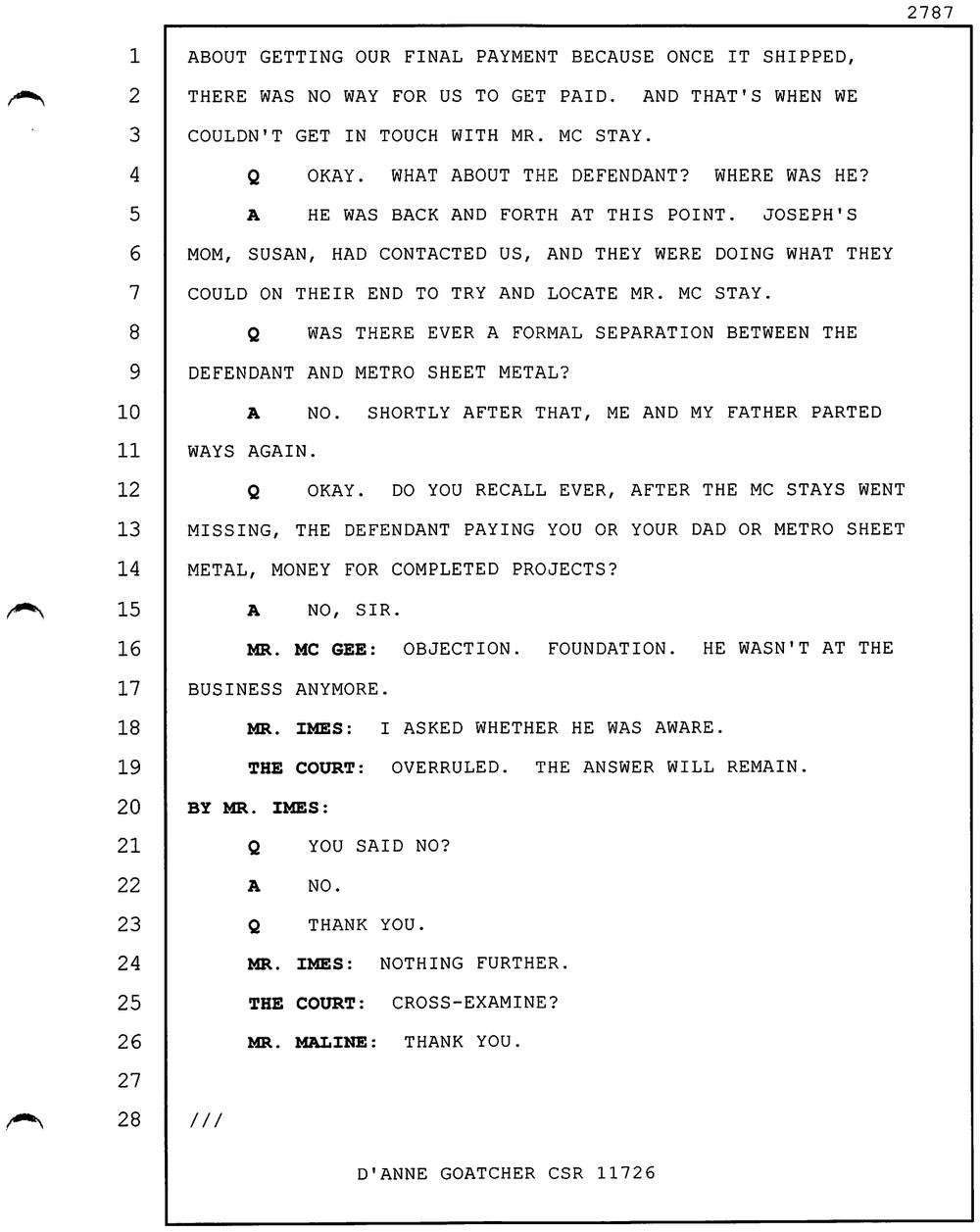
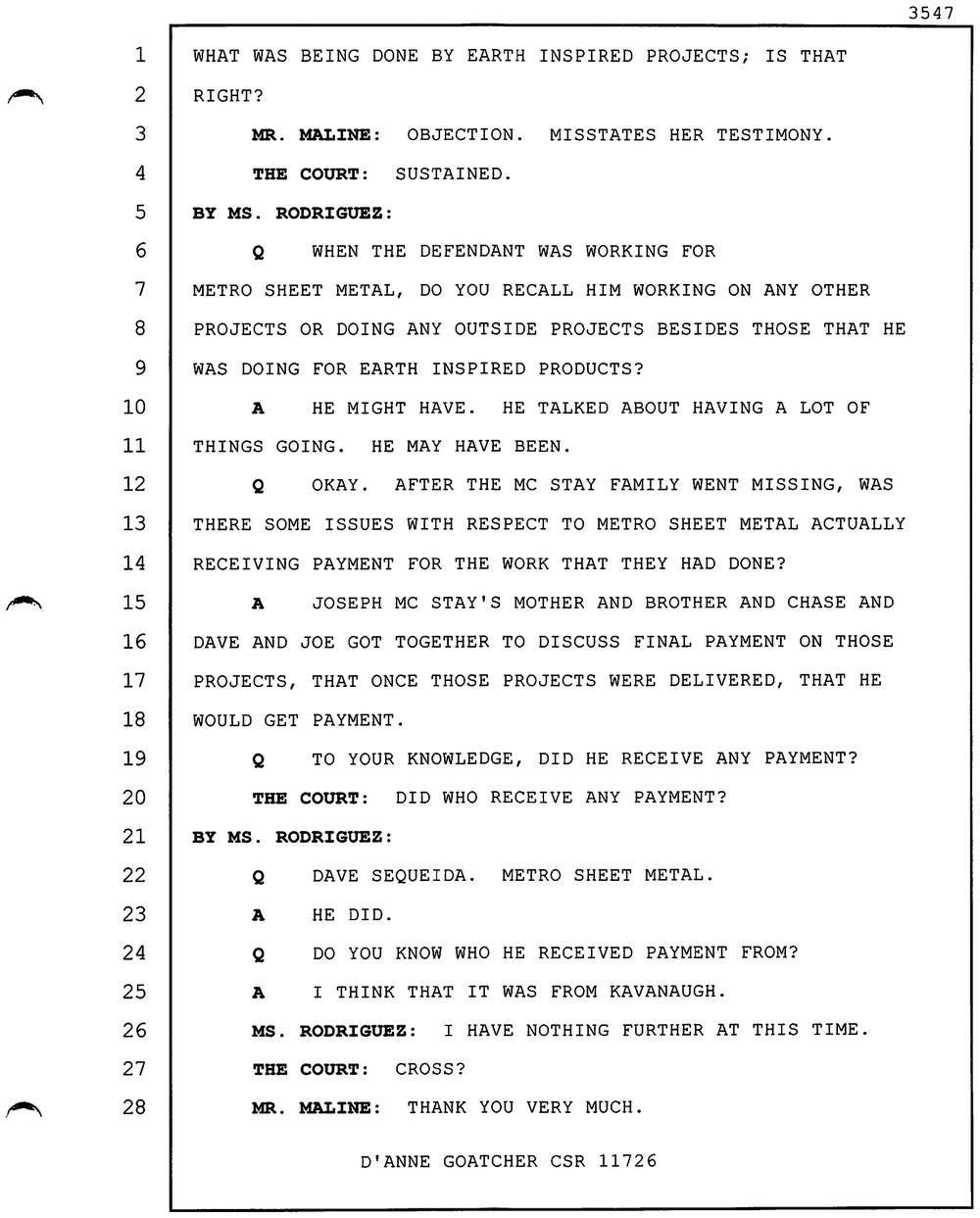
My answer: by his own account he had already left Metro. Metro’s statement shows my $4,900 on February 22, and I paid the $3,450 balance on March 8 (Part 4). Ms. Garcia told the jury Metro was paid in full, apart from the insurance remake: “Everything had been paid; correct?” “Yes.” (RT 3569:16-17) Earlier, on the State’s direct, she said Metro did receive the final payment on the last jobs, and asked who it came from, she said: “I think that it was from Kavanaugh.” (RT 3547:12-25) That was her belief. The records show those payments were mine: $4,900 on February 22 and $3,450 on March 8.
See the transcript (RT 3547, RT 3569)
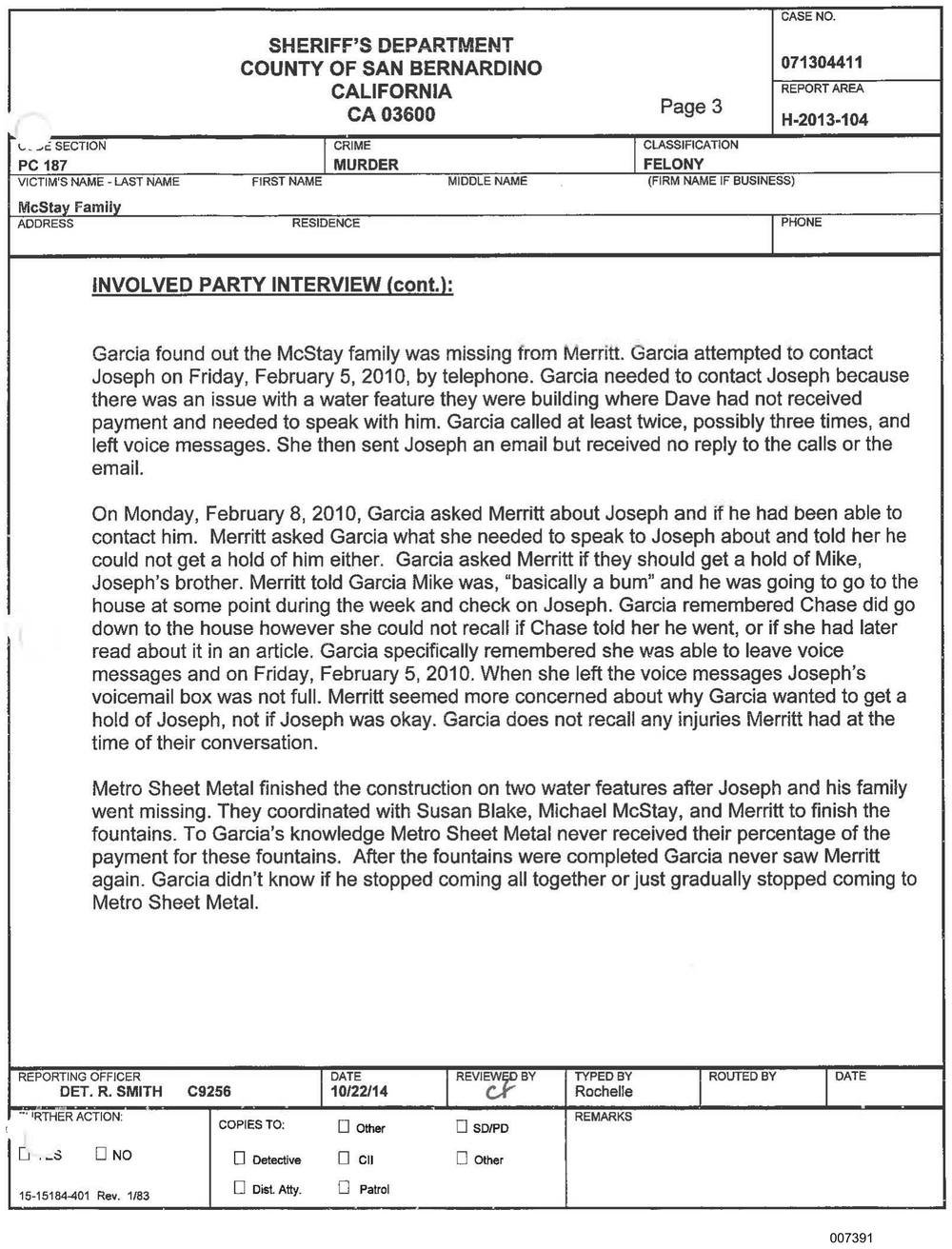
4. Carmen Garcia called Joseph on February 5 about a payment. Det. Smith’s report says she called Joseph “because there was an issue with a water feature they were building where Dave had not received payment.” (Bates 007391)
See Det. Smith’s report (Bates 007391)
At trial she said she didn’t know what the call was about: (RT 3530:8-15)
Q Do you recall when that was that you became aware of that?
A I recall that we tried contacting him on a Friday and couldn’t get in touch. I know Dave had some questions about a project. I don’t know if it was money-related or design-related. I don’t remember that. And I couldn’t — we couldn’t get in touch with him by phone, and he didn’t respond by e-mail.
See the transcript (RT 3530)
My account: if it was money, it was the final payment on Paul Mitchell or Saudi Arabia, which was not yet due. Metro’s statement shows Paul Mitchell still owing after Joseph’s $6,350, and Joseph had paid the 50% deposit on Saudi Arabia. A final payment not yet made is not a check diverted.
5. One job Metro was never paid for. Ms. Garcia described it: (RT 3556:3-16)
Q Okay. And then there was a Paul Mitchell —
A Paul Mitchell into Florida, I believe.
Q Those were kind of big jobs; correct?
A Correct. Plus I believe we were also working on a project that had been damaged in the delivery, and Joseph had asked Dave if he would remake it and that when he received the insurance, he would pay Dave the money that was due. Might have been three projects.
Q Okay. And that one project that you described where Joseph said if you could rebuild it, Dave, I will pay you when I get the insurance proceeds; correct?
A Correct.
Q Do you recall that being the T. Junker account?
A I don’t remember the name on that account.
See the transcript (RT 3556)
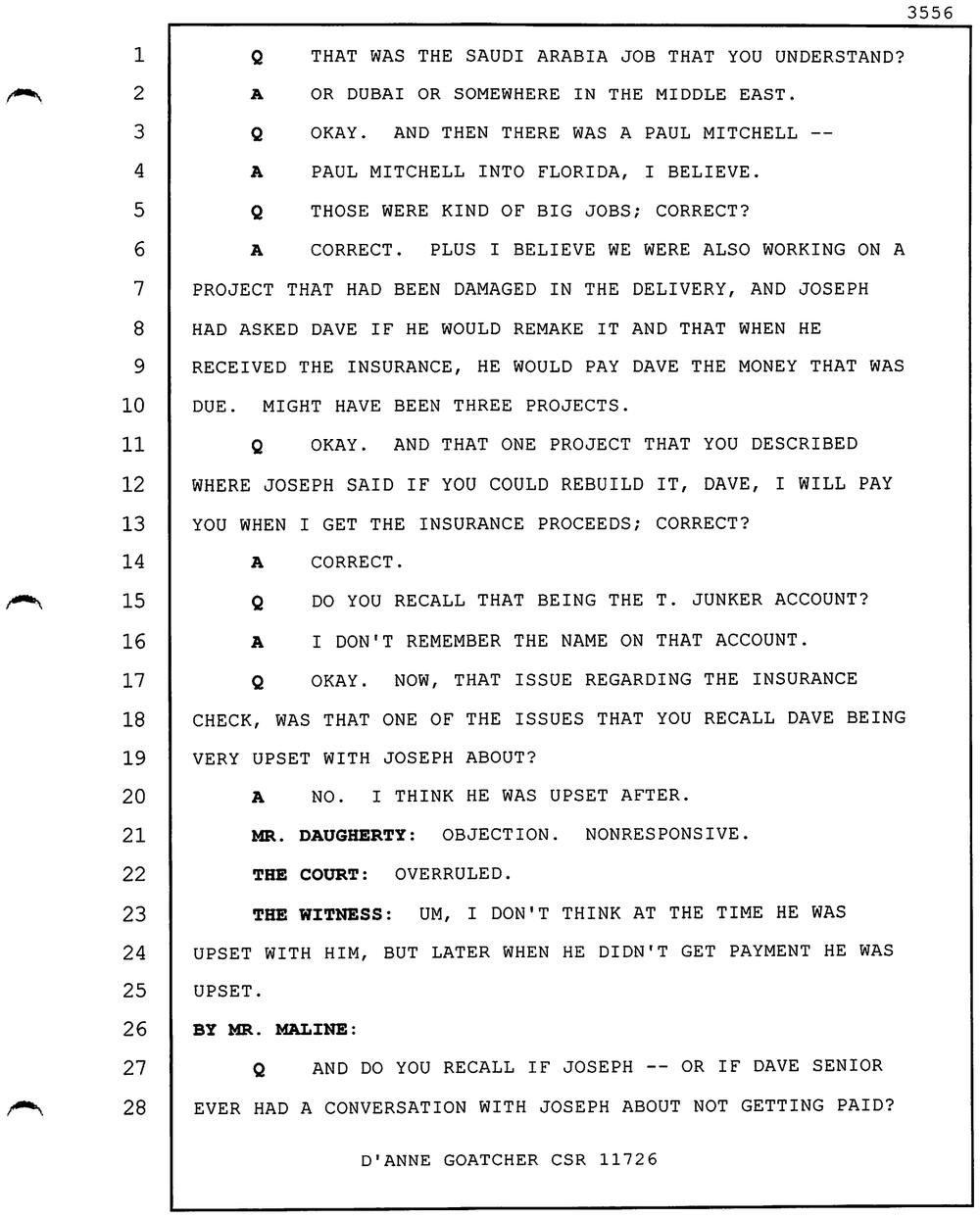
My answer: by her own account, that remake was to be paid from an insurance claim, after the claim was paid. It was never a check, and it was never in my hands.
6. Gaps in Joseph’s check numbers. A few of Joseph’s check numbers never came through his account between October 2009 and March 2010: #1090, #1095, #1099, #1101, #1102, #4118-4120, #4130 and #4239 (see the statements in card 3). My answer: a check that never cleared paid no one. To spend Metro’s money, I would have had to cash the check, and a cashed check is in the bank record as paid. There is none.
7. Ms. Garcia said the signatures on my two February 4 checks to Metro looked different. (RT 3538:9-3540:10) My answer: they looked different because I wrote them. Metro deposited both. Why I wrote them is in Part 2.
8. A small error in the State’s summary. Det. Smith’s summary says Metro received five checks in December 2009; his own list shows eight. It changes nothing.
What helps me, not already above
1. The owner didn’t believe I had anything to do with it. (p. 71:19-72:2)
MR. SEQUEIDA: The more and more dealings I had with Chase, the more and more I realized that, you know, I don’t want to deal with this guy. Trying to — but I still — I don’t — I don’t think Chase had anything to do with it. Okay? I mean, they were too close. And Chase had nothing to gain. I mean, he was — he didn’t — I don’t think he could handle the — I don’t know. That’s my own opinion. Okay?
See the interview (pp. 71-72)
2. Metro let me charge supplies, with no problem. Ms. Garcia told Det. Smith: (Bates 007390)
Dave would occasionally let Merritt charge items on a Home Depot account Metro Sheet Metal had. Garcia did not recall any occasions when Merritt’s use of the Home Depot account became an issue.
See Det. Smith’s report (Bates 007390)
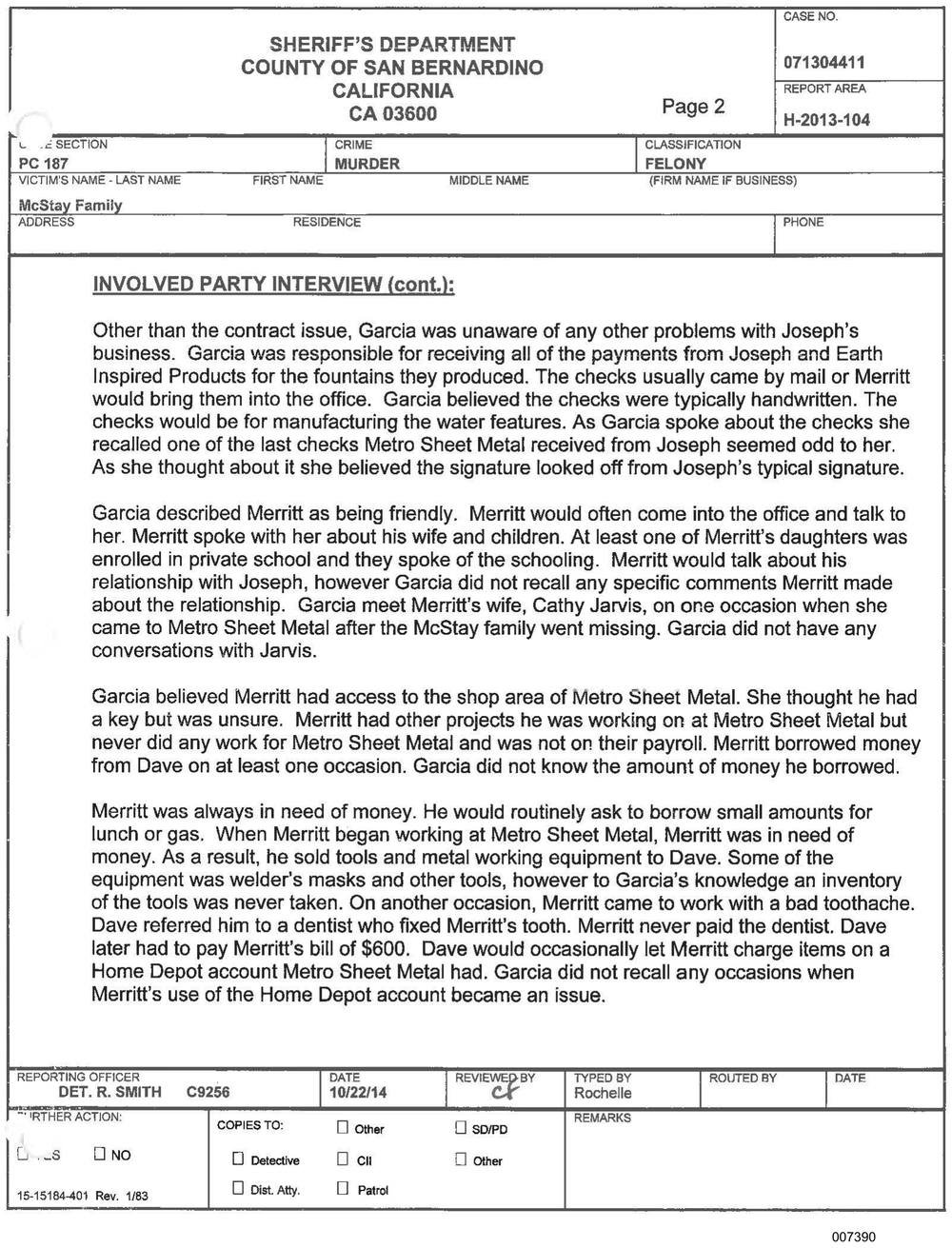
The rest is above: the witness’s changed story (card 2), the checks (card 3), Joseph’s books (card 4), and Ms. Garcia’s testimony (card 6).
Sources
- Trial transcript, People v. Merritt, San Bernardino County Superior Court, Case No. FVI1404194 (RT): Sequeida Jr. 2774-2803 (Jan. 17, 2019) and 2843-2850 (Jan. 22, 2019); Carmen Garcia 3516-3576 (Jan. 31, 2019); the court’s ruling on the motion to acquit, 4996-4997, 5006-5007 (Mar. 4, 2019); argument and ruling on Exhibit 1123, 7016-7017, 7023-7024 (Apr. 29, 2019); the court on counsel’s statements, 7675-7676 (May 8, 2019); Ms. Rodriguez’s closing, 8420-8421; the court’s ruling on the motion for new trial, 8940-8942, 8946.
- Trial video of Sequeida Jr.’s testimony, January 17, 2019 (Law & Crime, YouTube), 20:31-21:53, for RT 2780.
- Joseph McStay’s jobs ledger, 2009 (Bates 002604-002607).
- San Bernardino County Sheriff’s Department: Det. R. Smith, check report, September 17, 2014 (Bates 007402-007417); Det. Smith, interview of Carmen Garcia (Bates 007389-007392); Det. Bachman, interview of David Sequeida Jr. (Bates 007394-007398); bank report (Bates 007446).
- Interview of Dave Sequeida Sr., September 30, 2014 (pp. 67-72).
- Joseph McStay’s Union Bank records, account ending 3626: statements October 2009 to March 2010 and the bank’s copies of the checks.
- Metro Sheet Metal statement to Earth Inspired Products, March 1, 2010 (Exhibit 740).