What They Should Have Known
What was never revealed about the border crossing
FOR IMMEDIATE RELEASE — part of a series examining the evidence in the case.
This is the next in a series examining the evidence in the death-penalty case of Charles (Chase) Merritt: in regard to what the trial jury was shown, and what was kept from it. This installment concerns something plain and hard to argue with: pictures. Surveillance video, from cameras the government viewed, and subsequently deemed as “not of evidentiary value.” Within this footage however was a group of four — a man, a woman, and two small children — walking through a border-area parking lot. The same people that, later on that same evening, the evening of February 8, 2010, were captured on video crossing the Mexico border. The San Diego Sheriff’s Department, the government’s first investigators, concluded that group was “probably” the missing McStay family, the victims in this case. Significant because almost four years later San Bernardino County prosecutors chose to dismiss the border-crossing video because, as they concluded, the McStay family had been killed four days earlier, on February 4th, 2010. Since the prosecution’s own charged story had the McStays dead before the date of the videos, the jury that convicted Charles “Chase” Merritt and sentenced him to death was shown none of the footage — at the prosecution’s behest the court excluded the border-crossing video, and neither the prosecution nor the defense thought to enter the parking-lot video. Whether it was because of lack of due diligence or something else is the question at hand.
You do not need to have followed this case to follow this release. Everything below is explained in plain terms, and every quotation comes directly from the trial transcript, the government’s own reports, or the government’s own evidence logs and the defense’s own murder file.
This is about what two different counties did with the same film — one that investigated and concluded the family probably crossed into Mexico, and one that prosecuted on the opposite premise — as well as what the defense and prosecution alike left either unexplored, or seen and subsequently dismissed. The through-line: a jury was shown far less than the record held. And what they were not shown was theirs to weigh, and never reached them.
The situation
On the evening of February 4, 2010, a young family disappeared from their home in Fallbrook, California. Joseph McStay, his wife Summer, and their two small sons — ages three and four — were gone. Their Isuzu Trooper turned up four days later in a parking lot in San Ysidro, California, a short walk from the busiest pedestrian border crossing in the United States. Three years later, their remains were found in shallow desert graves near Victorville. In 2014, prosecutors charged Joseph’s business associate, Charles (Chase) Merritt, with all four murders, on a theory that he killed the family at their home in the evening hours of February 4. In 2019, a jury convicted him and he was sentenced to death.
There was no eyewitness, no confession, and no physical evidence placing Merritt inside the family’s home. The prosecution’s case depended on a single premise: that the McStays died at their home, at Merritt’s hand, on the date the State insisted the crime occurred.
But two separate government cameras had recorded a group of four — a man, a woman, and two small children — in the border area on February 8: first walking through the parking lot near the abandoned Trooper, then walking into Mexico. The government’s own initial investigators came to believe that group crossing the border was likely the McStays. If it was — if the family was alive on the 8th — then the subsequent case against Mr. Merritt, built on their earlier deaths, fails. Whether the group was the McStays was a question for a jury to weigh. This is the story of the footage that would have let it do so, and of the fact that the jury was shown none of it.
Two counties, two opposite conclusions
The single most important thing to understand about this evidence is that two different law-enforcement agencies looked at it and reached opposite conclusions — and the difference between them is the difference between how the case began and how it was prosecuted.
San Diego County came first. When the family vanished, it was a missing-persons case, and the San Diego County Sheriff’s Department worked it — before any body had been found, before there was any murder theory to protect. San Diego’s investigators requested the border-crossing surveillance, reviewed it across a three-year investigation, showed it to the family, and brought in the National Center for Missing and Exploited Children. It was NCMEC personnel, reviewing the February 8 footage, who located the video of a family crossing the border at approximately 1900 hours — a family that “matched the description of the McStay family.” (Report of Det. E. Bachman, Nov. 16, 2013, Bates 000194.) San Diego’s lead detective, Troy DuGal, worked his assessment of the border crossing from “possible” up to “probable” in his own contemporaneous reports. The Department issued a public statement concluding that the family had, “in all likelihood, travelled into Mexico of their own free will.” On the strength of that conclusion — and because young children were involved — the case was handed to the FBI, which committed years of federal resources to searching for the McStays in Mexico.
None of those agencies had a suspect to convict when they reached that conclusion. They followed the evidence to it.
San Bernardino County came second. After the remains were found, the homicide case — the prosecution of Chase Merritt — was run out of San Bernardino County. And San Bernardino took the opposite position: the crossers could not have been the McStays, because the McStays had already been killed. In support, the prosecution offered that there was no official record the crossers were the McStays, and no record of them returning to the United States.
Hold those two positions side by side. The agencies that investigated the disappearance first, with no murder to prove, concluded the crossers were probably the McStays. The agency prosecuting the murder concluded they could not have been. The jury heard the second and was not given the opportunity to consider the first.
A note on what these pictures do and do not establish, because it governs everything below. There are two distinct questions, and this release keeps them apart. The first is whether the two tapes show the same group of four — the parking-lot camera early in the evening and the border crossing at about 7:00 p.m. That is a matching question, and although it is a matter of inference, it is in my opinion something even a grainy frame settles on its own: the two tapes record a group in the same border-area location, on the same evening, on the same path from the abandoned Trooper toward the pedestrian gate, and within the same time period — and it is my position, developed from reviewing the footage, that the same white bag and white coat appear in both, tying them to one party. A reader looking at the stills printed here should judge that for themselves; what the frames plainly carry is time, place, and path.
The second question is whether that group was indeed the McStays. That question, or the answer to it, is much more nuanced. Although the pictures, and the evidence they carry with them, point toward the family, the pictures do not answer that question by themselves — the crossing tape shows only the crossers’ backs, no faces — and the parking-lot footage is indeed grainy and even less detailed than the border footage. What this release does not waver from, however, is that it was the jury’s question to weigh, and they were never given a chance to do so. What follows is offered on these terms: a group whose movements the frames record, an identification the government itself called probable, and a jury shown none of the footage under either.
The “no record” argument was not new — and the first investigators had already weighed it
San Bernardino’s strongest-sounding point was that there is no official record the crossers were the McStays, and no record of a return. It sounds decisive. It is not, and the reason is simple: the first investigators already knew there was no such record, and concluded it was probably the family anyway.
San Diego reached “probable,” the Sheriff reached “free will,” and the FBI committed years to searching Mexico — all of them knowing there was no turnstile record naming the McStays. At a crossing where an estimated 100,000 people walk through daily, and where the walk from where the Trooper was parked took just minutes, the investigators treated the video as the record, not the paperwork. The FBI does not devote a multi-year search for a family in Mexico if the absence of a crossing log means they never crossed. In other words, San Bernardino’s “no record” argument was not a new fact that defeated San Diego’s conclusion. It was an old fact San Diego had in front of it the whole time — and set aside, because the footage outweighed it.
Of course the McStays died. Nobody contends otherwise. The question was never whether they died — it was when. If the group in the footage was the McStays, and they were alive and walking into Mexico on February 8, then they were not killed on the 4th as the State asserts — an assertion forwarded to the jury without its ever being shown any of the footage that would have let it judge the crossing for itself.
The pictures
There were two sets of images. One was excluded by the court. The other was in the prosecution’s and defense’s own files and never reached the jury.
The border-crossing video (rear view) — excluded by the court. The first was the border-crossing footage itself: a group of four — a man, a woman, and two small children — crossing from the United States into Mexico at about 7:00 p.m. on February 8. The camera caught them only from behind. It was this rear-view footage that San Diego’s investigators, the family members who viewed it, and eventually the FBI relied on. Identifying items appear in it: boots the grandmother associated with Summer, a purse she identified as Summer’s, beanies the boys wore (the family explained they covered a younger child’s birthmark), and a stuffed-animal backpack-leash restraint tethering a child to an adult — the same type of restraint later recovered from the floorboard of the abandoned Trooper.
The Sheriff’s Department did not treat that video as marginal. On March 23, 2010, investigators circulated a “Border Images” memorandum reporting that the border CD contained enhanced images of the family’s 7:00 p.m. crossing (19:00:28 through 19:00:34), organized into three folders — the full images; “Filtered Images, full image filtered and enhanced”; and “Sub Image Filtered, a cutout [of] the family from the images.” (Bates 003328.) Officers reviewing the enhanced images reported identifying details: the male appeared to be carrying headphones in his left hand; the child with the man wore his hood up with his arms out of the jacket sleeves; and “the child with the lady had a backpack on” — consistent with the backpack-leash restraint recovered from the Trooper’s floorboard. (Bates 003328.) An agency does not enhance, filter, and cut a family out of a video frame by frame if it regards that video as unidentifiable or without value.
The defense sought to show the border video to the jury. The trial court would not allow it. The court sustained an objection that the video lacked “foundation” — a legal term meaning the proof needed to establish that a piece of evidence is what it claims to be — ruling: “There’s no foundation for the video. You cannot show the video. You cannot ask specifics of what is shown in the video.” (RT 7595:12–15.) The ruling was formalized minutes later: “Your request to utilize the border video is denied. There’s no foundation for it.” (RT 7598:6–7.)
What makes that ruling extraordinary is what the same judge said in the same conversation, moments before excluding it. Describing the very interpretation the video supported, the court said, in its own words:
“He testified … that he showed the video to the family and asked the family if that could be the McStay family, and they said, yeah, it could be. … The McStays drove there, they parked the car, they went into Mexico. End of story. Something happened after that. All of that is in evidence already.” (RT 7597:15–7598:25.)
The court understood exactly what the footage showed — described the innocent interpretation in its own words — and kept the proof of it from the jury.
That ruling was error under California’s own law of authentication, and the reason is not a close question. To show a video to a jury, the law asks only for evidence sufficient to support a finding that the recording is what it is claimed to be — and that foundation may be supplied by any witness with knowledge of the relevant circumstances, or by the contents of the recording itself. (Evid. Code §§ 1400, 1401, 1421.) The proponent need not produce the camera’s operator, a technician, or the custodian of the agency that made the recording. The state Supreme Court settled this in People v. Goldsmith (2014) 59 Cal.4th 258, a surveillance-recording case, which holds that a video may be authenticated by circumstantial evidence and that testimony from whoever created or maintained the equipment is not required. Whether some “better” witness could theoretically be produced goes to the weight the jury gives the video — not to whether the jury may see it at all.
Detective DuGal was exactly such a witness, and he was on the stand. He had requested the footage from the U.S. Border Patrol for a specified crossing point and date range; his office received it in response; he reviewed it across a three-year investigation; his agency processed, filtered, and enhanced it; he showed it to the family; and he relied on it in the assessment that reached “probable.” A witness who can testify to what he asked for, whom he asked, what he received, and what it depicts has supplied everything the law requires. The court’s contrary demand — that the defense produce a federal custodian to “come in and say … it’s accurate” — imposed a condition California law does not recognize, and applied it to exclude the defense’s central piece of exculpatory evidence.
Candor requires one more thing from this account, because this release holds itself to the record it asks others to honor. The exclusion colloquy did not begin with the court announcing that test. It began with the prosecution objecting to the video on relevance and on identity: “We would object to that, the border video. And playing it at this point is simply not relevant. It’s not them.” (RT 7592:2–4.) The charged theory, stated as settled fact — offered as the reason the jury should not see the very pictures whose meaning was the question. The federal-custodian premise entered next, and it entered from the defense: “The border video requires somebody from Homeland Security.” (RT 7592:25–26.) The prosecution’s answer was “Get them.” (RT 7592:28.) The court then wrote that premise into its ruling. None of this rescues the ruling — a court is responsible for applying the law of authentication whether or not a party hands it the wrong test, and under Goldsmith the test it applied was wrong. But it locates the failure honestly. A prosecution that argued identity as fact and, handed the wrong test, said “get them” rather than acknowledging the witness already on the stand could authenticate. A defense that supplied and then conceded a foundation requirement the law does not impose — without citing sections 1400–1421, without an offer of proof, without putting Detective DuGal through the retrieval, the chain, the viewing, and the enhancement. And a court that adopted the concession and excluded the exhibit. The error was compounded from all sides, not invented from the bench.
The parking-lot video (front view) — in the files, never shown. The second set is the one that was never excluded, because it was never offered. Within the surveillance the government produced to the defense — roughly 28,000 individual frames — was footage from a parking-lot camera, Camera 16, that recorded the same group from the front: walking through the San Ysidro shopping-center lot, near where the Trooper was parked, in the minutes before the border crossing. And again, front view — the exact angle the border video lacked.
That angle mattered, because the whole reason the identifications stayed cautious was that the border video showed only the crossers’ backs. San Diego’s lead detective said as much on the stand, explaining why he called the crossing “probable” but not certain:
Q (Mr. Maline): “And so that — the fact that the family crossed — or the family that you viewed on the video crossed on February 8th, combined with the fact that the car was found near that border crossing on the 8th, those factors led you to believe that … that was the family; would you agree?”
A (Det. DuGal): “Not as definitive as you put it. In law … we deal with probable cause. I believe it was probable that it was them based on the family’s assessment. But it was almost equally probable it was not them, because we had no facial features and it was a grainy video from behind them, you know, dim-lit area. It did fit for a time frame. That’s it.” (RT 2469:27–2470:10.)
No facial features. From behind. Every deficiency the detective named — no faces, rear view only — is a deficiency the front-view parking-lot footage, although admittedly grainy, bore directly upon. It was the same group from the front, carrying the same white bag and white coat that appear in the rear-view crossing.
The jury never saw it. It was produced to the defense buried in tens of thousands of undifferentiated frames, and at trial a detective was asked whether the surveillance held anything useful:
ADA Imes: “Okay. Did you see anything of any evidentiary value on any of the surveillance tapes?”
Det. DuGal: “From these lots?”
ADA Imes: “Yes.”
Det. DuGal: “No.”
(RT 2337:4–8.)
“No evidentiary value.” That was the footage of a group of four walking toward the border on the day in question — the answer that, in the jury’s minds, foreclosed the existence of any visual evidence supporting the border-crossing interpretation.
The method, in an investigator’s own words
There is a question a reader is entitled to ask: how does a video that is unarguably connected to footage authorities already deemed “probable” as to being the McStays become footage of “no evidentiary value”? A possible answer is in the sworn testimony of the San Bernardino detective then heading the investigation.
Detective Bachman was asked about a report he wrote comparing surveillance images of a vehicle he and the prosecutors later claimed was the defendant’s. He acknowledged he had begun from a conclusion: he “compared pictures based off the belief, initially, that it was the Trooper leaving the residence,” and built his report to show “inaccuracies” — differences, such as which side the exhaust pipe was on, that “would exclude the Isuzu Trooper” (the McStays’ vehicle). Defense counsel then drew out the method directly:
Q (Mr. Maline): “So you are looking for how to exclude a video — exclude that vehicle; correct?”
A (Det. Bachman): “Correct.”
Q: “And for Mr. Merritt’s vehicle, you were looking to include it; correct?”
A: “Yeah, to find consistencies in there.”
Q: “But with the Trooper, you were looking for inconsistencies?”
A: “Right.”
(RT 7480:12–20.)
That is a lead investigator describing, under oath, two opposite methods applied to the same kind of evidence depending on which way it cut: with the victims’ Trooper, he looked for reasons to exclude; with the suspect’s vehicle, he looked for reasons to include. And he began, by his own account, from “the belief, initially” that the vehicle was the Trooper — the conclusion first, the comparison built to fit it.
This release does not claim Bachman said any of this about the border footage; he was testifying about the vehicle comparison. It offers the testimony for what it plainly is — the investigation’s method, stated in its own words — and lets the reader consider how that same method, applied to a video of a group of four walking toward the border, produces the answer the jury heard: “no evidentiary value.” The detective who gave that answer, DuGal, had written in his own reports that the crossing was probably the family. The prosecution elicited “no evidentiary value” from him on direct examination. And the San Bernardino Sheriff’s lead detective on the case, Smith, sat in the courtroom as a consultant to the District Attorney throughout the trial. The characterization was drawn out, and it was left to stand.
What the parking-lot camera recorded — the full sequence
The first of those videos, from Camera 16 parking-lot footage, captured the group — front view — walking away from the area where the Trooper was found abandoned. The frames that follow are presented in the order the camera recorded them. They are dark, low-resolution nighttime surveillance stills, and they are offered not as proof of identity — no one claims a grainy frame can furnish that — but for what they plainly carry: time, place, and path, and, where visible, the white coat and white bag that run through the sequence. A reader should judge the images for themselves. That is precisely what the jury was never permitted to do.
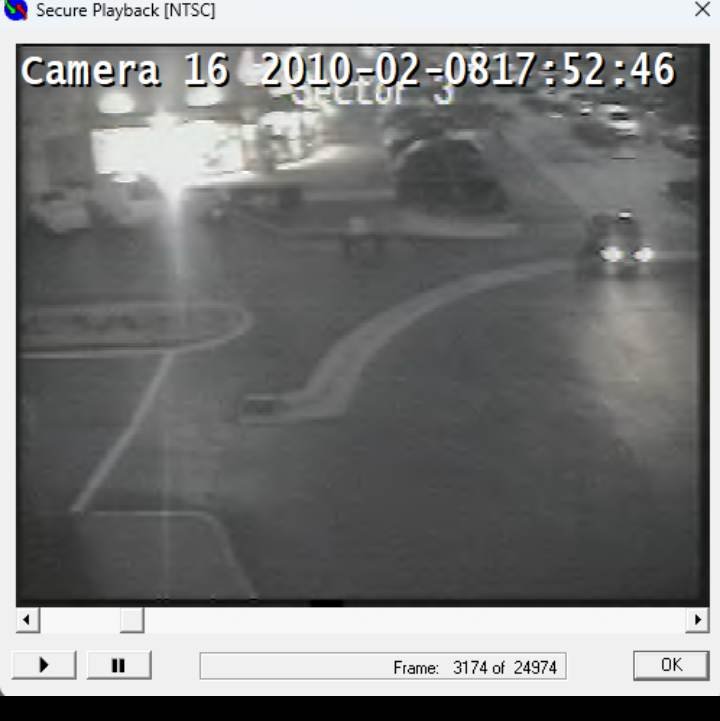
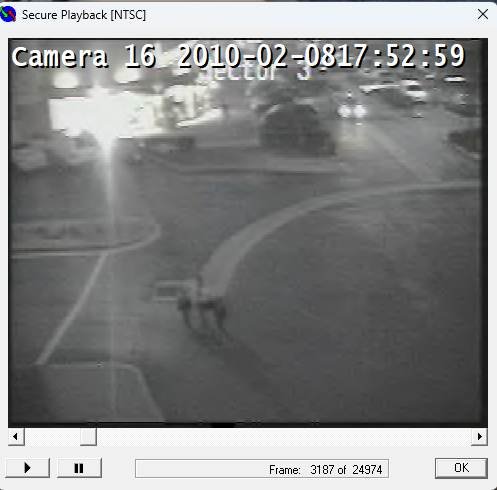
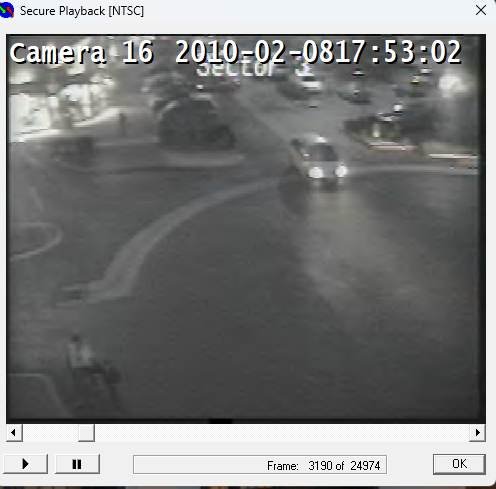
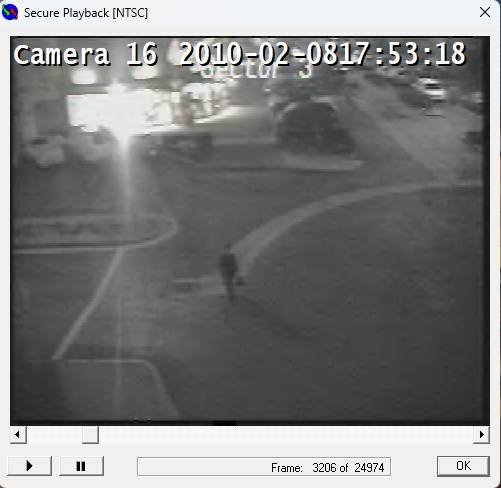
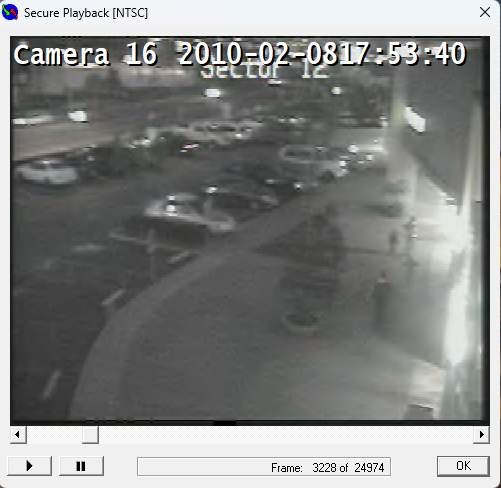
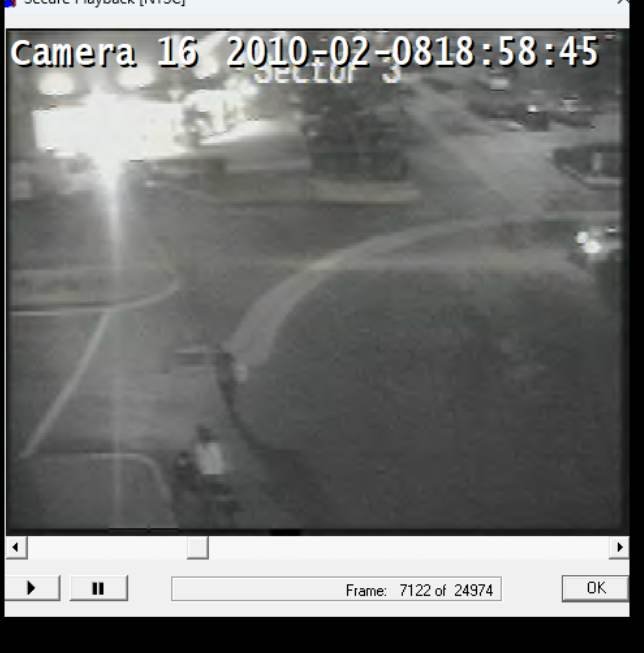
This sequence depicts a woman and two young children walking toward the camera and away from a crosswalk that leads to the parking area where the Trooper was later found (Image 1); then the same three figures with a male adult just coming into view behind them (Image 2); then the same view, closer, the male closing the gap (Image 3); then the group continuing across the lot (Image 4); then all four together, walking away from the camera in front of the duty-free store, one child turned back with hands raised toward the adult male who had caught up (Image 5); and finally, just over an hour later, the group in the same general area again, walking toward the border crossing (Image 6).
The next image is a still from the border crossing itself — the same group, seen from behind, crossing from the United States into Mexico.
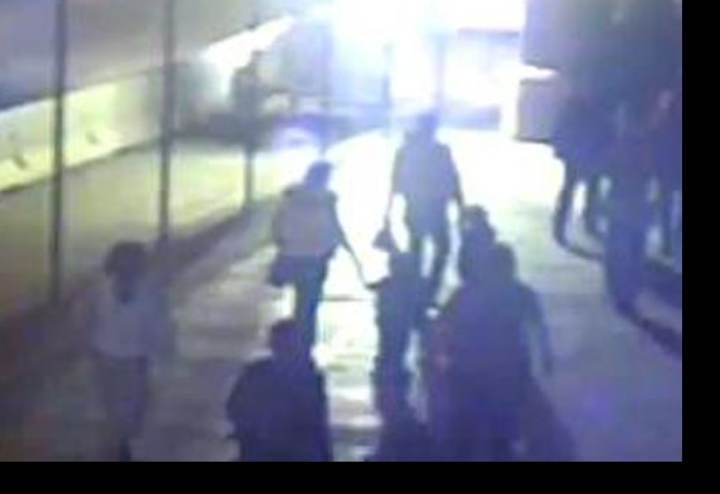
These images capture the same group of four from complementary angles: the front view (Images 1–6) and the rear view (Image 7). Identifying items appear in both — the white bag and the white coat — tying the two perspectives to one party.
The same camera that captured Images 1–6 (Camera 16) completed the account later that night. At 11:08 p.m. it recorded the McStays’ Isuzu Trooper being towed from the parking area the group had walked away from:
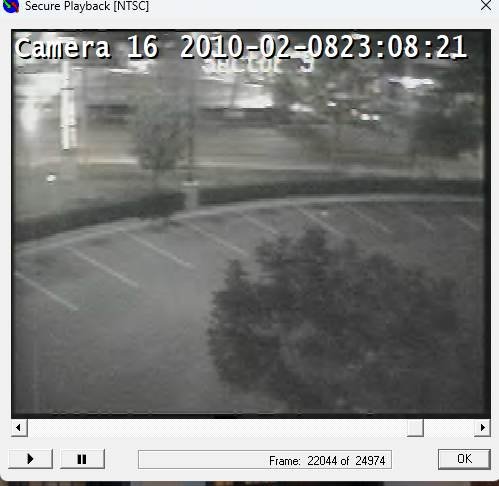
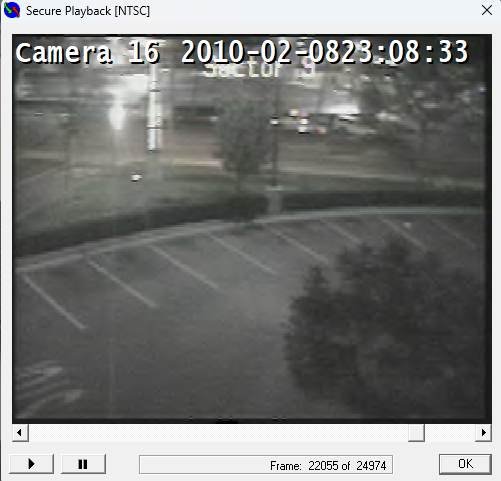
The tow itself is fixed by the State’s own records: the Sheriff’s Department dated its border-crossing review to “the day the McStay’s vehicle was towed,” and its forensic tasking described February 8 as “when family vehicle recovered at Mexican border parking lot.” (Bates 000194; Bates 003350.) These frames — from the same Camera 16 sequence dismissed at trial as having “no evidentiary value” — are the visual record of that recovery: the vehicle leaving the lot by tow truck, hours after the group recorded walking through it left on foot.
The vehicle, the computer, and the tow — corroboration from the government’s own files
The innocent reading did not rest on the video alone. It was supported, strand by strand, by evidence the government itself developed.
The Trooper. The ignition key recovered from Joseph McStay’s pocket when the graves were excavated fit and operated the Trooper without damage or hot-wiring — indicating Joseph was the last to operate the vehicle. (RT 5693:1–26.) Detective DuGal, who processed the Trooper and, at 6’1″, sat in the driver’s seat himself, testified that the seat was positioned for a person smaller than he, that the seating position was consistent with a male of 5’9″ — Joseph’s height — and that Petitioner stands approximately six feet to 6’1″. (RT 2524:28–2528:15.) Petitioner’s true height is 6’2″ — fixed in the State’s own charging paperwork, the arrest warrant sworn by Detective Bachman, which lists him at 6’02” and 210 pounds. (Arrest Warrant, DR# 071304411, Bates 007873.) The point does not depend on the difference: at either figure, the driver’s seat was set for someone smaller than Petitioner, and consistent with Joseph. And the stuffed-animal leash restraint recovered from the floorboard was the same type seen tethering a child in the border video, confirmed by family as the one the McStays used. (The Trooper’s physical evidence — the key, the seat, and the DNA identifying Joseph as the primary driver — is developed in full in the petition’s consolidated Trooper claim.)
The family computer. While the case was still a missing-persons investigation, the government’s own forensic examiner searched the family’s computers with four requests, one of them expressly for “any recent communications denoting threats of violence to the family.” (RCFL Report of Examination, Lab No. 10-0095-A-01, Apr. 2, 2010, Bates 003350.) What the examination recovered was travel research. On January 27, 2010, at 4:46 p.m., a Google search was run for “age requirement for entering mexico”; over the next three minutes the results were opened — “kids travel documents” (4:47 p.m.), and at 4:49 p.m., “Do I need a passport to travel to Mexico,” “Do kids need a passport to travel to Mexico,” and “mexico entry requirements.” (Bates 003358–003359.) The searches sit inside an ordinary working afternoon: the same account had a Google SketchUp design file open at 4:14 p.m., returned to SketchUp help pages into the evening, and downloaded Google Chrome at 6:30 p.m. The browser profile was “jo” — Joseph’s. (RCFL Report T-2013-484, Sept. 20, 2014, Bates 029651–029653.) The examiner also found an inquiry into purchasing Rosetta Stone Spanish-language software in December 2009. And the request for threats came back in a single line: “No communications of any type were found denoting threats to the family.” (Bates 003350–003351.) The government’s own examiner, tasked to look for coercion or reason to flee in fear, found none. These are the searches of a family preparing to travel, not of a family about to die.
The family saw the pictures in 2010 — and did not reject them
The pictures were not shown in a vacuum in 2010, either. While the case was still a missing-persons investigation, San Diego detectives put the crossing tape in front of the people who knew the McStays best, in recorded interviews at the Sheriff’s homicide office. The recorded answers were not the trial answers.
Susan Blake, Joseph’s mother: “Susan believed it was probably her missing family, but wished she could see their faces to be sure” — and, watching further, told a second detective “the gait of the female in the video appears to be similar to Summer’s gait, and the gait of one of the children appears to be similar” to Joseph Jr.’s. (Bates 006112–006113; Report of Det. Hillen, Bates 001819–001820.)
Blanche Aranda, Summer’s mother: identified the purse — “It would be the purse, Summer.” — answered “I think, yes” when asked whether the four figures were Joseph, Summer, Gianni, and Joseph Jr., and said, still watching: “I think that’s my family.” (Report of Det. DuGal, Bates 001659–001661.)
Michael McStay, Joseph’s brother: “agreed the image could be his missing family walking across the border,” though he could not be sure — the video was grainy, the backs only — and left it in his own recorded words: “I can’t tell.” (Bates 006112; 001782.)
Tracy Russell, Summer’s sister: said of the adult male, “That could be him”; pointed to the child holding his hand — “That would be Joseph,” meaning Joseph Jr.; and, asked whether she would say “This is not them,” answered: “No.” (Bates 001832–001833.)
Years later, after a homicide theory existed, some of those same witnesses testified the opposite: “I knew it wasn’t them” (RT 1765:28–1766:1); “Absolutely not. I said so to the detectives. I laughed, and I said, is this the best you have?” (RT 1981:10–11); “my son wouldn’t go to Mexico or take his children over the border.” (RT 1747:24–25.) Those recorded 2010 statements sat in the same boxes as the Camera 16 footage. The jury that was asked to decide whether the group of four could reasonably have been the McStays heard only the later denials — and never saw the tapes the earlier answers were about.
The 2010 words do not identify the group by themselves, any more than the stills do. Where the family hesitated in 2010, they gave one recurring reason: they could not see faces — the rear view’s defect, and precisely what the never-shown front-view Camera 16 footage bore upon. (Bates 000194.) What the 2010 record shows is what a juror looking at both tapes would have been entitled to stack alongside San Diego, NCMEC, and Detective DuGal: that when the images were fresh and no theory was at stake, the people closest to the family did not reject them.
The detective’s own reports said one thing; his testimony said another
Detective DuGal’s contemporaneous reports reflect a steady progression in his assessment of the crossing — from “possible,” to “more than possible,” to “strong circumstantial evidence,” to “probable” — resting throughout on the same pillars: the Trooper at the border, the computer searches for Mexico entry, and the video of the family crossing. He reached “probable” before the bodies were ever found. The documented rungs survive in the State’s own files: “possible” (the image “law enforcement had identified as a possible image of the missing McStay family,” March 2010, Bates 001659–001660); “likely … strong” (December 2011, Bates 001785); “probable” (November 2013, Bates 000194).
At trial, he distanced himself from the assessment his own reports record. Asked whether he had told family members he personally believed it was Joseph, Summer, and the kids, he answered “No” — and, asked “You never said that?”, again “No.” (RT 2468:19–24.) He kept his distance later: “It’s not my belief. … I don’t know the McStays, so it’s not my belief.” (RT 7611:4–7.)
His own reports say otherwise. On December 15, 2011, he “advised Michael that the circumstantial evidence of the Ugg boots on the female, the coat with the fur lining that the female wore, the size and stature of all four persons, and now the backpack leash system, made this likely that it was his family crossing the border,” adding that while he “could not positively identify” the family from the video, “the circumstantial evidence was strong.” (Report of Det. DuGal, Dec. 15, 2011, Bates 001785.) In the same interview he told Michael “there was no doubt that Joseph and Summer used this backpack leash system with their children.” (Bates 001784–001785.)
When defense counsel tried to confront the courtroom denial with the detective’s own interviews, the objection was sustained “as cumulative.” (RT 2470:11–16.) So the jury heard the disclaimer, and never the reports that contradicted it. The State, which possessed those reports, did not correct the testimony; its own objection foreclosed the correction.
The Sheriff’s official conclusion and the FBI handover
In March 2013, after three years of investigation, the San Diego County Sheriff’s Department issued a media release stating that “[t]he consensus is the family, in all likelihood, travelled into Mexico of their own free will.” (San Diego County Sheriff’s Department media release, Bates 006355.)
Because of that assessment, and because minor children were involved, the Department transferred the case evidence — the Trooper, the computers, and the surveillance videos — to the FBI, which accepted and worked the case for years. The transfer inventory lists, by bar code, the Las Americas video (which includes the Camera 16 parking-lot footage), the Ross store video, the Duty Free video, and the border-crossing video. (FBI property-release forms, Bates 006260.) This forecloses any suggestion that the parking-lot footage did not exist or was not in the government’s possession.
To put it plainly: the government’s own first agency, after three years, concluded the family most likely left voluntarily; its own evidence logs confirm the footage existed and was in its hands; its own lead detective considered the crossing probable; and the jury never saw any of it.
The child, and the way he ran
Before turning to the gravesite, one comparison deserves its own look, because it is the one piece of this footage a person can weigh with their own eyes and no expertise at all.
The problem with the border-crossing video, as the investigators themselves said, was that it showed the crossers only from behind — no faces. The parking-lot camera, an hour earlier, caught the same group from the front. Among those front-view frames is one that shows a small child in mid-stride: both arms held out from the body, elbows bent, the forearms turned outward, roughly parallel to the ground. It is an unusual, particular way of running.
The McStays’ youngest son ran that same way. The family had home video of him doing it — running down a hallway at their residence, arms out, forearms turned, elbows bent, exactly as the child in the parking lot is captured mid-step. Placed side by side, the two are strikingly alike: on the left, the enlarged figure from the San Ysidro parking lot on the evening of February 8, 2010; on the right, the McStay child running at home.
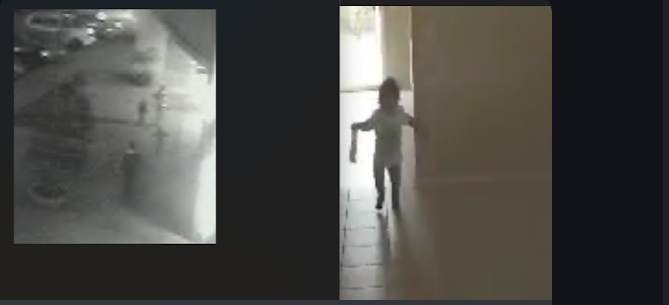
This is not offered as proof, and it does not need to be. A grainy frame is not a fingerprint, and Petitioner does not claim it is one. What the comparison is, is exactly the kind of front-view, individuating detail the rear-view border video could never supply — the detail the lead detective said was missing, the reason his identification stayed at “probable” rather than certain. It was the jury’s to see, to hold beside the family’s home video, and to weigh. The jury never got the chance, because the footage that carried it was left in a folder and never shown.
The February 12 photograph — the hardest fact, put in by the defense itself
There is one fact that must be stated plainly, because leaving it out would be its own kind of dishonesty. Defense counsel introduced at trial an aerial photograph of the gravesite area, taken February 12, 2010, that showed ground disturbance — four days after the border crossing.
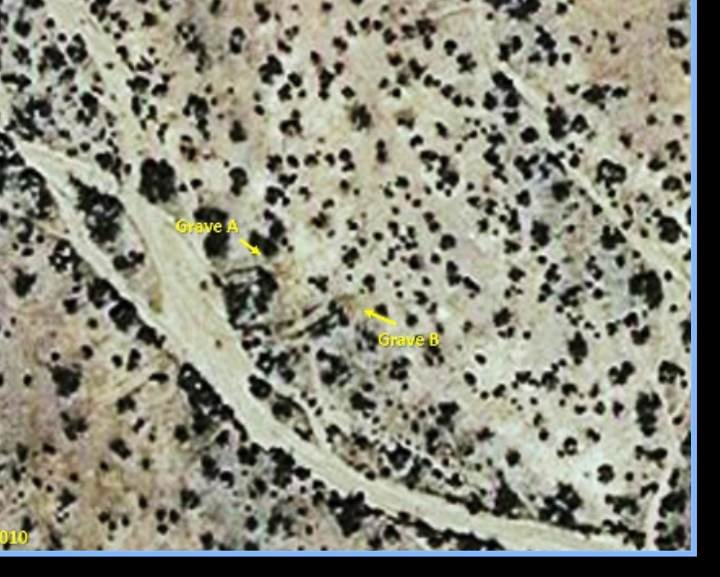
That fact cuts in a complicated way, and honesty requires laying it out. On one hand, disturbance visible by February 12 is entirely consistent with the innocent reading: it comes after the February 8 crossing, and it undercuts the prosecution’s own claim of a February 6 burial — a family cannot be buried on the 6th and crossing the border alive on the 8th. The remains themselves carried no date; the State’s own warrant affidavit described a partial skull “bleached white due to exposure to the elements for an undetermined amount of time.” (Affidavit of Det. Bachman, Bates 007873.) The photograph does not fix a date of burial; it marks an outer bound, and that outer bound falls after the crossing. On the other hand, it is fair to acknowledge that the image narrowed the likely window rather than leaving it open-ended.
Why the defense introduced a photograph that narrowed the window at all is a genuine puzzle — and it is a puzzle of the same shape as everything else in this story. The photograph’s innocent meaning depended entirely on the jury also accepting the February 8 crossing. But the border video was excluded, and the front-view parking-lot frames were never shown. Counsel put in the fact whose exculpatory reading rested on visual proof the jury never received. Petitioner does not contend the imagery dates the burial, and he carries no burden to date it: the burden was the State’s, to prove murder on February 4 and burial on February 6, and a family walking into Mexico on February 8 is inconsistent with both.
The undisputed fact of the family’s death does not answer the disputed fact of its date. The State’s burden was not to prove that the family died; it was to prove that Petitioner killed them when the State said he did — in the days before the crossing. If the group in the footage was the McStays, walking into Mexico on February 8, the State’s charged timeline fails — wherever, whenever, and at whoever’s hands they later met their deaths.
Nor could the State’s insinuation that the crossing was somehow staged supply a competing reasonable reading. A staging theory requires staged actors: four people, two of them children of matching sizes, equipped with the family’s distinctive backpack-leash restraint, a purse the grandmother identified as Summer’s, and boots and beanies consistent with the family’s — all while the family’s own leash system sat in the Trooper, the Trooper’s driver surfaces carried Joseph’s DNA, its seat was positioned for a man of Joseph’s stature rather than Petitioner’s, and its ignition key lay in Joseph’s pocket in the grave. The State identified no decoys, produced no evidence that anyone other than Joseph drove the Trooper to the border, and offered no account of how the key returned to a buried man’s pocket. An interpretation supported by no evidence is not a reasonable conclusion a jury may weigh; it is speculation — and the State advanced it while keeping from the jury the very footage that would have let the jury judge it.
The file that was the defense’s own
Here the questions turn inward, and they are questions, not accusations — because the record supports only what can be observed, not what was in anyone’s mind.
The front-view parking-lot footage was not something the defense had to pry loose from the government. It was in the defense’s own discovery. It was in the boxes. And it never reached the jury — never offered, never shown, never described to them as anything but a detective’s “no evidentiary value.”
Consider what was and was not available as a reason to withhold it. It was not cumulative — the jury saw no image of the crossing group on February 8 at all, because the border video was excluded. It was not a weakness the defense theory couldn’t absorb — it was the defense theory, the visual proof of the exact account counsel argued in closing. It carried no risk of backfire — the prosecution had offered no competing reading of the February 8 evidence to rebut it with, and the government’s own first agency had already concluded the group most likely left voluntarily. There was, in short, no tactical advantage in leaving it in the box, and every reason to bring it out.
So two questions follow, and the record answers neither. Did counsel review the footage and choose not to use it? Or did counsel simply never review it at all? The record does not say which. It says only that the pictures were the defense’s own, and the jury never saw them. There is no version of the answer in which a family walking on film, four days after the State said they were dead, was a thing a capital defense could afford to leave unopened in its own files.
Why this matters — the instruction the jury could not follow
In a case built entirely on circumstantial evidence, California law gave this jury a specific instruction, known as CALCRIM No. 224. In plain terms, it tells jurors this: when the evidence can reasonably be read two ways — one pointing to guilt, one pointing to innocence — they must adopt the reading that points to innocence. Not weigh it, not balance it — adopt it, so long as it is reasonable.
The innocent reading here was that the McStays drove to the border, parked, and walked into Mexico alive on February 8 — the reading the trial judge himself articulated from the bench, and the reading the State’s first investigators, its own Sheriff’s Department, and the FBI all adopted. By the instruction’s own terms, if the jury found that reading reasonably supported, it was required to accept it — and it is hard to call unreasonable a conclusion the lead investigating agency reached on its own evidence, before any suspect existed.
But a jury cannot adopt a reading whose evidence it is never shown. The footage that supported the innocent reading was excluded on one hand and buried on the other. Together, those two failures ensured the jury saw no image of the crossing group on February 8 at all. The instruction told the jurors to take the path to innocence where the evidence forked — and they were never shown the fork.
Where this goes
These facts anchor a claim now being pursued in Merritt’s habeas corpus petition — the process for challenging a conviction after the ordinary appeals are exhausted. The failures fall into three distinct categories, and the petition keeps them separate. The trial court’s exclusion of the border-crossing video — on a “foundation” standard California law does not require, when the detective who obtained and reviewed the tape could have authenticated it — is a ruling error that kept the rear-view footage from the jury. Counsel’s failure to offer the front-view Camera 16 footage that sat in the defense’s own files is a question of the adequacy of the defense itself — an ineffective-assistance question, because evidence a lawyer already holds and never presents is not evidence anyone hid from him. So is counsel’s handling of the border video’s foundation: supplying the federal-custodian premise, conceding it could not be met without attempting the subpoena, and preserving nothing under the authentication law that actually governs. And the government’s conduct — eliciting “no evidentiary value” from a detective whose own reports called the crossing probable, and foreclosing, by a sustained objection, the defense’s attempt to put those contradicting reports before the jury — raises the distinct question of whether favorable evidence was effectively withheld, the concern at the heart of Brady v. Maryland. Because the case was investigated in one county and prosecuted in another, the petition also invokes the settled rule that a prosecuting agency is charged with knowledge of the files of the agencies that investigated on its behalf — a county line does not launder possession. San Bernardino inherited the evidence. It did not acquire the right to bury it.
Earlier installments in this series concerned what the phone records did and did not show. This one concerns something a juror could have seen with their own eyes: a group of four — front then rear, lot then crossing, on film — that the government’s own first investigators called probably the missing family, on a date that would break the State’s charged timeline. Whether it was the McStays was the jury’s question to answer. The jury was shown none of it. The series continues.
Every quotation above is drawn from the trial record, the government’s own reports, or the government’s own evidence logs, and is identified by source. Trial-transcript citations refer to the Reporter’s Transcript in People v. Merritt, San Bernardino County Superior Court No. FVI1404194; document citations are to Bates-numbered discovery produced by the government. Statements of Charles Merritt quoted herein are his own.