Did I say I wasn’t in the desert on the 6th?
The prosecutor told the jury I lied to detectives about being in the High Desert on February 6, 2010, the day the State placed my phone near the graves. He played them one line from my interview, told them I had denied being there, and used that supposed lie as evidence of a guilty mind.
The detective who questioned me had already written down something different. Twice.
On October 22, 2014, Detective Edward Bachman asked me whether I had been in the High Desert in the week after the McStay family disappeared. I told him I did not recall going there on February 6. I also told him, again and again, that I might have been, visiting my sister in Oro Grande or my brother in Hesperia. What I denied, every time, was being at the grave site.
Bachman understood the difference. His reports, written two days and twelve days after the interview, both record that I said it was possible I was in the High Desert, and that I denied being at the grave site. Five years later, the prosecutor told the jury I had lied by denying I was in the desert at all. The judge repeated it when he denied my motion for a new trial.
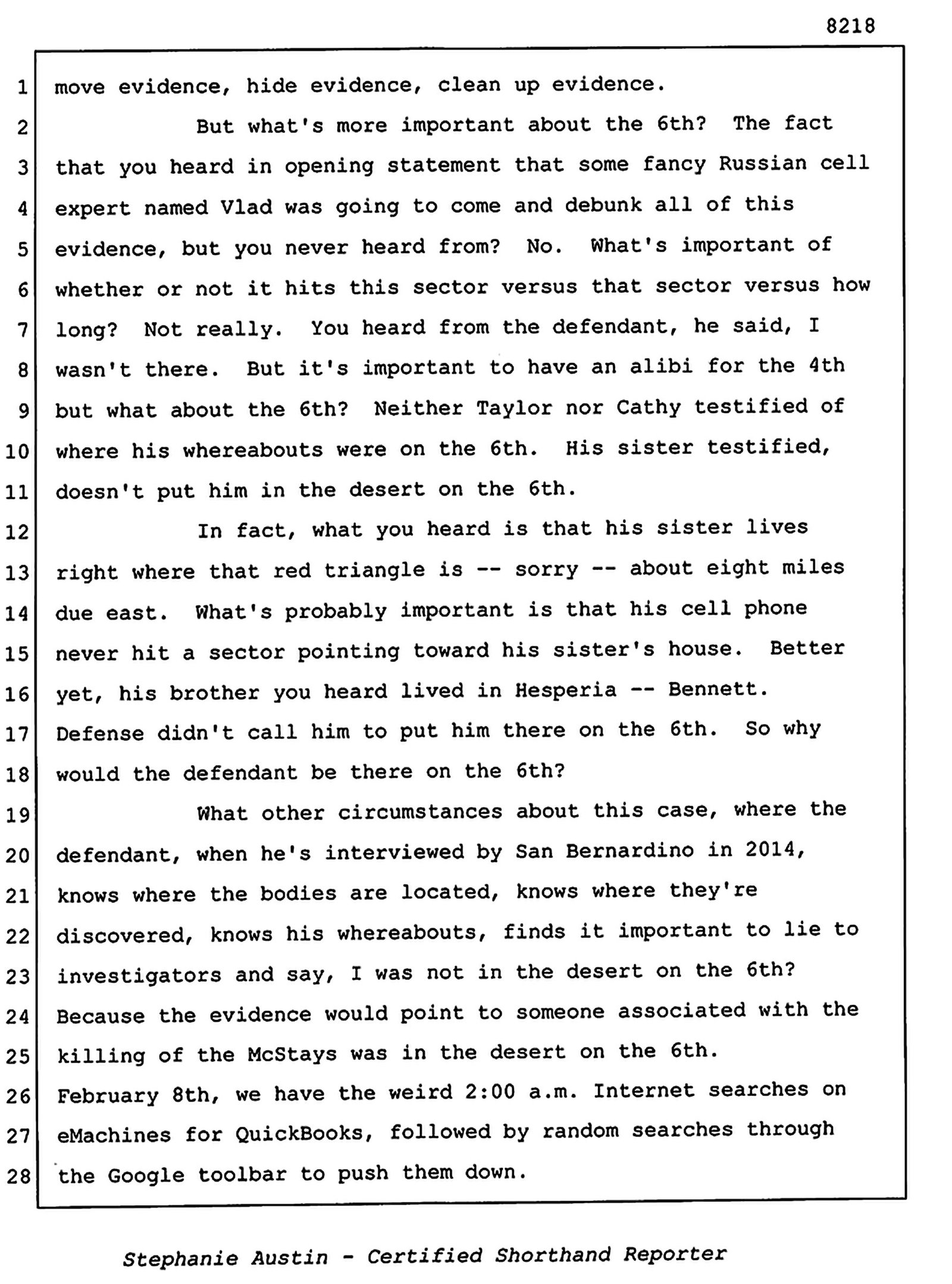
The State said I lied and said “I was not in the desert on the 6th.” (Mr. Imes, RT 8218:19-25)
The record: Asked if I could have been at my sister’s on the 6th: “Oh, there’s a chance that I was in Oro Grande. But there’s no chance I was anywhere near that grave site — whatsoever.” (Interview, 10/22/14, pp. 335-336)
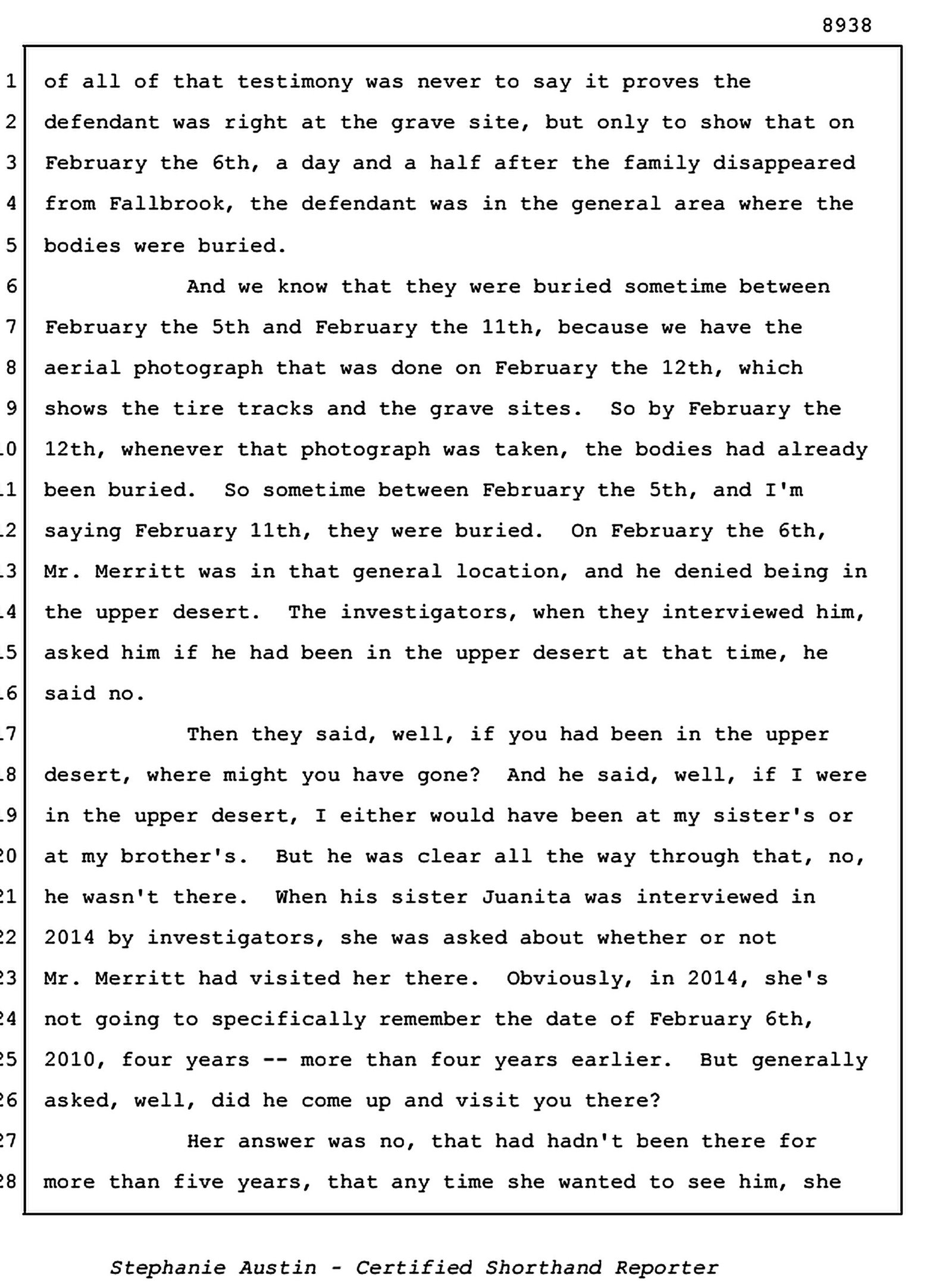
The judge said “He was clear all the way through that, no, he wasn’t there.” (RT 8938:12-21)
The record: Two days after the interview, Bachman wrote: “Merritt claimed it was possible he was in the High Desert, but would have been visiting his sister Juanita in Oro Grande or his brother Bennett in Hesperia.” (Summary, 10/24/14, p. 36, Bates 006753) Twelve days after, again: “Merritt claimed it was possible he was in the high desert but at no point in time was he at the gravesite.” (Report, 11/3/14, p. 12, Bates 007863)
And the jury heard one line, “and I definitely wasn’t at the desert,” played with nothing around it (RT 8217:20-24). I did say those words. What came before and after them is below.
This was not a subtlety found years later. The detective who did the questioning wrote the distinction down within days.
Here is the record, so you can check it yourself.
What the prosecutor told the jury
In closing argument, Mr. Imes put it as a lie:
Mr. Imes: What other circumstances about this case, where the defendant, when he’s interviewed by San Bernardino in 2014, knows where the bodies are located, knows where they’re discovered, knows his whereabouts, finds it important to lie to investigators and say, I was not in the desert on the 6th? Because the evidence would point to someone associated with the killing of the McStays was in the desert on the 6th.
RT 8218:19-25
That is the claim this page tests: that I told investigators, flatly, that I was not in the desert on February 6. Below is everything I said about it, in order, then what the detective wrote, then what the jury and the judge were told.
What I said in the interview
Interview of Charles Merritt by Detectives Bachman and Hanke, October 22, 2014 (reporter’s transcript, Mander Reporting). Page and line numbers are from that transcript. The full transcript is posted on The records.
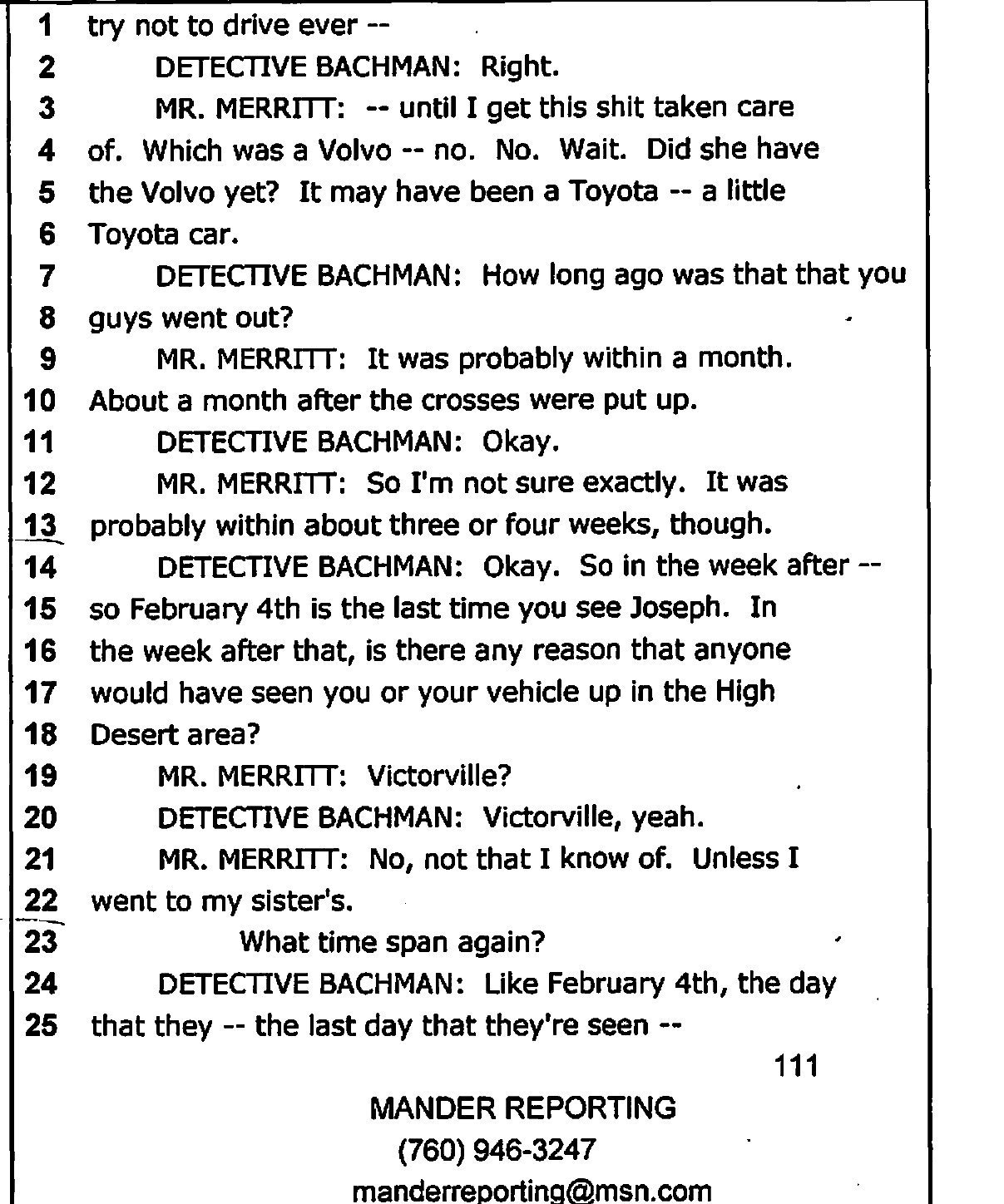
Unless I went to my sister’s
Detective Bachman: Okay. So in the week after — so February 4th is the last time you see Joseph. In the week after that, is there any reason that anyone would have seen you or your vehicle up in the High Desert area?
Me: Victorville?
Detective Bachman: Victorville, yeah.
Me: No, not that I know of. Unless I went to my sister’s. What time span again?
Detective Bachman: Like February 4th, the day that they — the last day that they’re seen —
Me: Right.
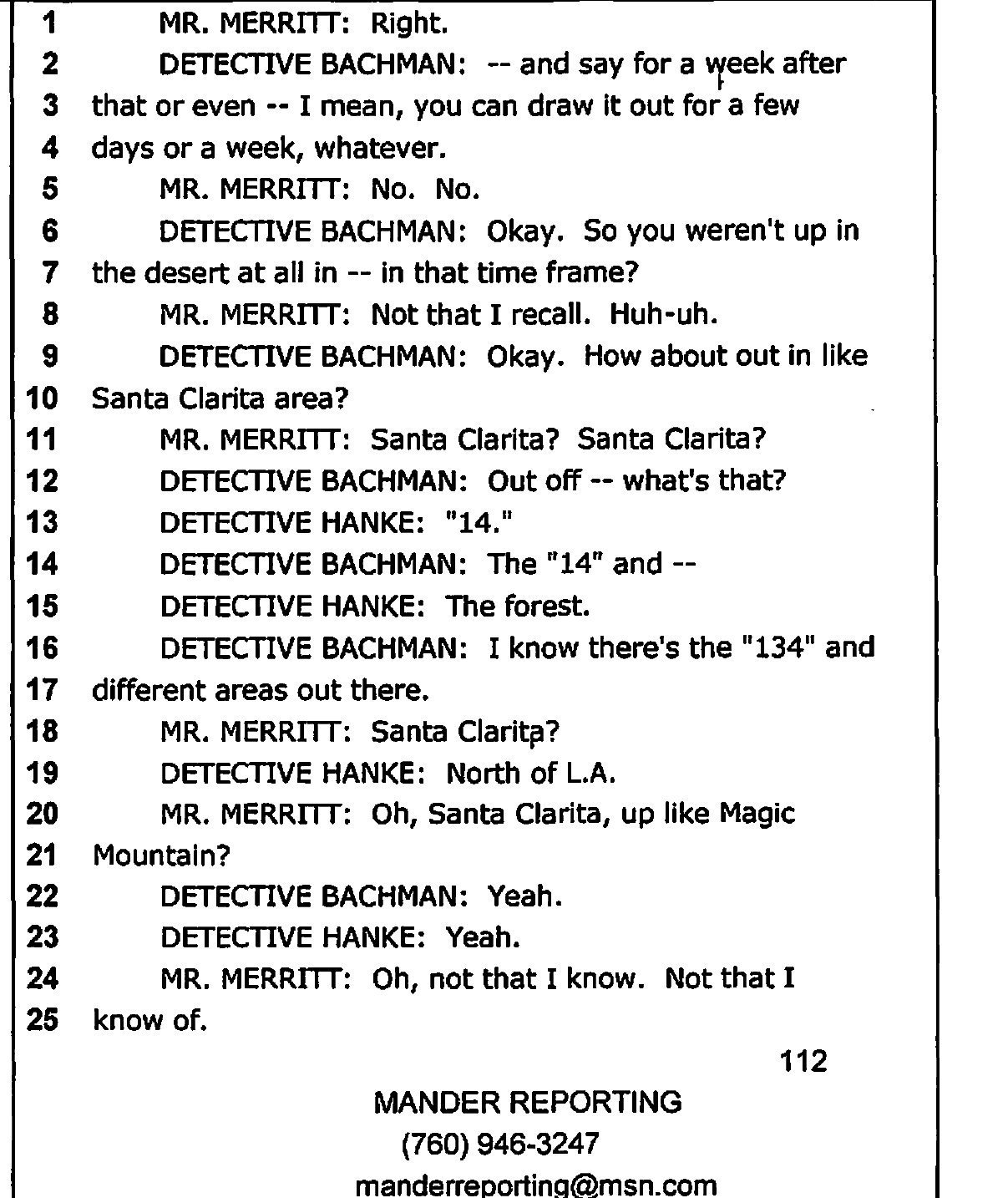
Detective Bachman: — and say for a week after that or even — I mean, you can draw it out for a few days or a week, whatever.
Me: No. No.
Detective Bachman: Okay. So you weren’t up in the desert at all in — in that time frame?
Me: Not that I recall. Huh-uh.
Interview, October 22, 2014, p. 111:14-112:8
Detective Bachman asked about the week after February 4th, a week that includes the 6th. My first answer was “Unless I went to my sister’s.” From the very start, my answer about the desert had a condition on it.
SEE THE TRANSCRIPT (PAGES 111, 112)
Enhanced for legibility. Tap it to see the full pages.
If I went there, it would be Oro Grande or Hesperia
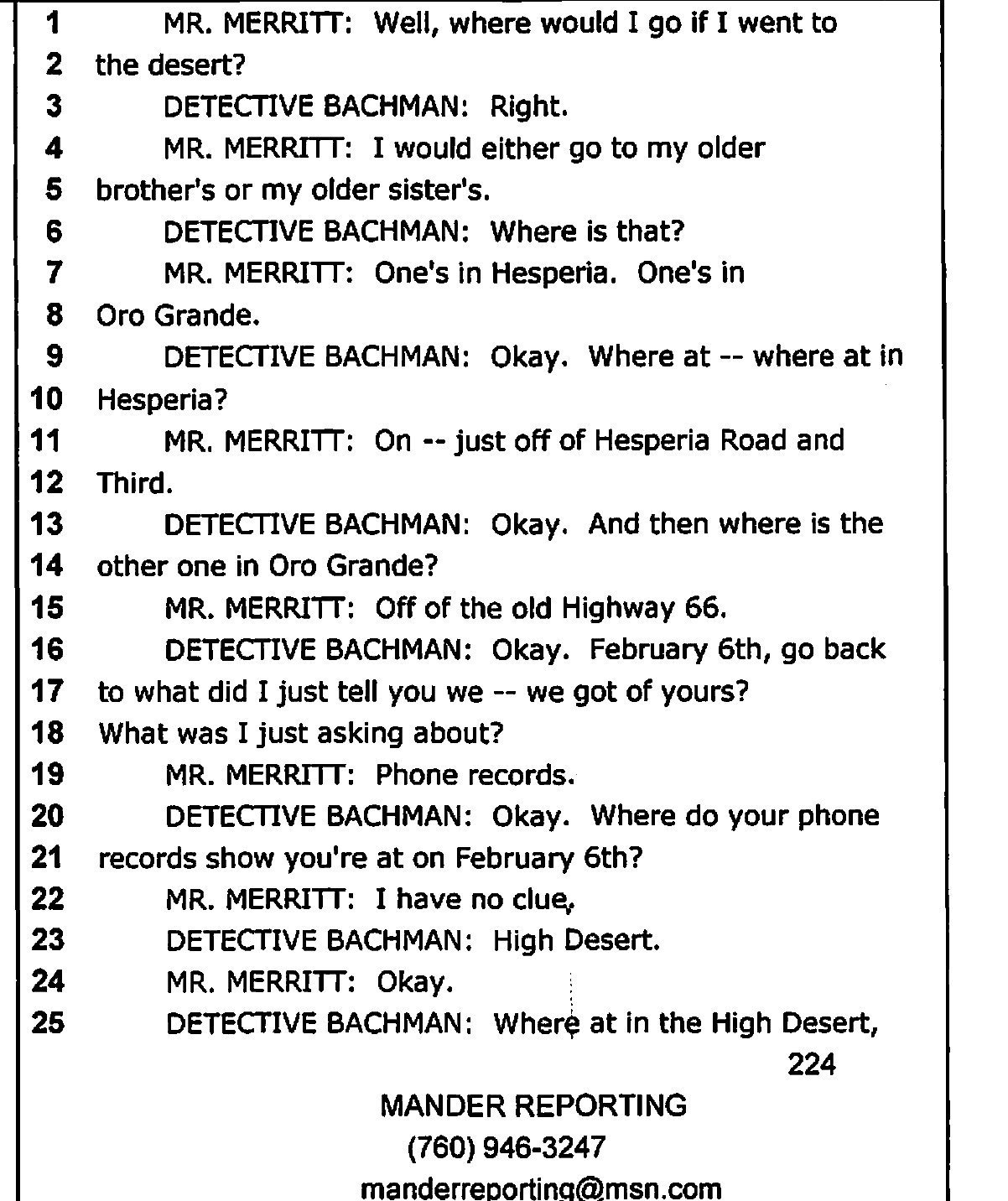
Detective Bachman: Okay. Where do your phone records show you’re at on February 6th?
Me: I have no clue.
Detective Bachman: High Desert.
Me: Okay.
Detective Bachman: Where at in the High Desert, do you think?
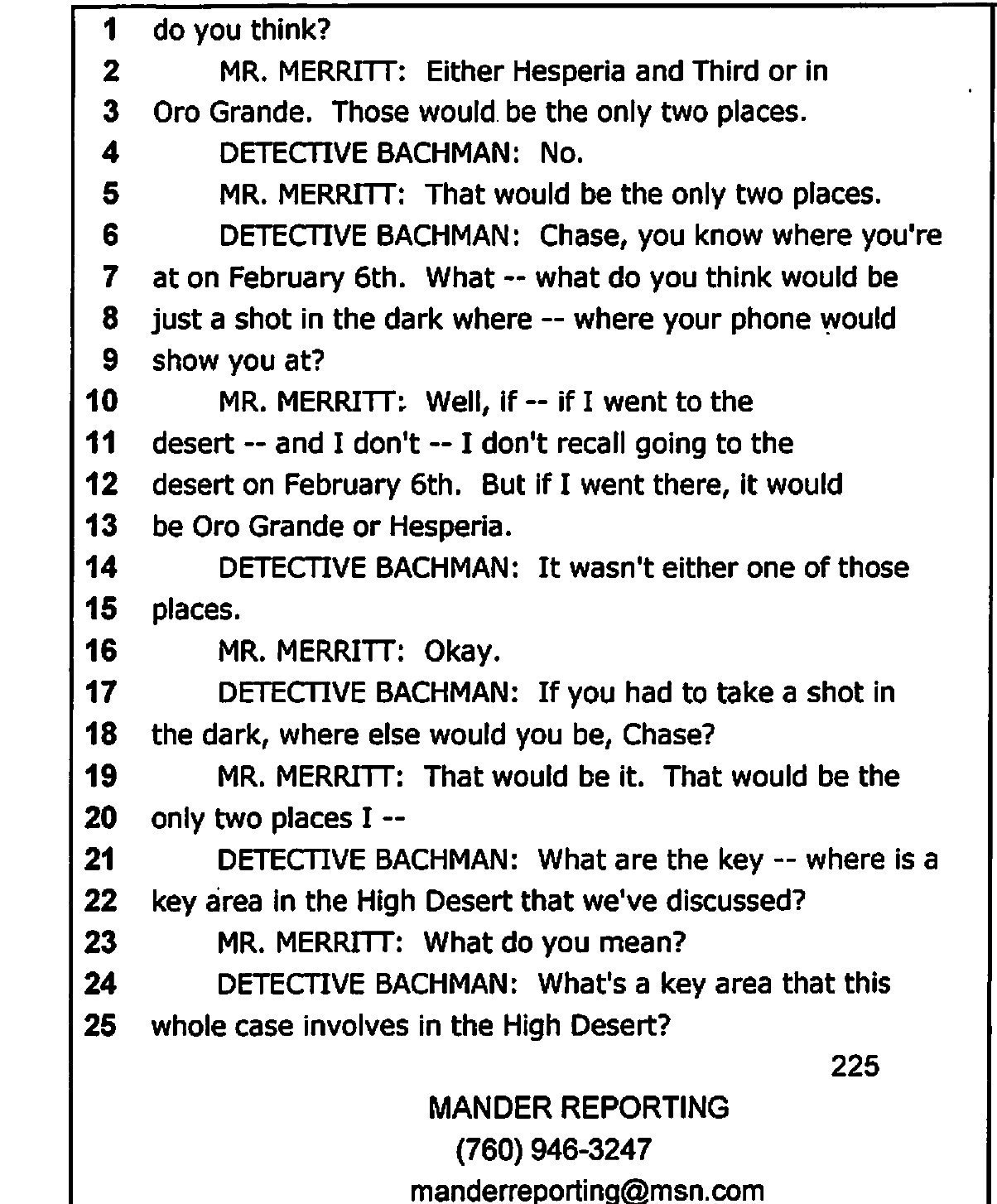
Me: Either Hesperia and Third or in Oro Grande. Those would be the only two places.
Detective Bachman: No.
Me: That would be the only two places.
Detective Bachman: Chase, you know where you’re at on February 6th. What — what do you think would be just a shot in the dark where — where your phone would show you at?
Me: Well, if — if I went to the desert — and I don’t — I don’t recall going to the desert on February 6th. But if I went there, it would be Oro Grande or Hesperia.
Interview, October 22, 2014, p. 224:20-225:13
Told my phone records put me in the High Desert on February 6th, I said I didn’t recall going. But if I went, it would have been Oro Grande or Hesperia, where my sister and brother lived.
SEE THE TRANSCRIPT (PAGES 224, 225)
Enhanced for legibility. Tap it to see the full pages.
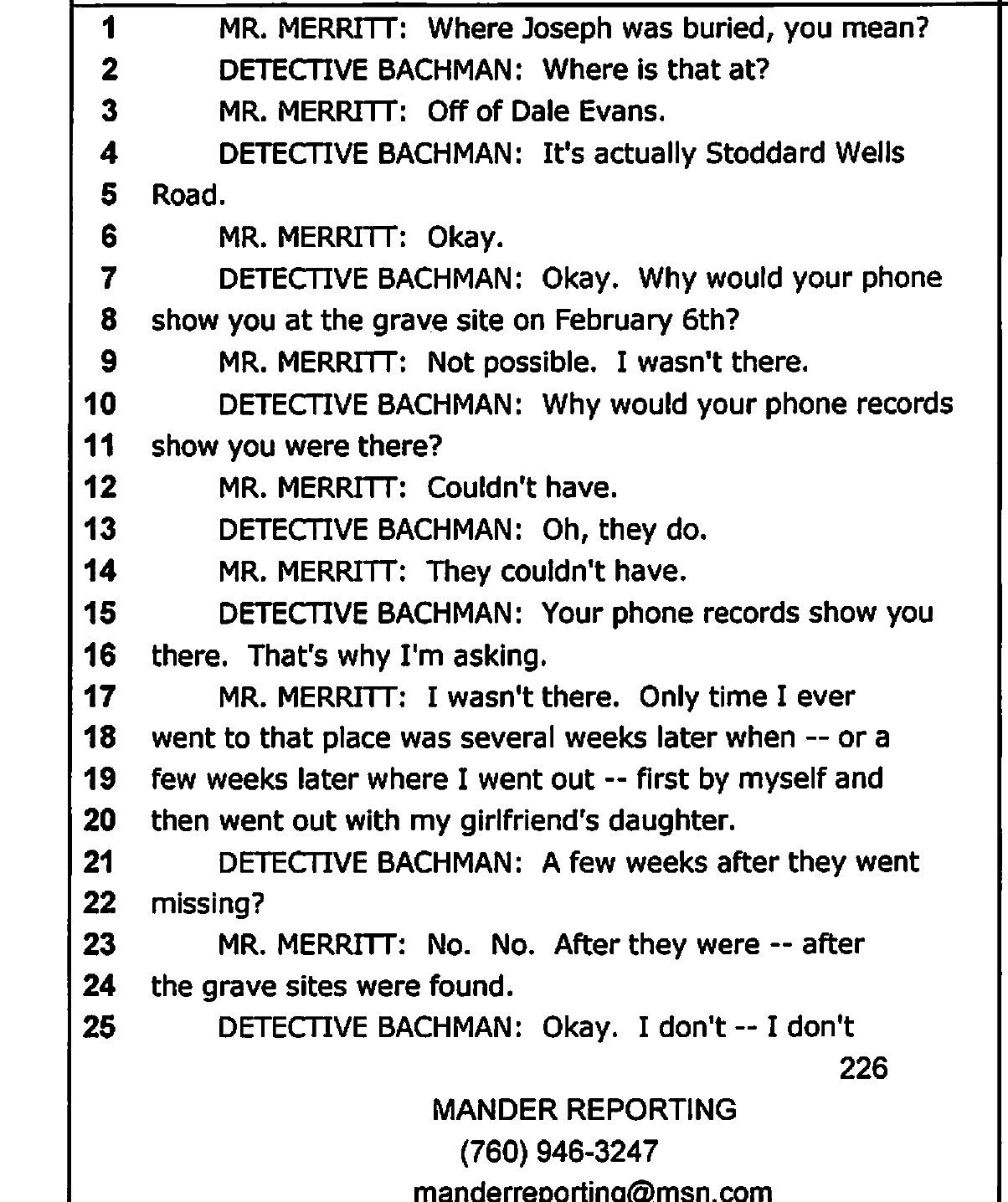
Where Joseph was buried, you mean?
Detective Bachman: What are the key — where is a key area in the High Desert that we’ve discussed?
Me: What do you mean?
Detective Bachman: What’s a key area that this whole case involves in the High Desert?
Me: Where Joseph was buried, you mean?
Detective Bachman: Where is that at?
Me: Off of Dale Evans.
Detective Bachman: It’s actually Stoddard Wells Road.
Me: Okay.
Detective Bachman: Okay. Why would your phone show you at the grave site on February 6th?
Me: Not possible. I wasn’t there.
Interview, October 22, 2014, p. 225:21-226:9
When he asked about “a key area” in the High Desert, I asked, “Where Joseph was buried, you mean?” From there on, my denials were about the grave site.
SEE THE TRANSCRIPT (PAGES 225, 226)
Enhanced for legibility. Tap it to see the full pages.
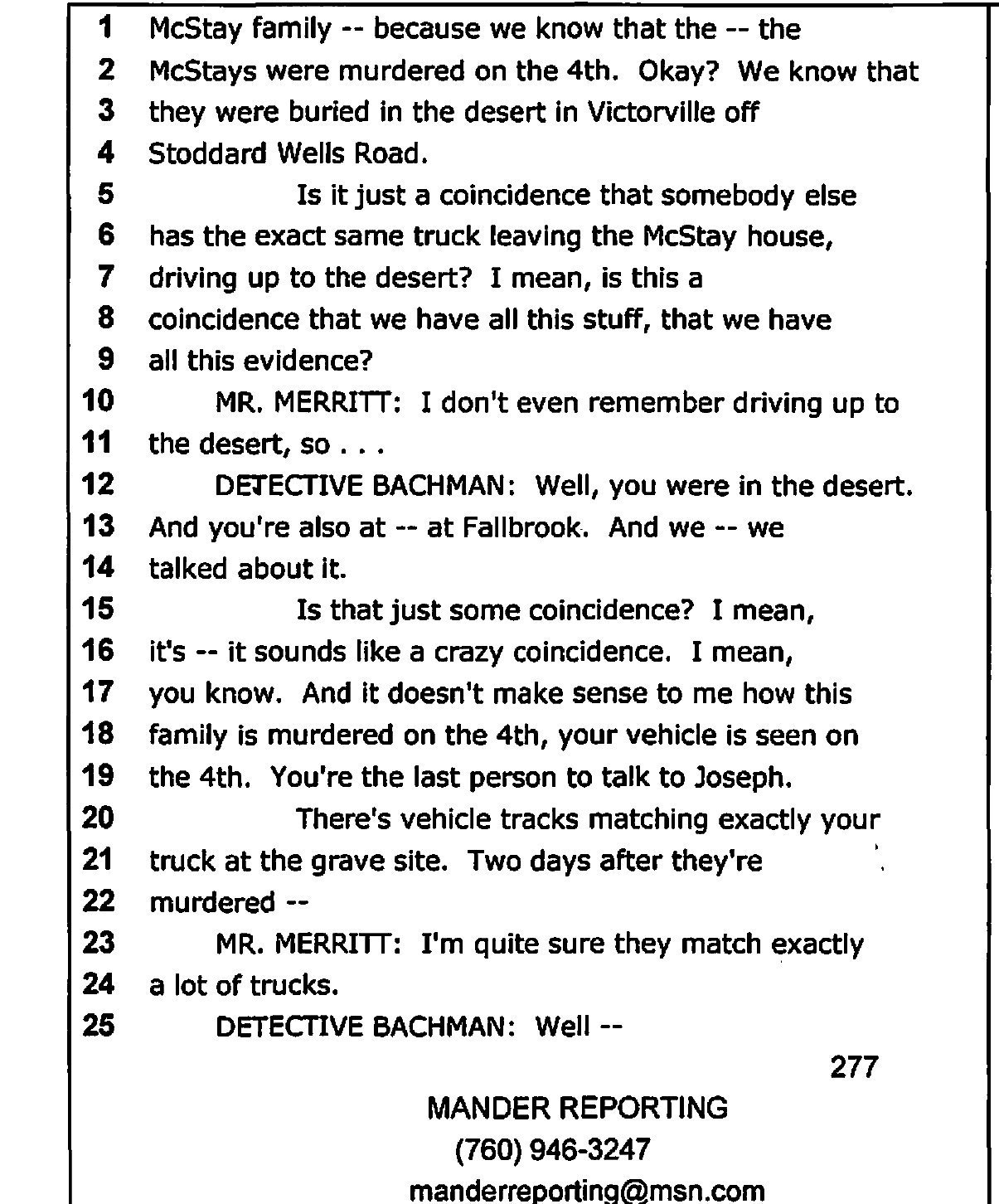
I definitely wasn’t at the desert
Me: I don’t even remember driving up to the desert, so . . .
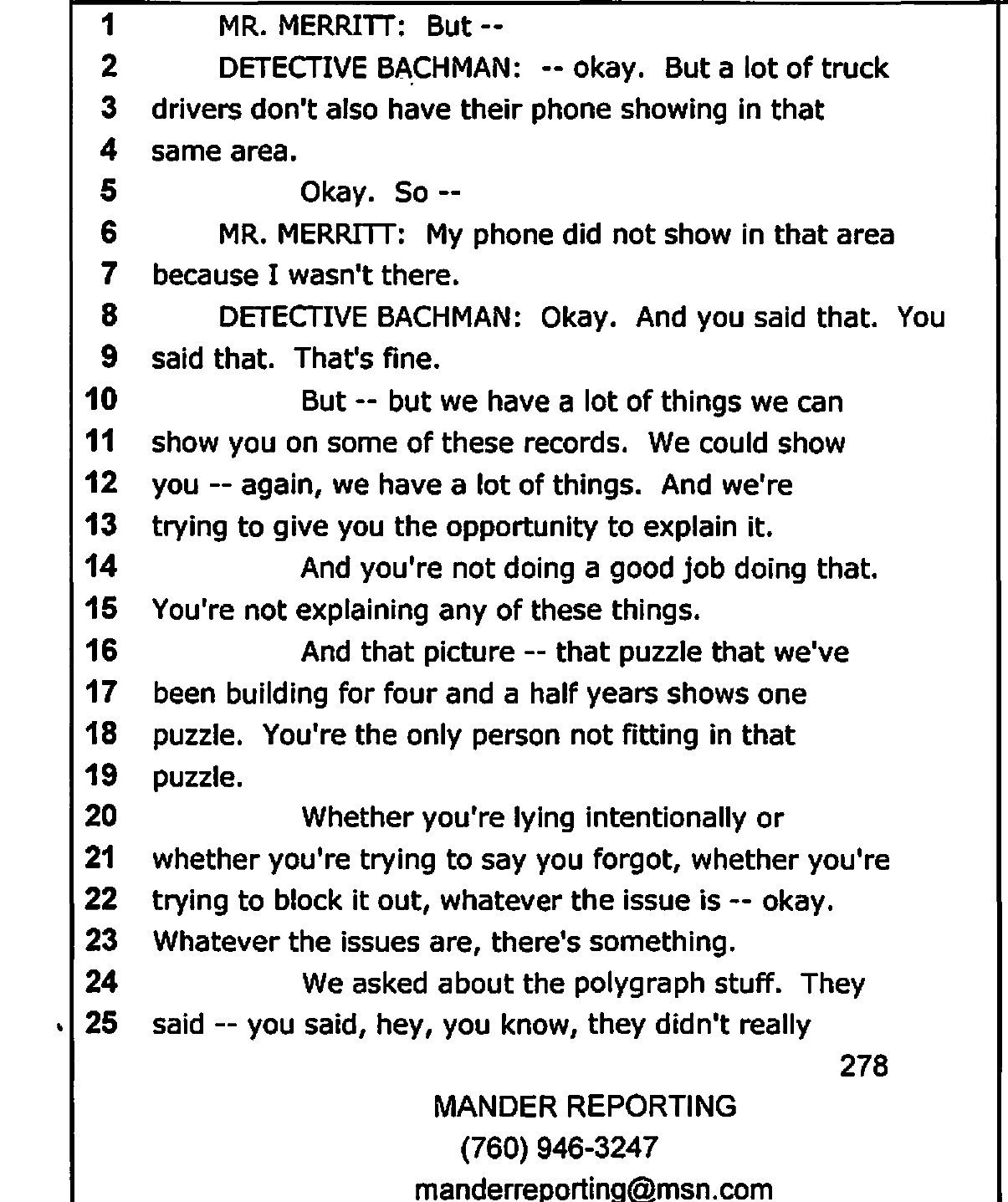
Detective Bachman: Well, you were in the desert. And you’re also at — at Fallbrook. And we — we talked about it. […] There’s vehicle tracks matching exactly your truck at the grave site. Two days after they’re murdered —
Me: I’m quite sure they match exactly a lot of trucks.
Detective Bachman: Well —
Me: But —
Detective Bachman: — okay. But a lot of truck drivers don’t also have their phone showing in that same area. Okay. So —
Me: My phone did not show in that area because I wasn’t there.
[…]
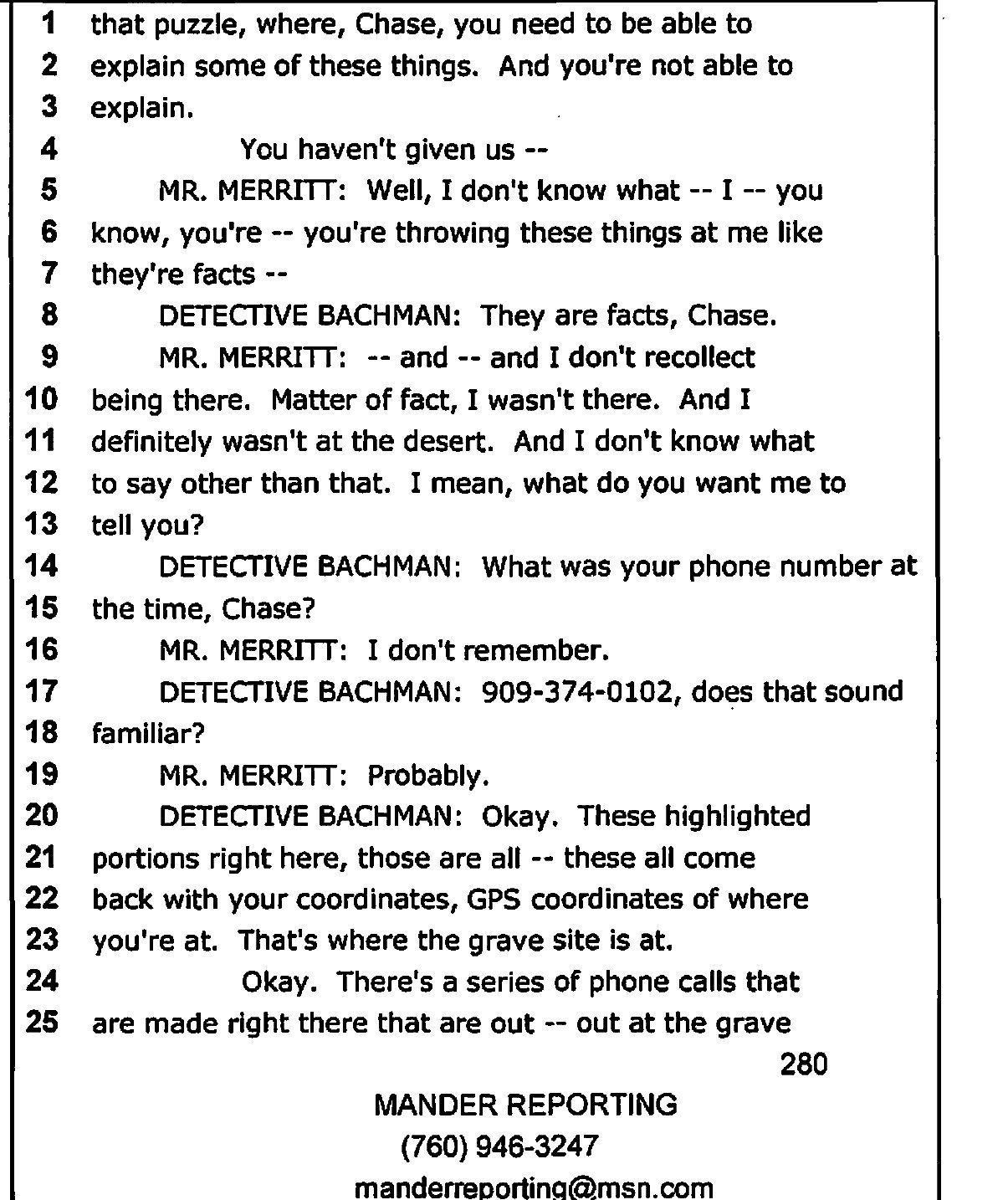
Me: Well, I don’t know what — I — you know, you’re — you’re throwing these things at me like they’re facts —
Detective Bachman: They are facts, Chase.
Me: — and — and I don’t recollect being there. Matter of fact, I wasn’t there. And I definitely wasn’t at the desert. And I don’t know what to say other than that. I mean, what do you want me to tell you?
[…]
Detective Bachman: Okay. These highlighted portions right here, those are all — these all come back with your coordinates, GPS coordinates of where you’re at. That’s where the grave site is at.
Interview, October 22, 2014, p. 277:10-278:7; 280:5-23
I said those words: “And I definitely wasn’t at the desert.” I am not going to pretend otherwise. But look at what I was answering. He had just raised Fallbrook, then my truck and my phone at the grave site, “in that same area.” Two pages later he was pointing at the grave site on a map. Five pages later, his own question separated the two again: “If that’s not you at the grave sites, what were you doing in the desert?” This is the one line the prosecutor played to the jury. Everything before and after it is on this page.
SEE THE TRANSCRIPT (PAGES 277, 278, 280)
Enhanced for legibility. Tap it to see the full pages.
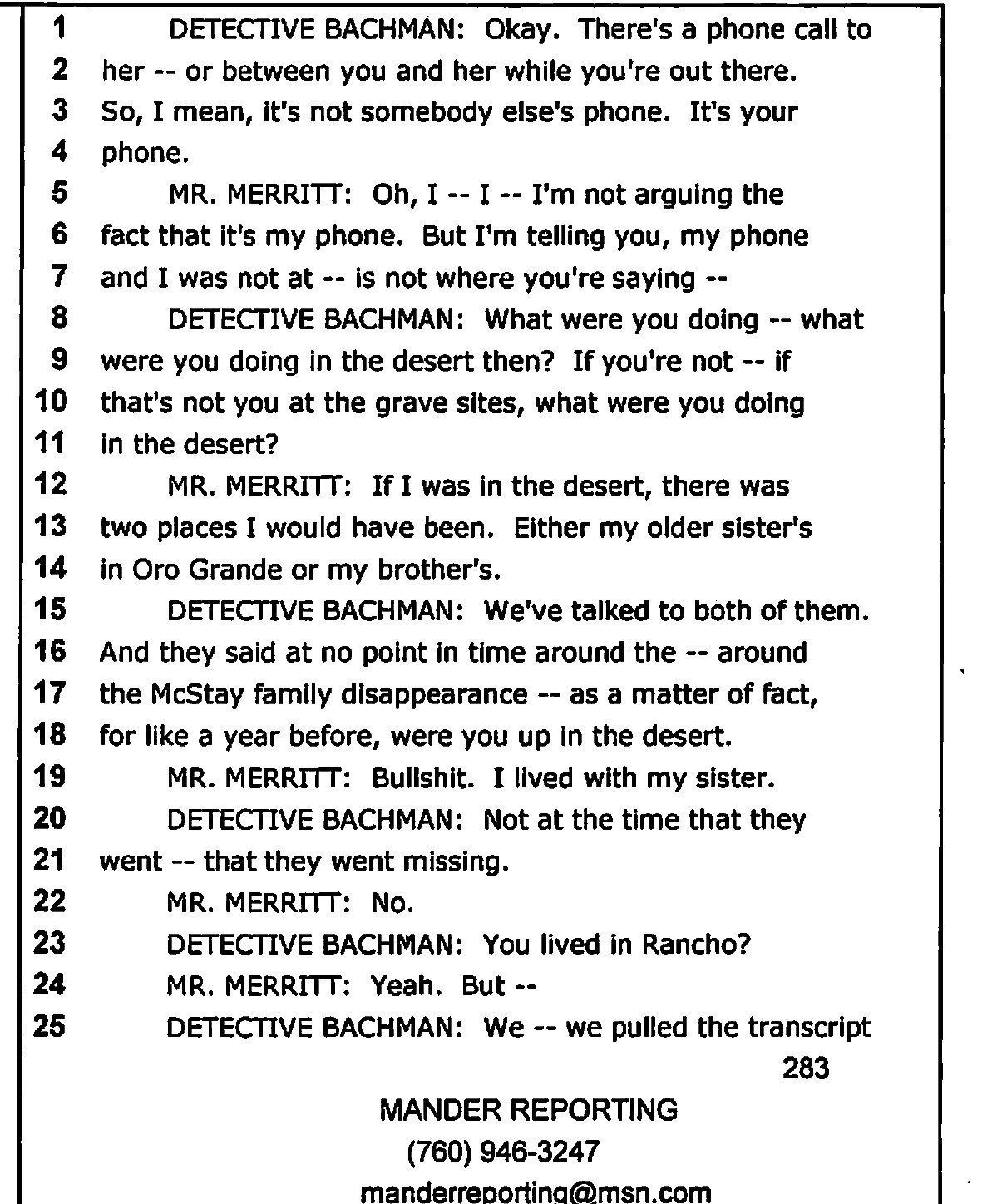
What were you doing in the desert?
Me: Oh, I — I — I’m not arguing the fact that it’s my phone. But I’m telling you, my phone and I was not at — is not where you’re saying —
Detective Bachman: What were you doing — what were you doing in the desert then? If you’re not — if that’s not you at the grave sites, what were you doing in the desert?
Me: If I was in the desert, there was two places I would have been. Either my older sister’s in Oro Grande or my brother’s.
Interview, October 22, 2014, p. 283:5-14
His own question separated the two: “If that’s not you at the grave sites, what were you doing in the desert?” My answer: my sister’s or my brother’s.
SEE THE TRANSCRIPT (PAGE 283)
Enhanced for legibility. Tap it to see the full page.
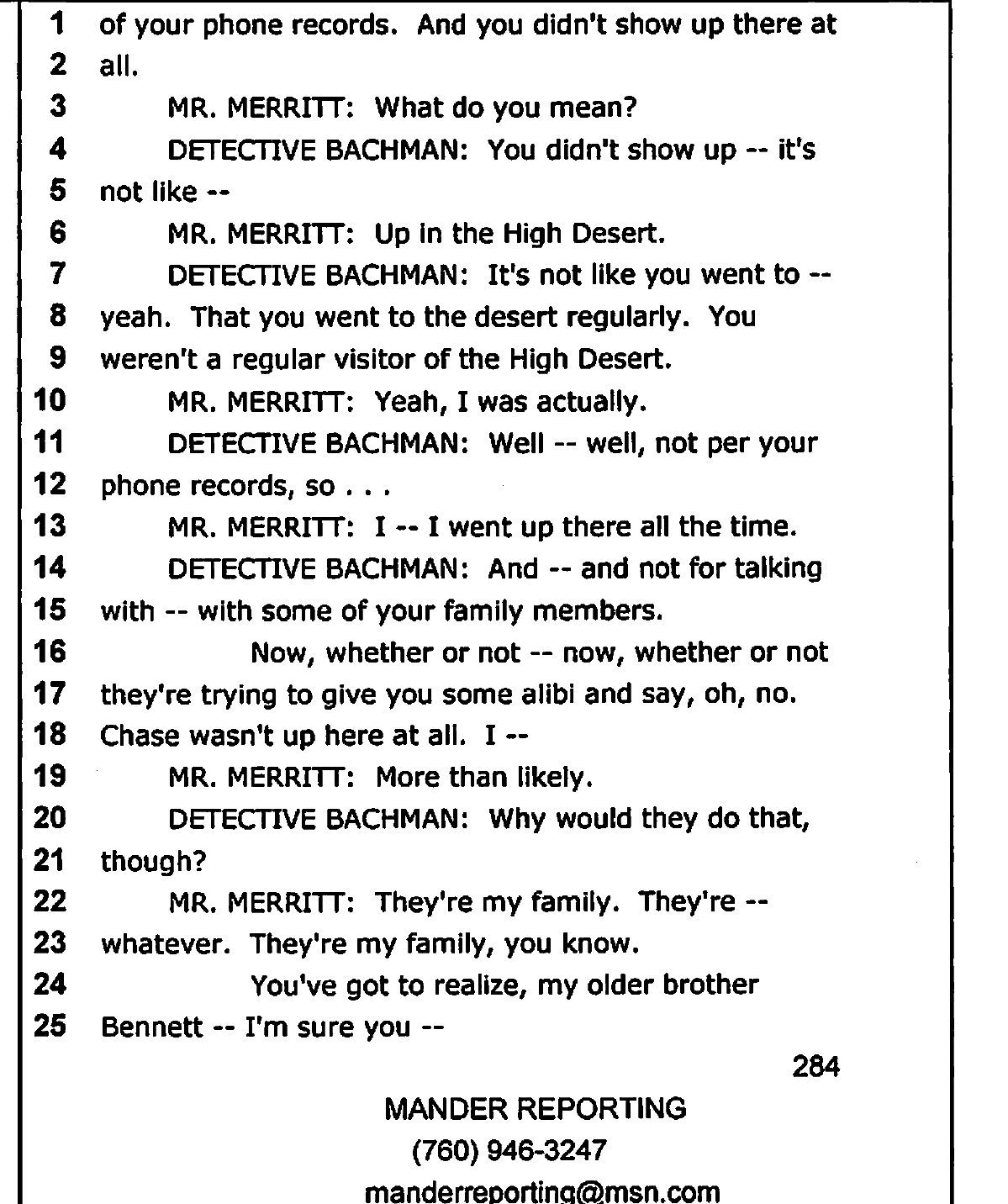
I went up there all the time
Detective Bachman: We — we pulled the transcript of your phone records. And you didn’t show up there at all.
Me: What do you mean?
Detective Bachman: You didn’t show up — it’s not like —
Me: Up in the High Desert.
Detective Bachman: It’s not like you went to — yeah. That you went to the desert regularly. You weren’t a regular visitor of the High Desert.
Me: Yeah, I was actually.
Detective Bachman: Well — well, not per your phone records, so . . .
Me: I — I went up there all the time.
Interview, October 22, 2014, p. 283:25-284:13
When he said I wasn’t a regular visitor of the High Desert, I told him I went up there all the time.
SEE THE TRANSCRIPT (PAGES 283, 284)
Enhanced for legibility. Tap it to see the full pages.
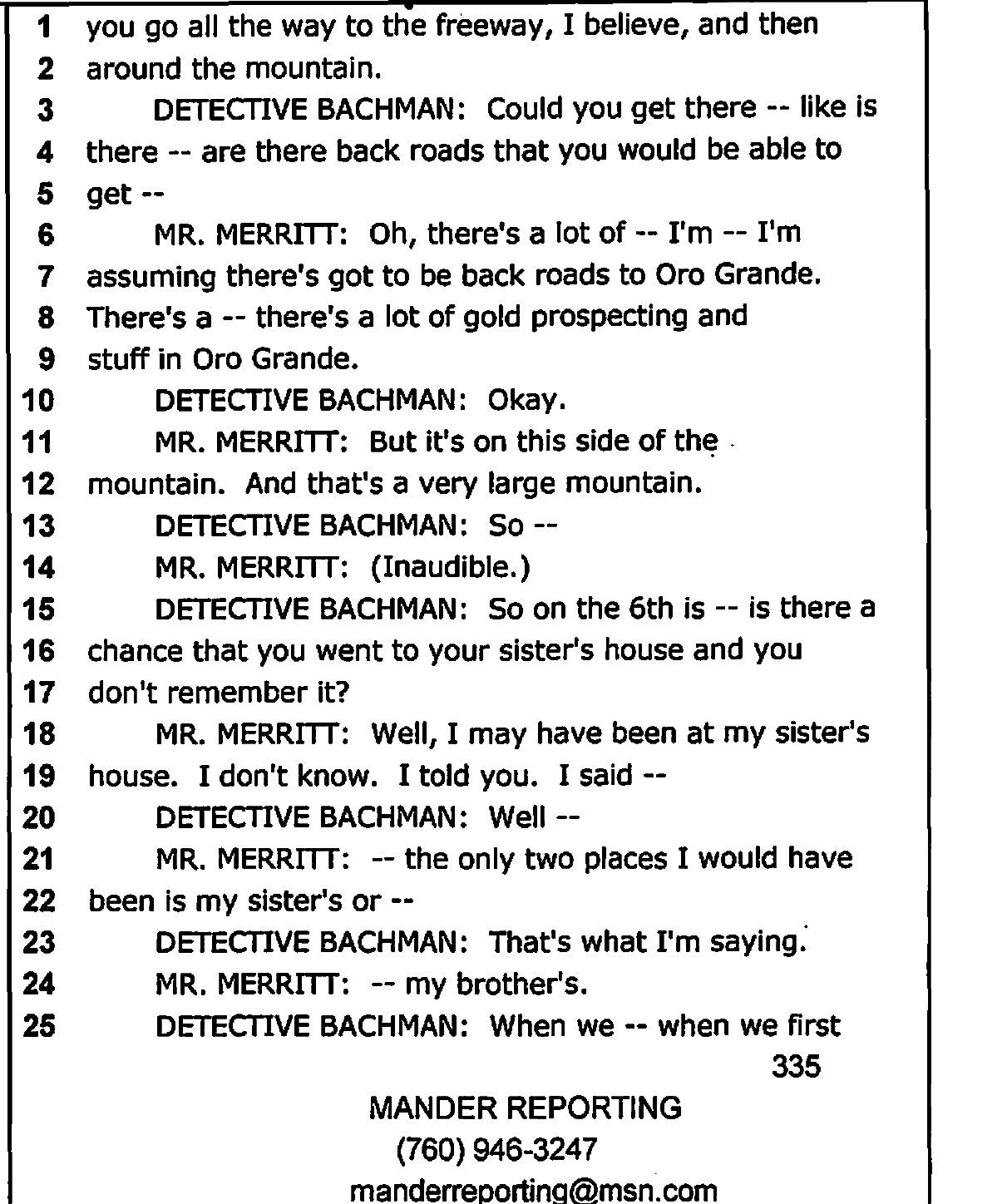
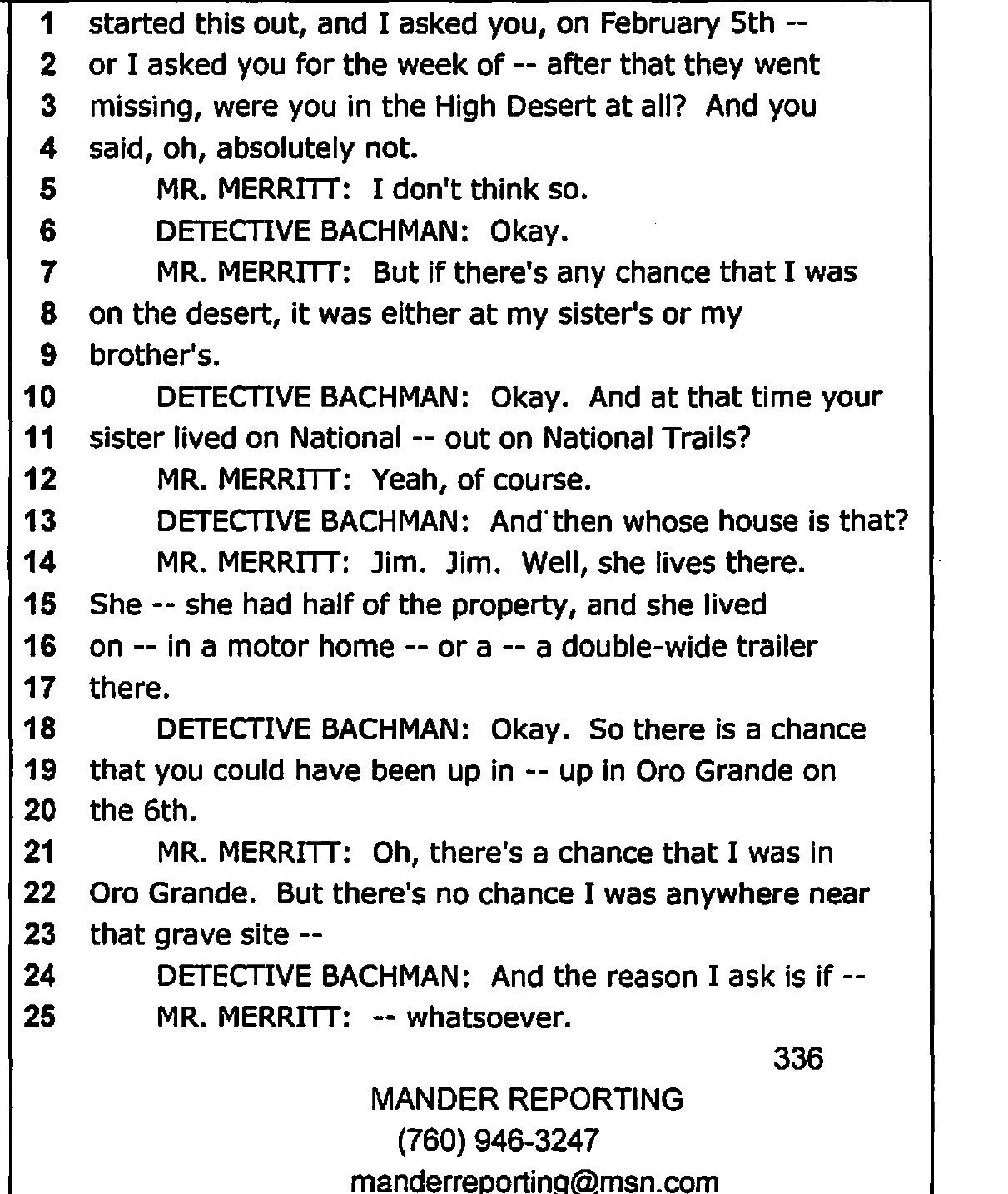
There’s a chance that I was in Oro Grande
Detective Bachman: So on the 6th is — is there a chance that you went to your sister’s house and you don’t remember it?
Me: Well, I may have been at my sister’s house. I don’t know. I told you. I said —
Detective Bachman: Well —
Me: — the only two places I would have been is my sister’s or —
Detective Bachman: That’s what I’m saying.
Me: — my brother’s.
Detective Bachman: When we — when we first started this out, and I asked you, on February 5th — or I asked you for the week of — after that they went missing, were you in the High Desert at all? And you said, oh, absolutely not.
Me: I don’t think so.
Detective Bachman: Okay.
Me: But if there’s any chance that I was on the desert, it was either at my sister’s or my brother’s.
[…]
Detective Bachman: Okay. So there is a chance that you could have been up in — up in Oro Grande on the 6th.
Me: Oh, there’s a chance that I was in Oro Grande. But there’s no chance I was anywhere near that grave site —
Detective Bachman: And the reason I ask is if —
Me: — whatsoever.
Interview, October 22, 2014, p. 335:15-336:25
Asked if I might have been at my sister’s on the 6th: “I may have been.” When he said I’d earlier answered “absolutely not,” I said, “I don’t think so,” and repeated that if I was in the desert at all, it was my sister’s or my brother’s. Oro Grande: “there’s a chance.” The grave site: “no chance… whatsoever.”
Look at how Bachman described my first answer: “you said, oh, absolutely not.” That is not what I said. On pages 111-112, my first answer was “No, not that I know of. Unless I went to my sister’s,” and then “Not that I recall.” The qualified answer became an absolute one here, in the interview room, before it ever reached a jury. Yet when Bachman wrote his reports, he wrote down the qualified version.
SEE THE TRANSCRIPT (PAGES 335, 336)
Enhanced for legibility. Tap it to see the full pages.
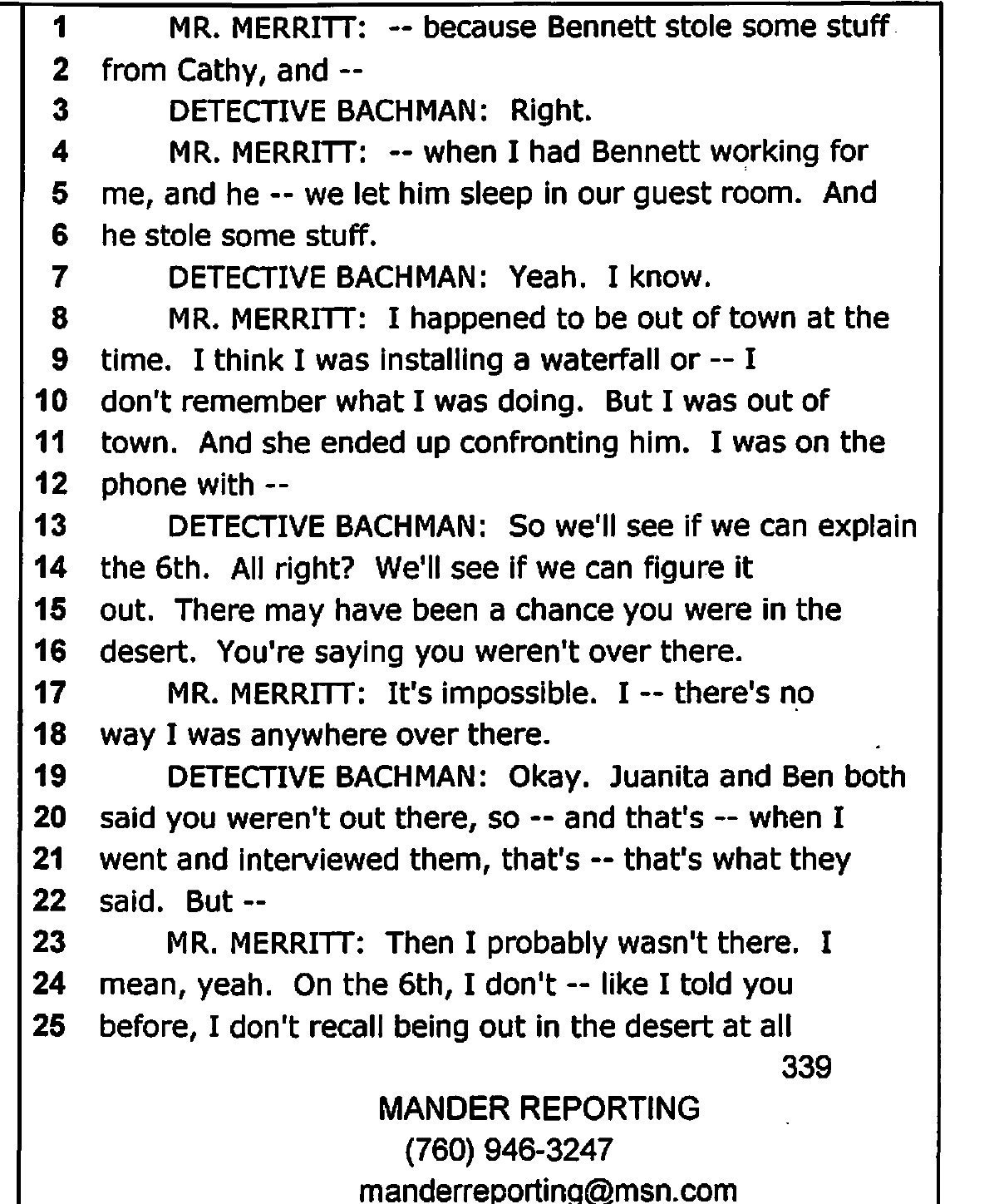
There may have been a chance you were in the desert
Detective Bachman: So we’ll see if we can explain the 6th. All right? We’ll see if we can figure it out. There may have been a chance you were in the desert. You’re saying you weren’t over there.
Me: It’s impossible. I — there’s no way I was anywhere over there.
Detective Bachman: Okay. Juanita and Ben both said you weren’t out there, so — and that’s — when I went and interviewed them, that’s — that’s what they said. But —
Me: Then I probably wasn’t there. I mean, yeah. On the 6th, I don’t — like I told you before, I don’t recall being out in the desert at all on the 6th.
Detective Bachman: Right.
Me: So not a — not a likely, because it’s not real likely.
Detective Bachman: Your phone hits up in the desert. That’s why I’m asking. And it’s — it’s a pretty particular area, so . . .
Me: Well, if it — if — if my phone hit up there, it would have been because I was at my sister’s Juanita’s. That would be the only reason I’d be there.
Interview, October 22, 2014, p. 339:13-340:11
Here Detective Bachman told me what my sister and brother had supposedly said. “Then I probably wasn’t there” was a spontaneous answer to that, not a claim about where I was. When he came back to my phone, I told him what I had said all along: if it hit up there, it was because I was at my sister’s.
SEE THE TRANSCRIPT (PAGES 339, 340)
Enhanced for legibility. Tap it to see the full pages.
If I was, I was
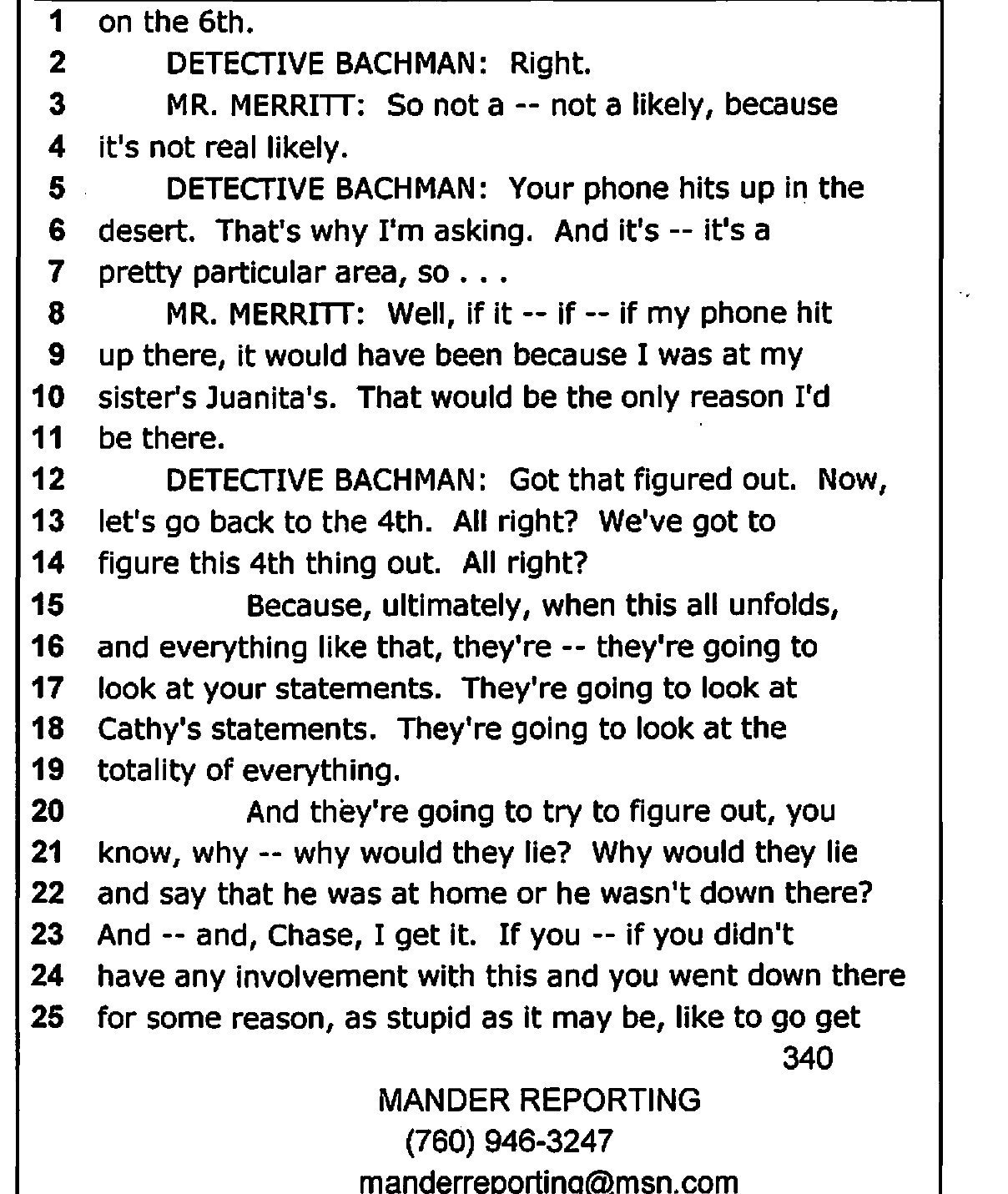
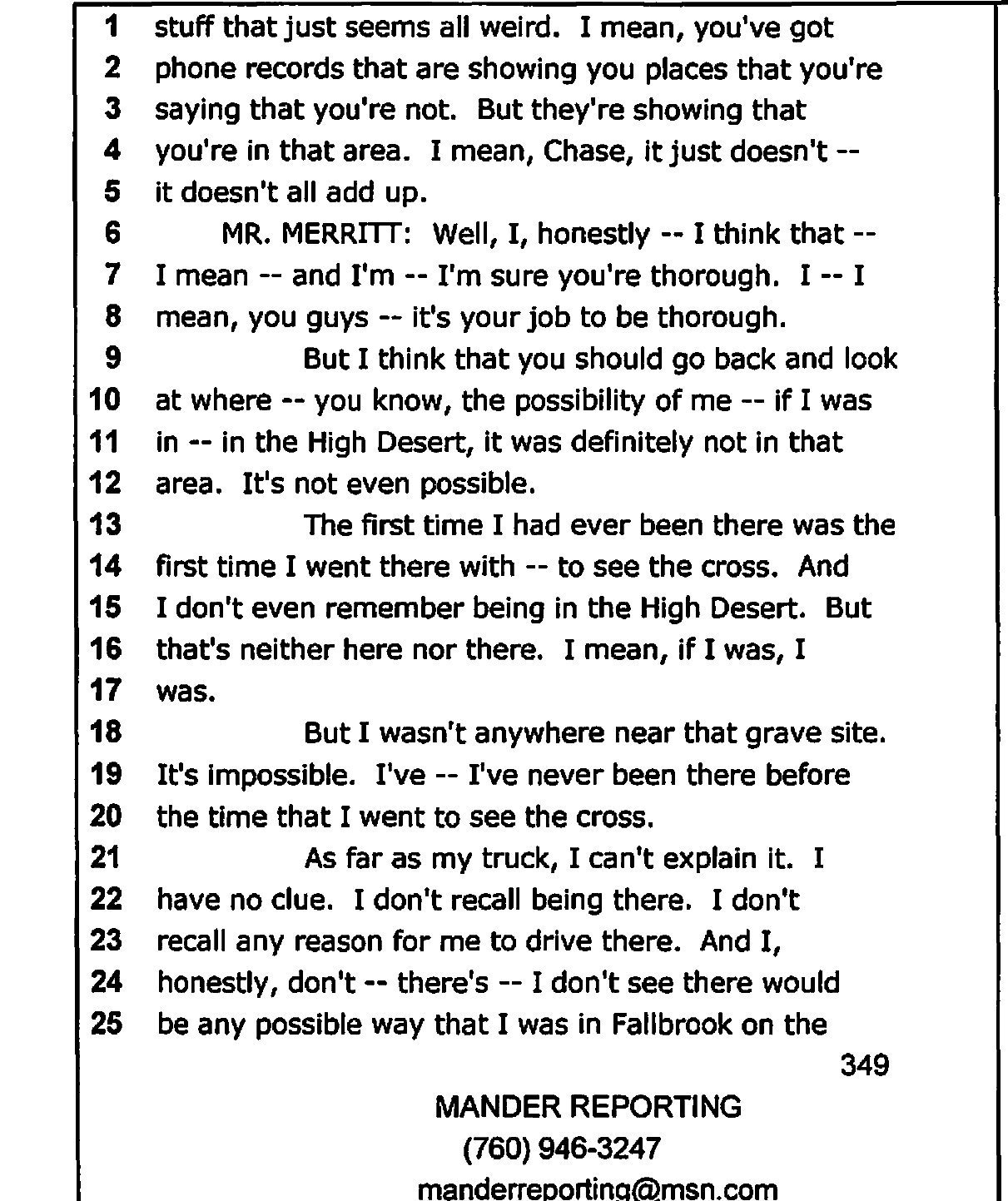
Me: […] But I think that you should go back and look at where — you know, the possibility of me — if I was in — in the High Desert, it was definitely not in that area. It’s not even possible.
The first time I had ever been there was the first time I went there with — to see the cross. And I don’t even remember being in the High Desert. But that’s neither here nor there. I mean, if I was, I was.
But I wasn’t anywhere near that grave site.
Interview, October 22, 2014, p. 349:9-18
Near the end, one more time: “if I was, I was. But I wasn’t anywhere near that grave site.”
SEE THE TRANSCRIPT (PAGE 349)
Enhanced for legibility. Tap it to see the full page.
Three different statements, not one denial
Read in order, the interview has three different kinds of answers about the desert. The prosecutor’s version folded them into one.
| What I said | Where |
|---|---|
| I don’t recall going to the desert on the 6th. “Not that I recall.” “I don’t recall going to the desert on February 6th.” “I don’t recall being out in the desert at all on the 6th.” | pp. 112, 225, 340 |
| But I might have been, and if so, here is where. “Unless I went to my sister’s.” “If I went there, it would be Oro Grande or Hesperia.” “If I was in the desert, there was two places I would have been.” “There’s a chance that I was in Oro Grande.” “If I was, I was.” | pp. 111, 225, 283, 335-336, 340, 349 |
| I was not at the grave site. “Not possible. I wasn’t there.” “No chance I was anywhere near that grave site — whatsoever.” “I wasn’t anywhere near that grave site.” | pp. 226, 336, 349 |
Not remembering is not denying. Saying “I might have been, at my sister’s” is the opposite of denying. The one denial I maintained consistently and without qualification was that I was not at the grave site on February 6.
There is one line that cuts the other way, and I will not skip it. On page 277, after Bachman had raised Fallbrook and then put my truck and my phone at the grave site, I said: “Matter of fact, I wasn’t there. And I definitely wasn’t at the desert.” Those words are mine. The question is whether they were my position about the whole High Desert on February 6. The rest of the interview, before and after, says they were not, and so does the detective who heard them. Both of his reports, written days later, say I told him it was possible I was in the High Desert, and that I denied being at the grave site.
What the detective wrote down
Bachman wrote up the interview twice. Both times he recorded the same distinction I had drawn.
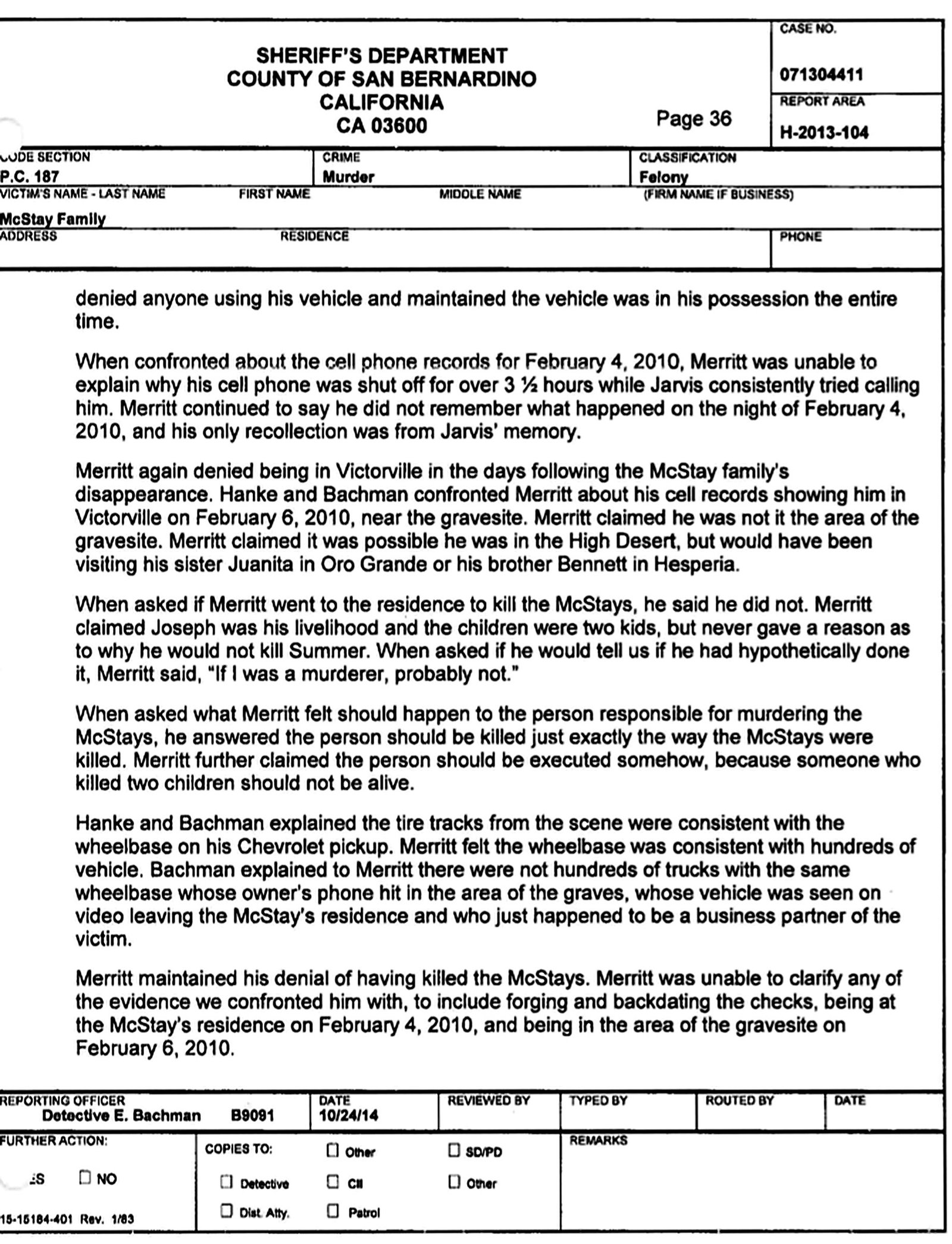
Two days after the interview
Merritt again denied being in Victorville in the days following the McStay family’s disappearance. Hanke and Bachman confronted Merritt about his cell records showing him in Victorville on February 6, 2010, near the gravesite. Merritt claimed he was not it [sic] the area of the gravesite. Merritt claimed it was possible he was in the High Desert, but would have been visiting his sister Juanita in Oro Grande or his brother Bennett in Hesperia.
Det. Bachman, Summary dated 10/24/14, page 36 (Bates 006753)
The same paragraph also says I “again denied being in Victorville.” That is true; I did not recall it. But in the next two sentences, Bachman wrote what I said about the grave site, and that it was possible I was in the High Desert, visiting family.
SEE THE REPORT (PAGE 36)
Enhanced for legibility. Tap it to see the full page.
Twelve days after the interview
[…] Merritt claimed he did not remember going to the High Desert, but if he had, would have only been at his brother Bennett’s residence in Hesperia or his sister Juanita’s residence in Oro Grande. […]
Merritt claimed it was possible he was in the high desert but at no point in time was he at the gravesite.
Det. Bachman, Sheriff’s report dated 11/3/14, page 12 (Bates 007863)
SEE THE REPORT (PAGE 12)
Enhanced for legibility. Tap it to see the full page.
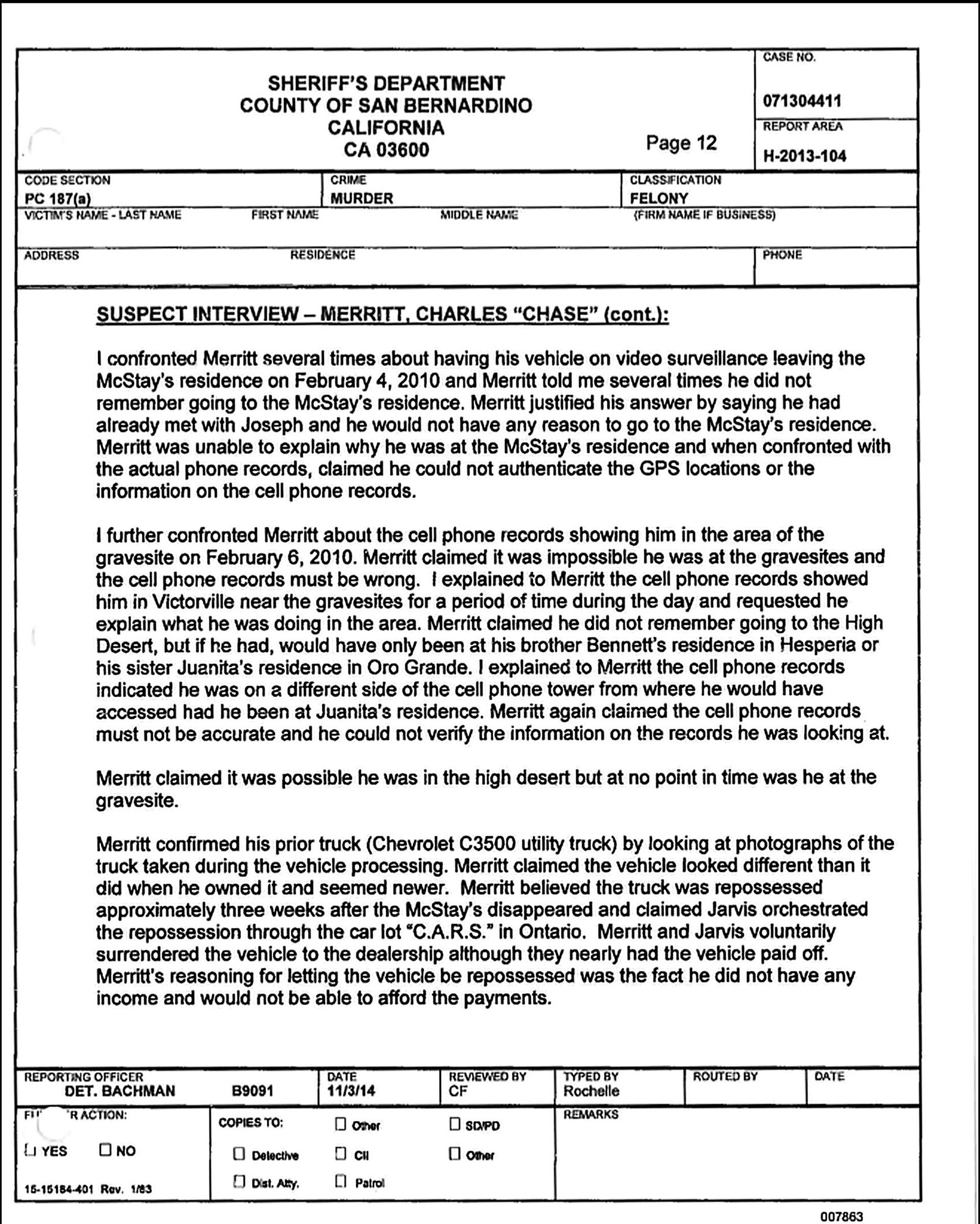
Twice, the detective who questioned me wrote it down himself: two days after the interview, and again twelve days after. Both times: it was possible I was in the High Desert, at my sister’s or my brother’s, but not at the grave site. That is what I said. It is not what the jury or the judge were told.
What Agent Boles told the jury
Mr. Imes: Were you made aware of statements by the defendant about his activity in the desert and time frame?
Agent Boles: Yes.
Mr. Imes: What was that?
Agent Boles: I was told that there were statements that he had not been up there.
Mr. McGee: Your Honor —
Mr. Imes: The given time frame.
Mr. McGee: Object. Hearsay. Foundation.
The Court: Overruled. It goes to the reason he was checking other dates and what dates he may have found in that checking.
Mr. McGee: I assume it’s not offered for the truth?
The Court: Correct.
Mr. Imes: And that was relating to February 6th?
Agent Boles: Yes.
RT 4578:14-4579:1
Agent Boles did not say he heard or read my interview. He told the jury what he “was told.” My lawyer objected. The court let it in as “not offered for the truth,” but the jury still heard it.
SEE THE TRANSCRIPT (PAGES 4578, 4579)
Enhanced for legibility. Tap it to see the full pages.
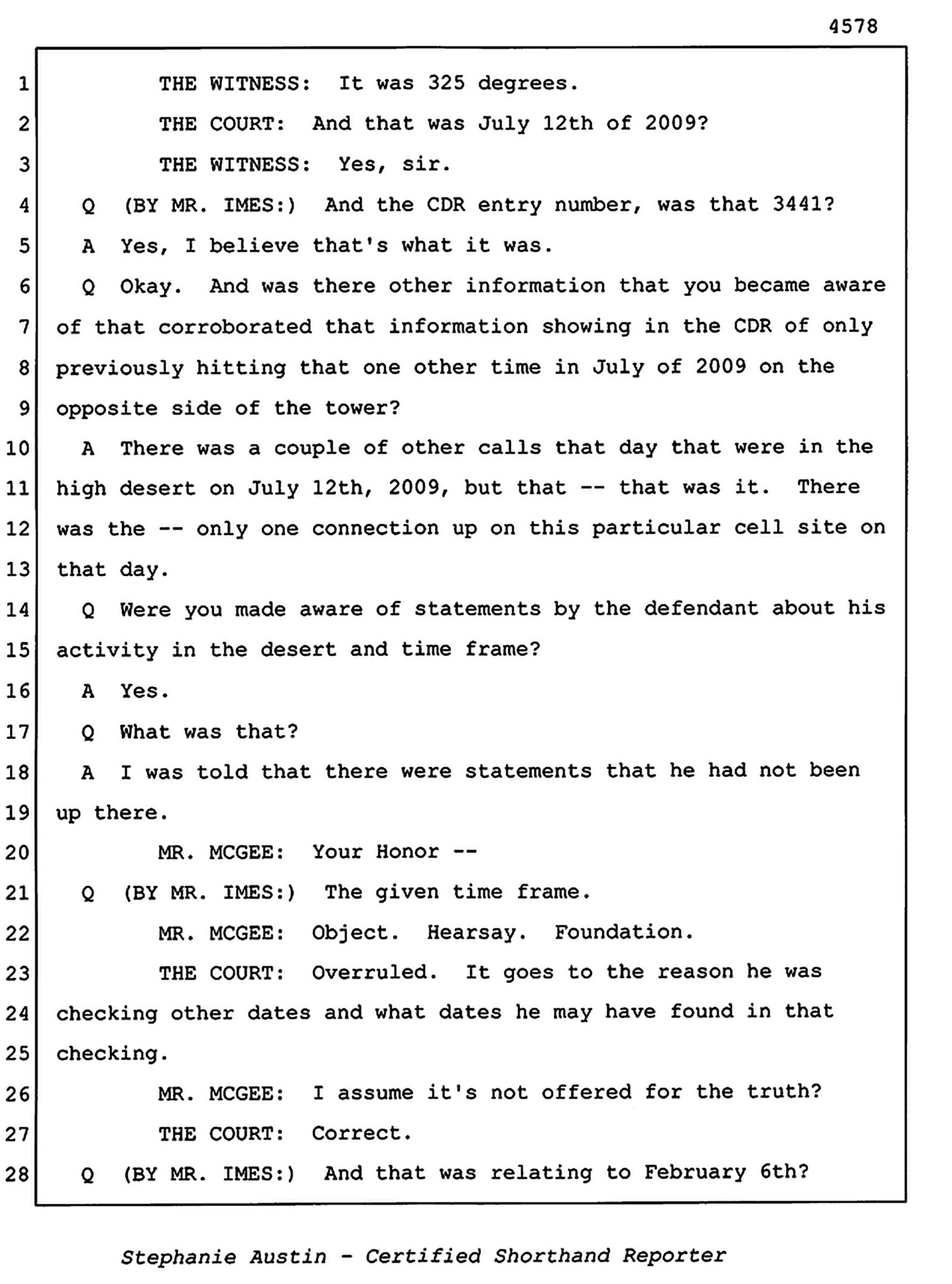
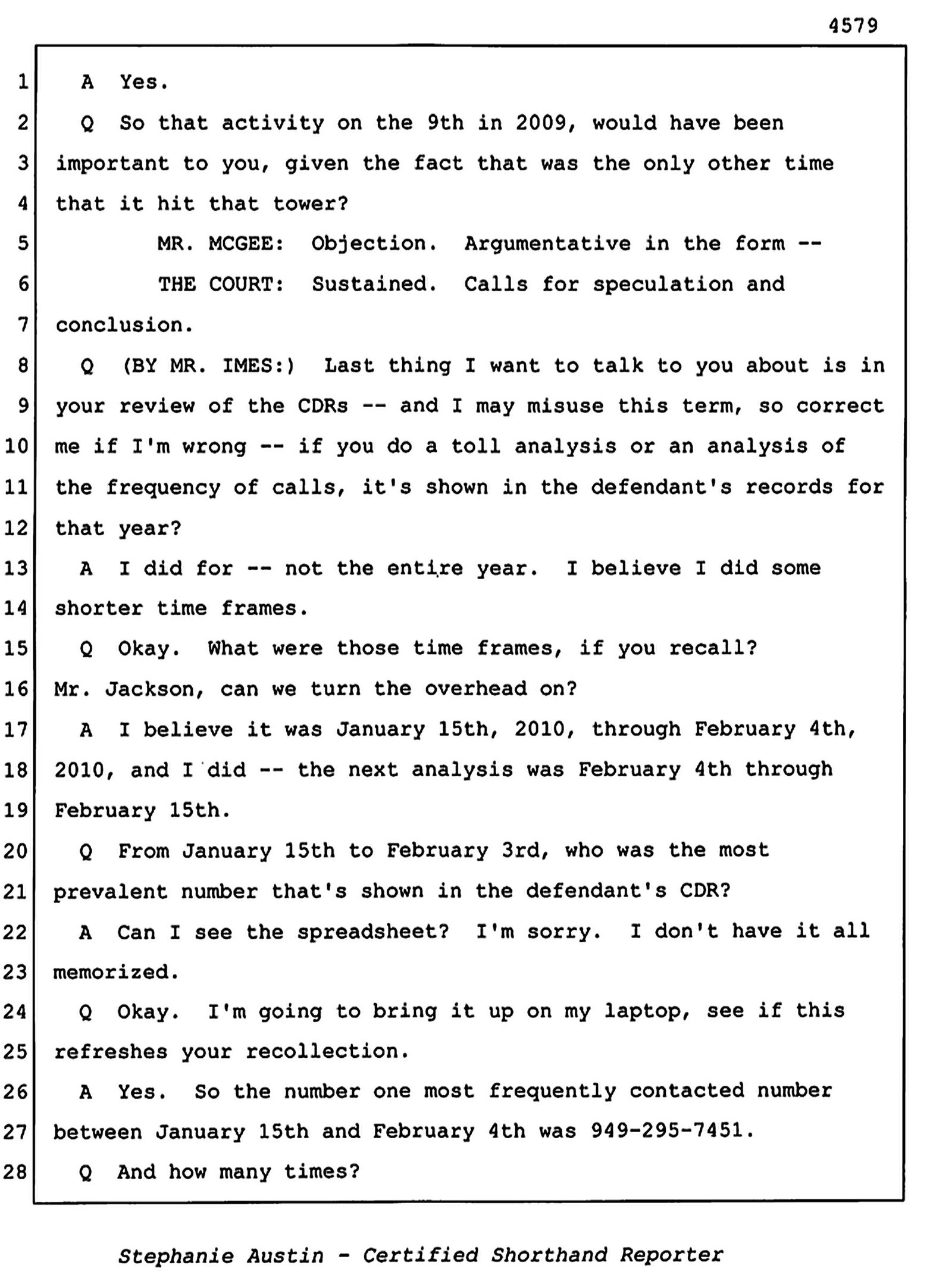
That matters. The court admitted Boles’s answer only to explain why he checked other dates, not as proof that I said it. The jury heard it anyway. And what Boles “was told,” that I said I “had not been up there,” is not what the detective who questioned me wrote down, as his reports above show.
What the prosecutor played, and what he said
Mr. Imes: […] I’m sorry. Thought there was audio for you.
(Audio playing.)
Mr. Imes: I wasn’t in the desert, despite his phone records, logging six cell site hits in the desert.
[…]
Mr. Imes: You heard from the defendant, he said, I wasn’t there.
[…]
Mr. Imes: What other circumstances about this case, where the defendant, when he’s interviewed by San Bernardino in 2014, knows where the bodies are located, knows where they’re discovered, knows his whereabouts, finds it important to lie to investigators and say, I was not in the desert on the 6th? Because the evidence would point to someone associated with the killing of the McStays was in the desert on the 6th.
RT 8217:20-24; 8218:7-8; 8218:19-25
In closing, the prosecutor played the jury one line from my interview, “and I definitely wasn’t at the desert,” with nothing around it. Then he told them I said “I wasn’t in the desert” and “I was not in the desert on the 6th,” and called it a lie to investigators. What was around that line is above.
SEE THE TRANSCRIPT (PAGE 8217)
Enhanced for legibility. Tap it to see the full page.
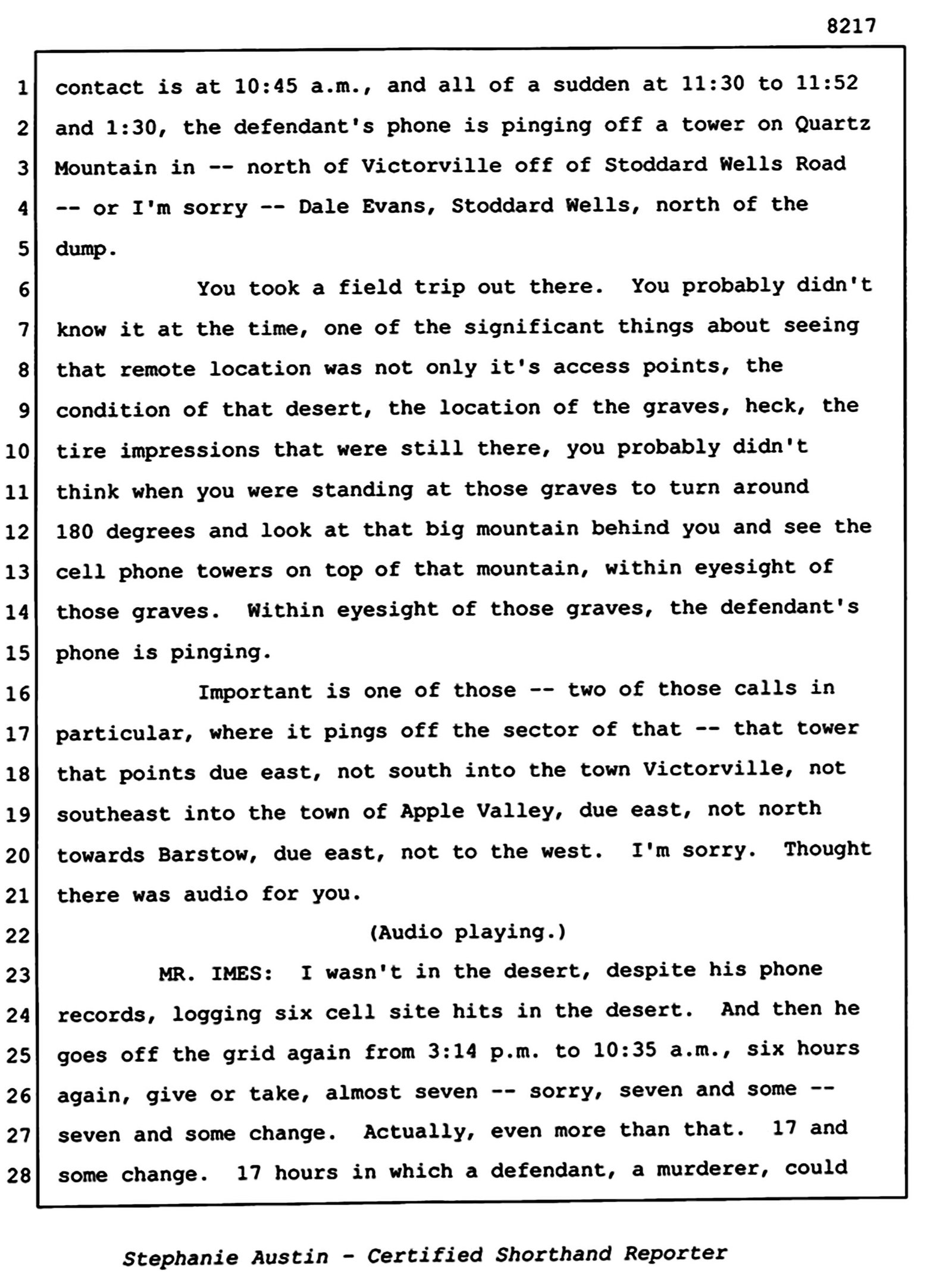
SEE THE TRANSCRIPT (PAGE 8218)
Enhanced for legibility. Tap it to see the full page.
What the judge said
The Court: […] On February the 6th, Mr. Merritt was in that general location, and he denied being in the upper desert. The investigators, when they interviewed him, asked him if he had been in the upper desert at that time, he said no.
Then they said, well, if you had been in the upper desert, where might you have gone? And he said, well, if I were in the upper desert, I either would have been at my sister’s or at my brother’s. But he was clear all the way through that, no, he wasn’t there. […]
So the impact of all of that evidence is, Mr. Merritt says, I wasn’t up there. His cell — and he was asked, Could someone else have had your cell phone? Could someone else have been up there with your cell phone? No, no way. So we have his cell phone there, him denying that he was there, and no explanation as to why his cell phone and inferentially him, would be in that general area.
And as I indicated at the 1118 motion, that general area is out in the desert. It’s not in the middle of the city of Victorville. You know, if Mr. Merritt had said, Well, yeah, I went up to the city of Victorville to buy materials for a waterfall, or went there for whatever reason, and he’s hitting off a cell tower in that general area, maybe that’s an explanation, maybe that’s reasonable, but that’s not the situation here. These are hits out in the desert with, as I say, no explanation why it would be hitting in that area and him denying that he was in that area.
New-trial ruling, January 17, 2020, RT 8938:12-21; 8939:2-18
At the new-trial hearing, the judge said I “said no,” that I was “clear all the way through that,” and that I gave “no explanation.” The interview above shows the condition I put on my answers, and the explanation I gave: my sister’s in Oro Grande or my brother’s in Hesperia.
SEE THE TRANSCRIPT (PAGES 8938, 8939)
Enhanced for legibility. Tap it to see the full pages.
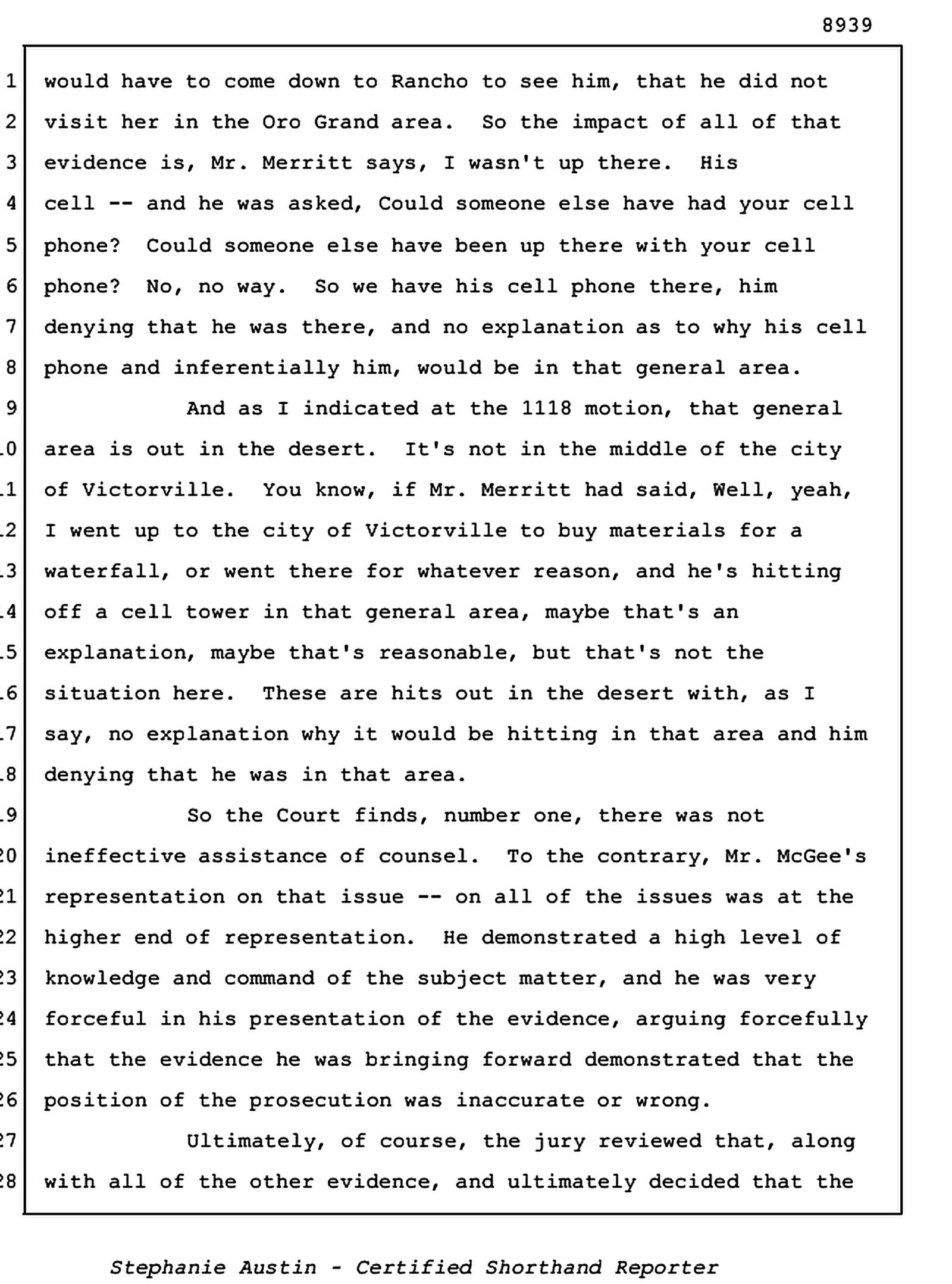
The judge’s reasoning was not only about the desert in general. He also pointed to cell hits “out in the desert” near the grave site, with “no explanation.” But two parts of it can be checked against the record. “He was clear all the way through that, no, he wasn’t there”: the interview shows I said, again and again, that I might have been, and where. “No explanation”: I gave two reasons I might have been in the High Desert, my sister’s in Oro Grande or my brother’s in Hesperia, and the detective wrote them down twice. Whether those places explain the particular towers the State tied to the grave site is a separate question. Either way, they do not support the judge’s description of me as having denied, all the way through, being in the High Desert.
Why it mattered
A false statement to the police can be argued as consciousness of guilt: a man who lies about where he was must have had something to hide. The State used this one that way, in a case with no eyewitness, no confession, and no forensic evidence placing me at the graves.
But a lie needs a statement. What I said was that I did not recall going, that I might have, and where, and that I was not at the grave site. That is what the detective wrote down. The jury was told something else: one line, played alone, and a prosecutor’s summary that dropped every condition I had put on it.
These raise separate questions, and they should be kept separate:
- Prosecutorial misconduct. A prosecutor may argue that a defendant’s statements are inconsistent. A prosecutor may not tell a jury a defendant said something he did not say. The question is whether “lie to investigators and say, I was not in the desert on the 6th” misstated the interview, when the State’s own detective had recorded twice that I said I might have been there.
- False or misleading evidence. Agent Boles told the jury what he “was told”: that I said I “had not been up there.” The question is whether that was materially misleading, and whether the prosecution knew or should have known, given its own detective’s reports.
- Prejudice. The question is whether the supposed lie made a real difference to the State’s consciousness-of-guilt theory, in a circumstantial case.
Decide for yourself.
In October 2014, I told the detective I did not remember going to the High Desert on February 6, that if I had, it was to my sister’s or my brother’s, and that I was never at the grave site. He wrote that down, twice. In 2019, the jury was told I had lied by saying I was not in the desert at all. In 2020, the judge said I had been clear all the way through that I was not there.
The interview, the reports, the closing argument and the ruling are all above, with the original pages. Read them, and decide whether I lied, or whether what I said was changed.
Sources
- Interview of Charles Merritt by Detectives Bachman and Hanke, October 22, 2014, reporter’s transcript (Mander Reporting), pp. 111-112, 224-226, 277-284, 335-340, 349. Posted on The records.
- Det. Edward Bachman, summary dated October 24, 2014, p. 36 (Bates 006753).
- Det. Edward Bachman, Sheriff’s report dated November 3, 2014, p. 12 (Bates 007863).
- RT 4578-4579: Agent Kevin Boles, direct examination by Mr. Imes.
- RT 8217-8218: closing argument, Mr. Imes.
- RT 8938-8939: the court’s ruling on my motion for new trial, January 17, 2020.